


Simple Summary
We assessed the resilience of traditional ecological knowledge in new and emerging protected areas by examining awareness, utilisation, and perceived effectiveness of the local communities living in and around Liuwa Plain National Park and Simalaha Community Conservancy. The social fabric of both protected areas is shaped by the traditional leadership and culture of the Lozi Litunga, but they differ in years of existence and the approaches used to manage natural resources as per the protected area categories of the International Union for Conservation of Nature. This study was important, as traditional ecological knowledge offers a valuable resource for managing natural resources and adapting to climate change challenges, particularly in rural landscapes. Our findings indicate a high awareness of traditional ecological knowledge in both protected areas, but its use and perceived effectiveness were higher in Liuwa Plain National Park, an old and conventional protected area, than in Simalaha Community Conservancy, a new and emerging protected area. This difference was also significant among the younger community members. These findings show that conservation governance systems and the transfer of knowledge between generations strongly influence whether traditional ecological knowledge continues to be practiced and valued, highlighting the importance of strengthening it within emerging community-based conservation approaches.
Abstract
Traditional ecological knowledge (TEK) is cardinal to natural resource management, and its resilience in protected areas (PAs) depends on its continued practice. The changing socio-ecological landscape has given rise to new PAs that emphasise community participation, like Simalaha Community Conservancy (SCC), versus state-owned, like Liuwa Plain National Park (LPNP). Resilience was assessed by comparing TEK awareness, utilisation, and perceived effectiveness between LPNP and SCC. Three categories of TEK (rules and regulations; myths and taboos; and customs and rituals) were analysed using a blended analytical framework drawing on the knowledge–practice–belief complex and a social–ecological systems perspective. A structured questionnaire was administered to 427 respondents, and data were analysed using descriptive statistics and chi-square tests. TEK awareness was high, but significantly higher in LPNP than in SCC. Age and length of residence were strongly associated with knowledge, confirming older and long-term residents as key knowledge-holders. Rules and regulations were widely recognised and utilised, while customs and rituals, and myths and taboos, were variable. LPNP showed higher utilisation and perceived effectiveness of TEK, particularly among younger cohorts. These findings highlight the influence of conservation governance and intergenerational knowledge transmission on TEK resilience, underscoring the need to strengthen its integration in emerging PAs.
1. Introduction
Much of the world’s natural resources have long been inhabited and managed by indigenous peoples, who possess a wide knowledge base on the management of the ecosystems in which they interact [1]. Through interactions with their environment, systems were created to govern their co-existence with the natural environment. This forms the rich culture and traditions that distinctly differentiate ethnic groups. These knowledge systems emphasise the holistic perspectives of nature conservation and the interconnectedness of ecosystems [2], whose potential to contribute to natural resource management has been widely recognised [3,4,5].
Traditional ecological knowledge (TEK) is broadly defined as a complex body of knowledge, practices, skills, techniques, and innovations that are developed, accumulated, and transmitted over generations within specific communities of indigenous peoples [6]. Its significance in natural resource management lies in its capacity to integrate ecological understanding with cultural, moral, and spiritual dimensions of community life [7,8]. This demonstrates that TEK operates as a system of moral ecology, in which environmental stewardship is guided by cultural obligation and not by formal regulations.
Several studies have documented TEK in various African landscapes and have consistently illustrated its central role in biodiversity conservation and local resource governance. In Zambia, research has documented TEK in wildlife and floodplain management systems, showing how taboos, seasonal rules, ecological indicators, and intergenerational transmission shape sustainable fishing, hunting, and farming practices [4,9]. Additional work has linked TEK to pollinator knowledge and conservation behaviours among smallholder farmers, demonstrating its continued relevance in agroecosystem management despite socio-economic pressures [10]. Across Southern Africa, similar patterns emerge, showing how sacred forests, rituals, and taboos maintain forest structure and regulate resource harvesting [5,11] and act as effective informal conservation systems [12,13]. Regional analyses further show socio-cultural factors eroding TEK across rural landscapes [5,11]. Although these studies collectively affirm TEK’s ecological value, they predominantly examine single landscapes or resource domains and seldom compare TEK across contrasting governance systems. Furthermore, while this study advances inter-sight insights and nuances, few studies elsewhere have analysed how TEK awareness, utilisation, and perceived effectiveness differ among social groups and varying forms of TEK within these conservation systems.
Governance characteristics influence how TEK types are applied [14,15]. Governance contrasts extend to access regimes, where national parks impose stricter limits on resource use, while conservancies accommodate greater livelihood access within a conservation framework. They also differ in the recognition of traditional authority, the distribution of livelihood benefits, and their historical relations with local communities. National parks have often been associated with displacement and the criminalisation of local practices, whereas conservancies tend to emphasise partnership and co-management [14,15].
To analyse how governance contexts shape the resilience of different TEK types, this study adopted a blended theoretical framework drawn from two complementary traditions. The first was the knowledge–practice–belief complex, in which TEK was understood as an integrated system of ecological knowledge, practical management skills, social institutions, and cultural worldviews that together shape how people know, how they act, and how they make meaning in relation to their environments. Within this system, TEK takes several interrelated forms that structure how communities understand, organise, and interact with their environments [1]. The second is the social–ecological system (SES) perspective, which conceptualises protected areas as interconnected systems composed of resource systems, resource units, users, and governance structures [16,17].
Recent studies have increasingly examined traditional ecological knowledge using integrative approaches that combine these frameworks. Research on indigenous fisheries governance and resource harvesting practices has shown how cultural beliefs, customary management practices, and ecological knowledge interact within broader social–ecological systems to sustain natural resources [18,19]. Similarly, studies of agricultural systems have applied the knowledge–practice–belief framework within social–ecological resilience analyses to understand how traditional knowledge contributes to climate adaptation and ecosystem sustainability [20]. These studies demonstrate the value of integrating cultural knowledge systems with social–ecological systems perspectives when analysing the role of TEK in resource governance. Integrating these perspectives provides a lens for understanding how different TEK types persist or decline under contrasting conservation systems in Zambia, and how governance contexts influence the three operational dimensions examined in this study: TEK awareness, utilisation, and perceived effectiveness.
Accordingly, this study addressed the following research questions: (i) What are the levels of awareness, utilisation, and perceived effectiveness of TEK among communities living in and adjacent to LPNP and SCC? (ii) What are the differences in awareness, utilisation, and perceived effectiveness of different categories of TEK (rules and regulations, myths and taboos, customs and rituals) between LPNP and SCC? (iii) How do demographic factors affect awareness, utilisation, and perceived effectiveness of TEK in LPNP and SCC? By contrasting these governance regimes, the framework not only assesses whether TEK is resilient but also explains why specific TEK forms endure or erode under different conservation conditions and what this implies for policies striving to balance state-led protection with community-based conservation.
2. Materials and Methods
2.1. Study Area
Both LPNP and SCC are biodiversity hotspots, hosting a wide array of flora and fauna, and they support complex socio-ecological systems where local communities co-exist with wildlife. The two PAs also have different conservation statuses that present unique cases for community involvement in natural resource management [21,22]. Like other state-led national parks in the world, LPNP is classified as Category II under the International Union of Conservation for Nature (IUCN) Category for PAs [23], and it is characterised by centralised authority, statutory regulations, restricted access, and limited community control. SCC falls under Category IV of the IUCN of PAs categories [23] and represents a community-managed conservancy grounded in local participation, customary institutions, and shared decision-making.
Both landscapes lie within the Barotseland cultural region under the customary authority of the Litunga and the Barotse Royal Establishment, indicating shared cultural traditions and traditional ecological knowledge systems. Ecologically, both areas occur within the broader Zambezi basin ecosystem and support similar livelihoods and natural resource use options. These shared ecological and cultural characteristics provide a comparable context for examining local knowledge systems. However, they differ in conservation governance structures. LPNP is a state-declared national park where conservation management is largely coordinated through government institutions and conservation partners, with relatively limited direct community authority over natural resource governance. In contrast, SCC operates as a community-based conservancy where local institutions, traditional authorities, and community structures play a more direct role in natural resource governance and benefit sharing. Additionally, the two areas differ in spatial extent and establishment history, with LPNP being larger (3660 km2) and gazetted earlier in 1972, while SCC (~1820 km2) is a more recent community conservation initiative established in 2012. These contrasting management systems present an invaluable opportunity to study how traditional knowledge systems are utilised, maintained, and perceived to contribute to sustainable natural resource management in contrasting protected area systems.
LPNP is located in the Kalabo District of Western Province, Zambia, and covers ~3660 km2 in the Barotse Floodplain. Its conservation history dates back to the late nineteenth century when King Lewanika designated it as a hunting reserve [24]. Before becoming a national park in 1972, it was managed as a hunting reserve by the King, with communities playing roles as gamekeepers and enforcers of traditional conservation practices. These practices declined after the centralisation of park management, but were later partially restored with support from the Barotse Royal Establishment (BRE). Today, LPNP is governed collaboratively by the Government of the Republic of Zambia (GRZ), African Parks (AP), and the BRE. GRZ oversees policy and infrastructure, AP focuses on wildlife management and community engagement, and BRE maintains cultural and customary oversight [24].
Ecologically, the park features vast grasslands, seasonal wetlands, and nutrient-poor sandy soils, but benefits from the Zambezi River floods. It hosts diverse wildlife species, including the second-largest blue wildebeest (Connochaetes taurinus) migration, and is home to key species like zebra (Equus quagga), red lechwe (Kobus leche), spotted hyenas (Crocuta crocuta), and lions (Panthera leo). Vegetation includes flood-adapted grasses and scattered tree islands. LPNP lies in Agroecological Region IIb with a semi-arid climate, receiving 600–800 mm of annual rainfall during the November–April wet season, while the dry season is marked by high daytime temperatures and cool nights [25].
SCC is located in western Zambia, covering ~1820 km2 within the Chobe-Zambezi wildlife dispersal area and forming part of the KAZA TFCA [26]. The Conservancy supports about 4544 households across 547 villages. Historically, the SCC’s chiefdoms used customary laws and cultural practices to manage natural resources sustainably. Established in 2012 under Sekute and Inyambo Yeta chiefdoms, SCC became Zambia’s first community conservancy to tackle environmental and socio-economic challenges by restoring biodiversity, reintroducing wildlife, and promoting eco-tourism. Supported by the Peace Parks Foundation (PPF), the Conservancy developed wire-fenced boundaries, reintroduced wildlife, and established wildlife areas to foster livelihoods through regenerative agriculture, tourism, and fisheries [26,27]. Current governance combines traditional authority with modern conservation, where the Sesheke and Chundu Chiefdoms oversee administrative and judicial functions. Village Actions Groups (VAGs) and Community Resource Boards (CRBs) mobilise communities for conservation activities and manage tourism and resource revenues [26,28].
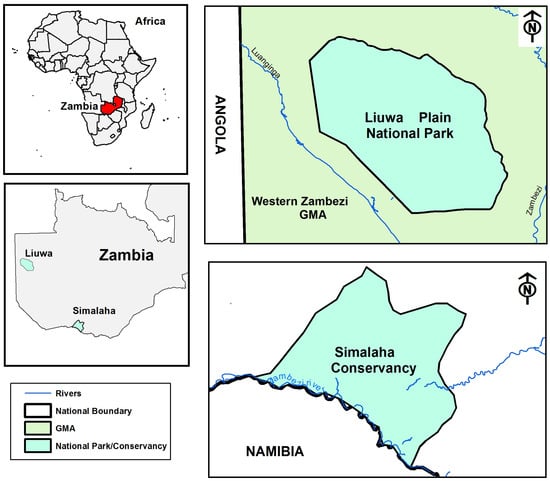
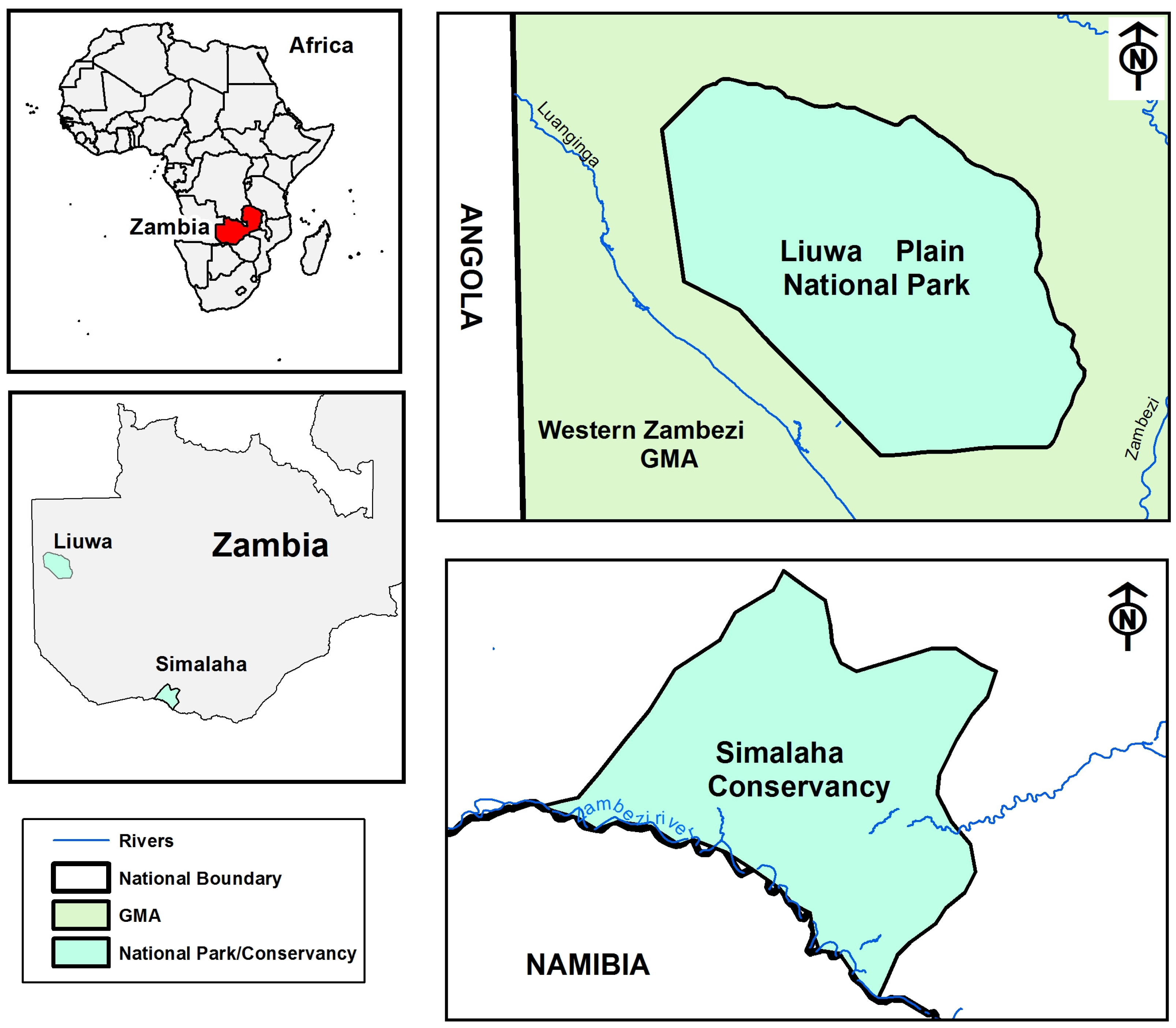
SCC is dominated by Miombo and Mopane Woodlands with perennial grasses like Hyparrhenia and Cynodon. Wetlands along the Zambezi and Chobe rivers support species such as reeds, papyrus, and floodplain grasses. SCC acts as a migration corridor for elephants and supports antelopes like sable and kudu [27]. It also harbours over 400 bird species, including the endangered wattled crane and African fish eagle [29]. SCC lies in Agroecological Region I with semi-arid to sub-humid conditions. Annual temperatures range from 20 °C to 28 °C, with highs over 35 °C and lows averaging 6 °C to 10 °C. Rainfall ranges from 400 mm to 800 mm, mostly between November and March [30]. Figure 1 illustrates the location of LPNP and SCC in Western Province, Zambia.
Figure 1.
Liuwa Plain National Park and Simalaha Community Conservancy in western Zambia.
2.2. Data Collection
We purposively selected five out of the ten VAGs in each study area in order to achieve a balanced perspective between communities living within the PAs and those in adjacent areas. These included Liuwa, Mulinga, Mishulundu (within the LPNP), Lumei and Luola (adjacent to the LPNP), and Simalaha, Makanga, Sankolonga (within the SCC), Mabumbu, and Kakulwani (adjacent to the SCC). This approach was used to ensure that the data collected represented responses from those who interacted with PAs on a daily basis and those who did not. The target population consisted of 10,489 households in the Liuwa ecosystem and 4544 households in the Simalaha ecosystem, based on VAG-level demographic statistics. A two-stage sampling approach was used. First, five VAGs were purposively selected in each protected area to capture communities situated both within and adjacent to conservation boundaries. Second, the sample size for household surveys was determined using Yamane’s formula [31] for sample size estimation at a 95% confidence level and a 5% margin of error. Applying the formula to the household populations within the selected VAGs yielded a minimum required sample of approximately 380 respondents. To ensure adequate representation across villages and allow for non-response, a total of 427 households were surveyed (266 in LPNP and 161 in SCC), allocated proportionally to the household population of each selected VAG. To collect data, we used a semi-structured questionnaire (Supplementary File) combining closed- and open-ended questions that captured both qualitative and quantitative data. Enumerators were engaged, and researchers reviewed the questionnaire with them to ensure they understood the definition of TEK and the study objectives. They were also guided on how to pose questions accurately, clarify misunderstandings, and apply neutral probing techniques. Semi-structured household questionnaires are widely used in TEK research because they allow for systematic comparison across respondents while also capturing locally embedded knowledge and cultural meanings [32]. Similarly, multi-stage sampling approaches are commonly employed in community-based conservation studies to ensure representation across villages and households within complex socio-ecological landscapes [33,34].
Quantification was achieved using a 5-point Likert scale [35], where respondents rated their awareness (1 not aware to 5 totally aware), utilisation (1 not used to 5 frequently used), and perceived effectiveness of TEK practices, ranging from 1, not effective, to 5, very effective. Additionally, categorical variables (e.g., “Yes,” “No,” “Not Sure”) and open-ended responses were included to provide further context. Likert-scale measurements are frequently used in TEK research to quantify perceptions of knowledge, utilisation, and environmental change while allowing statistical comparison across respondents [20].
2.3. Data Analysis
All data were coded and analysed using the IBM SPSS Statistics for Windows, Version 27.0 [36]. Awareness, utilisation, and perceived effectiveness levels were determined using frequencies and crosstabulations from the Likert-scale responses. Chi-square analysis was used to compare statistical differences and associations between the two PAs and several demographic characteristics (i.e., age, education level, gender) known to influence the uptake of TEKs among local communities [20,37]. Chi-square analysis is widely applied in studies of indigenous and local knowledge systems to examine associations between knowledge variables and socio-demographic characteristics such as age, gender, and education [38]. Open-ended responses were analysed using qualitative content analysis, a method commonly used in TEK research to identify recurring themes and interpret culturally embedded knowledge systems [37,39]. Responses were reviewed, grouped into thematic categories, and converted into numerical codes for entry into SPSS.
2.4. Limitations
The reliance on self-reported household survey data may have introduced recall bias or socially desirable responses, especially for culturally sensitive TEK practices. Translation and interpretation during questionnaire administration may also have influenced how respondents understood certain TEK concepts. To reduce bias, we adhered to the standard strategies of conducting pre-surveys and training of data collectors. This allowed us to identify potential bias before data collection, thereby allowing adjustments to ensure unbiased results. Thus, the findings provide valuable insights into TEK awareness, utilisation, and perceived effectiveness in the two protected areas.
2.5. Ethical Considerations
The study was conducted under research permit No. NPW/8/27/1 obtained from the Department of National Parks and Wildlife (DNPW) and ethical clearance No. 2023/2/13/1 issued by The Copperbelt University’s Ethical Committee. Participants were fully informed about the study’s purpose, objectives, methods, and their rights, including withdrawal at any stage without any repercussions, after giving consent to participate. To protect participants’ privacy, data confidentiality was strictly maintained, and personal information was anonymised. Data collection was conducted in a culturally sensitive manner, with careful consideration of local traditions and customs. Permission from community leaders, as well as the use of local research assistants who were aware of local traditions and customs, ensured that research activities were aligned with community norms and avoided disrupting traditional practices. Respondents aged 15–17 years were included in the study because, in both LPNP and SCC, this age group plays an active role in natural resource use, including fishing, livestock herding, reed harvesting, gathering, and, in some cases, functioning as youth household heads. Their participation was, therefore, essential for understanding the intergenerational transmission and utilisation of TEK.
3. Results
3.1. Demographic Characteristics of Respondents
The largest proportion of participants was drawn from LPNP, which made up 62% (n = 266) of the respondents. The majority were female, 56% (n = 240), and the age of respondents ranged from 15 to 71 years. Both study areas were predominantly inhabited by the Lozi ethnic grouping (74%, n = 316), and most of the respondents attained primary education (64%, n = 271). The main livelihood activity in both study areas was agriculture, 81% (n = 344), followed by fishing, 39% (n = 167). Respondents did not strictly stick to only one livelihood activity but practiced multiple activities depending on the season. Table 1 provides a summary of the demographic characteristics of the two study areas.
Table 1.
Demographic characteristics of the surveyed households (%, (n)) in Liuwa Plain National Park and Simalaha Community Conservancy, western Zambia, 2024.
3.2. Awareness of Traditional Ecological Knowledge
Overall, 92% (n = 391) of respondents were aware of TEK. These levels of awareness varied significantly between the two study sites (χ2 = 23.280, df = 1, p < 0.001). In LPNP, 97% (n = 257) of respondents reported being aware of TEK, compared to 83% (n = 134) in SCC. Awareness was also strongly associated with age (χ2 = 12.460, df = 6, p = 0.004) and length of residence (χ2 = 32.110, df = 10, p < 0.001). Younger respondents aged 15–20 had the lowest awareness (71%, n = 15), while respondents aged 71 and above demonstrated full awareness (100%, n = 29). Those who had lived in the study areas for fewer than ten years also reported lower awareness (73%, n = 41), whereas respondents residing for more than twenty years reported near-universal awareness (99%, n = 239). Table 2 illustrates the awareness of TEK in the two study areas.
Table 2.
Awareness of traditional ecological knowledge in Liuwa Plain National Park and Simalaha Community Conservancy, western Zambia, 2024.
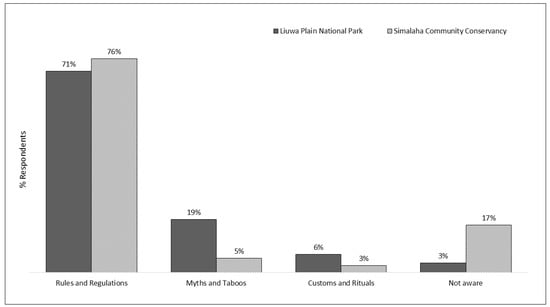
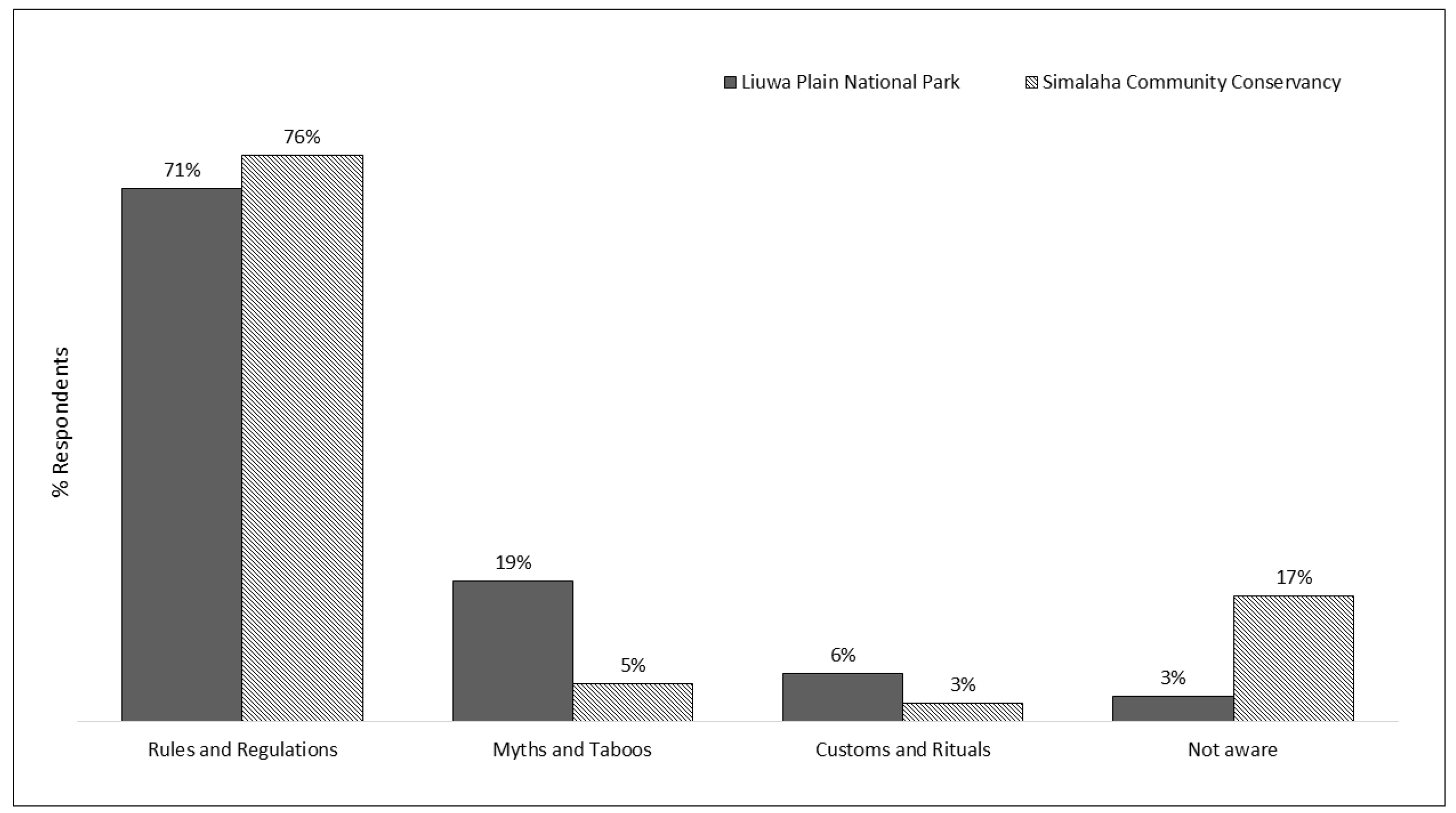
Comparisons between the two study PAs showed a higher level of awareness of traditional rules and regulations in both SCC (76%, n = 122) and LPNP (71%, n = 189) compared to the other TEK types (Figure 2). A chi-square test revealed a significant difference in the awareness of TEK categories (χ2 = 38.809, df = 3, p < 0.001) between the two PAs.
Figure 2.
Awareness of traditional ecological knowledge categories in Simalaha Community Conservancy and Liuwa Plain National Park, western Zambia, 2024.
Qualitative responses reinforced these patterns. Some respondents attributed low awareness among younger or newly settled residents to weakened intergenerational teaching. One respondent from SCC stated, “Older generations no longer sit down to teach the younger people about the customs and taboos of long ago; much of that knowledge has gone with the old people who have died.” Another participant in SCC added, “Those who live in the village know you cannot cut trees from sacred places,” highlighting that awareness of certain rules persists mainly among long-term residents.
3.3. Knowledge of Traditional Ecological Knowledge
SCC reported substantially lower levels of knowledge of customs and rituals compared to those in LPNP. Specifically, 51% (n = 82) of respondents in SCC had no knowledge, and 32% (n = 50) had little knowledge, whereas in LPNP, only 20% (n = 53) reported no knowledge, and 26% (n = 69) reported little knowledge of customs and rituals. A Pearson chi-square test showed that there was a significant difference between the two PAs with regard to the knowledge levels of customs and rituals (χ2 = 65.91, df = 4, p < 0.001). With regard to myths and taboos, significant differences also occurred in the level of knowledge between SCC and LPNP (χ2 = 43.38, df = 4, p < 0.001), as a higher proportion of respondents in LPNP had high or very high levels of knowledge (48.50%, n = 129) compared to only 23% (n = 37) of the respondents in SCC that reported the same. Similarly, the knowledge levels of traditional rules and regulations between the two PAs were significantly different (χ2 = 10.22, df = 4, p = 0.037). Table 3 illustrates the knowledge levels of the three categories of TEKs in the two PAs.
Table 3.
Level of knowledge of traditional ecological knowledge categories in Simalaha Community Conservancy and Liuwa Plain National Park, western Zambia, 2024.
Overall, age had the most significant effect on the knowledge levels of rules and regulations (χ2 = 50.605, df = 24, p < 0.001), customs and rituals (χ2 = 68.119, df = 24, p < 0.001), and myths and taboos (χ2 = 72.272, df = 24, p < 0.001). One male respondent in SCC noted, “Older generations no longer sit down to teach the younger people about the customs and taboos of long ago; much of that knowledge has gone with the old people who have died.” The dominant source of TEK was oral accounts (57%, n = 243) from family and neighbours. Other sources included community training (14%, n = 60), religious/traditional ceremonies (14%, n = 60), traditional leaders (4%, n = 17), school/education (4%, n = 17), and government field officials (2%, n = 9).
Open-ended responses provided further insight into the specific TEK practices known in each area. In LPNP, several respondents mentioned traditional tree-related taboos, noting that certain species should never be used as firewood. One elder explained, “Tree species such as Mupanda (Ficus sycomorus) are still avoided for firewood because they bring livestock diseases; there are also other types of trees that are believed to cause misfortune and conflict within families.” This illustrates continued knowledge of rules, taboos, and resource-specific restrictions, although in SCC respondents consistently reported that such knowledge is declining.
3.4. Utilisation of Traditional Ecological Knowledge
Utilisation of TEK was assessed across three categories of TEK using a four-point ordinal scale (not used at all, rarely used, occasionally used, and frequently used). For all three categories of TEK, statistical differences in the utilisation of TEK occurred between SCC and LPNP (Table 4). Respondents from LPNP reported higher levels of TEK utilisation than those from SCC. For instance, more respondents indicated frequent and occasional use of customs and rituals in LPNP as opposed to SCC (Table 4). Similarly, this disparity also followed for myths and taboos, and rules and regulations. Except for education level (χ2 = 1.660, df = 4, p = 0.798), all other demographic factors [i.e., age (χ2 = 15.975, df = 6, p = 0.014), gender (χ2 = 0.846, df = 1, p = 0.036), and ethnicity (χ2 = 25.516, df = 13, p = 0.020)] had a significant effect on the utilisation of TEKs.
Table 4.
Frequency of utilisation of traditional ecological knowledge categories in Simalaha Community Conservancy and Liuwa Plain National Park, western Zambia, 2024.
Differences in utilisation were also reflected in respondents’ narratives. One participant from SCC noted, “Younger people tend to ignore taboos and customs because they think they know better, but a number of families still adhere strictly to these taboos.” Another respondent emphasised the continued influence of sacred places, stating, “Those who live in the village know you cannot cut trees from sacred places.” These comments align with the statistical results showing higher utilisation in LPNP and declining adherence among younger respondents in SCC.
3.5. Perceived Effectiveness of Traditional Ecological Knowledge
In all the three categories of TEK, significant differences in the perceived effectiveness of TEK existed between SCC and LPNP, i.e., customs and rituals (χ2 = 150.60, df = 4, p < 0.001), myths and taboos (χ2 = 157.44, df = 4, p < 0.001), and rules and regulations (χ2 = 192.33, df = 4, p < 0.001). Overall, respondents from LPNP expressed higher perceived effectiveness of TEK compared to those from SCC. For instance, 47% (n = 126) of the respondents in LPNP rated customs and rituals as effective to very effective, while in SCC, only 6% (n = 10) reported the same. For myths and taboos, 42% (n = 112) of LPNP and 6% (n = 10) of SCC respondents perceived them as effective to very effective. A similar trend was observed for rules and regulations, with 56% (n = 150) in LPNP rating them as very effective to effective, whereas in SCC, only 8% (n = 13) rated them the same.
Perceptions varied across demographic categories, particularly gender and age. Among female respondents, 37% (n = 88) perceived myths and taboos as ineffective, while 14% (n = 34) found them slightly effective, and 29% (n = 72) rated them as effective to very effective. In contrast, 40% (n = 75) of males considered them ineffective, 16% (n = 29) as slightly effective, and 28% (n = 53) regarded them as effective to very effective. However, there was an insignificant association between gender and perceived effectiveness of myths and taboos (χ2 = 11.062, df = 4, p = 0.260). In the case of customs and rituals, 31% (n = 75) of the female respondents rated them as ineffective, 16% (n = 39) as slightly effective, and 30% (n = 72) as effective to very effective. Among males, 36% (n = 6) perceived them as ineffective, 16% (n = 29) as slightly effective, and 35% (n = 64) considered them as effective to very effective. The association between gender and perceived effectiveness of customs and rituals was statistically significant (χ2 = 10.600, df = 4, p = 0.031).
In contrast, no statistically significant effect was found on how men and women perceived the effectiveness of traditional rules and regulations (χ2 = 4.146, df = 4, p = 0.387). Proportions of both the females (31%, n = 75) and males (37%, n = 70) that perceived traditional rules and regulations as ineffective were similar, as was the proportion that perceived their effectiveness amongst the female (38%, n = 91) and male (38%, n = 69) respondents. With regard to age, a significant effect on the perceived effectiveness of customs and rituals (χ2 = 47.880, df = 24, p = 0.003) emerged. Almost half of the youth (aged 15–20 years, 48%, n = 10) reported customs and rituals as ineffective, while 5% (n = 1) rated them as very effective. Perceptions improved steadily with increasing age: respondents aged 31–40 years recorded 34% (n = 33) “ineffective” versus 13% (n = 12) “very effective”, and by 51–60 years, the pattern had reversed, with just 26% (n = 17) responding “ineffective” and 37% (n = 24) very effective. The 61–70 years group showed the strongest endorsement, as only 10% (n = 4) indicated “ineffective” compared with 28% (n = 11) “very effective”.
The same age-linked divergence was even more pronounced for myths and taboos (χ2 = 52.470, df = 24, p = 0.001). A majority of the 15–20-year-olds (57%, n = 12) dismissed myths and taboos as ineffective, while just 5% (n = 1) found them very effective. Support rose steadily across the life course: in the 31–40 year age group, 37% (n = 35) were skeptical and 10% (n = 10) highly supportive, whereas in the 51–60 year age group, the proportion rating myths and taboos very effective jumped to 35% (n = 23), surpassing the 29% (n = 19) who still judged them as ineffective. Elder participants (61–70 years) again showed the strongest confidence, with only 13% (n = 5) citing them as “ineffective” but 28% (n = 11) citing them as “very effective”.
Perceptions of traditional rules and regulations followed the same trajectory (χ2 = 54.890, df = 24, p < 0.001). Among 15–20-year-olds, 43% (n = 9) regarded customary rules as ineffective and just 5% (n = 1) as very effective. By contrast, respondents aged 51–60 years recorded similar views: only 23% (n = 15) responded “ineffective” and 40% (n = 26) very effective. The 61–70-year age group echoed this endorsement, i.e., ineffective (8%, n = 3) versus very effective (40%, n = 16). Qualitative responses further illustrated how respondents interpreted the effectiveness of TEK in sustaining natural resources. Several participants explained that certain wildlife species, such as the hippo, were said to “belong to the chief”. The elephant was also considered a royal animal that could not be hunted or have its tusks taken, even if found dead, as it belonged to the royal household. Specific fishing pools are also traditionally reserved for the chief, and these restrictions limited overharvesting and helped maintain wildlife and fish stocks. Communities also used traditional fishing baskets that allowed small fish to escape, which prevented destructive harvesting. Others highlighted how TEK rules related to forests shaped ecological outcomes. For instance, one respondent linked the increased cutting of trees to the “loss of biodiversity and the outgrowing of certain trees more than others,” suggesting that TEK once played a role in maintaining species balance. Practices such as not allowing people to fish in particular stretches of the river were likewise viewed as effective because they protected breeding grounds and ensured seasonal recovery of fish populations. Collectively, these examples show that respondents perceived TEK as effective when its rules visibly contributed to regulating access, preventing overuse, and sustaining ecological processes.
3.6. Perceptions on Enhancing Awareness, Utilisation, and Effectiveness of Traditional Ecological Knowledge
Respondents’ attitudes toward promoting customs and rituals, myths and taboos, and rules and regulations were generally positive, though levels of endorsement varied across the three domains. Forty-nine percent either agreed (25%, n = 107) or strongly agreed (24%, n = 102) that customs and rituals should be promoted. In contrast, 30% expressed disagreement, with 17% (n = 71) strongly disagreeing, 14% (n = 58) disagreeing, and a further 21% (n = 89) remaining neutral. Support was stronger for myths and taboos, with 56% (n = 239) in favour as they agreed or strongly agreed. Only 24% (n = 103) opposed the idea, as they disagreed or strongly disagreed. About 20% (n = 85) reported a neutral stance. The strongest support was recorded for traditional rules and regulations, with 68% (n = 292) of respondents either agreeing or strongly agreeing that they should be promoted. Only 19% (n = 80) expressed dissent as they disagreed or strongly disagreed, while 13% (n = 55) were neutral.
To promote TEK, different strategies were suggested. The most popular strategy was educating younger generations (29%, n = 124), followed by stiffer penalties and punishments for offenders (17%, n = 73) and media campaigns (16%, n = 68). Sixteen percent (n = 68) of respondents saw no need for strategies. Less popular, but still noteworthy strategies included policy incorporation (1%, n = 4) and incorporating TEK into school curricula (4%, n = 17).
4. Discussion
4.1. Awareness and Knowledge Levels of Traditional Ecological Knowledge
Awareness and knowledge of TEK represent the “knowledge” dimension of the knowledge–practice–belief complex [1,39]. From an SES perspective, this knowledge dimension is expected to vary according to the stability of cultural transmission pathways, the continuity of human–environment interactions, and the institutional setting in which people engage with natural resources [17]. The very high overall awareness of TEK in this study (92%) suggests that TEK remains an active resource among communities in and around LPNP and SCC. This pattern is consistent with research among Lozi communities in the Barotse floodplain, where indigenous knowledge of floods, fisheries, soils, and trees remains widely held and tightly linked to livelihoods [4]. Transmission studies in the same region show that Lozi ecological knowledge continues to be passed on through oral narratives, proverbs, taboos, ritual practices, and participation in resource use activities, even though these pathways are increasingly pressured by social change [4].
However, our findings also show that TEK knowledge is unevenly distributed. Respondents in LPNP exhibited significantly higher knowledge levels across all TEK types than those in SCC, and older and long-term residents showed much higher knowledge than youth or recently settled individuals. This stratification mirrors patterns found in Zambian Game Management Areas, where knowledge of wildlife behaviour, vegetation, and resource management is strongest among elders and long-settled residents, while younger cohorts report weaker knowledge [9]. Similar age-linked patterns have been observed in the Barotse floodplain, where older Lozi demonstrate detailed knowledge of fish breeding cycles, flood patterns, and sacred sites, while younger generations are increasingly detached from these ecological narratives [37].
Respondents’ explanations further support this interpretation; youth were frequently described as “no longer sitting down to learn” from elders, indicating a weakening of the intergenerational transmission mechanisms that sustain the knowledge component of TEK. Intergenerational erosion is a widely documented trend in southern Africa, often driven by educational shifts, migration, changing livelihoods, and religious influences [37,40]. The contrast between LPNP and SCC highlights how governance history shapes TEK knowledge. LPNP is an older protected landscape with long-standing sacred sites, royal wildlife categories, and persistent customary authority structures. Such settings tend to preserve detailed, place-based ecological knowledge because rituals, taboos, and rules continue to be enacted in relation to fixed landscapes, an effect documented among Tonga communities of Kalomo [41] and among Shona communities managing sacred forests in Zimbabwe [13].
By contrast, SCC is a more recent community conservancy characterised by demographic mobility, external interventions, and a more fluid socio-economic setting. Research in comparable southern African conservancies shows that TEK knowledge declines fastest where settlement is recent, where customary institutions are weaker, and where ritual participation has diminished [42]. The lower knowledge of customs, rituals, myths, and taboos in SCC, despite relatively high general awareness, reflects this pattern of decoupling between communities and historically grounded TEK landscapes.
A further pattern in our data that traditional rules and regulations are better known than customs/rituals or myths/taboos aligns with findings from Zimbabwe’s Nharira community, where explicit resource use rules (e.g., forbidden groves, restricted species, seasonal taboos) remain more resilient than the deeper symbolic and ritual narratives that once governed them [43]. In Zambia, Kalaba et al. [44] show that villages under customary authority, where land is vested in chiefs and forest access is communal, retain stronger links to local traditions than peri-industrial villages located on state land, where gazetted National Forest Reserves have excluded communities from formal forest management and undermined traditional leadership. This supports our finding that TEK knowledge is more robust in governance settings where customary institutions remain central to forest use.
Taken together, these patterns support a theoretically grounded interpretation: TEK knowledge in LPNP and SCC is not simply “high” or “low,” but differentiated across governance regimes, demographic groups, and cultural transmission pathways. In SES terms, the robustness of the knowledge subsystem depends on the alignment between ecological landscapes (sacred pools, forests, rivers), governance institutions (chiefs, indunas, conservancy authorities), and social actors (elders, youth, migrants). Where this alignment persists, as in LPNP, TEK knowledge remains deep and influential, and where it has weakened, as in SCC, TEK persists as a recognised idea, but its detailed content is fragmenting.
4.2. Utilisation of Traditional Ecological Knowledge
Unlike awareness, which concerns cognitive recognition of TEK, utilisation reflects the degree to which traditional norms remain embedded in daily decisions and subsistence activities. This behavioural element is strongly shaped by livelihood strategies, authority structures, and the extent to which communities continue to rely on natural resources. A key finding in this study is that TEK utilisation is consistently higher in LPNP than in SCC. This divergence is not simply a reflection of differences in awareness but rather of contrasting institutional and livelihood contexts. In LPNP, where households depend heavily on natural resources and customary leadership maintains influence over access and conduct, TEK is woven into everyday activities. By contrast, TEK utilisation in SCC appears more fragmented, reflecting changes in livelihood patterns and authority structures. Respondents frequently emphasised that younger people do not consistently follow traditional norms, partly because their daily activities are increasingly detached from customary resource use practices. This pattern aligns with findings from Botswana, where TEK use declines when communities shift toward wage labour, which reduces their reliance on traditional resource management practices [45]. This shows that utilisation weakens not because TEK is forgotten but because it becomes less central to the practical routines that shape behaviour.
Demographic effects in utilisation also reflect the role of lived experience. Older respondents were more likely to use TEK, not only because they have accumulated knowledge but because their livelihoods remain more tightly connected to natural resources. This link between age, ecological engagement, and practice has been documented among pastoral communities in Ethiopia [46] and fisher communities in Ghana, where older people maintain traditional harvesting methods long after younger generations have shifted to modern gear [47]. Gender patterns similarly reflect differentiated responsibilities: men and women rely on different resource areas and species, shaping the types of TEK they use in practice.
Across TEK categories, practical rules and regulations were applied more consistently than belief-based customs or taboos. This reflects the functional nature of rules that directly influence resource access, such as avoiding certain river pools, not cutting particular trees, or observing community-defined boundaries. Studies in Zimbabwe show that such rules persist because they are reinforced by visible ecological consequences [43]. Customs and rituals showed the lowest utilisation, particularly in SCC, reflecting broader patterns of cultural change in southern Africa. Rituals require coordinated community participation, sacred sites, and symbolic meaning, elements that are often disrupted by migration, new religious affiliations, and changes in settlement patterns [44]. The low utilisation of rituals in SCC thus reflects shifts in social cohesion rather than a simple loss of knowledge. Taken together, utilisation patterns suggest that TEK persists most strongly where livelihoods, authority, and landscapes remain interconnected. This shows the importance of understanding TEK not merely as knowledge held by communities but as a set of practices continuously reinforced by social and ecological interactions.
4.3. Perceived Effectiveness of Traditional Ecological Knowledge
Patterns of perceived effectiveness further reflect the broader divergence between the two PAs. LPNP respondents expressed greater confidence in the effectiveness of customs and rituals, myths and taboos, and traditional rules and regulations in contributing to the sustainable use of natural resources. By contrast, a majority of respondents in SCC expressed skepticism or outright rejection of the effectiveness of these TEK categories. This finding was not surprising given LPNP’s long history of traditions that are well embedded in the governance structures of natural resource management. In LPNP, critical resources (i.e., fisheries) are strictly managed by the traditional leadership (indunas), and the government department merely provides support.
Our findings on the effect of age on the perceived effectiveness of TEK suggest that experiential knowledge accumulated over time may enhance recognition of TEK value in natural resource management. In contrast, gender and level of education were insignificantly associated with perceived effectiveness, indicating that attitudes toward TEK transcend these categories. However, despite age-related differences, the overall lower perception of TEK effectiveness in SCC may reflect broader social transformations, such as religious conversion and cultural erosion through urban migration. Arguably, this would make TEK more vulnerable to erosion [46,47]. Nonetheless, practices such as customary fishing bans continue to deliver conservation benefits even if their cultural rationale is fading. Studies from Ghana and Namibia have shown that sacred groves or totemic restrictions can sustain biodiversity over decades, regardless of whether people fully understand or endorse the original spiritual reasoning [47,48]. This implies that while perceptions are important for community adherence and sustainability, TEK may retain ecological utility even in contexts where it is undervalued socially [40,49].
The study reveals limited community involvement in the enforcement of TEK practices across both LPNP and SCC. This may also hinder the intergenerational transmission of TEK. When few community members actively participate in enforcing ecological practices, the channels for learning and knowledge sharing diminish. Sinthumule [5] highlights that sustained transmission of TEK requires active engagement in decision-making, ritual observance, and conflict resolution, all of which foster deeper ecological understanding and moral responsibility among younger generations. However, it is important to recognise that participation is not solely about formal roles, but cultural relevance and everyday practice also play a critical role. Even when respondents reported low participation in formal enforcement, their adherence to taboos or observance of seasonal rituals may still reflect a form of passive participation. As Colding & Folke [48] argue, TEK systems often function through invisible institutions that are embedded in everyday behaviour, rather than explicitly enforced.
Respondents proposed several strategies to address the decline in TEK, with many emphasising the need to educate younger generations. This supports the existing literature that identifies intergenerational transmission as essential to TEK continuity, especially in the face of formal education systems that often sideline indigenous knowledge [48,50]. Others called for stronger enforcement mechanisms, including community-based penalties and the use of local media to raise awareness. Such approaches align with findings by Ens et al. [51], who argue that effective conservation must blend cultural revitalisation with practical governance. Media platforms can play a critical role in reshaping perceptions [52]. A notable portion of respondents questioned the relevance of TEK, a view that may reflect broader shifts in values due to modernisation, religious change, and reduced ritual significance [11,47]. This suggests that revitalisation efforts must be culturally sensitive and context-specific. Although less commonly mentioned, integrating TEK into school curricula and policy frameworks presents critical opportunities for institutional recognition. Such measures have been shown to enhance legitimacy and foster co-management between traditional authorities and formal institutions [43].
4.4. Implications for Conservation
A key implication of this study is the apparent paradox that TEK is more resilient in LPNP, a state-led national park, than in SCC, a community conservancy. This divergence reflects the different historical trajectories of the two protected areas. LPNP has been gazetted for decades, during which its fixed boundaries, restrictions on settlement, and limited economic activities have reinforced a relatively stable social–ecological system. Communities living around LPNP continue to depend on fishing, livestock, basketry, and small-scale agriculture, and many households have long-standing ties to ritual sites, seasonal resource calendars, and royal wildlife categories. Additionally, partnerships with non-governmental organisations in the management of the protected area have created structured opportunities for community participation, which indirectly reinforce local ecological knowledge and the legitimacy of customary authority. These long-established governance and livelihood arrangements create a stable environment where TEK continues to function as an informal regulatory system alongside state-led conservation rules.
In contrast, SCC is a much newer establishment, characterised by higher demographic mobility, recent in-migration, diversified livelihoods, and weaker ritual continuity. These conditions disrupt the cultural and ecological foundations that sustain TEK transmission, contributing to lower utilisation and reduced perceptions of effectiveness. Even though SCC is designed as a community-managed conservancy, its institutional youthfulness and rapidly changing socio-economic context have not yet allowed TEK to re-root itself in daily practices or local identity. Nevertheless, rule-based TEK, such as restrictions on the protection of sacred sites, continues to yield conservation benefits, even where spiritual interpretations have weakened. For conservation planning, this means that SCC requires active social–ecological rebuilding such as revitalising sacred sites, strengthening cultural transmission, involving youth in conservation work, and communicating the ecological rationale behind traditional rules. Ultimately, the resilience of TEK in western Zambia depends less on whether a protected area is “state-led” or “community-led” and more on the stability of cultural institutions, the longevity of local engagement, and the degree to which livelihoods remain tied to ecological processes.
5. Conclusions
This study demonstrates that age and length of residence are strongly associated with TEK awareness, utilisation, and perceived effectiveness, with younger generations showing lower engagement. There is, therefore, a need to deliberately strengthen intergenerational knowledge transmission. Integrating TEK into local school curricula and non-formal environmental education programmes would further enhance continuity, particularly in newer conservation landscapes, such as SCC. Conservation programmes in emerging conservancies should invest in rebuilding cultural and ecological foundations, including revitalising sacred sites, restoring culturally significant resource use calendars, and reinforcing collective norms around conservation. Interventions should be sensitive to demographic mobility, religious change, and livelihood diversification, which shape how TEK is practiced and valued.
Further research is recommended to examine the long-term dynamics of TEK resilience across a wider range of protected area categories and socio-cultural contexts in Zambia and southern Africa. Longitudinal studies would be particularly valuable in assessing how TEK evolves over time under changing governance, demographic, and climatic conditions. Qualitative ethnographic work focusing on youth perceptions, religious influences, and gendered knowledge systems would also deepen understanding of the mechanisms driving TEK persistence or erosion.
Supplementary Materials
The following supporting information can be downloaded at: https://www.mdpi.com/article/10.3390/wild3020017/s1, Supplementary File: Semi-structured questionnaire.
Author Contributions
Conceptualisation, G.M., N.N., D.P. and V.R.N.; methodology, G.M. and N.N.; validation, G.M., N.N., D.P. and V.R.N.; formal analysis, G.M., N.N., D.P. and V.R.N.; investigation, G.M.; resources, N.N., V.R.N. and D.P.; data curation, G.M., N.N., D.P. and D.Z.; writing—original draft preparation, G.M.; writing—review and editing, G.M., N.N., D.Z., D.P. and V.R.N.; visualisation, G.M. and D.Z.; supervision, N.N., V.R.N., D.Z. and D.P.; project administration, N.N. and V.R.N.; funding acquisition, V.R.N. All authors have read and agreed to the published version of the manuscript.
Funding
This study was supported by the Southern Africa Science Service Centre for Climate Change and Adaptive Management under the Enhanced Livelihoods And Natural Resource Management Under Accelerated Climate Change—Copperbelt University Project (ELNAC under “SASSCAL 2.0 – ISRP”).
Institutional Review Board Statement
The study was conducted under research permit No. DNPW/8/27/1, obtained from the Department of National Parks and Wildlife in Zambia, and Ethical Clearance No. 2023/2/13/1, issued by the Copperbelt University’s Ethical Committee. The study was conducted in accordance with the institutional guidelines for research involving human participants and environmental data collection.
Informed Consent Statement
Informed consent was obtained from legal guardians and from all individual participants included in this study. Verbal consent was obtained rather than written because of the prevailing illiteracy.
Data Availability Statement
The raw data supporting the conclusions of this article will be made available by the authors on request.
Acknowledgments
Gratitude is extended to the Southern African Science Service Centre for Climate Change and Adaptive Land Management (SASSCAL) for their support to undertake this study under the Enhanced Livelihoods Natural Resource Management under the Accelerated Climate Change project. Special thanks are also due to the Department of National Parks and Wildlife, African Parks, and Simalaha Community Conservancy leadership, as well as the Barotse Royal Establishment, for granting research access. Appreciation is extended to local community members in LPNP and SCC for their cooperation and willingness to share their knowledge, and the field assistants for their invaluable support during data collection. The authors have reviewed and edited the output and take full responsibility for the content of this publication.
Conflicts of Interest
The authors declare no conflicts of interest.
Abbreviations
The following abbreviations are used in this manuscript:
| BRE | Barotse Royal Establishment |
| KBP | Knowledge–Belief–Practice (complex) |
| LPNP | Liuwa Plains National Park |
| SCC | Simalaha Community Conservancy |
| SES | Social–Ecological System |
References
- Gadgil, M.; Berkes, F.; Folke, C. Indigenous knowledge: From local to global. Ambio 2021, 50, 967–969. [Google Scholar] [CrossRef] [Scilit]
- Yacoub, H. Knowledge and community resilience in rangelands recovery: The case of Wadi Allaqi Biosphere Reserve, South Eastern Desert, Egypt. Restor. Ecol. 2018, 26, 37–43. [Google Scholar] [CrossRef] [Scilit]
- Berkes, F.; Folke, C. Linking Social and Ecological Systems: Management Practices and Social Mechanisms for Building Resilience; Cambridge University Press: NewYork, NY, USA, 2002; pp. 1–459. [Google Scholar]
- Milupi, I.D.; Njungu, M.; Moonga, S.M.; Namafe, C.; Monde, P.N.; Simooya, S.M. Climate Change Impacts, Vulnerability, and Adaptation Options among the Lozi Speaking People in the Barotseflood plain of Zambia. Int. J. Humanit. Soc. Sci. Educ. 2019, 6, 149–157. [Google Scholar]
- Sinthumule, N.I. Traditional ecological knowledge and its role in biodiversity conservation: A systematic review. Front. Environ. Sci. 2023, 11, 1164900. [Google Scholar] [CrossRef] [Scilit]
- Berkes, F.; Folke, C.; Gadgil, M. Traditional Ecological Knowledge, Biodiversity, Resilience and Sustainability. In Biodiversity Conservation: Problems and Policies; Perrings, C.A., Mäler, K.G., Folke, C., Holling, C.S., Jansson, B.O., Eds.; Springer: Dordrecht, The Netherlands, 1994; Volume 4, pp. 269–287. [Google Scholar]
- Kideghesho, J.R. The potentials of traditional African cultural practices in mitigating overexploitation of wildlife species and habitat loss: Experience of Tanzania. Int. J. Biodivers. Sci. Manag. 2009, 5, 83–94. [Google Scholar] [CrossRef] [Scilit]
- Adeyanju, S.O.; Bulkan, J.; Onyekwelu, J.C.; Peterson St-Laurent, G.; Kozak, R.; Sunderland, T.; Stimm, B. Drivers of Biodiversity Conservation in Sacred Groves: A Comparative Study of Three Sacred Groves in Southwest Nigeria. Int. J. Commons 2022, 16, 94. [Google Scholar] [CrossRef] [Scilit]
- Milupi, I.D. A Review of Community-Based Natural Resource Management. Appl. Ecol. Environ. Res. 2017, 15, 1121–1143. [Google Scholar] [CrossRef] [Scilit]
- Mulwanda, C.; Nyirenda, V.R.; Namukonde, N. Perceived social-ecological benefits of insect pollinators in Mufulira mining district of Zambia. Int. J. Trop. Insect Sci. 2022, 42, 3245–3252. [Google Scholar] [CrossRef] [Scilit]
- Sinthumule, N.I.; Mashau, M.L. Traditional ecological knowledge and practices for forest conservation in Thathe Vondo in Limpopo Province, South Africa. Glob. Ecol. Conserv. 2020, 22, e00910. [Google Scholar] [CrossRef] [Scilit]
- Byers, J.E.; Cuddington, K.; Jones, C.G.; Talley, T.S.; Hastings, A.; Lambrinos, J.G.; Crooks, J.A.; Wilson, W.G. Using ecosystem engineers to restore ecological systems. Trends Ecol. Evol. 2006, 21, 493–500. [Google Scholar] [CrossRef] [Scilit]
- Chigonda, T. More than just, story telling: A Review of Biodiversity Conservation and Utilisation from Precolonial to Postcolonial Zimbabwe. Scientifica 2018, 2018, 6214318. [Google Scholar] [CrossRef] [Scilit]
- Ostrom, E. A General Framework for Analyzing Sustainability of Social-Ecological Systems. Science 2009, 325, 419–422. [Google Scholar] [CrossRef] [Scilit]
- Gauvreau, A.M.; Lepofsky, D.; Rutherford, M.; Reid, M. Everything revolves around the herring relationship through time. Ecol. Soc. 2017, 22, 10. [Google Scholar] [CrossRef] [Scilit]
- Ruiz-Mallén, I.; Corbera, E. Community-based conservation and traditional ecological knowledge: Implications for social-ecological resilience. Ecol. Soc. 2013, 18, 12. [Google Scholar] [CrossRef] [Scilit]
- McGinnis, M.D.; Ostrom, E. Social-ecological system framework: Initial changes and continuing challenges. Ecol. Soc. 2014, 19, 30. [Google Scholar] [CrossRef] [Scilit]
- Kobluk, H.M.; Gladstone, K.; Reid, M.; Brown, K.; Krumhansl, K.A.; Salomon, A.K. Indigenous knowledge of key ecological processes confers resilience to a small-scale kelp fishery. People Nat. 2021, 3, 723–739. [Google Scholar] [CrossRef] [Scilit]
- Li, J.; Han, F. Strong ethics and flexible actions, the properties of traditional ecological knowledge (TEK), as key resources for socioecological resilience to the impacts of climate change: A case study of Baojiatun, Yunnan-Guizhou Plateau karst area, southwest China. Ecol. Soc. 2022, 27, 31. [Google Scholar] [CrossRef] [Scilit]
- Sherpa, T.O. Indigenous people’s perception of indigenous agricultural knowledge for climate change adaptation in Khumbu, Nepal. Front. Clim. 2023, 4, 1067630. [Google Scholar] [CrossRef] [Scilit]
- Munthali, S.M.; Smart, N.; Siamudaala, V.; Mtsambiwa, M.; Harvie, E. Integration of Ecological and Socioeconomic Factors in Securing Wildlife Dispersal Corridors in the Kavango-Zambezi Transfrontier Conservation Area, Southern Africa. In Selected Studies in Biodiversity; Şen, B., Grillo, O., Eds.; InTech: London, UK, 2018; pp. 181–203. [Google Scholar]
- Nyirenda, V.R.; Nkhata, B.A. Collaborative governance and benefit sharing in Liuwa Plain National Park, western Zambia. Parks 2013, 19, 103–114. [Google Scholar] [CrossRef] [Scilit]
- Dudley, N. Guidelines for Applying Protected Area Management Categories; IUCN-The World Conservation Union: Gland, Switzerland, 2008; pp. 10–23. Available online: https://portals.iucn.org/library/efiles/documents/paps-016.pdf (accessed on 12 March 2026).
- Department of National Parks and Wildlife [DNPW]. Liuwa Plain National Park General Management Plan, 2019–2029; DNPW: Chilanga, Zambia, 2019; pp. 1–35.
- Turpie, J.; Smith, B.; Emerton, L.; Barnes, J. Economic Valuation of the Zambezi Basin Wetlands; IUCN Regional Office for Southern Africa: Harare, Zimbabwe, 1999; pp. 27–44. [Google Scholar]
- Peace Parks Foundation. Simalaha Community Conservancy Annual Report [Annual Report]; Peace Parks Foundation: Stellenbosch, South Africa, 2016; pp. 17–24. [Google Scholar]
- Grimaud, P.; Gumbo, D.; Phiri, M.; Banda, P. Presentation of intervention site: Biophysical environment. In Towards Sustainable Wildlife Management: An in-Depth Study for the Promotion of Community Conservancies in Zambia and Zimbabwe; Grimaud, P., Gumbo, D., Le Bel, S., Eds.; FAO & CIRAD: Rome, Italy, 2022; pp. 50–63. [Google Scholar]
- Lupiya, A. The Kavango–Zambezi Conservation Area (KAZA) and Its Dynamics in Zambia. Master’s Thesis, University of Cape Town, Cape Town, South Africa, 2019. [Google Scholar]
- Birdlife International. Important Bird and Biodiversity Area (IBA) Factsheet: Liuwa Plain National Park; Birdlife International Zambia: Lusaka, Zambia, 2020. [Google Scholar]
- Zambia Agricultural Research Institute. Zambia Agro-Ecological Regions and Farming Systems; Technical report; ZARI: Chilanga, Zambia, 2019.
- Yamane, T. Statistics: An Introductory Analysis, 2nd ed.; Harper & Row: New York, NY, USA, 1967; pp. 129–140. [Google Scholar]
- Baydoun, S.; Hani, N.; Zein, H.E.; Zaidan, R.; Ghanem, H.; Mhanna, M.; Chalak, L. An Initial Assessment of Community Values, Rules, and Traditional Ecological Knowledge of Mount Hermon, Lebanon: Key Perspectives towards Biocultural Conservation. Hum. Ecol. 2024, 52, 319–334. [Google Scholar] [CrossRef] [Scilit]
- Kom, Z.; Nethengwe, N.S.; Mpandeli, S.; Chikoore, H. Indigenous knowledge indicators employed by farmers for adaptation to climate change in rural South Africa. J. Environ. Plan. Manag. 2023, 66, 2778–2793. [Google Scholar] [CrossRef] [Scilit]
- Ochieng, C.N.; Thenya, T.; Shah, P.; Odwe, G. Awareness of traditional knowledge and attitudes towards wildlife conservation among Maasai communities: The case of Enkusero Sampu Conservancy, Kajiado County in Kenya. Afr. J. Ecol. 2021, 59, 712–723. [Google Scholar] [CrossRef] [Scilit]
- Likert, R. A technique for the measurement of attitudes. Arch. Sci. Pyschol 1932, 22, 1–55. [Google Scholar]
- IBM Corp. IBM SPSS Statistics for Windows, Version 27.0; Computer software; IBM Corp: Armonk, NY, USA, 2020.
- Shava, S.; Krasny, M.E.; Tidball, K.G.; Zazu, C. Agricultural knowledge in urban and resettled communities: Applications to social–ecological resilience and environmental education. Environ. Edu. Res. 2010, 16, 575–589. [Google Scholar] [CrossRef] [Scilit]
- Mapedza, E.; Rashirayi, T.; Xueliang, C.; Haile, A.T.; van Koppen, B.; Ndiyoi, M.; Sellamuttu, S.S. Indigenous Knowledge Systems for the management of the Barotse Flood Plain in Zambia and their implications for policy and practice in the developing world. Curr. Dir. Water Scarcity Res. 2022, 4, 209–225. [Google Scholar]
- Berkes, F. Implementing ecosystem-based management: Evolution or revolution? Fish Fish. 2012, 13, 465–476. [Google Scholar] [CrossRef] [Scilit]
- Aswani, S.; Lemahieu, A.; Sauer, W.H.H. Global trends of local ecological knowledge and future implications. PLoS ONE 2018, 13, e0195440. [Google Scholar] [CrossRef] [Scilit]
- Yanou, M.P.; Ros-Tonen, M.A.F.; Reed, J.; Nakwenda, S.; Sunderland, T. The Hybridisation, Resilience, and Loss of Local Knowledge and Natural Resource Management in Zambia. Hum. Ecol. 2024, 52, 1087–1105. [Google Scholar] [CrossRef] [Scilit]
- Moloise, S.D.; Matamanda, A.R.; Bhanye, J.I. Traditional ecological knowledge and practices for ecosystem conservation and management: The case of savanna ecosystem services in Limpopo, South Africa. Int. J. Sustain. Dev. World Ecol. 2024, 31, 29–42. [Google Scholar] [CrossRef] [Scilit]
- Mavhura, E.; Mushure, S. Forest and wildlife resource-conservation efforts based on indigenous knowledge: The case of Nharira community in Chikomba district, Zimbabwe. For. Policy Econ. 2019, 105, 83–90. [Google Scholar] [CrossRef] [Scilit]
- Kalaba, F.K.; Quinn, C.H.; Dougill, A.J. The role of forest provisioning ecosystem services in coping with household stresses and shocks in Miombo woodlands, Zambia. Ecosyst. Serv. 2013, 5, 143–148. [Google Scholar] [CrossRef] [Scilit]
- Mbaiwa, J.E.; Stronza, A.L. The effects of tourism development on rural livelihoods in the Okavango Delta, Botswana. J. Sustain. Tour. 2010, 18, 635–656. [Google Scholar] [CrossRef] [Scilit]
- Gemedo-Dalle; Isselstein, J.; Maass, B.L. Indigenous ecological knowledge of Borana pastoralists in southern Ethiopia and current challenges. Int. J. Sustain. Dev. World Ecol. 2006, 13, 113–130. [Google Scholar] [CrossRef] [Scilit]
- Boafo, Y.A.; Saito, O.; Kato, S.; Kamiyama, C.; Takeuchi, K.; Nakahara, M. The role of traditional ecological knowledge in ecosystem services management: The case of four rural communities in Northern Ghana. Int. J. Biodiver. Sci Ecosyst. Serv. Manag. 2016, 12, 24–38. [Google Scholar] [CrossRef] [Scilit]
- Colding, J.; Folke, C. Social Taboos: Invisible systems of local resource management and biological conservation. Ecol. Appl. 2001, 11, 584–600. [Google Scholar]
- Milupi, I.D.; Moonga, M.S.; Chileshe, B. Traditional Ecological Knowledge and Sustainable Practices among the Lozi-speaking people of Zambia. Int. Multidiscip. Res. J. 2020, 3, 24–42. [Google Scholar]
- Murata, C.; Thondhlana, G. Challenges to the Use of Traditional Ecological Knowledge in Natural Resource Management in Rural Eastern Cape, South Africa. In Integrating Indigenous and Scientific Knowledge for Sustainable Food Systems in Africa; Dittoh, S., Bon, A., Akkermans, H., Eds.; Springer Nature: Gland, Switzerland, 2025; pp. 111–135. [Google Scholar]
- Ens, E.J.; Pert, P.; Clarke, P.A.; Budden, M.; Clubb, L.; Doran, B.; Douras, C.; Gaikwad, J.; Gott, B.; Leonard, S.; et al. Indigenous biocultural knowledge in ecosystem science and management: Review and insight from Australia. Biol. Conserv. 2015, 181, 133–149. [Google Scholar] [CrossRef] [Scilit]
- Fikret, B. Sacred Ecology: Traditional Ecological Knowledge and Resource Management, 2nd ed.; Taylor & Francis: Philadephia, PA, USA, 2008; pp. 59–90. [Google Scholar]

Disclaimer/Publisher’s Note: The statements, opinions and data contained in all publications are solely those of the individual author(s) and contributor(s) and not of MDPI and/or the editor(s). MDPI and/or the editor(s) disclaim responsibility for any injury to people or property resulting from any ideas, methods, instructions or products referred to in the content. |
© 2026 by the authors. Licensee MDPI, Basel, Switzerland. This article is an open access article distributed under the terms and conditions of the Creative Commons Attribution (CC BY) license.