1. Introduction
The golden ratio of a segment is one of many mathematical concepts that permeate the history of mathematics. Numerous books have been written on this subject because, often in unexpected ways, the golden ratio appears in various mathematical and physical investigations, as noted, for instance, in [
1,
2,
3]. Let us recall its definition and some of its properties. The golden ratio of a segment originates from the classical problem presented in Euclid’s Elements Book II ([
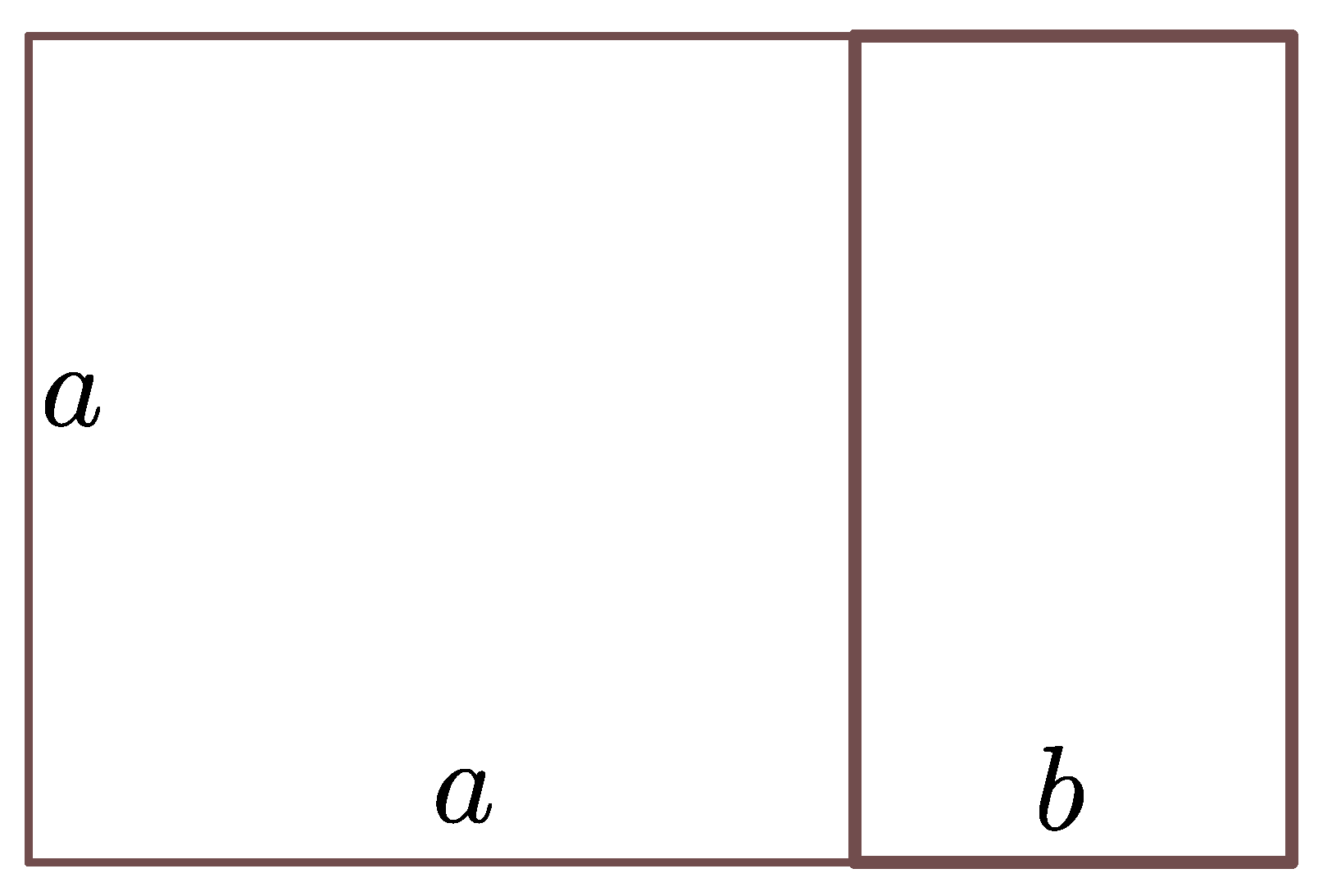
4], Prop. 11): To cut a given straight line so that the rectangle contained by the whole and one of the segments is equal to the square of the remaining segment. This can be visualized with the so-called golden rectangle (see
Figure 1), where the larger rectangle and the smaller rectangle have sides in the same ratio.
This problem reappears in Book VI ([
4], Prop. 30): to cut a given straight line in extreme and mean ratio. If we denote the lengths of the two parts of a segment by
a and
b, with
a representing the larger part, then we have
where the Greek letter
(phi) denotes the so-called golden ratio, since the above relation holds for any
b, we can choose
, obtaining
we derive the equation
or after usual simplifications
Hence, since
is the ratio of positive quantities, we select the positive root, namely
Some of the greatest mathematical minds of all ages, from Pythagoras and Euclid in ancient Greece, through the medieval Italian mathematician Leonardo of Pisa and the Renaissance astronomer Johannes Kepler, to present-day scientific figures such as Oxford physicist Roger Penrose, have spent endless hours over this simple ratio and its properties.
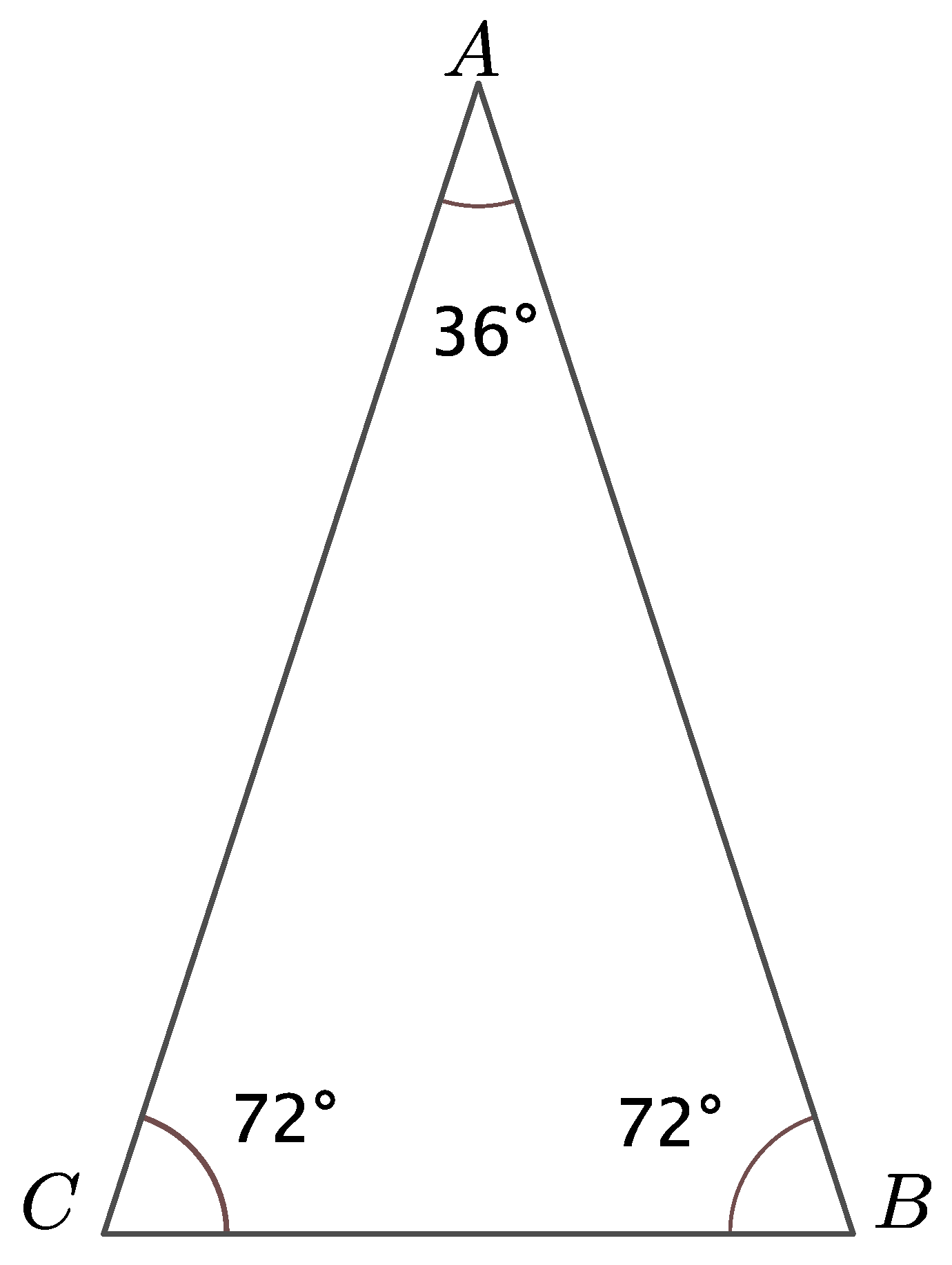
The golden ratio is closely related to the construction of the regular pentagon and the regular decagon inscribed in a circle. In the case of the decagon, it is divided into ten isosceles triangles, each with a vertex angle of 36° and base angles of 72°. In each of these triangles, the ratio between one of the oblique sides and the base is the golden number
. Thus, each of the triangles is golden. The construction of the golden triangle is found in Euclid’s Elements Book VI ([
4], Prop. 10): To construct an isosceles triangle having each of the angles at the base double of the remaining one. If
is a Golden triangle (
Figure 2), it has the property
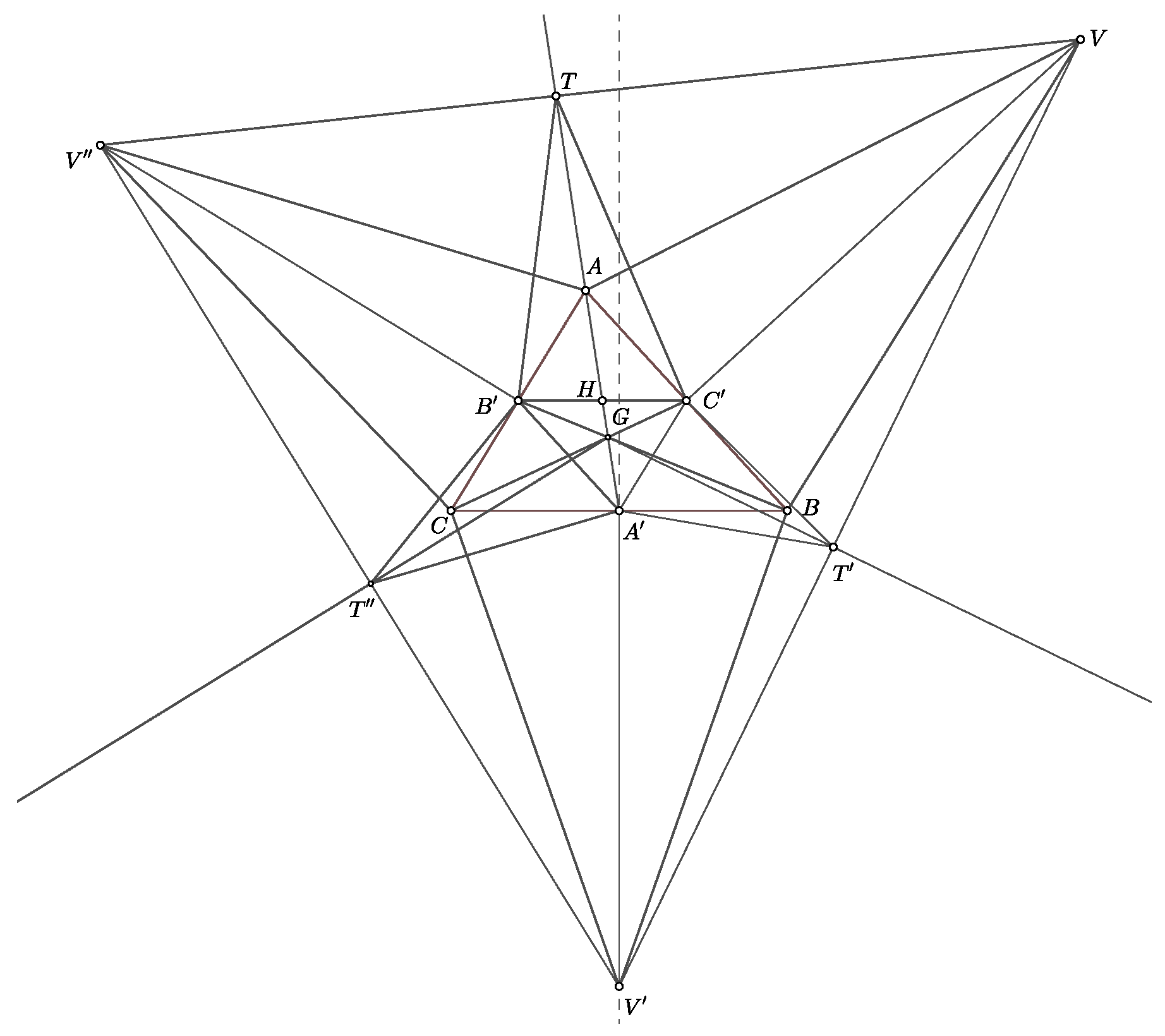
After recalling these basic notions, let’s illustrate our geometric construction. Let
be a triangle (see
Figure 3), and on each of its sides we construct the isosceles triangles
and
Suppose
for some
(large enough for
, and
can be formed), and
. Let
, and
be the midpoints of
and
, respectively. Then the lines
,
, and
concur, say at
This point
G is the centroid of
. Let
T be the intersection of the lines
and
.
To proceed with our geometric construction, we need to identify the conditions under which is isosceles on the base . If that occurs, then the median must also serve as the height and bisector of the angle , for the well-known properties of isosceles triangles. This means that must coincide with the axis of the base of , which must therefore be isosceles on the base . In the same way, for and to be isosceles, then must be isosceles both on the base and on the base . It follows that must be equilateral. Consequently, we will start from an equilateral triangle in the next section, choosing since this case yields several interesting configurations.
2. The Equilateral Triangle
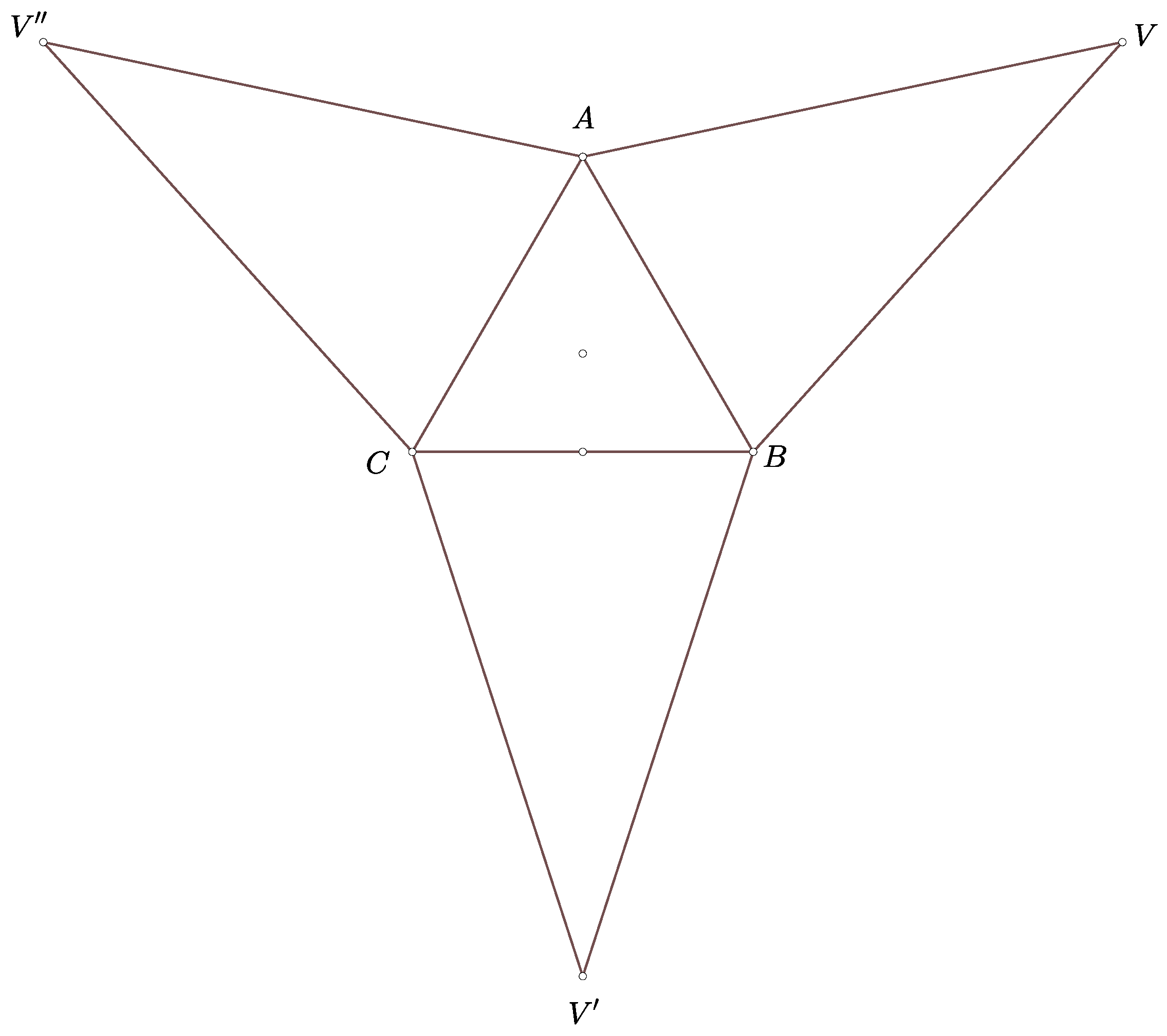
Let
be an equilateral triangle (see
Figure 4) with sides
. Let
,
, and
be three golden triangles, for which
, where
is the golden number.
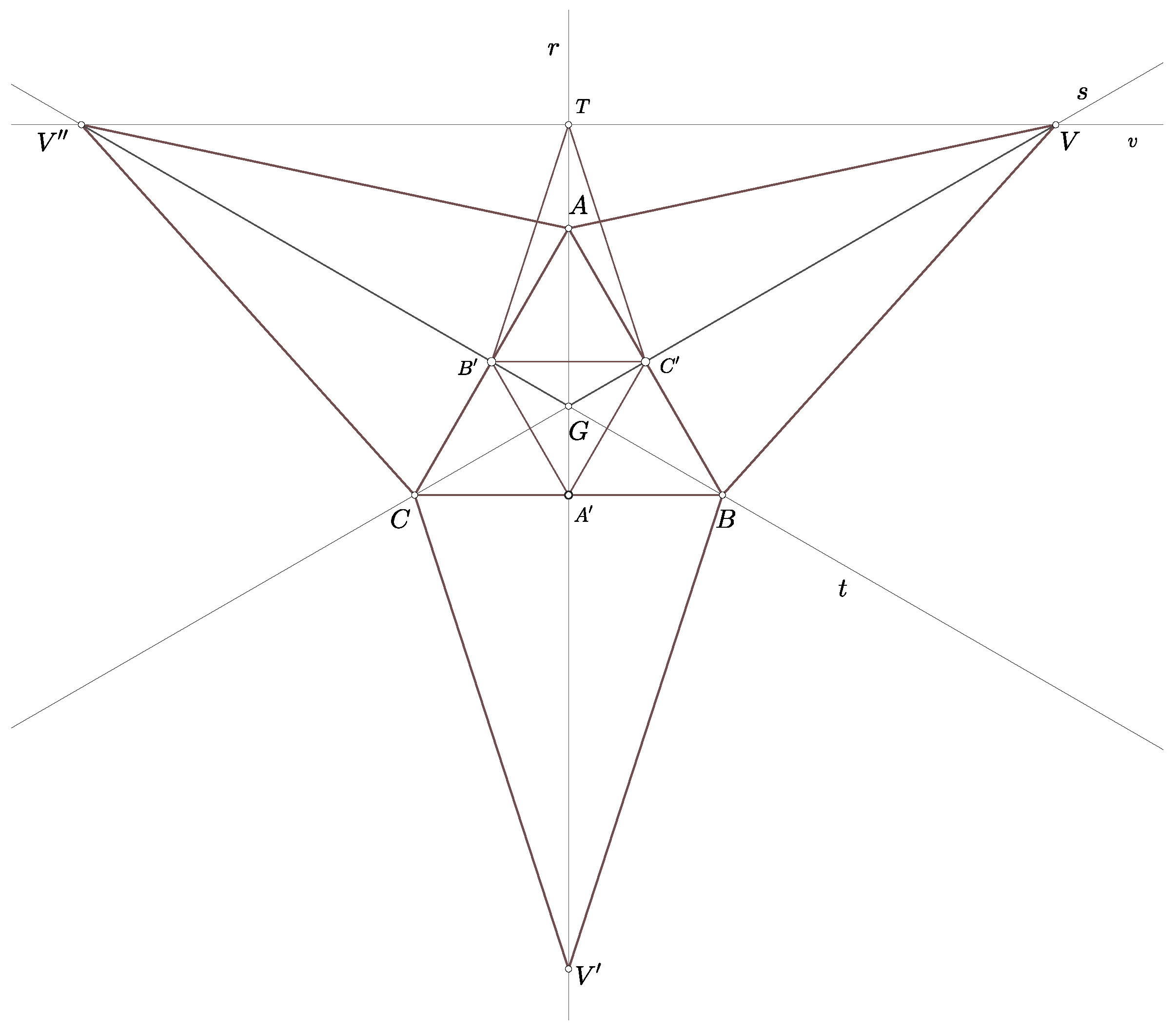
Let
be the equilateral triangle (see
Figure 5) whose vertices are the midpoints of the sides of
, such that
. Let
and
t denote the axes of
(and of
), and draw line
v that connects the vertices
V and
. The lines
r and
v will be perpendicular to one another. In fact, the triangle
is isosceles, since
is congruent to
, furthermore
, so that
is the bisector of
and perpendicular to side
.
We denote with T the intersection of lines r and v.
Theorem 1. The triangle is isosceles and golden.
Proof. Let us consider, for simplicity,
Figure 6.
Triangles
and
are congruent, sharing side
, with
, and
, so
and the triangle
is isosceles. Now, we must demonstrate that it is also golden:
First of all, in the right triangle
, the angle
, so in the right triangle
the angle
, hence
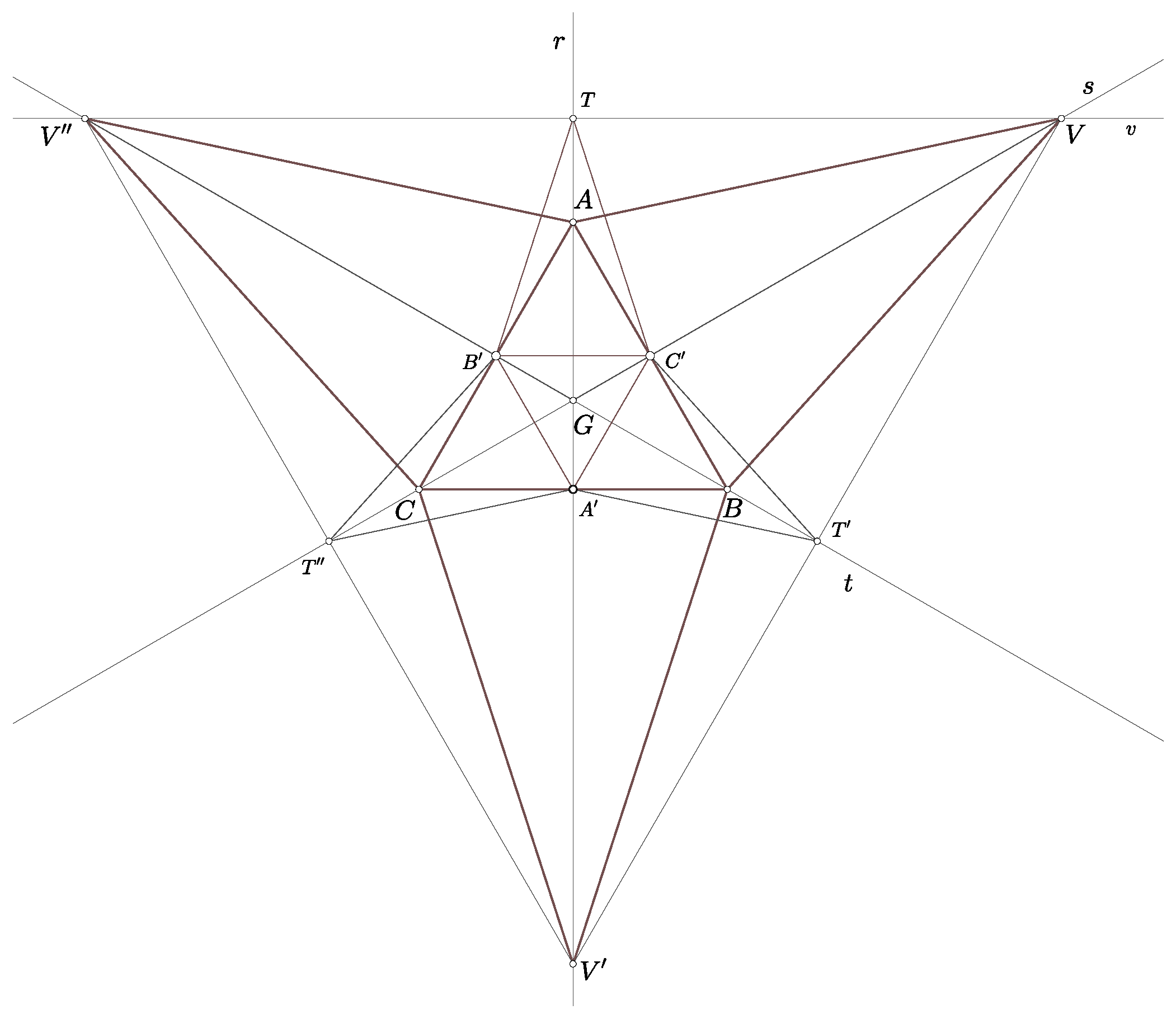
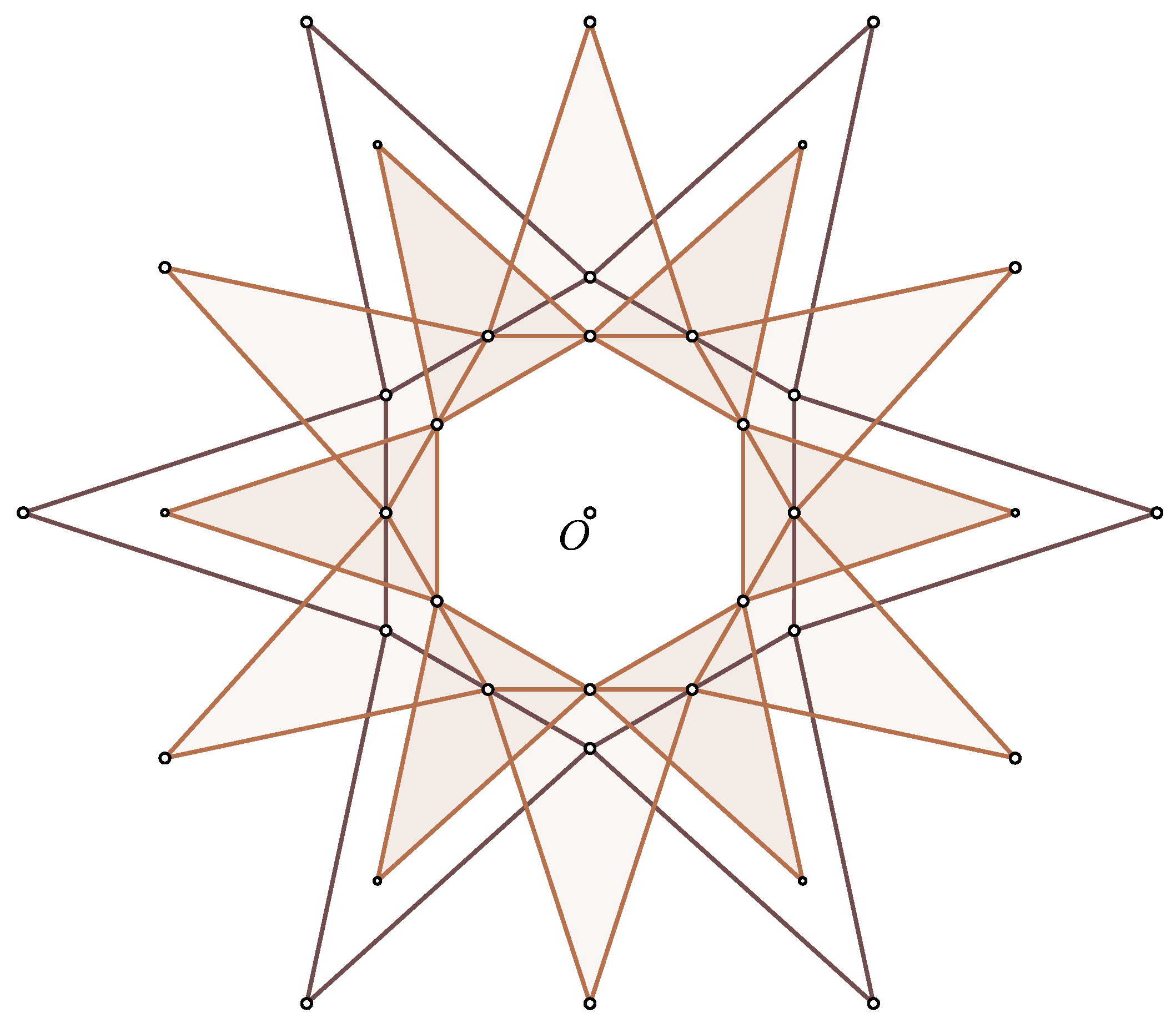
By adding more golden triangles to the other two sides of triangle
, we create the first configuration of
Figure 7:
If we apply this construction to the sides of the medial triangle of triangle
, we create a second configuration of golden triangles, as illustrated in
Figure 8. By using a similar approach, we can generate an infinite number of configurations.
3. A Hidden Harmony
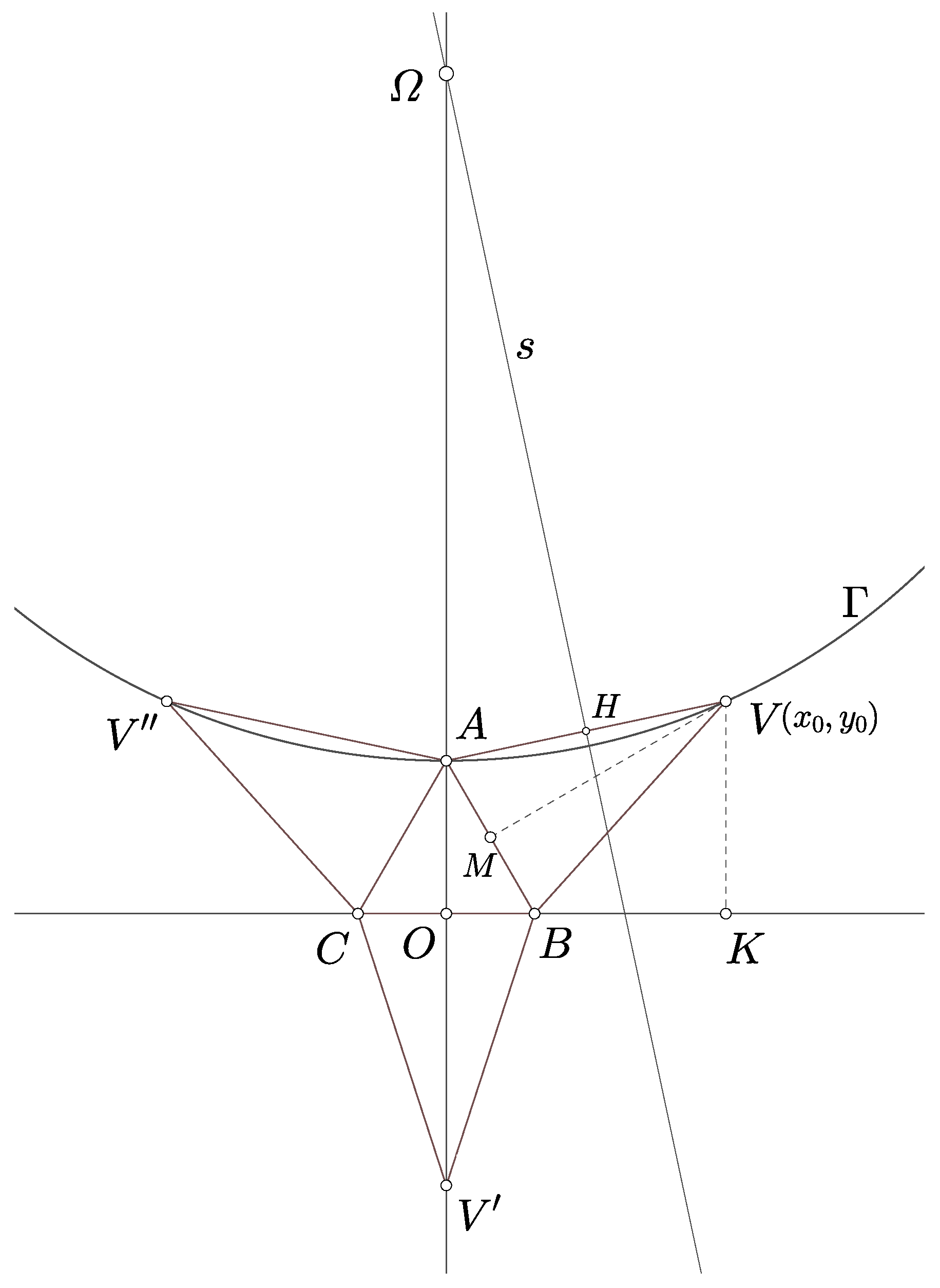
Consider
Figure 9, where we reference a Cartesian coordinate system. Let
be the center of circle
, which passes through
V,
A, and
.
Theorem 2.
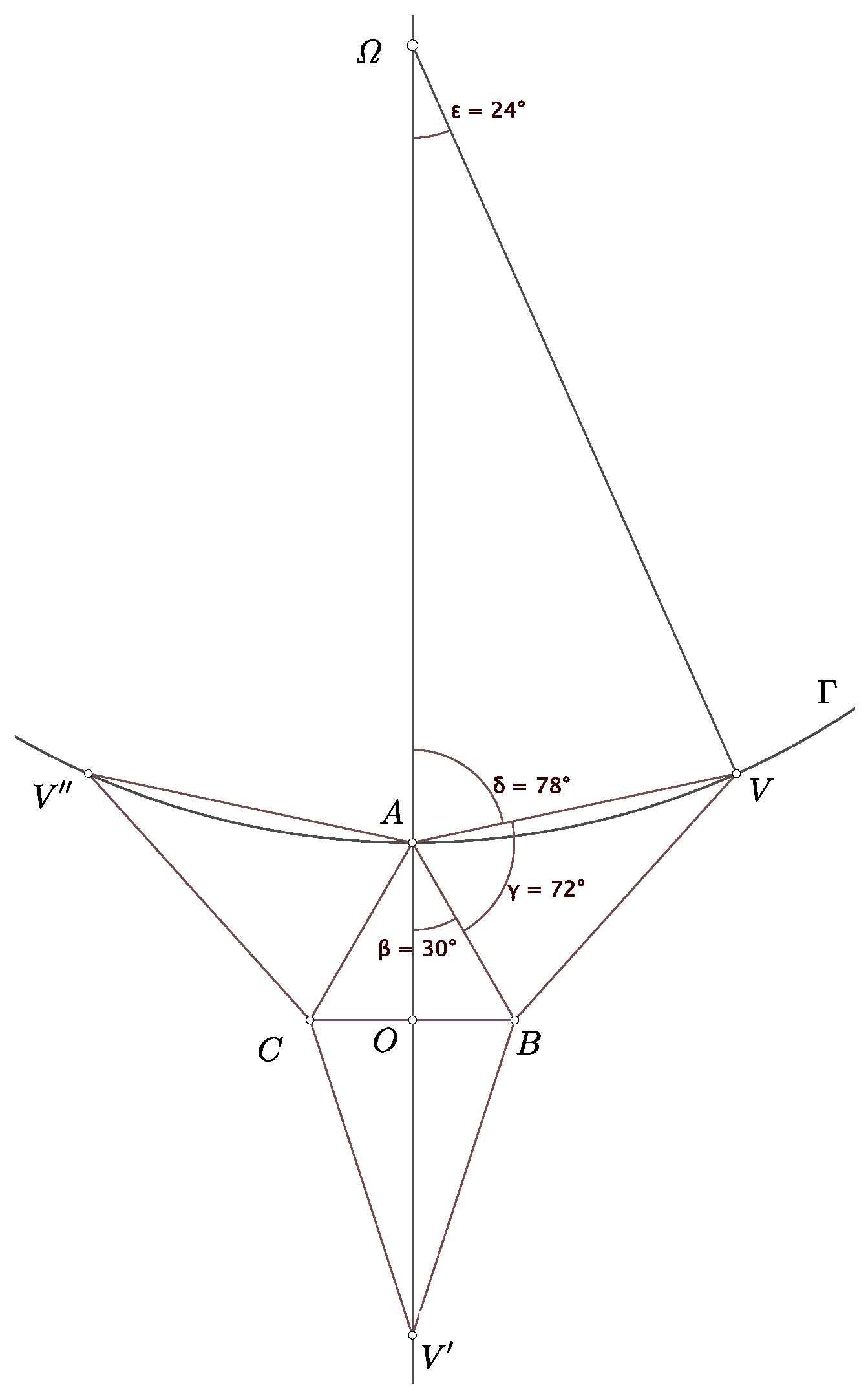
Proof. We have to demonstrate that
To achieve this goal, we need to determine the coordinates of
. First, we have
Since
and
we have
from which we get the coordinates of
:
Thus, we acquire the coordinates of the midpoint
H:
The axis equation of segment
is
where
is its slope. It intersects the
y-axis at point
, so we have
And finally, with
we find
□
This indicates that if we report the segment
(see
Figure 10) on
, we obtain the golden triangle
.
Thus,
denotes a side of the regular decagon inscribed within
(see
Figure 11).
Moreover note that
. In fact:
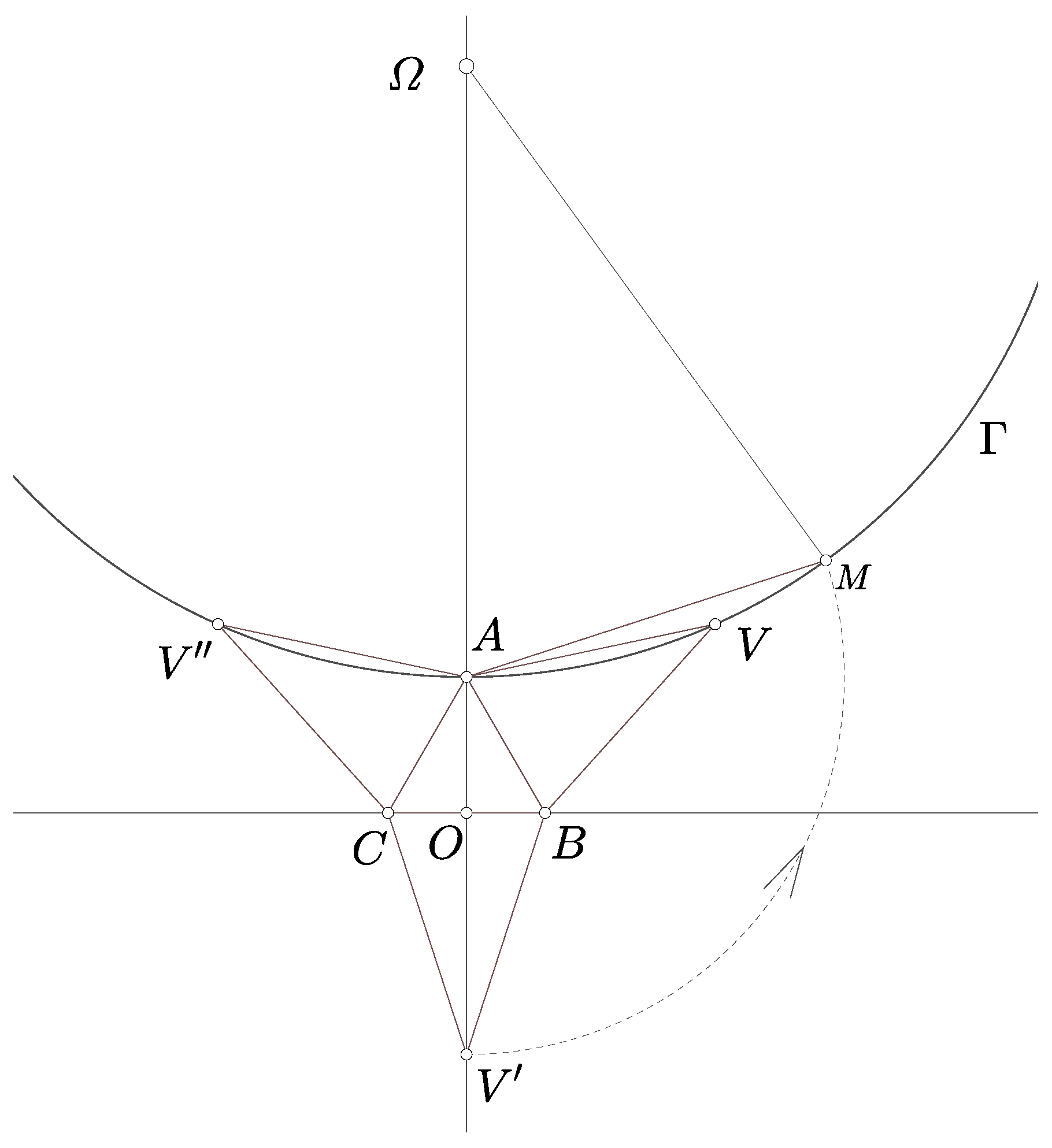
If we draw the
t-axis of side
of triangle
(see
Figure 12), one can analytically verify that it intersects the circumference
precisely at the point
M. This is a hidden property of the entire construction.
Furthermore, given the size of the angles marked in the figure (see
Figure 13),
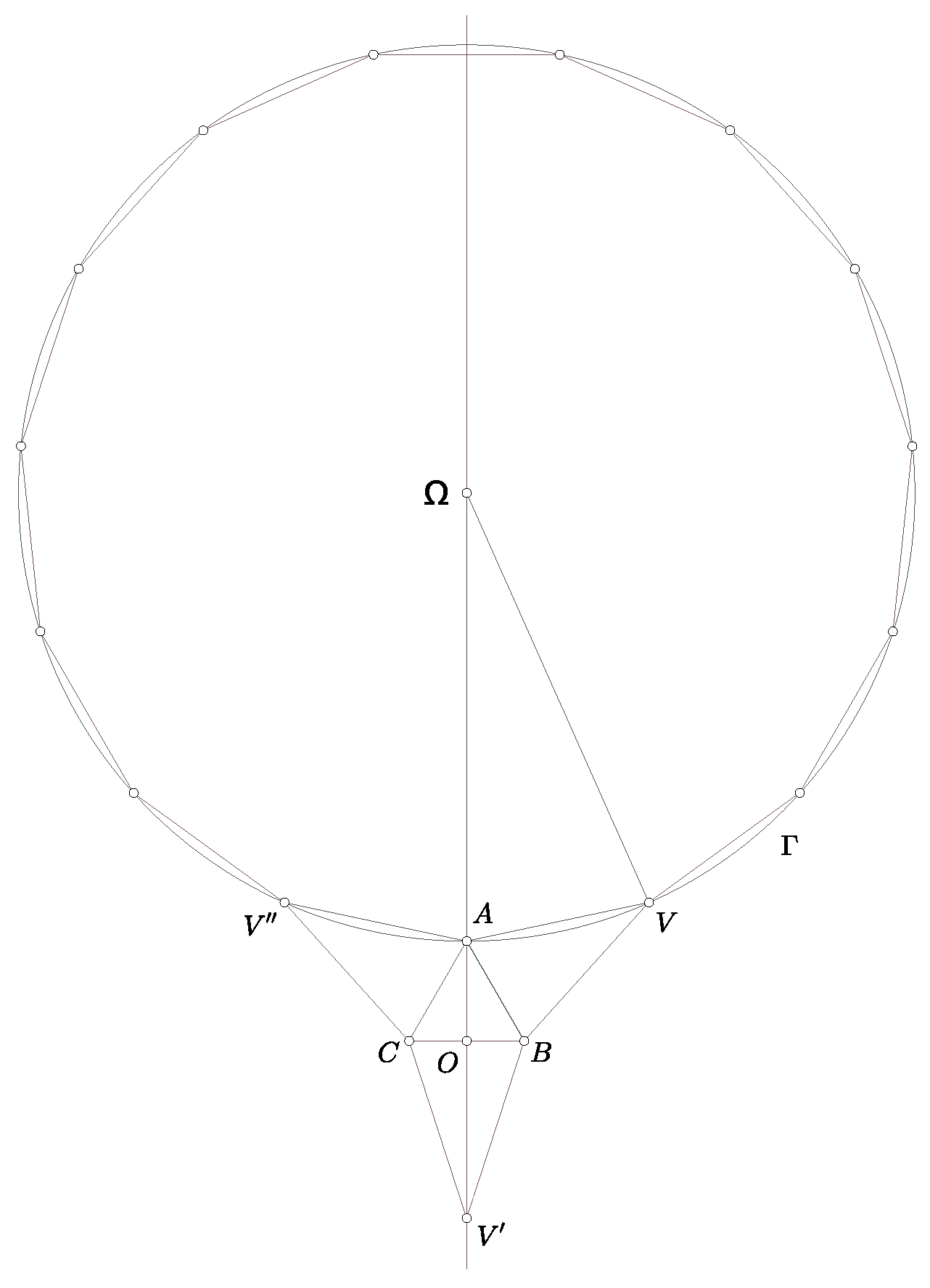
is the side of the regular pentadecagon (a 15-sided polygon) inscribed in
(see
Figure 14).
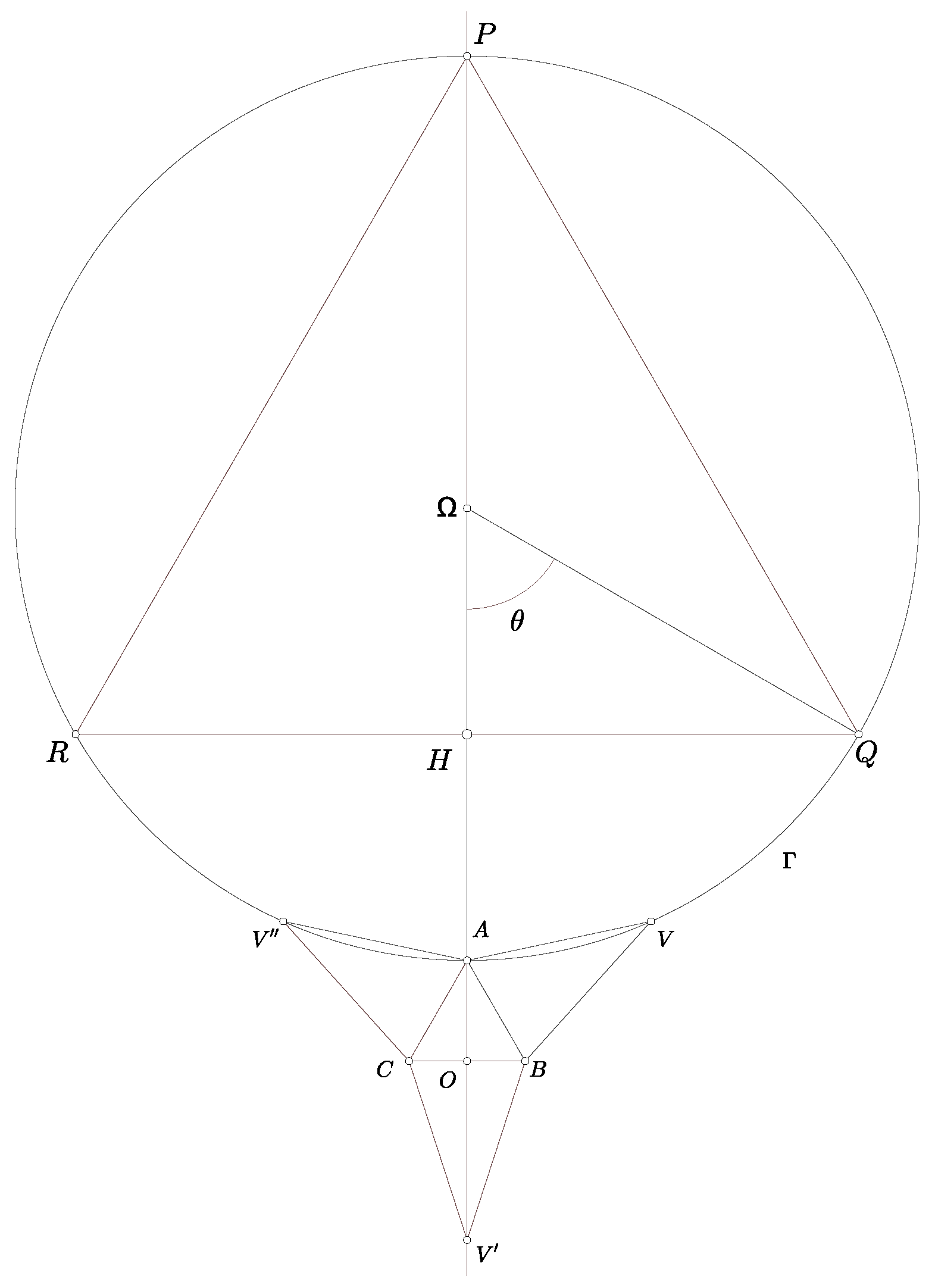
Now, if we draw a perpendicular line from the midpoint
H of segment
(see
Figure 15) to
, it intersects the circumference
at points
R and
Q. Considering the right-angled triangle
, we derive
so that
Since it lies on the same arc of the circle where the angle at the circumference with vertex at
P lies, we have
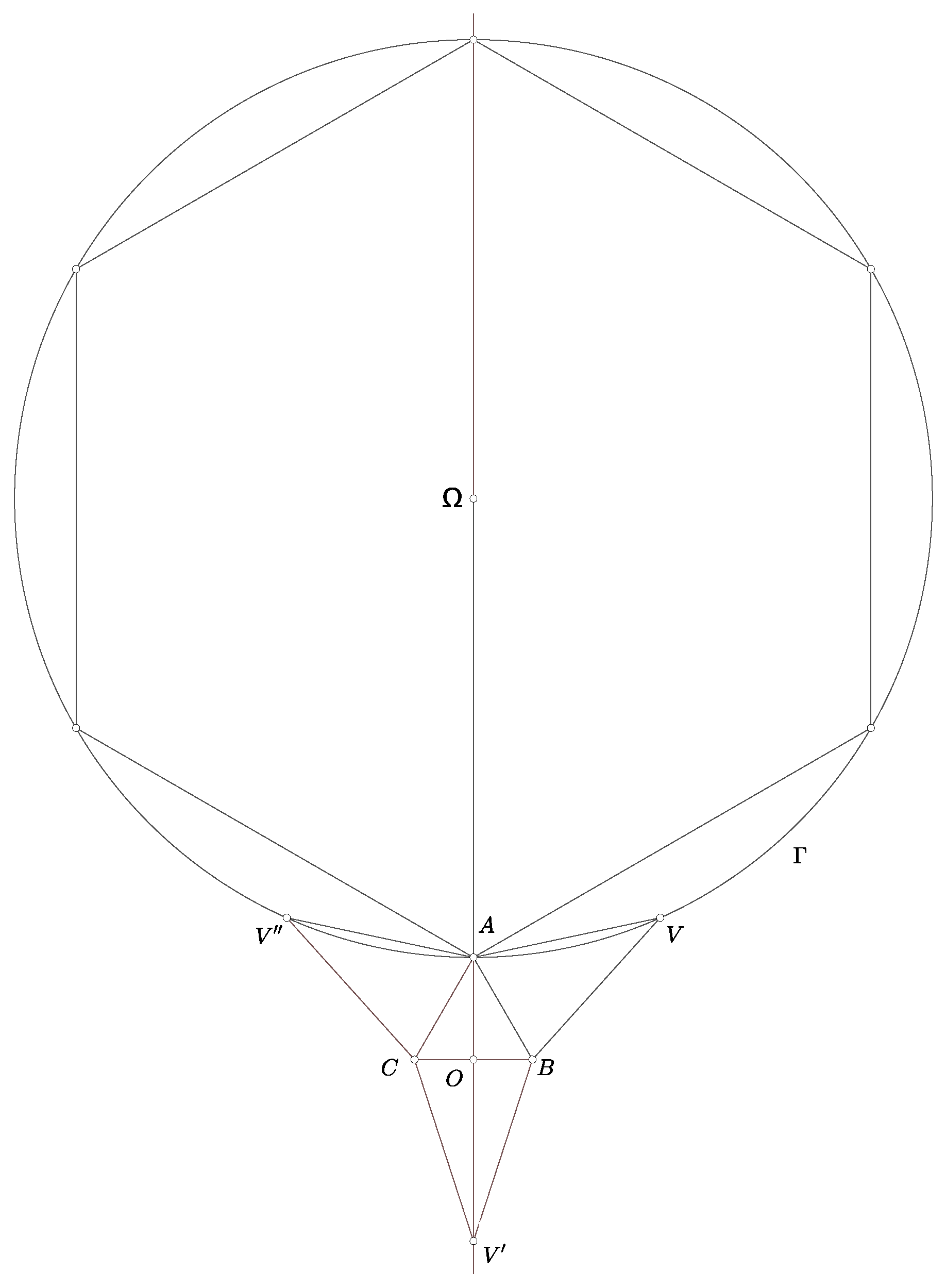
Thus, we can easily deduce that triangle is equilateral.
So,
is the side of the regular hexagon inscribed in
(see
Figure 16).
4. The Square
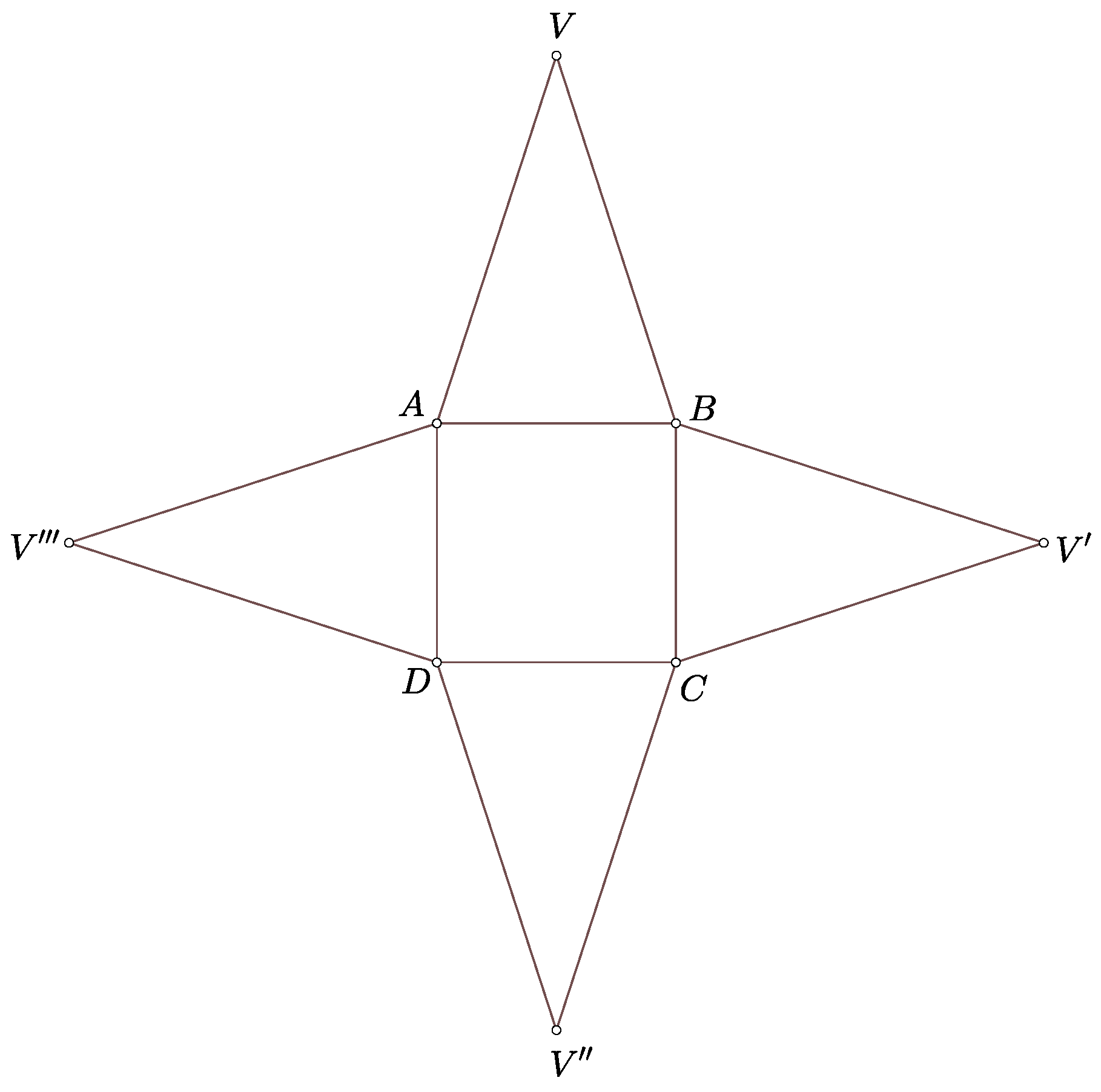
Even in the relationship between the square and the golden triangle, configurations with characteristics similar to those in the previous sections can be found.
Let
be a square with side length
a (see
Figure 17). On each side, consider four golden triangles with vertices
V,
,
, and
, such that each side of the triangles has a length of
, where
represents the golden ratio.
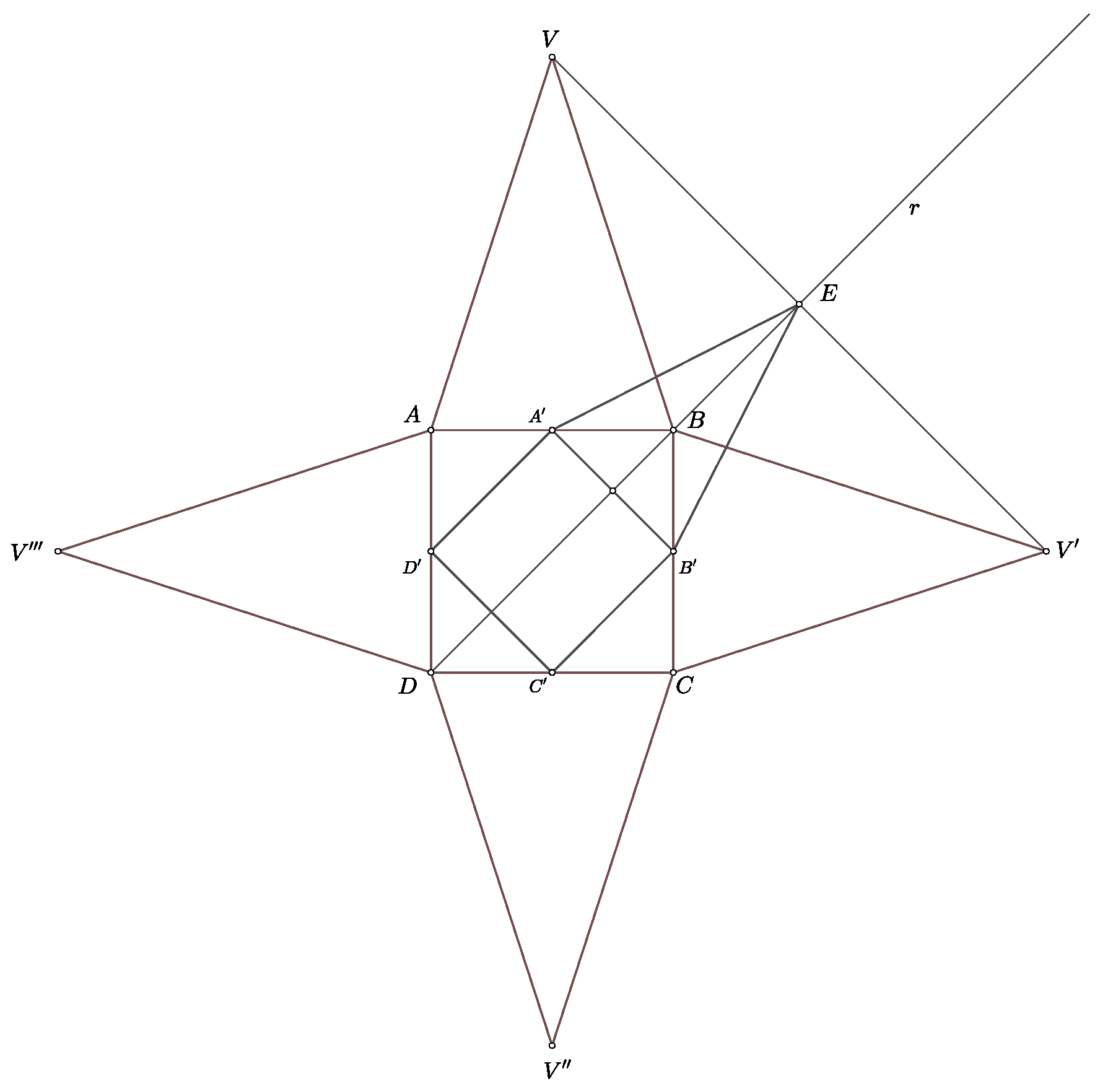
Consider the square
whose vertices are the midpoints of the square
(see
Figure 18).
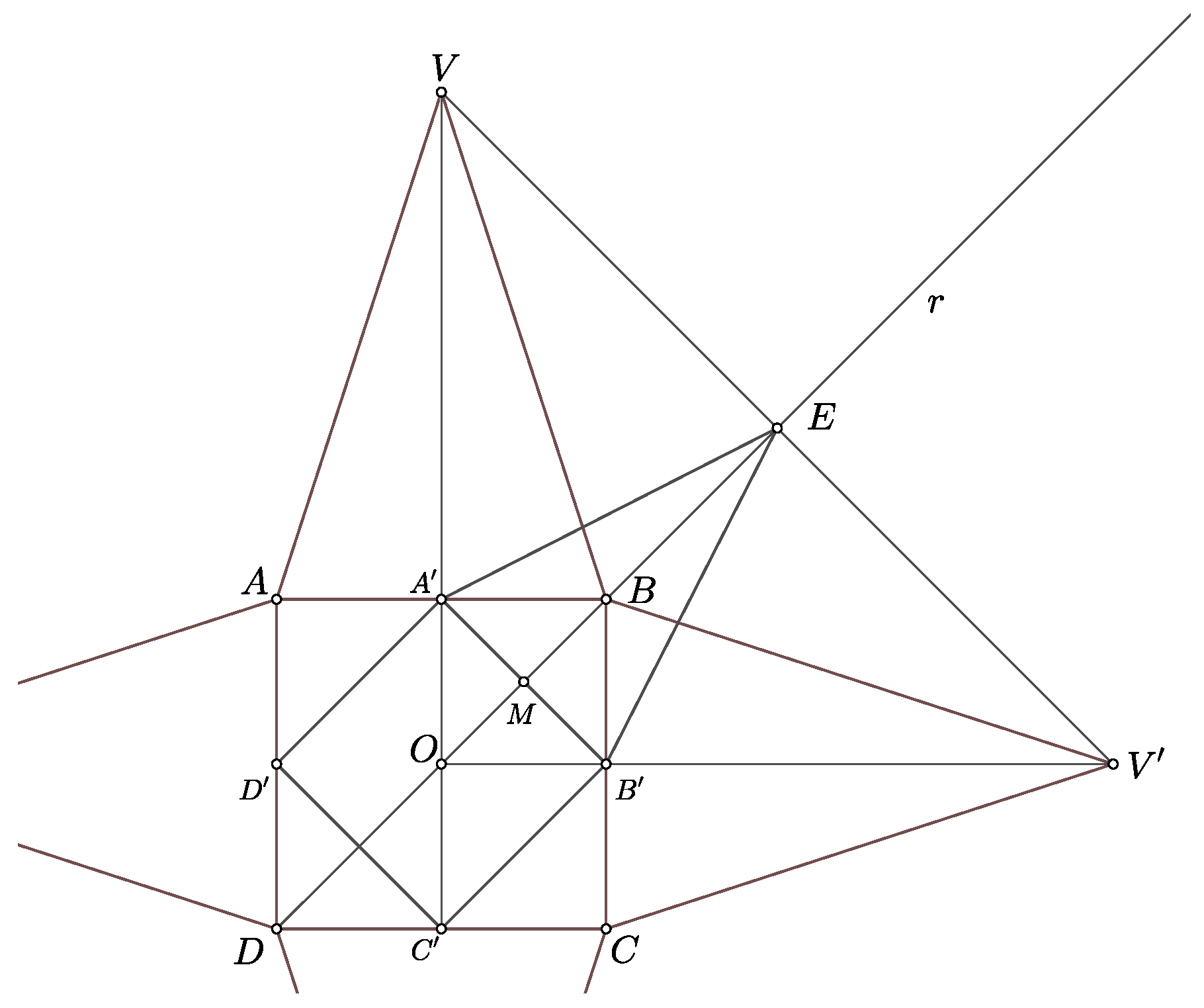
Let E be the intersection point of the extended diagonal r of square and the segment , which is perpendicular to it.
Theorem 3. The triangle is golden.
Proof. In the isosceles right triangle
, the segment
serves as the altitude to the hypotenuse
, so we have
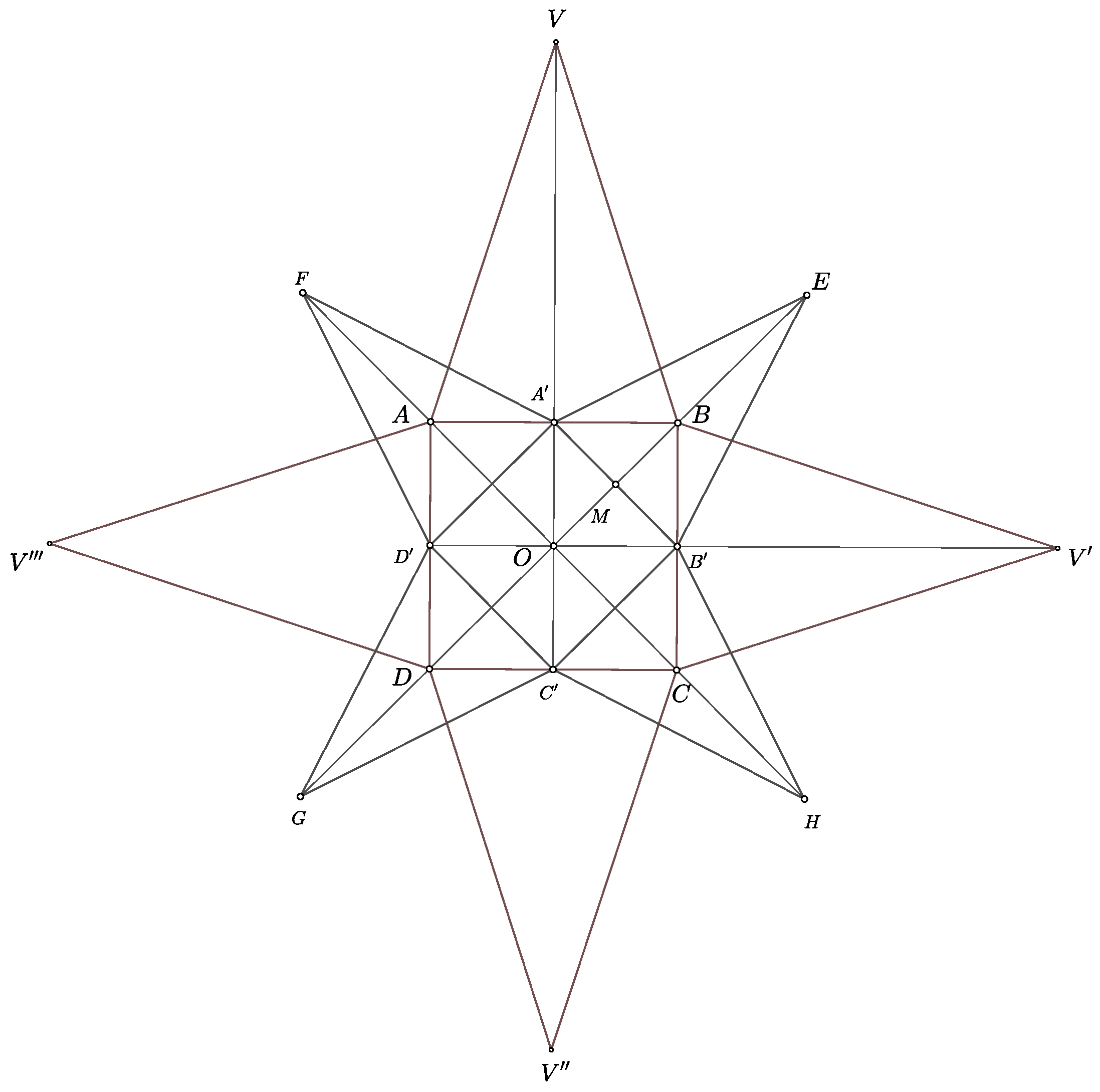
We obtain an initial configuration of golden triangles similar to the one previously obtained with the equilateral triangle (see
Figure 20).
From this configuration, we can derive infinitely many configurations for the square. However, similar configurations can also be obtained with other regular polygons, such as in the regular hexagon (see
Figure 21).