
Article

Self-Esteem and Eating Attitudes in Emerging Adulthood: The Mediating Role of Social Physique Anxiety and the Moderating Role of Gender

Department of Psychology, School of Social Sciences, University of Crete, 74150 Rethymno, Greece
*
Author to whom correspondence should be addressed.
Psychol. Int. 2026, 8(1), 4; https://doi.org/10.3390/psycholint8010004

Submission received: 5 November 2025 / Revised: 23 December 2025 / Accepted: 6 January 2026 / Published: 9 January 2026

Abstract

Emerging adulthood is a critical time for the development of disordered eating attitudes. Low self-esteem is a known risk factor for unhealthy eating attitudes, but the mechanisms behind this link are not fully understood. This study examined the relationship between self-esteem and eating attitudes in emerging adults, focusing on the mediating role of social physique anxiety and the moderating role of gender. The sample included 495 university students (68.9% women, mean age = 20.94 years, SD = 1.97). Self-esteem, social physique anxiety, and eating attitudes were assessed using the Rosenberg Self-Esteem Scale, Social Physique Anxiety Scale, and Eating Attitudes Test-26, respectively. Mediation and moderation mediation analyses were conducted using PROCESS macro. Women reported lower self-esteem, higher levels of social physique anxiety, and more frequent disordered eating behaviors. Mediation analysis indicated that social physique anxiety fully mediated the relationship between self-esteem and eating attitudes (path c’: b = 0.05, 95% CI [−0.12, 0.21]; indirect effect: b = −0.44, 95% CI [−0.57, −0.32]). Moderated mediation revealed that the indirect effect of low self-esteem on maladaptive eating attitudes through social physique anxiety was stronger among women (index of moderated mediation: b = 0.28, 95% CI [0.07, 0.51]). These findings indicate that low self-esteem can heighten body-related distress in social settings, increasing vulnerability to disordered eating, especially among women. By providing a better understanding of the mechanisms linking self-esteem and eating attitudes in emerging adults, the findings can inform the development of interventions targeting self-perception and body-related concerns, especially among women, to reduce the risk of eating disorders and promote healthier eating attitudes.

1. Introduction

Eating disorders, including anorexia nervosa, bulimia nervosa, and binge eating disorder, are highly prevalent (Galmiche et al., 2019; Qian et al., 2022). Their rates have increased in recent years and are expected to rise further in the coming decades (Xu et al., 2025), posing a major public health concern and highlighting the urgent need for prevention strategies. Disordered eating can be viewed as a continuum that spans from healthy eating behavior and minimal weight concerns to dysregulated eating and clinically diagnosable eating disorders (Striegel-Moore et al., 1989). Within this continuum, disordered eating and unhealthy eating attitudes often emerge as early indicators before the onset of a full disorder (Stice et al., 2021). These attitudes encompass both cognitive and behavioral aspects related to food consumption, body weight, and self-perception, and may include overeating, weight and shape overvaluation, unhealthy weight control behavior, and binge eating. Importantly, unhealthy eating attitudes and behaviors are established risk factors for eating disorders (Liechty & Lee, 2013; Stice et al., 2017, 2021; Yamamiya & Stice, 2024), obesity (Nagata et al., 2018; Neumark-Sztainer et al., 2006), and psychological distress (Kärkkäinen et al., 2018).
An expanding body of research indicates that eating disorders are most commonly diagnosed among young adults (Xu et al., 2025), with the majority having onset before the age of 25 (Ward et al., 2019). This evidence highlights emerging adulthood, the transitional period from adolescence to adulthood, as a particularly vulnerable period for the development of eating disorders. Emerging adulthood, occurring between ages 18 and 29, is a distinct developmental stage marked by significant identity exploration, greater independence in decision making, and frequent changes in employment and social relationships (Arnett et al., 2014).
The characteristics specific to this life stage, including identity exploration, have been linked to the etiology of eating disorders, as well as the formation of unhealthy eating attitudes (Gonidakis et al., 2018; Potterton et al., 2020). During this period, individuals are especially vulnerable to societal and cultural pressures regarding appearance and body image (El-Jor et al., 2025). These influences, combined with the stress of major life transitions, may contribute to the development of maladaptive eating habits and attitudes.
Self-esteem, or the perception of one’s own worth, is an integral component of identity formation. During emerging adulthood, a period characterized by major life transitions such as starting college, relocating, and making important career decisions, self-esteem may decline as individuals face these challenges (Chung et al., 2014). Research indicates that self-esteem is a significant predictor of disordered eating, such as drive for thinness, bulimic behavior and binge eating (Dakanalis et al., 2016; Goldschmidt et al., 2016; Shea & Pritchard, 2007). In addition, low self-esteem has been identified as a risk factor for persistent body dissatisfaction over time (Wang et al., 2019). A meta-analysis of longitudinal studies further revealed a bidirectional relationship between low self-esteem and eating pathology, indicating that each can predict the other over time in both clinical and non-clinical populations (Krauss et al., 2023). Consistent with this, the transdiagnostic model of eating disorders proposed by Fairburn et al. (2003) highlights low self-esteem as a key maintenance mechanism of eating disorders. Taken together, these findings suggest that low self-worth may predispose individuals to dysfunctional eating attitudes and behaviors.
Social physique anxiety refers to the anxiety or distress individuals experience when they perceive or anticipate being negatively evaluated based on their physical appearance, particularly in social or public settings (Hart et al., 1989). It is a form of social anxiety that specifically revolves around concerns about body size, shape, and overall physical appearance (Hart et al., 1989; Leary & Kowalski, 1997). Emerging adults may be particularly vulnerable to this form of anxiety, as this developmental period is marked by identity exploration and heightened sensitivity to interpersonal evaluation and social comparison (Fitzsimmons-Craft, 2011).
Social physique anxiety has been consistently associated with unhealthy eating attitudes among emerging adults (Alcaraz-Ibáñez et al., 2020; Cox et al., 1997; Diehl et al., 1998; Fitzsimmons-Craft et al., 2012; Han et al., 2019), while a recent meta-analysis revealed strong connections between social physique anxiety and eating disorder symptomatology (Alcaraz-Ibáñez et al., 2023). Individuals with heightened body image concerns may engage in restrictive dieting, excessive exercise, or other compensatory behaviors in an attempt to manage or control perceived flaws in their appearance (Sabiston et al., 2007).
The relationship between self-esteem, social physique anxiety, and eating attitudes is complex and multi-faceted. Individuals with low self-esteem are more likely to experience higher levels of social physique anxiety, as negative self-perceptions may intensify concerns and worries about how others view their physical appearance. Various studies support this association, indicating that low self-esteem serves as a risk factor for increased social physique anxiety (Diehl et al., 1998; Kosmidou et al., 2017; Tsartsapakis & Zafeiroudi, 2025; Tsartsapakis et al., 2023). Both low self-esteem and high social physique anxiety have been linked to greater vulnerability to disordered eating and maladaptive eating attitudes, such as restrictive dieting, binge eating, and preoccupation with food (Alcaraz-Ibáñez et al., 2023; Dakanalis et al., 2016; Goldschmidt et al., 2016). Notably, Brunet et al. (2010) found that social physique anxiety mediates the relationship between self-esteem and drive for thinness among adolescents, suggesting that individuals with negative self-evaluations may have heightened concerns about their physical appearance, which in turn might exacerbate unhealthy eating behaviors as a way of coping with social expectations.
Furthermore, the role of gender in these associations warrants particular attention. Research indicates that women often report lower levels of self-esteem compared to men (Bleidorn et al., 2016). In addition, women are more frequently exposed to cultural ideals that emphasize thinness and physical attractiveness, which can contribute to heightened self-scrutiny and dissatisfaction with their bodies. Consequently, they also tend to experience higher levels of social physique anxiety and be more concerned about how others evaluate their bodies (Brunet et al., 2010; Zartaloudi et al., 2023). These heightened worries about physical appearance can, in turn, lead to maladaptive coping strategies related to eating and body control. As a result, women are more likely than men to engage in unhealthy eating behaviors, such as restrictive dieting, binge eating, or purging, as a means of managing body-related distress and striving to meet societal body standards (Qian et al., 2022; Striegel-Moore et al., 2009). Together, these findings highlight the significant role of gendered social and psychological factors in shaping self-esteem, body image concerns, and disordered eating patterns.
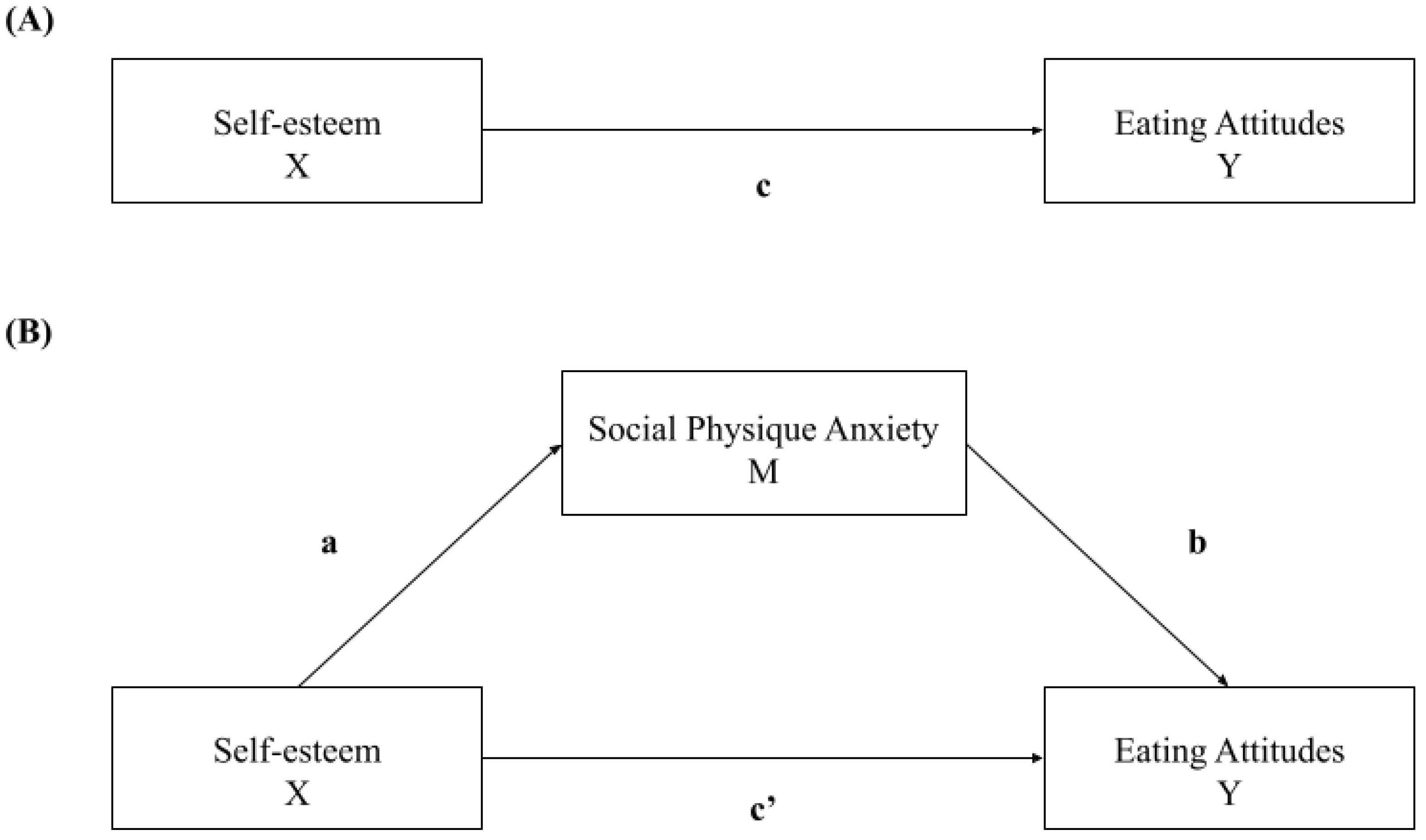
While previous research has established links between self-esteem and eating attitudes, as well as between social physique anxiety and disordered eating, the specific mechanisms through which self-esteem influences eating behaviors remain insufficiently understood. In particular, the mediating role of social physique anxiety in the relationship between self-esteem and eating attitudes has yet to be fully explored in the context of emerging adulthood. The present study aims to address this gap by investigating how self-esteem is related to eating attitudes in emerging adults, with a focus on the mediating role of social physique anxiety. Accordingly, the first hypothesis posited that social physique anxiety would mediate the relationship between self-esteem and eating attitudes (mediation model; Figure 1), such that lower levels of self-esteem would be associated with higher anxiety about physical appearance, which in turn would predict more dysfunctional eating attitudes. By examining these relationships, the study seeks to deepen our understanding of the psychological processes that contribute to the development of eating disorders and to inform interventions that promote mental health and healthier eating attitudes among emerging adults.
Moreover, exploring the moderating role of gender in these associations may reveal why women appear more vulnerable to body-related distress and unhealthy eating patterns. Hence, the second hypothesis of the study proposed that gender would moderate the relationship between social physique anxiety and eating attitudes, such that this association would be stronger among women than among men (moderated mediation model). The findings are expected to provide valuable insights for developing targeted, gender-sensitive interventions that foster positive self-esteem, reduce body image anxiety, and promote healthier eating attitudes among emerging adults.
Sociocultural norms play a significant role in eating pathology, with evidence showing that thin-ideal internalization and the pursuit of slimness, often promoted by social media, are associated with body image concerns and disordered eating (Grabe et al., 2008; Schaefer et al., 2019). Westernization and urbanization are linked to increased exposure to media pressures, which may further intensify body dissatisfaction (Rodgers et al., 2023). In addition, online social comparison has been associated with heightened eating disorder symptoms and concerns regarding body image (Bonfanti et al., 2025). Existing data on disordered eating in Greece are limited and primarily focused on female populations, with previous studies reporting prevalence rates of 18% (Vlachakis & Vlachaki, 2014) and 23% (Costarelli et al., 2009). As a rapidly developing country influenced by globalized beauty ideals and digital media, Greece represents a particularly relevant context for examining eating attitudes and appearance-related social anxiety. At the same time, Greek society combines characteristics of modern, individualistic cultures with enduring collectivistic elements (Georgas, 1999), placing strong emphasis on family bonds. Given that family plays a crucial role in the development of self-esteem and eating behaviors, investigating these associations within the Greek cultural context is particularly important for understanding eating attitudes during emerging adulthood.

2. Materials and Methods

2.1. Participants

To be eligible for inclusion in the study, participants had to be adults aged between 18 and 30 years and have a good understanding of the Greek language. Initially, 502 university students participated in the study. However, seven participants were excluded due to missing data on study variables. The final analytic sample consisted of 495 students, of whom 154 (31.1%) were male and 341 (68.9%) were female, with a mean age of M = 20.94 years (SD ± 1.97). The sample was predominantly Greek (96.2%), with a small proportion of Cypriot participants (3.2%). Most were enrolled in undergraduate programs (98.2%), while 1.8% were pursuing postgraduate studies. More than half of the participants (59.4%) reported that they did not have an intimate relationship at the time of the study. Additionally, 70.9% of participants were living alone, while 29.1% lived with others (e.g., a partner, parents, or roommates). The majority of participants were from urban areas (79.2%) and were currently residing in urban settings (95.7%). Moreover, 9.2% of the participants reported experiencing an eating disorder in the six months prior to the study, while 8.5% suspected they had an eating disorder at the time of data collection. A small, but considerable percentage (28.5%) had visited a nutritionist in the past. The mean (±SD) Body Mass Index (BMI) of the sample was 22.93 (±3.28). Table 1 presents the socio-demographic characteristics of the participants.

2.2. Measures

2.2.1. Socio-Demographic Characteristics

Socio-demographic characteristics were collected to gather information about participants’ age, gender, nationality, educational level (undergraduate or postgraduate student), relationship status (single or in a relationship), place of origin (urban or rural), current place of residence (urban or rural) and type of residence (living alone or with others). Self-reported data were also obtained regarding participants’ height and weight, history of eating disorders (past and current), previous visits to nutritionists, and current frequency of physical activity. Body mass index (BMI) was calculated as weight (in kilograms) divided by height (in meters) squared.

2.2.2. Self-Esteem

Participants’ self-esteem was assessed using the Rosenberg Self-Esteem Scale (RSES; Rosenberg, 1965). The RSES is a unidimensional, self-report measure consisting of 10 items. Participants indicated their level of agreement or disagreement on a 4-point Likert scale, ranging from 1 “strongly disagree” to 4 “strongly agree”. Some items are positively worded (e.g., “I feel that I have a number of good qualities”) and others negatively worded (e.g., “I feel I do not have much to be proud of”), so reverse scoring was applied. The total score is computed by summing the responses, with scores ranging from 10 to 40. Higher scores reflect higher self-esteem, indicating that individuals view themselves as worthy and competent, while lower scores suggest lower self-esteem. The psychometric properties of the scale have been found satisfactory across various samples (e.g., Eklund et al., 2018; Gómez-Lugo et al., 2016). The Greek version of the RSES was translated and validated by Tsagarakis et al. (2007) and demonstrated good internal consistency (α = 0.86). In this study, the scale showed strong reliability (α = 0.88).

2.2.3. Social Physique Anxiety

Social physique anxiety was measured using the Social Physique Anxiety Scale (SPAS; Hart et al., 1989), a 12-item self-report measure. Participants rated how often they experienced anxiety about being evaluated based on their body size and shape in social situations, using a 5-point Likert scale ranging from 1 “Never” to 5 “Always”. The total score, ranging from 12 to 60, reflects the level of anxiety about physical appearance. Reverse-coded items were recoded before summing responses to calculate the total score. Higher scores indicate greater distress in the face of interpersonal evaluation of physique. The SPAS has demonstrated good psychometric properties in previous studies (Hart et al., 1989), and the Greek version was validated by Psychountaki et al. (2004). In the present study, the SPAS showed excellent reliability (α = 0.91).

2.2.4. Eating Attitudes

Eating attitudes were assessed using the Eating Attitudes Test-26 (EAT-26; Garner et al., 1982), a self-report instrument designed to evaluate attitudes and behaviors associated with eating disorders. The EAT-26 consists of 26 items and is commonly used in both clinical and non-clinical settings. Participants indicated how often they engaged in specific eating-related behaviors and attitudes on a 6-point Likert scale, ranging from “Never” to “Always”. Specifically, responses were scored as follows: “Never” or “Rarely” or “Sometimes” = 0, “Often” = 1, “Usually” = 2, and “Always” = 3. The total score is derived by summing responses, with one reverse-scored item. The total score ranges from 0 to 78, with higher scores indicating more dysfunctional eating attitudes. Factor analysis has identified three main components of the EAT-26: (i) Dieting (13 items), which involves a desire to be thinner and weight-control behaviors (e.g., “I am preoccupied with the desire to be thinner”), (ii) Bulimia and Food Preoccupation (6 items), which includes binge eating and compensatory behaviors (e.g., “I vomit after I have eaten”), and (iii) Oral Control (7 items), which reflects tendencies to control eating and social pressures (e.g., “I avoid eating when I am hungry”). Scores of 20 or higher on the EAT-26 suggest a need for further evaluation. The psychometric properties of the EAT-26 have been well established in several studies (e.g., Doninger et al., 2005; Garner et al., 1982). The Greek version of the EAT-26 was validated by Simos (1996). In the present study, the internal consistency was satisfactory for Dieting (α = 0.84), Bulimia and Food Preoccupation (α = 0.69), and the Total score (α = 0.83). Lower internal consistency was observed for Oral Control (α = 0.57). Notably, reduced reliability for this subscale has also been reported among female university students in the original scale development study (Garner et al., 1982). For this reason, only the total score of EAT-26 was utilized in the main analyses of the present study (i.e., mediation model and moderated mediation model).

2.3. Procedure

Data collection was conducted between March and June 2018. Participants were recruited either by being approached in person on the university campuses of the Department of Psychology at the University of Crete (Rethymno, Crete, Greece) and the Department of Physical Education and Sport Science at the University of Thessaly (Trikala, Greece), where they were administered the questionnaires on site, or by receiving a web link to access the study questionnaires online. Despite using two recruitment methods, the procedure was identical for all participants. Prior to data collection, participants were fully informed about the study’s purpose and the voluntary nature of their participation. They were assured of confidentiality and anonymity, with no consequences for declining or withdrawing from the study. Informed consent was obtained from all participants before they began the survey. Participants were provided with written instructions and were informed that completing the questionnaires would take approximately 15 min. The study was conducted in accordance with the Declaration of Helsinki and was approved by the Research Ethics Committee of the Department of Psychology, University of Crete (protocol code 182/6 March 2018).

2.4. Statistical Analysis

Statistical analyses were conducted using SPSS Statistics 29 software (IBM, Armonk, NY, USA). Descriptive statistics were first performed to summarize the socio-demographic characteristics of the sample. Means and standard deviations were calculated for continuous variables, while frequencies and proportions were used for categorical variables. The reliability of the scales and subscales was assessed using Cronbach’s alpha coefficient to evaluate internal consistency. To examine gender differences across the study variables, independent-samples t-tests (Student’s t-test) were conducted. The association between gender and EAT-26 categorization, using the established cut-off score of 20, was evaluated with chi-square test. Bivariate associations between study variables were explored using Pearson’s r correlation coefficient.
PROCESS macro version 4.2 (Hayes, 2013) was used to conduct mediation and moderated mediation analyses. Specifically, mediation analysis was performed using Hayes’s Model 4, which estimates both the direct and indirect effects of self-esteem on eating attitudes through social physique anxiety. Additionally, Hayes’s Model 14 was employed to test the moderating role of gender on the indirect effect of self-esteem on eating attitudes through social physique anxiety. In model 14, the moderator operates along the b path, which respresents the effect of the mediator on the dependent variable (Hayes, 2013). The results are reported as unstandardized b coefficients with corresponding 95% confidence intervals (CIs). For mediation analysis only, standardized β coefficients are also provided. For all analyses, 5000 bias-corrected bootstrapped samples were generated, and hypothesis testing was conducted at a significance level of 0.05.
Power analysis was conducted to justify the sample size. Using Monte Carlo power analysis for indirect effects, as proposed by Schoemann et al. (2017), we confirmed that the mediation analysis had sufficient power. With our sample size of N = 495, assuming 5000 replications and 20,000 Monte Carlo draws per replication, and using the observed standardized coefficients for the a, b, and c’ paths along with the standard deviations of the independent, mediator, and dependent variables, the estimated power far exceeded the conventional threshold of 0.80. Furthermore, a post hoc power analysis was conducted in G*Power version 3.1.9.7. (Faul et al., 2007) for the interaction term between the mediator and the moderator (Social physique anxiety × Gender) underlying the moderated mediation model. Assuming a small effect size (f2 = 0.02), α = 0.05, and N = 495, the analysis indicated a power of 0.88, exceeding the conventional requirement of 0.80.

3. Results

3.1. Descriptive Results

Table 2 presents the mean scores and standard deviations of the variables used in this study, as well as the differences in mean scores between males and females. Men scored significantly higher in self-esteem than women [t(493) = −2.79, p = 0.005]. In contrast, women reported higher levels of social physique anxiety [t(493) = 7.42, p < 0.001], as well as more frequent engagement in unhealthy eating attitudes overall [t(391.02) = 2.67, p = 0.008] and in dieting behavior [t(421.03) = 3.61, p < 0.001]. No significant gender differences were found for Bulimia and Food Preoccupation or Oral Control subscales. In total, 102 participants (20.6%) scored at or above the EAT-26 cut-off of 20, indicating a potential risk for eating disorders and the need for further evaluation. Of these, 82 were women (80.4%) and 20 were men (19.6%), with the chi-square test showing a significant association between gender (male or female) and EAT-26 categorization (total score < 20 or ≥20) [χ2(1) = 7.93, p = 0.005].

3.2. Bivariate Correlations

Self-esteem was negatively correlated with social physique anxiety (r = −0.53, p < 0.001), dieting (r = −0.21, p < 0.001), bulimia and food preoccupation (r = −0.18, p < 0.001), and overall eating attitudes (r = −0.22, p < 0.001). On the contrary, social physique anxiety was positively correlated with dieting (r = 0.50, p < 0.001), bulimia and food preoccupation (r = 0.33, p < 0.001), and overall eating attitudes (r = 0.46, p < 0.001) (Table 3).

3.3. Mediation Analysis

The hypothesized model, in which social physique anxiety mediated the relationship between self-esteem and eating attitudes, was tested using Hayes’ Model 4 and the results are presented in Table 4. The mediation analysis showed that self-esteem negatively predicted social physique anxiety (path a: b = −0.97, 95% CI [−1.11, −0.84]), and social physique anxiety positively predicted disordered eating attitudes (path b: b = 0.46, 95% CI [0.37, 0.55]). The standardized β coefficients for the a and b paths were −0.53 and 0.47, respectively, indicating moderate-to-large effect sizes. The total effect of self-esteem on eating attitudes was significant (path c: b = −0.40, 95% CI [−0.55, −0.24]). However, the direct effect became non-significant, when social physique anxiety was included in the model as the mediator (path c′: b = 0.05, 95% CI [−0.12, 0.21]), and the standardized coefficient was close to zero (β = 0.03). The indirect effect of self-esteem on eating attitudes through social physique anxiety was significant, as the bootstrapped 95% confidence interval did not include zero (indirect effect: b = −0.44, 95% CI [−0.57, −0.32]). These results indicate that social physique anxiety fully mediates the relationship between self-esteem and eating attitudes. The standardized coefficient for the indirect effect was −0.25, indicating a moderate effect, which suggests that lower self-esteem is associated with higher disordered eating attitudes via increased social physique anxiety. The model, including both self-esteem and social physique anxiety, explained 21% of the variance in eating attitudes (R2 = 0.21).

3.4. Moderated Mediation Analysis

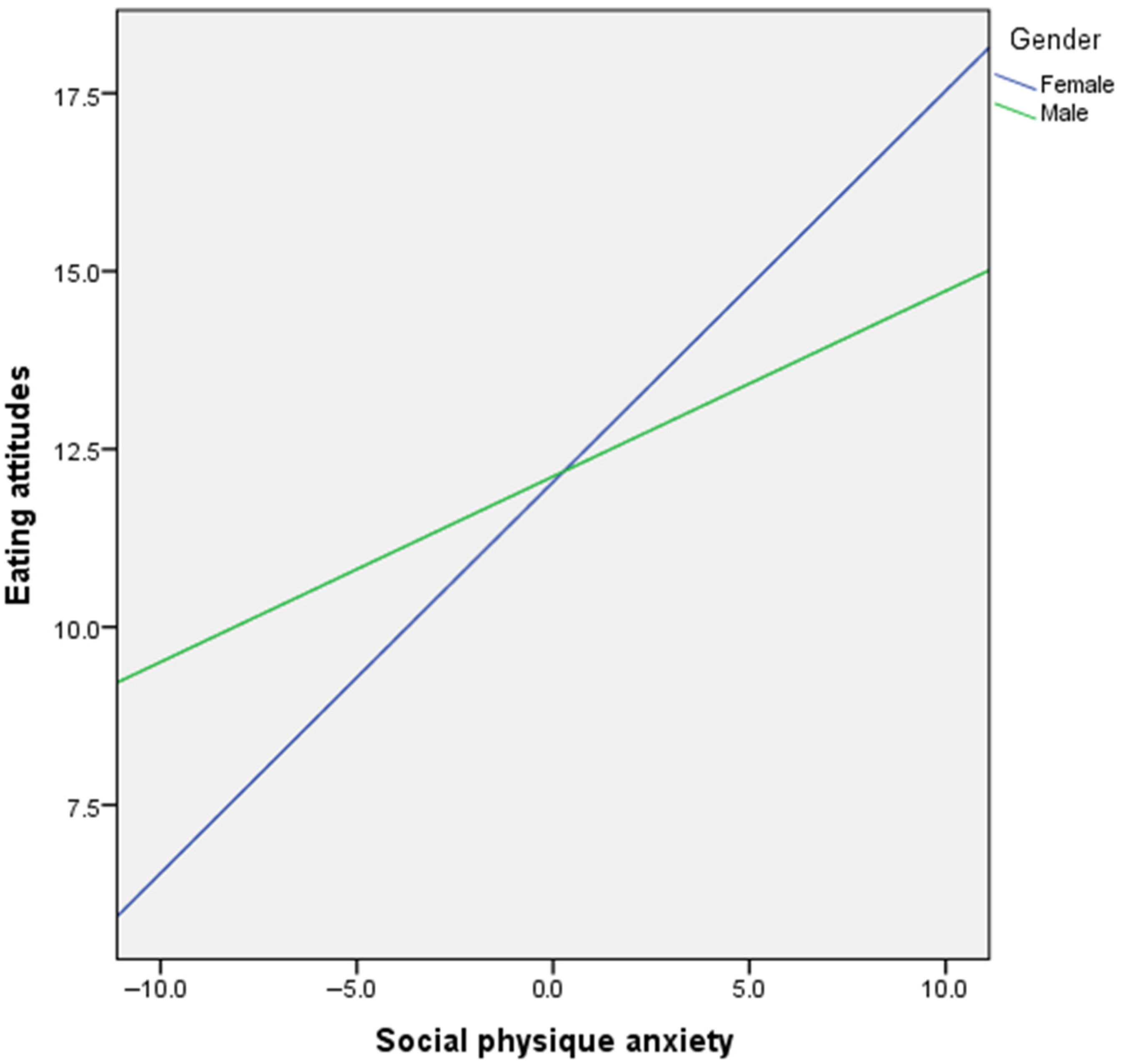
A moderated mediation analysis was conducted using Hayes’ Model 14, in which gender specifically moderates the association between social physique anxiety and eating attitudes. In this model (Table 5), self-esteem continued to negatively predict social physique anxiety (path a: b = −0.97, 95% CI [−1.11, −0.84]), and social physique anxiety positively predicted disordered eating attitudes (path b: b = 0.84, 95% CI [0.59, 1.09]). In addition, the conditional effect of social physique anxiety on eating attitudes was significant for both genders (conditional path b for males: b = 0.26, 95% CI [0.10, 0.42], conditional path b for females: b = 0.55, 95% CI [0.44, 0.66]). As illustrated in Figure 2, the effect was stronger for females. The interaction between social physique anxiety and gender was also significant (b = −0.29, 95% CI [−0.47, −0.11]). The direct effect of self-esteem on eating attitudes remained non-significant in the presence of social physique anxiety in the model (path c′: b = 0.07, 95% CI [−0.10, 0.23]). The conditional indirect effects of self-esteem on eating attitudes were significant for both genders. However, the effect was stronger among females (conditional indirect effect for males: b = −0.25, 95% CI [−0.45, −0.06], conditional indirect effect for females: b = −0.54, 95% CI [−0.69, −0.40]). The index of moderated mediation was significant (b = 0.28, 95% CI [0.07, 0.51]), indicating that the indirect effect of self-esteem on disordered eating attitudes through social physique anxiety varied as a function of gender.

4. Discussion

The present study examined the association between self-esteem and eating attitudes among emerging adults, focusing on the mediating role of social physique anxiety and the moderating role of gender. The findings revealed that social physique anxiety fully mediated the relationship between self-esteem and eating attitudes, with the indirect effect being stronger among women. These findings suggest that during emerging adulthood—a developmental stage marked by heightened self-focus, social comparison, and life transitions—individuals with lower self-esteem may be particularly sensitive to perceived evaluations of their bodies. This heightened social physique anxiety can, in turn, be related to greater preoccupation with weight and shape, leading to the adoption of unhealthy or disordered eating behaviors as a means of coping with body-related distress. Women, in particular, seem to be more vulnerable to this cycle, likely due to intensified sociocultural pressures to conform to narrow beauty ideals and greater exposure to appearance-based scrutiny.
Eating disorders and unhealthy eating behaviors are highly prevalent, especially among emerging adults who experience major life changes and ongoing identity exploration (Potterton et al., 2020). Numerous studies have associated lower self-esteem with an increased risk of developing dysfunctional eating patterns and behaviors (Dakanalis et al., 2016; Fairburn et al., 2003; Goldschmidt et al., 2016; Krauss et al., 2023; Shea & Pritchard, 2007). Consistent with this literature, our results showed that self-esteem was negatively correlated with unhealthy eating attitudes, dieting behaviors and bulimia-related tendencies, further underscoring the critical role of self-perception in shaping eating pathology during this vulnerable developmental period.
Despite the robust evidence linking low self-esteem with eating pathology, the specific mechanisms through which negative self-evaluations increase vulnerability to disordered eating are not fully understood. We hypothesized that social physique anxiety may function as an intermediate process connecting self-esteem and eating attitudes, and our findings supported this hypothesis, revealing that social physique anxiety fully mediated this relationship. Previous studies suggest that individuals who view themselves negatively tend to experience heightened concern and distress regarding the interpersonal evaluation of their body (Diehl et al., 1998; Kosmidou et al., 2017; Tsartsapakis & Zafeiroudi, 2025; Tsartsapakis et al., 2023). Moreover, individuals who experience greater anxiety about their body image are more likely to engage in maladaptive eating habits, such as restrictive dieting and binge eating (Alcaraz-Ibáñez et al., 2020, 2023; Cox et al., 1997; Diehl et al., 1998; Fitzsimmons-Craft et al., 2012; Han et al., 2019). Although there is empirical support for these associations, only one prior study, by Brunet et al. (2010), has examined the mediating role of social physique anxiety in the relationship between self-esteem and eating attitudes, demonstrating this pathway among adolescents. Our findings extend this association to emerging adulthood, a developmental stage characterized by instability and exploration. During this period, individuals may be particularly sensitive to others’ evaluations and, consequently, more prone to adopting risky or unhealthy behaviors. Within this context, our findings suggest that emerging adults with lower self-esteem are more likely to worry about the way others perceive their body shape and size. These excessive concerns may, in turn, be associated with disordered eating attitudes, including weight control, preoccupation with food, and compensatory behaviors, potentially reflecting coping strategies to manage distress and anxiety surrounding body evaluation.
These findings should be considered within the broader sociocultural context. The westernization of the Greek culture may be associated with increased exposure to social media, which can promote the internalization of and comparison with unrealistic body ideals, thereby contributing to greater body dissatisfaction and disordered eating (Bonfanti et al., 2025; Rodgers et al., 2023). In this context, social anxiety related to body evaluation may be further heightened as social media reinforce the thin-body ideal. Consequently, behaviors such as excessive dieting, binge eating and other disordered eating patterns may emerge as mechanisms to cope with the resulting distress.
Furthermore, our findings indicated that gender plays a moderating role in the relationship between self-esteem, social physique anxiety, and eating attitudes, with women being more strongly affected by social physique anxiety than men. Evidence shows that women generally report lower levels of self-esteem (Bleidorn et al., 2016). Additionally, women are more prone to anxiety caused by the social evaluation of their appearance (Brunet et al., 2010; Zartaloudi et al., 2023), while they more frequently adopt maladaptive eating attitudes compared to men (Qian et al., 2022; Striegel-Moore et al., 2009). All these together emphasize the increased vulnerability of women. The results of the present study highlight that women with low self-esteem may be in heightened risk, because they seem to be more concerned on their physical appearance and thus may engage more in disordered eating. Eating disorders are multifactorial, with the internalization of the thin ideal promoted by society being one of the factors associated with the onset of eating disorders in the binge/purge spectrum (Stice et al., 2017). In addition, according to objectification theory, women are socialized to adopt an observer’s perspective of their own bodies, viewing themselves as objects to be evaluated (Fredrickson & Roberts, 1997). This self-objectification can exacerbate anxiety and stress in social contexts where physical appearance may be judged, thereby increasing women’s vulnerability to body dissatisfaction (Saunders et al., 2024) and maladaptive eating behaviors (Schaefer & Thompson, 2018).
Eating disorders constitute a major public health issue which requires not only an interdisciplinary approach to treatment but also the development of innovative prevention strategies. The findings of the present study suggest that individuals with low self-worth are at greater risk of engaging in unhealthy eating behaviors, emphasizing the need of targeted prevention efforts. Although self-esteem has been widely recognized as a key risk factor and is commonly addressed in prevention and intervention programs (Abdoli et al., 2025; Koreshe et al., 2023), the current study extends this understanding by identifying social physique anxiety as a critical mechanism linking self-esteem to eating pathology. These results highlight the importance of incorporating the construct of social physique anxiety into prevention frameworks. Moreover, interventions that aim to strengthen self-esteem and promote effective coping strategies for managing body-related concerns may be particularly beneficial in reducing vulnerability to disordered eating.
Future intervention strategies should also consider gender differences in the relationship between self-esteem, social anxiety about physical appearance, and eating attitudes. Our findings underscore the heightened vulnerability of women, who are more strongly affected by body-related concerns and anxiety. Societal pressures promoting unrealistic body ideals and the internalization of the thin beauty ideal are important risk factors for body dissatisfaction and eating-related difficulties (Thompson & Stice, 2001). Women are particularly susceptible to these pressures, as concerns about body shape and weight may lead them to adopt unhealthy eating attitudes in an effort to conform to societal standards. Thus, prevention and interventions should be designed to address gender-specific vulnerabilities and tailored to the psychological needs of both men and women. Specifically, intervention programs should aim to enhance women’s self-worth, as proposed by the transdiagnostic model by Fairburn et al. (2003), to reduce body-related anxiety, and promote adaptive coping strategies to manage social physique anxiety, using approaches such as psychoeducation, problem-solving, and cognitive-behavioral techniques. In addition, programs could focus on fostering a positive body image and improving critical engagement with social media content (Wood-Barcalow et al., 2010). Such interventions may be particularly effective in promoting healthy eating attitudes and behaviors, as well as in protecting against disordered eating among women.
The strengths of the present study include the use of widely used and validated psychometric instruments, the large sample size, and the integration of multiple variables within the model. This approach better captures the multifactorial nature of psychological phenomena, allowing for a more comprehensive investigation of the constructs and their interrelationships. Nonetheless, several limitations should be acknowledged. First, the cross-sectional design of the study limits the ability to draw conclusions regarding the directionality and the causality of the observed effects, and the findings should therefore be interpreted with caution. Future longitudinal studies could provide a greater insight into the temporal dynamics among self-esteem, social physique anxiety, and eating attitudes. Second, the underrepresentation of males in the sample resulted in an unbalanced gender ratio, which might have influenced the findings. Third, the use of a convenience sample consisting of university students limits the generalizability of the findings, as this group typically exhibits higher education level and socioeconomic status compared to emerging adults not enrolled in higher education. Moreover, the combination of two recruitment methods (on campus and online) may have introduced some bias; however, consistent procedures were followed to minimize potential systematic differences between the two groups. These factors—the unbalanced gender ratio, convenience sampling and the use of two recruitment methods—are highlighted to encourage readers to interpret the findings with appropriate caution. In future research, the use of larger, more demographically diverse and gender-balanced samples of emerging adults would enhance the replicability of the findings. Finally, data collection relied solely on self-report measures, which may have introduced biases related to memory distortion and social desirability. Given the sensitivity of the variables assessed, future studies should employ mixed-method designs or incorporate measures from multiple sources to address this limitation.

5. Conclusions

The present study examined the association between self-esteem and eating attitudes among emerging adults. The findings support previous evidence indicating that lower self-esteem is related to more dysfunctional eating behaviors. Importantly, the results extend existing research by identifying social physique anxiety as a key mechanism linking self-esteem with eating attitudes. Specifically, social physique anxiety fully mediated the relationship between self-esteem and eating attitudes, suggesting that emerging adults with a negative self-image may experience increased stress in the face of interpersonal evaluations of body appearance, which in turn might worsen eating patterns. Furthermore, the findings revealed that these associations were stronger among women, highlighting their increased vulnerability to body-related concerns and disordered eating. The study underscores the importance of building a strong sense of self-worth and promoting efficient coping mechanisms for managing social physique anxiety in prevention and intervention efforts among emerging adults. Such interventions should account for gender differences and be tailored to address the unique psychological needs of each gender. Prevention programs informed by these findings could specifically target the vulnerable population of women, aiming to enhance self-esteem and reduce body-related social anxiety. In conclusion, the study contributes both to theoretical knowledge by clarifying the psychological process through which self-esteem influences eating attitudes and to practical knowledge by identifying key targets for intervention and prevention.

Author Contributions

Conceptualization, K.K.; methodology, C.M. and K.K.; validation, C.M. and K.K.; formal analysis, C.M. and K.K.; investigation, C.M. and K.K.; data curation, C.M.; writing—original draft preparation, C.M.; writing—review and editing, K.K.; visualization, C.M.; supervision, K.K.; project administration, K.K. All authors have read and agreed to the published version of the manuscript.

Funding

This research received no external funding.

Institutional Review Board Statement

The study was conducted in accordance with the Declaration of Helsinki, and approved by the Psychology Department’s Research Ethics Committee at the University of Crete (protocol code 182/6 March 2018).

Informed Consent Statement

Informed consent was obtained from all participants involved in the study.

Data Availability Statement

Data supporting these findings are available upon reasonable request from the corresponding author.

Acknowledgments

We are very grateful to all participants in the study.

Conflicts of Interest

The authors declare no conflicts of interest.

Abbreviations

The following abbreviations are used in this manuscript:
BMIBody Mass Index
EATEating Attitudes
EAT-26Eating Attitudes Test-26
RSESRosenberg Self-Esteem Scale
SESelf-esteem
SPASocial Physique Anxiety
SPASSocial Physique Anxiety Scale

References

  1. Abdoli, M., Schiechtl, E., Rosato, M. S., Mangweth-Matzek, B., Cotrufo, P., & Hüfner, K. (2025). Body image, self-esteem, emotion regulation, and eating disorders in adults: A systematic review. Neuropsychiatrie, 39, 118–132. [Google Scholar] [CrossRef] [PubMed]
  2. Alcaraz-Ibáñez, M., Paterna, A., & Griffiths, M. D. (2023). Social physical anxiety and eating disorders: A systematic review and meta-analysis. Body Image, 45, 133–141. [Google Scholar] [CrossRef] [PubMed]
  3. Alcaraz-Ibáñez, M., Paterna, A., Griffiths, M. D., & Sicilia, Á. (2020). Examining the role of social physique anxiety on the relationship between physical appearance comparisons and disordered eating symptoms among Spanish emerging adults. Scandinavian Journal of Psychology, 61(6), 803–808. [Google Scholar] [CrossRef] [PubMed]
  4. Arnett, J. J., Žukauskienė, R., & Sugimura, K. (2014). The new life stage of emerging adulthood at ages 18–29 years: Implications for mental health. The Lancet Psychiatry, 1(7), 569–576. [Google Scholar] [CrossRef]
  5. Bleidorn, W., Arslan, R. C., Denissen, J. J., Rentfrow, P. J., Gebauer, J. E., Potter, J., & Gosling, S. D. (2016). Age and gender differences in self-esteem—A cross-cultural window. Journal of Personality and Social Psychology, 111(3), 396–410. [Google Scholar] [CrossRef]
  6. Bonfanti, R. C., Melchiori, F., Teti, A., Albano, G., Raffard, S., Rodgers, R., & Coco, G. L. (2025). The association between social comparison in social media, body image concerns and eating disorder symptoms: A systematic review and meta-analysis. Body Image, 52, 101841. [Google Scholar] [CrossRef]
  7. Brunet, J., Sabiston, C. M., Dorsch, K. D., & McCreary, D. R. (2010). Exploring a model linking social physique anxiety, drive for muscularity, drive for thinness and self-esteem among adolescent boys and girls. Body Image, 7(2), 137–142. [Google Scholar] [CrossRef]
  8. Chung, J. M., Robins, R. W., Trzesniewski, K. H., Noftle, E. E., Roberts, B. W., & Widaman, K. F. (2014). Continuity and change in self-esteem during emerging adulthood. Journal of Personality and Social Psychology, 106(3), 469–483. [Google Scholar] [CrossRef]
  9. Costarelli, V., Demerzi, M., & Stamou, D. (2009). Disordered eating attitudes in relation to body image and emotional intelligence in young women. Journal of Human Nutrition and Dietetics, 22(3), 239–245. [Google Scholar] [CrossRef]
  10. Cox, L. M., Lantz, C. D., & Mayhew, J. L. (1997). The role of social physique anxiety and other variables in predicting eating behaviors in college students. International Journal of Sport Nutrition, 7(4), 310–317. [Google Scholar] [CrossRef]
  11. Dakanalis, A., Timko, A., Serino, S., Riva, G., Clerici, M., & Carrà, G. (2016). Prospective psychosocial predictors of onset and cessation of eating pathology amongst college women. European Eating Disorders Review, 24(3), 251–256. [Google Scholar] [CrossRef] [PubMed]
  12. Diehl, N. S., Johnson, C. E., Rogers, R. L., & Petrie, T. A. (1998). Social physique anxiety and disordered eating: What’s the connection? Addictive Behaviors, 23(1), 1–6. [Google Scholar] [CrossRef] [PubMed]
  13. Doninger, G. L., Enders, C. K., & Burnett, K. F. (2005). Validity evidence for eating attitudes test scores in a sample of female college athletes. Measurement in Physical Education and Exercise Science, 9(1), 35–49. [Google Scholar] [CrossRef]
  14. Eklund, M., Bäckström, M., & Hansson, L. (2018). Psychometric evaluation of the Swedish version of Rosenberg’s self-esteem scale. Nordic Journal of Psychiatry, 72(5), 318–324. [Google Scholar] [CrossRef]
  15. El-Jor, C., Hallez, Q., Filippone, L., Flaudias, V., & Shankland, R. (2025). Disordered eating in emerging adults: A narrative review and recommendations for prevention. Emerging Adulthood, 13(3), 721–747. [Google Scholar] [CrossRef]
  16. Fairburn, C. G., Cooper, Z., & Shafran, R. (2003). Cognitive behaviour therapy for eating disorders: A “transdiagnostic” theory and treatment. Behaviour Research and Therapy, 41(5), 509–528. [Google Scholar] [CrossRef]
  17. Faul, F., Erdfelder, E., Lang, A.-G., & Buchner, A. (2007). G*Power 3: A flexible statistical power analysis program for the social, behavioral, and biomedical sciences. Behavior Research Methods, 39(2), 175–191. [Google Scholar] [CrossRef]
  18. Fitzsimmons-Craft, E. E. (2011). Social psychological theories of disordered eating in college women: Review and integration. Clinical Psychology Review, 31(7), 1224–1237. [Google Scholar] [CrossRef]
  19. Fitzsimmons-Craft, E. E., Harney, M. B., Brownstone, L. M., Higgins, M. K., & Bardone-Cone, A. M. (2012). Examining social physique anxiety and disordered eating in college women. The roles of social comparison and body surveillance. Appetite, 59(3), 796–805. [Google Scholar] [CrossRef]
  20. Fredrickson, B. L., & Roberts, T. A. (1997). Objectification theory: Toward understanding women’s lived experiences and mental health risks. Psychology of Women Quarterly, 21(2), 173–206. [Google Scholar] [CrossRef]
  21. Galmiche, M., Déchelotte, P., Lambert, G., & Tavolacci, M. P. (2019). Prevalence of eating disorders over the 2000–2018 period: A systematic literature review. The American Journal of Clinical Nutrition, 109(5), 1402–1413. [Google Scholar] [CrossRef]
  22. Garner, D. M., Olmsted, M. P., Bohr, Y., & Garfinkel, P. E. (1982). The eating attitudes test: Psychometric features and clinical correlates. Psychological Medicine, 12(4), 871–878. [Google Scholar] [CrossRef] [PubMed]
  23. Georgas, D. (1999). Psychological dimensions of modern family. The Greek Review of Social Research, 98, 21–47. [Google Scholar] [CrossRef]
  24. Goldschmidt, A. B., Wall, M. M., Zhang, J., Loth, K. A., & Neumark-Sztainer, D. (2016). Overeating and binge eating in emerging adulthood: 10-year stability and risk factors. Developmental Psychology, 52(3), 475–483. [Google Scholar] [CrossRef] [PubMed]
  25. Gonidakis, F., Lemonoudi, M., Charila, D., & Varsou, E. (2018). A study on the interplay between emerging adulthood and eating disorder symptomatology in young adults. Eating and Weight Disorders-Studies on Anorexia, Bulimia and Obesity, 23(6), 797–805. [Google Scholar] [CrossRef]
  26. Gómez-Lugo, M., Espada, J., Morales, A., Marchal-Bertrand, L., Soler, F., & Vallejo-Medina, P. (2016). Adaptation, validation, reliability and factorial equivalence of the Rosenberg self-esteem scale in Colombian and Spanish population. The Spanish Journal of Psychology, 19, E66. [Google Scholar] [CrossRef]
  27. Grabe, S., Ward, L. M., & Hyde, J. S. (2008). The role of the media in body image concerns among women: A meta-analysis of experimental and correlational studies. Psychological Bulletin, 134(3), 460–476. [Google Scholar] [CrossRef]
  28. Han, J. H., Kim, S. A., Kim, S., & Park, J. Y. (2019). Factors influencing disordered eating behavior based on the theory of triadic influence. Perspectives in Psychiatric Care, 55(3), 366–371. [Google Scholar] [CrossRef]
  29. Hart, E. A., Leary, M. R., & Rejeski, W. J. (1989). The measurement of social physique anxiety. Journal of Sport and Exercise Psychology, 11(1), 94–104. [Google Scholar] [CrossRef]
  30. Hayes, A. F. (2013). Introduction to mediation, moderation, and conditional process analysis: A regression-based approach. The Guilford Press. [Google Scholar]
  31. Kärkkäinen, U., Mustelin, L., Raevuori, A., Kaprio, J., & Keski-Rahkonen, A. (2018). Do disordered eating behaviours have long-term health-related consequences? European Eating Disorders Review, 26(1), 22–28. [Google Scholar] [CrossRef]
  32. Koreshe, E., Paxton, S., Miskovic-Wheatley, J., Bryant, E., Le, A., Maloney, D., National Eating Disorder Research Consortium, Touyz, S., & Maguire, S. (2023). Prevention and early intervention in eating disorders: Findings from a rapid review. Journal of Eating Disorders, 11(1), 38. [Google Scholar] [CrossRef] [PubMed]
  33. Kosmidou, E., Giannitsopoulou, E., & Moysidou, D. (2017). Social physique anxiety and pressure to be thin in adolescent ballet dancers, rhythmic gymnastics and swimming athletes. Research in Dance Education, 18(1), 23–33. [Google Scholar] [CrossRef]
  34. Krauss, S., Dapp, L. C., & Orth, U. (2023). The link between low self-esteem and eating disorders: A meta-analysis of longitudinal studies. Clinical Psychological Science, 11(6), 1141–1158. [Google Scholar] [CrossRef]
  35. Leary, M. R., & Kowalski, R. M. (1997). Social anxiety. Guilford Press. [Google Scholar]
  36. Liechty, J. M., & Lee, M. J. (2013). Longitudinal predictors of dieting and disordered eating among young adults in the US. International Journal of Eating Disorders, 46(8), 790–800. [Google Scholar] [CrossRef]
  37. Nagata, J. M., Garber, A. K., Tabler, J. L., Murray, S. B., & Bibbins-Domingo, K. (2018). Prevalence and correlates of disordered eating behaviors among young adults with overweight or obesity. Journal of General Internal Medicine, 33(8), 1337–1343. [Google Scholar] [CrossRef]
  38. Neumark-Sztainer, D., Wall, M., Guo, J., Story, M., Haines, J., & Eisenberg, M. (2006). Obesity, disordered eating, and eating disorders in a longitudinal study of adolescents: How do dieters fare 5 years later? Journal of the American Dietetic Association, 106(4), 559–568. [Google Scholar] [CrossRef]
  39. Potterton, R., Richards, K., Allen, K., & Schmidt, U. (2020). Eating disorders during emerging adulthood: A systematic scoping review. Frontiers in Psychology, 10, 3062. [Google Scholar] [CrossRef]
  40. Psychountaki, M., Stavrou, A. N., & Zervas, Ι. (2004, November 26–28). Social physique anxiety scale. Adaption to Greek population. Proceedings of the 8th National—3rd International Congress of Sport Psychology (pp. 28–30), Trikala, Greece. [Google Scholar]
  41. Qian, J., Wu, Y., Liu, F., Zhu, Y., Jin, H., Zhang, H., Wan, Y., Li, C., & Yu, D. (2022). An update on the prevalence of eating disorders in the general population: A systematic review and meta-analysis. Eating and Weight Disorders-Studies on Anorexia, Bulimia and Obesity, 27(2), 415–428. [Google Scholar] [CrossRef]
  42. Rodgers, R. F., Laveway, K., Campos, P., & de Carvalho, P. H. B. (2023). Body image as a global mental health concern. Cambridge Prisms: Global Mental Health, 10, e9. [Google Scholar] [CrossRef]
  43. Rosenberg, M. (1965). Rosenberg Self-Esteem Scale (RSES). APA PsycTests. [Google Scholar] [CrossRef]
  44. Sabiston, C. M., Sedgwick, W. A., Crocker, P. R. E., Kowalski, K. C., & Mack, D. E. (2007). Social physique anxiety in adolescence: An exploration of influences, coping strategies, and health behaviors. Journal of Adolescent Research, 22(1), 78–101. [Google Scholar] [CrossRef]
  45. Saunders, J. F., Nutter, S., Waugh, R., & Hayden, K. A. (2024). Testing body-related components of objectification theory: A meta-analysis of the relations between body shame, self-objectification, and body dissatisfaction. Body Image, 50, 101738. [Google Scholar] [CrossRef]
  46. Schaefer, L. M., Burke, N. L., & Thompson, J. K. (2019). Thin-ideal internalization: How much is too much? Eating and Weight Disorders-Studies on Anorexia, Bulimia and Obesity, 24(5), 933–937. [Google Scholar] [CrossRef] [PubMed]
  47. Schaefer, L. M., & Thompson, J. K. (2018). Self-objectification and disordered eating: A meta-analysis. International Journal of Eating Disorders, 51(6), 483–502. [Google Scholar] [CrossRef] [PubMed]
  48. Schoemann, A. M., Boulton, A. J., & Short, S. D. (2017). Determining power and sample size for simple and complex mediation models. Social Psychological and Personality Science, 8(4), 379–386. [Google Scholar] [CrossRef]
  49. Shea, M. E., & Pritchard, M. E. (2007). Is self-esteem the primary predictor of disordered eating? Personality and Individual Differences, 42(8), 1527–1537. [Google Scholar] [CrossRef]
  50. Simos, G. M. (1996). Investigation of potential preventive interventions for eating disorders [Unpublished doctoral dissertation. Aristotle University of Thessaloniki. [Google Scholar]
  51. Stice, E., Desjardins, C. D., Rohde, P., & Shaw, H. (2021). Sequencing of symptom emergence in anorexia nervosa, bulimia nervosa, binge eating disorder, and purging disorder and relations of prodromal symptoms to future onset of these disorders. Journal of Abnormal Psychology, 130(4), 377–387. [Google Scholar] [CrossRef]
  52. Stice, E., Gau, J. M., Rohde, P., & Shaw, H. (2017). Risk factors that predict future onset of each DSM–5 eating disorder: Predictive specificity in high-risk adolescent females. Journal of Abnormal Psychology, 126(1), 38–51. [Google Scholar] [CrossRef]
  53. Striegel-Moore, R. H., Rosselli, F., Perrin, N., DeBar, L., Wilson, G. T., May, A., & Kraemer, H. C. (2009). Gender difference in the prevalence of eating disorder symptoms. International Journal of Eating Disorders, 42(5), 471–474. [Google Scholar] [CrossRef]
  54. Striegel-Moore, R. H., Silberstein, L. R., Frensch, P., & Rodin, J. (1989). A prospective study of disordered eating among college students. International Journal of Eating Disorders, 8(5), 499–509. [Google Scholar] [CrossRef]
  55. Thompson, J. K., & Stice, E. (2001). Thin-ideal internalization: Mounting evidence for a new risk factor for body-image disturbance and eating pathology. Current Directions in Psychological Science, 10(5), 181–183. [Google Scholar] [CrossRef]
  56. Tsagarakis, M., Kafetsios, K., & Stalikas, A. (2007). Reliability and validity of the Greek version of the revised experiences in close relationships measure of adult attachment. European Journal of Psychological Assessment, 23(1), 47–55. [Google Scholar] [CrossRef]
  57. Tsartsapakis, I., & Zafeiroudi, A. (2025). Social physique anxiety in college students: The role of study field, physical activity, physical self-perception, and self-esteem. Sports, 13(4), 119. [Google Scholar] [CrossRef] [PubMed]
  58. Tsartsapakis, I., Zafeiroudi, A., Vanna, G., & Gerou, M. (2023). Relationships of body dissatisfaction and self-esteem with social physique anxiety among university students in different study programs. Trends in Psychology, 33(3), 1175–1188. [Google Scholar] [CrossRef]
  59. Vlachakis, D., & Vlachaki, C. (2014). Prevalence of disordered eating attitudes in young adults. PeerJ PrePrints 2, e538v1. [Google Scholar] [CrossRef]
  60. Wang, S. B., Haynos, A. F., Wall, M. M., Chen, C., Eisenberg, M. E., & Neumark-Sztainer, D. (2019). Fifteen-year prevalence, trajectories, and predictors of body dissatisfaction from adolescence to middle adulthood. Clinical Psychological Science, 7(6), 1403–1415. [Google Scholar] [CrossRef]
  61. Ward, Z. J., Rodriguez, P., Wright, D. R., Austin, S. B., & Long, M. W. (2019). Estimation of eating disorders prevalence by age and associations with mortality in a simulated nationally representative US cohort. JAMA Network Open, 2(10), e1912925. [Google Scholar] [CrossRef]
  62. Wood-Barcalow, N. L., Tylka, T. L., & Augustus-Horvath, C. L. (2010). “But I like my body”: Positive body image characteristics and a holistic model for young-adult women. Body Image, 7(2), 106–116. [Google Scholar] [CrossRef]
  63. Xu, Y., Yin, C., Jia, H., Li, X., Zhao, S., Lv, Y., Jia, S., Meng, Y., Li, Y., & Gao, X. (2025). Global, regional, and national burdens of eating disorders in adolescents and young adults aged 10–24 years from 1990 to 2021, with projections to 2040. Journal of Affective Disorders, 389, 119680. [Google Scholar] [CrossRef]
  64. Yamamiya, Y., & Stice, E. (2024). Risk factors that predict future onset of anorexia nervosa, bulimia nervosa, binge eating disorder, and purging disorder in adolescent girls. Behavior Therapy, 55(4), 712–723. [Google Scholar] [CrossRef]
  65. Zartaloudi, A., Christopoulos, D., Kelesi, M., Govina, O., Mantzorou, M., Adamakidou, T., Karvouni, L., Koutelekos, I., Evangelou, E., Fasoi, G., & Vlachou, E. (2023). Body image, social physique anxiety levels and self-esteem among adults participating in physical activity programs. Diseases, 11(2), 66. [Google Scholar] [CrossRef]
Figure 1. Hypothesized model with social physique anxiety as the mediator between self-esteem and eating attitudes. (A) Total effect of self-esteem on eating attitudes (path c); (B) mediation model showing path a (self-esteem → social physique anxiety), path b (social physique anxiety → eating attitudes), and the direct effect of self-esteem on eating attitudes after including mediator in the model (path c′). X: Independent variable; Y: Dependent variable; M: Mediator.
Psycholint 08 00004 g001
Figure 2. The moderating role of gender: Conditional effect of social physique anxiety on eating attitudes (path b) for males and females.
Psycholint 08 00004 g002
Table 1. Socio-demographic characteristics of the participants (N = 495).
Frequency (Ν)Percentage (%)
Gender
     Male15431.1
     Female34168.9
Nationality
     Greek47596.2
     Cypriot163.2
     Other30.6
Educational level
     Undergraduate student48498.2
     Postgraduate student91.8
Relationship status
     Single29359.4
     In a relationship20040.6
Residence
     Alone35170.9
     With others14429.1
Birthplace
     Urban39279.2
     Rural10320.8
Place of residence
     Urban 47395.7
     Rural214.3
Past eating disorder
     No44690.8
     Yes459.2
Current eating disorder
     No45091.5
     Yes428.5
Past nutritionist visit
     No35371.5
     Yes14128.5
Physical activity
     None346.9
     Rare8016.2
     Moderate13226.7
     Frequent12224.7
     Intensive12625.5
Mean (SD)Min–Max
Age (years)20.94 (1.97)18.0–30.0
Height (m)1.70 (0.09)1.5–2.0
Weight (kg)66.80 (12.88)35.0–136.0
Body Mass Index (kg/m2)22.93 (3.28)14.0–44.9
Table 2. Descriptive statistics and gender differences in study variables.
Total Sample
(N = 495)
Males
(N = 154)
Females
(N = 341)
tp
MeanSDMinMaxMeanSDMeanSD
Self-esteem (RSES − Total score)30.795.3813.040.031.794.9430.345.52−2.790.005
Social physique anxiety (SPAS − Total score)31.859.8812.060.027.198.6133.959.717.42<0.001
Dieting (EAT-26)7.226.880.033.05.795.047.877.483.61<0.001
Bulimia and Food Preoccupation (EAT-26)2.162.810.012.02.202.632.142.89−0.200.843
Oral Control (EAT-26)3.102.880.018.02.982.483.163.040.690.492
Eating attitudes (EAT-26 − Total score)12.489.530.049.010.977.5513.1610.242.670.008
Abbreviations: EAT-26: Eating Attitudes Test-26; RSES: Rosenberg Self-Esteem Scale; SPAS: Social Physique Anxiety Scale. Bold font indicates statistical significance at p < 0.05.
Table 3. Bivariate correlations (Pearson’s r) between study variables.
1.2.3.4.5.6.
1. Self-esteem (RSES − Total score)1
2. Social physique anxiety (SPAS − Total score)−0.53 ***1
3. Dieting (EAT-26)−0.21 ***0.50 ***1
4. Bulimia and Food Preoccupation (EAT-26)−0.18 ***0.33 ***0.59 ***1
5. Oral Control (EAT-26)−0.06−0.000.10 *0.041
6. Eating attitudes (EAT-26 − Total score)−0.22 ***0.46 ***0.93 ***0.74 ***0.38 ***1
Abbreviations: EAT-26: Eating Attitudes Test-26; RSES: Rosenberg Self-Esteem Scale; SPAS: Social Physique Anxiety Scale. * p < 0.05. *** p < 0.001.
Table 4. Mediation analysis of the relationship between self-esteem and eating attitudes through social physique anxiety (Hayes’ Model 4).
Pathβ Coefficient b (95% CI)Standard Errortp
a: SE → SPA−0.53−0.97 (−1.11, −0.84)0.07−13.89<0.001
b: SPA → EAT0.470.46 (0.37, 0.55)0.059.99<0.001
c: SE → EAT (Total effect)−0.22−0.40 (−0.55, −0.24)0.08−5.10<0.001
c′: SE → EAT (Direct effect)0.030.05 (−0.12, 0.21)0.080.560.578
a×b: SE → SPA → EAT (Indirect effect) −0.25−0.44 (−0.57, −0.32)0.06
Abbreviations: EAT: Eating Attitudes; SE: Self-esteem; SPA: Social Physique Anxiety. Notes: The β coefficients are completely standardized. Bootstrapped standard error and 95% confidence interval (5000 samples) are reported for the indirect effect. The indirect effect is considered statistically significant when the corresponding 95% confidence interval does not include zero.
Table 5. Moderated (by gender) mediation analysis of the relationship between self-esteem and eating attitudes through social physique anxiety (Hayes’ Model 14).
Pathb (95% CI)Standard Errortp
a: SE → SPA−0.97 (−1.11, −0.84)0.07−13.89<0.001
b: SPA → EAT0.84 (0.59, 1.09)0.136.62<0.001
Conditional b: Male0.26 (0.10, 0.42)0.083.190.002
Conditional b: Female0.55 (0.44, 0.66)0.0510.24<0.001
Interaction: SPA × Gender−0.29 (−0.47, −0.11)0.09−3.140.002
c′: SE → EAT (Direct effect)0.07 (−0.10, 0.23)0.080.780.434
Conditional indirect effect: Male−0.25 (−0.45, −0.06)0.10
Conditional indirect effect: Female−0.54 (−0.69, −0.40)0.08
Index of moderated mediation0.28 (0.07, 0.51)0.11
Abbreviations: EAT: Eating Attitudes; SE: Self-esteem; SPA: Social Physique Anxiety. Notes: Bootstrapped standard errors and 95% confidence intervals (5000 samples) are reported for conditional indirect effects and the index of moderated mediation. Conditional indirect effects and the index of moderated mediation are considered statistically significant when the corresponding 95% confidence intervals do not include zero.
Disclaimer/Publisher’s Note: The statements, opinions and data contained in all publications are solely those of the individual author(s) and contributor(s) and not of MDPI and/or the editor(s). MDPI and/or the editor(s) disclaim responsibility for any injury to people or property resulting from any ideas, methods, instructions or products referred to in the content.