
Epidemiology of Short-Stay Unit Emergency Calls in a Tertiary Emergency Department: A TECOR Study

 ,
,  , ,
, , 
Abstract
1. Introduction
2. Materials and Methods
2.1. Setting

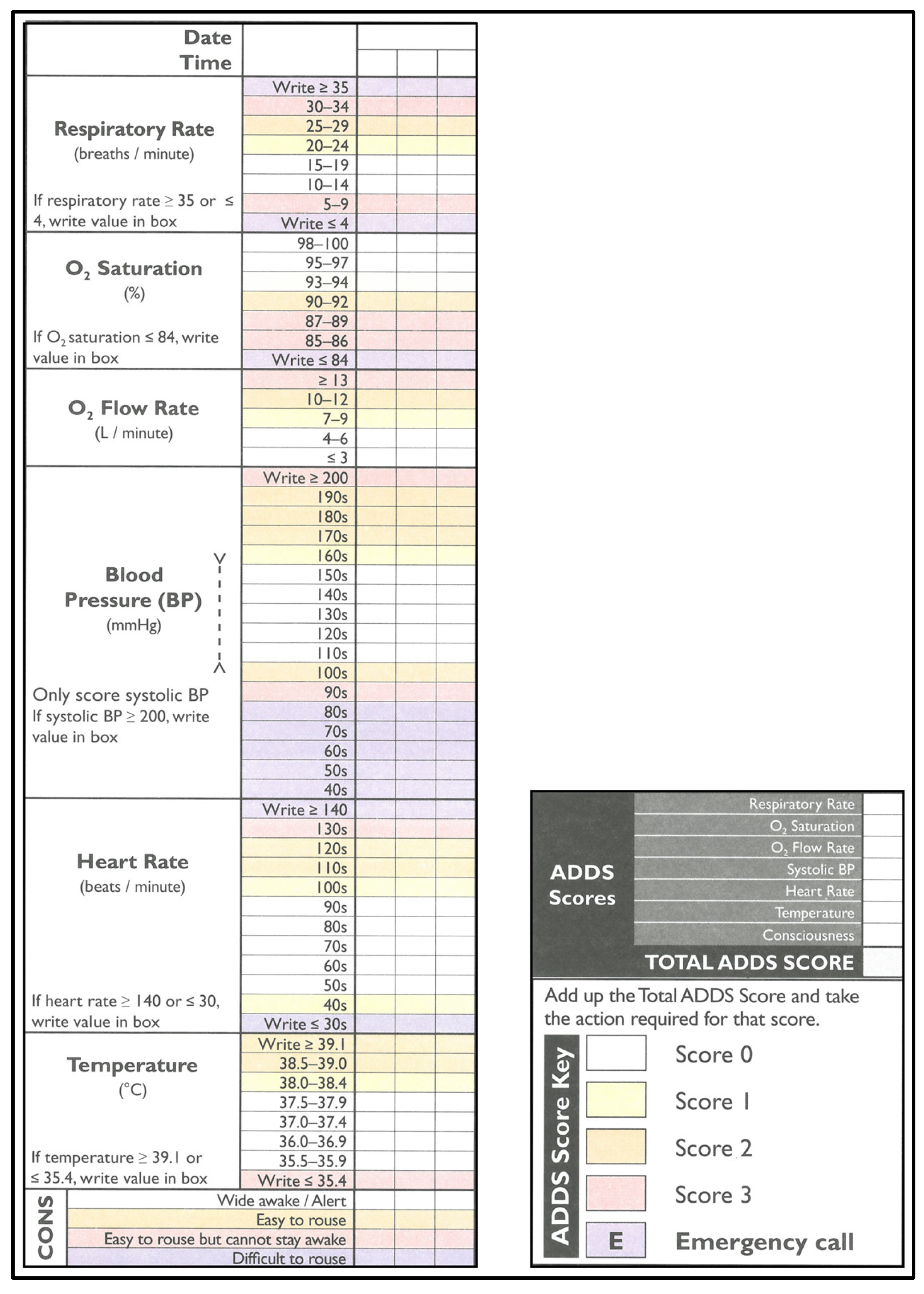
| Call Type | Criteria |
|---|---|
| MET Call | Any observation in the purple area 1 |
| A total ADDS 2 score greater than or equal to 8 1 | |
| Airway threat | |
| Serious concern about the patient | |
| New drop in oxygen saturation < 90% | |
| Sudden fall in level of consciousness | |
| Seizure | |
| Code Blue | Impending or actual cardiac or respiratory arrest |
| Impending or actual airway compromise |
2.2. Methods
2.3. Inclusion Criteria
2.4. Exclusion Criteria
2.5. Data Analysis
2.6. Ethical Approval
3. Results
3.1. Incidence of Emergency Calls
3.2. Characteristics of Patients Requiring an Emergency Call
3.3. Emergency Call Characteristics
3.4. Emergency Call Management and Outcomes
4. Discussion
Limitations
5. Conclusions
Author Contributions
Funding
Institutional Review Board Statement
Informed Consent Statement
Data Availability Statement
Conflicts of Interest
Abbreviations
| SSU | Short-Stay Unit |
| ED(s) | Emergency Department(s) |
| RRS | Rapid Response System |
| MET | Medical Emergency Team |
| TECOR | Tasmanian Emergency Care Outcomes Registry |
| ADDS | Adult Deterioration Detection Score |
| GOC | Goals of Care |
| CCM | Continuous Cardiac Monitoring |
| GCS | Glasgow Coma Scale |
Appendix A

References
- Baugh, C.W.; Venkatesh, A.K.; Bohan, J.S. Emergency department observation units: A clinical and financial benefit for hospitals. Health Care Manag. Rev. 2011, 36, 28–37. [Google Scholar] [CrossRef] [PubMed]
- Konnyu, K.J.; Kwok, E.; Skidmore, B.; Moher, D. The effectiveness and safety of emergency department short stay units: A rapid review. Open Med. J. 2012, 6, e10–e16. [Google Scholar]
- Galipeau, J.; Pussegoda, K.; Stevens, A.; Brehaut, J.C.; Curran, J.; Forster, A.J.; Tierney, M.; Kwok, E.S.; Worthington, J.R.; Campbell, S.G.; et al. Effectiveness and safety of short-stay units in the emergency department: A systematic review. Acad. Emerg. Med. 2015, 22, 893–907. [Google Scholar] [CrossRef] [PubMed]
- Andrews, L.B.; Stocking, C.; Krizek, T.; Gottlieb, L.; Krizek, C.; Vargish, T.; Siegler, M. An alternative strategy for studying adverse events in medical care. Lancet 1997, 349, 309–313. [Google Scholar] [CrossRef]
- Davis, P.; Lay-Yee, R.; Briant, R.; Ali, W.; Scott, A.; Schug, S. Adverse events in New Zealand public hospitals I: Occurrence and impact. N. Z. Med. J. 2002, 115, U271. [Google Scholar]
- Leape, L.L.; Brennan, T.A.; Laird, N.; Lawthers, A.G.; Localio, A.R.; Barnes, B.A.; Hebert, L.; Newhouse, J.P.; Weiler, P.C.; Hiatt, H. The nature of adverse events in hospitalized patients—Results of the Harvard Medical Practice Study II. N. Engl. J. Med. 1991, 324, 377–384. [Google Scholar] [CrossRef]
- Schimmel, E.M. The hazards of hospitalization. Ann. Intern. Med. 1964, 60, 100–110. [Google Scholar] [CrossRef]
- Wilson, R.M.; Runciman, W.B.; Gibberd, R.W.; Harrison, B.T.; Newby, L.; Hamilton, J.D. The quality in Australian health care study. Med. J. Aust. 1995, 163, 458–471. [Google Scholar] [CrossRef]
- Jones, D.; Pearsell, J.; Wadeson, E.; See, E.; Bellomo, R. Rapid response system components and in-hospital cardiac arrests rates 21 years after introduction into an Australian teaching hospital. J. Patient Saf. 2023, 19, 478–483. [Google Scholar] [CrossRef]
- DeVita, M.A.; Bellomo, R.; Hillman, K.; Kellum, J.; Rotondi, A.; Teres, D.; Auerbach, A.; Chen, W.-J.; Duncan, K.; Kenward, G.; et al. Findings of the first consensus conference on medical emergency teams. Crit. Care Med. 2006, 34, 2463–2478. [Google Scholar] [CrossRef]
- Maharaj, R.; Raffaele, I.; Wendon, J. Rapid response systems: A systematic review and meta-analysis. Crit. Care 2015, 19, 254. [Google Scholar] [CrossRef] [PubMed]
- Winters, B.D.; Weaver, S.J.; Pfoh, E.R.; Yang, T.; Pham, J.C.; Dy, S.M. Rapid-response systems as a patient safety strategy: A systematic review. Ann. Intern. Med. 2013, 158, 417–425. [Google Scholar] [CrossRef] [PubMed]
- McGaughey, J.; Fergusson, D.A.; Van Bogaert, P.; Rose, L. Early warning systems and rapid response systems for the prevention of patient deterioration on acute adult hospital wards. Cochrane Database Syst. Rev. 2021. [Google Scholar] [CrossRef]
- Pearce, S.; Marr, E.; Shannon, T.; Marchand, T.; Lang, E. Overcrowding in emergency departments: An overview of reviews describing global solutions and their outcomes. Intern. Emerg. Med. 2024, 19, 483–491. [Google Scholar] [CrossRef]
- Australasian College for Emergency Medicine. Policy on Standard Terminology. Available online: https://acem.org.au/getmedia/e5cf7ac4-dae5-4193-be9a-6746b0d85009/Policy_on_Standard_Terminology (accessed on 27 March 2024).
- Savioli, G.; Ceresa, I.F.; Gri, N.; Bavestrello Piccini, G.; Longhitano, Y.; Zanza, C.; Piccioni, A.; Esposito, C.; Ricevuti, G.; Bressan, M.A. Emergency department overcrowding: Understanding the factors to find corresponding solutions. J. Pers. Med. 2022, 12, 279. [Google Scholar] [CrossRef]
- Singer, A.J.; Thode, H.C., Jr.; Viccellio, P.; Pines, J.M. The association between length of emergency department boarding and mortality. Acad. Emerg. Med. 2011, 18, 1324–1329. [Google Scholar] [CrossRef]
- Australasian College for Emergency Medicine. Position Statement: Access Block. Available online: https://acem.org.au/getmedia/c0bf8984-56f3-4b78-8849-442feaca8ca6/S127_v01_Statement_Access_Block_Mar_14.aspx (accessed on 17 September 2025).
- Clark, J.; Islam, M.S. Hospital access block: A scoping review. J. Emerg. Nurs. 2022, 48, 430–454. [Google Scholar] [CrossRef]
- Tran, V.; Dunbabin, T.; Page, S.; Thurlow, L.; Barrington, G. The Epidemiology of Emergency Calls in a Tertiary Emergency Department for Admitted Patients: A TECOR Study. Healthcare 2025, 13, 1670. [Google Scholar] [CrossRef]
- Tran, V.; Barrington, G.; Page, S. The Tasmanian Emergency Care Outcomes Registry (TECOR) Protocol. Emerg. Care Med. 2024, 1, 153–164. [Google Scholar] [CrossRef]
- Hill, A.; Horswill, M.S.; Preece, M.H.; Watson, M.O. The Development of the Adult Deterioration Detection System (ADDS) Chart; University of Queensland: Brisbane, Australia, 2010. [Google Scholar]
- Considine, J.; Jones, D.; Bellomo, R. Emergency department rapid response systems: The case for a standardized approach to deteriorating patients. Eur. J. Emerg. Med. 2013, 20, 375–381. [Google Scholar] [CrossRef]
- Adult Deterioration Detection System (ADDS) Chart with Blood Pressure Table, Developed by the Australian Commission on Safety and Quality in Health Care (ACSQHC); ACSQHC: Sydney, Australia, 2012.
- Smith, R.L.; Hayashi, V.N.; Lee, Y.I.; Navarro-Mariazeta, L.; Felner, K. The medical emergency team call: A sentinel event that triggers goals of care discussion. Crit. Care Med. 2014, 42, 322–327. [Google Scholar] [CrossRef]
- Kerkham, T.; Brain, M. Goals of care conversations and documentation in patients triggering medical emergency team calls. Intern. Med. J. 2020, 50, 1373–1376. [Google Scholar] [CrossRef] [PubMed]
- Nolan, J.; Mackay, I.; Nolan, T.; de Looze, J. Medical Emergency Team call within 24 h of medical admission with a focus on sepsis: A retrospective review. Intern. Med. J. 2024, 54, 961–969. [Google Scholar] [CrossRef] [PubMed]
- Wijesundera, P.; See, E.J.; Robbins, R.; Crosthwaite, A.; Smallwood, D.; Jones, D.; Bellomo, R. Features, risk factors, and outcomes of older internal medicine patients triggering a medical emergency team call. Acta Anaesthesiol. Scand. 2022, 66, 392–400. [Google Scholar] [CrossRef] [PubMed]
- Strøm, C.; Rasmussen, L.S.; Löwe, A.-S.; Lorentzen, A.K.; Lohse, N.; Madsen, K.H.B.; Rasmussen, S.W.; Schmidt, T.A. Short-stay unit hospitalisation vs. standard care outcomes in older internal medicine patients—A randomised clinical trial. Age Ageing 2018, 47, 810–817. [Google Scholar] [CrossRef]
- Strøm, C.; Mollerup, T.K.; Kromberg, L.S.; Rasmussen, L.S.; Schmidt, T.A. Hospitalisation in an emergency department short-stay unit compared to an internal medicine department is associated with fewer complications in older patients–an observational study. Scand. J. Trauma Resusc. Emerg. Med. 2017, 25, 80. [Google Scholar] [CrossRef]
- Basic, D.; Khoo, A. Admission variables predicting short lengths of stay of acutely unwell older patients: Relevance to emergency and medical short-stay units. Aust. Health Rev. 2009, 33, 502–512. [Google Scholar] [CrossRef][Green Version]
- Zhang, R.; Maher, B.; Ramos, J.; Hardidge, A.; Olenko, L.; Weinberg, L.; Robbins, R.; Churilov, L.; Peyton, P.; Jones, D. The epidemiology of Medical Emergency Team calls for orthopedic patients in a teaching hospital: A retrospective cohort study. Resuscitation 2021, 159, 1–6. [Google Scholar] [CrossRef]
- Hagedoorn, N.N.; Zachariasse, J.M.; Moll, H.A. Association between hypotension and serious illness in the emergency department: An observational study. Arch. Dis. Child. 2020, 105, 545–551. [Google Scholar] [CrossRef]
- Brekke, I.J.; Puntervoll, L.H.; Pedersen, P.B.; Kellett, J.; Brabrand, M. The value of vital sign trends in predicting and monitoring clinical deterioration: A systematic review. PLoS ONE 2019, 14, e0210875. [Google Scholar] [CrossRef]
- Chen, J.; Bellomo, R.; Flabouris, A.; Hillman, K.; Assareh, H.; Ou, L. Delayed emergency team calls and associated hospital mortality: A multicenter study. Crit. Care Med. 2015, 43, 2059–2065. [Google Scholar] [CrossRef]
- Tirkkonen, J.; Skrifvars, M.B.; Tamminen, T.; Parr, M.J.; Hillman, K.; Efendijev, I.; Aneman, A. Afferent limb failure revisited–A retrospective, international, multicentre, cohort study of delayed rapid response team calls. Resuscitation 2020, 156, 6–14. [Google Scholar] [CrossRef]
- Trinkle, R.M.; Flabouris, A. Documenting Rapid Response System afferent limb failure and associated patient outcomes. Resuscitation 2011, 82, 810–814. [Google Scholar] [CrossRef]
- Santiano, N.; Young, L.; Hillman, K.; Parr, M.; Jayasinghe, S.; Baramy, L.-S.; Stevenson, J.; Heath, T.; Chan, C.; Claire, M.; et al. Analysis of medical emergency team calls comparing subjective to “objective” call criteria. Resuscitation 2009, 80, 44–49. [Google Scholar] [CrossRef]
- Martland, J.; Chamberlain, D.; Hutton, A.; Smigielski, M. Communication and general concern criterion prior to activation of the rapid response team: A grounded theory. Aust. Health Rev. 2016, 40, 477–483. [Google Scholar] [CrossRef]
- Wood, C.; Chaboyer, W.; Carr, P. How do nurses use early warning scoring systems to detect and act on patient deterioration to ensure patient safety? A scoping review. Int. J. Nurs. Stud. 2019, 94, 166–178. [Google Scholar] [CrossRef]
| Category | Variable | n (%) |
|---|---|---|
| Gender | Female | 20 (52.63) |
| Male | 18 (47.37) | |
| Total | 38 | |
| Number of Calls/Gender | Female | 27 (50.00) |
| Male | 27 (50.00) | |
| Total | 54 | |
| Age | Mean (years ± SD) | 74.60 (17.01) |
| Range (min–max) | 35–96 | |
| Median (IQR) | 81.5 (65–86) | |
| Australian Triage Scale | 1 | - |
| 2 | 13 (34.21) | |
| 3 | 22 (57.89) | |
| 4 | 3 (7.89) | |
| 5 | - | |
| ED Length of Stay | Mean (hours ± SD) | 7.10 (4.53) |
| Range (min–max) | 0.5–18.8 | |
| Median (IQR) | 5.80 (4.20–9.20) | |
| ED SSU Length of Stay | Mean (hours ± SD) | 44.05 (25.60) |
| Range (min–max) | 6.25–109.73 | |
| Median (IQR) | 40.15 (26.05–58.28) | |
| Hospital Length of Stay | Mean (hours ± SD) | 176.74 (181.29) |
| Range (min–max) | 13–912 | |
| Median (IQR) | 123 (80–211) | |
| Disposition, n (%), Median SSU LOS hours | ICU | 3 (7.89), 31.13 |
| Ward | 26 (68.42), 42.72 | |
| Usual place of residence | 6 (15.79), 45.12 | |
| Other hospital | 1 (2.63), 29.43 | |
| Died in ED | 2 (5.26), 43.50 | |
| Top ten ED diagnosis (ICD-10), n (%) | Generally unwell/illness NOS (R69.0) Chest pain undifferentiated (R07.4) | 9 (23.68) |
| 4 (10.53) | ||
| Limb pain (M79.69) | 2 (5.26) | |
| Cellulitis of lower limb (L03.13) | 2 (5.26) | |
| Epistaxis (nosebleed) (R04.0) | 2 (5.26) | |
| Urinary tract infection (UTI) (N39.0) | 1 (2.63) | |
| Injury of head–not otherwise specified (S09.9) | 1 (2.63) | |
| Lower back pain (M54.5) Influenza-like Illness (ILI) (J11.1) | 1 (2.63) | |
| 1 (2.63) | ||
| Hyperglycaemia (R73) | 1 (2.63) |
| Category | Variable | n (%) |
|---|---|---|
| Call Type | MET Call | 52 (96.30) |
| Code Blue | 2 (3.70) | |
| Call Reason | Airway threat | 1 (1.85) |
| Difficulty breathing | 1 (1.85) | |
| Respiratory rate < 4 | - | |
| Respiratory rate > 35 | 3 (5.56) | |
| Oxygen saturation < 90% | 5 (9.26) | |
| Heart rate < 40 | 4 (7.41) | |
| Heart rate > 140 | 6 (11.11) | |
| Systolic blood pressure < 90 | 20 (37.04) | |
| Glasgow coma scale < 10 | 7 (12.96) | |
| Seizure | 4 (7.41) | |
| Serious concern | 7 (12.96) | |
| ADDS 1 | - | |
| Other | 1 (1.82) | |
| Call Duration | Mean (minutes ± SD) | 37.81 (17.22) |
| Range (min–max) | 8–101 | |
| Median (IQR) | 34.5 (30–42) | |
| Number of Emergency Calls | 1 | 28 (73.68) |
| 2 | 6 (15.79) | |
| 3 | 2 (5.26) | |
| 4 | 2 (5.26) | |
| 5 | - |
| Category | Variable | n (%) |
|---|---|---|
| ADDS 1 Modifications | None | 19 (35.19) |
| Systolic blood pressure | 19 (35.19) | |
| Heart rate | 8 (14.81) | |
| Oxygen saturation | 10 (18.52) | |
| Oxygen flow rate | - | |
| Temp | - | |
| Consciousness | 1 (1.185) | |
| Other | ||
| Goals of Care | Unchanged | 34 (62.96) |
| A to B 2 | - | |
| A or B to C 2 | - | |
| A or B or C to D 2 | 2 (3.70) | |
| Incomplete before emergency call | 18 (33.34) | |
| Incomplete after emergency call | 18 (33.34) | |
| Disposition | Unchanged | 40 (74.07) |
| Moved to resuscitation bay | 7 (12.96) | |
| Moved to ICU | 1 (1.85) | |
| Died | - | |
| Moved to main ED | 6 | |
| Delays to MET | Delay to MET | 10 (18.52) |
| Mean (minutes ± SD) | 82 (54.24) | |
| Range (min–max) | 31–205 | |
| Median (IQR) | 58.5 (44–121) | |
| Reason for delay(s) | None stated | 4 (40.00) |
| Appropriate staff in attendance | - | |
| Message sent | 2 (20.00) | |
| Called incorrect level of clinician | 7 (70.00) | |
| Called ED clinical review | - | |
| Severity not identified | 6 (60.00) | |
| Hospital Separation | Aged care | 2 (5.26) |
| Died | 4 (10.53) | |
| Public hospital | 1 (2.63) | |
| Other service | 2 (5.26) | |
| Usual residence/accommodation | 29 (76.32) |
Disclaimer/Publisher’s Note: The statements, opinions and data contained in all publications are solely those of the individual author(s) and contributor(s) and not of MDPI and/or the editor(s). MDPI and/or the editor(s) disclaim responsibility for any injury to people or property resulting from any ideas, methods, instructions or products referred to in the content. |
© 2026 by the authors. Licensee MDPI, Basel, Switzerland. This article is an open access article distributed under the terms and conditions of the Creative Commons Attribution (CC BY) license.
Share and Cite
Barrington, G.; Dunbabin, T.; Page, S.; Thurlow, L.; Tredoux, L.; Tran, V. Epidemiology of Short-Stay Unit Emergency Calls in a Tertiary Emergency Department: A TECOR Study. Emerg. Care Med. 2026, 3, 4. https://doi.org/10.3390/ecm3010004
Barrington G, Dunbabin T, Page S, Thurlow L, Tredoux L, Tran V. Epidemiology of Short-Stay Unit Emergency Calls in a Tertiary Emergency Department: A TECOR Study. Emergency Care and Medicine. 2026; 3(1):4. https://doi.org/10.3390/ecm3010004
Chicago/Turabian StyleBarrington, Giles, Toni Dunbabin, Simone Page, Lauren Thurlow, Lizette Tredoux, and Viet Tran. 2026. "Epidemiology of Short-Stay Unit Emergency Calls in a Tertiary Emergency Department: A TECOR Study" Emergency Care and Medicine 3, no. 1: 4. https://doi.org/10.3390/ecm3010004
APA StyleBarrington, G., Dunbabin, T., Page, S., Thurlow, L., Tredoux, L., & Tran, V. (2026). Epidemiology of Short-Stay Unit Emergency Calls in a Tertiary Emergency Department: A TECOR Study. Emergency Care and Medicine, 3(1), 4. https://doi.org/10.3390/ecm3010004