
Review

Assessing the Onset of Regional Anaesthesia: The Role of Thermographic Imaging
Department of Anaesthesia, Intensive Care Medicine and Acute Pain Medicine, Cork University Hospital, T12DC4A Cork, Ireland
*
Author to whom correspondence should be addressed.
Anesth. Res. 2025, 2(4), 27; https://doi.org/10.3390/anesthres2040027

Submission received: 11 August 2025 / Revised: 2 November 2025 / Accepted: 1 December 2025 / Published: 17 December 2025

Abstract

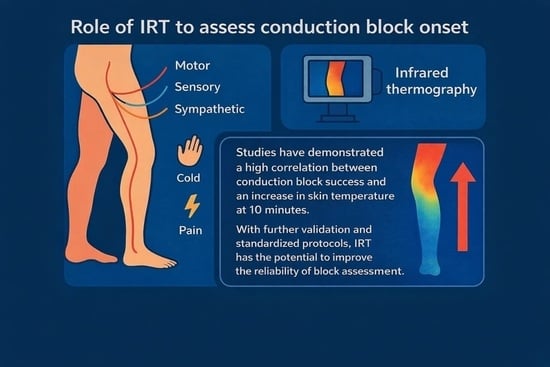
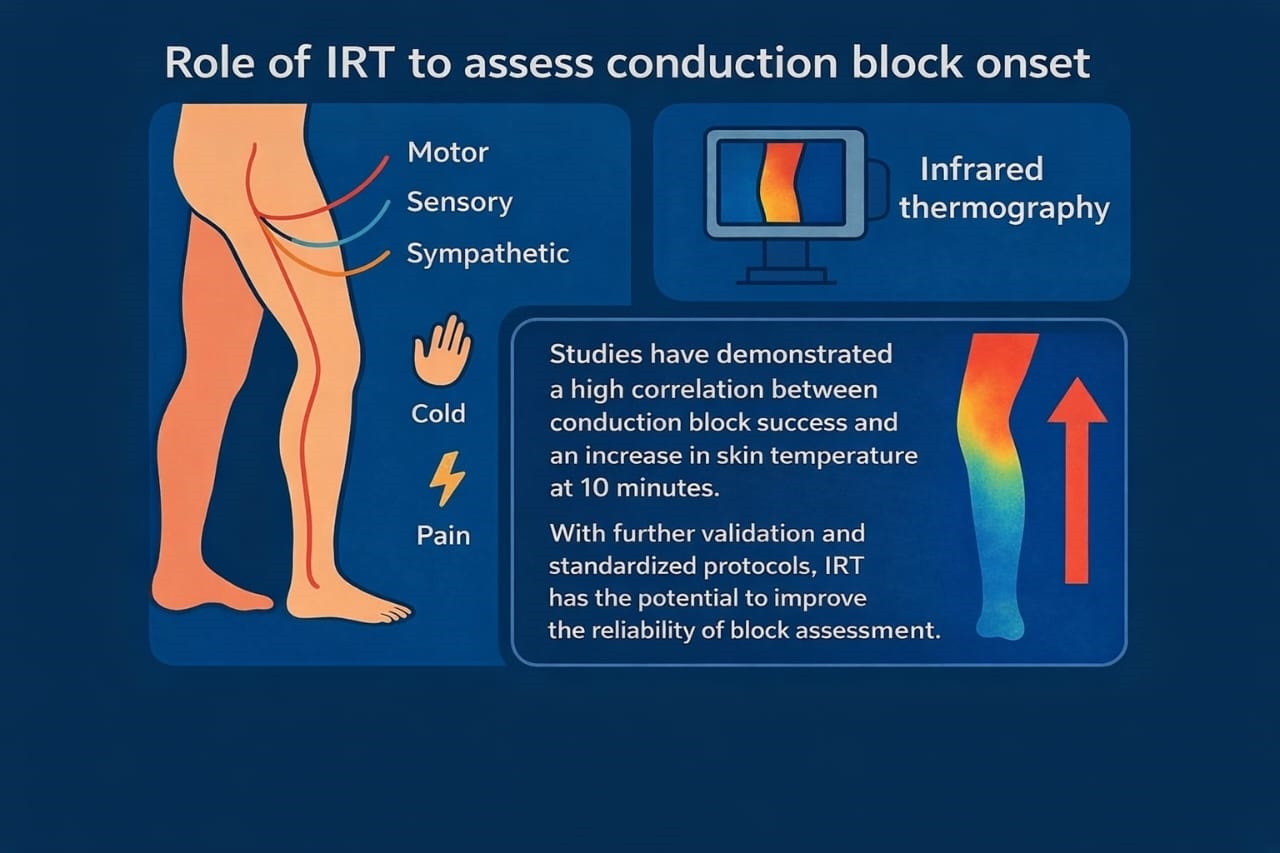
The assessment of a conduction block following regional anaesthesia involves the clinical examination of motor and sensory neural pathways. Motor assessment includes the subjective evaluation of power, while sensory function is assessed using subjective perceptions of touch, cold and pain. There are considerable subjectivities and variabilities in the assessment of regional anaesthesia. Regional anaesthesia results in a blockade of not only somatosensory and motor nerve fibres but also sympathetic fibres. This results in vasodilation and an increase in blood flow, which leads to an increase in skin temperature. Multiple studies have demonstrated a high correlation between conduction block success and skin temperature changes at 10 min, detected using infrared thermography with a higher sensitivity and specificity and positive and negative predictive values up to 100%. Infrared thermography (IRT) is a non-invasive imaging tool which measures surface temperature. The role of IRT in assessing conduction blocks has been evaluated. We reviewed the literature to characterise the role of IRT in determining the onset of a conduction block following regional anaesthesia. This narrative review article synthesises the current evidence on the application of IRT in the evaluation of conduction block onset. In conclusion, IRT is a reliable tool to assess early block success as compared to routine assessment methods (touch, cold and pain perception). However, the limited studies and effects of environmental factors highlight the need for standardised protocols and multicentre studies to integrate into routine clinical practice. With further validation and integration into clinical practice, it has the potential to improve both patient safety and the reliability of block assessment.

Graphical Abstract

1. Introduction

The term regional anaesthesia refers to a series of commonly performed procedures resulting in temporary signal disruptions in motor and sensory nerves. Regional anaesthesia is achieved when a local anaesthetic solution is deposited adjacent to either the central (neuraxial) or peripheral nerves. Local anaesthetic agents inhibit neural transmembrane sodium channels and thereby prevent action potential generation [1,2,3]. The net effect of successful regional anaesthesia is the absence of pain sensations in the distribution of the target nerve(s) [4]. Commonly performed central regional anaesthetic techniques include spinal and epidural blocks [5]. Peripheral regional anaesthesia targets nerves that are variably distant to the central neuraxis and is commonly known as peripheral nerve block [6]. The blanket term regional anaesthesia will be used to describe both central and peripheral regional anaesthetic techniques. The term conduction block will be used to describe the effect of a local anaesthetic on nerves.
Regional anaesthesia in the modern era offers targeted analgesia and anaesthesia, reducing the need for systemic opioids and facilitating a faster recovery [7], but the timely assessment of conduction block onset remains a challenge. The routinely used bedside methods, i.e., touch, cold, pin-prick and motor assessments, are simple but subjective and depend heavily on patient cooperation and clinicians’ interpretation [8]. These subjective methods can be difficult to assess in paediatrics populations, anxious and sedated patients and patients with intellectual disabilities.
In recent years, IRT has been investigated as a way to make this method more objective by detecting the increase in skin temperature caused by sympathetic mediated vasodilatation. The earlier literature [9,10,11,12] showed promising results of temperature changes, with successful peripheral and central neuraxial blocks. At the same time, the literature highlights the limitations of IRT, i.e., the timings and the degree of temperature change vary between block types and are also influenced by environmental (ambient temperature) and patient factors (peripheral vascular disease, diabetes) [9,12]. These findings suggest that IRT is a non-invasive tool for assessing conduction blocks.
This narrative review article synthesises recent evidence to characterise the role of IRT in determining the onset of conduction blocks following regional anaesthesia.

2. The Assessment of Conduction Block in Regional Anaesthesia

The sensory modalities of temperature, touch and pain originate in receptors at terminal nerve endings. Pain originates in the nociceptors. Proprioception originates in the muscle spindles. Sensory signals are then transmitted along different types of nerve fibres within the sensory nerve. There are four principal nerve fibre subtypes involved in sensory signalling. Pain and temperature are conducted by A-delta (small-diameter myelinated) and C (small-diameter unmyelinated) fibres, touch by A-beta (large-diameter myelinated) fibres and proprioception by A-alpha (large-diameter myelinated) fibres [13,14,15]. Motor signals are transmitted along A-gamma (large-diameter myelinated) fibres. The presence of myelination increases the nerve conduction velocity with respect to unmyelinated nerves. Both myelination and nerve fibre diameter may influence the timing of conduction block onset across sensory modalities. The onset of conduction block usually progresses from small-diameter unmyelinated sensory fibres to large, myelinated motor fibres [1]. Table 1 illustrates the classification of nerve fibres and their function and illustrates whether they are myelinated or non-myelinated.
A conduction block following regional anaesthesia is a clinical assessment of motor and sensory neural pathways. Motor assessment involves the subjective clinical evaluation of muscle power in the distribution of the relevant nerve(s) in comparison to a non-affected region. Sensory testing assesses the perceptions of touch, cold and/or pain sensation in the distribution of the relevant nerve(s), again with reference to a non-affected region. Significant variability exists in the manners in which the onset and adequacy of regional anaesthesia are assessed. The literature suggests that the loss of touch sensation is the most reliable indicator of conduction block onset [16]. No ideal test to assess the efficacy of regional anaesthesia exists, although the characteristics of such a test have been defined [17].

3. Thermographic Imaging

Thermography is based upon the principle that different frequencies of light have different temperatures. Thermography is not a new concept. Hershel described ‘calorific rays’ in experiments reported in 1800 [18]. Infrared thermography is derived from the basic physics concept that any object at a temperature above absolute zero emits electromagnetic radiation in the infrared spectrum of light. Commercially available thermographic cameras measure light in the infrared spectrum. Thermographic measurement in humans was first performed in 1928 [19]. Since then, several clinical applications have been described [20,21,22,23,24,25,26].
An object’s emissive power is defined as the object’s ability to emit infrared radiation. Small changes in an object’s temperature can alter emissive power. Infrared thermography (IRT) cameras capture the thermal radiation both emitted and reflected by an object. IRT technology has advanced significantly in the last few years, moving from low-resolution, qualitative imaging to high-sensitivity digital systems. The current commercially available IRT cameras can register temperature variations of 0.1 °C, producing high-resolution, real-time images that can objectively display the physiological effects of regional anaesthesia. IRT cameras have evolved for ease of use as a smartphone add-on feature. Intuitive smartphone applications permit IRT data to be easily analysed.
Small unmyelinated sympathetic nerve fibres accompany mixed motor and sensory nerves and supply vasomotor tone to regional blood vessels. The conduction block of peripheral and central nerves invariably produces a blockade of sympathetic nerves, which in turn causes vasodilatation. Vasodilation leads to an increase in blood flow, which can increase local temperature and thereby increase the emissive power of the region. IRT can detect the changes in infrared light emitted in response to vasodilation [22,27,28,29,30].

4. Thermographic Imaging in Regional Anaesthesia

Thermographic imaging has been in clinical use since the early 1990s for assessing conduction blocks [12,31,32,33,34,35,36,37]. We reviewed the literature to evaluate the role of IRT in determining the onset of conduction blocks following regional anaesthesia.

4.1. Skin Temperature Changes After Upper Limb Block

Galvin et al. evaluated IRT in twenty-five patients undergoing hand and forearm surgery under axillary brachial plexus blocks [38]. Blocks were performed using nerve stimulation, and 1.5% Mepivacaine was the drug of choice. As compared to the current regional anaesthesia practice, comparatively large volumes of local anaesthetic (40 mL) were used to achieve an axillary brachial plexus block. The authors report a high correlation between conduction block success and temperature changes at 10 min, with a peak 4.5 °C increase noted at 20 min. Thermography performed 10 min after a high-dose axillary brachial plexus block demonstrated a sensitivity of 90%, specificity of 100%, positive predictive value of 100%, and negative predictive value of 98%, indicating that it may serve as a reliable tool for assessing block onset.
Lange et al. explored IRT in forty-six patients undergoing hand surgery [39]. Uniquely, the investigators individually blocked the four major terminal nerves of the brachial plexus at anatomically distinct sites: the musculocutaneous nerve in the axilla; the radial nerve block at mid-arm; and the ulnar and median nerves at mid-forearm. A total of 6 mL of 0.75% ropivacaine was administered under ultrasound guidance at each nerve. A skin temperature increase was seen in areas innervated by the ulnar and median nerves, but not the musculocutaneous and radial nerves. Clinically, all individual nerve blocks were successful after 22 min when evaluated using cold and pin-prick sensations and motor function assessments.
Minville et al. evaluated the use of IRT to predict block success in thirty patients undergoing upper limb surgery under infraclavicular brachial plexus blocks [40]. A consistent temperature increase of 1 °C or greater at 10 min following block performance was positively correlated with conduction block success when assessed at 30 min. The calculated positive predictive value for a 1 °C rise in skin temperature at 10 min was 100%. The authors concluded that IRT is a reliable, simple and early indicator of a successful nerve block.
Asghar et al. studied IRT in forty-five patients who had received an ultrasound-guided lateral infraclavicular nerve block (LIC) using 20 mL 0.75% ropivacaine [10]. IRT imaging was taken at 1 min intervals up to 30 min following the completion of the block procedure. The authors reported that a consistent increase of 1 °C in skin temperature for the 2nd and 5th digits predicts a successful block, with a positive predictive value of 100%. Interestingly, a sustained skin temperature on the 2nd and 5th digits of less than 30 °C after block performance was positively associated with a failed block.
Gamal et al. used IRT in 80 patients to predict failed supraclavicular nerve blocks [41]. The authors used 25 mL of a local anaesthetic mixture of 0.5% bupivacaine and 2% lidocaine in a ratio of 1:1. The authors used IRT to measure skin temperature at the tip of the small finger (ulnar nerve), tip of the index finger (median nerve) and base of the dorsal aspect of the index finger (radial nerve). The authors emphasised that, 10 min following nerve block, IRT showed an excellent sensitivity and negative predictive value for ruling out block failure (98–100%). The authors suggested that the increase in skin temperature would confirm block success at the corresponding segment, while the failure of skin temperature to rise suggests block failure with same accuracy.

4.2. Skin Temperature Change After Lower Limb Blocks

Markus F Stevens et al. evaluated IRT in thirty-three patients undergoing knee or foot surgery after a combined femoral and sciatic nerve block and ten patients with epidural anaesthesia [42]. The authors used 30 mL of 1% prilocaine and 10 mL of 0.75% ropivacaine for the femoral nerve block, and 20 mL of 1% prilocaine and 10 mL of 0.75% ropivacaine for the sciatic nerve block. The epidural was placed at either L3/4 or L4/5 with a test dose of 3 mL of 1% lidocaine, followed by 10 mL of 0.75% ropivacaine over 5 min. They found that the temperature increase in the area innervated by the femoral nerve was negligible; in contrast, skin temperature increased in 5 to 10 min in the area innervated by the sciatic nerve. The authors concluded that a temperature increase measured using IRT is a reliable but late sign of a successful block.
Werdehausen et al. evaluated IRT in twenty-four patients undergoing lower limb surgery under a combined femoral and sciatic nerve block (by using nerve stimulator), spinal anaesthesia or epidural anaesthesia [43]. In patients receiving peripheral regional anaesthesia, the authors used 30 mL of 1% prilocaine and 10 mL of 0.75% ropivacine for the femoral nerve block and 20 mL of 1% prilocaine and 10 mL of 0.75% ropivacaine for the sciatic nerve block. Patients receiving epidural anaesthesia had an epidural placed at L4–5, and 10 mL of 0.75% ropivacaine was administered. Spinal anaesthesia was performed using 3 mL of 0.5% hyperbaric bupivacaine. The skin temperature was noted to increase in all participants. The authors concluded that, regardless of technique, the temperature increase is more pronounced distally, i.e., in the toes. While IRT is a reliable tool for measuring temperature changes in the toes, the authors caution against any inference of the adequacy of anaesthesia or analgesia.
Van Harren et al. evaluated the role of IRT in 18 patients undergoing foot surgery under a subgluteal sciatic nerve block [11]. The authors used 30 mL of 0.75% ropivacaine under ultrasound guidance. The authors demonstrated that, after a sciatic nerve block, the temperatures of the foot increased significantly, and there is a good correlation between sensory testing (pin-prick) and the measurement of skin temperature using infrared thermographic imaging (IRT). Skin temperature measurement using IRT is a feasible tool in determining block success when sensory testing is impossible, i.e., in paediatric patients, patients with intellectual disabilities and patients under general anaesthesia.
Yoshimura et al. evaluated the role of IRT in 20 patients undergoing hip surgery under general anaesthesia [44]. Analgesia was provided with a supra-inguinal fascia iliaca block (SFIB). The authors used 30 mL of 0.25% levobupicaine under ultrasound guidance. IRT was used to assess skin temperature changes at the femoral, obturator and lateral femoral cutaneous nerve sites before and at 5, 10 and 15 min post-block. The authors found that temperature was increased by 1.2 °C at 5 and 10 min and by 0.9 °C at 15 min following the block. The sensory block was assessed through a cold test immediately after final IRT image acquisition, and the authors found that the cold test response was reduced in all patients with a successful conduction block. The authors hypothesised that a temperature increase of >0 °C measured using IRT will predict a successful block, suggesting that IRT can be used as an objective assessment tool for adequate analgesia.

4.3. Skin Temperature Change After Neuraxial Anaesthesia

Reports of thermographic imaging for assessing conduction blockades in regional anaesthesia have sporadically appeared since the 1990s. The impact of neuraxial anaesthesia on distal blood flow, skin temperature and the correlation with block height was evaluated by a number of investigators. Kimura et al. used thermographic imaging to assess sympathetic blockades after total spinal anaesthesia in three patients with intractable pain syndromes [45]. The authors reported alterations in skin temperature attributable to the onset of total spinal anaesthesia. While of questionable relevance to current anaesthesia and pain practice, this paper highlights some of the complexities of interpreting thermography data in the context of regional anaesthesia. The authors report a regional variability in terms of temperature changes, with apparent early paradoxical drops in temperature noted.
In the context of contemporary neuraxial anaesthesia, Werdehausen et al. evaluated IRT in patients who received either spinal or epidural anaesthesia [43]. Sixteen patients (eight spinal and eight epidural) undergoing lower limb surgery were included in the neuraxial anaesthesia arms of this observational study. Spinal and epidural anaesthesia were performed at L4/5. Patients undergoing spinal anaesthesia received 3 mL hyperbaric bupivacaine, while patients receiving epidural anaesthesia received 10 mL 0.75% ropivacaine. Temperature increases were noted, with the greatest change in temperature measured at the hallux. The authors noted that the greatest change in temperature occurred in the foot, with minimal if any alterations in temperature noted in the proximal thigh.
Van Haren et al. evaluated dermatomal temperature changes using IRT following spinal anaesthesia [46]. Twelve patients for whom lumbar (L3/4) spinal anaesthesia using either 3 mL of 0.5% bupivacaine or 3.5 mL of 2% lidocaine was planned were invited to participate in this study. Thermographic images were obtained of dermatomes L3-T2 before and at time points following spinal anaesthesia. Temperature changes in the measured dermatomes were inconsistent and did not adequately predict the sensory block height. The authors concluded that patient and environmental factors may have influenced the surface temperature across the measured dermatomes and may limit the utility of thermography in assessing conduction block onset in spinal anaesthesia. Therefore, the influence of spinal anaesthesia on cutaneous blood flow and associated changes in temperature may not be adequately assessed using thermography of the trunk from T2-L3.
In women undergoing caesarean sections, Murphy et al. evaluated the feasibility of IRT to assess and characterizethe onset and height [47] of spinal anaesthesia using cutaneous temperature changes as measured by thermography. Thirty participating women received spinal anaesthesia. The dose of intrathecal drugs was at the discretion of the attending anaesthesiologist. The dose of intrathecal bupivacaine ranged from 11 to 12 mg and was combined with either or both intrathecal fentanyl 15–20 mcg (n = 30) and intrathecal morphine 100 mcg (n = 10). Similarly to the findings of Werdehausen [43] and Van Haren [46], the onset of spinal anaesthesia was associated with a rise in temperature in the patient’s periphery, with the greatest rise in temperature located in the feet. Temperature changes at the patient’s trunk were varied and inconsistent and did not correlate with dermatomal block height.
These papers suggest that thermography of the feet and distal leg may be predictive of spinal anaesthesia block onset. The role of thermography in evaluating block height appears less certain.
Bouvet et al. used IRT to assess dermatomal levels of labour epidural analgesia in 53 patients undergoing spontaneous vaginal delivery [48]. An epidural was placed at the L3–4 or L4–5 interspace. A test dose of 3 mL of 2% lidocaine with adrenaline (0.25%) was administered, followed by a 10–15 mL bolus of 0.1% ropivacaine with sufentanil 0.05%, and epidural infusion was maintained with the same concentration of LA at 3 mL/h with patient-controlled boluses of 5 mL and a lockout time of 10 min. The authors used IRT to measure skin temperature changes at the C4, T4, T10, L2 and L5 dermatomes before the epidural and at 20 min following the epidural dose. The authors found a significant increase in skin temperature (+0.4 to +0.9 °C) at T4, T10, L2 and L5, with the most significant change at T10 between failed and successful epidural analgesia. The authors suggested that IRT might be useful for the early diagnosis of successful obstetric epidural analgesia.
Zhang et al. evaluated the role of IRT in 61 patients undergoing elective unilateral breast or thoracoscopic surgery [12]. For analgesia, a single-shot thoracic paravertebral block (TPVB) was performed at the T4 level first and then at the T5 level under ultrasound guidance. The authors used 10 mL of 0.4% ropivacaine at each level. Methods like the pin-prick test, cold test, pupillary dilation reflex and analgesia nociception index have been used to assess the outcomes of TPVB, but none has been proven beneficial. The authors emphasised that the measurement of skin temperature using IRT after TPVB would be a reliable method for assessing the effectiveness of regional blocks, as there is no gold standard for assessing the success/failure of a nerve block. The authors found that an increase of 1 °C at the T4 level 15 min after the block has a greater prediction of block success, with a sensitivity of 83.3% and specificity of 100%. They found that, in successful blocks, the skin temperature increased rapidly from 5 to 20 min, and it continued to rise at each time point (p < 0.01), but, on the other hand, there was no increase in skin temperature in the failed block (p > 0.05). This paper suggests that the increase in skin temperature difference at the T4 dermatome is an early, quantitative and reliable predictor of a successful TPVB, and hence IRT is a reliable method for evaluating the effectiveness of thoracic paravertebral blocks.
Yong-Chul Kim et al. used IRT in the assessment of a successful lumbar sympathetic ganglion block (LSGB) in 26 patients with nervous system disorders [49]. The block was performed at the L3 and L4 level with 1.5 mL of contrast (Omnipaque) and 1.5 mL of 0.75% ropivacaine at each level. They studied the net change in temperature at various regions of the lower limb to identify the regions demonstrating the most significant temperature change. They found that the temperature increase is more on the plantar and dorsal surfaces of foot, as compared to higher regions, i.e., the leg, knee and thigh. They concluded that IRT is the most effective, simple and safe method of assessing a successful lumbar sympathetic ganglion block.
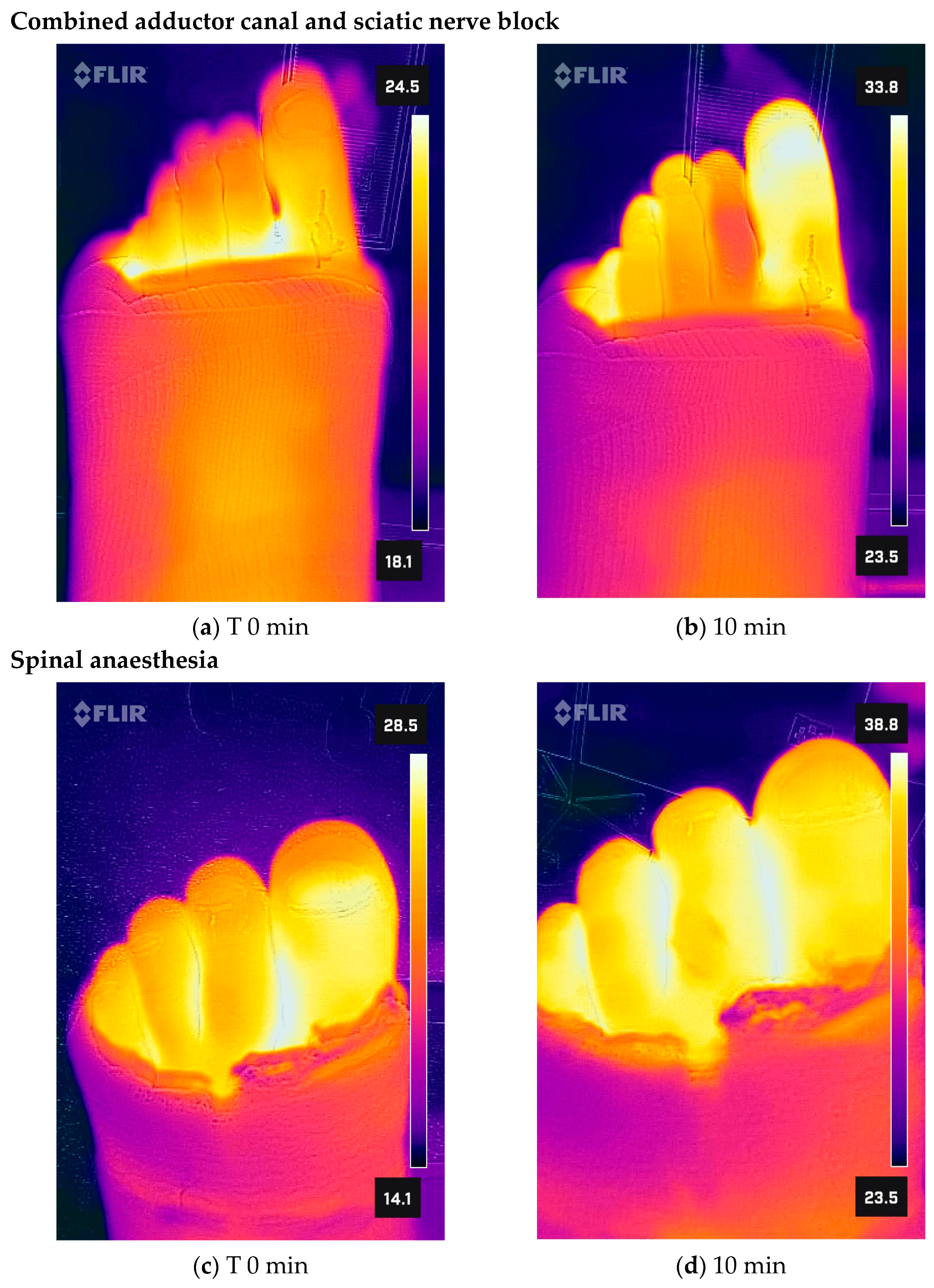
Figure 1 illustrates thermography of a foot after different regional analgesia techniques.
Hermans et al. found that a relevant and reliable temperature increase is only seen in distal body parts (i.e., fingers and toes) [50]. The thick and largely hairless skin of limb extremities is referred to as glabrous skin [51,52]. Glabrous skin has rich arteriovenous anastomoses and a high density of sweat glands. The effect of a sympathetic block is therefore likely to be more readily seen in areas covered with glabrous skin. The authors concluded that the skin temperature measurement of distal extremities using IRT is a reliable and feasible diagnostic tool for assessing and predicting the success or failure of regional anaesthesia [53]. Hermans et al. also noted an initial drop in skin temperature immediately following block performance. This is postulated to result from an initial subcutaneous surge in relatively cold venous blood [54], which precedes the temperature rise seen with arteriolar dilation.

4.4. Broader Clinical Application of IRT Beyond Regional Anaesthesia

Cherchi et al. (2021) used IRT to assess the kidney graft microcirculation in the immediate post-reperfusion period, and they hypothesised that IRT would give a better perspective on the quality of the arterial perfusion and graft revascularization of the renal cortex compared with data provided by a perfusion machine and Doppler flowmetry [55].
Kim et al. (2018) compared IRT and a respiratory volume monitor (RVM) in 20 patients to assess respiratory measurements during sedation in patients undergoing endoscopic urological procedures under spinal anaesthesia [56]. The authors found that IRT detected apnea earlier compared to the use of RVM or the evaluation of Spo2. IRT detected respiratory deterioration 1 min earlier than Spo2 and 40 s earlier than RVM. They suggested that IRT is a rapid diagnostic tool for respiratory depression in hypoxaemic-susceptible patients during monitored anaesthesia care.
Andreasen et al. hypothesised the use of the “eye ball test” for specific IRT patterns after a lateral infraclavicular block (LIC) and proposed that the IRT patterns of blocked hands are a valid and reliable diagnostic test for predicting successful blocks [57]. At 30 min following the nerve block, the sensitivity was 92.4%, the specificity was 84.0% and the positive predictive value was 94.4%. They also predicted successful blocks, with a high positive predictive value and sensitivity 18 min following block performance through the use of IRT.
Table 2 provides an overview of the published literature that has used IRT to assess conduction block onset. For each study, we outline the number of patients enrolled, type of block performed (peripheral or central neuraxial block) and techniques used to infiltrate local anaesthetic (ultrasound-guided or nerve stimulator), along with the type, volume and concentration of local anaesthetic (L/A) used, as these factors influence block onset. It also explains the intervals (in minutes) at which skin temperature change was measured using IRT to predict a successful conduction block. The table illustrates how IRT has been used to predict successful conduction blocks across different techniques.

5. Advantages, Limitations and Future Directions of IRT

5.1. Advantages of IRT

IRT offers numerous benefits in the assessment of regional anaesthesia. It is non-invasive, contact-free and provides an objective measure, independent of patient feedback or examiner interpretation [31,41]. Studies have shown that an early rise in skin temperature often corresponds with a successful block onset [58], and, in some cases, thermography can help identify failed or incomplete blocks sooner than traditional sensory testing [41]. These qualities make it an appealing complement to routine bedside assessments. Thermography can be used in a variety of peripheral and central neuraxial block assessments, supporting its broad generalisability [59].

5.2. Limitations and Considerations of IRT

Despite its potential benefits, IRT has a few limitations that restrict its use in routine clinical practice. One of the main limitations is that temperature change is not consistent across different conduction block types and also between individual nerves and patients. For example, there is an earlier temperature rise after spinal anaesthesia when compared to epidural anaesthesia, while peripheral conduction blocks have a slower rise in temperature compared to central neuraxial blocks, making it difficult to define a universal threshold for block success [60,61,62,63].
External factors, i.e., ambient room temperature, patient positioning, skin perfusion or pre-existing peripheral vascular disease, diabetes mellitus with autonomic neuropathy, hypothermia, smoking and the use of vasoconstrictor medications may alter the sympathetic and microvascular response, which can influence results and reduce reliability [59,64]. Technical issues, including differences between infrared cameras, calibration settings and image analysis methods, further complicate comparisons between studies. Timing is another limitation; IRT can provide an early confirmation of block success in some settings, while in others the temperature change lags behind sensory or motor loss, indicating that IRT is not always the earliest indicator of block onset [65]. Kimura et al. mentioned in their study that skin temperature change can be effected by factors other than sympathetic factors, like the location of measurements (proximal vs. distal change) [45]. In addition, most published work has been conducted on small patient groups, often in controlled research settings, which limits generalisability.
With further refinement and validation, IRT could be a valuable tool for routine conduction block assessment following regional anaesthesia.

5.3. Future Directions

Future progress in IRT for assessing regional anaesthesia will depend on improving both consistency and clinical applicability. At present, studies vary in the temperature thresholds they use, the skin regions they measure and even the type of camera or thermometer employed. Some define success as a rise of 0.5 °C, others 1.0 °C, while some rely on comparisons with the contralateral limb. This lack of agreement makes findings difficult to compare and highlights the need for standardised protocols for image acquisition, acclimatisation and analysis [11,41,66]. Although improvements in technology have made IRT more accessible, there is still no universally accepted method for capturing or interpreting thermal images (particularly concerningpixel coloration and temperature scaling). Different commercially available IRT cameras apply their own colour palettes and conversion algorithms, so the same temperature change can appear different on each device. To make comparable results, researchers have started exploring practical ways to standardise image processing, i.e., incorporating fixed temperature reference points in each image, using automated calibration or applying colour normalisation algorithms that align pixel intensity and thermal gradients across datasets. The development of such consistent standards will be a crucial step towards improving reliability and enabling a meaningful comparison across studies [67].
Studies on a larger scale and multicentre trials are also required. Much of the existing evidence comes from small, single-centre cohorts, which limits generalisability [41,68]. Multicentre trials, particularly those that include patients with diabetes, vascular disease or communication difficulties, could clarify how useful thermography is in populations where routinely used bedside tests (sensory and motor assessment) are less reliable [69].
Technological advances like artificial intelligence (AI) are likely to play an important role in moving thermography forward [70]. Portable, low-cost cameras are now widely available, and early work on automated image processing and machine learning suggests the possibility of real-time, operator-independent assessments [70]. Incorporating thermography into ultrasound platforms with the use of AI may further streamline its use, allowing anaesthetists to capture thermal and anatomical information side by side during block placement. Alongside these developments, practical issues such as clinician training and cost-effectiveness should not be overlooked. Demonstrating that thermography can add safety or efficiency without excessive expenses will be critical for wider adoption [71]. If these challenges are addressed, thermography could evolve into a practical adjunct that improves the accuracy and objectivity of regional block assessment, while complementing, rather than replacing, clinical judgement.

5.4. Cost of IRT Camera

The growing demand for IRT devices in both health and non-healthcare settings has led to large reductions in purchasing costs. The newest devices are portable, hand-held, user-friendly models and may now be purchased for a fraction of previously quoted prices. IRT cameras (with an infrared resolution of 80 × 60 or 120 × 90 pixels) may cost between USD 500 and 1000.

6. Conclusions

This narrative review suggests that thermographic imaging is a non-invasive, valuable tool for objectively assessing conduction block success. The previous literature consistently reports an early rise in skin temperature following a successful conduction block, reflecting sympathetic inhibition and vasodilation. Vasodilation leads to increase in blood flow, resulting in an increase in skin temperature, measurable using IRT. Skin temperature was increased in the distal parts of extremities, which is a reliable indicator of sympathetic and sensory nerve block. The literature suggests that IRT is a reliable, simple and early indicator of block success, but the role of IRT in evaluating block height following spinal anaesthesia appears less certain. Compared with routinely used clinical tests such as cold, pin-prick and touch, IRT offers an objective, observer-independent measure that can be captured in real time
Thermographic imaging has emerged as an appealing adjunct for assessing the onset of regional anaesthesia, demonstrating a comparable accuracy in confirming both block success and failure. It also offers a practical tool for assessing the extent and duration of analgesia in real time.
Across multiple block types—including brachial plexus, paravertebral, femoral, sciatic and spinal or epidural—most studies have demonstrated a measurable increase in skin temperature following a successful block, reflecting sympathetic inhibition and vasodilation. This response has often correlated well with standard clinical assessments and, in some cases, provided an earlier or more objective confirmation of block success.
Nevertheless, the current evidence base remains limited. Many studies are small, single-centred and heterogeneous in methodology. The timing and magnitude of thermal changes vary by block type, nerve distribution and patient characteristics. Some nerves show inconsistent thermal responses, and thresholds for defining block success differ between reports. External factors such as ambient temperature, camera calibration and comorbid vascular conditions further complicate interpretation.
Future work should focus on standardising acquisition protocols, defining clinically meaningful cut-offs for temperature change and validating findings in larger, diverse populations. Advances in automated image processing and machine learning may improve sensitivity and reduce observer dependence. Importantly, thermography should not be viewed as a replacement for clinical assessment but as a complementary tool that may enhance objectivity, support the early detection of block failure and contribute to workflow efficiency.
In summary, IRT represents a promising, non-invasive technique for the assessment of conduction blocks. With further validation and integration into clinical practice, it has the potential to improve both patient safety and the reliability of block assessment.

Funding

This research received no external funding.

Institutional Review Board Statement

Not applicable.

Informed Consent Statement

Not applicable.

Data Availability Statement

No new data were created or analysed in this study. Data sharing is not applicable to this article.

Conflicts of Interest

The authors declare no conflicts of interest.

Abbreviations

The following abbreviations are used in this manuscript:
IRTInfrared thermography
LICLateral infraclavicular block
L/ALocal anaesthesia
SFIBSupra-inguinal fascia iliaca block
TPVBThoracic paravertebral block
LSGB Lumbar sympathetic ganglion block
AIArtificial intelligence

References

  1. Taylor, A.; McLeod, G. Basic pharmacology of local anaesthetics. BJA Educ. 2020, 20, 34–41. [Google Scholar] [CrossRef] [PubMed]
  2. Liu, H.; Liu, Z.; Zhou, H.; Yan, R.; Li, Y.; Zhang, X.; Bao, L.; Yang, Y.; Zhang, J.; Song, S. Advances in Structural Biology for Anesthetic Drug Mechanisms: Insights into General and Local Anesthesia. BioChem 2025, 5, 18. [Google Scholar] [CrossRef]
  3. Vinyes, D.; Muñoz-Sellart, M.; Fischer, L. Therapeutic Use of Low-Dose Local Anesthetics in Pain, Inflammation, and Other Clinical Conditions: A Systematic Scoping Review. J. Clin. Med. 2023, 12, 7221. [Google Scholar] [CrossRef]
  4. Folino, T.B.; Mahboobi, S.K. Regional Anesthetic Blocks. In StatPearls; StatPearls Publishing: Treasure Island, FL, USA, 2025. Available online: https://www.ncbi.nlm.nih.gov/books/NBK563238/ (accessed on 29 January 2023).
  5. Olawin, A.M.; Das, J.M. Spinal Anesthesia. In StatPearls; StatPearls Publishing: Treasure Island, FL, USA, 2025. Available online: https://www.ncbi.nlm.nih.gov/books/NBK537299/ (accessed on 27 June 2022).
  6. Chang, A.; Dua, A. Peripheral Nerve Blocks. In StatPearls; StatPearls Publishing: Treasure Island, FL, USA, 2025. Available online: https://www.ncbi.nlm.nih.gov/books/NBK459210/ (accessed on 4 May 2025).
  7. Dost, B.; De Cassai, A.; Amaral, S.; Balzani, E.; Karapinar, Y.E.; Beldagli, M.; Yalin, M.S.O.; Turunc, E.; Ahiskalioglu, A.; Tulgar, S. Regional anesthesia for pediatric cardiac surgery: A review. BMC Anesthesiol. 2025, 25, 77. [Google Scholar] [CrossRef]
  8. Curatolo, M.; Petersen-Felix, S.; Arendt-Nielsen, L. Sensory assessment of regional analgesia in humans: A review of methods and applications. Anesthesiology 2001, 93, 1517–1530. [Google Scholar] [CrossRef] [PubMed]
  9. Sumartono, C.; Soni Sunarso, S.; Wirabuana, B.; Putri, H.S.; Johansyah, A.; Hidayati, H.B. Relation of the successful block regional anesthesia with increased peripheral venous circumference and peripheral skin temperature at distal part of the block. Anaesth. Pain Intensive Care 2021, 25, 458–462. [Google Scholar] [CrossRef]
  10. Asghar, S.; LundstrØm, L.H.; Bjerregaard, L.S.; Lange, K.H.W. Ultrasound-guided lateral infraclavicular block evaluated by infrared thermography and distal skin temperature. Acta Anaesthesiol. Scand. 2014, 58, 867–874. [Google Scholar] [CrossRef] [PubMed]
  11. van Haren, F.G.; Kadic, L.; Driessen, J.J. Skin temperature measured by infrared thermography after ultrasound-guided blockade of the sciatic nerve. Acta Anaesthesiol Scand. 2013, 57, 1111–1117. [Google Scholar] [CrossRef] [PubMed]
  12. Zhang, S.; Liu, Y.; Liu, X.; Liu, T.; Li, P.; Mei, W. Infrared thermography for assessment of thoracic paravertebral block: A prospective observational study. BMC Anesthesiol. 2021, 21, 168. [Google Scholar] [CrossRef] [PubMed] [PubMed Central]
  13. Sonawane, K.; Dixit, H.; Jayaraj, A.; Sekar, C.; Thota, N.R. “Knowing It Before Blocking It,” the ABCD of the Peripheral Nerves: Part A Nerve Anatomy and Physiology. Cureus 2023, 15, e41771. [Google Scholar] [CrossRef] [PubMed]
  14. Mackenzie, R.A.; Burke, D.; Skuse, N.F.; Lethlean, A.K. Fibre function and perception during cutaneous nerve block. J. Neurol. Neurosurg. Psychiatry 1975, 38, 865–873. [Google Scholar] [CrossRef] [PubMed] [PubMed Central]
  15. Arcilla, C.K.; Tadi, P. Neuroanatomy, Unmyelinated Nerve Fibers. In StatPearls; StatPearls Publishing: Treasure Island, FL, USA, 2025. Available online: https://www.ncbi.nlm.nih.gov/books/NBK554461/?utm_source=chatgpt.com (accessed on 2 January 2023).
  16. Ode, K.; Selvaraj, S.; Smith, A.F. Monitoring regional blockade. Anaesthesia 2017, 72, 70–75. [Google Scholar] [CrossRef]
  17. Curatolo, M.; Petersen-Felix, S.; Arendt-Nielsen, L. Assessment of regional analgesia in clinical practice and research. Br. Med Bull. 2005, 71, 61–76. [Google Scholar] [CrossRef] [PubMed][Green Version]
  18. Herschel, W. Experiments on the refrangibility of the invisible rays of the sun. Philos. Trans. R. Soc. B Biol. Sci. 1800, 90, 284–292. [Google Scholar] [CrossRef]
  19. Czerny, M. Über Photographie im Ultraroten. Eur. Phys. J. A 1929, 53, 1–12. [Google Scholar] [CrossRef]
  20. Ring, E.F.J. The historical development of thermometry and thermal imaging in medicine. J. Med. Eng. Technol. 2006, 30, 192–198. [Google Scholar] [CrossRef]
  21. Ferlini Agne, G.; Adamson, K.; McGlinchey, L.; Kravchuk, O.; Santos, L.; Schumacher, J. Comparison of a hand-held high-end resolution infrared thermography (FLIR P640) and a smartphone infrared thermographic device (FLIR One) for the assessment of skin surface temperature after anaesthetising the median nerve in Healthy horses. PLoS ONE 2024, 19, e0309603. [Google Scholar] [CrossRef] [PubMed] [PubMed Central]
  22. Blazek, V.; Blanik, N.; Blazek, C.R.; Paul, M.; Pereira, C.; Koeny, M.; Venema, B.; Leonhardt, S. Active and Passive Optical Imaging Modality for Unobtrusive Cardiorespiratory Monitoring and Facial Expression Assessment. Anesth Analg. 2017, 124, 104–119. [Google Scholar] [CrossRef] [PubMed]
  23. Priego Quesada, J.I.; Kunzler, M.R.; Carpes, F.P. Methodological Aspects of Infrared Thermography in Human Assessment. In Application of Infrared Thermography in Sports Science; Priego Quesada, J.I., Ed.; Springer International Publishing: Cham, Switerland, 2017; pp. 49–79. ISBN 978-3-319-47410-6. [Google Scholar]
  24. Lahiri, B.; Bagavathiappan, S.; Jayakumar, T.; Philip, J. Medical applications of infrared thermography: A review. Infrared Phys. Technol. 2012, 55, 221–235. [Google Scholar] [CrossRef]
  25. Ammer, K.; Ring, E.F.J. The Thermal Human Body. A Practical Guide to Thermal Imaging; CRC Press: Boca Raton, FL, USA, 2019; ISBN 978-0-429-01998-2/978-981-4745-82-6. [Google Scholar]
  26. Ramirez-GarciaLuna, J.L.; Bartlett, R.; Arriaga-Caballero, J.E.; Fraser, R.D.J.; Saiko, G. Infrared Thermography in Wound Care, Surgery, and Sports Medicine: A Review. Front. Physiol. 2022, 13, 838528. [Google Scholar] [CrossRef] [PubMed] [PubMed Central]
  27. Gungor, S.; Candan, B. OP013 Infrared (FLIR) imaging as a monitor for sympathetic blocks in complex regional pain syndrome (CRPS). Reg. Anesth. Pain Med. 2023, 48, A7–A8. [Google Scholar] [CrossRef]
  28. Liu, Q.; Li, M.; Wang, W.; Jin, S.; Piao, H.; Jiang, Y.; Li, N.; Yao, H. Infrared thermography in clinical practice: A literature review. Eur. J. Med. Res. 2025, 30, 33. [Google Scholar] [CrossRef]
  29. Miglani, A.; Borkowska, A.; Murphy, B.; O’Flaherty, D.; McCaul, C.L. Infrared thermographic assessment of cutaneous temperature changes during labour epidural analgesia initiation: An observational pilot study. Int. J. Obs. Anesth. 2025, 62, 104304. [Google Scholar] [CrossRef] [PubMed]
  30. Borum, A.D.; Voogd, K.L.; Smith, M.A.; Gerlif, C.; Jensen, H.I. Relationship between Temperature and Pain Sensation Following a Peripheral Ulnar Block: An Exploratory Pilot Study. Open Anesth. J. 2024, 18, e25896458335716. [Google Scholar] [CrossRef]
  31. Zirnis, A.E.; Miščuks, A.; Golubovska, I.; Kopanceva, V.; Binde, E.; Sļepiha, V.; Rubīns, U. Thermography in Anesthetic Peripheral Nerve Blocks When Using Different Local Anesthetics. Diagnostics 2025, 15, 2743. [Google Scholar] [CrossRef] [PubMed]
  32. Angrisani, L.; De Benedetto, E.; Duraccio, L.; Regio, F.L.; Ruggiero, R.; Tedesco, A. Infrared Thermography for Real-Time Assessment of the Effectiveness of Scoliosis Braces. Sensors 2023, 23, 8037. [Google Scholar] [CrossRef] [PubMed] [PubMed Central]
  33. Ilo, A.; Romsi, P.; Mäkelä, J. Infrared Thermography and Vascular Disorders in Diabetic Feet. J. Diabetes Sci. Technol. 2020, 14, 28–36. [Google Scholar] [CrossRef] [PubMed] [PubMed Central]
  34. Kim, N.E.; Park, B.; Moon, Y.R.; Lee, S.Y.; Gil, H.Y.; Kim, S.; Lee, S.; Chang, H.S.; Jeong, H.W.; Park, H.; et al. Changes in facial temperature measured by digital infrared thermal imaging in patients after transnasal sphenopalatine ganglion block: Retrospective observational study. Medicine 2019, 98, e15084. [Google Scholar] [CrossRef] [PubMed] [PubMed Central]
  35. Orădan, A.V.; Georgescu, A.V.; Jolobai, A.N.; Pașca, G.I.; Corpodean, A.A.; Juncan, T.P.; Ilie-Ene, A.; Muntean, M.V. The Precision of Colour Doppler Ultrasonography Combined with Dynamic Infrared Thermography in Perforator Mapping for Deep Inferior Epigastric Perforator Flap Breast Reconstruction. J. Pers. Med. 2024, 14, 969. [Google Scholar] [CrossRef]
  36. Bovaira, M.; Cañada-Soriano, M.; García-Vitoria, C.; Calvo, A.; De Andrés, J.A.; Moratal, D.; Priego-Quesada, J.I. Clinical results of lumbar sympathetic blocks in lower limb complex regional pain syndrome using infrared thermography as a support tool. Pain Pract. 2023, 23, 713–723. [Google Scholar] [CrossRef]
  37. Asghar, S.; Bjerregaard, L.S.; Lundstrøm, L.; Lund, J.; Jenstrup, M.T.; Lange, K.H.W. Distal infrared thermography and skin temperature after ultrasound-guided interscalene brachial plexus block: A prospective observational study. Eur. J. Anaesthesiol. 2014, 31, 626–634. [Google Scholar] [CrossRef] [PubMed][Green Version]
  38. Galvin, E.M.; Niehof, S.; Medina, H.J.; Zijlstra, F.J.; van Bommel, J.; Klein, J.; Verbrugge, S.J.C. Thermographic Temperature Measurement Compared with Pinprick and Cold Sensation in Predicting the Effectiveness of Regional Blocks. Anesth. Analg. 2006, 102, 598–604. [Google Scholar] [CrossRef]
  39. Lange, K.; Jansen, T.; Asghar, S.; Kristensen, P.; Skjønnemand, M.; Nørgaard, P. Skin temperature measured by infrared thermography after specific ultrasound-guided blocking of the musculocutaneous, radial, ulnar, and median nerves in the upper extremity. Br. J. Anaesth. 2011, 106, 887–895. [Google Scholar] [CrossRef] [PubMed][Green Version]
  40. Minville, V.; Gendre, A.; Hirsch, J.; Silva, S.; Bourdet, B.; Barbero, C.; Fourcade, O.; Samii, K.; Bouaziz, H. The efficacy of skin temperature for block assessment after infraclavicular brachial plexus block. Anesth. Analg. 2009, 108, 1034–1036. [Google Scholar] [CrossRef] [PubMed]
  41. Gamal, M.; Hasanin, A.; Adly, N.; Mostafa, M.; Yonis, A.M.; Rady, A.; Abdallah, N.M.; Ibrahim, M.; Elsayad, M. Thermal Imaging to Predict Failed Supraclavicular Brachial Plexus Block: A Prospective Observational Study. Local Reg. Anesth. 2023, 16, 71–80. [Google Scholar] [CrossRef] [PubMed] [PubMed Central]
  42. Stevens, M.F.; Werdehausen, R.; Hermanns, H.; Lipfert, P. Skin temperature during regional anesthesia of the lower extremity. Anesth. Analg. 2006, 102, 1247–1251. [Google Scholar] [CrossRef] [PubMed]
  43. Werdehausen, R.; Braun, S.; Hermanns, H.; Freynhagen, R.; Lipfert, P.; Stevens, M. Uniform distribution of skin-temperature increase after different regional-anesthesia techniques of the lower extremity. Reg. Anesth. Pain Med. 2007, 32, 73–78. [Google Scholar] [CrossRef] [PubMed]
  44. Yoshimura, M.; Shiramoto, H.; Koga, M.; Yoshimatsu, A.; Morimoto, Y. Skin temperature changes after ultrasound-guided supra-inguinal fascia iliaca block: A prospective observational study. JA Clin. Rep. 2021, 7, 31. [Google Scholar] [CrossRef] [PubMed]
  45. Kimura, T.; Goda, Y.; Kemmotsu, O.; Shimada, Y. Regional differences in skin blood flow and temperature during total spinal anaesthesia. Can. J. Anaesth. 1992, 39, 123–127. [Google Scholar] [CrossRef] [PubMed][Green Version]
  46. van Haren, F.G.A.M.; Driessen, J.J.; Kadic, L.; Van Egmond, J.; Booij, L.H.D.J.; Scheffer, G.J. The relation between skin temperature increase and sensory block height in spinal anaesthesia using infrared thermography. Acta Anaesthesiol. Scand. 2010, 54, 1105–1110. [Google Scholar] [CrossRef] [PubMed]
  47. Murphy, B.; McCaul, C.C.L.; O’Flaherty, D. Infrared thermographic assessment of spinal anaesthesia-related cutaneous temperature changes during caesarean section. Int. J. Obstet. Anesth. 2022, 49, 103245. [Google Scholar] [CrossRef] [PubMed]
  48. Bouvet, L.; Roukhomovsky, M.; Desgranges, F.-P.; Allaouchiche, B.; Chassard, D. Infrared thermography to assess dermatomal levels of labor epidural analgesia with 1 mg/mL ropivacaine plus 0.5 µg/mL sufentanil: A prospective cohort study. Int. J. Obstet. Anesth. 2020, 41, 53–58. [Google Scholar] [CrossRef] [PubMed]
  49. Kim, Y.C.; Bahk, J.H.; Lee, S.C.; Lee, Y.W. Infrared Thermographic Imaging in the Assessment of Successful Block on Lumbar Sympathetic Ganglion. Yonsei Med J. 2003, 44, 119–124. [Google Scholar] [CrossRef]
  50. Hermanns, H.; Werdehausen, R.; Hollmann, M.W.; Stevens, M.F. Assessment of skin temperature during regional anaesthesia What the anaesthesiologist should know. Acta Anaesthesiol. Scand. 2018, 62, 1280–1289. [Google Scholar] [CrossRef] [PubMed]
  51. Romanovsky, A.A. Skin temperature: Its role in thermoregulation. Acta Physiol. 2014, 210, 498–507. [Google Scholar] [CrossRef] [PubMed] [PubMed Central]
  52. Kessack, L.; Davenport, G.; McGlennan, C.; Bamber, J. Observational study of peripheral skin temperature changes following spinal anaesthesia for caesarean birth. Int. J. Obstet. Anesth. 2024, 58, 103970. [Google Scholar] [CrossRef] [PubMed]
  53. Cañada-Soriano, M.; Priego-Quesada, J.I.; Bovaira, M.; García-Vitoria, C.; Salvador Palmer, R.; Cibrián Ortiz de Anda, R.; Moratal, D. Quantitative Analysis of Real-Time Infrared Thermography for the Assessment of Lumbar Sympathetic Blocks: A Preliminary Study. Sensors 2021, 21, 3573. [Google Scholar] [CrossRef] [PubMed]
  54. Eisenach, J.H.; Pike, T.L.; Wick, D.E.; Dietz, N.M.; Fealey, R.D.; Atkinson, J.L.D.; Charkoudian, N. A comparison of peripheral skin blood flow and temperature during endoscopic thoracic sympathotomy. Anesth. Analg. 2005, 100, 269–276. [Google Scholar] [CrossRef] [PubMed]
  55. Cherchi, V.; Baccarani, U.; Vetrugno, L.; Pravisani, R.; Bove, T.; Meroi, F.; Terrosu, G.; Adani, G.L. Early Graft Dysfunction Following Kidney Transplantation: Can Thermographic Imaging Play a Predictive Role? Semin. Cardiothorac. Vasc. Anesth. 2021, 25, 196–199. [Google Scholar] [CrossRef] [PubMed]
  56. Kim, J.; Kwon, J.H.; Kim, E.; Yoo, S.K.; Shin, C.-S. Respiratory measurement using infrared thermography and respiratory volume monitor during sedation in patients undergoing endoscopic urologic procedures under spinal anesthesia. J. Clin. Monit. Comput. 2019, 33, 647–656, Erratum in J. Clin. Monit. Comput. 2021, 35, 675. https://doi.org/10.1007/s10877-020-00643-3. [Google Scholar] [CrossRef] [PubMed]
  57. Andreasen, A.M.; Linnet, K.E.; Asghar, S.; Rothe, C.; Rosenstock, C.V.; Lange, K.H.W.; Lundstrøm, L.H. “Eyeball test” of thermographic patterns for predicting a successful lateral infraclavicular block. Can J Anaesth. Can. J. Anaesth. 2017, 64, 1111–1118. (In English) [Google Scholar] [CrossRef] [PubMed][Green Version]
  58. Gohad, R.; Jain, S. Regional Anaesthesia, Contemporary Techniques, and Associated Advancements: A Narrative Review. Cureus 2024, 16, e65477. [Google Scholar] [CrossRef] [PubMed] [PubMed Central]
  59. Możański, M.; Rustecki, B.; Kalicki, B.; Jung, A. Thermal imaging evaluation of paravertebral block for mastectomy in high risk patient: Case report. J. Clin. Monit. Comput. 2015, 29, 297–299. [Google Scholar] [CrossRef] [PubMed] [PubMed Central][Green Version]
  60. Kondo, Y.; Sato, S.; Takahashi, S. Changes in skin temperature following spinal and epidural anesthesia. Masui 1991, 40, 1456–1462. [Google Scholar][Green Version]
  61. Ginosar, Y.; Weiniger, C.F.; Kurz, V.; Babchenko, A.; Nitzan, M.; Davidson, E. Sympathectomy-mediated vasodilatation: A randomized concentration ranging study of epidural bupivacaine. Can. J. Anaesth. 2009, 56, 213–221, Erratum in Can. J. Anaesth. 2010, 57, 626. [Google Scholar] [CrossRef] [PubMed]
  62. Adiantara, K.R.; Kristianto, H.; Yueniwati, Y. Infrared Thermography in Detecting Peripheral Arterial Disease in Diabetic Foot: A Scoping Review. J. Health Sains 2024, 5, 154–163. [Google Scholar] [CrossRef]
  63. Frank, S.M.; El-Rahmany, H.K.; Tran, K.M.; Vu, B.; Raja, S.N. Comparison of lower extremity cutaneous temperature changes in patients receiving lumbar sympathetic ganglion blocks versus epidural anesthesia. J. Clin. Anesth. 2000, 12, 525–530. [Google Scholar] [CrossRef] [PubMed]
  64. Bruins, A.A.; Kistemaker, K.R.J.; Boom, A.; Klaessens, J.H.G.M.; Verdaasdonk, R.M.; Boer, C. Thermographic skin temperature measurement compared with cold sensation in predicting the efficacy and distribution of epidural anesthesia. J. Clin. Monit. Comput. 32, 335–341. [CrossRef] [PubMed] [PubMed Central]
  65. Wang, Q.; Zhou, Y.; Ghassemi, P.; McBride, D.; Casamento, J.P.; Pfefer, T.J. Infrared Thermography for Measuring Elevated Body Temperature: Clinical Accuracy, Calibration, and Evaluation. Sensors 2022, 22, 215. [Google Scholar] [CrossRef] [PubMed]
  66. Politi, S.; Aloisi, A., Jr.; Bartoli, V.; Guglietta, A.; Magnifica, F. Infrared Thermography Images Acquisition for a Technical Perspective in Screening and Diagnostic Processes: Protocol Standardized Acquisition. Cureus 2021, 13. [Google Scholar] [CrossRef] [PubMed]
  67. Campanile, L.; Marulli, F.; Mastroianni, M.; Palmiero, G.; Sanghez, C. Machine Learning-aided Automatic Calibration of Smart Thermal Cameras for Health Monitoring Applications. IoTBDS 2021, 1, 343–353. [Google Scholar] [CrossRef]
  68. Liu, H.; Zhu, Z.; Jin, X.; Huang, P. The diagnostic accuracy of infrared thermography in lumbosacral radicular pain: A prospective study. J. Orthop. Surg. Res. 2024, 19, 409. [Google Scholar] [CrossRef] [PubMed]
  69. Helmy, M.A.; Mohamed, I.H.; Mostafa, M.; Hasanin, A.; Mahmoud, M.; Elsonbaty, M.; Kamel, M.M. The Ability of Infrared Thermography to Detect Successful Caudal Block in Children Undergoing Infra-Umbilical Surgery. Paediatr. Anaesth. 2025; Epub ahead of print. [Google Scholar] [CrossRef] [PubMed]
  70. Nowakowski, A.Z.; Kaczmarek, M. Artificial Intelligence in IR Thermal Imaging and Sensing for Medical Applications. Sensors 2025, 25, 891. [Google Scholar] [CrossRef]
  71. Asano, H.; Hirakawa, E.; Hayashi, H.; Hamada, K.; Asayama, Y.; Oohashi, M.; Uchiyama, A.; Higashino, T. A method for improving semantic segmentation using thermographic images in infants. BMC Med. Imaging 2022, 22, 1. [Google Scholar] [CrossRef] [PubMed] [PubMed Central]
Figure 1. Thermographic imaging of the foot after regional anaesthesia: (a) before combined adductor canal and sciatic nerve block; (b) 10 min of combined adductor canal and sciatic nerve block; (c) before spinal anaesthesia; (d) 10 min after performance of spinal anaesthesia. Temperature scale in °C is shown vertically in each image. Post-block images (b,d) demonstrate a moderate increase in skin temperature consistent with sympathectomy and vasodilation (thermographic image data from ongoing research at Cork University Hospital).
Anesthres 02 00027 g001
Table 1. Classification of nerve fibres and their function.
Nerve Fibre TypeMyelinated/UnmyelinatedFunction
A-alphaLarge myelinatedProprioception
A-betaLarge myelinatedTouch
A-gammaLarge myelinatedMotor
A-deltaSmall myelinatedPain and temperature
C-fibresSmall unmyelinatedPain and temperature
Table 2. Summary of studies and volume of L/A used to assess conduction block onset using IRT to measure skin temperature change.
Researcher NameNumber of PatientsConduction Block TypeTechnique of L/A InfiltrationDrug and Volume of L/A UsedSkin Temperature Change (Min) Predicting Successful Block
Galvin et al. [38]25Axillary brachial plexusNerve stimulation40 mL of mepivacaine 1.5%10 min
Lange et al. [39]46Individual nerve block of upper limb musculocutaneous, radial, ulnar, medianUltrasound guidance6 mL of ropivacaine 0.75%22 min
Miniville et al. [40]30Infraclavicular nerve blockNerve stimulatorLidocaine 1.5% with 1:400,000 epinephrine 10 mL for musculocutaneous nerve response and 30 mL for radial, ulnar or medial nerve response was injected10 min
Asghar et al. [10]45Lateral infraclavicular nerve blockUltrasound guidance20 mL of 0.75% ropivacaine30 min
Gamal et al. [41]80Supraclavicular nerve blockUltrasound guidance25 mL of mixture of 0.5% bupicaine and 2% lidocaine in ratio of 1:110 min
Markus F Stevens et al. [42]33Combined femoral and sciatic nerve blockNerve stimulator30 mL 0.75% prilocaine and 10 mL ropivacaine in femoral
20 mL 0.75% prilocaine and 10 mL of mepivacaine in sciatic nerve block
10 min
Markus F Stevens et al. [42]10Epidural at L3/4 or L4/5N/A3 mL lidocaine 1% and 10 mL 0.75% ropivacaine5 min
Wardehausen et al. [43]24Combined femoral and sciatic nerve block, spinal or epidural anaesthesia at L4/5Nerve stimulatorIn femoral nerve block, 30 mL 1% prilocaine and 10 mL 0.75% ropivacaine; in sciatic nerve block, 20 mL 1% prilocaine and 10 mL 0.75% ropivacaine; in epidural, 10 mL 0.75% ropivacaine; in spinal, 3 mL of 0.5% hyperbaric bupicaine used8.6 min after combined femoral sciatic nerve block, 4.2 min after epidural, 3.2 min after spinal anaesthesia
Van Harren et al. [11]18Subgluteal sciatic nerve blockUltrasound guidance30 mL 0.75% ropivacaineTemperature increased at 10 min at toes and foot
Yoshimura et al. [44]20SFIB nerve blockUltrasound guidance30 mL of 0.25% levobupicaine>0 °C at 5 min
Van Haren et al. [46]12Spinal anaesthesia at L3/4N/A3 mL 0.5% bupicaine or 3.5 mL 2% lidocaine
Murphy et al. [47]30Spinal anaesthesia level at discretion of anaesthetistN/ABupicaine 10–12 mg + fentanyl 15–20 mcg (n = 30) + morphine 100 mcg (n = 10)Researcher did not mention the time
Bouvet et al. [48]53Lumbar epidural at L3–4 or L4–5Landmark techniqueTest dose of 3 mL of 2% lidocaine with adrenaline (0.25%), 10–15 mL bolus of 0.1% ropivacaine with sufentanil 0.05% and infusion at 3 mL/hr with patient controlled boluses of 5 mL with a lockout time of 10 minSkin temperature change of +0.4 to +0.9 °C measured at 20 min
Zhang et al. [12]61TPVB at T4 and T5Ultrasound guidance10 mL of 0.4% ropivacaineTemperature increase at 15 min at T4 level
Yong chul Kim et al. [49]26LSGB at L3 and L4 1.5 mL of contrast (Omnipaque) and 1.5 mL of 0.75% ropivacaineTemperature assessed after 30 min of block
Disclaimer/Publisher’s Note: The statements, opinions and data contained in all publications are solely those of the individual author(s) and contributor(s) and not of MDPI and/or the editor(s). MDPI and/or the editor(s) disclaim responsibility for any injury to people or property resulting from any ideas, methods, instructions or products referred to in the content.