


Abstract
Aluminum light poles are essential components of modern infrastructure, providing illumination for highways, urban areas, and pedestrian pathways. Despite their importance, structural vulnerabilities in handholes—necessary for electrical access—can reduce fatigue life due to the structure’s response to wind. This study addresses a critical gap in translating laboratory-derived S–N data into field-applicable methods for assessing cumulative damage in these structures. A probabilistic cumulative damage analysis framework was developed to quantify the structural degradation of handholes due to variable wind velocities. Using a series of controlled cyclic fatigue tests and Miner’s Rule, the study establishes a methodology to convert stress ranges into equivalent wind velocities and correlate laboratory cycle counts with real-world loading conditions. The findings reveal a logarithmic progression of damage accumulation and highlight the utility of integrating standardized factors from ASCE-7 for scalable and geographically adaptable assessments. A proof-of-concept application demonstrates the model’s potential to predict failure risks during extreme wind events, such as hurricanes and tornadoes. This research provides a practical and predictive tool for engineers and contractors to evaluate the structural integrity of aluminum light poles, enabling proactive maintenance and reducing unplanned failures.
1. Introduction
Light poles play a vital role in modern infrastructure by ensuring safety and security on roadways, parking lots, commercial centers, and industrial facilities, as well as for pedestrians on nearby sidewalks. When positioned correctly, they effectively eliminate dark spots and alert both vehicles and pedestrians to potential hazards [1,2]. One key component of light pole design is the electrical access handhole, located near the base of the pole. These handholes, typically reinforced and attached [3], provide essential access for the installation and maintenance of the electrical wiring system. Despite their importance, these handholes can also introduce sites for potential fatigue crack development. Regular inspection and maintenance of light poles are crucial to minimizing the risk of unexpected collapses and, most importantly, to preventing loss of life.
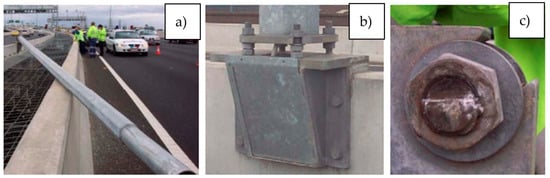
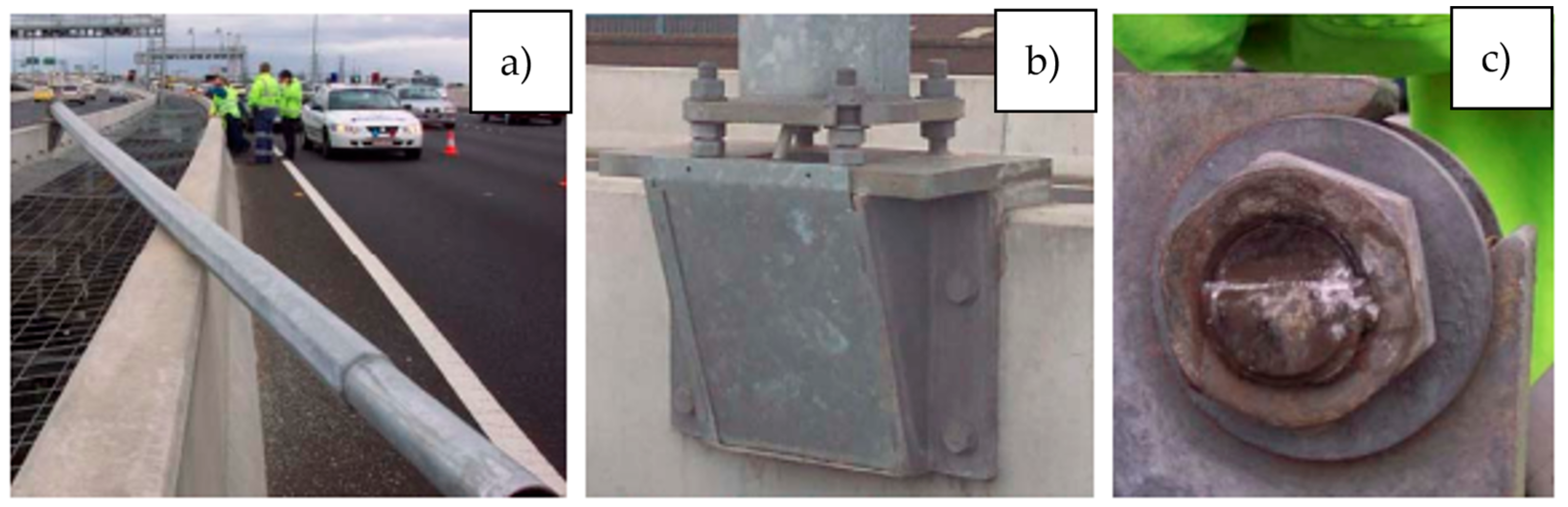
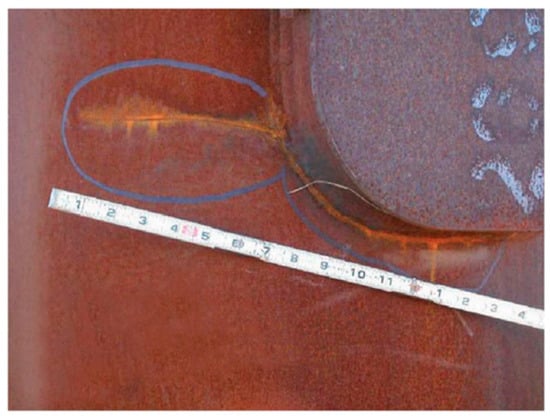
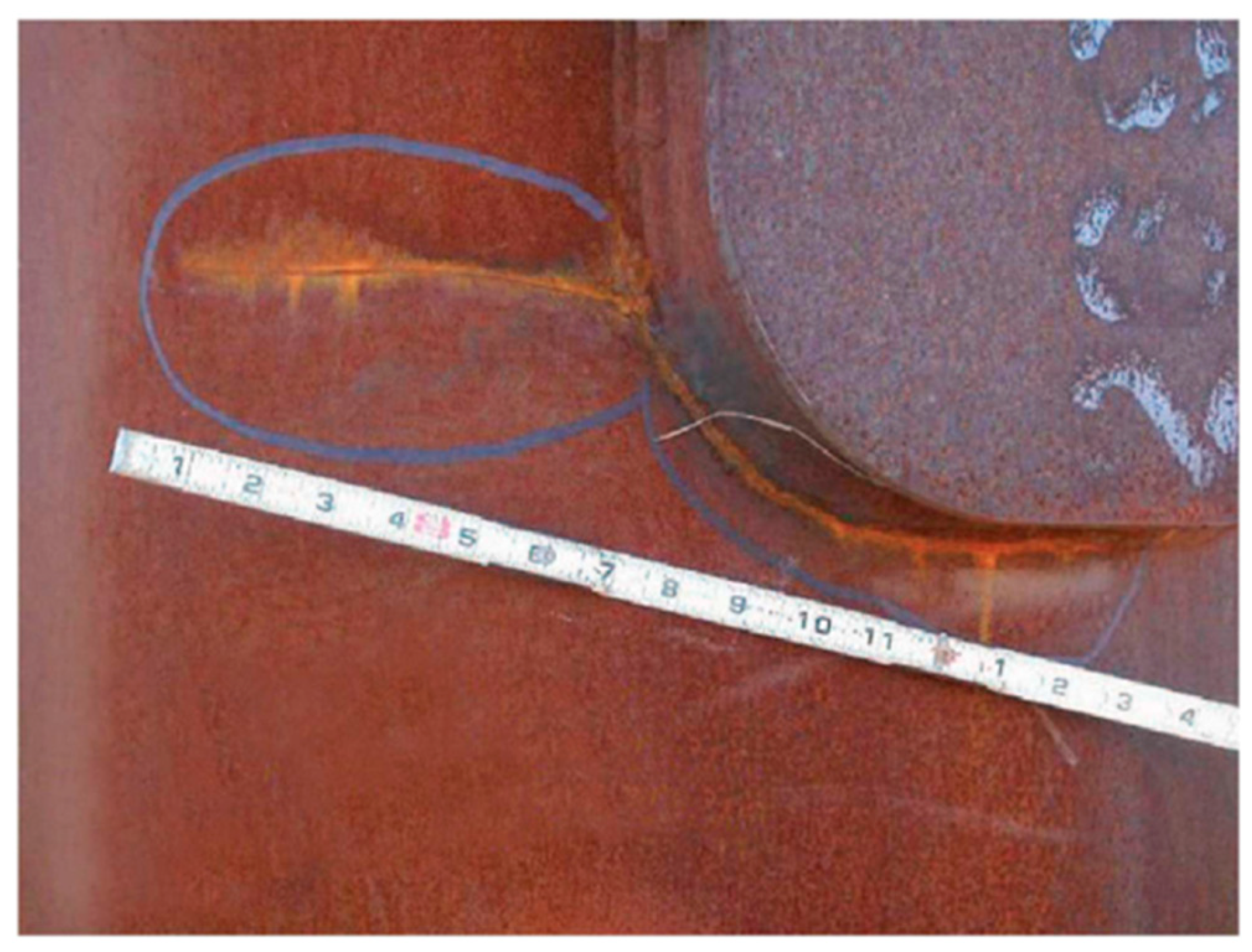
Wind-induced fatigue cracking has long been recognized as a major cause of structural failure in light poles [4]. Among the notable incidents, the September 2003 collapse of a light pole on the Western Link Elevated Road was particularly disruptive, causing significant delays to northbound traffic. A similar failure occurred in June 2004 near the crest of the Bolte Bridge, highlighting ongoing concerns with pole stability, depicted in Figure 1 [5]. In another instance, in March 2009, a light pole at Hays High School in Buda, Texas, fell onto the roof of a neighboring gymnasium during a girls’ soccer game, further emphasizing the potential dangers associated with structural failures [6,7]. In 2014, extreme wind conditions led to the failure of several light pole structures in a large public parking lot in Kansas. Subsequent investigations revealed fatigue cracks in critical areas of the poles, prompting a reevaluation of their design and maintenance [8]. Tsai et al. reviewed the collapse of a high-mast light pole on I-29 near Sioux City in 2003, among other failures, providing valuable insights into the underlying causes [9]. Reports indicate that steel light poles experienced 11 notable failures between 2000 and 2010, underscoring a pattern of recurring issues [10]. Additionally, Koob’s study on high mast towers and pole luminaires documented the failure of a 140-foot-tall tower, with detailed observations of cracking in the handhole, as depicted in Figure 2 [11].
Figure 1.
Failure of bolt system in a light pole: (a) collapsed pole, (b) shoebase–bolt system prior to failure, and (c) bolt after failure.
Figure 2.
Fatigue cracking around handhole in a high mast tower.
Numerous studies have investigated the complexities of light poles and their fatigue life. Oterkus et al. [12] performed stress analysis on composite cylindrical shells with elliptical cutouts, establishing design criteria for laminated composite shells. Consolazio et al. [13] conducted a three-month monitoring study on a Variable Message Sign (VHS) to determine equivalent static pressures for fatigue loads, contributing to future sign support structure designs. Roy et al. [14] explored cost-effective connection details for highway sign, luminaire, and traffic signal structures by testing 80 full-size galvanized specimens under fatigue and performing Finite Element Analysis. Their findings led to proposed revisions to AASHTO standards. Shaheen et al. [15] conducted a study on wind-induced vibration monitoring of high-mast illumination poles (HMIP) using wireless smart sensors, offering effective strategies for mitigating vibrations in these structures. Zhou et al. [16] examined the high-cycle fatigue performance of HMIP bases with pre-existing cracks, revealing that the tested specimens outperformed the predicted fatigue life for AASHTO category E details. Connor et al. [17] investigated fatigue loading and design methodologies for high-mast lighting towers, proposing a comprehensive fatigue design load approach that accounts for wind gusts and vortex shedding. Additionally, they presented several other significant findings, further enhancing the understanding the behavior of these structures.
The University of Akron has carried out several studies on the fatigue life of aluminum light poles. Azzam [18] investigated the fatigue behavior of welded aluminum light poles, focusing on socket connections and through plate base connections. Daneshkhah et al. [19] examined reinforced welded handholes in aluminum light poles, developing S–N curves and analyzing their mechanical behavior. Schlater’s master’s thesis [20] focused on the fatigue behavior of reinforced electrical access handholes in 10-inch diameter specimens. Extensive research on aluminum light poles and associated handholes was conducted by Rusnak et al. This study included topics such as flush-insert-design handholes [21], open-unreinforced handholes [22], geometric variations [23], fracture mechanics analysis [24], and the performance of smaller diameter poles containing handholes [25]. Rusnak’s master’s thesis and doctoral dissertation [26,27], focused on the fatigue life of smaller-diameter aluminum light poles and the nuances of various handhole designs.
Cumulative fatigue damage has been the focus of prior research. Batsoulas et al. [28] examined the mechanics of fatigue damage to predict the fatigue life of composite laminates under various loading conditions, addressing a wide range of fatigue loading scenarios. Manson et al. [29] presented insights into cumulative fatigue damage analysis. Lin et al. [30] proposed a probabilistic fatigue damage model, accounting for the randomness of load and material properties. Their study introduced improvements to nonlinear fatigue damage models by incorporating load sequence effects and load exceedance variation within fatigue spectra. Blacha [31] proposed a nonlinear probabilistic modification of Miner’s Rule for damage accumulation. Hectors et al. [32] reviewed cumulative damage and life prediction models for high-cycle fatigue of metals, highlighting the complexity of fatigue damage accumulation and the challenges in developing a generalized predictive model.
Despite extensive research on the fatigue behavior of aluminum light poles and their components, a gap exists in the practical application of laboratory-derived S–N (stress–life) data to assess cumulative damage in handholes under real-world conditions. While fatigue life models have been developed, existing methodologies do not provide engineers with reliable tools to directly apply these models for evaluating the cumulative effects of repeated wind loads on handholes, particularly in regions where the light poles are subjected to high wind conditions. This gap in the current body of knowledge hinders the ability to accurately predict failure and make informed maintenance or replacement decisions. Developing a robust, field-applicable methodology for cumulative damage assessment is crucial for enhancing the structural integrity and longevity of light poles. Such a framework would allow for more accurate prediction of failure mechanisms, facilitate timely intervention, and ultimately mitigate the risk of catastrophic structural failures, improving safety and reducing the potential for costly infrastructure damage.
The novelty of this work lies in the development of a probabilistic framework that bridges laboratory-derived S–N fatigue data with real-world wind loading conditions by converting stress ranges into equivalent wind velocities. Unlike prior deterministic fatigue analyses of light poles, this approach quantifies cumulative damage probabilistically, providing a field-applicable and risk-informed tool for maintenance and design assessment.
The research present in this study was part of a comprehensive program at the University of Akron focused on handholes in aluminum light poles. The study revealed a gap in practical methods to apply S–N data to assess cumulative damage in handholes. Without a reliable way to translate laboratory results to real-world conditions, engineers face challenges in evaluating the structural integrity of poles, particularly in regions prone to high winds. To address this, the team leveraged the extensive S–N data gathered in the lab [20,25] to develop a field-ready methodology. This new framework allows engineers to account for the effects of repeated wind loads on handholes and make more informed maintenance and replacement decisions.
2. Experimental Program and Cumulative Damage Analysis Framework
2.1. Experimental Setup and Loading Protocol
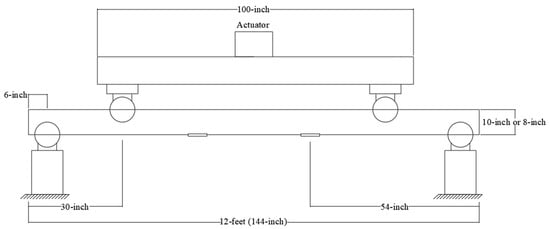
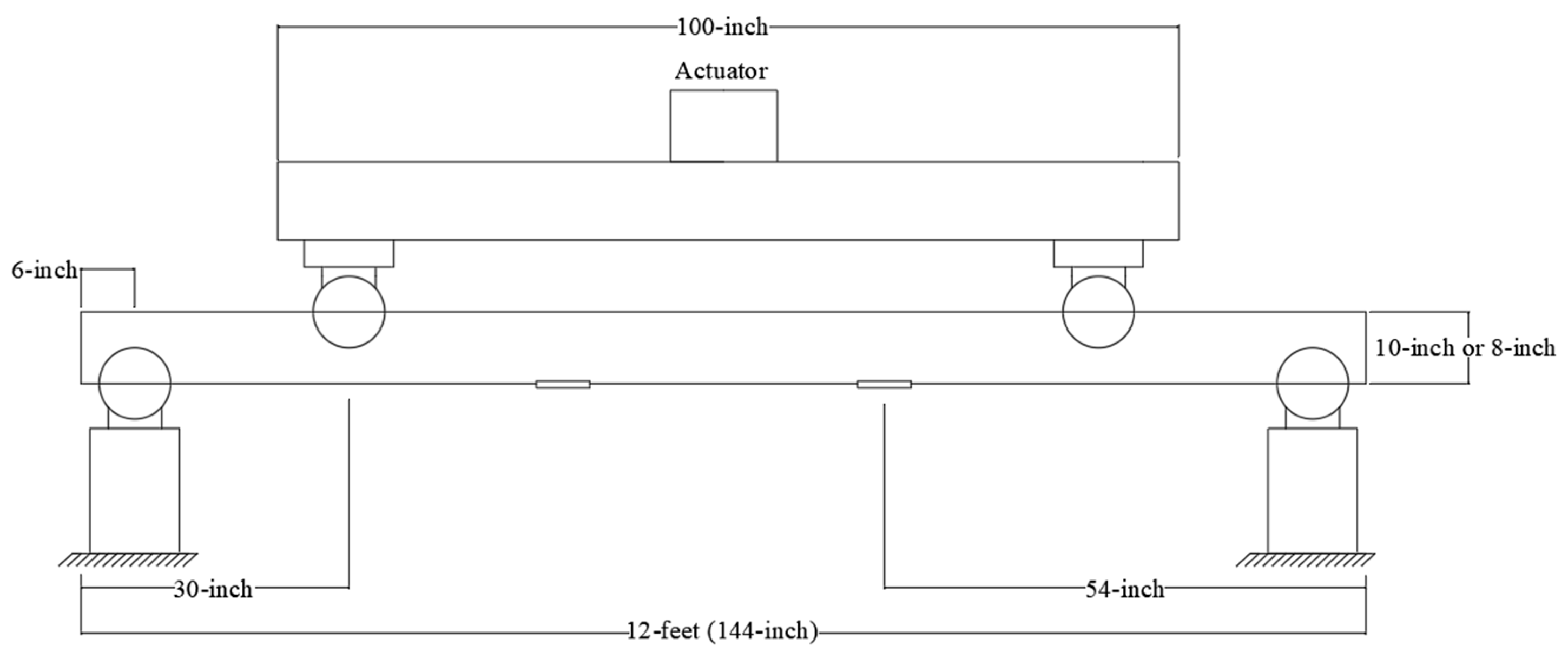
The experimental setup at the University of Akron laboratory during the comprehensive program (previous work [18,19,20,21,22,23,24,25,26,27]) featured an apparatus designed to test specimens in four-point bending under constant amplitude cyclic fatigue. A total of twenty-nine (29) experiments were conducted to develop the S–N data from the cyclic fatigue tests. Each light pole specimen was 12 feet (144 inches) in length, with two (2) handholes positioned 54 inches from either end of the pole. The handholes had an aspect ratio of 4 inches by 6 inches, with the major dimension aligned along the pole’s vertical axis and were reinforced by an oval insert welded in place using Gas Metal Arc Welding (GMAW) [33]. Of the experiments, twenty-two (22) involved poles with a 10-inch-diameter and a wall thickness of 0.25 inches, while seven (7) used 8-inch-diameter poles with the same wall thickness. All dimensions are reported in inches, and stresses in ksi (with corresponding MPa values provided when applicable), unless otherwise specified. A complete list of imperial-to-SI unit conversions is provided in Appendix A for reference.
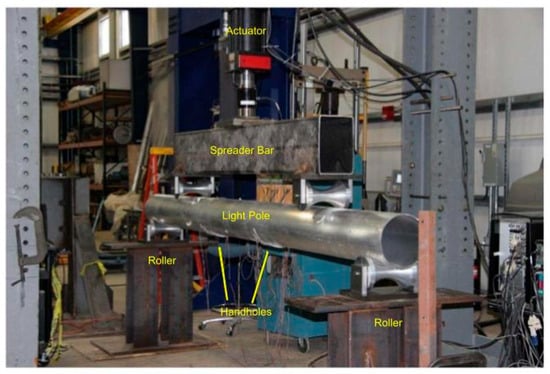
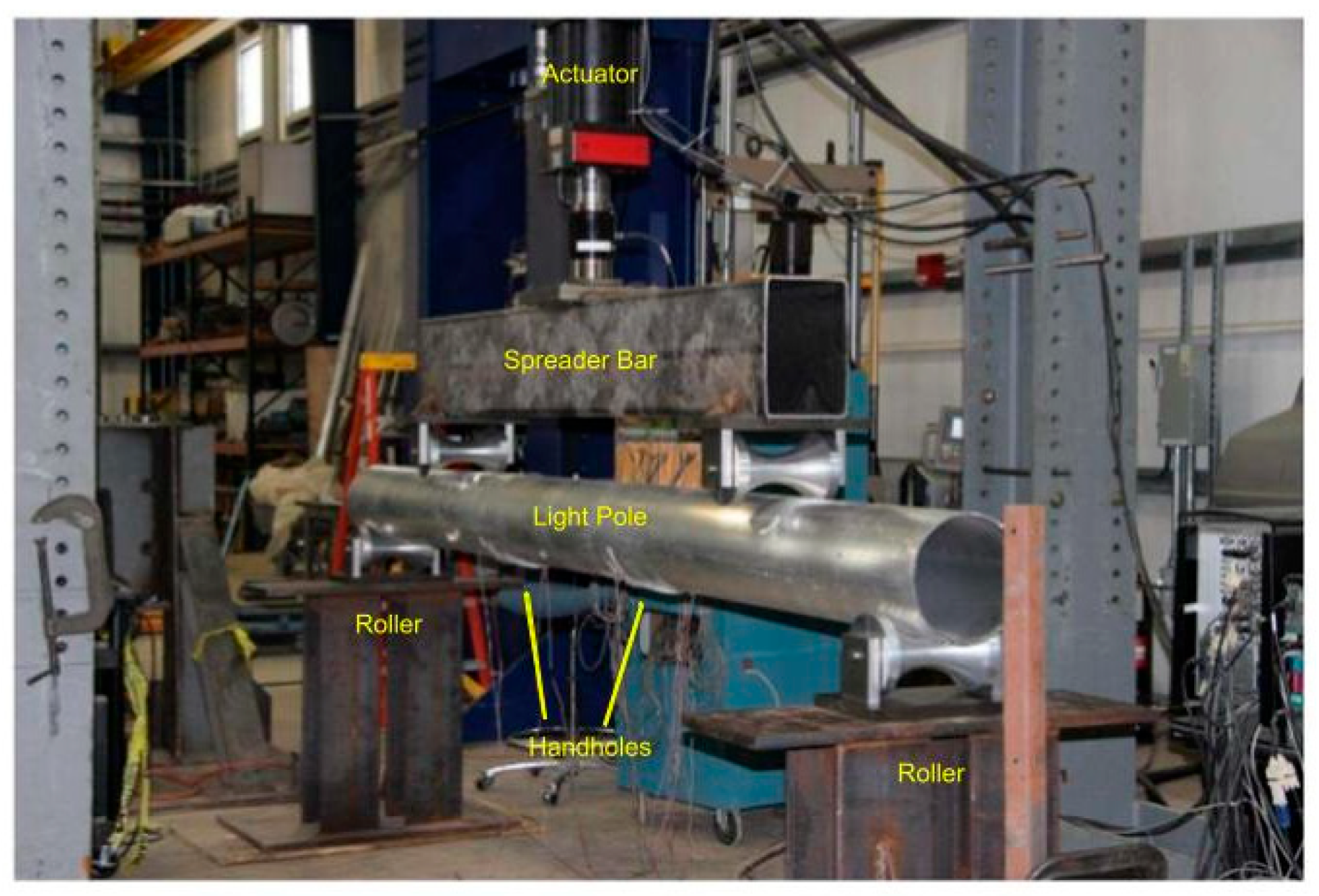
Each specimen was supported by two separate rollers, positioned approximately 6 inches from each end of the pole. A 100-inch spreader bar, equipped with steel rollers 8 inches from each end, was used to achieve four-point bending. The spreader bar was placed on the specimen with the rollers located 30 inches from each end of the pole. Loading was applied through a 55-kip servo-hydraulic actuator, powered by an MTS STS controller system, and applied at the center of the spreader bar. Detailed material properties for the pole/tube, cast insert, and weldment can be found in the following sources: Pole [34], Cast Insert [35], Weld [36] and heat treat treatment [37]. Figure 3 presents a sample drawing of the experimental setup, while Figure 4 shows a photograph from the lab. The stress ranges tested for each respective size are summarized in Table 1 and Table 2.
Figure 3.
Experimental test setup.
Figure 4.
Experimental laboratory photo.
Table 1.
Tested stress ranges 10-inch-diameter pole.
Table 2.
Tested stress ranges 8-inch-diameter pole.
Measurement precision and variability were considered throughout testing. Load and displacement data were collected using an MTS STS system. Based on the manufacturer’s calibration services and typical laboratory testing practices, the estimated uncertainty in calculated stress ranges is on the order of ±1–2%.
The complete experimental and finite element (FE) results for the 10-inch-diameter specimens is presented in Schlatter’s study [20], while the corresponding results for the 8-inch-diameter specimens can be found in the work by Rusnak et al. [25].
The research team determined relevant damage states based on the conditions handholes are likely to encounter in the field. These damage states are defined as follows:
- DS1—Detection of initial cracking.
- DS2—Structural failure of the handhole.
2.2. Probabilistic Cumulative Damage Analysis Framework
The probabilistic cumulative damage analysis converted the laboratory data into a format that could be practically applied in the field. During the development of this process, the research team encountered two primary challenges: (1) converting stress ranges observed in a controlled laboratory settings into equivalent wind velocities (mph) experienced under real-world conditions, and (2) defining a ‘load cycle’ that accurately reflects the loading scenarios encountered in the field. The relevant nomenclature for the following section is provided in Table 3.
Table 3.
Nomenclature.
2.2.1. Stress Range to Wind Velocity
In response to challenge number (1), the research team went through a multifaced process.
Hollow specimens were analyzed using external pressure, a technique commonly known as ‘pressure fatigue testing’ [38,39,40]. In our experiments, the specimens were subjected to a defined stress range. The research team applied principles from Mechanics of Materials [41,42], which allows the external pressure to be treated analogously to stress. This relationship between stress and pressure is defined in Equation (1). “P” is the average (or characteristic pressure on the pole) where “F” is the resultant force.
By conducting the tests within a specified stress range (measured in ksi), the data can be conveniently converted to pounds per square foot (psf), thereby facilitating the transformation of stress range data into a format suitable for subsequent conversion to velocity. In the calculation of the stress, the geometry of the light pole was taken into consideration.
After converting the data to a usable format (in psf), the research team applied the principles outlined in ASCE-7 [43]. The analysis was primarily based on Chapter 26 of ASCE-7, with the team utilizing Equation 26.10-1, as shown in Equation (2).
The research team rearranged Equation (2) to express it in terms of velocity, resulting in the modified form presented in Equation (3).
The variables Kz, Kzt, and Ke were derived from the ASCE-7 code, and the rationale behind the selection of each value is outlined below:
- Kz: This velocity pressure coefficient is based on the exposure category, as defined in Section 26.10.1 of ASCE-7. The research team referred to Section 26.7.3 in ASCE-7 [43] to determine the appropriate exposure category. An exposure category of “C” was selected, as categories “B” and “D” are not applicable to the light poles in question. Given the test conditions and the focus on the “handholes” of high mast light poles, which are typically situated within 15 feet of the overall height, a value of 0.85 was chosen for Kz.
- Kzt: The topographic factor, Kzt, depends on the elevation and distance relative to features such as hills or escarpments, as outlined in Section 26.8.2 of ASCE-7 [43]. Due to the variability in the location of high mast light poles across the country, a standardized value of 1 was selected for Kzt. This value aligns with that used in a technical report on high mast light poles by Hamel et al. [44].
- Ke: The ground elevation factor, Ke, is detailed in Section 26.9 of ASCE-7 [43]. Similar to Kzt, the variability in high mast light pole locations nationwide led the research team to select a value of 1 for Ke.
Using these variables, the wind velocity was calculated based on stress levels, consistent with the methods used in the team’s experimental tests.
2.2.2. Cycles in the Field
The research team aimed to establish a direct correlation between the laboratory-tested cycles and real-world conditions, given the absence of a definitive standard for cycles in the field. Wind loading is often unpredictable [45], though meteorologists typically record the duration of such events [46]. The experiments were cycled at frequencies of either 1 Hz or 2 Hz, depending on the stress range. By considering the rate of loading and the specified stress range an estimate of the duration was calculated for which the handhole experienced the equivalent of a real-world wind event.
The cyclic loading was applied at frequencies of 1 Hz and 2 Hz, corresponding to one and two complete stress cycles per second, respectively. All loading data were initially recorded in seconds to directly reflect the laboratory cycling rate. For field interpretation, these values were scaled to minutes to provide a comparable measure of sustained wind exposure duration.
2.2.3. Miners Rule
The analysis is based on Miner’s Rule [47,48,49], which is widely applied in fatigue analysis for evaluating cumulative damage. Miner’s Rule provides a straightforward method for assessing the progression of fatigue damage under varying stress cycles. The progression of fatigue damage is measured using the cumulative damage index D, which quantifies the proportion of fatigue life consumed as cyclic loading proceeds. The equation for Miner’s Rule is shown in Equation (4).
The variable represents the number of loading cycles a given component has experienced at a specific stress range , directly correlating to its accumulated damage. Conversely, denotes the total number of cycles the component can endure at the same stress range before failure occurs. The damage progression is quantified through the ratio , which serves as an indicator of the component’s current degradation state at . Failure is defined when the cumulative damage reaches D = 1, signifying that the component has exhausted its fatigue life under the applied loading conditions.
2.2.4. Total Application
By converting stress to wind velocity, correlating laboratory cycles to real-world conditions, and applying Miner’s Rule, the cumulative damage to a handhole in an aluminum light pole under varying wind conditions can be assessed. Wind velocity directly influences the rate of fatigue damage accumulation because the dynamic pressure of wind loading increases with the square of velocity. Consequently, higher wind speeds induce greater stress amplitudes in the pole wall and handhole region, leading to a proportionally faster rate of cumulative damage growth per unit time. Equation (5) defines “” representing the percentage of accumulated damage during a wind event “X.” In this equation, “T” is the duration for which the wind event “X” acts on the handhole, and is the time required to reach the applicable damage state or complete failure.
By applying Equation (3) (to determine wind velocity from the tested stress range) and Equation (5) (to calculate the percentage of accumulated damage), the cumulative damage to a handhole in a high mast aluminum light pole can be evaluated under varying wind conditions. For instance, if the ratio is calculated as 0.236, this implies that the component has consumed 23.6% of its total expected fatigue life under the given loading conditions. In other words, 23.6% of the fatigue capacity has been utilized, while the remaining 76.4% represents the unused portion of its fatigue life. This metric reflects life consumption rather than a statistical probability of failure or survival.
3. Probabilistic Cumulative Damage Analysis and Its Application
3.1. Probabilistic Cumulative Damage Analysis
Building upon the deterministic Miner’s Rule–based framework, a probabilistic cumulative damage model was formulated to quantify uncertainty in the rate of fatigue progression under variable wind velocities. This model provides a field-applicable means of relating laboratory fatigue behavior to real-world wind exposure, incorporating stochastic variations in stress amplitude, duration, and environmental conditions.
The tables present the average data points obtained from the probabilistic cumulative damage analysis performed at varying wind velocities, corresponding to the tested stress ranges. Each data point represents the occurrence of a specific damage state. Because each light pole incorporates two independent handholes, two data points were recorded for each applicable stress range (or wind velocity). Damage progression was quantified in terms of exposure duration, expressed in minutes, under the prescribed wind event velocity. The cumulative data for each wind velocity are summarized in Table 4 and Table 5, while the averaged values across similar wind velocity levels are presented in Table 6 and Table 7. In cases where the onset of Damage State 1 (DS1) could not be identified, the corresponding entry is denoted as “No Data.”
Table 4.
10-inch-diameter pole velocity to damage percentage per minute total data points.
Table 5.
8-inch-diameter pole velocity to damage percentage per minute total data points.
Table 6.
10-inch-diameter pole velocity to damage percentage per minute average data points.
Table 7.
8-inch-diameter pole velocity to damage percentage per minute average data points.
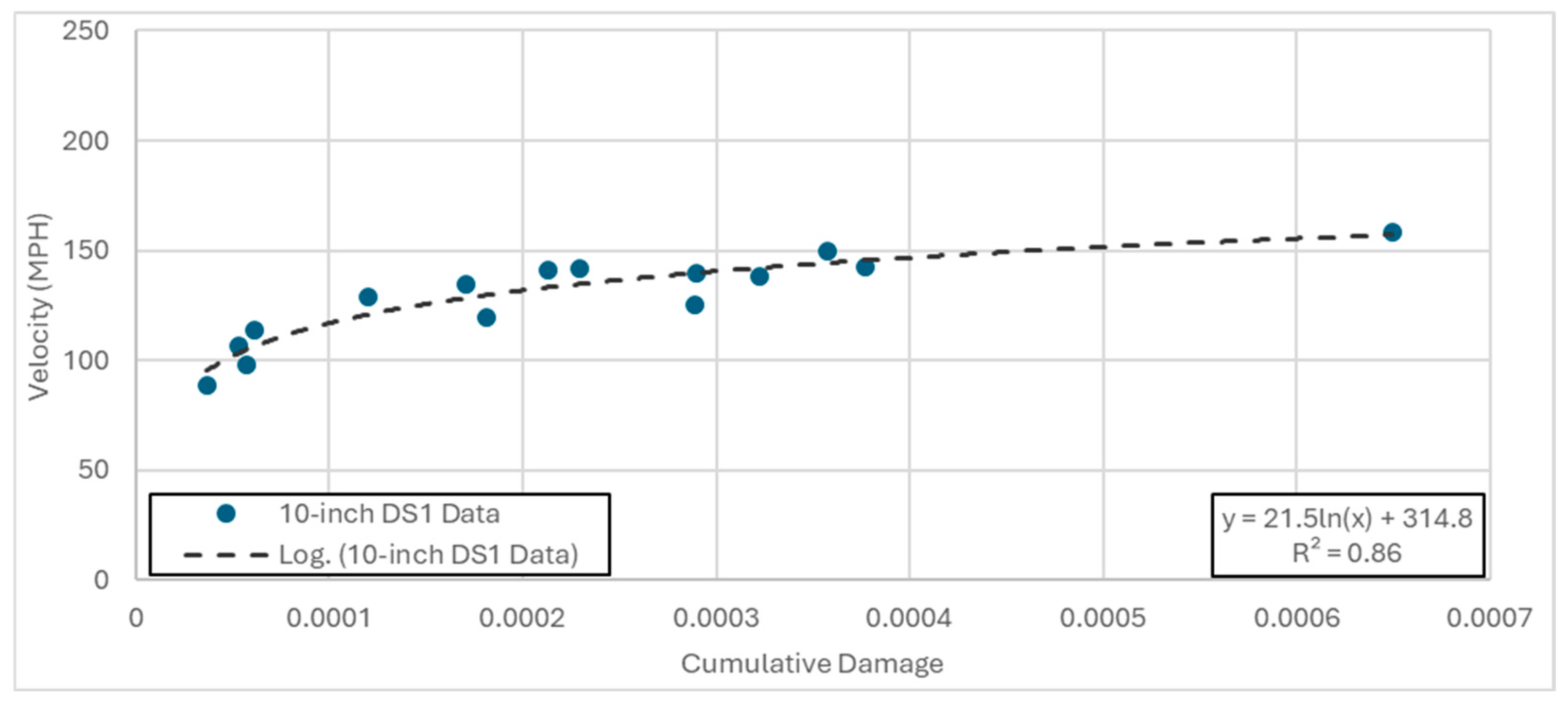
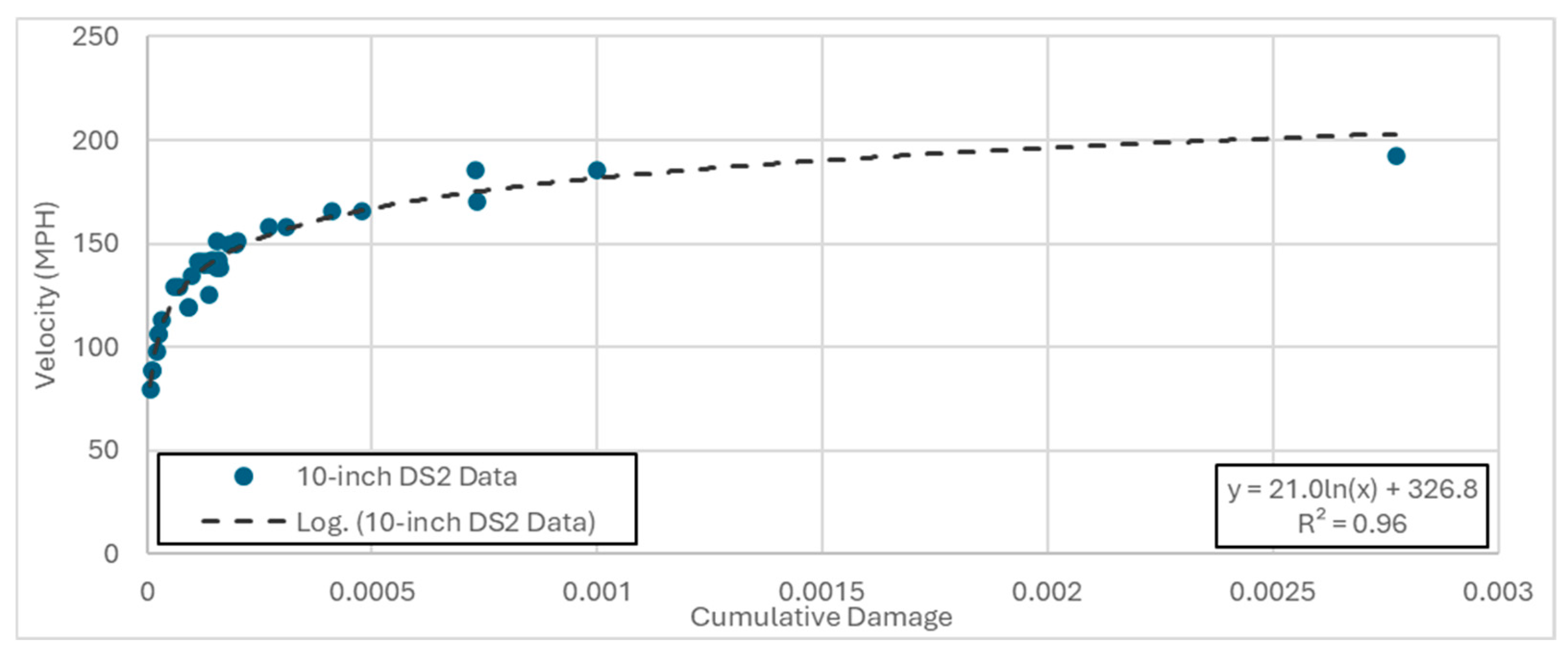
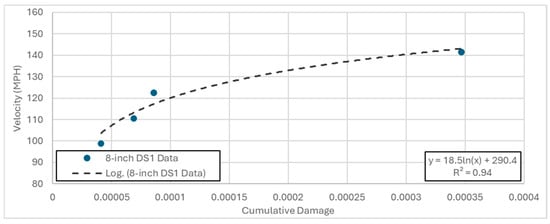
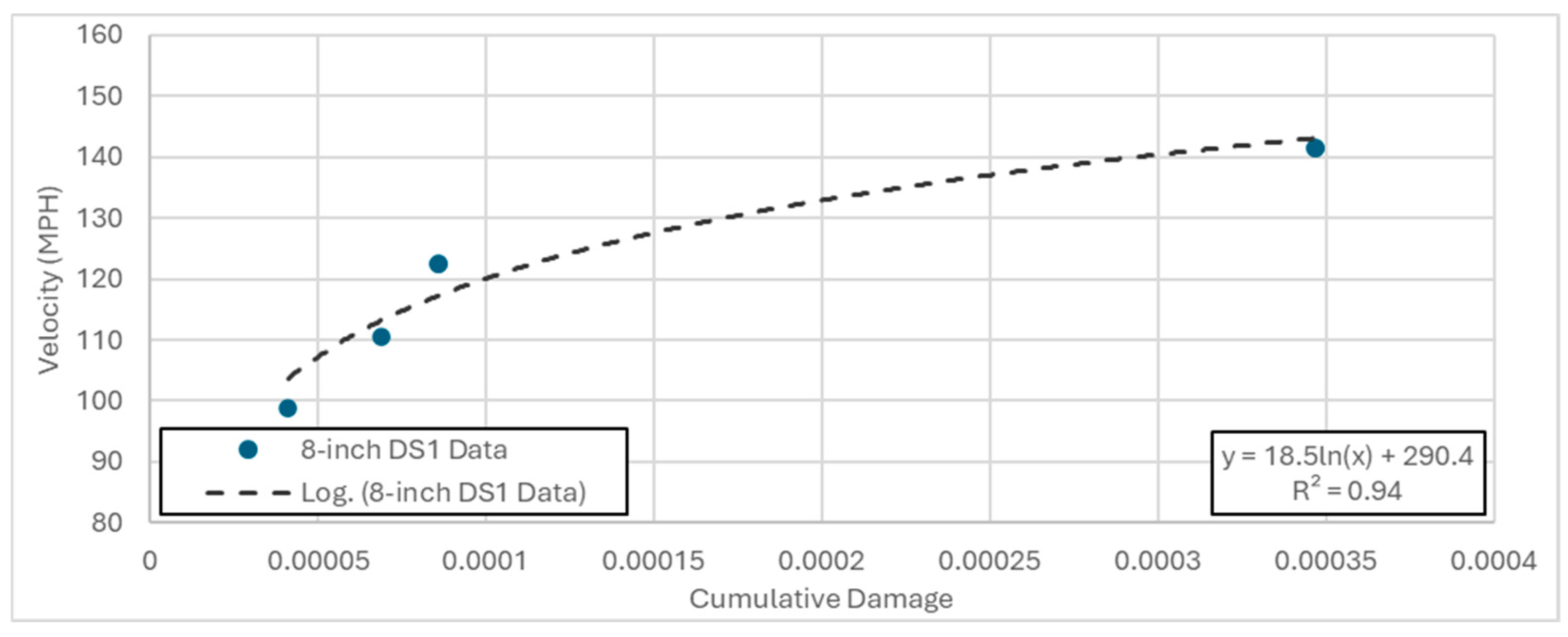
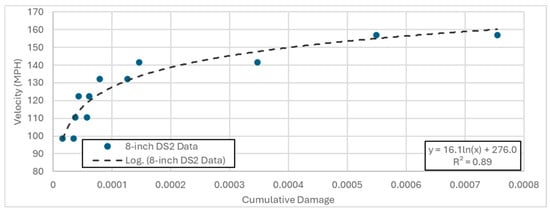
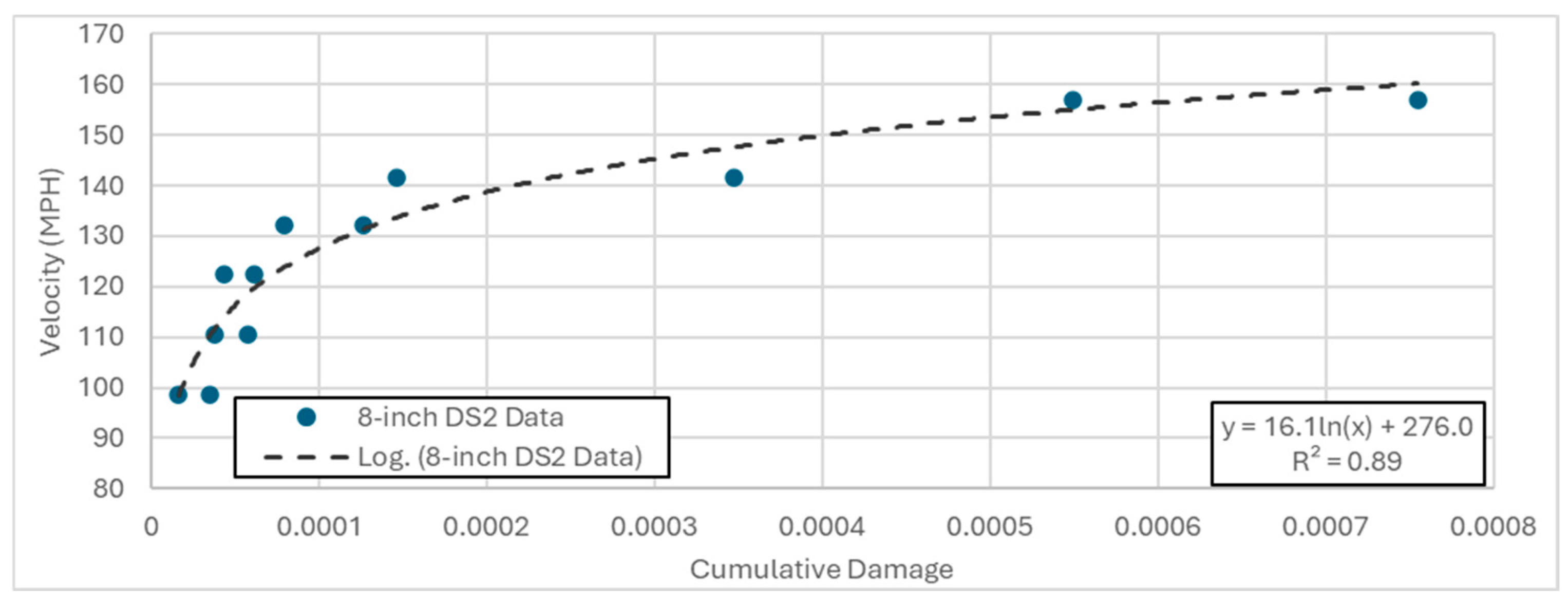
To better understand the relationship between wind velocity and the rate of damage accumulation per minute due to external wind loading, the data from Table 3 and Table 4 were graphically plotted. Additionally, the equation representing this data was derived from the trendline, enabling the calculation of wind velocities not directly tested. Figure 5 depicts the cumulative damage of the 10-inch-diameter light pole handholes at Damage State 1 (DS1). Figure 6 shows the corresponding cumulative damage to Damage State 2 (DS2) for the same 10-inch-diameter light pole handhole. Figure 7 depicts the cumulative damage to Damage State 1 (DS1) in the 8-inch-diameter light pole handhole, while Figure 8 shows the corresponding cumulative damage to Damage State 2 (DS2) for the same 8-inch-diameter light pole handhole. The logarithmic regression equations and corresponding R2 values are displayed within Figure 5, Figure 6, Figure 7 and Figure 8.
Figure 5.
Relationship between wind velocity and cumulative damage (10-inch specimen, DS1). Logarithmic trendline with corresponding equation and R2 value shown.
Figure 6.
Relationship between wind velocity and cumulative damage (10-inch specimen, DS2). Logarithmic trendline with corresponding equation and R2 value shown.
Figure 7.
Relationship between wind velocity and cumulative damage (8-inch specimen, DS1). Logarithmic trendline with corresponding equation and R2 value shown.
Figure 8.
Relationship between wind velocity and cumulative damage (8-inch specimen, DS2). Logarithmic trendline with corresponding equation and R2 value shown.
The equations of the logarithmic trendline is present in each of the respective figures. These equations were generated in order to obtain wind velocities to damage states not tested and are present in Equations (6)–(9). In the equations, “Y” represents the wind velocity and “X” represents the cumulative damage. Equation (6) represents the equation for the 10-inch-diameter pole handhole to DS1, Equation (7) represents the equation for the 10-inch-diameter pole handhole to DS2, Equation (8) represents the equation for the 8-inch-diameter pole handhole to DS1, Equation (9) represents the equation for the 8-inch-diameter pole handhole to DS2.
3.2. Proof of Concept of the Probabilistic Cumulative Damage Analysis
To facilitate the cumulative damage analysis, the research team created a proof of concept using the data and process generated. Consistent wind velocities and gusts, along with their associated durations that were utilized in the proof of concept can be seen in Table 8. Gusts are common in any sort of wind event [50]. ASCE-07 uses a “3 s gust factor” to account for short-duration wind gusts as it corresponds to the peak wind speeds that are most likely to cause structural damage [43]. For the sake of the proof of concept, the research team assumed that each of the gusts last a total of 3 s. Some of the constant wind velocity data selected for proof of concept was similar to some recorded extreme events, like hurricane Sandy [51,52] and a possible tornadic event and its associated velocities and average duration [53,54,55].
Table 8.
Proof of concept case study Wind data points.
Processing the data from Table 8 through the cumulative damage analysis, utilizing the derived equation in the process, the calculated total damage the handhole experienced is presented in Table 9 with both the cumulative damage and percentage to failure or damage.
Table 9.
Proof of concept case study cumulative damage.
Table 9 indicates that the presence of a handhole in a 10-inch-diameter pole results in a 1.5% probability of initial fatigue crack formation and a 0.7% probability of catastrophic fracture. Similarly, for an 8-inch-diameter light pole with a handhole, the likelihood of initiating a fatigue crack is 0.9%, while the probability of catastrophic fracture is 0.3%. These cumulative damage percentages in this proof-of-concept case study represent the combined effects of the variable wind conditions outlined in Table 8, including both sustained winds and short-duration gusts. The results demonstrate that even under extreme events such as hurricanes or tornado-level winds, total fatigue life consumption remains below 2% for a single event, confirming the model’s capability to quantify cumulative damage across distinct wind velocity scenarios.
4. Discussion
This study distinguishes itself from previous deterministic fatigue assessments by implementing a probabilistic cumulative damage framework that links laboratory-measured stress ranges to real-world wind velocities. This approach provides a realistic representation of fatigue progression and enables risk-based evaluation of structural integrity under variable wind loading. The key findings presented herein underscore the practicality and scalability of the proposed methodology, as well as its potential to serve as a predictive tool in real-world applications.
4.1. Interpretation of Results in Engineering Context
- Logarithmic Damage Progression: The damage trendlines for both 10-inch- and 8-inch-diameter poles exhibit logarithmic behavior, as seen in Figure 5, Figure 6, Figure 7 and Figure 8. This aligns with known fatigue phenomena where cumulative damage tends to accelerate as microstructural fatigue cracks propagate beyond critical thresholds. This progression underscores the importance of periodic inspections and preemptive interventions, particularly for poles subjected to regions with consistent high wind velocities.
- Wind Velocity Translation: The successful conversion of stress ranges into wind velocities provides actionable insights for contractors. By incorporating ASCE-7 factors such as Kz, Kzt, and Ke, the methodology accounts for local topographic and atmospheric variations, enhancing its applicability across diverse geographic settings. However, these factors’ potential sensitivity to unique environmental conditions necessitates localized calibration to improve predictive accuracy.
- Field Relevance of Laboratory Results: The correlation between laboratory-derived cycle counts and field conditions helps bridge a critical gap in engineering practice. The methodology effectively addresses the challenge of translating controlled experimental results into stochastic field conditions by leveraging Miner’s Rule. This simplification, while practical, assumes linear damage accumulation, potentially underestimating nonlinear damage effects observed in materials subjected to varying amplitude cycles.
- Critical Observations on Handhole Failures: The inability to consistently detect Damage State 1 (DS1) in high wind scenarios emphasizes the abrupt nature of crack initiation and propagation under extreme loading. This phenomenon highlights the importance of enhanced inspection protocols and the integration of real-time monitoring technologies, such as wireless strain gauges or acoustic emission sensors, to preemptively identify incipient failures.
4.2. Practical Implications for Structural Maintenance
- Lifecycle Management: By quantifying damage as a percentage of total failure under specific wind events, this methodology empowers asset managers to prioritize maintenance schedules based on empirical risk assessments. The approach/framework can reduce lifecycle costs by shifting focus from reactive to proactive maintenance strategies.
- Customization Potential: The modularity of the cumulative damage analysis process allows its adaptation to other structural components, such as base plates and weld seams, further broadening its applicability. Future studies should explore its integration with digital twin models to simulate long-term performance under probabilistic wind scenarios.
- Validation Through Extreme Events: The proof-of-concept analysis using historical extreme weather events, such as Hurricane Sandy and tornado scenarios, demonstrates the model’s robustness. However, the analysis reveals the necessity for expanding datasets to intermediate wind velocities and mixed-mode loading conditions for greater interpolation accuracy.
5. Conclusions
A novel probabilistic cumulative damage framework was developed in this study to evaluate the fatigue performance of handholes in aluminum light poles subjected to variable wind conditions. By bridging the gap between controlled laboratory testing and real-world applications, this approach provides engineers and contractors with a predictive tool to assess structural integrity. The findings underscore the utility of Miner’s Rule as a foundation for cumulative damage assessment, particularly when combined with wind velocity conversions. The observed logarithmic nature of damage accumulation highlights the escalating risk of failure as fatigue life nears completion, reinforcing the importance of early detection and proactive maintenance strategies, especially in high-risk environments.
The developed methodology demonstrates significant scalability, making it applicable across various structural configurations and environmental conditions. Reliance on standardized factors from ASCE-7 enhances its adaptability to different geographic and meteorological contexts. Although this study focuses specifically on handholes, the framework holds promise for assessing other critical features, including weld seams, pole bases, or connections in composite structures. By integrating wind velocity data with damage states, the framework transitions field assessments from qualitative observations to quantitative predictions, enabling data-driven maintenance and replacement decisions that can reduce unplanned failures and associated costs.
Nonetheless, certain limitations remain. The inability to capture DS1 under high wind velocities highlights the challenges of replicating real-world failure dynamics within controlled laboratory settings. This gap underscores the need for advanced real-time monitoring systems capable of detecting early-stage crack propagation under transient loading conditions.
Building on these findings, future research should focus on several areas to enhance the model’s robustness and applicability. Incorporating advanced fatigue models that account for nonlinear damage accumulation, particularly under variable amplitude loading, could provide a more accurate representation of material behavior. Additionally, expanding experimental testing to cover a broader range of wind velocities and mixed-mode fatigue loading scenarios would refine the methodology’s predictive capabilities. Investigating the influence of environmental factors, such as temperature fluctuations, corrosion, and UV exposure, could also offer a more comprehensive understanding of damage progression in aluminum poles.
A holistic structural analysis that considers the entire pole assembly, rather than isolated handholes, is another important direction. Coupling such studies with finite element modeling would help simulate component interactions under dynamic wind loads. Real-time monitoring technologies, such as strain gauges or wireless acoustic emission systems, could further enhance the practical utility of the model by providing continuous assessments of pole health. Integrating these insights into digital twin models would support predictive maintenance strategies with higher precision.
Finally, future work should explore material innovations, such as fiber-reinforced composites or advanced aluminum alloys, to improve the durability of handholes and extend the service life of light poles. Collaboration with industry stakeholders to integrate these findings into standards and codes, such as AASHTO or ASCE-7, would facilitate broader adoption of the methodology and promote improved infrastructure design and maintenance practices.
This study lays a strong foundation for the assessment of cumulative damage in aluminum light poles and provides a framework for addressing fatigue-related challenges in structural engineering. Further refinement and expansion of this work will enhance its value, both as a predictive tool for field applications and as a basis for advancing research in structural fatigue analysis.
Author Contributions
C.R. led the conceptualization of the study, developed the analytical framework, executed the experimental program, performed data acquisition, and conducted the primary data analysis. A.A.-h. contributed to the development of the analytical framework, assisted with data processing and validation, and supported the interpretation of results. C.M. secured project funding, provided technical oversight, and contributed to the data analysis and interpretation. All authors have read and agreed to the published version of the manuscript.
Funding
The authors declare that this study received funding from Hapco Pole Products.
Data Availability Statement
The data generated and analyzed in this study, including cyclic fatigue test results, stress–range conversions, and cumulative damage calculations, are available from the corresponding author upon reasonable request. All processed data supporting the findings of this study are included within the article.
Conflicts of Interest
The authors declare that this study received funding from Hapco Pole Products. The only thing used from HAPCO directly for this study was the aluminum light poles. The funder was not involved in the study design, collection, analysis, interpretation of data, the writing of this article or the decision to submit it for publication. The authors declare no conflicts of interest regarding the publication of this article.
Appendix A
To assist readers in interpreting the results, Table A1 provides conversions between imperial and SI units for parameters used in this study.
Table A1.
Imperial Unit, Equivalent SI Unit and Conversion Factor.
References
- CMI Companies. Why Light Poles are Important and How You Can Maintain Them. 2023. Available online: https://www.cmilighting.com/blog/light-poles-important-can-maintain/ (accessed on 21 January 2025).
- Nova Pole. The Importance of Effective Street Light Poles/Street Lighting Poles. 2020. Available online: https://www.novapole.com/news-43-the-importance-of-effective-street-light-poles--street-lighting-poles (accessed on 21 January 2025).
- Hapco. Reinforced Handholes. Technical Product Sheet. 2024. Available online: https://www.hapco.com/pole-accessories/reinforced-handholes/ (accessed on 21 January 2025).
- Garlich, M.J.; Thorkildsen, E.T. Guidelines for the Installation, Inspection, Maintenance and Repair of Structural Supports for Highway Signs, Luminaires, and Traffic Signals; Technical Report FHWA NHI 05-036; Federal Highway Administration: Washington, DC, USA, 2005. [Google Scholar]
- Taplin, G.; Sanders, G.; Maklary, Z.; Connal, J. Fatigue Failures of Light Poles; National Academies of Sciences, Engineering, and Medicine: Washington, DC, USA, 2006. [Google Scholar]
- Ireland, B. The Harder They Fall; Trade Publication: Lighting and Control; MC&M Endeavor Business Media LLC: Milwaukee, WI, USA, 2010. [Google Scholar]
- Steinbach, P. Importance of Support-Pole Specification, Inspection. 2009. Available online: https://www.athleticbusiness.com/facilities/stadium-arena/article/15141609/importance-of-support-pole-specification-inspection (accessed on 22 January 2025).
- GES Tech Group. Light Pole Fatigue Crack Fail. General Engineering Science and Technology Group; GES Tech Group, Inc.: Crawfordville, FL, USA, 2014. [Google Scholar]
- Tsai, L.W.; Alipour, A. Assessment of Fatigue Life and Reliability of High-Mast Luminaire Structures. J. Constr. Steel Res. 2020, 170, 106048. [Google Scholar] [CrossRef] [Scilit]
- Peveto, K. Fall-Prone Light Poles Used at Southeast Texas Schools. The Beaumont Enterprise, 9 July 2010.
- Koob, M.J. Base Connection Retrofits for High Mast Towers and Pole Luminaries Used for Roadway and Bridge Lighting. Bridge Struct. 2007, 3, 67–80. [Google Scholar] [CrossRef]
- Oterkus, E.; Madenci, E.; Nemeth, M.P. Stress Analysis of Composite Cylindrical Shells with an Elliptical Cutout; AIAA Tech. Rep.; Mathematical Sciences Publishers: Berkeley, CA, USA, 2005. [Google Scholar]
- Consolazio, G.R.; Johns, K.W.; Dexter, R.J. Fatigue Performance of Variable Message Sign and Luminaire Support Structures. Volume II—Fatigue Testing and Failure Analysis of Aluminum Luminaire Support Structures; FHWA Report No. FHWA 1998-010; U.S. Department of Transportation: Washington, DC, USA, 1998. [Google Scholar]
- Roy, S.; Park, Y.C.; Sause, R.; Fisher, J.W.; Kaufmann, E.J. NCHRP Web-Only Document 176: Cost-Effective Connection Details for Highway Sign, Luminaire, and Traffic Signal Structures; Advanced Technology for Large Structural Systems (ATLSS) Center, Lehigh University: Bethlehem, PA, USA, 2011. [Google Scholar]
- Shaheen, M.; Li, J.; Bennett, C.; Collins, W. Wind-Induced Vibration Monitoring of High-Mast Illumination Poles Using Wireless Smart Sensors. Sensors 2024, 24, 2506. [Google Scholar] [CrossRef] [Scilit] [PubMed]
- Zhou, Y.; Dawood, M.; Gencturk, B. High-Cycle Fatigue Performance of High-Mast Illumination Pole Bases with Pre-Existing Cracks. J. Constr. Steel Res. 2017, 138, 463–472. [Google Scholar] [CrossRef] [Scilit]
- Connor, R.; Collicott, S.; DeSchepper, A.; Sherman, R.; Ocampo, J. NCHRP Report 718: Fatigue Loading and Design Methodology for High-Mast Lighting Towers; Transportation Research Board, National Academies: Washington, DC, USA, 2012. [Google Scholar]
- Azzam, D. Fatigue Behavior of High Welded Aluminum Light Pole Support Structures. Ph.D. Thesis, The University of Akron, Akron, OH, USA, 2006. [Google Scholar]
- Daneshkhah, A.; Schlatter, C.; Rusnak, C.; Menzemer, C. Fatigue Behavior of Reinforced Welded Handholes in Aluminum Light Poles. Eng. Struct. 2019, 188, 60–68. [Google Scholar] [CrossRef] [Scilit]
- Schlatter, C. Fatigue Behavior of the Reinforced Electrical Access Hole in Aluminum Light Support Structures. Master’s Thesis, The University of Akron, Akron, OH, USA, 2017. [Google Scholar]
- Rusnak, C.; Menzemer, C. Fatigue Behavior of Flush Welded Handholes in Aluminum Light Poles. Eng. Struct. Mater. 2021, 7, 465–480. [Google Scholar]
- Rusnak, C.; Menzemer, C. Fatigue Behavior of Nonreinforced Handholes in Aluminum Light Poles. Metals 2021, 11, 1263. [Google Scholar] [CrossRef] [Scilit]
- Rusnak, C.; Menzemer, C. Fatigue Behavior of Reinforced Welded Handholes in Aluminum Light Poles with a Change in Detail Geometry. In Failure Analysis—Structural Health Monitoring of Structure and Infrastructure Components; IntechOpen: London, UK, 2022. [Google Scholar]
- Rusnak, C.; Menzemer, C. Fracture Mechanics and Its Application in the Fatigue Behavior of Reinforced Welded Handholes in Aluminum Light Poles. Open J. Civ. Eng. 2023, 13, 677–694. [Google Scholar] [CrossRef]
- Rusnak, C.; Al-Hamami, A.; Menzemer, C. The Performance of Small Diameter Aluminum Light Support Structures Containing Handholes under Cyclic Fatigue. Open J. Civ. Eng. 2024, 14, 196–213. [Google Scholar] [CrossRef]
- Rusnak, C. Fatigue Behavior in Reinforced Electrical Access Holes in Aluminum Light Support Structures. Master’s Thesis, The University of Akron, Akron, OH, USA, 2019. [Google Scholar]
- Rusnak, C. Fatigue Behavior in Electrical Access Holes in Aluminum Light Support Structures. Ph.D. Thesis, The University of Akron, Akron, OH, USA, 2022. [Google Scholar]
- Batsoulas, N.; Giannopoulos, G. Cumulative Fatigue Damage of Composite Laminates: Engineering Rule and Life Prediction Aspect. Materials 2023, 16, 3123. [Google Scholar] [CrossRef] [Scilit] [PubMed]
- Manson, S.; Halford, G. Re-Examination of Cumulative Fatigue Damage Analysis—An Engineering Perspective. Eng. Fract. Mech. 1986, 25, 539–571. [Google Scholar] [CrossRef] [Scilit]
- Lin, H.; Cao, J.; Yao, W.; Ma, M.; Wu, T. Probabilistic Fatigue Cumulative Damage Model Considering the Randomness of Load and Material Properties. Eng. Fail. Anal. 2023, 154, 106061. [Google Scholar] [CrossRef] [Scilit]
- Blacha, L. Non-Linear Probabilistic Modification of Miner’s Rule for Damage Accumulation. Materials 2021, 14, 6889. [Google Scholar] [CrossRef] [Scilit] [PubMed]
- Hectors, K.; Waele, W. Cumulative Damage and Life Prediction Models for High-Cycle Fatigue of Metals: A Review. Metals 2021, 11, 270. [Google Scholar] [CrossRef] [Scilit]
- Minnick, W.H.; Mosman, J. Gas Metal Arc Welding Procedures for Aluminum. In GMAW/FCAW Handbook, 2nd ed.; Chapter 10; The Goodheart-Willcox Company, Inc.: Tinley Park, IL, USA, 2023; pp. 93–102. [Google Scholar]
- Matweb. Aluminum 6063. Material Property Database: Matweb. Available online: https://asm.matweb.com/search/SpecificMaterial.asp?bassnum=MA6063T6 (accessed on 10 February 2025).
- Matweb. Aluminum A356-T6. Material Property Database: Matweb. Available online: https://www.matweb.com/search/datasheet.aspx?matguid=d524d6bf305c4ce99414cabd1c7ed070&ckck=1 (accessed on 10 February 2025).
- AlcoTec. Alloy 4043 Weld Data Sheet. AlcoTec Wire Corporation; Manufacturer Data Sheet. 2024. Available online: https://tollweldingsupply.com/wp-content/uploads/2018/03/ALC4043.pdf (accessed on 10 February 2025).
- Hapco. Specifications Advantage. Hapco Pipe Products; Manufacturer Data Sheet. 2015. Available online: https://www.hapco.com/wp-content/uploads/pdfs/H000005C-Hapco-Specifications.pdf (accessed on 21 January 2025).
- Costa, P.; Nwawe, R.; Soares, H.; Reis, L.; Freitas, M.; Chen, Y.; Montalvão, D. Review of Multiaxial Testing for Very High Cycle Fatigue: From ‘Conventional’ to Ultrasonic Machines. Machines 2020, 8, 29. [Google Scholar] [CrossRef] [Scilit]
- Freitas, M. Multiaxial Fatigue: From Materials Testing to Life Prediction. Theor. Appl. Fract. Mech. 2017, 92, 360–372. [Google Scholar] [CrossRef] [Scilit]
- ATS. Pressure Fatigue Resistance Test. Laboratory Procedure Summary; Applied Technical Services. 2024. Available online: https://atslab.com/specialty/additive-manufacturing-components/fatigue-testing-lab/ (accessed on 16 February 2025).
- Beer, F.P.; Johnston, E.R.; DeWolf, J.T.; Mazurek, D.F. Mechanics of Materials, 7th ed.; McGraw-Hill Education: New York, NY, USA, 2018. [Google Scholar]
- Ugural, A.C.; Fenster, S.K. Advanced Mechanics of Materials and Applied Elasticity, 5th ed.; Pearson: Hoboken, NJ, USA, 2019. [Google Scholar]
- ASCE. Minimum Design Loads for Buildings and Other Structures, ASCE 7-22; The American Society of Civil Engineers: Reston, VA, USA, 2022. [Google Scholar]
- Hamel, S.; Hoisington, D. High-Mast Light Pole Anchor Nut Loosening in Alaska. Final Project Report; Pacific Northwest Transportation Consortium (PacTrans) and USDOT University Transportation Center for Federal Region 10: Anchorage, AK, USA, 2013. [Google Scholar]
- Hu, W.; Yang, Q.; Peng, L.; Liu, L.; Zhang, P.; Li, S.; Wu, J. Non-Stationary Modeling and Simulation of Strong Winds. Heliyon 2024, 10, e2919. [Google Scholar] [CrossRef] [Scilit] [PubMed]
- NOAA Storm Report Records. National Weather Service Database. 2024. Available online: https://www.ncei.noaa.gov/stormevents. (accessed on 18 February 2025).
- Miner, M.A. Cumulative Damage in Fatigue. J. Appl. Mech. 1945, 12, A159–A164. [Google Scholar] [CrossRef] [Scilit]
- Uherek, F.C. What Is Miner’s Rule? Technical Blog; Rexnord Corporation. 2023. Available online: https://www.regalrexnord.com/regal-rexnord-insights/what-is-miners-rule?srsltid=AfmBOoptlSMdZg92O7aUsbQB0NqVkgA-LW-eifbzfw7FXO7C7nDV-JvA. (accessed on 18 February 2025).
- ASTM E1049-85; Standard Practices for Cycle Counting in Fatigue Analysis. ASTM International: West Conshohocken, PA, USA, 2017.
- Adame, D. The Difference Between Wind Speed and Wind Gusts. Spectrum News NY1, 7 August 2020.
- Fanelli, C.; Fanelli, P.; Wolcott, D. Hurricane Sandy; NOAA Water Level and Meteorological Data Report; U.S. Department of Commerce: Washington, DC, USA, 2013. [Google Scholar]
- Blake, E.; Kimberlain, T.; Berg, R.; Cangialosi, J.; Beven, J., II. Tropical Cyclone Report: Hurricane Sandy (AL182012); National Hurricane Center: Miami, FL, USA, 2013. [Google Scholar]
- NOAA. Classifying Tornadoes. National Oceanic and Atmospheric Administration; 2024. Available online: https://www.weather.gov/news/250703_tornado_activity (accessed on 18 February 2025).
- NOAA. Tornadoes FAQ. National Oceanic and Atmospheric Administration; 2024. Available online: https://www.weather.gov/lmk/tornadoesfaq (accessed on 18 February 2025).
- Snow, J. Tornado Methodology. Encyclopaedia Britannica. 2024. Available online: https://www.britannica.com/ (accessed on 18 February 2025).

Disclaimer/Publisher’s Note: The statements, opinions and data contained in all publications are solely those of the individual author(s) and contributor(s) and not of MDPI and/or the editor(s). MDPI and/or the editor(s) disclaim responsibility for any injury to people or property resulting from any ideas, methods, instructions or products referred to in the content. |
© 2025 by the authors. Licensee MDPI, Basel, Switzerland. This article is an open access article distributed under the terms and conditions of the Creative Commons Attribution (CC BY) license (https://creativecommons.org/licenses/by/4.0/).