Review

The Utility of Ultrasound-Guided Synovial Biopsy in the Diagnosis of Crystal-Induced Arthritis

by
Arthur M. Mandelin II
1,*,
Diane Lewis Horowitz
2,
Darren Tabechian
3 and
Ami Ben-Artzi
4
1
Division of Rheumatology, Department of Medicine, Northwestern University Feinberg School of Medicine, Chicago, IL 60611, USA
2
Northwell, New Hyde Park, NY 11040, USA
3
Division of Allergy, Immunology and Rheumatology, Department of Medicine, School of Medicine and Dentistry, University of Rochester, Rochester, NY 14609, USA
4
Scripps Memorial Hospital La Jolla, San Diego, CA 92037, USA
*
Author to whom correspondence should be addressed.
Gout Urate Cryst. Depos. Dis. 2026, 4(1), 2; https://doi.org/10.3390/gucdd4010002
Submission received: 3 June 2025 / Revised: 29 September 2025 / Accepted: 4 December 2025 / Published: 27 January 2026

Abstract

The diagnosis of crystal-induced arthritis is routinely established by synovial fluid analysis. However, a synovial effusion is not always present, fluid aspiration is not always possible or practical, and synovial fluid analysis is occasionally subject to false negative results. When there is a high suspicion of crystal-induced arthritis, but crystals are not identified in the synovial fluid, a biopsy of the synovium in search of crystals can assist in making a diagnosis. In this manuscript, we review the utility of ultrasound-guided needle biopsy of synovial tissue in the identification of crystal-induced arthritis, briefly describe the procedure, and recommend best practices for specimen handling and tissue processing.

1. Why Perform Synovial Biopsy in Crystalline Arthritis Crystal-Induced Arthritis?

The diagnosis of crystal-induced arthritis is frequently straightforward. The clinical history, examination findings, and the results of imaging modalities, coupled with microscopic analysis of the synovial fluid, usually reveal the diagnosis. However, the aspiration of synovial fluid is not always possible or practical, and crystals will not always be detected in synovial fluid analysis, especially with less-experienced observers [1]. There has long been concern about the inter-rater reliability of synovial fluid analysis for the detection of crystal-induced arthritis [2], and indeed, research performed in support of the diagnostic criteria for gout which were published close to five decades ago by the American Rheumatism Association (now the American College of Rheumatology) found that discordance occurred 16% of the time between a clinical impression in favor of gout but a negative synovial fluid analysis [3].
The 2015 ACR/EULAR diagnostic criteria for gout and the 2023 ACR/EULAR classification criteria for calcium pyrophosphate deposition disease (CPPD) do not include synovial tissue analysis in the diagnostic criteria [4,5]. The diagnostic criteria for gout place significant importance on the presence of monosodium urate (MSU) crystals found in synovial fluid or in a tophus. In patients with a swollen/tender peripheral joint or bursa who do not have evidence of tophus or of MSU crystals found in a tophus or in synovial fluid (either due to a negative fluid aspiration or absence of a fluid aspiration), the criteria rely upon other factors such as duration and characteristics of the joint pain/swelling/tenderness, imaging (x-ray, ultrasound, DECT), presence of a tophus, and uric acid levels [4]. The classification criteria for CPPD classify a patient as having CPPD if they have CPPD crystals seen in synovial fluid from a swollen, tender, inflamed joint, or if they have crowned dens syndrome. The diagnosis of CPPD is also made in patients who have a tender, inflamed, swollen joint, and no alternative diagnosis if they achieve over 56 points on classification criteria that include age, clinical characteristics, presence of related metabolic disease, and imaging. These criteria deduct points for one or more synovial fluid analyses if they do not show CPPD [5]. Future classification criteria for crystal-induced arthritis may include synovial tissue analysis.
When there is a high suspicion of crystal-induced arthritis but crystals are not identified in the synovial fluid, inspection of the synovium through biopsy can assist in making a diagnosis. Fifty years ago, Schumacher and colleagues performed unguided (“blind”) needle biopsies of symptomatic joints and demonstrated for the first time that crystalline deposits could be identified in the synovium of patients who lacked a joint effusion or a clinically detectable tophus [6]. Crystalline deposition in synovial tissue has since been well-described [7,8,9,10]. Synovial biopsy for crystal-induced arthritis has been investigated in several retrospective case series [11,12,13,14]. For example, Moses and colleagues performed a retrospective review of pathology reports involving biopsies of synovial tissue at a tertiary care center during the period from 1988 to 2015. These specimens had been obtained primarily during surgery. Of 2786 samples, 65 were obtained for the primary or secondary indication of suspected crystal-induced arthritis. Of those, monosodium urate (MSU) crystals or microtophi were identified in five (7.7%) cases. Of the 2721 remaining biopsies in which crystalline deposition had not been initially suspected, 33 specimens (1.2%) were nevertheless found to have crystal-induced arthritis. Of those, gout was identified in 11 (33.3%) and CPPD in 17 (51.5%) [11].

2. Why Perform Ultrasound-Guided Synovial Biopsy?

Moses and colleagues obtained most of their synovial specimens surgically [11]. Later, less invasive needle-based synovial biopsy techniques (Parker Pearson needle aspiration, needle arthroscopy) for research or clinical indications relied on the biopsy being performed by anatomic landmark guidance. This approach involves palpation of bony landmarks to determine the location of the biopsy site, and the biopsy device is guided during the procedure by the operator’s proprioception [15,16]. Soroosh and colleagues conducted a retrospective study of such “blind” needle biopsies performed for chronic monoarthritis of the knee, which included 80 patients, of whom 2 (3%) were diagnosed with gout, and 52 (65%) were characterized as having non-specific synovitis [17]. However, these unguided techniques were largely confined to use in larger joints with more obvious physical exam findings, and often required the use of specialized tools that needed to be employed in a surgical environment. This sometimes resulted in delays in diagnosis while the procedure logistics were arranged [18]. Perhaps more importantly, landmark-guided procedures failed to obtain sufficient tissue as frequently as 15% of the time, especially in less-swollen joints [19].
In an effort to improve yield, image-guided needle biopsy of the synovium using fluoroscopy to identify the biopsy site was introduced in the 1980s [20]. This technique carries concerns for radiation exposure and requires bulky, expensive equipment. More recently, the proliferation of musculoskeletal ultrasound has provided a safer and more readily available procedural guidance modality. The technique can be learned relatively easily, as the approach to ultrasound-guided synovial biopsy (UGSB) is similar to conventional ultrasound-guided arthrocentesis [21]. UGSB is a safe and well-tolerated procedure that can be performed with disposable single-use materials [22]. Its use is well-established in Europe and is rapidly growing in popularity in the United States. The procedure allows a synovial sample to be obtained to aid in the evaluation of patients with inflammatory arthritis of unclear etiology, and can be an essential tool in the armamentarium of inflammatory arthritis research. While previous techniques were confined to larger joints, UGSB can be performed even on small joints [19,23].
Retrospective cohorts involving imaging-guided needle biopsies of synovial tissue have reported favorable rates of MSU identification compared to other synovial biopsy techniques. Sitt and colleagues [13] reported on 111 consecutive ultrasound-guided synovial biopsies obtained from 2003 to 2015 primarily for evaluation of a suspected infection or tumor. Fourteen samples were sent for crystal analysis, and two (14.3%) were found to have MSU crystals. However, the report did not specify which transport media were used, and as discussed later in this manuscript, media selection can affect yield significantly. Najm’s case series of 76 ultrasound-guided synovial biopsies performed on patients primarily with chronic monoarthritis over the 7 years starting in 2007 yielded 1 (1.3%) diagnosis of gout among the 8 cases that identified specific lesions (the others were pigmented villonodular synovitis, amyloidosis, lymphoma, osteochondromatosis, and sepsis) [24]. Specimens in this series were handled in 4% formalin for histology, which, as we will discuss shortly, can significantly impair the ability to identify MSU crystals.
Taken together, the body of literature published to this point demonstrates the utility of synovial analysis for the identification of crystal arthritis and highlights the advantages of using ultrasound guidance, and also identifies the importance of proper technique and specimen handling to maximize yield. A comparison of sample acquisition techniques is described in Table 1.

3. Overview of the Ultrasound-Guided Biopsy Procedure

We and others have previously described the UGSB procedure in detail [21,22]. Briefly, the procedure is most often performed with a 14- to 18-gauge coaxial biopsy needle, but some centers use a forceps device—particularly for large joints such as the knee. An appropriate joint for biopsy is one that is both symptomatic and has ultrasound findings consistent with inflammation. Local anesthetic is injected into the skin and soft tissues, up to and including the joint capsule, under ultrasound guidance. The biopsy device is then introduced under ultrasound guidance and directed to the biopsy site within the joint space. The biopsy device is deployed and triggered, the device is removed, and the synovial sample is retrieved. Several passes may be made in order to obtain multiple samples, depending on the planned method(s) of analysis and the breadth of the differential diagnosis.
The procedure has been proven safe and well-tolerated [12,24,25]. The overall complication rate in the largest study so far published was 1.71% [25]. A comparison of 467 UGSB procedures versus 57 arthroscopic-guided synovial biopsies did not identify any differences in pain, swelling, or stiffness after the procedure [25]. One series reported that after undergoing UGSB, the majority of patients are either very likely or somewhat likely to agree to undergo UGSB again [22].

4. Synovial Tissue Handling for Crystal Analysis

Once synovial tissue has been obtained, proper tissue processing techniques can improve the diagnostic yield of the analysis. Conversely, improper transport or processing can seriously impact sensitivity and may lead to false negatives. When suspecting a crystal arthritis, transporting the tissue in a non-aqueous solution such as absolute ethanol or methanol is recommended [11,19,26]. MSU crystals are water-soluble, and the majority of MSU crystals in a sample will thus dissolve if subjected to standard formalin fixation. When there is a high MSU crystal burden, a small fraction of the crystals may remain for a short period of time after formalin fixation due to the decreased permeability of the protein matrix surrounding the crystals [27], but this will at best underestimate the MSU crystal burden and may lead to false negative assessments. Pathology reports retrospectively reviewed by Moses and colleagues [11] identified monosodium urate crystals or microtophi in 7.7% cases performed for the primary or secondary indication of assessment for the presence of crystals; 81% of these cases had been submitted in absolute alcohol. When crystalline deposition had not been suspected, tissue specimens had been submitted in either formalin, no fixative, alcohol, or multiple fixatives. Only 1.2% of these cases were found to have crystal-induced arthritis, perhaps due to the low pre-test probability, but also perhaps due to the high proportion of aqueous processing [11]. In the event that tissue is mistakenly subjected to aqueous processing, it might still be possible to use electron microscopy to visualize crystal-shaped clefts that remain after the tissue is processed [28].
Similarly, hematoxylin may interfere with the crystals in calcium pyrophosphate deposition disease (CPPD), causing them to lose their birefringence [29]. Multiple techniques and stains have been described to maximize crystal evaluation, such as non-aqueous alcoholic eosin staining for CPPD and MSU [29] and alizarin red staining for basic calcium phosphate (BCP) [30]. Frozen sectioning also preserves the crystalline structure and improves diagnostic yield [10,22]. Given logistical constraints, for routine clinical practice, the authors recommend clinical biopsy specimens be sent for non-aqueous processing in absolute alcohol and subsequent evaluation by light microscopy and polarized light microscopy [31].
The EULAR Synovitis and OMERACT Synovial Tissue Biopsy Groups have provided recommendations for clinical biopsies. These recommendations are used to evaluate tissue for multiple processes, including gout. The expert panel does not recommend anhydrous processing to look for crystals, but we recommend requesting anhydrous processing when available if there is a suspicion of crystal-induced arthritis [32].

5. Tissue Analysis

The identification of crystals in synovial tissue is diagnostic of crystal-induced arthritis, a prototypic autoinflammatory disease. The histology is further characterized by a neutrophilic infiltrate, the absence of which makes crystal-induced arthritis very unlikely. Conversely, the presence of a neutrophilic infiltrate in the absence of crystals warrants an investigation into other pathologic processes such as infection or autoimmune arthritis [14,24,33,34].

5.1. Disease-Specific Pathologic Findings—Gout

5.1.1. Crystals in Gout

Using polarized light microscopy, the MSU crystals in gout will exhibit strongly negative birefringence and appear yellow when parallel to the analyzer and blue when perpendicular to the analyzer. MSU crystals appear clear and needle-shaped with hematoxylin and eosin (H&E) staining [6,35]. Gomori staining can help identify urate crystals in tissue by staining them black against a green background [36].

5.1.2. Synovial Tissue Findings in Acute Gout

In acute gout, the synovial membrane is edematous and hyperemic, and the synovium will have a diffuse perivascular inflammatory infiltrate consisting mostly of neutrophils but with some lymphocytes, macrophages, and plasma cells. The neutrophils often accumulate around dissolved crystal deposits, creating “ghost spaces” or lacunae [6]. Infiltration of synovial villi with neutrophils and lymphocytes, along with fibrin deposition, may be seen. In addition, histiocytic or foreign-body-type giant cells may be observed [11,36,37]. Fibrin deposition is also found in acute gouty arthritis [36].

5.1.3. Synovial Tissue Findings in Chronic Gout

In chronic gouty synovitis, synovial hyperplasia leads to a thickened synovial lining, pannus formation, development of fibrous tissue, and deposition of tophi in the synovium [38]. The inflammatory infiltrate consists of neutrophils, mononuclear cells, and plasma cells. The synovium will contain a proteinaceous matrix that appears as an eosinophilic amorphous material, lymphocytic infiltrate, foreign body giant cell reaction, and a thickened fibrotic synovium. Crystals will be seen within the proteinaceous matrix if the sample has undergone anhydrous processing [11].

5.1.4. Tophaceous Deposits in Synovial Tissue

Tophi appear as aggregates of amorphous material surrounded by a foreign body giant cell reaction and a mild chronic inflammatory infiltrate. This infiltrate mostly consists of fibrocytes with scattered giant cells and lymphocytes. Rarely, neutrophils are seen in the infiltrate surrounding a tophus [6]. The amorphous material represents the dissolved MSU crystals if the sample has undergone aqueous-based processing. Fibrous tissue often encapsulates the tophus [38,39].

5.2. Disease-Specific Pathologic Findings—Calcium Pyrophosphate (CPPD)

5.2.1. Crystals in CPPD

Even with optimal processing techniques, CPPD crystals are challenging to identify in synovial tissues compared to MSU crystals [26,29,40]. In non-calcified H&E-stained sections processed in an anhydrous manner, these crystals manifest as oval or round, granular dark blue/purple deposits (Figure 1) [11,26]. Under polarized light microscopy, CPPD crystals display short, rhomboidal shapes with positive birefringence and appear blue when parallel to the analyzer and yellow when perpendicular to the analyzer [11,26,41]. CPPD crystals can be found in the synovium, the articular cartilage, and the fibrocartilaginous menisci [26].

5.2.2. Synovial Tissue Findings in CPPD

The inflammatory infiltrate seen in the synovial tissue of CPPD is less intense than in gout [36]. The synovium will show a mild to moderate inflammatory infiltrate consisting of polymorphonuclear cells, macrophages, lymphocytes, and plasma cells [41]. In contrast to gout, there will not be a foreign body giant cell reaction surrounding the crystals. Synovial deposits of CPPD can cause a local histiocytic reaction and the development of a focus of metaplastic cartilage in the synovium [26].

5.3. Disease-Specific Pathologic Findings—Basic Calcium Phosphate (BCP)/Hydroxyapatite

5.3.1. Crystals in BCP

Individual BCP crystals are usually between 75 and 250 nm in size and cannot be seen on light microscopy unless present in clumps, in which the overall size of the BCP deposit can be large enough to be visible [26,39]. The aggregates of BCP crystals have been described as having a “shiny coin” appearance [38], and upon hematoxylin and eosin staining prior to decalcification, the samples will exhibit a blue-purple coloration, transitioning to a pale eosinophilic or basophilic color post-decalcification [26]. Alizarin red staining is the traditional stain used to see BCP [30]. However, Alizarin red also identifies CPPD crystals and is not specific for BCP [39]. Other methods, such as electron microscopy, Fourier transform infrared spectroscopy, Raman spectroscopy, x-ray diffraction, radioassay, and tetracycline staining, have been described to identify BCP in tissues, but these techniques each have various limitations and are not commonly used in clinical practice at the time of this publication [38,42,43].

5.3.2. Synovial Tissue Findings in BCP

When infiltrated by BCP, the synovium exhibits a papillary villous structure, fibrous thickening of the membrane, and localized expansion of synovial lining cells [26,43]. Focal giant cell formation can be seen in the synovium containing BCP. In contrast to gout, in BCP disease, there is no infiltrate of polymorphonuclear leukocytes and lymphocytes in the synovium [44].

6. Conclusions

Crystal-induced arthritis can present a diagnostic challenge in cases when synovial fluid analysis is unrevealing. Ultrasound-guided synovial biopsy (UGSB) can provide added utility in these diagnostically challenging cases. The minimally invasive and safe nature of UGSB supports its expanding role in evaluating suspected crystal-induced arthritis. Proper specimen handling is crucial in identifying embedded crystals; non-aqueous fixatives are necessary for preserving crystal morphology and optimizing diagnostic yield. Further research should investigate best practices for synovial tissue analysis in crystal-induced arthritis.

Author Contributions

All authors contributed equally to this work, including conceptualization, writing—original draft preparation, review, and editing. All authors have read and agreed to the published version of the manuscript.

Funding

This research received no external funding.

Institutional Review Board Statement

Not applicable.

Informed Consent Statement

Not applicable.

Data Availability Statement

No new data were created.

Conflicts of Interest

The authors declare no conflicts of interest.

Abbreviations

The following abbreviations are used in this manuscript:
MSUMonosodium urate
CPPDCalcium pyrophosphate deposition disease
UGSBUltrasound-guided synovial biopsy
H&EHematoxylin and eosin
BCPBasic calcium phosphate

References

  1. Lumbreras, B.; Pascual, E.; Frasquet, J.; González-Salinas, J.; Rodríguez, E.; Hernández-Aguado, I. Analysis for crystals in synovial fluid: Training of the analysts results in high consistency. Ann. Rheum. Dis. 2005, 64, 612–615. [Google Scholar] [CrossRef] [PubMed]
  2. Gordon, C.; Swan, A.; Dieppe, P. Detection of crystals in synovial fluids by light microscopy: Sensitivity and reliability. Ann. Rheum. Dis. 1989, 48, 737–742. [Google Scholar] [CrossRef] [PubMed] [PubMed Central]
  3. Wallace, S.L.; Robinson, H.; Masi, A.T.; Decker, J.L.; McCarty, D.J.; Yü, T.F. Preliminary criteria for the classification of the acute arthritis of primary gout. Arthritis Rheum. 1977, 20, 895–900. [Google Scholar] [CrossRef] [PubMed]
  4. Neogi, T.; Jansen, T.L.; Dalbeth, N.; Fransen, J.; Schumacher, H.R.; Berendsen, D.; Brown, M.; Choi, H.; Edwards, N.L.; Janssens, H.J.E.M.; et al. 2015 Gout classification criteria: An American College of Rheumatology/European League Against Rheumatism collaborative initiative. Ann. Rheum. Dis. 2015, 74, 1789–1798. [Google Scholar] [CrossRef]
  5. Abhishek, A.; Tedeschi, S.K.; Pascart, T.; Latourte, A.; Dalbeth, N.; Neogi, T.; Fuller, A.; Rosenthal, A.; Becce, F.; Bardin, T.; et al. The 2023 ACR/EULAR classification criteria for calcium pyrophosphate deposition disease. Ann. Rheum. Dis. 2023, 82, 1248–1257. [Google Scholar] [CrossRef]
  6. Schumacher, H.R. Pathology of the synovial membrane in gout. Arthritis Rheum. 1975, 18, 771–782. [Google Scholar] [CrossRef] [PubMed]
  7. Filippou, G.; Tacchini, D.; Adinolfi, A.; Bertoldi, I.; Picerno, V.; Toscano, C.; Carta, S.; Santoro, P.; Frediani, B.; Spina, D. Histology of the synovial membrane of patients affected by osteoarthritis and calcium pyrophosphate dihydrate crystal deposition disease vs. osteoarthritis alone: A pilot study. Scand. J. Rheumatol. 2016, 45, 538–539. [Google Scholar] [CrossRef]
  8. Soloway, S.; Tucker, B.S. Calcium pyrophosphate dihydrate deposition disease in a knee with total joint replacement. J. Clin. Rheumatol. 2016, 22, 277. [Google Scholar] [CrossRef]
  9. Zhang, W.; Doherty, M.; Bardin, T.; Barskova, V.; Guerne, P.A.; Jansen, T.L.; Leeb, B.F.; Perez-Ruiz, F.; Pimentao, J.; Punzi, L.; et al. European league against rheumatism recommendations for calcium pyrophosphate deposition. Part I: Terminology and diagnosis. Ann. Rheum. Dis. 2011, 70, 563–570. [Google Scholar] [CrossRef] [PubMed]
  10. Slot, O.; Terslev, L. Ultrasound-guided dry-needle synovial tissue aspiration for diagnostic microscopy in gout patients presenting without synovial effusion or clinically detectable tophi. J. Clin. Rheumatol. 2015, 21, 167–168. [Google Scholar] [CrossRef]
  11. Moses, V.; Asirvatham, J.R.; McHugh, J.; Ike, R. Synovial biopsy in the diagnosis of crystal-associated arthropathies. JCR J. Clin. Rheumatol. 2020, 26, 142–146. [Google Scholar] [CrossRef]
  12. Romao, V.C.; Polido-Pereira, J.; Barros, R.; Luis, R.; Vidal, B.; Vieira-Sousa, E.; Vitorino, E.; Humby, F.; Kelly, S.; Pitzalis, C.; et al. Efficacy, safety and sample quality of ultrasound-guided synovial needle biopsy in clinical practice and research: A prospective observational study. Arthritis Care Res. 2019, 72, 1497–1505. [Google Scholar] [CrossRef] [PubMed]
  13. Sitt, J.C.; Griffith, J.F.; Lai, F.M.; Hui, M.; Chiu, K.H.; Lee, R.K.; Ng, A.W.; Leung, J. Ultrasound-guided synovial Tru-cut biopsy: Indications, technique, and outcome in 111 cases. Eur. Radiol. 2017, 27, 2002–2010. [Google Scholar] [CrossRef]
  14. Coiffier, G.; Ferreyra, M.; Albert, J.D.; Stock, N.; Jolivet-Gougeon, A.; Perdriger, A.; Guggenbuhl, P. Ultrasound-guided synovial biopsy improves diagnosis of septic arthritis in acute arthritis without enough analyzable synovial fluid: A retrospective analysis of 176 arthritis from a French rheumatology department. Clin. Rheumatol. 2018, 37, 2241–2249. [Google Scholar] [CrossRef] [PubMed]
  15. Ike, R.W.; Arnold, W.J.; Kalunian, K.C. Arthroscopy in rheumatology: Where have we been? Where might we go? Rheumatology 2021, 60, 518–528. [Google Scholar] [CrossRef] [PubMed]
  16. Parker, R.H.; Pearson, C.M. A simplified synovial biopsy needle. Arthritis Rheum. Off. J. Am. Coll. Rheumatol. 1963, 6, 172–176. [Google Scholar] [CrossRef]
  17. Soroosh, S.G.; Ghatfan, A.; Farbod, A.; Meftah, E. Synovial biopsy for establishing a definite diagnosis in undifferentiated chronic knee monoarthritis. BMC Musculoskelet. Disord. 2023, 24, 23. [Google Scholar] [CrossRef]
  18. Smits, M.; van de Groes, S.; Thurlings, R.M. Synovial Tissue Biopsy Collection by Rheumatologists: Ready for Clinical Implementation? Front. Med. 2019, 6, 138. [Google Scholar] [CrossRef]
  19. Gerlag, D.M.; Tak, P.P. How to perform and analyse synovial biopsies. Best Pract. Res. Clin. Rheumatol. 2013, 27, 195–207. [Google Scholar] [CrossRef]
  20. Beaulé, V.; Larédo, J.D.; Cywiner, C.; Bard, M.; Tubiana, J.M. Synovial membrane: Percutaneous biopsy. Radiology 1990, 177, 581–585. [Google Scholar] [CrossRef]
  21. Ben-Artzi, A.; Horowitz, D.L.; Mandelin, A.M., II; Tabechian, D. Best practices for ultrasound-guided synovial biopsy in the United States. Best Pract. Res. Clin. Rheumatol. 2023, 37, 101834. [Google Scholar] [CrossRef] [PubMed]
  22. Kelly, S.; Humby, F.; Filer, A.; Ng, N.; Di Cicco, M.; Hands, R.E.; Rocher, V.; Bombardieri, M.; D’Agostino, M.A.; McInnes, I.B.; et al. Ultrasound-guided synovial biopsy: A safe, well-tolerated and reliable technique for obtaining high-quality synovial tissue from both large and small joints in early arthritis patients. Ann. Rheum. Dis. 2015, 74, 611–617. [Google Scholar] [CrossRef] [PubMed]
  23. Scire, C.A.; Epis, O.; Codullo, V.; Humby, F.; Morbini, P.; Manzo, A.; Caporali, R.; Pitzalis, C.; Montecucco, C. Immunohistological assessment of the synovial tissue in small joints in rheumatoid arthritis: Validation of a minimally invasive ultrasound-guided synovial biopsy procedure. Arthritis Res. Ther. 2007, 9, R101. [Google Scholar] [CrossRef] [PubMed]
  24. Najm, A.; Orr, C.; Heymann, M.F.; Bart, G.; Veale, D.J.; Le Goff, B. Success rate and utility of ultrasound-guided synovial biopsies in clinical practice. J. Rheumatol. 2016, 43, 2113–2119. [Google Scholar] [CrossRef]
  25. Just, S.A.; Humby, F.; Lindegaard, H.; Meric de Bellefon, L.; Durez, P.; Vieira-Sousa, E.; Teixeira, R.; Stoenoiu, M.; Werlinrud, J.; Rosmark, S.; et al. Patient-reported outcomes and safety in patients undergoing synovial biopsy: Comparison of ultrasound-guided needle biopsy, ultrasound-guided portal and forceps and arthroscopic-guided synovial biopsy techniques in five centres across Europe. RMD Open 2018, 4, e000799. [Google Scholar] [CrossRef] [PubMed]
  26. O’Connell, J.X. Pathology of the synovium. Am. J. Clin. Pathol. 2000, 114, 773–784. [Google Scholar] [CrossRef]
  27. Shidham, V.; Shidham, G. Staining method to demonstrate urate crystals in formalin-fixed, paraffin-embedded tissue sections. Arch. Pathol. Lab. Med. 2000, 124, 774–776. [Google Scholar] [CrossRef]
  28. Schumacher, H.R.; Jimenez, S.A.; Gibson, T.; Pascual, E.; Traycof, R.; Dorwart, B.B.; Reginato, A.J. Acute gouty arthritis without urate crystals identified on initial examination of synovial fluid. Arthritis Rheum. Off. J. Am. Coll. Rheumatol. 1975, 18, 603–612. [Google Scholar] [CrossRef]
  29. Shidham, V.; Chivukula, M.; Basir, Z.; Shidham, G. Evaluation of crystals in formalin-fixed, paraffin-embedded tissue sections for the differential diagnosis of pseudogout, gout, and tumoral calcinosis. Mod. Pathol. 2001, 14, 806–810. [Google Scholar] [CrossRef]
  30. Wortmann, R.L.; Schumacher, H.R.; Becker, M.A.; Ryan, L.M. (Eds.) Chapter 11: Radiographic Changes of Crystal-Induced Arthropathies. In Crystal-Induced Arthropathies: Gout, Pseudogout and Apatite-Associated Syndromes; CRC Press: Boca Raton, FL, USA, 2006; p. 179. [Google Scholar]
  31. Bély, M.; Apáthy, A. Crystal Deposits in Tissue of 64 Patients with Gout—A Comparative Study of Standard Stains and Histochemical Reactions with the Non-Staining Technique of Bély and Apáthy. EC Cardiol. 2022, 9, 1–19. [Google Scholar]
  32. Najm, A.; Le Goff, B.; Orr, C.; Thurlings, R.; Cañete, J.D.; Humby, F.; Alivernini, S.; Manzo, A.; Just, S.A.; Romão, V.C.; et al. Standardisation of synovial biopsy analyses in rheumatic diseases: A consensus of the EULAR Synovitis and OMERACT Synovial Tissue Biopsy Groups. Arthritis Res. Ther. 2018, 20, 265. [Google Scholar] [CrossRef] [PubMed]
  33. Cañete, J.D.; Celis, R.; Noordenbos, T.; Moll, C.; Gómez-Puerta, J.A.; Pizcueta, P.; Palacin, A.; Tak, P.P.; Sanmartí, R.; Baeten, D. Distinct synovial immunopathology in Behçet disease and psoriatic arthritis. Arthritis Res. Ther. 2009, 11, R17. [Google Scholar] [CrossRef] [PubMed]
  34. Kraan, M.C.; Reece, R.J.; Smeets, T.J.; Veale, D.J.; Emery, P.; Tak, P.P. Comparison of synovial tissues from the knee joints and the small joints of rheumatoid arthritis patients: Implications for pathogenesis and evaluation of treatment. Arthritis Rheum. 2002, 46, 2034–2038. [Google Scholar] [CrossRef] [PubMed]
  35. Schumacher, H.R., Jr. Pathology of crystal deposition diseases. Rheum. Dis. Clin. N. Am. 1988, 14, 269–288. [Google Scholar] [CrossRef] [PubMed]
  36. Shidham, V.B.; Galindo, L.M.; Gupta, D.; Jhala, N.; Shidham, G.B. Histology: Urate Crystals in Tissue: A Novel Staining Method for Formalin-Fixed, Paraffin-Embedded Sections. Lab. Med. 1998, 29, 109–113. [Google Scholar] [CrossRef]
  37. Agudelo, C.A.; Schumacher, H.R. The synovitis of acute gouty arthritis: A light and electron microscopic study. Hum. Pathol. 1973, 4, 265–279. [Google Scholar] [CrossRef]
  38. Towiwat, P.; Chhana, A.; Dalbeth, N. The anatomical pathology of gout: A systematic literature review. BMC Musculoskelet. Disord. 2019, 20, 140. [Google Scholar] [CrossRef]
  39. McCarthy, G.M.; Dunne, A. Calcium crystal deposition diseases—Beyond gout. Nat. Rev. Rheumatol. 2018, 14, 592–602. [Google Scholar] [CrossRef]
  40. Keen, C.E.; Crocker, P.R.; Brady, K.; Hasan, N.; Levison, D. Calcium pyrophosphate dihydrate deposition disease: Morphological and micro-analytical features. Histopathology 1991, 19, 529–536. [Google Scholar] [CrossRef]
  41. Beutler, A.; Rothfuss, S.; Clayburne, G.; Sieck, M.; Ralph, H.S., Jr. Calcium pyrophosphate dihydrate crystal deposition in synovium. Relationship to collagen fibers and chondrometaplasia. Arthritis Rheum. Off. J. Am. Coll. Rheumatol. 1993, 36, 704–715. [Google Scholar] [CrossRef]
  42. Rosenthal, A.K.; Mattson, E.; Gohr, C.M.; Hirschmugl, C.J. Characterization of articular calcium-containing crystals by synchrotron FTIR. Osteoarthr. Cartil. 2008, 16, 1395–1402. [Google Scholar] [CrossRef] [PubMed] [PubMed Central]
  43. Niessink, T.; Jansen, T.L.; Coumans, F.A.; Welting, T.J.; Janssen, M.; Otto, C. An objective diagnosis of gout and calcium pyrophosphate deposition disease with machine learning of Raman spectra acquired in a point-of-care setting. Rheumatology 2025, 64, 1791–1798. [Google Scholar] [CrossRef] [PubMed]
  44. Halverson, P.B.; Garancis, J.C.; McCarty, D.J. Histopathological and ultrastructural studies of synovium in Milwaukee shoulder syndrome—A basic calcium phosphate crystal arthropathy. Ann. Rheum. Dis. 1984, 43, 734–741. [Google Scholar] [CrossRef] [PubMed]
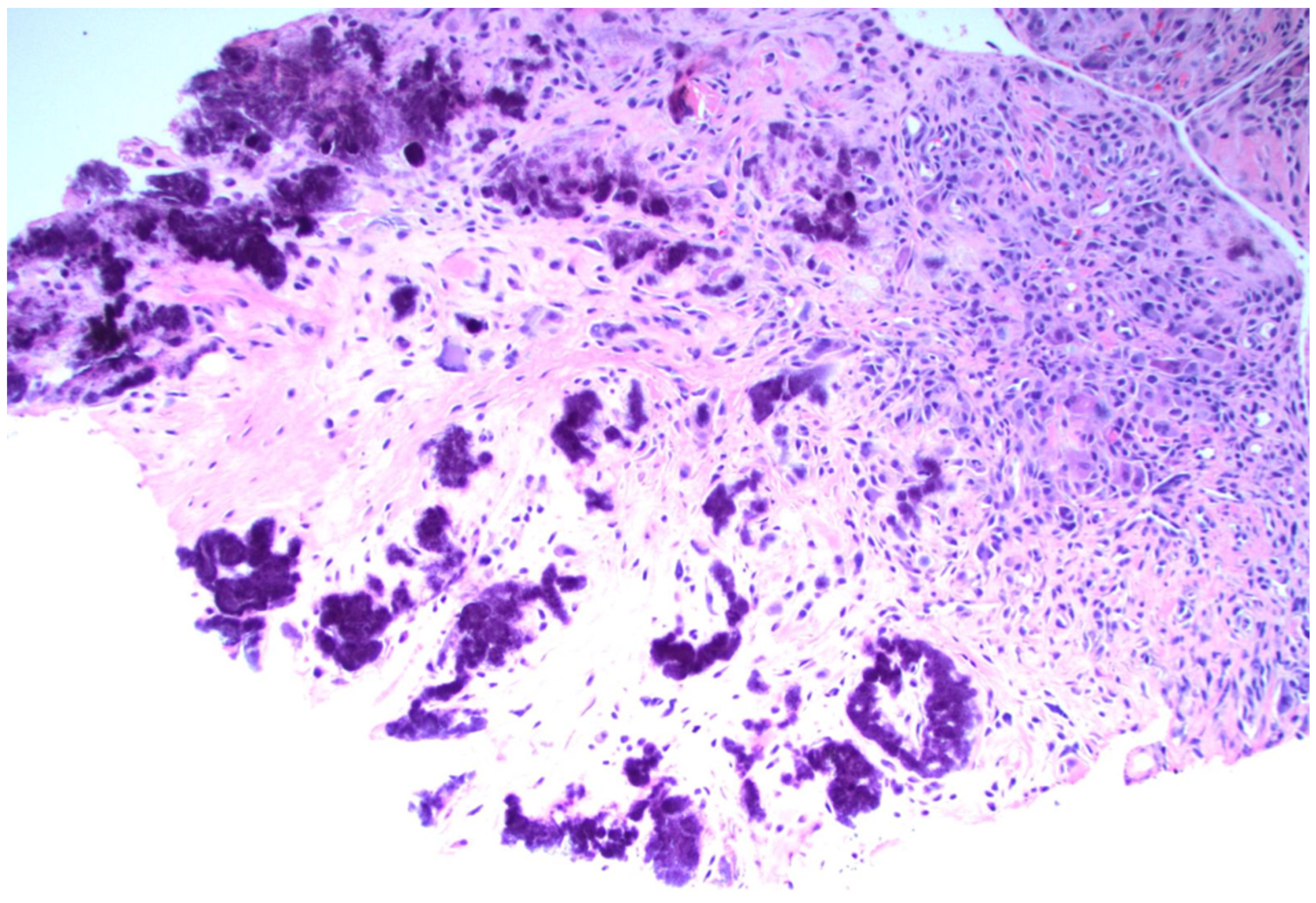
Figure 1. Synovial biopsy sample of calcium pyrophosphate deposition disease (CPPD), stained with hematoxylin and eosin. CPPD crystals are aggregated and appear dark purple. Source: Dr. Ami Ben-Artzi.
Gucdd 04 00002 g001
Table 1. Comparison of synovial biopsy techniques.
MethodPositive AspectsNegative Aspects
Landmark GuidedDoes not require rheumatologist to have access to ultrasound or fluoroscopyLower yield compared to other methods
Increased risk of non-synovial tissue injury
Increased risk and lower yield in small joints and joints with less inflammation.
Fluoroscopically guided biopsyHigher yield of synovial tissue as compared to landmark-guided biopsyRadiation exposure
Increased cost and require investment in fluoroscopy system
Typically requires collaboration with radiology or orthopedics
Ultrasound-Guided Portal and ForcepsHigher yield of synovial tissue as compared to landmark-guided biopsyRequires initial investment in autoclavable reusable equipment
Can obtain tissue from multiple angles within the joint spaceRequires operator to be experienced in ultrasound and in synovial biopsy
Ultrasound-Guided Guillotine NeedleHigher yield of synovial tissue as compared to landmark-guided biopsy Requires operator to be experienced in ultrasound and in synovial biopsy
Size of tissue sample is limited by size of guillotine needle
Shape of the guillotine needle can limit access to certain areas of joint space
Ease of use of guillotine needle
Guillotine needle is disposable
Cost is more favorable than other methods of obtaining tissue
Disclaimer/Publisher’s Note: The statements, opinions and data contained in all publications are solely those of the individual author(s) and contributor(s) and not of MDPI and/or the editor(s). MDPI and/or the editor(s) disclaim responsibility for any injury to people or property resulting from any ideas, methods, instructions or products referred to in the content.