
Platform-Enabled Destination Management: KPI Dashboards and DEA Benchmarking in the Peloponnese

 ,
,  ,
,  and
and 
Abstract
1. Introduction
2. Literature Review
2.1. The Role of DDMMOs in the Destination Management Process
2.2. Capturing Destination Performance
2.3. Study Area: Peloponnese Regional Units
3. Methodology
4. Results
4.1. Temporal Evolution of Overall Technical Efficiency (CRS)
4.2. Decomposing Inefficiency: Pure Technical vs. Scale Effects
4.3. Longitudinal Uplift Targets and Dynamic Peer Sets
4.4. Substantive Interpretation Against Prior Literature
5. Discussion
6. Conclusions
Author Contributions
Funding
Data Availability Statement
Conflicts of Interest
Appendix A. Formal Specification of the Output-Oriented DEA Model
- Input: Room capacity.
- Outputs: (i)Tourism revenue (annual total) and (ii) overnight stays (annual total).
Output-Oriented DEA (Envelopment Form)
References
- Edgell, D.L., Sr. Managing Sustainable Tourism: A Legacy for the Future, 3rd ed.; Routledge: London, UK, 2020. [Google Scholar]
- Morrison, A.M. Marketing and Managing Tourism Destinations, 2nd ed.; Routledge: London, UK, 2023. [Google Scholar] [CrossRef]
- Møgelhøj, H.v.M. Overtourism: The Role of Effective Destination Management; Business Expert Press: New York, NY, USA, 2021. [Google Scholar]
- Page, S.J. Tourism Management, 6th ed.; Routledge: London, UK, 2019. [Google Scholar] [CrossRef]
- Mandić, A.; Kennell, J. Smart governance for heritage tourism destinations: Contextual factors and destination management organization perspectives. Tour. Manag. Perspect. 2021, 39, 100862. [Google Scholar] [CrossRef]
- Gretzel, U.; Sigala, M.; Xiang, Z.; Koo, C. Smart tourism: Foundations and developments. Electron. Mark. 2015, 25, 179–188. [Google Scholar] [CrossRef]
- Gretzel, U. The Smart DMO: A new step in the digital transformation of destination management organizations. Eur. J. Tour. Res. 2022, 30, 3002. [Google Scholar] [CrossRef]
- Martins, C.A.; Carneiro, M.J.A.; Pacheco, O.R. Key factors for implementation and success of destination management systems: Empirical evidence from European countries. Ind. Manag. Data Syst. 2021, 121, 1287–1324. [Google Scholar] [CrossRef]
- Sorokina, E.; Wang, Y.; Fyall, A.; Lugosi, P.; Torres, E.; Jung, T. Constructing a smart destination framework: A destination marketing organization perspective. J. Destin. Mark. Manag. 2022, 23, 100688. [Google Scholar] [CrossRef]
- Katemliadis, I. Improving the Effectiveness and Efficiency of Destination Development, Management and Marketing Organisations (DDMMOs): A Systemic Approach. Ph.D. Thesis, Hellenic Open University, Patras, Greece, 2024. [Google Scholar] [CrossRef]
- Deirmentzoglou, G.A.; Vlassi, E.; Anastasopoulou, E.E. DDMMO website quality, destination image and intention to use metaverse platforms. Platforms 2024, 2, 180–192. [Google Scholar] [CrossRef]
- Koščak, M.; O’Rourke, T. (Eds.) Ethical and Responsible Tourism: Managing Sustainability in Local Tourism Destinations; Taylor & Francis: Abingdon, UK, 2023. [Google Scholar] [CrossRef]
- Jauhari, V. (Ed.) Managing Sustainability in the Hospitality and Tourism Industry: Paradigms and Directions for the Future; CRC Press: Boca Raton, FL, USA, 2014. [Google Scholar] [CrossRef]
- Legrand, W.; Chen, J.S.; Laeis, G.C. Sustainability in the Hospitality Industry: Principles of Sustainable Operations; Routledge: London, UK, 2022. [Google Scholar] [CrossRef]
- Giannopoulos, A.; Piha, L.; Skourtis, G. Destination branding and co-creation: A service ecosystem perspective. J. Prod. Brand Manag. 2021, 30, 148–166. [Google Scholar] [CrossRef]
- Melis, G.; McCabe, S.; Atzeni, M.; Del Chiappa, G. Collaboration and learning processes in value co-creation: A destination perspective. J. Travel Res. 2023, 62, 699–716. [Google Scholar] [CrossRef]
- Chim-Miki, A.F.; Batista-Canino, R.M. Development of a tourism coopetition model: A preliminary Delphi study. J. Hosp. Tour. Manag. 2018, 37, 78–88. [Google Scholar] [CrossRef]
- Evans, N. Strategic Management for Tourism, Hospitality and Events, 4th ed.; Routledge: London, UK, 2024. [Google Scholar]
- Buhalis, D. Marketing the competitive destination of the future. Tour. Manag. 2000, 21, 97–116. [Google Scholar] [CrossRef]
- Zhu, Z.; Isa, S.S.; Ramlan, M.A. Creative tourism competitiveness in Chongqing City using diamond model. Int. J. Bus. Technol. Manag. 2023, 5, 118–132. Available online: https://mysitasi.mohe.gov.my/journal-website/get-meta-article?artId=a89eeed7-611a-11ef-a699-005056a6a970&formatted=true#:~:text=This%20paper%20uses%20Porter%E2%80%99s%20diamond%20model%20to%20analyze,competitiveness%20of%20Chongqing%E2%80%99s%20cultural%20and%20creative%20tourism%20development (accessed on 26 September 2025).
- Mior Shariffuddin, N.S.; Azinuddin, M.; Hanafiah, M.H.; Wan Mohd Zain, W.M.A. A comprehensive review on tourism destination competitiveness (TDC) literature. Compet. Rev. 2023, 33, 787–819. [Google Scholar] [CrossRef]
- Faur, M.; Ban, O. Models of tourism destination competitiveness. In Proceedings of the 39th International Business Information Management Association (IBIMA), Seville, Spain, 30–31 May 2022. [Google Scholar]
- Bouchra, N.H.; Hassan, R.S. Application of Porter’s diamond model: A case study of tourism cluster in UAE. In Industry Clusters and Innovation in the Arab World; Emerald Publishing: Bingley, UK, 2023; pp. 129–156. [Google Scholar] [CrossRef]
- Purwaningsih, M.; Purwandari, B.; Sunarso, F.P.; Setiadi, F. Harnessing e-collaboration for rural tourism recovery after COVID-19: Dual analysis using SWOT and Porter’s diamond model. Emerg. Sci. J. 2021, 5, 559–575. [Google Scholar] [CrossRef]
- Fernando, I.N. Tourism amid Covid-19 pandemic in Sri Lanka: Way-forwarding strategies through the Porter’s diamond model. Sri Lanka J. Mark. 2021, 7, 22–45. [Google Scholar] [CrossRef]
- De Keyser, R.; Vanhove, N. The competitive situation of tourism in the Caribbean area: Methodological approach. Tour. Rev. 1994, 49, 19–22. [Google Scholar] [CrossRef]
- Dwyer, L.; Kim, C. Destination competitiveness: Determinants and indicators. Curr. Issues Tour. 2003, 6, 369–414. [Google Scholar] [CrossRef]
- Dwyer, L.; Mellor, R.; Livaic, Z.; Edwards, D.; Kim, C. Attributes of destination competitiveness: A factor analysis. Tour. Anal. 2004, 9, 91–101. [Google Scholar] [CrossRef]
- Ritchie, J.R.B.; Crouch, G.I. The Competitive Destination: A Sustainable Tourism Perspective; CABI: Wallingford, UK, 2003. [Google Scholar]
- World Economic Forum. Travel & Tourism Development Index 2024. Available online: https://www.weforum.org/publications/travel-tourism-development-index-2024/ (accessed on 26 September 2025).
- Agustan, R.; Rianse, U.; Sukotjo, E.; Faslih, A. Exploration and implementation of a smart tourism destination with the 6As framework & TOPSIS (Case Study: Wakatobi, Indonesia). Sci. Rev. Eng. Environ. Sci. 2024, 33, 419–442. [Google Scholar] [CrossRef]
- Zhandilla, B.D.; Shokhan, R.; Mamrayeva, D.G. Conceptual foundations of the category of tourist destination. Buketov Bus. Rev. 2022, 108, 135–143. [Google Scholar] [CrossRef]
- Muthuraman, S.; Al Haziazi, M. Smart tourism destination—New exploration towards sustainable development in Sultanate of Oman. In Proceedings of the 2019 5th International Conference on Information Management (ICIM), Cambridge, UK, 24–27 March 2019; pp. 332–335. [Google Scholar] [CrossRef]
- Boes, K.; Buhalis, D.; Inversini, A. Smart tourism destinations: Ecosystems for tourism destination competitiveness. Int. J. Tour. Cities 2016, 2, 108–124. [Google Scholar] [CrossRef]
- Baggio, R.; Micera, R.; Del Chiappa, G. Smart tourism destinations: A critical reflection. J. Hosp. Tour. Technol. 2020, 11, 407–423. [Google Scholar] [CrossRef]
- Hassan, M.K.; Mondal, A.K.M.G.R.; Saha, S.K. Factors affecting the choice of Cox’s Bazar sea beach of Bangladesh as a tourist destination. Int. J. Manag. 2013, 2, 1–28. [Google Scholar]
- Araújo, L. Measuring tourism success: How European National Tourism Organisations are shifting the paradigm. Worldw. Hosp. Tour. Themes 2022, 14, 79–84. [Google Scholar] [CrossRef]
- Gössling, S. New performance indicators for water management in tourism. Tour. Manag. 2015, 46, 233–244. [Google Scholar] [CrossRef]
- Crotts, J.C.; Magnini, V.P.; Calvert, E. Key performance indicators for destination management in developed economies: A four pillar approach. Ann. Tour. Res. Empir. Insights 2022, 3, 100053. [Google Scholar] [CrossRef]
- Hussain, S.; Ahonen, V.; Karasu, T.; Leviäkangas, P. Sustainability of smart rural mobility and tourism: A key performance indicators-based approach. Technol. Soc. 2023, 74, 102287. [Google Scholar] [CrossRef]
- Cooper, W.; Seiford, L.; Zhu, J. Handbook on Data Envelopment Analysis; Springer: New York, NY, USA, 2011. [Google Scholar]
- Emrouznejad, A.; Petridis, K.; Charles, V. Data Envelopment Analysis with GAMS. In International Series in Operations Research and Management Science; Springer: Cham, Switzerland, 2023. [Google Scholar] [CrossRef]
- Derpanis, D. Data Envelopment Analysis. Master’s Thesis, National Technical University of Athens, Athens, Greece, 2009. Available online: https://thesis.ekt.gr/thesisBookReader/id/18453?lang=el#page/82/mode/2up (accessed on 26 September 2025).
- Hadad, S.; Hadad, Y.; Malul, M.; Rosenboim, M. The economic efficiency of the tourism industry: A global comparison. Tour. Econ. 2012, 18, 931–940. [Google Scholar] [CrossRef]
- Soysal-Kurt, H. Measuring tourism efficiency of European countries by using data envelopment analysis. Eur. Sci. J. 2017, 13, 31–49. [Google Scholar] [CrossRef]
- Lozano-Ramírez, J.; Jiménez, M.A.; Lozano, S. A pre-pandemic data envelopment analysis of the sustainability efficiency of tourism in EU-27 countries. Curr. Issues Tour. 2023, 26, 1669–1687. [Google Scholar] [CrossRef]
- Nurmatov, R.; Lopez, X.L.F.; Millan, P.P.C. Tourism, hospitality, and DEA: Where do we come from and where do we go? Int. J. Hosp. Manag. 2021, 95, 102883. [Google Scholar] [CrossRef]
- Sigala, M. Using data envelopment analysis for measuring and benchmarking productivity in the hotel sector. J. Travel Tour. Mark. 2004, 16, 39–60. [Google Scholar] [CrossRef]
- Neves, J.C.; Lourenço, S. Using data envelopment analysis to select strategies that improve the performance of hotel companies. Int. J. Contemp. Hosp. Manag. 2009, 21, 698–712. [Google Scholar] [CrossRef]
- Boccali, F.; Mariani, M.M.; Visani, F.; Mora-Cruz, A. Innovative value-based price assessment in data-rich environments: Leveraging online review analytics through data envelopment analysis. Technol. Forecast. Soc. Chang. 2022, 182, 121807. [Google Scholar] [CrossRef]
- Wu, D.; Li, H.; Wang, Y. Measuring sustainability and competitiveness of tourism destinations with data envelopment analysis. J. Sustain. Tour. 2023, 31, 1315–1335. [Google Scholar] [CrossRef]
- Gómez-Vega, M.; Herrero-Prieto, L.C.; López, M.V. Clustering and country destination performance at a global scale: Determining factors of tourism competitiveness. Tour. Econ. 2022, 28, 1605–1625. [Google Scholar] [CrossRef]
- Wu, D.; Li, H.; Huang, Q.; Li, C.; Liang, S. Measurement and determinants of smart destinations’ sustainable performance: A two-stage analysis using DEA–Tobit model. Curr. Issues Tour. 2024, 27, 529–545. [Google Scholar] [CrossRef]
- Manasakis, C.; Apostolakis, A.; Datseris, G. Using data envelopment analysis to measure hotel efficiency in Crete. Int. J. Contemp. Hosp. Manag. 2013, 25, 510–535. [Google Scholar] [CrossRef]
- Karakitsiou, A.; Kourgiantakis, M.; Mavrommati, A.; Migdalas, A. Regional efficiency evaluation by input-oriented data envelopment analysis of hotel and restaurant sector. Oper. Res. 2020, 20, 2041–2058. [Google Scholar] [CrossRef]
- Mavrommati, A.; Pliakoura, A. Performance dynamics in Greek wine sector: A study of technical efficiency and strategic implications. Oper. Res. 2025, 25, 17. [Google Scholar] [CrossRef]
- Greek Tourism Confederation (SETE Intelligence). Regional & National Data. 2025. Available online: https://insete.gr/districts/?lang=en (accessed on 26 September 2025).
- Bank of Greece. Tourism—Travel Receipts and Overnight Stays. 2025. Available online: https://www.bankofgreece.gr/en/statistics/external-sector/balance-of-payments/travel-services (accessed on 26 September 2025).
- Varelas, S.; Tsoupros, G. Key Performance Indicators and Data Envelopment Analysis in Greek Tourism: A Strategic Planning Tool for Destinations and DMMOs. Sustainability 2024, 16, 3453. [Google Scholar] [CrossRef]
- Greek Tourism Confederation (SETE Intelligence). Annual Report on Greek Tourism 2023; SETE: Athens, Greece, 2024. Available online: https://insete.gr/studies/annual-report-of-greek-tourism-2023/?lang=en (accessed on 26 September 2025).
- Metaxas, T.; Karagiannis, D. Peloponnesus: A Unique Example of Unorthodox Regional Development: Can the Gastronomic Tradition Show the Right Path? Munich Personal RePEc Archive: Munich, Germany, 2015. Available online: https://mpra.ub.uni-muenchen.de/66829/ (accessed on 26 September 2025).
- Hellenic Statistical Authority. Hotels, Rooms for Rent and Tourism Campsites, 2023. Available online: https://www.statistics.gr/en/statistics/-/publication/STO12/2023 (accessed on 26 September 2025).


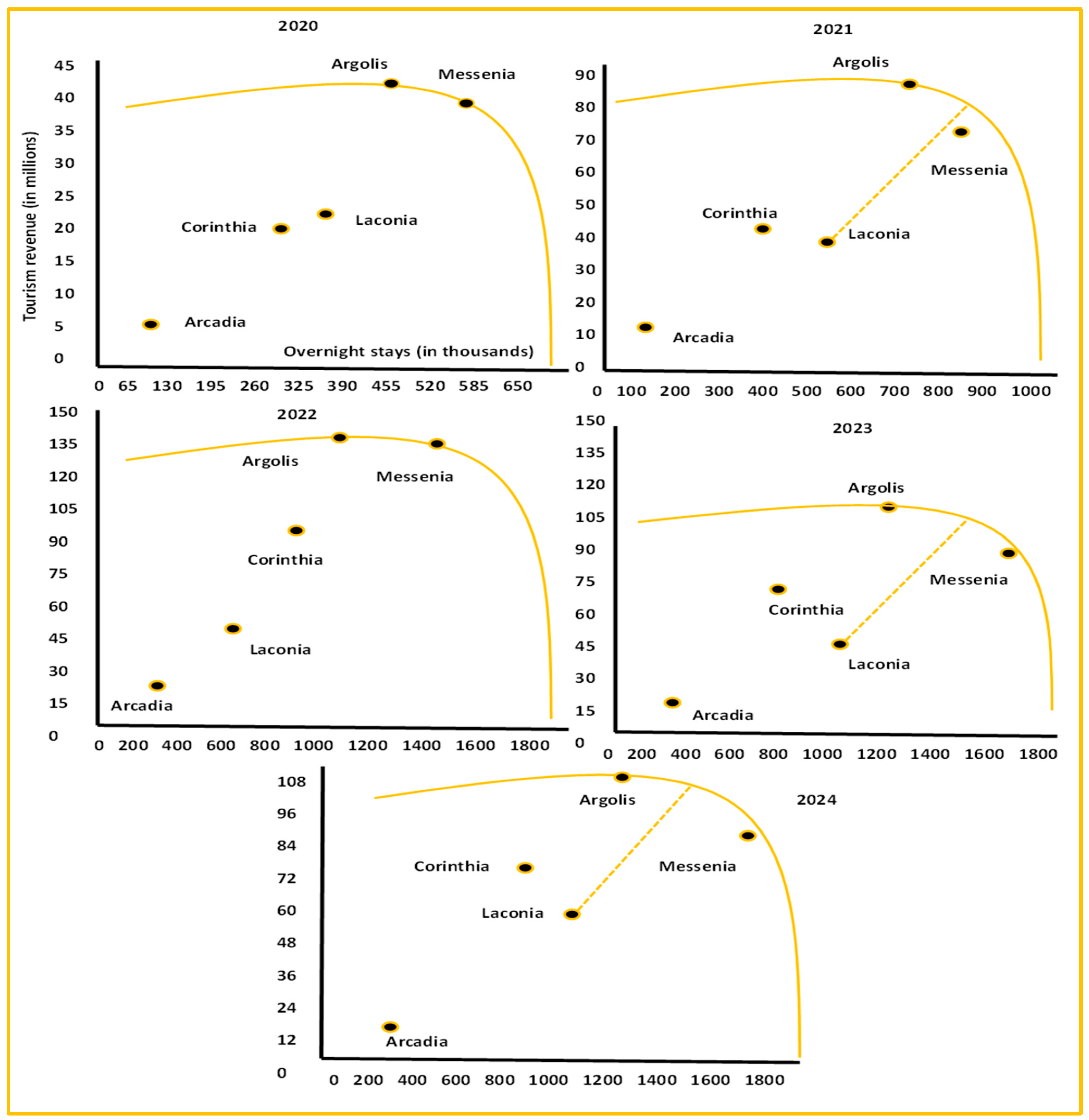
| 2020 | ||||||||||
|---|---|---|---|---|---|---|---|---|---|---|
| Regional Units | Technical Efficiency | Required increase in tourism revenue (CRS) *1 | Required increase in overnight stays *2 (CRS) | Benchmark(s)- λ weight *3 (CRS) | Pure Technical Efficiency | Required increase in tourism revenue (VRS) | Required increase in overnight stays (VRS) | Benchmark(s)-λ weight (VRS) | Scale efficiency | Economies of Scale |
| Argolis | 100% | - | - | - | 100% | - | - | 100% | Decreasing | |
| Messenia | 100% | - | - | - | 100% | - | - | 100% | Decreasing | |
| Laconia | 95.44% | 4.80% | 4.80% | Argolis (19.34%)- Messenia (39.68%) | 100% | - | - | 95% | Decreasing | |
| Corinthia | 75.23% | 32.90% | 32.90% | Argolis (33.21%)- Messenia (33.79%) | 77.78% | 28.60% | 28.60% | Argolis (17.24%)- Laconia (80.59%) | 97% | Decreasing |
| Arcadia | 61.80% | 127% | 61.80% | Messenia (31.6%) | 100% | - | - | - | 62% | Decreasing |
| 2021 | ||||||||||
| Regional Units | Technical Efficiency | Required increase in tourism revenue (CRS) | Required increase in overnight stays (CRS) | Benchmark(s)-λ weight (CRS) | Pure Technical Efficiency | Required increase in tourism revenue (VRS) | Required increase in overnight stays (VRS) | Benchmark(s)-λ weight (VRS) | Scale efficiency | Economies of Scale |
| Argolis | 100% | - | - | - | 100% | - | - | - | 100% | Increasing |
| Laconia | 100% | - | - | - | 100% | - | - | - | 100% | Decreasing |
| Messenia | 93.53% | 6.90% | 6.90% | Argolis (61.14%)- Laconia (12.24%) | 100% | - | - | - | 94% | Increasing |
| Corinthia | 80.56% | 24.10% | 24.10% | Argolis (61.14%)- Laconia (12.24%) | 90.99% | 9.90% | 9.90% | Argolis (50.75%)- Arcadia (45.18%)- Laconia (4.06%) | 89% | Decreasing |
| Arcadia | 49.25% | 103.10% | 103.10% | Argolis (15.18%)- Laconia (30.45%) | 100% | - | - | - | 49% | Decreasing |
| 2022 | ||||||||||
| Regional Units | Technical Efficiency | Required increase in tourism revenue (CRS) | Required increase in overnight stays (CRS) | Benchmark(s)-λ weight (CRS) | Pure Technical Efficiency | Required increase in tourism revenue (VRS) | Required increase in overnight stays (VRS) | Benchmark(s)-λ weight (VRS) | Scale efficiency | Economies of Scale |
| Argolis | 100% | - | - | - | 100% | - | - | - | 100% | Decreasing |
| Messenia | 100% | - | - | - | 100% | - | - | - | 100% | Decreasing |
| Corinthia | 99.67% | 0.30% | 0.30% | Argolis (51.51%)- Messenia (15,19%) | 100% | - | - | - | 100% | Decreasing |
| Laconia | 85.47% | 41.30% | 17% | Messenia (52.40%) | 97.31% | 48% | 2.80% | Arcadia (17.59%)- Corinthia (82.40%) | 88% | Decreasing |
| Arcadia | 50.05% | 147.50% | 99.80% | Messenia (28.71%) | 100% | - | - | - | 50% | Decreasing |
| 2023 | ||||||||||
| Regional Units | Technical Efficiency | Required increase in tourism revenue (CRS) | Required increase in overnight stays (CRS) | Benchmark(s)-λ weight (CRS) | Pure Technical Efficiency | Required increase in tourism revenue (VRS) | Required increase in overnight stays (VRS) | Benchmark(s)-λ weight (VRS) | Scale efficiency | Economies of Scale |
| Argolis | 100% | - | - | - | 100% | - | - | - | 100% | Increasing |
| Laconia | 100% | - | - | - | 100% | - | - | - | 100% | Increasing |
| Corinthia | 98.95% | 1.10% | 4.40% | Argolis (69.01%) | 100% | - | - | - | 99% | Decreasing |
| Messenia | 97.47% | 2.60% | 2.60% | Argolis (104.35%)-Laconia (33.52%) | 100% | - | - | - | 97% | Increasing |
| Arcadia | 46.89% | 113% | 113% | Argolis (14.40%)-Laconia (30.98%) | 100% | - | - | - | 47% | Decreasing |
| 2024 | ||||||||||
| Regional Units | Technical Efficiency | Required increase in tourism revenue (CRS) | Required increase in overnight stays (CRS) | Benchmark(s)-λ weight (CRS) | Pure Technical Efficiency | Required increase in tourism revenue (VRS) | Required increase in overnight stays (VRS) | Benchmark(s)-λ weight (VRS) | Scale efficiency | Economies of Scale |
| Argolis | 100% | - | - | - | 100% | - | - | - | 100% | Decreasing |
| Laconia | 100% | - | - | - | 100% | - | - | - | 100% | Decreasing |
| Messenia | 96.44% | 3.70% | 3.70% | Argolis (62.03%)- Laconia (95.96%) | 100% | - | - | - | 96% | Increasing |
| Corinthia | 93.16% | 7.30% | 7.30% | Argolis (61.44%)- Laconia (16.52%) | 100% | - | - | - | 93% | Decreasing |
| Arcadia | 49.60% | 101.60% | 101.60% | Argolis (10.60%)- Laconia (35.63%) | 100% | - | - | - | 50% | Decreasing |
Disclaimer/Publisher’s Note: The statements, opinions and data contained in all publications are solely those of the individual author(s) and contributor(s) and not of MDPI and/or the editor(s). MDPI and/or the editor(s) disclaim responsibility for any injury to people or property resulting from any ideas, methods, instructions or products referred to in the content. |
© 2025 by the authors. Licensee MDPI, Basel, Switzerland. This article is an open access article distributed under the terms and conditions of the Creative Commons Attribution (CC BY) license (https://creativecommons.org/licenses/by/4.0/).
Share and Cite
Tsoupros, G.; Anastasopoulos, I.; Varelas, S.; Anastasopoulou, E.E. Platform-Enabled Destination Management: KPI Dashboards and DEA Benchmarking in the Peloponnese. Platforms 2025, 3, 21. https://doi.org/10.3390/platforms3040021
Tsoupros G, Anastasopoulos I, Varelas S, Anastasopoulou EE. Platform-Enabled Destination Management: KPI Dashboards and DEA Benchmarking in the Peloponnese. Platforms. 2025; 3(4):21. https://doi.org/10.3390/platforms3040021
Chicago/Turabian StyleTsoupros, Georgios, Ioannis Anastasopoulos, Sotirios Varelas, and Eleni E. Anastasopoulou. 2025. "Platform-Enabled Destination Management: KPI Dashboards and DEA Benchmarking in the Peloponnese" Platforms 3, no. 4: 21. https://doi.org/10.3390/platforms3040021
APA StyleTsoupros, G., Anastasopoulos, I., Varelas, S., & Anastasopoulou, E. E. (2025). Platform-Enabled Destination Management: KPI Dashboards and DEA Benchmarking in the Peloponnese. Platforms, 3(4), 21. https://doi.org/10.3390/platforms3040021