
Driving Strategic Innovation Through AI Adoption in Government Financial Regulators: A Case Study

 ,
,  , and
, and
Abstract
1. Introduction
2. Literature Review
2.1. Dynamic Capabilities in the Public Sector Context
2.2. AI Adoption in Organizations
2.3. AI as a Governance Challenge for Public Institutions
3. Materials and Methods
3.1. Case Selection
3.2. Data Collection
3.3. Data Analysis
4. Results: The Dynamic Capabilities for Responsible AI Adoption
4.1. Sensing: Identifying Opportunities in a Regulatory Environment
4.1.1. Internal Routines: Internal Readiness Auditing and Use-Case Intake and Triage
4.1.2. Ecosystem Routines: Convening Stakeholder Meetings and Public Problem Signaling
4.2. Seizing: Mobilizing Resources Through Controlled Experimentation
4.2.1. Internal Routines: Governed Sandbox Environments and Iterative Feedback and Refinement
4.2.2. Ecosystem Routines: Establishing Common Interfaces and Standardizing Collaboration Contracts
4.3. Reconfiguring: Institutionalizing Innovation for Enduring Governance
4.3.1. Internal Routines: Embedding New Governance Roles and Updating Policies and Metrics
4.3.2. Ecosystem Routines: Creating Multi-Party Governance and Publishing Open Artifacts
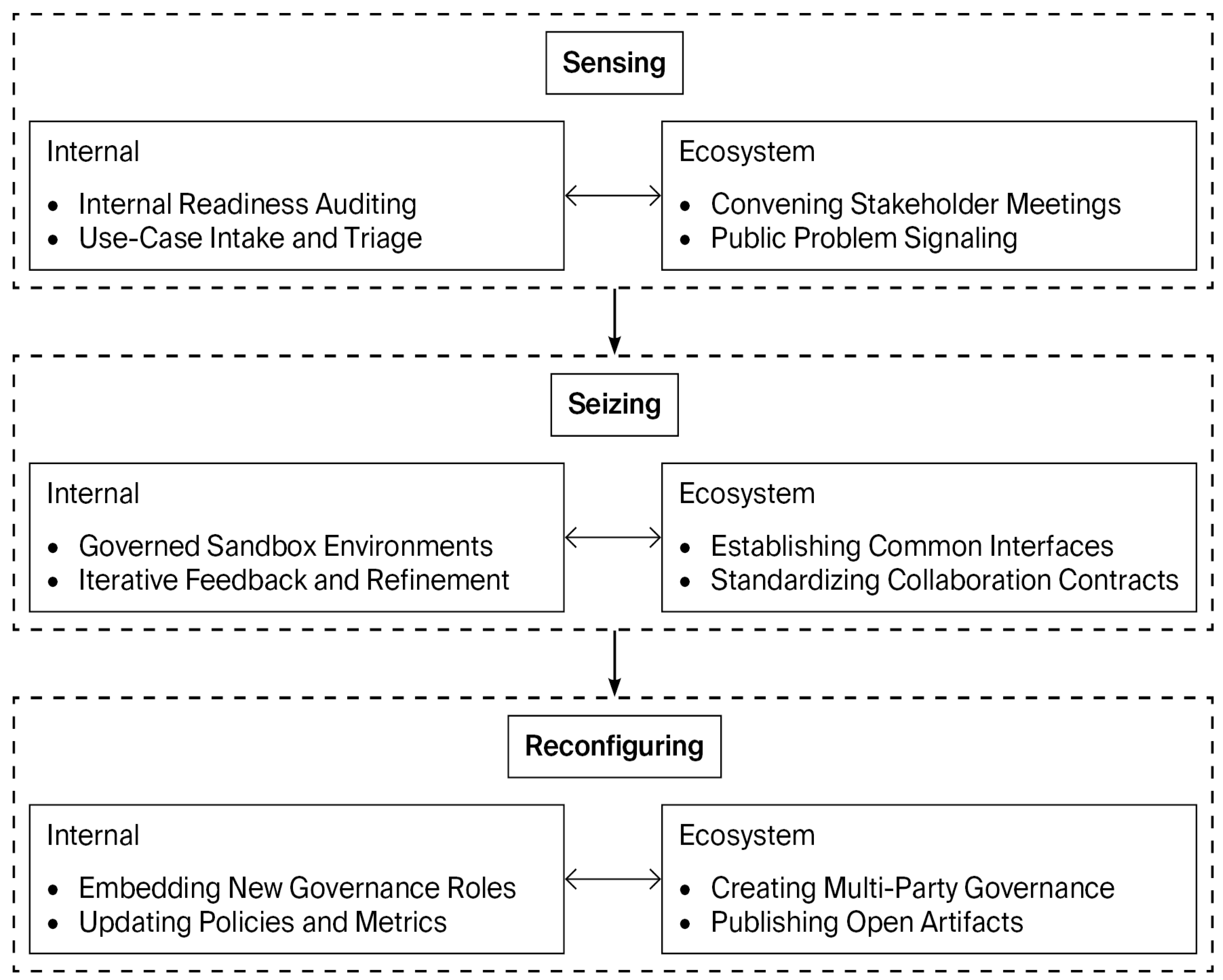
- Sequential Flow (vertical solid arrows): The down-pointing arrows show the maturation path (sensing → seizing → reconfiguring). The “XYZ Government Financial Regulator” must first sense and then seize an opportunity before it can successfully reconfigure its operations around a new solution.
- Cross Boundary Alignment (horizontal double-headed arrows): The two-way arrows between the internal and ecosystem panels at each stage indicate required, concurrent coordination (e.g., internal sensing ↔ ecosystem sensing). Effective internal sensing (e.g., identifying a use case) must align with ecosystem sensing (e.g., understanding citizen input in that use case). Successful internal seizing (e.g., running a sandbox) is dependent on robust ecosystem seizing (e.g., having clear collaboration contracts with partners).
5. Discussion
5.1. Answer to the Research Question/Objective
5.2. Positioning Relative to the Literature
5.3. Theoretical Contribution
5.4. Practical Contribution
6. Conclusions
6.1. Summary
6.2. Limitations
6.3. Future Research
Author Contributions
Funding
Institutional Review Board Statement
Informed Consent Statement
Data Availability Statement
Conflicts of Interest
Appendix A. Source Log
- [IT-Assessment-2024, p. 3]—IT & Legacy Systems Assessment (April 2024), p. 3;
- [IT-Assessment-2024, p. 6]—same doc, p. 6;
- [CultureSurvey-2024, Q14]—Employee Culture Survey (July 2024), item Q14;
- [TNA-2024-05, p. 2]—Training Needs Assessment (May 2024), p. 2;
- [HR-EthicsMemo-2024-05, p. 2]—HR/Ethics Memo on AI & Transparency (May 2024), p. 2;
- [MIN-2024-05-22]—Use-Case Intake Workshop Minutes (22 May 2024);
- [STRAT-2024, §2.3]—Supervisory Strategy 2024–2026, §2.3 (Analytics Priorities);
- [AML-2024-05, §1.2]—AML/CFT Risk Memo (May 2024), §1.2;
- [DPIA-2024-05, Checklist]—DPIA Pre-Screen Checklist (May 2024);
- [CAR-2024-03, Slide 9]—Cross-Agency AI Roadmap Deck (Mar 2024), slide 9;
- [RFI-2024-04]—Public RFI: AI for Supervisory Risk Signals (April 2024);
- [TechSprint-Call-2024]—Tech Sprint Call for Participation (March 2024);
- [CSC-2024-06, p. 1]—Civil Society Consultation Summary (June 2024), p.1;
- [PRG-2024-06, p. 4]—AI Sandbox Progress Report (June 2024), p.4;
- [LOG-2024-06, §4.1]—System Logs & Model QA Summary (June 2024), §4.1;
- [UX-Eval-2024-07, p. 2]—UX Evaluation Report (July 2024), p. 2;
- [DAS-2024-06, §3.1]—Data Architecture Spec (APIs/Schemas) (June 2024), §3.1;
- [RDG-2024-06, v1.2]—Reference Dataset Guide v1.2 (June 2024);
- [CCT-2024-06, §4–§7]—Collaboration Contract Template (Data/Audit/Transparency) (Jun 2024), §§4–7;
- [ORG-2024-04, p. 1]—Org Announcement: AI Roles & Committees (April 2024), p. 1;
- [MRC-2024-05, Charter]—Model Risk Committee Charter (May 2024);
- [POL-2024-06, §5]—Policy Update: AI Use & SOPs (June 2024), §5;
- [MLOps-Metrics-2024-05, Table S3]—MLOps Metrics Compendium (May 2024), Table S3;
- [KPI-2024-06, Dashboard]—AI KPI Dashboard (June 2024);
- [AIR-2024-07, p. 5]—AI Implementation Roadmap (July 2024), p. 5;
- [TRN-2024-07, p. 3]—Workforce Training Plan (July 2024), p. 3;
- [GOV-2024-05, p. 2]—Multi-Party Governance Board Charter (May 2024), p. 2;
- [OAR-2024-07, Index]—Open Artifacts Repository Index (Jul 2024);
- [HBK-2024-07, Draft §3]—Supervisory Handbook Draft (Jul 2024), §3;
- [PP-2024-04, §1.1]—AI Program Project Plan (Apr 2024), §1.1;
- [MIN-2024-03-12, Item 4]—Steering Committee Minutes (12 March 2024), Item 4;
- [TS-2024-06, §2.2]—Technical Specifications: Data Types & Flows (June 2024), §2.2;
- [ER-2024-07, p. 6]—Evaluation Report: AI Pilots (July 2024), p. 6;
- [MLT-2024-07, p. 1]—Multilateral Benchmark Note (July 2024), p. 1;
- [PROC-2024-06, p. 2]—Procurement Pattern Analysis (June 2024), p. 2;
- [LEG-2024-07, p. 4]—Legacy System Retirement Plan (July 2024), p. 4;
- [VPQ-2024-04, p. 1]—Vendor Pre-Qualification List (April 2024), p. 1;
- [EX-2024-07, p. 3]—Incident Exercise Playbook (July 2024), p. 3;
- [CFS-2024-06, p. 2]—Citizen Feedback Summary (June 2024), p. 2.
References
- Mergel, I.; Edelmann, N.; Haug, N. Defining Digital Transformation: Results from Expert Interviews. Gov. Inf. Q. 2019, 36, 101385. [Google Scholar] [CrossRef]
- Sousa, T.B.D.; Guerrini, F.M.; Oliveira, M.R.D.; Cantorani, J.R.H. Industry 4.0 and Collaborative Networks: A Goals- and Rules-Oriented Approach Using the 4EM Method. Platforms 2025, 3, 14. [Google Scholar] [CrossRef]
- Di Giulio, M.; Vecchi, G. Implementing Digitalization in the Public Sector. Technologies, Agency, and Governance. Public Policy Adm. 2023, 38, 133–158. [Google Scholar] [CrossRef]
- Reuters. US Appeals Court Strikes down SEC Rule on ‘Audit Trail’ Funding. Reuters. 25 July 2025. Available online: https://www.reuters.com/legal/government/us-appeals-court-strikes-down-sec-rule-audit-trail-funding-2025-07-25/ (accessed on 1 December 2025).
- Al-Besher, A.; Kumar, K. Use of Artificial Intelligence to Enhance E-Government Services. Meas. Sens. 2022, 24, 100484. [Google Scholar] [CrossRef]
- Alhosani, K.; Alhashmi, S.M. Opportunities, Challenges, and Benefits of AI Innovation in Government Services: A Review. Discov. Artif. Intell. 2024, 4, 18. [Google Scholar] [CrossRef]
- Agbese, M.; Mohanani, R.; Khan, A.; Abrahamsson, P. Implementing AI Ethics: Making Sense of the Ethical Requirements. In Proceedings of the 27th International Conference on Evaluation and Assessment in Software Engineering, Oulu, Finland, 14–16 June 2023; ACM: Oulu, Finland, 2023; pp. 62–71. [Google Scholar]
- Rane, N.L.; Desai, P.; Choudhary, S. Challenges of Implementing Artificial Intelligence for Smart and Sustainable Industry: Technological, Economic, and Regulatory Barriers. In Artificial Intelligence and Industry in Society 5.0; Deep Science Publishing: San Francisco, CA, USA, 2024. [Google Scholar]
- Miller, M.; Ghaffarzadegan, N. Dynamic Capabilities in the Public Sector: A Systematic Literature Review. Int. J. Public Sect. Manag. 2025, 38, 717–734. [Google Scholar] [CrossRef]
- Teece, D.J. Explicating Dynamic Capabilities: The Nature and Microfoundations of (Sustainable) Enterprise Performance. Strateg. Manag. J. 2007, 28, 1319–1350. [Google Scholar] [CrossRef]
- Kothandapani, H.P. Automating Financial Compliance with AI: A New Era in Regulatory Technology (RegTech). Int. J. Sci. Res. Arch. 2024, 11, 2646–2659. [Google Scholar] [CrossRef]
- Bolton, M.; Mintrom, M. RegTech and Creating Public Value: Opportunities and Challenges. Policy Des. Pract. 2023, 6, 266–282. [Google Scholar] [CrossRef]
- El Khoury, R.; Alshater, M.M.; Joshipura, M. RegTech Advancements-a Comprehensive Review of Its Evolution, Challenges, and Implications for Financial Regulation and Compliance. J. Financ. Report. Account. 2025, 23, 1450–1485. [Google Scholar] [CrossRef]
- Grassi, L.; Lanfranchi, D. RegTech in Public and Private Sectors: The Nexus between Data, Technology and Regulation. J. Ind. Bus. Econ. 2022, 49, 441–479. [Google Scholar] [CrossRef]
- Ben Youssef, A. Introducing Platforms: A Transdisciplinary Journal on Platform Management, Services and Policy and All Related Research. Platforms 2022, 1, 1–4. [Google Scholar] [CrossRef]
- Su, R.; Li, N. Environmental, Social, and Governance Performance, Platform Governance, and Value Creation of Platform Enterprises. Sustainability 2024, 16, 7251. [Google Scholar] [CrossRef]
- Teece, D.J.; Pisano, G.; Shuen, A. Dynamic Capabilities and Strategic Management. Strateg. Manag. J. 1997, 18, 509–533. [Google Scholar] [CrossRef]
- Eisenhardt, K.M.; Martin, J.A. Dynamic Capabilities: What Are They? Strateg. Manag. J. 2000, 21, 1105–1121. [Google Scholar] [CrossRef]
- Cath, C. Governing Artificial Intelligence: Ethical, Legal and Technical Opportunities and Challenges. Philos. Trans. R. Soc. Math. Phys. Eng. Sci. 2018, 376, 20180080. [Google Scholar] [CrossRef]
- Cath, C.J.N. Artificial Intelligence and the “Good Society”: The US, EU, and UK Approach. SSRN Electron. J. 2016. [Google Scholar] [CrossRef]
- Mergel, I. Digital Service Teams in Government. Gov. Inf. Q. 2019, 36, 101389. [Google Scholar] [CrossRef]
- Russell, S.J.; Norvig, P. Artificial Intelligence: A Modern Approach, 4th ed.; Pearson Series in Artificial Intelligence; Pearson: Hoboken, NJ, USA, 2021; ISBN 978-0-13-461099-3. [Google Scholar]
- Muntanyola-Saura, D. Book Review: Erik Brynjolfsson and Andrew McAfee, The Second Machine Age: Work, Progress, and Prosperity in a Time of Brilliant Technologies. Int. Sociol. 2016, 31, 626–628. [Google Scholar] [CrossRef]
- Weber, M.; Engert, M.; Schaffer, N.; Weking, J.; Krcmar, H. Organizational Capabilities for AI Implementation—Coping with Inscrutability and Data Dependency in AI. Inf. Syst. Front. 2023, 25, 1549–1569. [Google Scholar] [CrossRef]
- De Santis, F. Artificial Intelligence to Support Business Decisions. In Artificial Intelligence in Accounting and Auditing; Springer Nature: Cham, Switzerland, 2024; pp. 107–137. ISBN 978-3-031-71370-5. [Google Scholar]
- Kim, J. Case Study about Efficient AI(Artificial Intelligence) Implementation Strategy. Int. J. Adv. Res. Big Data Manag. Syst. 2019, 3, 1–6. [Google Scholar] [CrossRef]
- Bostrom, N.; Yudkowsky, E. The Ethics of Artificial Intelligence. In Artificial Intelligence Safety and Security, 1st ed.; Yampolskiy, R.V., Ed.; Chapman and Hall/CRC: Boca Raton, FL, USA; CRC Press/Taylor & Francis Group: Boca Raton, FL, USA, 2018; pp. 57–69. ISBN 978-1-351-25138-9. [Google Scholar]
- Jarrahi, M.H.; Askay, D.; Eshraghi, A.; Smith, P. Artificial Intelligence and Knowledge Management: A Partnership between Human and AI. Bus. Horiz. 2023, 66, 87–99. [Google Scholar] [CrossRef]
- Lichtenthaler, U. Five Maturity Levels of Managing AI: From Isolated Ignorance to Integrated Intelligence. J. Innov. Manag. 2020, 8, 39–50. [Google Scholar] [CrossRef]
- Chen, Z.; Balan, M.M.; Brown, K. Language Models Are Few-Shot Learners for Prognostic Prediction. arXiv 2023, arXiv:2302.12692. [Google Scholar] [CrossRef]
- Javaid, H.A. How Artificial Intelligence Is Revolutionizing Fraud Detection in Financial Services. Innov. Eng. Sci. J. 2024, 4, 1–7. [Google Scholar]
- Bostrom, N. Superintelligence: Paths, Dangers, Strategies; Oxford University Press: Oxford, UK, 2014. [Google Scholar]
- Mehrabi, N.; Morstatter, F.; Saxena, N.; Lerman, K.; Galstyan, A. A Survey on Bias and Fairness in Machine Learning. ACM Comput. Surv. 2022, 54, 1–35. [Google Scholar] [CrossRef]
- Adam, M.; Wessel, M.; Benlian, A. AI-Based Chatbots in Customer Service and Their Effects on User Compliance. Electron. Mark. 2021, 31, 427–445. [Google Scholar] [CrossRef]
- Peng, C.; Van Doorn, J.; Eggers, F.; Wieringa, J.E. The Effect of Required Warmth on Consumer Acceptance of Artificial Intelligence in Service: The Moderating Role of AI-Human Collaboration. Int. J. Inf. Manag. 2022, 66, 102533. [Google Scholar] [CrossRef]
- Fares, O.H.; Butt, I.; Lee, S.H.M. Utilization of Artificial Intelligence in the Banking Sector: A Systematic Literature Review. J. Financ. Serv. Mark. 2023, 28, 835–852. [Google Scholar] [CrossRef]
- Veale, M.; Brass, I. Administration by Algorithm?: Public Management Meets Public Sector Machine Learning. In Algorithmic Regulation; Yeung, K., Lodge, M., Eds.; Oxford University Press: Oxford, UK, 2019; pp. 121–149. ISBN 978-0-19-883849-4. [Google Scholar]
- Chen, Y.-C.; Ahn, M.J.; Wang, Y.-F. Artificial Intelligence and Public Values: Value Impacts and Governance in the Public Sector. Sustainability 2023, 15, 4796. [Google Scholar] [CrossRef]
- Grieco, A.; Caricato, P.; Margiotta, P. From Key Role to Core Infrastructure: Platforms as AI Enablers in Hospitality Management. Platforms 2025, 3, 16. [Google Scholar] [CrossRef]
- Aderibigbe, A.O.; Ohenhen, P.E.; Nwaobia, K.; Gidiagba, J.O.; Ani, E.C. Artificial Intelligence in Developing Countries: Bridging the Gap between Potential and Implementation. Comput. Sci. IT Res. J. 2023, 4, 185–199. [Google Scholar] [CrossRef]
- Ångström, R.C.; Björn, M.; Dahlander, L.; Mähring, M.; Wallin, M.W. Getting AI Implementation Right: Insights from a Global Survey. Calif. Manag. Rev. 2023, 66, 5–22. [Google Scholar] [CrossRef]
- Ntoutsi, E.; Fafalios, P.; Gadiraju, U.; Iosifidis, V.; Nejdl, W.; Vidal, M.; Ruggieri, S.; Turini, F.; Papadopoulos, S.; Krasanakis, E.; et al. Bias in Data-driven Artificial Intelligence Systems—An Introductory Survey. WIREs Data Min. Knowl. Discov. 2020, 10, e1356. [Google Scholar] [CrossRef]
- Massive Analysis Quality Control (MAQC) Society Board of Directors; Haibe-Kains, B.; Adam, G.A.; Hosny, A.; Khodakarami, F.; Shraddha, T.; Kusko, R.; Sansone, S.-A.; Tong, W.; Wolfinger, R.D.; et al. Transparency and Reproducibility in Artificial Intelligence. Nature 2020, 586, E14–E16. [Google Scholar] [CrossRef]
- Mittelstadt, B.D.; Allo, P.; Taddeo, M.; Wachter, S.; Floridi, L. The Ethics of Algorithms: Mapping the Debate. Big Data Soc. 2016, 3, 2053951716679679. [Google Scholar] [CrossRef]
- Benhamou, S. Artificial Intelligence and the Future of Work. Rev. Déconomie Ind. 2020, 170, 57–88. [Google Scholar] [CrossRef]
- Broeders, D.; Prenio, J. Innovative Technology in Financial Supervision (Suptech): The Experience of Early Users; Financial Stability Institute/Bank for International Settlements: Basel, Switzerland, 2018. [Google Scholar]
- Choi, H.; Park, M.J. To Govern or Be Governed: An Integrated Framework for AI Governance in the Public Sector. Sci. Public Policy 2023, 50, 1059–1072. [Google Scholar] [CrossRef]
- Kuziemski, M.; Misuraca, G. AI Governance in the Public Sector: Three Tales from the Frontiers of Automated Decision-Making in Democratic Settings. Telecommun. Policy 2020, 44, 101976. [Google Scholar] [CrossRef]
- Arner, D.W.; Barberis, J.; Buckley, R.P. FinTech, RegTech, and the Reconceptualization of Financial Regulation. Nw. J. Int’l L. Bus. 2017, 37, 371–414. [Google Scholar]
- Wirtz, B.W.; Weyerer, J.C.; Geyer, C. Artificial Intelligence and the Public Sector—Applications and Challenges. Int. J. Public Adm. 2019, 42, 596–615. [Google Scholar] [CrossRef]
- Floridi, L.; Cowls, J. A Unified Framework of Five Principles for AI in Society. In Machine Learning and the City; Carta, S., Ed.; Wiley: Hoboken, NJ, USA, 2022; pp. 535–545. ISBN 978-1-119-74963-9. [Google Scholar]
- Eisenhardt, K.M.; Graebner, M.E. Theory Building From Cases: Opportunities And Challenges. Acad. Manag. J. 2007, 50, 25–32. [Google Scholar] [CrossRef]
- Yin, R.K. Case Study Research and Applications: Design and Methods, 6th ed.; SAGE: Los Angeles, CA, USA; London, UK; New Delhi, India; Singapore; Washington, DC, USA; Melbourne, Australia, 2018; ISBN 978-1-5063-3616-9. [Google Scholar]
- Permin, E.; Wohlgemuth, C.; Keller, T. Use-Case-Driven Architectures for Data Platforms in Manufacturing. Platforms 2025, 3, 15. [Google Scholar] [CrossRef]
- Braun, V.; Clarke, V. Using Thematic Analysis in Psychology. Qual. Res. Psychol. 2006, 3, 77–101. [Google Scholar] [CrossRef]
- Morgan, H. Conducting a Qualitative Document Analysis. Qual. Rep. 2022, 27, 64–77. [Google Scholar] [CrossRef]
- Christou, P. Thematic Analysis through Artificial Intelligence (AI). Qual. Rep. 2024, 29. [Google Scholar] [CrossRef]
- Warner, K.S.R.; Wäger, M. Building Dynamic Capabilities for Digital Transformation: An Ongoing Process of Strategic Renewal. Long Range Plann. 2019, 52, 326–349. [Google Scholar] [CrossRef]
- Nambisan, S.; Lyytinen, K.; Majchrzak, A.; Song, M. Digital Innovation Management: Reinventing Innovation Management Research in a Digital World. MIS Q. 2017, 41, 223–238. [Google Scholar] [CrossRef]
- Klievink, B.; Janssen, M. Realizing Joined-up Government—Dynamic Capabilities and Stage Models for Transformation. Gov. Inf. Q. 2009, 26, 275–284. [Google Scholar] [CrossRef]
- Tõnurist, P.; Kattel, R.; Lember, V. Innovation Labs in the Public Sector: What They Are and What They Do? Public Manag. Rev. 2017, 19, 1455–1479. [Google Scholar] [CrossRef]
- Ammah, L.N.A.; Lütge, C.; Kriebitz, A.; Ramkissoon, L. AI4people—An Ethical Framework for a Good AI Society: The Ghana (Ga) Perspective. J. Inf. Commun. Ethics Soc. 2024, 22, 453–465. [Google Scholar] [CrossRef]
- Matteucci, S.C. Public Administration Algorithm Decision-Making and the Rule of Law. Eur. Public Law 2021, 27, 103–130. [Google Scholar] [CrossRef]
- Mikhaylov, S.J.; Esteve, M.; Campion, A. Artificial Intelligence for the Public Sector: Opportunities and Challenges of Cross-Sector Collaboration. Philos. Trans. R. Soc. Math. Phys. Eng. Sci. 2018, 376, 20170357. [Google Scholar] [CrossRef] [PubMed]
- Arifin, Z.; Frmanzah. The Effect of Dynamic Capability to Technology Adoption and Its Determinant Factors for Improving Firm’s Performance; Toward a Conceptual Model. Procedia-Soc. Behav. Sci. 2015, 207, 786–796. [Google Scholar] [CrossRef]
- Graham, K.; Moore, R. The Role of Dynamic Capabilities in Firm-Level Technology Adoption Processes: A Qualitative Investigation. J. Innov. Manag. 2021, 9, 25–50. [Google Scholar] [CrossRef]
- Shen, L.; Zhang, X.; Liu, H. Digital Technology Adoption, Digital Dynamic Capability, and Digital Transformation Performance of Textile Industry: Moderating Role of Digital Innovation Orientation. Manag. Decis. Econ. 2022, 43, 2038–2054. [Google Scholar] [CrossRef]
- Sunday, C.E.; Vera, C.C.-E. Examining Information and Communication Technology (ICT) Adoption in SMEs: A Dynamic Capabilities Approach. J. Enterp. Inf. Manag. 2018, 31, 338–356. [Google Scholar] [CrossRef]
- Piening, E.P. Dynamic Capabilities in Public Organizations: A Literature Review and Research Agenda. Public Manag. Rev. 2013, 15, 209–245. [Google Scholar] [CrossRef]
- Calzada, I. Artificial Intelligence for Social Innovation: Beyond the Noise of Algorithms and Datafication. Sustainability 2024, 16, 8638. [Google Scholar] [CrossRef]
- Gritsenko, D.; Wood, M. Algorithmic Governance: A Modes of Governance Approach. Regul. Gov. 2022, 16, 45–62. [Google Scholar] [CrossRef]
- Pūraitė, A.; Zuzevičiūtė, V.; Bereikienė, D.; Skrypko, T.; Shmorgun, L. Algorithmic Governance in Public Sector: Is Digitization a Key to Effective Management. Indep. J. Manag. Prod. 2020, 11, 2149–2170. [Google Scholar] [CrossRef]
- Luna-Reyes, L.; Juiz, C.; Gutierrez-Martinez, I.; Duhamel, F.B. Exploring the Relationships between Dynamic Capabilities and IT Governance: Implications for Local Governments. Transform. Gov. People Process Policy 2020, 14, 149–169. [Google Scholar] [CrossRef]
- Panagiotopoulos, P.; Protogerou, A.; Caloghirou, Y. Dynamic Capabilities and ICT Utilization in Public Organizations: An Empirical Testing in Local Government. Long Range Plan. 2023, 56, 102251. [Google Scholar] [CrossRef]


| Item/Category | Description/Tag Prefix | Count | Notes |
|---|---|---|---|
| Panel A: Case and Period Case | XYZ Government Financial Regulator—national public institution overseeing financial markets; actively integrating AI. | ||
| Period covered | March–July 2024 | ||
| Panel B: Corpus Summary | |||
| Project plans | PP-YYYY-MM (e.g., PP-2024-04) | 5 | Program scope, milestones |
| Technical specs/data architecture | TS/DAS-YYYY-MM (e.g., DAS-2024-06) | 5 | Schemas, APIs, data flows |
| Meeting minutes | MIN-YYYY-MM-DD | 20 | Steering, intake, governance |
| Progress reports | PRG-YYYY-MM | 10 | Sandbox/pilot status |
| Evaluation reports | ER-YYYY-MM | 5 | Usability, outcomes |
| System logs | LOG-YYYY-MM, §… | ≈300 | Model QA, latency, errors |
| End-user feedback/UX | UX-Eval-YYYY-MM, p… | 40 | Forms, focus notes |
| Surveys and assessments | CultureSurvey-2024; IT-Assessment-2024; TNA-2024-05 | 3 (1 each) | Org readiness baselines |
| Policy/governance artifacts | MRC-2024-05; POL-2024-06; GOV-2024-05 | 3 (1 each) | Charters, SOP updates |
| Ecosystem signals | RFI-2024-04; TechSprint-Call-2024; CSC-2024-06; CAR-2024-03 | 4 (1 each) | Market/civil society inputs |
| Sensing | |||
|---|---|---|---|
| Internal or Ecosystem | Micro-Routines | Observable Activities | Representative Evidence/Quotation |
| Internal | Readiness Auditing | Assessing legacy systems and skills | “Only 60% of core systems support real-time data integration.” [IT-Assessment-2024, p. 3] |
| Analyzing employee culture surveys | “82% of respondents feel confident adopting AI with training.” [CultureSurvey-2024, Q14] | ||
| Use-Case Intake and Triage | Triaging use-cases for ethics and legality | “We are awaiting the updates to the XYZ Government Financial Regulator’s code of ethics and integrity so that the aspects of ethics and transparency in Artificial Intelligence (AI) can be integrated…”—DPIA Pre-Screen Checklist/Minutes [DPIA-2024-05, Checklist]; [MIN-2024-05-22] | |
| Ecosystem | Convening Stakeholder Meetings | Hosting cross-agency workshops | “Workshop agreed on a shared roadmap for data sharing and model audits.” [CAR-2024-03, Slide 9] |
| Public Problem Signaling | Issuing public RFIs for tech solutions | “migrating all its data to a secure cloud environment in partnership with a recognized technological company.”—Meeting Minutes/Public RFI [MIN-2024-03-12, Item 4] “RFI seeks proposals for secure cloud migration and auditability.” [RFI-2024-04] | |
| Soliciting input from stakeholders | “Shared challenges collaboratively.” [CSC-2024-06, p. 1] | ||
| Seizing | |||
|---|---|---|---|
| Internal or Ecosystem | Micro-Routines | Observable Activities | Representative Evidence/Quotation |
| Internal | Governed Sandbox Environments | Using sandboxes with anonymized data | “The secure and flexible sandbox platform allowed for the testing of solutions using anonymized and synthetic data, ensuring data protection while fostering public-private collaboration and innovation.”—Progress Report [PRG-2024-06, p. 4] |
| Iterative Feedback and Refinement | Tracking model performance metrics | “updating performance metrics to include measures of trust and efficiency.” [MLOps-Metrics-2024-05, Table S3] | |
| Systematically collecting user feedback | “Redesigning the legal assistance interface improved its usability rate from 40% to 80% across the organization.”—Evaluation Report [UX-Eval-2024-07, p. 2] | ||
| Ecosystem | Establishing Common Interfaces | Defining standard API specifications | “including structured data… unstructured data… and real-time data captured via application programming interfaces (APIs).”—Defining Standard API and Technical Specifications [DAS-2024-06, §3.1; TS-2024-06, §2.2] |
| Standardizing Collaboration Contracts | Creating shared reference datasets | “To develop shared datasets under collaboration contracts…” Reference Dataset Guide [RDG-2024-06, v1.2] | |
| Drafting data use and audit agreements | “The Authority retains audit rights over training data, code artifacts, and logs.” Collaboration Contract Template [CCT-2024-06, §4–§7] “promoting public-private collaboration.”—Evaluation Report [ER-2024-07, p. 6] | ||
| Reconfiguring | |||
|---|---|---|---|
| Internal or Ecosystem | Micro-Routines | Observable Activities | Representative Evidence/Quotation |
| Internal | Embedding New Governance Roles | Appointing new roles (e.g., AI Product Owner) | “establishing new governance roles and responsibilities.” Org. Announcement and Model Risk Charter Committee [ORG-2024-04, p. 1]; [MRC-2024-05, Charter] |
| Updating Policies and Metrics | Updating SOPs and policies | “The organization established centers of innovation and excellence, where the staff is free to experiment with AI technologies… [to empower] staff to experiment with advanced technologies and methodologies.”—Policies [POL-2024-06, §5]; [ORG-2024-04, p. 1] | |
| Creating new performance dashboards | “Key performance metrics, including accuracy, precision rate, recall rate, and F1 scores, were utilized to benchmark the effectiveness of AI tools… the F1 score averaged 92% across tested applications.”—[KPI-2024-06, Dashboard; MLOps-Metrics-2024-05, Table S3] | ||
| Ecosystem | Creating Multi-Party Governance | Chartering multi-party governance boards | “signing [of] collaboration agreements between the… Regulator and other public sector agencies, advanced learning institutions, and local industries…”—Governance Charter and Project Plan [GOV-2024-05, p. 2; PP-2024-04, §1.1] |
| Ecosystem | Publishing Open Artifacts | Publishing open templates and checklists | “releasing templates and codifying learning within the industry.”—Open Artifacts, Handbooks, and Progress Report [OAR-2024-07, Index] |
| Codifying learnings into handbooks | “collaboration with multilateral organizations to benchmark practices and align with international standards.” Supervisory Handbook Draft [HBK-2024-07, Draft §3; Multilateral Benchmark Note MLT-2024-07, p. 1] | ||
Disclaimer/Publisher’s Note: The statements, opinions and data contained in all publications are solely those of the individual author(s) and contributor(s) and not of MDPI and/or the editor(s). MDPI and/or the editor(s) disclaim responsibility for any injury to people or property resulting from any ideas, methods, instructions or products referred to in the content. |
© 2025 by the authors. Licensee MDPI, Basel, Switzerland. This article is an open access article distributed under the terms and conditions of the Creative Commons Attribution (CC BY) license (https://creativecommons.org/licenses/by/4.0/).
Share and Cite
Merlano Porras, C.A.; Arregoces Castillo, L.; Bosman, L.; Gamez-Djokic, M. Driving Strategic Innovation Through AI Adoption in Government Financial Regulators: A Case Study. Platforms 2025, 3, 20. https://doi.org/10.3390/platforms3040020
Merlano Porras CA, Arregoces Castillo L, Bosman L, Gamez-Djokic M. Driving Strategic Innovation Through AI Adoption in Government Financial Regulators: A Case Study. Platforms. 2025; 3(4):20. https://doi.org/10.3390/platforms3040020
Chicago/Turabian StyleMerlano Porras, Carlos Andrés, Luis Arregoces Castillo, Lisa Bosman, and Monica Gamez-Djokic. 2025. "Driving Strategic Innovation Through AI Adoption in Government Financial Regulators: A Case Study" Platforms 3, no. 4: 20. https://doi.org/10.3390/platforms3040020
APA StyleMerlano Porras, C. A., Arregoces Castillo, L., Bosman, L., & Gamez-Djokic, M. (2025). Driving Strategic Innovation Through AI Adoption in Government Financial Regulators: A Case Study. Platforms, 3(4), 20. https://doi.org/10.3390/platforms3040020