Article

Bristly millipedes (Polyxenida) in Deep-Time Highlight Their Conserved Life Habits for 100 Million Years

1
Biocenter, Ludwig-Maximilians-Universität München (LMU Munich), Grosshaderner Str. 2, 82152 Planegg-Martinsried, Germany
2
State Key Laboratory of Palaeobiology and Stratigraphy, Nanjing Institute of Geology and Palaeontology, Chinese Academy of Sciences, Nanjing 210008, China
3
Independent Researcher, Kreuzbergstr. 90, 66482 Zweibrücken, Germany
4
GeoBio-Center at LMU, Richard-Wagner-Str. 10, 80333 München, Germany
*
Author to whom correspondence should be addressed.
Arthropoda 2025, 3(4), 17; https://doi.org/10.3390/arthropoda3040017
Submission received: 12 August 2025 / Revised: 28 October 2025 / Accepted: 14 November 2025 / Published: 12 December 2025

Abstract

Pincushion millipedes or bristly millipedes (Polyxenida) are common and widespread around the world, yet we still lack a proper understanding of the life of these elusive animals. This limit is even more expressed when looking at their extinct counterparts. Luckily, such fossils are usually preserved in amber, which has the potential to preserve unusual details. We investigated 44 new and 6 previously published fossils of Polyxenida, starting from the Cretaceous period (~100 mya) through the Eocene (~35 mya) and Oligocene/Miocene (~23 mya) to the present. As suggested by previous research, fossil bristly millipedes in the Cretaceous period shared the same lifestyle as their extant counterparts, including aggregation behaviour of both immatures and adults. In addition, we report newly observed behaviours for the fossils such as defecation, cohabitation between representatives of Polyxenidae and Synxenidae, and the possible role of frass and exuviae as defence. Altogether these findings improve our knowledge on the intricate life of bristly millipedes, revealing not only glimpses into their past but also clues and cues on their modern-day counterparts. Bristly millipedes are not just “simple” bark-dwellers; their communities and behaviours visibly testify to a rather complex lifestyle, which remained largely unchanged for 100 million years.

1. Introduction

Polyxenida, the group of bristly millipedes also known as pincushion millipedes, has only elusive representatives of minute size, usually no longer than 5–6 mm in length. Similar to the majority of millipedes (Diplopoda), polyxenidans are detritivorous feeders. They are commonly found on tree bark [1] and in rock crevices [2,3], likely due to suitable microenvironmental conditions (i.e., microhabitats) [4], where algae and lichens are growing. Within Polyxenida are two major ingroups, Synxenidae and Polyxenidae, while another supposed major ingroup (i.e., Lophoproctidae) is likely nested within the latter group [5]. Polyxenidans are ubiquitous around the world, yet a few species are highly endemic such as species of the group Synxenidae (Condexenus Nguyen Duy-Jacquemin, 2006) in Namibia [6]; Phryssonotus Scudder, 1885 mostly in Australia, South America, and South Africa; and Phryssonotus platycephalus Lucas, 1846 in Europe. Although little studied, it is known that bristly millipedes are gregarious, living in groups of several hundred individuals per m2 [7]. This supposedly defensively driven aggregation is often completed by diverse sets of defences such as their modified sets of defensive setae (unique in the entire group of Diplopoda) [8]. They have also developed intricate behaviours, especially expressed in the ingroup Polyxenidae (e.g., walls of exuviae) [9].
Bristly millipedes are usually found under tree bark, which makes them a common group found in fossil resin, such as amber (e.g., bias in entrapped euarthropodans) [10]. To this date, bristly millipedes have been found in most amber deposits from all over the world such as Dominican amber (~20 mya) [11], Mexican amber (~23 mya) [12], Bitterfeld amber (~35 mya) [13], Baltic amber (~35 mya) [14], Rovno amber (~35 mya) [9], Canadian amber (~80 mya) [15], Kachin amber, Myanmar (~100 mya) [16,17,18], and the oldest one from Lebanese amber (~130 mya) [19]. Many aspects of the life habits of the fossils remain unknown so far, also for the extant species, as only occasional opportunistic discoveries improve our understanding of their lifestyle [20].
Despite a scarcity of bristly millipedes described from amber at first glance and this group being left out in paleontological research, the number of preserved specimens is a trove of information regarding their past life. We report here new observations on ambers from the Cretaceous period (~100 mya), Eocene (~35 mya), and Oligocene/Miocene (~23 mya) as well as extant specimens, revealing details on their extinct and extant life. We reveal that the community structure of bristly millipedes did not significantly change over the last 100 million years and that already during the Cretaceous they were highly gregarious, reaching 87 individuals in a single amber piece. We furthermore report new ambers from Kachin, Baltic, Bitterfeld, and Mexican deposits with fossilized specimens that are preserved in different stages of defecation (i.e., “frozen behaviour”). Altogether, we discuss the lifestyle and defensive behaviours of these elusive millipedes as revealed by fossils in amber.

2. Material and Methods

2.1. Amber Material

For our study we investigated a total of 50 amber pieces, coming from the literature and newly investigated fossils. Six fossil specimens came from the literature [17,18,21,22] (Table S1). In addition, we investigated 43 new ambers from Miocene Mexican (Chiapas), Eocene German (Bitterfeld), Eocene Baltic, and Cretaceous Myanmar (Kachin) ambers and reinvestigated the holotype of Polyxenus conformis Koch & Berendt, 1854. Of the 44 newly investigated or reinvestigated fossils
(1)
Three ambers are from the Geological and Paleontological Institute and Museum (GPIH), Museum of Nature, Leibniz Institute for the Analysis of Biodiversity Change, Hamburg, Germany; one Bitterfeld amber is stored under the number Bi0568 (~35 mya), and two Baltic ambers are stored under the numbers GPIH Nielsen-AKBS-01419 and GPIH-Scheele-1362 (~35 mya);
(2)
Three Baltic ambers are from the Museum für Naturkunde (ZMB), in Berlin, Germany; one of these is the holotype of Polyxenus conformis, stored under the number MB.A.1606, and the other two ambers are stored under the numbers MB.A.0537 and MB.A.0539 (~35 mya);
(3)
A single Mexican amber is from the Amber Collection, Senckenberg Research Institute and Natural History Museum (SMF), Frankfurt (Main), Germany, stored under the number SMF-Be-628 (~23 mya);
(4)
A single Kachin amber is from the Nanjing Institute of Geology and Paleontology Chinese Academy of Sciences (NIGPAS), Nanjing, China; stored under the number NIGP208860 (~100 mya);
(5)
A single Kachin amber is from the private collection of Patrick Müller, and it is stored under the number BUB 4991;
(6)
Thirty-five fossils are from the Palaeo-Evo-Devo Research Group Collection of Arthropods (PED), Ludwig-Maximilians-Universität München (LMU Munich), Planegg-Martinsried, Germany; four are preserved in Baltic ambers (~35 mya) and 31 are preserved in Kachin ambers (~100 mya) (Table S1).
All newly investigated ambers from the PED collection have been legally acquired on the platform eBay from the sellers burmite-miner, fossil_insect, macro-cretaceous, and rmvveta.

2.2. Extant Material

For comparing our fossil observation to extant representatives of Polyxenida, we have investigated five extant specimens. Three of the specimens are from the historical collection of Karl Wilhelm Verhoeff, preserved on glass slides and deposited in the Zoologische Staatssammlung München (ZSM), Munich, Germany. They have been identified as representatives of Lophoproctus Pocock, 1895, and are stored under the numbers ZSM A20031611 and ZSM A20031615 (Table S1). We have also investigated a single representative of Synxenidae (i.e., Phryssonotus novaehollandiae Silvestri, 1923), from the ZSM. The specimen is deposited under the number ZSM A20250651.
We have investigated a single extant representative of Polyxenus lagurus Linnaeus, 1754, preserved in EtOH and from the Arachnida & Myriapoda collection, Leibniz-Institute for the Analysis of Biodiversity Change (ZSMH), Hamburg, Germany. It is stored under the number ZSMH EingNr76-1927 (Table S1).

2.3. Documentation Methods

We documented the new fossil and extant specimens using a Keyence VHX-6000 digital microscope (Keyence Corporation, Osaka, Japan), at different magnifications (50× to 500×). We used different light settings and illuminations (coaxial or ring-light and/or transmitted light), with different backgrounds (black, white, and glass). Before the documentation, we applied a drop of glycerol on top of the polished ambers followed by a glass cover slide in order to reduce refraction (see methods in [23]). We obtained the sharp images using the built-in stacking function of the microscope—it automatically takes images at different focus—and automatically stitched the images together to create sharp panoramic images.
We also documented the process of defecating using the tilting capability of the Keyence VHX-6000 to document the specimens at different angles (−5° to 5°). With the software Photoshop CS2 version 9.0 (9.0 × 211), we created stereo-anaglyph images (red–blue glasses required). These stereoscopic images offer a better field of view than traditional pictures. For all the images we performed colour corrections and arranged figure plates with the software Photoshop CS2 version 9.0 (9.0 × 211).

2.4. Terminology

Regarding the terminology, it seems important to make a remark regarding the specific term “barbate trichome”, which refers to the set of highly modified setae of polyxenidans, used to entangle their predators after detachment [24]. The use of this term is in need of discussion as trichomes generally refer to the set of defensive structures in plants (e.g., trichomes in plants) [25] and within Euarthropoda denotes a surface structure that is not forming a proximal joint.
Here, the first use of “barbate trichomes” can be traced back at least to Brölemann [26]. In his article on Macroxenus Brölemann, 1917, written in French, he refers to “bouquet de trichomes” that can be translated to “bundles of trichomes”. This was probably a confusing use of the French term “trichome” in reference to “hair” or “hair tangle”. This change is surprising, especially as the two terms hairs (“poils” in French) and setae (“soies” in French) were still used by Brölemann in 1910 [27]. Similarly, English researchers such as Strainforth (1916) [28] were still using the more general term “bundles of bristles”, and even before that, Pocock [29] used the terms “setae” and “hairs”; in addition, Chalande [30] was using “bouquet de grand poils”, translating to “bundles of long hairs”, and continued to use later in 1908 these terms [31]. This confusing use seems to have risen due to the “French school”, which was one of the important schools at that time, leading to the use of “barbate trichomes” as the dominant term in both English and French research.
In conclusion, for the description of the bristly millipedes, regarding the confusing term “trichome”, we decided to use the term “seta” and/or “defensive seta”. We have also followed the terminology used by Short et al. [32].
Concerning the identification of developmental stages of millipedes, we have followed the system of Condé [33]. However, for an easier understanding of the developmental stages, we have used the term “stages” followed by a normal Arabic number instead of the term “stadium” with Roman numbers.

2.5. Ethics and Conflicts Around Myanmar Amber

We are aware of the current situation in Myanmar and the ongoing humanitarian issues surrounding the trade with amber (Letter of the Society of Vertebrate Paleontology, SVP) [34]. The use of amber containing vertebrate remains has raised concerns regarding the economic values, potentially supporting a repressive government in Myanmar [35]. However, this issue has been disputed and therefore the moratorium questioned [36,37]. In the case of small, non-vertebrate and/or incomplete specimens of low monetary values, certificates of export and import are usually not provided.
We share the SVP’s view and the importance to address the current issues regarding Myanmar and that ambers from conflict zones should be rigorously certified, their acquisition be ethically correct and human dignity respected. However, for small, low-value ambers, such as those we investigated in the present study, we are not able to provide documents and certificates recommended by the SVP.

3. Results

3.1. Aggregation Behaviour

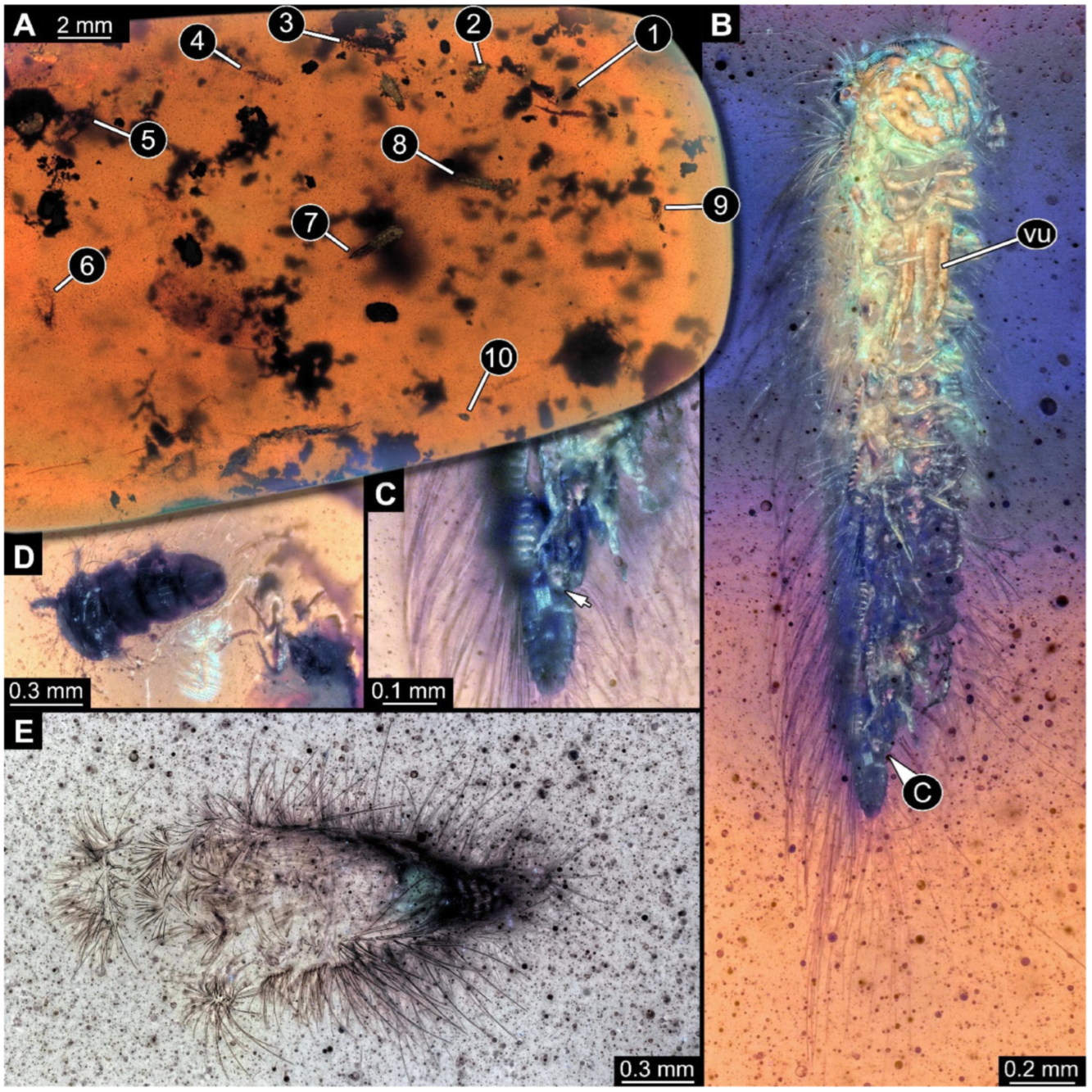
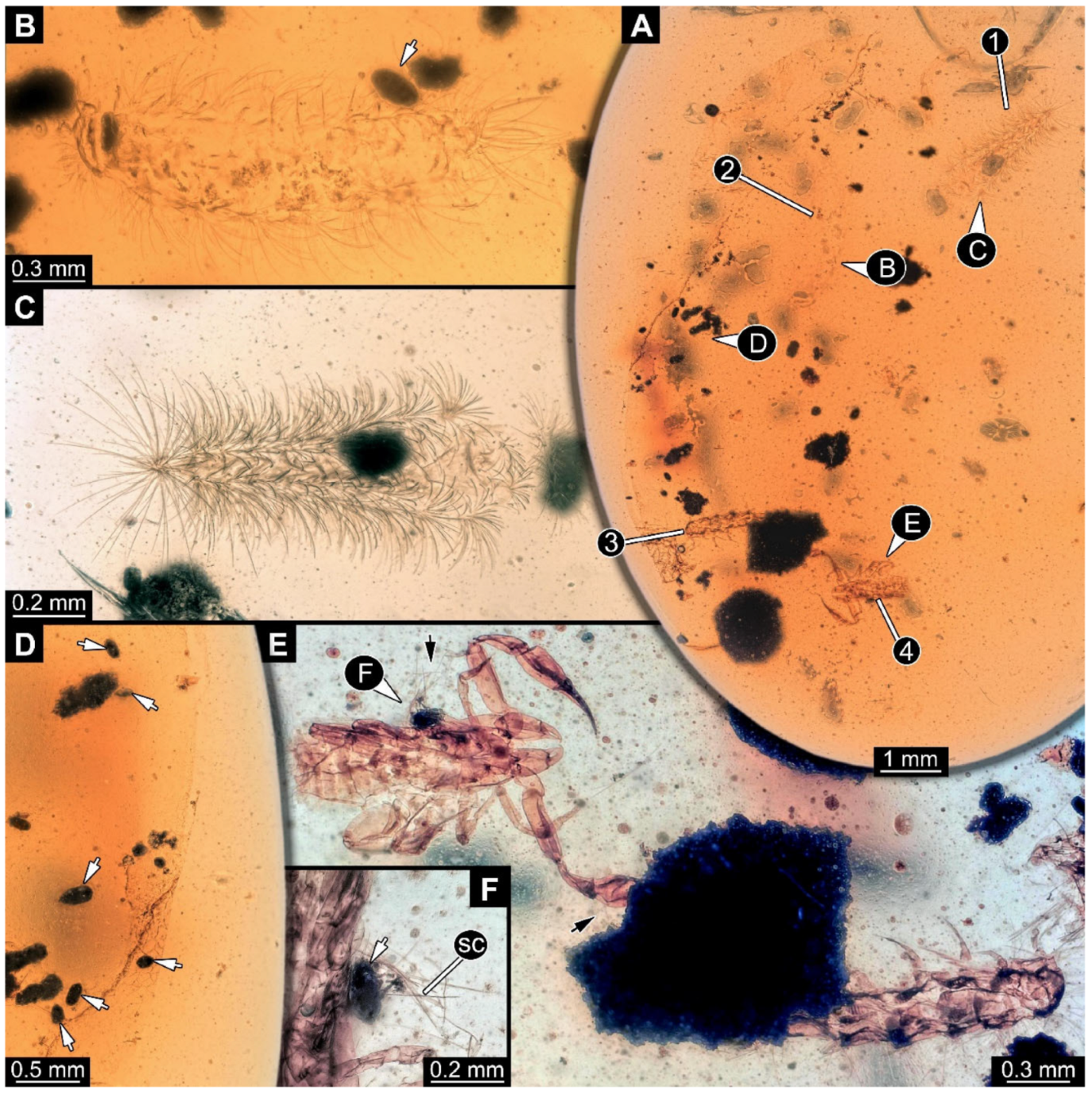
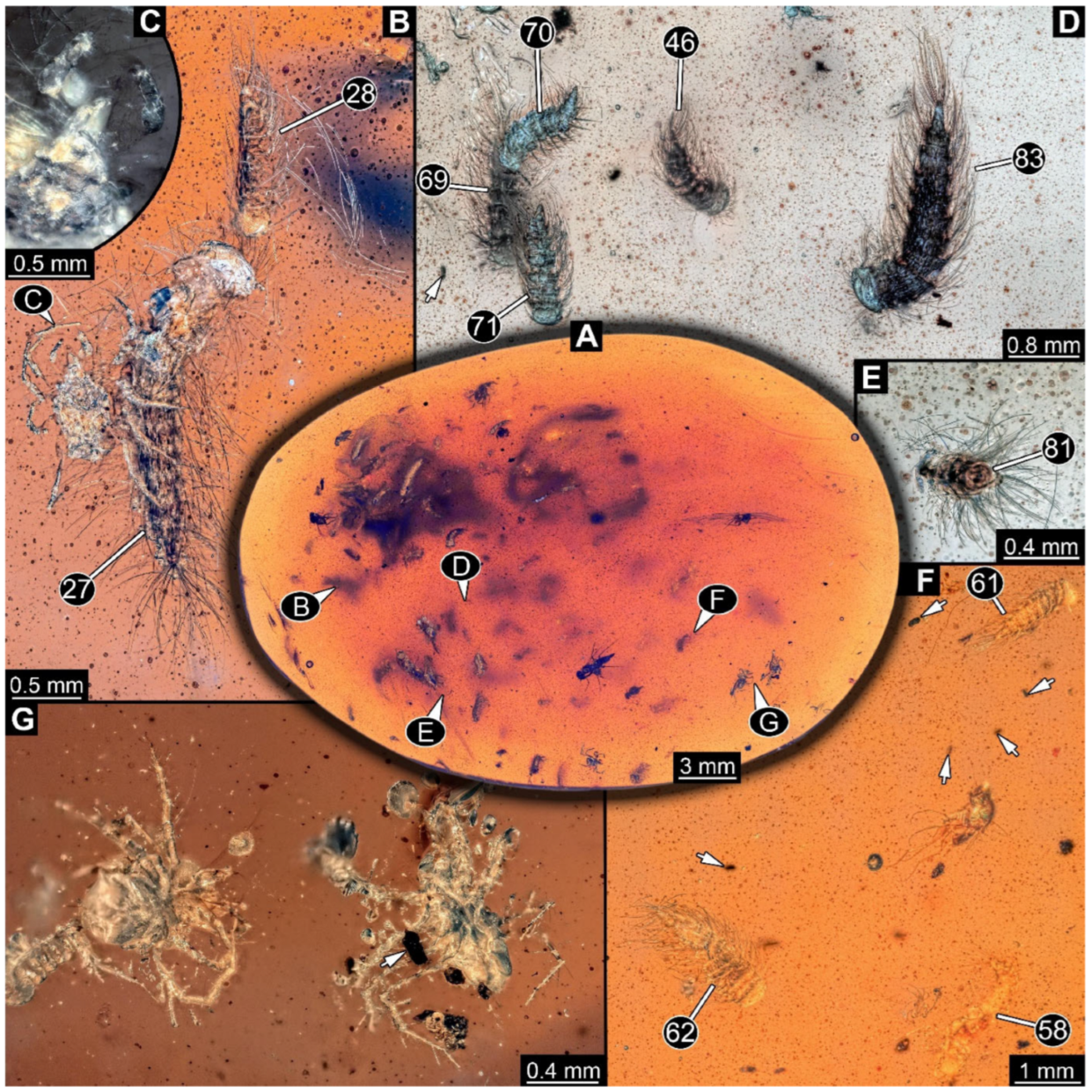
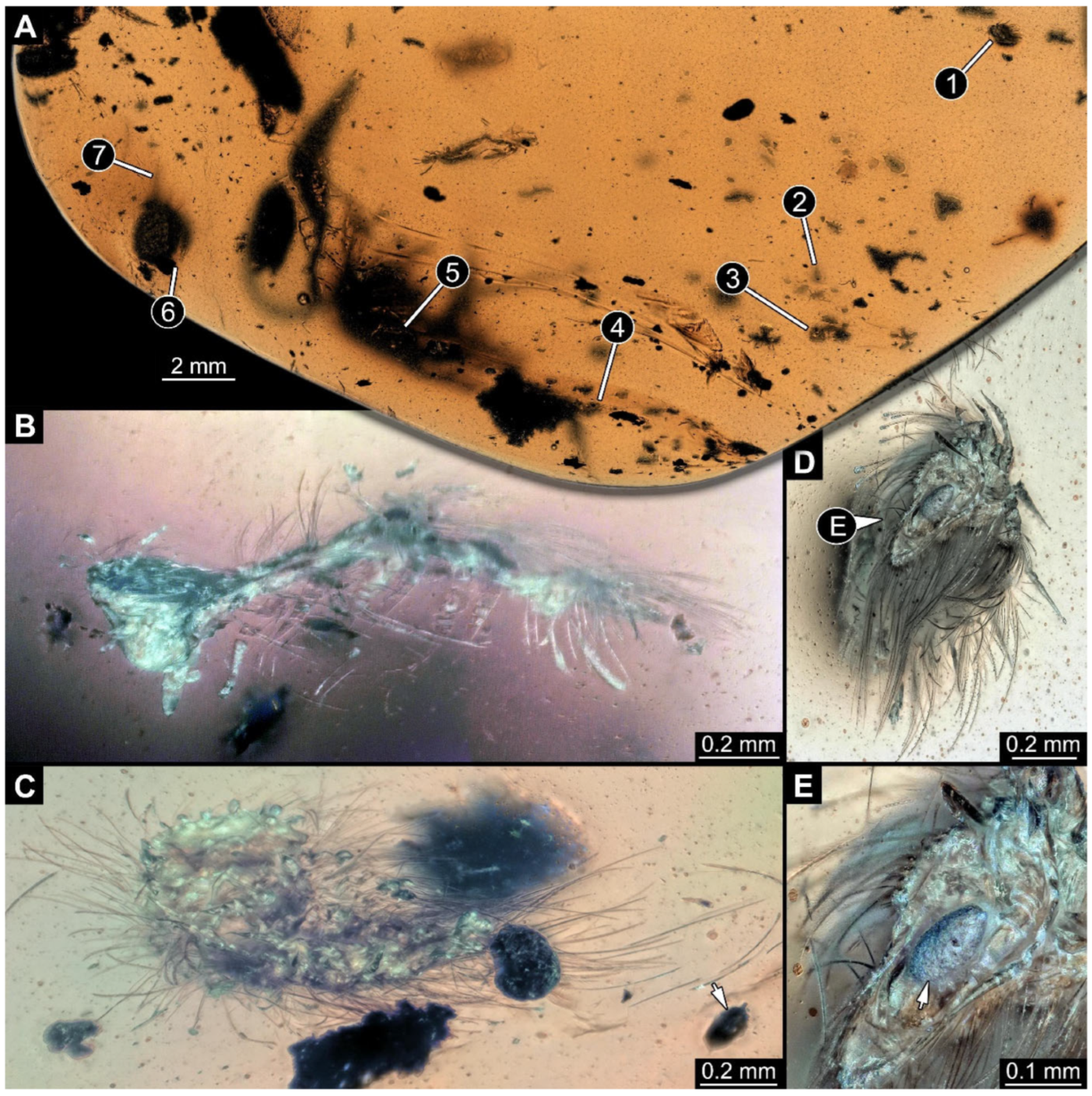
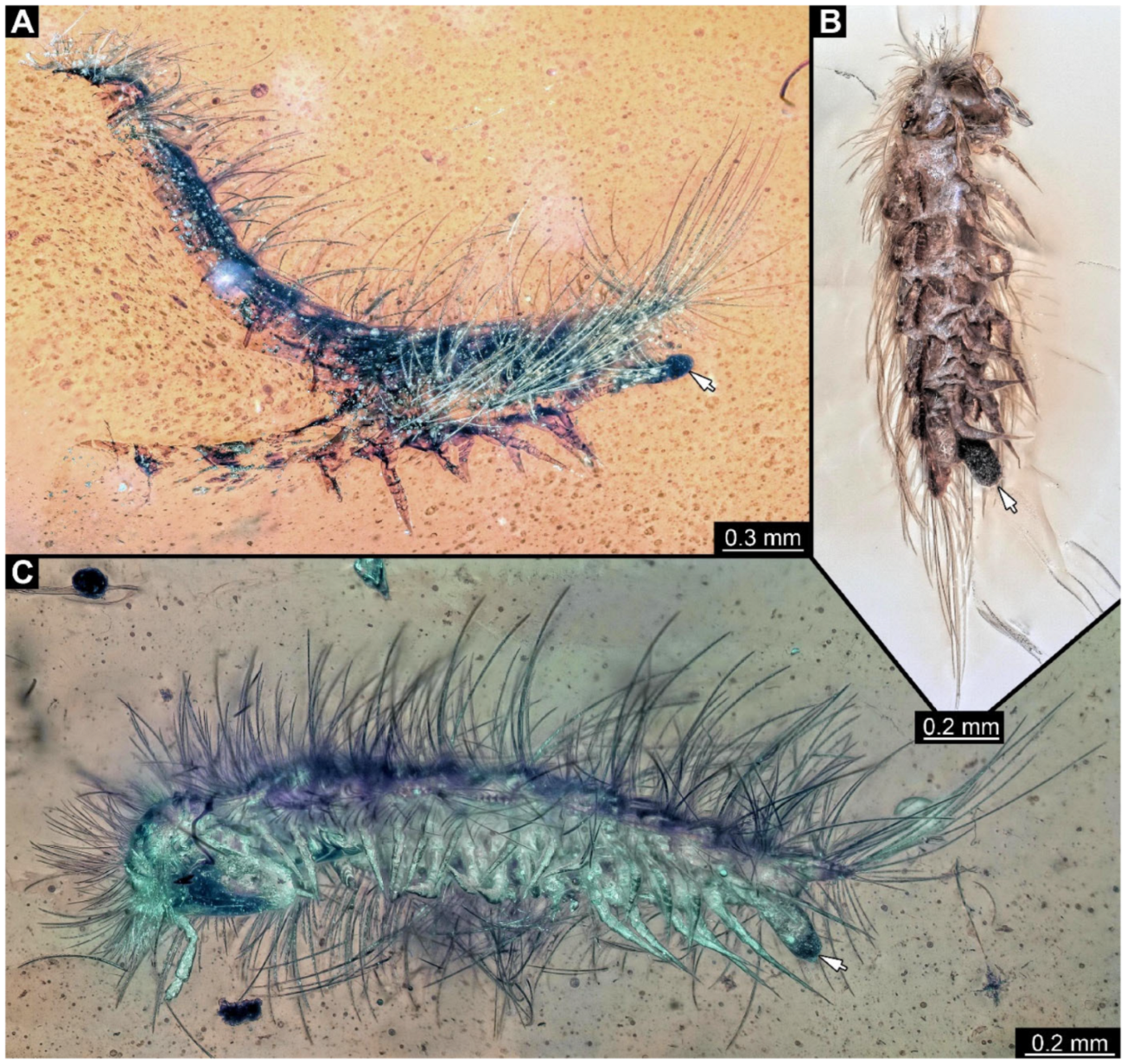
NIGP208860 (Figure 1): Amber of 34 × 23 mm. In total, 89 millipede-like animals have been reported, but only 87 specimens have been clearly identified to be representatives of Synxenidae (see Table S2; Figure S1). Specimens are from different developmental stages; all are immatures, and no adults have been observed (Table 1). Six specimens are found defecating or with pieces of frass close to their anal valves (Table S2).
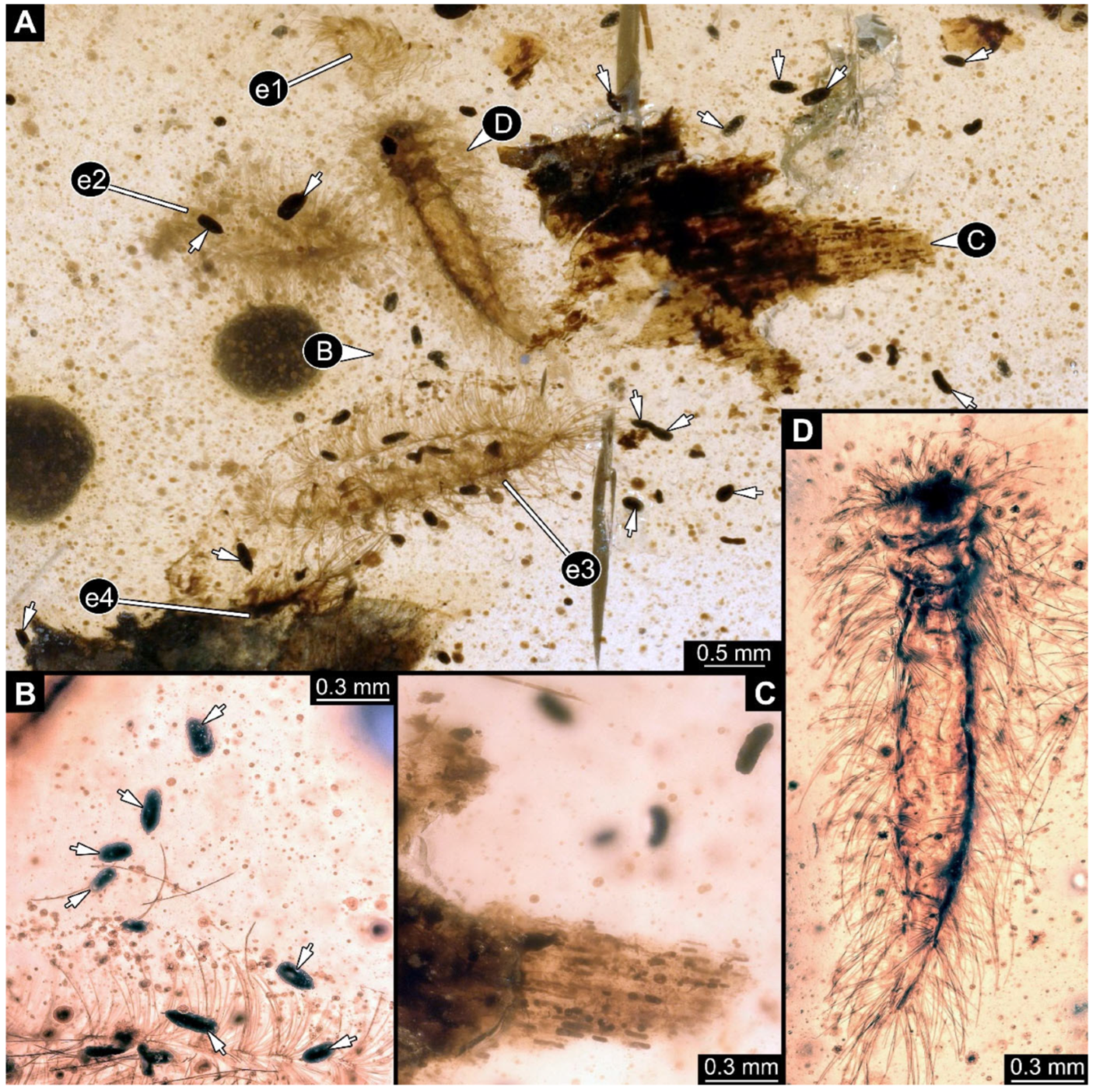
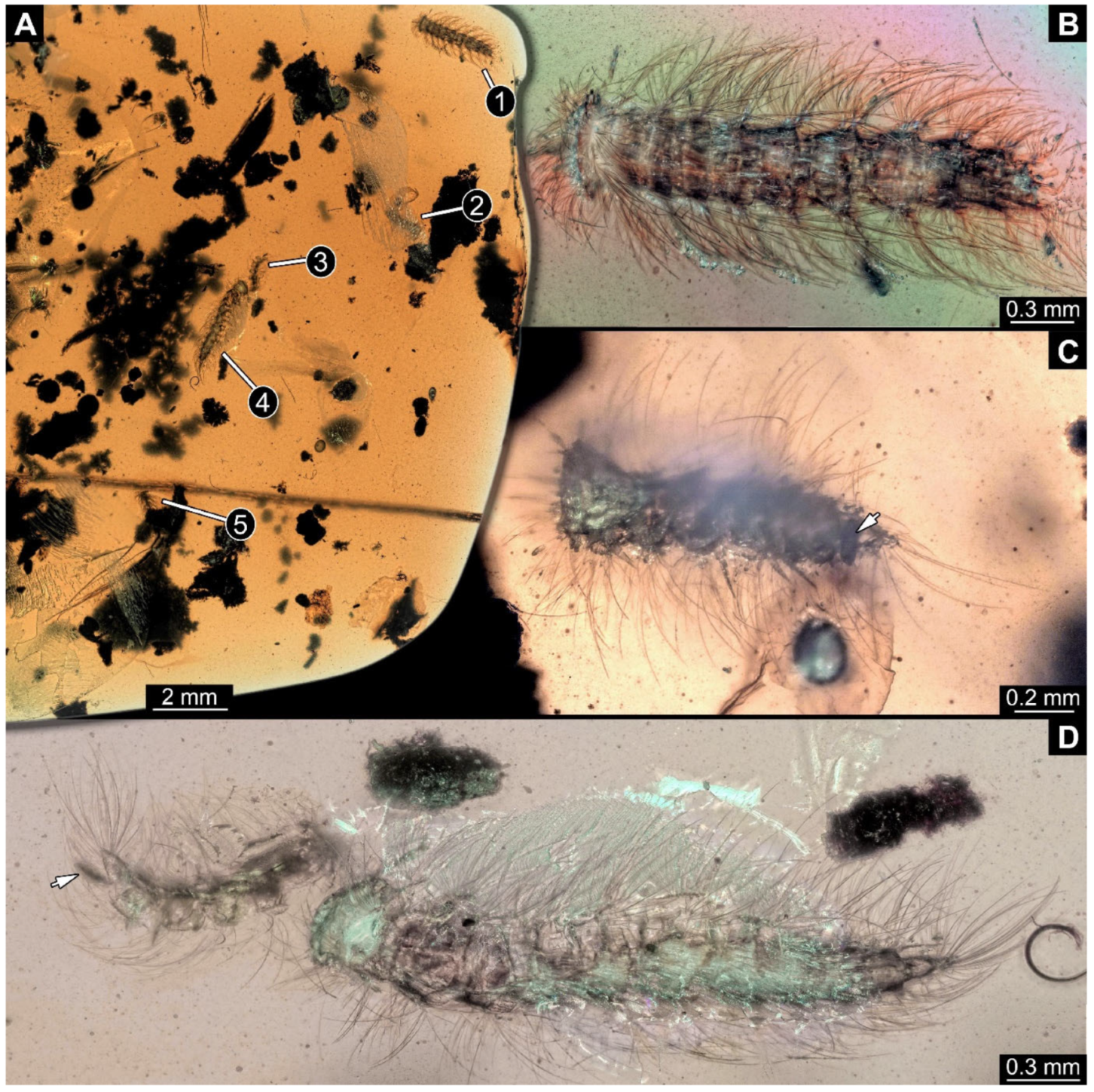
PED 2596 (Figure 2): Amber of 15 × 10 mm, from Myanmar (~100 mya), with Synxenidae-like millipedes fossilized together, close to a preserved piece of wood (Figure 2C). Only a single specimen is found, poorly preserved (Figure 2D, PED 2596-1), surrounded by four exuviae of Synxenidae. One exuvia (PED 2596-2) is fragmented and only the posterior end is preserved, the three other exuviae (PED 2596-3–5) are seemingly fully preserved with the head almost detached. Forty-one black masses identified as frass are in the amber piece, close to the community of Synxenidae.
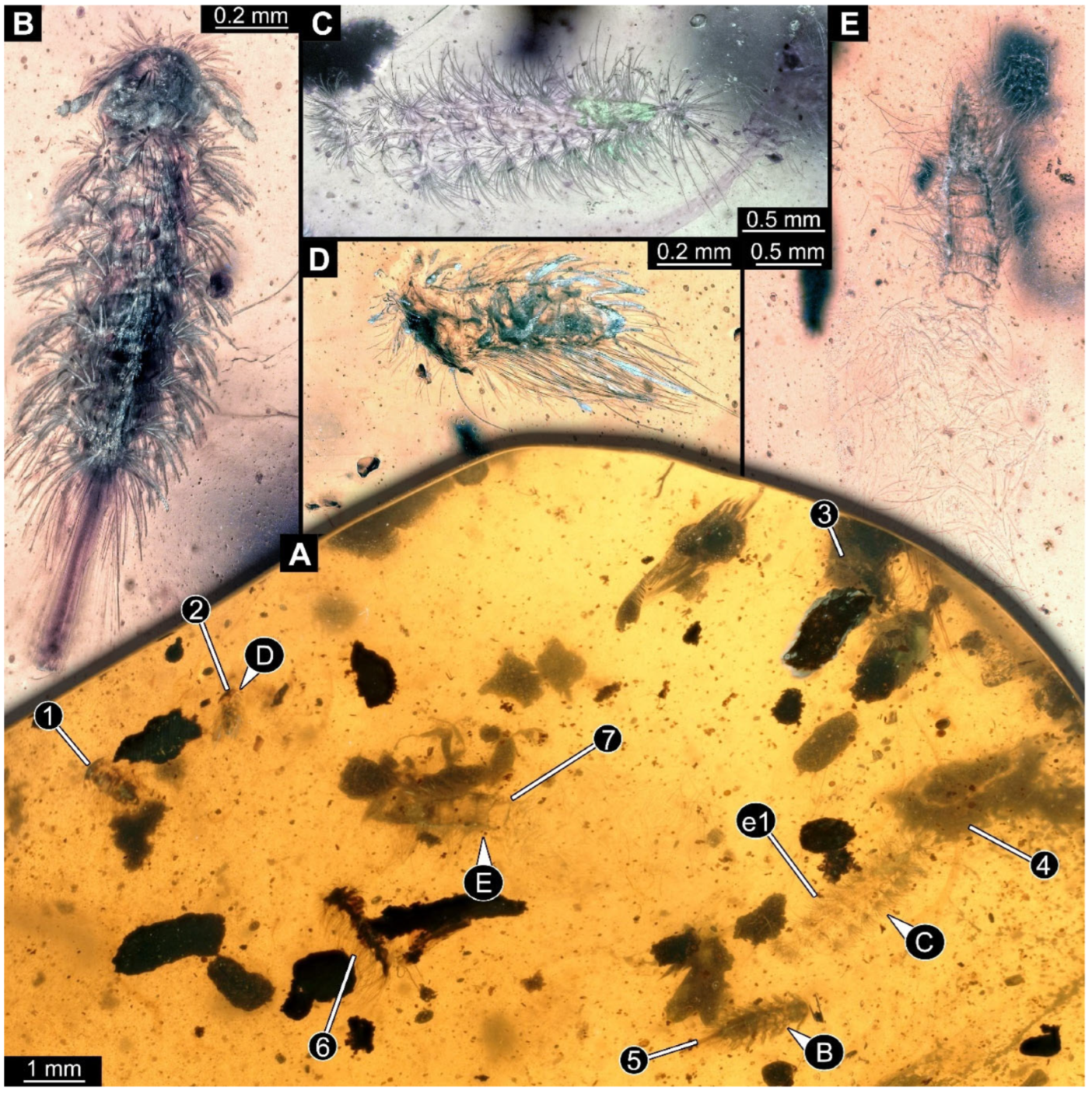
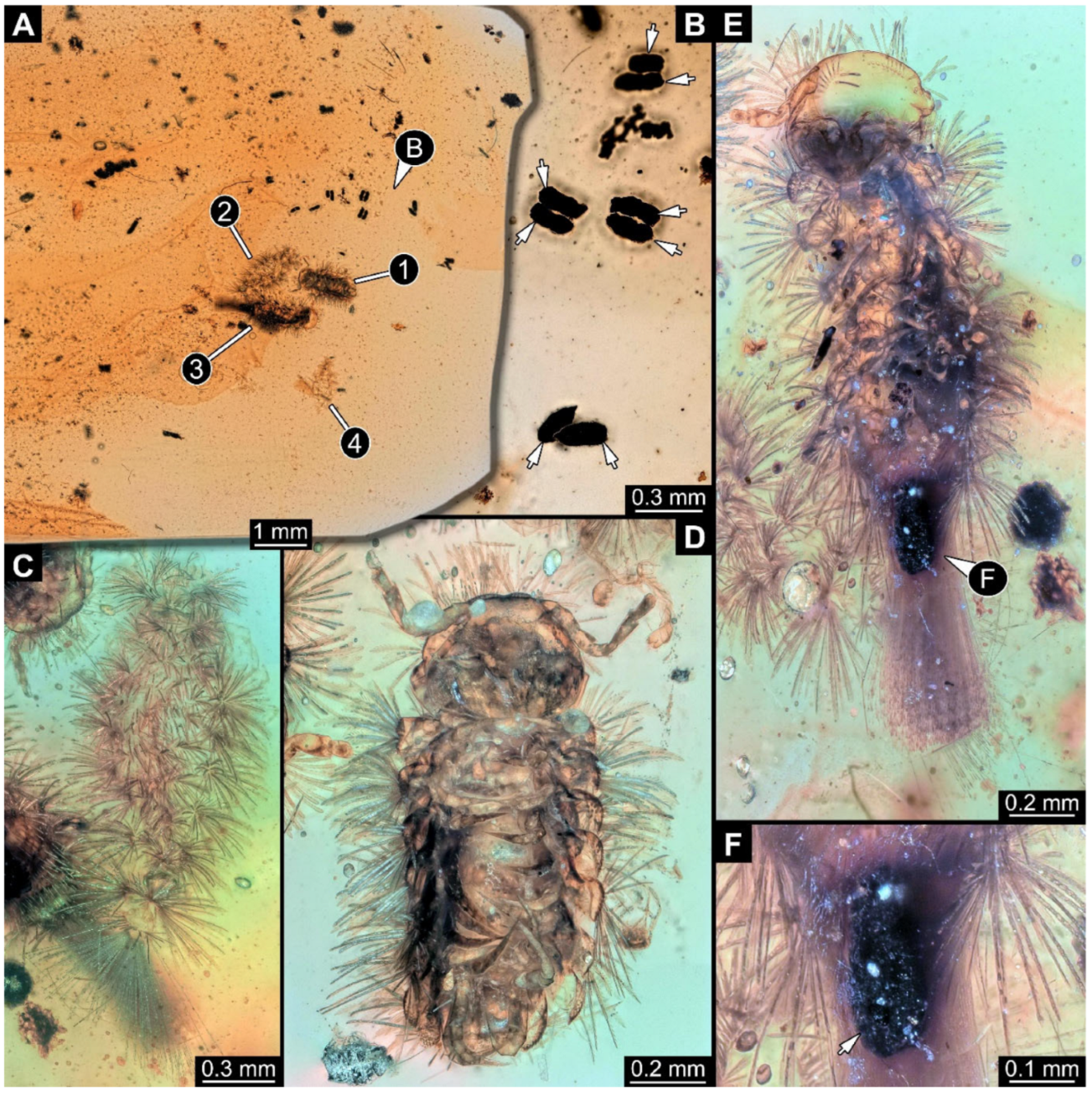
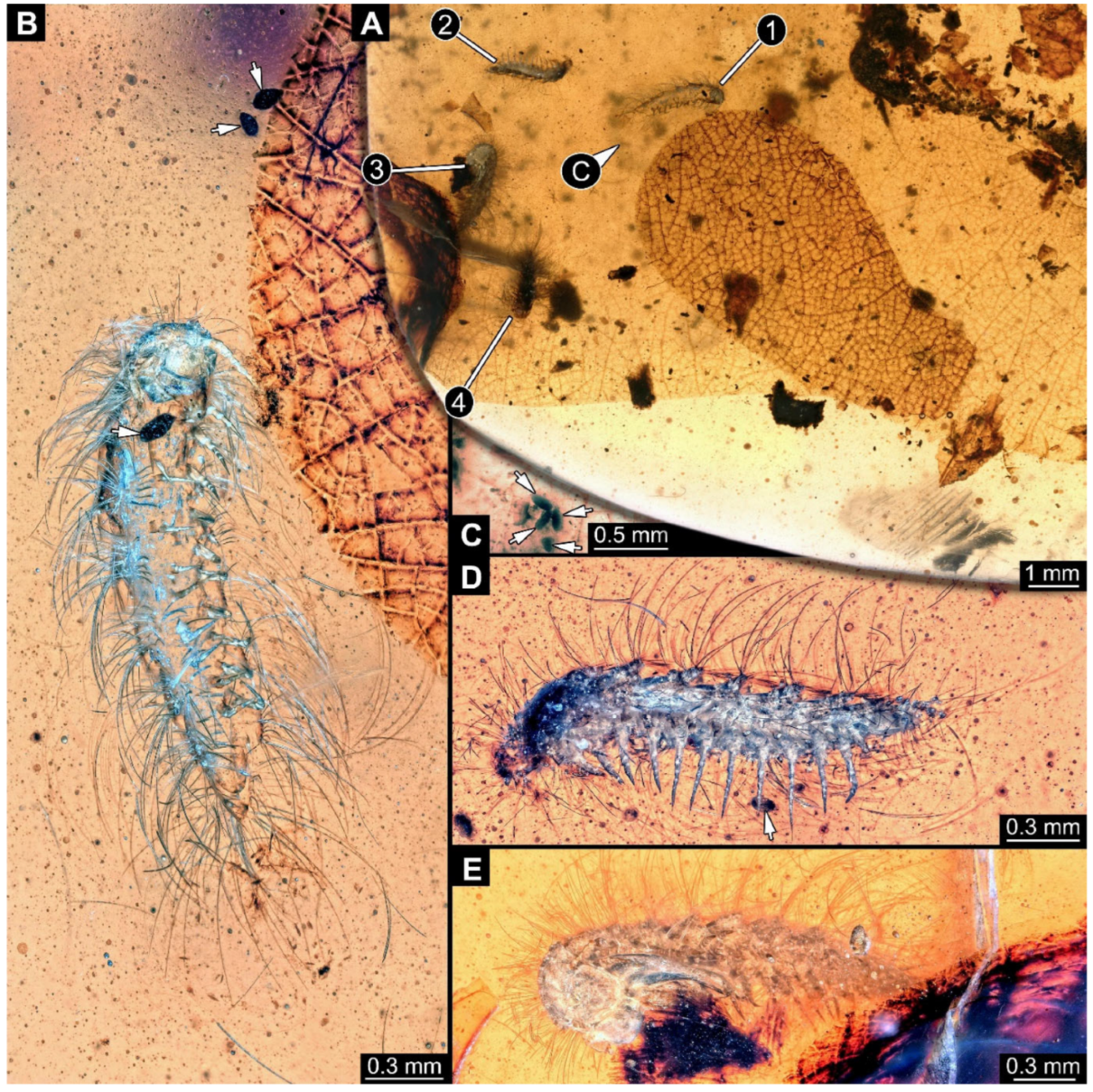
PED 3238 (Figure 3): Amber of 27 × 22 mm, from Myanmar (~100 mya). Within the amber, eleven representatives of Polyxenida are preserved (PED 3238-1–7; PED 3238-9–12) as well as one exuvia of Synxenidae (PED 3238-8; e1 in Figure 3). Out of the eleven identified specimens, only PED 3238-5 differs as being a representative of Polyxenidae (Figure 3A), while the others are identified as representatives of Synxenidae. All millipedes have been identified to be immatures (Table 2). Within the amber, three specimens are found defecating: PED 3238-1, PED 3238-10, and PED 3238-12.
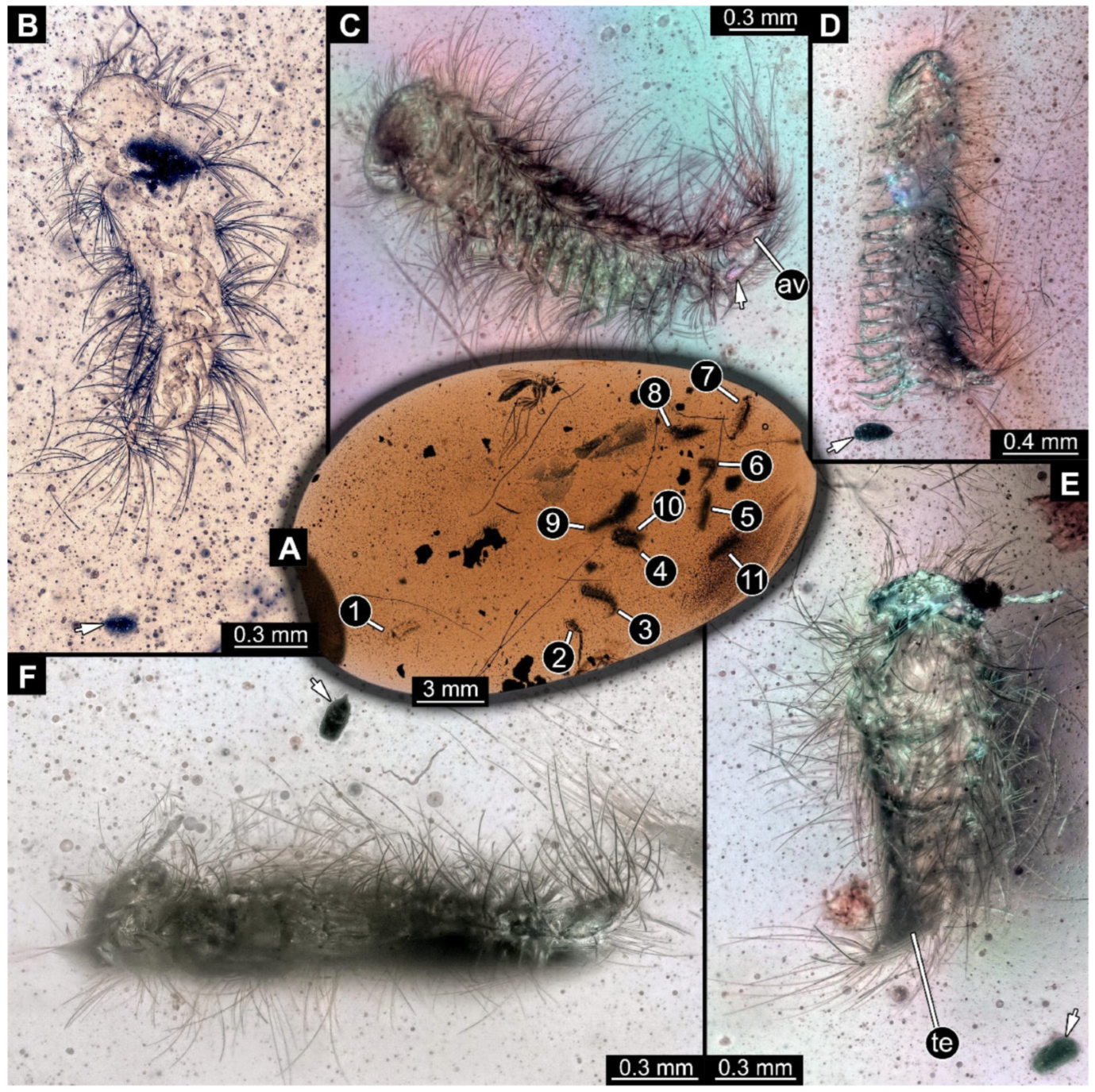
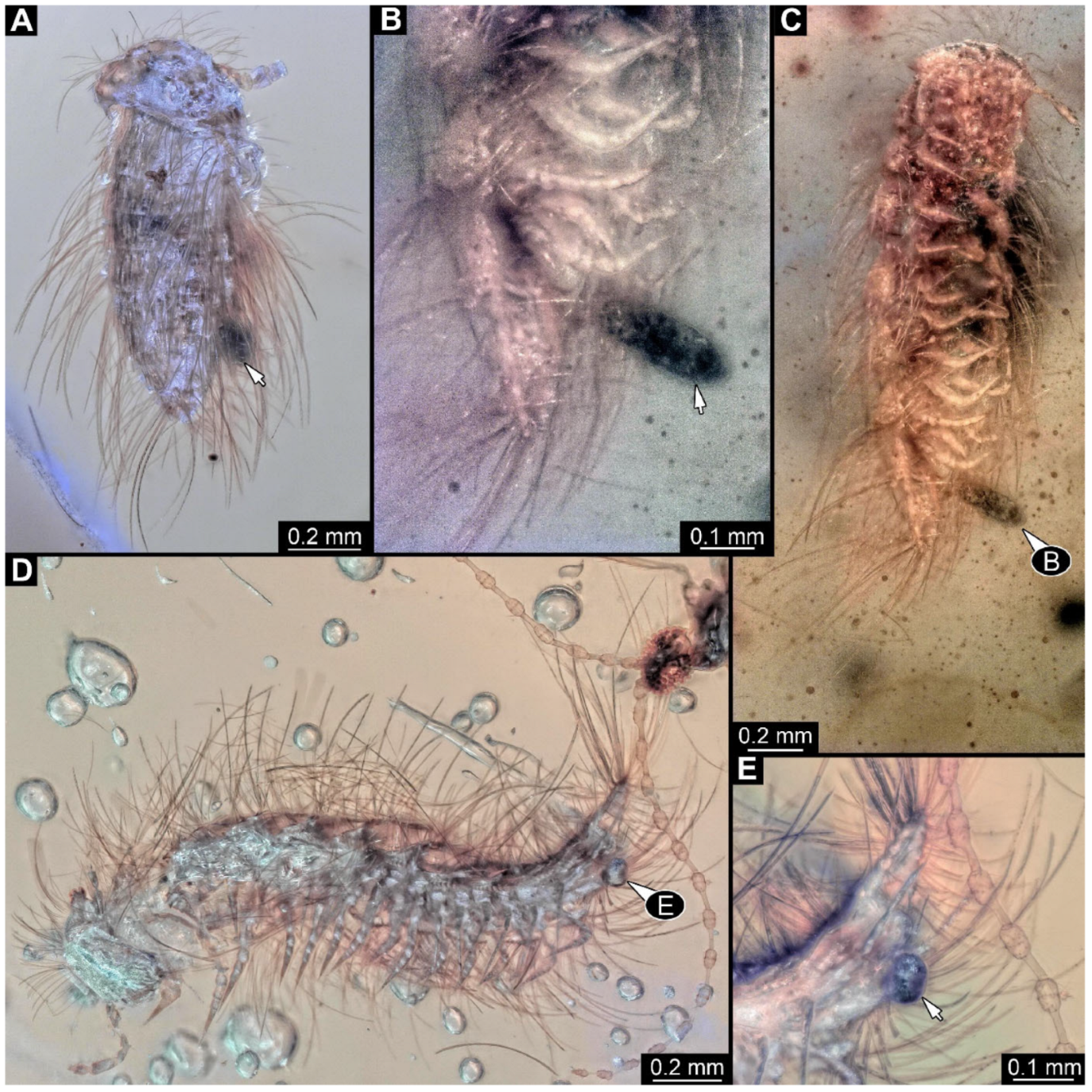
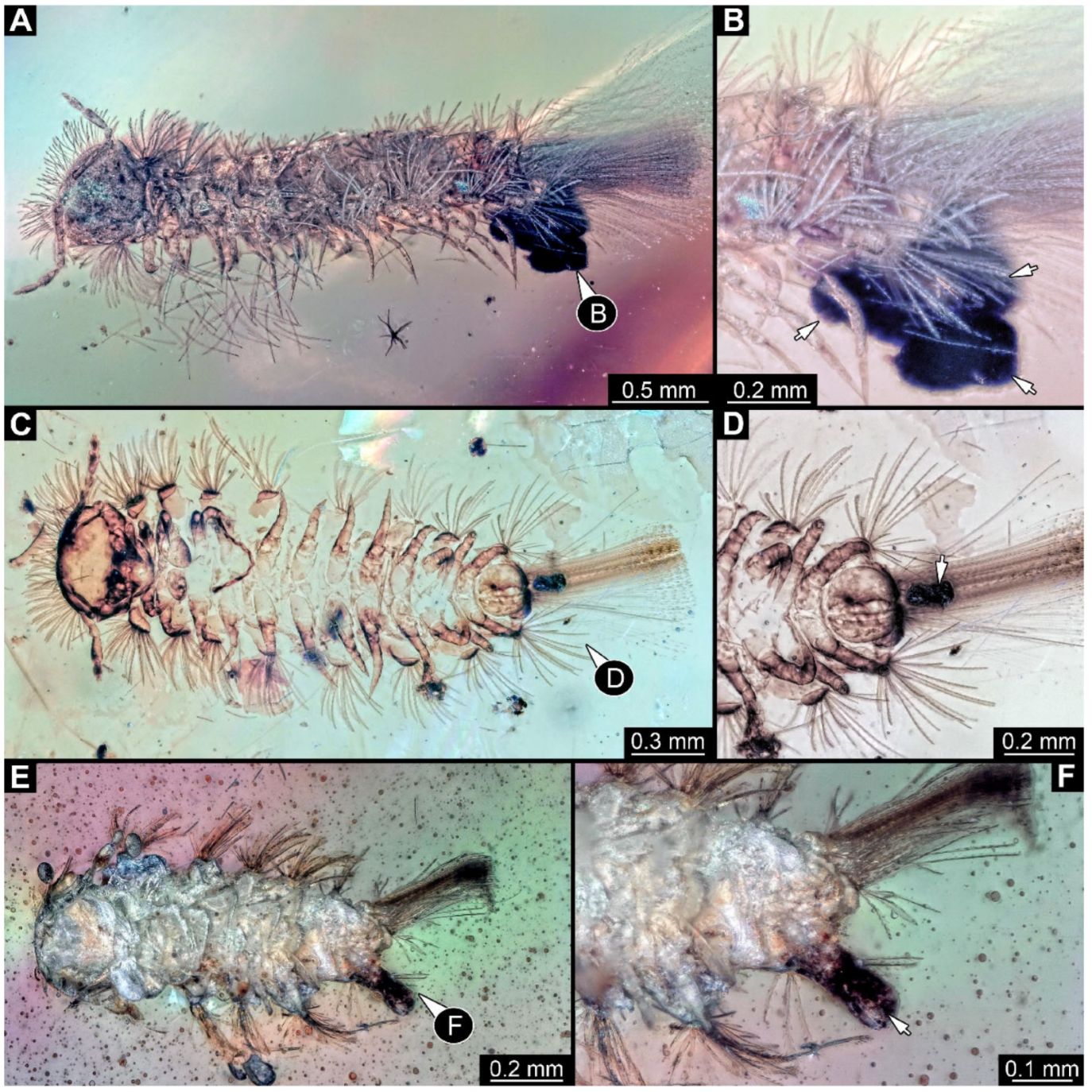
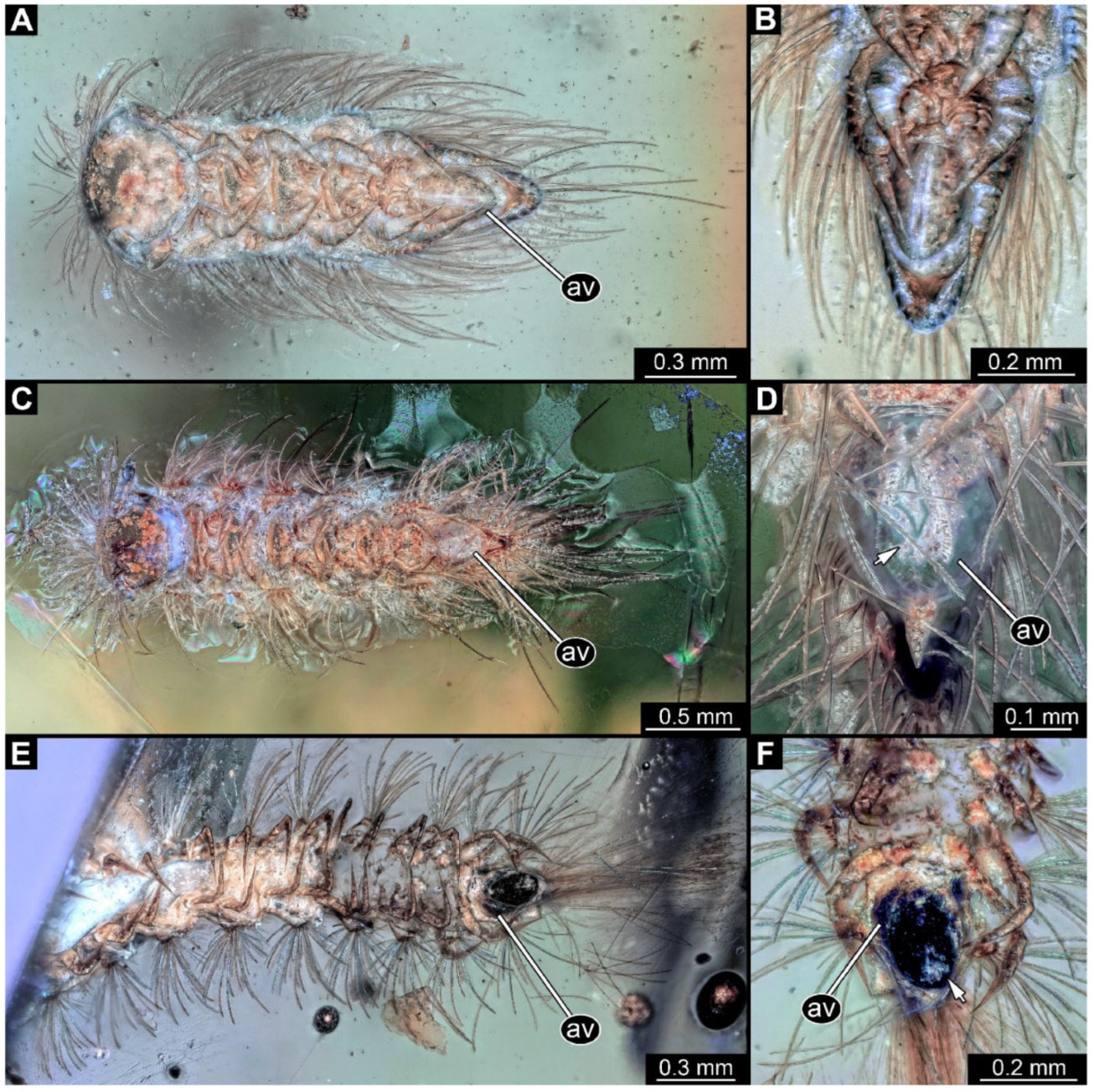
PED 1488 (Figure 4): Amber of 23 × 14 mm, from Myanmar (~100 mya). Eleven representatives of Synxenidae are preserved within PED 1488; they are from different ontogenetic stages (Table 3). Five specimens have been found with frass close. Four of them are seemingly defecating, or at least with frass close to their terminal end (Figure 4B–E). While for PED 1488-5, the frass is close to the specimen, it is not located in front of its terminal end (Figure 4F: arrow).
PED 2755 (Figure 5): Amber of 31 × 17 mm, from Myanmar (~100 mya). In total, seven representatives of Synxenidae have been identified (Figure 5); they are from different developmental stage and are all immatures (Table 4). Two specimens are seemingly found defecating: close to the terminal end of PED 2755-1, a single piece of frass is visible close to the anal valves in between the last pairs of legs (Figure 5D,E: arrow), and a single piece of frass is also located close to PED 2755-3 (Figure 5C: arrow).
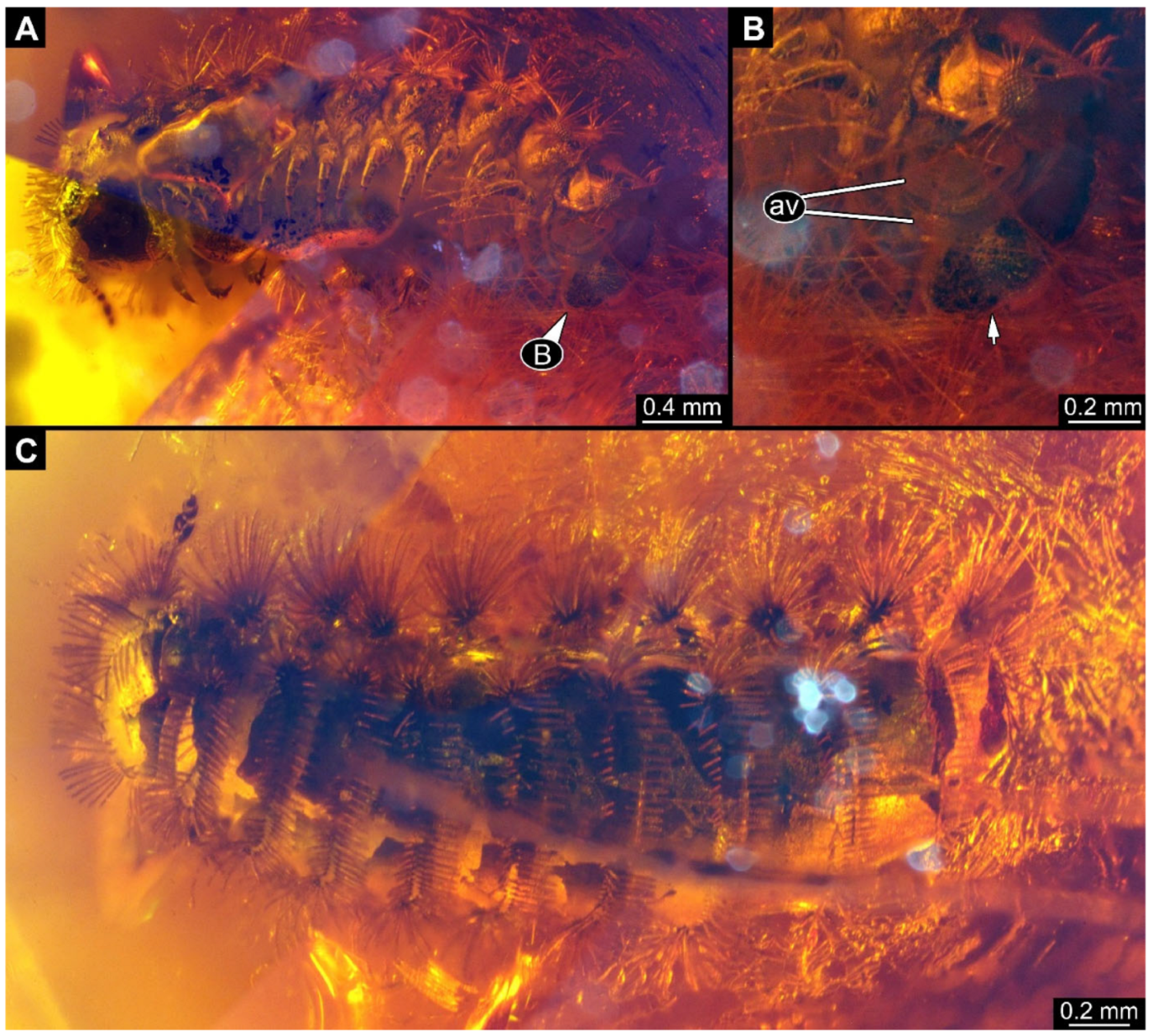
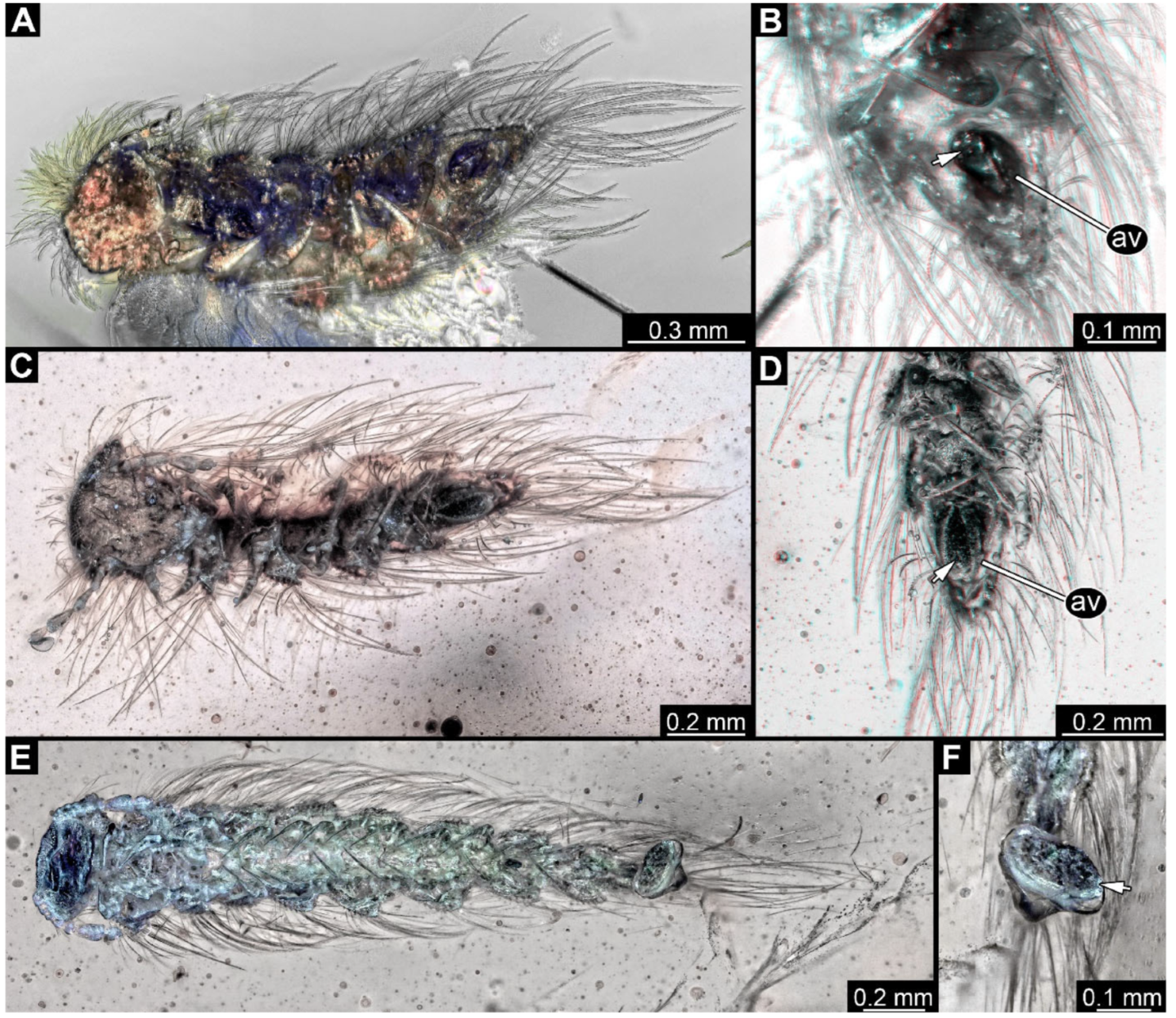
PED 2885 (Figure 6): Amber of 36 × 18 mm, from Myanmar (~100 mya). In total, ten representatives of Synxenidae have been identified (Figure 6A), including two exuviae (PED 2885-5–6; Figure 6A,E). Most specimens have been identified to be immatures (Table 5). A single specimen (PED 2885-7) is found in the process of defecating; on the terminal end of the specimen, a piece of frass is found in front of the anal valves, behind the last pair of legs (Figure 6C: arrow).
PED 3328 (Figure 7): Amber of 19 × 20 mm, from Myanmar (~100 mya). In total, five representatives of Synxenidae are preserved within the amber piece (Figure 7A). Three specimens are identified to be immatures (PED 3328-2–3 and PED 3328-5; Table 6), and only PED 3328-4 (Figure 7D) has been identified to be an adult; PED 3328-1 is however fragmented, making clear identification not possible. The sex of PED 3328-4 remains unclear as the genitalia are not visible. Two millipedes are in the process of defecating, PED 3328-2 and PED 3328-3, with frass located in front of their anal valves (Figure 7C,D: arrow).
PED 2439 (Figure 8): Amber of 19 × 13 mm, from Myanmar (~100 mya). In total, four representatives of Synxenidae are preserved within the amber piece (Figure 8A). Two specimens are clearly identified to be immatures (Table 7), and only PED 2439-4 has been identified to be an adult; PED 2439-3 however is fragmented and therefore its development cannot be identified. Within the amber piece, multiple pieces of frass are visible (Figure 8C), and two pieces of frass are located close to the millipedes PED 2439-1 and PED 2439-3 (Figure 8B,D: arrows) but not close to their anal end.

3.2. Defecation Process

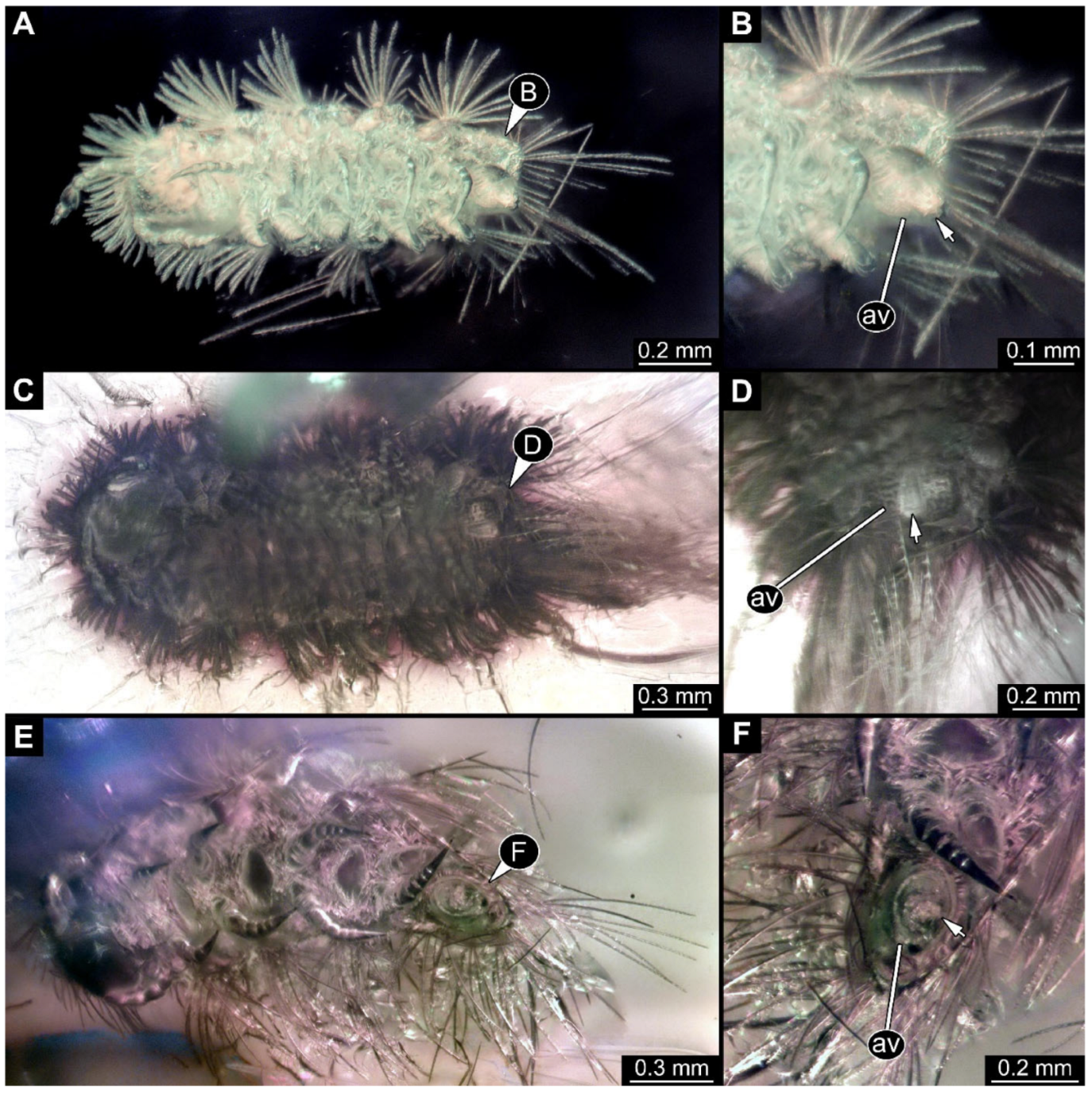
The process of defecation in polyxenidans follows a certain sequence, visible in several specimens in amber (Figure 9). At first, the “non-defecating” millipedes can be identified from their closed anal valves (Figure 9A,B). Then, the process of defecation starts by the opening of the two anal valves (Figure 9C,D), with, in certain cases, frass material already visible in between the two valves (Figure 9D: arrow). The frass is pushed through the opening (Figure 9F: arrow), stretching the entire opening until full expulsion (Figure 10A,B: arrow), and/or still remaining in contact with the animal. Finally, the frass becomes detached, but is yet again found in close range to the animal. The valves can then close again.
Frass can be identified from their pitch-black colour and irregular surfaces, which can be misidentified as dirt masses. However, compared to the latter, frass are identifiable by their elongated shape with thin thread-like and stubby flat ends.

3.3. Defecation in the Literature

Pauropsxenus extraneus [18] (figures 5 and 6): In their paper, the authors investigated 40 individuals preserved in Kachin amber (~100 mya) that they later diagnosed to be representatives of Pauropsxenus extraneus and P. ordinatus. Seven specimens have been determined (NGIP168242–NGIP168243), and two specimens of P. extraneus are fossilized while defecating and with frass close to their anal valves: NGIP168242, an adult female with single piece of frass located in front of the anal valves (Figure 5B), and NGIP168243, an adult female, with at least three pieces of frass located in front of the anal valves (Figure 6B).
Phryssonotus burmiticus [22] (figure 1A): Holotype BMNH IN.19122, female adult from Kachin amber (~100 mya). The anal valves seem to be protruding; a mass is present in front, but it remains unclear. It is unsure if this is a piece of frass or the protruding anal valves.
Phryssonotus burmiticus [17] (figures 1, 3, and 5): In their paper, the authors investigated and included 15 specimens from Kachin amber (~100 mya). Two specimens are fossilized while defecating (NIGP167288 and NIGP167293): NIGP167288, an adult male, with a single round piece of frass found close to the anal valves (Figure 1B and Figure 3B), and NIGP167293, a subadult male, where the frass is seemingly pushed between the two anal valves (Figure 5B).
Phryssonotus sp. [21] (figure p. 27): Single specimen of Synxenidae, identified as Phryssonotus sp. (no accession number provided; Baltic amber, ~35 mya), fossilized while defecating. This specimen is laterally visible; it is an immature of stage 4/5 (number of legs unclear, between 6 and 8) with a black mass of frass in front of its terminal end.
Polyxenus conformis (Figure 10): Female adult (holotype; MB.A.1606), from Baltic amber (~35 mya). Around the anal end of the animal, a single piece of frass is visible, surrounded by defensive setae (Figure 10A,B).

3.4. Defecation in the New Fossils

PED 3560 (Figure 11A,B): Immature representative of Synxenidae, preserved in Myanmar Kachin amber (~100 mya). Six pairs of legs are visible, making it a representative of stage 4. In between the anal valves is a frass pushing through (Figure 11B).
PED 3665 (Figure 11C,D): Immature representative of Synxenidae, preserved in Myanmar Kachin amber (~100 mya). Six pairs of legs are visible, making it a representative of stage 4. In between the anal valves is a frass pushing through (Figure 11B).
PED 1084 (Figure 11E,F): Immature representative of Synxenidae, preserved in Myanmar Kachin amber (~100 mya). Twelve pairs of legs are visible, making it a representative of stage 7. In front of the anal valves, a frass is visible (Figure 11F); the frass is seemingly surrounded by a bubble.
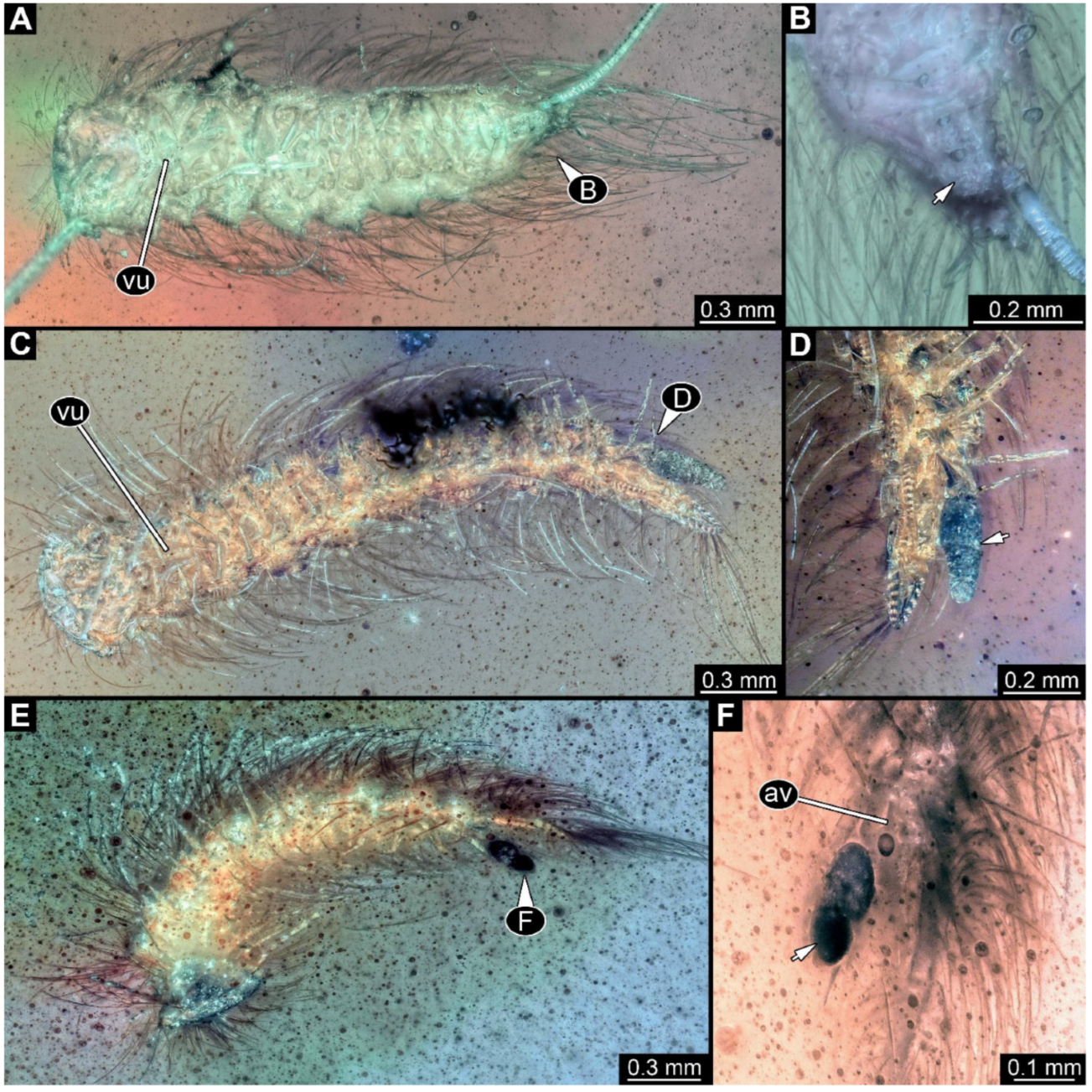
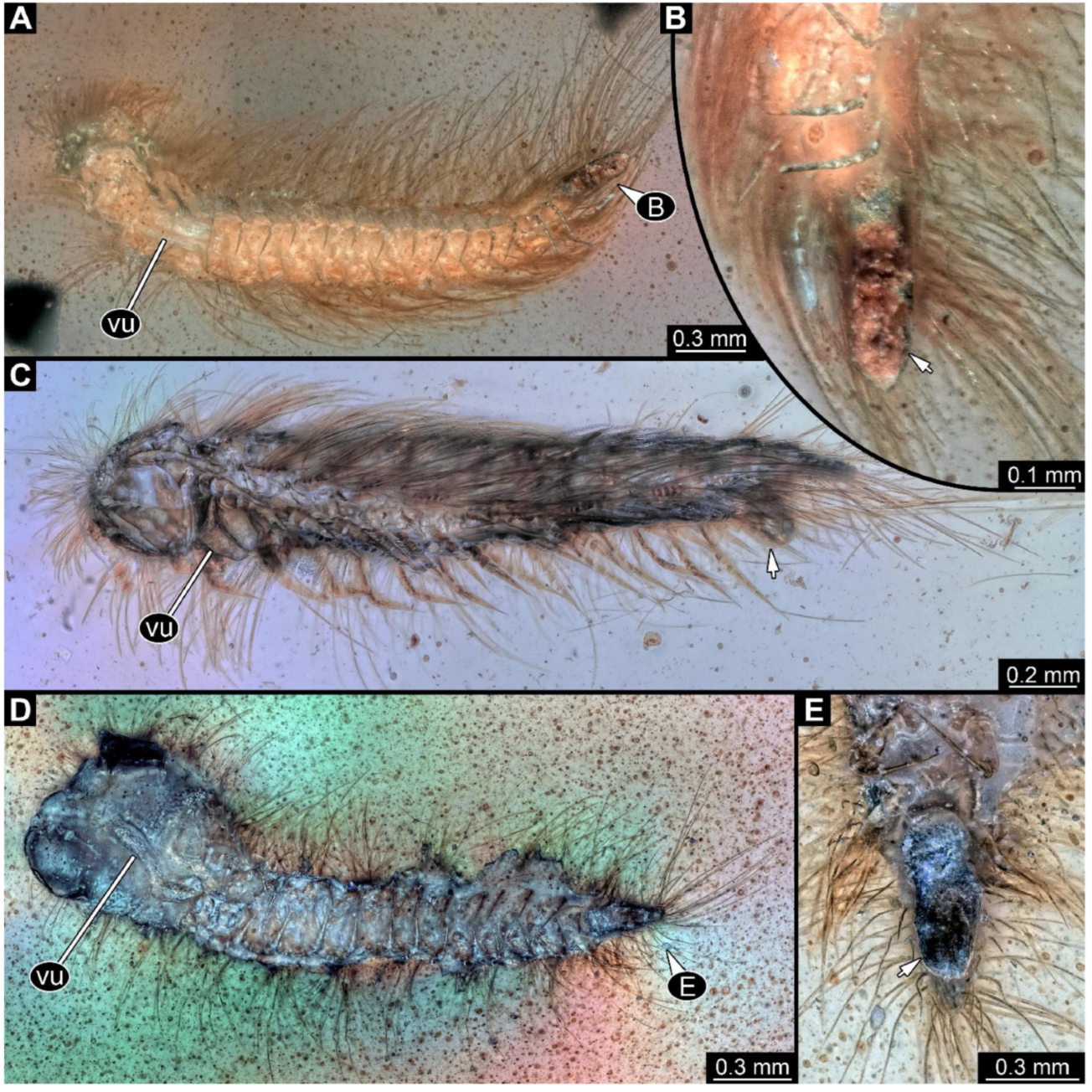
PED 2209 (Figure 12): Two representatives of Synxenidae preserved in Kachin amber (~100 mya): PED 2209-1 is an immature of stage 6 (10 pairs of legs) and PED 2209-2 is an immature female of stage 8 (14 pairs of legs; vulvae visible). Within the amber are four black masses identified as frass of Synxenidae: located in front of the anal valves of PED 2209-1 is a single piece of frass (Figure 12C: arrow), and similarly close to the anal end of PED 2209-2 is a single elongated piece of frass (Figure 12E: arrow).
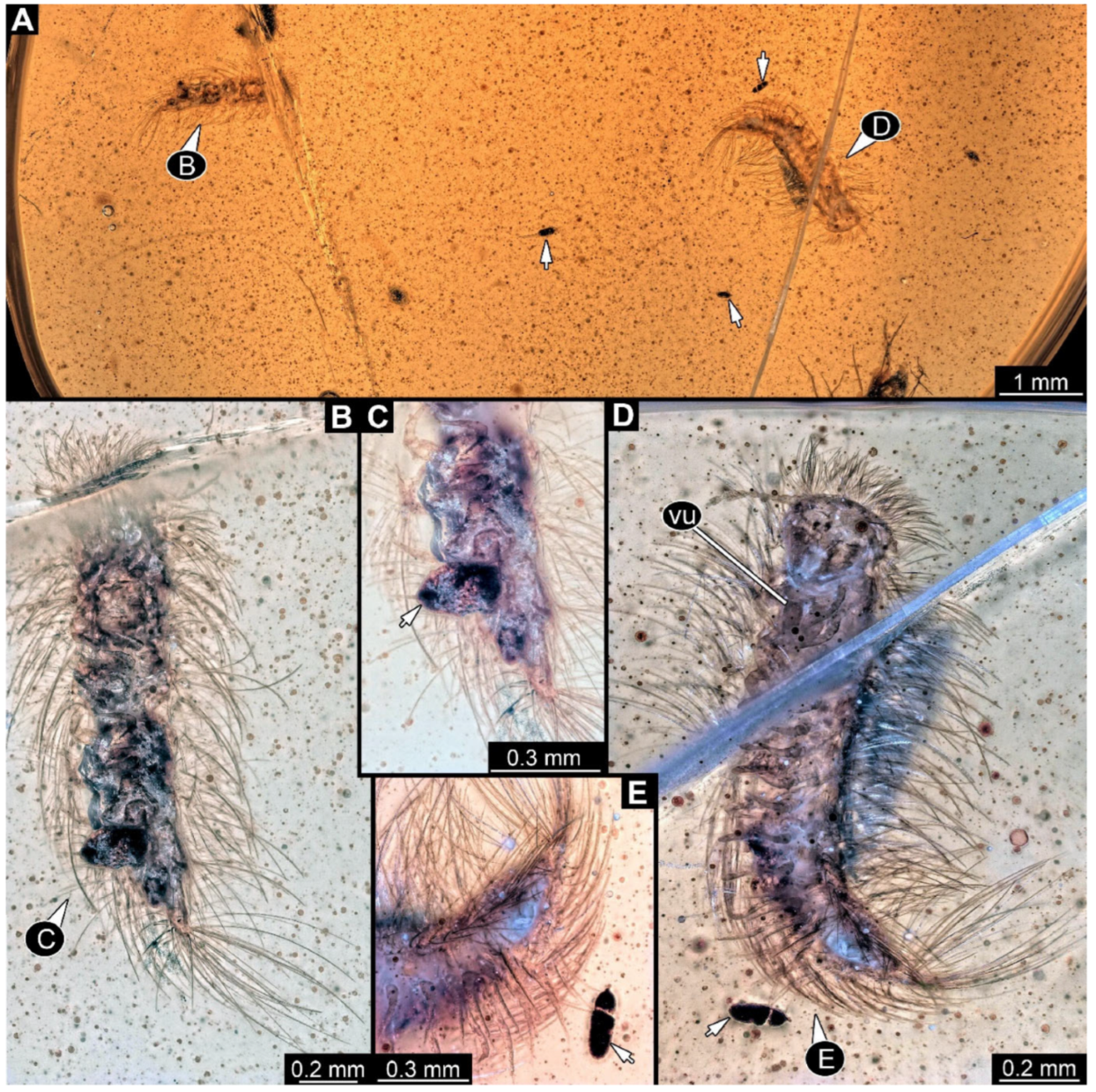
PED 1003 (Figure 13): Amber of 15 × 9 mm, from Myanmar (~100 mya). Two representatives of Synxenidae are preserved in the amber (PED 1003-2–3) and a single exuvia (PED 1003-1): PED 1003-2 is an immature from stage 7 (12 pairs of legs) and PED 1003-3 is unclear. In the same amber piece is a pseudoscorpion (PED 1003-4), with its claws aiming toward PED 1003-3. Defensive setae and a single piece of frass are found directly touching the lateral side of PED 1003-4 (Figure 13F); setae are also found close to its pedipalps (Figure 13E: arrows). Frass are found within the amber piece (Figure 13D) and close to PED 1003-2 (Figure 13B: arrow).
PED 1298 (Figure 14A): Immature representative of Synxenidae, preserved in Kachin amber (~100 mya). The developmental stage of the specimen is unclear. A round black piece of frass is located in front of the anal valves (arrow).
PED 1457-2 (Figure 14B,C): Immature representative of Synxenidae, preserved in Kachin amber (~100 mya). Ten pairs of legs are visible, making it an immature of stage 6. There is an elongated black piece of frass out of the anal valves, close to its terminal end (Figure 14B: arrow).
PED 1309 (Figure 14D,E): Subadult representative of Synxenidae, preserved in Kachin amber (~100 mya). The elongated pair of vulvae is not visible, unclear if absent. Sixteen pairs of legs are visible, making it a subadult immature of stage 9. A round black piece of frass is leaving the anal valves (Figure 14E: arrow).
PED 1691 (Figure 15A): Fragmented representative of Synxenidae, preserved in Kachin amber (~100 mya). The specimen is fragmented in two, with the anterior part partly missing. An elongated black piece of frass is located at the terminal end (arrow).
PED 1843 (Figure 15B): Immature representative of Synxenidae, preserved in Kachin amber (~100 mya). Six pairs of legs are visible, making it an immature of stage 4. Black frass is pushed through the two anal valves (arrow).
PED 2061-2 (Figure 15C): Immature representative of Synxenidae, preserved in Kachin amber (~100 mya). Fourteen pairs of legs are visible, making it an immature of stage 8; the genitals are not visible. Black frass is pushed through the anal valves and visible at the terminal end (arrow).
PED 0863 (Figure 16A,B): Adult female representative of Synxenidae, preserved in Kachin amber (~100 mya). In total, seventeen pairs of legs and two elongated vulvae are visible on the second pair of legs. A long piece of frass is visible close to the terminal end of the millipede, behind the last pair of legs (Figure 16B: arrow).
PED 0591 (Figure 16C): Immature female representative of Synxenidae, preserved in Kachin amber (~100 mya). An underdeveloped pair of vulvae is visible on the second pair of legs; there are seemingly 14 pairs of legs, making it an immature female of stage 8. Round and protruding anal valves are visible (arrow).
BUB 4991 (Figure 16D,E): Fragmented and partly visible adult female representative of Synxenidae, preserved in Kachin amber (~100 mya). The head is not visible, but the two elongated vulvae are visible. At least 15 pairs of legs are visible; the pair of elongated vulvae suggest an immature female of stage 9–10. There is an elongated black piece of frass, pushed through the two anal valves and as long as the terminal end of the millipede (Figure 16E: arrow).
PED 1598-2 (Figure 17A,B): Immature female representative of Synxenidae, preserved in Kachin amber (~100 mya). Eight lateral bundles, twelve pairs of legs, and two vulvae are visible, making it an immature of stage 7. A piece of frass is located in front of the anal end (Figure 17B: arrow).
PED 1570 (Figure 17C,D): Adult female representative of Synxenidae, preserved in Kachin amber (~100 mya). Seventeen pairs of legs are visible as well as a pair of elongated vulvae; thus, it is an adult of stage 10. A single elongated piece of frass is located in front of the anal valves (Figure 17D: arrow).
PED 3468 (Figure 17E,F): Representative of Synxenidae, preserved in Kachin amber (~100 mya). Due to its position within the amber and the lack of visibility, the developmental stage is unclear; there are at least 14 pairs of legs. A large black piece of frass is in front of the anal end (Figure 17F: arrow).
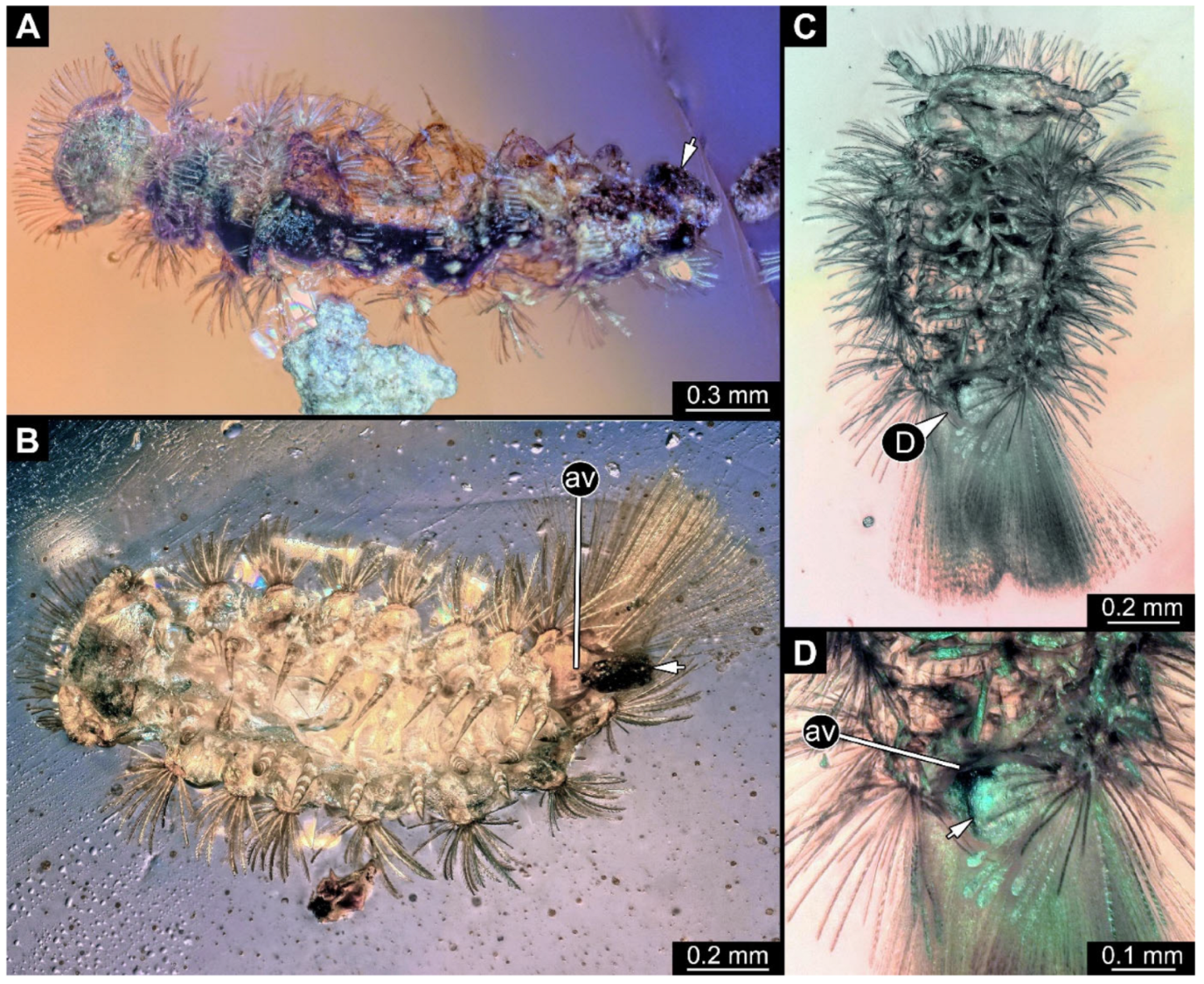
PED 0056 (Figure 18A): Immature representative of Synxenidae, preserved in Baltic amber (~35 mya). There are seemingly three pairs of legs, identifying it as an immature of stage 1. The anal valves are extending toward the anterior part of the millipede, and an elongated piece of frass is pushed through them (arrow).
PED 0035 (Figure 18B): Immature representative of Synxenidae, preserved in Baltic amber (~35 mya). Four pairs of legs are visible and three distinct lateral bundles, suggesting that it is an immature of stage 2. A piece of frass is pushed through the anal valves; it can be seen by its more reflective appearance than the two anal valves (arrow).
GPIH Scheele 1362 (Figure 18C): Adult female representative of Synxenidae, preserved in Baltic amber (~35 mya). Seventeen pairs of legs are visible and a long pair of vulvae, located on the second pair of legs. Frass is located in front of the anal end, partly hampering the visibility of the seventeenth pair of legs (arrow).
GPIH Nielsen AKBS-01419 (Figure 18D): Immature representative of Synxenidae, preserved in Baltic amber (~35 mya). Five pairs of legs are visible, making it an immature of stage 3. A single large black piece of frass is visible, located in front of the anal valves (arrow).
Bi0586 (Figure 18E,F): Immature representative of Synxenidae, preserved in Eocene Bitterfeld amber (~35 mya). Three pairs of legs are visible, making it an immature of stage 1. A piece of frass is pushed through the anal valves and is now visible in front of the anal valves, hampering their observation (Figure 18F: arrow).
PED 4057 (Figure 19): Amber of 16 × 11 mm, from Myanmar (~100 mya). Two representatives of Polyxenidae are preserved in the amber (PED 4057-1,3) as well as two exuviae (Figure 19A,C). PED 4057-1 is an immature of stage 6 (seven lateral bundles and ten pairs of legs); no traces of defecation are found (Figure 19D). PED 4057-3 is seemingly an immature of stage 6 (Figure 19E,F; seven lateral bundles). A large black mass, likely frass, is located in front of the anal valves (Figure 19F: arrow). Within the amber piece, multiple pieces of frass are found (Figure 19B); eight of these are paired in “bundles”.
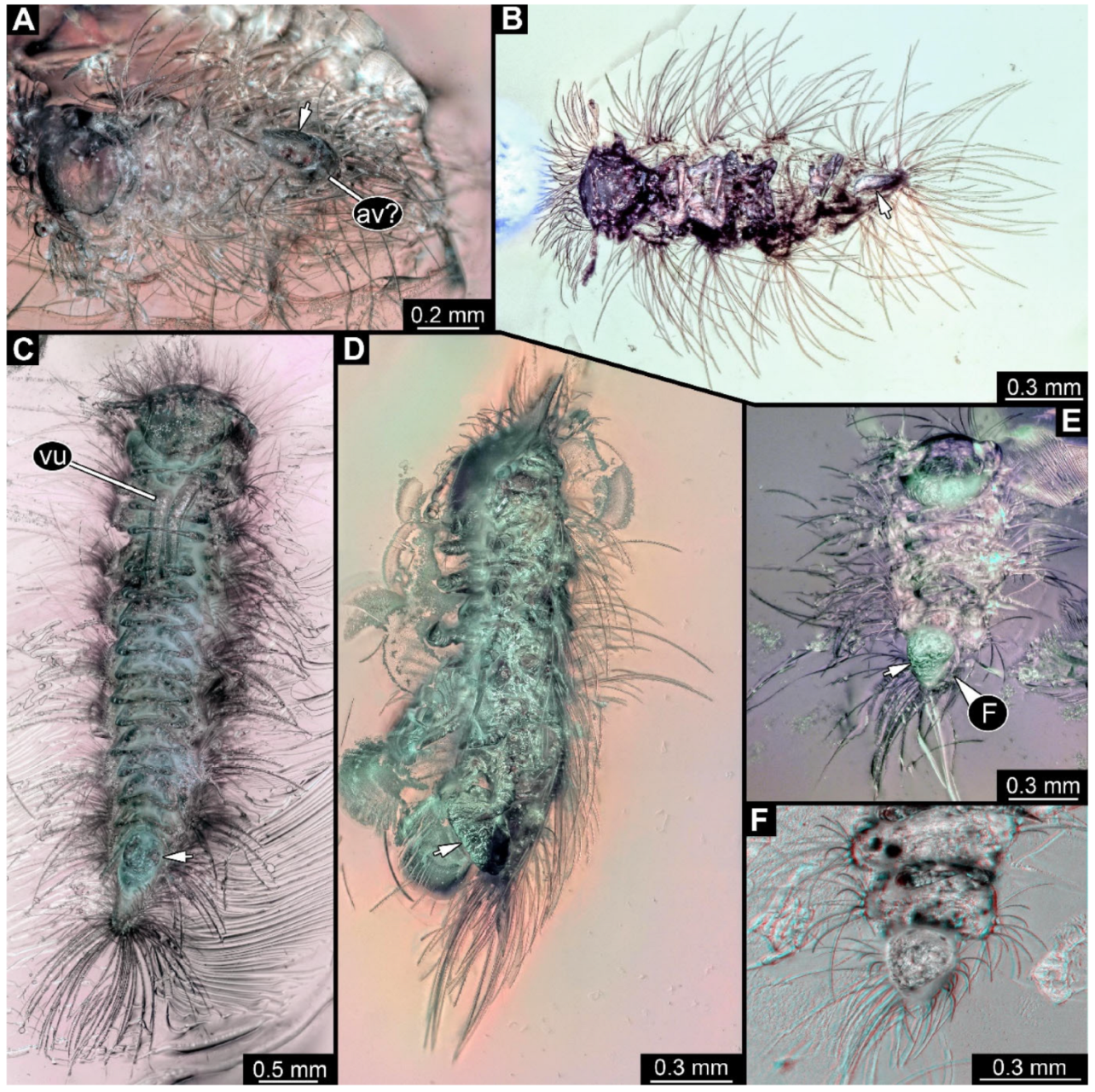
PED 0429 (Figure 20A): Fragmented representative of Polyxenidae, preserved in Kachin amber (~100 mya). The posterior part of the fossil is missing; at least seven lateral bundles are visible, making it an immature of at least stage 7. A piece of black frass is found on the ventral side of the millipede, close to the fragmented posterior part (arrow).
PED 0860 (Figure 20B): Immature representative of Polyxenidae, preserved in Kachin amber (~100 mya). Ten pairs of legs and seven lateral bundles are visible, suggesting that it is an immature of stage 6. The anal valves are closed, but a single piece of black frass is visible in front of them (arrow).
PED 1685 (Figure 20C,D): Immature representative of Polyxenidae, preserved in Kachin amber (~100 mya). Seemingly twelve pairs of legs are visible, suggesting that it is a subadult of stage 7. A piece of frass is visible, pushed through the two anal valves (Figure 20D: arrow).
PED 0285 (Figure 21A,B): Immature representative of Polyxenidae, preserved in Baltic amber (~35 mya). Twelve pairs of legs are visible as well as eight pairs of lateral bundles, making it a subadult of stage 7. Multiple pieces of frass, seemingly three, are visible in front of its terminal end (Figure 21B: arrows).
PED 0697 (Figure 21C,D): Immature representative of Polyxenidae, preserved in Baltic amber (~35 mya). Twelve pairs of legs are visible as well as eight pairs of lateral bundles, making it a subadult of stage 7. A single small piece of frass is located close to the anal valves; the anal valves are closed (Figure 21D: arrow).
PED 0947 (Figure 21E,F): Immature representative of Polyxenidae, preserved in Baltic amber (~35 mya). Seemingly six pairs of legs are visible and five lateral bundles, making it an immature of stage 4. A black elongated piece of frass is visibly protruding from the anus area of the animal (Figure 21F: arrow).
SMF Be 628b (Figure 22A,B): Immature representative of Polyxenidae, preserved in Mexican amber (Chiapas, ~23 mya). Five pairs of legs are visible as well as four lateral bundles, making it an immature of stage 3. Frass protruding between the two anal valves is visible (Figure 22B: arrow).
MB.A.0537 (Figure 22C,D): Adult representative of Polyxenidae, preserved in Baltic amber (~35 mya). Twelve pairs of legs are visible and seemingly eight lateral bundles, making it an immature of stage 7. The two anal valves are opened, and a small amount of frass is visibly protruding (Figure 22D: arrow).
MB.A.0539 (Figure 22E,F): Immature representative of Synxenidae, preserved in Baltic amber (~35 mya). Four pairs of legs are visible, making it an immature of stage 2. Seemingly, a piece of frass is pushed through the anal valves (Figure 22F: arrow).
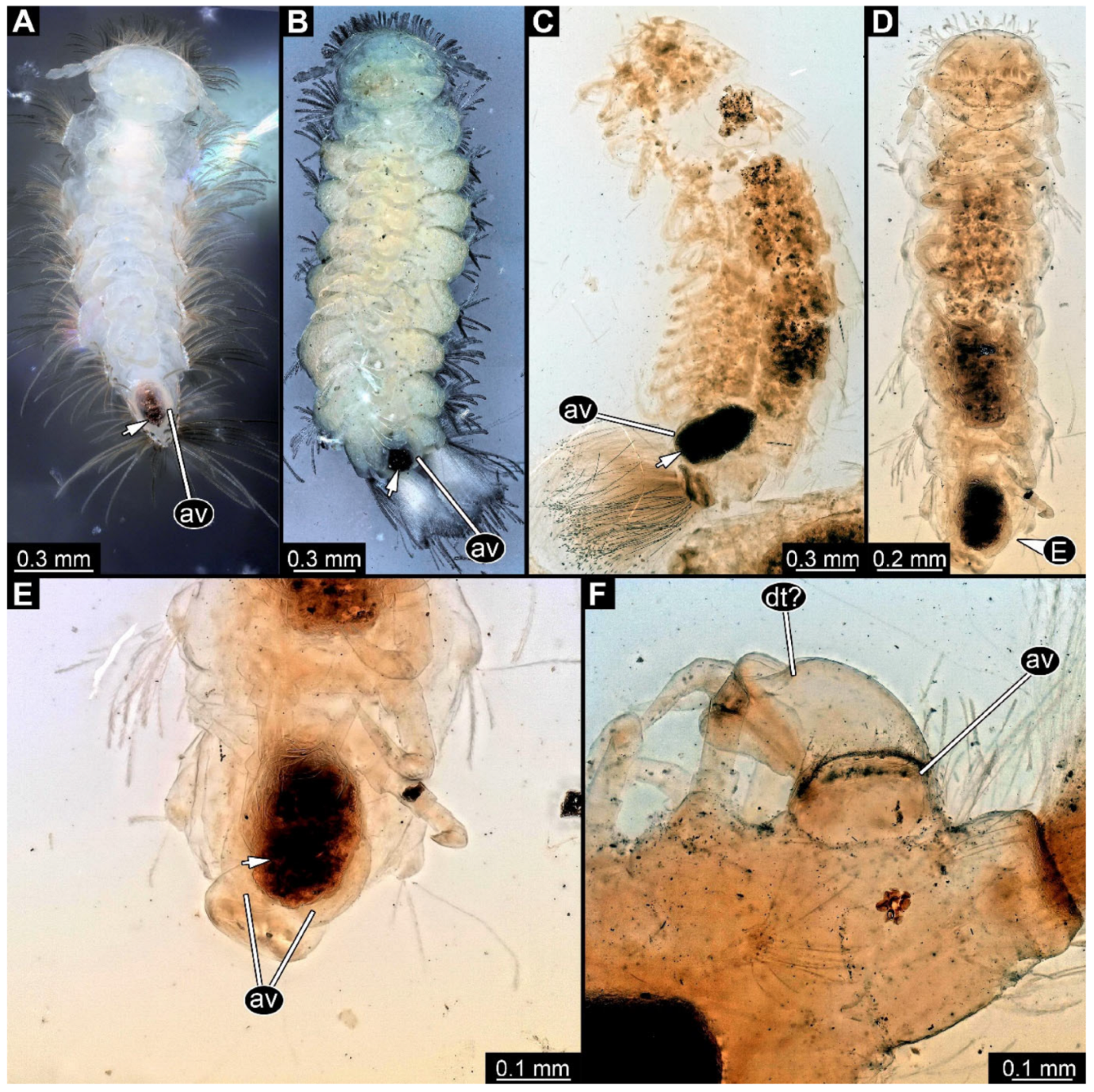
Extant millipedes defecating (Figure 23): Both the slide and EtOH material show frass (black mass), located between the two anal valves (Figure 23A,B,D,E). The bristly millipedes are from different developmental stages: a representative of Phryssonotus novaehollandiae, from stage 5 (Figure 23A); a representative of Polyxenus lagurus, a subadult from stage 7 (Figure 23B); and three representatives of Lophoproctus (Figure 23C–F), where two are seemingly defecating, with supposed frass protruding and being pushed through the anal valves (Figure 23C–E). The last specimen of Lophoproctus has been found with its digestive track seemingly prolapsed (Figure 23F).

4. Discussion

4.1. Fossilized Behaviours in Bristly Millipedes

“Frozen behaviours”, first introduced by Boucot [38] and later described and compiled by Arillo [39], are exceptional types of preservation in ambers that can be investigated. Such findings are revealing clues on the past life of euarthropodans, helping to better understand previous predator–prey interactions [40], plant–insect interactions [41], and reproduction (e.g., copulation [42]; e.g., hatching [43]) or parasitism [44,45].
Within the 44 newly investigated fossils, we investigated seven occurrences of visible aggregation with at least four millipedes preserved together. Although not common, some specimens have been found defecating or at least the millipedes are surrounded by frass. Out of the 50 ambers investigated—previously published, re-examined, or new—49 individuals within 42 different amber pieces have been fossilized in the process of defecating. This adds up to about 10% of all inclusions of polyxenidans available at the PED collection in Munich. In most of these cases, the frass can be directly linked to the specimen as they are located directly at the anal valves or even still in between them.
Surprisingly, the lifestyle of bristly millipedes has remained largely unchanged during the past 100 million years. Already in the Cretaceous period, their current lifestyle was well set. In the amber piece PED 2596 (Figure 2), a single individual of Synxenidae is surrounded by multiple exuviae and frass, close to a piece of bark (Figure 2). Although “frozen behaviours” can potentially be exaggerated and/or modified [39], in the here reported ambers it seems unlikely that the recorded aggregations represent an exaggerated behaviour from encapsulation.

4.2. Gregariousness in Bristly millipedes

Aggregation in bristly millipedes is well known for their modern forms; a population of the extant species Polyxenus lagurus has been reported to reach in certain occasions (during reproduction period) more than 100 individuals/m2 [7]. Previously reported from Kachin amber, relatively large communities of bristly millipedes are quite common (e.g., IN.19123) [46,47] but never reached more than 25 specimens per amber piece. These new findings show that they were already highly gregarious during the Cretaceous, with populations reaching a comparable value in a single amber piece (Figure 1 and Figure S1).
Bristly millipedes are the unique group of millipedes that do not possess a hard calcified exoskeleton. They are also not relying on chemical defence to protect themselves; instead, they are relying on detachable defensive setae [8,24]. In addition to these modified setae, they are adopting a gregarious behaviour presumably for an anti-predatory purpose. Yet, in bristly millipedes this effect has so far not been investigated specifically.
As the number of individuals in a population increases, each single individual is less likely to be preyed on due to predator saturation (or dilution of risk) [48,49]. The benefits of aggregation seem here to be even more accentuated by artificially increasing their effective or seeming number by retaining their moult remains close by (Figure 2, Figure 3, Figure 6, Figure 13 and Figure 19). Moult remains in bristly millipedes may have multiple uses: (1) they are potential decoys (see in Figure 2A,B exuviae covered in frass) and (2) they are also used as “building bricks” for their refuges [50,51]. It also seems that cohabitation between the two ingroups Polyxenidae and Synxenidae is more common than expected. The occurrence of different groups of bristly millipedes in the same habitat (i.e., forest) was already known [4] but rarely in the same community.
Furthermore, aggregation can also provide animals a better microenvironment, for example, reducing water loss as in woodlice [52]. Although predated by them, bristly millipedes are commonly found in the same habitat [1,4,53]. Surprisingly, bristly millipedes are not facing water loss [54]; instead, they are capable of active water vapour absorption [55].
Yet, despite plenty of benefits, aggregation nonetheless has drawbacks. Bristly millipedes are known for relying on microhabitats, with a certain high fidelity to their “roosting area” [1]. Altogether with their high aggregation, it can put the entire community at risk if detected by predators. As seen in the Cretaceous fossils (Figure 1), their high number likely attracted a group of seemingly predatory mites present in the habitat (Figure 1A,B,G), resulting in a specimen captured by one of them (Figure 1B). It is unclear if the mites are actually predating the population of Synxenidae, yet NIGP208860-27 is visibly damaged and missing defensive setae in the trunk area next to the pedipalps of NIGP208860-92 (Figure 1B,C).

4.3. Defecation in Fossil Record of Polyxenida

The quick entrapment within the tree–resin matrix “froze” the specimens, recording their behaviours and even the entire sequence of defecation in Polyxenida (Figure 9). One might mistake the pieces of frass for dirt fragments located in front of the anal valves, surrounding the anus. But a closer look reveals the opened valves and the frass in between them.
Frass can be found at a different distance to the millipedes, either visibly protruding between the two anal valves (Figure 9F), in front of the anal valves, out of the anal valves, or located further from them. Some frass has been seemingly expelled but yet stayed close to the animals (e.g., Figure 12D,E or Figure 17E,F); this can partly be from the low-viscosity properties of the resin limiting the “detachment” of frass from the animal during the encapsulation.
Reports of “frozen defecation” in amber are not entirely new [39,56]. A large number of pieces of frass, including different types and shapes, have been reported in Baltic amber [57]. Yet, in these cases the frass could not be linked to the animal which might have produced them. Frass that could be linked back to their producer has been reported in dictyopterans, i.e., cockroaches including termites (i.e., termite community, [58]; cockroach, [59]). Regarding Polyxenida, these new fossils show that bristly millipedes are also commonly found fossilized while defecating. The elongated shape of polyxenidan frass is similar in some aspects to frass produced by termites, which questions the reliability of using frass to infer taxonomic identities of the producers on different levels (“family” or “genera”) [57]. The shapes of frass used as a character to identify groups of insects, as suggested by Nuorteva & Kinnunen [57], would not be supported by these findings. The high similarities between frass from bristly millipedes and termites are visibly testifying that the shape likely relates to the lifestyle of the euarthropodan producer (here lifestyle along trees).
Although bristly millipedes are commonly found and were reported from different amber outcrops, so far, such behaviour (i.e., defecation) was never highlighted. More surprising, after reviewing the previous literature, we could identify six additional specimens in which frass is surrounding the terminal end of the animals (Table S1). However, for one instance it needs to be directly checked: the holotype of Phryssonotus burmiticus Cockerell, 1917 (BMNH In.19122) [22]; a mass seems to be present in front of the anus. These previously described specimens are showing similar stages of defecation as seen here: frass in front of the anal valve [17,18] (their figure 1B p. 217; their figure 5B p. 7), multiple defecation [18] (their figure 6B p. 8), or frass in between the anal valves [17] (their figures 2B,D p. 218 and 5B p. 221).
The preservation of defecation behaviour in amber has been present since at least the Cretaceous period and then persisted through the Eocene. This is an even more common behaviour as it is shared by both immatures and adults from the two main ingroups Polyxenidae and Synxenidae. Nonetheless, our findings are not only limited to fossil specimens as extant defecating bristly millipedes in historical collections have been found (Figure 23). It seems that museum collections (and other historical collections) such as the Verhoeff collection (ZSM, Munich, Germany) can offer more understanding on the defecation mechanism in extant polyxenidans. Even though collected, sacrificed, glass-mounted, or EtOH-conserved around 1940, these specimens are displaying the same defecating process (Figure 23C–F).

4.4. Functions of Defecation

Most living animals do defecate, and this sole action can be considered as a rather simple and obligate behaviour for waste elimination. Yet, defecation behaviours in arthropodans can be more than this [60]. Such finds (i.e., frass and coprolites) should not be disregarded as waste; these “artifacts” are exceptional material to better understand the past life of animals, offering details on their food resource (e.g., pollen in cockroach faeces) [59], predators [61], and parasites [62].
In the case of Polyxenida, two distinct uses of defecation seem to be observable: (1) one passive use by keeping their “wastes” in their environment, surrounding their population as well as their exuviae (e.g., Figure 2A), and (2) a more “active” use, where frass is close to the terminal end. Yet, as previously mentioned, euarthropodans preserved while defecating have already been recorded; however, attributing the defecation process to a directed/targeted behaviour has to be precautious as it can be exaggerated [39] or it can be a postmortem action, without any link to a mechanism aimed against predators or resulting from stress.
Defecation due to a high amount of stress is well known in euarthropodans [63]. In the investigated fossil record, at least two fossils have been found with at least three pieces of frass close to their anal end (Figure 21A,B) [18] (their figure 6B). These two occurrences seemingly testify to the high stress that these animals have experienced during their encapsulation. Additionally, most of the reports are specimens in the process of defecating, which thus likely happened after the start of the encapsulation.
Within Myriapoda, adaptation of the defecation behaviour has been remarked on in the past. For the ingroup of Spirobolida, after egg-laying, the eggs can be covered by faecal material and is therefore camouflaged as frass [64]. Defecation is also a limitation in euarthropodans as it can lead to water loss; yet, in millipedes, adaptations to the hindgut and malpighian tubes help in the reabsorption of water before the full expulsion of frass [65]. Other euarthropodans are seemingly showing “frass-keeping”; in lepidopteran, larvae in times of reduced water availability will substantially reabsorb water from faeces (i.e., rectal complex) [66]. In bristly millipedes a similar complex is found, retaining water from dehydrating faeces [55]. Occurrences of frass visibly in between the anal valves would support potential water-retaining from frass (e.g., Figure 11A–D and Figure 22). However, for the cases of frass fully expelled but “kept” close to the anal end, it is not clear and supported.
As revealed here, we did not only find millipedes defecating but also high densities of frass in their habitat (e.g., Figure 2, Figure 12, and Figure 13). This is surprising as usually euarthropodans tend to distance themselves from their body waste [60,63,67]. The main drivers behind this distancing behaviour are multiple: limiting the spread of disease from the presence of frass, limiting the spread of parasites, and also limiting the attraction of predators due to chemical cues [63]. Yet, despite the downsides, living among their own frass is not harmful and may even be beneficial in certain cases. Keeping frass in communities of immatures and adults is a great way to share symbiotic microbiota via coprophagy, required for feeding and resource processing (e.g., hindgut fermentation) [68,69], or simply allows for a second digestion (i.e., external rumen) [63,70]. Although hypothetical and not further investigated here, it seems plausible that this high density of frass in their habitats has potential upsides.
Although a single find in amber, two exuviae were covered by frass (Figure 2A,B). Similar behaviour was investigated in the group of aphids that keep their exuviae and frass (i.e., “lack of house-cleaning”) to act as decoys against the parasitoid wasps Aphidius rhopalosiphi de Stefani-Perez, 1902 [71]. Gall midges, i.e., Lestodiplosis vasta Möhn, 1955 [72], are known ectoparasites of Polyxenus lagurus [72,73]. They rely on chemical cues to select sites of oviposition [74] and would be potentially misled to attack exuviae.

5. Conclusions

Reports of past lifestyles are scarce, and due to the bias from resin entrapment, it is difficult to draw conclusions with certainty. Despite the lack of studies, it has been suggested that representatives of Polyxenida used to live the same way as their extant counterparts. With our observations we finally bring more information that can support it: indeed, bristly millipedes did have a similar lifestyle, and visibly for the past 100 million years. Fossil polyxenidans, already in the Cretaceous, used to live in groups that cover the almost complete ontogenesis, surrounded by exuviae and dozens of pieces of frass. This particular lifestyle, although 100 million years old, is similar to the lifestyle in extant communities. This study not only strongly supports that bristly millipedes have lived the same way since the Cretaceous period but also provides new details on their life, especially their putative response to stress. This aggregation, likely for defensive purposes, is completed by the surprising close association of these millipedes with their own exuviae and frass. As shown here, bristly millipedes have been highly gregarious, and faithful to small habitats (i.e., refuge); they have likely developed behavioural adaptations to possibly increase their survival.
It seems here that defecation under stress is common in fossils of bristly millipedes. Visibly, after experiencing a certain amount of stress, these elusive millipedes do defecate and possibly used it as deterrent (e.g., predatory pseudoscorpion in Kachin amber). However, to date, no such reports on their extant congeners have been made. It is expected that the number of bristly millipedes in the process of defecation preserved in museum collections is high, with many such specimens remaining unstudied or the defecation overlooked and unpublished.
Bristly millipedes have been evolutionarily successful, undergoing little morphological change over hundreds of million years. The exceptional preservation as well as the high number of fossils not only revealed their past lifestyle but also offered hints on their extant life. The defensive function of the defecation seems to not be the only explanation as it can signal the presence of these bristly millipedes. The high amount of frass in the environment probably has an additional function that the millipedes could benefit from, but it would need further investigation.

Supplementary Materials

The following supporting information can be downloaded at https://www.mdpi.com/article/10.3390/arthropoda3040017/s1, Figure S1: Overview of NIGP208860, Kachin amber (~100 mya); numbers refer to the millipede-like specimens within the amber; Table S1: List of fossils and extant bristly millipedes investigated in this publication, including new and previous specimens from the literature; Table S2: Information on the specimens in NIGP208860, including their developmental stage. Specimens found defecating are also noted. Abbreviations: (?) refers to unclear findings; frag = fragmented.

Author Contributions

Conceptualization, J.L.C. and J.T.H.; methodology, J.L.C., D.H., P.M., C.H. and J.T.H.; investigation, J.L.C., D.H., P.M. and J.T.H.; resources, J.T.H., P.M. and D.H.; writing—original draft preparation, J.L.C., D.H., C.H. and J.T.H.; writing—review and editing, J.L.C., D.H., P.M., C.H. and J.T.H.; visualization, J.L.C. and J.T.H.; supervision, J.T.H. All authors have read and agreed to the published version of the manuscript.

Funding

D.H. thanks the National Key Research and Development Program of China (2024YFF0807601) and the National Science Foundation of China (42288201) for their support. JTH received support by the Volkswagen Foundation via a Lichtenberg Professorship. The authors thank the German Research foundation (DFG) for funding this project (project 516824140, HA 6300/10-1).

Institutional Review Board Statement

Not applicable.

Data Availability Statement

The original contributions presented in this study are included in the article/Supplementary Material; high-resolution images are also available on Zenodo, doi: https://doi.org/10.5281/zenodo.17877349.

Acknowledgments

We would like to thank Megan Short and Cuong Huynh for their time discussing this intriguing behaviour. Certain reports of potential defecations could not have been made without the help of Andrew Ross and Richie Howard (access to high res. images of BMNH IN.19122). Furthermore, we address our thanks to Ulrich Kotthoff for the access to the Hamburg fossil material and Danilo Harms for the access to the extant material in Hamburg. We also thank David Ware and Emily Eybing for their welcoming and for the access to the Berlin fossil material and historical collection of Koch & Berendt from 1854. JLC thanks the Graduate School Life Science Munich (LSM) for their continuous support. We are grateful to the three anonymous reviewers that thoroughly reviewed our manuscript.

Conflicts of Interest

The authors declare that there are no conflicts of interest.

References

  1. Manton, S.M. The Evolution of Arthropodan Locomotory Mechanisms.—Part 5. The Structure, Habits and Evolution of Pselaphognatha (Diplopoda). Zool. J. Linn. Soc. 1957, 43, 153–187. [Google Scholar] [CrossRef]
  2. Karasawa, S.; Kawano, K.; Fukaya, S.; Tsurusaki, N. Upgrading of Three Subspecies of Eudigraphis takakuwai to the Species Rank (Diplopoda: Penicillata: Polyxenida: Polyxenidae). Species Divers. 2020, 25, 89–102. [Google Scholar] [CrossRef]
  3. Shaw, H.K.A. Additions to the Wild Fauna and Flora of the Royal Botanic Gardens, Kew: XXIV. Kew Bull. 1961, 15, 169–191. [Google Scholar] [CrossRef]
  4. Ebejer, K.A.; Schembri, P.J. Polyxenid Millipede (Diplopoda, Polyxenida) Associated with Empty Snail Shells. Cent. Mediterr. Nat. 2001, 3, 97–100. [Google Scholar]
  5. Short, M.; Vahtera, V. Phylogenetic Relationships of Millipedes in the Subclass Penicillata (Diplopoda) with a Key to the Genera. J. Nat. Hist. 2017, 51, 2443–2461. [Google Scholar] [CrossRef]
  6. Nguyen Duy-Jacquemin, M. Condexenus, a New Genus of the Millipede Family Synxenidae (Diplopoda, Polyxenida) from Namibia. Nor. J. Entomol. 2006, 53, 105–124. [Google Scholar]
  7. David, J.-F. Seasonal Abundance of Millipedes in a Mediterranean Oak Forest (Southern France). Isr. J. Zool. 1995, 41, 23–31. [Google Scholar]
  8. Makarov, S.E. Diplopoda—Integument. In Treatise on Zoology-Anatomy, Taxonomy, Biology. The Myriapoda; Brill: Leiden, The Netherlands, 2015; Volume 2, pp. 69–99. ISBN 978-90-04-18827-3. [Google Scholar]
  9. Le Cadre, J. (Ludwig-Maximilians-Universität, München, Germany); Perkovsky, E.E. (Natural History Museum of Denmark, Copenhagen, Denmark; I.I. Schmalhausen Institute of Zoology, National Academy of Sciences of Ukraine, Ukraine). Discussion via email, Personal communication, 2025.
  10. Solórzano Kraemer, M.M.; Delclòs, X.; Clapham, M.E.; Arillo, A.; Peris, D.; Jäger, P.; Stebner, F.; Peñalver, E. Arthropods in Modern Resins Reveal If Amber Accurately Recorded Forest Arthropod Communities. Proc. Natl. Acad. Sci. USA 2018, 115, 6739–6744. [Google Scholar] [CrossRef] [PubMed]
  11. Santiago-Blay, J.A.; Poinar, G.O. Millipeds from Dominican Amber, with the Description of Two New Species (Diplopoda: Siphonophoridae) of Siphonophora. Ann. Entomol. Soc. Am. 1992, 85, 363–369. [Google Scholar] [CrossRef]
  12. Álvarez-Rodríguez, M.; Riquelme, F.; Hernández-Patricio, M.; Cupul-Magaña, F. Diplopoda in the World Fossil Record. Zool. Syst. 2024, 49, 185–245. [Google Scholar] [CrossRef]
  13. Haug, J.T.; Haug, C.; Neumann, C.; Sombke, A.; Hörnig, M.K. Early Post-Embryonic Polyxenidan Millipedes from Saxonian Amber (Eocene). Bull. Geosci. 2013, 93, 1–11. [Google Scholar] [CrossRef]
  14. Koch, C.L.; Berendt, G.C. Die im Bernstein befindlichen Crustaceen, Myriapoden, Arachniden und Apteren der Vorwelt. In Die in Bernstein Befindlichen Organischen Reste der Vorwelt; Berendt, G.C., Ed.; Nicolaischen Buchhandlung: Berlin, Germany, 1854; pp. 1–124. [Google Scholar]
  15. Le Cadre, J.; Gauweiler, J.; Haug, J.T.; Arce, S.I.; Baranov, V.; Hammel, J.U.; Haug, C.; Kaulfuss, U.; Kiesmüller, C.; McKellar, R.C.; et al. New Amber Fossils Indicate That Larvae of Dermestidae Had Longer Defensive Structures in the Past. Insects 2025, 16, 710. [Google Scholar] [CrossRef] [PubMed]
  16. Ross, A.J. Complete Checklist of Burmese (Myanmar) Amber Taxa 2023. Mesozoic 2024, 1, 21–57. [Google Scholar] [CrossRef]
  17. Su, Y.; Cai, C.; Huang, D. Revision of Phryssonotus burmiticus (Diplopoda, Polyxenida, Synxenidae) in Mid-Cretaceous Amber from Myanmar. Cretac. Res. 2019, 93, 216–224. [Google Scholar] [CrossRef]
  18. Su, Y.; Cai, C.; Huang, D. Two New Species of the Bristle Millipede Genus Pauropsxenus (Diplopoda, Polyxenidae) in Mid-Cretaceous Burmese Amber. Cretac. Res. 2020, 111, 104427. [Google Scholar] [CrossRef]
  19. Nguyen Duy-Jacquemin, M.; Azar, D. The Oldest Records of Polyxenida (Myriapoda, Diplopoda): New Discoveries from the Cretaceous Ambers of Lebanon and France. Geodiversitas 2004, 26, 631–641. [Google Scholar]
  20. Iniesta, L.F.M.; Oliveira, E.C.; Paranhos, C.T.; Bassini-Silva, R.; Bouzan, R.S.; Jacinavicius, F.C. First Report of Polyxenidae (Diplopoda: Polyxenida) as a Host for Charletonia rocciai Treat & Flechtmann, 1979 (Trombidiformes: Erythraeidae) in Brazil. Entomol. Commun. 2024, 6, ec06007. [Google Scholar] [CrossRef]
  21. Penney, D.; Green, D.I. Fossils in Amber: Remarkable Snapshots of Prehistoric Forest Life; Siri Scientific Press: Rochdale, UK, 2011; ISBN 978-0-9558636-6-0. [Google Scholar]
  22. Rasnitsyn, A.P.; Golovatch, S.I. The Identity of Phryssonotus burmiticus (Cockerell, 1917) (Diplopoda, Polyxenida, Synxenidae) in Cretaceous Amber from Myanmar. J. Syst. Palaeontol. 2004, 2, 153–157. [Google Scholar] [CrossRef]
  23. Haug, J.T.; Müller, C.H.G.; Sombke, A. A Centipede Nymph in Baltic Amber and a New Approach to Document Amber Fossils. Org. Divers. Evol. 2013, 13, 425–432. [Google Scholar] [CrossRef]
  24. Eisner, T.; Eisener, M.; Deyrup, M. Millipede Defense: Use of Detachable Bristles to Entangle Ants. Proc. Natl. Acad. Sci. USA 1996, 93, 10848–10851. [Google Scholar] [CrossRef]
  25. Fordyce, J.A.; Agrawal, A.A. The Role of Plant Trichomes and Caterpillar Group Size on Growth and Defence of the Pipevine Swallowtail Battus philenor. J. Anim. Ecol. 2001, 70, 997–1005. [Google Scholar] [CrossRef]
  26. Brölemann, W. Macroxenus, Nouveau Genre de Myriapodes Psélaphognathes. Bull. Soc. Hist. Nat. Afr. Nord. 1917, 8, 114–118. [Google Scholar]
  27. Brölemann, W. Biospeologica. XVII. Symphyles, Pselaphognathes, Polydesmoides et Lysiopetaloides (Myriapodes). Arch. Zool. Exp. Gen. 1910, 5, 339–378. [Google Scholar]
  28. Strainforth, T. The Bristly Millipede in East Yorkshire. In The Naturalist: A Monthly Journal of Natural History for the North of England; West-Riding Consolidated Naturalists’ Society, Yorkshire Naturalists’ Union, Eds.; Simpkin & Marshall: London, UK, 1916; pp. 181–182. [Google Scholar]
  29. Pocock, R.I. Res Ligusticae. XXI. Contributions to Our Knowledge of the Diplopoda of Liguria. Ann. Mus. Genova 1894, 34, 505–523. [Google Scholar]
  30. Chalande, J. Les Pollyxenidae de France; Revision Du Genre Pollyxenus. Bull. Soc. Hist. Nat. Toulouse 1888, 22, 86–90. [Google Scholar]
  31. Chalande, J. Collections Recueillies Par M. Maurice de Rothschild Dans l’Afrique Orientale. Description d’une Nouvelle Espèce de Myriapodes Du. Genre Pollyxenus. Bull. Mus. Natl. Hist. Nat. 1908, 14, 113–115. [Google Scholar]
  32. Short, M.; Vahtera, V.; Wesener, T.; Golovatch, S.I. The Millipede Family Polyxenidae (Diplopoda, Polyxenida) in the Faunas of the Crimean Peninsula and Caucasus, with Notes on Other European Polyxenidae. Zootaxa 2020, 4772, 306–332. [Google Scholar] [CrossRef]
  33. Condé, B. Développement Postembryonnaire Compare Des Pénicillates (Myriapodes). Bull. Mus. Natl. Hist. Nat. 1962, 34, 247–254. [Google Scholar]
  34. Rayfield, E.J.; Theodor, J.M.; Polly, P.D. Fossils from Conflict Zones and Reproducibility of Fossil-Based Scientific Data; Society of Vertebrate Paleontology: Abington, UK, 2020. [Google Scholar]
  35. Poinar, G.; Ellenberger, S. Burmese Amber Fossils, Mining, Sales and Profits. Geoconserv. Res. 2020, 3, 12–16. [Google Scholar] [CrossRef]
  36. Haug, J.T.; Azar, D.; Ross, A.; Szwedo, J.; Wang, B.; Arillo, A.; Baranov, V.; Bechteler, J.; Beutel, R.; Blagoderov, V.; et al. Comment on the letter of the Society of Vertebrate Palaeontology (SVP) dated April 21, 2020 regarding “Fossils from conflict zones and reproducibility of fossil-based scientific data”: Myanmar amber. PalZ 2020, 94, 431–437. [Google Scholar] [CrossRef]
  37. Szwedo, J.; Wang, B.; Soszyńska-Maj, A.; Azar, D.; Ross, A.J. International Palaeoentomological Society Statement. Palaeoentomology 2020, 3, 221–222. [Google Scholar] [CrossRef]
  38. Boucot, A.J. Evolutionary Paleobiology of Behavior and Coevolution; Elsevier: Amsterdam, The Netherlands, 1990; ISBN 978-1-4832-9081-2. [Google Scholar]
  39. Arillo, A. Paleoethology: Fossilized Behaviours in Amber. Geol. Acta 2007, 5, 159–166. [Google Scholar] [CrossRef]
  40. Kiesmüller, C.; Haug, J.T.; Müller, P.; Hörnig, M.K. A Case of Frozen Behaviour: A Flat Wasp Female with a Beetle Larva in Its Grasp in 100-Million-Year-Old Amber. Foss. Rec. 2022, 25, 287–305. [Google Scholar] [CrossRef]
  41. Pérez-de la Fuente, R.; Delclòs, X.; Peñalver, E.; Engel, M.S. A Defensive Behavior and Plant-Insect Interaction in Early Cretaceous Amber—The Case of the Immature Lacewing Hallucinochrysa diogenesi. Arthropod Struct. Dev. 2016, 45, 133–139. [Google Scholar] [CrossRef]
  42. Klimov, P.B.; Sidorchuk, E.A. An Enigmatic Lineage of Mites from Baltic Amber Shows a Unique, Possibly Female-Controlled, Mating. Biol. J. Linn. Soc. 2011, 102, 661–668. [Google Scholar] [CrossRef]
  43. Hörnig, M.K.; Fischer, T.C.; Haug, J.T. Caught in the Act of Hatching—A Group of Heteropteran Nymphs Escaping from Their Eggs Preserved in Dominican Amber. Paleodiversity 2019, 12, 123–134. [Google Scholar] [CrossRef]
  44. Poinar, G. Evidence of Parasitism by Strepsiptera in Dominican Amber. BioControl 2004, 49, 239–244. [Google Scholar] [CrossRef]
  45. Arillo, A.; Blagoderov, V.; Peñalver, E. Early Cretaceous Parasitism in Amber: A New Species of Burmazelmira Fly (Diptera: Archizelmiridae) Parasitized by a Leptus sp. Mite (Acari, Erythraeidae). Cretac. Res. 2018, 86, 24–32. [Google Scholar] [CrossRef]
  46. Rasnitsyn, A.; Ross, A. A Preliminary List of Arthropod Families Present in the Burmese Amber Collection at The Natural History Museum, London. Bull. Nat. Hist. Mus. Lond. 2000, 56, 21–24. [Google Scholar]
  47. Grimaldi, D.A.; Engel, M.S.; Nascimbene, P.C. Fossiliferous Cretaceous Amber from Myanmar (Burma): Its Rediscovery, Biotic Diversity, and Paleontological Significance. Am. Mus. Novit. 2002, 2002, 1–71. [Google Scholar] [CrossRef]
  48. Hamilton, W.D. Geometry for the Selfish Herd. J. Theor. Biol. 1971, 31, 295–311. [Google Scholar] [CrossRef]
  49. Lehtonen, J.; Jaatinen, K. Safety in Numbers: The Dilution Effect and Other Drivers of Group Life in the Face of Danger. Behav. Ecol. Sociobiol. 2016, 70, 449–458. [Google Scholar] [CrossRef]
  50. Le Cadre, J. (Ludwig-Maximilians-Universität, München, Germany). Natural observation, Personal observation, 2025.
  51. Le Cadre, J. (Ludwig-Maximilians-Universität, München, Germany); Huynh, C. (School of Life and Environmental Sciences, Deakin University, Burwood, Victoria, Australia). Discussion via email, Personal communication, 2024.
  52. Broly, P.; Deneubourg, J.-L.; Devigne, C. Benefits of Aggregation in Woodlice: A Factor in the Terrestrialization Process? Insectes Soc. 2013, 60, 419–435. [Google Scholar] [CrossRef]
  53. Lopes Ferreira, R.; Souz Silva, M. Biodiversity under Rocks: The Role of Microhabitats in Structuring Invertebrate Communities in Brazilian Outcrops. Biodivers. Conserv. 2001, 10, 1171–1183. [Google Scholar] [CrossRef]
  54. Eisenbeis, G.; Wichard, W. Atlas on the Biology of Soil Arthropods; Springer Science & Business Media: Berlin/Heidelberg, Germany, 2012; ISBN 978-3-642-72634-7. [Google Scholar]
  55. Wright, J.C.; Westh, P. Water Vapour Absorption in the Penicillate Millipede Polyxenus lagurus (Diplopoda: Penicillata: Polyxenida): Microcalorimetric Analysis of Uptake Kinetics. J. Exp. Biol. 2006, 209, 2486–2494. [Google Scholar] [CrossRef] [PubMed]
  56. Poinar, G., Jr. Trace Fossils in Amber: A New Dimension for the Ichnologist. Ichnos 1998, 6, 47–52. [Google Scholar] [CrossRef]
  57. Nuorteva, M.; Kinnunen, K.A. Insect Frass in Baltic Amber. Bull. Geol. Soc. Finl. 2008, 80, 105–124. [Google Scholar] [CrossRef]
  58. Zhao, Z.; Yin, X.; Shih, C.; Gao, T.; Ren, D. Termite Colonies from Mid-Cretaceous Myanmar Demonstrate Their Early Eusocial Lifestyle in Damp Wood. Natl. Sci. Rev. 2020, 7, 381–390. [Google Scholar] [CrossRef]
  59. Hinkelman, J.; Vršanská, L. A Myanmar Amber Cockroach with Protruding Feces Contains Pollen and a Rich Microcenosis. Sci. Nat. 2020, 107, 13. [Google Scholar] [CrossRef]
  60. Cole, M.E.; Ceja-Navarro, J.A.; Mikaelyan, A. The Power of Poop: Defecation Behaviors and Social Hygiene in Insects. PLoS Pathog. 2021, 17, e1009964. [Google Scholar] [CrossRef]
  61. Qvarnström, M.; Wernström, J.V.; Piechowski, R.; Tałanda, M.; Ahlberg, P.E.; Niedźwiedzki, G. Beetle-Bearing Coprolites Possibly Reveal the Diet of a Late Triassic Dinosauriform. R. Soc. Open Sci. 2019, 6, 181042. [Google Scholar] [CrossRef]
  62. De Baets, K.; Huntley, J.W.; Klompmaker, A.A.; Schiffbauer, J.D.; Muscente, A.D. The Fossil Record of Parasitism: Its Extent and Taphonomic Constraints. In The Evolution and Fossil Record of Parasitism: Coevolution and Paleoparasitological Techniques; De Baets, K., Huntley, J.W., Eds.; Springer International Publishing: Cham, Switzerland, 2021; pp. 1–50. ISBN 978-3-030-52233-9. [Google Scholar]
  63. Weiss, M.R. Defecation Behavior and Ecology of Insects. Annu. Rev. Entomol. 2006, 51, 635–661. [Google Scholar] [CrossRef] [PubMed]
  64. Shear, W. Millipeds. Am. Sci. 1999, 87, 232. [Google Scholar] [CrossRef]
  65. Stewart, T.C.; Woodring, J.P. Anatomical and Physiological Studies of Water Balance in the Millipedes Pachydesmus crassicutis (Polydesmida) and Orthoporus texicolens (Spirobolida). Comp. Biochem. Physiol. A 1973, 44, 735–750. [Google Scholar] [CrossRef]
  66. Reynolds, S.E.; Bellward, K. Water Balance in Manduca Sexta Caterpillars: Water Recycling from the Rectum. J. Exp. Biol. 1989, 141, 33–45. [Google Scholar] [CrossRef]
  67. Weiss, M.R. Good Housekeeping: Why Do Shelter-Dwelling Caterpillars Fling Their Frass? Ecol. Lett. 2003, 6, 361–370. [Google Scholar] [CrossRef]
  68. Nalepa, C.A.; Bignell, D.E.; Bandi, C. Detritivory, Coprophagy, and the Evolution of Digestive Mutualisms in Dictyoptera. Insectes Soc. 2001, 48, 194–201. [Google Scholar] [CrossRef]
  69. Nalepa, C.A. Origin of Mutualism Between Termites and Flagellated Gut Protists: Transition from Horizontal to Vertical Transmission. Front. Ecol. Evol. 2020, 8, 14. [Google Scholar] [CrossRef]
  70. Louzada, J.; Nichols, E.S. Detritivorous Insects. In Insect Bioecology and Nutrition for Integrated Pest Management; CRC Press: Boca Raton, FL, USA, 2012; ISBN 978-0-429-15108-8. [Google Scholar]
  71. Muratori, F.B.; Damiens, D.; Hance, T.; Boivin, G. Bad Housekeeping: Why Do Aphids Leave Their Exuviae inside the Colony? BMC Evol. Biol. 2008, 8, 338. [Google Scholar] [CrossRef]
  72. Möhn, E. Neue zoophage Gallmücken-Gattungen (Diptera: Itonididae). Beitr. Entomol. Contrib. Entomol. 1955, 5, 415–425. [Google Scholar] [CrossRef]
  73. Enghoff, H. Morphological Comparison of Bisexual and Parthenogenetic Polyxenus lagurus (Linne, 1758) (Diplopoda, Polyxenidae) in Denmark and Southern Sweden, with Notes on Taxonomy Distribution and Ecology. Entomol. Medd. 1976, 44, 161–182. [Google Scholar]
  74. Hall, D.R.; Amarawardana, L.; Cross, J.V.; Francke, W.; Boddum, T.; Hillbur, Y. The Chemical Ecology of Cecidomyiid Midges (Diptera: Cecidomyiidae). J. Chem. Ecol. 2012, 38, 2–22. [Google Scholar] [CrossRef] [PubMed]
Figure 1. A 100-million-year-old community of 87 specimens of Synxenidae in Kachin amber (NIGP208860). (A) Overview of the amber. (B) Two individuals of Synxenidae with a mite (NIGP208860-92) attached to NIGP208860-27. (C) Mouthparts of NIGP208860-92. (D) Five individuals of Synxenidae (NIGP208860-46, 69–71, 83) of different developmental stages with frass close by. (E) NIGP208860-81; immature of stage 1. (F) NIGP208860-58, NIGP208860-61, and NIGP208860-62 with frass close by (arrows). (G) NIGP208860-90–91, in ventral view. Abbreviations: numbers refer to specimen number in this amber piece (see Supplementary Figure S1); arrows refer to frass.
Arthropoda 03 00017 g001
Figure 2. A 100-million-year-old community of Synxenidae in Kachin amber. (A) Overview of the amber PED 2596. (B) Close-up view of the frass around the exuvia. (C) Wood bark with frass around. (D) PED 2596-1 in ventral view; unknown developmental stage. Abbreviations: e1–e4 = exuviae 1–4; arrows refer to pieces of frass.
Arthropoda 03 00017 g002
Figure 3. A 100-million-year-old community of Synxenidae and Polyxenidae in Kachin amber. (A) Overview of the amber PED 3238; numbers refer to the specimen number in this amber piece. (B) PED 3238-5 in dorsal view; immature of Polyxenidae of stage 6. (C) PED 3238-8; exuvia of Synxenidae. (D) PED 3238-2 in ventral view; immature of Synxenidae of stage 2. (E) PED 3238-7; fragmented remains of Synxenidae. Abbreviation: e1 = exuvia 1.
Arthropoda 03 00017 g003
Figure 4. A 100-million-year-old community of eleven specimens of Synxenidae in Kachin amber. (A) Overview of the amber PED 1488; numbers refer to the specimen number in this amber piece. (B) PED 1488-1 in ventral view; immature of stage 5. (C) PED 1488-3 in ventral view; immature of stage 8. (D) PED 1488-11 in ventral view; immature of stage 8. (E) PED 1488-4 in dorsal view; immature of stage 7. (F) PED 1488-5 in lateral view; immature of stage 7. Abbreviations: av = anal valves; te = terminal end; arrows refer to pieces of frass.
Arthropoda 03 00017 g004
Figure 5. A 100-million-year-old community of Synxenidae, preserved in the Kachin amber PED 2755. (A) Overview of the amber piece; numbers refer to the specimen numbers. (B) PED 2755-5 in lateral view; poorly preserved individual. (C) PED 2755-3 in lateral view; immature with a preserved frass close by (arrow). (D,E) PED 2755-1 terminal end. (D) PED 2755-1 in ventral view; immature of unknown developmental stage. (E) Close-up of the terminal end with a frass (arrow).
Arthropoda 03 00017 g005
Figure 6. A 100-million-year-old community of ten individuals of Synxenidae, preserved in Kachin amber PED 2885. (A) Overview of the amber piece; numbers refer to the numbers of specimens. (B) PED 2885-2 in ventro-lateral view; immature female of stage 9. (C) Close-up view of PED 2885-2 terminal end with a frass piece (arrow). (D) PED 2885-1 in dorsal view; immature of stage 1–2. (E) PED 2885-6; exuvia of Synxenidae. Abbreviation: vu = vulval sacs.
Arthropoda 03 00017 g006
Figure 7. A 100-million-year-old community of five representatives of Synxenidae, preserved in Kachin amber (PED 3328). (A) Overview of the amber piece; numbers refer to the numbers of the specimens. (B) PED 3328-1 in dorsal view; fragmented seemingly immature of at least stage 9. (C) PED 3328-2 in ventral view; immature of seemingly stage 5 with frass in front of the anal valves (arrow). (D) PED 3328-4 in dorsal view; adult female of stage 10 with PED 3328-3 in ventro-lateral view, and immature of unknown stage with frass close by (arrow).
Arthropoda 03 00017 g007
Figure 8. A 100-million-year-old community of Synxenidae, in Kachin amber (PED 2439). (A) Overview of the amber piece; numbers refer to the number of specimens. (B) PED 2439-1 in ventro-lateral view; immature of stage 6 with frass around it (arrow). (C) Close-up of multiple pieces of frass. (D) PED 2439-2 in lateral view; fragmented immature of seemingly stage 6. (E) PED 2439-3 in ventral view; curled specimens of unknown stage.
Arthropoda 03 00017 g008
Figure 9. The different phases of defecation in Synxenidae and Polyxenidae. (A,B) PED 0787, Baltic amber, Synxenidae. (A) Immature of stage 3 in ventral view, with anal valves closed. (B) Close-up of the terminal end. (C,D) PED 0786, Baltic amber, Synxenidae. (C) Immature of stage 4 in ventral view, with anal valves opened and frass within it. (D) Close-up of the terminal end and frass (arrow). (E,F) PED 1430, Kachin amber, Polyxenidae. (E) Immature of at least stage 7 in ventral view, with frass going out. (F) Close-up of the terminal end and frass (arrow). Abbreviation: av = anal valves.
Arthropoda 03 00017 g009
Figure 10. Holotype of Polyxenus conformis, from the Berendt Collection in Berlin (MB.A.1606-1). (A) Ventral view of the millipede; adult of stage 8. (B) Close-up view of the frass in front of the anal valves (arrows) of the animal. (C) Dorsal view of the bristly millipede. Abbreviation: av = anal valves.
Arthropoda 03 00017 g010
Figure 11. Fossilized individuals of Synxenidae in the process of defecation, in Kachin amber; arrows refer to the frass. (A,B) PED 3560, in ventral view. (A) Immature of stage 4. (B) Close-up stereo anaglyph image of defecation. (C,D) PED 3665, in ventral view. (C) Immature of stage 4. (D) Close-up stereo anaglyph image of defecation. (E,F) PED 1084, in ventral view. (E) Immature of stage 7. (F) Close-up of the frass in front of the anal valves. Abbreviation: av = anal valves.
Arthropoda 03 00017 g011
Figure 12. Fossilized individuals of Synxenidae in Kachin amber (PED 2209) with traces of defecation. (A) Overview of the amber piece. (B,C) PED 2209-1. (B) Immature of stage 6 in ventral view. (C) Close-up of the frass in front of the anal valves. (D,E) PED 2209-2. (D) Immature of stage 8 in ventral view. (E) Close-up of the frass, close to the anal valves. Abbreviations: vu = vulval sacs; arrows refer to the frass.
Arthropoda 03 00017 g012
Figure 13. Community of Synxenidae with a pseudoscorpion, syninclusion in Kachin amber (PED 1003). (A) Overview of the amber PED 1003; numbers refer to the number of the specimens. (B) PED 1003-1, potential exuvia with seemingly frass. (C) PED 1003-2, exuvia of Synxenidae. (D) Close-up view of the amber piece with frass pieces. (E) PED 1003-3, seemingly an immature of unknown stage, targeted by PED 1003-4, a pseudoscorpion; black arrows refer to detached defensive setae. (F) Close-up of defensive setae and a piece of frass attached to the body of PED 1003-4. Abbreviations: sc = scale setae; arrows refer to the frass.
Arthropoda 03 00017 g013
Figure 14. Fossilized individuals of Synxenidae in the process of defecation, preserved in Kachin amber. (A) PED 1298 in dorso-lateral view; immature of unclear stage. (B,C) PED 1457-2 in ventro-lateral view. (B) Close-up view on the frass. (C) Immature of stage 6. (D,E) PED 1309 in ventro-lateral view. (D) Immature of stage 9; seemingly female. (E) Close-up view on the frass. Abbreviation: arrows refer to frass.
Arthropoda 03 00017 g014
Figure 15. Fossilized representatives of Synxenidae in the process of defecation, in Kachin amber. (A) PED 1691 in lateral view, fragmented specimen of unknown stage. (B) PED 1843 in lateral view, immature of stage 4. (C) PED 2061-2 in lateral view, immature of stage 8. Abbreviation: arrows refer to frass.
Arthropoda 03 00017 g015
Figure 16. Fossilized representatives of Synxenidae, preserved while defecating in Kachin amber. (A,B) PED 0863 in ventral view. (A) Adult female with frass in front of its anal valves. (B) Close-up view of the frass. (C) PED 0591 in ventro-lateral view, immature female of stage 8. (D,E) BUB 4991 in ventral view. (D) Fragmented immature female of seemingly stage 9. (E) Close-up view of the frass. Abbreviation: vu = vulval sacs; arrows refer to frass.
Arthropoda 03 00017 g016
Figure 17. Fossilized representatives of Synxenidae, preserved while defecating in Kachin amber. (A,B) PED 1598-2 in ventral view. (A) Immature female of stage 7. (B) Close-up view of the frass. (C,D) PED 1570 in ventral view. (C) Adult female of stage 10. (D) Close-up view of the frass. (E,F) PED 3468 in ventro-lateral view. (E) Immature of stage 9. (F) Close-up view of the frass. Abbreviations: av = anal valves; vu = vulval sacs; arrows refer to frass.
Arthropoda 03 00017 g017
Figure 18. Fossilized representatives of Synxenidae preserved in Eocene ambers, in the process of defecation. (A) PED 0056 (Baltic amber) in ventral view, immature of stage 1. (B) PED 0035 (Baltic amber) in ventral view, immature of stage 2. (C) GPIH Scheele 1362 (Baltic amber) in ventral view, adult female of stage 10. (D) GPIH Nielsen AKBS-01419 (Baltic amber) in ventro-lateral view, immature of stage 3. (E,F) Bi0586 (Bitterfeld amber) in ventral view. (E) Immature of stage 1. (F) Close-up stereoscopic image the terminal end. Abbreviations: av? = possible anal valves; vu = vulval sacs; arrows refer to frass.
Arthropoda 03 00017 g018
Figure 19. A 100-million-year-old community of Polyxenidae, preserved in Kachin amber (PED 4057). (A) Overview of the amber piece; numbers refer to the numbers of specimens. (B) Close-up view of multiple pieces of frass. (C) PED 4057-2, exuvia of Polyxenidae. (D) PED 4057-1 in ventral view, immature of stage 6. (E,F) PED 4057-3 in ventral view. (E) Immature of seemingly stage 7 with frass in front of the anal valves. (F) Close-up view of the frass. Abbreviation: arrows refer to frass.
Arthropoda 03 00017 g019
Figure 20. Fossilized representatives of Polyxenidae found defecating, in Kachin amber. (A) PED 0429 in dorsal view, fragmented immature of at least stage 7. (B) PED 0860 in ventral view, immature of stage 6. (C,D) PED 1685 in ventral view. (C) Immature of stage 7. (D) Close-up view of the frass. Abbreviations: av = anal valves; arrows refer to frass.
Arthropoda 03 00017 g020
Figure 21. Fossilized representatives of Polyxenidae found defecating. (A,B) PED 0285 in Baltic amber, in ventro-lateral view. (A) Immature of stage 7 with multiple frass. (B) Close-up view on the terminal end. (C,D) PED 0697 in Kachin amber, in ventral view. (C) Immature of stage 7 with one detached frass. (D) Close-up view on the terminal end. (E,F) PED 0947 in Kachin amber, in ventral view. (E) Immature of stage 4 with frass coming out. (F) Close-up on the terminal end of PED 0947. Abbreviation: arrows refer to frass.
Arthropoda 03 00017 g021
Figure 22. Fossilized representatives of Polyxenida found in the process of defecation. (A,B) SMF Be 628b in Chiapas amber, in ventro-lateral view. (A) Immature of stage 3 with protruding anal valves. (B) Close-up view of the terminal end. (C,D) MB.A.0537 in Baltic amber, in ventral view. (C) Adult of Polyxenidae from stage 8, identified as Polyxenus sp. Latzel, 1884, with opened anal valves and frass visible. (D) Close-up view of the terminal end. (E,F) MB.A.0539 in Baltic amber, in ventral view. (E) Immature of Synxenidae from stage 2, with frass going out from the anal valves. (F) Close-up view of the terminal end. Abbreviations: av = anal valves; arrows refer to frass.
Arthropoda 03 00017 g022
Figure 23. Extant representatives of Polyxenida, mounted permanently on slides or stored in ethanol in the Zoological State Collection Munich; arrows refer to the frass. (A) Phryssonotus novaehollandiae in ventral view, immature of stage 5 in the process of defecating. (B) Polyxenus lagurus in ventral view, adult of stage 8 with frass pushed through the anal valves. (CF) Representatives of Lophoproctus. (C) Fragmented seemingly adult in lateral view with frass pushed through the anal valves. (D) Immature of stage 5 in ventral view in the process of defecating. (E) Close-up view of the frass pushed through the anal valves. (F) Seemingly prolapsed digestive tracks, in lateral view, sticking out of the anal valves. Abbreviations: av = anal valves; dt? = possible digestive tracks.
Arthropoda 03 00017 g023
Table 1. Number of individuals per developmental stage in NIGP208860 (unsure stages are included in brackets).
nind (Unsure)Stage
4 (2)1
6 (1)2
8 (2)3
9 (4)4
11 (5)5
4 (2)6
47
4 (2)8
(1)9
010
18not identifiable
Table 2. Information on the developmental stage of bristly millipedes in PED 3238, including the ones defecating. Abbreviation: (?) refers to unclear finds.
Ind#StageDefecation
PED 3238-13?Yes
PED 3238-22-
PED 3238-36-
PED 3238-42-
PED 3238-56-
PED 3238-6--
PED 3238-7--
PED 3238-8exuvia-
PED 3238-95?-
PED 3238-106?Yes
PED 3238-114-
PED 3238-125Yes
Table 3. Information on the developmental stage of bristly millipedes in PED 1488, including the ones defecating. Abbreviation: (?) refers to unclear finds.
Ind#StageDefecation
PED 1488-15Yes?
PED 1488-2--
PED 1488-38Yes
PED 1488-47Yes?
PED 1488-57Yes?
PED 1488-6unclear-
PED 1488-7unclear-
PED 1488-88?-
PED 1488-97-
PED 1488-10unclear-
PED 1488-118Yes?
Table 4. Information on the developmental stage of bristly millipedes in PED 2755, including the ones defecating. Abbreviation: (?) refers to unclear finds.
Ind#StageDefecation
PED 2755-1unclearYes
PED 2755-2--
PED 2755-3unclearYes?
PED 2755-43-
PED 2755-5unclear-
PED 2755-6exuvia-
PED 2755-7unclear-
Table 5. Information on the developmental stage of bristly millipedes in PED 2885, including the ones defecating. Abbreviation: (?) refers to unclear finds.
Ind#StageDefecation
PED 2885-11–2?-
PED 2885-2unclear-
PED 2885-3--
PED 2885-44-
PED 2885-5exuvia-
PED 2885-6exuvia-
PED 2885-79Yes
PED 2885-89?-
PED 2885-9unclear-
PED 2885-10--
Table 6. Information on the developmental stage of bristly millipedes in PED 3328, including the ones defecating.
Ind#StageDefecation
PED 3328-1--
PED 3328-23Yes
PED 3328-3unclearYes
PED 3328-410-
PED 3328-5unclear-
Table 7. Information on the developmental stage of bristly millipedes in PED 2439, including the ones defecating. Abbreviation: (?) refers to unclear finds.
Ind#StageDefecation
PED 2439-16Yes?
PED 2439-27?-
PED 2439-3unclearYes?
PED 2439-410?-
Disclaimer/Publisher’s Note: The statements, opinions and data contained in all publications are solely those of the individual author(s) and contributor(s) and not of MDPI and/or the editor(s). MDPI and/or the editor(s) disclaim responsibility for any injury to people or property resulting from any ideas, methods, instructions or products referred to in the content.