
Review

Structural Weakness: Collagen Alterations in Cerebral Aneurysm Development
1
Department of Clinical Sciences, Florida State University College of Medicine, Tallahassee, FL 32306, USA
2
Department of Neurosurgery, University of Alabama at Birmingham, Birmingham, AL 35294, USA
3
Department of Neurosurgery, Tallahassee Memorial Healthcare, Tallahassee, FL 32308, USA
*
Author to whom correspondence should be addressed.
These authors contributed equally to this work.
J. Vasc. Dis. 2026, 5(2), 13; https://doi.org/10.3390/jvd5020013
Submission received: 9 February 2026 / Revised: 3 March 2026 / Accepted: 6 March 2026 / Published: 9 March 2026

Abstract

Background/Objectives: Aneurysms develop secondary to progressive weakening of arterial walls and remain a major cause of morbidity and mortality worldwide. Collagen, particularly fibrillar types I and III, is the primary tensile load-bearing component of arteries, yet its specific role in aneurysm formation, progression, and rupture is incompletely defined. This narrative review synthesizes current evidence on collagen structure, regulation, and degradation in aneurysm pathophysiology, highlighting cerebral aneurysms within the broader context of aneurysms as a whole. Methods: Searches of PubMed, MEDLINE, Embase, and Google Scholar were performed to identify all English-language studies published prior to January 2026. Search terms included “cerebral aneurysm”, “collagen”, “extracellular matrix”, “vascular remodeling”, and “aneurysm rupture”. Included studies evaluated collagen structure or content, extracellular matrix remodeling, matrix metalloproteinases, or biomechanical properties of the aneurysm wall in experimental or human models. Results: The literature search identified 348 records, of which 87 studies published between 1999 and 2025 met the inclusion criteria and were synthesized in this review. Collagen types I and III form the primary tensile scaffold of intracranial arteries, while basement membrane and regulatory collagens (e.g., types IV, V, and VI) modulate fibril organization, endothelial stability, and mechanical homeostasis. Research demonstrates that endothelial dysfunction, nitric oxide dysregulation, oxidative stress, and matrix metalloproteinase activation are key pathways driving collagen fragmentation and degradation. Genetic and epigenetic disturbances in collagen and related extracellular matrix pathways further increase aneurysm susceptibility. Conclusions: Collagen dysregulation appears to be a final common pathway through which hemodynamic, inflammatory, hormonal, and genetic insults converge to weaken intracranial arterial walls. However, existing evidence is dominated by animal and aortic models, and in vivo tools, such as Magnetic Resonance Imaging with collagen-sensitive sequences and Positron Emission Tomography Tracers, to quantify collagen integrity in cerebral aneurysms are lacking. Future efforts should prioritize human-focused studies, advanced collagen-sensitive imaging, biomarker development, and targeted strategies to preserve or restore collagen structure as potential means to improve aneurysm risk stratification, prevention, and treatment.

1. Introduction

Aneurysms develop through progressive focal degradation of arterial wall integrity, leading to pathologic dilation that often remains clinically silent yet carries a substantial risk of catastrophic rupture. Although aneurysm biology has been examined for decades, the mechanistic sequence underlying arterial wall weakening remains incompletely understood. Computational flow, hemodynamic, and structural studies demonstrate that aneurysm initiation and progression emerge from the interplay of abnormal wall shear stress, inflammatory signaling, endothelial dysfunction, and extracellular matrix (ECM) degradation [1]. These findings reinforce the concept that aneurysms are not caused by a single factor but from a convergence of genetic, inflammatory, mechanical, and age-related processes that erode vascular integrity over time.
Cerebral aneurysms pose a particularly significant global health burden. Current epidemiological evidence indicates that 2.8% of adults in the world have an unruptured aneurysm [2], equating to tens of millions of individuals worldwide. Most aneurysms are detected around age 50, a period when cumulative vascular stress and ECM turnover accelerate [3]. While prevalence is approximately equal in males and females early in adulthood, a substantial shift occurs after menopause: the female-to-male ratio rises to nearly 2:1, reflecting the loss of estrogen-mediated protection on vascular collagen synthesis, remodeling, and connective-tissue repair [4]. Rupture carries devastating clinical consequences. Aneurysmal subarachnoid hemorrhage is associated with substantial mortality and morbidity [5].
Within the vessel wall, collagen functions as a primary structural element supporting mechanical stability. Collagen type I provides tensile strength that counters high contractility force within arteries. Collagen type III contributes elasticity to the vascular wall [6]. Together, they form the primary tensile load-bearing network that resists excessive strain and prevents arterial overexpansion.
Experimental work demonstrates that alterations in collagen fiber organization, density, and cross-linking significantly weaken the wall’s ability to withstand physiological stresses [7]. Subtle disruptions in collagen biosynthesis or degradation can shift the mechanical balance, predisposing vessel walls to focal dilation and aneurysm development. Although collagen’s role as the initiating cause of aneurysm formation has not been definitively proven, consistent abnormalities have been reported across both aortic and cerebral aneurysms [8,9]. Collectively, these findings suggest that impaired collagen homeostasis may represent a common pathway by which diverse biological and mechanical insults contribute to aneurysm development.
Multiple collagen types (I, III, IV, V, and VI) interact to form the structural framework of intracranial blood vessel walls, with each type contributing distinct mechanical and architectural properties across the vessel’s three layers. Fibrillar collagen types I and III constitute the principal tensile scaffold of cerebral arteries, while basement membrane and regulatory collagens (including types IV, V, and VI) modulate fibril organization, endothelial stability, and vessel wall mechanobiology [9,10]. Disruption of this collagen network appears to be a key downstream consequence of endothelial dysfunction, oxidative stress, nitric oxide (NO) dysregulation, and matrix metalloproteinase activation, particularly at high shear-stress arterial bifurcations. Additionally, chronic inflammatory activation mediated through pathways such as NF-κB, interleukin signaling, and transforming growth factor-β promotes collagen degradation. Genetic and epigenetic perturbations in collagen and ECM-related pathways, as seen in connective tissue disorders such as Ehlers–Danlos and Marfan syndromes, further amplify susceptibility to aneurysm formation and rupture. There also appears a subset of genes that show strong association with aneurysm development. Compared with large elastic arteries like the aorta, intracranial vessels contain less collagen and elastin and lack an external elastic lamina, which likely renders them more vulnerable to relatively subtle perturbations in collagen content, architecture, and turnover [11].
This narrative review integrates evidence from animal models, human tissue studies, biomechanical analyses, and epidemiologic research to examine how collagen structure, regulation, and degradation contribute to intracranial aneurysm pathophysiology. This article reviews collagen composition within the arterial wall; molecular, genetic, hormonal, and hemodynamic factors that promote collagen fragmentation and loss; and emerging diagnostic and therapeutic approaches aimed at preserving collagen integrity. Key limitations in the existing literature include the predominance of non-cerebral and preclinical models to directly quantify collagen integrity in intracranial aneurysms. Framing cerebral aneurysm disease as a disorder of collagen homeostasis highlights significant gaps in human-based evidence and underscores the need for improved methods of collagen assessment.

2. Materials and Methods

A comprehensive literature search was performed using PubMed, MEDLINE, Embase, and Google Scholar to identify relevant studies published between January 1990 and October 2025. Searches were conducted using combinations of the following keywords: “cerebral aneurysm”, “collagen”, “extracellular matrix”, “vascular remodeling”, and “aneurysm rupture”. Studies with full texts available in English were evaluated for inclusion. Eligible studies investigated collagen structure, or collagen’s role in aneurysm formation, progression, rupture, or degradation. A full text review was conducted for each article after relevance was established based on titles and abstracts. Reference lists of included studies were manually searched for additional eligible articles.
The literature search identified 348 records across PubMed, Scopus, and Web of Science. After the removal of 96 duplicate records, 252 unique articles underwent title and abstract screening. Of these, 165 studies were excluded due to the lack of relevance to intracranial aneurysms, absence of extracellular matrix or vascular wall biology content, or exclusive focus on procedural or technical treatment without biological insight.
Full-text review was performed for 87 articles, of which 87 studies met the inclusion criteria and were incorporated into the final synthesis. Articles were excluded at the full-text stage for the following reasons: lack of collagen-related outcomes (n = 9), non-arterial connective tissue focus (n = 6), purely descriptive epidemiologic analyses (n = 3), or insufficient mechanistic or translational relevance (n = 2).
The 87 included studies, published between 1999 and 2026, comprised a mixture of experimental, translational, and clinical investigations. Study designs included animal models, human tissue analyses, genetic and epigenetic association studies, biomechanical modeling, and imaging-based assessments. Several studies contributed to more than one thematic category.

3. Results

3.1. Vascular Wall Structure and Collagen Types

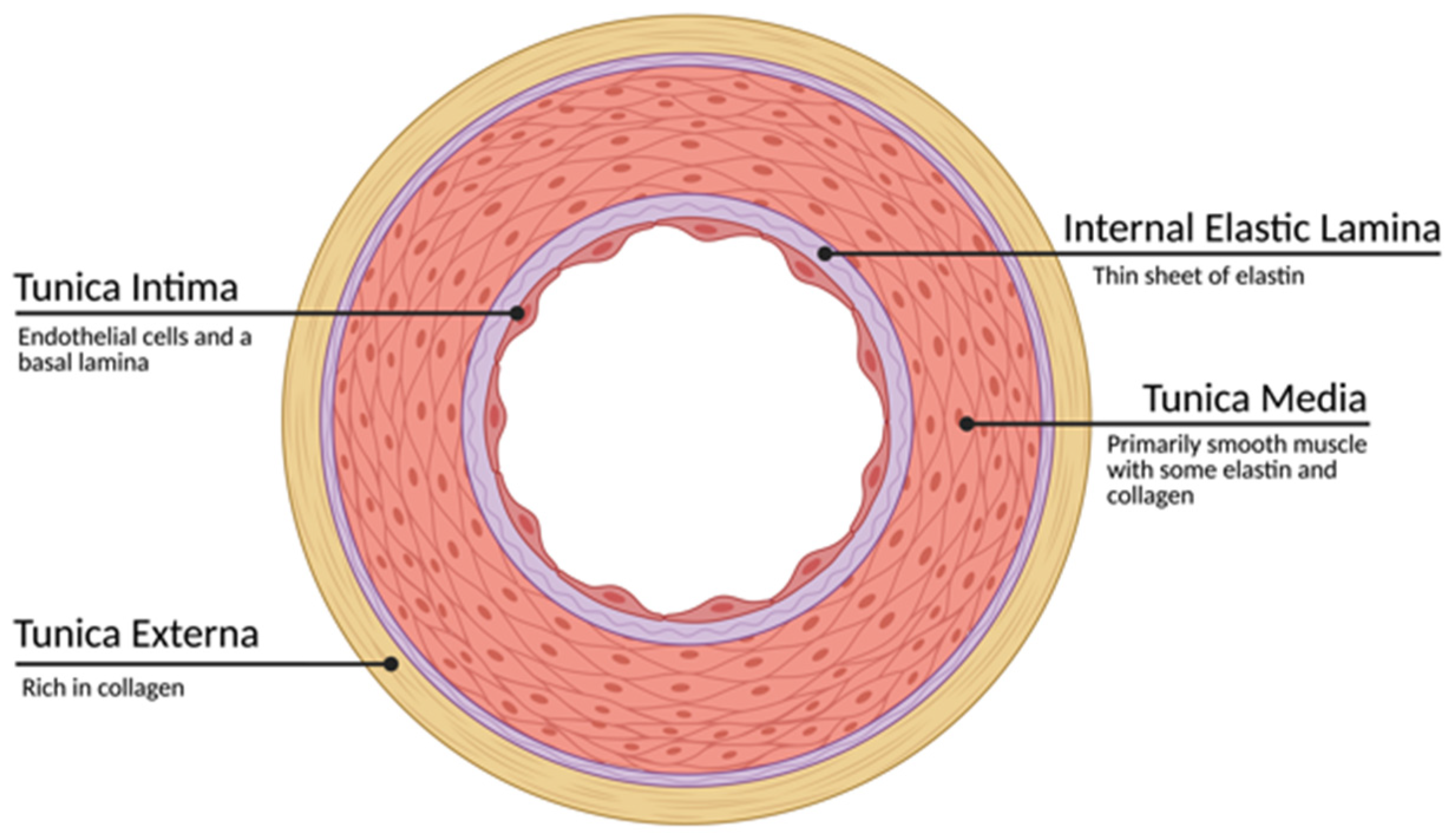
Arteries are primarily composed of three distinct layers, or tunicas. From deep to superficial, they are the tunica intima, tunica media, and tunica adventitia, as depicted by Figure 1. The tunica intima consists of a single layer of simple squamous endothelial cells lining the artery lumen. This is supported by an underlying basal lamina and thin layer of subendothelial loose connective tissue containing collagen, elastin, and fibroblasts [12]. The middle layer, the tunica media, is composed predominantly of smooth muscle, with elastin and collagen interwoven throughout the ECM. Separating the tunica media and the intima is the internal elastic lamina, a fenestrated sheet of elastin that contributes to artery compliance [13]. The outermost layer, the tunica adventitia, otherwise referred to as the tunica externa, is rich in collagen fibers. Collagen is a key structural protein of the ECM, providing tensile strength through its unique molecular architecture [14]. As a result, the tunica adventitia serves as a major contributor to the tensile strength of arterial walls [15].
The hierarchical structure of collagen consists of three α-chains that form a right-handed triple helix with the repeating Gly-X-Y motifs, where X is often proline and Y is often hydroxyproline or hydroxylysine. Collagen fibrils are stabilized by covalent cross-links between lysine or hydroxylysine residues, catalyzed by the enzyme lysyl oxidase. Aging and pathological processes can alter ECM composition and cross-linking, such as increasing the type I to type III ratio or changing lysyl oxidase activity, ultimately increasing vascular wall rigidity [16].
The primary collagens found in intracranial arteries are types I, III, IV V, VI, and VIII. Each type is integral to the appropriate function and load-bearing ability of the vessels, with the roles outlined below in Table 1. Collagen type I is the primary load-bearing component of the tunica adventitia.

3.2. Pathophysiology of Aneurysm Formation

The literature shows a consensus that the tunica intima, specifically the endothelial cells, acts as an initiator of aneurysm propagation. It is proposed that endothelial cells contribute to this process through several mechanisms, including NO dysregulation, oxidative stress, adhesion-molecule upregulation, and matrix metalloproteinase (MMP)-mediated ECM degradation [17,18,19]. Each of these unique pathways coalesce into the activation of proteases and subsequent weakening of the arterial wall.
Under normal conditions, NO, generated from endothelial nitric oxide synthase (eNOS) diffuses into the tunica media and regulates the relaxation of arteries through the conversion of guanylyl cyclase into cyclic guanosine monophosphate (cGMP) within vascular smooth muscle [20]. cGMP has the downstream effect of reducing calcium content, which induces the relaxation of smooth muscle of the tunica media and increases arterial compliance [21]. The effects of NO dysregulation have yet to be completely understood in human models, but there has been shown to be a substantial contribution on aneurysm pathogenesis in rodents.
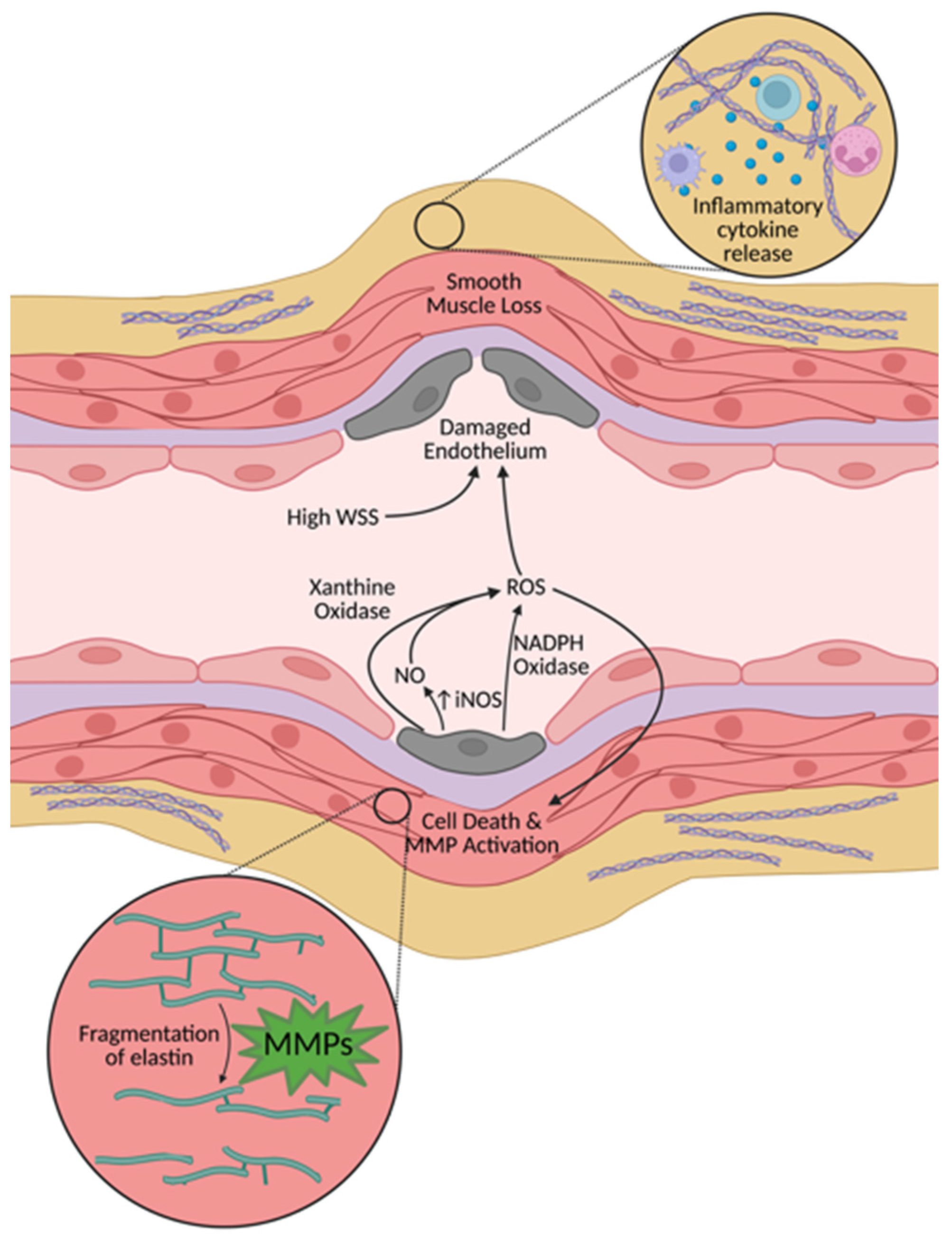
In rodent models, dysfunction of NO generation is associated with the breakdown of structural proteins, mainly collagen types I and III, via MMP-2, -9, and -13 [22,23]. As illustrated in Figure 2, this is induced by the overproduction of inducible nitric oxide synthase (iNOS), which manufactures NO. Unlike eNOS, which is tightly regulated in a calcium-dependent manner under physiologic conditions, iNOS is transcriptionally upregulated during inflammatory states and once expressed, functions largely in a calcium-independent fashion. As a result, iNOS produces sustained and substantially higher levels of nitric oxide compared to the low, homeostatic amounts generated by eNOS [21]. As a result, iNOS generates massive, sustained concentrations of NO. NO then combines with superoxide to form peroxynitrite, an oxidant that damages smooth muscle cells and activates MMPs [24]. As collagen types I and III become progressively fragmented and destroyed by NO-activated MMPs, the tunica media and adventitia are weakened. This predisposes arteries to progressive dilation that is characteristic of an aneurysm. The mechanism of the MMP degradation of collagen is through a zinc-dependent catalytic domain to cleave specific peptide bonds within the collagen triple helix, producing structurally weakened fragments that unravel and can easily be removed by other proteases [25].
Increased levels of reactive oxidative species (ROS), such as malondialdehyde and lipid hydroperoxides, have been clinically linked to aneurysms [26]. Sources of ROS in aneurysmal tissue have been identified as NADPH oxidase, uncoupled eNOS, and iNOS, all of which are particularly dominant under inflammatory conditions [27,28]. In cultured human coronary smooth muscle cells, Valentin et al. [29] demonstrated that exposure to various ROS, oxidized LDL, or ROS from xanthine-oxidase, promoted the conversion of pro-MMP-2 to its active form. Active MMP-2 then degrades extracellular collagen, damaging arterial stability [23].
An additional response to oxidative stress is a phenotypic shift of vascular endothelial cells from contractile to synthetic. This change promotes the generation of adhesion molecules ICAM-1 and VCAM-1, the upregulation of MMP genes, and endothelial apoptosis through pro-inflammatory cytokines [19]. ICAM-1 and VCAM-1 are responsible for the transmigration of immune cells via binding to integrins. The influx of these immune cells amplifies MMP activity, increases ROS production, and sustains inflammatory cytokine release within the vessel wall [30], further perpetuating a cascade of matrix degradation and smooth muscle loss within the tunica media and adventitia that undermines the mechanical integrity of the artery.
Additionally, hemodynamic forces are another factor at play in the development of aneurysms. Wall shear stress (WSS) is the tangential force exerted on the endothelium by the flowing blood in the lumen and is dependent on vessel geometry and blood flow dynamics [31]. High WSS is commonly seen at arterial bifurcations, especially in wide or asymmetrical junctions [32]. In these regions, the stress on endothelial cells stimulates NO and ROS production, which activate MMPs that degrade the tunica media and adventitia [32]. Alternatively, regions with low WSS, often the aneurysm sac, promote chemoattractants for inflammatory cells that release additional MMPs and ROS [33]. A high WSS will initiate the formation of an aneurysm, and the subsequent low WSS of the sac facilitates progressive dilation of the aneurysm.
The presence of comorbidities can exacerbate the pathogenesis of aneurysms. Hypertension sustains additional mechanical stress on the arterial wall, furthering endothelial dysfunction and the degradative pathway previously described [11]. In the context of risk mitigation, those in groups with additional predispositions to aneurysmal development have a heightened need for strict blood pressure regulation. Beyond aneurysm formation, uncontrolled hypertension alters the risk of a rupture for those with an already developed aneurysm. Of those with formed intracranial aneurysms, patients with uncontrolled hypertension were 16.7 (95% CI 2.1–132.1) times more likely to experience a rupture [11].
Chronic cigarette smoking as an additional established comorbidity has been associated with both cerebral and aortic aneurysm development. Through sustained oxidative stress, smoking upregulates MMP activity, furthering proteolytic ECM breakdown and resultant weakened collagen regeneration [34,35]. Following the same trend as hypertension, smoking not only increased the development of aneurysms but also increased the risk for rupture. In a meta-analysis with a total of 6196 patients, the relative risk of rupture for intracranial aneurysm in smoking and non-smoking groups was 1.26 (95% CI: 1.18–1.34). In comparing former smokers and the non-smoking group, there was no statical difference in risk of rupture [36]. For patients who currently have an aneurysm or are at risk of developing one, smoking cessation is imperative and should be strongly encouraged as a means to risk-reduction.

3.3. Comparative Analysis: Aortic vs. Cerebral Aneurysms

Although aortic and cerebral aneurysms are distinct clinical entities, comparing them highlights important differences in collagen structure, wall composition, and mechanical stress, which helps contextualize collagen’s role in intracranial aneurysm pathology. Both aneurysm types involve the degradation of collagen and elastin in the arterial wall, but the patterns and consequences of this degradation differ due to the unique biology of each vessel.
Aortic aneurysms, particularly abdominal aortic aneurysms (AAA), occur in large, elastic arteries with a thick media rich in elastin and type I and III collagen. Progressive inflammation, macrophage infiltration and upregulation of matrix metalloproteinases (MMP2, MMP9) lead to significant collagen loss and medial thinning, producing gradual dilation of the aorta over years [37].
Because of the aorta’s inherently robust structure, rupture risk correlates strongly with overall vessel diameter, a reflection of the balance between wall tensile strength and systemic blood pressure. The larger the aneurysm becomes, the more likely it is that wall stress exceeds the load-bearing capacity of its collagen scaffold.
A 2021 Yale clinical study examined whether the Thumb-Palm Test (TPT), a simple bedside maneuver associated with connective-tissue laxity, could serve as a proxy marker for systemic collagen abnormalities that predispose to AAA. The investigators explored whether generalized ligamentous hypermobility (measured by the TPT) might help identify individuals at risk or indicate broader collagen vulnerability patterns [38]. This study raised the question of whether similar connective-tissue-based screening tools could be applied beyond AAA, though their utility in other aneurysm types remains uncertain.
Intracranial aneurysms contain markedly less collagen and elastin, have no external elastic lamina, and rely heavily on a thin media for mechanical stability. This makes cerebral arteries far more sensitive to small changes in collagen organization. Hemodynamic stress at bifurcations of the circle of Willis promotes the focal degradation of type I and III collagen fibers, smooth-muscle cell loss, and MMP-driven remodeling, all of which contribute to aneurysm formation [39,40]. Unlike aortic aneurysms, where diameter is a strong predictor, cerebral aneurysm rupture risk depends more on wall microstructure, collagen integrity, and local flow patterns than on size alone [41].
These differences highlight why collagen degradation has more immediate and unpredictable clinical consequences in cerebral aneurysms. The aorta, with its thick medial layer and abundant collagen-elastin matrix, can endure years of remodeling before structural failure becomes imminent. In contrast, intracranial arteries lack such redundancies. As a result, even modest disruptions in collagen density, orientation, or cross-linking can significantly compromise wall integrity and precipitate aneurysm formation or rupture in the brain.
Despite the subtle difference in AAA and intracranial aneurysms, the two pathologies often coexist in a subset of patients [42]. This observation is suggestive of a broader concept that frames aneurysms as a result of systemic arterial maladaptation and ECM instability, rather than a localized structural deformity confined to an isolated segment of weakness. The parallels in comorbidities, such as hypertension and smoking [11,34,35], along with a striking overlap in genes associated with both AAA and intracranial aneurysm [43], further supports the idea of a shared developmental pathway.

3.4. Biological Determinants of Aneurysm Susceptibility

Rather than being confined to a small set of isolated syndromes, aneurysm susceptibility can be seen as a spectrum of genetic disease that ranges from rare, high penetrance monogenic disorders to more common polygenic risk states, with additional contributions from somatic mosaicism and gene–environmental interactions. Despite this layered mechanism, each of these conditions intersect at impaired collagen integrity and uncoordinated ECM remodeling.
Inherited connective tissue disorders, such as Ehlers–Danlos syndrome (EDS) and Marfan syndrome (FBN1 mutation), involve genetic mutations that alter the structure and function of collagen as well as related ECM protein production. EDS comprises a variety of mutation subtypes, with the majority primarily involving genetic variation in the genes that encode the fibrillar collagens, such as types I, III, and V [44]. A subtype of EDS, vascular EDS, contains a mutation in the COL3A1 gene. EDS has clinical features such as hypermobility, hyperextensible skin, and vascular complications including arterial aneurysms [45]. Marfan syndrome involves a mutation in the FBN1 gene, which encodes a microfibrillar protein, fibrillin-1. This key protein works as a scaffold for elastin and ensures proper elastic fiber organization, as well as modulates TGF-β signaling, both essential for collagen and ECM integrity. A defect in this gene presents with disruptions in cardiovascular systems, such as aortic root aneurysm and dissection where elastic fiber and smooth muscle differentiation are crucial, along with other defects in skeletal and ocular systems [45].
In connective tissue disorders such as Marfan syndrome, single nucleotide polymorphisms (SNPs) and gene expression studies have shown genetic factors that increase susceptibility to aneurysm, primarily through their effects on mutations that alter ECM integrity, signaling of TGF-β pathways, and vascular homeostasis [46]. Further studies using a genome-wide approach found common SNPs for the FBN1 gene, at the 15q21.1 locus, as a point present in both syndromic and sporadic aortic aneurysms, showing a potentially similar mechanism [47]. Other exome sequencing studies have identified additional loci (PRKG1 and COL4A1) that affect the severity of aneurysm risk seen in Marfan syndrome. Notably, COL4A1 has been suggested in cerebral aneurysm susceptibility [46].
Other mechanisms of collagen gene regulation involve epigenetic regulation, such as DNA methylation and histone modifications, which can serve to silence or activate gene expression. Post-translational modifications, such as lysyl hydroxylation or cross-linking mediated by lysyl oxidase, are also essential in proper collagen fibril assembly. Defects in these mechanisms could lead to connective tissue disorders and multiorgan system defects where collagen structurally dominates. Rat models have demonstrated cerebral aneurysm formation when placed under hemodynamic stress, which produced an upregulation of interleukin-1β and NF-κB signaling and a subsequent downregulation in collagen biosynthesis via impaired lysyl oxidase activity in aneurysm walls. This suggests a key feature of cerebral aneurysm pathology [48]. In contrast, pulmonary fibrosis also demonstrates dysregulated collagen structure mediated through similar pathways; however, the result is excessive or aberrant cross-linking that produces weaker blood vessels [49].
Autosomal dominant polycystic kidney disease (ADPKD) represents a systemic disorder in which genetically mediated disruption of vascular mechanosensing and extracellular matrix homeostasis directly intersect with intracranial aneurysm susceptibility. ADPKD is caused by mutations in PKD1 and PKD2, which encode the polycystin proteins polycystin-1 (PC1) and polycystin-2 (PC2), respectively [49]. PC1, a large multidomain glycoprotein, and PC2, a calcium-regulated cation channel, localize to primary cilia where they function as mechanotransducers of fluid shear stress and regulators of intracellular calcium signaling. Through these roles, polycystins govern endothelial mechanosensing, vascular smooth muscle cell behavior, and extracellular matrix organization, linking altered flow sensing to downstream disturbances in collagen architecture and vessel wall integrity [50,51]. Beyond renal cyst formation, endothelial-specific loss of PKD1 in experimental models is associated with a collagen-remodeling phenotype characterized by reduced type III collagen content, disruption of basement membrane organization, and increased extracellular matrix turnover mediated by dysregulated transforming growth factor β signaling and metalloproteinase activation. These changes impair collagen fibril assembly and wall tensile support, resulting in impaired flow-mediated vasodilation and a structurally vulnerable arterial wall phenotype [52,53,54].
Clinically, ADPKD is one of the strongest non-syndromic risk factors for intracranial aneurysm formation and rupture. The prevalence of intracranial aneurysms in ADPKD cohorts ranges from approximately 9–12%, reaching about 8% by 70 years of age, representing a several-fold increase compared with the general population [50,55,56]. The incidence of aneurysmal subarachnoid hemorrhage has been estimated at roughly 200 per 100,000 patient-years, nearly 25 times higher than the baseline population rates [56].
At the molecular level, loss of PC1/PC2 function leads to reduced intracellular calcium, elevated cyclic AMP, and activation of proliferative signaling pathways including PKA-B-Raf-MEK-ERK and mTOR, which impair NO-mediated endothelial responses, promote oxidative stress, and alter collagen synthesis and turnover within the arterial wall [50,51,52]. In parallel, PKD1 haploinsufficiency upregulates transforming growth factor-β signaling, a key regulator of extracellular matrix remodeling, while experimental PKD models demonstrate reduced endothelial tight junction proteins and decreased type III collagen content in aneurysm walls, directly linking polycystin dysfunction to structural weakening of cerebral arteries [57,58]. Consistent with this aggressive vascular phenotype, intracranial aneurysm rupture occurs at a younger median age of 42.8 years in ADPKD than in the general population age of 52.8 years, underscoring the importance of targeted screening with magnetic resonance angiography in high-risk individuals and periodic rescreening when initial studies are negative [59,60,61,62].
Blue Rubber Bleb Nevus Syndrome (BRBNS) is a rare genetic disorder characterized by systemic vascular malformations. Histopathologic studies have demonstrated abnormal deposition of type IV collagen within vascular basement membranes, suggesting disrupted ECM organization [63]. Although direct causal links between BRBNS and aneurysm formation remain limited, these alterations in collagen IV-dependent vascular architecture support a model in which basement membrane and ECM dysregulation weaken vessel wall integrity, predisposing affected vessels to aneurysmal change, particularly in the setting of increased hemodynamic stress.
Taken together, these observations reinforce that aneurysm risk reflects a layered continuum. Rare high impact variants, common polygenic influences, epigenetic regulation and possibly somatic mosaicism, whose shared downstream consequence is impaired collagen integrity and maladaptive ECM remodeling under hemodynamic load.

3.5. Diagnostic and Imaging Approaches

Recent studies have increasingly highlighted collagen-related imaging modalities and biomarkers as promising diagnostic tools for aneurysm assessment, particularly in AAA. For example, Fourier transform infrared imaging spectroscopy (FT-IRIS) has been shown to accurately quantify collagen content and maturity in AAA tissue samples subjected to differing wall stresses [64]. Additional imaging approaches, such as transmission electron microscopy and atomic force microscopy, have been used to characterize the collagen fibril structure in murine models of AAA [65]. Moreover, simultaneous molecular MRI targeting ECM collagen and inflammatory activity has demonstrated predictive potential for AAA rupture in mice [66].
In human studies, serum biomarkers also show diagnostic promise. In patients with AAA, abdominal aortic diameter has been positively correlated with circulating collagen XVIII levels, suggesting that collagen XVIII may serve as a viable serum biomarker [67]. Another investigation into the mechano-biological properties of AAA tissues revealed structural associations between collagen and proteoglycans and how these components respond to mechanical loading. Specifically, collagen type I and endocan were shown to reflect the biomechanical conditions of the aortic wall both in tissue and in serum, indicating their potential utility in AAA risk stratification [68]. Additional collagen-related biomarkers include elevated MMPs, which degrade ECM components such as collagen and elastin; however, MMP elevation is a relatively nonspecific indicator of cardiovascular injury and lacks the sensitivity required for targeted AAA diagnosis [69]. Another study identified the microRNA miR-29c-3p as a potential serum biomarker in patients with AAA, with elevated levels distinguishing affected individuals from the controls [70].
Despite these promising developments, none of these tools have been widely adopted in clinical practice. Furthermore, while multiple collagen-related imaging and biomarker approaches exist for AAA, analogous diagnostic strategies for cerebral aneurysms remain limited. To date, we identified only one recent preliminary study proposing a collagen-related biomarker specific to cerebral aneurysms. Hackenberg et al. [71] reported that elevated levels of venous type I collagen degradation products, particularly C-telopeptide and, most notably, C-terminal telopeptide (ICTP), were associated with IA presence. ICTP emerged as a highly promising biomarker for cerebral aneurysm prediction. The authors emphasized the need for future studies incorporating longitudinal data to validate ICTP’s diagnostic utility [71].

3.6. Sex and Age Differences in Collagen Remodeling

Both age and sex have been shown to strongly influence collagen remodeling in cerebral aneurysms, in terms of growth, rupture risk, and prevalence. Worldwide, women are 1.5 to 2 times more susceptible to cerebral aneurysms than men. Fluctuations in estrogen, a prevalent hormone in the human body, has been suggested to be one of the reasons why women are more susceptible to cerebral aneurysms. Estrogen serves a protecting role in collagen integrity by maintaining the barrier of the innermost layer of the artery, the endothelium. It does this by enhancing the bioavailability of NO, a potent vasodilator, which mitigates hemodynamic stress by appropriately dilating when faced with high wall shear stress. Another role of estrogen is to decrease the expression of ECM degrading enzymes such as MMP-2 and MMP-9. Degrading enzymes, if left unchecked, would otherwise target the vessel wall for collagen and elastin fibers for destruction. A balance of proper estrogen levels guarantees that there is a preservation of elements needed for structural integrity, and in doing so, safeguards against cerebral aneurysm formation [72]. In females, particularly following menopause, the decline in estrogen production diminishes the protective role it plays in the arterial walls and increases the overall prevalence ratio of cerebral aneurysms [73].
Age dependent mechanisms have also been shown to contribute to the weakening and disruption of essential mechanical functions of the cerebral arterial wall. Naturally occurring molecular reactions and environmental factors lead to reactive oxygen species (ROS) accumulating with age [74]. These species cause cumulative damage to the collagen and elastin fibers of the arterial wall, and activate matrix metalloproteinases, MMP-2 and MMP-9, to further impair endothelial cell function and reduce vascular protective mechanisms [74]. With age-related decline, the efficiency of mitochondria, the ATP-producing powerhouse, also decreases. This decrease in energy production in smooth muscle cells compromises key repair functions that work to combat the effects of ROS [75].
The ECM and smooth muscle cells of the medial layer of vessels withstand a lifetime of intense stress, which some individuals may be more predisposed to due to genetic differences and epigenetic changes. Genes required for ECM regulation such as collagen synthesis, MMP expression, and cross-linking can undergo age-related mutations [76]. Epigenetic factors, such as DNA methylation and histone acetylation, can also be activated or inactivated, which may lead to ECM deterioration [77].
Over time, these mechanisms can lead to thinning and fragmentation of a key structural component called the internal elastic lamina. The weakening of a foundational component of the media can lead to a bulge, and the eventual formation of an aneurysm. Other risk factors encouraged by aging include a decline in repair mechanisms, which is detrimental due to collagen’s already high turnover rate. When repair mechanisms fail to keep up with constant turnover, it can lead to the progression of disorganized growth and ultimately malfunctional collagen production. The turnover rate has been suggested to accelerate in older individuals, meaning that the risk factor for inferiorly produced collagen is even higher in older populations [78]. Therefore, in natural aging, a decline in repair mechanisms due to dysfunctional ATP production, increased oxidative damage from ROS, and genetic stressors accelerate ECM degradation and amplify the risk of cerebral aneurysm formation.

3.7. Prevention

Few studies have investigated collagen-targeted therapies for the prevention and treatment of aneurysms. If collagen degradation contributes to aneurysm formation, then slowing collagen loss or enhancing collagen production may offer a meaningful preventive strategy. Evidence from preclinical models supports this idea. In a model of acute aortic dissection and intramural hematoma, P8RI, a CD31 agonist, prevented aneurysm development, resolved the hematoma, and stimulated collagen production within the dissected aorta [79]. Similarly, osteoprotegerin suppressed intracranial aneurysm progression in mice by promoting collagen biosynthesis and vascular smooth muscle cell proliferation [80].
Clinical observations also point toward a collagen-related mechanism. Vitamin D deficiency has been associated with larger AAA in older men, with an inverse relationship between vitamin D levels and aneurysm diameter. Although the underlying biology remains unclear, current evidence suggests that vitamin D deficiency accelerates collagen degeneration and remodeling [81,82]. Restoring vitamin D levels in at-risk individuals may therefore help reduce AAA progression.
Overall, collagen-focused approaches represent a promising yet understudied area in aneurysm prevention. These findings highlight the need for further research.

3.8. Treatment

Current management of intracranial aneurysms relies almost exclusively on mechanical exclusion of the aneurysm sac through surgical or endovascular means. While these approaches effectively reduce hemodynamic stress and rupture risk, they do not address the underlying biological abnormality that predisposes the arterial wall to failure. From a collagen-centric perspective, contemporary aneurysm care largely bypasses the primary anatomic problem: progressive loss of extracellular matrix integrity and tensile strength within the vessel wall [83,84].
To date, no established therapy directly targets collagen degradation, impaired collagen biosynthesis, or maladaptive extracellular matrix remodeling in cerebral aneurysms. However, emerging experimental and translational evidence suggests that vascular-protective strategies aimed at preserving collagen structure and function may represent a meaningful adjunct or preventive therapeutic direction.
Hormonal modulation provides one example of biologic vascular protection. Estrogen has been shown to significantly reduce both aneurysm formation and rupture in ovariectomized murine models, likely through the preservation of endothelial function and suppression of matrix-degrading enzymes such as MMP-2 and MMP-9 [72]. These findings are consistent with estrogen’s known role in supporting collagen synthesis and limiting extracellular matrix degradation and may help explain the increased prevalence and rupture risk of cerebral aneurysms observed in postmenopausal women [73]. Although hormone-based therapies are not currently indicated for aneurysm prevention, these data underscore the importance of systemic regulators of collagen homeostasis.
Additional experimental approaches have focused on limiting inflammatory and epigenetic drivers of extracellular matrix degeneration. Inhibition of histone deacetylase activity has demonstrated protective effects in experimental aneurysm models by modulating epigenetic regulators of vascular inflammation and smooth muscle cell survival, processes that secondarily influence extracellular matrix stability and aneurysm progression [85]. By stabilizing extracellular matrix architecture rather than altering blood flow alone, such strategies more directly address the structural vulnerability central to aneurysm pathophysiology.
Device-based innovations further illustrate a shift toward biologically informed therapy. CD31-mimetic coatings applied to flow-diverting stents have been shown to enhance endothelialization and promote the formation of a neoarterial wall enriched in organized collagen and smooth muscle cells [86]. These findings suggest that future endovascular technologies may combine mechanical support with the active promotion of collagen-dependent wall repair, bridging the gap between procedural success and long-term vessel integrity.
Collectively, these observations highlight a critical unmet need in aneurysm care: therapies that preserve or restore collagen homeostasis within the cerebral arterial wall. Rather than focusing solely on aneurysm geometry or flow dynamics, future treatment paradigms may benefit from targeting the biological processes that determine wall strength, resilience, and susceptibility to rupture.

3.9. Future Directions and Research Gaps

Despite advances in understanding collagen’s role in aneurysm formation, major research gaps persist. Much of the existing pathophysiology is derived from rat models, limiting its applicability to human disease. Early-stage human tissue is rarely available, making it unclear whether collagen degeneration represents an initiating event, a response to hemodynamic injury, or a late marker of wall failure. Current imaging techniques also cannot directly assess collagen integrity in vivo, restricting our ability to track disease progression. Furthermore, clinically similar aneurysms often behave unpredictably, suggesting that factors beyond diameter such as inflammatory activity or biochemical signals may influence rupture risk. Emerging work on circulating biomarkers, including the panel proposed by Molacek et al. [87], highlights the potential for blood-based tools to improve personalized prediction and prognosis, but these approaches require broader validation. Continued development of human-focused models, advanced imaging, and biomarker research is essential to close these gaps.

4. Conclusions

Cerebral aneurysms represent a quintessential failure of vascular structure, and collagen lies at the center of this failure. Across experimental and clinical studies, collagen types I and III emerge as the principal determinants of tensile strength in the intracranial arterial wall, supported by regulatory collagens in the basement membrane and adventitia. When this collagen network is disrupted through disordered synthesis, impaired cross-linking, or accelerated degradation, the balance between wall stress and wall strength shifts toward dilation and, ultimately, rupture. Although the initiating trigger may vary among patients, collagen dysregulation consistently appears as a convergent pathway in aneurysm pathology.
The mechanisms driving this collagen failure are multifactorial. Endothelial dysfunction and nitric oxide dysregulation foster an oxidative and inflammatory milieu that activates matrix metalloproteinases and other proteases capable of cleaving collagen fibrils. Hemodynamic forces at arterial bifurcations further amplify these signals, promoting focal collagen degradation where the vessel wall is most vulnerable. Genetic and epigenetic disturbances in collagen and ECM-related pathways, as seen in connective tissue disorders such as Ehlers–Danlos and Marfan syndromes, add another layer of susceptibility. In this context, sex- and age-dependent changes in collagen turnover, particularly the loss of estrogen-mediated vascular protection in postmenopausal women and the cumulative effects of lifelong mechanical loading, help explain observed epidemiologic patterns of aneurysm prevalence and rupture.
Ultimately, reframing cerebral aneurysms as disorders of collagen homeostasis has important clinical implications. It suggests that risk stratification may need to look beyond size and location toward microstructural features, circulating markers of collagen turnover, and patient-specific factors such as sex, age, and connective tissue phenotype. It also points toward a future in which preserving or restoring collagen integrity rather than simply excluding blood flow through endovascular devices could become a central goal of aneurysm prevention and treatment, directly addressing the structural weakness that gives this disease its devastating potential.

Author Contributions

Authors B.H. and L.H. contributed equally to this work. Conceptualization, B.H. and L.H.; methodology, B.H. and L.H.; validation, N.B. and M.P.; investigation, B.H., L.H., S.K. and M.B.; data curation, B.H. and L.H.; writing—original draft preparation, B.H., L.H., S.K. and M.B.; writing—review and editing, N.B., M.P. and M.L.; visualization, L.H.; supervision, N.B.; project administration, N.B. All authors have read and agreed to the published version of the manuscript.

Funding

This research received no external funding.

Institutional Review Board Statement

Not applicable.

Informed Consent Statement

Not applicable.

Data Availability Statement

No new data were created or analyzed in this study. Data sharing is not applicable to this article.

Conflicts of Interest

The authors declare no conflicts of interest.

Abbreviations

The following abbreviations are used in this manuscript:
ECM Extracellular Matrix
NONitric Oxide
eNOSEndothelial Nitric Oxide Synthase
MMPsMatrix Metalloproteinases
cGMP Cyclic Guanosine Monophosphate
iNOSInducible Nitric Oxide Synthase
ROS Reactive Oxygen Species
WSS Wall Shear Stress
AAA Abdominal Aortic Aneurysm
TPT Thumb-Palm Test
EDS Ehlers-Danlos Syndrome
SNPs Single Nucleotide Polymorphisms
ADPKD Autosomal Dominant Polycystic Kidney Disease
PC1 Polycystin-1
PC2 Polycystin-2
BRBNS Blue Rubber Bleb Nevus Syndrome
FT-IRIS Fourier Transform-Infrared Imaging Spectroscopy
ICTP C-Terminal Telopeptide

References

  1. Sadasivan, C.; Fiorella, D.J.; Woo, H.H.; Lieber, B.B. Physical factors effecting cerebral aneurysm pathophysiology. Ann. Biomed. Eng. 2013, 41, 1347–1365. [Google Scholar] [CrossRef]
  2. Gordon, M.K.; Hahn, R.A. Collagens. Cell Tissue Res. 2010, 339, 247–257. [Google Scholar] [CrossRef]
  3. Ortiz, A.F.H.; Suriano, E.S.; Eltawil, Y.; Sekhon, M.; Gebran, A.; Garland, M.; Cuenca, N.T.R.; Cadavid, T.; Almarie, B. Prevalence and risk factors of unruptured intracranial aneurysms in ischemic stroke patients—A global meta-analysis. Surg. Neurol. Int. 2023, 14, 222. [Google Scholar] [CrossRef]
  4. Fuentes, A.M.; Stone McGuire, L.; Amin-Hanjani, S. Sex differences in cerebral aneurysms and subarachnoid hemorrhage. Stroke 2022, 53, 624–633. [Google Scholar] [CrossRef]
  5. Jersey, A.M.; Foster, D.M. Cerebral aneurysm. In StatPearls; StatPearls Publishing: Treasure Island, FL, USA, 2023. [Google Scholar]
  6. Ziu, E.; Khan, S.M.Z.; Mesfin, F.B. Subarachnoid hemorrhage. In StatPearls; StatPearls Publishing: Treasure Island, FL, USA, 2023. [Google Scholar]
  7. Basu, P.; Sen, U.; Tyagi, N.; Tyagi, S.C. Blood flow interplays with elastin: Collagen and MMP: TIMP ratios to maintain healthy vascular structure and function. Vasc. Health Risk Manag. 2010, 6, 215–228. [Google Scholar]
  8. Mimata, C.; Kitaoka, M.; Nagahiro, S.; Iyama, K.-I.; Hori, H.; Yoshioka, H.; Ushio, Y. Differential distribution and expressions of collagens in the cerebral aneurysmal wall. Acta Neuropathol. 1997, 94, 197–206. [Google Scholar] [CrossRef]
  9. Barallobre-Barreiro, J.; Loeys, B.; Mayr, M.; Rienks, M.; Verstraeten, A.; Kovacic, J.C. Extracellular matrix in vascular disease, part 2/4: JACC focus seminar. J. Am. Coll. Cardiol. 2020, 75, 2189–2203. [Google Scholar] [CrossRef] [PubMed]
  10. Del Monte-Nieto, G.; Fischer, J.W.; Gorski, D.J.; Harvey, R.P.; Kovacic, J.C. Basic biology of extracellular matrix in the cardiovascular system, part 1/4: JACC focus seminar. J. Am. Coll. Cardiol. 2020, 75, 2169–2188. [Google Scholar] [CrossRef] [PubMed]
  11. Etminan, N.; Ruigrok, Y.M.; Hackenberg, K.A.M.; Vergouwen, M.D.I.; Krings, T.; Rinkel, G.J.E. Epidemiology, pathogenesis, and emerging concepts in unruptured intracranial aneurysms. Lancet Neurol. 2025, 24, 945–957. [Google Scholar] [CrossRef] [PubMed]
  12. Taylor, A.M.; Bordoni, B. Histology, blood vascular system. In StatPearls; StatPearls Publishing: Treasure Island, FL, USA, 2025. [Google Scholar]
  13. Tennant, M.; McGeachie, J.K. Blood vessel structure and function: A brief update on recent advances. Aust. N. Z. J. Surg. 1990, 60, 747–753. [Google Scholar] [CrossRef]
  14. Wagenseil, J.E.; Mecham, R.P. Vascular extracellular matrix and arterial mechanics. Physiol. Rev. 2009, 89, 957–989. [Google Scholar] [CrossRef]
  15. Teng, Z.; Tang, D.; Zheng, J.; Woodard, P.K.; Hoffman, A.H. An experimental study on the ultimate strength of the adventitia and media of human atherosclerotic carotid arteries in circumferential and axial directions. J. Biomech. 2009, 42, 2535–2539. [Google Scholar] [CrossRef] [PubMed]
  16. Osidak, M.S.; Osidak, E.; Akhmanova, M.; Domogatsky, S.; Domogatskaya, A. Fibrillar, fibril-associated and basement membrane collagens of the arterial wall: Architecture, elasticity and remodeling under stress. Curr. Pharm. Des. 2015, 21, 1124–1133. [Google Scholar] [CrossRef]
  17. Sheinberg, D.L.; McCarthy, D.J.; Elwardany, O.; Bryant, J.-P.; Luther, E.; Chen, S.H.; Thompson, J.W.; Starke, R.M. Endothelial dysfunction in cerebral aneurysms. Neurosurg. Focus 2019, 47, E3. [Google Scholar] [CrossRef]
  18. Aoki, T.; Nishimura, M.; Kataoka, H.; Ishibashi, R.; Nozaki, K.; Miyamoto, S. Complementary inhibition of cerebral aneurysm formation by eNOS and nNOS. Lab. Investig. 2011, 91, 619–626. [Google Scholar] [CrossRef]
  19. Siasos, G.; Mourouzis, K.; Oikonomou, E.; Tsalamandris, S.; Tsigkou, V.; Vlasis, K.; Vavuranakis, M.; Zografos, T.; Dimitropoulos, S.; Papaioannou, T.G.; et al. The role of endothelial dysfunction in aortic aneurysms. Curr. Pharm. Des. 2015, 21, 4016–4034. [Google Scholar] [CrossRef] [PubMed]
  20. Lüscher, T.F. Endothelium-derived nitric oxide: The endogenous nitrovasodilator in the human cardiovascular system. Eur. Heart J. 1991, 12, 2–11. [Google Scholar] [CrossRef] [PubMed]
  21. Sausbier, M.; Schubert, R.; Voigt, V.; Hirneiss, C.; Pfeifer, A.; Korth, M.; Kleppisch, T.; Ruth, P.; Hofmann, F. Mechanisms of NO/cGMP-dependent vasorelaxation. Circ. Res. 2000, 87, 825–830. [Google Scholar] [CrossRef] [PubMed]
  22. Lizarbe, T.R.; Tarín, C.; Gómez, M.; Lavin, B.; Aracil, E.; Orte, L.M.; Zaragoza, C. Nitric oxide induces the progression of abdominal aortic aneurysms through the matrix metalloproteinase inducer EMMPRIN. Am. J. Pathol. 2009, 175, 1421–1430. [Google Scholar] [CrossRef]
  23. Longo, G.M.; Xiong, W.; Greiner, T.C.; Zhao, Y.; Fiotti, N.; Baxter, B.T. Matrix metalloproteinases 2 and 9 work in concert to produce aortic aneurysms. J. Clin. Investig. 2002, 110, 625–632. [Google Scholar] [CrossRef]
  24. Marcet-Palacios, M.; Graham, K.; Cass, C.; Befus, A.D.; Mayers, I.; Radomski, M.W. Nitric oxide and cyclic GMP increase the expression of matrix metalloproteinase-9 in vascular smooth muscle. J. Pharmacol. Exp. Ther. 2003, 307, 429–436. [Google Scholar] [CrossRef]
  25. Laronha, H.; Caldeira, J. Structure and function of human matrix metalloproteinases. Cells 2020, 9, 1076. [Google Scholar] [CrossRef]
  26. Shi, F.; Ma, C.; Ji, C.; Li, M.; Liu, X.; Han, Y. Serum lipid oxidative stress products as risk factors are the candidate predictive biomarkers for human abdominal aortic aneurysms. Clin. Appl. Thromb. Hemost. 2020, 26, 1076029620932226. [Google Scholar] [CrossRef]
  27. McCormick, M.L.; Gavrila, D.; Weintraub, N.L. Role of oxidative stress in the pathogenesis of abdominal aortic aneurysms. Arterioscler. Thromb. Vasc. Biol. 2007, 27, 461–469. [Google Scholar] [CrossRef]
  28. Luo, S.; Lei, H.; Qin, H.; Xia, Y. Molecular mechanisms of endothelial NO synthase uncoupling. Curr. Pharm. Des. 2014, 20, 3548–3553. [Google Scholar] [CrossRef] [PubMed]
  29. Valentin, F.; Bueb, J.L.; Kieffer, P.; Tschirhart, E.; Atkinson, J. Oxidative stress activates MMP-2 in cultured human coronary smooth muscle cells. Fundam. Clin. Pharmacol. 2005, 19, 661–667. [Google Scholar] [CrossRef] [PubMed]
  30. Batty, M.; Bennett, M.R.; Yu, E. The role of oxidative stress in atherosclerosis. Cells 2022, 11, 3843. [Google Scholar] [CrossRef]
  31. Soldozy, S.; Norat, P.; Elsarrag, M.; Chatrath, A.; Costello, J.S.; Sokolowski, J.D.; Tvrdik, P.; Kalani, M.Y.S.; Park, M.S. The biophysical role of hemodynamics in the pathogenesis of cerebral aneurysm formation and rupture. Neurosurg. Focus 2019, 47, E11. [Google Scholar] [CrossRef]
  32. Lauric, A.; Hippelheuser, J.E.; Malek, A.M. Induction of aneurysmogenic high positive wall shear stress gradient by wide angle at cerebral bifurcations, independent of flow rate. J. Neurosurg. 2018, 131, 442–452. [Google Scholar] [CrossRef] [PubMed]
  33. Aoki, T.; Yamamoto, K.; Fukuda, M.; Shimogonya, Y.; Fukuda, S.; Narumiya, S. Sustained expression of MCP-1 by low wall shear stress loading concomitant with turbulent flow on endothelial cells of intracranial aneurysm. Acta Neuropathol. Commun. 2016, 4, 48. [Google Scholar] [CrossRef]
  34. Rabkin, S.W. The effect of nicotine and tobacco on aortic matrix metalloproteinases in the production of aortic aneurysm. Curr. Vasc. Pharmacol. 2016, 14, 514–522. [Google Scholar] [CrossRef]
  35. Starke, R.M.; Thompson, J.W.; Ali, M.S.; Pascale, C.L.; Lege, A.M.; Ding, D.; Chalouhi, N.; Hasan, D.M.; Jabbour, P.; Owens, G.K.; et al. Cigarette smoke initiates oxidative stress-induced cellular phenotypic modulation leading to cerebral aneurysm pathogenesis. Arterioscler. Thromb. Vasc. Biol. 2018, 38, 610–621. [Google Scholar] [CrossRef] [PubMed]
  36. Wang, H.; Wang, L.; Wang, J.; Zhang, L.; Li, C. The biological effects of smoking on the formation and rupture of intracranial aneurysms: A systematic review and meta-analysis. Front. Neurol. 2022, 13, 862916. [Google Scholar] [CrossRef] [PubMed]
  37. Golledge, J.; Thanigaimani, S.; Powell, J.T.; Tsao, P.S. Pathogenesis and management of abdominal aortic aneurysm. Eur. Heart J. 2023, 44, 2682–2697. [Google Scholar] [CrossRef]
  38. Blumel, R.; Patel, K.; Rizzo, J.A.; Mok, S.; Barrett, A.; Wu, J.; Zafar, M.A.; Ziganshin, B.A.; Elefteriades, J.A. Accuracy of the “thumb-palm test” for detection of ascending aortic aneurysm. Am. J. Cardiol. 2021, 150, 114–116. [Google Scholar] [CrossRef]
  39. Humphrey, J.D.; Taylor, C.A. Intracranial and abdominal aortic aneurysms: Similarities, differences, and need for a new class of computational models. Annu. Rev. Biomed. Eng. 2008, 10, 221–246. [Google Scholar] [CrossRef]
  40. Tanweer, O.; Wilson, T.A.; Metaxa, E.; Riina, H.; Meng, H. A comparative review of the hemodynamics and pathogenesis of cerebral and abdominal aortic aneurysms. J. Neurointerv. Surg. 2014, 6, A45–A51. [Google Scholar] [CrossRef]
  41. Kim, J.H.; Kim, J.W.; Song, S.W.; Ahn, S.J.; Park, M.; Park, S.K.; Suh, S.H. Intracranial aneurysms are associated with Marfan syndrome: Single cohort retrospective study in 118 patients using brain imaging. Stroke 2021, 52, 331–334. [Google Scholar] [CrossRef]
  42. Liu, S.; Guan, H.; Wang, F. Genetic susceptibility and potential therapeutic targets of unruptured intracranial aneurysms: A genome-wide study based on Mendelian randomization. Clin. Neurol. Neurosurg. 2025, 249, 108749. [Google Scholar] [CrossRef]
  43. Shin, Y.W.; Jung, K.H.; Moon, J.; Lee, S.-T.; Lee, S.K.; Chu, K.; Roh, J.-K. Site-specific relationship between intracranial aneurysm and aortic aneurysm. Stroke 2015, 46, 1993–1996. [Google Scholar] [CrossRef] [PubMed]
  44. Ritelli, M.; Colombi, M. Molecular genetics and pathogenesis of Ehlers–Danlos syndrome and related connective tissue disorders. Genes 2020, 11, 547. [Google Scholar] [CrossRef] [PubMed]
  45. Elendu, C.; Amaechi, D.C.; Elendu, T.C.; Ibhiedu, J.O.; Torubiri, A.O.; Okoye, O.K. Comprehensive review of aortic aneurysms, dissections, and cardiovascular complications in connective tissue disorders. Medicine 2023, 102, e36499. [Google Scholar] [CrossRef]
  46. Aubart, M.; Gazal, S.; Arnaud, P.; Milleron, O.; Thibault, C.; Golmard, L.; Lerouxel, E.; Faivre, L.; Jondeau, G.; Collod-Beroud, G.; et al. Association of modifiers and other genetic factors explain Marfan syndrome clinical variability. Eur. J. Hum. Genet. 2018, 26, 1759–1772. [Google Scholar] [CrossRef]
  47. LeMaire, S.A.; McDonald, M.L.; Guo, D.C.; Russell, L.; Miller, C.C., III; Johnson, R.J.; Bekheirnia, M.J.; Franco, M.L.; Pyeritz, R.E.; Bavaria, J.E.; et al. Genome-wide association study identifies a susceptibility locus for thoracic aortic aneurysms and aortic dissections spanning FBN1 at 15q21.1. Nat. Genet. 2011, 43, 996–1000. [Google Scholar] [CrossRef]
  48. Aoki, T.; Kataoka, H.; Ishibashi, R.; Nozaki, K.; Morishita, R.; Hashimoto, N. Reduced collagen biosynthesis is the hallmark of cerebral aneurysm: Contribution of interleukin-1β and nuclear factor-kappaB. Arterioscler. Thromb. Vasc. Biol. 2009, 29, 1080–1086. [Google Scholar] [CrossRef] [PubMed]
  49. Jones, M.G.; Andriotis, O.G.; Roberts, J.J.; Lunn, K.; Tear, V.J.; Cao, L.; Ask, K.; Smart, D.E.; Bonfanti, A.; Johnson, P.; et al. Nanoscale dysregulation of collagen structure–function disrupts mechano-homeostasis and mediates pulmonary fibrosis. eLife 2018, 7, e36354. [Google Scholar] [CrossRef]
  50. Cornec-Le Gall, E.; Alam, A.; Perrone, R.D. Autosomal dominant polycystic kidney disease. Lancet 2019, 393, 919–935. [Google Scholar] [CrossRef]
  51. Al-Orjani, Q.; Alshriem, L.A.; Gallagher, G.; Buqaileh, R.; Azizi, N.; AbouAlaiwi, W. Mechanistic insights into the pathogenesis of polycystic kidney disease. Cells 2025, 14, 61. [Google Scholar] [CrossRef]
  52. Hamzaoui, M.; Groussard, D.; Nezam, D.; Djerada, Z.; Lamy, G.; Tardif, V.; Dumesnil, A.; Renet, S.; Brunel, V.; Peters, D.J.; et al. Endothelium-specific deficiency of polycystin-1 promotes hypertension and cardiovascular disorders. Hypertension 2022, 79, 383–395. [Google Scholar] [CrossRef] [PubMed]
  53. Perrone, R.D.; Malek, A.M.; Watnick, T. Vascular complications in autosomal dominant polycystic kidney disease. Nat. Rev. Nephrol. 2015, 11, 589–598. [Google Scholar] [CrossRef]
  54. Raptis, V.; Loutradis, C.; Sarafidis, P.A. Renal injury progression in autosomal dominant polycystic kidney disease: A look beyond the cysts. Nephrol. Dial. Transplant. 2018, 33, 1293–1303. [Google Scholar] [CrossRef]
  55. Lefèvre, S.; Audrézet, M.P.; Halimi, J.M.; Longuet, H.; Bridoux, F.; Ecotière, L.; Augusto, J.-F.; Duveau, A.; Renaudineau, E.; Vigneau, C.; et al. Diagnosis and risk factors for intracranial aneurysms in autosomal polycystic kidney disease: A cross-sectional study from the Genkyst cohort. Nephrol. Dial. Transplant. 2022, 37, 1091–1100. [Google Scholar] [CrossRef]
  56. Rinkel, G.J.E.; Ruigrok, Y.M.; Krings, T.; Etminan, N.; Vergouwen, M.D.I. Advances in screening and management of unruptured intracranial aneurysms. Lancet Neurol. 2025, 24, 958–968. [Google Scholar] [CrossRef]
  57. Liu, D.; Wang, C.J.; Judge, D.P.; Halushka, M.K.; Ni, J.; Habashi, J.P.; Moslehi, J.; Bedja, D.; Gabrielson, K.L.; Xu, H.; et al. A Pkd1-Fbn1 genetic interaction implicates TGF-β signaling in the pathogenesis of vascular complications in autosomal dominant polycystic kidney disease. J. Am. Soc. Nephrol. 2013, 24, 1858–1870. [Google Scholar] [CrossRef] [PubMed]
  58. Cayron, A.F.; Morel, S.; Azam, M.; Haemmerli, J.; Aoki, T.; Bijlenga, P.; Allémann, E.; Kwak, B.R. Enhanced intracranial aneurysm development in a rat model of polycystic kidney disease. Cardiovasc. Res. 2025, 121, e48–e60. [Google Scholar] [CrossRef] [PubMed]
  59. Harris, P.C.; Torres, V.E. Polycystic kidney disease, autosomal dominant. In GeneReviews®; University of Washington: Seattle, WA, USA, 2022. [Google Scholar]
  60. Borghol, A.H.; Alkhatib, B.; Zayat, R.; Ravikumar, N.P.; Debeh, F.G.M.; Ghanem, A.; Mina, J.; Mao, M.A.; Dahl, N.K.; Hickson, L.J.; et al. Intracranial aneurysms in autosomal dominant polycystic kidney disease: A practical approach to screening and management. Mayo Clin. Proc. 2025, 100, 456–469. [Google Scholar] [CrossRef]
  61. Torres, V.E.; Ahn, C.; Barten, T.R.M.; Brosnahan, G.; Cadnapaphornchai, M.A.; Chapman, A.B.; Gall, E.C.-L.; Drenth, J.P.; Gansevoort, R.T.; Harris, P.C.; et al. KDIGO 2025 clinical practice guideline for the evaluation, management, and treatment of autosomal dominant polycystic kidney disease (ADPKD): Executive summary. Kidney Int. 2025, 108, S1–S239. [Google Scholar] [CrossRef]
  62. Nurmonen, H.J.; Huttunen, T.; Huttunen, J.; Kurki, M.I.; Helin, K.; Koivisto, T.; Fraunberg, M.; Jääskeläinen, J.E.; Lindgren, A.E. Polycystic kidney disease among 4,436 intracranial aneurysm patients from a defined population. Neurology 2017, 89, 1852–1859. [Google Scholar] [CrossRef] [PubMed]
  63. Patel, R.C.; Zynger, D.L.; Laskin, W.B. Blue rubber bleb nevus syndrome: Novel lymphangiomatosis-like growth pattern within the uterus and immunohistochemical analysis. Hum. Pathol. 2009, 40, 413–417. [Google Scholar] [CrossRef]
  64. Cheheltani, R.; Pichamuthu, J.E.; Rao, J.; Weinbaum, J.S.; Kiani, M.F.; Vorp, D.A.; Pleshko, N. Fourier transform infrared spectroscopic imaging-derived collagen content and maturity correlates with stress in the aortic wall of abdominal aortic aneurysm patients. Cardiovasc. Eng. Technol. 2017, 8, 70–80. [Google Scholar] [CrossRef]
  65. Jones, B.; Tonniges, J.R.; Debski, A.; Albert, B.; Yeung, D.A.; Gadde, N.; Mahajan, A.; Sharma, N.; Calomeni, E.P.; Go, M.R.; et al. Collagen fibril abnormalities in human and mice abdominal aortic aneurysm. Acta Biomater. 2020, 110, 129–140. [Google Scholar] [CrossRef]
  66. Adams, L.C.; Brangsch, J.; Reimann, C.; Kaufmann, J.O.; Buchholz, R.; Karst, U.; Botnar, R.M.; Hamm, B.; Makowski, M.R. Simultaneous molecular MRI of extracellular matrix collagen and inflammatory activity to predict abdominal aortic aneurysm rupture. Sci. Rep. 2020, 10, 15206. [Google Scholar] [CrossRef]
  67. Rašiová, M.; Farkašová, Ľ.; Koščo, M.; Moščovič, M.; Špak, Ľ.; Petrášová, D.; Tkáč, I. Positive association between abdominal aortic diameter and serum collagen XVIII levels. Int. Angiol. 2019, 38, 410–417. [Google Scholar] [CrossRef]
  68. Metschl, S.; Bruder, L.; Paloschi, V.; Jakob, K.; Reutersberg, B.; Reeps, C.; Maegdefessel, L.; Gee, M.; Eckstein, H.-H.; Pelisek, J. Changes in Endocan and dermatan sulfate are associated with biomechanical properties of abdominal aortic wall during aneurysm expansion and rupture. Thromb. Haemost. 2022, 122, 1513–1523. [Google Scholar] [CrossRef]
  69. Cui, N.; Hu, M.; Khalil, R.A. Biochemical and biological attributes of matrix metalloproteinases. Prog. Mol. Biol. Transl. Sci. 2017, 147, 1–73. [Google Scholar]
  70. Licholai, S.; Szczeklik, W.; Sanak, M. miR-29c-3p is an effective biomarker of abdominal aortic aneurysm in patients undergoing elective surgery. Microrna 2016, 5, 124–131. [Google Scholar] [CrossRef]
  71. Hackenberg, K.A.; Richter, P.; Hetjens, S.; Dreier, R.; Ratliff, T.; Akanji, O.; Dremel, J.; Abdulazim, A.; Al Masalmeh, I.; Alzghloul, M.; et al. Circulating collagen breakdown products as a biomarker for presence and instability of human intracranial aneurysms. Eur. Stroke J. 2025, 10, 584–591. [Google Scholar] [CrossRef] [PubMed]
  72. Tada, Y.; Wada, K.; Shimada, K.; Makino, H.; Liang, E.I.; Murakami, S.; Kudo, M.; Shikata, F.; Silva, R.A.P.; Kitazato, K.T.; et al. Estrogen protects against intracranial aneurysm rupture in ovariectomized mice. PLoS ONE 2014, 9, e94921. [Google Scholar] [CrossRef] [PubMed]
  73. Zuurbier, C.C.M.; Molenberg, R.; Mensing, L.A.; Wermer, M.J.; Juvela, S.; Lindgren, A.E.; Jääskeläinen, J.E.; Koivisto, T.; Yamazaki, T.; Uyttenboogaart, M.; et al. Sex difference and rupture rate of intracranial aneurysms: An individual patient data meta-analysis. Stroke 2022, 53, 627–635. [Google Scholar] [CrossRef] [PubMed]
  74. El Assar, M.; Angulo, J.; Rodríguez-Mañas, L. Oxidative stress and vascular inflammation in aging. Free Radic. Biol. Med. 2013, 65, 380–401. [Google Scholar] [CrossRef]
  75. Lateef, O.M.; Fakorede, S.; Harris, C.; Lateef, A.M.; Ajayi, A.F. Mitochondria at the crossroads of aging and cardiovascular disease. Life Sci. 2026, 385, 124127. [Google Scholar] [CrossRef] [PubMed]
  76. Młynarska, E.; Kowalik, A.; Krajewska, A.; Krupińska, N.; Marcinkowska, W.; Motor, J.; Przybylak, A.; Tłustochowicz, K.; Rysz, J.; Franczyk, B. Inflammaging and senescence-driven extracellular matrix remodeling in age-associated cardiovascular disease. Biomolecules 2025, 15, 1452. [Google Scholar] [CrossRef]
  77. Ding, Y.N.; Tang, X.; Chen, H.Z.; Liu, D.P. Epigenetic regulation of vascular aging and age-related vascular diseases. Adv. Exp. Med. Biol. 2018, 1086, 55–75. [Google Scholar] [CrossRef] [PubMed]
  78. Kehlet, S.N.; Willumsen, N.; Armbrecht, G.; Dietzel, R.; Brix, S.; Henriksen, K.; Karsdal, M.A. Age-related collagen turnover of the interstitial matrix and basement membrane: Implications of age- and sex-dependent remodeling of the extracellular matrix. PLoS ONE 2018, 13, e0194458. [Google Scholar] [CrossRef]
  79. Andreata, F.; Syvannarath, V.; Clement, M.; Delbosc, S.; Guedj, K.; Fornasa, G.; Khallou-Laschet, J.; Morvan, M.; Even, G.; Procopio, E.; et al. Macrophage CD31 signaling in dissecting aortic aneurysm. J. Am. Coll. Cardiol. 2018, 72, 45–57. [Google Scholar] [CrossRef] [PubMed]
  80. Miyata, T.; Minami, M.; Kataoka, H.; Hayashi, K.; Ikedo, T.; Yang, T.; Yamamoto, Y.; Yokode, M.; Miyamoto, S. Osteoprotegerin prevents intracranial aneurysm progression by promoting collagen biosynthesis and vascular smooth muscle cell proliferation. J. Am. Heart Assoc. 2020, 9, e015731. [Google Scholar] [CrossRef]
  81. Adamska-Tomaszewska, D.; Kocełak, P.; Owczarek, A.J.; Olszanecka-Glinianowicz, M.; Chudek, J. Factors affecting vitamin D status in outpatients with abdominal aortic aneurysm and peripheral artery disease—A single centre study. Nutr. Metab. Cardiovasc. Dis. 2021, 31, 3161–3166. [Google Scholar] [CrossRef]
  82. Wong, Y.Y.; Flicker, L.; Yeap, B.B.; McCaul, K.A.; Hankey, G.J.; Norman, P.E. Is hypovitaminosis D associated with abdominal aortic aneurysm, and is there a dose-response relationship? Eur. J. Vasc. Endovasc. Surg. 2013, 45, 657–664. [Google Scholar] [CrossRef]
  83. Jeong, H.W.; Seo, J.H.; Kim, S.T.; Jung, C.K.; Suh, S.I. Clinical practice guideline for the management of intracranial aneurysms. Neurointervention 2014, 9, 63–71. [Google Scholar] [CrossRef]
  84. Adamou, A.; Alexandrou, M.; Roth, C.; Chatziioannou, A.; Papanagiotou, P. Endovascular treatment of intracranial aneurysms. Life 2021, 11, 335. [Google Scholar] [CrossRef]
  85. Cai, Y.; Huang, D.; Ma, W.; Wang, M.; Qin, Q.; Jiang, Z.; Liu, M. Histone deacetylase 9 inhibition upregulates microRNA-92a to repress the progression of intracranial aneurysm via silencing Bcl-2-like protein 11. J. Drug Target. 2021, 29, 761–770. [Google Scholar] [CrossRef] [PubMed]
  86. Cortese, J.; Rasser, C.; Even, G.; Bardet, S.M.; Choqueux, C.; Mesnier, J.; Perrin, M.-L.; Janot, K.; Caroff, J.; Nicoletti, A.; et al. CD31 mimetic coating enhances flow diverting stent integration into the arterial wall promoting aneurysm healing. Stroke 2021, 52, 677–686. [Google Scholar] [CrossRef] [PubMed]
  87. Molacek, J.; Treska, V.; Zeithaml, J.; Hollan, I.; Topolcan, O.; Pecen, L.; Slouka, D.; Karlikova, M.; Kucera, R. Blood biomarker panel recommended for personalized prediction, prognosis, and prevention of complications associated with abdominal aortic aneurysm. EPMA J. 2019, 10, 125–135. [Google Scholar] [CrossRef] [PubMed]
Figure 1. Schematic cross-section of a healthy artery illustrating the three primary layers: the tunica intima, tunica media, and tunica externa.
Jvd 05 00013 g001
Figure 2. Detailed visualization of the mechanisms leading to wall failure. High wall shear stress (WSS) produces endothelial damage and triggers the upregulation of iNOS. The resulting production of ROS (also via NADPH and Xanthine oxidase) leads to smooth muscle loss and MMP activation. The subsequent fragmentation of elastin and inflammatory collagen maladaptive remodeling weaken the arterial wall, predisposing it to dilation.
Jvd 05 00013 g002
Table 1. Role of intracranial collagen. Table describing the primary types of collagen found in intracranial vessels, with attention paid to the primary vasculature layer, function, and relevance to aneurysm pathophysiology. Adapted from Barallobre-Barreiro J et al. [9] and Del Monte-Nieto G et al. [10].
Collagen TypePrimary Vessel Wall LocationMain FunctionRelevance to Aneurysm Development
ITunica adventitiaProvides tensile strength; resists high pressureLoss or fragmentation weakens arterial wall, increasing risk of dilation and rupture
IIITunica adventitia and mediaProvides elasticity and compliance; works with type IReduced type III or altered I:III ratio decreases flexibility and predisposes to rupture; COL3A1 mutations cause vascular fragility
IVEndothelial basement membraneForms sheet-like network supporting endothelial cellsBasement membrane degradation destabilizes endothelium and allows inflammatory infiltration, contributing to ECM breakdown
VCo-localizes with types I and IIIRegulates fibril assembly and collagen fiber diameterDisordered fibril organization impairs mechanical integrity of the arterial wall
VIPericellular matrix in mediaAnchors smooth muscle cells to ECM; supports mechanosensingDisruption reduces smooth muscle support and repair capability, weakening the vessel wall
VIIIEndothelial and subendothelial matrixInvolved in vascular remodeling and endothelial repairUpregulated at sites of endothelial injury and high shear stress; may contribute to maladaptive remodeling in aneurysm formation
Disclaimer/Publisher’s Note: The statements, opinions and data contained in all publications are solely those of the individual author(s) and contributor(s) and not of MDPI and/or the editor(s). MDPI and/or the editor(s) disclaim responsibility for any injury to people or property resulting from any ideas, methods, instructions or products referred to in the content.