


Abstract
Mtx1 is a mosquitocidal protein that exhibits high toxicity toward Culex species. It is produced during the vegetative phase of Lysinibacillus sphaericus but at very low levels and is rapidly degraded. The low expression appears to result from a weak promoter and a potential regulatory stem-loop structure in the 5′ untranslated region. To investigate this regulation, promoter variants of mtx1 were constructed to disrupt stem-loop formation, and promoter activity was assessed using green fluorescent protein (GFP) as a reporter. Disruption of the inverted repeat resulted in approximately twofold higher fluorescence compared with the wild-type promoter in L. sphaericus 2297, indicating partial derepression of translation. To improve protein stability, Bacillus subtilis WB800N, a protease-deficient host, was employed for heterologous expression. Truncated Mtx1 (tMtx1) was secreted into the culture medium, and no obvious degradation products were detected by Western blot analysis under the conditions tested. Although the overall yield was low and not quantitatively determined, the secreted protein retained biological activity. Larvicidal assays showed elevated mortality in tMtx1-containing culture supernatants, with an estimated LC50 at approximately a 1:83 dilution and detectable activity up to a 1:512 dilution relative to control cultures. These results demonstrate that the upstream inverted repeat contributes to partial repression of mtx1 expression in L. sphaericus and that protease-deficient B. subtilis can be used as a host for producing biologically active tMtx1, although further optimization will be required to improve yield.
1. Introduction
Mosquitoes are vectors of many serious human diseases, including dengue, malaria, and filariasis. Their global distribution and increasing resistance to chemical insecticides have created a strong need for safe and sustainable mosquito-control strategies. Among the most successful biological agents are Bacillus thuringiensis subsp. israelensis (Bti) and Lysinibacillus sphaericus (Ls), which produce potent larvicidal toxins with remarkable host specificity and environmental safety [1,2]. Unlike synthetic larvicides, these bacterial products act through multiple toxin components, making them environmentally benign and compatible with integrated vector-management programs.
B. thuringiensis produces a mixture of Cry and Cyt crystal toxins that are highly active against Aedes larvae [3,4], whereas many L. sphaericus strains produce a binary toxin composed of BinA (~42 kDa) and BinB (~51 kDa) that is particularly effective against Culex and Anopheles larvae [5,6]. Based on larvicidal activity, L. sphaericus strains are classified into high-toxicity isolates (LC50 ~102–103 cells mL−1) and low-toxicity isolates (LC50 ~105 cells mL−1) [7]. Low-toxicity strains lack the binary toxin but produce soluble mosquitocidal proteins during vegetative growth, including Mtx1, Mtx2, and Mtx3. Mtx2 and Mtx3 share homology with pore-forming toxins [8,9], suggesting membrane-disrupting activity, while Mtx1 represents a mechanistically distinct toxin class.
Among soluble toxins, Mtx1 is notable for its activity against Culex larvae and its ADP-ribosylating mechanism [10,11]. Mtx1 is synthesized as an 870-amino acid protein with an N-terminal signal peptide and is processed in the larval gut into 27- and 70 kDa fragments [12,13]. Recombinant Mtx1 exhibits larvicidal activity comparable to the binary toxin and displays synergy with Mtx2 and Cry11Aa [13,14,15]. Field populations resistant to Bin toxins have been reported [16,17], highlighting the potential of Mtx1 as a complementary control agent.
Despite its promise, the practical application of Mtx1 is limited by low expression levels in L. sphaericus and rapid degradation by proteases during vegetative growth [18,19]. Earlier studies proposed that the low expression may result from post-transcriptional repression caused by an A + T-rich inverted repeat sequence located between the predicted −10 region and the ribosome-binding site of the mtx1 gene. This sequence is predicted to form a stem-loop structure in the mRNA that could hinder translation initiation or reduce transcript stability [12,20].
Although RNA-based regulation is now widely recognized as a major mechanism of bacterial gene control, including regulation mediated by mRNA secondary structures and RNA-binding proteins, most detailed work has focused on model Gram-positive species such as Bacillus subtilis [21,22,23]. To our knowledge, there have been no specific reports examining post-transcriptional regulation of mosquitocidal toxin genes in Lysinibacillus spp. Thus, the functional role of the predicted mRNA structure upstream of mtx1 has remained unverified despite advances in L. sphaericus genomics [24]. This study directly addresses this unresolved question by experimentally validating the regulatory function of the predicted stem-loop structure in the mtx1 5′ untranslated region.
Another limitation is the proteolytic instability of the toxin in its native host. Expression in an alternative host that secretes proteins efficiently while lacking extracellular proteases could substantially improve yield and stability. B. subtilis WB800N (BsuWB800N), a protease-deficient derivative of strain 168, is widely used for secretory production of recombinant proteins [25]. Recent advances in secretion engineering, including signal peptide optimization and pathway tuning, have further improved its performance as a protein production chassis [26,27,28].
In this study, we addressed two unresolved questions in Mtx1 biology. First, we experimentally evaluated the regulatory role of the predicted stem-loop in the mtx1 5′ untranslated region by constructing targeted promoter variants, providing direct evidence for post-transcriptional repression in L. sphaericus. Second, in contrast to earlier studies that primarily examined intracellular expression, we evaluated the protease-deficient host BsuWB800N in combination with the secretory expression strategy (pHT43) to assess extracellular production and biological activity of Mtx1. These results provide insight into the post-transcriptional regulation of mtx1 and demonstrate a feasible, exploratory approach for stable Mtx1 production, although further optimization will be required to improve yield.
2. Material and Methods
2.1. Bacterial Strains, Plasmids, and Culture Conditions
Escherichia coli DH5α was used as the host for plasmid construction and propagation. The primary host for heterologous expression and secretion of tMtx1 was BsuWB800N, a protease-deficient strain suitable for secretory expression, and the shuttle expression vector pHT43 were purchased from Mo Bi Tec (Hamburg, Germany). B. subtilis 168 (Bsu168) was obtained from the Bacillus Genetic Stock Center (Ohio State University, Columbus, OH, USA) and was utilized as the non-native control host for the promoter-fusion assays. L. sphaericus 2297 (Ls2297), formerly known as Bacillus sphaericus 2297, was obtained from our laboratory collection and described previously [29]. Ls2297 served as the native host for characterizing the mtx1 promoter regulation. The reporter gfp gene was derived from plasmid pAD123 [30]. The shuttle vector pBCX [31] was previously modified in our laboratory by replacing its native promoter with the cyt2A sporulation promoter, yielding pBCX-cyt2APro. In the present study, the cyt2A promoter region in pBCX-cyt2APro was replaced with the mtx1 promoter (Pmtx1) fused to gfp, generating pBCX-Pmtx1-gfp. The pGEX-tMtx1 harboring the truncated mtx1 gene was described earlier [29].
Unless otherwise stated, all cultures were grown in Luria–Bertani (LB) broth or on LB agar (1.5%) at 37 °C with shaking at 200 rpm. When appropriate, antibiotics were added at the following final concentrations: 100 µg mL−1 ampicillin for E. coli, 10 µg mL−1 tetracycline for pBCX-based constructs, and 10 µg mL−1 chloramphenicol for pHT43-based plasmids. All restriction enzymes and ligases were purchased from Thermo Fisher Scientific (Waltham, MA, USA), while antibiotics and reagents were obtained from Sigma-Aldrich (St. Louis, MO, USA). Unless otherwise specified, all chemicals were of analytical grade.
2.2. Transformation Procedures
Ls2297 was transformed by electroporation following a protocol modified from Bone and Ellar [32]. Briefly, cells grown on LB agar at 37 °C for 5–6 h were scraped and washed twice with ice-cold 10% sucrose before resuspension in 300 µL 10% sucrose. One to two µL of plasmid DNA was mixed with 100 µL competent cells in a 0.4 cm cuvette and pulsed at 1.8 kV, 400 Ω, 25 µF in a Bio-Rad Gene Pulser® (Bio-Rad Laboratories, Inc., Hercules, CA, USA). After recovery in 1 mL LB for 1 h at 37 °C (200 rpm), the cells were plated on selective LB agar and incubated overnight at 37 °C.
Bsu168 and BsuWB800N were transformed by natural competence induction as described by Kunst et al. [33]. Briefly, overnight cultures grown in LB were diluted 1:100 into competence medium (Spizizen minimal salts supplemented with 0.5% glucose and 0.02% casein hydrolysate) and incubated at 37 °C with shaking until mid-exponential phase. Cells were further incubated in fresh competence medium for 1–2 h to allow competence development, mixed with plasmid DNA (~1 µg), incubated at 37 °C for 2 h, and plated on selective LB agar.
2.3. Construction of Pmtx1 Variants
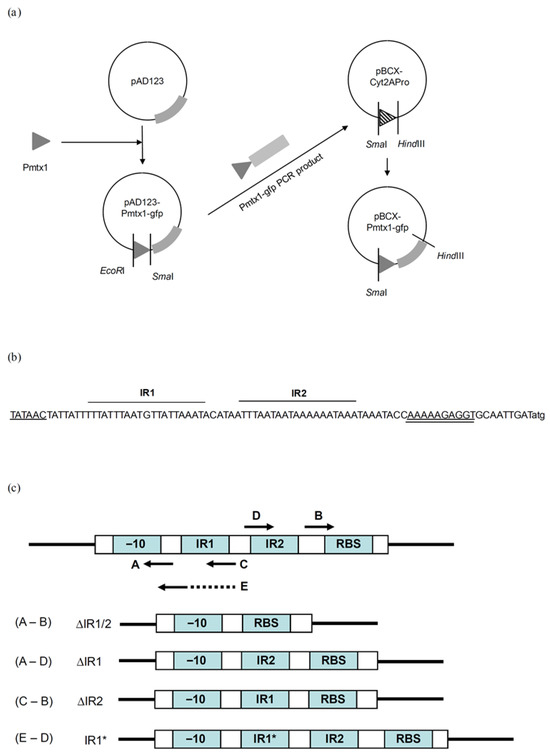
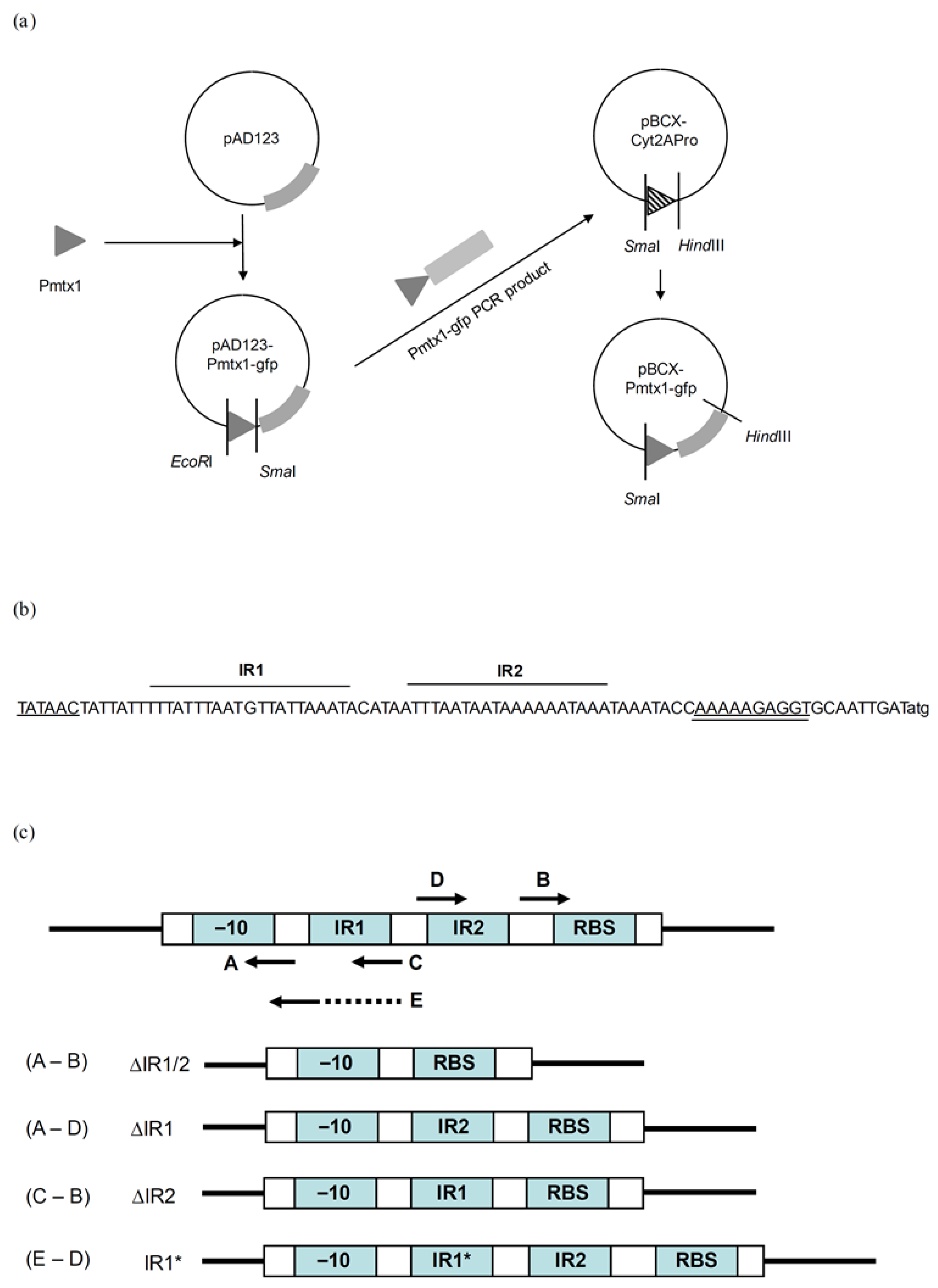
The promoter region of mtx1 (Pmtx1) was amplified from Ls2297 genomic DNA using primers Pmtx1F and Pmtx1R, including the native 5′ UTR and start codon, and inserted into pAD123 containing a promoterless gfp gene at the EcoRI and SmaI sites to generate pAD123-Pmtx1-gfp. The Pmtx1-gfp fragment was subsequently amplified using primers pAD123-checkF and gfpRev, digested with HindIII, and ligated into pBCX-cyt2APro digested with SmaI and HindIII to replace the cyt2A promoter region, yielding pBCX-Pmtx1-gfp (Figure 1a). This plasmid served as the template for constructing four Pmtx1 variants (Figure 1c). Three of these mutants carried deletions in the inverted repeat upstream of the ribosome-binding site of mtx1: the ΔIR1/2 variant lacked the entire inverted repeat, ΔIR1 lacked the first half of the repeat, and ΔIR2 lacked the second half of the repeat. The fourth construct (IR1*) carried targeted nucleotide substitutions in the first half of the inverted repeat, designed to disrupt base pairing and prevent formation of the predicted stem-loop secondary structure without altering the ribosome-binding site. The wild-type Pmtx1 reporter construct was generated using primers A and B. Deletion of IR1, IR2, and IR1/IR2 was achieved using primer pairs A-D, C-B, and A-B, respectively (Figure 1c). The IR1* substitution mutant was constructed using primer E in combination with primer D. Primer sequences provided in Table 1.
Figure 1.
Plasmid construction and generation of Pmtx1 variants. (a) Plasmid construction scheme. The Pmtx1 region (gray triangle) was first inserted upstream of promoterless gfp (gray rectangle) in pAD123. The resulting Pmtx1-gfp fragment was then amplified and inserted into pBCX-cyt2APro, replacing the cyt2APro region (striped triangle). The obtained plasmid, pBCX-Pmtx1-gfp, was used as the template for generating Pmtx1 variants. (b) DNA sequence upstream of mtx1. The −10 sequences are underlined, and the ribosome-binding site is double underlined. Lowercase letters indicate the translation start site. (c) Schematic representation of the different Pmtx1 constructs. The promoter region of mtx1 includes the −10 element (−10), the first half of the inverted repeat (IR1), the second half (IR2), and the ribosome-binding site (RBS). IR1* denotes altered bases within IR1. In the IR1* construct, base substitutions were introduced to disrupt predicted complementarity with IR2 and prevent stem-loop formation. Arrows labeled A–E indicate primers used for constructing Pmtx1 variants; primer pairs corresponding to each construct are shown in parentheses to the left of each variant.
Table 1.
Primers used in this study. Restriction enzyme recognition sites are underlined. Mutated nucleotides introduced in the IR1* construct are shown in bold and underlined. tMtx1 is defined as the truncated mtx1 gene fragment.
All variants were generated by whole-plasmid PCR using Phusion High-Fidelity DNA Polymerase (NEB, Ipswich, MA, USA) according to the manufacturer’s recommendations. Typical 50 µL reactions contained 1× HF buffer, 200 µM each dNTP, 0.5 µM of each primer, 50–100 ng plasmid template, and 1 U polymerase. PCR cycling conditions consisted of an initial denaturation at 98 °C for 30 s, followed by 30 cycles of 98 °C for 10 s, 55 °C for 20 s, and 72 °C for 3 min, with a final extension at 72 °C for 5 min. PCR products were resolved on a 1% agarose gel, and the single band corresponding to the full-length plasmid amplicon was excised to remove residual template plasmid, followed by gel purification using a commercial gel extraction kit (Qiagen, Hilden, Germany). The purified linear PCR product was then self-ligated using T4 DNA ligase and transformed into E. coli DH5α. Recombinant plasmids were confirmed by colony PCR and DNA sequencing of the promoter region. Verified constructs were subsequently transformed into Ls2297 and Bsu168 as described above. Primer sequences are listed in Table 1.
2.4. Fluorescence Intensity Measurement
Cells transformed with the various Pmtx1 promoter variants were grown overnight at 37 °C in LB medium supplemented with 10 µg mL−1 tetracycline. The overnight cultures were diluted 1:100 into fresh LB containing the same antibiotic and incubated at 37 °C with shaking (200 rpm) for an additional 7 h. Cell density was monitored, and 1 mL of culture was collected when the OD600 reached approximately 1.0. Cells were harvested by centrifugation at 8000× g for 5 min, the pellets were washed once and resuspended in 1 mL phosphate-buffered saline (PBS), and the suspensions were adjusted to OD600 = 1.0 to ensure comparable cell densities among samples.
Fluorescence intensity was measured using a JASCO FP-6500 spectrofluorometer (Jasco Inc., Tokyo, Japan) with excitation at 488 nm (bandwidth 3 nm) and emission detected at 512 nm (bandwidth 3 nm) in 1 cm quartz cuvettes. Relative promoter activity was expressed as fluorescence intensity compared with the wild-type Pmtx1 construct measured in the same assay. Fluorescence values represent the mean ± SD from three independent biological replicates. Statistical analysis was performed using one-way ANOVA followed by pairwise t-tests to evaluate differences between promoter variants and the wild-type control. A p value < 0.05 was considered statistically significant. Pairwise t-tests were performed without multiple-comparison correction, as the analysis was exploratory and specifically aimed at comparing each promoter variant to the wild-type control.
2.5. Western Blot Analysis
For sample preparation, 1 mL of culture was separated into supernatant (media) and cell pellet fractions. The culture supernatant was precipitated with trichloroacetic acid (TCA) to a final concentration of 10% (w/v) and incubated on ice for 30 min. The precipitated proteins were collected by centrifugation at 12,000× g for 10 min at 4 °C, washed once with cold acetone, and air-dried briefly before being resuspended in SDS-PAGE sample buffer. The cell pellet was resuspended directly in 1× SDS sample buffer. All samples were boiled for 10 min prior to analysis by SDS-polyacrylamide gel electrophoresis (SDS-PAGE) and Western blotting as described below.
Equal culture volumes (1 mL) were processed for all samples to ensure equivalent loading between time points. Protein samples were separated by 12% SDS-PAGE and transferred onto nitrocellulose membranes using a semi-dry blotting system. Membranes were blocked overnight at 4 °C in PBS containing 0.1% Tween 20 (PBST) and 5% skimmed milk. After blocking, membranes were incubated for 2 h at room temperature with a rabbit polyclonal antiserum against Mtx1 diluted 1:3000 in PBST containing 1% skimmed milk. The membranes were then washed three times for 10 min each with PBST and incubated for 1 h with an alkaline phosphatase-conjugated goat anti-rabbit IgG secondary antibody (1:5000 dilution) prepared in PBST containing 1% skimmed milk. After three additional washes with PBST, color development was performed using BCIP (5-bromo-4-chloro-3-indolyl-phosphate) and NBT (nitro blue tetrazolium) until the desired band intensity was observed.
2.6. Construction of pHT43-tMtx1, Culture Collection, and Larvicidal Activity Assay Against Culex quinquefasciatus Larvae
To construct pHT43-tMtx1, the tMtx1 fragment was amplified from plasmid pGEX-tMtx1 using primers tMtx1f-XbaI and tMtx1r-AatII. The PCR product was digested with XbaI and AatII, ligated into pHT43 cut with the same enzymes, and transformed into BsuWB800N. Primer sequences are listed in Table 1.
Recombinant BsuWB800N strains harboring pHT43-tMtx1 were cultured in LB broth containing 10 µg mL−1 chloramphenicol at 37 °C with shaking (200 rpm). When cultures reached mid-logarithmic phase (OD600 ~ 0.6–0.8), 1 mM IPTG (isopropylthio-β-D-thiogalactoside) was added to induce expression, and incubation was continued for 24 h. Cultures were then centrifuged at 8000× g for 10 min, and the resulting supernatants were collected for larvicidal bioassays.
For this study, a purified Mtx1 was not included as a positive control, as the primary objective was the functional confirmation of the secreted tMtx1 activity. Larvicidal activity was evaluated using C. quinquefasciatus second-instar larvae (provided by the Institute of Molecular Biosciences, Mahidol University, Thailand). Bioassays were performed in 24-well plates, each well containing five larvae in 1 mL of water. An equal volume (1 mL) of twofold serially diluted culture supernatant was added to each well. Twofold serial dilutions of sterile LB medium served as negative controls. For each concentration, 20 larvae were tested in total. Larval mortality was recorded after 48 h of incubation at room temperature, and corrected mortality was calculated from seven independent assays. Statistical analysis was performed by comparing the percentage mortality of the pHT43-tMtx1 samples against the pHT43 empty vector control at each dilution. The unpaired, two-sample t-test assuming unequal variances was used to determine statistical significance. The Dilution for 50% Mortality (D50) was calculated using Probit Analysis, software SPSS 11.5.
3. Results
3.1. Role of Inverted Repeat in Regulation of mtx1 Expression
A potential stem-loop structure is predicted to form from the inverted repeats (IR1 and IR2) located upstream of mtx1, as analyzed using the RNAfold program [34] (http://rna.tbi.univie.ac.at/cgi-bin/RNAWebSuite/RNAfold.cgi (accessed 20 October 2024). This structure is positioned between the predicted −10 element and the ribosome-binding site and could act as a translational repressor (Figure 1b).
To test the hypothesis that this structure modulates expression, four Pmtx1 variants were generated: three deletion constructs (ΔIR1, ΔIR2, and ΔIR1/2) that individually or jointly removed the inverted-repeat halves, and one substitution construct (IR1*) that disrupted base pairing within IR1 while retaining sequence length (Figure 1c). Each variant was fused to gfp in plasmid pBCX and expressed in both L. sphaericus (Ls2297) and B. subtilis (Bsu168).
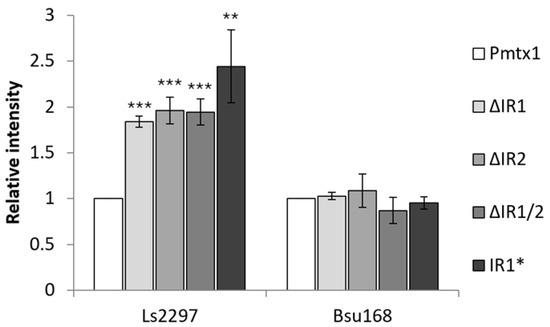
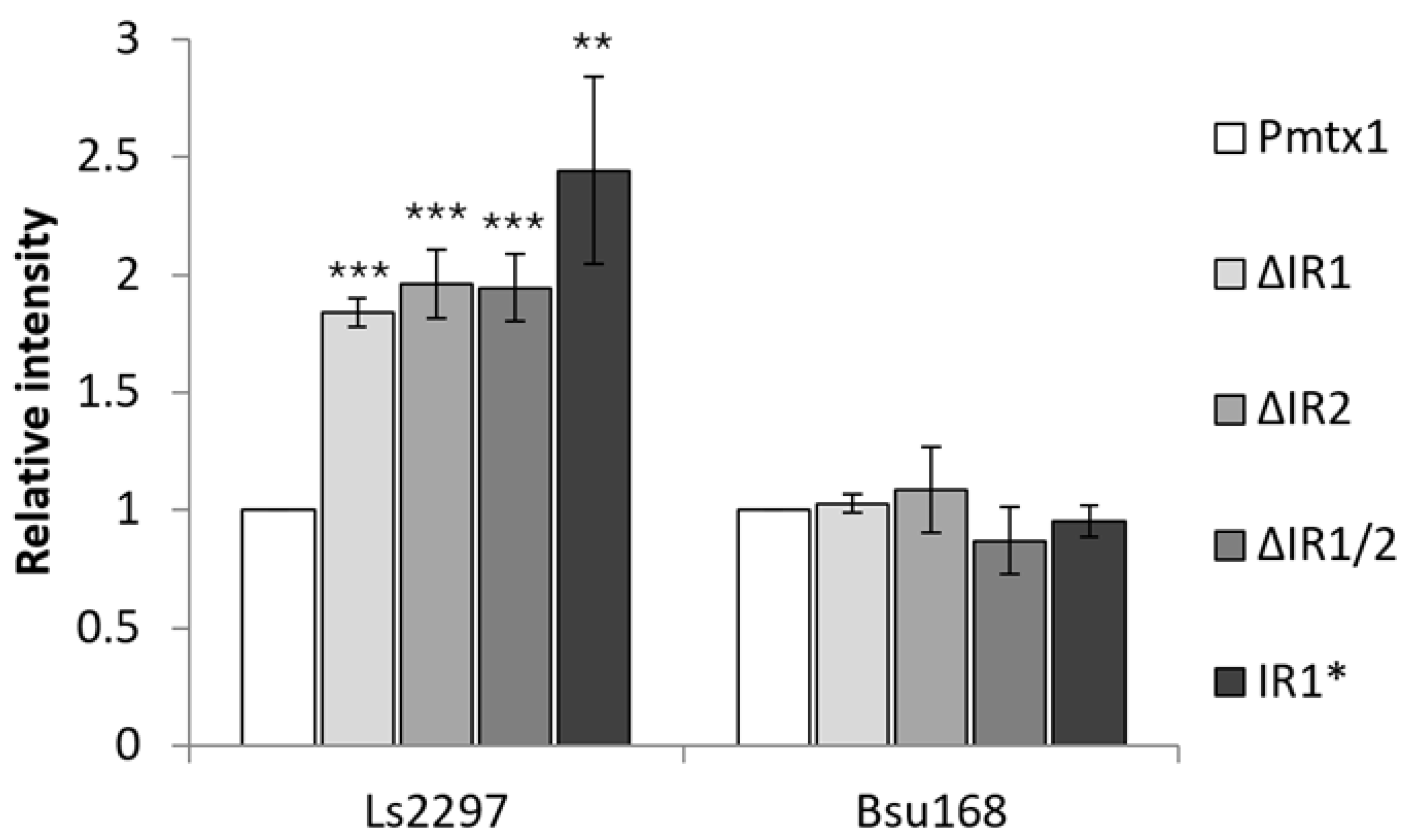
As shown in Figure 2, deletion of either or both halves of the inverted repeat (ΔIR1, ΔIR2, or ΔIR1/2) resulted in approximately twofold higher fluorescence in Ls2297 relative to the wild-type Pmtx1. The IR1* substitution mutant showed the highest derepression, yielding approximately 2.5-fold greater fluorescence than the wild-type promoter. Statistical analysis confirmed significant overall differences among the Ls2297 variants (one-way ANOVA, p = 0.000175). Subsequent pairwise t-tests comparing each mutant to the wild-type control confirmed that the fluorescence values for all mutants were statistically significantly higher than the wild-type control (p < 0.05 for all comparisons). Because mRNA abundance was not measured, the observed differences in GFP fluorescence cannot distinguish between effects on translation efficiency and mRNA stability.
Figure 2.
Fluorescence intensity of Pmtx1 variants. Ls2297 and Bsu168 were transformed with wild-type and mutant Pmtx1 constructs fused to gfp. Fluorescence values were normalized to OD600 and are shown as relative fluorescence units compared to the wild-type promoter in each host. Data represent SD from three independent biological replicates. Statistical significance relative to wild-type Pmtx1 in Ls2297 was determined by one-way ANOVA followed by pairwise t-tests and is indicated in the figure (* p < 0.05, ** p < 0.01, *** p < 0.001).
In contrast, when the same constructs were expressed in Bsu168, fluorescence levels were comparable across all promoter variants, including the wild-type control. This was supported by the one-way ANOVA for Bsu168, which showed no significant difference among the variants (p = 0.1586). This finding suggests that the regulatory effect is host-specific. However, these statistical comparisons should be interpreted cautiously, as no correction for multiple testing was applied and the analysis was exploratory in nature.
3.2. tMtx1 Expression and Secretion in BsuWB800N
To overcome the proteolytic instability of Mtx1 observed in L. sphaericus, the protease-deficient strain BsuWB800N was used as a heterologous expression host. This strain lacks eight extracellular proteases (including AprE, NprE, Epr, Bpr, Mpr, NprB, Vpr, and WprA). The expression vector pHT43, containing the strong IPTG-inducible Pgrac promoter and the amyQ signal peptide, was used to direct proteins through the Sec-dependent secretion pathway.
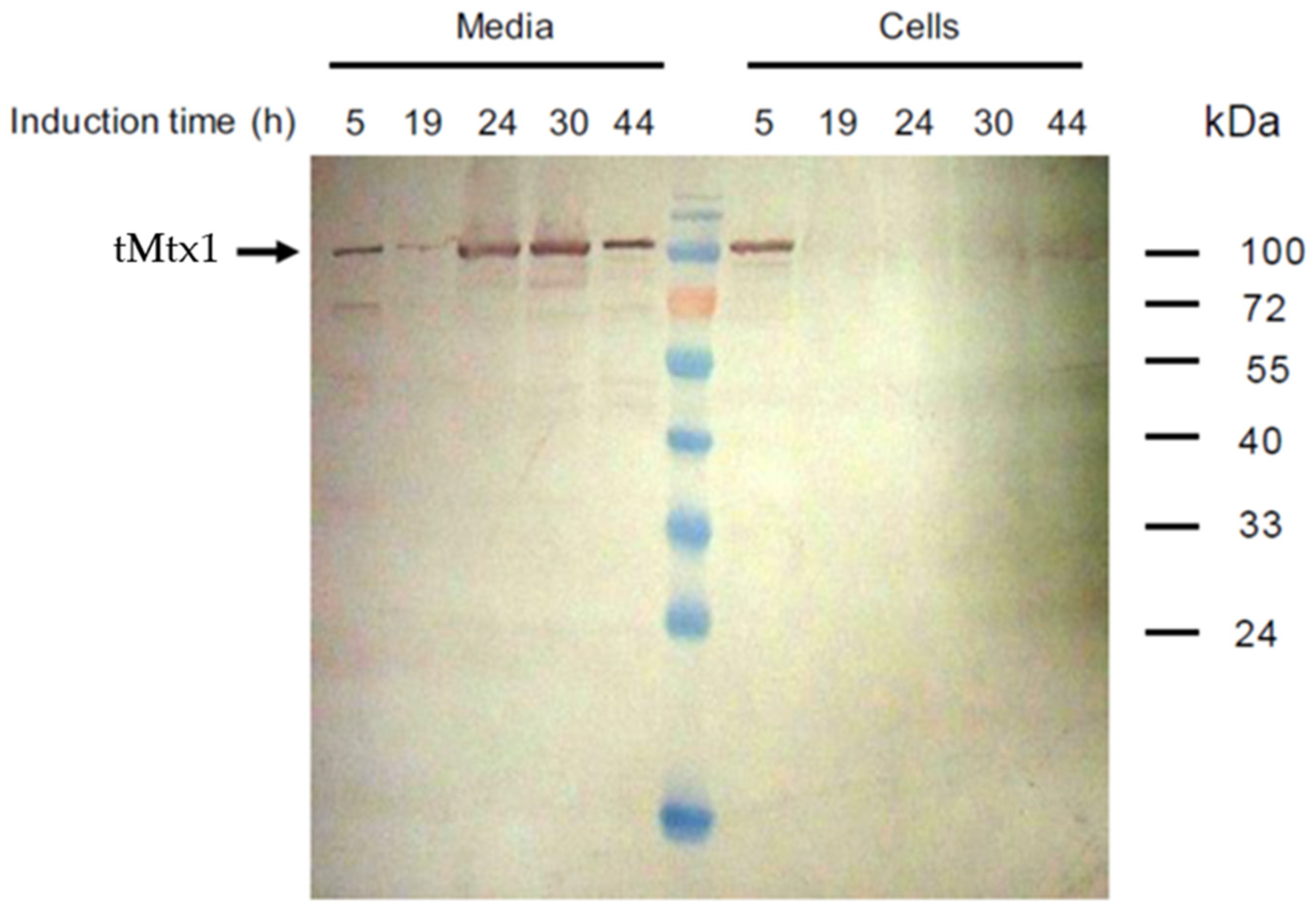
Following IPTG induction, tMtx1 production was examined in both the cell pellet and culture supernatant fractions (Figure 3). This analysis is qualitative, as samples were loaded based on equal culture volume rather than normalized by OD600 or total protein content, and band intensities were not quantified by densitometry. At 5 h post-induction, tMtx1 was detectable in both fractions, indicating that secretion occurred concurrently with intracellular synthesis. As growth entered stationary phase (e.g., 19 h), the extracellular signal became visibly stronger and appeared to contain the bulk of the produced tMtx1, while the intracellular signal was visibly diminished. The subsequent disappearance of the cytoplasmic tMtx1 band beyond 19 h suggests that active synthesis had largely ceased. Crucially, the intact extracellular tMtx1 band (~96 kDa) remained visibly stable up to 44 h post-induction. No lower-molecular-weight degradation products were discernible. Together, these results support increased proteolytic stability of tMtx1 in the BsuWB800N host under the conditions tested.
Figure 3.
Western blot analysis of tMtx1 expression and secretion by BsuWB800N (pHT43-tMtx1). Samples were collected at 5, 19, 24, 30, and 44 h after induction with 1 mM IPTG. For each time point, 1 mL of culture was separated into supernatant (Media) and cell-pellet (Cells) fractions. The culture supernatant was precipitated with 10% TCA prior to SDS-PAGE. The cell pellet (Cells) lanes were loaded with protein isolated from a fixed volume of culture (1 mL) and were not normalized based on cell density (OD600) or total protein, and band intensities were not quantified by densitometry. An arrow indicates the band corresponding to the intact tMtx1 protein (~96 kDa). Molecular-mass markers (kDa) are shown on the right.
3.3. Larvicidal Activity of Secreted tMtx1
To evaluate whether the secreted tMtx1 protein was biologically active, culture supernatants of BsuWB800N (pHT43-tMtx1) collected 24 h after IPTG induction were assayed for larvicidal activity against C. quinquefasciatus larvae. Given that the concentration of tMtx1 in the culture medium could not be precisely quantified, larvicidal activity was assessed based on the serial dilution factor of the culture supernatant. Twofold serial dilutions of the culture supernatant were tested.
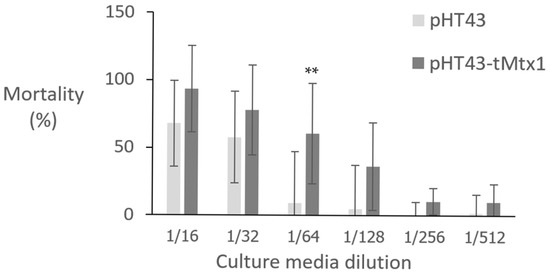
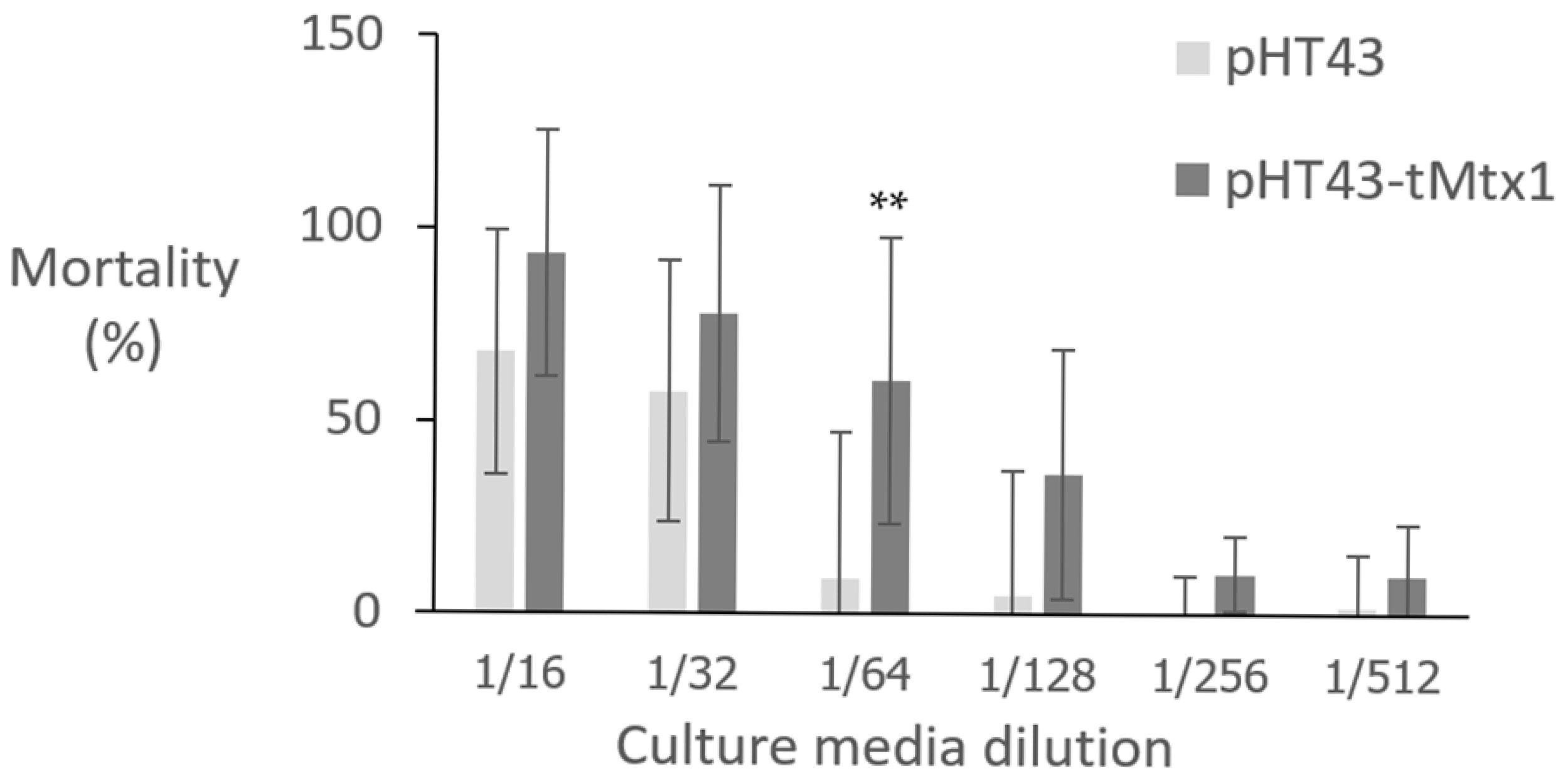
Supernatants from BsuWB800N harboring pHT43-tMtx1 exhibited significantly higher larval mortality than those containing the empty plasmid pHT43, with toxicity discernible even at 1:512 dilutions (Figure 4). The larvicidal activity was statistically significant at the 1:64 dilution compared to the control (t-test, p = 0.005). No significant difference was observed at more dilute concentrations. The estimated Dilution for 50% Mortality (D50) was found to be 1:83 (95% CI: 1:72 to 1:95 dilution).
Figure 4.
Toxicity of the culture supernatant from BsuWB800N (pHT43-tMtx1) against C. quinquefasciatus larvae. Values represent the means ± standard deviation from seven independent biological replicates. Significant difference between the test sample and the empty vector control was determined by an unpaired two-sample t-test assuming unequal variances. A statistically significant difference was observed only at the 1:64 dilution (** p = 0.005).
4. Discussion
4.1. The Pmtx1 Inverted Repeat Functions as a Host-Specific Repressor
Secondary RNA structures located within 5′ untranslated regions are well known to modulate mRNA translation and stability in bacteria [20,22]. The results from the promoter-fusion constructs demonstrate that the inverted repeats (IR1 and IR2) contribute to the negative regulation of mtx1 expression in L. sphaericus. The statistically significant increase in expression (approximately 2- to 2.5-fold) observed upon deletion of either half (IR1 or IR2) and the substitution in IR1 (IR1*) provides the first direct experimental validation of the inhibitory role of this predicted stem-loop structure. This pattern indicates that both inverted repeats contribute to this level of repression and that the integrity of the predicted stem-loop structure is critical for this regulatory effect. This finding strongly supports a mechanism in which the folding of the RNA secondary structure modestly interferes with access to the ribosome-binding site (RBS) or hinders RNA polymerase progression, thereby contributing to the repression of mtx1 expression.
Preliminary expression analysis using the mtx1 promoter fused to gfp revealed that fluorescence intensity in Ls2297 was approximately fourfold lower than that in Bsu168, suggesting that expression of mtx1 may be intrinsically repressed or less efficient in its native host. The higher expression observed in B. subtilis could also partly reflect differences in plasmid copy number or promoter recognition efficiency, as shuttle vectors often replicate more efficiently in Bacillus species [35].
Crucially, the statistical analysis showed no significant difference among the promoter variants in the Bsu168 host, despite the regulatory RNA element being identical. This result suggests that repression mediated by the mtx1 stem-loop occurs only in the native L. sphaericus background. This host-specific difference implies the involvement of an auxiliary regulatory factor.
We hypothesize that the absence of repression in B. subtilis could reflect a missing L. sphaericus-specific factor. It is therefore highly plausible that L. sphaericus encodes an unidentified factor, such as an RNA-binding protein (e.g., a CsrA-like protein or Hfq) or a transcription antiterminator, recognizing the stem-loop structure to trigger repression [36,37]. Alternatively, the absence of repression could be due to host-specific differences in the accessibility of ribonucleases or the inherent RNA folding kinetics that differentially affect the stability or conformation of the mtx1 mRNA in the two species [38,39].
We interpret the observed differences in fluorescence primarily as translational effects. However, we acknowledge that 5′ UTR structures can also significantly influence mRNA stability [40]. Therefore, the differences in reporter activity may partially reflect changes in transcript abundance rather than purely translational efficiency. Distinguishing between these mechanisms would require quantitative reverse transcription-PCR (qRT-PCR) analysis, which was beyond the scope of this initial study.
Together, these findings demonstrate that the inverted repeat functions as a negative regulatory element in L. sphaericus, most likely by forming a secondary RNA structure that interferes with translation initiation. Its absence of effect in B. subtilis further supports a species-specific post-transcriptional control mechanism; however, the identity of the responsible trans-acting factors remains unknown. Potential candidates include RNA-binding proteins or ribonucleases described in Bacillus and related genera, but their involvement in L. sphaericus is currently speculative and awaits experimental validation. Identifying the regulatory components or RNA-binding factors involved, possibly through transcriptomic or RNA-protein interaction analyses, will be an important next step toward enhancing Mtx1 expression for improved biological control formulations [21,41].
4.2. Suitability of BsuWB800N for tMtx1 Secretion
The combined features of the BsuWB800N-pHT43 system, specifically the protease deficiency and the efficient amyQ signal peptide, make it a robust platform for secretory expression of heterologous proteins [26,42]. The visual absence of lower-molecular-weight degradation products across the 44 h time course (Figure 3) indicates that BsuWB800N effectively limited proteolytic degradation, allowing for the secretion of intact, full-length tMtx1. While this observation is qualitative based on the Western blot analysis, it clearly highlights the suitability of this protease-deficient strain for stabilizing sensitive heterologous toxins.
Although the overall production yield appeared low (as quantitative yield analysis was not performed), the successful secretion of biologically active tMtx1, evidenced by a high estimated LD50 of 1:83 dilution, confirms the suitability of BsuWB800N as a host. The likely limited yield may reflect intrinsic differences in folding efficiency or secretion compatibility of the large Mtx1 protein (~96 kDa) with the Sec pathway. This low yield is consistent with previous observations from our laboratory, where heterologous secretion of the related mosquitocidal protein Mtx2 in the same BsuWB800N host also resulted in limited yield [43]. Nevertheless, these observations highlight the suitability of BsuWB800N as a host for producing secreted insecticidal proteins.
The secretion machinery of B. subtilis is highly adaptable and can be fine-tuned through signal-peptide screening and optimization of the Sec and signal-recognition-particle (SRP) pathways to further improve yield and folding efficiency [44,45]. Future optimization could involve testing alternative secretion signals or co-expressing molecular chaperones to facilitate export of complex toxins such as Mtx1. For example, the co-expression of the extracytoplasmic chaperone PrsA could be employed to assist Sec-mediated transport and prevent aggregation, as PrsA overexpression is known to significantly improve the folding and secretion efficiency of various enzymes in B. subtilis [46]. Enhanced extracellular accumulation of active toxin would greatly simplify purification and formulation for biological-control applications.
4.3. Larvicidal Activity and Expression Context
The observed background activity in the control (pHT43) culture medium is consistent with previous reports that B. subtilis produces lipopeptide biosurfactants, mainly surfactin, fengycin, and iturin, that are toxic to mosquito larvae. These amphiphilic compounds disrupt the larval cuticle and interfere with surface respiration, leading to mortality [47,48,49,50]. Because biosurfactant synthesis in B. subtilis is repressed under glucose- or glutamine-rich conditions [51], the use of standard LB medium, which lacks these repressing nutrients, likely permitted biosurfactant production and explains the observed baseline toxicity. Despite this background toxicity, the potency of the tMtx1-containing supernatant was confirmed, with a statistically significant larvicidal activity observed at the 1:64 dilution and an estimated D50 of 1:83 dilution.
The observed background toxicity in the control supernatant suggests the presence of biologically active components that may contribute to larval mortality independently of tMtx1. The sharp decline in control mortality beyond the 1:32 dilution indicates that this activity is likely dominated by a physical surfactant effect, in which biosurfactants reduce water surface tension and impair larval respiration [47]. At lower, more realistic concentrations, residual biosurfactants may act as membrane-disrupting agents. Upon ingestion, this secondary biological activity could compromise the integrity of the larval midgut epithelium [50], potentially enhancing access and activity of the co-ingested tMtx1 protein. Taken together, these observations suggest that unpurified culture supernatants may exert larvicidal effects through multiple, complementary mechanisms, which could be advantageous for future development of integrated biological control strategies. Future studies should clarify the relative contributions of biosurfactants and tMtx1, determine whether their activities are additive or synergistic and guide optimization of culture conditions.
Another approach to limit Mtx1 degradation is to express it during sporulation, when access of proteases to newly produced proteins is reduced. Consistent with this rationale, Yang et al. [19] showed that Mtx1 driven by the L. sphaericus bin sporulation-specific promoter in B. thuringiensis subsp. israelensis 4Q7 yielded cells toxic to Culex larvae. We explored this alternative strategy using two sporulation promoters: the cyt2A promoter from B. thuringiensis, previously shown in our laboratory to enhance production of diverse proteins [52,53], and the PJ promoter, reported as a strong sporulation promoter from Ls2297 [54]. In these comparative experiments, cells expressing Mtx1 under the control of both sporulation promoters were successfully protected from degradation, and the resulting cells were confirmed to be toxic to Culex larvae. However, similar to the findings for vegetative secretion, the overall accumulation of Mtx1 remained a limiting factor. Thus, while sporulation-phase expression can effectively mitigate instability and ensure toxin protection, these results reinforce that achieving high production of Mtx1 remains challenging and will likely require further optimization of secretion signals and expression context.
5. Conclusions and Future Perspectives
The Mtx1 protein from L. sphaericus exhibits potent mosquitocidal activity but has faced challenges for practical large-scale application due to its low native expression level and instability. Our findings provide key insights into these limitations: an inverted repeat sequence upstream of the mtx1 ribosome-binding site was identified as contributing to translational repression in L. sphaericus. To address stability, BsuWB800N, a protease-deficient strain optimized for secretory expression, was employed as a heterologous host. The secreted Mtx1 was confirmed to be biologically active.
While the protein stability and biological activity are confirmed, the overall yield remains low, necessitating further optimization before this platform is viable for commercial development. Future improvement should focus on strategies to boost expression, such as promoter engineering, including the evaluation of strong or sporulation-specific promoters (e.g., those derived from cry3A or vip3A genes) to enhance Mtx1 accumulation [55]. Additionally, optimization of the secretion pathway, potentially through signal peptide screening or the co-expression of molecular chaperones, is warranted.
For large-scale and field applications, integration of optimized expression cassettes into the B. subtilis chromosome must be explored to ensure genetic stability and avoid the need for antibiotic selection. Furthermore, a direct acknowledgment of remaining gaps is essential: the optimization of final product formulation stability and the verification of efficacy under field-like conditions are necessary steps before deployment.
These results demonstrate a viable strategy for stabilizing and secreting the active toxin. This secretory approach inherently simplifies downstream processing by separating the toxin from the bulk of the bacterial cell biomass, facilitating purification. These insights could help guide future optimization efforts aimed at developing a high-yield, stable B. subtilis-based Mtx1 system suitable for potential incorporation into biocontrol formulations, while also requiring full consideration of biosafety and environmental containment for a recombinant B. subtilis-based larvicidal approach.
Author Contributions
S.S. initiated and designed the study, performed experiments, analyzed the data and wrote the first draft of the manuscript. B.P. supervised the work of S.S., helped interpret the data, edited the final draft of the manuscript. All authors have read and agreed to the published version of the manuscript.
Funding
This work was supported by the National Center for Genetic Engineering and Biotechnology, National Science and Technology Development Agency, Thailand (grant no. P1010720) and the Thailand Research Fund (grant no. TRG5380013).
Institutional Review Board Statement
Not applicable.
Informed Consent Statement
Not applicable.
Data Availability Statement
The raw data supporting the conclusions of this article will be made available by the authors on request.
Acknowledgments
We thank the Institute of Molecular Biosciences, Mahidol University, Thailand, for providing mosquito larvae.
Conflicts of Interest
The authors declare no conflicts of interest.
References
- Berry, C. The bacterium, Lysinibacillus sphaericus, as an insect pathogen. J. Invertebr. Pathol. 2012, 109, 1–10. [Google Scholar] [CrossRef] [Scilit] [PubMed]
- Valtierra-de-Luis, D.; Villanueva, M.; Berry, C.; Caballero, P. Potential for Bacillus thuringiensis and other bacterial toxins as biological control agents to combat Dipteran pests of medical and agronomic importance. Toxins 2020, 12, 773. [Google Scholar] [CrossRef] [Scilit]
- Crickmore, N.; Zeigler, D.R.; Feitelson, J.; Schnepf, E.; Van Rie, J.; Lereclus, D.; Baum, J.; Dean, D.H. Revision of the nomenclature for the Bacillus thuringiensis pesticidal crystal proteins. Microbiol. Mol. Biol. Rev. 1998, 62, 807–813. [Google Scholar] [CrossRef] [Scilit] [PubMed]
- Schnepf, E.; Crickmore, N.; Van Rie, J.; Lereclus, D.; Baum, J.; Feitelson, J.; Zeigler, D.R.; Dean, D.H. Bacillus thuringiensis and its pesticidal crystal proteins. Microbiol. Mol. Biol. Rev. 1998, 62, 775–806. [Google Scholar] [CrossRef] [Scilit] [PubMed]
- Broadwell, A.H.; Baumann, L.; Baumann, P. The 42- and 51-kilodalton mosquitocidal proteins of Bacillus sphaericus 2362: Construction of recombinants with enhanced expression and in vivo studies of processing and toxicity. J. Bacteriol. 1990, 172, 2217–2223. [Google Scholar] [CrossRef] [Scilit]
- Charles, J.F.; Nielson-LeRoux, C.; Delecluse, A. Bacillus sphaericus toxins: Molecular biology and mode of action. Annu. Rev. Entomol. 1996, 41, 451–472. [Google Scholar] [CrossRef]
- Baumann, P.; Clark, M.A.; Baumann, L.; Broadwell, A.H. Bacillus sphaericus as a mosquito pathogen: Properties of the organism and its toxins. Microbiol. Rev. 1991, 55, 425–436. [Google Scholar] [CrossRef]
- Chan, S.W.; Thanabalu, T.; Wee, B.Y.; Porter, A.G. Unusual amino acid determinants of host range in the Mtx2 family of mosquitocidal toxins. J. Biol. Chem. 1996, 271, 14183–14187. [Google Scholar] [CrossRef] [Scilit]
- Liu, J.W.; Porter, A.G.; Wee, B.Y.; Thanabalu, T. New gene from nine Bacillus sphaericus strains encoding highly conserved 35.8-kilodalton mosquitocidal toxins. Appl. Environ. Microbiol. 1996, 62, 2174–2176. [Google Scholar] [CrossRef] [Scilit]
- Thanabalu, T.; Berry, C.; Hindley, J. Cytotoxicity and ADP-ribosylating activity of the mosquitocidal toxin from Bacillus sphaericus SSII-1: Possible roles of the 27- and 70-kilodalton peptides. J. Bacteriol. 1993, 175, 2314–2320. [Google Scholar] [CrossRef] [Scilit]
- Schirmer, J.; Wieden, H.J.; Rodnina, M.V.; Aktories, K. Inactivation of the elongation factor Tu by mosquitocidal toxin-catalyzed mono-ADP-ribosylation. Appl. Environ. Microbiol. 2002, 68, 4894–4899. [Google Scholar] [CrossRef] [Scilit] [PubMed]
- Thanabalu, T.; Hindley, J.; Jackson-Yap, J.; Berry, C. Cloning, sequencing, and expression of a gene encoding a 100-kilodalton mosquitocidal toxin from Bacillus sphaericus SSII-1. J. Bacteriol. 1991, 173, 2776–2785. [Google Scholar] [CrossRef] [Scilit] [PubMed]
- Thanabalu, T.; Hindley, J.; Berry, C. Proteolytic processing of the mosquitocidal toxin from Bacillus sphaericus SSII-1. J. Bacteriol. 1992, 174, 5051–5056. [Google Scholar] [CrossRef] [Scilit] [PubMed]
- Rungrod, A.; Tjahaja, N.K.; Soonsanga, S.; Audtho, M.; Promdonkoy, B. Bacillus sphaericus Mtx1 and Mtx2 toxins co-expressed in Escherichia coli are synergistic against Aedes aegypti larvae. Biotechnol. Lett. 2009, 31, 551–555. [Google Scholar] [CrossRef] [Scilit] [PubMed]
- Wirth, M.C.; Yang, Y.; Walton, W.E.; Federici, B.A.; Berry, C. Mtx toxins synergize Bacillus sphaericus and Cry11Aa against susceptible and insecticide-resistant Culex quinquefasciatus larvae. Appl. Environ. Microbiol. 2007, 73, 6066–6071. [Google Scholar] [CrossRef] [Scilit]
- Su, T.; Thieme, J.; Ocegueda, C.; Ball, M.; Cheng, M.-L. Resistance to Lysinibacillus sphaericus and other commonly used pesticides in Culex pipiens (Diptera: Culicidae) from Chico, California. J. Med. Entomol. 2018, 55, 423–428. [Google Scholar] [CrossRef] [Scilit]
- Menezes, H.S.G.; Costa-Latgé, S.G.; Genta, F.A.; Napoleão, T.H.; Paiva, P.M.G.; Romão, T.P.; Silva-Filha, M.H.N.L. A Culex quinquefasciatus strain resistant to the binary toxin from Lysinibacillus sphaericus displays altered enzyme activities and energy reserves. Parasit. Vectors 2023, 16, 273. [Google Scholar] [CrossRef] [Scilit]
- Ahmed, H.K.; Mitchell, W.J.; Priest, F.G. Regulation of mosquitocidal toxin synthesis in Bacillus sphaericus. Appl. Microbiol. Biotechnol. 1995, 43, 310–314. [Google Scholar] [CrossRef]
- Yang, Y.; Wang, L.; Gaviria, A.; Yuan, Z.; Berry, C. Proteolytic stability of insecticidal toxins expressed in recombinant bacilli. Appl. Environ. Microbiol. 2007, 73, 218–225. [Google Scholar] [CrossRef] [Scilit]
- Gold, L. Posttranscriptional regulatory mechanisms in Escherichia coli. Annu. Rev. Biochem. 1988, 57, 199–233. [Google Scholar] [CrossRef]
- Babitzke, P.; Baker, C.S.; Romeo, T. Regulation of translation initiation by RNA binding proteins. Annu. Rev. Microbiol. 2009, 63, 27–44. [Google Scholar] [CrossRef] [Scilit] [PubMed]
- Peng, A.; Yin, G.; Zuo, W.; Zhang, L.; Du, G.; Chen, J.; Wang, Y.; Kang, Z. Regulatory RNAs in Bacillus subtilis: A review on regulatory mechanism and applications in synthetic biology. Synth. Syst. Biotechnol. 2024, 9, 223–233. [Google Scholar] [CrossRef] [Scilit] [PubMed]
- Tants, J.-N.; Schlundt, A. The role of structure in regulatory RNA elements. Biosci. Rep. 2024, 44, BSR20240139. [Google Scholar] [CrossRef] [Scilit]
- Gómez-Garzón, C.; Hernández-Santana, A.; Dussán, J. A genome-scale metabolic reconstruction of Lysinibacillus sphaericus unveils unexploited biotechnological potentials. PLoS ONE 2017, 12, e0179666. [Google Scholar] [CrossRef] [Scilit] [PubMed]
- Jeong, H.; Jeong, D.; Park, S.; Kim, S.; Choi, S. Complete genome sequence of Bacillus subtilis strain WB800N, an extracellular protease-deficient derivative of strain 168. Microbiol. Resour. Announc. 2018, 7, e01380-18. [Google Scholar] [CrossRef] [Scilit]
- Neef, J.; van Dijl, J.M.; Buist, G. Recombinant protein secretion by Bacillus subtilis and Lactococcus lactis: Pathways, applications, and innovation potential. Essays Biochem. 2021, 65, 187–195. [Google Scholar] [CrossRef] [Scilit]
- Lenz, P.; Bakkes, P.J.; Müller, C.; Malek, M.; Freudl, R.; Oldiges, M.; Drepper, T.; Jaeger, K.; Knapp, A. Analysis of protein secretion in Bacillus subtilis by combining a secretion stress biosensor strain with an in vivo split GFP assay. Microb. Cell Fact. 2023, 22, 203. [Google Scholar] [CrossRef] [Scilit]
- Öktem, A.; Pranoto, D.A.; van Dijl, J.M. Post-translational secretion stress regulation in Bacillus subtilis is controlled by intra- and extracellular proteases. New Biotechnol. 2024, 79, 71–81. [Google Scholar] [CrossRef] [Scilit]
- Promdonkoy, B.; Promdonkoy, P.; Tanapongpipat, S.; Luxananil, P.; Chewawiwat, N.; Audtho, M.; Panyim, S. Cloning and characterization of a mosquito larvicidal toxin produced during vegetative stage of Bacillus sphaericus 2297. Curr. Microbiol. 2004, 49, 84–88. [Google Scholar] [CrossRef] [Scilit]
- Dunn, A.K.; Handelsman, J. A vector for promoter trapping in Bacillus cereus. Gene 1999, 226, 297–305. [Google Scholar] [CrossRef] [Scilit]
- Lertcanawanichakul, M.; Wiwat, C. Improved shuttle vector for expression of chitinase gene in Bacillus thuringiensis. Lett. Appl. Microbiol. 2000, 31, 123–128. [Google Scholar] [CrossRef] [Scilit] [PubMed]
- Bone, E.J.; Ellar, D.J. Transformation of Bacillus thuringiensis by electroporation. FEMS Microbiol. Lett. 1989, 58, 171–178. [Google Scholar] [CrossRef]
- Kunst, F.; Msadek, T.; Rapoport, G. Signal transduction network controlling degradative enzyme synthesis and competence in Bacillus subtilis. In Regulation of Bacterial Differentiation; Piggot, P.J., Moran, C.P., Jr., Youngman, P., Eds.; ASM Press: Washington, DC, USA, 1994; pp. 1–20. [Google Scholar]
- Lorenz, R.; Bernhart, S.H.; Höner zu Siederdissen, C.; Tafer, H.; Flamm, C.; Stadler, P.F.; Hofacker, I.L. ViennaRNA Package 2.0. Algorithms Mol. Biol. 2011, 6, 26. [Google Scholar] [CrossRef] [Scilit]
- Val-Calvo, J.; Miguel-Arribas, A.; Abia, D.; Wu, L.J.; Meijer, W.J.J. pLS20 is the archetype of a new family of conjugative plasmids harboured by Bacillus species. NAR Genom. Bioinform. 2021, 3, lqab096. [Google Scholar] [CrossRef] [Scilit] [PubMed]
- Van Assche, E.; Van Puyvelde, S.; Vanderleyden, J.; Steenackers, H.P. RNA-binding proteins involved in post-transcriptional regulation in bacteria. Front Microbiol. 2015, 6, 141. [Google Scholar] [CrossRef] [Scilit]
- Romeo, T.; Babitzke, P. Global regulation by CsrA and its RNA antagonists. Microbiol. Spectr. 2018, 6. [Google Scholar] [CrossRef] [Scilit]
- Woodson, S.A. RNA folding and ribosome assembly. Curr. Opin. Chem. Biol. 2008, 12, 667–673. [Google Scholar] [CrossRef] [Scilit]
- Taggart, J.C.; Dierksheide, K.J.; LeBlanc, H.J.; Lalanne, J.-B.; Durand, S.; Braun, F.; Condon, C.; Li, G.-W. A high-resolution view of RNA endonuclease cleavage in Bacillus subtilis. Nucleic Acids Res. 2025, 53, gkaf030. [Google Scholar] [CrossRef] [Scilit]
- Chen, F.; Cocaign-Bousquet, M.; Girbal, L.; Nouaille, S. 5′UTR sequences influence protein levels in Escherichia coli by regulating translation initiation and mRNA stability. Front. Microbiol. 2022, 13, 1088941. [Google Scholar] [CrossRef] [Scilit]
- Pi, H.; Weiss, A.; Laut, C.L.; Grunenwald, C.M.; Lin, H.K.; Yi, X.I.; Stauff, D.L.; Skaar, E.P. An RNA-binding protein acts as a major post-transcriptional modulator in Bacillus anthracis. Nat. Commun. 2022, 13, 1491. [Google Scholar] [CrossRef] [Scilit]
- Guo, D.; Li, M.; Jiang, M.; Cong, G.; Liu, Y.; Wang, C.; Li, X. Enhanced extracellular production and characterization of sucrose isomerase in Bacillus subtilis with optimized signal peptides. Foods 2022, 11, 2468. [Google Scholar] [CrossRef] [Scilit]
- Trakulnaleamsai, C.; Promdonkoy, B.; Soonsanga, S. Production of Lysinibacillus sphaericus mosquitocidal protein Mtx2 from Bacillus subtilis as a secretory protein. Protein Pept. Lett. 2021, 28, 1054–1060. [Google Scholar] [CrossRef] [Scilit]
- Fu, L.L.; Xu, Z.R.; Li, W.F.; Shuai, J.B.; Lu, P.; Hu, C.X. Protein secretion pathways in Bacillus subtilis: Implication for optimization of heterologous protein secretion. Biotechnol. Adv. 2007, 25, 1–12. [Google Scholar] [CrossRef] [Scilit]
- Fiedler, S.M.; Graumann, P.L. Bacillus subtilis Sec and Srp systems show dynamic adaptations to different conditions of protein secretion. Cells 2024, 13, 377. [Google Scholar] [CrossRef] [Scilit] [PubMed]
- Hamburger, F.; Schlichting, N.; Eichenlaub, M.; Costea, P.I.; Sauer, C.; Jenewein, S.; Kabisch, J. Automation-aided construction and characterization of Bacillus subtilis PrsA strains for the secretion of amylases. Front. Bioeng. Biotechnol. 2025, 12, 1479626. [Google Scholar] [CrossRef] [Scilit] [PubMed]
- Das, K.; Mukherjee, A.K. Assessment of mosquito larvicidal potency of cyclic lipopeptides produced by Bacillus subtilis strains. Acta Trop. 2006, 97, 168–173. [Google Scholar] [CrossRef] [Scilit] [PubMed]
- Geetha, I.; Manonmani, A.M.; Paily, K.P. Identification and characterization of a mosquito pupicidal metabolite of a Bacillus subtilis subsp. subtilis strain. Appl. Microbiol. Biotechnol. 2010, 86, 1737–1744. [Google Scholar] [CrossRef] [Scilit]
- Manonmani, A.M.; Geetha, I.; Bhuvaneswari, S. Enhanced production of mosquitocidal cyclic lipopeptide from Bacillus subtilis subsp. subtilis. Indian. J. Med. Res. 2011, 134, 476–482. [Google Scholar]
- Revathi, K.; Chandrasekaran, R.; Thanigaivel, A.; Kirubakaran, S.A.; Sathish-Narayanan, S.; Senthil-Nathan, S. Effects of Bacillus subtilis metabolites on larval Aedes aegypti L. Pestic. Biochem. Physiol. 2013, 107, 369–376. [Google Scholar]
- Cosby, W.M.; Vollenbroich, D.; Lee, O.H.; Zuber, P. Altered srf expression in Bacillus subtilis resulting from changes in culture pH is dependent on the Spo0K oligopeptide permease and the ComQX system of extracellular control. J. Bacteriol. 1998, 180, 1438–1445. [Google Scholar] [CrossRef] [Scilit]
- Utamatho, M.; Ratlerdkarn, M.; Promdonkoy, B. DNA Vector for Recombinant Protein Production in Bacterial Hosts, Bacillus spp. Thailand Patent Filing No. 0901004207, 17 September 2009. [Google Scholar]
- Utamatho, M.; Ratlerdkarn, M.; Panyasiri, C.; Promdonkoy, B. DNA Plasmid for Production of Vegetative Insecticidal Proteins (Vips) in Bacterial Hosts, Bacillus spp. Thailand Patent Filing No. 1001001520, 30 September 2010. [Google Scholar]
- Porcar, M.; Juarez-Perez, V.; Delecluse, A. Isolation and characterization of a strong promoter from Bacillus sphaericus strain 2297. J. Invertebr. Pathol. 2002, 81, 57–58. [Google Scholar] [CrossRef] [Scilit]
- Soonsanga, S.; Rungrod, A.; Phaonakrop, N.; Roytrakul, S.; Promdonkoy, B. Proteomic analysis and promoter modification of Bacillus thuringiensis to improve insecticidal Vip3A protein production. Mol. Biotechnol. 2022, 64, 100–107. [Google Scholar] [CrossRef] [Scilit]

Disclaimer/Publisher’s Note: The statements, opinions and data contained in all publications are solely those of the individual author(s) and contributor(s) and not of MDPI and/or the editor(s). MDPI and/or the editor(s) disclaim responsibility for any injury to people or property resulting from any ideas, methods, instructions or products referred to in the content. |
© 2026 by the authors. Licensee MDPI, Basel, Switzerland. This article is an open access article distributed under the terms and conditions of the Creative Commons Attribution (CC BY) license.