Article

Management, Production, Infection Events, and Antimicrobial Use on 25 Commercial Turkey Farms in Germany (2019–2021)—A Descriptive Analysis


by
Lena Sonnenschein-Swanson
1,
Silvia Baur-Bernhardt
2,
Annemarie Käsbohrer
3,
Marcus Georg Doherr
1,*,
Diana Meemken
2,
Mary-Ann Sommer
2,
Birgit Ursula Stetina
4 and
Petra Weiermayer
3,5
1
Institute for Veterinary Epidemiology and Biostatistics, School of Veterinary Medicine, Freie Universität, 14163 Berlin, Germany
2
Institute of Food Safety and Food Hygiene, School of Veterinary Medicine, Freie Universität, 14163 Berlin, Germany
3
Clinical Department for Farm Animals and Food System Science, University of Veterinary Medicine, 1210 Vienna, Austria
4
Faculty of Psychology, Sigmund Freud Private University Vienna, 1020 Vienna, Austria
5
Institute of Integrative Medicine, Department for Medicine, University Witten/Herdecke, 58453 Herdecke, Germany
*
Author to whom correspondence should be addressed.
Poultry 2026, 5(2), 19; https://doi.org/10.3390/poultry5020019
Submission received: 13 October 2025 / Revised: 7 February 2026 / Accepted: 23 February 2026 / Published: 2 March 2026

Abstract

A two-cohort feasibility study was conducted to investigate the potential role of homeopathic therapy in reducing antimicrobial use in turkeys. The objective of the analysis presented here was to describe the complex characteristics of the study farms. For analysis of heterogeneity, data of 25 turkey farms (7 homeopathy (H); 18 conventional (C)) were analyzed. Farms in cohort H had significantly higher numbers of poultry farms nearby and included outdoor husbandry, while those in cohort C included neither organic nor biodynamic husbandry types. During raising, a combination of straw and wood shavings was more frequent, while during fattening, only one type of litter was predominant. Very few additional significant differences were identified at farm level, while at production batch level, several further differences existed. When comparing the study cohort characteristics with national statistics, both cohorts seemed to perform better than the national average. The incidence of antibiotic treatment days was lower in cohort H compared to cohort C (C 0.14, H 0.01, p < 0.001), while production period-related mortality (C 3.7%, H 3.7%) was comparable. Our detailed collection of data, previously unavailable, provides a relevant insight and will enable the analysis of multivariable aspects linked to antimicrobial usage in turkey production.

1. Introduction

Global meat production increased by 1.7 percent in 2024, reaching 379 million tonnes (carcass weight equivalent) [1]. The expansion was primarily underpinned by higher poultry meat output, followed by gains in bovine meat production. In contrast, ovine meat output registered only marginal growth, and pig meat production remained largely stable [1]. In Europe, output gains were primarily attributed to pig and poultry meat, with smaller increases in bovine meat production. In Asia, the expansion of poultry meat was the key contributor to overall growth [1]. Global poultry meat production reached 150 million tonnes in 2024, marking a 2.6 percent year-on-year increase [1]. In 2024, production increases occurred in the four leading producing countries’ respective economic areas: China, the United States, Brazil, and the European Union [1]. In Germany, with gross domestic production of 1.7 million tonnes of slaughter weight, the self-sufficiency rate for poultry meat was around 100 percent [2]. With over 156 million animals, chickens dominated German poultry farms in 2023 [2]. Laying hens and broilers accounted for 93 per cent of the poultry population. In second place was turkey production, with around nine million animals slaughtered per year, mainly for domestic meat consumption. Third place went to duck farming, with around 1.6 million slaughtered animals [2].
The high and still rising global share of poultry meat in total meat production is reflected in a complex and heterogeneous production system, which also includes a quite distinctive hierarchical structure of the production process at the farm level [3,4,5].
Based on the German poultry yearbooks from 2020 to 2022 (corresponding to our study period 2019–2021) [6,7,8], the main breed used in turkey production in Germany is B.U.T. Big Six. Separated by sex in both the raising and fattening period, birds are kept in open stables with a stable-level all-in/all-out management. Maximum legal stocking density is 58 kg/sqm (males) and 52 kg/sqm (females) according to the German mandatory health control program, whereas 53 kg/sqm (males) and 48 kg/sqm (females) are the maximum values in the voluntary Animal Welfare (label) Initiative. Additional information on management and production are described in the poultry yearbooks, but lack details on potentially relevant parameters such as the number of poultry farms nearby, water origin and use of functional phytochemicals [6,7,8].
In Germany, the use of antimicrobials in commercial poultry production has to be reported to the competent authority since 2017 [9,10,11]. Based on these data, half-yearly treatment frequencies are determined for the individual farms and animal species, i.e., the average number of days on which an antimicrobial substance was administered for each individual animal kept in this farm over the half-year observation period and animal species. The range and key indicators of these farm-specific treatment frequencies are presented in national reports. If the median (key indicator 1) of the nationwide half-yearly treatment frequencies is exceeded by an individual farm, the animal keeper must consult a veterinarian to investigate the reasons that may have led to the exceedance, and how the use of antibiotics can be reduced. If the third quartile (key indicator 2) of the nationwide half-yearly therapy frequencies is exceeded, an appropriate action plan must be drafted together with the consulting veterinarian and submitted to the competent authority. The relevant key figures are published half-yearly in the German Federal Gazette [8]. According to the report for the period 2018–2021, the percentage of turkey farms using no antimicrobials at all within a half-year period ranged between 15.7% and 22.7%. In the same period, the key indicator 2 value ranged between 29.8 and 25.6 [11]. The report for 2024 showed a key indicator 2 of 37.8 and 38.0 using an adapted calculation method, while the former calculation method resulted in values of slightly below 30.0 [10].
In 2023, Germany had approximately 700 larger commercial turkey farms with an output of more than 1000 turkeys for fattening for meat production per year and farm. Animals were provided by seven hatcheries. The turkey sector is primarily concentrated in the north, west and eastern regions, most notably in the Federal State of Lower Saxony, where approximately 40% of the total national production takes place. In 2020, Germany produced 387,000 tonnes of turkey meat, while consuming 476,777 tonnes; an average of 5.8 kg of turkey meat was thus consumed per person per year, with consistent numbers over the observation period of our study (years 2019–2021).
Antimicrobial resistance is a serious public health concern, resulting in an estimated 4.71 million deaths worldwide in 2021 that were associated with bacterial antimicrobial resistance (AMR) [12]. The European Farm to Fork Strategy from 2019 set a 50% reduction target of sales of antimicrobials for farmed animals by 2030, which is supported by the new EU Regulations on veterinary medicinal products [13,14]. In addition, the EU Organic Regulation 2018/848 requires giving preference to homeopathy and phytotherapy in organic farms over conventional medicine, including antibiotics [15]. The factors above, combined with several non-clinical factors such as, according to Sousa et al. (2025), inadequate policies/guidelines and need to satisfy farmers’ expectations [16] which resulted in no further reduction in antibiotic prescription, indicate that the potential of integrative medicine (i.e., best practices of complementary and conventional medicine) [17] in reducing numbers of infections and reduced use of antibiotics with a focus on prevention, metaphylaxis and targeted therapy of infectious requires exploration and the development of proofed guidance [18].
To better understand the complexity and dynamic processes contributing to antibiotic usage in farmed poultry production, a scoping review was recently conducted [5]. Several potential risk factors with impact on antimicrobial use related to farmers, housing conditions, management and animal-related factors were identified which need further consideration [5]. To investigate this further, a two-cohort feasibility study was conducted within a project aiming to explore the potential role of homeopathic therapy in reducing antimicrobial use and related antimicrobial resistance in turkeys (the HOMAMR project) [19]. Turkey farm data were collected and analyzed retrospectively, for the comparison of two types of interventions commonly delivered by veterinarians, i.e., farms using conventional medicines only compared to homeopathic-oriented farms in which turkeys only received conventional medical treatment when needed, while considering potential risk factors as well as the complexity and heterogeneity of the production systems [5].
The objectives of this work based on a sample of 25 turkey holdings and 445 production batches in Germany were (i) to describe the turkey production system with emphasis on the value ranges and variability of farm-related, management-related and animal-related factors that could potentially serve as confounders when identifying risk factors for infection related parameters such as incidence of antibiotic treatment and production/performance indicators such as mortality at farm, batch and production period level, (ii) to compare these factors between farms using conventional medicine only (C) and homeopathic-oriented farms (H) as well as between raising and fattening periods, and (iii) to identify similarities with, as well as differences from, German industry figures and official statistics.

2. Materials and Methods

2.1. Participant Recruitment and Data Collection

Participant recruitment, data collection, and the intended data management were described in the published study protocol [19]. In short, four questionnaires were developed and, after a successful testing phase, distributed online via the platform LimeSurvey between June 2023 and June 2024 (LimeSurvey GmbH, Hamburg, Germany, Cloud Version 5.6.18). Each participating farmer answered three questionnaire types, (a) a “farmer record sheet”, (b) a “farm record sheet” per included farm and (c) a “raising, fattening (including slaughter data), breeding report” per respective animal batch and production period. In addition to the data collected through the questionnaires provided to the farm owners/managers, information from several other sources, such as the farm veterinarian, compulsory medical reports (such as medication usage and dispensing records), and abattoirs, was derived for each production batch. Most of the information was collected during on-site visits. A detailed description of the approach and the questionnaires used can be found in the study protocol [19]. A study veterinarian checked the questionnaires for obvious validity problems and forwarded them to the epidemiological study team. Paper-based information was transferred into a digital format using standardized forms. Plausibility checks were conducted during data entry as well as in preparation of the analyses using Excel functions as well as a survey-specific script including survey-specific macros.
The participation in the survey was voluntary. In the first step, a group of seven farms, which were regularly consulted by a veterinary practice specializing in homeopathy-focused herd health management, was recruited for the study. Additionally, an open call was issued to recruit as many control group farms as possible. The response categories were designed as precisely as possible to avoid misclassification and information bias. As the study design was retrospective, there is a risk of recall bias. For this reason, we included only data from January 2019 to December 2021.

2.2. Eligibility Criteria and Potential Risk Factors

Eligibility criteria were described in the study protocol [19]. All farms willing to participate in the study were checked to ensure they met them. Farms specialized in raising and/or fattening and/or breeding of female and/or male turkeys in Germany and Austria, with animals having experienced bacterial or viral infections of the respiratory or gastrointestinal tract or systemic infections at least once during the three-year study period (2019–2021) were included. Infections must have been diagnosed by the treating veterinarian, at least based on clinical symptoms. Homeopathic and conventional medical treatment must have been administered within the framework of a continuous support relationship in 2019–2021 between the farmer and a veterinarian specializing in homeopathy and employed by our research team’s cooperating veterinary practice, or between the farmer and veterinarians from our other (non-homeopathy) cooperating veterinary practices. Farmers unwilling to give consent to provide complete data, and farmers not providing data in due time (six months after receiving survey 3 or 4, respectively) were excluded. For cohort C, another reason for exclusion was if homeopathic medicinal products (HMPs) had been used or prescribed at least occasionally during the three-year retrospective observation period. Hence, in cohort C farms’ use of HMPs was not allowed at all. In cohort H, the lege artis veterinarians’ approach to homeopathic treatment in turkey raising, fattening and breeding was assured, i.e., homeopathic treatment was performed by an experienced homeopathic veterinarian with specified education only [19]. The search strategies and the adapted version of the nominal group technique used to identify potential risk factors were described in the study protocol [19,20]. The update of the literature search and the outcome were described in the scoping review on potential risk factors related to antimicrobial usage and antimicrobial resistance in commercial poultry production [5].

2.3. Data Management

The main unit of analysis was the production batch (cohort of animals), for which the raising, fattening and breeding periods were considered as separate sub-units of analysis to consider divergence in housing, feeding, management, infection, and treatment incidence. Identification of each production period within a farm was defined by using hatching date, housing date, start of fattening if applicable, and end of the individual period or the slaughter date, whichever was appropriate. Codebooks were developed and the level of organization (farm, stable, production period) was identified for each parameter. Stable-specific information was accumulated on the level of the production period if several stables were involved in raising and/or fattening and/or breeding one animal cohort. Farm-specific information such as working engagement, attitude towards homeopathy, attitude towards antibiotics, husbandry type, poultry farms nearby were not evaluated for raising or fattening or breeding separately while production period-specific information was.
Variables considered as treatment intensity, production, performance-specific, and animal welfare parameters in the study protocol [19] were calculated as follows: for the calculation of treatment days, a distinction was made between antibiotics and other substances (e.g., NSAID, Triazin derivates and Aminopyridines). The latter were not counted when the sum of antibiotic treatment days or the number of animals involved (antibiotic treatment animal days) was calculated. Animal days at risk were calculated as follows: the average number of animals kept during the period (number at the beginning plus number at the end, then divided by two) times the length (days) of the specific production period. The first parameter describing treatment intensity, namely incidence of antibiotic treatment days, was calculated per production period as follows: sum of all antibiotic treatment animal days per production period (antibiotic treatment days considered individually by substance class) divided by the average animal days at risk per production period. The second parameter describing antimicrobial treatment intensity was included for a comparison with official benchmarking and calculated as follows: the same nominator was used reflecting the sum of all antibiotic treatment animal days per production period. For the denominator, the average number of animals at risk per production period, was calculated taking into account changes in the number of animals at risk due to partly depopulation for slaughter or death. The number of animals lost per day was calculated as follows: remaining animals (number of animals at the beginning of the production period minus number of animals at the end of the production period) divided by the length of stay on the farm (= number of days). National benchmarking is conducted over a six-month period, with no distinction made between production periods (raising or fattening) [11]. Those estimates (quartiles) were compared with our production-period-specific results in the study period from 2019 to 2021, considering raising and fattening periods separately. In consequence, there was a difference in the definition of the time interval for which the antibiotic treatment frequency was derived, between the benchmarking system and our study results. Calculations and details of data management are summarized in Table 1.

2.4. Statistical Analysis

Two levels of analysis were applied, (i) on farm and (ii) on production-period level, depending on the factors considered. After extracting all relevant information from the survey database and other sources, the respective statistics (depending on the variable format) were used to describe the frequency, central tendency, variability, and distribution of values or categories for all variables in the dataset. Inconsistencies and data gaps were identified, described, and addressed by the research team. Whenever possible, cross-checks were used to identify substantial deviations (more than 10% of the values) in the same values between different sources in numerical variables such as time periods (days) and number of animals in the different production steps. For mortality, a deviation of more than plus or minus 10% was defined as inconsistent. Implausible information was either corrected by re-checking the records and/or consulting the farmer or excluded from the analysis. A culling event due to highly pathogenic avian influenza resulted in the exclusion of the affected production batch, as the production period could not be completed. Whenever two hatching dates or two fattening-starting dates were reported for a production batch, deviations of less than 20% in numerical variables such as time periods (days) and number of animals in the different production steps were allowed, and the first (earlier) date was selected for analysis. If the start of fattening was not specified as a date but as a week, the last day of the week was recorded and selected for further analysis; if the farmer specified nothing, the 35th day of life of the animals was imputed as the start of fattening. In the biodynamic farm defined as a holistic, self-sustaining, and regenerative agricultural system, the end of fattening was determined to be the same for males and females for logistical reasons. Number of animals at the beginning of a production period was used for determining “housing unit size”. Production periods with incomplete slaughter data were excluded if the number of animals at slaughter and the date of slaughter were missing. Incomplete data were handled according to a predefined missing data procedure if only specific data not needed for calculation of primary or secondary outcome parameters were missing. E.g., item-specific implausible data on potential confounding factors, e.g., stocking rate, etc., were handled according to a predefined missing-data procedure. Implausible treatment/slaughter data needed for calculation of primary or secondary outcome parameters were either clarified, or if no clarification was possible, the corresponding experimental unit was excluded from the heterogeneity analysis and the descriptive analysis of treatment intensity, production, performance-specific and animal welfare parameters. The same procedure was applied for units of analysis without information on incidence of antibiotic treatment days and mortality as regards descriptive analysis of treatment intensity, production, performance specific and animal welfare parameters. The data evaluation was conducted using IBM SPSS Statistics v29 and STATA v18. Comparisons of variable-level information between farms using conventional medicine only (C) and farms additionally using homeopathic medicines (H) and their production batches/periods, as well as between raising and fattening periods, were conducted by using cross tabulation and Fisher’s Exact test (Chi2 test if cell frequencies sufficiently large) when parameters were categorical, or Kruskal–Wallis test routines when parameters were numerical counts, scores or true values. For reporting results of Kruskal–Wallis test, the p-values after correction for ties was presented.
For categorical variables without inherent order, numerical coding of the categories followed an assumed risk (from low to high) for disease prevalence, mortality, condemnation/pathological/bacterial/viral/parasitological findings, performance and AMR/AMU. This risk ranking was based on the results of a scoping review [5]. The lowest risk categories for potential risk factors are presented in brackets, followed by the respective references: for working engagement (higher) [3], attitude towards antibiotics (prudent use) [4,21], husbandry type (organic) [22], outdoor husbandry (no) [23], ventilation technology (non-natural ventilation technology) [3], housing-unit size (smaller) [3,4,24], stocking density (higher) [4], litter (diversity; wood shavings with other than cold–humid season; other than wood shavings with cold–humid season) [25,26], water (water from the mains and application of water hygiene) [24,27], feed origin (purchased feed) [3], hygiene (application of good hygiene principles) [24], season (spring) [4,25,28,29,30,31], gender (female) [28,32,33], raising location (external on another farm) [24,34], vaccination (no application of routine vaccination scheme with live vaccination) [27], egg-laying week of parents (earlier) [4,5]. Initial categories of variables that had the potential to have a confounding effect are provided in Supplementary Materials S5 and S6 of the related study protocol [19], and were adapted for this analysis by merging related categories (see Supplementary Material S1 of this article).

2.5. Ethics and Data Protection

The study protocol, including the surveys, was approved by the Ethics Committee of the Freie Universität Berlin (Approval Number: ZEA-NR.2023-015). This entire work complied with data protection and data security guidelines of the Freie Universität Berlin, the Helsinki Declaration, and with the International Conference of Harmonisation (ICH)—Good Clinical Practice. All study-related information was stored securely at the study site and was backed up by the first and last author. Participants’ individual study information was not released outside of the study. Details on confidentiality and on the ethics statement can be found in the study protocol [19].

3. Results

Overall, 31 farms could be recruited that were willing to share suitable data. The periods during which the individual questionnaires were available to participants and the number of farms, production periods, and reasons for exclusion of farms and production periods are described in Figure 1. Only farms located in Germany were included in the analysis; two farms from Austria that initially expressed interest had to be excluded because neither of them met the predefined inclusion criteria.
For analysis of heterogeneity (variability of measurements within variables, as well as between H and C cohorts, and between raising and fattening phases), 25 of the initial 31 farms (seven farms from cohort H and 18 farms from cohort C) from 12 different ZIP code regions in Germany were included. These 25 farms provided data on 485 production periods. Data from 40 of these 485 periods were found to be implausible and also excluded (Figure 1). Hence, in total 445 production periods (cohort C: 294, cohort H: 151), split into 198 raising periods (C: 148, H: 50), 227 fattening periods (C: 146, H: 81) and 20 breeding periods (C: 0, H: 20) were available for the heterogeneity analysis reported in this study. Due to the structure of data, some production periods had to be excluded from certain aspects of analysis. For the potential risk factor of the localization of raising, only fattening and breeding periods (during laying phase) were considered (n = 237), since this information was not collected for raising periods. For the potential risk factor of stocking rate, information was not plausible for one of 445 production periods and therefore excluded. For the potential risk factor of slaughterhouse, only fattening periods leading slaughter were considered, and five fattening and ten breeding periods (during laying phase) did not provide any information on the corresponding slaughterhouse, reducing this part of the analysis to 222 records. For production specific parameters of weight at slaughter, average daily weight gain, totally condemned carcasses, and death on arrival, neither data from the biodynamic farm (n = 36) nor from the breeding farm (during laying phase) (n = 10) and from the production periods without any slaughter data (n = 5) were available, resulting in 186 records to be analyzed. For treatment, production, and performance-specific parameters of mortality, treatment frequency, treatment incidence, average animal days at risk, length of stay during the production period, and age at the end of the individual period, data were not available from five production periods without any slaughter data.

3.1. Parameter-Specific Heterogeneity

3.1.1. Heterogeneity Between Farms

For each farm, consistent information as regards the variables describing the farmer (working engagement, attitude towards homeopathy, attitude towards antibiotics, years as head of the farm, age of the farmer, gender of the farmer, highest education, highest vocational qualification), general features of the farm (number of stables, husbandry type, poultry farm nearby) and animal-related variables (raising in groups) was provided. As expected, there was no within-farm heterogeneity over time, but heterogeneity between farms was observed.

3.1.2. Heterogeneity Between Production Periods Within and Between Farms

Feeding practices (feed change) and animal genetics did not vary between production periods within and between farms. Raising in groups (mixed- vs. separated-sex raising) and availability of information on egg-laying week 5–24 of parents (yes; no information) did not vary within farms but between farms. Variation was identified between production periods within farms and between farms for the following factors: type of production (raising, fattening, breeding), outdoor husbandry, in-house ventilation technique, number of animals at the beginning of the production period, stocking rate, litter, water source, feed origin, functional phytochemical use, hygiene score, government measures, season, gender, raising location, relocation of turkeys, vaccination, slaughterhouse, breeding company and number of breeding companies.
Supplementary Materials S2a,b summarize variabilities of categories of all potential risk factors within production periods and between production periods in detail.
Supplementary Materials S3 summarizes potential risk factor categories’ occurrence and categorizes the potential risk factors into categories of ‘no occurrence’ and of ‘most occurrence’.

3.2. Description of the Two Cohorts (H, C) at Farm Level

Proportions of categorical variable levels or the median and range for numeric variables, based on the values observed for the 25 farms, were compared. Most of the farmers in both cohorts stated male as gender, and the average age was around 50 years old. On average, job experience was around 20 years, and the majority of participants had a secondary school leaving certificate or less as their highest level of education and completed apprenticeship with/without master craftsman as their highest vocational training. Most of the farmers had a high working engagement (C: 88.9 vs. H: 71.4%), a positive attitude towards homeopathy (50 vs. 85.7%), and agreed to prudent use of antibiotics principles (77.8 vs. 57.1%). Farmers in cohort H less frequently had a high working engagement but showed a positive attitude towards homeopathy more frequently. There was no negative attitude towards homeopathy observed in cohort H. Farmers’ attitude towards antibiotic use showed a higher tendency to prudent use in cohort C than in cohort H; however, these differences were not statistically significant.
Overall, farms had two to six stables per farm, with a lower median for cohort C (3 vs. 5 stables per farm). Cohort H farms were surrounded by a higher number of poultry farms (within 2 km distance) than cohort C farms (median 1 vs. 8, p < 0.001). All of the conventional and six of the seven homeopathic farms had conventional husbandry; only one H farm was labelled as biodynamic fattening farm (the highest organic standard, a holistic form of organic farming that emphasizes creating a closed-loop system) [35], whereas all raising periods were considered as conventional. Outdoor husbandry was observed in three farms of cohort H only. Table 2 summarizes differences in farm level potential risk factors by comparison of category frequencies and of medians between cohort C and cohort H, while Table 3 presents the differences in production period level potential risk factors (i) between cohort C and cohort H, (ii) between raising and fattening periods for both cohorts together and (iii) for cohort C and cohort H within each production period separately.

3.3. Description of the Two Cohorts’ Raising and Fattening Periods at the Production Period Level and of the Breeding Farm

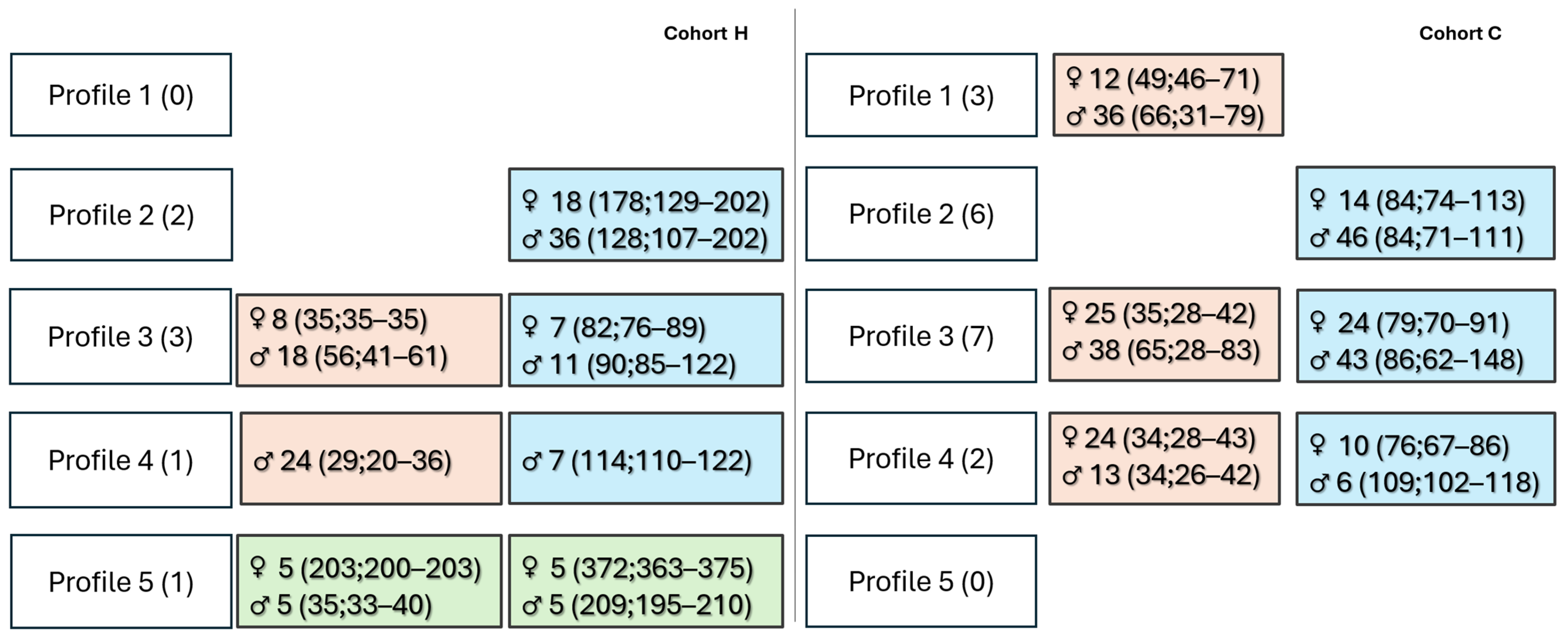
All 445 production periods were included in the descriptive statistical comparison of variables between cohort C and cohort H. At the production period level, around 50% were fattening periods in both cohorts (49.7 vs. 53.6%). In contrast to cohort C, in cohort H the number of raising periods included in the study was lower, and 13.2% of the production periods were allocated to breeding (either raising or laying phase). There was a statistically significant difference in the type of production between the two cohorts (p < 0.001). Our study revealed a rather heterogeneous animal cohort production system, characterized by separate (independent) or subsequent raising and fattening periods on the same or different farms, resulting in a complex structure of dependent and independent observations (Figure 2).
For the descriptive analysis and statistical comparison between production systems presented in this work, potential dependencies between observations were ignored at this point, and resulting p-values therefore must be interpreted with caution. The breeding farm periods (single farm with 10 raising cohorts kept for breeding), as well as five fattening periods for which neither slaughter data nor data to calculate mortality were available, were excluded, hence, 420 of the 445 production batches were included in the comparison of factors relevant in both periods between raising and fattening. Significant differences were observed for several housing conditions and management-related factors as well as animal-related factors.

3.3.1. Outdoor Husbandry

There was no outdoor husbandry in cohort C (0 vs. 39.7%, p < 0.001). There was no outdoor husbandry in raising, but in cohort H 74.7% of the fattening periods had outdoor husbandry, i.e., most of the fattening periods of three farms (p < 0.001).

3.3.2. In-House Ventilation Technique

Open housing was the most frequently used in-house ventilation technique in both cohorts (79.6 vs. 63.6%) and in raising and fattening (59.1 vs. 93.7%), while forced ventilation was in second place in cohort C (15.0%) and inlet air flaps in cohort H (21.9%). In cohort C, open housing remained the most frequently used technique during raising and fattening (64.2 vs. 95.1%), whereas during raising, forced ventilation (29.7%) was also frequently used, while forced ventilation was not used during raising in cohort H. In contrast to this, in cohort H, during raising inlet air flaps was the most frequently used in-house ventilation technique (56.0%), while neither forced ventilation nor inlet air flaps were applied during fattening. Hence, there were statistically significant differences in in-house ventilation technique between raising and fattening, and between the two cohorts (p < 0.001).

3.3.3. Number of Animals at the Beginning of the Production Period

A number of 5000 to 15,000 animals at the beginning of the production period was most often observed in both cohorts (63.3 vs. 47.7%) and in both raising and fattening (56.6 vs. 60.4%), while a number below 5000 birds at the beginning of the production period was more common in cohort H (31.8%) compared to cohort C (6.8%). A number above 15,000 animals was more common in cohort C (29.9%) and in raising (35.4%), but also true for 20.5% of the periods in cohort H and for 21.6% of the fattening periods. In cohort C, 72.0% of the fattening production periods began with 5000 to 15,000 animals, and most of the remaining housed periods included about 15,000 birds (35.9%). In contrast, in cohort H, a number of 5000 to 15,000 animals at the beginning of the production period was more common in raising (62.0%) than in fattening (39.2%). This was also the case for a number above 15,000 birds at the beginning of the production period (38.0 vs. 13.9%), while a number less than 5000 animals at the beginning of the production period was not observed in raising, but most often observed in fattening (46.8%). Thus, there were statistically significant differences in the number of animals at the beginning of the production period between raising and fattening (p = 0.001, p < 0.001 for the comparison of raising and fattening in cohort C and H separately) and within the two cohorts (p < 0.001).
Detailed analysis based on numeric values confirmed that there was a significantly higher number of animals at the beginning of the production period in cohort C (median 11,684 vs. 6501, p < 0.001) and a significantly higher number of animals at housing in raising (11,825 vs. 9574, p < 0.001), but the latter was only confirmed for cohort H (9743 vs. 5500, p < 0.001).

3.3.4. Stocking Rate

For stocking rate, there is a pronounced tendency towards more space for the birds in cohort H, with the lowest stocking rate of below 30 kg/sqm most frequently reported (57.0%), whereas in cohort C the intermediate stocking rate (>30–≤53 kg/sqm) was slightly more frequently used (37.2%) than the other two categories. There is an obvious tendency towards more space for the birds in raising in both cohorts, with the lowest stocking rate of below 30 kg/sqm being most often used in raising (72.7%), whereas in fattening the mid stocking rate (>30–≤53 kg/sqm) was slightly more frequently used (43.4%) than the other two categories. During the raising period, the lowest stocking density was used most frequently in cohort C (63.5%) and consistently in cohort H. While in cohort C the highest stocking rate (>53–≤58 kg/sqm) and the middle category were preferably used during fattening (50.0, 43.0%), in cohort H the lowest and the mid stocking rate were almost equally often used (45.6, 44.3%) during fattening. In summary, statistically significant (p < 0.001) higher stocking rates were observed in cohort C and during the fattening phase.

3.3.5. Litter

Considerable heterogeneity was observed regarding the litter used. Whereas in 65.7% of the cohort C production periods and in 68.5% of the fattening periods only one type of litter was used, this was the case for only 34.9% of the periods in raising and for only 21.9% of the periods in cohort H, where wood shaving litter was not used at all. In contrast to this, in cohort H in fattening wood shavings straw mix was also more often used than straw only (60.8 vs. 39.2%). In raising, a combination of wood shavings with straw (as mix or respread) was most often used (62.6%) with 100% use in raising in cohort H. The most commonly used litter in cohort C was straw only (53.1%) while this applies to 21.9% of the cohort H periods. There, a combination of wood shavings with straw (as mix or respread) was most often used (78.1%) compared to cohort C (30.6%). There was a statistically significant difference in litter use for each of the comparisons (p < 0.001), i.e., higher use of a combination of straw and wood shavings in cohort H and in raising.

3.3.6. Watering System

All farms—except one that introduced water hygienization in later production periods—did not show any within-farm heterogeneity in use of watering system. In general, hygienized city water (using acidification, chlorine dioxide, sodium hypochlorite solution, hydrogen perioxide, electrochemically activated solution, Virkon® H2O, LANXESS India Private Limited, Wagle Estate, India) was the most frequently used watering system in both cohorts (54.4% vs. 41.7%). City water without additional hygienization was in second place in cohort C (27.2%), and fountain water was in second place in cohort H (35.8%) where fountain water was used in fattening periods only. In raising, hygienized city water was the most frequently used watering system (64.1%), while in fattening, hygienized city water, fountain water and city water were used almost equally often (33.3 vs. 30.6 vs. 26.1%). In fattening, in cohort C hygienized city water was used most often (43.4%) followed by city water (35.0%), while in cohort H fountain water was used in more than two thirds of the fattening periods (68.4%). There was a statistically significant difference in watering system use for each of the comparisons (p < 0.001, p = 0.002 for the comparison of raising and fattening in cohort C), i.e., higher use of fountain water in cohort H and during fattening.

3.3.7. Feed Origin

Overall, in cohort C and raising, there was a tendency to feed the birds with purchased feed only (56.5%, 68.2%), whereas in cohort H and during fattening, own produced feed combined with purchased feed was used most frequently (55.0%, 57.2%). There was a statistically significant difference in feed origin between cohort C and cohort H (p = 0.022) and between raising and fattening (p < 0.001), i.e., more often the use of purchased feed only in cohort C and raising. No feed change apart from phase feeding practice was recorded.

3.3.8. Functional Phytochemicals

Functional phytochemicals were more frequently used in cohort H (46.4 vs. 10.9%, p < 0.001) and were slightly more often used in fattening (23.0 vs. 15.7%), in both instances typically as a mix, but for the latter comparison there was no statistically significant difference detected. In contrast, in cohort H functional phytochemicals were statistically significantly more often used in fattening (53.2 vs. 16.0%, p < 0.001), whereas in cohort C functional phytochemicals were statistically significantly more often used in raising (15.5 vs. 6.3%, p < 0.001). In cohort C, in fattening periods, the category ‘a mix of functional phytochemicals’ was not observed at all. Hence, there was a statistically significant difference in use of functional phytochemicals between the two cohorts and between raising and fattening, but within the two cohorts only (p < 0.001), i.e., more use in cohort H, more use in fattening in cohort H, more use in raising in cohort C.

3.3.9. Hygiene Score

In both cohorts, a high hygiene score was most often assigned (73.5 vs. 65.6%). In cohort C, in raising and fattening, a high hygiene score was most often allocated (73.0, 73.4%), while in cohort H, in raising a high hygiene score was most often assigned (84.0%) and in fattening a moderate hygiene score was most often allocated (55.7%). There was a statistically significant difference in the hygiene score between raising and fattening overall (p = 0.005) and especially in cohort H (p < 0.001), but neither between the two cohorts nor between raising and fattening in cohort C.

3.3.10. Government Measures

Governmental measures due to antimicrobial use above benchmark value II were in place in both cohorts for some periods but were not necessary for most of the production periods (81.0 vs. 86.8%), nor for most of the raising and fattening periods (75.3 vs. 88.7%). There was a statistically significant difference in the frequency of governmental measures due to antimicrobial use above benchmark value II between raising and fattening (p < 0.001, p = 0.01, p = 0.009 for the comparison of raising and fattening in cohort C and cohort H), with a higher frequency for raising periods.

3.3.11. Season

In both cohorts, birds were kept throughout the year, with no clearly visible peak production phases.

3.3.12. Genetics and Gender

Uniformly, the B.U.T. Big Six breed was raised, fattened and bred. There were more production periods with males than females in both cohorts, with this difference being more pronounced in cohort H (62.9 vs. 71.5%). There were more males than females in both raising and fattening (67.6, 67.1%), with slightly more males in fattening than in raising in cohort C (58.8 vs. 67.1%) and more males in raising than in fattening in cohort H (84.0 vs. 68.4%). However, there was no significant difference between the two cohorts nor between raising and fattening except from a significant difference between raising and fattening in cohort H (p = 0.047).

3.3.13. Raising Location

For both cohorts, most often chicks for fattening were raised externally on another farm (48.0 vs. 60.4%). For the remaining production periods, in both cohorts chicks were more often raised externally in another stable on the same farm (37.7 vs. 26.4%). Hence, there was no statistically significant difference between the two cohorts.

3.3.14. Relocation of Birds During the Production Period

Animals were more often relocated more than once in cohort H (41.1%), whereas in cohort C birds were relocated only once (50.3%), and rarely more than once (0.7%). Animals were not relocated more often in raising (90.4%). In contrast, in fattening, birds were most often relocated once (70.7%), while in cohort H, fattening birds were more often relocated more than once (60.8%) compared to only once (29.1%). There were statistically significant differences in relocation of turkeys during the production period between raising and fattening and between the two cohorts (p < 0.001); i.e., birds were more often relocated in cohort H and in fattening.

3.3.15. Raising in Groups

Mixed-sex raising was performed in cohort H (23.8%, p < 0.001) and there in fattening periods only (45.6%, p < 0.001), but not at all in cohort C. However, mixed-sex raising is performed at other farms not using homeopathy, other than those in the study.

3.3.16. Vaccination According to Recommended Standard Vaccination Schedule

Turkeys were vaccinated according to a standard vaccination schedule (Turkey RhinoTracheitis (TRT), NewCastle Disease (ND), Haemorrhagic Enteritis (HE)) more often in cohort H (45.6 vs. 70.9%) and in fattening (52.5 vs. 61.3%), which was complemented through autogenous vaccines, also more often in cohort H (18.7 vs. 23.8%), leading to a comprehensive vaccination scheme in 94.7% of the production periods in cohort H. In contrast to this, less than the standard vaccination schedule was applied in 35.7% of the production periods in cohort C. For raising and fattening periods, the completion through autogenous vaccines (both 16.2%) resulted in a comprehensive vaccination scheme of 68.7 vs. 77.5% of the production periods. In cohort C, turkeys were vaccinated according to a standard vaccination schedule more often in raising (47.3 vs. 44.8%), while in cohort H this was the case in fattening (68.0 vs. 91.1%). There was a statistically significant difference in the application of a standard vaccination schedule between cohort C and cohort H (p < 0.001), but there was no statistically significant difference in the application of a standard vaccination schedule between raising and fattening, while in cohort H, fattening birds were statistically significantly more often vaccinated according to a standard vaccination protocol compared to raising (p < 0.001).

3.3.17. Breeding Companies

Chicks were purchased from six different breeding companies with unequal use of breeding farms between the two cohorts. Overall, in cohort C, chicks originated with highest frequency from breeding company ‘B1’, while in cohort H there was a predominance for breeding company ‘B4’. Raising chicks originated with the highest frequency from breeding company ‘B1’, followed by ‘B4’, while in fattening there was a predominance for breeding company ‘B4’, followed by ‘B1’. There were significant differences between the two cohorts and between raising and fattening (p < 0.001).

3.3.18. Slaughterhouses

Birds were slaughtered in five different slaughterhouses, with unequal use of slaughterhouses between the two cohorts. In cohort C, birds were most frequently delivered to slaughterhouse ‘S2’, but also two other slaughterhouses were frequently used (‘S3’, ‘S4’). In cohort H, most fattening groups were slaughtered in ‘S3’ while the bio-dynamic farm animals were slaughtered on the farm. There were significant differences between the two cohorts (p < 0.001).

3.3.19. Egg-Laying Week 5–24 of Parents

Information on the egg-laying week of the parents was missing most of the time in both cohorts (63.3 vs. 100%) and in most of the raising and fattening periods (66.7 vs. 81.5%). There was a statistically significant difference in the availability of information on the egg-laying week of parents between cohort C and H and between raising and fattening (p = 0.001) which was also true for raising and fattening in cohort C (p = 0.005) while there was no information at all on the egg-laying week of parents in cohort H. Details can be seen in Table 2.

3.3.20. Specifics of the Single Breeding Farm

The single breeding farm in this study was specific as regards several potential management-related risk factors such as breeding company, season (no housing dates in autumn), as well as production standards (significantly longer length of stay). Regarding animal-related potential risk factors, a higher proportion of animals were vaccinated with autogenous vaccines in addition to the standard vaccination schedule, compared to cohorts C and H raising and fattening periods. Chicks originated from the breeding company ‘B2’ only, which was not considered by any other farm. With only one breeding farm in cohort H and no breeding farm in cohort C, and the management differences observed when compared to the other farms in the study, the breeding farm was excluded from most statistical analyses, reducing the available number of production period records by 20 records (Table 3).

3.3.21. Treatment Intensity, Production, Performance-Specific, and Animal Welfare Parameters

Among the treatment intensity, production, performance-specific, animal welfare and safety parameters there was no statistically significant difference between cohort C and cohort H identified for overall mortality (median 3.7 vs. 3.7%) and weight at slaughter (21.0 vs. 20.7 kg for males and 10.2 vs. 10.3 kg for females). While mortality in raising was significantly lower in cohort H (3.1 vs. 1.9%, p < 0.001), mortality in fattening was comparable between the two cohorts (4.8 vs. 4.3%). There was a significantly lower mortality in raising compared to fattening (2.7 vs. 4.5%, p < 0.001). There was no statistical difference between the raising and fattening for homeopathic treatment days (19 vs. 20) in cohort H.
The recorded age at the start of fattening showed considerable heterogeneity, which was also reflected in the age at the end of raising, as well as in the age at the end of fattening. Animals were significantly younger at start of fattening in cohort H (median 42 vs. 41, mean 51.3 vs. 47.9, p = 0.001) and older at the end of raising in cohort C (median 45.5 vs. 36, p = 0.009). Overall, there was a significantly longer length of stay, regardless of the production period in cohort H (72 vs. 108, p < 0.001). Age at the end of the fattening period was higher in cohort H (145 vs. 174, p < 0.001) which was due to significant differences detected in females (113 vs. 219, p < 0.001) while there were no significant differences observed in males (150 vs. 148, p = 0.367). Raising for breeding periods were assigned to raising, and breeding periods were assigned to fattening in this overall analysis.
There was a significantly lower treatment frequency in cohort H (9.9 vs. 2.3, p < 0.001) and a significantly lower incidence of antibiotic treatment days in cohort H (0.14 vs. 0.01, p < 0.001), and in fattening (0.19 vs. 0.06, p < 0.001). The latter result was also true for comparison of raising and fattening in cohort C (0.23 vs. 0.09, p < 0.001) and cohort H (0.14 vs. 0.0, p < 0.001) when separately analyzed. There was a significantly lower treatment frequency in fattening overall (8 vs. 5.1, p < 0.001); however, in cohort C no statistically significant difference between raising and fattening was detectable, which is in contrast to a significantly lower incidence of antibiotic treatment days in fattening in cohort C.
Daily weight gain was significantly lower in cohort C (135.4 vs. 142.7, p = 0.003) which was due to significant differences detected in males (141.8 vs. 143.5, p = 0.017) while there were no significant differences observed in females (89.8 vs. 85.6, p = 0.102). Both number of confirmed infections and number of suspected infections were significantly lower in cohort H (2 vs. 1, p < 0.001 for each value) and significantly lower in fattening (2 vs. 1, p < 0.001), while for the comparison of raising and fattening in cohort C for suspected infections the p-value was p = 0.001.
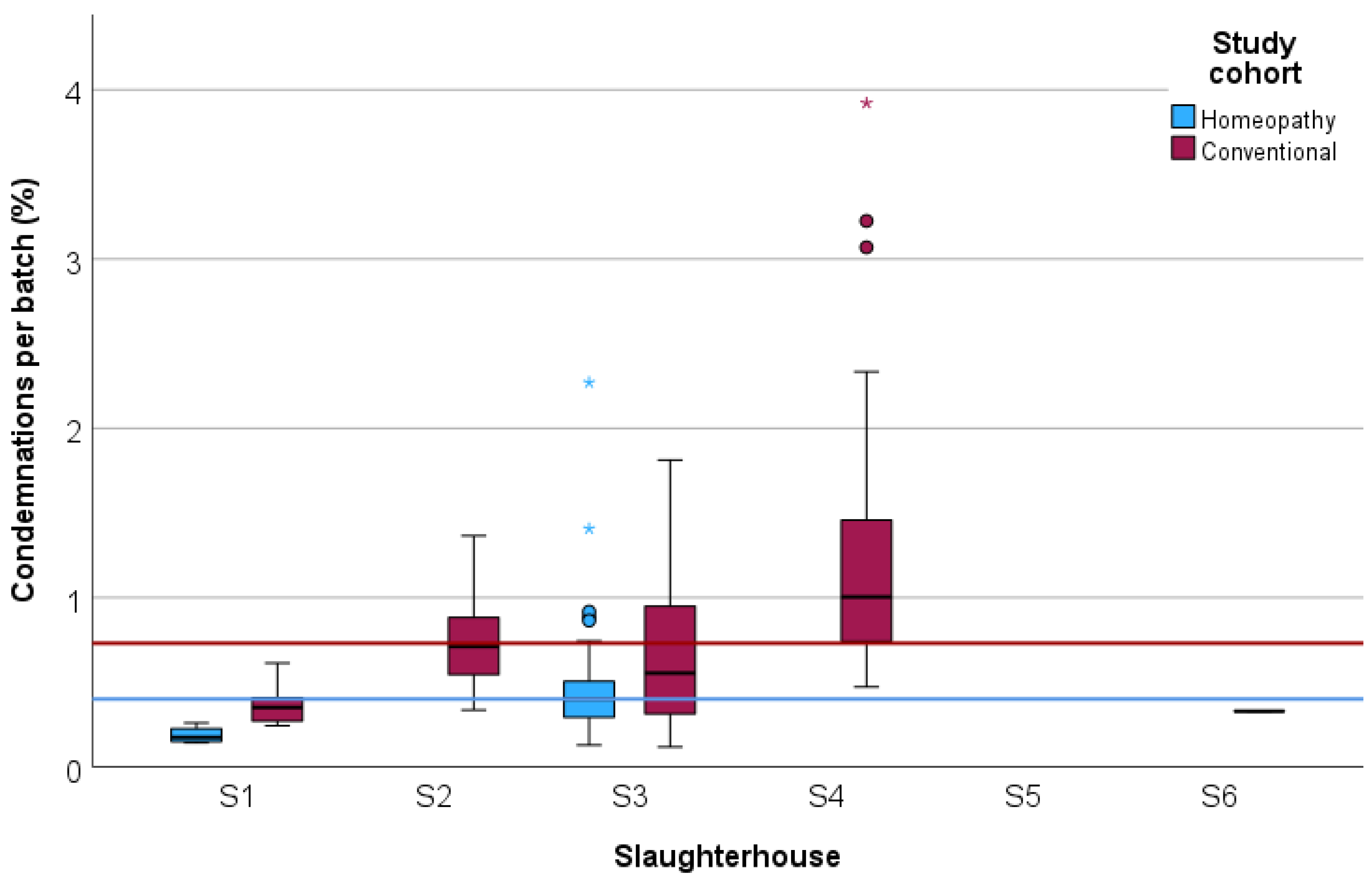
Number of deaths at arrival at slaughter (0.09 vs. 0.06, p = 0.002) and total condemnation (0.7 vs. 0.4, p < 0.001) were significantly lower in cohort H. Percentages of total condemnations per slaughterhouse in cohort C and cohort H is displayed in Figure 3.
There was no indication of adverse or serious adverse treatment or vaccination events available in the treatment records of all farms included in this study. Details can be seen in Table 4.
Condemnations (%) by slaughterhouse and study cohort

4. Discussion

The data collection was performed through the development and implementation of four questionnaires in LimeSurvey (Cloud Version 5.6.18). This captured information on characteristics related to (a) the farmer/farm manager, (b) the farm itself, and (c) a “raising/fattening/breeding report” per respective animal batch and production period that captured information from different sources (i.e., farmer, veterinarian, slaughterhouse, etc.). This structured data collection ensured that all relevant data was included (when available) in a systematic way, thus reducing reporting bias and misclassification [36]. Predefined inclusion and exclusion criteria led to the exclusion of some farms initially interested in participating in the study, and exclusion of some production batches for which relevant information could not be extracted from the records. As it is rarely feasible to recruit a truly random sample of farmers to provide observational reports as described by Pfeiffer et al. (2021) [36], it must be assumed that farmers from the C cohort are not fully representative of the target population. The same might be true for farmers in the H cohort; however, when comparing the study cohort characteristics with national statistics, both cohorts seemed to perform better than the national average. For comparison of parameters between cohorts within this study, the effect of selection bias therefore is considered to be minor. Recall bias related to the retrospective study design cannot be fully excluded at least for parameters that could not be extracted from existing documentation; but, again, we do not consider this to differ between the comparison groups, thus having only little if any influence on the comparisons presented here. A prospective observational study design might reduce potential recall bias but would face similar challenges in the selection of farms—especially given voluntary participation.
The final sample of farms included 21 farms from southern Germany and four farms from the East, but unfortunately, no farms were located in the West or North of the country. This certainly reduced the possibility to capture the full variability present in commercial turkey production of Germany but was not preventable (a) due to the homeopathic veterinarian being located in the South of Germany and having contacts to cooperating veterinarian practices predominately in this region, and (b) the voluntary response to join the study by farms treated with conventional medicine only. We nevertheless consider our presentation of the range of expressions of farmer, farm and production period characteristics as well as disease, antibiotic treatment, production and performance parameters of value for comparison between cohorts, and with national and international turkey production data.
In our field study, to encompass the wide range of turkey farming practices, participation of a biodynamic farm was accepted. This biodynamic farm showed noticeable differences in housing conditions and management-related factors, such as almost all fattening periods having outdoor husbandry. Animal-related factors differed as well, such as being raised in mix-sex groups, and having a longer length of stay during fattening, but although the length of the fattening period was equal for males and females on this farm for production-specific logistical reasons, the average length of stay was at least comparable with data from the EU regulation on organic farming (between 140 and 180 days). The proportion of organic/biodynamic farms in our study (2%) corresponds to the total proportion of organic/biodynamic farms among turkey farms in Germany (4%) [2,15]. Also to encompass the wide range of turkey farming practices, participation of a breeding farm was accepted. The breeding farm showed even more differences in housing conditions and management-related factors as well as animal-related factors. These included a significantly longer length of stay during raising for breeding and breeding period, resulting in high maximum values in this parameter; breeding farms depict a completely different production system, not comparable to commercial turkey raising and/or fattening farms.
Regarding the observed heterogeneity between the two cohorts and between raising and fattening, for example, cohort H had a significantly higher number of poultry farms nearby, included outdoor husbandry, and had production periods with mixed raising, while cohort C covered neither organic nor biodynamic husbandry type nor breeding farms. For the latter reason and due to being a completely different production system not comparable to commercial turkey raising and/or fattening farms, the breeding farm from cohort H had to be excluded from further analysis. In raising, e.g., there was a higher use of a combination of straw and wood shavings observed, while in fattening one litter type only was used most frequently. In raising, a high hygiene score was most common, while in fattening a moderate hygiene score was more common in cohort H. Furthermore, in the raising periods, e.g., cohort H had a lower stocking rate and relocated the birds more often than cohort C. As regards the fattening periods, e.g., cohort C used functional phytochemicals less frequently, while cohort H used them more frequently. Considering the potential effect of these factors on the treatment intensity, production, performance-specific and animal welfare parameters as identified in the scoping review of Sonnenschein-Swanson et al. (2025) it is interesting to observe that there were no significant differences between cohort H and C in all farm-level characteristics except for poultry farms nearby, and at the production-period (batch) level for characteristics such as feed change, hygiene score, government measures, season, genetics, gender and raising location, and between raising and fattening periods for feed change season, genetics, gender and vaccination schedule (except from cohort H) [5]. A more detailed analysis of the impact of all factors, while taking the observed heterogeneity into account, is foreseen [5,37].
Our study results were within the range of the description provided in German poultry yearbooks from the years 2020 to 2022 and from the report for the period 2018–2021 by the German Federal Gazette, as regards parameters such as genetics (B.U.T. Big Six only), production rhythm (continuous process when more than one stable was available, which was most commonly the case), in-house ventilation technique (open housing most common), stocking rate (maximum stocking density 58 kg/sqm (males) and 52 kg/sqm (females)), litter (use of wood shavings and straw during raising, and of wood shavings or short straw during fattening), feed origin (compounder feed or combined feeding in phase feeding programs), raising location (external on another farm), raising in groups (separated sex), vaccination (according to standard vaccination schedule). This was also true for treatment intensity, production, performance-specific and animal welfare parameters of weight at slaughter (Germany, national average of 21.47 kg at an age of 145 days for males, 10.73 kg at an age of 111 days for females) as well as daily weight gain (Germany, national average of daily weight gain of 148 g for males, daily weight gain of 97 g for females), while data on mortality (both genders: Germany, national average of 5.65%) as well as on treatment frequency 2019 to 2021 (benchmarking 13.7–16.9) were higher compared to our study results even though average number of animals per farm was lower (Germany, national average of 5300) [6,7,8,38].
Data and results from our study farms, as compared with industry data shown above, were considered reasonably comparable to the overall population of commercial turkey farms in Germany, with all caveats regarding selection bias. Relevant information was provided, indicating a high variability in specific turkey production characteristics (despite existing industry standards) and little to no variability in other parameters. Benchmark comparison indicated a possible selection bias towards best-performing farms in cohort C, as already assumed and reported by treating veterinarians and farmers. This potential selection bias might be due to the fact that not all regions in Germany were represented by farmers whose turkeys were treated by our non-homeopathic cooperating veterinary practices. In cohort H, a selection bias cannot be completely ruled out. Although all farmers who had their turkeys treated with homeopathy by a veterinarian specializing in homeopathy and employed by our research team’s cooperating veterinary practice agreed to participate, only this subset may be reflected. Results of our study still showed that the incidence of antibiotic treatment days was lower in cohort H compared to cohort C, which was also displayed by the treatment frequency results. But due to voluntary participation in cohort C (and H) and due to potential best-practice homeopathy offered by veterinarians specializing in homeopathy and employed by our research team’s cooperating veterinary practice in cohort H generalizability of results might be limited. Number of infections was significantly lower in cohort H compared to cohort C, which is in line with results from the literature showing that homeopathic treatment led to a significant and clinically relevant reduction of (recurrent) infections [18,39,40,41,42,43]. Although the exact mode of action needs to be further elucidated [44], homeopathy is based on stimulating autoregulatory and self-healing processes, enabling the organism to initiate a systemic self-reorganization towards more robust functioning as a whole [45,46]. Production-period-related mortality was not significantly different between the two cohorts. We regarded mortality, and total condemnation at slaughter as the most robust production, performance-specific, animal welfare parameters. Mortality data must be unequivocally documented, and the standardized examination procedure in poultry defined in article 11 and 25 as the reasons for condemnation in article 45 of the EU regulation 2019/627 is also documented [47].
A strength of our study was a finely detailed collection of relevant data, not available until now, which is important for design and implementation of future studies. A weakness of this analysis is that the issue of non-independence is not appropriately accounted for in the descriptive analysis of the 445 productions periods. Hence, p-values are to be considered with caution due to potential clustering effect inflating Type I error.
Our scoping review [5] as well as our field study identified a magnitude of factors that might be relevant when assessing their influence on treatment intensity, production, performance specific and animal welfare parameters also captured in this study. Our results displayed the high complexity and dynamic processes of poultry production as did Van Limbergen et al. (2020) wherein causal pathways with statistically significant associations in the multivariable models between several management, performance, housing and health variables in broiler farms were claimed [3,5]. Junghans et al. (2020) and Lüning et al. (2023) provided some more examples of the complexity of the dynamic processes involved [4,48].
The results of our field study in turkeys from 2019 to 2021 support the evidence that veterinarians who practice both complementary and conventional medicine (that is, integrative medicine) use fewer antibiotics, but due to heterogeneity detected there remains a strong need for targeting the multivariable aspects of antimicrobial usage in turkey production considering specific random and fixed factors in order to find relevant risk factors and develop uni- and multivariate statistical models linking a range of risk factors to specific health and production outcomes. This statistical approach will be fundamental to the subsequent article based on cohort C and H comparison of 420 production periods, considering raising and fattening only, to provide specific recommendations on AMU monitoring and benchmarking [18,49,50,51].

5. Conclusions

Our study results capture the complexity and heterogeneity of the production system, and the hierarchical structure of animals within consecutive or parallel production batches on farms in the field. This accentuates a need to map the reality of turkey production in respective research projects [5]. There is evidence that veterinarians who practice both complementary and conventional medicine (that is, integrative medicine) use fewer antibiotics [18,49], which supports our study results. Hence, antimicrobial prevention and treatment strategies utilizing complementary medicine may contribute to reducing antibiotic use, but more rigorous research is necessary to provide more high-quality evidence of effectiveness [18,49].

Supplementary Materials

The following supporting information can be downloaded at: https://www.mdpi.com/article/10.3390/poultry5020019/s1. Table S1: Supplemental Material S1: Meta information on variables included in the study data set; adapted to Supplementary Materials S5 and S6 of the already published study protocol [19]. Table S2: Supplemental Material S2a: Variability of potential risk factors within production periods, between production periods, between farms is described for both cohorts together and separately where applicable (for explanation of numerically coded categories see Supplement S1). Table S3: Supplemental Material S2b: Summary of variability of potential risk factors within production periods, between production periods, between farms is described for both cohorts together and separately where applicable (for explanation of numerically coded categories see Supplement S1). Table S4: Supplemental Material S3: Potential risk factors evaluated at farm level for no occurrence and most occurrence and on production period level for most occurrence for production period specific risk factors based on absolute numbers from 25 farms and 445 production periods.

Author Contributions

Conceptualization: P.W.; Data curation: S.B.-B.; formal analysis: M.G.D.; funding acquisition: P.W., D.M., A.K., S.B.-B.; investigation: S.B.-B., A.K., M.G.D., L.S.-S., D.M., B.U.S., M.-A.S., P.W.; methodology: M.G.D., A.K., D.M., P.W., L.S.-S.; project administration: P.W., A.K., D.M., M.G.D.; resources; software; supervision: A.K., D.M., M.G.D., P.W.; validation: S.B.-B., A.K., M.G.D., L.S.-S., D.M., B.U.S., M.-A.S., P.W.; visualization: P.W.; roles/writing—original draft: P.W.; and writing—review and editing: S.B.-B., A.K., M.G.D., L.S.-S., D.M., B.U.S., M.-A.S., P.W. All authors have read and agreed to the published version of the manuscript.

Funding

The project is partly funded by Software AG-Stiftung (P-14497), Darmstadt, and Sanddorf-Stiftung (FU Berlin 17/12/2021 HOMAMR), Regensburg, both Germany. The funders had no influence on the conduct, content, implementation, and publication of the project.

Institutional Review Board Statement

The study protocol, including the surveys, was approved by the Ethics Committee of the Freie Universität Berlin (Approval Number: ZEA-NR.2023-015, approved on 28 September 2023).

Informed Consent Statement

We confirm that all necessary consent for participation and publication has been obtained from the involved parties.

Data Availability Statement

The original contributions presented in this study are included in the article and/or the Supplementary Materials. Further inquiries can be directed to the corresponding author.

Acknowledgments

We want to thank Emanuela Haberl for support with technical issues, and Esther van der Werf for scientific advice on the study design. We thank Stiftung Software AG, Darmstadt, and Sanddorf-Stiftung, Regensburg, both in Germany, for supporting this project.

Conflicts of Interest

The authors declare that this study received funding from Software AG-Stiftung and Sanddorf-Stiftung. The funder was not involved in the study design, collection, analysis, interpretation of data, the writing of this article or the decision to submit it for publication. Three authors (S.B.-B., M.A.S. and P.W.) practice as veterinarians treating animals with conventional medicine and homeopathy.

References

  1. Food and Agriculture Organization of the United Nations. Meat Market Review, Overview of Global Market Developments in 2024. Available online: https://openknowledge.fao.org/items/b553c447-f6b2-4ff8-825e-024767b27760 (accessed on 28 August 2025).
  2. Bundesministerium für Landwirtschaft, E.u.H. Tierhaltung, Geflügelhaltung. Available online: https://www.bmel-statistik.de/landwirtschaft/tierhaltung/gefluegelhaltung/ (accessed on 28 August 2025).
  3. Van Limbergen, T.; Sarrazin, S.; Chantziaras, I.; Dewulf, J.; Ducatelle, R.; Kyriazakis, I.; McMullin, P.; Méndez, J.; Niemi, J.K.; Papasolomontos, S.; et al. Risk factors for poor health and performance in European broiler production systems. BMC Vet. Res. 2020, 16, 287. [Google Scholar] [CrossRef]
  4. Junghans, A.; Deseniß, L.; Louton, H. Data evaluation of broiler chicken rearing and slaughter-An exploratory study. Front. Vet. Sci. 2022, 9, 957786. [Google Scholar] [CrossRef]
  5. Sonnenschein-Swanson, L.; Baur-Bernhardt, S.; Käsbohrer, A.; Doherr, M.G.; Meemken, D.; Weiermayer, P. Potential Risk Factors Related to Antimicrobial Usage and Antimicrobial Resistance in Commercial Poultry Production—A Scoping Review. Poultry 2025, 4, 39. [Google Scholar] [CrossRef]
  6. Zentralverband der Deutschen Geflügelwirtschaft e.V. Geflügeljahrbuch; Eugen Ulmer KG: Stuttgart, Germany, 2020. [Google Scholar]
  7. Zentralverband der Deutschen Geflügelwirtschaft e.V. Geflügeljahrbuch 2021—Was Kostet Tierwohl? Eugen Ulmer KG: Stuttgart, Germany, 2021. [Google Scholar]
  8. Zentralverband der Deutschen Geflügelwirtschaft e.V. Geflügeljahrbuch 2022—Nachhaltige Geflügelerzeugung; Eugen Ulmer KG: Stuttgart, Germany, 2022. [Google Scholar]
  9. Bundesministerium für Landwirtschaft, E.u.H. Wie Funktioniert das Konzept zur Antibiotikaminimierung in der Nutztierhaltung? Available online: https://www.bmleh.de/DE/themen/tiere/tierarzneimittel/konzept-antibiotikaminimierung.html (accessed on 4 February 2026).
  10. Bundesinstitut für Risikobewertung. Antibiotika-Verbrauchsmengen und Therapiehäufigkeit 2024. Available online: https://www.bfr.bund.de/wisenschaftsbericht/antibiotika-verbrauchsmengen-und-therapiehaeufigkeit-2024/ (accessed on 10 September 2025).
  11. Bundesinstitut für Risikobewertung. Tabellen zur Entwicklung der Therapiehäufigkeit und der Antibiotikaverbrauchsmengen 2018–2021. Available online: https://www.bfr.bund.de/cm/343/therapiehaeufigkeit-und-antibiotikaverbrauchsmengen-2018-2021-bericht.pdf (accessed on 3 August 2025).
  12. Global burden of bacterial antimicrobial resistance 1990–2021: A systematic analysis with forecasts to 2050. Lancet 2024, 404, 1199–1226. [CrossRef]
  13. European Commission. Communication from the Commission to the European Parliament, the Council, the European Economic and Social Committee and the Committee of the Regions A Farm to Fork Strategy for a Fair, Healthy and Environmentally-Friendly Food System. Available online: https://eur-lex.europa.eu/legal-content/EN/TXT/?uri=CELEX:52020DC0381 (accessed on 15 June 2022).
  14. European Union. Regulation (EU) 2019/6 of the European Parliament and of the Council of 11 December 2018 on Veterinary Medicinal Products and Repealing Directive 2001/82/EC (Text with EEA relevance). Available online: https://eur-lex.europa.eu/eli/reg/2019/6/oj/eng (accessed on 15 May 2025).
  15. Europäisches Parlament und Rat. Verordnung (EU) 2018/848 des Europäischen Parlaments und des Rates vom 30. Mai 2018 über die Ökologische/Biologische Produktion und die Kennzeichnung von Ökologischen/Biologischen Erzeugnissen Sowie zur Aufhebung der Verordnung (EG) Nr. 834/2007 des Rates. Available online: https://eur-lex.europa.eu/eli/reg/2018/848/oj?locale=de (accessed on 31 March 2022).
  16. Sousa, A.; de Rago, L.; Pinho, J.O.; Estrela, M.; Coelho, A.C.; Oliveira, P.A.; Figueiras, A.; Roque, F.; Herdeiro, M.T. Understanding how veterinarians’ knowledge, attitudes, and practices influence antibiotic prescription: A systematic review of survey studies. BMC Vet. Res. 2025, 21, 543. [Google Scholar] [CrossRef]
  17. Forster, P.; Käsbohrer, A.; Cramer, H.; Frass, M.; Maeschli, A.; Martin, D.; Panhofer, P.; Stetina, B.U.; Wolf, U.; Zentek, J.; et al. CIMUVET-survey: Complementary and Integrative Medicine (CIM) use in veterinary practice in Austria and CIM education at universities in Austria, Germany and Switzerland. PLoS ONE 2025, 20, e0327599. [Google Scholar] [CrossRef]
  18. Baars, E.W.; Weiermayer, P.; Szőke, H.P.; van der Werf, E.T. The Introduction of the Global Traditional, Complementary, and Integrative Healthcare (TCIH) Research Agenda on Antimicrobial Resistance and Its Added Value to the WHO and the WHO/FAO/UNEP/WOAH 2023 Research Agendas on Antimicrobial Resistance. Antibiotics 2025, 14, 102. [Google Scholar] [CrossRef]
  19. Baur-Bernhardt, S.; Käsbohrer, A.; Doherr, M.G.; Meemken, D.; Sonnenschein-Swanson, L.; Stetina, B.U.; Sommer, M.A.; Weiermayer, P. Assessing the Feasibility of a Two-Cohort Design to Assess the Potential of Homeopathic Medicinal Products to Reduce Antimicrobial Resistance in Turkeys (The HOMAMR Project)-Study Protocol. Homeopathy 2025, 114, 50–57. [Google Scholar] [CrossRef]
  20. Humphrey-Murto, S.; Varpio, L.; Wood, T.J.; Gonsalves, C.; Ufholz, L.A.; Mascioli, K.; Wang, C.; Foth, T. The Use of the Delphi and Other Consensus Group Methods in Medical Education Research: A Review. Acad. Med. 2017, 92, 1491–1498. [Google Scholar] [CrossRef] [PubMed]
  21. Kempf, I.; Le Roux, A.; Perrin-Guyomard, A.; Mourand, G.; Le Devendec, L.; Bougeard, S.; Richez, P.; Le Pottier, G.; Eterradossi, N. Effect of in-feed paromomycin supplementation on antimicrobial resistance of enteric bacteria in turkeys. Vet. J. 2013, 198, 398–403. [Google Scholar] [CrossRef] [PubMed]
  22. Mughini-Gras, L.; Di Martino, G.; Moscati, L.; Buniolo, F.; Cibin, V.; Bonfanti, L. Natural immunity in conventionally and organically reared turkeys and its relation with antimicrobial resistance. Poult. Sci. 2020, 99, 763–771. [Google Scholar] [CrossRef]
  23. Cornell, K.A.; Smith, O.M.; Crespo, R.; Jones, M.S.; Crossley, M.S.; Snyder, W.E.; Owen, J.P. Prevalence Patterns for Enteric Parasites of Chickens Managed in Open Environments of the Western United States. Avian Dis. 2022, 66, 60–68. [Google Scholar] [CrossRef]
  24. Jones, E.M.; Snow, L.C.; Carrique-Mas, J.J.; Gosling, R.J.; Clouting, C.; Davies, R.H. Risk factors for antimicrobial resistance in Escherichia coli found in GB turkey flocks. Vet. Rec. 2013, 173, 422. [Google Scholar] [CrossRef] [PubMed]
  25. Campe, A.; Koesters, S.; Niemeyer, M.; Klose, K.; Ruddat, I.; Baumgarte, J.; Kreienbrock, L. Epidemiology of influences on the performance in broiler flocks--a field study in Germany. Poult. Sci. 2013, 92, 2576–2587. [Google Scholar] [CrossRef] [PubMed]
  26. Holt, R.V.; Skånberg, L.; Keeling, L.J.; Estevez, I.; Newberry, R.C. Resource choice during ontogeny enhances both the short- and longer-term welfare of laying hen pullets. Sci. Rep. 2024, 14, 3360. [Google Scholar] [CrossRef] [PubMed]
  27. Smith, R.P.; Lawes, J.; Davies, R.H.; Hutchison, M.L.; Vidal, A.; Gilson, D.; Rodgers, J. UK-wide risk factor study of broiler carcases highly contaminated with Campylobacter. Zoonoses Public Health 2023, 70, 523–541. [Google Scholar] [CrossRef]
  28. Aksoy, T.; Çürek, D.; Narinç, D.; Önenç, A. Effects of season, genotype, and rearing system on broiler chickens raised in different semi-intensive systems: Performance, mortality, and slaughter results. Trop. Anim. Health Prod. 2021, 53, 189. [Google Scholar] [CrossRef]
  29. Lüning, J.; Auerbach, M.; Lindenwald, R.; Campe, A.; Rautenschlein, S. Retrospective Investigations of Recurring Histomonosis on a Turkey Farm. Avian Dis. 2022, 66, 410–417. [Google Scholar] [CrossRef]
  30. Adcock, K.G.; Berghaus, R.D.; Goodwin, C.C.; Ruder, M.G.; Yabsley, M.J.; Mead, D.G.; Nemeth, N.M. Lymphoproliferative Disease Virus and Reticuloendotheliosis Virus Detection and Disease in Wild Turkeys (Meleagris gallopavo). J. Wildl. Dis. 2024, 60, 139–150. [Google Scholar] [CrossRef]
  31. Gretarsson, P.; Kittelsen, K.; Oppermann Moe, R.; Toftaker, I. Causes of carcass condemnation in Norwegian aviary housed layers. Acta Vet. Scand. 2023, 65, 18. [Google Scholar] [CrossRef]
  32. Baxter, M.; Richmond, A.; Lavery, U.; O’Connell, N.E. A comparison of fast growing broiler chickens with a slower-growing breed type reared on Higher Welfare commercial farms. PLoS ONE 2021, 16, e0259333. [Google Scholar] [CrossRef]
  33. Çapar Akyüz, H.; Onbaşılar, E.E.; Bayraktaroğlu, A.G.; Ceylan, A. Age and sex related changes in fattening performance, dermatitis, intestinal histomorphology, and serum IgG level of slow- and fast-growing broilers under the intensive system. Trop. Anim. Health Prod. 2022, 54, 312. [Google Scholar] [CrossRef]
  34. Montalcini, C.M.; Petelle, M.B.; Toscano, M.J. Commercial hatchery practices have long-lasting effects on laying hens’ spatial behaviour and health. PLoS ONE 2023, 18, e0295560. [Google Scholar] [CrossRef]
  35. Biodynamnic Federation Demeter. Biodynamics. Available online: https://demeter.net/biodynamics/ (accessed on 16 September 2025).
  36. Pfeiffer, C.; Stevenson, M.; Firestone, S.; Larsen, J.; Campbell, A. Using farmer observations for animal health syndromic surveillance: Participation and performance of an online enhanced passive surveillance system. Prev. Vet. Med. 2021, 188, 105262. [Google Scholar] [CrossRef]
  37. Heinze, G.; Wallisch, C.; Dunkler, D. Variable selection—A review and recommendations for the practicing statistician. Biom. J. 2018, 60, 431–449. [Google Scholar] [CrossRef] [PubMed]
  38. Bundesinstitut für Risikobewertung. Therapiehäufigkeit und Antibiotikaverbrauchsmengen 2018–2021. Entwicklung in zur Fleischerzeugung gehaltenen Rindern, Schweinen, Hühnern und Puten. Available online: www.bfr.bund.de/cm/343/therapiehaeufigkeit-und-antibiotikaverbrauchsmengen-2018-2021-bericht.pdf (accessed on 15 July 2025).
  39. Pannek, J.; Pannek-Rademacher, S.; Jus, M.S.; Wöllner, J.; Krebs, J. Usefulness of classical homeopathy for the prophylaxis of recurrent urinary tract infections in individuals with chronic neurogenic lower urinary tract dysfunction. J. Spinal Cord. Med. 2019, 42, 453–459. [Google Scholar] [CrossRef] [PubMed]
  40. Banik, N.; De Jaegere, S.; Niederle, S.; Reineke, T. Homeopathic and Conventional Treatments for Acute Upper Respiratory Tract Infections: Real-World Cohort Study on Recurrence and Antibiotic Prescriptions. Complement. Med. Res. 2025, 32, 13–25. [Google Scholar] [CrossRef]
  41. Palm, J.; Kishchuk, V.V.; Ulied, À.; Fernández, J.P.; De Jaegere, S.; Jong, M.C.; Keller, T.; Kosakovskyi, A.; Kompaniiets, K.; Mityuryayeva-Korniiko, I.; et al. Effectiveness of an add-on treatment with the homeopathic medication SilAtro-5-90 in recurrent tonsillitis: An international, pragmatic, randomized, controlled clinical trial. Complement. Ther. Clin. Pract. 2017, 28, 181–191. [Google Scholar] [CrossRef] [PubMed]
  42. Matta, E.C.D.; Takeda, M.; Salles Scortegagna de Medeiros, N.; Hosomi, J.K.; Bonamin, L.V. Homeopathy, Acupuncture and Phytotherapy in the Veterinary Treatment or Prophylaxis of Diseases in Animals: An Overview of Systematic Reviews. Homeopathy 2024, 114, 106–116. [Google Scholar] [CrossRef]
  43. López-Carvallo, J.A.; Mazón-Suástegui, J.M.; Arcos-Ortega, G.F.; Hernández-Oñate, M.Á.; Tovar-Ramírez, D.; Abasolo-Pacheco, F.; García-Bernal, M. Highly diluted bioactive compounds in marine aquaculture: A potential alternative for sustainable production. Rev. Aquac. 2022, 14, 1170–1193. [Google Scholar] [CrossRef]
  44. Universität Bern. Institut für Komplementäre und Integrative Medizin, Studienprogramme. Available online: https://www.ikim.unibe.ch/studium/lehrveranstaltungen/index_ger.html (accessed on 22 September 2024).
  45. Jonas, W.B.; Kaptchuk, T.J.; Linde, K. A critical overview of homeopathy. Ann. Intern. Med. 2003, 138, 393–399. [Google Scholar] [CrossRef]
  46. Bell, I.R.; Boyer, N.N. Homeopathic medications as clinical alternatives for symptomatic care of acute otitis media and upper respiratory infections in children. Glob. Adv. Health Med. 2013, 2, 32–43. [Google Scholar] [CrossRef]
  47. Commission, E. Commission Implementing Regulation (EU) 2019/627 of 15 March 2019 laying down uniform practical arrangements for the performance of official controls on products of animal origin intended for human consumption in accordance with Regulation (EU) 2017/625 of the European Parliament and of the Council and amending Commission Regulation (EC) No 2074/2005 as regards official controls. Off. J. Eur. Union 2019, L 131/51, 51–100. [Google Scholar]
  48. Lüning, J.; Wunderl, D.; Rautenschlein, S.; Campe, A. Histomonosis in German turkey flocks: Possible ways of pathogen introduction. Avian Pathol. 2023, 52, 199–208. [Google Scholar] [CrossRef] [PubMed]
  49. Baars, E.W.; Zoen, E.B.; Breitkreuz, T.; Martin, D.; Matthes, H.; von Schoen-Angerer, T.; Soldner, G.; Vagedes, J.; van Wietmarschen, H.; Patijn, O.; et al. The Contribution of Complementary and Alternative Medicine to Reduce Antibiotic Use: A Narrative Review of Health Concepts, Prevention, and Treatment Strategies. Evid. Based Complement. Altern. Med. 2019, 2019, 5365608. [Google Scholar] [CrossRef] [PubMed]
  50. Maeschli, A.; Schmidt, A.; Ammann, W.; Schurtenberger, P.; Maurer, E.; Walkenhorst, M. Einfluss eines komplementärmedizinischen telefonischen Beratungssystems auf den Antibiotikaeinsatz bei Nutztieren in der Schweiz. Complement. Med. Res. 2019, 26, 174–181. [Google Scholar] [CrossRef] [PubMed]
  51. Sommer, M.-A. Epidemiologische Untersuchung zur Tiergesundheit in Schweinezuchtbetrieben unter besonderer Berücksichtigung von Managementfaktoren und des Einsatzes von Antibiotika und Homöopathika; Tierärztliche Hochschule Hannover: Hannover, Germany, 2009. [Google Scholar]
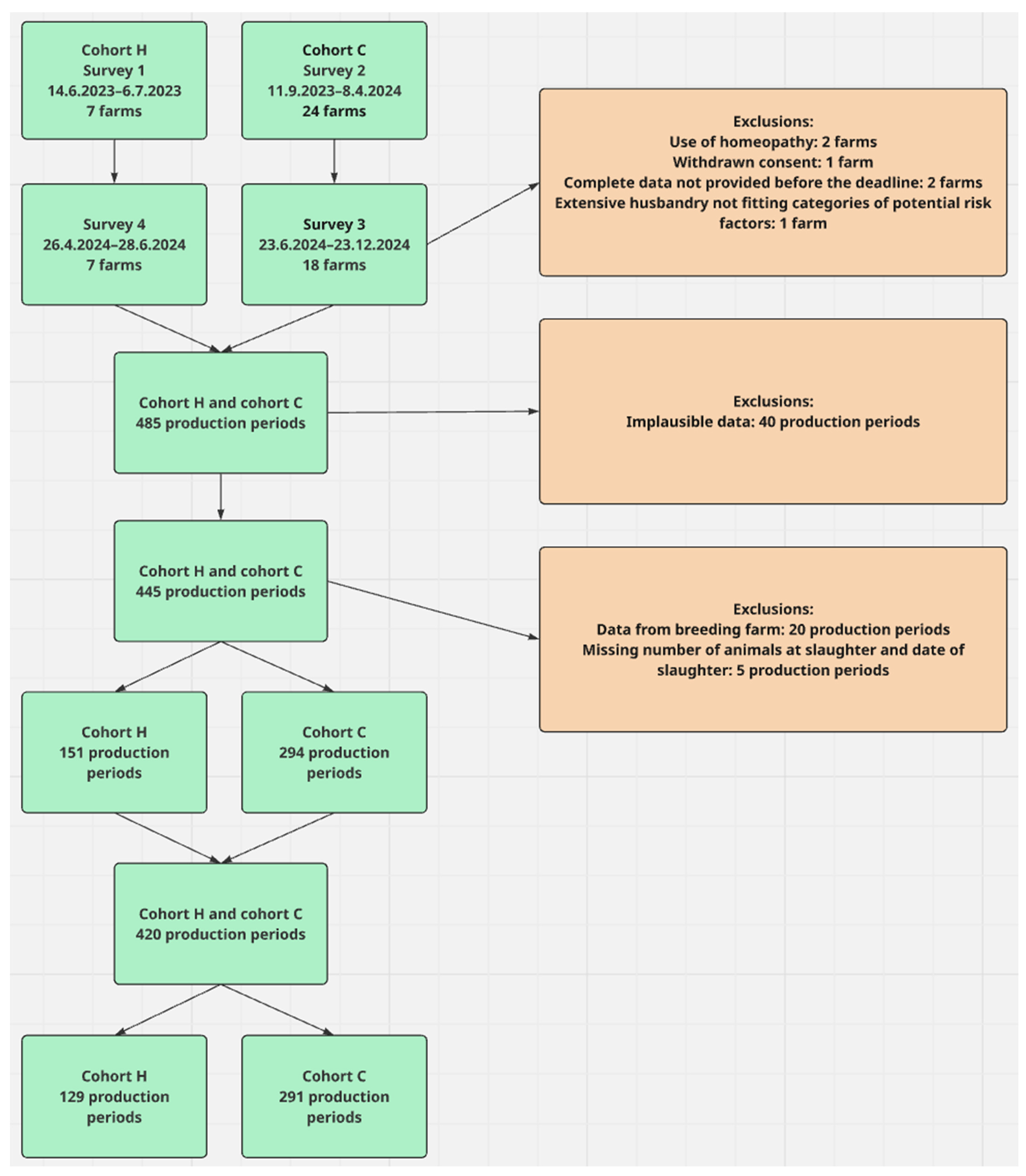
Figure 1. Data collection periods of the different surveys, numbers of farms and numbers of production periods included in the heterogeneity analysis, in a study on commercial turkey production in Germany (2019–2021). Green: number of farms respective production periods of the two cohorts. Rose: exclusions thereof.
Poultry 05 00019 g001
Figure 2. describes the production systems of the study cohorts (C and H) considering gender of the birds, in a study on commercial turkey production in Germany (2019–2021). Profile with number of farms within brackets; gender of the batch followed by number of batches as well as median, minimum and maximum of days in the respective batch phase; Profile 1: raising only; Profile 2: fattening only, (in Cohort H long length of stay due to biodynamic farm); Profile 3: combination (raising followed by fattening); Profile 4: both raising for sale and raising for fattening; Profile 5: breeding. Colour codes: rose: raising phase; blue: fattening phase; green: breeding phase. The length of stay during the production period was not available for the production periods without any slaughter data (n = 5). Hence, these were excluded in this figure.
Poultry 05 00019 g002
Figure 3. Illustrates the comparison of total condemnations by slaughterhouse (%) between cohorts C and H. Median values are presented for both cohorts (colour code: blue: cohort H, red: cohort C). Outliers are marked with dots (mild) or stars (severe).
Poultry 05 00019 g003
Table 1. Calculation of antimicrobial use parameters within this study, and in the official German benchmarking system, in a study on management, production, infection events, and antimicrobial use on 25 commercial turkey farms in Germany (2019–2021).
ParameterCalculation
Sum of antibiotic treatment animal daysFor each individual antimicrobial treatment, the number of animals treated is multiplied by the number of days the veterinary medicinal product (VMP) containing an antimicrobial is applied. Each antibiotic substance class is counted separately. Treatments with NSAID, Triazin derivates and Aminopyridines are not considered here. These figures are summarized for the production period.
Animal days at risk
(denominator 1)
The average number of animals at risk is calculated as follows: (the number of animals at the beginning of the period added to the number of animals at the end of the period) divided by two.
To arrive at the number of animal days at risk, this average number of animals at risk is multiplied by the duration of the production period in days, calculated as the difference between the starting and the end dates of the production period.
Animal days at risk/period (denominator 2)For fattening periods this calculation takes into account changes in the number of animals at risk due to partly depopulation for slaughter or death.
To take mortality into account, an average daily mortality rate was calculated and applied (see below).
For each period (e.g., first period from start of fattening to first slaughter event), the number of animals under risk was calculated by using the number of animals at the beginning of the period, reduced by the number of animals assumed to have died in that period (daily mortality rate multiplied by duration of the period in days); this number of animals was multiplied with the duration of the respective period.
For the next period, the same was applied, using the number of remaining animals as the start value, deducing the died fraction and multiplying this with the duration (days) since the last change in number of animals.
Duration of each period was based on the difference between date for start of fattening, and individual consecutive slaughtering dates.
The animal days at risk were calculated as the sum of the figures calculated for the specific periods, divided by the full duration (days) of the period.
For raising periods, this figure was calculated by dividing the animal days at risk (as explained above) by the duration of the raising period.
Incidence of antibiotic treatment daysSum of all antibiotic animal treatment days divided by the animal days at risk (denominator 1).
Treatment frequencySum of all antibiotic animal treatment days divided by animal days at risk per period (denominator 2).
MortalityThe number of animals lost per day was calculated as follows: lost animals (number of animals at the beginning of the production period minus number of animals at the end of the production period) divided by the length of stay on the farm (= number of days).
Table 2. Differences in farm-level potential risk factors by comparison of category frequencies and of medians between conventional farms (cohort C, 18 farms) and homeopathy farms (cohort H, 7 farms) using Fisher’s Exact Test (FET) and Kruskal–Wallis Test (KW) to assess statistical significance, in a study on commercial turkey production in Germany (2019–2021). Columns represent farm level potential risk factors (categorical); factor-level columns totals add up to 100%.
Farm Level Potential Risk Factors (Categorical).
Variable LevelTotalC (%)H (%)FET_p
Score for working engagement of the farmers 1high score2188.971.40.285
2moderate score411.128.6
3low score0
Attitude towards use of homeopathy1Positive1550.085.70.246
2Neutral838.914.3
3Negative211.10.0
4no answer0
Attitude towards use of antibiotics1prudent use1877.857.10.302
2Overuse722.242.9
Gender of the farmer1Male2394.485.70.47
2Female25.614.3
Highest education1academic degree522.214.30.551
2A-level degree411.128.6
3secondary school leaving certificate or less1666.757.1
Highest vocational qualification1academic degree833.328.60.819
2completed apprenticeship with/without master craftsman1766.771.4
Husbandry type1biodynamic and organic10.014.30.102
2Conventional24100.085.7
Poultry farms nearby1none738.90.0<0.001
21–3 farms1361.128.6
3>3 farms50.071.4
Number of stables at the farm11–3 stables1361.128.60.144
2<3 stables1238.971.4
Years as head of the farm Median 18.521.00.647
Min–Max 4–3811–32
Age of the farmer Median 48.5520.287
Min–Max 34–6941–59
Number of the stables at the farm Median 350.12
Min–Max 2–62–5
Poultry farms nearby Median 18<0.001
Min–Max 0–32–30
Table 3. Differences in production period level potential risk factors by comparison of category frequencies between conventional farms (cohort C) and homeopathy farms (cohort H), between raising (R) and fattening (F) periods overall, and between R and F periods within cohorts C and H separately, using Fisher’s Exact Test (FET) to assess statistical significance, in a study on commercial turkey production in Germany (2019–2021). Significant differences (p< 0.05) are marked in bold.
Production Period Level Potential Risk Factors (Categorical)
445 Production Periods420 Production PeriodsCohort C
291 Production Periods
Cohort H
129 Production Periods
VariableLevelTotalC (%)H (%)FET_pTotalR (%)F
(%)
FET_pTotalR (%)F
(%)
FET_pTotalR (%)F (%)FET_p
Housing conditions and management related factors
Type of production1fattening22749.753.6<0.0012220.0100.0<0.0011430.0100.0<0.001790.0100.0<0.001
2breeding200.013.3 0 0 0
3raising19850.333.1 198100.00.0 148100.00.0 50100.00.0
Outdoor husbandry1no385100.060.3<0.001361100.073.4<0.001291100.0100.0 70100.025.3<0.001
2yes600.039.7 590.026.6 00.00.0 590.074.7
In-house ventilation technique1forced ventilation5915.09.9<0.0014422.20.0<0.0014429.70.0<0.0010 <0.001
2inlet air flaps340.321.9 2914.70.0 10.70.0 2856.00.0
3air supply via doors, windows or shutters0 0 0 0
4combination225.14.6 224.06.3 155.44.9 70.08.9
5open housing33079.663.6 32559.193.7 23164.295.1 9444.091.1
Number of animals at beginning of production period1<5000 animals686.831.8<0.001568.118.0<0.0011910.82.10.001370.046.8<0.001
25000-15,000 animals25863.347.7 24656.660.4 18454.772.0 6262.039.2
3>15,000 animals11929.920.5 11835.421.6 8834.525.9 3038.013.9
Stocking rate **1>53–≤58 kg/sqm8727.05.3<0.001863.535.8<0.001784.750.0<0.00180.010.1<0.001
2>30–≤53 kg/sqm16637.237.8 14323.743.4 10831.843.0 350.044.3
3≤30 kg/sqm19135.857.0 19072.720.8 10463.57.0 86100.045.6
Litter1wood shavings respread with straw8210.933.1<0.0018237.93.2<0.0013216.94.9<0.00150100.00.0<0.001
2wood shavings straw mix12619.745.0 10624.825.7 5833.16.3 480.060.8
3wood shavings3712.60.0 3718.70.0 3725.00.0 0
4straw18953.121.9 18416.268.5 15321.684.6 310.039.2
5others113.70.0 112.52.7 113.44.2 0
Watering system1city water hygienized22354.441.7<0.00120164.133.3<0.00115965.543.40.0024260.015.2<0.001
2city water9627.210.6 9418.226.1 7818.935.0 1616.010.1
3fountain water hygienized469.511.9 4511.69.9 287.411.9 1724.06.3
4fountain water 808.835.8 806.130.6 268.19.8 540.068.4
Feed origin1purchased feed only23456.545.00.02223068.242.8<0.00116466.945.5<0.0016672.038.0<0.001
2own and purchased feed21143.555.0 19031.857.2 12733.154.6 6328.062.0
3own feed0 0 0 0
Feed change during production period1Yes—feed supplement0 0 0 0
2yes—special mixture0 0 0 0
3none445100.0100.0 420100.0100.0 291100.0100.0 129100.0100.0
Functional phytochemical use1mix834.446.4<0.0016310.618.90.056138.80.0<0.0015016.053.2<0.001
2single196.50.0 195.14.1 196.86.3 00.00.0
3none34389.153.6 33884.377.0 25984.593.7 7984.046.8
Hygiene score1high score31573.565.60.08229075.863.1<0.00521373.073.40.937784.044.3<0.001
2moderate score13026.534.4 13024.236.9 7827.026.6 5216.055.7
3low score0 0 0 0
Government measures1none36981.086.80.12434675.388.7<0.00123775.787.40.0110974.091.10.009
2above benchmark value II7619.013.3 7424.811.3 5424.312.6 2026.08.9
3salmonella0 0 0 0
4flu0 0 0 0
Season1spring11626.225.80.84811025.826.60.9017625.726.60.7463426.026.60.933
2autumn10722.826.5 10724.226.6 6721.025.2 4034.029.1
3summer11626.525.2 10525.324.8 7626.425.9 2922.022.8
4winter10624.522.5 9824.822.1 7227.022.4 2618.021.5
Animal-related factors
Genetics1B.U.T. Big Six445100.0100.0 420100.0100.0 291100.0100.0 129100.0100.0
2other than B.U.T Big Six0 0 0 0
Gender1female15237.128.50.07014132.432.90.60110841.232.90.1413316.031.60.047
2male29362.971.5 27967.667.1 18358.867.1 9684.068.4
Raising location *1external on another farm12548.060.40.123124 55.9 69 48.3 55 69.6
2external in another stable on the same farm7937.726.4 65 29.3 53 37.1 12 15.2
3internal in the same stable in the same farm144.87.7 14 6.3 7 4.9 7 8.9
4combination199.65.5 19 8.6 14 9.8 5 6.3
Relocation of turkeys during production period1none20449.039.7<0.00119490.46.8<0.00114492.64.9<0.0015084.010.1<0.001
2yes once17750.319.2 1696.170.7 1457.493.7 242.029.1
3yes more than once640.741.1 573.522.5 20.01.4 5514.060.8
Raising in groups1separated-sex409100.076.2<0.001384100.083.8<0.001291100.0100.0 93100.054.4<0.001
2mixed-sex360.023.8 360.016.2 0 360.045.6
Vaccination according to recommended standard vaccination schedule1standard vaccination schedule24145.670.9<0.00124052.561.30.10913447.344.80.66710668.091.1<0.001
2more than standard vaccination schedule9118.723.8 6816.216.2 5316.220.3 1516.08.9
3less than standard vaccination schedule11335.75.3 11231.322.5 10436.535.0 816.00.0
Slaughterhouse ***, ****1S1104.25.1<0.00110 4.5 6 4.2 4 5.1
2S25337.10.0 53 23.9 53 37.1 0
3S38330.849.4 83 37.4 44 30.8 39 49.4
4S43927.30.0 39 17.6 39 27.3 0
5S5360.045.6 36 16.2 0 36 45.6
6S6 ****11.00.0 1 0.5 1 0.7 0
Breeding company ****1B114044.26.6<0.00113636.428.8<0.00112744.642.7<0.001912.03.80.048
2B2200.013.3 0 0 0
3B35810.517.9 5818.29.9 3114.96.3 2728.016.5
4B415922.860.9 15835.939.2 6728.417.5 9158.078.5
5B56622.50.0 669.121.6 6612.233.6 0
6B6 ****20.01.3 20.50.5 0 22.01.3
Number of breeding companies1one443100.098.70.11541899.599.61.0291100.0100.0 12798.098.71.0
2> one20.01.3 20.50.5 00.00.0 22.01.3
Egg-laying week 5–24 of parents1yes10836.70.00.00110733.318.5<0.00110744.628.70.0050
2no information33763.3100.0 31366.781.5 18455.471.3 129100.0100.0
* For the potential risk factor of the localization of raising, only fattening and breeding periods were considered (n = 237), since the raising periods did not have to answer this question. ** For the potential risk factor of stocking rate, the number of production periods is n = 444, as for one production period this information is implausible. *** For the potential risk factor of slaughterhouse, only fattening periods were considered, since the raising periods did not have to answer this question and 15 production periods (five fattening periods and ten breeding periods) did not provide any information on which slaughterhouse was used (n = 222). **** Two different breeding companies or slaughterhouses (respectively) were used within a production period.
Table 4. Differences in treatment intensity, production, performance specific and animal welfare parameters by comparison of medians between conventional farms (cohort C) and homeopathy farms (cohort H), between raising (R) and fattening (F) periods for both cohorts combined, and between R and F periods within C and H cohorts separately, using the Kruskal–Wallis (KW) Test to assess statistical significance, in a study on commercial turkey production in Germany (2019–2021). Significant differences (p < 0.05) are marked in bold.
Production Period Level Count/Interval-Level Variables
445 Production Periods420 Production PeriodsCohort C 291 Production PeriodsCohort H 129 Production Periods
VariableLevelTotalC H KW_pTotalR FKW_pTotalRFKW_pTotalRFKW_p
Technical Data for Statistical Analysis
Number of animals at beginning of the production periodMedian 11,6846501<0.001 11,8259574<0.001 12,09011,3540.635 97435500<0.001
Min–Max 1647–54,608275–20,215 1647–54,608275–24,500 1647–54,6084526–24,500 5670–20,215275–19,913
Age at housing (days)Median 00<0.001 028<0.001 00<0.001 035<0.001
Min–Max 0–790–51 0–10–79 0–10–79 0–00–51
Age at start of fattening (days)Median 42410.001 42 42 37
Min–Max 26–8318–204 18–83 26–83 18–61
Age at end of raising * (days)Median 45.5360.009 41.5 45.5 35
Min–Max 26–8320–204 20–83 26–83 20–61
Age at end of fattening all * (days)Median 145174<0.001 146 145 149
Min–Max 106–183111–413 106–245 106–183 111–245
Age at end of fattening males * (days)Median 1501480.367 149
Min–Max 139–183138–413 139–245
Age at end of fattening females * (days)Median 113219<0.001 117
Min–Max 106–125111–413 106–245
Age at end of individual period *** (days)Median 81144<0.001 42146<0.001 46145<0.001 35149<0.001
Min–Max 26–18320–413 20–83106–245 26–83106–183 20–61111–245
Sum of homeopathic treatment days (days)Median 025<0.001 000.01 00 19200.079
Min–Max 0–03–80 0–350–40 3–355–40
Sum of treatment days (days)Median 103<0.001 105<0.001 11.58<0.001 71<0.001
Min–Max 0–550–36 0–550–36 0–550–34 0–230–36
Sum of antibiotic treatment days (days)Median 93<0.001 85<0.001 1080.012 50<0.001
Min–Max 0–450–27 0–450–33 0–450–33 0–210–27
Number of animals slaughteredMedian 10,7114864<0.001 9138 10,711 5285
Min–Max 4431–22,660225–19,403 225–22,660 4431–22,660 225–19,403
Length of stay during production period *** (days)Median 72108<0.001 4289<0.001 4683<0.001 35122<0.001
Min–Max 26–14820–375 20–8362–202 26–8362–148 20–6176–202
Average animal days at risk *** (days)Median 715,390362,853<0.001 433,002823,985<0.001 468,291898,179<0.001 288,648597,5950.348
Min–Max 75,348–3,438,87312,953–1,706,086 75,348–2,950,37137,750–3,438,873 75,348–2,950,371353,213 –3,438,873 121,380–941,07037,750–1,706,086
Treatment frequency (with losses) ***
(number of antibiotic treatments per production period)
Median 9.42.14<0.001 8.05.1<0.001 10.18.10.095 5.00<0.001
Min–Max 0–31.60–26.5 0–29.50–31.6 0–29.50–32.1 0–20.80–26.5
Treatment-intensity-specific and animal welfare parameters
Incidence of antibiotic treatment days *** (proportion (%) of days at risk)Median 0.140.01<0.001 0.190.06<0.001 0.230.09<0.001 0.140<0.001
Min–Max 0–0.60–0.4 0–0.60–0.4 0–0.60–0.4 0–0.40–0.3
Mortality raising (%)Median 3.11.9<0.001
Min–Max 0.5–18.40.2–9.1
Mortality fattening *** (%)Median 4.84.40.308
Min–Max 0.3–30.21.3–18.2
Mortality all *** (%)Median 3.73.70.081 2.74.5<0.001 3.14.8<0.001 1.94.3<0.001
Min–Max 0.3–30.20.2–18.2 0.2–18.40.3–30.2 0.5–18.40.3–30.2 0.2–9.11.3–18.2
Production and performance-specific and animal welfare parameters
Weight at slaughter all ** (kg)Median 20.120.60.165 20.4 20.1 20.6
Min–Max 9.1–24.19.3–23.3 9.1–24.1 9.1–24.1 9.3–23.3
Weight at slaughter males ** (kg)Median 21.020.70.155 20.9
Min–Max 16.3–24.118.8–23.3 16.3–24.1
Weight at slaughter females ** (kg)Median 10.210.30.928 10.2
Min–Max 9.1–11.79.3–10.6 9.1–11.7
Average daily weight gain all ** (g)Median 135.4142.70.003 137.9 135.4 142.7
Min–Max 77.3–152.381.8–161.2 77.3–161.2 77.3–152.3 81.8–161.2
Average daily weight gain males ** (g)Median 141.8143.50.017 142.3
Min–Max 116.2–152.3127.4–161.2 116.2–161.2
Average daily weight gain females ** (g)Median 89.885.60.102 89.4
Min–Max 77.3–99.581.8–91.0 77.3–99.54
Number of infectious disease events confirmed by laboratory findingsMedian 21<0.001 21<0.001 21<0.001 1.50<0.001
Min–Max 0–130–8 0–130–8 0–130–7 0–60–8
Number of suspected infectious disease events based on clinical diagnosis and/or necropsy results Median 21<0.001 21<0.001 320.001 21<0.001
Min–Max 0–140–10 0–140–10 0–140–7 0–60–10
Totally condemned carcasses ** (%)Median 0.70.4<0.001 0.6 0.7 0.4
Min–Max 0.1–3.90.1–2.3 0.1–3.9 0.1–3.9 0.1–2.3
Death on arrival ** (%)Median 0.090.060.002 0.1 0.09 0.06
Min–Max 0.01–4.60–0.2 0–4.6 0.01–4.6 0–0.2
Adverse eventsno445100.0100.0 420100.0100.0 291100.0100.0 129100.0100.0
Serious adverse eventsno445100.0100.0 420100.0100.0 291100.0100.0 129100.0100.0
* In the analysis of 445 production periods, raising for breeding periods were assigned to raising, and breeding periods were assigned to fattening to perform a complete statistical analysis of all 445 production periods. ** For production specific parameters of weight at slaughter, average daily weight gain, totally condemned carcasses and death on arrival neither data from the biodynamic farm (n = 36) nor from the breeding farm (n = 10) nor from the production periods without any slaughter data (n = 5) were available. *** For treatment intensity, production and performance-specific parameters of mortality, treatment frequency, treatment incidence, average animal days at risk, length of stay during production period, age at the end of the individual period were not available from the production periods without any slaughter data (n = 5).
Disclaimer/Publisher’s Note: The statements, opinions and data contained in all publications are solely those of the individual author(s) and contributor(s) and not of MDPI and/or the editor(s). MDPI and/or the editor(s) disclaim responsibility for any injury to people or property resulting from any ideas, methods, instructions or products referred to in the content.