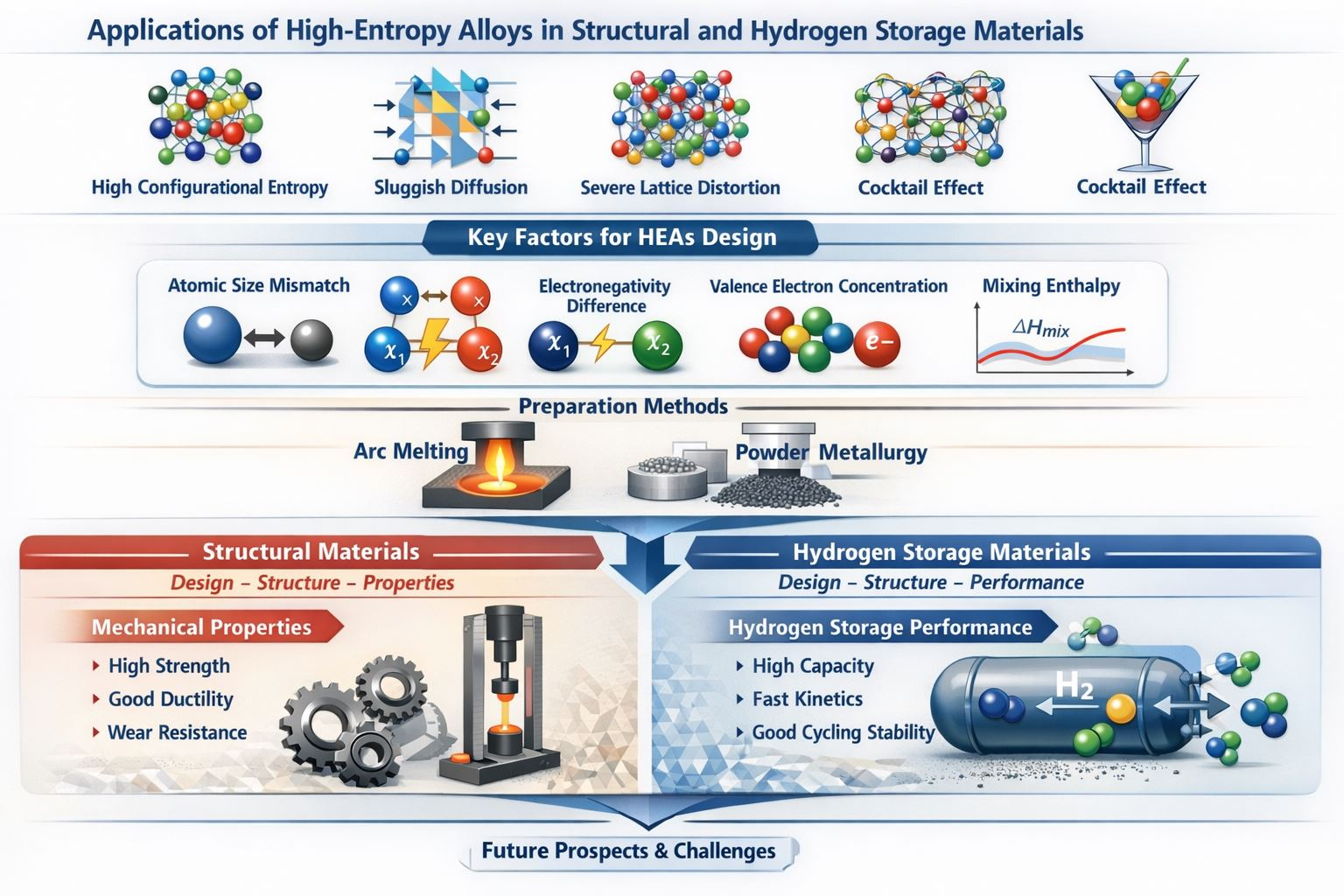

Compositional Design of High-Entropy Alloys: Advances in Structural and Hydrogen Storage Materials

Abstract
1. Introduction
2. Compositional Design of HEAs
2.1. Definition of HEAs
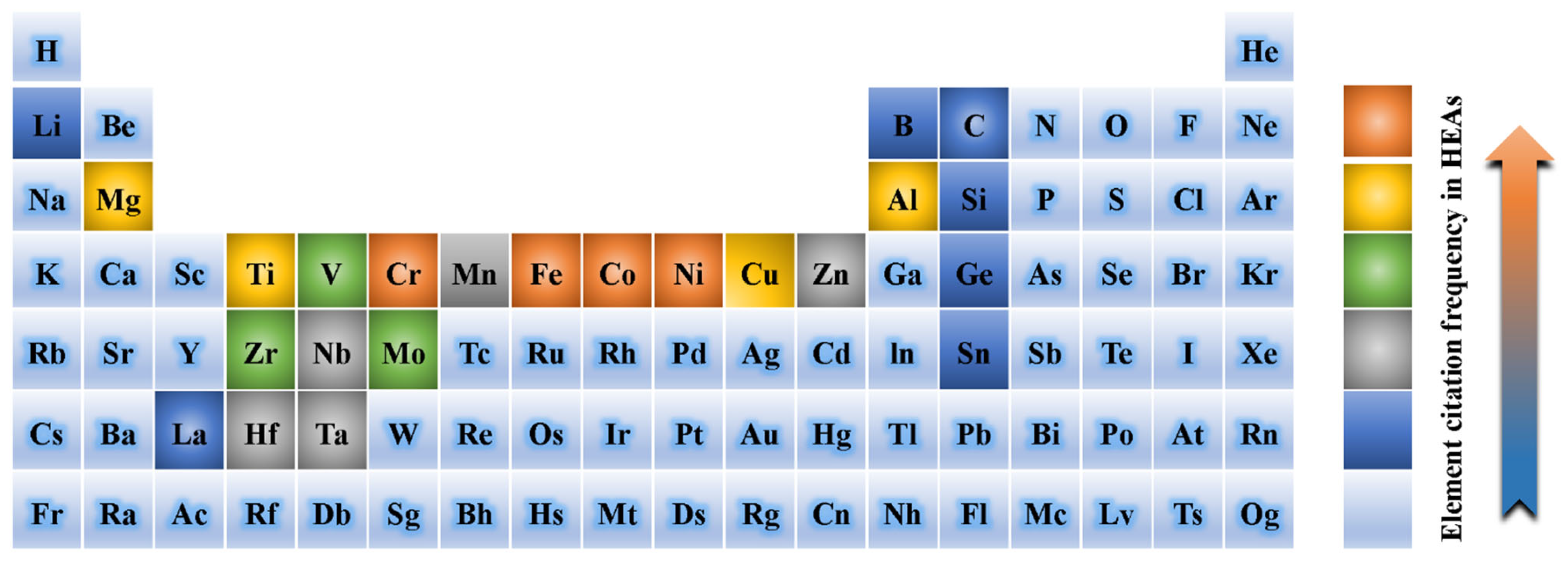
2.2. Effect of Alloying Elements
- (1)
- Al significantly influences phase transitions. Half of the current research examines Al content effects. Al governs phase selection and the strengthening pathway in Co/Cr/Fe/Ni-based HEAs. Thermodynamically, Al increases the atomic size mismatch δ and decreases the valence electron concentration, driving the matrix along the sequence FCC → FCC + BCC → BCC as Al rises. Kinetically, strong negative Al–(Ni, Co, Fe) pair enthalpies promote B2 short-range order and, at higher contents, ordered B2 precipitates or even a continuous B2 matrix. Xing et al. [37] demonstrated a transition from single-phase FCC to FCC + BCC + B2, and finally to BCC + B2 in FeCrNiMnAlx HEAs (x > 0). Wear resistance improved with increasing Al content. In AlxCoCrCuFeNi HEAs, superior high-temperature resistance was observed at higher Al content [38].
- (2)
- Fe addition to the Al0.5CoCrFexNiTi0.5 HEA inhibits σ phase formation while promoting the formation of the FCC phase [39]. The compressive strength of the alloys decreases with the increase in Fe content. Microstructurally, Fe raises the stacking fault energy (relative to Mn) and reduces chemical short-range order, which converts deformation from TWIP/TRIP or planar glide to more homogeneous dislocation slip. These effects explain the observed decline in compressive strength with higher Fe. However, increased Fe typically improves ductility and work-hardening stability, reduces casting hot-cracking, and enhances weldability.
- (3)
- Mo, with its large atomic radius, induces higher lattice distortion and solid solution strengthening. Mo addition promotes σ phase precipitation from the BCC phase in AlCrFeNiMox (x = 0, 0.2, 0.5, 0.8, 1.0) [40]. Furthermore, the μ phase appears with increasing Mo content in CoCrFeMoxNi (x > 0.04) alloy [41].
- (4)
- Hf—a large-radius, strong carbide/boride former—markedly alters phase stability in CoCrFeNi-based HEAs. Hf addition to CoCrFeNi leads to the transformation of solid solution from single-phase FCC to C15 Laves and FCC phases [42]. Hf also has a strong affinity for C or B elements, producing HfC or HfB2 dispersoids that refine grains and raising hardness and compressive yield strength.
- (5)
- Nb promotes the appearance of the Laves phase in CoCrFeNbxNi (x = 0, 0.25, 0.45, 0.5, 0.75, 1.0, and 1.2), while the formation of the Laves phase leads to a decrease in the plasticity and increase in the Vickers hardness and the wear resistance [43]. The results by Fan et al. [44] show that the synergistic effect of Nb and Mo results in the formation of a new kind of Laves phase semi-coherent with FCC matrix, while the ration of Nb/Mo will affect the size of the lamellar structure of the Laves phase.
- (6)
- Co can promote the formation of the FCC phase, including the microstructure of the Al0.4FeCrNiCox (x = 0, 0.25, 0.5, 1 mol) from FCC and BCC phases to the FCC phase with the increase in Co content [45]. From a deformation viewpoint, Co raises the stacking fault energy (SFE) relative to Mn-rich variants, shifting mechanisms from TWIP, TRIP, or planar glide toward more homogeneous dislocation slip. This typically improves work-hardening stability and uniform elongation at room temperature, while slightly lowering the extraordinary strain-hardening of low-SFE compositions.
- (7)
- Ti promotes the formation of the BCC phase. In Al2CrFeNiCoCuTix HEAs, the corrosion resistance of this alloy coating is enhanced in 0.5 mol/L HNO3 solution with increasing Ti content [46]. In terms of microstructure, Ti can achieve strong solid solution strengthening in both face-centered cubic and body-centered cubic matrix structures, thereby increasing the yield strength.
- (8)
- Ta has a similar phase evolution effect to Ti, promoting the formation of the BCC structure, while affecting the precipitate of the Cr2Nb-Laves phase in NiTiCrNbTax HEAs [47]. Furthermore, Ta provides strong solid solution hardening and raises the Peierls barrier in BCC, giving superior hot strength and creep resistance relative to Ti-only variants.
- (9)
- W, a high melting point metal, typically stabilizes BCC solid solutions in HEAs. The incorporation of W leads to the formation of tungsten oxides, which prohibits the evolution of a protective oxide layer on the surface of W-containing HEAs, exhibiting good oxidation resistance [48].
- (10)
- (11)
- V enhances yield strength and ductility of VxNbMoTa at room temperature, which can be contributed to solid solution strengthening and grain refinement [51]. V elevates the growth-restriction factor during solidification and tends to segregate weakly to boundaries, promoting finer as-cast grains; finer grains enhance both yield and uniform elongation.
- (12)
- La alters grain morphologies from a dendritic structure to near-equiaxed structure and decreases grain size, while increasing the ultimate strength and yield strength. Moreover, the formation of La precipitates and the disilicide phase as the La content increases leads to a decrease in ductility [52].
- (13)
- Ni stabilizes the FCC structure and suppresses the formation of the σ phase in CrMnFeCoNix (0 ≤ x ≤ 1.5) [53]. Higher Ni contents promote homogeneous FCC matrices with fewer interdendritic compositional gradients and less partitioning of Cr and Mn. Ni elevates the SFE, thereby shifting deformation from TWIP, TRIP, or planar glide toward stable dislocation slip with good work-hardening capacity. As a result, yield strength and uniform elongation both remain high.
- (14)
- Cu favors FCC solid solution formation [54]. Due to positive enthalpy of mixing with most 3d transition elements [55], Cu readily precipitates from the FCC phase, forming a Cu-rich FCC phase. In AlCrFeNiTiCux HEAs, increasing Cu content promotes the segregation of Al, Ni, and Ti in dendrites, while Fe and Cr precipitate into particles distributed within dendrites and interdendritic regions [56]. Nanoscale Cu-rich precipitates can contribute modest precipitation strengthening while preserving matrix ductility. Moreover, Cu additions raise electrical/thermal conductivity of FCC-based HEAs—useful for heat-spreader or wear-resistant conductor coatings—provided segregation is controlled.
- (15)
- (16)
- Mg content had a positive effect on the formation the BCC phase, while it can significantly decrease the hardness of AlFeCuCrMgx (x = 0.5, 1, 1.7) [60]. Mg provides relatively weak solid solution hardening, lowers the elastic modulus, and can soften Cu- or Mg-rich interdendritic pools if segregation is unchecked.
- (17)
- Zr facilitates BCC over FCC phase formation in TiMoNbZrx HEAs [61]. But the study by Chen et al. [62] shows that the increase in Zr content leads to the volume fraction of the Laves phase increasing in AlCoCrFeNiZrx alloy, while also proving that minor Zr addition can significantly improve the mechanical property of this HEA.
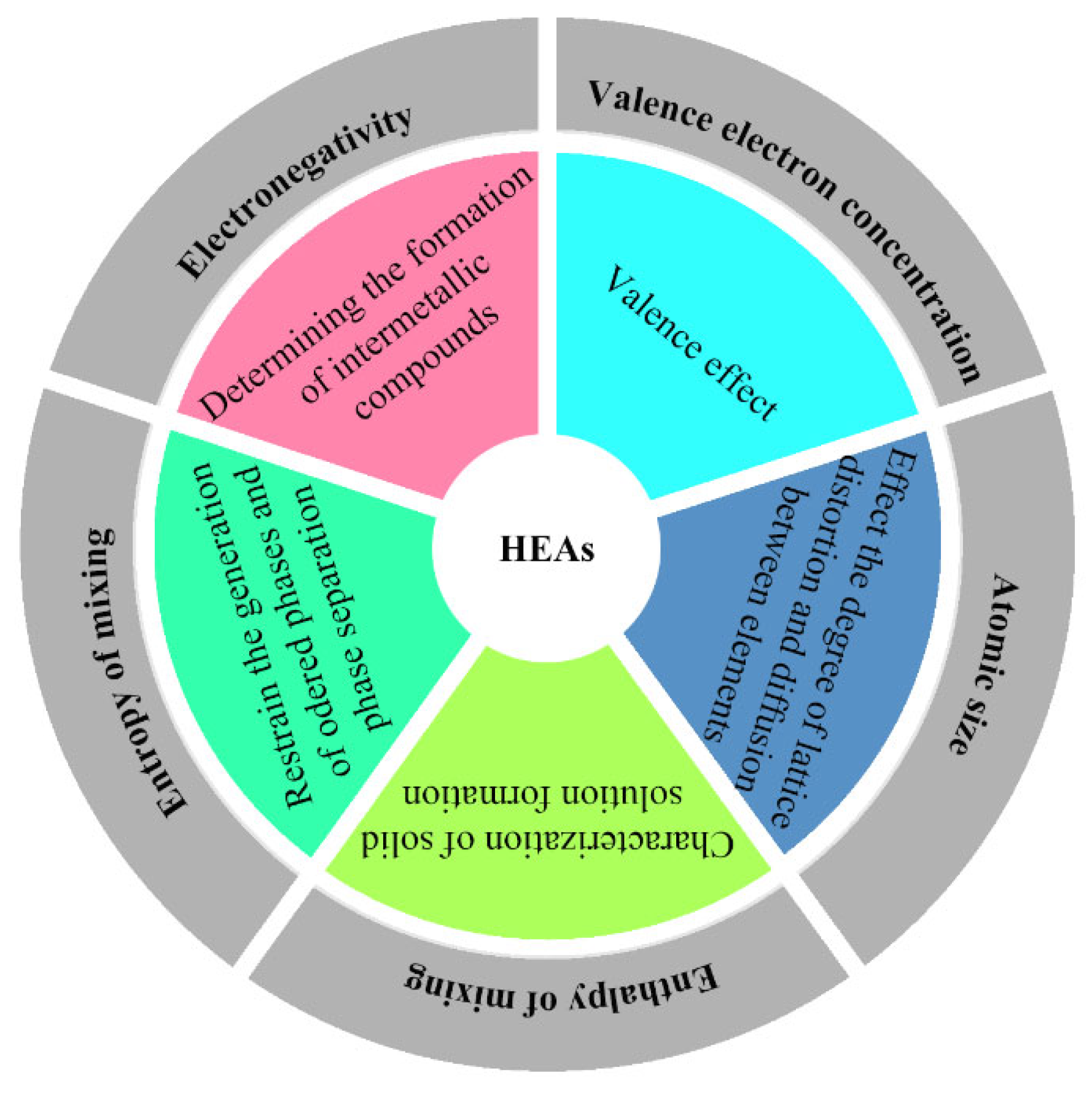
2.3. Solid Solution Formation Rules
- (1)
- Atomic size
- (2)
- Electronegativity
- (3)
- Valence electron concentration (VEC)
- (4)
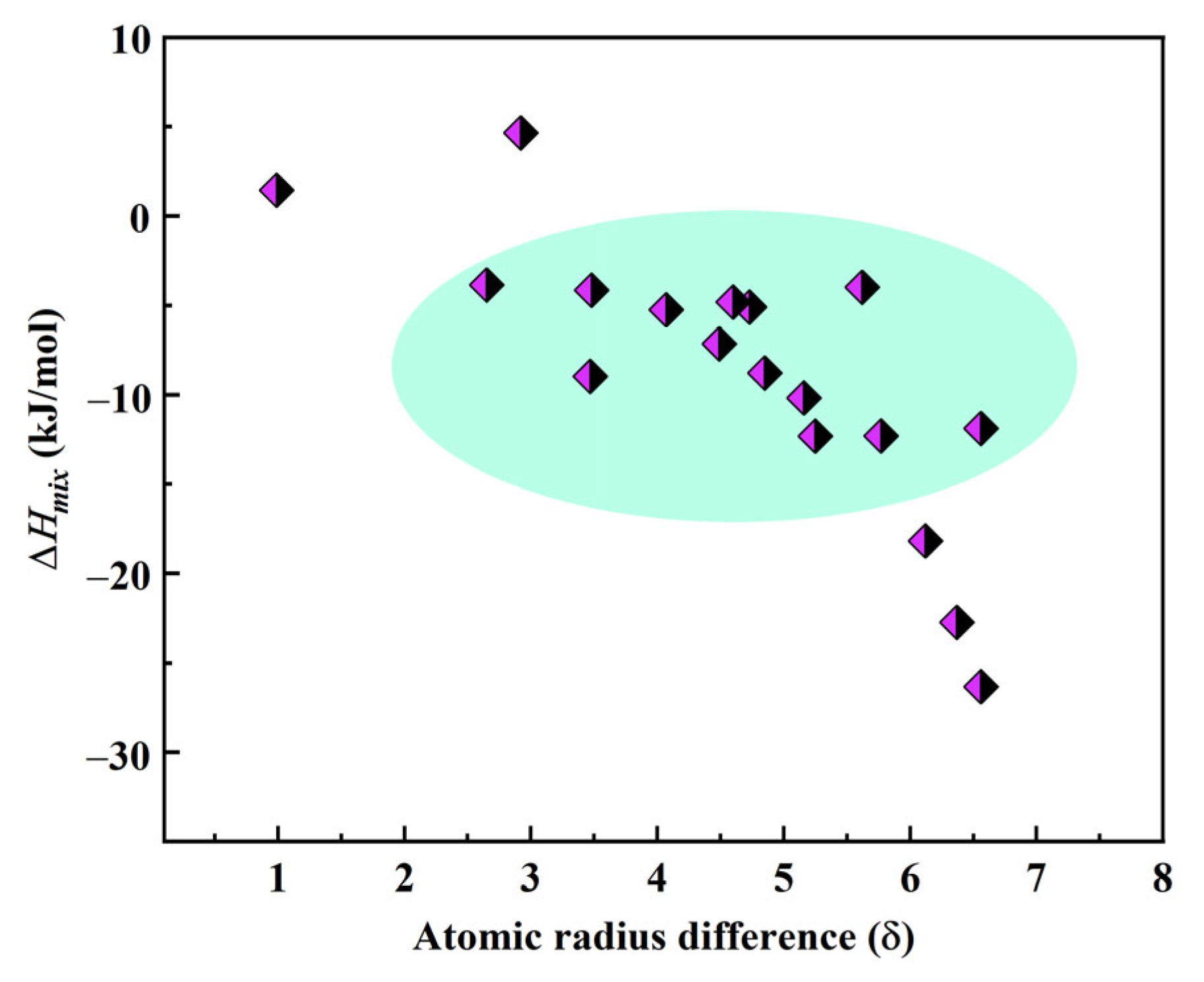
- Enthalpy of mixing (ΔHmix)
- (5)
- Entropy of mixing (ΔSmix)
- (1)
- ΔHmix–δ
- (2)
- VEC
- (3)
- Ω
3. Preparation Methods
3.1. Arc Melting (AM)
3.2. Powder Metallurgy
4. Structural Materials
5. Hydrogen Storage Materials
6. Challenges
7. Summary and Future Work
Author Contributions
Funding
Data Availability Statement
Conflicts of Interest
References
- Gupta, M. Metal matrix composites-the way forward. Appl. Sci. 2020, 10, 3000. [Google Scholar] [CrossRef]
- Karmakar, R.; Maji, P.; Ghosh, S.K. A review on the nickel based metal matrix composite coating. Met. Mater. Int. 2021, 27, 2134–2145. [Google Scholar] [CrossRef]
- Mayet Abdulilah, M.; Hussain Aftab, M.; Hussain Muhammad, M. Three-terminal nanoelectromechanical switch based on tungsten nitride-an amorphous metallic material. Nanotechnology 2015, 27, 035202. [Google Scholar] [CrossRef] [PubMed]
- Shahi Rohit, R.; Gupta Amit, K.; Kumari, P. Perspectives of high entropy alloys as hydrogen storage materials. Int. J. Hydrogen Energy 2023, 48, 21412–21428. [Google Scholar] [CrossRef]
- Kim, C.-S.; Cho, K.; Manjili Mohsen, H.; Nezafati, M. Mechanical performance of particulate-reinforced Al metal-matrix composites (MMCs) and Al metal-matrix nano-composites (MMNCs). J. Mater. Sci. 2017, 52, 13319–13349. [Google Scholar] [CrossRef]
- Ye, T.; Xu, Y.; Ren, J. Effects of SiC particle size on mechanical properties of SiC particle reinforced aluminum metal matrix composite. Mater. Sci. Eng. A 2019, 753, 146–155. [Google Scholar] [CrossRef]
- Liu, Q.; Fan, G.; Tan, Z.; Guo, Q.; Xiong, D.; Su, Y.; Li, Z.; Zhang, D. Reinforcement with intragranular dispersion of carbon nanotubes in aluminum matrix composites. Compos. Part B Eng. 2021, 217, 108915. [Google Scholar] [CrossRef]
- Malaki, M.; Tehrani, A.F.; Niroumand, B.; Gupta, M. Wettability in metal matrix composites. Metals 2021, 11, 1034. [Google Scholar] [CrossRef]
- Li, X.; Cai, W.; Li, D.; Xu, J.; Tao, H.; Liu, B. Amorphous alloys for electrocatalysis: The significant role of the amorphous alloy structure. Nano Res. 2021, 16, 4277–4288. [Google Scholar] [CrossRef]
- Wang, W. The elastic properties, elastic models and elastic perspectives of metallic glasses. Prog. Mater. Sci. 2012, 57, 487–656. [Google Scholar] [CrossRef]
- Na, J.H.; Park, E.S.; Kim, Y.C.; Fleury, E.; Kim, W.T.; Kim, D.H. Poisson’s ratio and fragility of bulk metallic glasses. J. Mater. Res. 2008, 23, 523–528. [Google Scholar] [CrossRef]
- Zhang, J.; Wang, X.; Li, M. From brittle to ductile transition: The influence of oxygen on mechanical properties of metallic glasses. J. Alloys Compd. 2021, 876, 160023. [Google Scholar] [CrossRef]
- Cantor, B.; Chang, I.T.H.; Knight, P.; Vincent, A.J.B. Microstructural development in equiatomic multicomponent alloys. Mater. Sci. Eng. A 2004, 375–377, 213–218. [Google Scholar] [CrossRef]
- Yeh, J.W.; Chen, S.K.; Lin, S.J.; Gan, J.Y.; Chin, T.S.; Shun, T.T.; Tsau, C.H.; Chang, S.Y. Nanostructured high-entropy alloys with multiple principal elements: Novel alloy design concepts and outcomes. Adv. Eng. Mater. 2004, 6, 299–303. [Google Scholar] [CrossRef]
- Yao, H.; Tan, Z.; He, D.; Zhou, Z.; Zhou, Z.; Xue, Y.; Cui, L.; Chen, L.; Wang, G.; Yang, Y. High strength and ductility AlCrFeNiV high entropy alloy with hierarchically heterogeneous microstructure prepared by selective laser melting. J. Alloys Compd. 2020, 813, 152196. [Google Scholar] [CrossRef]
- Gludovatz, B.; Hohenwarter, A.; Catoor, D.; Chang, E.H.; George, E.P.; Ritchie, R.O. A fracture-resistant high-entropy alloy for cryogenic applications. Science 2014, 345, 1153–1158. [Google Scholar] [CrossRef]
- Skrabalak, S.E. Mashing up metals with carbothermal shock. Science 2018, 359, 1467. [Google Scholar] [CrossRef]
- Yang, T.; Zhao, Y.L.; Tong, Y.; Jiao, Z.B.; Wei, J.; Cai, J.X.; Han, X.D.; Chen, D.; Hu, A.; Kai, J.J.; et al. Multicomponent intermetallic nanoparticles and superb mechanical behaviors of complex alloys. Science 2018, 362, 933–937. [Google Scholar] [CrossRef]
- Han, L.L.; Maccari, F.; Souza Filho, I.R.; Peter, N.J.; Wei, Y.; Gault, B.; Gutfleisch, O.; Li, Z.; Raabe, D. A mechanically strong and ductile soft magnet with extremely low coercivity. Nature 2022, 608, 310–316. [Google Scholar] [CrossRef]
- Gorr, B.; Azim, M.; Christ, H.-J.; Mueller, T.; Schliephake, D.; Heilmaier, M. Phase equilibria, microstructure, and high temperature oxidation resistance of novel refractory high-entropy alloys. J. Alloys Compd. 2015, 624, 270–278. [Google Scholar] [CrossRef]
- Lee, C.; Chou, Y.; Kim, G.; Gao, M.C.; An, K.; Brechtl, J.; Zhang, C.; Chen, W.; Poplawsky, J.D.; Song, G.; et al. Lattice-distortion-enhanced yield strength in a refractory high-entropy alloy. Adv. Mater. 2020, 32, 2004029. [Google Scholar] [CrossRef] [PubMed]
- Divilov, S.; Eckert, H.; Hicks, D.; Oses, C.; Toher, C.; Friedrich, R.; Esters, M.; Mehl, M.J.; Zettel, A.C.; Lederer, Y.; et al. Disordered enthalpy–entropy descriptor for high-entropy ceramics discovery. Nature 2024, 625, 66–73. [Google Scholar] [CrossRef] [PubMed]
- Qian, X.S.; Han, D.; Zheng, L.; Chen, J.; Tyagi, M.; Li, Q.; Du, F.; Zheng, S.; Huang, X.; Zhang, S.; et al. High-entropy polymer produces a giant electrocaloric efect at low fields. Nature 2021, 600, 664–669. [Google Scholar] [CrossRef] [PubMed]
- Lei, Z.; Liu, X.; Wu, Y.; Wang, H.; Jiang, S.; Wang, S.; Hui, X.; Wu, Y.; Gault, B.; Kontis, P.; et al. Enhanced strength and ductility in a high-entropy alloy via ordered oxygen complexes. Nature 2018, 563, 546–550. [Google Scholar] [CrossRef]
- Rao, Z.; Tung, P.-Y.; Xie, R.; Wei, Y.; Zhang, H.; Ferrari, A.; Klaver, T.P.C.; Körmann, F.; Sukumar, P.T.; Kwiatkowski da Silva, A.; et al. Machine learning–enabled high-entropy alloy discovery. Science 2022, 378, 78–85. [Google Scholar] [CrossRef]
- Yao, Y.; Dong, Q.; Brozena, A.; Luo, J.; Miao, J.; Chi, M.; Wang, C.; Kevrekidis, I.G.; Ren, Z.J.; Greeley, J.; et al. High-entropy nanoparticles: Synthe-sis-structure-property relationships and data-driven discovery. Science 2022, 376, 151. [Google Scholar] [CrossRef]
- Zhang, R.; Wang, C.; Zou, P.; Lin, R.; Ma, L.; Yin, L.; Li, T.; Xu, W.; Jia, H.; Li, Q.; et al. Compositionally complex doping for zero-strain zero-cobalt layered cathodes. Nature 2022, 610, 67–73. [Google Scholar] [CrossRef]
- He, Q.F.; Wang, J.G.; Chen, H.A.; Ding, Z.Y.; Zhou, Z.Q.; Xiong, L.H.; Luan, J.H.; Pelletier, J.M.; Qiao, J.C.; Wang, Q.; et al. A highly distorted ultraelastic chemically complex Elinvar alloy. Nature 2022, 602, 251–257. [Google Scholar] [CrossRef]
- Miracle, D.B.; Miller, J.D.; Senkov, O.N.; Woodward, C.; Uchic, M.D.; Tiley, J. Exploration and development of high entropy alloys for structural applications. Entropy 2014, 16, 494–525. [Google Scholar] [CrossRef]
- Praveen, S.; Kim, H.S. High-entropy alloys: Potential candidates for high-temperature applications—An overview. Adv. Eng. Mater. 2018, 20, 1700645. [Google Scholar] [CrossRef]
- Průša, F.; Cabibbo, M.; Šenková, A.; Kučera, V.; Veselka, Z.; Školáková, A.; Vojtěch, D.; Cibulková, J.; Čapek, J. High-strength ultrafine-grained CoCrFeNiNb high-entropy alloy prepared by mechanical alloying: Properties and strengthening mechanism. J. Alloys Compd. 2020, 835, 155308. [Google Scholar] [CrossRef]
- Cheng, H.; Liu, X.; Tang, Q.; Wang, W.; Yan, X.; Dai, P. Microstructure and mechanical properties of FeCoCrNiMnAlx high-entropy alloys prepared by mechanical alloying and hot-pressed sintering. J. Alloys Compd. 2019, 775, 742–751. [Google Scholar] [CrossRef]
- Sahlberg, M.; Karlsson, D.; Zlotea, C.; Jansson, U. Superior hydrogen storage in high entropy alloys. Sci. Rep. 2016, 6, 36770. [Google Scholar] [CrossRef] [PubMed]
- Zepon, G.; Leiva, D.R.; Strozi, R.B.; Bedoch, A.; Figueroa, S.J.A.; Ishikawa, T.T.; Botta, W.J. Hydrogen-induced phase transition of MgZrTiFe0.5Co0.5Ni0.5 high entropy alloy. Int. J. Hydrogen Energy 2018, 43, 1702–1708. [Google Scholar] [CrossRef]
- Zhang, C.; Song, A.; Yuan, Y.; Wu, Y.; Zhang, P.; Lu, Z.; Song, X. Study on the hydrogen storage properties of a TiZrNbTa high entropy alloy. Int. J. Hydrogen Energy 2020, 45, 5367–5374. [Google Scholar] [CrossRef]
- Shen, H.; Hu, J.; Li, P.; Huang, G.; Zhang, J.; Zhang, J.; Mao, Y.; Xiao, H.; Zhou, X.; Zu, X.; et al. Compositional dependence of hydrogenation performance of Ti-Zr-Hf-Mo-Nb high-entropy alloys for hydrogen/tritium storage. J. Mater. Sci. Technol. 2020, 55, 116–125. [Google Scholar] [CrossRef]
- Xing, X.; Liu, Y.; Hu, J.; Li, W. Effect of Al content on microstructure and wear properties of FeCrNiMnAlx high-entropy alloys. Mater. Res. Express. 2022, 9, 036510. [Google Scholar] [CrossRef]
- Liu, Y.Y.; Chen, Z.; Chen, J.C.; Shi, J.C.; Wang, Z.Y.; Wang, S.; Liu, F. Effect of Al content on high temperature oxidation resistance of AlxCoCrCuFeNi high entropy alloys (x = 0, 0.5, 1, 1.5, 2). Vacuum 2019, 169, 108837. [Google Scholar] [CrossRef]
- Lee, C.-F.; Shun, T.-T. Effect of Fe content on microstructure and mechanical properties of Al0.5CoCrFexNiTi0.5 high-entropy alloys. Mater. Charact. 2016, 114, 179–184. [Google Scholar] [CrossRef]
- Dong, Y.; Lu, Y.; Kong, J.; Zhang, J.; Li, T. Microstructure and mechanical properties of multi-component AlCrFeNiMox high-entropy alloys. J. Alloys Compd. 2013, 573, 96–101. [Google Scholar] [CrossRef]
- Praveen, S.; Murty, B.S.; Kottada, R.S. Effect of molybdenum and niobium on the phase formation and hardness of nanocrystalline CoCrFeNi high entropy alloys. J. Nanosci. Nanotechnol. 2014, 14, 8106. [Google Scholar] [CrossRef]
- Cengiz, S.; Thuvander, M. The effect of Hf addition on the boronizing and siliciding behavior of CoCrFeNi high entropy alloys. Materials 2022, 15, 2282. [Google Scholar] [CrossRef] [PubMed]
- Jiang, H.; Jiang, L.; Qiao, D.; Lu, Y.; Wang, T.; Cao, Z.; Li, T. Effect of niobium on microstructure and properties of the CoCrFeNbxNi high entropy alloys. J. Mater. Sci. Technol. 2017, 33, 712–717. [Google Scholar] [CrossRef]
- Fan, R.; Wang, L.; Zhao, L.; Wang, L.; Zhao, S.; Zhang, Y.; Cui, B. Synergistic effect of Nb and Mo alloying on the microstructure and mechanical properties of CoCrFeNi high entropy alloy. Mater. Sci. Eng. A 2022, 829, 142153. [Google Scholar] [CrossRef]
- Kumar, S.; Patnaik, A.; Pradhan, A.K.; Kumar, V. Effect of cobalt content on thermal, mechanical, and microstructural properties of Al0.4FeCrNiCox (x = 0, 0.25, 0.5, 1.0 mol) high-entropy alloys. J. Mater. Eng. Perform. 2019, 28, 4111–4119. [Google Scholar] [CrossRef]
- Qiu, X.W.; Zhang, Y.P.; Liu, C.G. Effect of Ti content on structure and properties of Al2CeFeNiCoCuTix high-entropy alloy coatings. J. Alloys Compd. 2014, 585, 282–286. [Google Scholar] [CrossRef]
- Zhang, X.; Cui, X.; Jin, G.; Ding, Q.; Zhang, D.; Wen, X.; Jiang, L.; Wan, S.; Tian, H. Microstructure evolution and properties of NiTiCrNbTax refractory high-entropy alloy coatings with variable Ta content. J. Alloys Compd. 2022, 891, 161756. [Google Scholar] [CrossRef]
- Moghaddam, A.O.; Sudarikov, M.; Shaburova, N.; Zherebtsov, D.; Zhivulin, V.; Solizoda, I.A.; Starikov, A.; Veselov, S.; Samoilova, O.; Trofimov, E. High temperature oxidation resistance of W-containing high entropy alloys. J. Alloys Compd. 2022, 897, 162733. [Google Scholar] [CrossRef]
- Xu, Z.Q.; Ma, Z.L.; Tan, Y.; Wang, M.; Zhao, Y.; Cheng, X.W. Effects of Si additions on microstructures and mechanical properties of VNbTiTaSix refractory high-entropy alloys. J. Alloys Compd. 2022, 900, 163517. [Google Scholar] [CrossRef]
- Kumar, A.; Dhekne, P.; Swarnakar, A.K.; Chopkar, M.K. Analysis of Si addition on phase formation in AlCoCrCuFeNiSix high entropy alloys. Mater. Lett. 2017, 188, 73–76. [Google Scholar] [CrossRef]
- Wang, M.; Ma, Z.L.; Xu, Z.Q.; Cheng, X.W. Effect of vanadium concentration on mechanical properties of VxNbMoTa refractory high-entropy alloys. Mater. Sci. Eng. A 2021, 808, 140848. [Google Scholar] [CrossRef]
- Xu, Q.; Chen, D.; Wang, C.; Cao, W.; Wang, Q.; Cui, H.; Zhang, S.; Chen, R. Effects of La on microstructure and mechanical properties of NbMoTiVSi0.2 refractory high entropy alloys. Trans. Nonferrous Met. Soc. China 2021, 31, 512–520. [Google Scholar] [CrossRef]
- Christofidou, K.A.; McAuliffe, T.P.; Mignanelli, P.M.; Stone, H.J.; Jones, N.G. On the prediction and the formation of the sigma phase in CrMnCoFeNix high entropy alloys. J. Alloys Compd. 2019, 770, 285–293. [Google Scholar] [CrossRef]
- Fan, Q.C.; Li, B.S.; Zhang, Y. Influence of Al and Cu elements on the microstructure and properties of (FeCrNiCo)AlxCuy high-entropy alloys. J. Alloys Compd. 2014, 614, 203–210. [Google Scholar] [CrossRef]
- Koundinya, N.T.B.N.; Sajith Babu, C.; Sivaprasad, K.; Susila, P.; Kishore Babu, N.; Baburao, J. Phase evolution and thermal analysis of nanocrystalline AlCrCuFeNiZn high entropy alloy produced by mechanical alloying. J. Mater. Eng. Perform. 2013, 22, 3077–3084. [Google Scholar] [CrossRef]
- Huang, L.; Wang, X.; Huang, B.; Zhao, X.; Chen, H.; Wang, C. Effect of Cu segregation on the phase transformation and properties of AlCrFeNiTiCux high-entropy alloys. Intermetallics 2022, 140, 107397. [Google Scholar] [CrossRef]
- Wu, H.; Huang, S.; Zhu, C.; Zhu, H.; Xie, Z. Influence of Cr content on the microstructure and mechanical properties of CrxFeNiCu high entropy alloys. Prog. Nat. Sci. Mater. Int. 2020, 30, 239–245. [Google Scholar] [CrossRef]
- Gao, N.; Lu, D.H.; Zhao, Y.Y.; Liu, X.W.; Liu, G.H.; Wu, Y.; Liu, G.; Fan, Z.T.; Lu, Z.P.; George, E.P. Strengthening of a CrMnFeCoNi high-entropy alloy by carbide precipitation. J. Alloys Compd. 2019, 792, 1028–1035. [Google Scholar] [CrossRef]
- Klimova, M.; Shaysultanov, D.; Semenyuk, A.; Zherebtsov, S.; Stepanov, N. Effect of carbon on recrystallised microstructures and properties of CoCrFeMnNi-type high-entropy alloys. J. Alloys Compd. 2021, 851, 156839. [Google Scholar] [CrossRef]
- Maulik, O.; Kumar, D.; Kumar, S.; Fabijanic, D.M.; Kumar, W. Structural evolution of spark plasma sintered AlFeCuCrCrMgx (x = 0, 0.5, 1.7) high entropy alloys. Intermetallics 2016, 77, 46–56. [Google Scholar] [CrossRef]
- Chen, G.; Xiao, Y.; Ji, X.; Liang, X.; Hu, Y.; Cai, Z.; Liu, J.; Tong, Y. Effects of Zr content on the microstructure and performance of TiMoNbZrx high-entropy alloys. Metals 2021, 11, 1315. [Google Scholar] [CrossRef]
- Chen, J.; Niu, P.; Liu, Y.; Lu, Y.; Wang, X.; Peng, Y.; Liu, J. Effect of Zr content on microstructure and mechanical properties of AlCoCrFeNi high entropy alloy. Mater. Des. 2016, 94, 39–44. [Google Scholar] [CrossRef]
- Zhang, Y.; Zhou, Y.J.; Lin, J.P.; Chen, G.L.; Liaw, P.K. Solid-solution phase formation rules for multi-component alloys. Adv. Eng. Mater. 2008, 10, 534–538. [Google Scholar] [CrossRef]
- Zintl, E. Intermetallische verbindungen. Angew. Chem. 1939, 52, 1–6. [Google Scholar] [CrossRef]
- Fang, S.; Xiao, X.; Xia, L.; Li, W.; Dong, Y. Relationship between the widths of supercooled liquid regions and bond parameters of Mg-based bulk metallic glasses. J. Non-Cryst. Solids 2003, 321, 120–125. [Google Scholar] [CrossRef]
- Guo, S.; Ng, C.; Lu, J.; Liu, C.T. Effect of valence electron concentration on stability of fcc or bcc phase in high entropy alloys. J. Appl. Phys. 2011, 109, 103505. [Google Scholar] [CrossRef]
- Wang, X.; Guo, W.; Fu, Y.Z. High-entropy alloys: Emerging materials for advanced functional applications. J. Mater. Chem. A 2021, 9, 663–701. [Google Scholar] [CrossRef]
- Guo, S.; Hu, Q.; Ng, C.; Liu, C.T. More than entropy in high-entropy alloys: Forming solid solutions or amorphous phase. Intermetallics 2013, 41, 96–103. [Google Scholar] [CrossRef]
- Kumar, A.; Singh, A.; Suhane, A. Mechanically alloyed high entropy alloys: Existing challenges and opportunities. J. Mater. Res. Technol. 2022, 17, 2431–2456. [Google Scholar] [CrossRef]
- Chen, R.; Qin, G.; Zheng, H.; Wang, L.; Su, Y.; Chiu, Y.; Ding, H.; Guo, J.; Fu, H. Composition design of high entropy alloys using the valence electron concentration to balance strength and ductility. Acta Mater. 2018, 144, 129–137. [Google Scholar] [CrossRef]
- Wang, J.; Bai, S.X.; Tang, Y.; Li, S.; Liu, X.Y.; Jia, J.H.; Ye, Y.C.; Zhu, L.A. Effect of the valence electron concentration on the yield strength of Ti-Zr-Nb-V high-entropy alloys. J. Alloys Compd. 2021, 868, 159190. [Google Scholar] [CrossRef]
- Yang, X.; Zhang, Y. Prediction of high-entropy stabilized solid-solution in multi-component alloys. Mater. Chem. Phys. 2012, 132, 233–238. [Google Scholar] [CrossRef]
- Miracle, D.B.; Senkov, O.N. A critical review of high entropy alloys and related concepts. Acta Mater. 2017, 122, 448–511. [Google Scholar] [CrossRef]
- Wan, Y.; Wang, Q.; Mo, J.; Zhang, Z.; Wang, X.; Liang, X.; Shen, B. WReTaMo Refractory High-Entropy Alloy with High Strength at 1600 °C. Adv. Eng. Mater. 2022, 24, 2100765. [Google Scholar] [CrossRef]
- Hou, L.L.; Hui, J.T.; Yao, Y.H.; Chen, J.; Liu, J.N. Effects of Boron Content on microstructure and mechanical properties of AlFeCoNiBx high entropy alloy prepared by vacuum arc melting. Vacuum 2019, 164, 212–218. [Google Scholar] [CrossRef]
- Taha, M.A.; Youness, R.A.; Zawrah, M.F. Review on nanocomposites fabricated by mechanical alloying. Int. J. Miner. Metall. Mater. 2019, 26, 1047–1058. [Google Scholar] [CrossRef]
- Wu, S.P.; Cai, X.L.; Cheng, Y.C.; Zhou, L. Evolution of intermetallic Cu9Al4 during the mechanical alloying of Cu-Al mixtures in high-energy ball milling. J. Electron. Mater. 2021, 50, 4549–4556. [Google Scholar] [CrossRef]
- Du, P.; Zhu, B.; Yang, X.X.; Xie, G.Q. Toxic elements-free low-cost Ti-Fe-Si metallic glass biomaterial developed by mechanical alloying. J. Alloys Compd. 2021, 886, 161290. [Google Scholar] [CrossRef]
- Li, Z.; Liu, X.; Jiang, L.; Wang, S. Characterization of Mg-20 wt% Ni-Y hydrogen storage composite prepared by reactive mechanical alloying. Int. J. Hydrogen Energy 2007, 32, 1869–1874. [Google Scholar] [CrossRef]
- Suryanarayana, C.; Al-Aqeeli, N. Mechanically alloyed nanocomposites. Prog. Mater. Sci. 2013, 58, 383–502. [Google Scholar] [CrossRef]
- Vaidya, M.; Muralikrishna, G.M.; Murty, B.S. High-entropy alloys by mechanical alloying: A review. J. Mater. Res. 2019, 34, 664–686. [Google Scholar] [CrossRef]
- Wu, S.; Chen, Y.; Kang, W.; Cai, X.; Zhou, L. Hydrogen storage properties of MgTiVZrNb high-entropy alloy and its catalytic effect upon hydrogen storage in Mg. Int. J. Hydrogen Energy 2024, 50, 1113–1128. [Google Scholar] [CrossRef]
- Tan, Z.; Wang, L.; Xue, Y.F.; Zhang, P.; Cao, T.Q.; Cheng, X.W. High-entropy alloy particle reinforced Al-based amorphous alloy composite with ultrahigh strength prepared by spark plasma sintering. Mater. Des. 2016, 109, 219–226. [Google Scholar] [CrossRef]
- Zhu, C.L.; Li, Z.J.; Hong, C.F.; Dai, P.Q.; Chen, J.F. Microstructure and mechanical properties of the TiZrNbMoTa refractory high-entropy alloy produced by mechanical alloying and spark plasma sintering. Int. J. Refract. Met. Hard Mater. 2020, 93, 105357. [Google Scholar] [CrossRef]
- Zhang, Y.; Ai, Y.L.; Chen, W.H.; Ouyang, S. Preparation and microstructure and properties of AlCuFeMnTiV lightweight high entropy alloy. J. Alloys Compd. 2022, 900, 163352. [Google Scholar] [CrossRef]
- Sun, Y.C.; Ke, B.; Li, Y.L.; Yang, K.; Yang, M.Q.; Ji, W.; Fu, Z.Y. Phases, microstructures and mechanical properties of CoCrNiCuZn high-entropy alloy prepared by mechanical alloying and spark plasma sintering. Entropy 2019, 21, 122. [Google Scholar] [CrossRef]
- Shabani, A.; Toroghinejad, M.R.; Shafyei, A.; Logé, R.E. Microstructure and mechanical properties of a multiphase FeCrCuMnNi high-entropy alloy. J. Mater. Eng. Perform. 2019, 28, 2388–2398. [Google Scholar] [CrossRef]
- Xiao, L.L.; Zheng, Z.Q.; Guo, S.W.; Huang, P.; Wang, F. Ultra-strong nanostructured CrMnFeCoNi high entropy alloys. Mater. Des. 2020, 194, 108895. [Google Scholar] [CrossRef]
- Cheng, H.; Xie, Y.C.; Tang, Q.H.; Rao, C.; Dai, P.Q. Microstructure and mechanical properties of FeCoCrNiMn high-entropy alloy produced by mechanical alloying and vacuum hot pressing sintering. Trans. Nonferrous Met. Soc. China 2018, 28, 1360–1367. [Google Scholar] [CrossRef]
- Yurkova, A.I.; Nakonechnyi, S.O.; Cherniavsky, V.V.; Kushnir, V.V. Nanostructured AlCoFeCrVNi and AlCoFeCrVTi high-entropy alloys resulted from mechanical alloying and sintering. Appl. Nanosci. 2022, 12, 849–860. [Google Scholar] [CrossRef]
- Zhao, Y.F.; Feng, X.B.; Zhang, J.Y.; Lu, Y.; Wu, S.H.; Wang, Y.Q.; Wu, K.; Liu, G.; Sun, J. Tailoring phase transformation strengthening and plasticity of nanostructured high entropy alloys. Nanoscale 2020, 12, 14135–14149. [Google Scholar] [CrossRef]
- Liu, X.Q.; Cheng, H.; Li, Z.J.; Wang, H.; Chang, F.; Wang, W.G.; Tang, Q.H.; Dai, P.Q. Microstructure and mechanical properties of FeCoCrNiMnTi0.1C0.1 high-entropy alloy produced by mechanical alloying and vacuum hot pressing sintering. Vacuum 2019, 165, 297–304. [Google Scholar] [CrossRef]
- Xie, Y.C.; Cheng, H.; Tang, Q.H.; Chen, W.; Chen, W.K.; Dai, P.Q. Effects of N addition on microstructure and mechanical properties of CoCrFeNiMn high entropy alloy produced by mechanical alloying and vacuum hot pressing sintering. Intermetallics 2018, 93, 228–234. [Google Scholar] [CrossRef]
- Ye, X.C.; Xu, W.Q.; Li, Z.; Xu, D.; Zhang, W.; Li, B.; Fang, D. Microstructures and mechanical properties of FeNiCrMnAl high-entropy alloys. J. Mater. Eng. Perform. 2022, 31, 7820–7829. [Google Scholar] [CrossRef]
- Sharma, A.; Oh, M.C.; Ahn, B. Microstructural evolution and mechanical properties of non-cantor AlCuSiZnFe lightweight high entropy alloy processed by advanced powder metallurgy. Mater. Sci. Eng. A 2020, 797, 140066. [Google Scholar] [CrossRef]
- Huang, L.P.; Long, M.H.; Liu, W.S.; Li, S. Effects of Cr on microstructure, mechanical properties and hydrogen desorption behaviors of ZrTiNbMoCr high entropy alloys. Mater. Lett. 2021, 293, 129718. [Google Scholar] [CrossRef]
- Joo, S.H.; Kato, H.; Jang, M.J.; Moon, J.; Kim, E.B.; Hong, S.J.; Kim, H.S. Structure and properties of ultrafine-grained CoCrFeMnNi high-entropy alloys produced by mechanical alloying and spark plasma sintering. J. Alloys Compd. 2017, 698, 591–604. [Google Scholar] [CrossRef]
- Zhang, J.; Hu, Y.Y.; Wei, Q.Q.; Xiao, Y.; Chen, P.G.; Luo, G.Q.; Shen, Q. Microstructure and mechanical properties of RexNbMoTaW high-entropy alloys prepared by arc melting using metal powders. J. Alloys Compd. 2020, 827, 154301. [Google Scholar] [CrossRef]
- Marques, F.; Balcerzak, M.; Winkelmann, F.; Zepon, G.; Felderhoff, M. Review and outlook on high-entropy alloys for hydrogen storage. Energy Environ. Sci. 2021, 14, 5191–5227. [Google Scholar] [CrossRef]
- Liu, J.J.; Xu, J.; Sleiman, S.; Chen, X.Y.; Zhu, S.; Cheng, H.h.; Huot, J. Microstructure and hydrogen storage properties of Ti-V-Cr based BCC-type high entropy alloys. Int. J. Hydrogen Energy 2021, 46, 28709–28718. [Google Scholar] [CrossRef]
- Friedrichs, O.; Martínez Martínez, D.; Guilera, G.; Sánchez López, J.C.; Fernández, A. In situ energy-dispersive XAS and XRD study of the superior hydrogen storage system MgH2/Nb2O5. J. Phys. Chem. C 2007, 111, 10700–10706. [Google Scholar] [CrossRef]
- Sundell, G.; Thuvander, M.; Yatim, A.K.; Nordin, H.; Andrén, H.O. Direct observation of hydrogen and deuterium in oxide grain boundaries in corroded Zirconium alloys. Corros. Sci. 2015, 90, 1–4. [Google Scholar] [CrossRef]
- Zhang, C.; Wu, Y.; You, L.; Cao, X.Z.; Lu, Z.P.; Song, X.P. Investigation on the activation mechanism of hydrogen absorption in TiZrNbTa high entropy alloy. J. Alloys Compd. 2019, 781, 613–620. [Google Scholar] [CrossRef]
- Inui, H.; Yamamoto, T.; Hirota, M.; Yamaguchi, M. Lattice defects introduced during hydrogen absorption–desorption cycles and their effects on P-C characteristics in some intermetallic compounds. J. Alloys Compd. 2002, 330–332, 117–124. [Google Scholar] [CrossRef]
- Kim, G.H.; Lee, S.G.; Lee, K.Y.; Chun, C.H.; Lee, J.Y. Observation of the defects induced by hydrogen absorption and desorption in LaNi5. Acta Mater. 1995, 43, 2233–2240. [Google Scholar] [CrossRef]
- Hongo, T.; Edalati, K.; Arita, M.; Matsuda, J.; Akiba, E.; Horita, Z. Significance of grain boundaries and stacking faults on hydrogen storage properties of Mg2Ni intermetallics processed by high-pressure torsion. Acta Mater. 2015, 92, 46–54. [Google Scholar] [CrossRef]
- Edalati, K.; Shao, H.; Emami, H.; Iwaoka, H.; Akiba, E.; Horita, Z. Activation of titanium-vanadium alloy for hydrogen storage by introduction of nanograins and edge dislocations using high-pressure torsion. Int. J. Hydrogen Energy 2016, 41, 8917–8924. [Google Scholar] [CrossRef]
- Floriano, R.; Zepon, G.; Edalati, K.; Fontana, G.L.B.G.; Mohammadi, A.; Ma, Z.l.; Li, H.W.; Contieri, R.J. Hydrogen storage properties of new A3B2-type TiZrNbCrFe high-entropy alloy. Int. J. Hydrogen Energy 2021, 46, 23757–23766. [Google Scholar] [CrossRef]
- Chen, J.T.; Li, Z.Y.; Huang, H.X.; Lv, Y.J.; Liu, B.G.; Li, Y.T.; Wu, Y.; Yuan, J.G.; Wang, Y.J. Superior cycle life of TiZrFeMnCrV high entropy alloy for hydrogen storage. Scr. Mater. 2022, 212, 114548. [Google Scholar] [CrossRef]
- Zlotea, C.; Sow, M.A.; Ek, G.; Couzinié, J.P.; Perrière, L.; Guillot, I.; Bourgon, J.; Møller, K.T.; Jensen, T.R.; Akiba, E.; et al. Hydrogen sorption in TiZrNbHfTa high entropy alloy. J. Alloys Compd. 2019, 775, 667–674. [Google Scholar] [CrossRef]
- Sleiman, S.; Huot, J. Effect of particle size, pressure and temperature on the activation process of hydrogen absorption in TiVZrHfNb high entropy alloy. J. Alloys Compd. 2021, 861, 158615. [Google Scholar] [CrossRef]
- Cardoso, K.R.; Roche, V.; Jorge, A.M., Jr.; Antiqueira, F.J.; Zepon, G.; Champion, Y. Hydrogen storage in MgAlTiFeNi high entropy alloy. J. Alloys Compd. 2021, 858, 158357. [Google Scholar] [CrossRef]
- Edalati, P.; Floriano, R.; Mohammadi, A.; Li, Y.t.; Zepon, G.; Li, H.W.; Edalati, K. Reversible room temperature hydrogen storage in high-entropy alloy TiZrCrMnFeNi. Scr. Mater. 2020, 178, 387–390. [Google Scholar] [CrossRef]
- Kao, Y.F.; Chen, S.K.; Sheu, J.H.; Lin, J.T.; Lin, W.E.; Yeh, J.W.; Lin, S.J.; Liou, T.H.; Wang, C.W. Hydrogen storage properties of multi-principal-component CoFeMnTixVyZrz alloys. Int. J. Hydrogen Energy 2010, 35, 9046–9059. [Google Scholar] [CrossRef]
- Montero, J.; Ek, G.; Sahlberg, M.; Zlotea, C. Improving the hydrogen cycling properties by Mg addition in Ti-V-Zr-Nb refractory high entropy alloy. Scr. Mater. 2021, 194, 113699. [Google Scholar] [CrossRef]
- Ma, X.; Ding, X.; Chen, R.; Cao, W.; Song, Q. Study on hydrogen storage property of (ZrTiVFe)xAly high-entropy alloys by modifying Al content. Int. J. Hydrogen Energy 2022, 47, 8409–8418. [Google Scholar] [CrossRef]
- Li, P.C.; Hu, J.T.; Huang, G.; Zhang, J.W.; Wang, W.D.; Tian, C.X.; Xiao, H.Y.; Zhou, X.S.; Shen, H.H.; Long, X.G.; et al. Electronic structure regulation toward the improvement of the hydrogenation properties of TiZrHfMoNb high-entropy alloy. J. Alloys Compd. 2022, 905, 164150. [Google Scholar] [CrossRef]



| Element | Phase Tendency | Typical Microstructural Effects | Property Impact |
|---|---|---|---|
| Al | FCC → FCC + BCC + B2 → BCC + B2 | Strong short-range order; B2 precipitation | Improve abrasion resistance and superior high-temperature performance |
| Fe | σ ↓; FCC ↑ | Adjust stacking fault energy | Improve ductility and work-hardening stability; reduce compressive strength |
| Mo | σ ↑ | Solution strengthening | Improve hardness and yield strength |
| Hf | FCC → C15 Laves + FCC | Refine grains | Improve hardness and yield strength |
| Nb | Laves ↑ | Diffusion strengthening | Improve hardness and the wear resistance |
| Co | FCC + BCC → FCC | Adjust stacking fault energy | Improve work-hardening stability and uniform elongation |
| Ti | BCC ↑ | Solution strengthening | Improve the yield strength |
| Ta | BCC ↑ | Solution strengthening | Improve hot strength and creep resistance |
| W | BCC ↑ | Solution strengthening | Improve oxidation resistance |
| Si | BCC ↑ | Precipitation strengthening | Improve hardness and yield strength |
| V | BCC ↑ | Solution strengthening/refine grains | Improve yield strength and uniform elongation |
| La | No change in matrix phase | Refine grains | Improve tensile strength and yield strength; reduce ductility |
| Ni | σ ↓; FCC ↑ | Adjust stacking fault energy | Improve yield strength and uniform elongation |
| Cu | Segregates/second phase in FCC | Weak precipitation strengthening | Improve yield strength |
| Cr | BCC ↑ | Precipitation strengthening | Improve yield strength |
| Mg | BCC ↑ | Weak solution strengthening | Reduce hardness |
| Zr | BCC + FCC ↑ | Refine grains | Improve tensile strength and yield strength |
| HEA | Preparation | Phase(s) | Ultimate Compressive Strength/MPa | HV | Ref. |
|---|---|---|---|---|---|
| CoCrFeNiNb | MA + SPS | HCP + FCC | 2412 | 798 ± 9 | [31] |
| FeCoCrNiMnAl0.7 | MA + HP | FCC + BCC | 2552 | 622 | [32] |
| Al0.5CoCrFe0.5NiTi0.5 | AM | FCC + BCC + σ | 2240 | 748 | [39] |
| AlCrFeNiMo0.2 | AM | BCC1 + BCC2 | 3222 | 911.5 | [40] |
| (VNbTiTa)90Si10 | AM | BCC + M5Si3 | 1671 | - | [49] |
| V1.0NbMoTa | AM | - | 1233 | - | [51] |
| NbMoTiVSi0.2 | AM | BCC + eutectic structure + MSi2 | 2091 | - | [52] |
| (NbMoTiVSi0.2)99.7La0.3 | AM | 2130 | - | [52] | |
| TiZrNbMoTa | MA + SPS | BCC + ZrO2 | 3759 | - | [84] |
| AlCuFeMnTiV | MA + SPS | BCC + B2 + HCP | 2630 | 618.44 | [85] |
| CoCrNiCuZn | MA + SPS | FCC1 + FCC2 | 2121 | 615 | [86] |
| FeCoCrNiMn | MA + VHPS | FCC + BCC + Amorphous | 2129 | 332 | [89] |
| FeCoCrNiMnTi0.1C0.1 | MA + VHPS | FCC + carbides | 1652 | 461 | [90] |
| CoCrFeNiMnN0.1 | MA + VHPS | FCC + Cr2N | 2141 | 468 | [93] |
| [FeNi]50Cr15Mn10Al25 | VM | BCC + B2 | 1660 | - | [94] |
| AlCuSiZnFe | MA + SPS | FCC + BCC | 1987 | - | [95] |
| ZrTiNbMoCr | AM | BCC + Laves | 1479 | 564 | [96] |
| ZrTiNbMo | AM | BCC | 2045 | - | [96] |
| (ZrTiNbMo)98Cr2 | AM | BCC + Laves | 2528 | - | [96] |
| CoCrFeMnNi | MA + SPS | FCC + carbides | 3000 | - | [97] |
| Re0.5NbMoTaW | AM | BCC + particle phase | 1465 ± 18 | 567 ± 9 | [98] |
| HEA | Hydrogen Absorption Temperature/K | Phase(s) | H2 Absorption Capacity/wt% | H/M | Onset Desorption Temperature/K | Peak Desorption Temperature/K | Ref. |
|---|---|---|---|---|---|---|---|
| TiVZrNbHf | 572 | BCC | 2.7 | 2.5 | - | - | [33] |
| MgZrTiFe0.5Co0.5Ni0.5 | 623 | BCC | 1.2 | 0.7 | - | - | [34] |
| TiZrNbTa | 293 | BCC | 1.67 | - | - | - | [35] |
| Ti0.2Zr0.2Nb0.3Mo0.1Hf0.2 | 373 | BCC | 1.54 | - | 605 | - | [36] |
| Ti0.2Zr0.2Nb0.2Mo0.2Hf0.2 | 373 | BCC | 1.18 | - | 575 | - | [36] |
| Ti0.2Zr0.2Nb0.1Mo0.3Hf0.2 | 373 | BCC | 1.40 | - | 437 | - | [36] |
| TiZrNbCrFe | 473 | C14 + BCC | 1.9 | 1.32 | - | - | [108] |
| TiZrFeMnCrV | 303 | C14 | 1.80 | - | - | - | [109] |
| TiZrNbHfTa | 573 | BCC | - | 2.5 | - | - | [110] |
| Ti0.2V0.2Zr0.2Nb0.2Hf0.2 | 573 | BCC | 2.1 | 1.94 | 623 | - | [111] |
| MgAlTiFeNi | 598 | BCC | 0.94 | - | - | - | [112] |
| TiZrCrMnFeNi | 293 | C14 | 1.7 | 1.0 | - | - | [113] |
| CoFeMnTi2.5VZr | 353 | C14 | 1.3 | - | - | - | [114] |
| Mg0.10Ti0.30V0.25Zr0.10Nb0.25 | 298 | BCC | 2.70 | 1.72 | 523 | 563 | [115] |
| (ZrTiVFe)90Al10 | 293 | C14 + tetragonal + HCP | 1.3 | - | - | - | [116] |
| TiZrHfMoNb | 523 | BCC | 1.041 | - | 486.2 | 503.709 | [117] |
| TiZrHfMoNbPt0.0025 | 523 | BCC | 1.421 | - | 475.547 | 505.3 | [117] |
| TiZrHfMoNbPd0.0025 | 523 | BCC | 1.604 | - | 461.523 | 473.355 | [117] |
| Application Field | Core Challenge | Specific Manifestations |
|---|---|---|
| Structural materials | Composition design and performance prediction | The immense compositional space poses a significant challenge for efficient screening, and the reliability of theoretical and machine learning predictions remains limited, hindering rapid and reliable discovery. |
| Microstructure–property manipulation | The introduction of interstitial elements enhances strength; however, their distribution, interaction with defects, and effects on ductility and toughness are typically highly complex and difficult to precisely control. | |
| Long-term stability in extreme environments | Mechanisms of creep resistance, phase evolution, and performance degradation under high temperature, strong radiation, etc. are not sufficiently studied. | |
| Hydrogen storage materials | Thermodynamic and kinetic properties | Overly strong metal–hydrogen bonds lead to high dehydrogenation temperatures; slow hydrogen diffusion kinetics within the complex lattice affect system efficiency and cycling rates. |
| Research Aspect | Key Finding | Example |
|---|---|---|
| Compositional Design and Elemental Effects | Systematic analysis of how individual alloying elements influence phase formation (FCC/BCC/Laves), microstructure, and properties. | Al promotes BCC phase; Ni stabilizes FCC phase; Mo/Nb promote Laves phase formation. |
| Solid Solution Formation Rules | Established predictive criteria (Ω ≥ 1.1, VEC, δ-ΔHmix) for forming stable solid solutions, crucial for navigating the vast composition space. | The Ω parameter incorporates Tm, ΔSmix, and ΔHmix to accurately predict solid solution stability. |
| Advanced Processing Techniques | Mechanical alloying (MA) combined with spark plasma sintering (SPS) is a highly effective route for producing HEAs with refined, homogeneous microstructures. | MA + SPS produced TiZrNbMoTa alloy with a compressive strength of 3759 MPa. |
| Structural Material Performance | HEAs can achieve a combination of ultra-high strength and good ductility, often through nanocrystalline structures and secondary phase strengthening. | CoCrFeNiNb (2412 MPa), AlCrFeNiMo0.2 (3222 MPa), and CoCrNiCuZn (3121 MPa) exhibit exceptional compressive strength. |
| Hydrogen Storage Material Performance | BCC-structured HEAs show great promise for hydrogen storage, with high capacity and tunable thermodynamics/kinetics, enhanced by surface activation. | TiVZrNbHf alloy achieved a hydrogen capacity of 2.7 wt.%; surface sub-hydroxide formation aids hydrogen absorption kinetics. |
Disclaimer/Publisher’s Note: The statements, opinions and data contained in all publications are solely those of the individual author(s) and contributor(s) and not of MDPI and/or the editor(s). MDPI and/or the editor(s) disclaim responsibility for any injury to people or property resulting from any ideas, methods, instructions or products referred to in the content. |
© 2026 by the authors. Licensee MDPI, Basel, Switzerland. This article is an open access article distributed under the terms and conditions of the Creative Commons Attribution (CC BY) license.
Share and Cite
Wu, S.; Wang, D.; Wang, N.; Ma, X.; Xu, Z.; Li, L.; Han, M.; Zhang, C. Compositional Design of High-Entropy Alloys: Advances in Structural and Hydrogen Storage Materials. Alloys 2026, 5, 3. https://doi.org/10.3390/alloys5010003
Wu S, Wang D, Wang N, Ma X, Xu Z, Li L, Han M, Zhang C. Compositional Design of High-Entropy Alloys: Advances in Structural and Hydrogen Storage Materials. Alloys. 2026; 5(1):3. https://doi.org/10.3390/alloys5010003
Chicago/Turabian StyleWu, Shaopeng, Dongxin Wang, Nairan Wang, Xiaobo Ma, Zhongxiong Xu, Le Li, Mingda Han, and Cheng Zhang. 2026. "Compositional Design of High-Entropy Alloys: Advances in Structural and Hydrogen Storage Materials" Alloys 5, no. 1: 3. https://doi.org/10.3390/alloys5010003
APA StyleWu, S., Wang, D., Wang, N., Ma, X., Xu, Z., Li, L., Han, M., & Zhang, C. (2026). Compositional Design of High-Entropy Alloys: Advances in Structural and Hydrogen Storage Materials. Alloys, 5(1), 3. https://doi.org/10.3390/alloys5010003