Article

Ammonium Paratungstate Production from Scheelite Ore: Process Study, Morphology and Thermal Stability


1
Graduate Program in Materials Science and Engineering Materials Science and Engineering, Federal University of Rio Grande do Norte, Natal 59078-970, RN, Brazil
2
Graduate Program in Chemical Engineering, Federal University of Rio Grande do Norte, Natal 59078-970, RN, Brazil
3
Department of Physics, Federal University of Rio Grande do Norte, Natal 59078-970, RN, Brazil
*
Authors to whom correspondence should be addressed.
Submission received: 21 October 2025 / Revised: 2 January 2026 / Accepted: 12 January 2026 / Published: 16 January 2026

Abstract

Ammonium paratungstate (APT) was synthesized from scheelite ore concentrates from the Brejuí Mine in Currais Novos, Rio Grande do Norte, Northeast Brazil. The process involved acid leaching to obtain tungstic acid (H2WO4), followed by its conversion to APT. A 23 factorial design evaluated the influence of temperature, HCl concentration, and reaction time on the leaching efficiency, revealing temperature and acid concentration as significant variables. Tungsten extraction reached 98.6% under moderate time and temperature conditions. The resulting H2WO4 phase exhibited a lamellar and porous morphology, facilitating its rapid dissolution and crystallization into APT at 60 °C. The produced nanometric APT exhibited high purity, a mixed rod-like/cubic morphology, and thermal stability above 600 °C. This work adds value to the Brazilian tungsten deposits by supporting more efficient and sustainable extraction routes for obtaining APT.

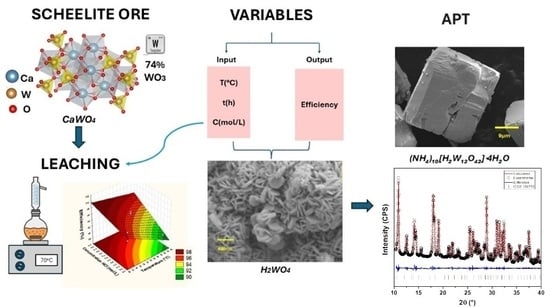
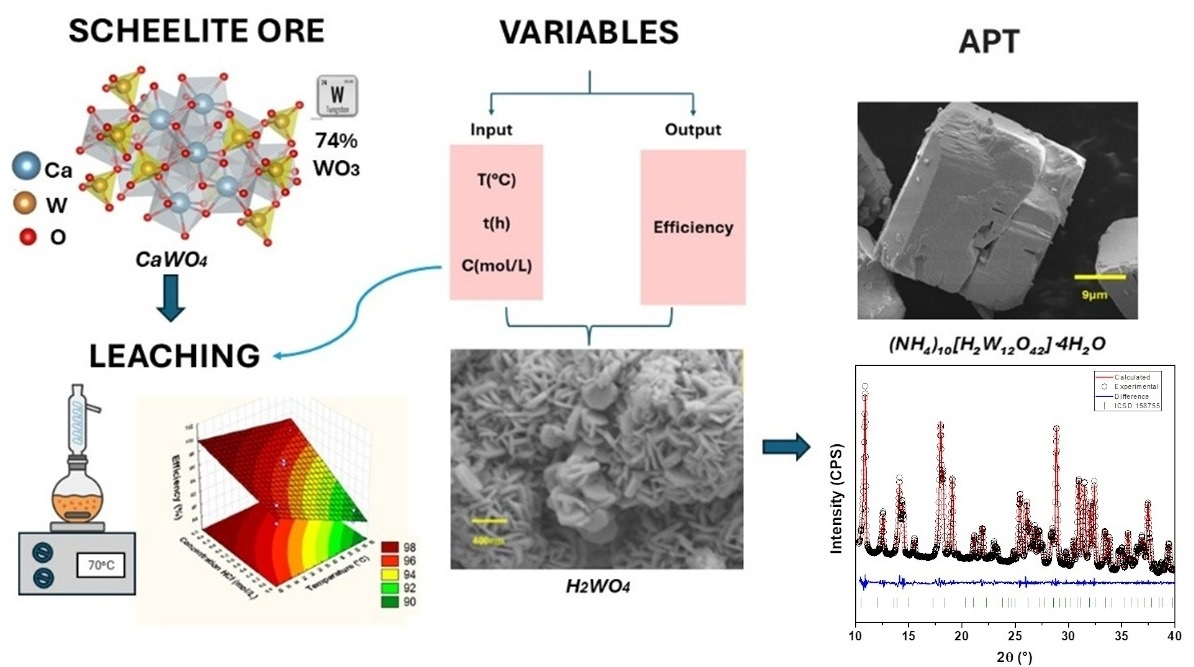
Graphical Abstract

1. Introduction

Tungsten is a strategic and rare metal of growing relevance to the mechanical, electronic, and chemical industries due to its exceptional physicochemical properties, such as high melting point, high density, and outstanding wear resistance [1]. These attributes make it indispensable in the production of special alloys, superalloys, and steels, and as a catalyst in high-temperature processes [2]. Currently, the main precursor in the production of metallic tungsten and its compounds is ammonium paratungstate-APT, (NH4)10[H2W12O42]⋅4H2O, whose purity and crystal morphology are critically affected by the quality of downstream products [2,3,4,5].
Industrial-scale APT production primarily relies on tungsten-bearing ores, with scheelite (CaWO4) accounting for approximately two-thirds of the world’s known reserves [5,6]. While wolframite was historically the dominant source, its increasing scarcity and the greater complexity of its beneficiation have led to a progressive shift toward scheelite exploitation [7,8,9,10]. In Brazil, significant scheelite deposits are located in the Northeast, particularly in the states of Paraíba and Rio Grande do Norte, with the Seridó region (RN) standing out, which hosts one of the most relevant tungsten skarn systems in the country [11,12], it contains ore concentrates with WO3 contents reaching up to 74%, making it highly attractive for hydrometallurgical processing [10,11,12,13].
Among the hydrometallurgical routes, acid leaching has emerged as a promising alternative to traditional alkaline leaching due to its operational and environmental advantages [14]. The use of hydrochloric acid (HCl) enables faster and more efficient extraction of high-purity tungstic acid (H2WO4), while generating low-salinity effluents that are more manageable for recycling treatments [15]. This approach is particularly effective in impurity removal, yielding a high-quality intermediate material suitable for the synthesis of APT and advanced tungsten-based compounds for catalysis and nanomaterials [16,17].
In recent years, there has been significant progress in modified acid systems, aiming for high extraction, lower temperature, and improved selectivity. For instance, Yin et al. [18] studied leaching in sulfuric acid solution with hydrogen peroxide, which promotes the decomposition of CaWO4 to CaSO4·nH2O and soluble tungsten species, with complexation by H2O2. In another work, Zhang et al. [19] further explored the concept of green leaching of synthetic scheelite with the same H2SO4–H2O2 system, focusing on the production of high-purity tungstic acid via thermal decomposition of the peroxytungstic solution. Several studies also treated scheelite with strong acids in the presence of complexing agents (HCl, HNO3, H3PO4, oxalic acid) to avoid passivation by H2WO4. Resin-enhanced acid leaching, initially proposed by Gong et al. [20], is a route where scheelite is leached in an acidic medium while an anionic resin removes tungstate from the solution in near real-time. Orefice et al. [21] expanded the concept within a solvometallurgical context, combining acid/organosolvent leaching with ion exchange resins for selective tungsten recovery, suggesting sustainable routes. Li et al. [22], in current studies, report that purely acidic processes still face passivation limitations but have been significantly improved with the use of oxidants, complexing agents and resins or even with the increased concentration of HCl during leaching [19,20,21,22].
However, the efficiency of acid leaching is highly dependent on the careful control of key parameters, such as acid concentration, temperature, and reaction time, as improper conditions may lead to reduced yields due to acid volatilization or the formation of passivating layers that inhibit the reaction [23,24]. Precise control of these variables is essential for the successful production of H2WO4, a direct precursor to APT, whose final purity and crystallinity are directly influenced by its morphology and particle size [2,25].
Given the above, the main objective of this study is to evaluate the method to produce high-purity APT from scheelite concentrates from the Brejuí Mine. To this end, the integrated approach to acid leaching, tungstic acid (H2WO4) preparation, and APT crystallization was investigated. The influence of process variables on degradation efficiency, as well as on the morphology and thermal stability of intermediate and final products, was systematically studied. Therefore, this work seeks to establish an optimized processing route that not only increases tungsten recovery efficiency but also contributes to the valorization of Brazilian mineral reserves and the development of more sustainable mining practices.

2. Materials and Methods

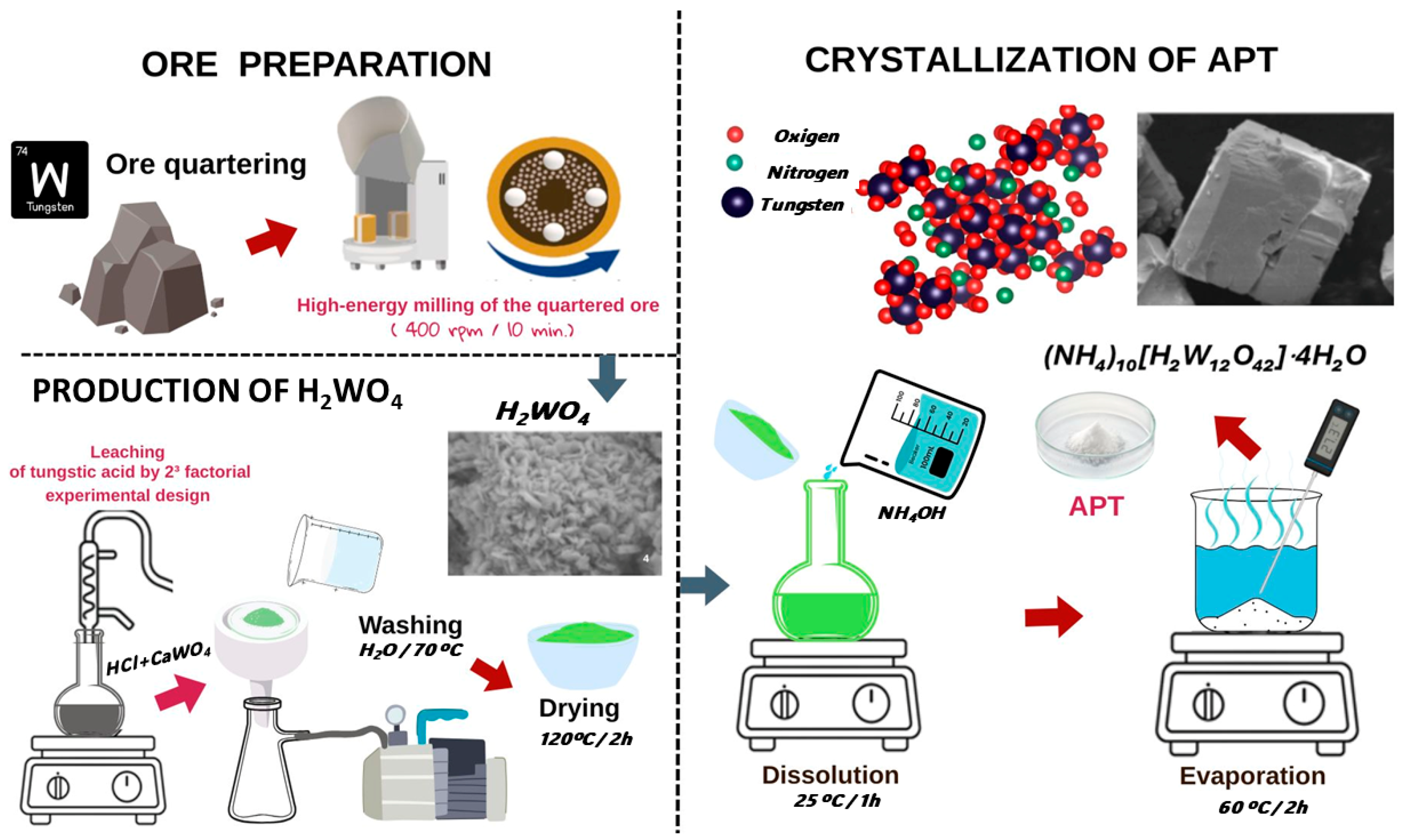
The flowchart of the APT production from scheelite ore is illustrated in Figure 1.

2.1. Preparation of Scheelite Concentrate

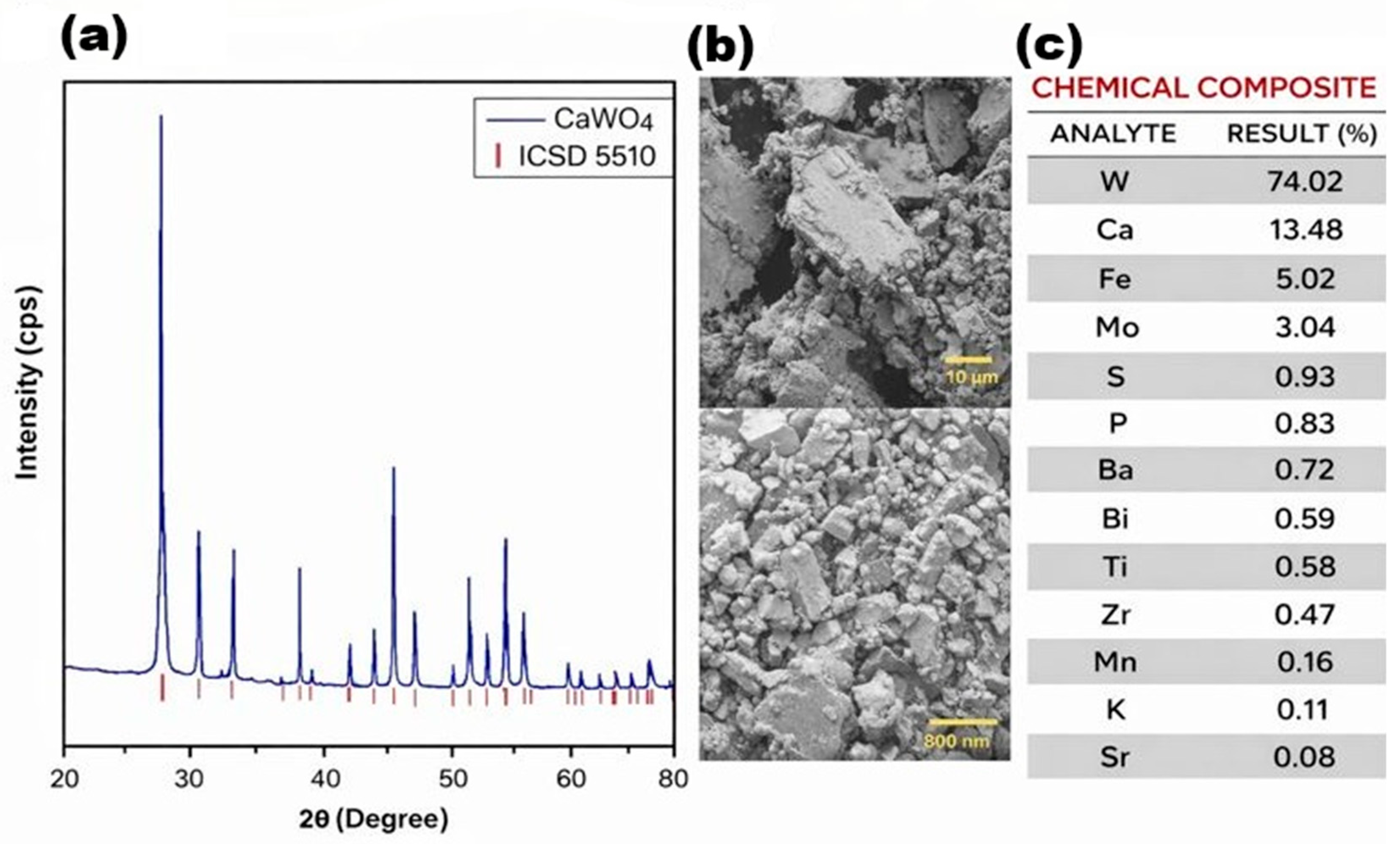
Scheelite ore concentrate was obtained from the Brejuí mine (Mineração Tomaz Salustino), located in Currais Novos, Rio Grande do Norte, Brazil. The concentrate was initially homogenized and quartered. To reduce particle size and enhance leaching efficiency, high-energy milling was performed on scheelite aliquots in a dry medium using a planetary mill (Pulverisette 7, Fritsch, Idar-Oberstein, Germany). The milling was conducted in a hard metal vial under the following parameters: a ball-to-powder mass ratio of 5:1, a milling time of 10 min, and a rotation speed of 400 rpm. Subsequently, for particle size classification, the ground powders were sieved using 200, 300, and 400 mesh stainless steel screens. After sieving, only the finest 400 mesh fraction (<38 μm) was selected and used in all subsequent experiments and characterizations, including those shown in Figure 2. This procedure was adopted to ensure better homogeneity and reproducibility of the samples. The milled powders were subsequently characterized by X-ray Diffraction (XRD), Scanning Electron Microscopy (SEM), and X-ray Fluorescence (XRF) and presented in Figure 2.

2.2. Experimental Design for Acid Leaching

To optimize the operational performance and reduce costs associated with tungstic acid (H2WO4) production, a 23 factorial experimental design was employed. The design evaluated three independent variables, HCl concentration, reaction temperature, and reaction time, at a low (−1) and a high (+1) level. The design was augmented with six replicates at the central point to detect potential curvature in the model and to estimate the pure experimental error. Table 1 lists the independent variables with their corresponding coded and actual values. The complete experimental design matrix, comprising a total of 14 runs, is presented in Table 2.
For a 23 factorial experiment, the relationship between the variables and the response is described by a first-order polynomial model (Equation (1)).
Y(x1, x2, x3) = b0 + b1x1 + b2x2 + b3x3 + b12x1x2 + b13x1x3 + b23x2x3 + b123x1x2x3 + ϵ(x1, x2, x3)
In the model, function Y represents the predicted response (leaching efficiency), b0 is the model intercept; bi are the linear coefficients for the main effects (xi); bij are the coefficients for the two-way interactions (xixj); and ϵ represents the random experimental error. The statistical significance and adequacy of the model were evaluated using Analysis of Variance (ANOVA), Pareto charts, and the coefficient of determination (R2).

2.3. Leaching Process of the Scheelite

Acid leaching of the scheelite concentrates was performed according to the conditions specified in the experimental design (Table 2). For each run, 50 g of scheelite concentrate was added to a flat-bottom flask coupled to a condenser, using a solid-to-liquid ratio of 1:10 (g/mL). The mixture was kept under constant magnetic stirring throughout the reaction.
After the reaction, the resulting slurry was filtered using a Büchner funnel under vacuum. The filtered solid was first subjected to an acid wash with 1 L of a 1% (v/v) HCl solution at 70 °C, followed by washing with distilled water (70 °C) until the filtrate reached a pH of 6. Finally, the purified solid was dried in an oven at 120 °C and ground in an agate mortar.
The leaching efficiency (η) was calculated as the ratio of the mass of tungsten trioxide in the final product to the initial mass present in the scheelite concentrate, as shown in Equation (2).
n = m F W O 3 m i W O 3
The terms are defined as follows:
miWO3 is initial mass of WO3 and was calculated from m0, the mass of the scheelite concentrate (g), and w0, its corresponding mass fraction of WO3 (%).
mFWO3 is recovered mass of WO3 and was calculated from m1, the mass of the final dried product (tungstic acid, H2WO4).
The mass fractions of WO3 were obtained by X-ray fluorescence analysis.

2.4. Obtaining the APT

The tungstic acid (H2WO4) produced under optimized leaching conditions was used for the synthesis of APT. A 35 g sample of the H2WO4 powder was slowly dissolved in concentrated ammonium hydroxide at a solid-to-liquid ratio of 1:6 (g/mL). The dissolution was carried out at room temperature with constant magnetic stirring for 60 min. Subsequently, the resulting solution was allowed to stand for 2 h and then filtered to remove any insoluble matter.
The clarified liquor was then subjected to evaporative crystallization. It was heated in an open beaker at 60 °C with continuous stirring until the solvent had completely evaporated and the APT crystals had formed; this process took approximately 2 h.

2.5. Characterization

The chemical composition of the samples was determined using an X-ray fluorescence (XRF) spectrometer (Shimadzu, Kyoto, Japan; model EDX-720). The crystalline structure of the materials was investigated with a Rigaku Miniflex II X-ray diffractometer using Cu Kα radiation (λ = 1.5406 Å). Crystalline phases were identified by comparison with data from the Inorganic Crystal Structure Database (ICSD). XRD analyses were performed on powdered samples at ambient conditions over a scan range of 20° to 80° (2theta), with a scan speed of 2°/min and a step size of 0.02°.
Morphological characterization was conducted using a scanning electron microscope (SEM; Carl Zeiss, Supra 35-VP, Oberkochen, Germany), which is equipped with an energy-dispersive X-ray spectrometer (EDS; Bruker, Billerica, MA, USA) for elemental analysis. Specific surface area (BET) analysis was performed on a Quantachrome Nova Station B instrument (Quantachrome Instruments, Boynton Beach, FL, USA). The sample (0.8309 g) was previously degassed at 150 °C for 24 h. The measurement was conducted using nitrogen as the adsorbate. These measurements were performed on the products from experimental runs 5 and 7.
Thermal behavior and stability of the H2WO4 and APT samples were evaluated by thermogravimetry (TG) and Differential Thermal Analysis (DTA). The analyses were conducted on a TA Instruments (model SDT Q600) under an argon atmosphere (50 mL/min). A platinum crucible containing approximately 5 mg of sample was heated from 30 °C to 1000 °C at a rate of 10 °C/min.

3. Results and Discussion

3.1. Effect of Acid Leaching Parameters on the Microstructural Properties of Tungstic Acid (H2WO4) Derived from Scheelite

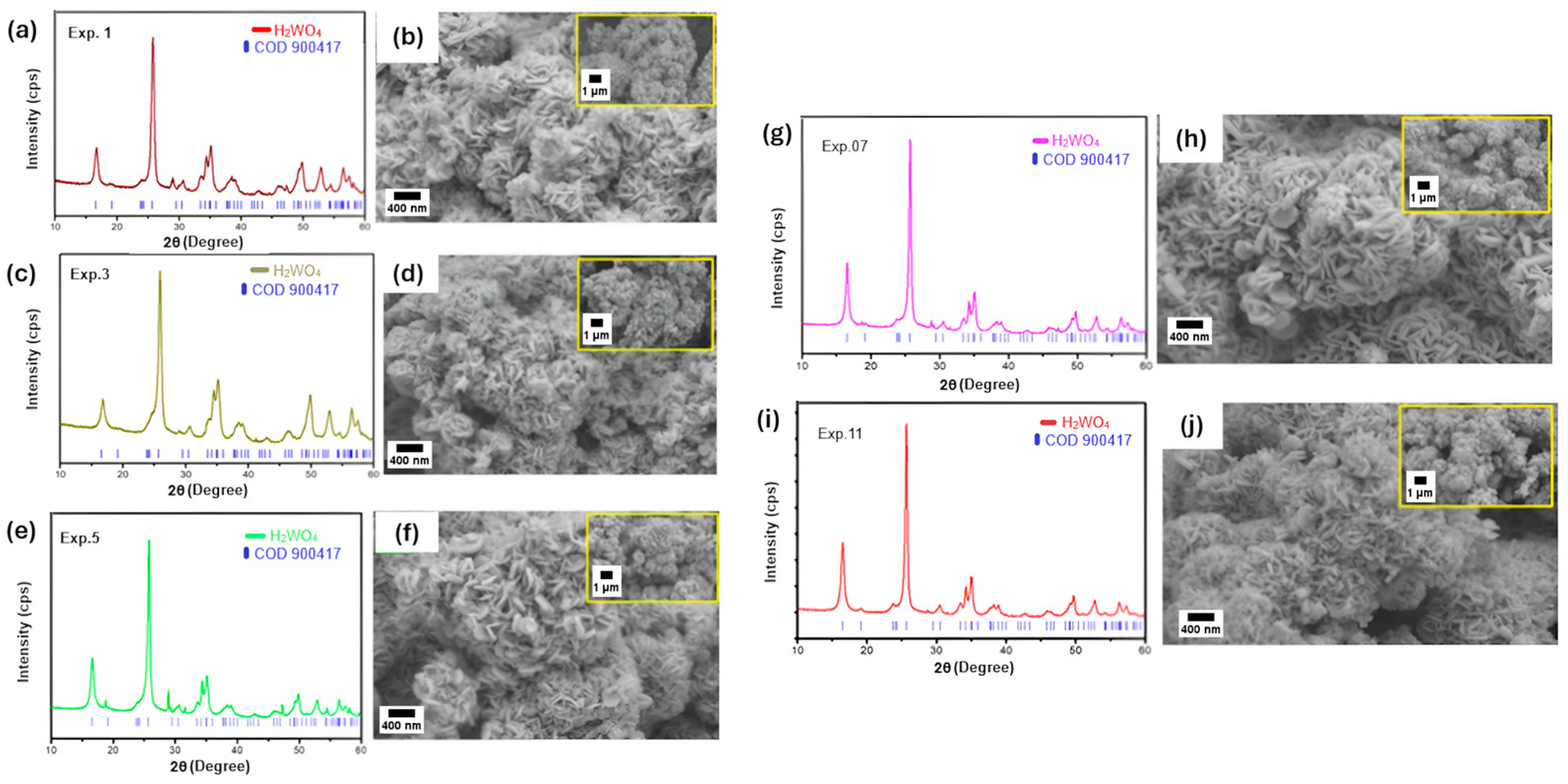
Figure 3a,c,e,g,i present the XRD patterns of tungstic acid powders obtained through acid leaching of scheelite ore, specifically from experimental arrangements 1, 3, 5, 7, and 11 (Table 2). The SEM-FEG micrographs of the same arrangements are shown in Figure 3b,d,f,h,j), respectively. The XRD patterns for experimental arrangements (1, 3, 5, 7, and 11) are shown in Figure 3a,c,e,g,i. The diffractograms exhibit crystalline peaks due to H2WO4, in good agreement with the standard COD 9004174 [26]. This indicates the effectiveness of the process in extracting tungsten from scheelite, resulting in the production of H2WO4, a valuable intermediate product of tungsten.
The structural and microstructural characteristics of H2WO4 indicate the high efficiency of the process, leading to effective tungsten extraction, elimination of scheelite impurities, and the formation of high-purity tungstic acid. This acid can serve as a fundamental raw material for producing high-purity ammonium paratungstate, as well as other tungsten products. Furthermore, it is evident that all XRD peaks of H2WO4 become narrower as the temperature and HCl concentration increase during the leaching process. This behavior indicates the formation of smaller H2WO4 crystallites [27]. The literature reports that higher temperatures during leaching can improve crystalline perfection [19]. However increasing the HCl concentration reduces the negative effects associated with the formation of the passivation layer of H2WO4. As a result, the crystallinity of H2WO4 increases [22,28], which is consistent with the experimental observations. Moreover, these results reinforce the extensive interest in the application of H2WO4 in diverse fields such as catalysis and nanotechnology [29,30].
It was observed that, for the HCl concentrations (4, 5, 6 mol/L) and the temperatures used in the respective arrangements, efficient results were achieved even at HCl concentrations lower than those reported by [23]. In Figure 3b,d,f,h,j, heterogeneous morphology and sizes are observed, including particle aggregates in the form of thin platelets, as reported by [30]. A significant porosity of the particles is also noticeable [30].

3.2. Effect of Process Variables on Leaching Efficiency

A 23 factorial design was used to evaluate the acid leaching of scheelite with HCl. The effects of temperature (70–90 °C), time (2–4 h), and HCl concentration (4–6 mol/L) were investigated, using extraction efficiency as the response. Table 3 presents the experimental matrix and the corresponding efficiencies obtained in each run.
The leaching analysis revealed that, although maximum efficiency (98.6%) was achieved under more severe conditions (70 °C, 4 h, 6 mol/L HCl), a comparable efficiency of 98.4% was obtained using a shorter leaching time (70 °C, 2 h, 6 mol/L HCl). In addition, a good efficiency of 96.7% was achieved with a lower acid concentration (70 °C, 4 h, 4 mol/L HCl). Notably, this indicates a more economically and environmentally favorable operating window, without significant efficiency losses.
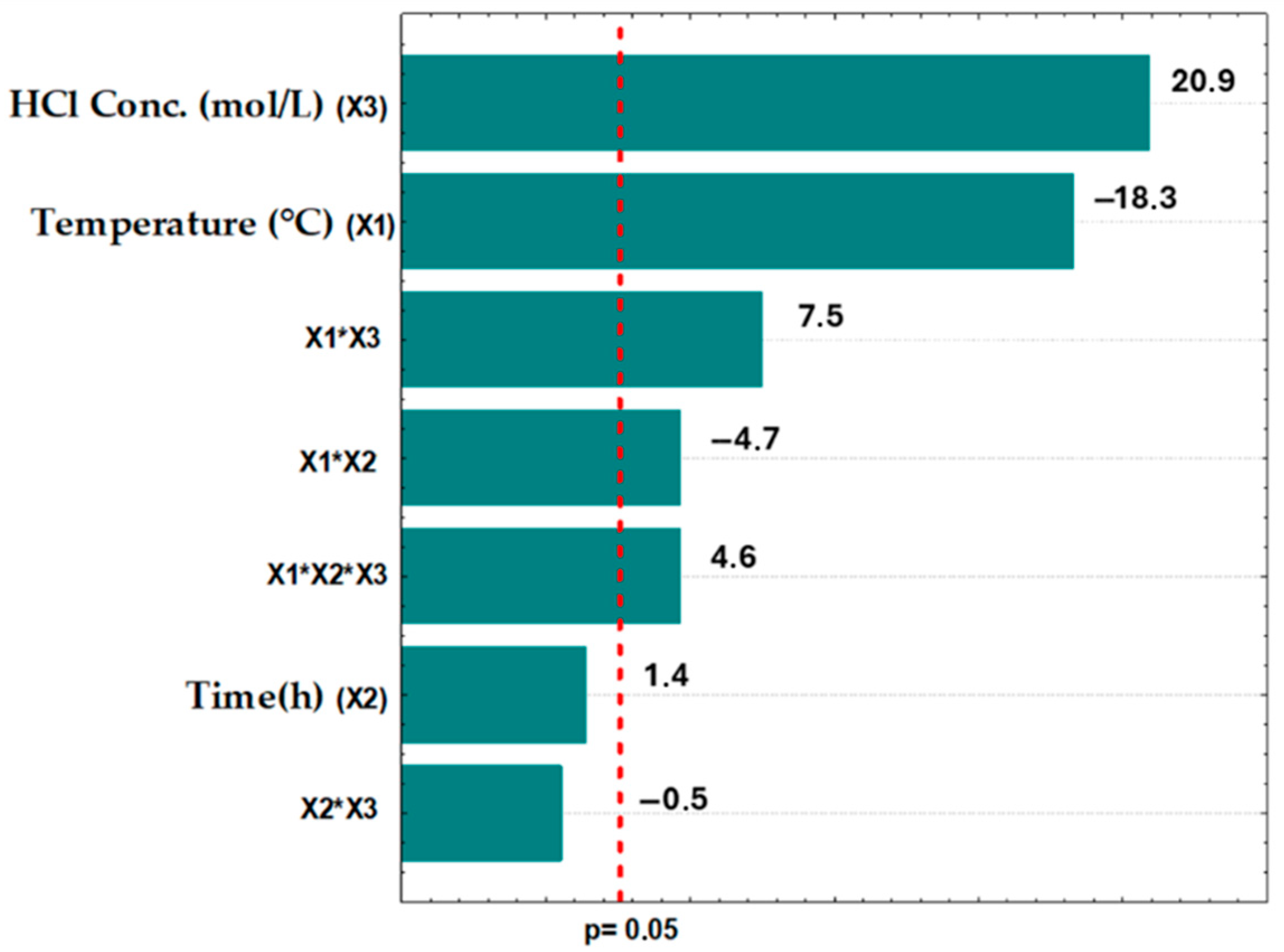
The statistical Analysis of the effects (Table 4) corroborates this observation, showing that temperature and HCl concentration were significant variables for the model (p < 0.05). The interactions between time-concentration, time-temperature, and time-temperature-concentration were also significant, while time, as a stand-alone variable, was not significant.
Figure 4 shows the Pareto chart of the standardized effects. The vertical line on the chart represents the minimum magnitude for a statistically significant effect at a 95% confidence level. Effects are considered significant if their corresponding bar extends to the right of this reference line (p < 0.05).
The main effects analysis (Figure 4) revealed that HCl concentration was the most influential variable, with a strong positive impact on efficiency. Temperature was also significant, but with a negative effect, possibly due to the formation of a passivating layer of H2WO4 [22]. Reaction time, in turn, showed no statistical influence as an isolated factor.
Regarding interactions between factors, the combinations Temperature ∗ Concentration (x1 ∗ x3) and Temperature ∗ Time (x1 ∗ x2) were significant, as was the triple interaction (x1 ∗ x2 ∗ x3). The Time ∗ Concentration interaction (x2 ∗ x3), however, showed no significant effect.
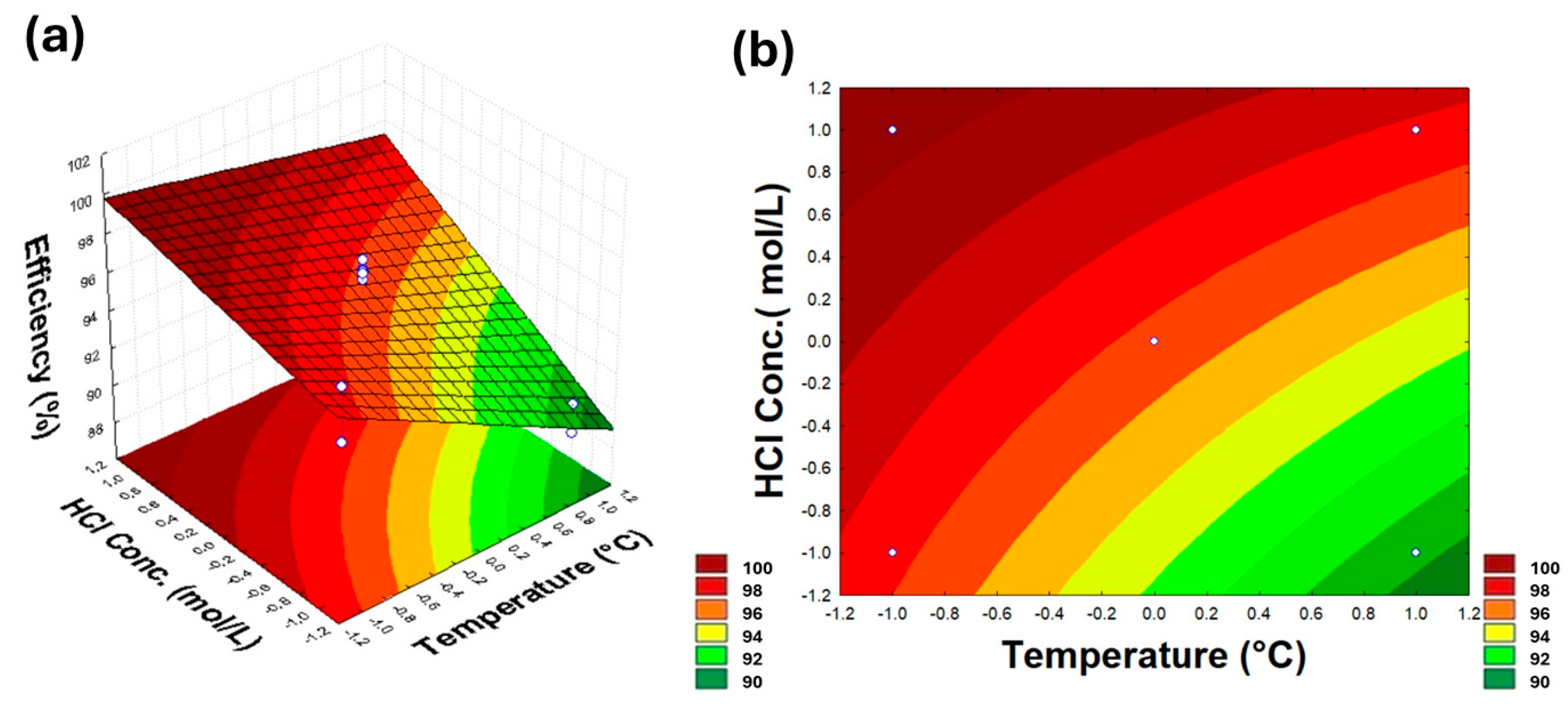
Figure 5 presents the response surface (a) and contour curves (b) of efficiency as a function of concentration and temperature.
The significance of the interaction between variables is best visualized by the response surfaces and contour plots [31,32] (Figure 5). The analysis reveals a strong positive interaction between temperature and HCl concentration on leaching efficiency. The iso-efficiency lines on the contour plot (Figure 5b) show a clear upward trend towards the upper right corner, where the highest efficiencies (>98%) are achieved under conditions of high acidity and high temperature.
Notably, the slope of the lines reveals that the effect of HCl concentration is visibly more pronounced than that of temperature. This demonstrates that high efficiencies can be achieved even at moderate temperatures (70 °C), provided that the acidity of the medium is high, reinforcing that acid concentration is the main controlling factor of the process.
Based on the response surface regression analysis, the following mathematical model was developed to describe the process efficiency as a function of the studied variables (Equation (3)):
Efficiency = 95.65 − 2.112x1 + 2.412x3 + 0.862x1x3 − 0.537x1x2 + 0.537x1x2x3
where:
x 1 = Temperature (coded variable)
x 2 = Time (coded variable)
x 3 = HCl concentration (coded variable)
The model showed a good fit to the experimental data, with a regression coefficient (R2) of approximately 0.88. The statistical significance of the model and its terms was confirmed by the Analysis of Variance (ANOVA), presented in Table 5, thus validating its predictive capability.
This result suggests that the acidity of the medium is the main limiting factor for tungsten solubilization, as high HCl concentrations promote the breakdown of the scheelite (CaWO4) structure and the release of the W6+ ion. This observation is in agreement with the findings of [22], who highlight the need for an excess of HCl to overcome the mass transfer resistance in dense scheelite concentrate particles.
Table 5 presents the complete analysis of variance (ANOVA) for the linear model fitted to the response variable Efficiency (%). The overall model was statistically significant (F = 6.21; p = 0.030), indicating that the factors investigated exert a relevant influence on the performance of the process.
Among the main effects, Temperature and HCl Concentration were highly significant (p < 0.00001), with large effect magnitudes. The negative effect associated with Temperature shows that increasing the temperature tends to reduce efficiency, suggesting that milder thermal conditions favor the leaching mechanism. Conversely, HCl Concentration exhibited a pronounced positive effect, indicating that higher acidity enhances the solubilization of the mineral constituents and consequently increases the overall efficiency. This behavior is consistent with the literature on strong acid systems applied to the dissolution of tungstate-bearing minerals.
The factor Time, however, was not statistically significant (p = 0.218), suggesting that under the conditions evaluated, extending the reaction duration does not substantially affect efficiency. This implies that the leaching process approaches equilibrium within the experimental range, making the effect of time less relevant compared to the other factors.
Regarding the interactions, significant effects were observed for x1 × x3 (Temperature × Concentration) and x1 × x2 × x3 (three-way interaction) (p < 0.01), demonstrating a degree of interdependence among the factors. These interactions indicate that the response is not driven by isolated effects, but rather by combined actions that may either enhance or partially offset the influence of individual factors. In contrast, the x2 × x3 interaction was not significant (p = 0.611), reinforcing that the factor Time remains secondary within the system.
The significant lack of fit (F = 115.53; p = 0.000121) indicates that the linear model does not fully capture the systematic variation present in the data. This result suggests that the response behavior is governed by nonlinear effects, possibly associated with changes in reaction kinetics, mass-transfer limitations, or the formation of intermediate species at different levels of acidity and temperature. Although the linear model provides a clear assessment of the relative importance of the factors, the significant lack of fit confirms that the system exhibits nonlinear behavior. Therefore, future studies should consider the use of response surface methodologies, such as Box–Behnken or Central Composite Designs, which allow the incorporation of quadratic terms and more accurately represent curvature in the response surface. The adoption of such designs is expected to reduce the lack of fit and yield statistically robust models that better describe the physicochemical behavior of the system.

3.3. Adsorption and Desorption of N2 by the BET/BJH Method of H2WO4

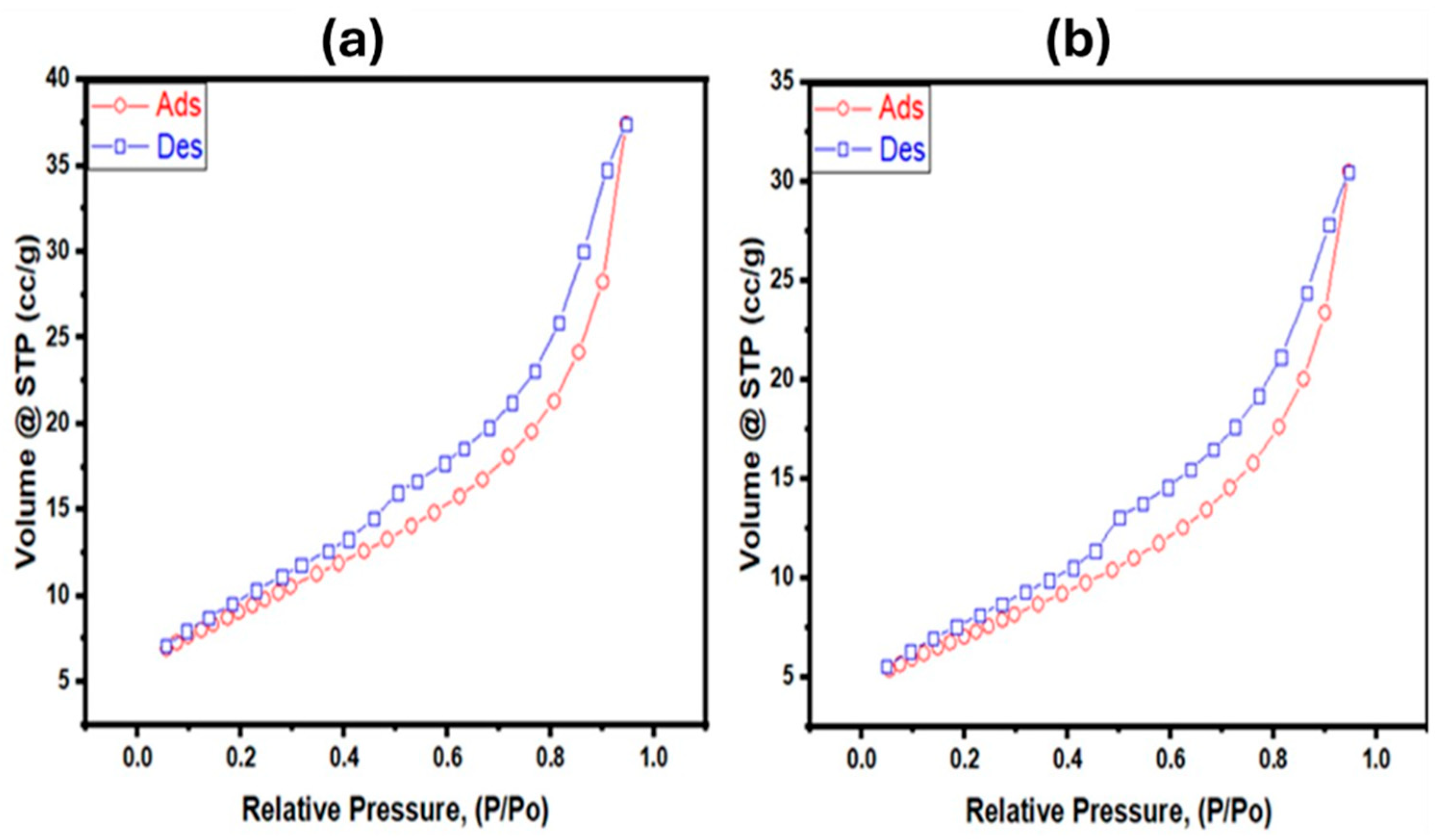
The textural properties of the H2WO4 acids obtained from experiments 5 and 7 are shown in Figure 6a,b and Table 6, respectively. They were analyzed using the N2 adsorption isotherm, which determined the specific surface area of the samples that showed the highest leaching efficiency. The samples from experiments 5 (Figure 6a) and 7 (Figure 6b) exhibited type IV adsorption isotherms, which are characteristic of mesoporous materials according to the IUPAC [33,34]. This confirms that the obtained tungstic acid is a mesoporous material [35], as evidenced by the spongy and aggregated morphology shown in Figure 3b,d,f,g,j.
Additionally, the H2WO4 samples (for experiments 5 and 7) exhibited H3-type hysteresis loops, characteristic of materials formed by non-rigid aggregates of plate-like particles [33], as shown in the SEM analyses (Figure 3b,d,f,g,j).
The specific surface areas, determined by the BET method, were 33.21 m2/g for experiment 5 and 25.64 m2/g for experiment 7 (Table 6). The average pore diameters for these samples were calculated, presenting values of 0.985 nm and 0.986 nm, respectively (Table 6). The higher specific surface area of sample 5 compared to sample 7 can be attributed to the extended leaching time during the H2WO4 extraction process, which likely resulted in greater pore exposure and, consequently, a higher surface area.

3.4. Microstructural Characterization of APT Obtained from H2WO4

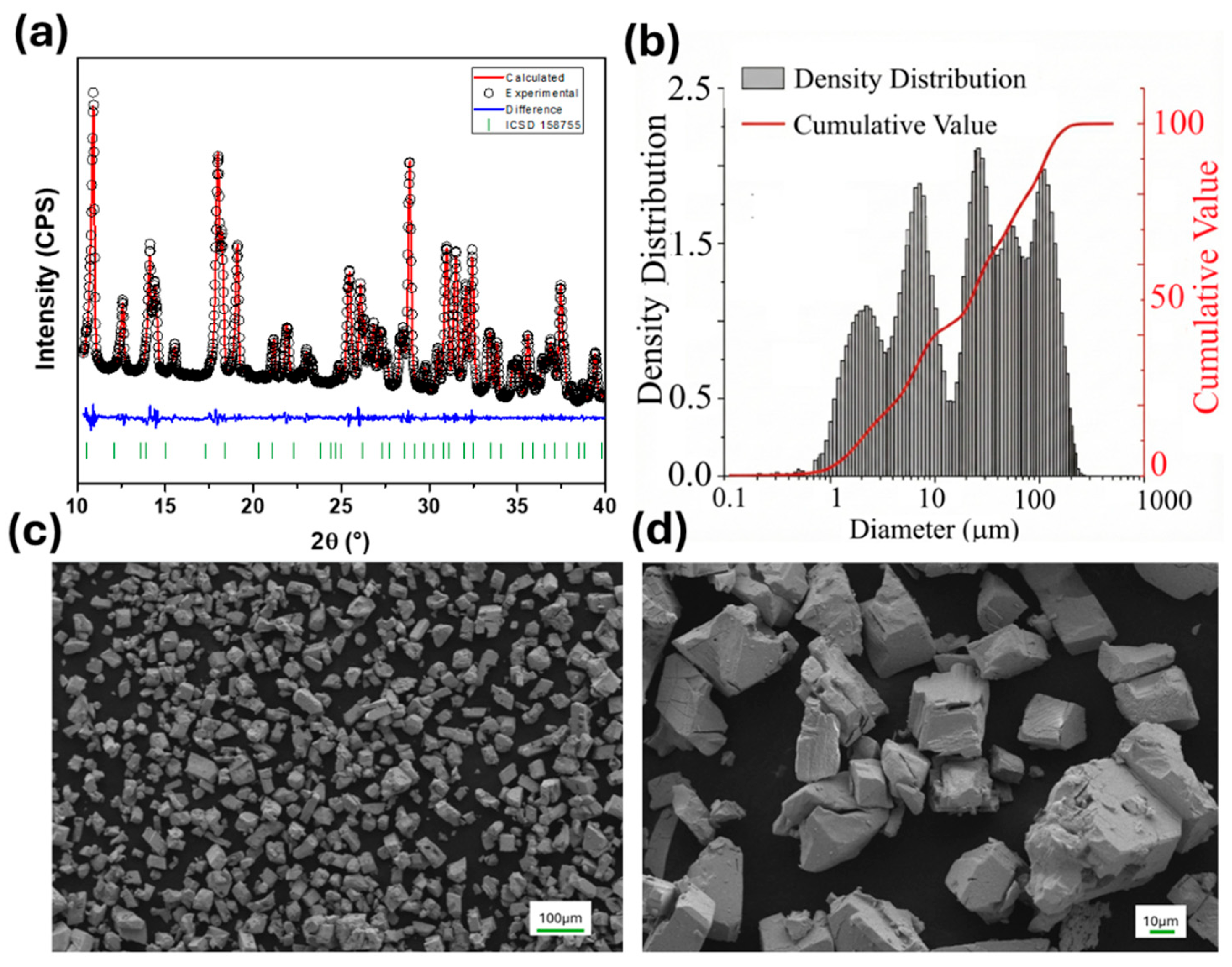
Experiment 7 exhibited the highest tungsten content, resulting in greater efficiency, which is essential for the production of APT. The XRD patterns generated for the APT produced from H2WO4 (Exp. 7) and the parameters and coefficients of the Rietveld refinement are shown in Figure 7a and Table 7, respectively. Figure 7c,d show the morphology of the APT formed. Figure 7b displays the particle size distribution, revealing a wide distribution with particle diameters predominantly in the range of 10 to 100 µm. While the Rietveld refinement (Table 7) indicates a crystallite size on the nanometric scale, the SEM analysis demonstrates that these particles are micro-sized particles with well-defined faceted morphology. The formation of the crystalline phase was confirmed by the ICSD 15237 [36] card (Figure 7a).
The ammonium tungstate solution ((NH4)2WO4), obtained by dissolving tungstic acid (H2WO4) in ammonium hydroxide (NH4OH), as represented in Equation (4), was crystallized at 60 °C, resulting in the formation of APT, according to Equation (5). The formation of the APT phase was confirmed by X-ray diffraction, as shown in Figure 7. Fait et al. [35] reported that the APT phase crystallizes at temperatures above 70 °C. The results obtained in this study indicate that the crystallization of the APT phase can occur efficiently at milder temperatures (60 °C) and within a short crystallization time (2 h), highlighting a promising route for obtaining APT with lower energy.
H2WO4(s)+ 2NH4OH (aq) => (NH4)2WO4(aq) + 2H2O(aq)
12(NH4)2WO4(aq) => (NH4)10[H2W12O42]⋅4H2O(s) + 14NH3(g) + 2H2O(g)
As evidenced by the XRD pattern presented in Figure 7a, the parameters adopted for Exp. 7 (Table 2) of the scheelite acid leaching process contributed to higher leaching efficiency and, consequently, to the production of high-purity APT on a nanometric scale (38.45 nm), as shown in Table 7. The obtained APT belongs to the space group I4, with lattice parameters a = 13.93 Å, b = 13.37 Å, and c = 10.14 Å [36]. Moreover, the Rietveld refinement demonstrated excellent fitting quality for the produced APT, with an X2 value of 2.80.
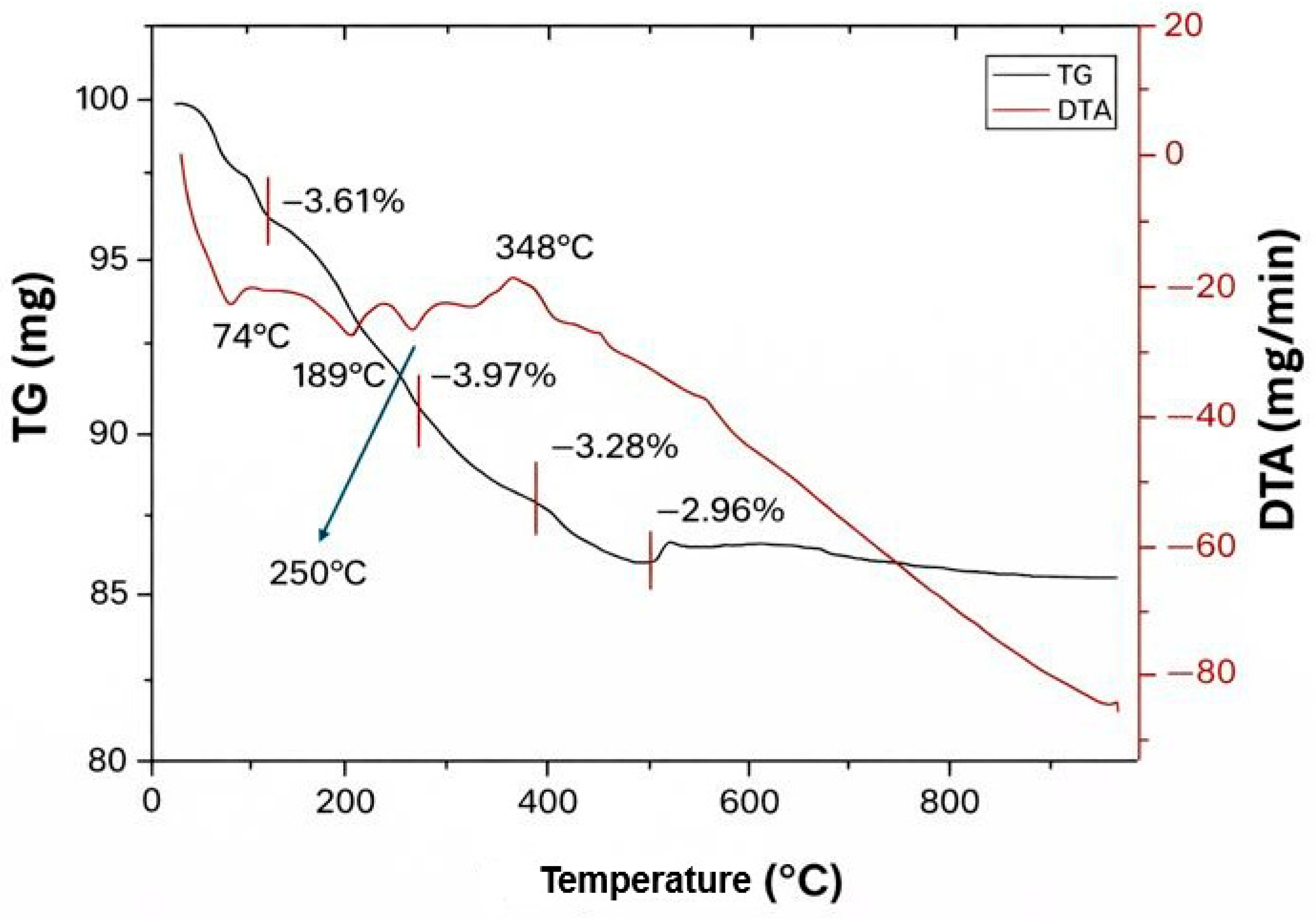
The TG and DTA curves recorded simultaneously up to 950 °C are shown in Figure 8. The overall reaction for the thermal decomposition of APT in Ar is described by Madarász et al. [37], as per Equation (6).
(NH4)10 [H2W12O42]·4H2O(s) → 12WO3(s) + 10NH3(g) + 10H2O(g)
The thermogravimetric study of tetrahydrated ammonium paratungstate under an Ar atmosphere at 950 °C showed a total mass loss of 13.81% (Figure 8). The TG and DTA curves presented in Figure 8 revealed four stages of mass loss, with three endothermic events and one exothermic event associated with the decomposition.
The first mass loss event, corresponding to 0.457 mg (25–120 °C), is due to the elimination of the initial H2O molecules from APT (dehydration reaction). In the DTA curve, this dehydration is observed with an endothermic peak at 74 °C, resulting in anhydrous ammonium paratungstate, (NH4)10 [H2W12O42].
The second event showed the highest mass loss, corresponding to 0.503 mg (120–245 °C). This event is due to the decomposition of APT, with the release of NH3 molecules, associated with the largest endothermic peak (at 189 °C). Fait et al. (2016) [35], in their studies on the thermal stability of APT, confirmed that during the second endothermic stage, only ammonia is released, resulting in the formation of ammonium metatungstate (NH4)6[H2W12O40]. The paratungstate ion remains generally unchanged during the release of NH3.
The third mass loss, equivalent to 0.415 mg, occurred between 245 °C and 360 °C, with the release of a mixture of NH3 and H2O, associated with a third endothermic event at 250 °C.
In the fourth event (360 °C to 480 °C), corresponding to the loss of the remaining water and ammonia molecules, equivalent to 0.375 mg, and the formation of WO3, an exothermic event is observed (T = 348 °C), caused by the release of heat during the crystallization of WO3. The thermal behavior of APT in the temperature range from 25 °C to 600 °C and found that the same events occurred, but at higher temperatures than those presented by the APT obtained from scheelite-derived H2WO4 [37].
The thermogravimetric and differential thermal analysis of the APT obtained in this study confirmed a four-stage decomposition process, occurring at slightly lower temperatures than those reported in the literature. This deviation may be attributed to the purity and morphological characteristics of the APT synthesized from scheelite-derived H2WO4, suggesting that the material produced via the proposed acid leaching route is thermally more reactive. These results validate the effectiveness of the synthesis process and highlight the thermal behavior of the product as suitable for its subsequent conversion into high-purity WO3.

4. Conclusions

This study successfully established a technically feasible and sustainable hydro-metallurgical route for the production of high-purity tungsten compounds from scheelite concentrates in the Seridó region of Brazil. The acid leaching process with HCl enabled the production of tungstic acid with high efficiency (98.6%) under the conditions of 70 °C, 4 h, and an HCl concentration of 6 mol/L, leading to the formation of nanocrystalline APT. A validated statistical model (R2 ≈ 0.90) was crucial to identify HCl concentration as the dominant process variable, allowing optimization prioritizing acidity over temperature. Overall, this work presents an efficient and lower-impact alternative that adds value to a strategic national mineral and reinforces Brazil’s potential to strengthen its high-tech materials production chain.

Author Contributions

Conceptualization, M.J.L., J.V. and A.S.; methodology, M.J.L., K.A., M.S. and F.E.S.S.; Validation, J.V. and M.J.L.; formal analysis, M.J.L., C.d.S.L. and A.S.; investigation, M.J.L.; resources, M.J.L. and C.d.S.L.; data curation, C.d.S.L. and M.J.L.; writing—original draft preparation K.A., M.S., C.d.S.L. and F.E.S.S.; writing—review and editing, M.J.L., A.S., M.M. and U.G.; supervision, M.M. and U.G. All authors have read and agreed to the published version of the manuscript.

Funding

This work was supported by the National Council for Scientific and Technological Development (CNPq) through project grant 407903/2022-4, which provided three Technological Development and Innovation (DTI) A fellowships, one DTI B fellowship, and one DTI C fellowship, and through a research productivity grant (PQ, CNPq 308894/2021-9). Additional support was provided by the Coordination for the Improvement of Higher Education Personnel Brazil (CAPES), Finance Code 001.

Data Availability Statement

The original contributions presented in this study are included in the article. Further inquiries can be directed to the corresponding author.

Acknowledgments

The authors thank Igor Zumba Damasceno, Ana Biatriz Guedes, and Carla L. S. C. Costa from LCEM-UFRN for providing the SEM-FEG images, and the LT2M-IFRN for performing the XRF analyses.

Conflicts of Interest

The authors declare no conflicts of interest.

References

  1. Bohlouli, A.; Afshar, M.R.; Aboutalebi, M.R.; Seyedein, S.H. Optimization of Tungsten Leaching from Low Manganese Wolframite Concentrate Using Response Surface Methodology (RSM). Int. J. Refract. Met. Hard Mater. 2016, 61, 107–114. [Google Scholar] [CrossRef]
  2. Shen, L.; Li, X.; Lindberg, D.; Taskinen, P. Tungsten Extractive Metallurgy: A Review of Processes and Their Challenges for Sustainability. Miner. Eng. 2019, 142, 105934. [Google Scholar] [CrossRef]
  3. Zhang, G.; Guan, W.; Xiao, L.; Zhang, Q. A Novel Process for Tungsten Hydrometallurgy Based on Direct Solvent Extraction in Alkaline Medium. Hydrometallurgy 2016, 165, 233–237. [Google Scholar] [CrossRef]
  4. Wan, L.; Huang, X.; Deng, D.; Li, H.; Chen, Y. Synthesis of Scheelite from Sodium Tungstate Solution by Calcium Hydroxide Addition. Hydrometallurgy 2015, 154, 17–19. [Google Scholar] [CrossRef]
  5. Shen, L.; Li, X.; Zhou, Q.; Peng, Z.; Liu, G.; Qi, T.; Taskinen, P. Kinetics of Scheelite Conversion in Sulfuric Acid. JOM 2018, 70, 2499–2504. [Google Scholar] [CrossRef]
  6. Tu, T.; Guo, H.; Liu, Q.; Wang, X. Response Surface Method Optimization of Mixed Acid Leaching Parameters for Scheelite Concentrate. Mining Met. Explor. 2021, 38, 2537–2546. [Google Scholar] [CrossRef]
  7. Martins, J.I.; Moreira, A.; Costa, S.C. Leaching of Synthetic Scheelite by Hydrochloric Acid without the Formation of Tungstic Acid. Hydrometallurgy 2003, 70, 131–141. [Google Scholar] [CrossRef]
  8. Monteiro, R.L.B.P.; Leonardos, O.H.; Correia-Neves, J.M. An Epigenetic Origin for the New Scheelite and Wolframite Occurrences in the Middle Jequitinhonha Valley, Minas Gerais, Brazil. Rev. Bras. Geociências 1990, 20, 68–74. [Google Scholar] [CrossRef]
  9. Chen, Y.; Huo, G.; Guo, X.; Zhang, L. Leaching Behavior and Mechanism of Scheelite and Wolframite in Treating a Mixed Scheelite–Wolframite Concentrate by Hydrochloric Acid. J. Sustain. Met. 2023, 9, 837–847. [Google Scholar] [CrossRef]
  10. Li, J.; Yang, J.; Zhao, Z.; Chen, X.; Liu, X.; He, L.; Sun, F. Efficient Extraction of Tungsten, Calcium, and Phosphorus from Low-Grade Scheelite Concentrate. Miner. Eng. 2022, 181, 107462. [Google Scholar] [CrossRef]
  11. Johnston, W.D.; De Vasconcellos, F.M. Scheelite in Northeastern Brazil. Econ. Geol. 1945, 40, 34–50. [Google Scholar] [CrossRef]
  12. Corrêa, R.S.; Oliveira, C.G.; Dantas, E.L.; Della Giustina, M.E.S.; Hollanda, M.H.B.M. The Root Zones of the Seridó W-Skarn System, Northeastern Brazil: Constraints on the Metallogenesis of a Large Ediacaran Tungsten Province. Ore Geol. Rev. 2021, 128, 103884. [Google Scholar] [CrossRef]
  13. Liu, X.; Xiong, J.; Chen, X.; Li, J.; He, L.; Sun, F.; Zhao, Z. Acidic Decomposition of Scheelite by Organic Sodium Phytate at Atmospheric Pressure. Miner. Eng. 2021, 172, 107125. [Google Scholar] [CrossRef]
  14. Liu, D.G.; Liao, C.F.; Liu, Y.X.; Xu, G.Z.; Zhou, F.; He, B.X.; Liang, Y. Efficient Extracting of Tungsten from Scheelite via NaOH-SiO2 Roasting Followed by Water Leaching. J. Cent. South Univ. 2023, 30, 1856–1864. [Google Scholar] [CrossRef]
  15. Li, J.-T.; Gao, L.-L.; Zhao, Z.-W.; Liu, X.-H.; Chen, X.-Y. Efficient Recovery of Tungsten from Scheelite Concentrates Using a Sulfur-Phosphorus Mixed Acid Leaching System. Tungsten 2024, 6, 821–832. [Google Scholar] [CrossRef]
  16. Olayiwola, A.U.; Du, H.; Wang, S.N.; Liu, B.; Lv, Y.Q.; Pan, B. Cleaner Production of Ammonium Paratungstate by Membrane Electrolysis-Precipitation of Sodium Tungstate Solution. Tungsten 2023, 5, 145–159. [Google Scholar] [CrossRef]
  17. Lei, Y.; Sun, F.; Liu, X.; Zhao, Z. Understanding the Wet Decomposition Processes of Tungsten Ore: Phase, Thermodynamics and Kinetics. Hydrometallurgy 2022, 213, 105928. [Google Scholar] [CrossRef]
  18. Yin, C.; Ji, L.; Chen, X.; Liu, X.; Zhao, Z. Efficient Leaching of Scheelite in Sulfuric Acid and Hydrogen Peroxide Solution. Hydrometallurgy 2020, 192, 105292. [Google Scholar] [CrossRef]
  19. Zhang, W.; Chen, Y.; Che, J.; Wang, C.; Ma, B. Green Leaching of Tungsten from Synthetic Scheelite with Sulfuric Acid-Hydrogen Peroxide Solution to Prepare Tungstic Acid. Sep. Purif. Technol. 2020, 241, 116752. [Google Scholar] [CrossRef]
  20. Gong, D.; Zhou, K.; Peng, C.; He, D.; Chen, W. Resin-Enhanced Acid Leaching of Tungsten from Scheelite. Hydrometallurgy 2018, 182, 75–81. [Google Scholar] [CrossRef]
  21. Orefice, M.; Nguyen, V.T.; Raiguel, S.; Jones, P.T.; Binnemans, K. Solvometallurgical Process for the Recovery of Tungsten from Scheelite. Ind. Eng. Chem. Res. 2022, 61, 754–764. [Google Scholar] [CrossRef]
  22. Li, X.; Jiang, H.; Peng, Z.; Duan, A.; Zhang, T.; Gong, Z. Leaching of Scheelite Concentrate for Tungsten Extraction. Minerals 2025, 15, 475. [Google Scholar] [CrossRef]
  23. Cao, C.; Qiu, X.; Li, Y.; Yang, L.; Pang, Z.; Yuan, Z. Study on Leaching Behaviour of Tungstates in Acid Solution Containing Phosphoric Acid. Hydrometallurgy 2020, 197, 105392. [Google Scholar] [CrossRef]
  24. Zhang, W.; Wen, P.; Xia, L.; Chen, J.; Che, J.; Wang, C.; Ma, B. Understanding the Role of Hydrogen Peroxide in Sulfuric Acid System for Leaching Low-Grade Scheelite from the Perspective of Phase Transformation and Kinetics. Sep. Purif. Technol. 2021, 277, 119407. [Google Scholar] [CrossRef]
  25. Qiu, Y.; Wang, Z.; Yin, C.; Chen, X.; Liu, X.; Chen, A.; Li, J.; He, L.; Sun, F.; Zhao, Z. A Kinetic Study on the Leaching of Scheelite Sulfuric Acid Decomposition Residue with Hydrogen Peroxide. J. Sustain. Metall. 2023, 9, 1526–1534. [Google Scholar] [CrossRef]
  26. COD 9004174; The Crystal Structure of Tungstite, WO3·H2O (Szymanski, J.T.; Roberts, A.C.). Crystallography Open Database (COD): Vilnius, Lithuania, 1984.
  27. Hassanzadeh-Tabrizi, S.A. Precise Calculation of Crystallite Size of Nanomaterials: A Review. J. Alloys Compd. 2023, 968, 171914. [Google Scholar] [CrossRef]
  28. Kahruman, C.; Yusufoglu, I. Leaching Kinetics of Synthetic CaWO4 in HCl Solutions Containing H3PO4 as Chelating Agent. Hydrometallurgy 2006, 81, 182–189. [Google Scholar] [CrossRef]
  29. Gholtash, J.E.; Farahi, M. Tungstic Acid-Functionalized Fe3O4@TiO2: Preparation, Characterization and Its Application for the Synthesis of Pyrano[2,3-c]Pyrazole Derivatives as a Reusable Magnetic Nanocatalyst. RSC Adv. 2018, 8, 40962–40967. [Google Scholar] [CrossRef]
  30. Villaseca, L.; Moreno, B.; Lorite, I.; Jurado, J.R.; Chinarro, E. Synthesis and Characterization of Tungsten Nitride (W2N) from WO3 and H2WO4 to Be Used in the Electrode of Electrochemical Devices. Ceram. Int. 2015, 41, 4282–4288. [Google Scholar] [CrossRef]
  31. Shams, S.F.; Kashefi, M.; Schmitz-Antoniak, C. Statistical Approach of Synthesize CoFe2O4 Nanoparticles to Optimize Their Characteristics Using Response Surface Methodology. J. Magn. Magn. Mater. 2017, 432, 362–372. [Google Scholar] [CrossRef]
  32. Bezerra, M.A.; Santelli, R.E.; Oliveira, E.P.; Villar, L.S.; Escaleira, L.A. Response Surface Methodology (RSM) as a Tool for Optimization in Analytical Chemistry. Talanta 2008, 76, 965–977. [Google Scholar] [CrossRef]
  33. Thommes, M.; Kaneko, K.; Neimark, A.V.; Olivier, J.P.; Rodriguez-Reinoso, F.; Rouquerol, J.; Sing, K.S.W. Physisorption of Gases, with Special Reference to the Evaluation of Surface Area and Pore Size Distribution (IUPAC Technical Report). Pure Appl. Chem. 2015, 87, 1051–1069. [Google Scholar] [CrossRef]
  34. Ke, J.; Zhou, H.; Liu, J.; Duan, X.; Zhang, H.; Liu, S.; Wang, S. Crystal Transformation of 2D Tungstic Acid H2WO4 to WO3 for Enhanced Photocatalytic Water Oxidation. J. Colloid Interface Sci. 2018, 514, 576–583. [Google Scholar] [CrossRef] [PubMed]
  35. Fait, M.J.G.; Radnik, J.; Lunk, H.J. Surface Tungsten Reduction during Thermal Decomposition of Ammonium Paratungstate Tetrahydrate in Oxidising Atmosphere: A Paradox? Thermochim. Acta 2016, 633, 77–81. [Google Scholar] [CrossRef]
  36. ICSD 15237; Die Kristallstruktur des Ammoniumparawolframat-Tetrahydrats (NH4)10H2W12O42·(H2O)4. Inorganic Crystal Structure Database (ICSD): Karlsruhe, Germany, 1972.
  37. Madarász, J.; Szilágyi, I.M.; Hange, F.; Pokol, G. Comparative Evolved Gas Analyses (TG-FTIR, TG/DTA-MS) and Solid State (FTIR, XRD) Studies on Thermal Decomposition of Ammonium Paratungstate Tetrahydrate (APT) in Air. J. Anal. Appl. Pyrolysis 2004, 72, 197–201. [Google Scholar] [CrossRef]
Figure 1. The flowchart of the experimental process for obtaining APT.
Powders 05 00003 g001
Figure 2. The analysis of milled scheelite ore: (a) crystal structure (XRD), (b) morphology (SEM), and (c) chemical composition (XRF).
Powders 05 00003 g002
Figure 3. XRD and SEM-FEG micrographs of H2WO4 samples synthesized by acid leaching according to the experimental design: (a) XRD pattern of Exp. 1; (b) SEM-FEG of Exp. 1; (c) XRD of Exp. 3; (d) SEM-FEG of Exp. 3; (e) XRD of Exp. 5; (f) SEM-FEG of Exp. 5; (g) XRD of Exp. 7; (h) SEM-FEG of Exp. 7; (i) XRD of Exp. 11; (j) SEM-FEG of Exp. 11.
Powders 05 00003 g003
Figure 4. Pareto diagram for the efficiency variable, where the symbol (*) denotes the interaction between the variables.
Powders 05 00003 g004
Figure 5. Response surface (a) and contour curve (b) Temperature vs. Concentration.
Powders 05 00003 g005
Figure 6. N2 adsorption and desorption for experiments 5 (a) and experiment 7 (b).
Powders 05 00003 g006
Figure 7. (a) XRD patterns of APT refined by the Rietveld method; (b) presents the corresponding particle size distribution histogram (diameter in µm); (c,d) SEM-FEG images showing the morphology of APT obtained from H2WO4 (Exp. 7).
Powders 05 00003 g007
Figure 8. The TG/DTA curves of APT obtained from H2WO4 (Exp. 7).
Powders 05 00003 g008
Table 1. Experimental range and levels of the independent variables.
Parameters−101
Reaction time2 h3 h4 h
Temperature70 °C80 °C90 °C
Concentration (HCl)4 mol/L5 mol/L6 mol/L
Table 2. Experimental design matrix.
ExperimentsTemperature (°C)Time (h)Concentration HCl (mol/L)
017024
029024
037044
049044
057026
069026
077046
089046
098035
108035
118035
128035
138035
148035
Table 3. Experiments and the leaching efficiency values (responses) for the 23 factorial experimental design.
Nº ExpTemperature (°C)Time (h)HCl Concentration (mol/L)Efficiency (%)
cod-x1 cod-x2 cod-x3
170−12−14−194.1
29012−14−190.3
370−1414−196.7
4901414−188.6
570−12−16198.4
69012−16195.9
770−1416198.6
8901416196.1
9800305096.8
10800305096.7
11800305097.3
12800305096.3
13800305096.7
14800305096.6
Table 4. Estimation of effects and coefficients for each variable and their respective interactions.
FactorEffectStd. Err.
Pure Err.
t(5)p−95%
Cnf.Limt
+95%
Cnf.Limt
Coeff.
Mean/Interc.95.6500.0871095.8080.00000095.42595.87495.650
Conc.HCl (mol/L) (x3)4.8250.23020.8930.0000054.2315.4182.412
Temperature (°C) (x1) −4.2250.230−18.2950.000009−4.818−3.631−2.112
x1 ∗ x31.7250.2307.4690.0006791.1312.3180.862
x1 ∗ x2 ∗ x31.0750.2304.6550.0055580.4811.6680.537
x1 ∗ x2−1.0750.230−4.6550.005558−1.668−0.481−0.537
Time (h) (x2)0.3250.2301.4070.218361−0.2680.9180.162
x2 ∗ x3−0.1250.230−0.5410.61156−0.7180.468−0.062
Table 5. Analysis of variance (ANOVA) for Equation (3) considering all parameters.
Source of VariationSQdfMQFcalculatedp-Value
Regression93.0789713.29706.210.030
Temperature (x1)35.7013135.7013334.72<0.00001
Time (x2)0.211210.21121.980.218
HCl Con. (x3)46.5613146.5613436.54<0.00001
x1 × x22.311312.311321.670.00556
x1 × x35.951215.951255.800.000679
x2 × x30.031310.03130.290.611
x1 × x2 × x32.311312.311321.670.00556
Residuals12.856262.1427
Lack of Fit12.3229112.3229115.530.000121
Pure Error0.533350.1067
Total105.935013
R2 = 0.88%, Fcal. = MQR/MQr = 6.21, Ftab. = 4.21, Fcal. > Ftab. = 6.21 > 4.21.
Table 6. Specific surface area, pore volume, and pore size of H2WO4 obtained from scheelite ore.
SamplesMultipoint BET
Surface Area (m2/g)
Total Pore Volume (cc/g)Average Pore Diameter (nm)
H2WO4-Exp.533.210.01640.9846
H2WO4-Exp.725.670.01260.9862
Table 7. Crystalline parameters and quality coefficients for Rietveld refinement of diffractograms of APT. The CIF cards (ICSD 15237) [36].
Crystal Structure Parameters Quality of Fit
Phase NameCryst. Size
(nm)
Lattice
Parameter,
a (Å)
Lattice
Parameter,
b (Å)
Lattice
Parameter,
c (Å)
Phase (%)CIFRwpRexpχ2
APT38.4513.93 13.37 10.14 100%ICSD-152370.952.32.8
Disclaimer/Publisher’s Note: The statements, opinions and data contained in all publications are solely those of the individual author(s) and contributor(s) and not of MDPI and/or the editor(s). MDPI and/or the editor(s) disclaim responsibility for any injury to people or property resulting from any ideas, methods, instructions or products referred to in the content.