Article

Detection of Pulsations and a Non-Stable Wind in IRAS 01005+7910, an Object with the B[e] Phenomenon


by
Anatoly S. Miroshnichenko
1,2,*,
Valentina G. Klochkova
3,
Vladimir E. Panchuk
3 and
Ekaterina S. Islentieva
3
1
Department of Physics and Astronomy, University of North Carolina—Greensboro, Greensboro, NC 27402, USA
2
Fesenkov Astrophysical Institute, Observatory, 23, Almaty 050020, Kazakhstan
3
Special Astrophysical Observatory of the Russian Academy of Sciences, Nizhnij Arkhyz, Zelenchukskiy Region, Karachai-Cherkessian Republic 369167, Russia
*
Author to whom correspondence should be addressed.
Astronomy 2026, 5(3), 13; https://doi.org/10.3390/astronomy5030013
Submission received: 30 April 2026 / Revised: 15 July 2026 / Accepted: 20 July 2026 / Published: 3 August 2026

Abstract

We present new results of the investigation of the optical spectrum features of the central star with the B[e] phenomenon in the system of the IR-source IRAS 01005+7910 using high-resolution ( R 60,000) spectroscopy data taken by the 6 m BTA telescope with the NES spectrograph. Comparison of the spectra obtained at different times shows significant variations in the complex H α and H β line profiles, such as a systematic increase in their emission peak strengths in 2025–2026 compared to those observed in 2013 as well as a strong variability in their wind component. A detected variable radial velocity V from 20 to 68 km s−1 with a standard deviation of the mean value of K = 8.0 km s−1 can be interpreted as a result of pulsations or the presence of a companion. The stationary positions of forbidden lines with a mean radial velocity of V = 51.38 ± 0.26 km s−1 are taken as an improved systemic velocity. Overall, a set of properties of IRAS 01005+7910 points to its status as a post-AGB star, which has undergone the hot-bottom burning phase.

1. Introduction

Intense optical spectroscopy of objects with the B[e] phenomenon began at the end of the 20th century. The phenomenon shows up in the spectra of stars by the presence of permitted and forbidden emission lines of neutral metals and ions (predominantly the CNO and Fe group), which form in a structured circumstellar medium [1]. Objects with the B[e] phenomenon exhibit large excesses of IR flux, while their optical spectra contain strong hydrogen emission lines. Lamers et al. [1] also note a large range of masses and luminosities of these objects as well as evolutionary stages that range from massive supergiants to intermediate-mass stars in transition toward the Planetary Nebula phase. Many results from studies of objects with the B[e] phenomenon obtained over a recent decades have become the basis of numerous papers and some reviews (e.g., [2,3,4]).
IRAS 01005+7910 (hereafter IRAS 01005) is typically classified as a high-latitude post-AGB star [5,6,7], which is an intermediate-mass (2–8 M ) star that is undergoing a transition from the asymptotic giant branch (AGB) to the Planetary Nebula phase. As follows from Table 1 in Oudmaijer et al. [8], the central star in IRAS 01005 is one of the hottest candidates for this type of object. Low-amplitude brightness variability of the object was reported in Arkhipova et al. [6]. The ASAS SN database [9], which contains a large array of photometric data for IRAS 01005, also shows a similar behavior with an average visual brightness of V = 10.95 ± 0.09 mag over the last ∼10 years.
A study of the object’s high-resolution optical spectrum highlighted some features which call into doubt the previous evaluation of its evolutionary state. In particular, Klochkova et al. [10,11] detected variations in the Balmer emission lines with P Cyg profiles and He i line profiles, as well as found many weak permitted and forbidden emission lines of atoms and ions of the CNO triad and iron group. The chemical composition of the star’s atmosphere and an initial nitrogen excess make the star’s post-AGB status dubious. In order to solve the evolutionary state problem for IRAS 01005, follow-up observations, including high-resolution spectroscopy, are needed.
Spectral monitoring conducted over several years and reported in the latter papers showed a radial velocity instability and a velocity gradient in the stellar atmosphere. These authors classified IRAS 01005 as a B1.7 ib star that is in agreement with the fundamental parameters determined by the model atmosphere method (Teff = 21,500 K and log g = 3.0). Nevertheless, the chemical composition of the star’s atmosphere and an initial nitrogen excess make the star’s post-AGB status dubious.
In this paper, we present the results of a new stage of the spectral monitoring of the hot star in the system IRAS 01005, in whose spectrum all the features of the B[e] phenomenon have been found. The methods of observations and data analysis are briefly discussed in Section 2. The results and a discussion comparing them with those obtained earlier are given in Section 3. Our conclusions are presented in Section 4.

2. Échelle Spectroscopy at the BTA Telescope

To search for variations in spectral features of different types, we used 5 spectra taken on random dates with the échelle spectrograph NES [12] mounted in the Nasmyth focus of the Big Telescope Alt-azimutal (BTA) of the Special Astrophysical Observatory in the Northern Caucasus, Russia. The stationary location of the spectrograph provides high stability of its technical parameters. The observing dates are shown in Table 1. The spectral resolving power of NES is R = λ / Δ λ 60,000. The signal-to-noise ratio along the spectral order varies by a factor of ∼1.5. The spectral range of the data was Δ λ = 391–680 nm in 2013 and Δ λ = 470–780 nm in 2025–2026. An image slicer that rearranged the star image into 3 slices was used to reduce light loss at the NES spectrograph entrance slit. The spectra taken in 2025–2026 were obtained without the slicer after reconstruction of the spectrograph.
The NES spectrograph is equipped with a large CCD detector, which has 4608 × 2048 pixels, a pixel size of 0.0135 × 0.0135 mm, and a readout noise of 1.8 electrons. Cosmic ray traces were removed by median averaging of pairs of spectra taken consecutively. The wavelength calibration was accomplished using a Th-Ar lamp. All data reduction procedures with 1D spectra were performed with the latest version of the DECH20t package [13]. Systematic measurement errors of heliocentric radial velocities (V) using telluric lines and interstellar lines of the Na i doublet do not exceed 0.25 km s−1 on one line, while the measurement error on broad features does not exceed 0.5 km s−1. We note that a high accuracy of the V measurements served as an additional criterion for line identification.
A list of identified features in the spectrum of IRAS 01005 was published in Table 2 of Klochkova et al. [10]. In order to refine and expand the list, we used the results published in Klochkova et al. [14], Klochkova and Chentsov [15], Klochkova et al. [16], which are based on NES spectra of similar objects with the B[e] phenomenon taken at the BTA telescope.

3. Main Results

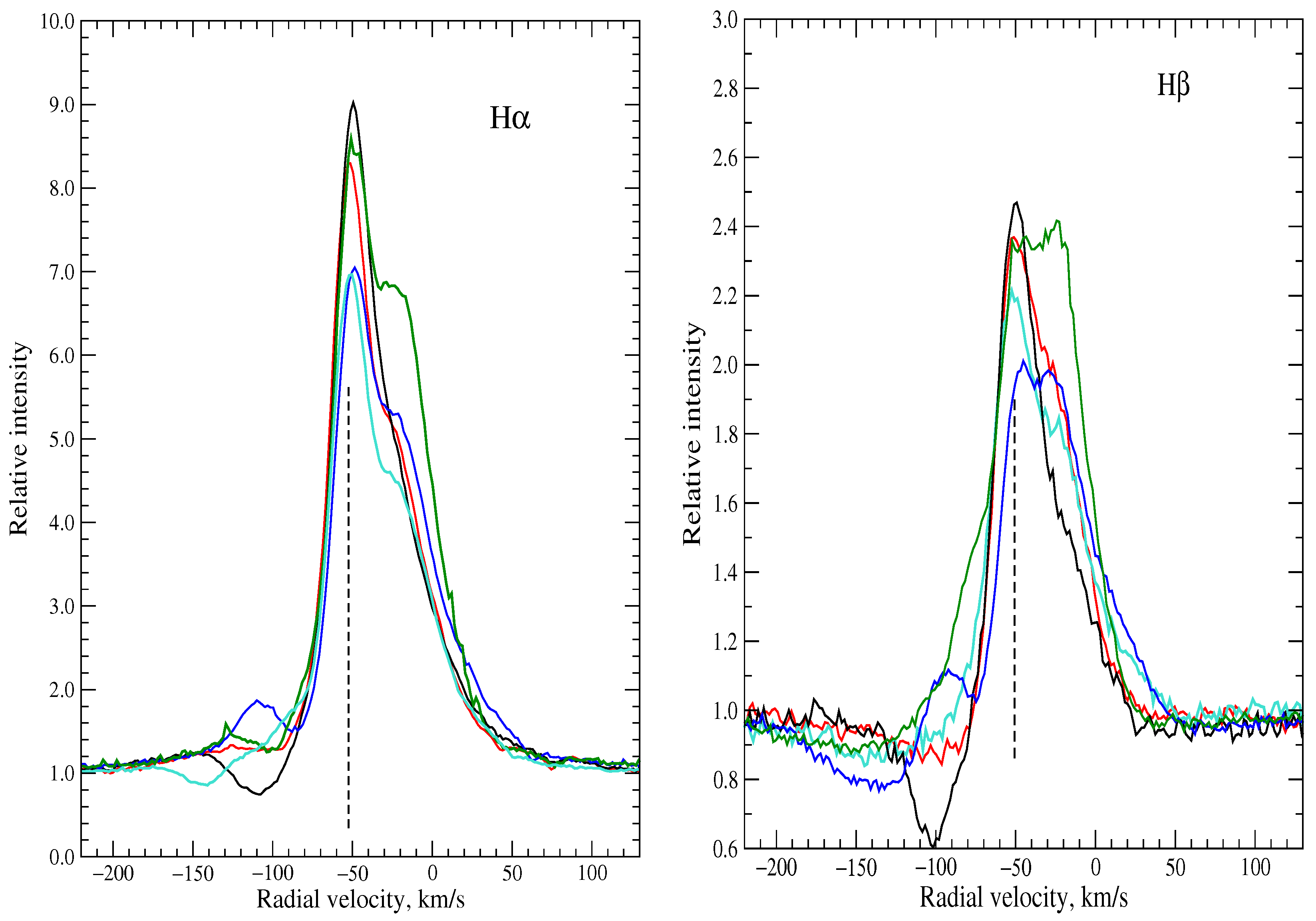
The complex and variable emission lines of neutral hydrogen in the spectrum of IRAS 01005 attract special attention. We show examples of these line profiles in Figure 1. The H α and H β profiles are typical of objects with the B[e] phenomenon. In particular, these P Cyg-type profiles contain a strong emission component with a peak intensity up to 7–9 times the continuum level. Figure 1 demonstrates the presence of a variable wind feature, suggesting a time-dependent wind variability and/or spatial inhomogeneity of the hydrogen layer in the circumstellar envelope.
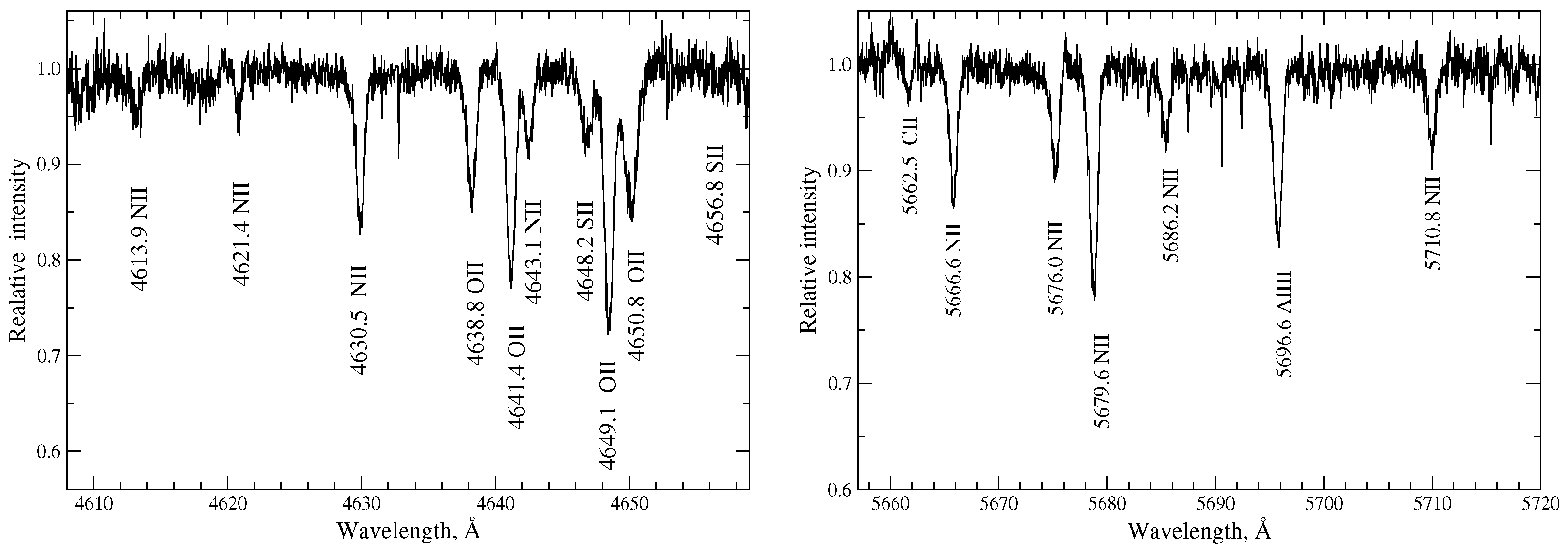
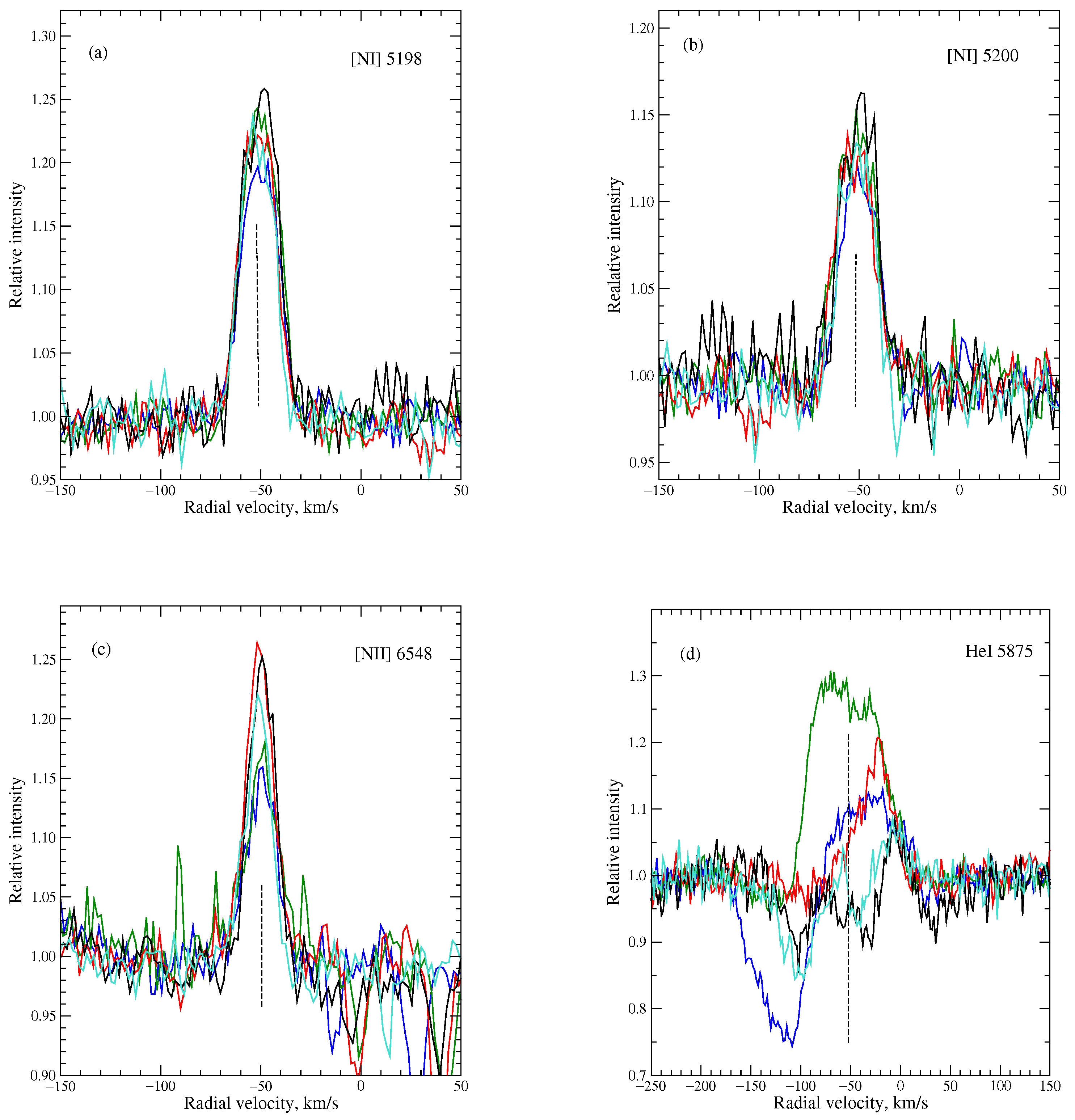
Detailed line identification in a broad wavelength range of the spectrum of IRAS 01005 was published by Klochkova et al. [11]. Symmetric photospheric absorptions (e.g., CNO triad ions, numerous weak lines of Si ii, Si iii, S ii, S iii and the iron group metals) coexist with narrow forbidden emission lines (mainly [Fe ii], [N i], [N ii], [O i], and [S ii]) that form in optically thin layers of the envelope. Examples of typical fragments of the spectrum with photospheric absorption lines are shown in Figure 2, while examples of forbidden line profiles are shown in panels (a), (b), and (c) of Figure 3.
The intensity of narrow forbidden lines (with full-widths at half maximum of ≤10 km s−1) in the spectrum of IRAS 01005 is not strong. It typically does not exceed 10% above the local continuum level, but these lines provide good accuracy of the radial velocity measurements. As follows from the data shown in Table 1, the standard error for every observing night does not exceed 0.15 km s−1, and the average V(emis-forb) = 51.36 km s−1 with a semi-amplitude of 0.26 km s−1 for the five observing dates. Panels (a), (b), and (c) of Figure 3, where the profiles of the strongest forbidden emissions are shown, provide a good illustration of their stationary positions and the temporal variability of their peaks. A comparison of the data taken in 2025–2026 with the earlier measurements [10,11] confirms the conclusion that the positions of these emission lines, which form in an optically thin region of the circumstellar envelope, do not vary.
Panel (d) of Figure 3 shows a complex profile of the He i 5875 Å line, which forms in a transitional region between the stellar atmosphere and the envelope in a wide range of radial velocities and demonstrates a special behavior. Significant variability in the line profile is due to the inhomogeneity and asymmetry of the envelope and the instability of the wind. This behavior of this line profile is a good illustration of a family of absorption–emission spectral features. A low intensity of the latter as well as the transformation of their profiles by overlapping absorption components make it difficult to measure their positions. As a result, the positional uncertainties shown in the last column of Table 1 are much larger compared to those of the radial velocity measurements from the positions of the forbidden lines and photospheric absorptions.
The first column of Table 1 shows the radial velocities of the photospheric absorption lines measured with high precision. We stress that the majority of the pure absorptions (with no additional features) were identified as features of ions, such as N ii, O ii, S ii, and Al iii. Table 2 in Klochkova et al. [11] presents the depths and radial velocities of most of these absorptions. The new observations taken in 2025–2026 revealed additional and more significant evidence of radial velocity variability in a range of V from 20 to 68 km s−1. Therefore, in the five reported observing nights, we detected variability in the radial velocity of the absorption lines of V (aver-abs) = 40.36 km s−1 with a semi-amplitude of ∼8 km s−1. Note that all the radial velocities of the photospheric absorptions observed in 2000–2013 [10,11] fall in the same range between 20 to 68 km s−1, and V (abs) in the spectrum taken on 18 January 2005 are very close to those measured in the spectrum taken on 27 January 2026. At the same time, the radial velocity of the forbidden lines, V (aver-forb) = 51.36 ± 0.26 km s−1, remains stable.
A significant increase in the radial velocity of photospheric absorptions of 20 km s−1 within 3 weeks (from 11 September 2025 to 4 October 2025) is notable. Our previous data taken in 2000–2013 [10,11] show the same variability range for these lines, while the average radial velocity of the forbidden lines remains stable, V ( a v e r F o r b i d ) = 51.36 ± 0.26 km s−1. Multiple high-resolution spectroscopic observations are needed within a few months to refine the amplitude, measure the period, and better understand the reasons for the variations.
We consider the detection of the non-stationary character of the wind components of the H α and H β lines to be a new result. A dramatic change in these line profiles occurred in the spectra taken in 2025–2026. In particular, the wind component was absent on 11 September 2025 but observed again on 4 October 2025. We also note an unusual profile of the H β line on 29 May 2013 (the blue line in the right panel of Figure 1) with a complex shape of the wind component.
Overall, judging by the features of the optical spectrum, the hot central star of IRAS 01005 with a compact dusty envelope is undoubtedly a member of the B[e] object community. However, there is no certain answer to the question of its evolutionary status. A high Teff and the presence of forbidden Fe ii, [Fe ii] and [O i] emission lines, as well as strong Balmer emission lines with P Cyg-type profiles, allow us to suggest a similarity between IRAS 01005 and a hot star [MA93] 1116 in the Small Magellanic Cloud. The results of low-resolution optical spectroscopy were published by Wisniewski et al. [17], who determined a Teff of 19,000 K and a luminosity of log L/L 4.4 , and suggested a status of a B[e] supergiant for this object.
Another object with similar properties of the optical spectrum to those of IRAS 01005 is LSiii +52°24, a hot star located at a Galactic latitude of b = 1 . ° 96 and an optical counterpart of the IR source IRAS 22023+5249. The main features of the spectrum of the latter object (very strong intensity of hydrogen emission lines, He i lines with variable profiles, signs of atmospheric pulsations, and the presence of forbidden lines of light metals) allowed Klochkova et al. [18] to suspect that this star belonged to B[e] supergiants. However, the entire set of features of LSiii +52°24, which include a moderate luminosity, peculiarities of the chemical composition according to Sarkar et al. [19] and a large radial velocity, more likely correspond to a hot post-AGB star status. The spectrum of LSiii +52°24 may be an example of the phenomenon of supergiant mimicry (see [20] for a detailed description).
A close analog of IRAS 01005 is AS 314, a star of a later spectral type (A0). A set of photometric and spectral features of the latter (an excess of far-IR radiation, P Cyg-type profiles of the H α and H β lines, forbidden lines in the optical spectra) revealed over the course of multi-year observations led Bakhytkyzy et al. [21] to no unambiguous choice between the following possibilities: a massive evolved star (a hypergiant or a Luminous Blue Variable) or a low-mass star in transition from the AGB to the Planetary Nebula stage. These authors tend to accept the massive star status for AS 314.
Similar doubts on the status of the object were raised and a similar preferred conclusion about IRAS 01005 was made at earlier stages of its investigation [10]. With the new spectra and additional conclusions reported above, we can classify the object as a supergiant based on the chemical composition of the atmosphere, which is inconsistent with those of post-AGB stars, taking into account a fast and unstable wind and large widths of the photospheric lines. An important reference to a large initial mass of IRAS 01005 can be abundant features of nitrogen and its ions. The presence of forbidden lines of [N i] and [N ii], which form in the envelope, may point to the synthesis of nitrogen in the core of a massive star in the past and a subsequent transfer into the atmosphere and the circumstellar medium. However, a luminosity of log L/L = 3.6 for IRAS 01005, derived using the Gaia DR3 parallax [22] and corrected for the interstellar extinction calculated from the diffuse interstellar band strengths [10], is much lower than the boundary suggested for B[e] supergiants in the review by Kraus [3]. We note that the star in IRAS 01005 with a luminosity of log L/L = 3.39 was included in a list of Galactic post-AGB stars [8] based on the Gaia DR3 parallax and assigned category “I”—most likely a post-AGB object—by Vickers et al. [7].
The parameters of IRAS 01005, including the presence of features of [N i] and [N ii], allow us to suggest the post-AGB status with a high initial mass, while the Hot-Bottom Burning (HBB) process can provide excess nitrogen [23]. A star undergoing a short-term HBB stage possesses a unique internal structure, which includes a degenerate CO-core surrounded by two alternatively active layers of helium located above the inert core and of hydrogen located below the convective envelope. The intershell process of helium burning is unstable, accompanied by flares and mixing episodes, and leads to a chain of neutronization reactions of metallic nuclei (the slow s-process) and transfer of the newly created material to the convective envelope and the stellar surface. A detailed description of these episodes, commonly called the third dredge-up (TDU), is presented in Herwig [24], Battino et al. [25], Karakas and Lattanzio [26]. We note that a sample of similar post-AGB stars with complex envelopes and atmospheric chemical composition altered in the course of the s-process and further mixing was studied using high-resolution spectroscopy carried out at the BTA telescope (see examples in [27,28,29,30]).
Quiet hydrogen burning in a layer is established after the end of TDU. At the same time, as stressed by McSaveney et al. [31], nitrogen synthesis occurs in the entire volume of the upper hydrogen envelope of a post-AGB star, which includes its outermost layers, where nitrogen synthesis occurs by transformation of C12 atoms into N14. The results of this evolutionary phase suggest the efficiency of HBB in stars with initial masses of 4–5 M [32]. The consequences of the HBB process at such a late stage of the star’s evolution can be significant changes in its surface chemical composition. In particular, a C-rich post-AGB star can further exist as an N-rich one. Therefore, investigation of the spectrum of IRAS 01005 gives us additional confirmation of the old conclusion by Lamers et al. [1] about the creation of the B[e] phenomenon in objects at different evolutionary stages but with close physical conditions in the circumstellar medium.

4. Conclusions

We detected variations in the wind component of the H α and H β emission lines by expanding spectroscopic monitoring of IRAS 01005. The positional stability of a sample of forbidden emissions of the CNO triad, Si and species of the iron group led to an accurate determination of the systemic radial velocity of V (sys) = 51.36 ± 0.26 km s−1.
The high accuracy of the positions of spectral features enabled the detection of the radial velocity variations of the photospheric absorptions with respect to an average value of V(aver-abs) = 40.4 ± 8.0 km s−1. The conclusion of the presence of pulsations in the atmosphere of the central star or the existence of a stellar companion has been reached. Continuation of high-resolution spectroscopic monitoring is needed to constrain the amplitude and period of the variability, as well as the reason for it.
A reliable measurement of the star’s luminosity and distance is the main task for constraining the evolutionary status of a star with a complex envelope. The observed set of properties of IRAS 01005 suggests a status of a post-AGB star that has undergone the HBB phase.

Author Contributions

Data reduction, V.G.K. and E.S.I.; Data Analysis, V.G.K., E.S.I. and A.S.M.; Instrumentation, V.E.P.; Writing—Original Draft Preparation, V.G.K.; Writing—Review and Editing, A.S.M. All authors have read and agreed to the published version of the manuscript.

Funding

This research was completed within the framework of the state request to the Special Astrophysical Observatory of the Russian Academy of Sciences from the Ministry of science and higher education of the Russian Federation. The project was partly carried out within the framework of Project No. BR24992759 ”Development of the concept for the first Kazakhstani orbital cislunar telescope—Phase I”, financed by the Ministry of Science and Higher Education of the Republic of Kazakhstan).

Data Availability Statement

The spectra used in this research are available upon reasonable request.

Acknowledgments

This research has made use of the SIMBAD database, operated at CDS, Strasbourg, France; the Astrophysics Data System, funded by NASA under Cooperative Agreement 80NSSC21M0056.; VALD databse of atomic data; and data from the European Space Agency (ESA) mission Gaia.

Conflicts of Interest

The authors declare no conflicts of interest.

Abbreviations

The following abbreviations are used in this manuscript:
AGBAsymptotic Giant Branch
HBBHot-Bottom Burning
CNOCarbon, Nitrogen, Oxygen
TeffEffective Temperature

References

  1. Lamers, H.J.G.L.M.; Zickgraf, F.J.; de Winter, D.; Houziaux, L.; Zorec, J. An improved classification of B[e]-type stars. Astron. Astrophys. 1998, 340, 117–128. [Google Scholar]
  2. Maravelias, G.; Kraus, M.; Cidale, L.S.; Borges Fernandes, M.; Arias, M.L.; Curé, M.; Vasilopoulos, G. Resolving the kinematics of the discs around Galactic B[e] supergiants. Mon. Not. R. Astron. Soc. 2018, 480, 320–344. [Google Scholar] [CrossRef]
  3. Kraus, M. A Census of B[e] Supergiants. Galaxies 2019, 7, 83. [Google Scholar] [CrossRef]
  4. Miroshnichenko, A.S.; Zharikov, S.V.; Manset, N.; Khokhlov, S.A.; Nodyarov, A.S.; Klochkova, V.G.; Danford, S.; Kuratova, A.K.; Mennickent, R.; Chojnowski, S.D.; et al. Recent Progress in Finding Binary Systems with the B[e] Phenomenon. Galaxies 2023, 11, 36. [Google Scholar] [CrossRef]
  5. Hrivnak, B.J.; Volk, K.; Kwok, S. 2-45 Micron Infrared Spectroscopy of Carbon-rich Proto-Planetary Nebulae. Astrophys. J. 2000, 535, 275–292. [Google Scholar] [CrossRef]
  6. Arkhipova, V.P.; Burlak, M.A.; Esipov, V.F.; Ikonnikova, N.P.; Komissarova, G.V. Nonstationarity of hot post-AGB objects: Variations of the brightness and spectrum of IRAS 01005+7910, IRAS 22023+5249, and IRAS 22495+5134. Astron. Lett. 2013, 39, 619–633. [Google Scholar] [CrossRef]
  7. Vickers, S.B.; Frew, D.J.; Parker, Q.A.; Bojičić, I.S. New light on Galactic post-asymptotic giant branch stars—I. First distance catalogue. Mon. Not. R. Astron. Soc. 2015, 447, 1673–1691. [Google Scholar] [CrossRef]
  8. Oudmaijer, R.D.; Jones, E.R.M.; Vioque, M. A census of post-AGB stars in Gaia DR3: Evidence for a substantial population of Galactic post-RGB stars. Mon. Not. R. Astron. Soc. 2022, 516, L61–L65. [Google Scholar] [CrossRef]
  9. Kochanek, C.S.; Shappee, B.J.; Stanek, K.Z.; Holoien, T.W.S.; Thompson, T.A.; Prieto, J.L.; Dong, S.; Shields, J.V.; Will, D.; Britt, C.; et al. The All-Sky Automated Survey for Supernovae (ASAS-SN) Light Curve Server v1.0. Publ. Astron. Soc. Pac. 2017, 129, 104502. [Google Scholar] [CrossRef]
  10. Klochkova, V.G.; Yushkin, M.V.; Miroshnichenko, A.S.; Panchuk, V.E.; Bjorkman, K.S. Discovery of spectral variation in the optical counterpart of IRAS 01005+7910. Astron. Astrophys. 2002, 392, 143–150. [Google Scholar] [CrossRef]
  11. Klochkova, V.G.; Chentsov, E.L.; Panchuk, V.E.; Sendzikas, E.G.; Yushkin, M.V. Spectral variability of the IR source IRAS 01005+7910 optical component. Astrophys. Bull. 2014, 69, 439–453. [Google Scholar] [CrossRef][Green Version]
  12. Panchuk, V.E.; Klochkova, V.G.; Yushkin, M.V. The high-resolution Echelle Spectrograph of the 6-m telescope of the special astrophysical observatory. Astron. Rep. 2017, 61, 820–831. [Google Scholar] [CrossRef]
  13. Galazutdinov, G.A. DECH: A Software Package for Astronomical Spectral Data Processing and Analysis. Astrophys. Bull. 2022, 77, 519–529. [Google Scholar] [CrossRef]
  14. Klochkova, V.G.; Sendzikas, E.G.; Chentsov, E.L. Spectral atlas of A-type supergiants. Astrophys. Bull. 2015, 70, 99–108. [Google Scholar] [CrossRef]
  15. Klochkova, V.G.; Chentsov, E.L. Detailed optical spectroscopy of the B[e] Star MWC17. Astrophys. Bull. 2016, 71, 33–42. [Google Scholar] [CrossRef]
  16. Klochkova, V.G.; Miroshnichenko, A.S.; Komarova, V.N.; Tavolzhanskaya, N.S. B[e] star CI Cam: A High-Resolution Spectrum Atlas in the Range of 395–780 nm. Astrophys. Bull. 2025, 80, 551–573. [Google Scholar] [CrossRef]
  17. Wisniewski, J.P.; Bjorkman, K.S.; Bjorkman, J.E.; Clampin, M. Discovery of a New Dusty B[e] Star in the Small Magellanic Cloud. Astrophys. J. 2007, 670, 1331–1336. [Google Scholar] [CrossRef]
  18. Klochkova, V.G.; Miroshnichenko, A.S.; Panchuk, V.E.; Tavolzhanskaya, N.S.; Yushkin, M.V. Instability in the System of the Distant Post-AGB Star LS III +52°24 (IRAS 22023+5249). Astron. Rep. 2022, 66, 429–440. [Google Scholar] [CrossRef]
  19. Sarkar, G.; García-Hernández, D.A.; Parthasarathy, M.; Manchado, A.; García-Lario, P.; Takeda, Y. High-resolution spectroscopy of the high-velocity hot post-AGB star LS III +52°24 (IRAS 22023+5249). Mon. Not. R. Astron. Soc. 2012, 421, 679–699. [Google Scholar] [CrossRef]
  20. Klochkova, V.G.; Chentsov, E.L. The Problem of Spectral Mimicry of Supergiants. Astron. Rep. 2018, 62, 19–30. [Google Scholar] [CrossRef]
  21. Bakhytkyzy, A.; Miroshnichenko, A.S.; Klochkova, V.G.; Panchuk, V.E.; Zharikov, S.V.; Mahy, L.; Van Winckel, H.; Agishev, A.T.; Khokhlov, S.A. AS 314: A Massive Dusty Hypergiant or a Low-Mass Post-Asymptotic Giant Branch Object? Galaxies 2025, 13, 17. [Google Scholar] [CrossRef]
  22. Gaia Collaboration; Brown, A.G.A.; Vallenari, A.; Prusti, T.; de Bruijne, J.H.J.; Babusiaux, C.; Biermann, M.; Creevey, O.L.; Evans, D.W.; Eyer, L.; et al. Gaia Early Data Release 3. Summary of the contents and survey properties. Astron. Astrophys. 2021, 649, A1. [Google Scholar] [CrossRef]
  23. Boothroyd, A.I.; Sackmann, I.J.; Ahern, S.C. Prevention of High-Luminosity Carbon Stars by Hot Bottom Burning. Astrophys. J. 1993, 416, 762. [Google Scholar] [CrossRef]
  24. Herwig, F. Evolution of Asymptotic Giant Branch Stars. Annu. Rev. Astron. Astrophys. 2005, 43, 435–479. [Google Scholar] [CrossRef]
  25. Battino, U.; Pignatari, M.; Tattersall, A.; Denissenkov, P.; Herwig, F. The NuGrid AGB Evolution and Nucleosynthesis Data Set. Universe 2022, 8, 170. [Google Scholar] [CrossRef]
  26. Karakas, A.; Lattanzio, J.C. Stellar Models and Yields of Asymptotic Giant Branch Stars. Publ. Astron. Soc. Aust. 2007, 24, 103–117. [Google Scholar] [CrossRef]
  27. Klochkova, V.G. Spectroscopy of F supergiants with infrared excess. Mon. Not. R. Astron. Soc. 1995, 272, 710–716. [Google Scholar] [CrossRef]
  28. Klochkova, V.G.; Szczerba, R.; Panchuk, V.E.; Volk, K. The peculiar post-AGB supergiant IRAS 04296+3429: Optical spectroscopy and its spectral energy distribution. Astron. Astrophys. 1999, 345, 905–914. [Google Scholar] [CrossRef]
  29. Klochkova, V.G. High-latitude supergiant V5112 Sgr: Enrichment of the envelope with heavy s-process metals. Astron. Lett. 2013, 39, 765–775. [Google Scholar] [CrossRef][Green Version]
  30. Klochkova, V.G.; Panchuk, V.E.; Tavolzhanskaya, N.S. Peculiarities of the atmosphere and envelope of a post-AGB star, the optical counterpart of IRAS 23304+6347. Astron. Lett. 2015, 41, 14–22. [Google Scholar] [CrossRef][Green Version]
  31. McSaveney, J.A.; Wood, P.R.; Scholz, M.; Lattanzio, J.C.; Hinkle, K.H. Abundances in intermediate-mass AGB stars undergoing third dredge-up and hot-bottom burning. Mon. Not. R. Astron. Soc. 2007, 378, 1089–1100. [Google Scholar] [CrossRef]
  32. Ventura, P.; Karakas, A.I.; Dell’Agli, F.; Boyer, M.L.; García-Hernández, D.A.; Di Criscienzo, M.; Schneider, R. The Large Magellanic Cloud as a laboratory for hot bottom burning in massive asymptotic giant branch stars. Mon. Not. R. Astron. Soc. 2015, 450, 3181–3190. [Google Scholar] [CrossRef]
Figure 1. H α and H β line profiles taken on 29 May 2013 (blue), 21 August 2013 (green), 11 September 2025 (red), 4 October 2025 (black), and 27 January 2026 (turquoise). The vertical dashed line corresponds to the systemic velocity V (sys) = 51.4 km s−1.
Astronomy 05 00013 g001
Figure 2. Fragments of the spectrum of IRAS 01005 taken on 29 May 2013 with photospheric absorptions of the CNO triad, Sii, and Al iii.
Astronomy 05 00013 g002
Figure 3. Panels (ac) show the forbidden lines of [N i] 5198 and 5200 Å and [N ii] 6548 Å in the spectra taken on 29 May 2013 (blue), 21 August 2013 (green), 11 September 2025 (red), 4 October 2025 (black), and 27 January 2026 (turquoise), respectively. Panel (d) shows the He i 5876 Å line profiles for the same dates. The vertical dashed line corresponds to the systemic velocity Vsys = 51.4 km s−1. Telluric lines were not removed from the plots.
Astronomy 05 00013 g003
Table 1. Average heliocentric radial velocities and uncertainties for three types of spectral lines measured in the spectra taken on different dates. The numbers of measured lines are shown in parentheses.
ObservingV, km s−1
DatesAbsorptionsEmis-ForbEmis-Perm
29 May 2013 40.43 ± 0.04  (84) 51.76 ± 0.09  (20) 54.13 ± 0.49  (12)
21 August 2013 29.93 ± 0.07  (38) 51.93 ± 0.12  (8) 58.17 ± 0.66  (9)
11 September 2025 41.76 ± 0.15  (25) 51.57 ± 0.14  (10) 55.38 ± 0.35  (13)
4 October 2025 21.60 ± 0.17  (27) 51.12 ± 0.13  (13) 49.60 ± 0.30  (12)
27 January 2026 68.09 ± 0.17  (20) 50.44 ± 0.12  (16) 50.68 ± 0.24  (14)
Disclaimer/Publisher’s Note: The statements, opinions and data contained in all publications are solely those of the individual author(s) and contributor(s) and not of MDPI and/or the editor(s). MDPI and/or the editor(s) disclaim responsibility for any injury to people or property resulting from any ideas, methods, instructions or products referred to in the content.