Article

A Statistical Study of the Jet Structure of Gamma-Ray Bursts

1
College of Physics and Electronics Information, Yunnan Normal University, Kunming 650500, China
2
Department of Astronomy, School of Physics and Astronomy, Key Laboratory of Astroparticle Physics of Yunnan Province, Yunnan University, Kunming 650091, China
*
Author to whom correspondence should be addressed.
These authors contributed equally to this work.
Astronomy 2026, 5(2), 7; https://doi.org/10.3390/astronomy5020007

Submission received: 24 December 2025 / Revised: 31 March 2026 / Accepted: 31 March 2026 / Published: 3 April 2026
(This article belongs to the Special Issue Current Trends in Cosmology)

Abstract

The jet structure plays an important role in both the prompt and afterglow emission phases of gamma-ray bursts (GRBs). Whether GRB jets are better described by uniform (top-hat) or structured models remains an open question. We use the afterglowpy Python package to numerically model the late X-ray afterglow light curves of a large sample of long and short GRBs, and apply the Bayesian Information Criterion (BIC) to compare the performance of top-hat and Gaussian structured jet models. Within our adopted modeling framework, we find that the top-hat model is preferred by the BIC for ∼78.9% (150/190) of long GRBs and 70% (7/10) of short GRBs. GRB 180205A and GRB 140515A exhibit Δ BIC < 2 for all three model comparisons, indicating that top-hat, Gaussian, and power-law jets provide equivalent fits to their afterglow light curves. This large-sample analysis suggests that uniform jets may be more common than structured jets in the observed GRB population, although this conclusion is subject to the limitations of our model assumptions and the BIC-based model selection criterion. Furthermore, we find that the best-fit distributions of observer angle θ obs , electron energy fraction ϵ e , and isotropic equivalent energy E 0 differ significantly between the top-hat and Gaussian jet models, with θ obs showing the most pronounced distinction.

1. Introduction

Gamma-ray bursts (GRB) are often interpreted as highly relativistic jets due to their high energies, short timescales, and extreme brightness [1,2,3,4,5]. It is currently believed that long gamma-ray bursts (LGRBs) originate from the collapse of massive stars, usually lasting >2 s, and short gamma-ray bursts (SGRBs) originate from the merger of two compact objects (two neutron stars or a neutron star and a black hole), usually lasting <2 s [5,6,7,8]. When a massive star collapses and a dense binary merges, they produce a central engine in the form of a superaccreting black hole or a rapidly rotating, strongly magnetized neutron star (millisecond magnetar), and it launches a relativistic outflow  [9,10,11,12,13,14,15,16]. When the outflow is decelerated by the circumburst medium, broadband afterglow emission from radio to gamma rays waves is generated by the forward and reverse external shocks [17,18,19]. For early optical afterglow, it is usually dominated by reverse shock (RS) emission. Detailed modeling of such emission, e.g., the reverse shock in GRB 140102A, has constrained jet magnetization and composition [20].
Due to the relativistic collimation effect of the GRB jet, we observe a steep time burst in most of the afterglow light curve, which is known as jet break [8]. It can usually be explained by two effects: edge effect [21] and lateral expansion effect. Consider a conical uniform jet with a jet opening angle of θ c , relativistic motion with the Lorentz factor Γ . There is no moving matter and radiation outside the jet cone. Assuming that the observer is exactly in the cone of θ c , due to relativistic beaming, the observer can only observe the radiation flux contributed within the 1 / Γ angle. Then the shock wave decelerates, the 1 / Γ cone increases, and when the 1 / Γ angle is comparable to the jet cone angle, the light curve shows “jet break”. Current observations of afterglow light curves have found that the jet break are less than expected, a phenomenon known as the “missing jet break problem”. Ryan showed that observing the light curve from outside the jet core can erase the jet break and delay the complete transition, which provides a reasonable solution to the “missing jet break problem” [22].
Early numerical jet simulations of GRBs afterglows showed that most GRBs can be described by “top-hat” jets (uniform jets) [21,23,24,25]. GRBs jets may be structured, i.e., the angular structure of the energy and the Lorentz factor [26,27,28]. Commonly discussed models of structured jets are power-law and Gaussian jets [28], as well as the widely used two-parameter boosted fireball model [29]. Observations of the gravitational wave signal GW170817A from the merger of two neutron stars indicate the existence of a complex angular jet structure. The general “top-hat” jet model has been challenged, and the off-axis structured jet can better match the observed data [30,31]. Zhang and Ryan used numerical models to fit the late X-ray afterglow data and found that most GRBs are observed outside the jet core (i.e., off-axis) [22,32]. Wu used the two-parameter boosted fireball model as the initial condition and found that cosmological SGRBs and GW170817A have the same outflow structure [33]. Liao studied the jet structure of GRBs from the perspective of long and short bursts, proved that the two types of bursts have the same jet structure [34]. Wei et al. simulated and calculated the differences and distinctions between the GRBs afterglow light curves of uniform jets and non-uniform jets under different observation angle and θ c  [35]. Recent modeling with tools like afterglowpy has further revealed diverse jet properties, from wide jets in orphan afterglows [36] to extremely narrow, highly magnetized jets in luminous bursts like GRB 230204B [37].
However, these studies (e.g., GW170817A’s complex structure by Wu [30]; off-axis observations by Zhang [32]; detailed single-source modeling by Gupta [20,36,37]) lack statistical analysis of large samples. For example, Liao [34] compared jet structures of long and short GRBs but did not quantify the fitting proportions of different models or parameter differences. Thus, whether long/short GRBs are dominated by uniform or structured jets remains unresolved statistically.
In this work, we employ the afterglowpy python package [38] built by Ryan for numerical calculation of afterglow light curves. The uniform jet model and the structured jet model are used to fit the late X-ray afterglow light curves of LGRBs and SGRBs. The best fitting model is selected according to the Bayesian information criterion, so as to study the jet structure of GRBs more comprehensively and systematically and provide clues to their physical origins. The data selection and analysis methods are outlined in Section 2. The fitting results are presented in Section 3. Conclusions and discussion are presented in Section 4.

2. Data Selection and Methods

Our sample consists of 226 long GRBs and 22 short GRBs, taken from the compilation of Liao [34]. As described in that work, all X-ray afterglow light curves were originally obtained from the Swift/XRT instrument and retrieved from the UK Swift Science Data Centre (UKSSDC) online repository [39,40]. The light curves are in the 0.3–10 keV energy band and were processed with the standard UKSSDC pipeline (version 3), using adaptive binning to achieve a minimum signal-to-noise ratio of S/N > 3 per bin, following the standard procedures described in Evans [40]. To ensure the applicability of the afterglow model, we adopt the same trimming criteria as Liao [34] and Ryan [22] to exclude early-time effects such as steep decay, plateau phases, and X-ray flares. A burst is included only if its light curve contains at least eight data points after trimming. The selected bursts span a redshift range of 0.1 5.0 and cover post-burst times from 10 3 s to 10 6 s.

2.1. Jet Model

The afterglow light curve of a structured jet is different from that of a uniform jet. Since the energy distribution per unit solid angle d E d Ω varies with the jet axis angle, the light curve will depend on the observation angle θ o b s relative to the jet axis. A uniform jet is defined as a conical jet with uniformly distributed energy and a Lorentz factor with a sharp jet cone at a given opening angle, i.e.,
d E d Ω =   E 0 , θ < θ c 0 , θ > θ c
Γ ( θ ) = Γ 0 , θ < θ c 1 , θ > θ c
The difference between structured jets and uniform jets lies in their angular or radial non-uniformity. Angular structure is manifested as the physical parameters of the jet (such as energy and velocity) changing with angle, while radial structure is manifested in a fixed direction, where the jet velocity changes with radial distance. Specifically, the energy and Lorentz factor of the jet will change according to a specific angular distribution law, thus forming an angle-dependent structural feature. It should be noted that the concept of “structured jet”does not refer to a specific physical model unless the specific distribution form of energy or Lorentz factor is clearly defined. In actual research, the commonly used parameterized models mainly include two angle-dependent structures: power-law jet and Gaussian jet. The energy distribution of these two models can be expressed as:
E ( θ ) = E 0 e θ 2 2 θ c 2 , θ θ w 0 , θ > θ w Gaussian .
E ( θ ) = E 0 1 + θ 2 b θ c 2 b 2 , θ θ w 0 , θ > θ w power law .
where,   E 0 represents energy, θ c represents the jet angle, θ w is the cutoff angle, and b is the power law exponent.

2.2. Afterglowpy Fitting

We utilize the afterglowpy Python package [38] to perform numerical simulations of afterglow light curves, enabling precise estimation of jet structure parameters. afterglowpy employs a single-shell approximation to simulate the synchrotron radiation from the forward shock of a relativistic blast wave. It is a Python 3 toolkit capable of calculating afterglow light curves and energy spectra for various jet models, including uniform jets (top-hat), structured jets such as Gaussian jets, and power-law jets. In Python, the flux density of the GRBs afterglow is calculated by calling fluxDensity, including the specified jet model and related jet parameters as follows.
  • θ obs : jet observation angle (unit: radians);
  • E 0 : isotropic equivalent energy along the jet axis (unit: erg);
  • n 0 : proton number density in the circumburst medium (unit: cm 3 );
  • θ c : jet opening angle (unit: radians);
  • θ w : jet cutoff angle for structured jets (unit: radians);
  • p: electron energy distribution index (dimensionless);
  • ϵ B : magnetic field energy fraction (dimensionless);
  • ϵ e : fraction of thermal energy carried by relativistic electrons (dimensionless);
  • b: power-law index of the angular energy distribution of the structured jet (dimensionless);
Because the current version of afterglowpy is implemented for a constant-density external medium, all fits in this work adopt an ISM-like circumburst density profile. Accordingly,   n 0 in our analysis represents the effective ambient density within this homogeneous-medium assumption, and should not be interpreted as evidence that every burst physically occurs in a true ISM environment. This limitation is particularly relevant for long GRBs, for which a wind-like progenitor environment may also be plausible.
We employ three jet models (top-hat, Gaussian, and power-law) to numerically simulate the afterglow data of long and short GRBs. Subsequently, we utilize the Markov Chain Monte Carlo (MCMC) ensemble sampling Python package emcee [41] in combination with afterglowpy to fit the X-ray afterglow light curve data of these bursts. Furthermore, we constrain the distribution ranges of the corresponding model parameters, as detailed in Table 1. Among these parameters,   E 0 , ϵ B , ϵ e and   n 0 are treated as logarithmic measurements. Specifically, we deploy 200 walkers to explore the parameter space, sampling 5000 iterations per run. To ensure convergence, we execute multiple independent emcee runs and cross-validate the results.

3. Fitting Result Analysis

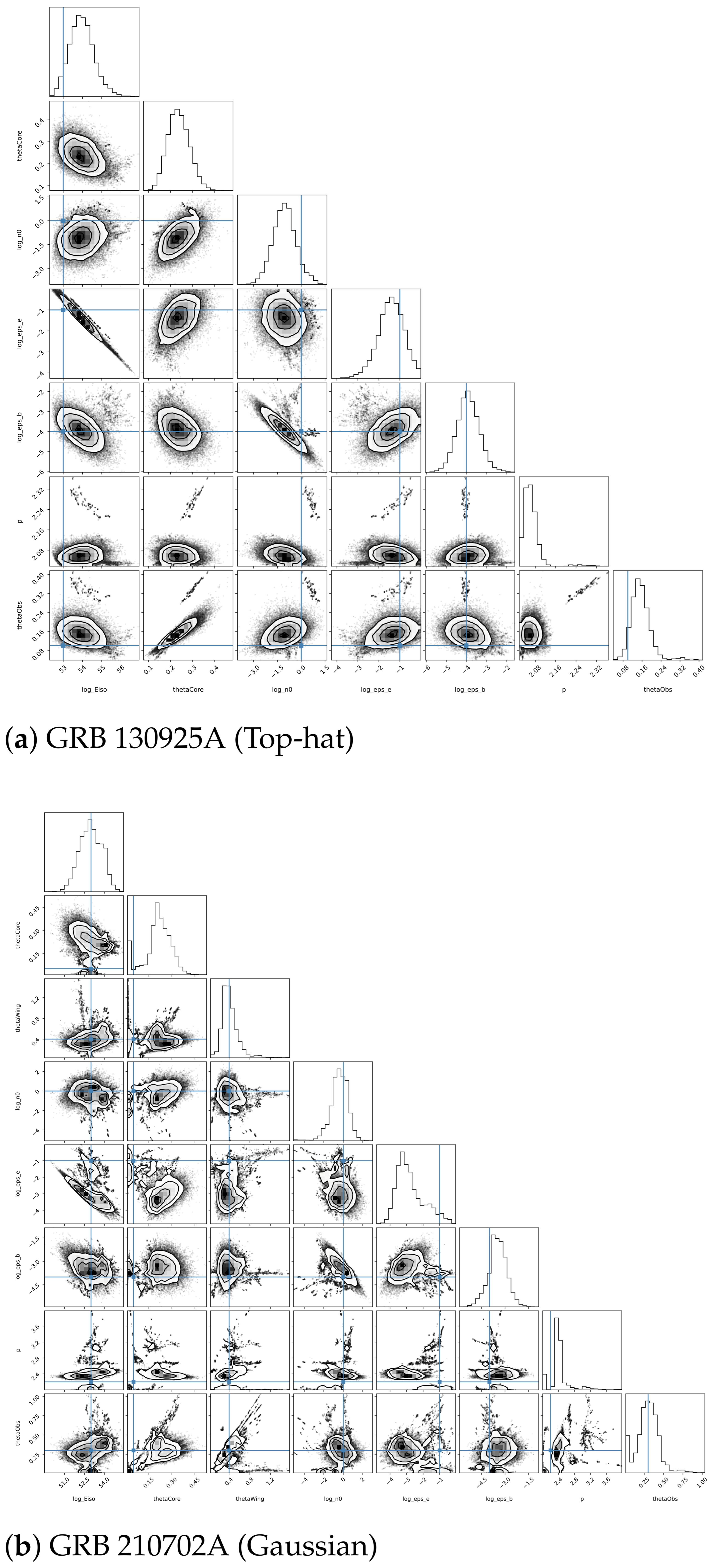

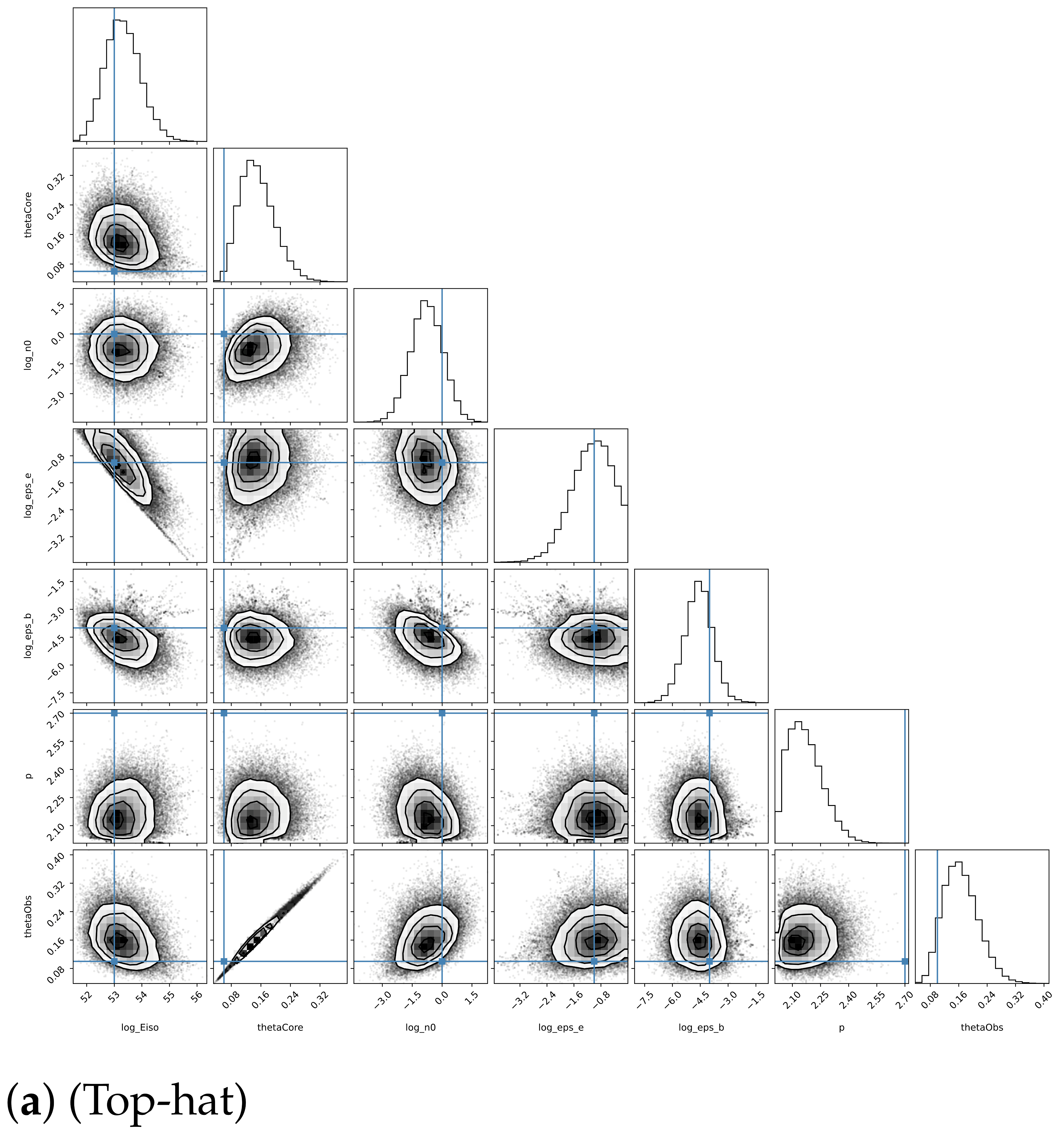
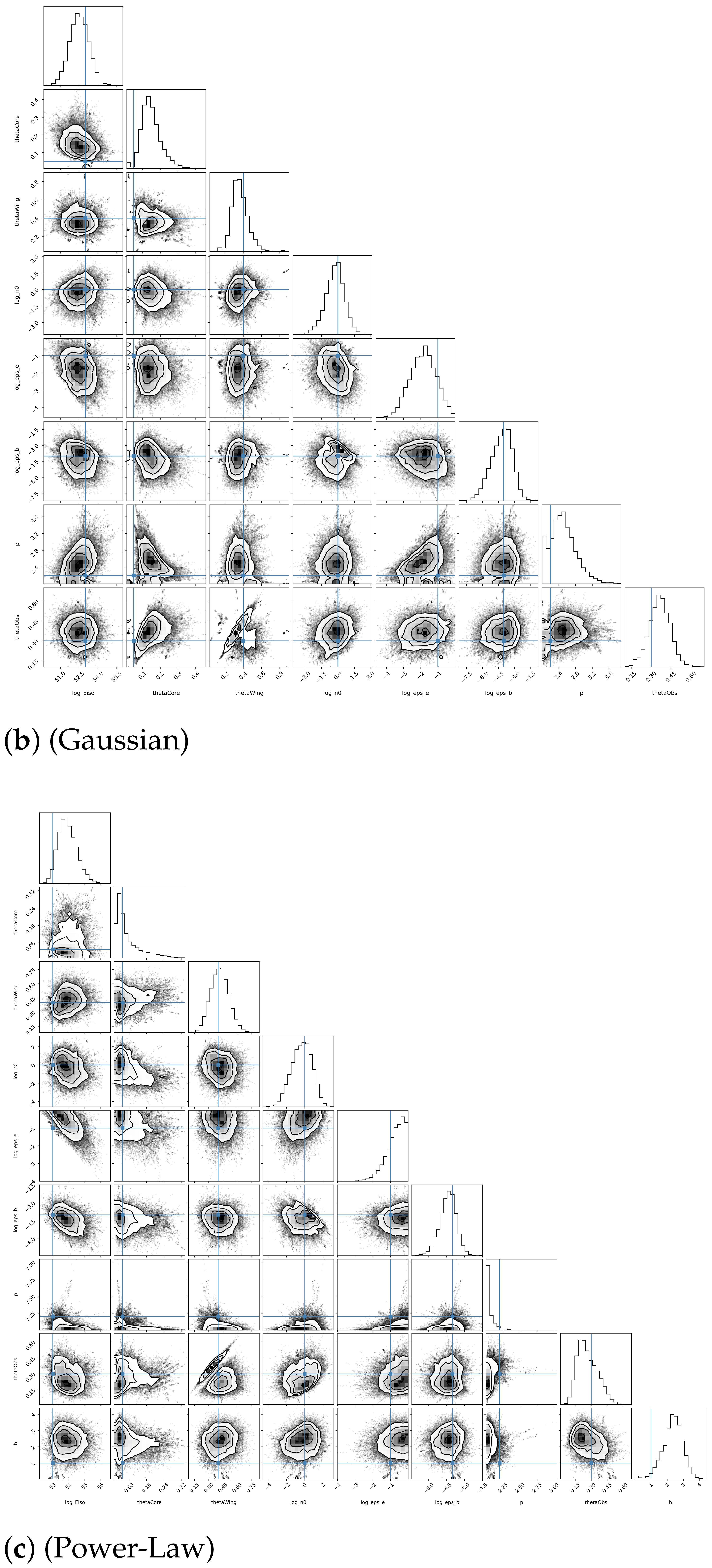
We run the Afterglowpy software on the afterglow light curves of 226 LGRBs and 22 SGRBs. Light curves with 0 < χ 2 / dof < 3 are considered as well-fit, including 190 long GRBs and 10 short GRBs. We use the Bayesian Information Criterion (BIC) to select the best-fitting model in the well-fitting sample. The BIC is defined as BIC = χ min 2 + k ln n , where χ min 2 is the minimum chi-square, k the number of free parameters, and n the number of data points. The model with lower BIC is preferred; a difference | Δ BIC |   =   | BIC A BIC B |   <   2 is inconclusive, while >6 indicates strong evidence [42]. In LGRBs, there are 150 bursts that are best fitted with top-hat, and 37 and 3 bursts that are best fitted with Gaussian and power-law, respectively. The partial fitting diagram is shown in Figure 1. Additional corner plot examples for different GRBs (see Figure A1) illustrate the fitting results obtained with the top-hat, Gaussian, and power-law models. Among the SGRBs, 7 bursts are best fitted by top-hat, 3 by Gaussian. The detailed fitting results are shown in Supplementary Materials.

3.1. Comparison of Top-Hat and Gaussian Jet Parameters

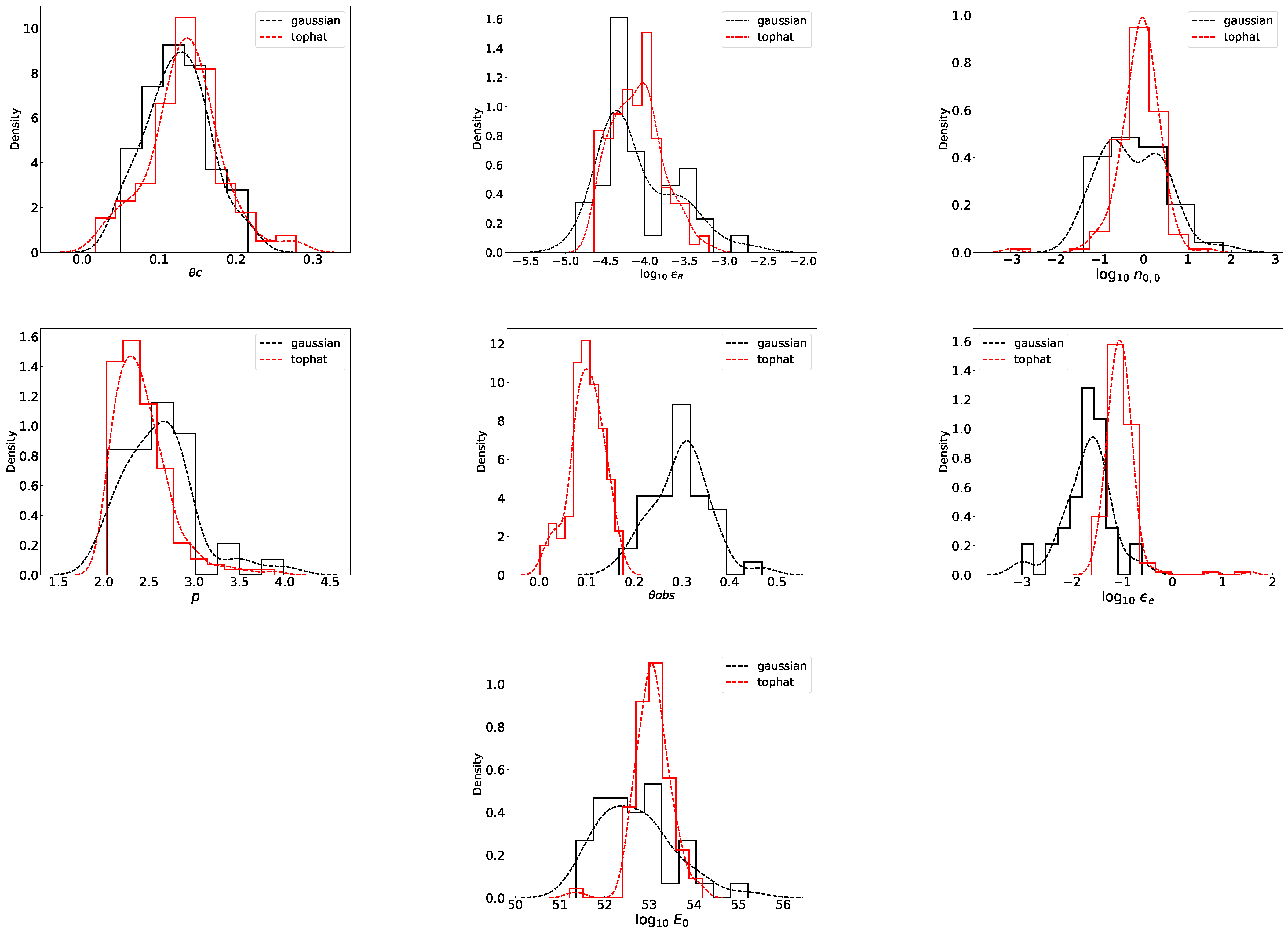
By fitting the afterglow X-ray light curve, we obtain the values of the corresponding jet parameters of top-hat, Gaussian and power-law. We will classify the jet parameters of the three bursts with power-law fitting as the best and those with Gaussian fitting as the best into a Gaussian group. In this section, we compare and analyze the 150 top-hat and 40 Gaussian (3 power-law) jet parameters of LGRBs. Figure 2 shows the distribution diagrams of θ c ,   E 0 , ϵ B , ϵ e ,   n 0 , p and θ o b s of the corresponding jet parameters of top-hat and Gaussian, where the black dotted line and red dotted line represent the fitting lines of top-hat and Gaussian, respectively. It can be clearly seen from Figure 2 that the distribution ranges of θ c , ϵ B ,   n 0 and p are similar, and the distribution of the peaks is close. However, the distributions of θ o b s , ϵ e , and   E 0 show great differences, among which θ o b s is the most significant. The distribution range and peak of θ o b s in the Gaussian model are larger than those of top-hat, while the distributions of ϵ e and   E 0 are larger than those of top-hat.The distribution of θ o b s may primarily stem from the structural differences between the two models themselves, rather than from the actual physical bimodal distribution of the GRB jet.
In order to compare the two models more accurately and clearly, we give the average, median and distribution range of the jet parameters of top-hat and Gaussian respectively in Table 2. We find that except for ϵ B ,   E 0 , and θ o b s , the average and median of the jet parameters of top-hat and Gaussian are not much different, and the distribution range is roughly the same. The distribution range, average, and median of θ o b s in the top-hat model are (0.002, 0.177), 0.100, and 0.101, respectively, which are smaller than the distribution range, average, and median of the Gaussian model (0.168, 0.469), 0.298, and 0.310. The average, median, and distribution range of ϵ e and   E 0 are larger in the top-hat model. The medians of ϵ e and   E 0 in the top-hat model are −1.046 and 53.076, respectively, which are larger than −1.85 and 52.562 in the Gaussian model.
By performing Kolmogorov-Smirnov (K-S) test on the jet parameters of the two models, we find that the p-values for θ c , ϵ B , n 0 , and p between top-hat and Gaussian jets are 0.495, 0.233, 0.00032, and 0.058, respectively (see Table 2). All values are greater than 10 4 , indicating no statistically significant difference in these parameters between the two models. This suggests that these parameters are not sensitive to the assumed jet structure when fitting X-ray afterglow light curves, likely because they are primarily constrained by the overall decay slope and normalization rather than the detailed jet geometry.
In contrast, the p-values for θ o b s , ϵ e , and E 0 are all much smaller than 10 4 , indicating significant differences between the two models. Notably, θ o b s shows the most pronounced contrast, suggesting that the observer angle is a key discriminant of jet geometry: different angular energy profiles require systematically different viewing angles to reproduce the same afterglow data. Meanwhile, ϵ e and E 0 are sensitive to the energy distribution within the jet, as structured jets distribute energy non-uniformly across angles, leading to different inferred energy budgets and electron acceleration efficiencies. These findings highlight that while some microphysical parameters may be model-independent, the inferred geometry and energy budget strongly depend on the assumed jet structure.

3.2. Off-Axis Analysis

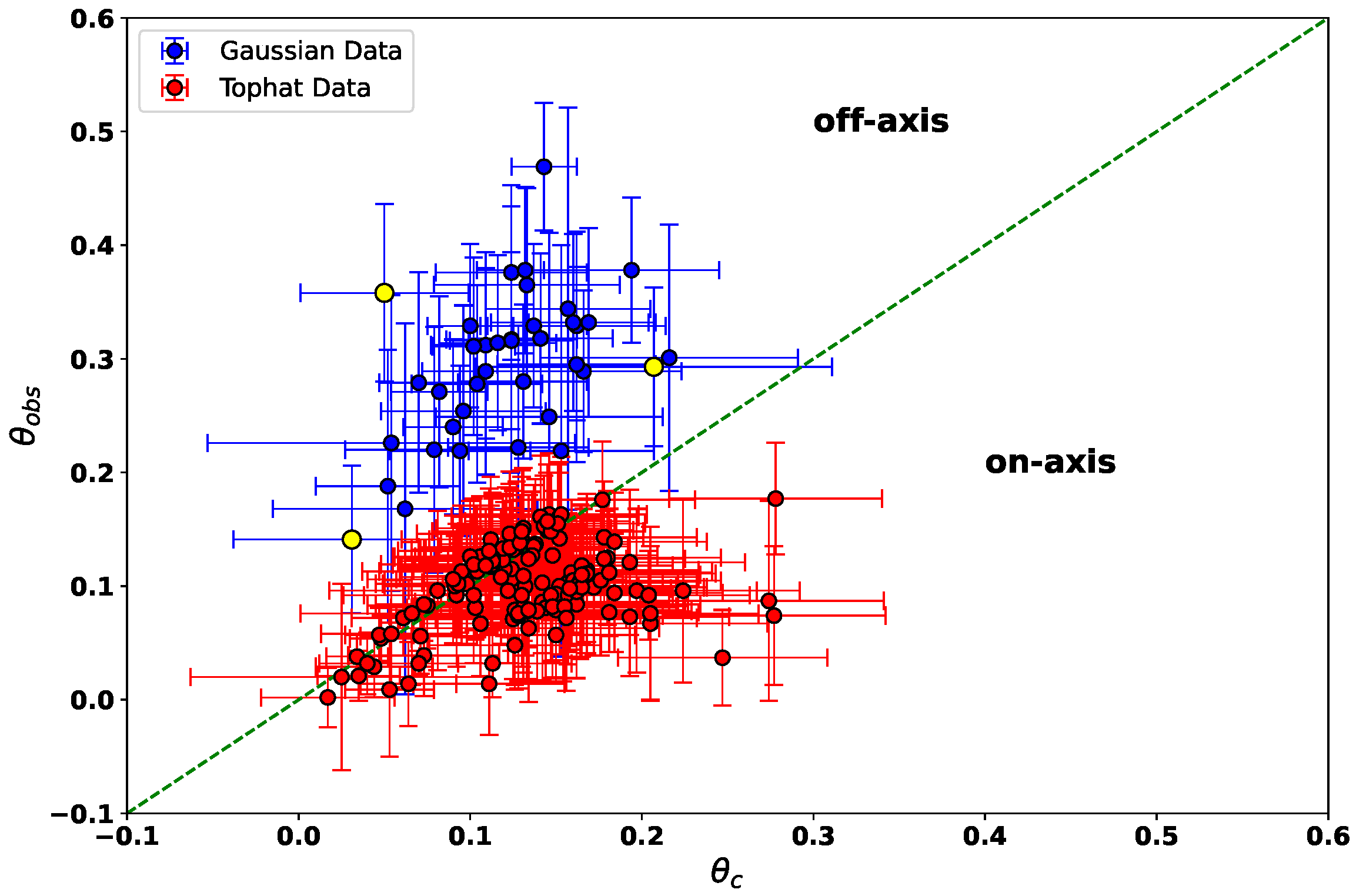
Previous work has demonstrated that the light curves of structured jets exhibit two behavioral modes, depending on whether the observer is aligned ( θ obs   < θ c , on-axis) or misaligned ( θ obs   > θ c , off-axis) [27,43,44]. In the aligned case, the light curve follows the standard on-axis top-hat behavior, slightly modified for nonzero viewing angles. There is little difference between E ( θ ) in the different configurations, and the light curve is well approximated by an inflected power law with a characteristic inflection time [45]. The structure of the misaligned light curve is more complex, it also behaves as an inflected power law, but the closure relation depends explicitly on the viewing angle and the jet angle structure. In Figure 3, we show the distribution of the jet opening angle θ c and the observation angle θ o b s for different models. We can see that the data points of Gaussian and power-law are above the diagonal, and most of the data points of top-hat are below the diagonal, with a small part on the diagonal. This indicates that the structured jets represented by the Gaussian and power-law models are off-axis observations, and the most significant difference between the top-hat model and the Gaussian and power-law models is off-axis.

4. Discussion and Conclusions

This paper uses the top-hat, Gaussian and power-law jet models in the afterglowpy package to fit the afterglow light curve data for 226 LGRBs and 22 SGRBs. We select 190 LGRBs and 10 SGRBs as good fits based on 0 < χ 2 / dof < 3 . And use BIC to judge the model goodness and find the best fit model among top-hat, Gaussian and power-law.
We compare and analyze the jet parameters of 150 top-hat and 40 Gaussian LGRBs (3 of which are power-law), and perform K-S tests. We find that the distribution ranges of θ c , ϵ B , n 0 , and p are similar, the peaks of the distributions are close, the differences between the medians and means are small, and there is no significant difference. The distributions of θ o b s , ϵ e , and E 0 show substantial differences, with θ o b s showing the most pronounced distinction. Notably, such parameter disparities can be fundamentally attributed to the off-axis geometry inherent in structured jets. Our results align with those of Kumar and Granot on jet structure. They propose a universal jet model [25,27], which assumes that all GRBs jets are essentially the same and that the observed differences arise only from the observer’s viewing angle. However, their study lacks detailed data fitting for further verification. We also find that the mean, median, and distribution range of θ o b s under the Gaussian model are larger than those under the top-hat model.
We analyze the jet opening angle θ c and observation angle θ o b s of different models and find that Gaussian and power law data are observed off-axis, while most of the top-hat data points are observed on-axis, and there is a very clear dividing line between uniform jets and structured jets. This shows that the most significant difference between uniform jets and structured jets is off-axis. Our conclusion is the same as previous studies [43,46]. They proposed a detailed model of structured jet afterglow radiation, indicating that the most significant difference compared to the uniform jet model is the off-axis observer.
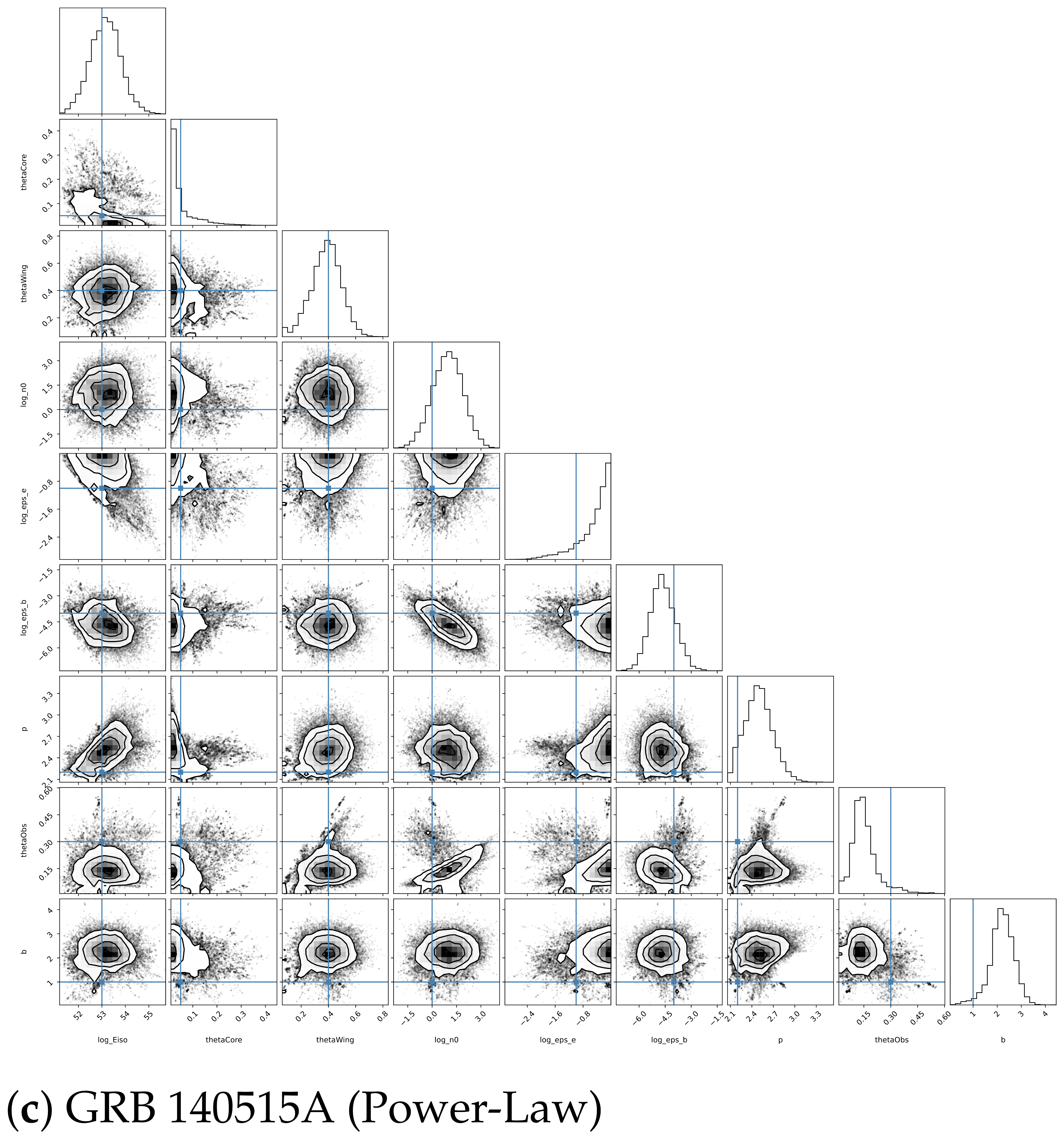
In addition, we find that among the 150 best-fitting top-hat models, 22 cases show Δ B I C < 2 between the top-hat and Gaussian fits, indicating that the two models yield comparable fitting performance. Among these, 7 are identified as slightly off-axis observations. There are 21 Gaussian and power-law fits that are similar, and interestingly, we find that all 21 are off-axis. This shows that for top-hat jets, if the viewing angle is slightly off-axis or on-axis, the fitting effect of some light curves is similar to that of Gaussian, but if the viewing angle is off-axis, the fitting effects of Gaussian and power-law are indistinguishable. This is consistent with the results of previous studies, who believe that for a Gaussian jet, if the line of sight is within the Gaussian cone, the light curve is similar to that of a top-hat jet, whereas if the line of sight is outside the Gaussian cone (but not too large), the light curve is similar to that of an off-axis power law [43]. In addition, we find that the Δ B I C of GRB 141026A top-hat, Gaussian and power-law are all less than 2, which indicates that the fitting effects of the three models are the same. We continue to check 37 Gaussian and 3 power-law samples. The top-hat and Gaussian fitting effects account for 6, the top-hat and power-law fitting effects also account for 6, and the Gaussian and power-law fitting effects are similar in 5, and all are observed off-axis. Among them, the fitting effects of the three models of GRB 180205A and GRB 140515A are the same. For cases where the models are statistically indistinguishable ( Δ BIC < 2), we present an example in Figure A2, which shows the corner plot of GRB 140515A, illustrating the posterior distributions of the fitted parameters for the top-hat, Gaussian, and power-law models. The overlapping contours further confirm the similarity of the fits.
Our results show that top-hat jets account for the majority of GRBs, but this may not be the real GRB jets. This article has not yet found any researchers who have conducted a statistical analysis of uniform and structured jets of large samples of GRBs. The distribution of jet parameters θ o b s , ϵ e and   E 0 between the top-hat and Gaussian models show great differences, with θ o b s being the most significant. And the most significant difference between uniform jets represented by the top-hat model and structured jets represented by the Gaussian and power-law models is the off-axis. Our analysis is limited to three models: top-hat (uniform), Gaussian, and power-law (structured). It excludes complex structures like two-component jets (e.g., a narrow core + wide envelope) or the boosted fireball model Duffell [29], which may better describe events like GW170817A. Future work should test these extended models to verify our conclusions.
Our model is limited to top-hat, Gaussian, and plower-law. In the future, there may be models that are more suitable for the afterglow light curve and are worth exploring. This work aims to provide some discussion on uniform and structured jets.
An important limitation of this work is the assumed circumburst density profile. Since the current implementation of afterglowpy for structured jets does not include a wind-like medium, our statistical comparison is restricted to a constant-density (ISM) framework. However, it is well established that long GRBs originating from massive stars are expected to occur in wind-like environments shaped by progenitor stellar winds [47], while short GRBs from compact object mergers may experience diverse and complex media [48]. As demonstrated by Duffell [49], the choice of density profile (e.g., ISM with k = 0 versus wind with k = 2 ) can significantly affect the interpretation of fitted parameters, particularly the circumburst density n 0 and the inferred energy scale E 0 . Consequently, some bursts in our sample may admit alternative solutions under wind-like environments, and the inferred values of n 0 , E 0 , θ obs , and even the BIC preference among jet models could shift when the external-medium profile is changed. Therefore, our conclusions should be interpreted as applying within a common ISM-based modeling framework rather than as a definitive determination of the true circumburst environments or jet structures of all GRBs. Future work incorporating wind profiles and other density structures will be essential to test the robustness of our findings and to further constrain the progenitor properties.

Supplementary Materials

The following supporting information can be downloaded at: https://www.mdpi.com/article/10.3390/astronomy5020007/s1, File S1: fitting_data.pdf.

Author Contributions

Conceptualization, M.L., J.-M.C. and Z.-Y.P.; methodology, M.L.; software, M.L. and J.-M.C.; validation, M.L., J.-M.C. and Z.-Y.P.; data analysis, M.L.; investigation, M.L.; resources, Z.-Y.P.; data curation, M.L.; writing—original draft preparation, M.L.; writing—review and editing, M.L., J.-M.C. and Z.-Y.P.; visualization, M.L.; supervision, Z.-Y.P.; project administration, Z.-Y.P.; funding acquisition, Z.-Y.P. All authors have read and agreed to the published version of the manuscript.

Funding

This work was supported by the National Natural Science Foundation of China (grant Nos. 12163007 and 11763009), the Key Laboratory of Colleges and Universities in Yunnan Province for High-energy Astrophysics, the National Astronomical Observatories, and the Yunnan Normal University Astronomical Education Base.

Data Availability Statement

We acknowledge the use of the public data from the Swift data archives. The XRT data used in this article comes from the Swift Science Data Center in the UK at https://www.swift.ac.uk/xrt_live_cat (accessed on 1 May 2023).

Acknowledgments

This study used XRT data from NASA’s Explorers program, provided by the UK’s Swift Science Data Center.

Conflicts of Interest

The authors declare no conflicts of interest.

Appendix A

Figure A1. (ac) correspond to the corner diagram examples of fitting the light curve using the top-hat model, Gaussian model and power-law model, respectively. The black contours correspond to the 1 σ and 2 σ confidence intervals, and the blue cross lines represent the initial parameter values.
Astronomy 05 00007 g0a1aAstronomy 05 00007 g0a1b
Figure A2. (ac) shows the corner plots obtained from fitting the top-hat, Gaussian, and Power-Law models to GRB 140515A, which are ambiguous cases with pairwise Δ B I C < 2 . The black contours correspond to the 1 σ and 2 σ confidence intervals, and the blue cross lines represent the initial parameter values.
Astronomy 05 00007 g0a2aAstronomy 05 00007 g0a2b

References

  1. Ruderman, M. Theories of gamma-ray bursts. In Proceedings of the Seventh Texas Symposium on Relativistic Astrophysics; Eardley, D., Ed.; New York Academy of Sciences: New York, NY, USA, 1975; Volume 262, pp. 164–180. [Google Scholar] [CrossRef]
  2. Schmidt, W.K.H. Distance limit for a class of model gamma-ray burst sources. Nature 1978, 271, 525–527. [Google Scholar] [CrossRef]
  3. Goodman, J. Are gamma-ray bursts optically thick? Astrophys. J. Lett. 1986, 308, L47–L50. [Google Scholar] [CrossRef]
  4. Krolik, J.H.; Pier, E.A. Relativistic motion in gamma-ray bursts. Astrophys. J. 1991, 373, 277–284. [Google Scholar] [CrossRef]
  5. Woosley, S.E. Gamma-ray bursts from stellar mass accretion disks around black holes. Astrophys. J. 1993, 405, 273–277. [Google Scholar] [CrossRef]
  6. Eichler, D.; Livio, M.; Piran, T.; Schramm, D.N. Nucleosynthesis, neutrino bursts and gamma-rays from coalescing neutron stars. Nature 1989, 340, 126–128. [Google Scholar] [CrossRef]
  7. MacFadyen, A.I.; Woosley, S.E. Collapsars: Gamma-ray bursts and explosions in failed supernovae. Astrophys. J. 1999, 524, 262–289. [Google Scholar] [CrossRef]
  8. Zhang, B. The Physics of Gamma-Ray Bursts; Cambridge University Press: Cambridge, UK, 2018; 576p, ISBN 978-1-107-11461-6. [Google Scholar] [CrossRef]
  9. Usov, V.V. Millisecond pulsars with extremely strong magnetic fields as a cosmological source of gamma-ray bursts. Nature 1992, 357, 472–474. [Google Scholar] [CrossRef]
  10. Dai, Z.G.; Lu, T. Gamma-ray bursts and afterglows from rotating strange stars and neutron stars. Phys. Rev. Lett. 1998, 81, 4301–4304. [Google Scholar] [CrossRef]
  11. Popham, R.; Woosley, S.E.; Fryer, C. Hyperaccreting black holes and gamma-ray bursts. Astrophys. J. 1999, 518, 356–374. [Google Scholar] [CrossRef]
  12. Narayan, R.; Piran, T.; Kumar, P. Accretion models of gamma-ray bursts. Astrophys. J. 2001, 557, 949–957. [Google Scholar] [CrossRef]
  13. Zhang, B.; Mészáros, P. Gamma-ray burst afterglow with continuous energy injection: Signature of a highly magnetized millisecond pulsar. Astrophys. J. Lett. 2001, 552, L35–L38. [Google Scholar] [CrossRef]
  14. Metzger, B.D.; Martínez-Pinedo, G.; Darbha, S.; Quataert, E.; Arcones, A.; Kasen, D.; Thomas, R.; Nugent, P.; Panov, I.V.; Zinner, N.T. Electromagnetic counterparts of compact object mergers powered by the radioactive decay of r-process nuclei. Mon. Not. R. Astron. Soc. 2010, 406, 2650–2662. [Google Scholar] [CrossRef]
  15. Lei, W.H.; Zhang, B.; Liang, E.W. Hyper-accreting black hole as GRB central engine. I: Baryon loading in GRB jets. arXiv 2012, arXiv:1209.4427. [Google Scholar] [CrossRef]
  16. Liu, T.; Gu, W.M.; Zhang, B. Neutrino-dominated accretion flows as the central engine of gamma-ray bursts. New Astron. Rev. 2017, 79, 1–25. [Google Scholar] [CrossRef]
  17. Piran, T.; Narayan, R. Spectra and light curves of gamma-ray burst afterglows. Astrophys. J. Lett. 1998, 497, L17–L20. [Google Scholar] [CrossRef]
  18. Kobayashi, S. Light curves of gamma-ray burst optical flashes. Astrophys. J. 2000, 545, 807–815. [Google Scholar] [CrossRef]
  19. Zhang, B.; Lü, H.J.; Liang, E.W. GRB observational properties. Space Sci. Rev. 2016, 202, 3–32. [Google Scholar] [CrossRef]
  20. Gupta, R.; Oates, S.R.; Pandey, S.B.; Castro-Tirado, A.J.; Joshi, J.C.; Hu, Y.-D.; Valeev, A.F.; Zhang, B.B.; Zhang, Z.; Kumar, A.; et al. GRB 140102A: Insight into prompt spectral evolution and early optical afterglow emission. Mon. Not. R. Astron. Soc. 2021, 505, 4086–4105. [Google Scholar] [CrossRef]
  21. Woosley, S.E. Blinded by the light. Nature 2001, 414, 853–854. [Google Scholar] [CrossRef]
  22. Ryan, G.; van Eerten, H.; MacFadyen, A.; Zhang, B. Gamma-ray bursts are observed off-axis. Astrophys. J. 2015, 799, 3. [Google Scholar] [CrossRef]
  23. Rhoads, J.E. The dynamics and light curves of beamed gamma-ray burst afterglows. Astrophys. J. 1999, 525, 737–749. [Google Scholar] [CrossRef]
  24. Panaitescu, A.; Mészáros, P.; Rees, M.J. Multiwavelength afterglows in gamma-ray bursts: Refreshed shock and jet effects. Astrophys. J. 1998, 503, 314–321. [Google Scholar] [CrossRef]
  25. Rhoads, J.E. How to tell a jet from a balloon: A proposed test for beaming in gamma-ray bursts. Astrophys. J. Lett. 1997, 487, L1–L4. [Google Scholar] [CrossRef]
  26. Zhang, B.; Mészáros, P. Gamma-ray burst beaming: A universal configuration with a standard energy reservoir? Astrophys. J. 2002, 571, 876–879. [Google Scholar] [CrossRef]
  27. Rossi, E.; Lazzati, D.; Rees, M.J. Afterglow light curves, viewing angle and the jet structure of gamma-ray bursts. Mon. Not. R. Astron. Soc. 2002, 332, 945–950. [Google Scholar] [CrossRef]
  28. Granot, J.; Kumar, P. Constraining the structure of gamma-ray burst jets through the afterglow light curves. Astrophys. J. 2003, 591, 1086–1096. [Google Scholar] [CrossRef]
  29. Duffell, P.C.; MacFadyen, A.I. A “Boosted Fireball” Model for Structured Relativistic Jets. Astrophys. J. Lett. 2013, 776, L9. [Google Scholar] [CrossRef]
  30. Wu, Y.; MacFadyen, A. Constraining the outflow structure of the binary neutron star merger event GW170817/GRB170817A with a Markov chain Monte Carlo analysis. Astrophys. J. 2018, 869, 55. [Google Scholar] [CrossRef]
  31. McDowell, A.; MacFadyen, A. Revisiting the parameter space of binary neutron star merger event GW170817. Astrophys. J. 2023, 945, 135. [Google Scholar] [CrossRef]
  32. Zhang, B.B.; van Eerten, H.; Burrows, D.N.; Ryan, G.; Racusin, J.L.; Yamazaki, R. An analysis of Chandra deep follow-up gamma-ray bursts: Implications for off-axis jets. Astrophys. J. 2015, 806, 15. [Google Scholar] [CrossRef]
  33. Wu, Y.; MacFadyen, A. GW170817 afterglow reveals that short gamma-ray bursts are neutron star mergers. Astrophys. J. Lett. 2019, 880, L23. [Google Scholar] [CrossRef]
  34. Liao, M.; Chen, J.M.; Li, T.; Zhang, B.; Liang, E.W. A comparative study of outflow structures of two classes of gamma-ray bursts. Mon. Not. R. Astron. Soc. 2024, 530, 2877–2884. [Google Scholar] [CrossRef]
  35. Wei, D.M.; Jin, Z.P. GRB afterglow light curves from uniform and non-uniform jets. Astron. Astrophys. 2003, 400, 415–419. [Google Scholar] [CrossRef]
  36. Gupta, R.; Kumar, A.; Pandey, S.B.; Castro-Tirado, A.J.; Ghosh, A.; Dimple; Hu, Y.-D.; Fernández-García, E.; Caballero-García, M.D.; Castro-Tirado, M.Á.; et al. Revealing nature of GRB 210205A, ZTF21aaeyldq (AT2021any) and follow-up observations with the 4 K × 4 K CCD imager + 3.6 m DOT. J. Astrophys. Astron. 2022, 43, 11. [Google Scholar] [CrossRef]
  37. Gupta, R.; Racusin, J.; Lipunov, V.; Hu, Y.-D.; Gulati, A.; Castro-Tirado, A.J.; Murphy, T.; Serino, M.; Zhirkov, K.; Shilling, S.; et al. Extremely luminous optical afterglow of an energetic gamma-ray burst GRB 230204B. Astrophys. J. 2026, 997, 246. [Google Scholar] [CrossRef]
  38. Ryan, G.; van Eerten, H.; Piro, L.; Troja, E.; Zhang, B.; Ricci, R. Gamma-ray burst afterglows in the multimessenger era: Numerical models and closure relations. Astrophys. J. 2020, 896, 166. [Google Scholar] [CrossRef]
  39. Evans, P.A.; Beardmore, A.P.; Page, K.L.; Tyler, L.G.; Osborne, J.P.; Goad, M.R.; O’Brien, P.T.; Vetere, L.; Racusin, J.; Morris, D.; et al. An online repository of Swift/XRT light curves of γ-ray bursts. Astron. Astrophys. 2007, 469, 379–385. [Google Scholar] [CrossRef]
  40. Evans, P.A.; Beardmore, A.P.; Page, K.L.; Osborne, J.P.; O’BRien, P.T.; Willingale, R.; Starling, R.L.C.; Burrows, D.N.; Godet, O.; Vetere, L.; et al. Methods and results of an automatic analysis of a complete sample of Swift-XRT observations of GRBs. Mon. Not. R. Astron. Soc. 2009, 397, 1177–1201. [Google Scholar] [CrossRef]
  41. Foreman-Mackey, D.; Hogg, D.W.; Lang, D.; Goodman, J. emcee: The MCMC Hammer. Publ. Astron. Soc. Pac. 2013, 125, 306–312. [Google Scholar] [CrossRef]
  42. Kass, R.E.; Raftery, A.E. Bayes factors. J. Am. Stat. Assoc. 1995, 90, 773–795. [Google Scholar] [CrossRef]
  43. Kumar, P.; Granot, J. The evolution of a structured relativistic jet and gamma-ray burst afterglow light curves. Astrophys. J. 2003, 591, 1075–1085. [Google Scholar] [CrossRef]
  44. van Eerten, H.; Zhang, W.; MacFadyen, A. Off-axis gamma-ray burst afterglow modeling based on a two-dimensional axisymmetric hydrodynamics simulation. Astrophys. J. 2010, 722, 235–248. [Google Scholar] [CrossRef]
  45. Granot, J.; Sari, R. The shape of spectral breaks in gamma-ray burst afterglows. Astrophys. J. 2002, 568, 820–829. [Google Scholar] [CrossRef]
  46. Rossi, E.M.; Lazzati, D.; Salmonson, J.D.; Ghisellini, G. The polarization of afterglow emission reveals gamma-ray bursts jet structure. Mon. Not. R. Astron. Soc. 2004, 354, 86–100. [Google Scholar] [CrossRef]
  47. Chevalier, R.A.; Li, Z.-Y. Wind Interaction Models for Gamma-Ray Burst Afterglows: The Case for Two Types of Progenitors. Astrophys. J. 2000, 536, 195–212. [Google Scholar] [CrossRef]
  48. Berger, E. Short-Duration Gamma-Ray Bursts. Annu. Rev. Astron. Astrophys. 2014, 52, 43–105. [Google Scholar] [CrossRef]
  49. van Eerten, H.J.; Wijers, R.A.M.J. Gamma-ray burst afterglow scaling coefficients for general density profiles. Mon. Not. R. Astron. Soc. 2009, 394, 2164–2174. [Google Scholar] [CrossRef]
Figure 1. (ac) are examples of some light curves best fitted by top-hat, Gaussian, and PowerLaw, respectively.
Astronomy 05 00007 g001
Figure 2. The distributions of jet parameters θ c , ϵ B ,   n 0 , p, θ o b s , ϵ e , and   E 0 . Black dashed line: Gaussian model; red dashed line: top-hat model. The black dashed line is the fitted line for the Gaussian and the red dashed line is the fitted line for the top-hat. Black solid line: distribution curve of Gaussian model parameters; red solid line: distribution curve of top-hat model parameters.
Astronomy 05 00007 g002
Figure 3. The distribution of θ c and θ o b s , where the blue dots represent data points that are well-fitted by Gaussian, the red dots represent top-hat, and the yellow dots represent power-law. The diagonal line is θ obs = θ c , the area above the diagonal line is off-axis, and the area below the diagonal line is on-axis.
Astronomy 05 00007 g003
Table 1. Parameter limits for top-hat, Gaussian, and power-law jet models.
ParameterTop-HatGaussianPower-Law
log 10   E 0 [49, 57][49, 57][49, 57]
θ c [0, 1][0, 1][0, 1]
θ o b s [0, π / 2 ][0, π / 2 ][0, π / 2 ]
θ W [0, π / 2 ][0, π / 2 ]
  b [0, 5]
  p [2, 5][2, 5][2, 5]
log 10 ϵ e [−10, 3][−10, 3][−10, 3]
log 10 ϵ B [−10, 3][−10, 3][−10, 3]
log 10   n 0 [−6, 5][−6, 5][−6, 5]
Table 2. The ranges, medians, average, and the p-values of their K-S tests for top-hat and Gaussian.
Parameter RangeMedianMeanp-Value
θ c top-hat ( 0.017 , 0.278 ) 0.1330.1340.495
Gaussian ( 0.05 , 0.216 ) 0.1240.124
θ o b s top-hat ( 0.002 , 0.177 ) 0.1010.100< 10 4
Gaussian ( 0.168 , 0.469 ) 0.310.298
  E 0 top-hat ( 51.214 , 54.188 ) 53.07653.081< 10 4
Gaussian ( 51.358 , 55.206 ) 52.56252.697
  n 0 top-hat ( 3.03 , 1.467 ) −0.06−0.0950.00032
Gaussian ( 1.374 , 1.800 ) −0.4750.250
ϵ e top-hat ( 1.613 , 1.559 ) −1.046−1.026< 10 4
Gaussian(−3.760, −0.740)−1.850−2.060
ϵ B top-hat(−4.642, −3.190)−4.085−4.0940.233
Gaussian(−4.872, −2.697)−4.313−4.088
ptop-hat ( 2.029 , 3.890 ) 2.3642.4270.058
Gaussian ( 2.043 , 3.988 ) 2.5952.618
Disclaimer/Publisher’s Note: The statements, opinions and data contained in all publications are solely those of the individual author(s) and contributor(s) and not of MDPI and/or the editor(s). MDPI and/or the editor(s) disclaim responsibility for any injury to people or property resulting from any ideas, methods, instructions or products referred to in the content.