General Relativistic Effect on Sitnikov Three-Body Problem: Restricted Case


Abstract
1. Introduction
2. Equation of Motion
2.1. Motion of Primary Bodies
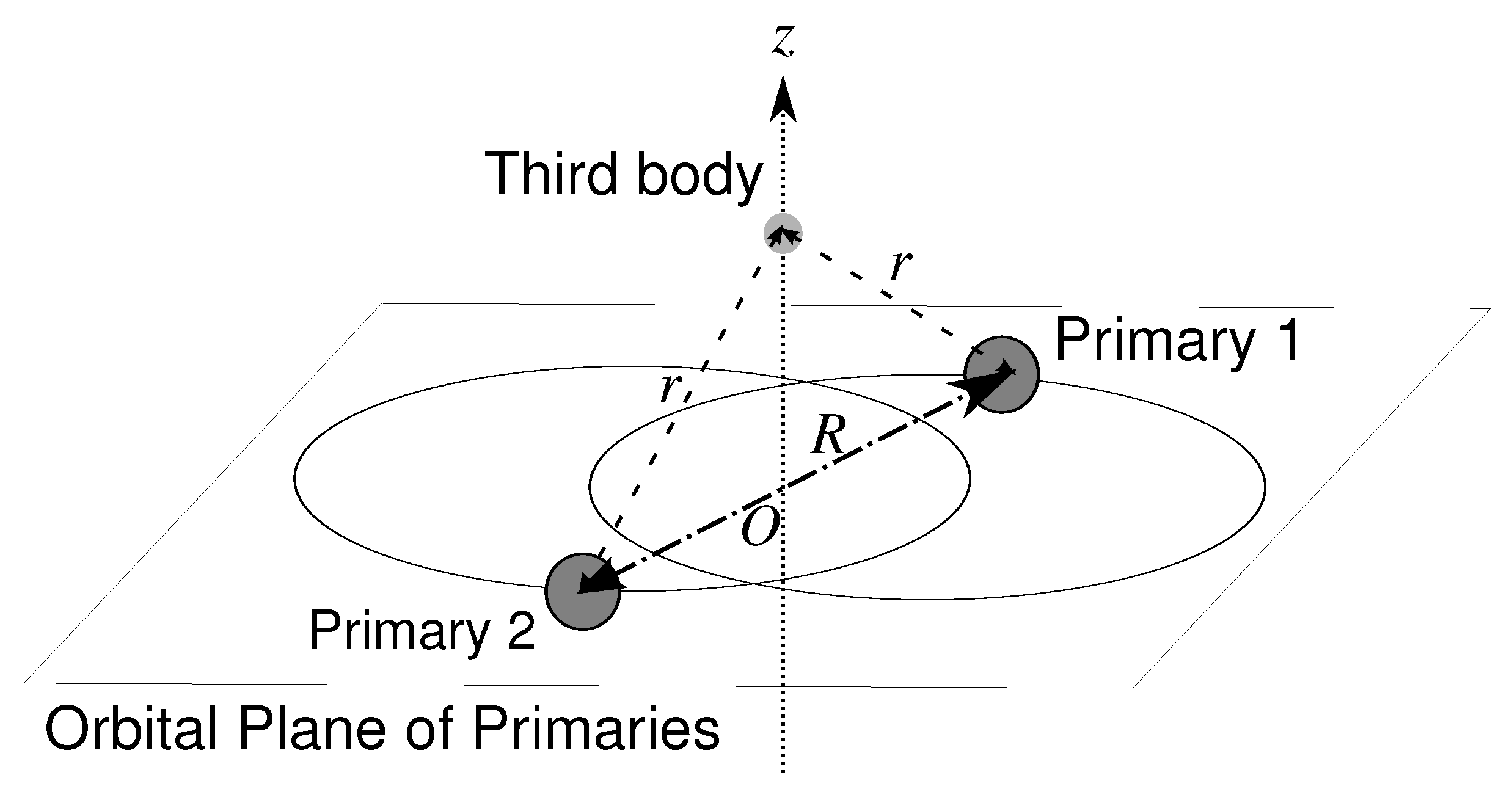
2.2. Motion of Third Body
3. Numerical Experiments
3.1. Overview of Numerical Integration
3.2. Criteria for Ejection Judgment and Underlying Mechanisms
3.3. Dimensionless Gravitational Radius
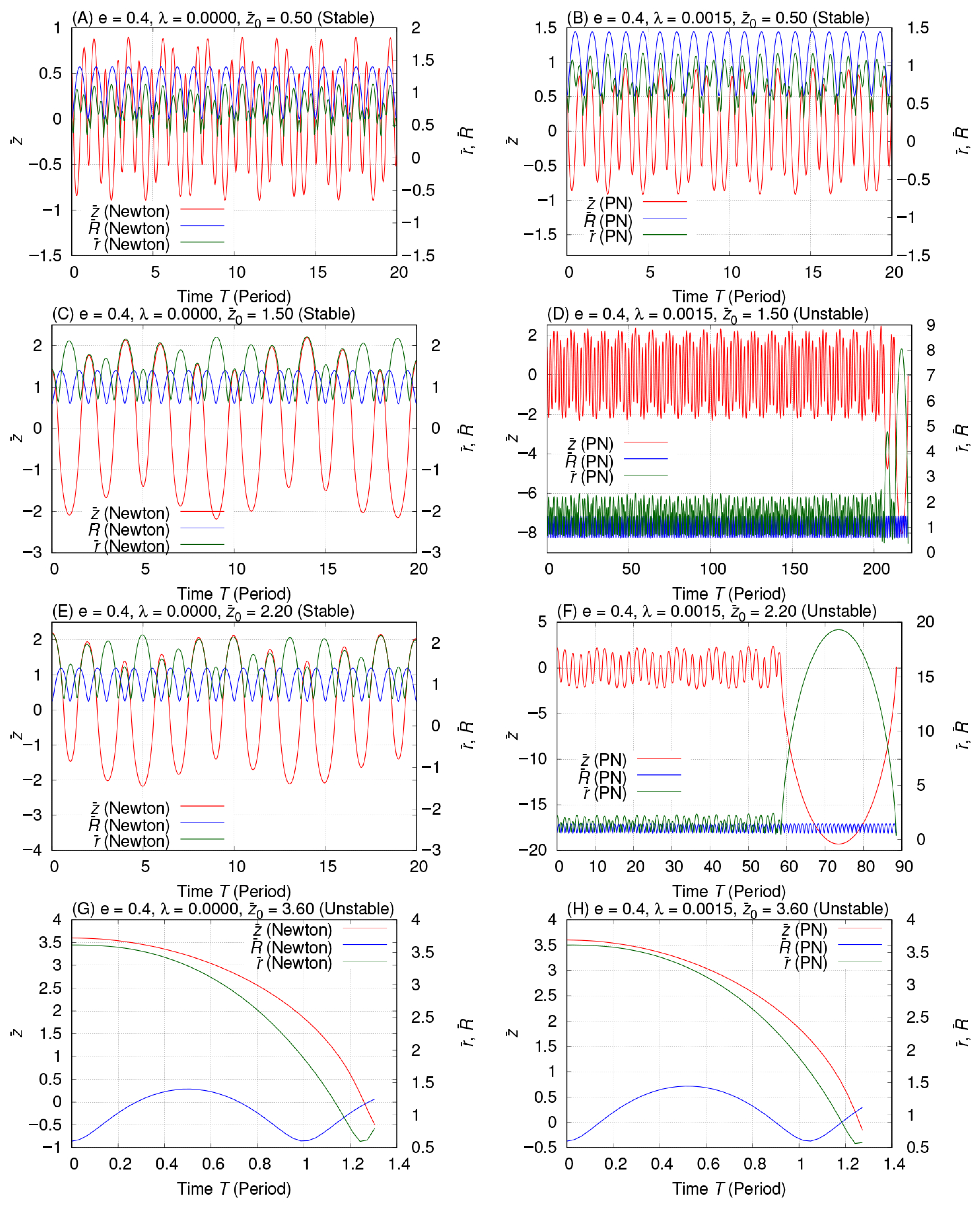
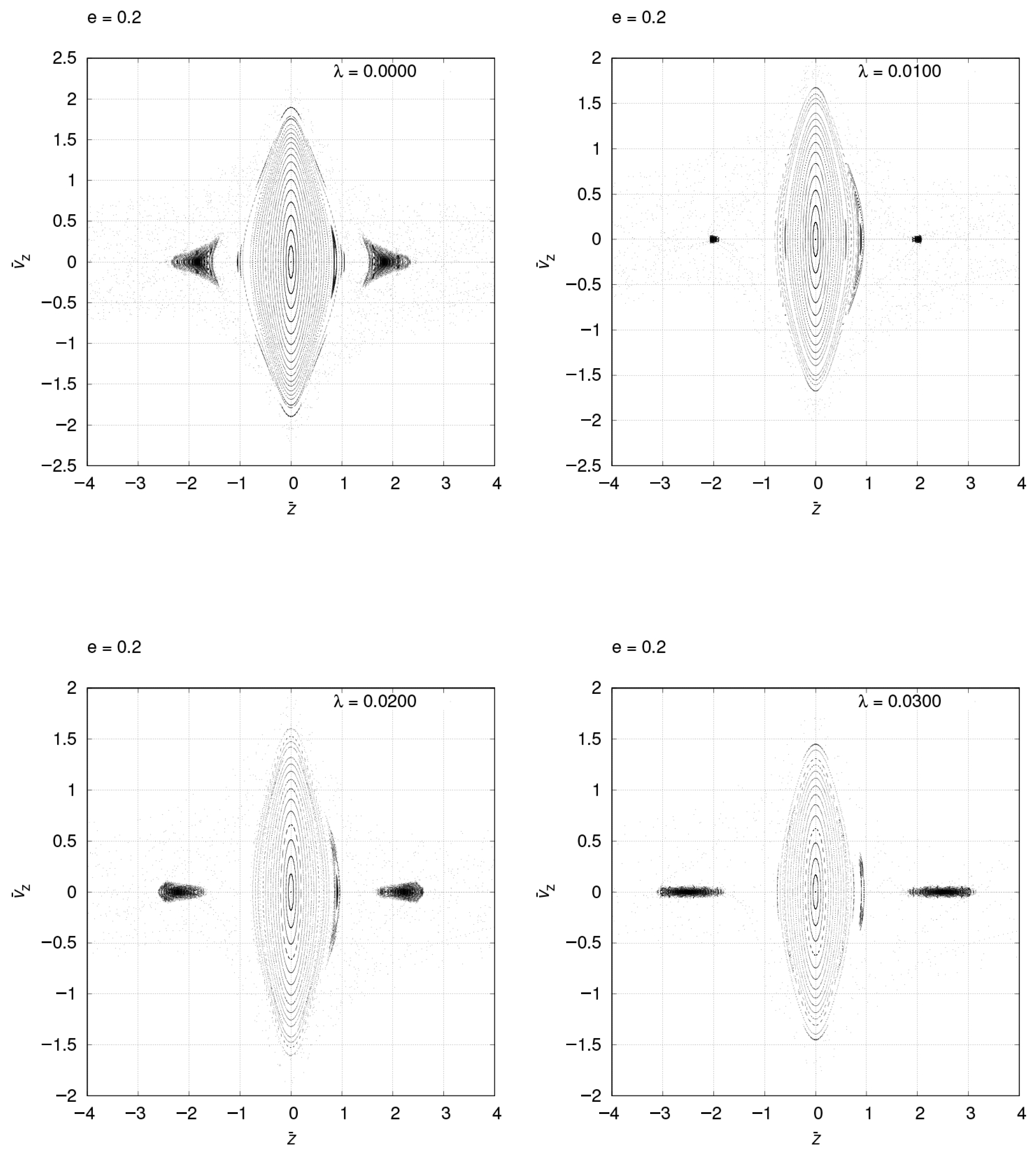
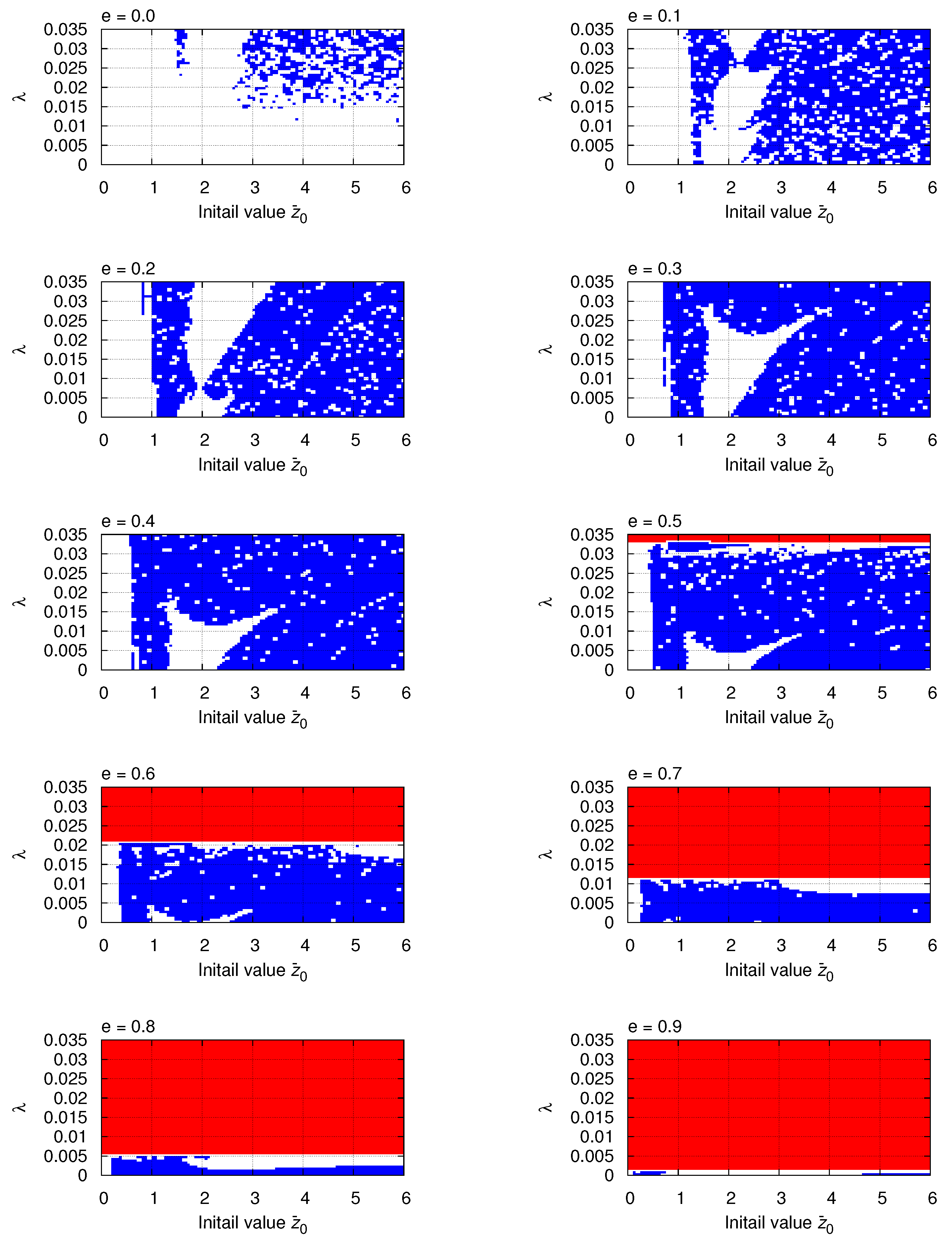
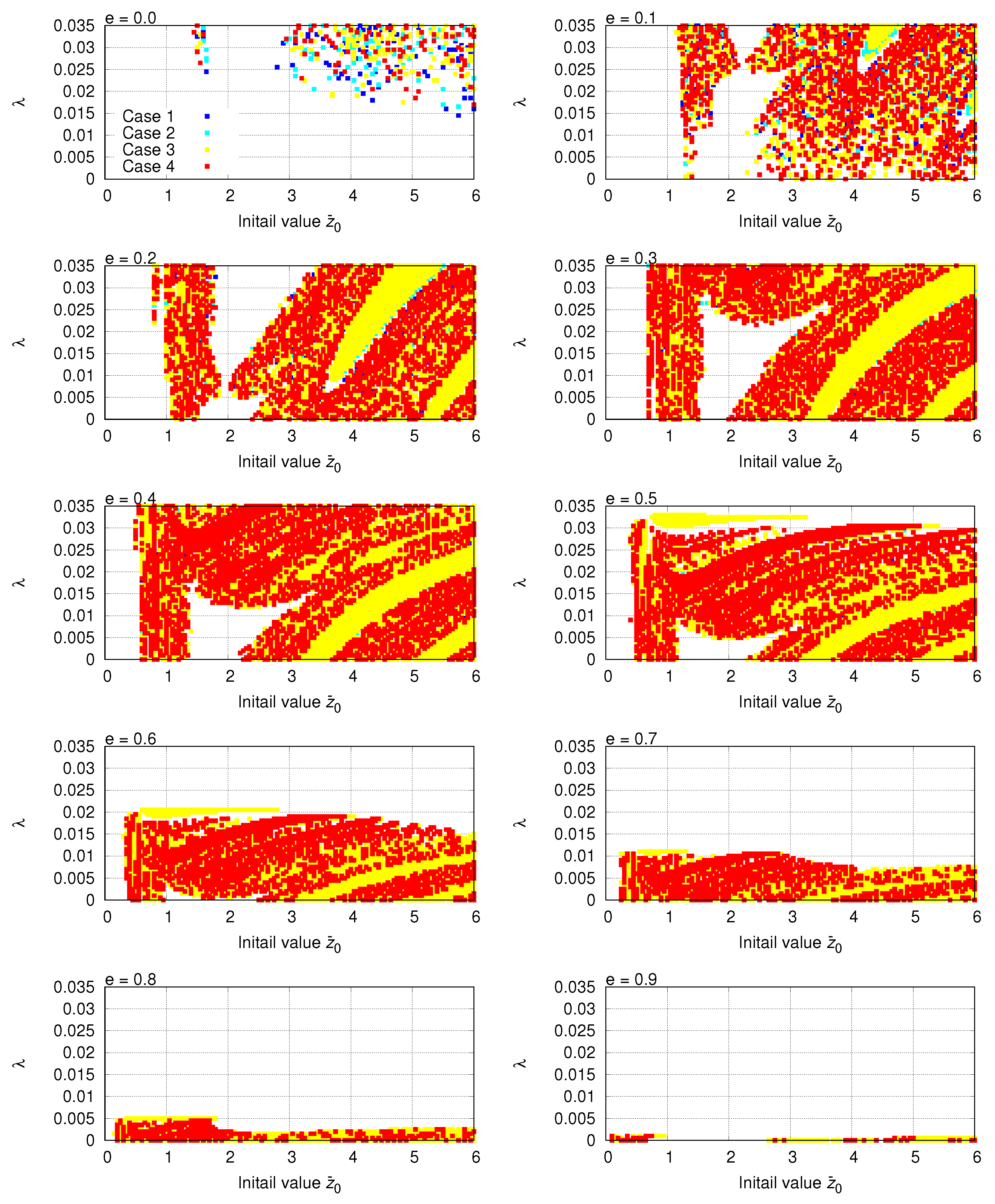
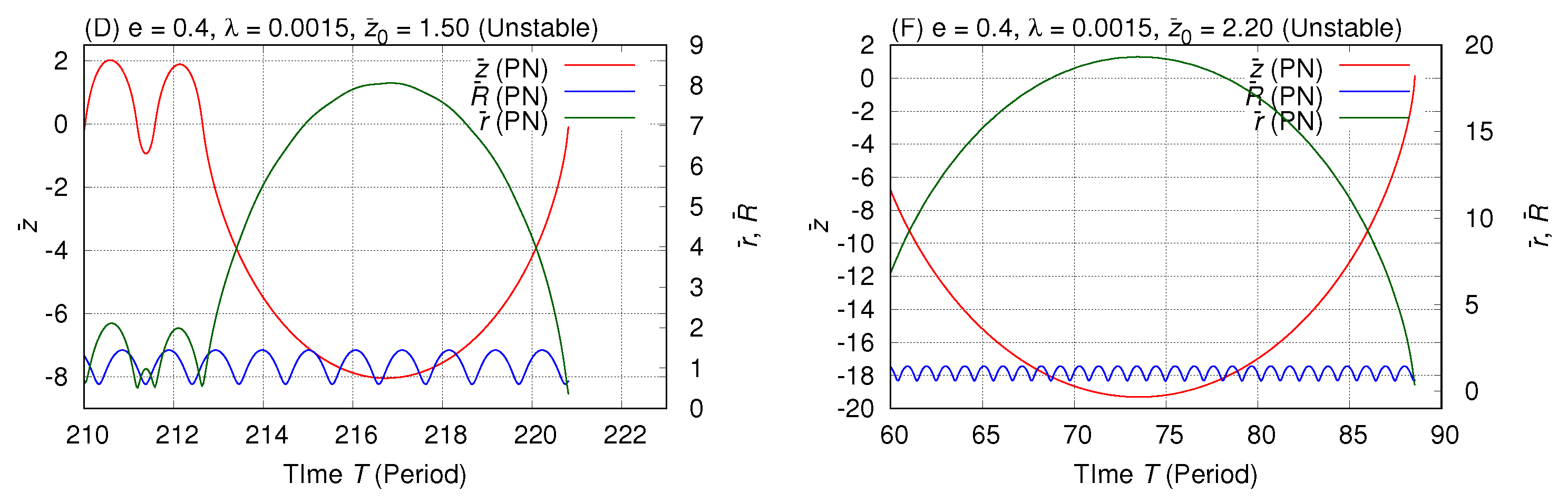
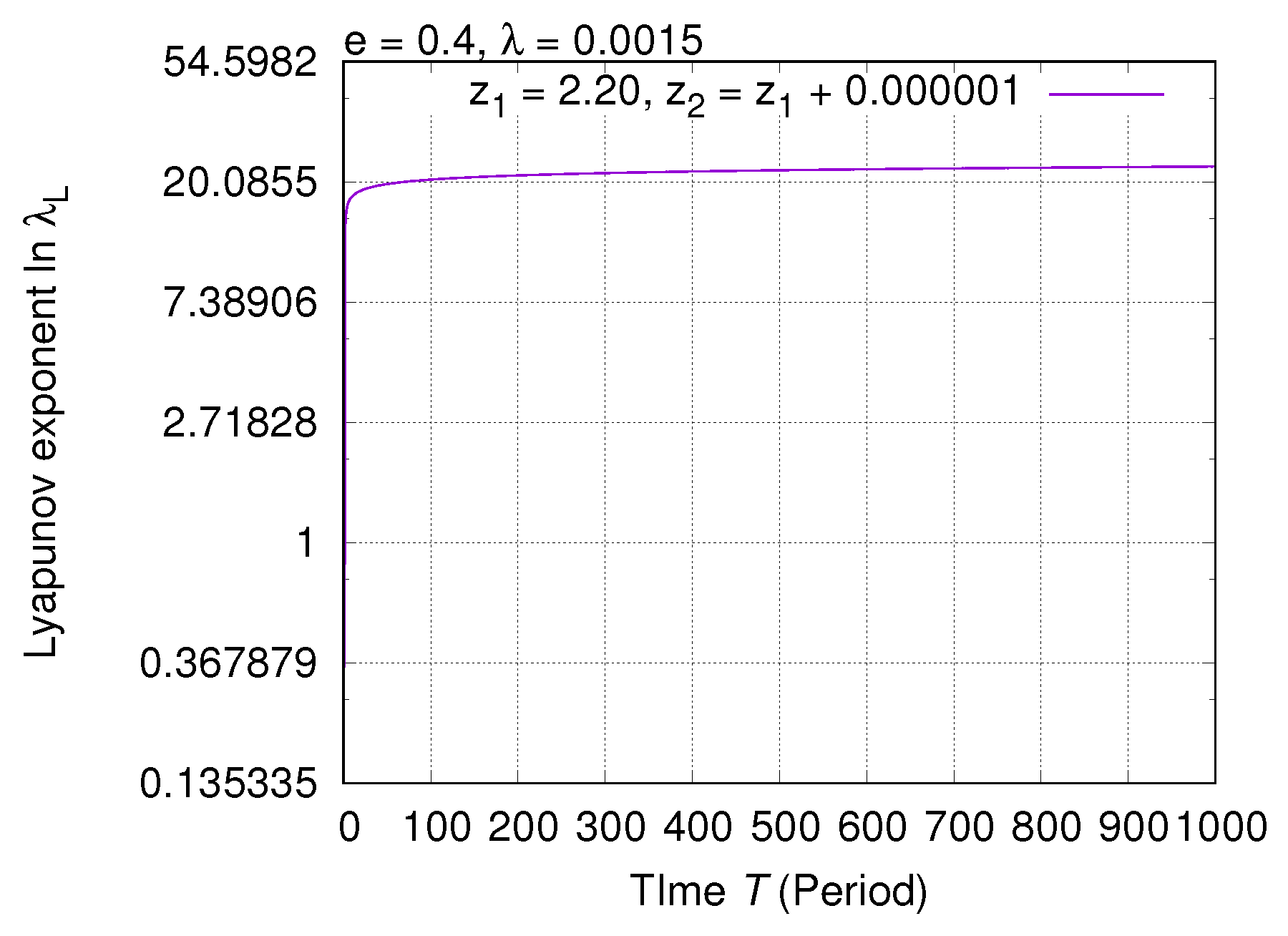
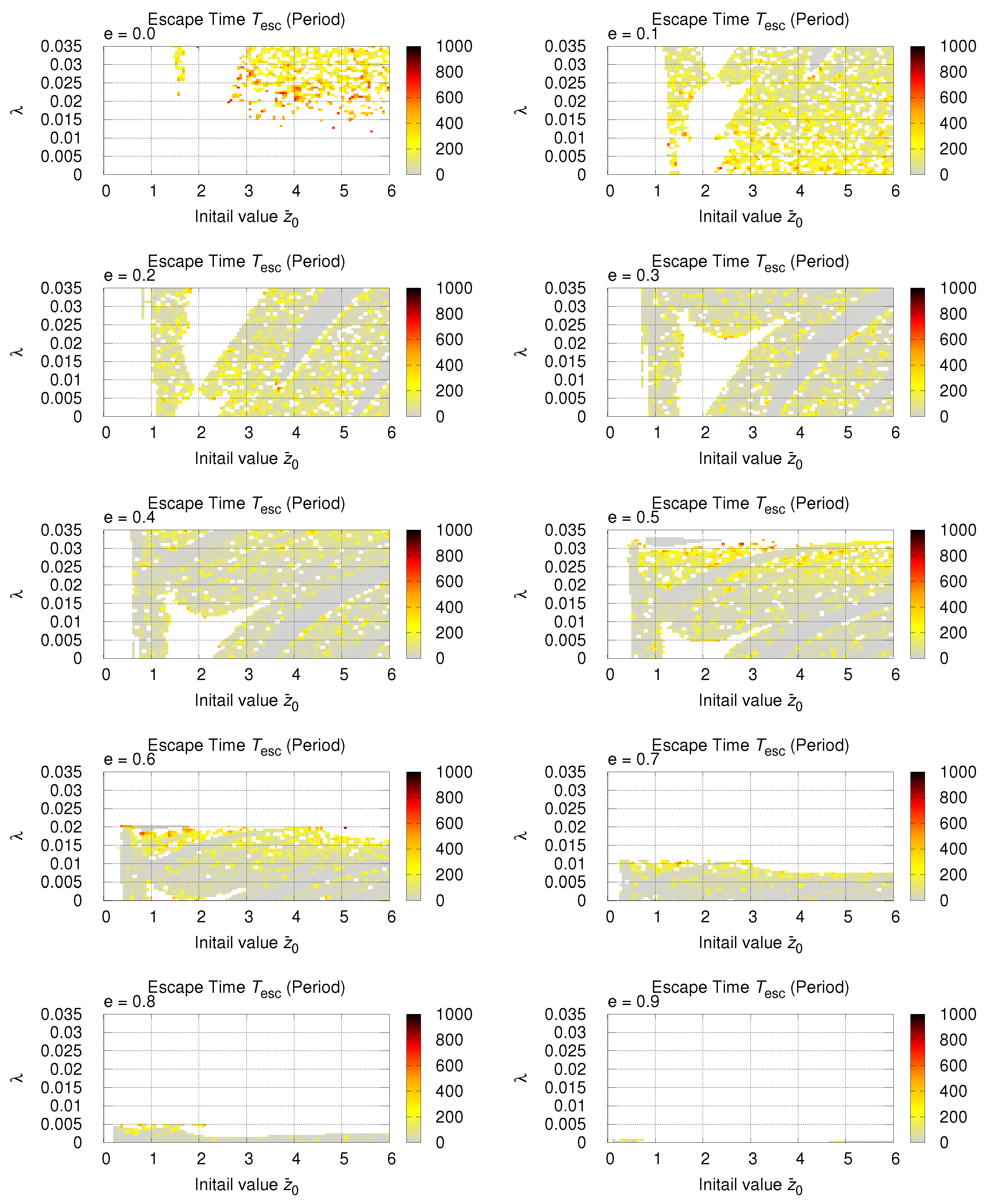
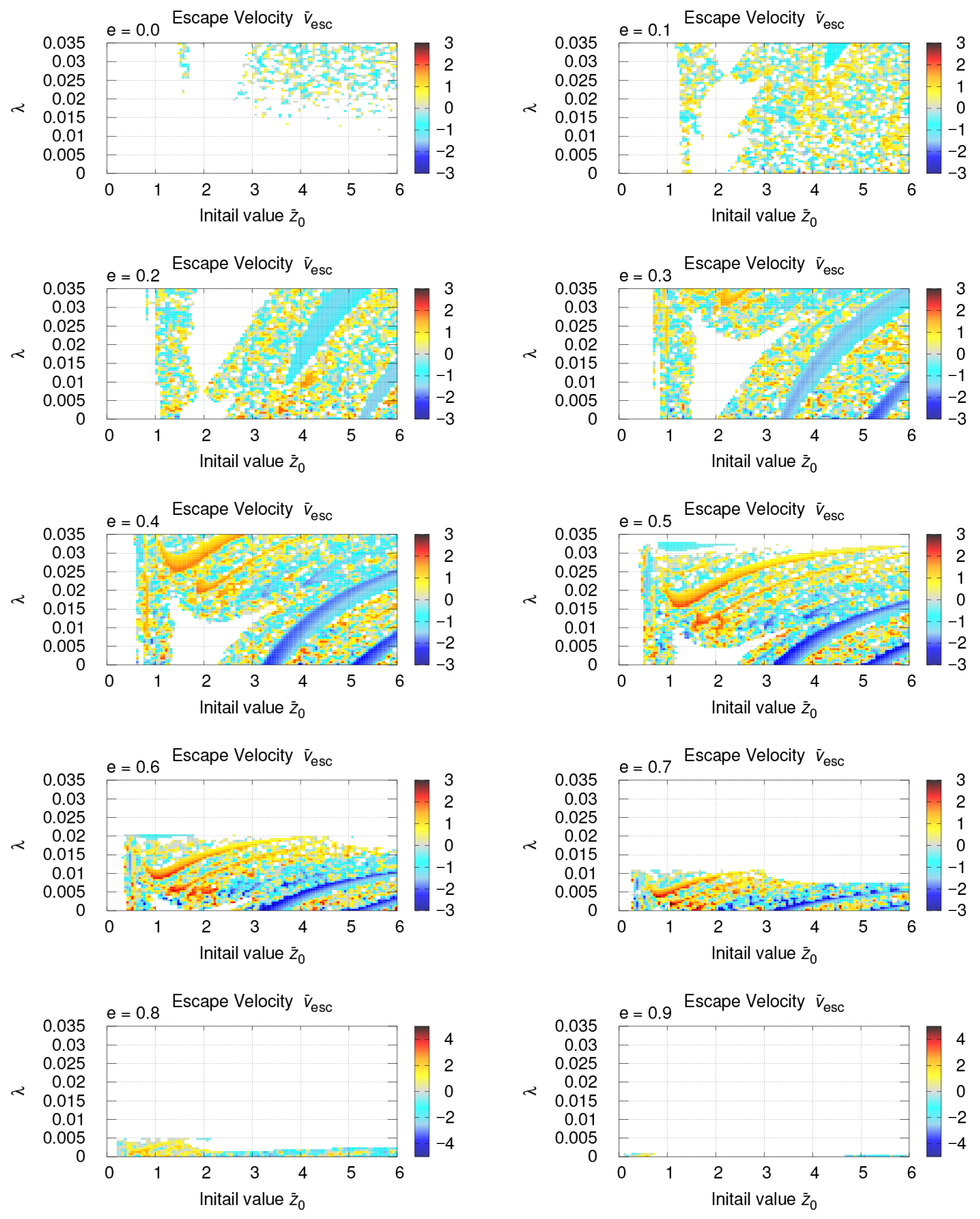
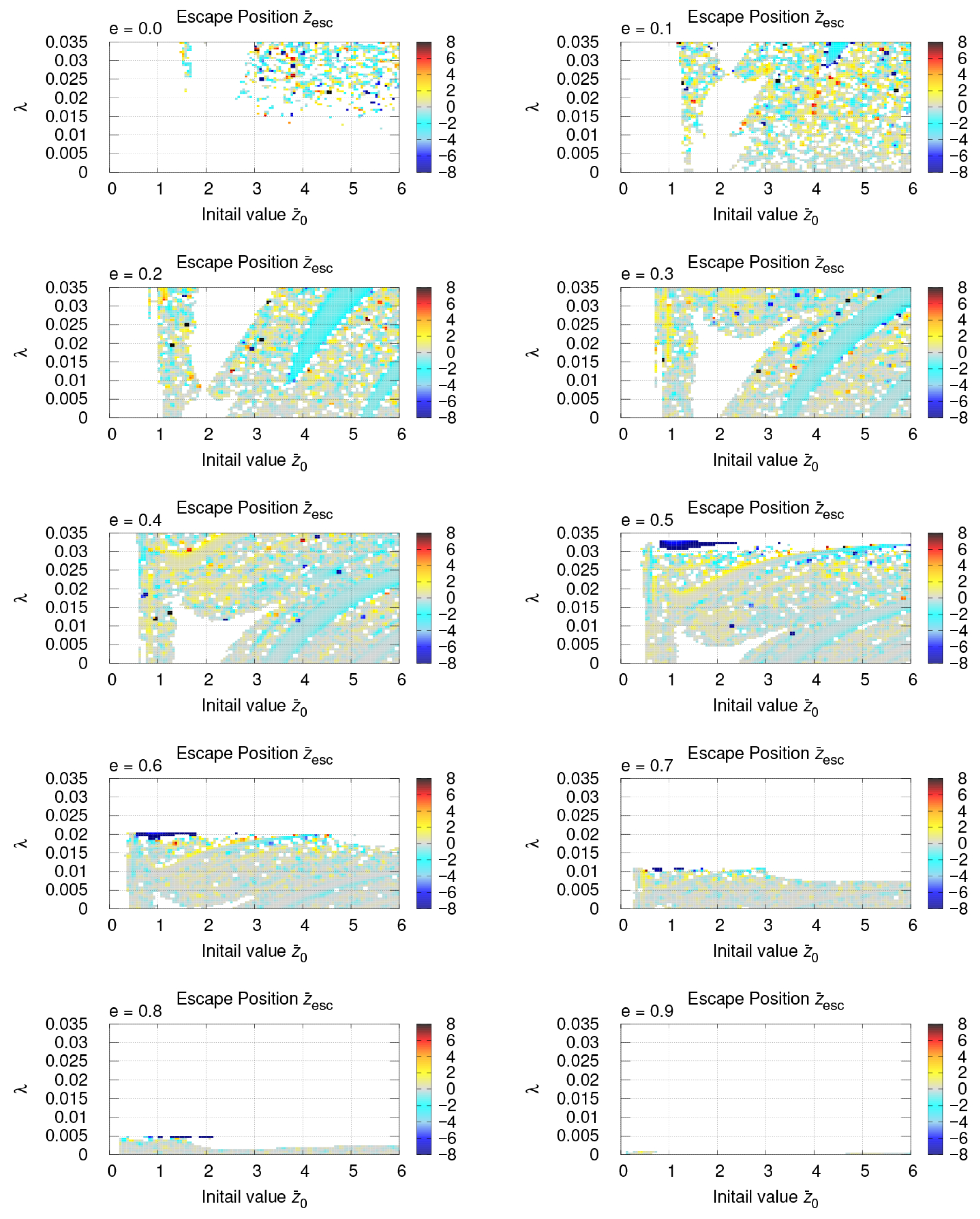
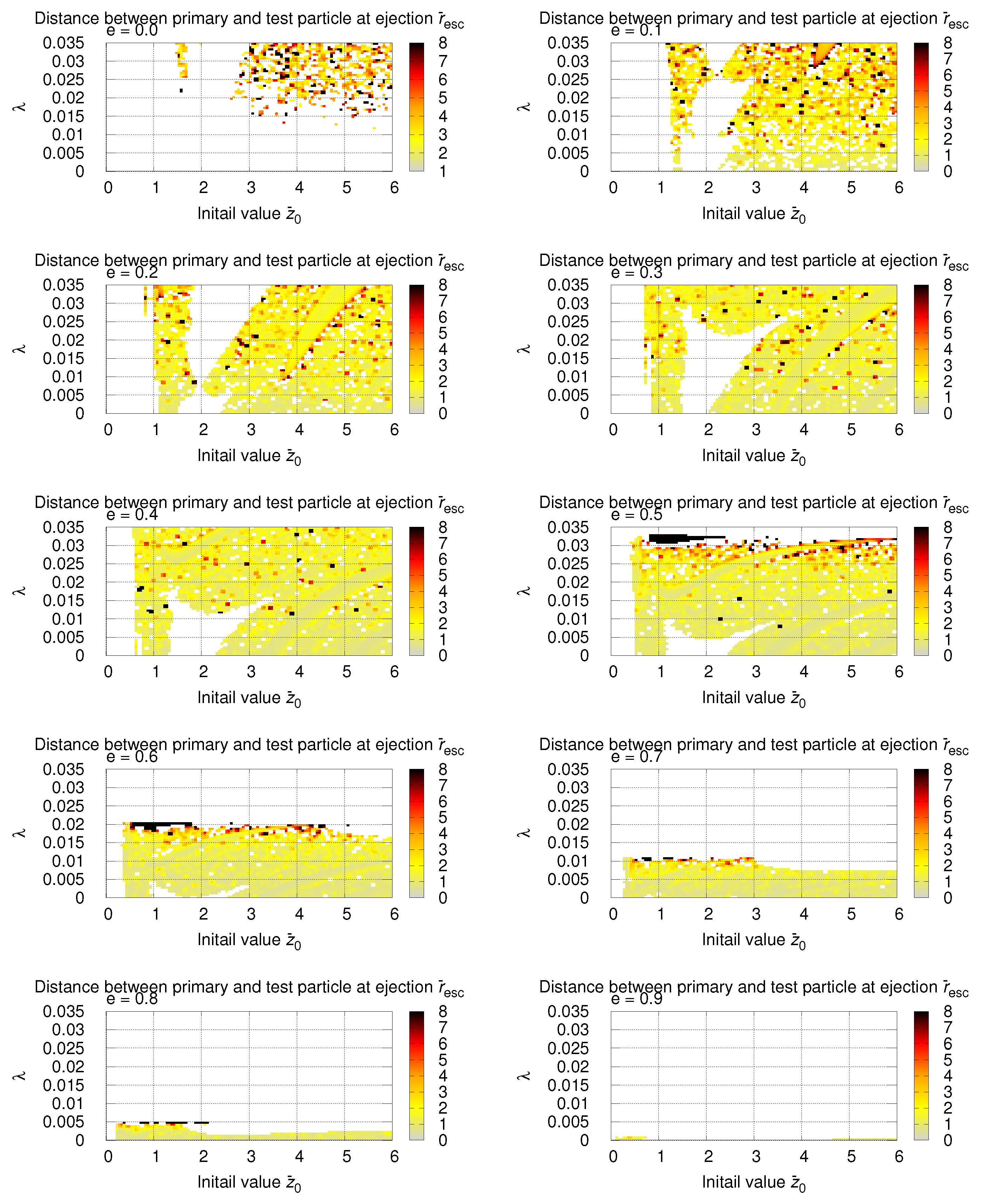
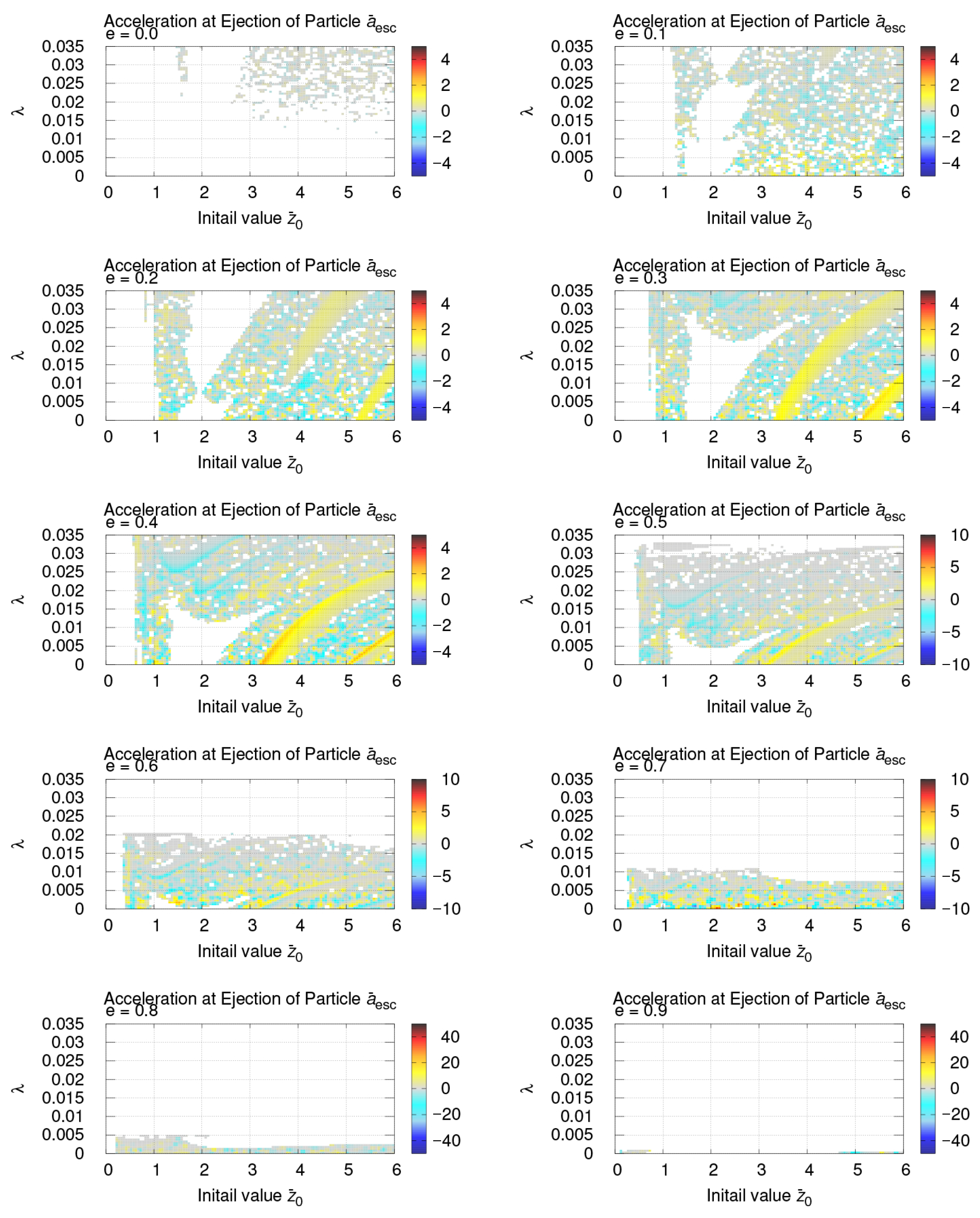
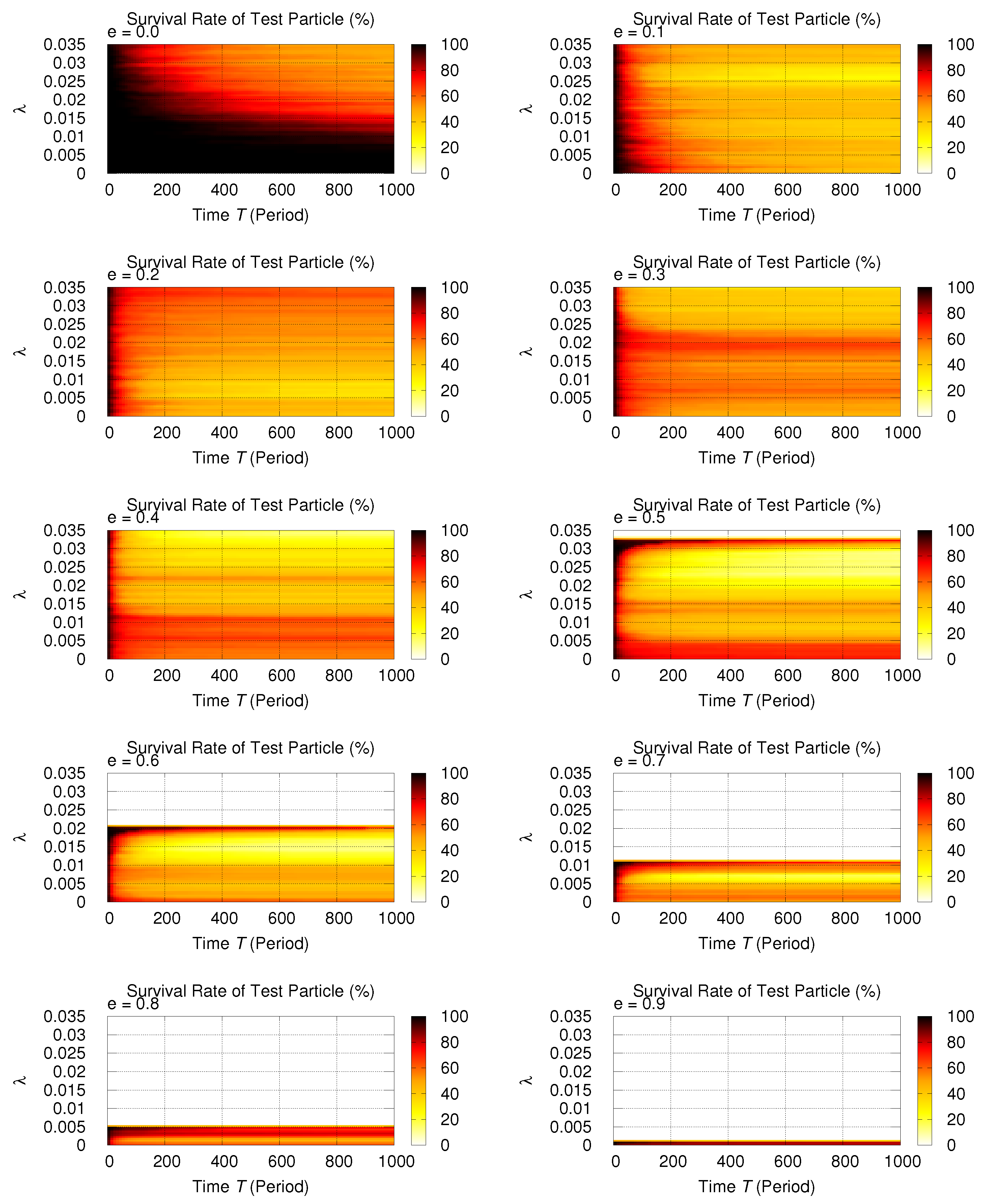
3.4. Results of Numerical Integrations
- Case 1 (Red): When the test particle is away from the binary orbital plane, and the distance between the test particle and the primary star is close.
- Case 2 (Yellow): When the test particle approaches the binary orbital plane, and the distance between the test particle and the primary star is close.
- Case 3 (Cyan): When the test particle is away from the binary orbital plane, and the distance between the test particle and the primary star is distant.
- Case 4 (Blue): When the test particle approaches the binary orbital plane, and the distance between the test particle and the primary star is distant.
4. Applications of Sitnikov Mechanism
4.1. Astrophysical Jets
4.2. Hyper-Velocity Stars
4.3. Supplementary Notes on Higher-Order Relativistic Effects and Gravitational Radiation Reaction
5. Conclusions
Funding
Data Availability Statement
Acknowledgments
Conflicts of Interest
References
- MacMillan, W.D. An integrable case in the restricted problem of three bodies. Astron. J. 1911, 27, 625. [Google Scholar] [CrossRef]
- Sitnikov, K. The Existence of Oscillatory Motions in the Three-Body Problem. Dokl. Akad. Nauk. USSR 1960, 133, 303. [Google Scholar]
- Alfaro, J.; Chiralt, C. Gaps of regular motion in Sitnikov’s problem. Celest. Mech. Dyn. Astron. 2005, 55, 351. [Google Scholar] [CrossRef]
- Belbruno, E.; Llibre, J.; Olle, M. On the Families of Periodic Orbits Which Bifurcate from the Circular Sitnikov Motions. Celest. Mech. Dyn. Astron. 1994, 60, 99. [Google Scholar] [CrossRef]
- Corbera, M.; Llibre, J. Periodic orbits of the Sitnikov problem via a Poincaré map. Celest. Mech. Dyn. Astron. 2000, 77, 273. [Google Scholar] [CrossRef]
- Dvorak, R. Numerical Results to the Sitnikov-Problem. Celest. Mech. Dyn. Astron. 1993, 56, 71. [Google Scholar] [CrossRef]
- Dvorak, R. The Sitnikov problem - A Complete Picture of Phase Space. Publ. Astron. Dept. Eötvös Univ. 2007, 19, 129. [Google Scholar]
- Hagel, J.; Lhotka, C. A High Order Perturbation Analysis of the Sitnikov Problem. Celest. Mech. Dyn. Astron. 2005, 93, 201. [Google Scholar] [CrossRef]
- Jalali, M.A.; Pourtakdoust, S.H. Regular and Chaotic Solutions of the Sitnikov Problem near the 3/2 Commensurability. Celest. Mech. Dyn. Astron. 1997, 68, 151. [Google Scholar] [CrossRef]
- Kallrath, J.; Dvorak, R.; Schlöder, J. The Dynamical Behaviour of our Planetary System: Proceedings of the Rourth Alexander van Humboldt Colloquium on Celestial Mechanics; Dvorak, R., Henrard, J., Eds.; Kluwer Academic Publishers: Dodrecht, The Netherlands, 1997; p. 415. [Google Scholar]
- Kovács, T.; Érdi, B. The structure of the extended phase space of the Sitnikov problem. Astron. Nachr. 2007, 328, 801. [Google Scholar] [CrossRef]
- Liu, J.; Sun, Y.S. On the Sitnikov Problem. Celest. Mech. Dyn. Astron. 1990, 49, 285. [Google Scholar] [CrossRef]
- Perdios, E.; Markellos, V.V. Stability and Bifurcations of Sitnikov Motions. Celest. Mech. Dyn. Astron. 1988, 42, 187. [Google Scholar] [CrossRef]
- Wodnar, K. Predictability, Stability, and Chaos in N-body Dynamical Systems; Plenum Press: New York, NY, USA, 1991. [Google Scholar]
- Yamada, K.; Asada, H. Collinear solution to the general relativistic three-body problem. Phys. Rev. D 2011, 82, 104019. [Google Scholar] [CrossRef]
- Ichita, T.; Yamada, K.; Asada, H. Post-Newtonian effects on Lagrange’s equilateral triangular solution for the three-body problem. Phys. Rev. D 2011, 83, 084026. [Google Scholar] [CrossRef]
- Yamada, K.; Asada, H. Triangular solution to the general relativistic three-body problem for general masses. Phys. Rev. D 2012, 86, 124029. [Google Scholar] [CrossRef]
- Yamada, K.; Tsuchiya, T.; Asada, H. Post-Newtonian effects on the stability of the triangular solution in the three-body problem for general masses. Phys. Rev. D 2015, 91, 124016. [Google Scholar] [CrossRef]
- Moore, C. Braids in classical dynamics. Phys. Rev. Lett. 1993, 70, 3675. [Google Scholar] [CrossRef] [PubMed]
- Chenciner, A.; Montgomery, R. A remarkable periodic solution of the three-body problem in the case of equal masses. Ann. Math. 2000, 152, 881. [Google Scholar] [CrossRef]
- Heggie, D.C. A new outcome of binary-binary scattering. Mon. Not. R. Astron. Soc. 2000, 318, L61. [Google Scholar] [CrossRef]
- Simo, C. Dynamical properties of the figure eight solution of the three-body problem. Contemp. Math. 2002, 292, 209. [Google Scholar]
- Fujiwara, T.; Fukuda, H.; Ozaki, H. Choreographic three bodies on the lemniscate. J. Phys. A 2003, 36, 10. [Google Scholar] [CrossRef]
- Imai, T.; Chiba, T.; Asada, H. Choreographic Solution to the General-Relativistic Three-Body Problem. Phys. Rev. Lett. 2007, 98, 201102. [Google Scholar] [CrossRef]
- Lousto, C.O.; Nakano, H. Three-body equations of motion in successive post-Newtonian approximations. Classical Quantum Gravity 2007, 25, 195019. [Google Scholar] [CrossRef]
- Torigoe, Y.; Hattori, K.; Asada, H. Gravitational Wave Forms for Two- and Three-Body Gravitating Systems. Phys. Rev. Lett. 2009, 102, 251101. [Google Scholar] [CrossRef]
- Asada, H. Gravitational wave forms for a three-body system in Lagrange’s orbit: Parameter determinations and a binary source test. Phys. Rev. D 2009, 80, 064021. [Google Scholar] [CrossRef]
- Yamada, K.; Asada, H. Nonchaotic evolution of triangular configuration due to gravitational radiation reaction in the three-body problem. Phys. Rev. D 2016, 93, 084027. [Google Scholar] [CrossRef]
- Ransom, S.M.; Stairs, I.H.; Archibald, A.M.; Hessels, J.W.T.; Kaplan, D.L.; van Kerkwijk, M.H.; Boyles, J.; Deller, A.T.; Chatterjee, S.; Schechtman-Rook, A.; et al. A millisecond pulsar in a stellar triple system. Nature 2014, 505, 520. [Google Scholar] [CrossRef] [PubMed]
- Naoz, S.; Kocsis, B.; Loeb, A.; Yunes, N. Resonant Post-Newtonian Eccentricity Excitation in Hierarchical Three-body Systems. Astrophys. J. 2013, 773, 187. [Google Scholar] [CrossRef]
- Will, C.M. Incorporating post-Newtonian effects in N-body dynamics. Phys. Rev. D 2014, 89, 044043. [Google Scholar] [CrossRef]
- Will, C.M. New General Relativistic Contribution to Mercury’s Perihelion Advance. Phys. Rev. Lett. 2018, 120, 191101. [Google Scholar] [CrossRef]
- Liu, B.; Lai, D.; Wang, Y.-H. Binary Mergers near a Supermassive Black Hole: Relativistic Effects in Triples. Astrophys. J. 2019, 883, L7. [Google Scholar] [CrossRef]
- Lim, H.; Rodriguez, C.L. Relativistic three-body effects in hierarchical triples. Phys. Rev. D 2020, 102, 064033. [Google Scholar] [CrossRef]
- Suzuki, H.; Gupta, P.; Okawa, H.; Maeda, K. Post-Newtonian Kozai-Lidov mechanism and its effect on cumulative shift of periastron time of binary pulsar. Mon. Not. R. Astron. Soc. 2021, 500, 1645. [Google Scholar] [CrossRef]
- Kovács, T.; Bene, G.; Tél, T. Relativistic effects in the chaotic Sitnikov problem. Mon. Not. R. Astron. Soc. 2011, 414, 2275. [Google Scholar] [CrossRef]
- Bernal, J.D.; Seoane, J.M.; Vallejo, J.C.; Huang, L.; Sanjuán, M.A.F. Influence of the gravitational radius on asymptotic behavior of the relativistic Sitnikov problem. Phys. Rev. E 2020, 102, 042204. [Google Scholar] [CrossRef] [PubMed]
- Misner, C.W.; Thorne, K.S.; Wheeler, J.A. Gravitation; W.H. Freeman: San Francisco, CA, USA, 1973. [Google Scholar]
- Will, C.M. The Confrontation between General Relativity and Experiment. Living Rev. Relativ. 2014, 17, 4. [Google Scholar] [CrossRef]
- Gragg, W.B. On Extrapolation Algorithms for Ordinary Initial Value Problems. J. SIAM Numer. Anal. 1965, 2, 384–403. [Google Scholar] [CrossRef]
- Hairer, E.; Norsett, S.P.; Wanner, G. Solving Ordinary Differential Equations I: Nonstiff Problems; Springer Series in Computational Mathematics; Springer: Berlin/Heidelberg, Germany, 1993; Volume 8. [Google Scholar]
- Press, M.H.; Teukolsky, S.A.; Vetterling, W.T.; Flannery, B.P. Numerical Recipes: The Art of Scientific Computing, 3rd ed.; Cambridge University Press: Cambridge, UK, 2007. [Google Scholar]
- Heggie, D.C. Binary evolution in stellar dynamics. Mon. Not. R. Astron. Soc. 1975, 173, 729. [Google Scholar] [CrossRef]
- Hut, P.; Bahcall, J.N. Binary-single star scattering. I - Numerical experiments for equal masses. Astrophys. J. 1983, 268, 319. [Google Scholar] [CrossRef]
- Hoffman, L.; Loeb, A. Dynamics of triple black hole systems in hierarchically merging massive galaxies. Mon. Not. R. Astron. Soc. 2007, 377, 957. [Google Scholar] [CrossRef]
- Satheesh, P.; Blecha, L.; Kelley, L.Z. Mergers and Recoil in Triple Massive Black Hole Systems from Illustris. arXiv 2025, arXiv:2506.04369. [Google Scholar] [CrossRef]
- Martin, R.G.; Lubow, S.H. Planet–disc interactions around eccentric binaries and misaligned ring formation. Mon. Not. R. Astron. Soc. 2025, 541, 2036. [Google Scholar] [CrossRef]
- Hills, J.G. Hyper-velocity and tidal stars from binaries disrupted by a massive Galactic black hole. Nature 1988, 331, 687. [Google Scholar] [CrossRef]
- Yu, Q.; Tremaine, S. Ejection of Hypervelocity Stars by the (Binary) Black Hole in the Galactic Center. Astrophys. J. 2003, 599, 1129. [Google Scholar] [CrossRef]
- Schnittman, J.D. Spin-orbit resonance and the evolution of compact binary systems. Phys. Rev. D 2004, 70, 124020. [Google Scholar] [CrossRef]
- Campanelli, M.; Lousto, C.O.; Zlochower, Y.; Merritt, D. Maximum Gravitational Recoil. Phys. Rev. Lett. 2007, 98, 231102. [Google Scholar] [CrossRef] [PubMed]
- Blandford, R.D.; Znajek, R.L. Electromagnetic extraction of energy from Kerr black holes. Mon. Not. R. Astron. Soc. 1977, 179, 433–456. [Google Scholar] [CrossRef]
- Tchekhovskoy, A.; Narayan, R.; McKinney, J.C. Efficient generation of jets from magnetically arrested accretion on a rapidly spinning black hole. Mon. Not. R. Astron. Soc. 2011, 418, L79. [Google Scholar] [CrossRef]
- Blandford, R.D.; Payne, D.G. Hydromagnetic flows from accretion disks and the production of radio jets. Mon. Not. R. Astron. Soc. 1982, 199, 883. [Google Scholar] [CrossRef]
- Pudritz, R.E.; Hardcastle, M.J.; Gabuzda, D.C. Magnetic Fields in Astrophysical Jets: From Launch to Termination. Space Sci. Rev. 2012, 169, 27–72. [Google Scholar] [CrossRef]
- Narayan, R.; Igumenshchev, I.V.; Abramowicz, M.A. Magnetically Arrested Disk: An Energetically Efficient Accretion Flow. Publ. Astron. Soc. Jpn. 2003, 55, L69–L72. [Google Scholar] [CrossRef]
- McKinney, J.C.; Tchekhovskoy, A.; Blandford, R.D. General relativistic magnetohydrodynamic simulations of magnetically choked accretion flows around black holes. Mon. Not. R. Astron. Soc. 2012, 423, 3083. [Google Scholar] [CrossRef]
- Ohsuga, K.; Mineshige, S. Global Structure of Three Distinct Accretion Flows and Outflows around Black Holes from Two-dimensional Radiation-magnetohydrodynamic Simulations. Astrophys. J. 2011, 736, 2. [Google Scholar] [CrossRef]
- Brown, W.R.; Geller, M.J.; Kenyon, S.J.; Kurtz, M.J. Discovery of an Unbound Hypervelocity Star in the Milky Way Halo. Astrophys. J. 2005, 622, L33–L36. [Google Scholar] [CrossRef]
- Blaauw, A. On the origin of the O- and B-type stars with high velocities (the “run-away” stars), and some related problems. Bull. Astron. Inst. Neth. 1961, 15, 265. [Google Scholar]
- Sesana, A.; Haardt, F.; Madau, P. Interaction of Massive Black Hole Binaries with Their Stellar Environment. I. Ejection of Hypervelocity Stars. Astrophys. J. 2006, 651, 392. [Google Scholar] [CrossRef]
- Baumgardt, H.; Gualandris, A.; Portegies Zwart, S. Ejection of hypervelocity stars from the Galactic Centre by intermediate-mass black holes. Mon. Not. R. Astron. Soc. 2006, 372, 174. [Google Scholar] [CrossRef]
- Levin, Y. Ejection of High-Velocity Stars from the Galactic Center by an Inspiraling Intermediate-Mass Black Hole. Astrophys. J. 2006, 653, 1203. [Google Scholar] [CrossRef]
- Ishibashi, W.; Fabian, A.C. AGN feedback: Galactic-scale outflows driven by radiation pressure on dust. Mon. Not. R. Astron. Soc. 2015, 451, 93. [Google Scholar] [CrossRef]
- Schäfer, G. The two-body problem in general relativity. Phys. Lett. A 1987, 123, 336. [Google Scholar] [CrossRef]
- Peters, P.C. Gravitational Radiation and the Motion of Two Point Masses. Phys. Rev. 1964, 136, B1224. [Google Scholar] [CrossRef]
- Burke, W.L. Gravitational radiation damping of slowly moving systems calculated using matched asymptotic expansions. J. Math. Phys. 1971, 12, 401. [Google Scholar] [CrossRef]
- Blanchet, L. Gravitational Radiation from Post-Newtonian Sources and Inspiralling Compact Binaries. Living Rev. Relativ. 2014, 17, 2. [Google Scholar] [CrossRef] [PubMed]



| Range of initial value of third body | |
| Initial velocity of third body | (fixed) |
| Range of dimensionless gravitational radius | |
| Range of Eccentricity of binary |
| Kovács et al. (2011) [36] | Bernal et al. (2020) [37] | Arakida (2025) (This Paper) | |
|---|---|---|---|
| Main Objective | Phase-space structure and bifurcation analysis | Predictability of chaotic scattering | Astrophysical applications (Jets and HVSs) |
| Novelty | Discovery of bifurcations due to variation in | Introduction of basin entropy analysis | Proposal of physical applications of the relativistic Sitnikov effect |
| Range of | |||
| Main Output | Poincaré maps | Escape basin structures | Escape positions and escape velocity distributions |
Disclaimer/Publisher’s Note: The statements, opinions and data contained in all publications are solely those of the individual author(s) and contributor(s) and not of MDPI and/or the editor(s). MDPI and/or the editor(s) disclaim responsibility for any injury to people or property resulting from any ideas, methods, instructions or products referred to in the content. |
© 2025 by the author. Licensee MDPI, Basel, Switzerland. This article is an open access article distributed under the terms and conditions of the Creative Commons Attribution (CC BY) license (https://creativecommons.org/licenses/by/4.0/).
Share and Cite
Arakida, H. General Relativistic Effect on Sitnikov Three-Body Problem: Restricted Case. Astronomy 2025, 4, 21. https://doi.org/10.3390/astronomy4040021
Arakida H. General Relativistic Effect on Sitnikov Three-Body Problem: Restricted Case. Astronomy. 2025; 4(4):21. https://doi.org/10.3390/astronomy4040021
Chicago/Turabian StyleArakida, Hideyoshi. 2025. "General Relativistic Effect on Sitnikov Three-Body Problem: Restricted Case" Astronomy 4, no. 4: 21. https://doi.org/10.3390/astronomy4040021
APA StyleArakida, H. (2025). General Relativistic Effect on Sitnikov Three-Body Problem: Restricted Case. Astronomy, 4(4), 21. https://doi.org/10.3390/astronomy4040021