Proceeding Paper

Hydromethanolic Extract of Artemisia campestris Targets Acetylcholinesterase and Butyryl Esterase for Sustainable Insect Control †

1
Laboratory of Phoeniciculture Research “Phoenix”, Faculty of Nature and Life Sciences, University of Kasdi Merbah, PB 511 Ghardaïa Road, Ouargla 30000, Algeria
2
Laboratory of Preservation of Ecosystems in Arid and Semi-Arid Areas, Faculty of Nature and Life Sciences, University of Kasdi Merbah, PB 511 Ghardaïa Road, Ouagrla 30000, Algeria
*
Author to whom correspondence should be addressed.
Presented at the 1st International Online Conference on Biology (IOCBI 2026), 10–12 February 2026; Available online: https://sciforum.net/event/IOCBI2026.
Biol. Life Sci. Forum 2026, 62(1), 8; https://doi.org/10.3390/blsf2026062008 (registering DOI)
Published: 22 June 2026

Abstract

Artemisia campestris is a medicinal plant species endemic to Algeria, particularly abundant in the southern regions and the central Sahara. Its long-standing use in traditional medicine has recently gained scientific attention, prompting further investigation into its bioactive potential. This study focuses on the phytochemical composition and biological activity of its hydromethanolic extract, with a particular emphasis on its ability to inhibit neural enzymes associated with insect physiology with particular relevance to Aphis gossypii (Glover), a major polyphagous agricultural pest. Preliminary screening revealed a diverse array of secondary metabolites, including tannins (catechic and gallic), flavonoids, quinones, glycosides, terpenoids, saponins, coumarins, and alkaloids; however, anthocyanins were not detected. Quantitative analysis confirmed high concentrations of total phenolics (80.91 ± 1.58 mg GAE/g), flavonoids (60.45 ± 2.02 mg RE/g), phenolic acids (4.24 ± 0.38 mg CAE/g), and condensed tannins (2.26 ± 0.29 mg CE/g). Enzyme inhibition assays were performed using Ellman’s method, and IC50 values were calculated by nonlinear regression analysis based on dose–response curves. The extract demonstrated significant in vitro inhibitory activity against acetylcholinesterase (AChE) and butyrylcholinesterase (BChE), with IC50 values of 13.79 ± 0.79 µg/mL and 8.34 ± 0.58 µg/mL, respectively. Molecular docking analyses further confirmed strong binding affinities of cyanidin-3-O-glucoside, malvidin-3-O-glucoside, and apigenin (−8.20 to −8.50 kcal/mol) with the AChE active site, stabilized by hydrogen bonding and π–π interactions with key residues. These results were benchmarked against galantamine, a reference inhibitor, which exhibited IC50 values of 1.50 ± 0.12 µg/mL under the same conditions. Although galantamine showed superior potency, the relatively low IC50 values of the A. campestris extract support its potential as a natural cholinesterase-inhibitory agent warranting further investigation. These findings suggest that A. campestris may represent a promising source of natural cholinesterase inhibitors with potential relevance for eco-friendly insect control. These in vitro and in silico findings provide a mechanistic rationale warranting future in vivo bioassay validation against A. gossypii and related agricultural pests.

1. Introduction

Global pest management continues to rely heavily on synthetic insecticides such as organophosphates, carbamates, pyrethroids, and neonicotinoids. Although highly effective, these compounds primarily target the insect nervous system and have raised increasing concerns regarding insect resistance, environmental persistence, contamination, and toxicity toward non-target organisms, including beneficial insects and humans [1,2,3,4,5]. The growing resistance observed in major agricultural pests and disease vectors has reduced the long-term efficacy of these compounds and intensified the search for safer, selective, and sustainable alternatives [6,7,8]. In this context, plant-derived biopesticides have gained considerable attention because of their natural origin, rapid biodegradability, and compatibility with integrated pest management strategies.
Phytopesticides represent a rich source of biologically active secondary metabolites, including terpenes, alkaloids, flavonoids, polyphenols, and acetylenic compounds, many of which exhibit insecticidal, repellent, growth-disrupting, or antifeedant activities [3,4,5]. Their generally low environmental persistence and reduced toxicity to mammals make them promising alternatives to conventional synthetic pesticides. Beyond direct toxicity, many plant-derived compounds exert neurotoxic effects through interference with insect neurotransmission pathways.
The biological relevance of these plants is further strengthened by the nature of the target insect considered in this study, Aphis gossypii (Glover), commonly known as the cotton aphid [9]. This species is a highly polyphagous and economically important sap-sucking pest that affects a wide range of crops, including cotton, cucurbits, citrus, and many greenhouse vegetables [10]. It causes direct damage by feeding on phloem sap, leading to leaf curling, chlorosis, and plant growth reduction, and indirect damage by transmitting plant viruses [11]. In addition, its high reproductive rate and ability to rapidly develop resistance to conventional insecticides make it one of the most challenging agricultural pests worldwide, reinforcing the need for alternative and sustainable control strategies [12].
Among the known molecular targets, acetylcholinesterase (AChE) is one of the most important enzymes involved in insect nervous system function. It regulates the hydrolysis of acetylcholine at synaptic junctions, and its inhibition leads to neurotransmitter accumulation, overstimulation of nerve cells, paralysis, and ultimately insect death [1,13]. For this reason, AChE remains a well-established biochemical target in both synthetic and natural insecticide development [1,13]. In addition, esterases such as butyrylesterase and carboxylesterase are involved in xenobiotic detoxification and may contribute to insect metabolic resistance, making them relevant complementary targets when evaluating the bioactivity and mode of action of botanical extracts [7,14].
Within this context, the genus Artemisia (Asteraceae) represents one of the most widely studied medicinal and aromatic plant groups due to its rich diversity of bioactive secondary metabolites and its long-standing use in traditional medicine. Species within this genus are particularly known for producing terpenoids, flavonoids, phenolic acids, and acetylene derivatives with documented antimicrobial, antioxidant, and insecticidal activities [15,16]. Among them, Artemisia campestris is a perennial aromatic shrub, grows in dry sandy soils and steppe habitats and is characterized by deeply divided leaves, yellowish inflorescences, and a strong aromatic odor resulting from its rich essential oil composition and it is a widely distributed species in North Africa, especially in arid and semi-arid regions, which has attracted increasing scientific interest due to its chemical diversity and biological potential [17]. Previous studies reported that its essential oils and extracts exhibit significant insecticidal activity against mosquito larvae and agricultural pests, highlighting its relevance as a promising botanical resource for pest control [18,19].
The choice of hydromethanolic extraction is based on its ability to extract a wide range of polar and moderately non-polar phytochemicals, including phenolics, flavonoids, glycosides, and alkaloids [20].
Despite increasing evidence supporting the biological and insecticidal potential of Artemisia species, most previous studies have focused primarily on essential oils, while the biological activity of hydromethanolic extracts remains comparatively underexplored. More importantly, the relationship between phytochemical composition, cholinesterase inhibition, and the underlying molecular mechanisms involved remains insufficiently characterized. A better understanding of these interactions is essential to support the development of effective and selective plant-based insecticides.
Therefore, the present study investigates evaluates the in vitro cholinesterase inhibitory activity of the hydromethanolic extract of A. campestris using A. gossypii’s AChE as a molecular docking alternative to synthetic insecticides. Specifically, the study assesses its in vitro inhibitory effects target insect, on acetylcholinesterase as the principal neurotoxic target and on butyrylesterase as a complementary enzymatic marker, and explores the relationship between enzymatic inhibition and the observed insecticidal effects. In addition, molecular docking analysis was performed to characterize the interactions between major phytochemical constituents and the target enzymes, providing mechanistic insight into the mode of action of the extract at the molecular level. By integrating in vitro enzymatic evaluation and in silico molecular interaction analysis, this work provides a mechanistic and biochemical rationale warranting future in vivo bioassay validation.

2. Materials and Methods

2.1. Extraction

Aerial parts of A. campestris were collected during the flowering period (spring season, April 2025) from natural populations in the Ouargla region (Southeastern Algeria; arid Sahara zone). A total of approximately 10 individual plants were randomly selected from different sites within the population to ensure representative sampling. The plant material was taxonomically identified and authenticated, and a voucher specimen was deposited at the Phoenix Herbarium of the Laboratory of Phoeniciculture Research, University of Kasdi Merbah (Ouargla, Algeria).
The collected material was air-dried under shade at room temperature for approximately three weeks, then ground into a fine powder using a laboratory grinder (standard analytical mill) and stored in airtight glass containers until extraction.
For extraction, 50 g of powdered plant material was macerated in 500 mL of hydro-methanolic solvent (methanol: distilled water, 80:20 v/v) at room temperature for 24 h with occasional stirring. The procedure was repeated three times to maximize phytochemical recovery. The combined extracts were filtered and concentrated under reduced pressure using a rotary evaporator (standard laboratory rotary evaporator), followed by freeze-drying of the aqueous residue using a lyophilizer (standard freeze-dryer). The resulting crude extract was stored at 4 °C until further analysis.

2.2. Phytochemical Analysis

The hydromethanolic extract was profiled both qualitatively and quantitatively. Initial phytochemical screening was performed using standard reagent tests to detect major secondary metabolite classes (tannins, flavonoids, alkaloids, terpenoids, saponins, coumarins, quinones, and glycosides) via characteristic colour or precipitate reactions [21,22,23,24].
Quantification was conducted using spectrophotometric assays: total phenolic content was determined by the Folin–Ciocalteu assay (expressed as mg gallic acid equivalents (GAE)/g) [21].
Flavonoids by a colourimetric method (expressed as mg rutin equivalents (RE)/g) adapted from Kim et al. [22].
Phenolic acids by the Arnow procedure (expressed as mg caffeic acid equivalents (CAE)/g) [23], and condensed tannins via the vanillin–HCl test (expressed as mg catechin equivalents (CE)/g) [24]. All assays were calibrated against their respective appropriate standards.

2.3. Biological Activity (AChE & BChE Inhibition)

The inhibitory activities of A. campestris hydromethanolic extract against acetylcholinesterase (AChE) and butyrylcholinesterase (BChE) were evaluated using the Acetylcholinesterase Inhibitor Screening Kit (Cat. No. MAK324, Sigma-Aldrich, St. Louis, MO, USA). The assay was conducted in a 96-well microplate format with a final reaction volume of 200 µL per well, following the manufacturer’s protocol. The method is based on Ellman’s colorimetric assay, in which enzyme-catalyzed hydrolysis of the substrate generates thiocholine, which reacts with 5,5′-dithiobis (2-nitrobenzoic acid) (DTNB) to form a yellow chromophore (5-thio-2-nitrobenzoic acid) measured kinetically at 405 nm. Hydromethanolic extract stock solutions were prepared at 200 µg/mL in water/DMSO (9:1, v/v) and serially diluted to final assay concentrations of 10–200 µg/mL. Galantamine dissolved in methanol was used as a positive reference inhibitor. IC50 values were determined from dose–response curves using nonlinear regression analysis. All measurements were performed in five independent replicates (n = 5).
Enzyme inhibition was calculated as:
% Inhibition = [(Amax − Aext)/Amax] × 100
where
  • Amax: measured absorbance of enzymatic activity without extract
  • Aext: measured absorbance of enzymatic activity with the extract

2.4. Data Analysis

All assays were performed in pentaplicate (n = 5), and results are expressed as the mean ± standard deviation (SD). Dose–response trends for acetylcholinesterase (AChE) and butyrylcholinesterase (BChE) inhibition were plotted against extract concentrations to evaluate the inhibitory profiles. The Half maximal inhibitory concentration (IC50) values, representing the concentration required to inhibit 50% of enzyme activity, were determined by nonlinear regression analysis of the dose–response curves.

2.5. Molecular Docking

Molecular docking was performed to investigate the binding interactions between selected secondary metabolites of Artemisia campestris and acetylcholinesterase (AChE). The amino acid sequence of AChE from Aphis gossypii was retrieved from the Universal Protein Resource (UniProt) database, and its three-dimensional (3D) structure was predicted using AlphaFold (https://alphafold.ebi.ac.uk/). The generated model was subsequently validated using ProSA-web (https://bio.tools/prosa-web), Verify3D (https://www.doe-mbi.ucla.edu/verify3d/), ERRAT (https://www.doe-mbi.ucla.edu/errat/), and Ramachandran plot analysis to assess its structural quality and stereochemical reliability [25,26,27,28,29]. Potential binding pockets were identified using the FPocketWeb server (https://durrantlab.pitt.edu/fpocketweb/) [30]. Docking simulations were conducted using AutoDock Vina in PyRx 0.8 with an exhaustiveness value of 8. The grid box was centered at (−1.823, 1.006, −0.082) was defined to adequately encompass the enzyme’s active site. Ligand–protein interactions were analysed and visualised using Discovery Studio Visualizer (D.S. Biovia, 2025).

3. Results

3.1. Phytochemical Screening

The hydro-methanolic extract of A. campestris was subjected to qualitative phytochemical analysis (Table 1).
Qualitative analysis of the hydromethanolic extract of A. campestris (Table 1) revealed the presence of several major secondary metabolite classes, including tannins (both catechic and gallic), flavonoids, anthocyanins, free quinones, glucosides, terpenoids, saponins, and coumarins. Alkaloid detection yielded contradictory results between the two reagents used: a positive reaction was obtained with Wagner’s reagent, while Mayer’s reagent gave a negative result. This discrepancy suggests the probable presence of alkaloids, which could not be fully confirmed; it may reflect the low concentration or specific structural class of alkaloids present, given that the two reagents differ in sensitivity and selectivity toward different alkaloid types.

3.2. Extraction Yield

The hydromethanolic extraction yield ranged from 11.78% to 13.01%, with a mean value of 12.48 ± 0.46%.

3.3. Quantification of Phytochemical Contents

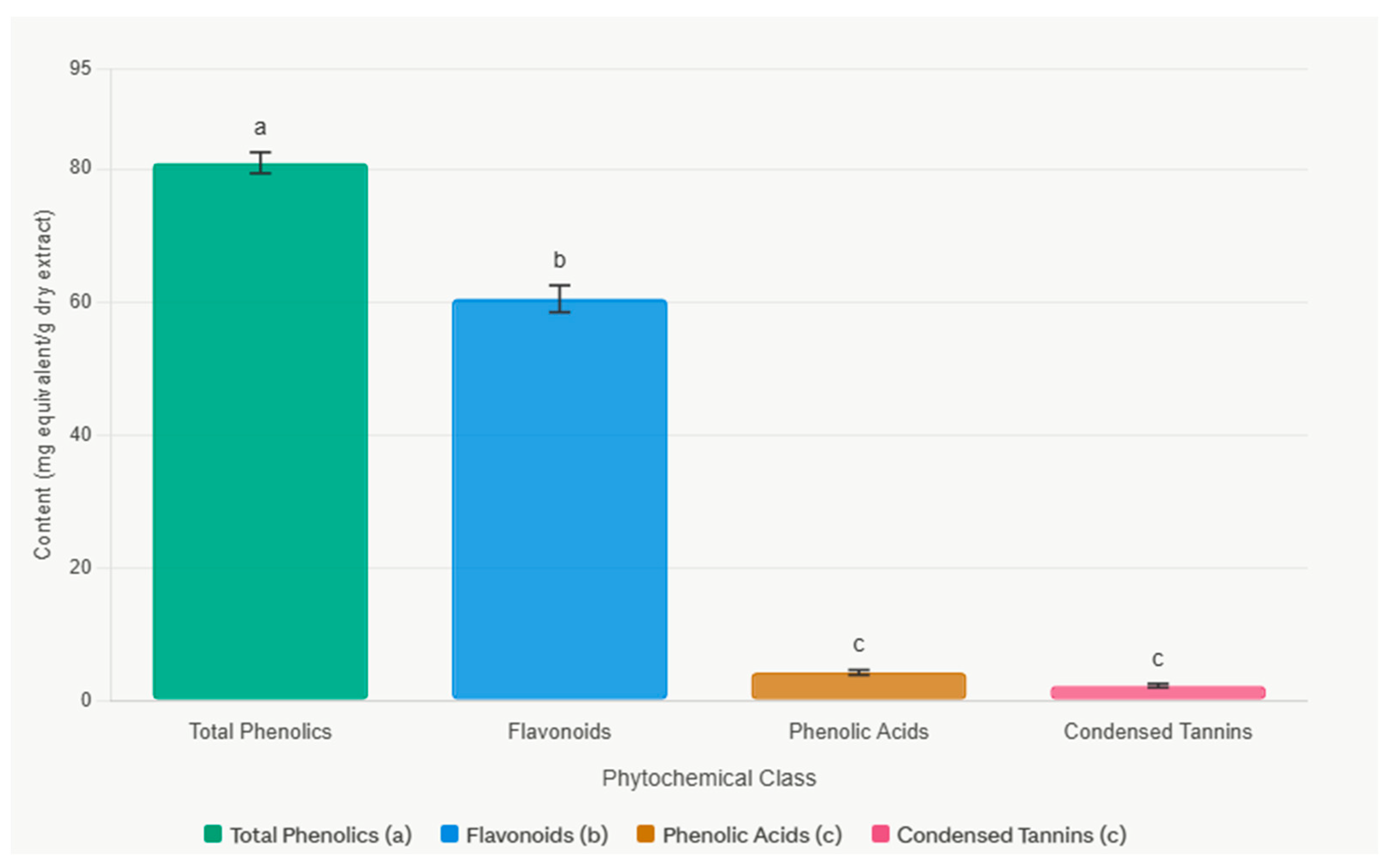
The phytochemical composition of the hydromethanolic extract of A. campestris, categorised by major phenolic classes, is depicted in Figure 1.
Quantitative analysis revealed that the hydromethanolic extract of A. campestris is primarily rich in phenolic compounds. The total phenolic content was 80.91 ± 1.58 mg GAE/g, followed by flavonoids at 60.45 ± 2.02 mg RE/g. Phenolic acids (4.24 ± 0.38 mg CAE/g) and condensed tannins (2.26 ± 0.29 mg CE/g) were present at lower concentrations (Figure 1). These values are based on five independent replicates (n = 5).

3.4. Enzyme Inhibition

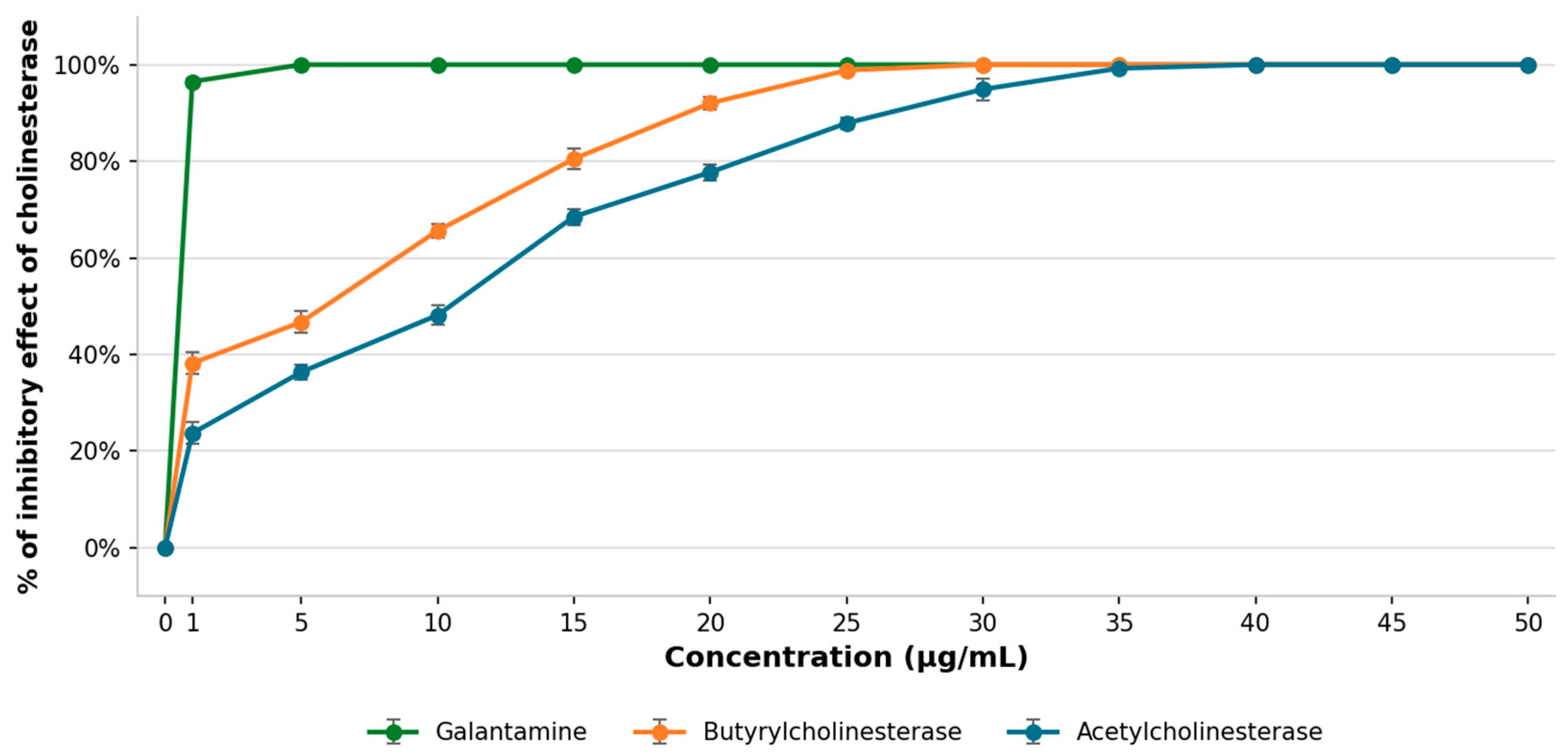
The hydromethanolic extract of A. campestris exhibited a clear concentration-dependent inhibition of cholinesterase enzymes, with significant activity against both acetylcholinesterase (AChE) and butyrylcholinesterase (BChE), as illustrated in Figure 2. Galantamine, used as a reference inhibitor, exhibited IC50 values of 1.50 ± 0.12 µg/mL for AChE under the same assay conditions, confirming the validity of the assay and providing a benchmark for comparison. Near-complete inhibition was observed at 30–50 µg/mL. The IC50 values were 13.79 ± 0.79 µg/mL for AChE and 8.34 ± 0.58 µg/mL for BChE, based on five independent replicates (n = 5). Galantamine, used as a reference inhibitor, displayed higher potency at lower concentrations.

3.5. Molecular Docking Analysis

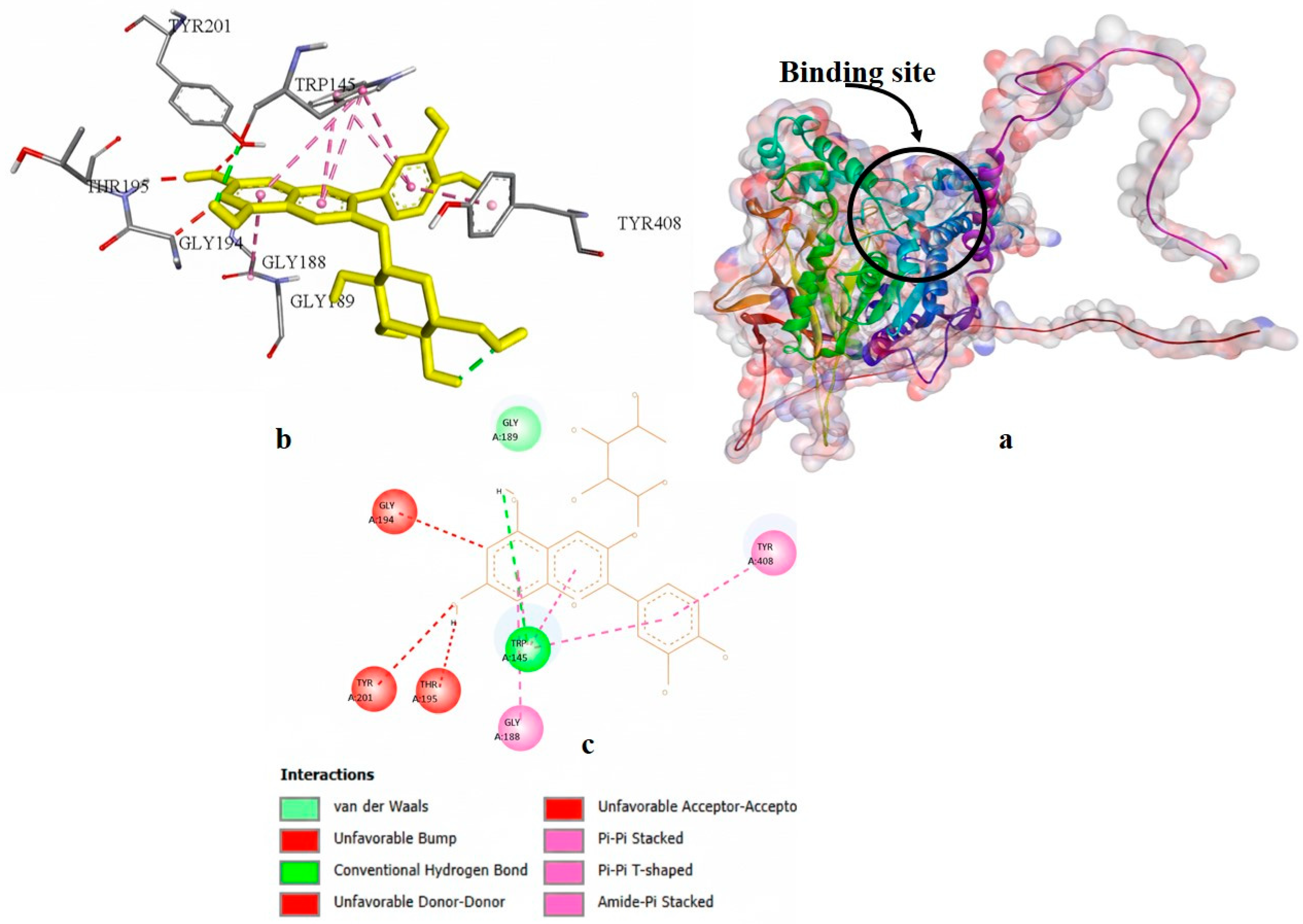
The docking results, presented in Table 2 and illustrated by the binding pose Figure 3, highlight the strong affinities of secondary metabolites from A. campestris for the A. gossypii acetylcholinesterase active site.
The docking results highlight the strong affinities of secondary metabolites from A. campestris for the A. gossypii acetylcholinesterase active site. Compounds such as cyanidin-3-O-glucoside, malvidin-3-O-glucoside, and apigenin showed the highest binding affinities, with binding energies ranging from −8.2 to −8.5 kcal/mol. These molecules interacted with key residues (Trp145, Tyr201, Phe409) through hydrogen bonding and π–π interactions.

4. Discussion

The relatively high yield of the hydromethanolic extract (12.48 ± 0.46%) confirms the efficiency of this solvent system in recovering a broad spectrum of polar bioactive compounds. These results are consistent with previous studies on A. campestris, which reported similar yields in the range of 10–14%, thereby supporting the reliability of this extraction method [31]. Such reproducibility is critical to the study’s objective, as a robust yield ensures sufficient recovery of phenolics and flavonoids that underpin the strong cholinesterase inhibition observed. Comparable yields have also been reported in recent investigations of A. campestris, reinforcing hydromethanol as a suitable solvent for phytochemical and bioactivity assays [31,32].
This profile underscores a clear predominance of polyphenols, particularly flavonoids, which play crucial roles in various biological activities. The dominance of phenolics and flavonoids is consistent with previous reports on A. campestris, where these compounds were identified as the major constituents [33,34]. Recent LC-MS investigations confirm similar phytochemical profiles, with flavonoids and phenolic acids highlighted as dominant contributors to antioxidant and enzyme modulating activities in Tunisian and Algerian A. campestris [35,36]. Their abundance likely contributes to the strong antioxidant and enzyme-inhibitory potential observed in subsequent assays. Importantly, the quantitative richness of flavonoids provides a biochemical rationale for the extract’s ability to inhibit cholinesterase enzymes, as confirmed by phytochemical and biological activity studies on Algerian A. campestris [37].
The predominance of flavonoids and tannins in A. campestris is consistent with earlier reports [33,34], and more recent studies confirm polyphenols as the dominant bioactive constituents in Tunisian populations [35]. The high prevalence of flavonoids and tannins is significant, as these compounds are well recognized for their antioxidant and enzyme-inhibitory properties [33]. Furthermore, terpenoids and coumarins, which are characteristic of the Artemisia genus, may also contribute to the observed biological activities [38]. Overall, the predominance of polyphenolic compounds likely facilitates the extract’s ability to interact with enzymes through hydrogen bonding and hydrophobic interactions [38].
Although BChE inhibition was slightly stronger, AChE remains the more relevant target due to its central role in insect neurotransmission [1,13]. The observed activity is likely attributable to the high concentration of polyphenolic compounds, particularly flavonoids, which can interact with the enzyme’s active site including the catalytic triad and the peripheral anionic site through hydrogen bonding and π–π stacking [39,40]. Such interactions stabilize ligand–enzyme complexes and hinder substrate access, which aligns with docking-based predictions of binding affinity and orientation [41]. Recent mechanistic reviews and in silico/in vitro studies confirm that flavonoids such as quercetin, apigenin, and kaempferol effectively inhibit cholinesterase by binding to both catalytic and peripheral sites, validating the biochemical rationale for the activity observed here [39,40,42].
The mechanistic basis for this activity is further supported by molecular docking results. Apigenin, detected in the extract, showed a binding energy of −8.20 kcal/mol against the A. gossypii AChE active site, consistent with its inhibitory potency. Cyanidin-3-O-glucoside and malvidin-3-O-glucoside (−8.50 and −8.40 kcal/mol, respectively) were included as anthocyanin reference ligands to explore binding potential of this compound class; they were not detected in the extract and their values should not be interpreted as evidence of extract activity. Collectively, these compounds provide multiple hydroxyl groups and planar aromatic rings capable of stabilizing interactions within the enzyme pocket. Docking simulations revealed binding energies between −8.2 and −8.5 kcal/mol, with hydrogen bonding and π–π stacking involving residues Trp145, Tyr201, and Phe409. These interactions are consistent with canonical binding modes of flavonoids, which are known to occupy both the catalytic triad and peripheral anionic site, thereby hindering substrate access and stabilizing enzyme–ligand complexes [43].
The agreement between docking predictions and experimental IC50 values provides compelling evidence that these metabolites act as competitive inhibitors of AChE. This mechanistic consistency reinforces the hypothesis that the phytochemical richness of A. campestris underpins its strong enzyme inhibitory potential. Recent computational and pharmacological studies confirm that flavonoids exert dual antioxidant and cholinesterase-inhibitory effects, validating the biochemical rationale observed here [44,45].
The biological relevance of the observed enzyme inhibition should be considered in the context of the target pest, A. gossypii. This aphid relies on cholinergic neurotransmission for normal nervous system function, and AChE inhibition is a well-established mechanism of neurotoxicity in hemipteran pests [1,13]. The potent in vitro AChE inhibition demonstrated by the A. campestris extract (IC50 = 13.79 ± 0.79 µg/mL), together with the strong in silico binding affinity of apigenin at the A. gossypii AChE active site, provides a preliminary mechanistic rationale suggesting potential relevance for the control of this pest a hypothesis that remains to be confirmed through direct in vivo bioassay. While the present study does not include direct bioassay data, the in vitro and in silico evidence collectively suggests that the extract’s cholinesterase inhibitory constituents could plausibly disrupt cholinergic neurotransmission in A. gossypii, a mechanistic hypothesis that must be validated through targeted in vivo bioassays before any insecticidal claim can be made. Notably, flavonoids such as apigenin and related phenolics have recently been shown to suppress A. gossypii populations and feeding behaviour [9], further supporting the pest-control potential of the A. campestris phytochemical profile. The comparison with galantamine warrants careful contextual interpretation. Galantamine, a purified and structurally optimized alkaloid, exhibited an IC50 of 1.50 ± 0.12 µg/mL approximately 9.2-fold more potent than the A. campestris extract (IC50 = 13.79 ± 0.79 µg/mL for AChE). This difference, however, is both expected and well-precedented in the botanical pharmacology literature. Galantamine acts as a single molecule at maximum molar concentration, whereas a crude hydromethanolic extract is a complex mixture in which active constituents collectively represent only a fraction of total dry weight; the effective molar concentration of any individual inhibitory compound is therefore substantially lower than the nominal extract concentration. When considered on this basis, the IC50 obtained is fully consistent with and in several cases superior to values reported for other botanical extracts under comparable conditions. For instance, Origanum vulgare extracts showed AChE IC50 values of 18–40 µg/mL [43], Artemisia copa extracts reported values of approximately 20–35 µg/mL [34], and phenolic-rich plant extracts showed IC50 values of 15–30 µg/mL [44]. Studies have further demonstrated that crude flavonoid fractions typically inhibit AChE at concentrations 5–15 times higher than galantamine yet still display relevant biological activity [40], and synergistic interactions among co-occurring polyphenols flavonoids, phenolic acids, and tannins have been shown to enhance the inhibitory potency of a whole extract beyond what isolated compound values would predict [42]. Taken together, the IC50 values of the A. campestris extract are scientifically meaningful and position it as a competitive candidate among botanical cholinesterase inhibitors, pending isolation of its most active constituents and formulation optimization.

5. Conclusions

This study demonstrates that the hydromethanolic extract of A. campestris is rich in bioactive secondary metabolites, particularly phenolics and flavonoids, which underpin its notable in vitro cholinesterase inhibitory activity. In vitro enzyme-based assays revealed IC50 values of 13.79 ± 0.79 µg/mL for AChE and 8.34 ± 0.58 µg/mL for BChE, demonstrating concentration-dependent inhibitory activity under controlled laboratory conditions. Molecular docking against the AlphaFold predicted AChE of A. gossypii revealed a favorable binding affinity for apigenin, a flavonoid identified in the extract (−8.20 kcal/mol), with stabilizing hydrogen bonding and π–π interactions at key active site residues; anthocyanin compounds used as reference ligands in the docking analysis were not detected in the extract and do not reflect its phytochemical composition. The consistency between experimental IC50 values and in silico binding predictions provides a mechanistic and biochemical rationale connecting the phytochemical richness of A. campestris to its cholinesterase inhibitory potential, and supports the relevance of these findings to the development of eco-friendly management strategies targeting A. gossypii a major agricultural pest that depends on intact cholinergic neurotransmission for coordinated feeding and movement, once in vivo efficacy is confirmed through direct bioassay. The role of A. campestris in this context is further underscored by the molecular docking evidence connecting its phytochemical constituents directly to the AChE of the target pest. These findings are, however, limited to in vitro enzymatic assays and computational predictions; direct in vivo bioassay validation against A. gossypii and related target insects remains the essential next step before any insecticidal activity can be claimed. Beyond this, plant extracts often exhibit variability in composition depending on growth stage, environment, and extraction method, which can affect reproducibility. Future research should therefore focus on bioassay validation under controlled conditions, the isolation of the most active constituents, formulation strategies, and controlled-release systems to ensure practical effectiveness and field applicability. By addressing these limitations and advancing from in vitro and in silico evidence toward validated applied formulations, A. campestris represents a scientifically grounded candidate for further investigation as a plant-based tool for sustainable management of A. gossypii and related agricultural pests.

Author Contributions

All authors contributed substantially to this work. M.B. led the study design, data analysis, and manuscript preparation. A.T. contributed to experimental work, data collection, and interpretation of results. H.I.-I. assisted with literature review, critical revisions, and overall supervision. All authors have read and agreed to the published version of the manuscript.

Funding

This research received no external funding.

Institutional Review Board Statement

Not applicable.

Informed Consent Statement

Not applicable.

Data Availability Statement

The protein sequence data used for the predicted structure from AlphaFold (https://alphafold.ebi.ac.uk/). And all other data generated and analyzed during this study are included in this article.

Conflicts of Interest

The authors declare no conflict of interest.

References

  1. Rants’o, T.A.; Koekemoer, L.; Panayides, J.-L.; Van Zyl, R.L. Potential of essential oil-based anticholinesterase insecticides against Anopheles vectors: A review. Molecules 2022, 27, 7026. [Google Scholar] [CrossRef] [PubMed]
  2. Rosenberg, Y.; Garcia, K.; Diener, J.; Sullivan, D.; Donahue, S.; Mao, L.; Lees, J.; Jiang, X.; Urban, L.; Momper, J.; et al. A single post-exposure oxime RS194B treatment rapidly reactivates acetylcholinesterase and reverses acute symptoms in macaques exposed to diethylphosphorothioate parathion and chlorpyrifos insecticides. J. Neurochem. 2023, 168, 370–380. [Google Scholar] [CrossRef] [PubMed]
  3. Ngegba, P.M.; Cui, G.; Khalid, M.Z.; Zhong, G. Use of botanical pesticides in agriculture as an alternative to synthetic pesticides. Agriculture 2022, 12, 600. [Google Scholar] [CrossRef]
  4. Souto, A.L.; Sylvestre, M.; Tölke, E.D.; Tavares, J.F.; Barbosa-Filho, J.M.; Cebrián-Torrejón, G. Plant-derived pesticides as an alternative to pest management and sustainable agricultural production: Prospects, applications and challenges. Molecules 2021, 26, 4835. [Google Scholar] [CrossRef] [PubMed]
  5. Isman, M.B. Botanical insecticides in the twenty-first century—Fulfilling their promise? Annu. Rev. Entomol. 2020, 65, 233–249. [Google Scholar] [CrossRef]
  6. Yousafi, Q.; Sarfaraz, A.; Khan, M.A.; Saleem, S.; Shahzad, U.; Khan, A.; Sadiq, M.; Abid, A.; Shahzad, M.; Hassan, N. In silico annotation of unreviewed acetylcholinesterase (AChE) in some lepidopteran insect pest species reveals the causes of insecticide resistance. Saudi J. Biol. Sci. 2021, 28, 2197–2209. [Google Scholar] [CrossRef] [PubMed]
  7. Costas-Ferreira, C.; Faro, L.R.F. Neurotoxic effects of neonicotinoids on mammals: What is there beyond the activation of nicotinic acetylcholine receptors?—A systematic review. Int. J. Mol. Sci. 2021, 22, 8413. [Google Scholar] [CrossRef] [PubMed]
  8. Kamal, M.; Hekal, M.H.; El-Azm, F.S.A.; Hosni, E.A.; Ali, Y.M.; Alzahrani, A.A.; Rafat, E. Synthesis and in silico studies of new thiophene-isoquinolinone hybrids as potential larvicides against Culex pipiens. Sci. Rep. 2025, 15, 9895. [Google Scholar] [CrossRef] [PubMed]
  9. Zhang, Y.; Li, X.; Zhang, M.; Xu, B.; Liu, X. Application of flavonoid compounds suppresses the cotton aphid, Aphis gossypii. Front. Plant Sci. 2025, 16, 1545499. [Google Scholar] [CrossRef] [PubMed]
  10. Liang, P.; Li, C.; Han, X.; Zhang, Y.; Gao, X. Molecular and functional characterization of heat-shock protein 70 in Aphis gossypii under thermal and xenobiotic stresses. Pestic. Biochem. Physiol. 2024, 199, 105774. [Google Scholar] [CrossRef] [PubMed]
  11. Wang, X.; Li, X.; Zhang, Y.; Liu, J.; Chen, J.; Ma, K.; Zhang, G. Effects of seven plant essential oils on the growth, development and feeding behavior of the wingless Aphis gossypii Glover. Plants 2024, 13, 916. [Google Scholar] [CrossRef]
  12. Shang, J.; Wang, Z.; Zhang, H.; Li, Y.; Gao, C. Baseline susceptibility, risk assessment of resistance, changes in insecticides sensitivity and fitness after selection of dimpropyridaz in Aphis gossypii Glover (Hemiptera: Aphididae). Pestic. Biochem. Physiol. 2024, 205, 106138. [Google Scholar] [CrossRef] [PubMed]
  13. Lindgren, C.; Rajeshwari, R.; Engdahl, C.; Kumari, R.; Ekström, F.; Linusson, A. The molecular properties of honey bee acetylcholinesterase reveal opportunities to avoid off-target effects in insecticide discovery. Chem. Eur. J. 2025, 31, e202500664. [Google Scholar] [CrossRef] [PubMed]
  14. Kuzu, B.; Alagoz, M.; Demir, Y.; Gulcin, I.; Burmaoglu, S.; Algul, O. Structure-based inhibition of acetylcholinesterase and butyrylcholinesterase with 2-aryl-6-carboxamide benzoxazole derivatives: Synthesis, enzymatic assay, and in silico studies. Mol. Divers. 2024, 29, 671–693. [Google Scholar] [CrossRef] [PubMed]
  15. Umam, K.; Widodo, N.; Rifa’i, M.; Utomo, D.H. Phytochemistry, pharmacology and mode of action of the anti-bacterial Artemisia plants. Bioengineering 2023, 10, 633. [Google Scholar] [CrossRef] [PubMed]
  16. Hussain, M.; Song, Y.; Raza, M.A.; Jabbar, A.; Siddiqui, M.A.; Sajid, M.S. Traditional uses, phytochemistry, pharmacology, and toxicology of the genus Artemisia L. (Asteraceae): A high-value medicinal plant. Curr. Top. Med. Chem. 2024, 24, 301–342. [Google Scholar] [CrossRef] [PubMed]
  17. Dib, I.; El Alaoui-Faris, F.E. Artemisia campestris L.: Review on taxonomical aspects, cytogeography, biological activities and bioactive compounds. Biomed. Pharmacother. 2019, 109, 1884–1906. [Google Scholar] [CrossRef] [PubMed]
  18. Ammar, S.; Kouki, A.; Khammassi, M.; Achèche, M.; Hlel-Gharbi, T.; Hamouda, M.B. Essential oils from three Algerian medicinal plants (Artemisia campestris, Pulicaria arabica, and Saccocalyx satureioides) as new botanical insecticides? Environ. Sci. Pollut. Res. 2020, 27, 26594–26604. [Google Scholar] [CrossRef] [PubMed]
  19. Almiar, F.A. A review of the phytochemical composition and therapeutic uses of Artemisia spp. Derna Univ. J. Appl. Sci. 2025, 2, 125–137. [Google Scholar] [CrossRef]
  20. Gonfa, T.; Teketle, S.; Kiros, T. Effect of extraction solvent on qualitative and quantitative analysis of major phyto-constituents and in-vitro antioxidant activity evaluation of Cadaba rotundifolia Forssk leaf extracts. Cogent Food Agric. 2020, 6, 1853867. [Google Scholar] [CrossRef]
  21. Singleton, V.L.; Orthofer, R.; Lamuela-Raventós, R.M. Analysis of total phenols and other oxidation substrates and antioxidants by means of Folin-Ciocalteu reagent. Methods Enzymol. 1999, 299, 152–178. [Google Scholar] [CrossRef]
  22. Kim, E.-J.; Jung, H.; Van, T.P.; Lee, T.-J.; Kim, N.H.; Kim, B.T. Comparison of colorimetric methods for the determination of flavonoid in propolis extract products. Korean J. Food Sci. Technol. 2005, 37, 932–936. [Google Scholar]
  23. Szaufer-Hajdrych, M.; Goślińska, O. The quantitative determination of phenolic acids and antimicrobial activity of Symphoricarpos albus (L.) Blake. Acta Pol. Pharm. 2004, 61, 69–74. [Google Scholar] [PubMed]
  24. Sun, B.; Ricardo-da-Silva, J.M.; Spranger, I. Critical factors of vanillin assay for catechins and proanthocyanidins. J. Agric. Food Chem. 1998, 46, 4267–4274. [Google Scholar] [CrossRef]
  25. Wiederstein, M.; Sippl, M.J. ProSA-web: Interactive web service for the recognition of errors in three-dimensional structures of proteins. Nucleic Acids Res. 2007, 35, W407–W410. [Google Scholar] [CrossRef] [PubMed]
  26. Eisenberg, D.; Lüthy, R.; Bowie, J.U. VERIFY3D: Assessment of protein models with three-dimensional profiles. Methods Enzymol. 1997, 277, 396–404. [Google Scholar] [CrossRef] [PubMed]
  27. Lovell, S.C.; Davis, I.W.; Arendall, W.B., III; de Bakker, P.I.W.; Word, J.M.; Prisant, M.G.; Richardson, J.S.; Richardson, D.C. Structure validation by Cα geometry: φ, ψ and Cβ deviation. Proteins 2003, 50, 437–450. [Google Scholar] [CrossRef] [PubMed]
  28. Colovos, C.; Yeates, T.O. Verification of protein structures: Patterns of nonbonded atomic interactions. Protein Sci. 1993, 2, 1511–1519. [Google Scholar] [CrossRef] [PubMed]
  29. Laskowski, R.A.; MacArthur, M.W.; Moss, D.S.; Thornton, J.M. PROCHECK: A program to check the stereochemical quality of protein structures. J. Appl. Crystallogr. 1993, 26, 283–291. [Google Scholar] [CrossRef]
  30. Kochnev, Y.; Durrant, J.D. FPocketWeb: Protein pocket hunting in a web browser. J. Cheminform. 2022, 14, 58. [Google Scholar] [CrossRef] [PubMed]
  31. Metoui, R.; Abderrabba, M.; Ayadi, S. Artemisia campestris dried leaf extracts: Effects of different extraction methods and solvents on phenolic composition and biological activities. S. Afr. J. Bot. 2022, 151, 288–294. [Google Scholar] [CrossRef]
  32. Belyagoubi-Benhammou, N.; Belyagoubi, L.; Atik-Bekkara, F. Exploring isolation protocols for artemisinin and other bioactive compounds from the Algerian Artemisia campestris. Plant Biosyst. 2025, 159, 1114–1128. [Google Scholar] [CrossRef]
  33. Bakchiche, B.; Gherib, A.; Ashour, M.L.; Dechoun, H.; Padula, G. Artemisia campestris and Artemisia herba-alba: LC-HRESI-MS profile alongside their antioxidant and antimicrobial evaluation. Acta Pharm. Sci. 2022, 60, 131–152. [Google Scholar] [CrossRef]
  34. Larrazábal-Fuentes, M.J.; Romero, C.; Mena, J.; Pastene, E.; Saez, K.; Ortiz, M. Chemical profiling, antioxidant, anticholinesterase, and antiprotozoal potentials of Artemisia copa Phil. (Asteraceae). Front. Pharmacol. 2020, 11, 594174. [Google Scholar] [CrossRef] [PubMed]
  35. Limam, I.; Skandrani, I.; Ben Sghaier, M.; Bouhlel, I.; Quartu, M.; Neffati, M.; Chekir-Ghedira, L. Tunisian Artemisia campestris L.: A potential therapeutic agent against myeloma—Phytochemical and pharmacological insights. Plant Methods 2024, 20, 59. [Google Scholar] [CrossRef] [PubMed]
  36. Brahmi, F.; Benamara, S.; Henchiri, C.; Guendouz, A.; Sebai, H. Chemical composition, antimicrobial and antioxidant activities of methanolic extracts of the Algerian Artemisia campestris L. at different stages of growth. Vegetos 2024, 37, 1084–1097. [Google Scholar] [CrossRef]
  37. Zahnit, W.; Smara, O.; Messaoudi, M.; Hacib, H.; Lalaoui, K.; Boudah, A.; Ben-Attia, M.; Tamendjari, A. Phytochemical profiling, mineral elements, and biological activities of Artemisia campestris L. grown in Algeria. Horticulturae 2022, 8, 914. [Google Scholar] [CrossRef]
  38. Hussain, A.; Ahmad, S.; Asif, H.; Hussain, M.; Ali, H.; Khan, I.A.; Iqbal, J. Green synthesis of iron and zinc nanoparticles, total phenolic and total flavonoid components, and pharmacological studies of Perovskia atriplicifolia Benth. Sci. Rep. 2025, 15, 39448. [Google Scholar] [CrossRef] [PubMed]
  39. Akili, A.W.R.; Prasetyaningrum, P.; Rosyidah, A.; Wahyudi, E.; Yunianta, Y. Investigating the potency of Erythrina-derived flavonoids as cholinesterase inhibitors and free radical scavengers through in silico approach: Implications for Alzheimer’s disease therapy. J. Appl. Pharm. Sci. 2023, 13, 100–110. [Google Scholar] [CrossRef]
  40. Cichon, N.; Saluk-Bijak, J.; Grzelak, A.; Bijak, M.; Miller, E. Mechanistic and therapeutic insights into flavonoid-based inhibition of acetylcholinesterase: Implications for neurodegenerative diseases. Nutrients 2024, 17, 78. [Google Scholar] [CrossRef] [PubMed]
  41. Orhan, I.E.; Senol, F.S.; Gulpinar, A.R.; Sekeroglu, N.; Kartal, M.; Sener, B. Selective cholinesterase inhibitors from Buxus sempervirens L. and their molecular docking studies. Curr. Comput.-Aided Drug Des. 2011, 7, 276–286. [Google Scholar] [CrossRef] [PubMed]
  42. Sadeghi, M.; Miroliaei, M.; Ghanadian, M.; Szumny, A.; Rahimmalek, M. Identification of cholinesterase inhibitors from flavonoids derivatives for possible treatment of Alzheimer’s disease: In silico and in vitro approaches. Curr. Res. Struct. Biol. 2024, 7, 100146. [Google Scholar] [CrossRef] [PubMed]
  43. Malak, N.; Ahmed, S.; Tariq, M.I.; Nadeem, H.; Arif, S.; Shahzad, S. Density functional theory calculations and molecular docking analyses of flavonoids for their possible application against the acetylcholinesterase and triose-phosphate isomerase proteins of Rhipicephalus microplus. Molecules 2023, 28, 3606. [Google Scholar] [CrossRef] [PubMed]
  44. Viswanathan, S.; Gopalakrishnan, S.; Rajasekaran, C.; Murugaiyah, V. Molecular docking analysis of flavonoids with AChE and BACE-1. Bioinformation 2024, 20, 103–110. [Google Scholar] [CrossRef] [PubMed]
  45. Wu, Y.; Wen, H.; Dong, X.; Jiang, T.; Li, P. The neuroprotective effects of cyanidin derivatives on AlCl3-induced zebrafish model of Alzheimer’s disease. Molecules 2025, 30, 3686. [Google Scholar] [CrossRef] [PubMed]
Figure 1. Quantitative phytochemical composition of the hydromethanolic extract of A. campestris. Values represent means ± standard deviation of five independent replicates (n = 5). Different letters above bars (a, b, c) indicate statistically significant differences between phytochemical classes (one-way ANOVA, F = 4671.42, p < 0.001; Tukey’s HSD post-hoc test, α = 0.05). Phenolic Acids and Condensed Tannins share the same letter (c), indicating no significant difference between these two groups. Total phenolics expressed as mg gallic acid equivalents (GAE/g dry extract); flavonoids as mg rutin equivalents (RE/g dry extract); phenolic acids as mg caffeic acid equivalents (CAE/g dry extract); condensed tannins as mg catechin equivalents (CE/g dry extract).
Blsf 62 00008 g001
Figure 2. Dose–Response Curves for Enzyme Inhibition by A. campestris Extract.
Blsf 62 00008 g002
Figure 3. (a) Ribbon diagram: Modelled Structure of Aphis gossypii AChE; (b) 3D representation of amino acid interactions with Cyanidin-3-O-glucoside of A. campestris with AChE Active Site. (c) 2D representation of amino acid interactions with Cyanidin-3-O-glucoside of A. campestris with AChE Active Site.
Blsf 62 00008 g003
Table 1. Qualitative phytochemical profile of A. campestris hydro-methanolic extract.
CompoundPresence
Tannins+++
Catechic tannins+
Gallic tannins+++
Flavonoids+++
Anthocyanins+
Free quinones+++
Glucosides+++
Terpenoids+++
Saponins++
Coumarins++
AlkaloidsWagner +/Mayer −
(+++) indicates strong presence; (++) indicates moderate presence; (+) indicates weak presence; (−) indicates absence. For alkaloids, Wagner’s reagent gave a positive result (+), while Mayer’s reagent gave a negative result (−).
Table 2. Binding energies and key interacting residues of A. campestris metabolites with A. gossypii acetylcholinesterase expressed in kcal/mol.
MoleculePubchem CIDBinding EnergyBinding Amino Acids
15-O-β-D-glucopyranosyl-11β, 13-dihydro urospermal A −6.50Trp145, Gly189, Ser193, Glu275, Ser276, Tyr408
5-O-caffeoylquinic acid5280633−7.30Tyr133, Trp145, Ser146, Gly189
Pelargonidin-3-O-glucuronide443648−6.20Gln130, Tyr133, Trp145, Ser193, Gly194, Tyr408, Phe409, Gly522
Cyanidin-3-O-glucoside441667−8.50Trp145, Gly188, Gly189, Gly194, Thr195, Tyr201, Tyr408
Malvidin 3-O-glucoside443652−8.40Gln130, Tyr133, Trp145, Ser193, Gly194, Tyr408, Phe409, Gly522
Esculetin-6-O-glucoside521417−7.60Tyr133, Trp145, Gly194, Glu275, Ser296, Tyr201, Phe409
3-hydroxyphloretin-6′-O-glucoside1020685873−6.5Tyr133, Glu142, Trp145, Ser146, Pro147, Gly188, Gly189, Gly194, Tyr201, Tyr408, Phe409, Tyr412
Apigenin5280443−8.20Tyr133, Trp145, Tyr201, Phe409, His521
Acacetin5280442−7.70Tyr133, Trp145, Gly194, Tyr201, Glu275, Tyr362, Phe368, Phe409, Asp413, His521
Chlorpyrifos (standard)2730−6.0Tyr133, Trp145, Gly189, Ser193, Tyr201, Tyr408, Phe409, Tyr412, His521, Met525
Disclaimer/Publisher’s Note: The statements, opinions and data contained in all publications are solely those of the individual author(s) and contributor(s) and not of MDPI and/or the editor(s). MDPI and/or the editor(s) disclaim responsibility for any injury to people or property resulting from any ideas, methods, instructions or products referred to in the content.