
Skip to Content
  • Proceeding Paper
  • Open Access

13 October 2021

Evaluation of Analytical Methods to Determine Regulatory Compliance of Coffee Leaf Tea †

,
,
,
,
,
,
and
1
Chemisches und Veterinäruntersuchungsamt (CVUA) Karlsruhe, Weissenburger Strasse 3, 76187 Karlsruhe, Germany
2
Hochschule für angewandte Wissenschaften Coburg, Friedrich-Streib-Strasse 2, 96450 Coburg, Germany
3
Coffee Consulate, Hans-Thoma-Strasse 20, 68163 Mannheim, Germany
4
Department of Flavor Chemistry, University of Hohenheim, Fruwirthstr. 12, Verfügungsgebäude 221, 70599 Stuttgart, Germany

Abstract

The leaves of the coffee plant Coffea are traditionally used in several countries worldwide to prepare tea-like beverages using aqueous infusion in hot water. There are currently no tested methods available to check the regulatory compliance of coffee leaf tea according to the European Union (EU) novel food authorization. This study shows that standard ISO methods for tea analysis could be transferred without modifications to coffee leaf tea analysis. The only difference found was a much lower content of some catechins in coffee leaf tea compared to Camellia sinensis tea, but the methods were clearly applicable for use in controlling the EU’s maximum limits for coffee leaf tea.

1. Introduction

The leaves of the coffee plant (genus Coffea) are traditionally used in several countries worldwide to prepare tea-like beverages using aqueous infusion in hot water. Since 1st of July 2020, the placing of coffee leaf tea on the market was authorized by the European Union (EU) under the framework of the novel food regulation [1]. The implementing regulation for coffee leaf tea established several conditions of use, including maximum amount of dried leaves per liter of water, a necessary pasteurization step, and several chemical requirements including maximum levels for chlorogenic acid, caffeine, and epigallocatechin gallate. To date, there are no standard methods available to control these parameters to check the regulatory compliance of coffee leaf tea. In this presentation, we have for the first time evaluated standard methods for Camellia sinensis tea analysis for transferability to coffee leaf tea.

2. Methods

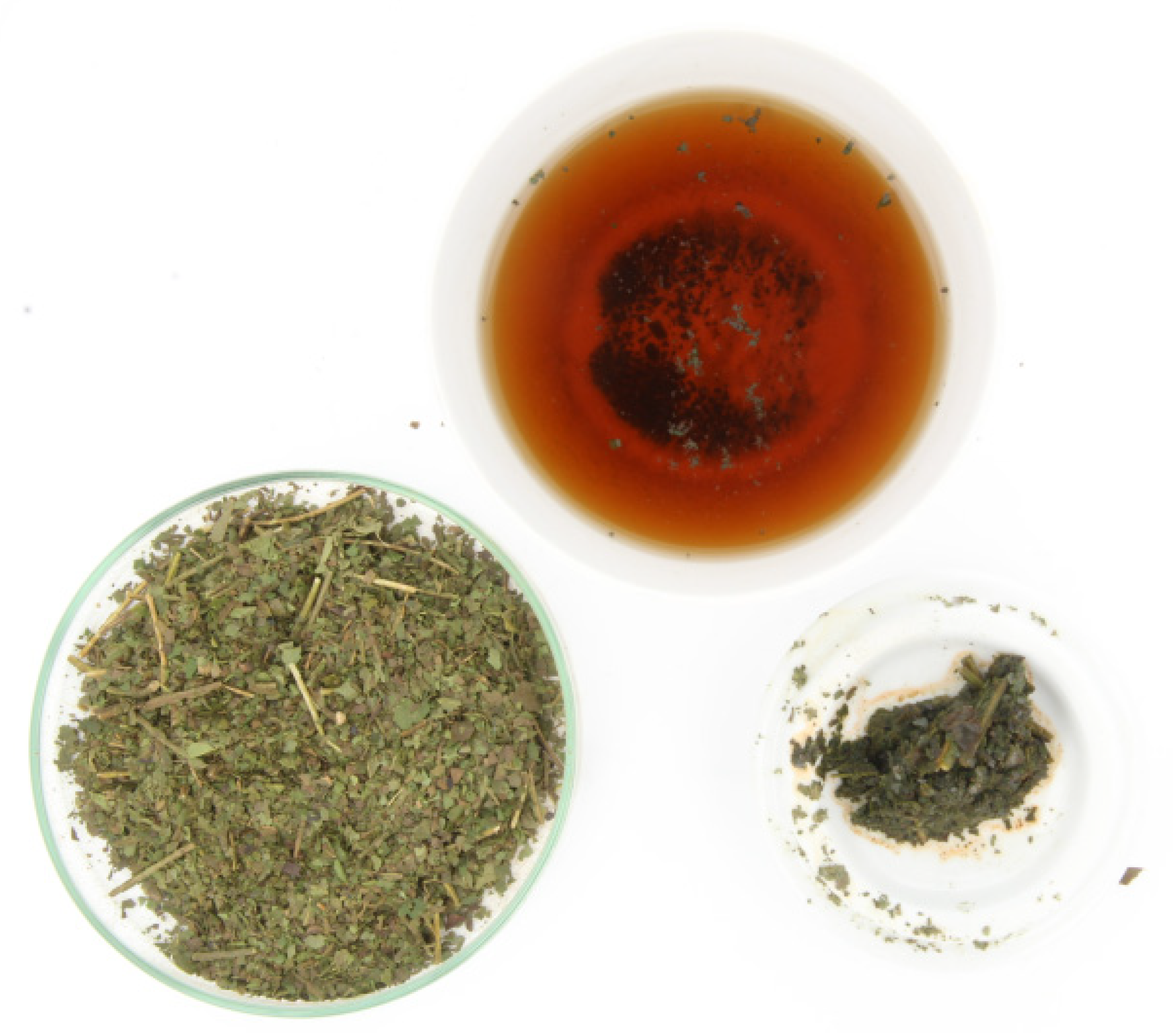
The coffee leaf samples contained two Coffea arabica and two C. canephora varieties, which were dried and processed using various methods. An example of coffee leaf tea sample is shown in Figure 1.
Figure 1. Example of coffee leaf tea (dried leaves, lower left; brewed beverage, top; spent leaves, lower right).
In order to ensure the homogeneity of the samples, each one of them was granulated to a size at which they could pass through a sieve with a pore size of 500 µm. The following methods were applied: ISO 14502-1:2005-03 [2], which is generally applied to determine the total polyphenols in green and black tea, based on a colorimetric method using Folin-Ciocalteu reagent; and ISO 14502-2:2007-12 [3], which is used to ascertain the content of catechins and other characteristic substances including caffeine in green tea, utilizing high-performance liquid chromatography. Both methods contain an extraction method, using 70% methanol, preheated to a temperature of 70 °C.
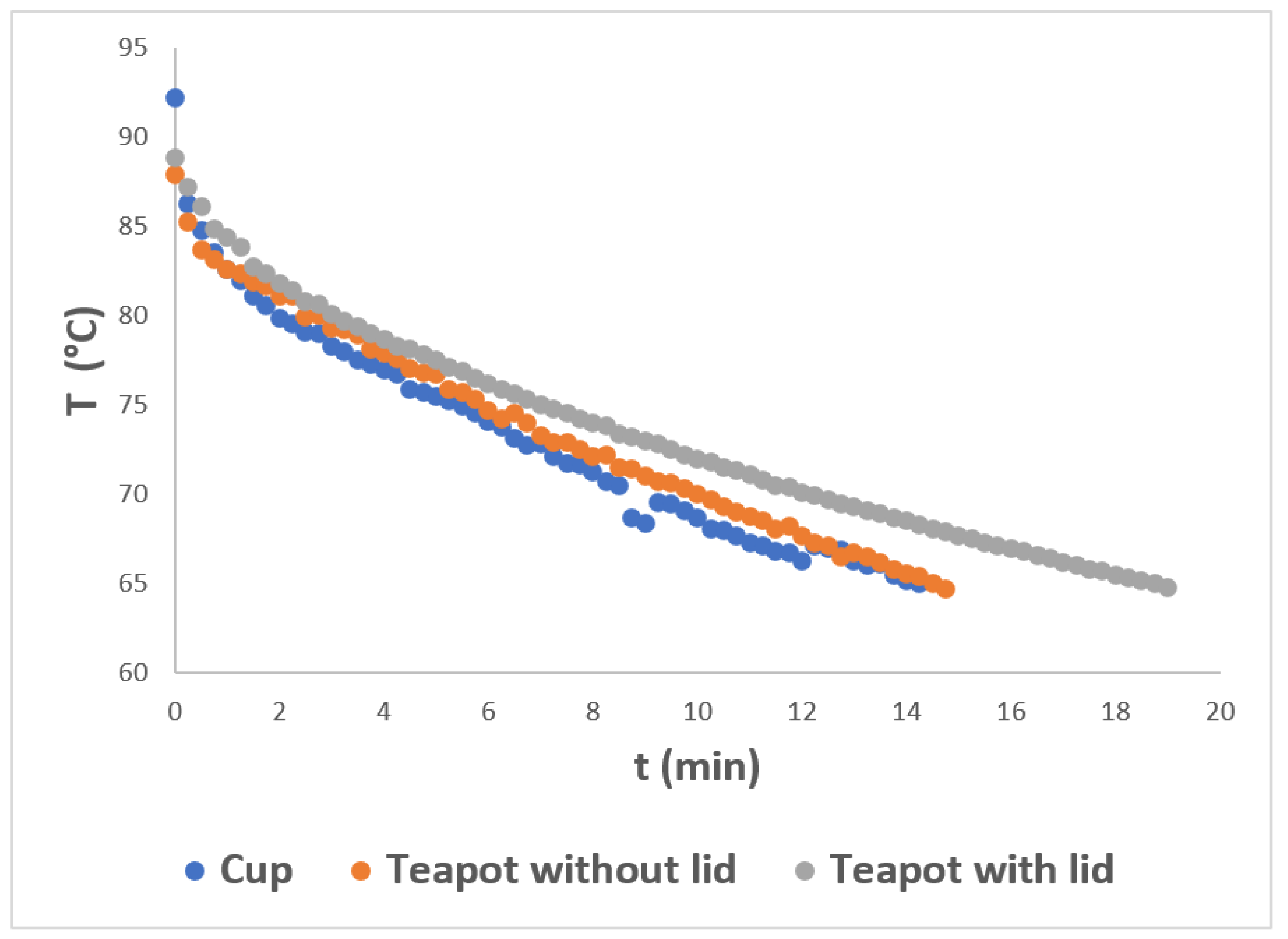
Regarding pasteurization, an experiment was conducted in which the temperature of brewed coffee leaf tea was constantly recorded, after being poured into a cup as well as a tea pot [4].
Finally, nuclear magnetic resonance (NMR) spectroscopic methods developed for coffee analysis were assessed to be used for coffee leaf tea analysis [5].

3. Results and Discussion

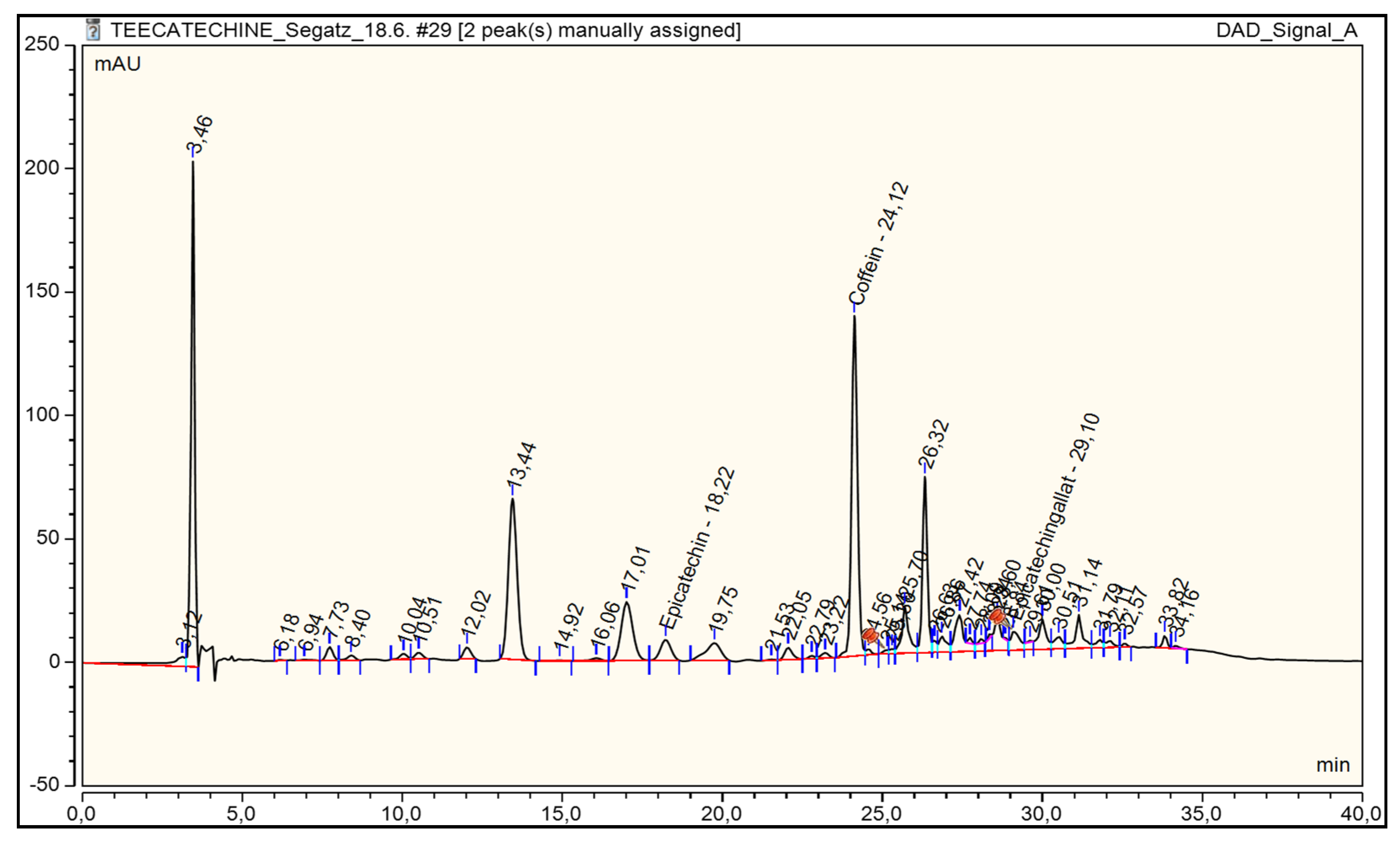
The results showed that the methods for polyphenol and catechin analysis could be transferred without modifications to coffee leaf tea. Figure 2 shows an exemplary chromatogram of the tea catechin separation.
Figure 2. Representative chromatogram of a coffee leaf tea analyzed using HPLC method ISO 14502-2:2007-12.
The only difference found was a much lower content of some catechins in coffee leaf tea compared to Camellia sinensis tea, but the methods were clearly applicable to be used to control the EU’s maximum limits for coffee leaf tea. Furthermore, standard European tea brewing methods using 90–95 °C hot water will ensure the EU’s necessary pasteurization conditions (at least 71 °C for 15 s) (Figure 3). The NMR methods allowed for the determination of chlorogenic acid, which is another compound with a maximum limit in the EU’s novel food approval.
Figure 3. Cooling behavior of coffee leaf tea filled in a tea cup as well as a teapot with and without lid.

Author Contributions

Conceptualization, D.W.L.; methodology, V.S.; formal analysis, V.S.; investigation, V.S., M.C.S. and P.B.; resources, D.W.L.; data curation, V.S.; writing—original draft preparation, V.S.; writing—review and editing, D.W.L., M.C.S., P.B., V.G., M.R., S.S. and Y.Z.; visualization, V.S.; supervision, D.W.L. and Y.Z. All authors have read and agreed to the published version of the manuscript.

Funding

This research received no external funding.

Institutional Review Board Statement

Not applicable.

Data Availability Statement

The data presented in this study are available on request from the corresponding author. The data are not publicly available due to institutional policy.

Acknowledgments

The team of the plant-based food laboratory at CVUA Karlsruhe is thanked for their support.

Conflicts of Interest

S.S. is the owner of Coffee Consulate, Mannheim, Germany. Coffee Consulate is an independent training and research center. Coffee Consulate is currently researching the potential of coffee by-products. However, S.S. reports no conflicts of interest related to the work under consideration. The other authors declare no conflicts of interest.

References

  1. European Commission. Commission Implementing Regulation (EU) 2020/917. Off. J. Euro. Union 2020, L209, 10. [Google Scholar]
  2. ISO 14502-1:2005-03; Determination of Substances Characteristic of Green and Black Tea-Part 1: Content of Total Polyphenols in Tea-Colorimetric Method Using Folin-Ciocalteu Reagent. International Organization for Standardization: Geneva, Switzerland, 2005.
  3. ISO 14502-2:2007-12; Determination of Substances Characteristic of Green and Black Tea-Part 2: Content of Catechins in Green tea-Method Using High-Performance Liquid Chromatography (ISO 14502-2:2005 + Corrigendum 1:2006). International Organization for Standardization: Geneva, Switzerland, 2005.
  4. Langer, T.; Winkler, G.; Lachenmeier, D.W. Untersuchungen zum Abkühlverhalten von Heißgetränken vor dem Hintergrund des temperaturbedingten Krebsrisikos. Deut. Lebensm. Rundsch. 2018, 114, 307–314. [Google Scholar] [CrossRef]
  5. Claassen, L.; Rinderknecht, M.; Porth, T.; Röhnisch, J.; Seren, H.Y.; Scharinger, A.; Gottstein, V.; Noack, D.; Schwarz, S.; Winkler, G.; et al. Cold brew coffee—Pilot studies on definition, extraction, consumer preference, chemical characterization and microbiological hazards. Foods 2021, 10, 865. [Google Scholar] [CrossRef]
Publisher’s Note: MDPI stays neutral with regard to jurisdictional claims in published maps and institutional affiliations.

Article Metrics

Citations

Article Access Statistics

Multiple requests from the same IP address are counted as one view.