Proceeding Paper

Complexation of Molybdenum(VI) with Humic Substances from Greek Leonardite: Spectroscopic Insights and Bioavailability Implications †

by
Konstantinos Chassapis
and
Maria Roulia
*
Inorganic Chemistry Laboratory, Department of Chemistry, National and Kapodistrian University of Athens, Panepistimiopolis, 15771 Athens, Greece
*
Author to whom correspondence should be addressed.
Presented at the 5th International Electronic Conference on Agronomy (IECAG 2025), 15–18 December 2025; Available online: https://sciforum.net/event/IECAG2025.
Biol. Life Sci. Forum 2026, 57(1), 8; https://doi.org/10.3390/blsf2026057008
Published: 8 April 2026
(This article belongs to the Proceedings of The 5th International Electronic Conference on Agronomy (IECAG 2025))

Abstract

Humic substances (HS), derived from the degradation of organic matter in terrestrial and aquatic systems, play critical roles in nutrient cycling, metal complexation, and soil fertility. This study investigates whether HS derived from Greek peaty lignite (leonardite) can bind Mo(VI), an essential micronutrient for nitrogen fixation and assimilation processes. Titration experiments showed that the addition of Mo(VI) to HS solutions decreased pH, indicating Mo(VI)–HS complexation via proton-release reactions. UV-Vis spectra revealed charge-transfer interactions without evidence of Mo reduction, while FTIR analysis confirmed that carboxylic, phenolic, and alcoholic groups participate in Mo(VI)–HS association as indicated by shifts in COO–, C=O, and O–H vibrations. The results demonstrate that HS can effectively complex Mo(VI), increasing its solubility and potentially enhancing its bioavailability in soils. These findings highlight the value of humic-rich materials such as leonardite in sustainable crop nutrition.

1. Introduction

Humic substances (HS)—including humic acid, fulvic acid and humin—constitute a major fraction of soil organic matter and act as a large reservoir of recalcitrant carbon and nitrogen in both aquatic and terrestrial systems. Thanks to their unique properties, HS play a central role in physical, chemical and biological phenomena; can ameliorate the pH buffering, water retention and cation exchange capacities of soils; act as growth promoters, biostimulants, and stress-relievers in plants; interact with both organic and inorganic substances via their surface functionality; and associate with immobile nutrients increasing their bioavailability and bind with persistent contaminants reducing their toxicity, significantly contributing in nutrient dynamics and sustainability [1,2,3,4,5,6].
Molybdenum is an essential trace element for most organisms and plays a vital role in the N fixation and denitrification; in nitrogenase, the major catalyst in N-involving processes, molybdenum and iron are co-factors. In the environment, molybdenum is released during the natural weathering of solid minerals. In a typical soil solution, Mo exists mostly as MoO42– and HMoO4 and less as H2MoO4—the protonated species existing at low pHs. Besides the three monomers, three isopolymolybdates (heptamer, protonated heptamer, and octamer) are the rest of the molybdenum species possibly present in aqueous solutions [7,8]. Molybdenum deficiency in soils, frequently reported especially under P-deficient conditions [9], hinders plant growth mostly due to the reduced molybdoenzymes activity, e.g., those regulating nitrogen assimilation (nitrite reductase) and fixing (nitrogenase), purine catabolism and ureide biosynthesis (xanthine dehydrogenase/oxidase), abscisic acid biosynthesis (aldehyde oxidase) and catabolism of sulfur-containing amino acids (sulfite oxidase) [10]. Molybdenum toxicity in plants grown under conventional agricultural conditions is rare; however, increased concentrations may suppress roots and shoot growth and/or induce Mo accumulation in plant tissues [7].
Obviously, molybdenum bioavailability in plants is strongly correlated with Mo solubility in soil. Once dissolved, MoO42– anions are subject to adsorption processes onto soil constituents such as clay minerals, Fe-, Mn- and Al-containing metal oxides, as well as organic compounds and carbonates. In addition, the solubility of MoO42– is greatly influenced by soil pH, increasing with pH rise, thus increasing its bioavailability to plants [8]. Therefore, understanding the Mo(VI)–HS interactions is essential as HS can either enhance Mo mobility and uptake (by plants) through complexation or, conversely, reduce its bioavailability in soils when stable and immobile Mo–HS complexes are produced.
Despite growing interest, the mechanism behind Mo–HS complex formation remains insufficiently understood. The objective of this study is to assess the capacity and mechanisms by which HS associate with Mo(VI). Spectroscopic techniques, i.e., UV-vis, FTIR and MAS-NMR, have been employed to characterize both the parent HSs as well as the Mo(VI)–HS complex. In this context, Mo complexation with HS can increase its bioavailabilty to support more efficient and sustainable fertilization strategies.

2. Materials and Methods

2.1. Materials

The HS sample, rich in humic acid, originated from the peaty lignite (leonardite) of Megalopolis Basin, Greece, (Horemi Mines), rich in humic substances, i.e., over 40 wt. % of lignite on a dry basis [11,12,13]. HS were extracted with the use of the Na4P2O7/NaOH solution and determined spectrophotometrically at λmax = 550 nm [14]. Dilute solutions were prepared, as HS, due to their amphiphilic character, can form micelle-like structures at high concentrations, thus appearing mostly colloidal.
Mo(VI) in the form of Na2MoO4·2H2O was utilized to study the Mo–HS interactions.
All chemicals were purchased from Sigma-Aldrich, Stenheim, Germany.

2.2. Mo(VI)–HS Solutions

To study the Mo(VI)–HS interactions, first, a “titration” of HS solutions with Na2MoO4·2H2O solution was carried out; for this purpose, a 0.1 M Na2MoO4·2H2O solution was added dropwise to 30 mL HS solution 0.1% w/v until constant pH was attained [12].
In all spectroscopic analyses, the Mo(VI)–HS association was examined using dilute solutions (20 mL) containing varying concentrations of Mo(VI) (from 4 × 10⁻⁴ to 3 × 10⁻³ M) and 0.1 g L−1 HS. The pH was adjusted to 3.5 using HNO3, the mixture was left for 24 h and then the supernatant was separated via centrifugation at 3600 rpm using a T54 device (MLW, Leipzig, Germany). All pHs were measured onto a PHS-3D pHmeter. Molybdenum concentrations were determined in the supernatant. The precipitated solid containing the molybdenum complex was used in MAS NMR analyses [15,16]. All HS solutions were prepared by dissolving HS in water. Spectra of blank samples (Na2MoO4·2H2O and HS for UV–Vis; and FTIR spectroscopies and HS for 13C MAS NMR spectra) were also acquired and are shown in the corresponding figures.

2.3. Physicochemical Analyses

All visible spectra were acquired on a Varian Cary 3E spectrophotometer.
Molybdenum concentrations were determined via Atomic Emission Spectroscopy on an Agilent 4210 MP-AES (Agilent, Santa Clara, CA, USA) at 379.825 nm (read time: 3 s, nebulizer flow: 0.85 L min−1, pump speed: 15 rpm, uptake time: 15 s, and stabilization time: 15 s) against a calibration curve established from a 100 mg L−1 reference Mo solution (Certificated Reference Materials, CPA Chem). All analyses were carried out in triplicate (error ± 8%).
Fourier transform infrared (FTIR) spectra (average of 50 scans) were acquired with the use of a Shimadzu IR Affinity-1 spectrophotometer (Shimadzu Co., Kyoto, Japan) at a resolution of 4 cm−1 equipped with a Shimadzu QATR 10 device.
13C CP/MAS NMR spectra were recorded on a Brucker Ascend 500 500 MHz instrument (Brucker, Ettlingen, Germany). 13C CP/MAS NMR spectra were acquired in a 4 mm ZrO2 rotor (Bruker Corporations, Billerica, MA, USA). The chemical shifts and the sums of signals (integrated areas) were calculated using the MestreNova software (Ver. 12.0.0-20080, 2017).

3. Results

3.1. Spectroscopy Results

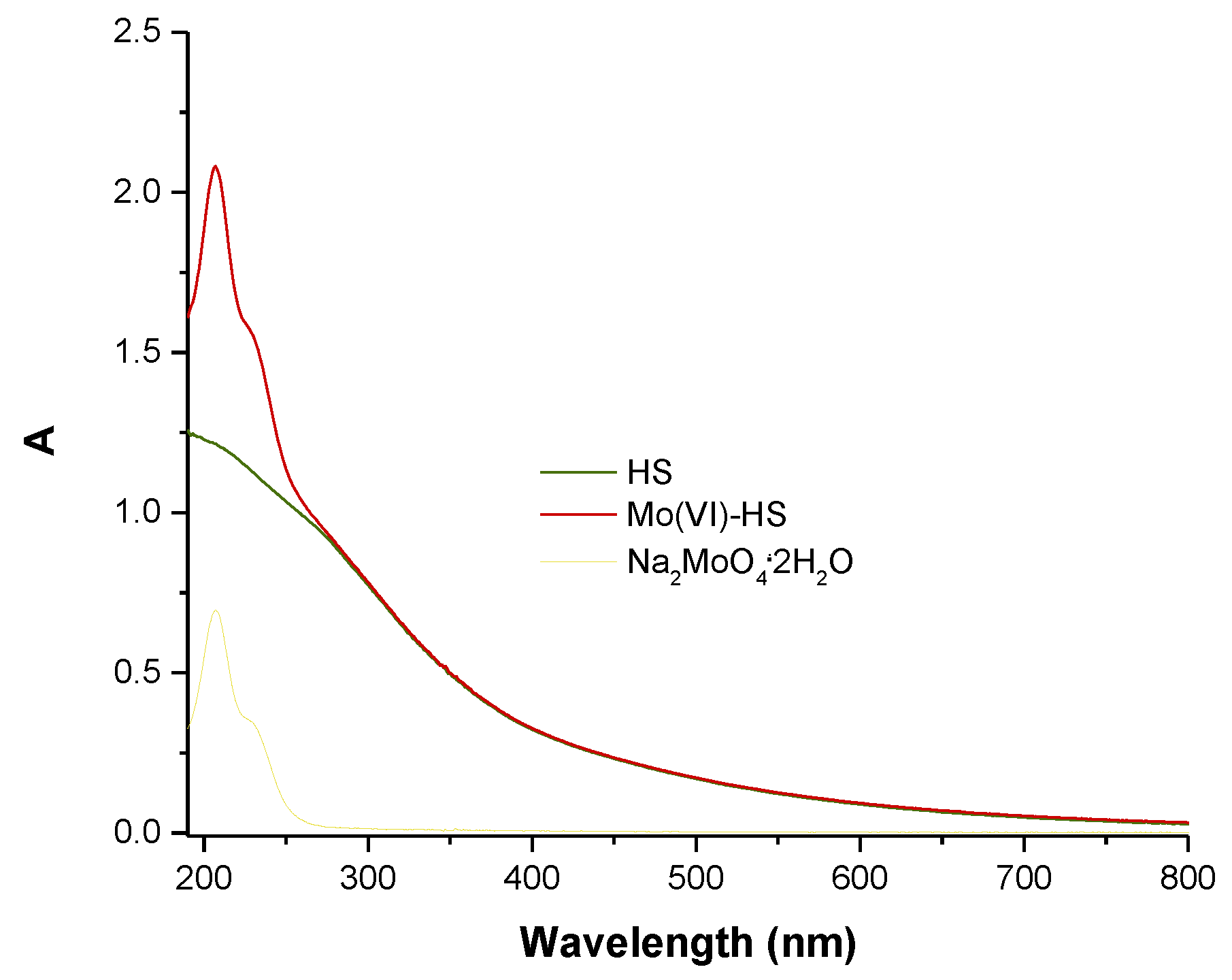
The UV-Vis spectra in Figure 1, recorded after adding Mo(VI) to the HS solution, offer clear evidence of the Mo(VI)–HS interactions. Significant spectral changes appear in the UV region (particularly below 280 nm), which include alterations in the relative intensities of the Mo(VI) doublet peaks, consistent with charge-transfer processes involving molybdate ions and humic molecules. The absence of any bands in the visible region of the spectra strongly suggests that reduction of Mo(VI) to Mo(V) does not occur under these conditions.
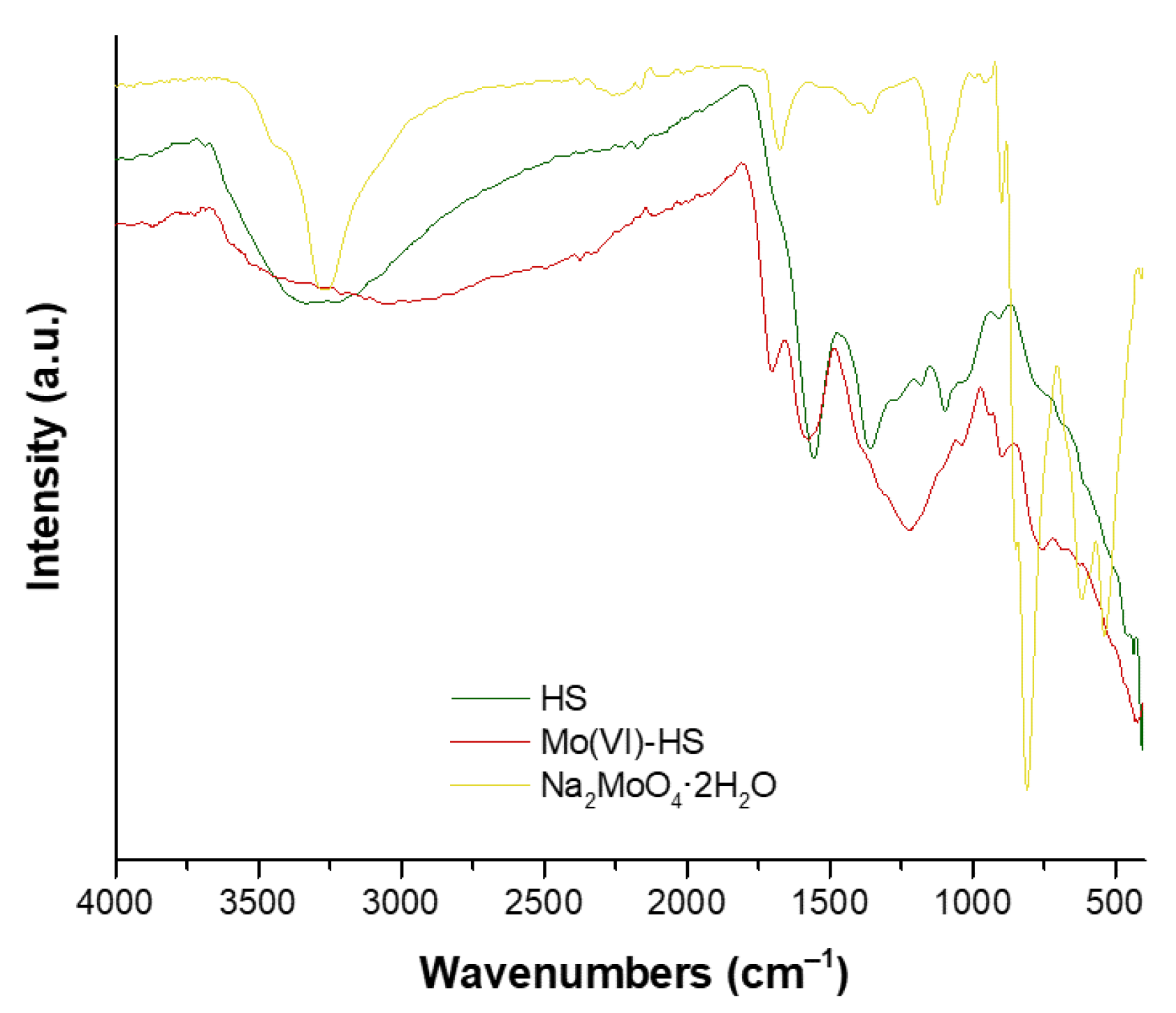
The FTIR spectra of the Mo(VI)–HS compounds (Figure 2) exhibit various alterations, the most important of which being those related to the hydroxylic and carboxylic groups. The decreased intensity near 3280 cm−1, where the phenolic and alcoholic O–H groups normally stretch [14,15], suggests that these groups play a key role in the Mo(VI)–HS association. Finally, the modifications in the shape and intensity of the 1560 and 1360 cm−1 bands—corresponding to the asymmetric and symmetric stretching of COO–, respectively [17,18]—support the involvement of the carboxylic groups in the metal–humic interactions.
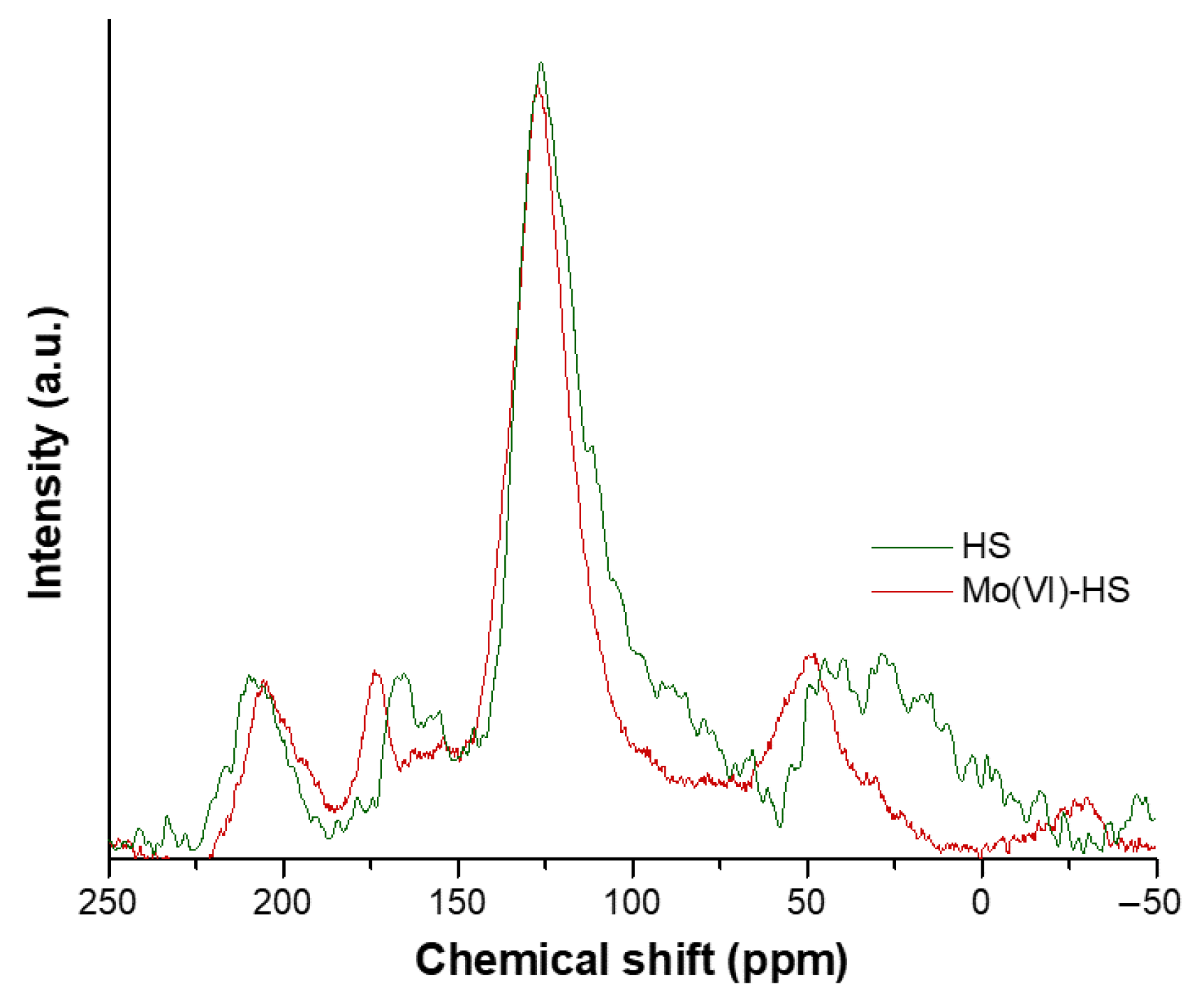
The Μο(VI)–HS association is further verified by the 13C CP/MAS NMR spectra shown in Figure 3. Structural fragment types were identified according to established chemical-shift ranges [19]. Following the addition of Mo(VI) to the HS solution, the major peaks corresponding to alkyl, aromatic and carboxyl carbons (0–46, 105–164 and 164–183 ppm, respectively) broaden and shift to higher field. Noticeable changes also occur in the quinone region (183–190 ppm); these spectral modifications indicate that carboxyl, hydroxyl and ketonic groups participate in the Mo(VI)–HS interactions.

3.2. Retention of Μο(IV) by HS

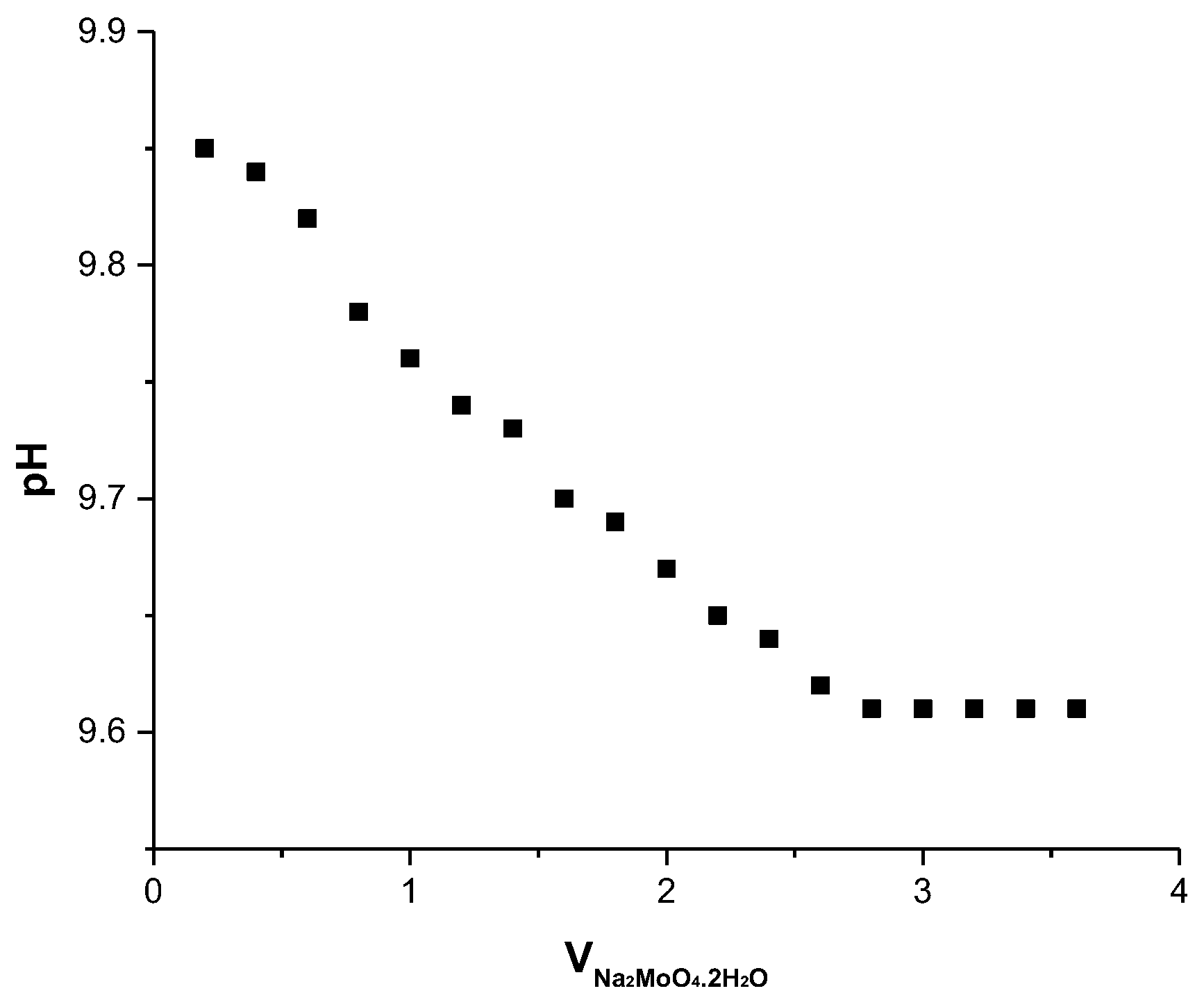
Besides the spectral changes, the addition of Mo(VI) ions to the humic substances solutions was accompanied by a pH decrease (Figure 4). Such pH changes are commonly associated with the formation of metal–humic complexes [20] via proton-releasing reactions.
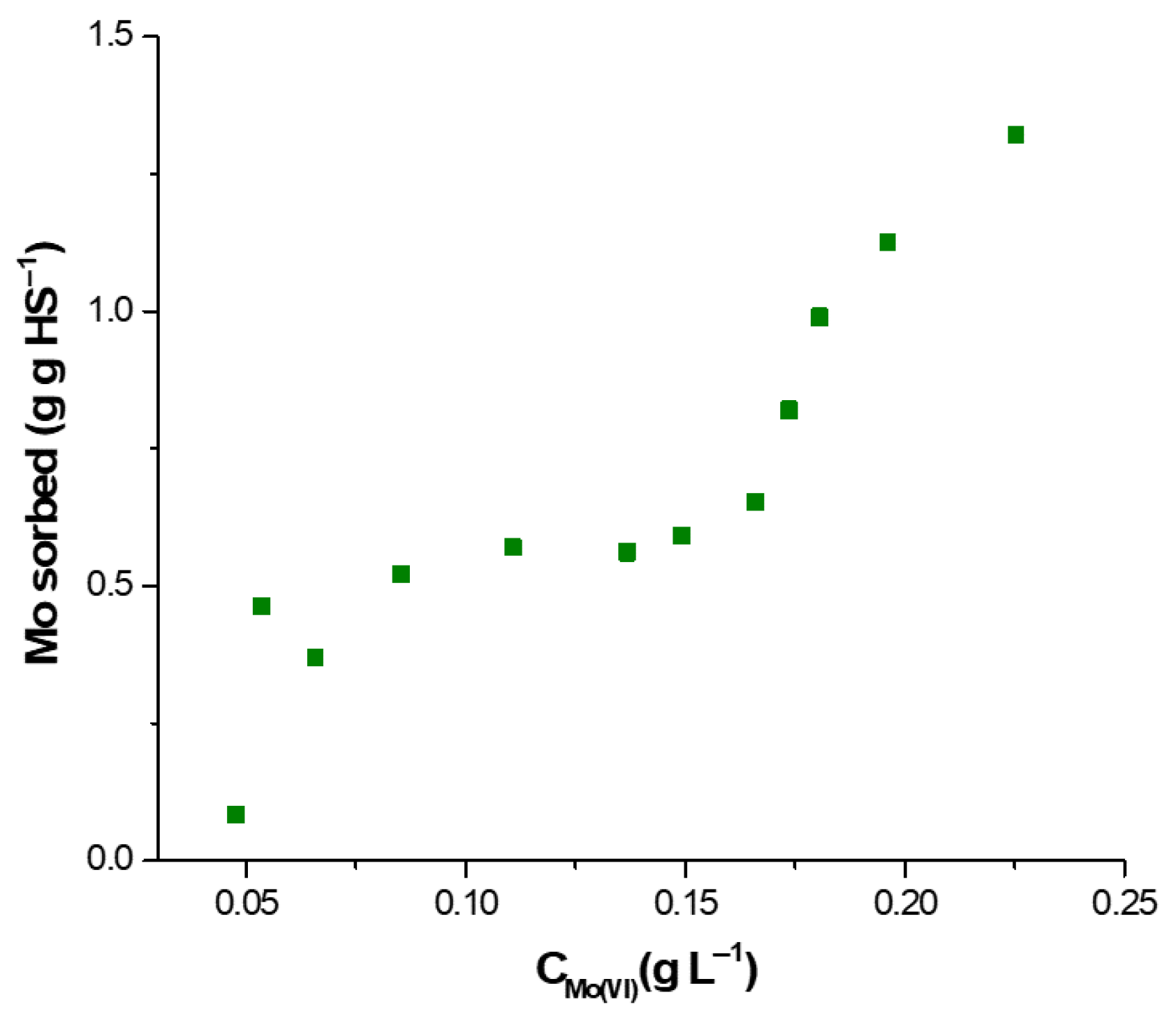
The values of equilibrium Mo(VI) content onto HS as a function of the equilibrium Mo(VI) concentration in solution are plotted in Figure 5. Such isotherms are classified as IV or L-type indicating multilayer adsorption in ionic substances with very strong intermolecular attraction [21]. These observations are also supported by the high quantities of Mo(VI) retained by HS (>1.3 g Mo g−1 HS).

4. Discussion

This study aims to evaluate the binding capacity of humic substances derived from Greek peaty lignite (leonardite) toward Mo(VI). Examining the Mo(VI)–HS association can help us understand nutrient cycling, soil chemistry and ecosystem health. Molybdenum is an essential trace element for both aquatic and terrestrial life. Being a component of enzymes (e.g., nitrogenase and nitrate reductase) Mo plays a crucial role in nitrogen metabolism, i.e., nitrogen fixation and assimilation. Even though Mo is required only in trace amounts, its availability in soil and water can strongly influence plant growth and agricultural productivity. In soil, molybdenum typically exists as the molybdate ion [22]. On this basis, given the largely beneficial effect of HS in both soils and plants, understanding the Mo(VI)–HS interactions is essential for predicting its mobility and bioavailability.
All spectroscopic techniques (UV-vis, FTIR and 13C CP/MAS NMR) employed to the study of the Mo(VI)–HS interactions revealed that HS obtained from Greek peaty lignite (leonardite) can complex Mo(VI) ions via their carboxyl, hydroxyl and ketonic groups. The exceptional property of HS to bind a wide range of metal ions forming metal–organic complexes of different stabilities and characteristics [23,24,25,26,27] has been attributed to the increased surface functionality of the heterogeneous macromolecular structure of HS. The Mo(VI)–HS compounds are most probably stabilized through a complex interplay of electrostatic interactions (following cation exchange), hydrogen bonding, and metal ion bridging. The carboxylic groups dissociate at pH values greater than three [28]. facilitating the Mo(VI)–HS binding.
The humic substances used in this study proved to be a highly effective adsorbent for Mo(VI), retaining more than 1.3 g Mo g−1 HS, exceeding the literature data [29]. The expansion of the molybdenum coordination sphere from four to six, forming octahedral complexes likely facilitates Mo retention by HS [29]. Another reason could be the increased surface functionality of Greek leonardite’s HS, an adsorbing material different from that previously studied [29]. As, firstly, HS are colloidal matrices with three-dimensional macromolecular networks capable of retaining Mo via complexation, electrostatic attraction, and physical entrapment and, secondly, Mo(VI) can act as a bridging metal center inducing rearrangement of the micellar HS into large supramolecular aggregates, which further enhance adsorption, the resulting adsorption capacity of our leonardite is superior. The second adsorption step in the type IV/L isotherm (Figure 5) may result from this macromolecular reorganization. Possible condensation of MoO42– into polyanions, which primarily occurs around pH 5 [30], is unlikely to account for the high adsorption rates observed in our dilute solutions at pH 3.5. Consequently, the measured retention likely reflects a combination of adsorption, complexation, aggregation, and precipitation phenomena within the heterogeneous humic matrix.
Beyond the agricultural relevance, the increased Mo adsorption by HS can also be significant for situations in which molybdate ions occur at elevated concentrations, where they may pose toxicity risks to animals or contaminate water supplies, and therefore need to be removed. The potential use of these low-rank coals in organomineral fertilization could enhance the economic and environmental perception of these raw materials.
The enhancement of plant growth in soils by humic substances has been largely attributed to their ability to solubilize micronutrients from their inorganic forms [31] (e.g., association with clays, oxides and (hydro)oxide colloids existing with the soil microaggregates). In this context, the presence of humic substances in soil solutions can improve the availability of essential elements. These observations contribute to the broader understanding of HS-mediated trace element dynamics and their role in sustainable agriculture.

5. Conclusions

Understanding the interactions between humic substances derived from Greek peaty lignite (leonardite) is the primary objective of this study. The results indicated that HS exhibit a high capacity to bind Mo(VI), retaining more than 1.3 g Mo g−1. Spectroscopic analyses (UV-vis, FTIR and 13C CP/MAS NMR) revealed that Mo(VI) complexation occurs primarily through carboxyl, hydroxyl and ketonic functional groups. The Mo(VI)–HS compounds are stabilized by a combination of electrostatic interactions, hydrogen bonding and metal-ion bridging (possibly covalent bonding).
Beyond their strong affinity for Mo(VI), these results reinforce the broader role of these HS in regulating trace-element mobility and bioavailability in soils achieving improved nutrient accessibility, thus supporting sustainable agricultural practices.
Overall, these findings provide new insights into Mo(VI)–HS interactions and underscore the dual agronomic and environmental significance of humic substances from Greek peaty lignite (leonardite) as natural complexing agents.

Author Contributions

Conceptualization, M.R. and K.C.; methodology, M.R.; validation, M.R. and K.C.; investigation, K.C.; resources, K.C.; data curation, M.R. and K.C.; writing—original draft preparation, M.R.; writing—review and editing, M.R.; visualization, M.R. and K.C.; supervision, M.R. All authors have read and agreed to the published version of the manuscript.

Funding

This research received no external funding.

Institutional Review Board Statement

Not applicable.

Informed Consent Statement

Not applicable.

Data Availability Statement

Data is contained within the article.

Acknowledgments

M.R. wishes to thank Antigoni Cheilari for the acquisition of the NMR spectra.

Conflicts of Interest

The authors declare no conflicts of interest.

References

  1. Clapp, C.E.; Hayes, M.H.B.; Senesi, N.; Bloom, P.R.; Jardine, P.M. Humic Substances and Chemical Contaminants; Clapp, C.E., Ed.; SSSA: Madison, WI, USA, 2001. [Google Scholar]
  2. Roulia, M. Humic Substances: A Novel Eco-Friendly Fertilizer. Agronomy 2022, 12, 754. [Google Scholar] [CrossRef]
  3. Hayes, M.H.B.; Roulia, M. Relevance of Organic Matter Compositions, Structures and Associations to Soil Aggregates and to Sustainable Productivity. Agronomy 2025, 15, 2182. [Google Scholar] [CrossRef]
  4. Zandonadi, D.B.; Monda, H.; Gralian, J.; James, A.; Lamar, R.T.; Santos, M.P. Humic acids as drivers of plant growth: Regulating root development and photobiology through redox modulation. Chem. Biol. Technol. Agric. 2025, 12, 71. [Google Scholar] [CrossRef]
  5. Lu, N.; Zhao, T.; Hong, C.; Yao, Y.; Zhu, W.; Hong, L.; Zhang, T.; Xu, H.; Wang, K.; Ding, C.; et al. Housefly larva bioconversion enhances heavy metal stabilization and antibiotic degradation during chicken manure composting. Sci. Rep. 2025, 15, 25736. [Google Scholar] [CrossRef]
  6. Song, K.; Xiao, Y.; Wang, Y.; Deng, M.; Zhou, S.; Huang, Y.; Yeerken, S.; Li, L.; Wu, F. Electron shuttling promotes denitrification and mitigates nitrous oxide emissions in lakes. Nat. Commun. 2025, 16, 8564. [Google Scholar] [CrossRef]
  7. McGrath, S.P.; Micó, C.; Zhao, F.J.; Stroud, J.L.; Zhang, H.; Fozard, S. Predicting molybdenum toxicity to higher plants: Estimation of toxicity threshold values. Environ. Pollut. 2010, 158, 3085–3094. [Google Scholar] [CrossRef]
  8. Kaiser, B.N.; Gridley, K.L.; Ngaire Brady, J.; Phillips, T.; Tyerman, S.D. The Role of Molybdenum in Agricultural Plant Production. Ann. Bot. 2005, 96, 745–754. [Google Scholar] [CrossRef]
  9. Gustafsson, J.P.; Tiberg, C. Molybdenum binding to soil constituents in acid soils: An XAS and modelling study. Chem. Geol. 2015, 417, 279–288. [Google Scholar] [CrossRef]
  10. Mendel, R.R. Molybdenum: Biological activity and metabolism. Dalton Trans. 2005, 21, 3404–3409. [Google Scholar] [CrossRef]
  11. Chassapis, K.; Roulia, M. Evaluation of low-rank coals as raw material for Fe and Ca organomineral fertilizer using a new EDXRF method. Int. J. Coal Geol. 2008, 75, 185–188. [Google Scholar] [CrossRef]
  12. Chassapis, K.; Roulia, M.; Tsirigoti, D. Chemistry of metal–humic complexes contained in Megalopolis lignite and potential application in modern organomineral fertilization. Int. J. Coal Geol. 2009, 78, 288–295. [Google Scholar] [CrossRef]
  13. Chassapis, K.; Roulia, M.; Nika, G. Fe(III)–humate complexes from Megalopolis peaty lignite: A novel eco-friendly fertilizer. Fuel 2010, 89, 1480–1484. [Google Scholar] [CrossRef]
  14. Roulia, M.; Kontezaki, E.; Kalogeropoulos, N.; Chassapis, K. One step bioremediation of olive-oil-mill waste by organoinorganic catalyst for humics-rich soil conditioner production. Agronomy 2021, 11, 1114. [Google Scholar] [CrossRef]
  15. Schnitzer, M.; Skinner, S.I.M. Akali versus acid extraction of soil organic matter. Soil Sci. 1968, 105, 392–396. [Google Scholar] [CrossRef]
  16. Calace, N.; Deriu, D.; Petronio, B.M.; Pietroletti, M. Adsorption isotherms and breakthrough curves to study how humic acids influence heavy metal–soil interactions. Water Air Soil Pollut. 2009, 204, 373–383. [Google Scholar] [CrossRef]
  17. Karpukhina, E.; Mikheev, I.; Perminova, I.; Volkov, D.; Proskurnin, M. Rapid quantification of humic components in concentrated humate fertilizer solutions by FTIR spectroscopy. J. Soil Sediment 2019, 19, 2729–2739. [Google Scholar] [CrossRef]
  18. Roulia, M.; Vassiliadis, A.A. Water Purification by Potassium Humate–C.I. Basic Blue 3 Adsorption-Based Interactions. Agronomy 2021, 11, 1625. [Google Scholar] [CrossRef]
  19. Polyakov, V.; Nizamutdinov, T.; Abakumov, E. Molecular Composition of Humic Acids of Different Aged Fallow Lands and Soils of Different Types of Use in Northwest of Russia. Agronomy 2024, 14, 996. [Google Scholar] [CrossRef]
  20. Schnitzer, M.; Khan, S.U. Humic Substances in the Environment; Marcel Dekker, Inc.: New York, NY, USA, 1972. [Google Scholar]
  21. Giles, C.H.; MacEwan, T.H.; Nakhwa, S.N.; Smith, D. Studies in adsorption. Part XI. A system of classification of solution adsorption isotherms, and its use in diagnosis of adsorption mechanisms and in measurement of specific surface areas of solids. J. Chem. Soc. 1960, 5, 3973–3993. [Google Scholar] [CrossRef]
  22. Kabata-Pendias, A. Trace Elements in Soils and Plants, 4th ed.; CRC Press: Boca Raton, FL, USA, 2010. [Google Scholar]
  23. Piccolo, A.; Stevenson, F.J. Infrared spectra of Cu2+ Pb2+ and Ca2+ complexes of soil humic substances. Geoderma 1982, 27, 195–208. [Google Scholar] [CrossRef]
  24. Nakayama, K.; Hung, M.-C.; Chiu, C.-Y.; Tang, S.-L.; Hsueh, M.-L.; Wu, C.-C.; Hung, I.-H.; Liu, Y.-H.; Tsai, J.-W. Optical properties of dissolved organic matter play pivotal roles in mediating trace metal forms in a mangrove-dominated tidal estuary. Mar. Pollut. Bull. 2026, 222, 118594. [Google Scholar] [CrossRef]
  25. Husain, M.A.; Scheinost, A.C.; Biswas, A. Dissolved organic matter oxidizes ferrous iron and forms colloidal ternary complexes with arsenic via ferric iron bridging in water under anoxic conditions. Geochim. Cosmochim. Acta 2026, 413, 122–137. [Google Scholar] [CrossRef]
  26. Yuan, Y.; Wu, B.; Wang, Z.; Xiao, X.; Liu, Y.; Zhang, B.; Chen, T.; Ma, Y.; Yang, T. Self-assembled metal oxide (FeOX/MnOX)-synthetic humic-like acid composites enhance heavy metal immobilization and differentially reshape bacterial and fungal communities in metal-contaminated agricultural soil. J. Hazard. Mater. 2026, 501, 140778. [Google Scholar] [CrossRef]
  27. Abbad, N.; Redon, R.; Aouiz, A.; Chebahi, N.; Bounoughaz, M.; Boulahdid, M.; Mounier, S. Complexation of Eu, Tb, and Dy with Standard Organic Matter Using Fluorescence Quenching: pH Dependence. ACS EST Water 2025, 12, 7340–7351. [Google Scholar] [CrossRef]
  28. Sheng, G.-P.; Zhang, M.-L.; Yu, H.-Q. A rapid quantitative method for humic substances determination in natural waters. Anal. Chim. Acta 2007, 592, 162–167. [Google Scholar] [CrossRef]
  29. Bibak, A.; Borggaard, O.K. Molybdenum adsorption by aluminum and iron oxides and humic acid. Soil Sci. 1994, 158, 323–328. [Google Scholar] [CrossRef]
  30. Housecroft, C.E.; Sharpe, A.G. Inorganic Chemistry, 5th ed.; Pearson: London, UK, 2018. [Google Scholar]
  31. Chen, Y.; Aviad, T. Effects of humic substances on plant growth. In Humic Sub-Stances in Soil and Crop Sciences; ASA-SSSA: Madison, WI, USA, 1990; pp. 161–186. [Google Scholar]
Figure 1. UV-vis spectra of the HS, Mo(VI), and Mo(VI)-HS solutions.
Blsf 57 00008 g001
Figure 2. FTIR spectra demonstrating the changes in the Mo(VI)-HS spectrum compared with those of the parent Mo(VI) and HS.
Blsf 57 00008 g002
Figure 3. Comparative HS and Mo(VI)-HS 13C CP/MAS NMR spectra.
Blsf 57 00008 g003
Figure 4. Changes in the pH during addition of Na2MoO4·2H2O to a HS solution (0.1% w/v).
Blsf 57 00008 g004
Figure 5. Adsorption isotherm of Mo(VI) onto HS.
Blsf 57 00008 g005
Disclaimer/Publisher’s Note: The statements, opinions and data contained in all publications are solely those of the individual author(s) and contributor(s) and not of MDPI and/or the editor(s). MDPI and/or the editor(s) disclaim responsibility for any injury to people or property resulting from any ideas, methods, instructions or products referred to in the content.