Proceeding Paper

Use of Agro-Industrial Biomasses as a Strategy to Increase the Sustainable Bioeconomy in the Amazon †

by
Orquidea Vasconcelos dos Santos
1,2,3,*,
Helen Cristina de Oliveira Palheta
2,
Jade Vitória Duarte de Carvalho
2,
Railanni dos Santos Cantão
3,
Andrei de Oliveira Ramos
3,
Amanda Ramos Soares
3 and
Mayara Galvão Martins
4
1
Graduate Program in Nutrition in the Amazon, Institute of Health Sciences, Federal University of Pará, Belém 66075-110, PA, Brazil
2
Graduate Program in Food Science and Technology, Institute of Technology, Federal University of Pará, Belém 66075-110, PA, Brazil
3
Institute of Health Sciences, Faculty of Nutrition, Federal University of Pará, Belém 66075-110, PA, Brazil
4
Instituto Mamirauá de desenvolvimento Sustentável, Tefé 69553-225, AM, Brazil
*
Author to whom correspondence should be addressed.
Presented at the 6th International Electronic Conference on Foods, 28–30 October 2025; Available online: https://sciforum.net/event/foods2025.
Biol. Life Sci. Forum 2026, 56(1), 20; https://doi.org/10.3390/blsf2026056020
Published: 24 February 2026
(This article belongs to the Proceedings of The 6th International Electronic Conference on Foods)

Abstract

Biomasses from agro-industrial practices in the Amazon have generated significant inputs in the last decade for the development of projects and the extension of more sustainable production chains, based on the results of research on both laboratory and pilot scales, and from the rapid expansion in industrial scaling. The rise in the use of biomass includes the use of raw materials from so-called superfruits, notable examples of which include açaí (Euterpe oleracea Mart.), Brazil nut (Bertholletia excelsa HBK), pupunha (Bactris gasipaes Kunth), tucumã (Astrocaryum aculeatum) and buriti (Mauritia flexuosa). All of these are of great importance to the trade balance of the Amazon region, contributing significantly to the import of products and by-products from Brazil. In view of the above, this research aims to present the nutritional, functional and technological properties of these biomasses as a contribution to industrial innovation in the use of isolated constituents in various segments of the food, pharmaceutical, dermocosmetic and packaging industries. The data show that research into the protein, fibrous and starch-based biopolymers contained in these biomasses has been guided and deepened, with an emphasis on investigations in isolation and on applications of bioactive compounds and starches and fibers in the development of films and packaging with good resistance properties and high environmental biodegradability, these being economically viable as food coatings, acting in synergy with the application of technologies and the increase in the sustainable circular bioeconomy in the Amazon, combining techno-economic and environmental development in the most diverse industrial sectors.

1. Introduction

Global strategies for sustainable development, as outlined in Agenda 2030, provide guidelines addressing the challenges of global growth, climate change, socioeconomic equity, food security, poverty eradication, and the relationship between economic development and environmental sustainability, based on the bioeconomy and the use of green technologies as strategies to reduce the impact of increasing industrialization on the environment [1,2].
In this sense, Brazil is recognized as one of the main countries in rapid agro-industrial expansion, being one of the largest producers and importers of food in the world. Its unique trajectory of agricultural development brings with it a directly proportional increase in the generation of agro-industrial waste (biomass) resulting from the application of increasingly advanced technologies in food processing. In the industrial sector, this creates a tension between the need for economic development and for environmental, social, and economic sustainability in waste management [1,3].
One of the regions of Brazil with the greatest potential is the Amazon, recognized as the largest tropical rainforest in the world, with native vegetation occupying 78.2% of its total area and boasting a vast diversity of native and exotic fauna and flora. This breadth of biodiversity encompasses an average of 15,000 tree species, of which 2956 are endemic, offering potential biomass sources with a range of promising applications in different industrial segments [4,5].
Biomass production in the Amazon region averages 174 tons per hectare, reaching peaks of up to 518 tons per hectare in preserved areas. This generates a stratified economic potential in direct production as well as environmental benefits with a value of approximately R $12 billion annually, with projections for sustainable products suggesting an increase in a range between R $38.5 billion and R $40 billion [4,5].
Symbiosis between these aspects is possible in many sectors, with implementation of agro-industrial techniques that extend production chains, along with a differentiated approach to millions of tons of waste with minimal or zero value but which can form the basis for processing of secondary plant raw materials (by-products and waste without a defined market), thus promoting extension of the food production chain in a more sustainable way [2,6].
The incorporation of “new raw materials” applicable to the design of new products with diverse industrial applications is a highlight in the production scales of cyclical chains. The inclusion of new items in the production cycle can be observed in the development of biodegradable packaging and films, protein isolates and concentrates, natural dyes, antimicrobial extracts, essential oils, fibrous components and others. These items are applicable in various industrial segments, including food, chemicals, pharmaceuticals, dermocosmetics, nutraceuticals, biorefineries, and biofuels, promoting synergy with the concept of a circular bioeconomy [2,3,6].
The definition of bioeconomy is constantly expanding, based on the three pillars of biotechnology, bioresources, and bioecology. These are the foundations for the most harmonious possible existence of economic development and environmentally sustainable production. This research focuses on a brief discussion of the possibilities of applying biomass from examples of Amazonian fruit biodiversity as a tool for enhancing production chains and a sustainable circular bioeconomy. Such biomass is applicable to the production of products with reduced environmental impact, based on the principles of the new Brazilian reverse logistics legislation [7].

2. Legal Framework: Reverse Logistics

The legal framework addressing pollution in the Amazon has been strengthened by Brazil’s regulation of a reverse logistics system for plastic packaging. This system sets legally binding reduction and recycling targets and deadlines beginning in 2026, requiring mandatory collection and recycling of at least 32% of all single-use plastic packaging and materials, with targets scaling to over 50% by 2040.
In this regard, incentives promote the use of recycled content in new plastics, mandating a minimum recycled material share of 22% in 2026, increasing to 40% by 2040 [7]. The initiative also defines additional objectives with significant socio-environmental and economic implications; these include the following:
  • Improve infrastructure with logistical enhancements for the collection of plastic packaging;
  • Improve the link between recycling production chains and packaging producers;
  • Encourage the use of materials with a lower environmental impact in packaging production;
  • Enhance ecodesign with the production of reusable, recyclable, and returnable packaging;
  • Encourage the market to replace fossil-based packaging with packaging produced from recycled materials;
  • Strengthen joint action between cooperatives and associations of recyclable material collectors, intensifying improvements in working conditions and infrastructure;
  • Promote and encourage production models with growth in the supply chain within the circular bioeconomy.
A sustainable circular bioeconomy is a fundamental strategic tool for addressing the challenges that arise in the pursuit of promoting synergy between development and the economy with minimal environmental impacts, while at the same time mitigating food insecurity and strengthening the transition to more sustainable economies, in line with the United Nations Sustainable Development Goals (SDGs), through the implementation of practical actions that combine sustainability and technological innovation, with the aim of reducing the need for fossil fuels while promoting an increase in resources from renewable natural sources that promote sustainability and strengthen the circular bioeconomy.
In line with global environmental regulations, there is an urgent need to develop new stages in the production chain, such as the application of waste and/or biomass as a base raw material for the development of new “second-generation” products with high added value. This can increase expansion in bioeconomic segments while promoting greater sustainability, adding more value to other constituents that were previously discarded as waste or as generated environmental contaminants [2,3,6].
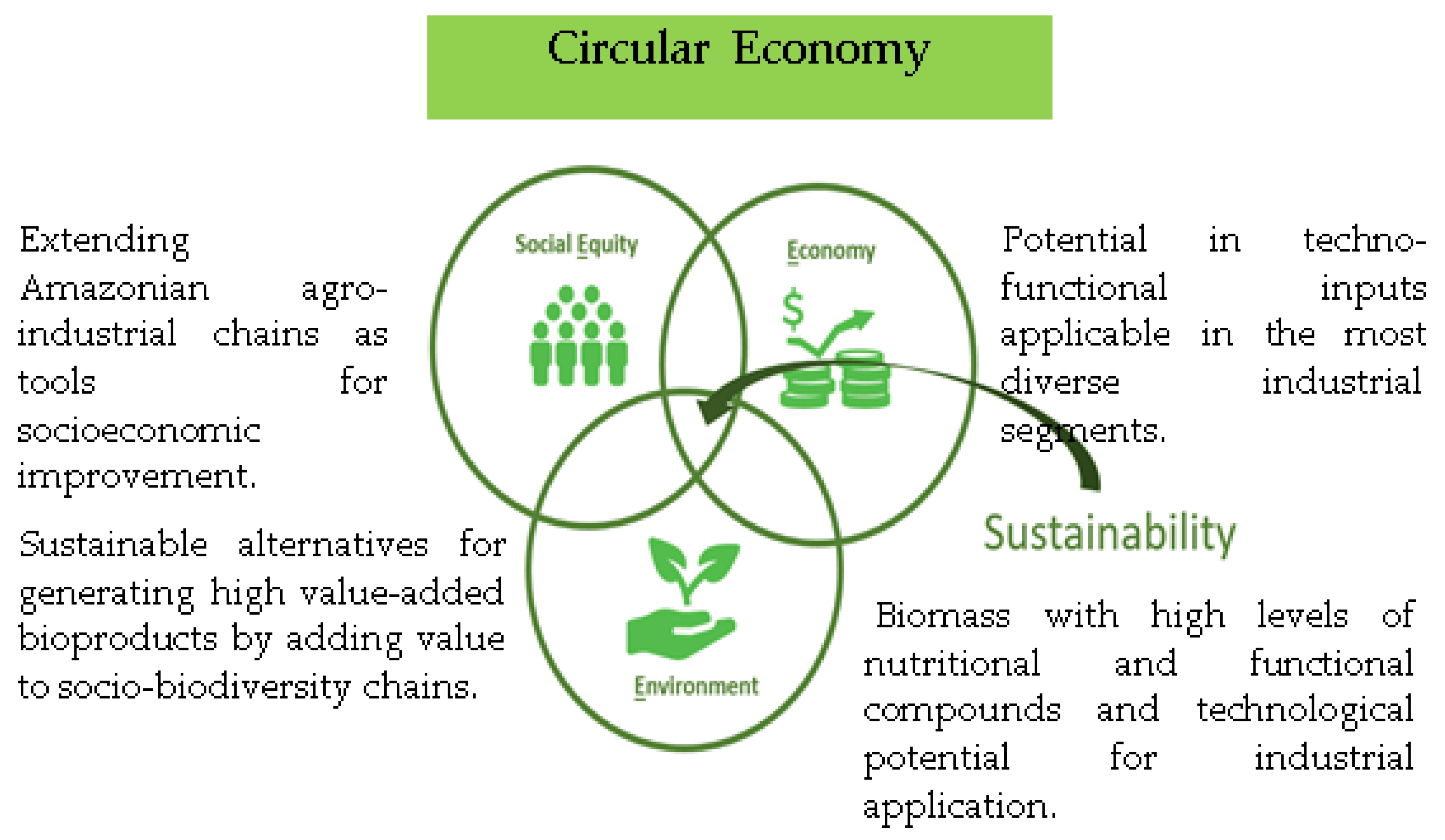
These practices have been paramount in generating new raw materials applicable to new product designs or eco-designs, particularly in sectors such as food, chemicals, pharmaceuticals, dermocosmetics, nutraceuticals, biorefineries, and biofuels, amongst others. Figure 1 summarizes aspects of the use of Amazon biomass related to the circular bioeconomy.
In observing the circular bioeconomy cycle based on extending the product chain, the application of by-products in favor of more sustainable industrial development is being driven by research and practices on a national and international scale. Given the vast biodiversity of the Amazon, the potential for industrial scaling should be better explored, with studies and initiatives to date having been quite fragmented.
In this context, exploring an extension of the production chain based on biomass from Amazonian fruits is a promising strategy. This approach not only optimizes sustainable management and economic gains but also mitigates environmental damage by reducing dependence on non-renewable resources, additionally combating food insecurity [1,5,6].
Among the raw materials with high potential for this application, species with significant protein content stand out; these include Brazil nut (Bertholetia excelsa HBK), sapucaia (Lecythis pisonis), and andiroba (Carapa guianensis Aublet). These resources are fundamental to producing concentrations and isolations in the food and nutraceutical industries, in addition to enabling the production of biodegradable functional films [6,8]. Table 1 presents additional examples of biomasses rich in cellulose, fibers, and bioactive compounds with antioxidant and anti-inflammatory properties.
The studies presented in Table 1 exemplify academic research into raw materials with high potential for industrial scaling, this potential deriving especially from the richness of their by-products and biomasses. Highlights include the development of biodegradable films from babassu [10] and peach palm [21] flours, as well as the isolation of bioactive compounds such as carotenoids (tucumã and peach palm) and anthocyanins (açaí) which already have consolidated applications in the pharmaceutical industry.
In addition, use of these biomasses emerges as a crucial strategy to mitigate contamination by fossil-based plastics. A practical example is the Bioplastics project, based in the Amazon and developed by World-Transforming Technologies (WTT), which converts waste from the Brazil nut chain into commercial bioplastics. Initiatives like this align with the projections of European Bioplastics (2025) [25], which forecasts a jump in global production from 2.47 million tons in 2024 to 5.73 million in 2029. This growth reflects a global trend of replacing fossil polymers with renewable and biodegradable sources, consolidating Amazonian biomasses as strategic environmental alternatives [26].
The diversification in the use of biomass from Amazonian fruit farming, combined with the isolation of constituents with high functional value, has driven the development of biocomposites for the medical and dermocosmetic industries. Furthermore, these residues show high potential as substrates for edible fungi and for insect nutrition. Simultaneously, there is a strong trend towards their application in the generation of biofuels and bioenergy, consolidating them as renewable raw materials with an excellent cost-benefit ratio.
The new sources of high value-added compounds, bioactive components, and biopolymers derived from biomass from the Amazonian fruit agro-industry are aligned with the principles of the circular bioeconomy and the Sustainable Development Goals (SDGs), with direct relevance to Goal 2 (Zero Hunger and Sustainable Agriculture), Goal 8 (Decent Work and Economic Growth), Goal 9 (Industry, Innovation and Infrastructure), Goal 11 (Sustainable Cities and Communities), Goal 12 (Responsible Consumption and Production), Goal 13 (Climate Action), Goal 15 (Life on Land) and Goal 17 (Partnerships for the Means of Implementation for Sustainable Development), and indirect relevance to the other goals aimed at strengthening the local bioeconomy and promoting sustainable practices [27].

3. Future Perspectives

Implementing the integrated actions of Agenda 2030 for Sustainable Development requires operationalizing multiple research and technology sectors and scaling research outcomes to industry.
One broadly applicable approach is green chemistry, founded on biodiversity, biotechnology, and the conversion of plant-based feedstocks into bioproducts. Also applicable are foundations in nanotechnology, nanostructured materials, and nanocomposites, along with the emerging use of plant-derived materials with 3D printing to produce edible items, packaging, and biodegradable films while minimizing toxic chemical inputs. Such strategies extend value chains by transforming residual fruit biomass into higher value-added bioproducts.
The evolution of these technological bases using plant-based raw materials adds new properties to new sectors by promoting the union of primary and secondary metabolic components, increasing their functionality in the incorporation of bioactive compounds such as anti-inflammatories, antioxidants, antimicrobials, and nutraceuticals; promoting improved benefits in health and the environment; enhancing food preservation; and improving the sensory attributes of packaged products.
In the Amazon region, expansion in the use of green chemistry bases, technologies, and nanotechnologies using biomass as raw materials leads to an increase in production chains, encouraging a sustainable bioeconomy, minimizing dependence on unsustainable conventional raw materials, increasing and enriching the socioeconomic relations of the region, and strengthening the foundations of a sustainable circular bioeconomy on all fronts.

Author Contributions

O.V.d.S., conceptualization, validation, investigation, data curation, supervision, project administration, funding acquisition, writing—original draft preparation; M.G.M., H.C.d.O.P. and J.V.D.d.C., methodology, validation, investigation, data curation, writing—original draft preparation; R.d.S.C., A.d.O.R. and A.R.S., investigation, data curation, writing—review and editing. All authors have read and agreed to the published version of the manuscript.

Funding

The authors acknowledge the financial support Coordination for the Improvement of Higher Education Personnel (CAPES) for Helen Cristina de Oliveira Palheta (process no. 88887.146002/2025-00) and Jade Vitória Duarte de Carvalho (process no. 88887.958621/2024-00).

Institutional Review Board Statement

Not applicable.

Data Availability Statement

Data sharing is not applicable.

Conflicts of Interest

The authors declare no conflicts of interest.

References

  1. Boruah, B.; Ray, S. Emerging techniques for valorization of fruit processing waste and sustainable utilization: A review. Food Hum. 2025, 5, 100920. [Google Scholar] [CrossRef]
  2. Himanshu, K.N.; Khangwa, I. Functional attributes and bio-prospects of fruit peel waste. Foods Raw Mater. 2026, 14, 84–103. [Google Scholar] [CrossRef]
  3. Capaldi, G.; Binello, A.; Aimone, C.; Mantegna, S.; Grillo, G.; Cravotto, G. New trends in extraction-process intensification: Hybrid and sequential green Technologies. Ind. Crops Prod. 2024, 209, 117906. [Google Scholar] [CrossRef]
  4. Silveira, P.H.P.M.; Cardoso, B.F.A.F.; Marchi, B.Z.; Monteiro, S.N. Amazon natural fibers for application in engineering composites and sustainable actions: A review. Eng 2024, 5, 133–179. [Google Scholar] [CrossRef]
  5. Silva, B.C.; Canelas, C.A.A.; Matos, A.T.; Rezende, R.A.; Dutra, J.C.F.; Reis, M.A.L.; Xavier-Junior, F.H.; Eiro-Quirino, L.; Passos, M.F. Revolutionizing sustainable materials: Amazonian fibers as raw material for generating of nanocelulose. Cellulose 2025, 32, 5361–5387. [Google Scholar] [CrossRef]
  6. Hermino, V.L.Q.; Silva, E.P.; de Abreu, E.R.; Mota, D.N.; Neves, S.M.; Torres, V.G.S.; Freitas, F.A.; Pereira, J.N. Use of agro-industrial waste from the processing of oilseeds and Amazonian fruits. Food Sci. Technol. 2025, 45, e00352. [Google Scholar] [CrossRef]
  7. Brasil, Decreto lei nº 12.688, de 21 de Outubro de 2025. Diário Oficial da União. Regulamenta e Institui o Sistema de Logística Reversa de Embalagens de Plástico. Available online: https://www.planalto.gov.br/ccivil_03/_Ato2023-2026/2025/Decreto/D12688.htm (accessed on 13 September 2025).
  8. Monteiro, A.R.; Battisti, A.P.; Valencia, G.A.; Andrade, C.J. The Production of High-Added-Value Bioproducts from Non-Conventional Biomasses: An Overview. Biomass 2023, 3, 123–137. [Google Scholar] [CrossRef]
  9. Silva, D.W.; Batista, F.G.; Scatolino, M.V.; Mascarenhas, A.R.P.; De Medeiros, D.T.; Tonoli, G.H.D.; Alves Junior, F.T. Developing a Biodegradable Film for Packaging with Lignocellulosic Materials from the Amazonian Biodiversity. Polymers 2023, 15, 3646. [Google Scholar] [CrossRef] [PubMed]
  10. Silva, L.R.C.; França, R.A.; Silva, R.N.; Alves, T.S.; Barbosa, R.; Rios, A.O.; Silva, Y.C.; Dias, D.; Pereira, L.F.R.; Pereira, C.V.L.; et al. Enhancing the Extraction of Phenolic Antioxidants from Amazonian Assai (Euterpe oleracea Martius) Fruit Waste Through Response Surface Methodology Optimization. Biomass 2024, 4, 402–413. [Google Scholar] [CrossRef]
  11. Santos, O.V.; Lemos, Y.S.; Conceição, L.R.V.; Teixeira-Costa, B.E. Lipids from the purple and white açaí (Euterpe oleracea Mart) varieties: Nutritional, functional, and physicochemical properties. Front. Nutr. 2024, 11, 1385877. [Google Scholar] [CrossRef] [PubMed]
  12. Santos, K.I.P.; Pinheiro, W.B.S.; Silva, R.C.; Botelho, A.S.; Araújo, L.A.; Caldas, I.F.R. Use of Carapa guianensis Aubl. agro-industrial waste as analternative for obtaining bioproducts. Comptes Rendus Chim. 2025, 28, 439–450. [Google Scholar] [CrossRef]
  13. Alves, E.S.; Graça, M.P.F.; Amaral, F.M.B.; Macêdo, A.A.M. Biodegradable Fruit and Vegetable-Based Films: Preparation and Characterization. In International Conference on Spectroscopy in Materials Science; Springer: Singapore, 2025; Volume 422, pp. 62–71. [Google Scholar] [CrossRef]
  14. Rojas-Bringas, P.M.; De-la-Torre, G.E.; Torres, F.G. Influence of the source of starch and plasticizers on the environmental burden of starch-Brazil nut fiber biocomposite production: A life cycle assessment approach. Sci. Total Environ. 2021, 769, 144869. [Google Scholar] [CrossRef]
  15. Santos, O.V.; Azevedo, G.O.; Santos, Â.C.; Lopes, A.S. Development of a Nutraceutical Product Derived from By-Products of the Lipid Extraction of the Brazil Nut (Bertolletia excelsa H.B.K). Foods 2023, 12, 1446. [Google Scholar] [CrossRef]
  16. Rosa, A.P.; Dockhorn, S.; Magnani, L.; Sugui, M.M.; Sinhorin, V.D.G. Avaliação antioxidante e mutagênica do extrato aquoso de cupuaçu em animais expostosa ciclofosfamida. Sci. Electron. Arch. 2023, 16, 34–42. [Google Scholar] [CrossRef]
  17. Mercês, Z.C.; Salvadori, N.M.; Cochlar, T.B.; Evangelista, S.M.; Lima, R.G.H.; Oliveira, V.R. Cupuaçu into Cupulate: Agronomic, Chemical, Sensory, Sustainable Approaches and Opportunities for New Food. J. Culin. Sci. Technol. 2025, 24, 33–48. [Google Scholar] [CrossRef]
  18. Batista, B.N.; Correia, A.C.; Jord, A.M.; Albuquerque, P.M. Fermented Beverages from Amazonian Fruits: Nutritional Characteristics and Bioactive Compounds. Beverages 2025, 11, 152. [Google Scholar] [CrossRef]
  19. Melo, R.P.F.; Silva, N.C.; Moreira, R.C.; Teixeira, R.H.F.; Rostagno, M.A.; Efraim, P.; Godoy, H.T.; Steel, C.J.; Bicas, J.L.; Martínez, J. Supercritical Fluid and Pressurized Liquid Extraction of Bioactive Compounds from Guarana (Paullinia cupana) Byproducts. Food Sci. Technol. 2025, 5, 3180–3190. [Google Scholar] [CrossRef]
  20. Costa, R.S.; Alves, T.V.G.; Silva, R.L.; Ferreira, L.M.M.C.; Costa, R.M.R.; Silva, J.O.C. Agro-industrial By-Products from Amazonian Fruits: Use for Obtaining Bioproducts. In Bioactive Compounds in Nutraceutical and Functional Food for Good Human Health; Intech Open: London, UK, 2021; pp. 1–21. [Google Scholar] [CrossRef]
  21. Costa, R.D.S.; Flores, S.H.; Brandelli, A.; Vargas, C.G.; Ritter, A.C.; Rodrigues, A.M.C.; Da Silva, L.H.M. Development and properties of biodegradable film from peach palm (Bactris gasipaes). Food Res. Technol. 2023, 173, 113172. [Google Scholar] [CrossRef]
  22. Rosário, R.C.; Pires, M.B.; Nascimento, F.C.A.; Costa, R.M.R.; Faial, K.C.F.; Nunes, E.C.; Teixeira-Costa, B.E.; Santos, O.V. Novel low-amylose starch from white variety of peach palm (Bactris gasipaes Kunth) fruit—Nutritional, functional and pasting properties. LWT-Food Sci. Technol. 2025, 218, 117531. [Google Scholar] [CrossRef]
  23. Prudente, E.S.; Santos, M.M.; Pantoja, G.V.; Bezerra, F.F.W.; Komesu, A.; Fontanari, G.G.; Martins, L.H. Sustainable Valorization of Amazonian Pracaxi (Pentaclethra macroloba Willd.) Residues via Optimized Ultrasound-Assisted Extraction of Bioactive Compounds. Sustain. Process. Connect 2025, 1, 2025.0007. [Google Scholar] [CrossRef]
  24. Alves, V.M.; Amorim, K.A.; da Silva, L.G.M.; Asquieri, E.R.; da Silva Araújo, E.; Bicudo de Almeida-Muradian, L.; de Melo, A.A.; Damiani, C. Chemical, nutritional, antinutritional, and technological characterization of Brazilian Tucumã-do-Amazonas fractions (Astrocaryum aculeatum). Eur. Food Res. Technol. 2025, 251, 1755–1771. [Google Scholar] [CrossRef]
  25. European Bioplastics. Bioplastics Market Development Update 2025. Disponível em. Available online: https://www.european-bioplastics.org/market/ (accessed on 13 September 2025).
  26. Olawade, D.B.; Wada, O.Z.; Ige, A.O. Advances and recent trends in plant-based materials and edible films: A mini-review. Front. Chem. 2024, 12, 1441650. [Google Scholar] [CrossRef] [PubMed]
  27. Gupta, R.K.; Ali, E.A.; Gawad, F.A.E.; Daood, V.M.; Sabry, H.; Karunanithi, S.; Srivastav, P.P. Valorization of fruits and vegetables waste byproducts for development of sustainable food packaging applications. Waste Manag. Bull. 2024, 2, 21–40. [Google Scholar] [CrossRef]
Figure 1. Aspects of the use of biomass related to the circular economy. Source: Authors (2025).
Blsf 56 00020 g001
Table 1. Potential applications of agro-industrial biomass from prominent species in Amazonian fruit farming.
Raw MaterialProducts/ByproductsRelevant CompositionPotential ApplicationReferences
Açaí
(Euterpe oleracea)
Oils, fibers, residual cake, pulpsAnthocyanins, lignocellulose, cellulose nanofibrilsFunctional compounds, nanostructured films, biocomposite reinforcement[9,10,11]
Andiroba
(Carapa guianensis)
Residual cake, pulpsOils, proteins, fibers, phenolicsBioactive compounds, films with antimicrobial capacity[6,12]
Babassu
(Attalea speciosa)
Mesocarp flour, coconut fibersFibers, residual oil (high in Omega-3 and Omega-6), lignocelluloseFunctional compounds, anti-inflammatories antioxidants, biodegradable film[4,10]
Buriti
(Mauritia Flexuosa L.f.)
Mesocarp flour, coconut fibersOils, fibers, proteins, bioactive compounds, carotenoidsFunctional compounds, anti-inflammatories, antioxidants, active films, antioxidants [8,13]
Brazil nut
(Bertholetia excelsa HBK)
Residual cake with high protein and fiber content Oils, proteins, lignocellulose fibers, residual oil (high in Omega-3 and Omega-6), functional compoundsProducts with high protein content, active packaging, biomaterials, biocomposite reinforcement[8,14,15]
Cupuaçu
Theobroma grandiflorum
Pulps, seeds, almonds Fibers, proteins, bioactive compoundsFunctional compounds, anti-inflammatories, prebiotic antioxidants, fermented cupulate, active films, antioxidants[16,17]
Guaraná
(Paullinia cupana)
Pulps, seeds, almonds Bioactive compounds, fibers, cellulose Functional compounds, anti-inflammatories, antioxidants, pharmaceutical products[18,19]
Peach palm (Bactris gasipaes Kunt)Fibers, mesocarp flour, pulps, seeds, almonds Oils, fibers, cellulose, lignin, bioactive compounds Compounds, anti-inflammatories, antioxidants, biocomposite reinforcement, biodegradable films[20,21,22]
Pracaxi
(Pentacleathra macroloba)
Pulps, seeds, almonds Oils, fibers, bioactive compoundsCompounds, anti-inflammatories, antioxidants, biocomposite reinforcement[10,23]
Tucumã
(Astrocaryum aculeatum)
Pulps, seeds, almonds, residual cake, fibersOils, fibers, residual oil (high in Omega-3 and Omega-6), bioactive compounds (carotenoids and flavonoids)Compounds, anti-inflammatories, antioxidants, biodegradable films, antioxidant activity[8,24]
Disclaimer/Publisher’s Note: The statements, opinions and data contained in all publications are solely those of the individual author(s) and contributor(s) and not of MDPI and/or the editor(s). MDPI and/or the editor(s) disclaim responsibility for any injury to people or property resulting from any ideas, methods, instructions or products referred to in the content.