Proceeding Paper

Near-Infrared Spectroscopy for Predicting Fumonisin and Deoxynivalenol in Maize: Development of Preliminary Chemometric Models †

1
National Institute for Agricultural and Veterinary Research (INIAV), I.P., Av. da República, Quinta do Marquês, 2780-157 Oeiras, Portugal
2
Centro de Investigação de Montanha (CIMO), Instituto Politécnico de Bragança, Campus de Santa Apolónia, 5300-253 Bragança, Portugal
3
GREEN-IT BioResources for Sustainability Unit, Institute of Chemical and Biological Technology António Xavier, ITQB NOVA, Av. da República, 2780-157 Oeiras, Portugal
4
Computação e Cognição Centrada nas Pessoas, Lusófona University, Campo Grande 376, 1749-019 Lisbon, Portugal
5
Associated Laboratory for Green Chemistry of the Network of Chemistry and Technology, LAQV REQUIMTE, R.D. Manuel II, 4051-401 Porto, Portugal
6
Faculty of Pharmacy, University of Coimbra, Azinhaga de Santa Comba, 3000-548 Coimbra, Portugal
7
Centre for Animal Science Studies (CECA), University of Porto, 4051-401 Porto, Portugal
*
Author to whom correspondence should be addressed.
Presented at the 6th International Electronic Conference on Foods: Future Horizons in Foods and Sustainability, 28–30 October 2025. Available online: https://sciforum.net/event/foods2025.
Biol. Life Sci. Forum 2026, 56(1), 16; https://doi.org/10.3390/blsf2026056016
Published: 10 February 2026
(This article belongs to the Proceedings of The 6th International Electronic Conference on Foods)

Abstract

Fumonisins and deoxynivalenol (DON) are toxic secondary metabolites, produced by Fusarium species frequently contaminating maize, representing a critical challenge to food safety and human health. Conventional analytical methods, such as HPLC and ELISA, are accurate but time-consuming and require complex sample preparation. In contrast, near-infrared spectroscopy (NIR) has emerged as a rapid, non-destructive, and cost-effective alternative for mycotoxin screening. This study investigates the potential of NIR spectroscopy combined with chemometric techniques to detect and quantify fumonisins (primarily FB1 and FB2) and DON in maize. A total of 60 maize samples were analyzed with mean concentrations of 534 µg/kg for FB1, 208 µg/kg for FB2, and 130 µg/kg for DON. The highest cumulative contamination of FB1 + FB2 reached 3420 µg/kg. While 30% of the samples showed no detectable fumonisin contamination, DON was absent in 17% of the samples. The best performing predictive models were developed using second-derivative pre-processing of the NIR spectra. The NIR calibration model yielded coefficients of determination (R2) of 0.91 for FB1, 0.88 for FB2, and 0.92 for DON, with corresponding root mean square errors (RMSE) of 683, 282, and 115 µg/kg, respectively. These results demonstrate that NIR spectroscopy, particularly when integrated with multivariate analysis, is a promising tool for distinguishing contaminated from uncontaminated maize and estimating mycotoxin levels with reasonable accuracy. These findings support the application of NIR as a practical tool for routine screening and quality control in the maize supply chain.

1. Introduction

Maize (Zea mays L.) is a vital crop for both food and feed, ranking as the most widely produced cereal worldwide, with 1.2 million tonnes of production in 2022. In Portugal, maize is the fourth most-produced food crop, with approximately 720,000 tonnes [1].
Maize varieties have their own distinct applications in feed and various food products. In the food industry, maize is widely utilized to produce flour, breakfast cereals, bread, snacks, porridge, and alcoholic and non-alcoholic beverages [2].
However, maize is highly susceptible to contamination by mycotoxins—toxins produced by molds in contaminated food—which represent significant risks to human and animal health, reaching from gastrointestinal and kidney disorders to immune deficiency and cancer [3]. Common mycotoxins in maize include aflatoxins, fumonisins, deoxynivalenol (DON), zearalenone, and ochratoxin A, produced by fungi such as Aspergillus, Fusarium, and Penicillium species. As reported by Rapid Alert System for Food and Feed (RASFF), Iran, China and the USA reported the highest levels of fumonisin contamination in maize or maize-based foods, ranging 50–170 mg/kg [4]. The occurrence of mycotoxins may occur at field level, in farms after harvesting and during the storage process [5]. Several studies have been focused on strategies of mycotoxin mitigation and fungal activity, including agricultural practices, bio-control strategies, optimization of storage conditions [6], and grain processing, such as roasting, baking, and nixtamalization [7].
For assurance of food safety and protection of public health, it is crucial to prioritize research, advanced analytical techniques for detection and quantification, adoption of good agricultural practices, and robust regulatory frameworks [8].
Mycotoxin analysis is typically expensive and time-consuming, meaning that it is imperative to apply advanced tools with robust developed models for detection and quantification of mycotoxins [4,9]. Near-infrared spectroscopy is a fast and non-destructive analytical technique, where the observed absorptions in the spectrum correspond to combination modes or overtones of fundamental vibrational modes [10]. This technique has been widely utilized in maize for quantification of mycotoxins, such as aflatoxins [11]. DON occurrence has been detected using UV-Vis-NIR diffuse reflection spectroscopy [9] and near-infrared hyperspectral imaging [12] in maize samples. Fumonisins B1 + B2 in maize samples have already been detected and quantified using near-infrared spectroscopy [13,14], by UV-Vis-NIR [15]. However, the development of predictive models using NIR spectroscopy for individual fumonisin B1, fumonisin B2 and DON remains limited, possibly due to the lower accuracy of predictive models when dealing with smaller quantities [13], as observed for fumonisin B2 levels. To ensure the food safety it is essential to adopt reliable and accurate methods for monitoring food quality. In this way, the objective of this preliminary study is the development of the predictive models for detection and quantification of fumonisin B1, fumonisin B2 and deoxynivalenol in maize samples using near-infrared spectroscopy.

2. Materials and Methods

2.1. Maize Samples

Sixty maize varieties were collected from three regions in the Tagus Valley, central Portugal, during 2018 and 2019. The maize grains were dried in an oven (Memmert UFB 400, Schwabach, Germany) until their moisture content reached 11–13%. The grains were then thoroughly mixed and ground using a Retsch rotor mill (SK300, Retsch GmbH, Haan, Germany) equipped with a 1.00 mm sieve. Each maize flour variety was stored in a plastic container at −20 °C until analysis.

2.2. Mycotoxin Analysis

Maize samples were extracted using 80% acetonitrile. For fumonisins, the extract was diluted with ultra-pure water, whereas for other mycotoxins, the extract was evaporated and reconstituted in 40% acetonitrile, following the method described by Silva et al. [16]. Quantification of fumonisins, aflatoxins, T-2 toxin, and zearalenone was carried out using UHPLC-TOF-MS analysis under chromatographic conditions validated by Silva et al. [16]. Deoxynivalenol (DON) quantification was performed in negative mode, as detailed by Freitas et al. [17]. LOD and LOQ were calculated as three and ten times the blank response, 62.5 and 120 µg/kg for fumonisins; and 12.6 and 42 µg/kg for DON.

2.3. Near-Infrared Spectroscopy Analysis

NIR spectra were acquired in the range of 4000–13,000 cm−1, with a spectral resolution of 16 cm−1 and 16 scans, using NIR transflection MPA apparatus (Bruker Optics, Ettlingen, Germany). For developing reliable quantitative models, multiplicative scatter correction (MSC), 1st and 2nd derivatives, was applied, enhancing the signal of the raw NIR spectra. Evaluation of partial least square (PLS) was established based on the root mean square (RMSE) and the correlation coefficient (R) [18]. The preprocessing of spectral data and the PLS models was performed using the toolbox developed for MATLAB software (R2023a) [19]. The samples obtained were grouped randomly into two groups: the calibration range corresponds to 65% of the total number of samples and the test range corresponds to 35% of the total number of samples [20].

2.4. Statistical Analysis

The levels of fumonisin B1, fumonisin B2 and DON in maize samples were determined in triplicate. The explanation of the UHPLC-ToF-MS results achieved for fumonisins was performed through PeakView™ 2.2 and MultiQuant™ 3.0.3 (SCIEX, Foster City, CA, USA) software. Statistical analysis of the fumonisin B1 and B2 levels was performed using SPSS Statistics 21.0 software (SPSS Inc., Chicago, IL, USA).

3. Results and Discussion

Mycotoxins

The levels of fumonisins B1, B2 and deoxynivalenol in maize samples harvested in 2020 are summarized in Table 1.
In the sixty maize samples analyzed, only fumonisin B1, B2 and DON were detected. The mean level of fumonisin B1 was 534 µg/kg, that of fumonisin B2 was 208 µg/kg and that of DON was 130.0 µg/kg. The highest fumonisin B1 and B2 concentration reached 3420 µg/kg. However, all detected levels were below the maximum limits established by the European Union [21]. In all maize samples analyzed, fumonisin B1 levels consistently exceeded those of B2. Approximately 87% of the samples were contaminated with fumonisins B1 + B2, slightly higher than reported by Tarazona et al. [22]. In contrast, Price et al. [23] reported no detection of fumonisins in 83 fungal strains analyzed. About 30% of maize samples tested showed no fumonisin B1 or fumonisin B2; 60% of the samples were free of fumonisin B2 contamination, while DON was absent in 17% of the samples.
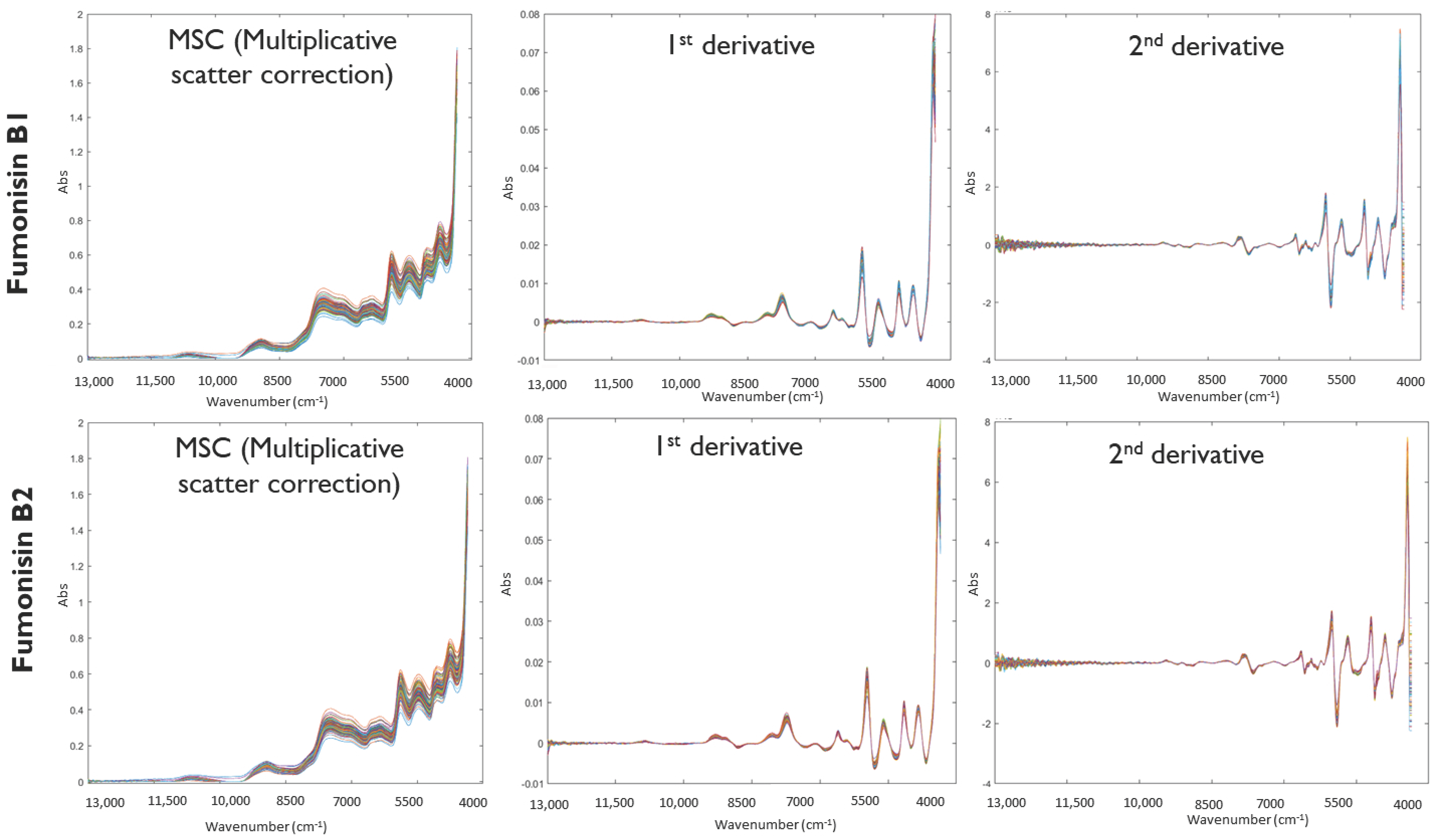
The spectra pre-processed using multiplicate scatter correction (MSC), first derivative and second derivative, for fumonisin B1 and fumonisin B2 are shown in Figure 1.
In the present study, three pre-processing techniques were applied to the samples: multiplicative scatter corrections (MSC), first derivative and second derivative. The main goal was to improve the precision of the spectral information, highlight key differences between samples, and minimize noise in each spectrum [10]. Spectral information above 9000 cm−1 was deemed irrelevant across all three pre-processing techniques. The first- and second-derivative techniques emphasized the most critical spectral regions, particularly 4000–6500 cm−1. Despite the pre-processing approaches used, no significant differences were observed between fumonisins B1 and B2, as both exhibited similar spectral profiles.
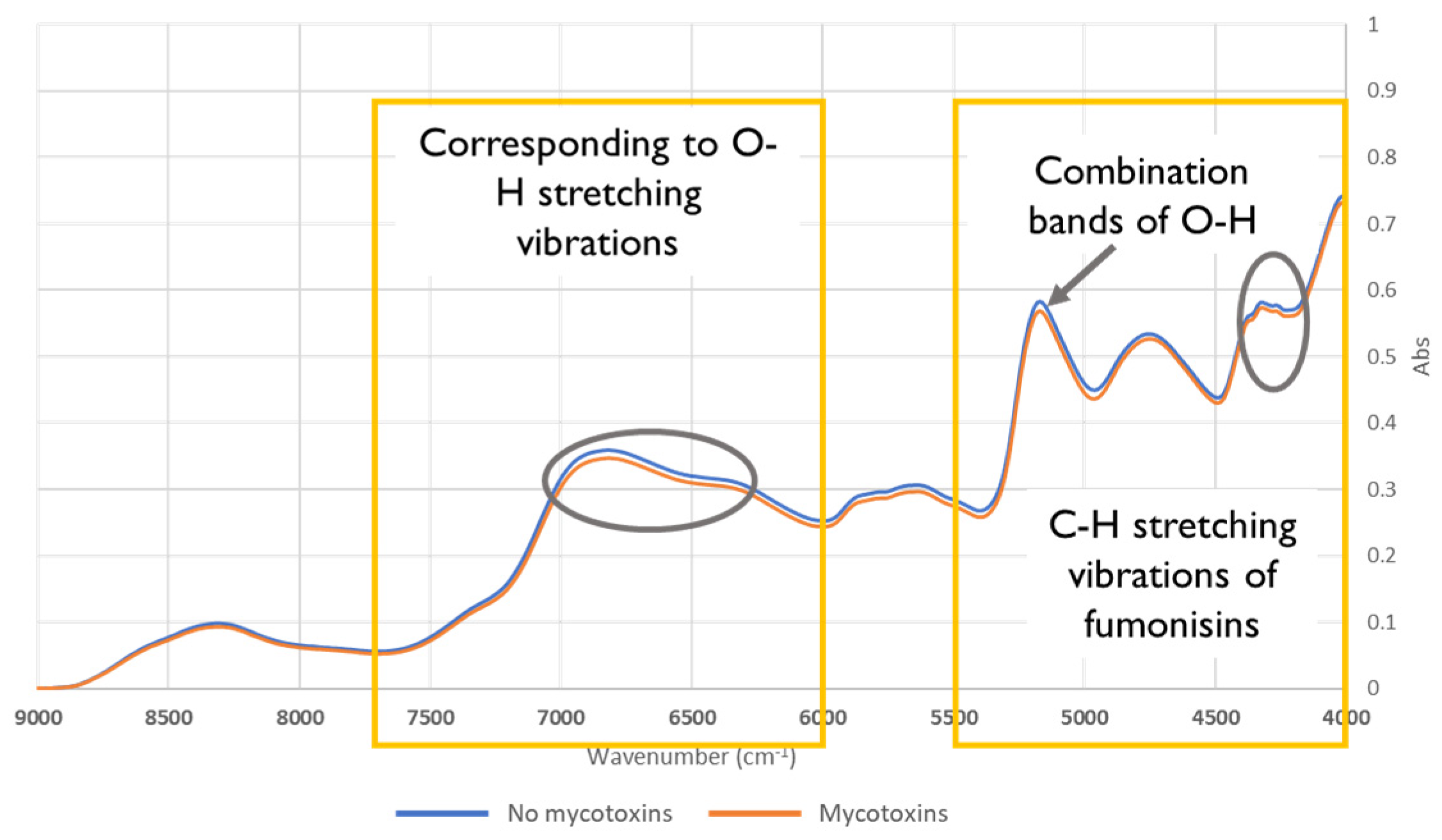
The NIR spectra of a maize sample with mycotoxin contamination (orange color) and without mycotoxin contamination (blue color) are represented in Figure 2. The main spectral differences are observed between 6400 and 7000 cm−1 in the first overtone region and in 7700–6000 cm−1, corresponding to O-H stretching vibrations, represented at grey circle. Additional differences are noted around 4100–4300 cm−1 and in the 5500–4000 cm−1 region, associated with combination bands of O-H and C-H stretching vibrations of fumonisins, represented at grey color. The most prominent peak in the spectrum at 5200 cm−1 is attributed to the combination and overtones of C-H, O-H and N-H stretching vibrations of the chemical composition of maize [13]. The spectrum of the uncontaminated sample exhibits higher absorption compared to the contaminated sample. This trend aligns with observations in maize samples contaminated by aflatoxins [24] and deoxynivalenol [9]. However, an opposite tendency has been reported for maize contaminated with fumonisins [24]. These spectral differences between contaminated and uncontaminated samples are associated with fungal attacks, which disrupt tissues and cells, modifying nutritional properties and subsequently affecting their spectral signature [25].
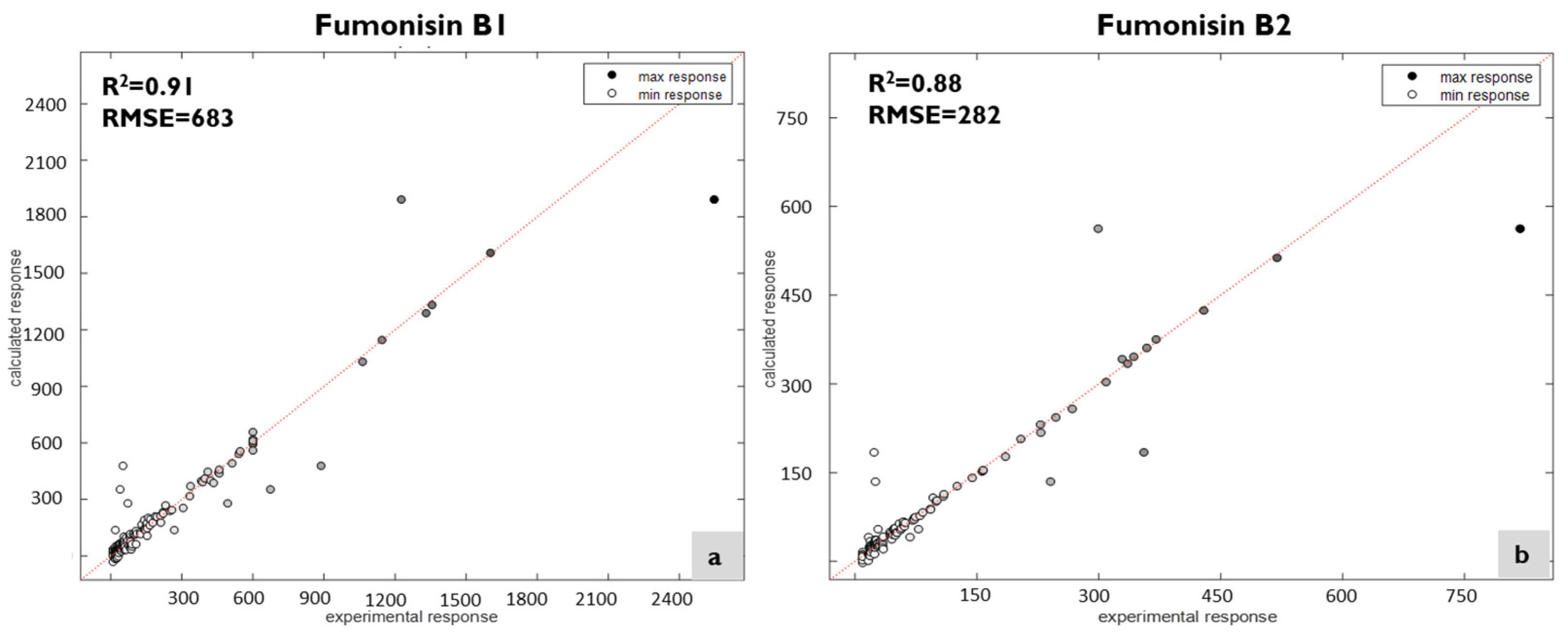
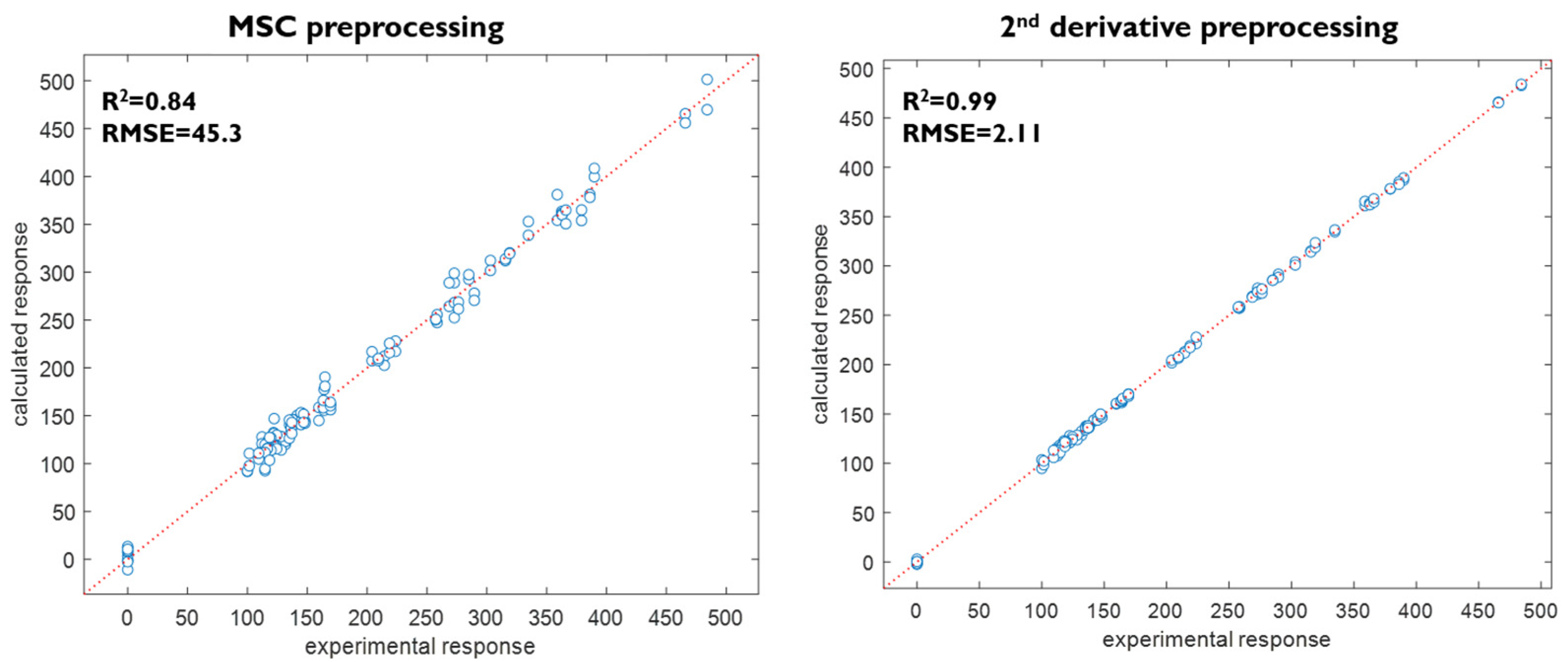
Figure 3 displays the results of the correlation between determined and predicted fumonisin levels using the calibration models developed after pre-processing with the second derivative. PLS models developed for quantification of DON were used with MSC and second-derivative preprocessing (Figure 4).
The preliminary models for predicting fumonisin B1 and B2 occurrence in maize using near-infrared spectroscopy show promising results. The partial least squares (PLS) regression yielded correlation coefficients and RMSE of 0.91 and 0.88, and 683 and 282 for fumonisin B1 and B2, respectively. The slightly lower correlation coefficient for fumonisin B2 may be attributed to the presence of potential outlier samples. However, as a preliminary study, the data supporting the predictive models remain robust. Promising PLS models were developed for quantification of DON using MSC pre-processing with R2 of 0.84, and R2 of 0.99 with second-derivative pre-processing. These results are consistent with findings of Ghilardelli et al. [25], who reported an R2 of calibration 0.899 for sum fumonisins, and Tyska et al. [14], who achieved an R2 of 0.899 and RMSE of 659 µg/kg for sum of fumonisin B1 and B2.

4. Conclusions

The application of NIR spectroscopy offers significant advantages over traditional analytical methods, particularly its speed, non-destructive nature, and cost-effectiveness. This technology enables the simultaneous estimation of fumonisin B1, B2 and deoxynivalenol levels. In the present study, preliminary robust calibration models were developed for fumonisin B1, fumonisin B2 and deoxynivalenol, yielding promising results with second-derivative pre-processing.
In conclusion, NIR spectroscopy demonstrates its potential as a powerful tool for the rapid and non-destructive detection of fumonisins B1, B2 and deoxynivalenol in maize. This method provides an efficient approach to ensuring food safety and quality. Continued advancements in calibration techniques and chemometric analyses are anticipated to further enhance the precision and reliability of NIR spectroscopy, primarily by increasing the number of samples tested and expanding the range of fumonisin levels. This will reinforce the role of NIR spectroscopy as an essential technology in food safety monitoring.

Author Contributions

Conceptualization, B.C.; methodology, B.C., P.S., A.F. and A.S.S.; software, P.S.; validation, A.S.S. and C.B.; formal analysis, B.C., P.S.; S.C.B. and A.F.; investigation, B.C. and P.S.; resources, A.F., A.S.S. and C.B.; writing—original draft preparation, B.C.; writing—review and editing, B.C., P.S., S.C.B., A.F., A.S.S. and C.B.; visualization, B.C.; supervision, A.S.S. and C.B.; project administration, A.F., A.S.S. and C.B.; funding acquisition, C.B. All authors have read and agreed to the published version of the manuscript.

Funding

This research was funded by the National Funds of the Rural Development Program through the operational group QUALIMILHO—new sustainable integration strategies that guarantee quality and safety in the national maize, PDR2020 nº 101-031295 (2017–2020). This work was also supported by FCT, the Portuguese Foundation for Science and Technology, through the R&D unit, to GREEN-IT, Bioresources for Sustainability (UIDB/04551/2020), and CIMO (UIDB/00690/2020 and UIDP/00690/2020). This research was also funded by PT national funds (FCT/MCTES, Fundação para a Ciência e Tecnologia and Ministério da Ciência, Tecnologia e Ensino Superior) through the grant UIDB/00211/2020.

Institutional Review Board Statement

Not applicable.

Informed Consent Statement

Not applicable.

Data Availability Statement

The data presented in this study are available at https://doi.org/10.1016/j.fochx.2025.102351.

Acknowledgments

We sincerely acknowledge Tiago Silva Pinto for assisting with farmer selection and João Coimbra and Nuno Tomé for the sampling logistics.

Conflicts of Interest

The authors declare no conflicts of interest.

References

  1. Food and Agriculture Organization. FAOSTAT. 2025. Available online: http://www.fao.org/faostat/en/#home (accessed on 1 February 2026).
  2. Pérez Ruiz, R.V.; Aguilar Toalá, J.E.; Cruz Monterrosa, R.G.; Rayas Amor, A.A.; Rodríguez, M.H.; Villasana, Y.C.; Pérez, J.H. Mexican Native Maize: Origin, Races and Impact on Food and Gastronomy. Int. J. Gastron. Food Sci. 2024, 37, 100978. [Google Scholar] [CrossRef]
  3. Abdallah, M.F.; De Boevre, M.; Landschoot, S.; De Saeger, S.; Haesaert, G.; Audenaert, K. Fungal Endophytes Control Fusarium Graminearum and Reduce Trichothecenes and Zearalenone in Maize. Toxins 2018, 10, 493. [Google Scholar] [CrossRef]
  4. Li, T.; Li, J.; Wang, J.; Xue, K.S.; Su, X.; Qu, H.; Duan, X.; Jiang, Y. The Occurrence and Management of Fumonisin Contamination across the Food Production and Supply Chains. J. Adv. Res. 2024, 60, 13–26. [Google Scholar] [CrossRef]
  5. Shi, H.; Li, J.; Zhao, Y.; Mao, J.; Wang, H.; Zhu, J. Effect of Aspergillus Flavus Contamination on the Fungal Community Succession, Mycotoxin Production and Storage Quality of Maize Kernels at Various Temperatures. Food Res. Int. 2023, 174, 113662. [Google Scholar] [CrossRef]
  6. Atnkut, B.; Nigussie, A.; Berza, B.; Mikru, A.; Zhao, B.; Astatkie, T. Mycotoxins Contaminations in Ethiopian Food: Impacts, Challenges, and Mitigation Strategies. Food Control 2025, 171, 111066. [Google Scholar] [CrossRef]
  7. Odjo, S.; Alakonya, A.E.; Rosales-Nolasco, A.; Molina, A.L.; Muñoz, C.; Palacios-Rojas, N. Occurrence and Postharvest Strategies to Help Mitigate Aflatoxins and Fumonisins in Maize and Their Co-Exposure to Consumers in Mexico and Central America. Food Control 2022, 138, 108968. [Google Scholar] [CrossRef]
  8. Nada, S.; Nikola, T.; Bozidar, U.; Ilija, D.; Andreja, R. Prevention and Practical Strategies to Control Mycotoxins in the Wheat and Maize Chain. Food Control 2022, 136, 108855. [Google Scholar] [CrossRef]
  9. Smeesters, L.; Meulebroeck, W.; Raeymaekers, S.; Thienpont, H. Non-Destructive Detection of Mycotoxins in Maize Kernels Using Diffuse Reflectance Spectroscopy. Food Control 2016, 70, 48–57. [Google Scholar] [CrossRef]
  10. Levasseur-Garcia, C. Updated Overview of Infrared Spectroscopy Methods for Detecting Mycotoxins on Cereals (Corn, Wheat, and Barley). Toxins 2018, 10, 38. [Google Scholar] [CrossRef]
  11. Bailly, S.; Orlando, B.; Brustel, J.; Bailly, J.-D.; Levasseur-Garcia, C. Rapid Detection of Aflatoxins in Ground Maize Using Near Infrared Spectroscopy. Toxins 2024, 16, 385. [Google Scholar] [CrossRef] [PubMed]
  12. Borràs-Vallverdú, B.; Marín, S.; Sanchis, V.; Gatius, F.; Ramos, A.J. NIR-HSI as a tool to predict deoxynivalenol and fumonisins in maize kernels: A step forward in preventing mycotoxin contamination. J. Sci. Food Agric. 2024, 104, 5495–5503. [Google Scholar] [CrossRef]
  13. Shen, G.; Kang, X.; Su, J.; Qiu, J.; Liu, X.; Xu, J.; Shi, J.; Mohamed, S.R. Rapid Detection of Fumonisin B1 and B2 in Ground Corn Samples Using Smartphone-Controlled Portable near-Infrared Spectrometry and Chemometrics. Food Chem. 2022, 384, 132487. [Google Scholar] [CrossRef]
  14. Tyska, D.; Mallmann, A.O.; Vidal, J.K.; Almeida, C.A.A.d.; Gressler, L.T.; Mallmann, C.A. Multivariate Method for Prediction of Fumonisins B1 and B2 and Zearalenone in Brazilian Maize Using near Infrared Spectroscopy (NIR). PLoS ONE 2021, 16, e0244957. [Google Scholar] [CrossRef]
  15. Chavez, R.A.; Cheng, X.; Herrman, T.J.; Stasiewicz, M.J. Single kernel aflatoxin and fumonisin contamination distribution and spectral classification in commercial corn. Food Control 2022, 131, 108393. [Google Scholar] [CrossRef]
  16. Silva, A.S.; Brites, C.; Pouca, A.V.; Barbosa, J.; Freitas, A. UHPLC-ToF-MS Method for Determination of Multi-Mycotoxins in Maize: Development and Validation. Curr. Res. Food Sci. 2019, 1, 1–7. [Google Scholar] [CrossRef]
  17. Freitas, A.; Barros, S.; Brites, C.; Barbosa, J.; Silva, A.S. Validation of a Biochip Chemiluminescent Immunoassay for Multi-Mycotoxins Screening in Maize (Zea mays L.). Food Anal. Methods 2019, 12, 2675–2684. [Google Scholar] [CrossRef]
  18. Deng, J.; Mei, C.; Jiang, H. Enhancing the application of near-infrared spectroscopy in grain mycotoxin detection: An exploration of a transfer learning approach across contaminants and grains. Food Chem. 2025, 480, 143854. [Google Scholar] [CrossRef]
  19. Consonni, V.; Baccolo, G.; Gosetti, F.; Todeschini, R.; Ballabio, D. A MATLAB toolbox for multivariate regression coupled with variable selection. Chemom. Intell. Lab. Syst. 2021, 213, 104313. [Google Scholar] [CrossRef]
  20. Schoot, M.; Kapper, C.; van Kollenburg, G.H.; Geert, J.; Postma, G.J.; van Kessel, G.; Buydens, L.M.C.; Jansen, J.J. Investigating the need for preprocessing of near-infrared spectroscopic data as a function of sample size. Chemom. Intell. Lab. Syst. 2020, 204, 104105. [Google Scholar] [CrossRef]
  21. Commission of the European Communities. Commission Regulation (EC) No 401/2006 of 23 February 2006 Laying down the Methods of Sampling and Analysis for the Official Control of the Levels of Mycotoxins in Foodstuffs. Off. J. Eur. Union 2006, 70, 12–34. [Google Scholar]
  22. Tarazona, A.; Gómez, J.V.; Mateo, F.; Jiménez, M.; Romera, D.; Mateo, E.M. Study on Mycotoxin Contamination of Maize Kernels in Spain. Food Control 2020, 118, 107370. [Google Scholar] [CrossRef]
  23. Price, J.L.; Visagie, C.M.; Meyer, H.; Yilmaz, N. Fungal Species and Mycotoxins Associated with Maize Ear Rots Collected from the Eastern Cape in South Africa. Toxins 2024, 16, 95. [Google Scholar] [CrossRef]
  24. Kim, Y.; Baek, I.; Lee, K.; Kim, G.; Kim, S.; Kim, S.; Chan, D.; Herrman, T.J.; Kim, N.; Kim, M.S. Rapid Detection of Single- and Co-Contaminant Aflatoxins and Fumonisins in Ground Maize Using Hyperspectral Imaging Techniques. Toxins 2023, 12, 472. [Google Scholar] [CrossRef]
  25. Ghilardelli, F.; Barbato, M.; Gallo, A. A Preliminary Study to Classify Corn Silage for High or Low Mycotoxin Contamination by Using near Infrared Spectroscopy. Toxins 2022, 14, 323. [Google Scholar] [CrossRef]
Figure 1. MSC 1st-derivative and 2nd-derivative spectra of maize flour samples, obtained from NIR in the range 4000–13,000 cm−1.
Blsf 56 00016 g001
Figure 2. NIR spectrum of maize flour sample with mycotoxin contamination and no mycotoxins acquired from 4000 to 13,000 cm−1. Mycotoxin contamination (orange color) and without mycotoxin contamination (blue color).
Blsf 56 00016 g002
Figure 3. PLS regression plot of measured (by UHPLC-TOF-MS) and estimated (by NIR) for (a) fumonisin B1 and (b) fumonisin B2 in maize flour samples.
Blsf 56 00016 g003
Figure 4. PLS calibration models developed with MSC and 2nd-derivative preprocessing for DON in maize flour samples. The regression plots of measured (analytical procedures) and estimated (by NIR) DON concentrations.
Blsf 56 00016 g004
Table 1. Minimum, maximum and mean levels of fumonisins detected in maize samples analyzed.
Positive Samples (n)Min. (µg/kg)Max.
(µg/kg)
Mean
(µg/kg)
Standard Deviation
Fumonisin B142<LOD2582.1534.5496.6
Fumonisin B222<LOD837.9208.2149.8
Fumonisin B1 + B248<LOD3420.0758.6646.1
Deoxynivalenol50<LOD484.1130.071.0
Disclaimer/Publisher’s Note: The statements, opinions and data contained in all publications are solely those of the individual author(s) and contributor(s) and not of MDPI and/or the editor(s). MDPI and/or the editor(s) disclaim responsibility for any injury to people or property resulting from any ideas, methods, instructions or products referred to in the content.