
Communication

Effects of Lyophilized Dietary Yeast Rhodotorula mucilaginosa on Skin and Fillet Pigmentation of Gilthead Seabream (Sparus aurata): A Computer-Based Image Analysis Assessment

by
Christina Zantioti
* and
Emmanouil E. Malandrakis
*
Laboratory of Applied Hydrobiology, Department of Animal Science, Faculty of Animal Biosciences, Agricultural University of Athens, 11855 Athens, Greece
*
Authors to whom correspondence should be addressed.
Aquac. J. 2026, 6(1), 10; https://doi.org/10.3390/aquacj6010010
Submission received: 31 December 2025 / Revised: 2 March 2026 / Accepted: 10 March 2026 / Published: 23 March 2026

Abstract

Skin pigmentation is a crucial factor influencing the market value of gilthead seabream. A three-month feeding trial evaluated the effects of dietary inclusion of Rhodotorula mucilaginosa on skin and fillet pigmentation of gilthead seabream (Sparus aurata). Four diets containing yeast were tested in triplicate tanks using 120 fish in total. Skin and fillet colours were assessed via computer-based image analysis in CIELAB, RGB and HSB spaces. Analysis of total carotenoids was also performed. Yeast inclusion increased L* and Whiteness values in the operculum and enhanced lightness in ventral skin regions. In the abdominal area, RGB values decreased, particularly in the 3% diet. Fillet responses were limited to the red muscle, where the 3% diet significantly increased a* and Chroma values. Overall, inclusion of R. mucilaginosa exceeding 2% influenced seabream skin brightness and total carotenoid content, while 3% inclusion enhanced red muscle pigmentation, suggesting potential as a natural pigment source in seabream feeds.

1. Introduction

The market value of gilthead seabream is based to some extent on its skin pigmentation, with the golden-yellow in the forehead area between the eyes being of great importance [1,2]. Nonetheless, colourimeters cannot accurately estimate the non-homogeneous fish pigmentation [3,4]. This could be attributed to its circular aperture with a diameter of 8 mm, which could lead to the omission of colours and subtones during measurement [5]. Computer-based image (CBI) analysis can accurately measure colour, providing homogeneous conditions without the need for direct contact with tissue under examination [6].
In addition to methodological advances in colour assessment, there is increasing interest in sustainable pigment sources to enhance external appearance and product quality. Among many fish, gilthead seabream cannot synthesize carotenoids de novo and thus relies solely on its diet [7]. Seabream skin pigmentation is under multiparametric regulation, with numerous internal factors like hormones and external factors like nutrition and the environment influencing the chromatic state of the fish [8]. Consequently, carotenoids derived either from natural or synthetic sources have been playing an important role in fish nutrition [9]. Synthetic astaxanthin has been widely used as a feed additive to enhance seabream pigmentation [10]. Nevertheless, there remains considerable scope for further research on natural pigment sources to support the transition towards more sustainable aquaculture practices.
Yeasts could be used as feed additives belonging to the sustainable feed ingredients category [11]. Moreover, they can produce metabolites like carotenoids, which could potentially enhance the health of reared fish [12]. Rhodotorula mucilaginosa has been identified as one of the permanent strains in the gut microflora of certain fish. It is known for producing pigments, the main of those being β-carotene, torulene and torularhodin [13,14]. Although synthetic astaxanthin is extensively used, evidence on yeast-derived pigments in gilthead seabream remains scarce. Thus, this yeast could be potentially used as a natural source of pigments in aquafeeds. Based upon this background, the aim of this study was to determine the potential of the pigmented yeast R. mucilaginosa as a pigmentation source for the gilthead seabream S. aurata using computer-based image analysis as a novel approach to quantify pigmentation.

2. Materials and Methods

Four diets containing 0% (C), 1% (RM1), 2% (RM2) and 3% (RM3) lyophilized Rhodotorula mucilaginosa strain ACA-DC 5340 were prepared and fed to gilthead seabream over a three-month period. Hereafter, “RM treatments” refers collectively to the yeast-supplemented diets (RM1–RM3). Fish were hand-fed twice daily at a 1.2% BW. A detailed description of the diet formulation is provided in Zantioti et al. 2026 [15]. R. mucilaginosa carotenoids were estimated at 207. 74 ± 8.23 μg/g [15]. A total of 120 fish were randomly allocated to 12 tanks (n = 10 per tank, three replicates per diet). Fish were fed twice daily, and environmental conditions were kept constant throughout the trial.
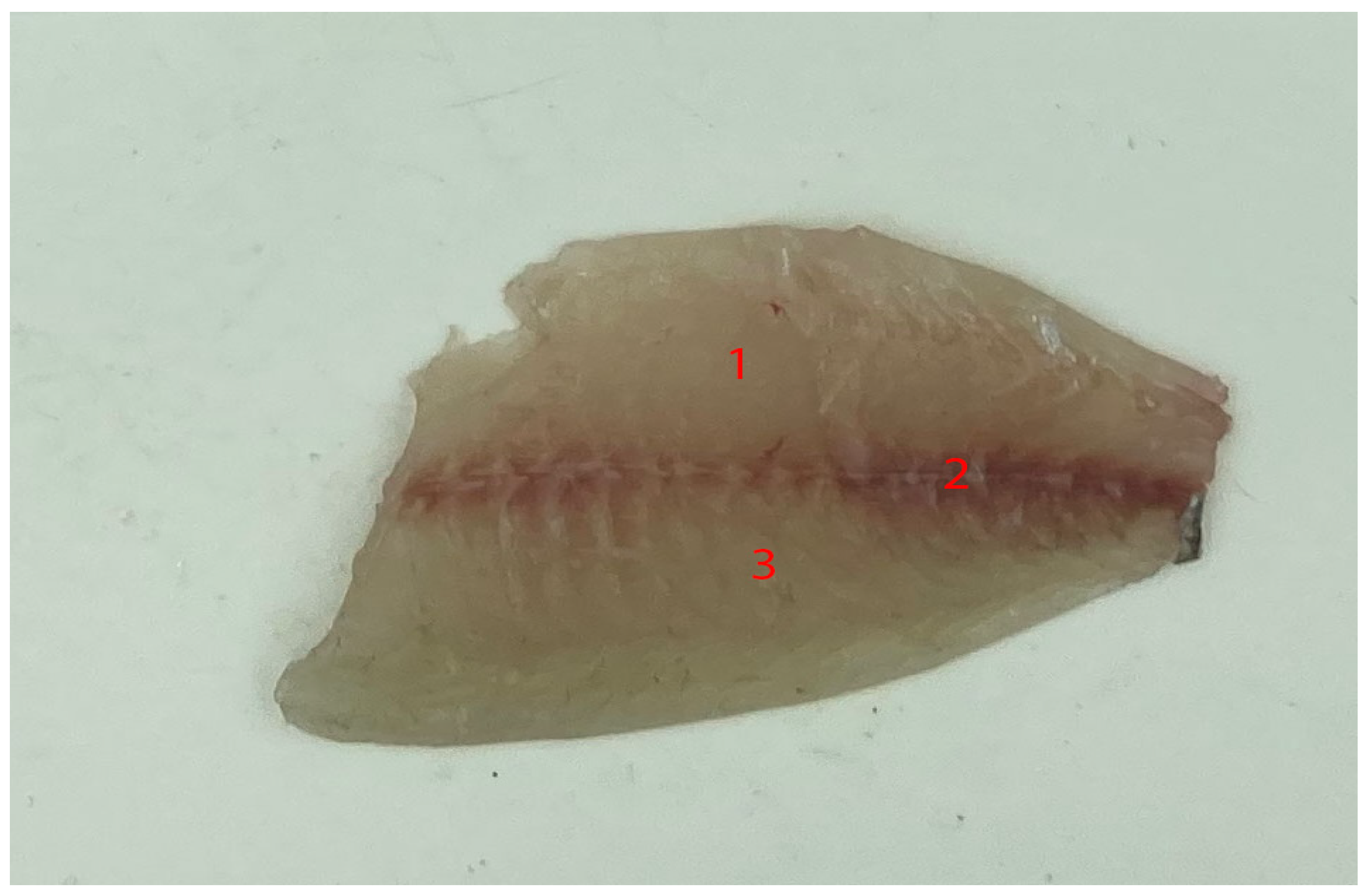
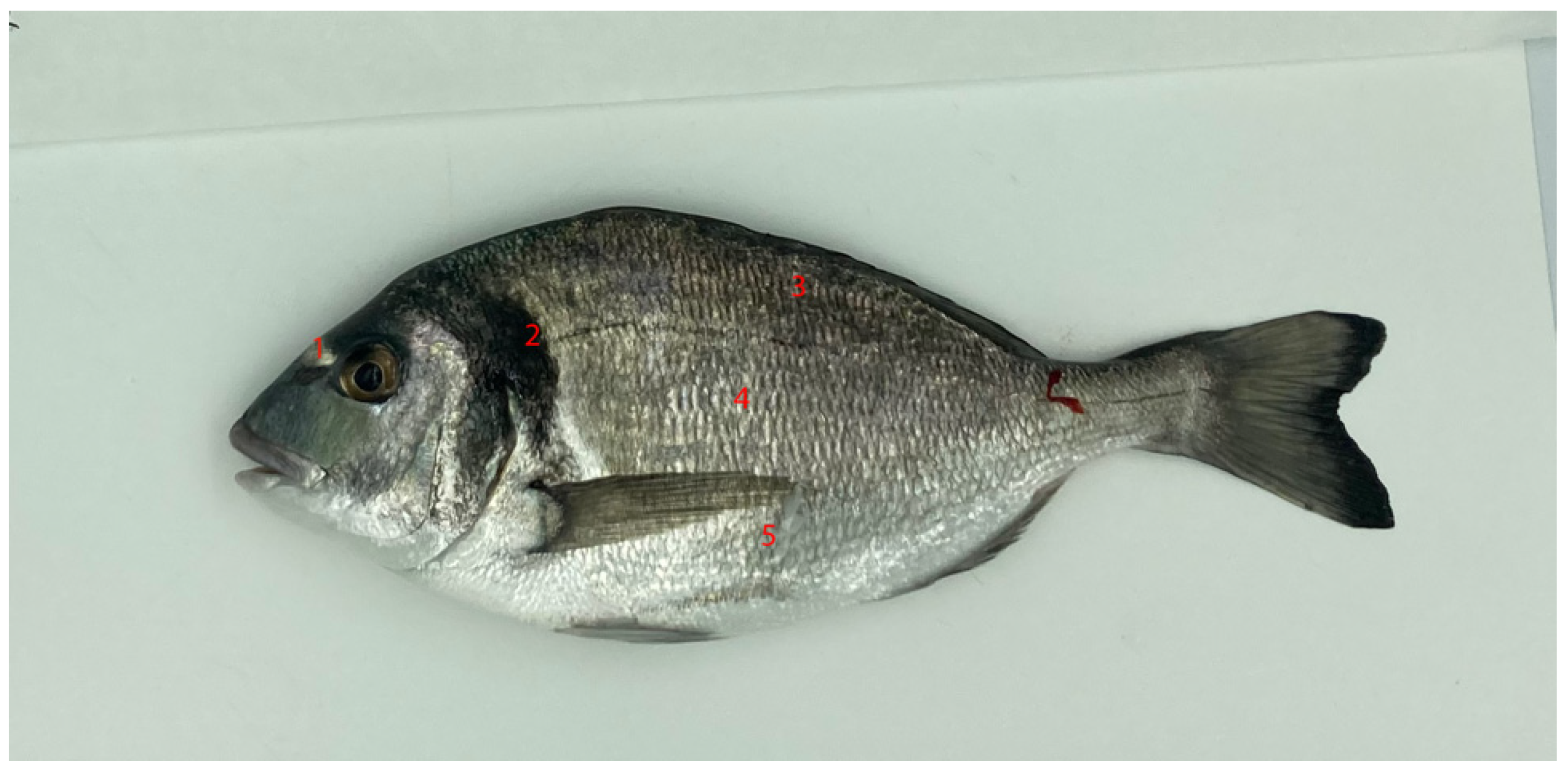
Six fish per treatment were randomly sampled for skin and fillet colour analysis. Fish and fillets were photographed (4032 × 3024 pixels) under standardized lighting conditions (Puluz Photobox 60 × 60 × 60 cm, PULUZ, Shenzhen, China), and five skin regions (Figure 1) and three fillet regions (Figure 2) were analyzed. Colour parameters (CIELAB’s L*- a*- b*, RGB and HSB) were extracted using computer-based image analysis (Adobe Photoshop 2022 Version 23.5.1, Adobe Inc., San Jose, CA, USA), and Chroma and Whiteness were calculated according to the following formulas. CIELAB parameters (L*, a*, b*) and derived indices represent conventional chromaticity standards for objective colour evaluation, while the additional colour spaces were chosen to provide a more holistic characterization of pigmentation. Full definitions and calculations of the colour parameters are provided in the Supplementary Materials (Table S1). Tables containing all measured parameters and their values for each anatomical region are provided in the Supplementary Materials (Table S2).
Chroma = a 2 + b 2
Whiteness = 100 ( 100 L ) 2 + ( a ) 2 + ( b ) 2
Colour assessment was performed by pixel-based analysis in Adobe Photoshop. For skin regions 1 and 2, a 3 × 3-pixel sampling area was used, whereas for skin regions 3, 4 and 5, an 11 × 11-pixel sampling area was applied. For fillet colour analysis, a 3 × 3-pixel sampling area was used. For each sampling point, three replicate measurements were performed and mean values were used for statistical analysis. Total carotenoid content in skin and fillet samples was determined according to the method described by Waseef et al. 2010, with slight modifications [16]. To ensure representative sampling, skin was collected from various locations on each fish and combined into a single pooled sample per individual before analysis. Data were analysed by one-way ANOVA followed by Tukey’s test. Non-normal datasets were evaluated using Kruskal–Wallis or Welch ANOVA. Statistical significance was set at p < 0.05 [17].

3. Results

Dietary R. mucilaginosa produced several significant effects on skin pigmentation (Table 1). In the forehead region, fish fed RM diets showed significantly lower b*, Saturation and Chroma values compared to the control (p < 0.001). In the operculum, all yeast-supplemented groups exhibited significantly higher L* and Whiteness values as well as higher RGB intensities (p < 0.01) (Table 1). This could indicate increased brightness in this region. Below the lateral line, fish fed RM2 and RM3 diets displayed significantly higher L*, Whiteness and B values (p < 0.05) consistent with a lighter appearance while RM2 also showed significantly increased R and G values compared to the control (Table 1). In the abdominal region, all RM diets resulted in significantly lower R and G values, with RM3 showing the strongest reduction (p < 0.05) (Table 1).
Although three fillet spots were measured, only the two most responsive spots are shown in Table 1 for conciseness, while the full results for all spots are provided in Supplementary Table S1. Fillet pigmentation differences were limited to specific regions. In white muscle, only b* differed significantly, with RM1 and RM3 showing higher values than the control (p < 0.05), indicating increased yellowness. In contrast, the red muscle in group RM3 exhibited significantly higher a* and Chroma values and lower Whiteness (p < 0.01), indicating an enhancement of red colouration at the highest inclusion levels (Table 1). Total carotenoid concentration in the skin differed among treatments (p < 0.05), with RM2 and RM3 showing significantly higher values (Table 2). Fillet carotenoid content was not affected by the dietary treatment.

4. Discussion

The colouration of Sparidae family is under multifactorial control, being influenced not only by endogenous but also exogenous factors such as nutrition [18]. Skin and fillet pigmentation of gilthead seabream responded selectively to dietary Rhodotorula mucilaginosa. Similar yeast-based pigmentation effects have been reported in other species. Rhodotorula paludigena was shown to influence scale colouration in ornamental koi carp [19]. In the forehead zone, all yeast diets reduced b* and Chroma values, contrasting with previous studies where microalgal carotenoids increased yellowness [1]. This reduction may reflect the carotenoid profile of R. mucilaginosa, which produces mainly β-carotene, torulene and torularhodin rather than the astaxanthin-type pigments naturally associated with yellow hues in Sparidae [20,21]. It is important to note that carotenoid bioavailability is a complex process that involves various steps and phases like liberation, absorption, transport and distribution [22]. Minor methodological effects linked to lateral photography may also have contributed to lower measured yellowness. Pulcini et al. mentioned that lateral shots of the forehead zone between the eyes lead to the recognition of a reduced number of yellow pixels by CBI software compared to frontal shots (2020). CBI appears to provide colour estimates more consistent with visual perception. In Atlantic salmon, CBI-derived colour values corresponded to the expected orange fillet colour. In contrast, values obtained with a colourimeter were associated with a purplish hue [23,24]. Generally, CBI analysis has been increasingly used as a non-invasive and practical alternative for pigmentation analysis; nevertheless, method validation against reference instrumentation remains an important next step.
In contrast, brightness-related parameters increased in several skin regions. Higher L* and Whiteness values in the operculum and ventral body areas suggest enhanced lightness, a pattern similarly reported when seabream was fed diets with inclusion of Phaeodactylum tricornutum [25]. These changes indicate that yeast pigments or associated compounds can alter skin appearance even if they do not intensify yellow coloration. From an applied perspective, increased brightness may be commercially relevant, as discolouration or colour fading is often associated with reduced perceived freshness and lower consumer acceptance [8]. Interestingly, the biological role of LDL may also be relevant to the transport of yeast-derived carotenoids, which are absorbed with dietary lipids and circulate via lipoproteins. In our previous trial with dietary lyophilized R. mucilaginosa, the observed changes in LDL support the hypothesis that the yeast may influence lipid transport and carotenoid trafficking, thereby contributing to pigmentation-related outcomes [15]. The changes observed in CBI are further supported by the analysis of total carotenoids in the skin, which revealed increased carotenoid content in fish fed yeast-containing diets at inclusion levels above 2%. Previous studies have shown that natural carotenoids can be efficiently bioabsorbed and deposited in gilthead seabream. However, this deposition does not necessarily translate into enhanced muscle pigmentation, a pattern also confirmed in the present study [16]. Further targeted analyses are required to identify which specific carotenoid compounds contribute to the observed increase in total carotenoid content.
Effects on fillet pigmentation were limited to specific tissues. White muscle showed only minor inconsistencies in b*, whereas red muscle exhibited a more pronounced response at the highest inclusion level, with increased a* and Chroma and reduced Whiteness. Red muscle, compared to white muscle, contains higher myoglobin levels and supports sustained aerobic swimming [26]. Given the higher vascularisation and lipid content of red muscle [27,28], preferential accumulation of yeast-derived carotenoids such as torularhodin may be plausible. Similar results were observed in trials with arctic, Salvelinus alpinus (L.), which exhibited increased fillet redness when fed diets containing astaxanthin [29]. Another natural source of natural pigment, the red macroalga Gracilariopsis persica, seemed to enhance the colouration of Persian sturgeon fillets [30]. Previous studies also suggest that the oxidation of myoglobin to metmyoglobin may cause a decrease in the a* value [31]. Myoglobin is also responsible for the pigmentation of the flesh, but its concentration in muscle tissue is related to various factors [32]. It is important to note that myoglobin redox status was not assessed in the present study and should be investigated in future work.
Dietary pigmentation strategies using both synthetic and natural sources like microalgae or microbial pigments have been widely evaluated across aquaculture species such as Salmo salar, Oncorhynchus mykiss and Pagrus pagrus, with dose-dependent and tissue-specific responses commonly reported [33,34]. Overall, R. mucilaginosa influenced pigmentation mainly through enhanced brightness and carotenoid content in the skin and increased redness in red muscle, with effects becoming more evident at inclusion levels above 2%. These results highlight the potential of pigmented yeasts as natural additives for modifying seabream appearance, although their carotenoid profile appears less effective in targeting yellow facial pigmentation. Although synthetic astaxanthin remains an efficacious additive to enhance the pigmentation of aquatic animals [35], yeast-derived pigments from R. mucilaginosa represent a promising natural alternative, but require further evaluation and dose optimization for practical application.
CBI has been shown before to correlate strongly with fish colour attributes linked to freshness and other quality indicators, with high correlation coefficients, highlighting its reliability as an objective tool for colour assessment [6]. Although in this study, CBI detected pigmentation differences, no direct comparison with a conventional colourimeter took place. Therefore, full methodological equivalence between CBI and chromatometry cannot be conclusively established within this study. Future studies should be performed using both techniques to directly evaluate their relative accuracy and precision.

5. Conclusions

In conclusion, the inclusion of the red yeast Rhodotorula mucilaginosa affected the skin pigmentation of gilthead seabream. Results become more noticeable at inclusion rates above 2%. Changes in the flesh pigmentation were noticeable only on the red muscle part of the fillet and at an inclusion level of 3%. From an applied perspective, pigmentation is a key quality trait influencing consumer perception and market value in gilthead seabream, and the observed colour modulation supports the interest in sustainable pigment strategies for aquafeeds. These findings support the potential of R. mucilaginosa as a dietary source of natural pigments. However, the underlying mechanisms were not directly assessed and remain to be validated. Future work involving larger sample sizes should examine pigment deposition and antioxidant activity to clarify the mechanisms involved. Also, histological examination and gene expression analyses of pigment-related pathways could help elucidate the mechanisms underlying colour changes. Lastly, although CBI was able to detect pigmentation alterations at different yeast inclusion levels, further work directly comparing CBI with conventional colourimeters is required to fully validate its accuracy and precision.

Supplementary Materials

The following supporting information can be downloaded at https://www.mdpi.com/article/10.3390/aquacj6010010/s1, Table S1: Definitions, interpretation and calculation of colour parameters used for image-based colour assessment; Table S2: Colour Parameters (CIELAB L, a, b*, RGB, and HSB) extracted by computer-based image analysis across anatomical regions and measurement spots.

Author Contributions

C.Z. was responsible for the conceptualisation, the investigation, the methodology, the data curation, the visualisation and the writing and editing of the original draft. E.E.M. was responsible for the conceptualisation, the supervision, the funding acquisition, the project management, the validation and the review and editing of the draft. All authors have read and agreed to the published version of the manuscript.

Funding

This study has been funded by the Operational Programme Maritime and Fisheries 2014–2020 and co-funded by the European Maritime and Fisheries Fund through the project “Use of yeasts and fungi in gilthead seabream diets towards improving external coloration and immune enhancement—BRIGHTFISH (MIS 5074567)”.

Institutional Review Board Statement

All experimental procedures involving fish were conducted in compliance with national (Presidential Decree 56/2013) and European legislation (86/609/EC) for the protection of animals used for scientific purposes. The license for the experimental unit, which is the Laboratory of Applied Hydrobiology, Agricultural University of Athens, is EL 25 BIO exp 046. All the experimental procedures followed the 3Rs strategy (reduction, replacement, refinement). A FELASA-certified person was in charge of the experimentation (Emmanouil Malandrakis FELASA Certificate ID: 051/15_34_2021).

Data Availability Statement

The datasets generated and/or analyzed during the current study are not publicly available but are available from the corresponding authors upon reasonable request.

Acknowledgments

E. Tsakalidou and E. Manolopoulou from the Laboratory of Dairy Research of the Agricultural University of Athens are kindly acknowledged for providing the experimental yeast strain from the ACA-DC microorganisms collection. The company Philosofish S.A. is thankfully acknowledged for providing experimental fish. During the preparation of this manuscript, the authors used Grammarly tool for the purposes of improving grammar and language clarity. The authors have reviewed and edited the output and take full responsibility for the content of this publication.

Conflicts of Interest

The authors declare no conflicts of interest.

Abbreviations

CBIComputer-based image
CIELABColour space defined by the Commission Internationale de l’Éclairage, comprising L* (lightness), a* (green–red), and b* (blue–yellow) axes
RGBRed–Green–Blue colour model
HSBHue–Saturation–Brightness colour model
RMRhodotorula mucilaginosa

References

  1. Gouveia, L.; Choubert, G.; Pereira, N.; Santinha, J.; Empis, J.; Gomes, E. Pigmentation of gilthead seabream, Sparus aurata (L. 1875), using Chlorella vulgaris (Chlorophyta, Volvocales) microalga. Aquac. Res. 2002, 33, 987–993. [Google Scholar] [CrossRef]
  2. Pulcini, D.; Capoccioni, F.; Franceschini, S.; Martinoli, M.; Tibaldi, E. Skin pigmentation in gilthead seabream (Sparus aurata L.) fed conventional and novel protein sources in diets deprived of fish meal. Animals 2020, 10, 2138. [Google Scholar] [CrossRef] [PubMed]
  3. Alçiçek, Z.; Balaban, M.Ö. Development and application of “the Two Image” method for accurate object recognition and color analysis. J. Food Eng. 2012, 111, 46–51. [Google Scholar] [CrossRef]
  4. Wallat, G.K.; Luzuriaga, D.A.; Balaban, M.O.; Chapman, F.A. Analysis of Skin Color Development in Live Goldfish Using a Color Machine Vision System. N. Am. J. Aquac. 2002, 64, 79–84. [Google Scholar] [CrossRef]
  5. Malandrakis, E.; Zantioti, C. Determining skin pigmentation of gilthead seabream Sparus aurata: A comparative approach of chromatometry and digital photography. In Proceedings of the Conference: Aquaculture Europe 2021, Funchal, Portugal, 4–7 October 2021. [Google Scholar]
  6. Erdağ, M.; Ayvaz, Z. The Use of Color to Determine Fish Freshness: European Seabass (Dicentrarchus labrax). J. Aquat. Food Prod. Technol. 2021, 30, 847–867. [Google Scholar] [CrossRef]
  7. Halver, J.; Hardy, R. Fish Nutrition, 3rd ed.; Academic Press: San Diego, CA, USA, 2002; ISBN 978-0-12-319652-1. [Google Scholar] [CrossRef]
  8. Pavlidis, M.A.; Chatzifotis, S.; Adachi, K. Pigmentation Physiology and Discoloration Problems. In Sparidae: Biology and Aquaculture of Gilthead Sea Bream and Other Species; Wiley-Blackwell: Hoboken, NJ, USA, 2011; pp. 295–319. [Google Scholar] [CrossRef]
  9. Singh, M.K.; Borgohain, P.; Kaur, K.; Gogoi, S. Emergence of Plants in Fish Pigmentation. Agric. Res. 2021, 10, 535–542. [Google Scholar] [CrossRef]
  10. Martinoli, M.; Contò, M.; Tonachella, N.; Cardinaletti, G.; Martini, A.; Pulcini, D.; Renzi, G.; Failla, S.; Tibaldi, E.; Capoccioni, F. Lipid quality and oxidative response in gilthead seabream fillets fed an organic diet including crayfish meal as a source of natural astaxanthin. Meas. Food 2025, 19, 100236. [Google Scholar] [CrossRef]
  11. Agboola, J.O.; Øverland, M.; Skrede, A.; Hansen, J.Ø. Yeast as major protein-rich ingredient in aquafeeds: A review of the implications for aquaculture production. Rev. Aquac. 2021, 13, 949–970. [Google Scholar] [CrossRef]
  12. Singh, B.P.; Rateb, M.E.; Rodriguez-Couto, S.; de Lourdes Teixeira de Moraes Polizeli, M.; Li, W.-J. Editorial: Microbial secondary metabolites: Recent developments and technological challenges. Front. Microbiol. 2019, 10, 914. [Google Scholar] [CrossRef]
  13. Chen, X.-Q.; Zhao, W.; Xie, S.-W.; Xie, J.-J.; Zhang, Z.-H.; Tian, L.-X.; Liu, Y.-J.; Niu, J. Effects of dietary hydrolyzed yeast (Rhodotorula mucilaginosa) on growth performance, immune response, antioxidant capacity and histomorphology of juvenile Nile tilapia (Oreochromis niloticus). Fish Shellfish Immunol. 2019, 90, 30–39. [Google Scholar] [CrossRef]
  14. Li, Z.; Li, C.; Cheng, P.; Yu, G. Rhodotorula mucilaginosa—Alternative sources of natural carotenoids, lipids, and enzymes for industrial use. Heliyon 2022, 8, e11505. [Google Scholar] [CrossRef]
  15. Zantioti, C.; Ntantali, O.; Chatzoglou, E.; Kavouras, M.; Lagkouvardos, I.; Karapanagiotidis, I.T.; Malandrakis, E.E. Effects of dietary lyophilized Rhodotorula mucilaginosa on the growth performance, proximate composition, blood biochemical parameters, gene expression and microbiome of gilthead seabream (Sparus aurata). Aquaculture 2026, 614, 743532. [Google Scholar] [CrossRef]
  16. Wassef, E.A.; Chatzifotis, S.; Sakr, E.M.; Saleh, N.E. Effect of two natural carotenoid sources in diets for gilthead seabream, Sparus aurata, on growth and skin coloration. J. Appl. Aquac. 2010, 22, 216–229. [Google Scholar] [CrossRef]
  17. Zar, J.H. Biostatistical Analysis, 5th ed.; Pearson/Prentice Hall: Upper Saddle River, NJ, USA, 2009; ISBN 978-0131008465. [Google Scholar]
  18. Makri, V.; Feidantsis, K.; Papadopoulos, D.; Lattos, A.; Georgoulis, I.; Michaelidis, B.; Giantsis, I.A. Natural-like pigmentation in cultured fish stocks, not only a matter of nutrition. A review of Salmonidae and Sparidae families, with a particular focus on the red porgy Pagrus pagrus. Aquac. Res. 2021, 52, 2942–2953. [Google Scholar] [CrossRef]
  19. Rekha, R.; Nimsi, K.A.; Manjusha, K.; Sirajudheen, T.K. Marine yeast Rhodotorula paludigena VA 242 a pigment enhancing feed additive for the Ornamental Fish Koi Carp. Aquac. Fish. 2024, 9, 66–70. [Google Scholar] [CrossRef]
  20. Pavlidis, M.; Mylonas, C. Sparidae: Biology and Aquaculture of Gilthead Sea Bream and Other Species; Wiley-Blackwell: Hoboken, NJ, USA, 2011; ISBN 9781405197724. [Google Scholar] [CrossRef]
  21. Bertolini, F.; Ribani, A.; Capoccioni, F.; Buttazzoni, L.; Utzeri, V.J.; Bovo, S.; Schiavo, G.; Caggiano, M.; Fontanesi, L.; Rothschild, M.F. Identification of a major locus determining a pigmentation defect in cultivated gilthead seabream (Sparus aurata). Anim. Genet. 2020, 51, 319–323. [Google Scholar] [CrossRef]
  22. Lim, K.C.; Yusoff, F.M.; Karim, M.; Natrah, F.M.I. Carotenoids modulate stress tolerance and immune responses in aquatic animals. Rev. Aquac. 2023, 15, 872–894. [Google Scholar] [CrossRef]
  23. Goñi, S.M.; Salvadori, V.O. Color measurement: Comparison of colorimeter vs. computer vision system. J. Food Meas. Charact. 2016, 11, 538–547. [Google Scholar] [CrossRef]
  24. Yagiz, Y.; Balaban, M.O.; Kristinsson, H.G.; Welt, B.A.; Marshall, M.R. Comparison of Minolta colorimeter and machine vision system in measuring colour of irradiated Atlantic salmon. J. Sci. Food Agric. 2009, 89, 728–730. [Google Scholar] [CrossRef]
  25. Ribeiro, A.R.; Gonçalves, A.; Barbeiro, M.; Bandarra, N.; Nunes, M.L.; Carvalho, M.L.; Silva, J.; Navalho, J.; Dinis, M.T.; Silva, T.; et al. Phaeodactylum tricornutum in finishing diets for gilthead seabream: Effects on skin pigmentation, sensory properties and nutritional value. J. Appl. Phycol. 2017, 29, 1945–1956. [Google Scholar] [CrossRef]
  26. Mclaughlin, R.L.; Kramer, D.L. The association between amount of red muscle and mobility in fishes: A statistical evaluation. Environ. Biol. Fishes 1991, 30, 369–378. [Google Scholar] [CrossRef]
  27. Madaro, A.; Torrissen, O.; Whatmore, P.; Lall, S.P.; Schmeisser, J.; Verlhac Trichet, V.; Olsen, R.E. Red and White Chinook Salmon (Oncorhynchus tshawytscha): Differences in the Transcriptome Profile of Muscle, Liver, and Pylorus. Mar. Biotechnol. 2020, 22, 581–593. [Google Scholar] [CrossRef] [PubMed]
  28. Allen, C.; Russell, S.; Fletcher, D. The relationship of broiler breast meat color and pH to shelf-life and odor development. Poult. Sci. 1997, 76, 1042–1046. [Google Scholar] [CrossRef] [PubMed]
  29. Adel, M.; Omidi, A.H.; Dawood, M.A.O.; Karimi, B.; Shekarabi, S.P.H. Dietary Gracilaria persica mediated the growth performance, fillet colouration, and immune response of Persian sturgeon (Acipenser persicus). Aquaculture 2021, 530, 735950. [Google Scholar] [CrossRef]
  30. Hatlen, B.; Jobling, M.; Bjerkeng, B. Relationships between carotenoid concentration and colour of fillets of Arctic chair, Salvelinus alpinus (L.), fed astaxanthin. Aquac. Res. 1998, 29, 191–202. [Google Scholar] [CrossRef]
  31. Nie, C.; Hu, Y.; Chen, R.; Guo, B.; Li, L.; Chen, H.; Chen, H.; Song, X. Effect of probiotics and Chinese medicine polysaccharides on meat quality, muscle fibre type and intramuscular fat deposition in lambs. Ital. J. Anim. Sci. 2022, 21, 811–820. [Google Scholar] [CrossRef]
  32. Chaijan, M.; Benjakul, S.; Visessanguan, W.; Lee, S.; Faustman, C. Interaction of fish myoglobin and myofibrillar proteins. J. Food Sci. 2008, 73, C292–C298. [Google Scholar] [CrossRef]
  33. Lau, C.C.; Mohd Nor, S.A.; Tan, M.P.; Yeong, Y.S.; Wong, L.L.; Van de Peer, Y.; Sorgeloos, P.; Danish-Daniel, M. Pigmentation enhancement techniques during ornamental fish production. Rev. Fish Biol. Fish. 2023, 33, 1027–1048. [Google Scholar] [CrossRef]
  34. Zantioti, C.; Dimitroglou, A.; Mountzouris, K.C.; Miliou, H.; Malandrakis, E.E. Use of pigmented fungi as additives in aquaculture. Aquac. Int. 2025, 33, 162. [Google Scholar] [CrossRef]
  35. EFSA Panel on Additives and Products or Substances Used in Animal Feed (FEEDAP). Scientific Opinion on the safety and efficacy of synthetic astaxanthin as feed additive for salmon and trout, other fish, ornamental fish, crustaceans and ornamental birds. EFSA J. 2014, 12, 3724. [Google Scholar] [CrossRef]
Figure 1. Anatomical regions of gilthead seabream (Sparus aurata) used for skin colour assessment through computer-based image analysis. Five standardized spots were selected on the left side of the body: (1) forehead, (2) operculum, (3) dorsal muscle above the lateral line, (4) muscle below the lateral line, and (5) abdominal area. Photographs were taken under controlled lighting conditions.
Aquacj 06 00010 g001
Figure 2. Sampling locations used for fillet colour analysis in gilthead seabream. Three spots were selected on the left fillet: (1) upper white muscle, (2) red muscle, and (3) lower white muscle. Images were obtained under uniform lighting to ensure consistent colour measurements.
Aquacj 06 00010 g002
Table 1. Summary of significant pigmentation responses in gilthead seabream fed diets containing different inclusion levels of the yeast Rhodotorula mucilaginosa. Only parameters exhibiting statistically significant differences compared to the control group are presented. All colour parameters for all sampling points are provided in the Supplementary Materials. (L*): denotes lightness in the CIE colour space, (a*): denotes the red–green axis in the CIE colour space, (b*): denotes the yellow–blue axis in the CIE colour space, (R): denotes red in the RGB colour space, (G): denotes green in the RGB colour space, (B): denotes blue in the RGB colour space, arrows (↑, ↓) indicate an increase or decrease in the respective values.
Parameters
Affected
EffectTreatments AffectedExplanation
Skin
Forehead (spot 1)b*, ChromaRM1, RM2, RM3Reduced yellow pigmentation in the forefront band
Operculum (spot 2)L*, Whiteness,
R, G, B
RM1, RM2, RM3Increased brightness and lightness
Below lateral line (spot 4)L*, Whiteness,
R, G, B
RM2,
RM3
Enhanced lightness and RGB intensity in ventral skin
Abdominal area (spot 5)R, GRM1, RM3Lower red and green values in the ventral skin
Fillet
White
muscle
(spot 1)
b*RM1, RM3Slight increase in yellowness, inconsistent across spots
Red muscle (spot 2)a*, Chroma ↑
Whiteness ↓
↑/↓RM3Enhancement of red muscle pigmentation at 3% inclusion
Table 2. Total carotenoid content (mg/kg dry weight) in skin and fillet samples. Data are presented as mean ± standard error. Different superscripts within a row indicate significant differences. NS: not significant, (**): p-value < 0.01.
Total Carotenoids (mg/kg)
CRM1RM2RM3p-Value
Skin5.12 ± 0.65 b4.64 ± 0.76 b7.45 ± 0.55 a8.27 ± 0.80 a**
Fillet1.38 ± 0.261.46 ± 0.152.32 ± 0.311.87 ± 0.29NS
Disclaimer/Publisher’s Note: The statements, opinions and data contained in all publications are solely those of the individual author(s) and contributor(s) and not of MDPI and/or the editor(s). MDPI and/or the editor(s) disclaim responsibility for any injury to people or property resulting from any ideas, methods, instructions or products referred to in the content.