
Detection and Identification of Non-Labeled Polystyrene Nanoplastics in Rodent Tissues Using Asymmetric Flow Field-Flow Fractionation (AF4) Combined with UV–Vis, Dynamic Light Scattering (DLS) Detectors and Offline Pyrolysis–GCMS (Pyro-GCMS)

 , and
, and
Abstract
1. Introduction
2. Materials and Methods
2.1. Chemical and Reagents
2.2. AF4-UV-DLS Method
2.3. Pyrolysis–Gas Chromatography–Mass Spectroscopy (Pyro-GCMS)
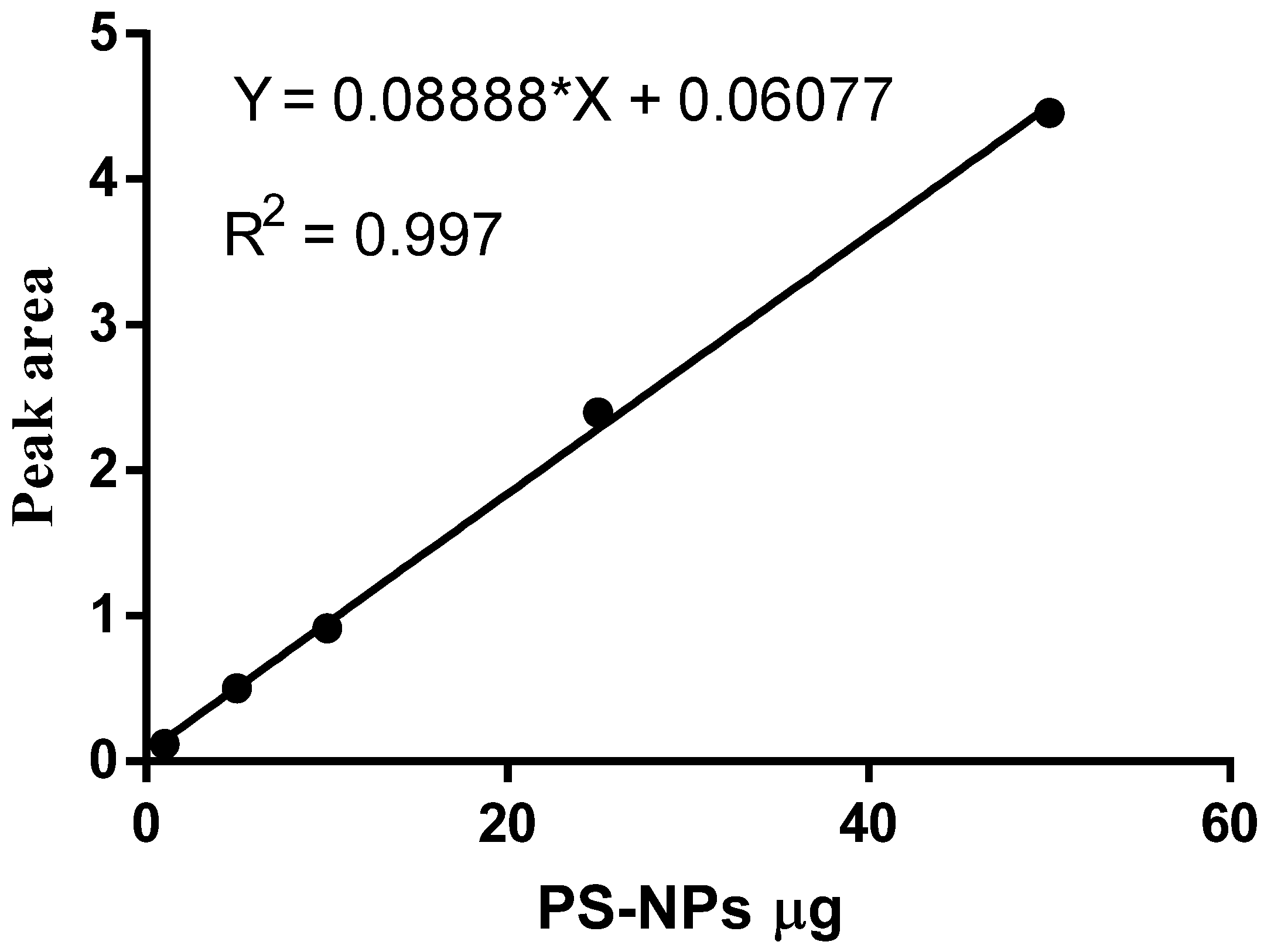
2.4. AF4-UV-DLS Calibration Curve
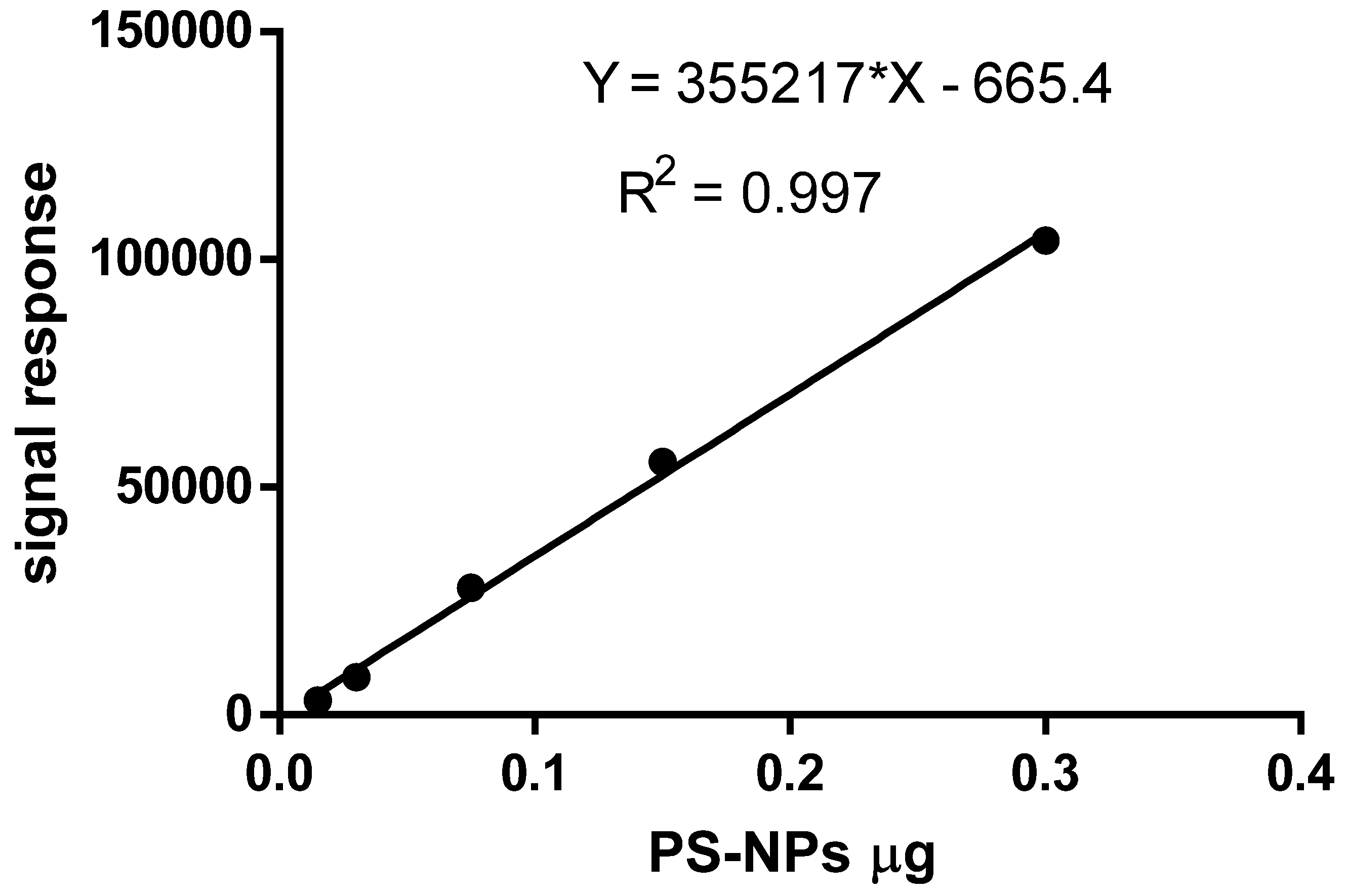
2.5. Pyrolysis–GCMS Calibration Curve
2.6. Optimization of NPs Extraction Protocol for Rodent Tissues Spiked with Known Amounts of PS-NPs
2.7. In Vivo Experiment
2.8. Sample Preparation for AF4 and Pyro-GCMS
2.9. Optimization of NPs Extraction Protocol for Rodent Tissues
2.10. PS-NP Recovery Rate
2.11. Quality Assurance/Quality Control
3. Results
3.1. Tissue Digestion Efficiencies
3.2. Proteinase K (PK) Digestion
3.3. Nitric Acid Digestion
3.4. Potassium Hydroxide/Hypochlorite Digestion
3.5. TMAH Digestion
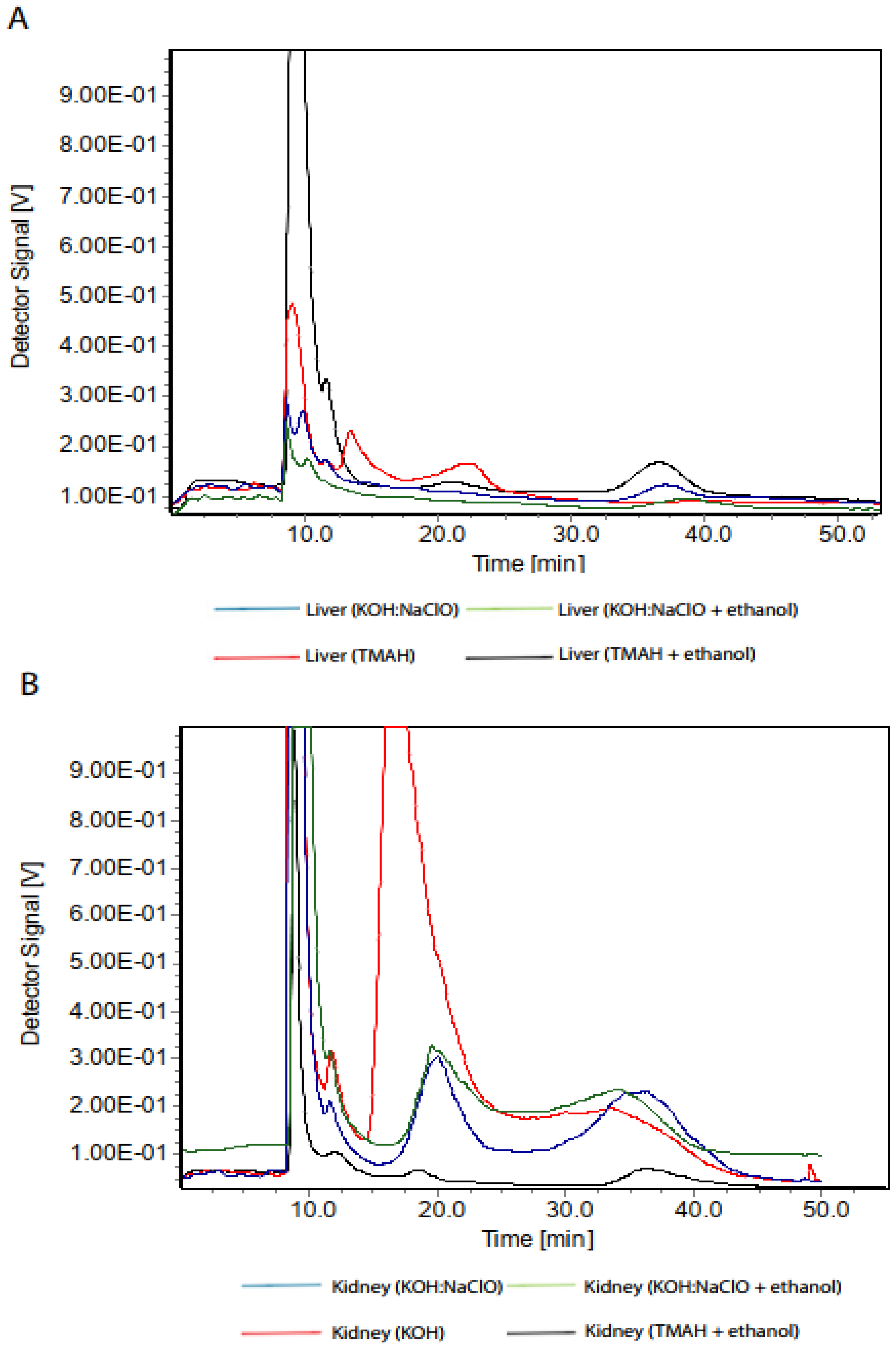
3.6. Tissue Digestion Summary
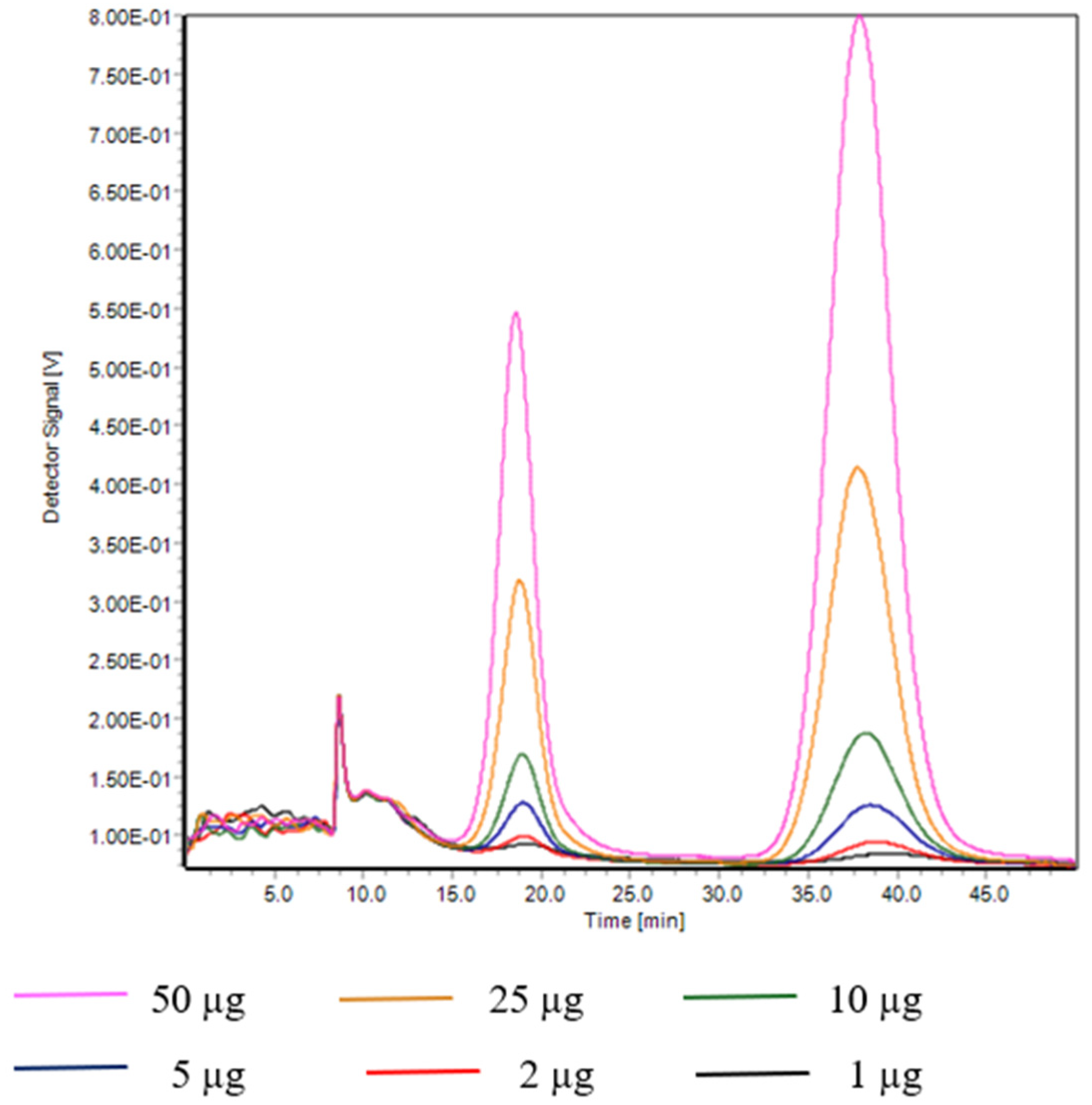
3.7. Analysis of PS-NPs with AF4-UV-DLS
3.8. Evaluation of PS-NPs Using the Pyro-GCMS Method Analysis
3.9. Spiked the PS-NPs in Water and Rodent Tissue
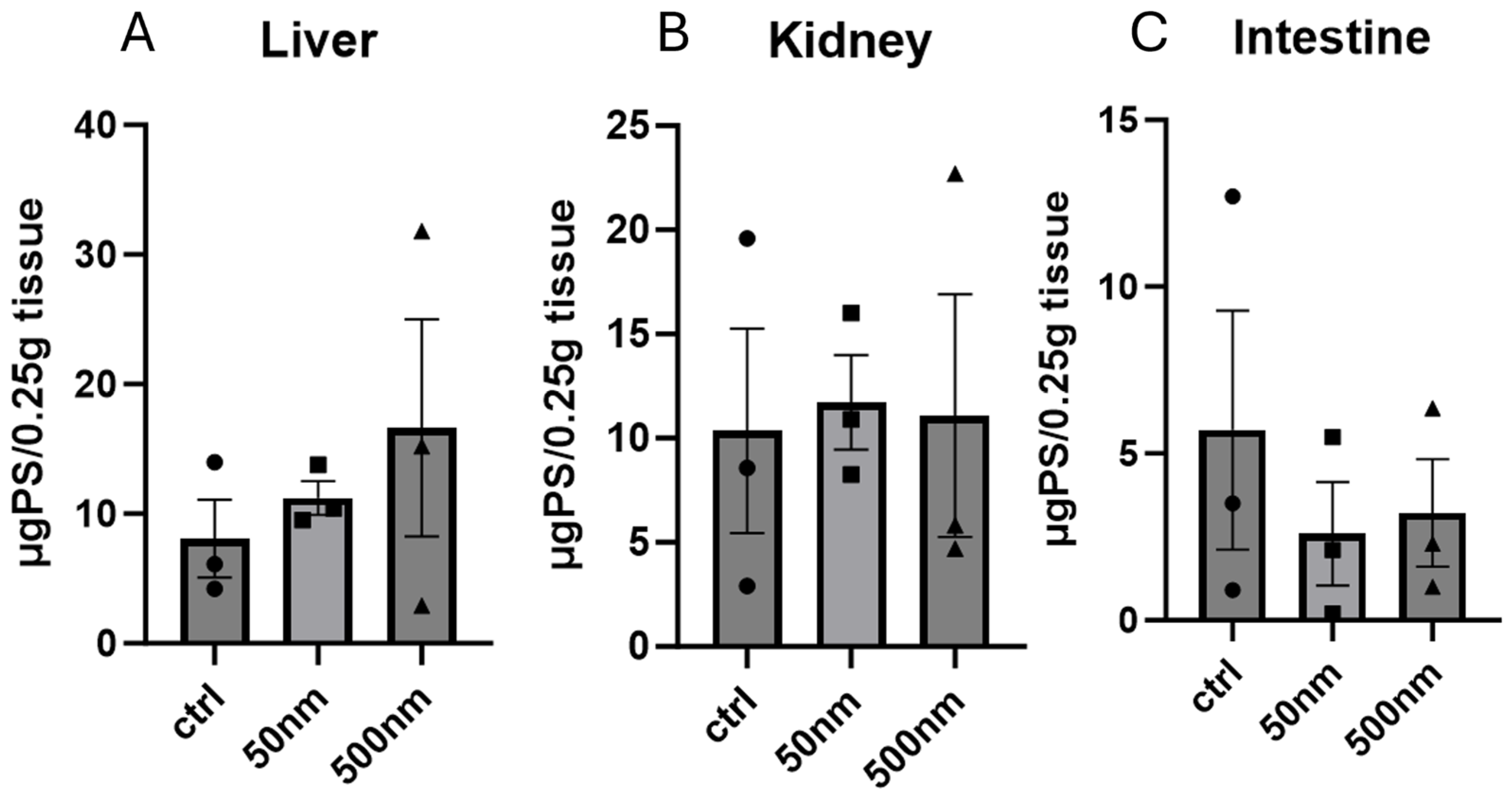
3.10. Detection of PS-NPs in Mouse Organs 24 h After Exposure to PS-NPs
4. Discussion
5. Conclusions
Author Contributions
Funding
Institutional Review Board Statement
Data Availability Statement
Acknowledgments
Conflicts of Interest
Abbreviations
| AF4 | Asymmetric flow field-flow fractionation |
| DLS | Dynamic light scattering |
| MNPs | Micro/nanoplastics |
| MPs | Microplastics |
| NPs | Nanoplastics |
| PS | Polystyrene |
| PS-NPs | Polystyrene nanoplastics |
| Pyro-GCMS | Pyrolysis–gas chromatography mass spectroscopy |
| UV–Vis | Ultraviolet–visible spectrophotometer |
| UPW | Ultrapure water |
References
- Thompson, R.C.; Swan, S.H.; Moore, C.J.; Vom Saal, F.S. Our Plastic Age; The Royal Society Publishing: London, UK, 2009; Volume 364, pp. 1973–1976. [Google Scholar]
- PlasticsEurope. Plastics—The Facts 2022. Available online: https://plasticseurope.org/knowledge-hub/plastics-the-facts-2022/ (accessed on 20 October 2025).
- Eriksen, M.; Cowger, W.; Erdle, L.M.; Coffin, S.; Villarrubia-Gómez, P.; Moore, C.J.; Carpenter, E.J.; Day, R.H.; Thiel, M.; Wilcox, C. A growing plastic smog, now estimated to be over 170 trillion plastic particles afloat in the world’s oceans—Urgent solutions required. PLoS ONE 2023, 18, e0281596. [Google Scholar] [CrossRef]
- da Silva Antunes, J.C.; Sobral, P.; Branco, V.; Martins, M. Uncovering layer by layer the risk of nanoplastics to the environment and human health. J. Toxicol. Environ. Health—Part B Crit. Rev. 2025, 28, 63–121. [Google Scholar] [CrossRef]
- Jenner, L.C.; Rotchell, J.M.; Bennett, R.T.; Cowen, M.; Tentzeris, V.; Sadofsky, L.R. Detection of microplastics in human lung tissue using μFTIR spectroscopy. Sci. Total Environ. 2022, 831, 154907. [Google Scholar] [CrossRef] [PubMed]
- Fotopoulou, K.N.; Karapanagioti, H.K. Degradation of Various Plastics in the Environment. In Hazardous Chemicals Associated with Plastics in the Marine Environment; Takada, H., Karapanagioti, H.K., Eds.; Springer International Publishing: Cham, Switzerland, 2019; pp. 71–92. [Google Scholar] [CrossRef]
- EFSA. Presence of microplastics and nanoplastics in food, with particular focus on seafood. EFSA J. 2016, 14, e04501. [Google Scholar] [CrossRef] [PubMed]
- Hartmann, N.B.; Hüffer, T.; Thompson, R.C.; Hassellöv, M.; Verschoor, A.; Daugaard, A.E.; Rist, S.; Karlsson, T.; Brennholt, N.; Cole, M.; et al. Are We Speaking the Same Language? Recommendations for a Definition and Categorization Framework for Plastic Debris. Environ. Sci. Technol. 2019, 53, 1039–1047. [Google Scholar] [CrossRef] [PubMed]
- Alava, J.J.; Jahnke, A.; Bergmann, M.; Aguirre-Martínez, G.V.; Bendell, L.; Calle, P.; Domínguez, G.A.; Faustman, E.M.; Falman, J.; Kazmiruk, T.N.; et al. A Call to Include Plastics in the Global Environment in the Class of Persistent, Bioaccumulative, and Toxic (PBT) Pollutants. Environ. Sci. Technol. 2023, 57, 8185–8188. [Google Scholar] [CrossRef]
- Weis, J.S.; Alava, J.J. (Micro)Plastics Are Toxic Pollutants. Toxics 2023, 11, 935. [Google Scholar] [CrossRef]
- Battistini, B.; Petrucci, F.; Bocca, B. In-house validation of AF4-MALS-UV for polystyrene nanoplastic analysis. Anal. Bioanal. Chem. 2021, 413, 3027–3039. [Google Scholar] [CrossRef]
- Baner, A.L. Case study: Styrene monomer migration into dairy products in single serve portion packs. In Plastic Packaging Materials for Food: Barrier Function, Mass Transport, Quality Assurance, and Legislation; Wiley-VCH: Weinheim, Germany, 2000; pp. 427–443. [Google Scholar]
- Kontou, S.; Dessipri, E.; Lampi, E. Determination of styrene monomer migrating in foodstuffs from polystyrene food contact articles using HS-SPME-GC-MS/MS: Results from the Greek market. Food Addit. Contam. Part A 2022, 39, 415–427. [Google Scholar] [CrossRef]
- Correia, M.; Loeschner, K. Detection of nanoplastics in food by asymmetric flow field-flow fractionation coupled to multi-angle light scattering: Possibilities, challenges and analytical limitations. Anal. Bioanal. Chem. 2018, 410, 5603–5615. [Google Scholar] [CrossRef]
- Mowla, M.; Shakiba, S.; Louie, S.M. Selective quantification of nanoplastics in environmental matrices by asymmetric flow field-flow fractionation with total organic carbon detection. Chem. Commun. 2021, 57, 12940–12943. [Google Scholar] [CrossRef]
- H.Valido, I.; Fuentes-Cebrian, V.; Hernández, A.; Valiente, M.; López-Mesas, M. Validated method for polystyrene nanoplastic separation in aqueous matrices by asymmetric-flow field flow fraction coupled to MALS and UV–Vis detectors. Microchim. Acta 2023, 190, 285. [Google Scholar] [CrossRef]
- Zhou, X.-X.; He, S.; Gao, Y.; Chi, H.-Y.; Wang, D.-J.; Li, Z.-C.; Yan, B. Quantitative Analysis of Polystyrene and Poly(methyl methacrylate) Nanoplastics in Tissues of Aquatic Animals. Environ. Sci. Technol. 2021, 55, 3032–3040. [Google Scholar] [CrossRef] [PubMed]
- Singh, B.; Kumar, A. Advances in microplastics detection: A comprehensive review of methodologies and their effectiveness. TrAC—Trends Anal. Chem. 2024, 170, 117440. [Google Scholar] [CrossRef]
- Moteallemi, A.; Dehghani, M.H.; Momeniha, F.; Azizi, S. Nanoplastics as emerging contaminants: A systematic review of analytical processes, removal strategies from water environments, challenges and perspective. Microchem. J. 2024, 207, 111884. [Google Scholar] [CrossRef]
- Adhikari, S.; Kelkar, V.; Kumar, R.; Halden, R.U. Methods and challenges in the detection of microplastics and nanoplastics: A mini-review. Polym. Int. 2022, 71, 543–551. [Google Scholar] [CrossRef]
- Vitali, C.; Peters, R.J.B.; Janssen, H.G.; Nielen, M.W.F.; Ruggeri, F.S. Microplastics and nanoplastics in food, water, and beverages, part II. Methods. TrAC—Trends Anal. Chem. 2022, 157, 116819. [Google Scholar] [CrossRef]
- Wang, Y.; Xiang, L.; Amelung, W.; Elsner, M.; Gan, J.; Kueppers, S.; Christian, L.; Jiang, X.; Adu-Gyamfi, J.; Heng, L.; et al. Micro- and nanoplastics in soil ecosystems: Analytical methods, fate, and effects. TrAC—Trends Anal. Chem. 2023, 169, 117309. [Google Scholar] [CrossRef]
- Picó, Y.; Barceló, D. Pyrolysis gas chromatography-mass spectrometry in environmental analysis: Focus on organic matter and microplastics. TrAC—Trends Anal. Chem. 2020, 130, 115964. [Google Scholar] [CrossRef]
- Shao, K.; Zou, R.; Zhang, Z.; Mandemaker, L.D.B.; Timbie, S.; Smith, R.D.; Durkin, A.M.; Dusza, H.M.; Meirer, F.; Weckhuysen, B.M.; et al. Advancements in Assays for Micro- and Nanoplastic Detection: Paving the Way for Biomonitoring and Exposomics Studies. Annu. Rev. Pharmacol. Toxicol. 2025, 65, 567–585. [Google Scholar] [CrossRef]
- Di Fiore, C.; Ishikawa, Y.; Wright, S.L. A review on methods for extracting and quantifying microplastic in biological tissues. J. Hazard. Mater. 2024, 464, 132991. [Google Scholar] [CrossRef]
- Huang, M.; Si, C.; Qiu, C.; Wang, G. Microplastics analysis: From qualitative to quantitative. Environ. Sci. Adv. 2024, 3, 1652–1668. [Google Scholar] [CrossRef]
- Xu, Y.; Ou, Q.; Wang, X.; Hou, F.; Li, P.; van der Hoek, J.P.; Liu, G. Assessing the Mass Concentration of Microplastics and Nanoplastics in Wastewater Treatment Plants by Pyrolysis Gas Chromatography-Mass Spectrometry. Environ. Sci. Technol. 2023, 57, 3114–3123. [Google Scholar] [CrossRef]
- Geppner, L.; Karaca, J.; Wegner, W.; Rados, M.; Gutwald, T.; Werth, P.; Henjakovic, M. Testing of Different Digestion Solutions on Tissue Samples and the Effects of Used Potassium Hydroxide Solution on Polystyrene Microspheres. Toxics 2023, 11, 790. [Google Scholar] [CrossRef]
- Prihandari, R.; Karnpanit, W.; Kittibunchakul, S.; Kemsawasd, V. Development of optimal digesting conditions for microplastic analysis in dried seaweed gracilaria fisheri. Foods 2021, 10, 2118. [Google Scholar] [CrossRef]
- Enders, K.; Lenz, R.; Beer, S.; Stedmon, C.A. Extraction of microplastic from biota: Recommended acidic digestion destroys common plastic polymers. ICES J. Mar. Sci. 2017, 74, 326–331. [Google Scholar] [CrossRef]
- Claessens, M.; Van Cauwenberghe, L.; Vandegehuchte, M.B.; Janssen, C.R. New techniques for the detection of microplastics in sediments and field collected organisms. Mar. Pollut. Bull. 2013, 70, 227–233. [Google Scholar] [CrossRef]
- Deng, Y.; Zhang, Y.; Lemos, B.; Ren, H. Tissue accumulation of microplastics in mice and biomarker responses suggest widespread health risks of exposure. Sci. Rep. 2017, 7, srep46687. [Google Scholar] [CrossRef] [PubMed]
- Pfeiffer, F.; Fischer, E.K. Various Digestion Protocols Within Microplastic Sample Processing—Evaluating the Resistance of Different Synthetic Polymers and the Efficiency of Biogenic Organic Matter Destruction. Front. Environ. Sci. 2020, 8, 572424. [Google Scholar] [CrossRef]
- Catarino, A.I.; Thompson, R.; Sanderson, W.; Henry, T.B. Development and optimization of a standard method for extraction of microplastics in mussels by enzyme digestion of soft tissues. Environ. Toxicol. Chem. 2017, 36, 947–951. [Google Scholar] [CrossRef] [PubMed]
- Karami, A.; Golieskardi, A.; Choo, C.K.; Romano, N.; Ho, Y.B.; Salamatinia, B. A high-performance protocol for extraction of microplastics in fish. Sci. Total Environ. 2017, 578, 485–494. [Google Scholar] [CrossRef] [PubMed]
- Lopes, C.; Fernández-González, V.; Muniategui-Lorenzo, S.; Caetano, M.; Raimundo, J. Improved methodology for microplastic extraction from gastrointestinal tracts of fat fish species. Mar. Pollut. Bull. 2022, 181, 113911. [Google Scholar] [CrossRef] [PubMed]
- Thiele, C.J.; Hudson, M.D.; Russell, A.E. Evaluation of existing methods to extract microplastics from bivalve tissue: Adapted KOH digestion protocol improves filtration at single-digit pore size. Mar. Pollut. Bull. 2019, 142, 384–393. [Google Scholar] [CrossRef] [PubMed]
- Schwaferts, C.; Sogne, V.; Welz, R.; Meier, F.; Klein, T.; Niessner, R.; Elsner, M.; Ivleva, N.P. Nanoplastic Analysis by Online Coupling of Raman Microscopy and Field-Flow Fractionation Enabled by Optical Tweezers. Anal. Chem. 2020, 92, 5813–5820. [Google Scholar] [CrossRef]
- Huynh, K.A.; Siska, E.; Heithmar, E.; Tadjiki, S.; Pergantis, S.A. Detection and Quantification of Silver Nanoparticles at Environmentally Relevant Concentrations Using Asymmetric Flow Field-Flow Fractionation Online with Single Particle Inductively Coupled Plasma Mass Spectrometry. Anal. Chem. 2016, 88, 4909–4916. [Google Scholar] [CrossRef]
- Grafinger, K.E.; Ochiai, C.; Zhou, H.X.; Hettich, T.; Büttler, A.; Álvarez Troncoso, R.; Zenker, A.; Gaugler, S. Towards quantitative microplastic analysis using pyrolysis-gas chromatography coupled with mass spectrometry. Polym. Test. 2024, 140, 108620. [Google Scholar] [CrossRef]
- Rauert, C.; Charlton, N.; Bagley, A.; Dunlop, S.A.; Symeonides, C.; Thomas, K.V. Assessing the Efficacy of Pyrolysis-Gas Chromatography-Mass Spectrometry for Nanoplastic and Microplastic Analysis in Human Blood. Environ. Sci. Technol. 2025, 59, 1984–1994. [Google Scholar] [CrossRef]
- Ivleva, N.P. Chemical Analysis of Microplastics and Nanoplastics: Challenges, Advanced Methods, and Perspectives. Chem. Rev. 2021, 121, 11886–11936. [Google Scholar] [CrossRef]
- Hankett, J.M.; Holtz, J.L.; Walker-Franklin, I.; Shaffer, K.; Jourdan, J.; Batiste, D.C.; Garcia, J.M.; Kaczan, C.; Wohlleben, W.; Ferguson, L. Matrix Matters: Novel insights for the extraction, preparation, and quantitation of microplastics in a freshwater mesocosm study. Microplast. Nanoplast. 2023, 3, 13. [Google Scholar] [CrossRef]
- Cole, M.; Lindeque, P.; Halsband, C.; Galloway, T.S. Microplastics as contaminants in the marine environment: A review. Mar. Pollut. Bull. 2011, 62, 2588–2597. [Google Scholar] [CrossRef]
- Foekema, E.M.; De Gruijter, C.; Mergia, M.T.; van Franeker, J.A.; Murk, A.J.; Koelmans, A.A. Plastic in north sea fish. Environ. Sci. Technol. 2013, 47, 8818–8824. [Google Scholar] [CrossRef] [PubMed]
- Zhou, Q.; Chen, J.; Zhang, D.; Pan, X. Evaluation of organic matter removal by H2O2 from microplastic surface by nano-physicochemical methods. Green Anal. Chem. 2022, 3, 100035. [Google Scholar] [CrossRef]
- Huang, K.; Xie, L.; Gu, X.; Xie, J.; Li, J.; Gao, S.; Ji, R.; Zhou, D. Comprehensive assessment of various digestion protocols for extraction microplastics from organic-rich environmental matrices. Water Res. 2025, 282, 123935. [Google Scholar] [CrossRef]
- Primpke, S.; Fischer, M.; Lorenz, C.; Gerdts, G.; Scholz-Böttcher, B.M. Comparison of pyrolysis gas chromatography/mass spectrometry and hyperspectral FTIR imaging spectroscopy for the analysis of microplastics. Anal. Bioanal. Chem. 2020, 412, 8283–8298. [Google Scholar] [CrossRef]
- Zhang, Y.; Yuan, J.; Mao, T. Impact of microplastics exposure on liver health: A comprehensive meta-analysis. Comp. Biochem. Physiol. Part C Toxicol. Pharmacol. 2025, 288, 110080. [Google Scholar] [CrossRef]
- Tao, H.; Wei, S.; Yuan, D.; Cui Hong, J.; Ying Long, B.; Jun, N.; Yuan, G.; Guo Wei, P.; Zuo Sen, Y.; Ling Jun, Y. The uptake and distribution evidence of nano-and microplastics in vivo after a single high dose of oral exposure. Biomed. Environ. Sci. 2024, 37, 31–41. [Google Scholar]
- Tsou, T.-Y.; Lee, S.-H.; Kuo, T.-H.; Chien, C.-C.; Chen, H.-C.; Cheng, T.-J. Distribution and toxicity of submicron plastic particles in mice. Environ. Toxicol. Pharmacol. 2023, 97, 104038. [Google Scholar] [CrossRef]
- Ding, Y.; Zhang, R.; Li, B.; Du, Y.; Li, J.; Tong, X.; Wu, Y.; Ji, X.; Zhang, Y. Tissue distribution of polystyrene nanoplastics in mice and their entry, transport, and cytotoxicity to GES-1 cells. Environ. Pollut. 2021, 280, 116974. [Google Scholar] [CrossRef]
- Walczak, A.P.; Hendriksen, P.J.; Woutersen, R.A.; van der Zande, M.; Undas, A.K.; Helsdingen, R.; van den Berg, H.H.; Rietjens, I.M.; Bouwmeester, H. Bioavailability and biodistribution of differently charged polystyrene nanoparticles upon oral exposure in rats. J. Nanopart. Res. 2015, 17, 231. [Google Scholar] [CrossRef]
- Du, B.; Li, T.; He, H.; Xu, X.; Zhang, C.; Lu, X.; Wang, Y.; Cao, J.; Lu, Y.; Liu, Y. Analysis of biodistribution and in vivo toxicity of varying sized polystyrene micro and nanoplastics in mice. Int. J. Nanomed. 2024, 19, 7617–7630. [Google Scholar] [CrossRef] [PubMed]



| AF4 | Unit | Value |
|---|---|---|
| Cross flow rate | mL/min | 1 |
| Focus pump flow rate | mL/min | 1 |
| Detector flow rate | mL/min | 0.5 |
| Injection time | Min | 10 |
| Elution time | Min | 45 |
| Injection volume | µL | 100 |
| UV–Vis | Nm | 254 |
| Spacer | µm | 350 |
| Mobile phase-FL 70 | 0.05% |
| Continuous DLS | Temperature | 25 °C |
| Acquisition time | 5.0 s | |
| Measurement position | 4.2 mm | |
| Attenuator | 11 | |
| Batch DLS | Temperature | 25 °C |
| Equilibration time | 120 s | |
| Measurement angle | 173° (NIBS default) | |
| Acquisition time | 10.0 s | |
| Position | Seek for optimum positions | |
| Attenuator | Automatic |
| Thermal Desorption Conditions |
| TDU: Splitless 50 °C (min) |
| 700 °C/min ramp, 300 °C (2.68 min) |
| CIS 4: 300 °C |
| Pyrolysis |
| Carrier Gas: Helium |
| Pyrolysis Temperature: 100–800 °C |
| Temperature Ramp: 5 °C/s |
| Hold Time: 0.10 min |
| TDU Transfer Temp: 340 °C |
| Gas Chromatograph: Agilent 6890N |
| Injector: Split/Splitless |
| Mode: Split 50:1 |
| Temperature: 40–320 °C |
| Temperature Ramp: 15 °C/min |
| Column: Agilent J&W (HP-5MSi); 30 m × 0.25 mm ID, film thickness 0.25 µm |
| Flow (constant): 1 mL/min |
| Temperature Program: 40 °C (1 min) → 320 °C (10 min) at 15 °C/min |
| Transfer Line Temperature: 280 °C |
| Mass spectrometer: Agilent 5973 inert |
| Ionization Energy: 70 eV |
| Scan Rate: 2.7 scans/s |
| Scan Range: 60–600 amu |
| Digestion Method | Digestion Time (Hours) | Ratio Tissue/Digestion Buffer | Tissue Tested | Temperature of Digestion Tested |
|---|---|---|---|---|
| Nitric acid (65%) | 2 h, 3 h, 24 h | 1:10 | Spleen, kidney | RT, 37 °C, 70 °C |
| Proteinase K (1 mg/mL) | 24 h, 72 h | 1:5 | Spleen, kidney | RT, 37 °C |
| KOH 10% | 24 h | 1:30 | Spleen, kidney, liver, heart, gut, skeletal muscle, brain | RT, 37 °C |
| KOH:NaClO 15%:5% | 96 h for livers | |||
| TMAH 15% | 24 h | 1:30 | Spleen, kidney, liver, brain | RT, 37 °C |
| 72 h for brain |
| Matrix | Size of PS (nm) | Mass PS Spiked (µg) | Analysis by AF4-UV-DLS | Analysis by Pyro-GCMS | ||||
|---|---|---|---|---|---|---|---|---|
| Mass PS Detected (µg) | CV % | Recovery (%) | Mass PS Detected (µg) | CV% | Recovery (%) | |||
| water | 50 | 5 | 4.82 ± 0.28 | 5.9 | 96.4 | 5.37 ± 0.62 | 11.52 | 107.3 |
| 25 | 23.73 ± 0.33 | 1.39 | 94.9 | 22.70 ± 5.97 | 26.3 | 90.8 | ||
| 50 | 50.20 ± 5.32 | 10.59 | 100.4 | 40.03 ± 6.72 | 16.78 | 80.1 | ||
| 500 | 5 | 5.1 ± 0.29 | 5.77 | 102 | 4.24 ± 1.34 | 31.61 | 84.8 | |
| 25 | 26.2 ± 0.14 | 0.54 | 104.8 | 17.55 ± 2.73 | 15.55 | 70.2 | ||
| 50 | 53.07 ± 0.74 | 1.39 | 106.1 | 34.88 ± 7.91 | 22.69 | 69.8 | ||
| Organ | Mass PS-NPs Spiked (µg) | PS-NPs Size (nm) | Extraction Method | Analysis by AF4-UV-DLS | Analysis by Py-GCMS | ||
|---|---|---|---|---|---|---|---|
| Mass PS Detected (µg) | Recovery (%) | Mass PS Detected (µg) | Recovery (%) | ||||
| Spleen | 70.2 | 50 | KOH | 55 | 78.3 | 33 | 47 |
| 54 | 500 | KOH | 44.8 | 83 | 27.6 | 51.2 | |
| Kidney | 70.2 | 50 | NaClO | 48.4 | 68.9 | 17.1 | 24.3 |
| 54 | 500 | NaClO | 25.9 | 48 | 22.1 | 40.9 | |
| Intestine | 70.2 | 50 | KOH | 55.8 | 79.5 | 24.5 | 34.9 |
| 54 | 500 | KOH | 62.8 | 116.2 | 37.6 | 69.6 | |
| Liver | 70.2 | 50 | KOH:NaClO | 57.2 | 81.5 | 21.2 | 30.2 |
| 54 | 500 | KOH:NaClO | 56.3 | 104.3 | 29.7 | 55.1 | |
| Tissue | Optimal Buffer | Time to Digestion | Notes/Observations |
|---|---|---|---|
| Brain | 15% TMAH | 72 h | Very few solids remaining after digestion. |
| Requires solvent assisted clearance. | |||
| Heart | 10% KOH only | 24 h | Very clean digestion, few solids remaining. |
| Increasing buffer/tissue ratio permits lowering of digestion time to 16 h. | |||
| Lung | 15% KOH:5% NaClO | 48 h | Smaller tissue amounts are ideal. |
| Larger tissue mass causes increase in dissolved surfactant lipids which require solvent-aided clearance. | |||
| Kidney | 15% KOH:5% NaClO | 72 h | Clean digestion; few solids remaining. |
| Digestion time is critical; lowering the digestion time results in MP sample loss. | |||
| Gut | 10%KOH | 24 h | Clean digestion; few solids remaining. |
| or | Proper washing of gut is critical, remaining fecal matter interacts negatively with buffers and will ruin sample. | ||
| 15% KOH:5% NaClO | Increasing buffer/tissue ratio permits lowering of digestion time to 16 h. | ||
| Liver | 15% TMAH | 96 h | Time of digestion is critical. Significant sample loss occurs prior to 96 h digestion. |
| or | Requires solvent-assisted clearance. | ||
| 15% KOH:5% NaClO | Buffer/tissue ratio is absolutely critical and does not seem to scale in a linear fashion. For every 0.1 g increase in tissue mass, we recommend a 0.2× increase in buffer volume. | ||
| Spleen | 10% KOH only | 24 h | Clean digestion; few solids remaining. |
| 10% KOH buffer produced the best clearance. | |||
| Skeletal muscle | 15% KOH:5% NaClO | 24 h | Some solids persist after digestion. |
| 24 h digestion time is critical; lowering it results in insufficient clearance despite increasing the buffer/tissue ratio. |
| Digestion Method | Chemical(s) Used | Advantages | Disadvantages |
|---|---|---|---|
| Enzymatic | Proteinase K |
|
|
|
| ||
| Strong acids | 67% Nitric acid |
|
|
|
| ||
| Strong bases | 10% KOH |
| |
| 15% TMAH |
|
| |
| |||
| Combination buffers | 15% KOH:5% NaClO |
|
|
|
Disclaimer/Publisher’s Note: The statements, opinions and data contained in all publications are solely those of the individual author(s) and contributor(s) and not of MDPI and/or the editor(s). MDPI and/or the editor(s) disclaim responsibility for any injury to people or property resulting from any ideas, methods, instructions or products referred to in the content. |
© 2026 by the authors. Licensee MDPI, Basel, Switzerland. This article is an open access article distributed under the terms and conditions of the Creative Commons Attribution (CC BY) license.
Share and Cite
Singh, G.; Velasquez, L.; Mason, C.; Scur, M.; Marcellus, K.A.; Gill, S. Detection and Identification of Non-Labeled Polystyrene Nanoplastics in Rodent Tissues Using Asymmetric Flow Field-Flow Fractionation (AF4) Combined with UV–Vis, Dynamic Light Scattering (DLS) Detectors and Offline Pyrolysis–GCMS (Pyro-GCMS). Microplastics 2026, 5, 2. https://doi.org/10.3390/microplastics5010002
Singh G, Velasquez L, Mason C, Scur M, Marcellus KA, Gill S. Detection and Identification of Non-Labeled Polystyrene Nanoplastics in Rodent Tissues Using Asymmetric Flow Field-Flow Fractionation (AF4) Combined with UV–Vis, Dynamic Light Scattering (DLS) Detectors and Offline Pyrolysis–GCMS (Pyro-GCMS). Microplastics. 2026; 5(1):2. https://doi.org/10.3390/microplastics5010002
Chicago/Turabian StyleSingh, Gurmit, Ligia Velasquez, Chris Mason, Michal Scur, Kristen A. Marcellus, and Santokh Gill. 2026. "Detection and Identification of Non-Labeled Polystyrene Nanoplastics in Rodent Tissues Using Asymmetric Flow Field-Flow Fractionation (AF4) Combined with UV–Vis, Dynamic Light Scattering (DLS) Detectors and Offline Pyrolysis–GCMS (Pyro-GCMS)" Microplastics 5, no. 1: 2. https://doi.org/10.3390/microplastics5010002
APA StyleSingh, G., Velasquez, L., Mason, C., Scur, M., Marcellus, K. A., & Gill, S. (2026). Detection and Identification of Non-Labeled Polystyrene Nanoplastics in Rodent Tissues Using Asymmetric Flow Field-Flow Fractionation (AF4) Combined with UV–Vis, Dynamic Light Scattering (DLS) Detectors and Offline Pyrolysis–GCMS (Pyro-GCMS). Microplastics, 5(1), 2. https://doi.org/10.3390/microplastics5010002