Article

Detection and Identification of Non-Labeled Polystyrene Nanoplastics in Rodent Tissues Using Asymmetric Flow Field-Flow Fractionation (AF4) Combined with UV–Vis, Dynamic Light Scattering (DLS) Detectors and Offline Pyrolysis–GCMS (Pyro-GCMS)


1
Food Research Division, Bureau of Chemical Safety, Food and Nutrition Directorate-HPFB, Health Canada, Ottawa, ON K1A 0K9, Canada
2
Regulatory Research Toxicology Division, Food and Nutrition Directorate-HPFB, Health Canada, Ottawa, ON K1A 0K9, Canada
*
Author to whom correspondence should be addressed.
Microplastics 2026, 5(1), 2; https://doi.org/10.3390/microplastics5010002 (registering DOI)
Submission received: 21 October 2025 / Revised: 14 November 2025 / Accepted: 17 November 2025 / Published: 1 January 2026

Abstract

Microplastic pollution is a growing global environmental and public health concern, driven by the increasing production and use of plastics. Due to their ubiquitous presence in the environment, humans and animals may be exposed to micro- and nanoplastics via several possible routes. For micro- and nanoplastics, the development of standardized and validated methods remains an important area of progress to support human health risk assessments. In order to monitor micro/nanoplastics’ occurrence in organisms and the environment, it is necessary to develop accurate and reliable methods to quantify and characterize micro/nanoplastics from various biological and environmental matrices. In this study, an analytical, multi-platform approach was established to characterize and quantify polystyrene nanoplastics in biological samples through a combination of sample pre-concentration, asymmetric flow field-flow fractionation, ultraviolet–visible light, dynamic light scattering detectors and pyrolysis–gas chromatography–mass spectroscopy. Several digestion methods on various rodent tissues were tested and modified, and these led to the development of tissue-specific protocols to maximize yield. These digestion protocols were then combined with a new method of concentrating and retaining plastics to prevent the loss of submicron particles. For identification and quantification, known amounts of polystyrene nanoplastics were spiked into rodent tissues (intestine, kidney and liver). This was followed up by a mouse in vivo study consisting of a single dose of PS-NPs, followed by tissue collection, digestion and analysis. Polystyrene particles were detected in the liver and kidney, but not reliably in the intestinal tissues.

1. Introduction

Plastics have become an integral part of daily human life and are among the most manufactured materials worldwide. Plastic is inexpensive, strong, durable, lightweight and easy to manufacture [1]. Globally, production of plastics has been increasing since 1950 and has reached a staggering 300 million tons per year [2]. It is estimated that around 170 trillion plastic particles are floating on the ocean’s surface [3], and plastic fragments have been discovered in every ecosystem on the globe.
Due to their widespread and persistent presence, micro/nanoplastics (MNPs) are an emerging global contaminant found in foods, water, air and soil and have potential for exposure in humans and animals [4,5]. Larger plastic fragments are degraded by physical and chemical factors through environmental exposure, which results in the production of MNPs [6]. Microplastics (MPs) are traditionally defined as plastic materials or fragments measuring less than 5 mm, whereas nanoplastics (NPs) are generally smaller than 1 µm in diameter [7,8]. Due to their persistence and ubiquity in the environment [9,10], MNPs have been recognized as a global contaminant [9]. Quantification and characterization of MNPs in the environment, food products and the tissues of living organisms is a critical area for toxicological evaluation. A common MNP pollutant is polystyrene (PS), one of the major polymers used in food packaging, building insulation, electrical and electronics industries and cosmetics. PS is a polymer of styrene monomers, which are composed of benzene and ethylene carbon units [11]. Rigid PS, due to its high permeability to gases and vapors, is mainly used for foods with a short shelf-life, usually refrigerated and with a high fat content, such as yogurt and fresh cheese [12]. Extruded PS foam trays are used for packaging meat, poultry, fish, fruits and vegetables. Other important food contact applications of PS include disposable cups for cold or hot drinks and disposable cutlery [13].
Methods reported for the detection of MNPs in food and environmental samples are limited, especially when trying to analyze submicron MNPs [11,13,14,15,16,17]. The analysis of MNPs is a big challenge because of their low concentration levels and complex sample matrix, as well as their diverse array of physicochemical properties including their composition, size, shape and density. Millimeter-sized plastic particles can be monitored visually, but confirmation of the polymer type requires spectroscopic tools such as Fourier-transform infrared spectroscopy, Raman spectroscopy and scanning electron microscopy combined with energy-dispersive X-ray spectroscopy [18]. These technologies have long been considered robust methods for the identification of diverse plastic materials, but have limited applications when analyzing environmental or biological samples. The accuracy of plastic identification also decreases as the size of the particles approaches the submicron range. Standardized methods are needed for the isolation, identification and quantification of MNPs, especially submicron MNPs. Multiple analytical techniques dedicated to MNP characterization and quantifications are currently being examined, including asymmetric flow field-flow fractionation (AF4) coupled with ultraviolet (UV) light, dynamic light scattering (DLS) and pyrolysis–gas chromatography–mass spectroscopy (pyro-GCMS). AF4 is a flow-based separation technique, where separation takes place in a small, ribbon-like channel under laminar flow conditions in the absence of a stationary phase. AF4 techniques can be applied to determine the particle size distribution of a wide range of sizes. Numerous methodological reviews have summarized the techniques and approaches used to detect MNPs in environmental and food samples [19,20,21,22]. Pyro-GCMS is currently one of the most popular analytical techniques for quantification of the total mass of MNPs isolated from environmental and biological samples, although it is a destructive technique and unable to provide information about the plastic characteristics except for absolute mass and polymer type [23,24].
A prelude to risk assessment and hazard characterization is to know the average human exposure levels from dietary sources. Although there have been increasing publications on internal microplastic exposure in biological tissues, analysis is still hampered by several factors, including the lack of harmonized and standardized protocols and technical challenges in the extraction and quantification of MNPs [25], especially in complex matrices. Separating MNPs from complex matrices, such as food, organisms and environmental samples like sediment and effluent is also difficult particularly due to their reduced size effect [26]. In addition, matrix effects can potentially interfere with analytical techniques, such as AF4-UV-DLS and pyro-GCMS, particularly in the pre-treatment/purification of the sample [25].
The first objective of this study is to evaluate and develop sample preparation methods for the extraction of PS-NPs from various rodent tissues and determine which are suitable for subsequent downstream analysis. The second objective is to develop the AF4-UV-DLS and pyro-GCMS method for both size characterization and mass determination of PS-NPs bioaccumulated in rodent tissues. A three-pronged approach was used for the development method. First, ultrapure water (UPW) was spiked with increasing concentrations of both 50 and 500 nm PS-NPs. The samples were subjected to AF4-UV-DLS and pyro-GCMS. Secondly, various rodent tissues were spiked with 50 and 500 nm PS-NPs and subjected to various methods of digestion, followed by filtration and concentration of the sample prior to AF4-UV-DLS and pyro-GCMS. Thirdly, mice were orally dosed with 50 and 500 nm PS-NPs and tissues collected 24 h later for biodistribution analysis.

2. Materials and Methods

2.1. Chemical and Reagents

All chemicals used in this study were analytical grade. Polybead® polystyrene microspheres, 0.50 μm and 0.05 μm at 2.6% solids (w/v), (Polysciences, Inc., Warrington, PA, USA) was used. FL70 Concentrate detergent (Fisher Chemicals, Ottawa, ON, Canada), closed-bottom quartz sample analysis tubes (Gerstel, Inc., Linthecum, MD, USA), 50 μL glass syringes with 22 gauge needle (Hamilton Company, Reno, NV, USA), ultrapure water (UPW, MilliporeSigma™ Synergy™ Ultrapure Water Purification System, Oakville, ON, Canada) and KOH pellets, NaClO 15% and TMAH 35% were obtained from ThermoFisher (Fisher Chemicals, Ottawa, ON, Canada) and used as received. For sample filtration, Millex 2.0 μm pore size, glass fiber, syringe filters obtained from MilliporeSigma, Oakville, ON, Canada were used as is. AMICON filter columns (ThermoFisher, Ottawa, ON, Canada) with a 0.5 mL and 15 mL capacity and a 3 kDa membrane cutoff size were used for sample concentration.

2.2. AF4-UV-DLS Method

NP separation was performed using an AF4 system coupled online with a UV–vis spectrophotometer (AF2000 Postnova Analytics, Landsberg, Germany), and DLS was carried out using a Nano ZS (Malvern Instruments Ltd., Malvern, Worcestershire, UK). All measurements were performed at 25 °C. The AF4 channel was 33.5 cm long and 6.0 cm wide. A 350 μm thick spacer and membrane in regenerated cellulose (RC) at a 10 kDa cutoff (Postnova Analytics, Landsberg, Germany) were used for the experiments. The AF4 mobile phase was prepared by diluting the FL-70 concentrate to 0.05% in UPW. AF4 carrier solution of 0.05% FL-70 was filtered through 0.1 mm Teflon membrane filters (Postnova Analytics, Landsberg, Germany). Each injection into the system was 100 μL. The AF4 separation method involved a focusing step and an elution step; the conditions are listed in Table 1, and for DLS in Table 2.

2.3. Pyrolysis–Gas Chromatography–Mass Spectroscopy (Pyro-GCMS)

Pyro-GCMS analysis was performed using Gerstel sample introduction module, (Gerstel, Inc., Linthecum, MD, USA) consisting of a Gerstel pyrolysis module (Gerstel PYRO) connected to a thermal desorption unit (TDU2) and cooled injection system (CIS 4). The pyrolysis module, TDU and CIS were coupled to an Agilent 6890N GC and 5973 inert Mass Spectrometer (Agilent Technologies Canada, Mississauga, ON, Canada). The pyrolysis conditions are listed in Table 3.

2.4. AF4-UV-DLS Calibration Curve

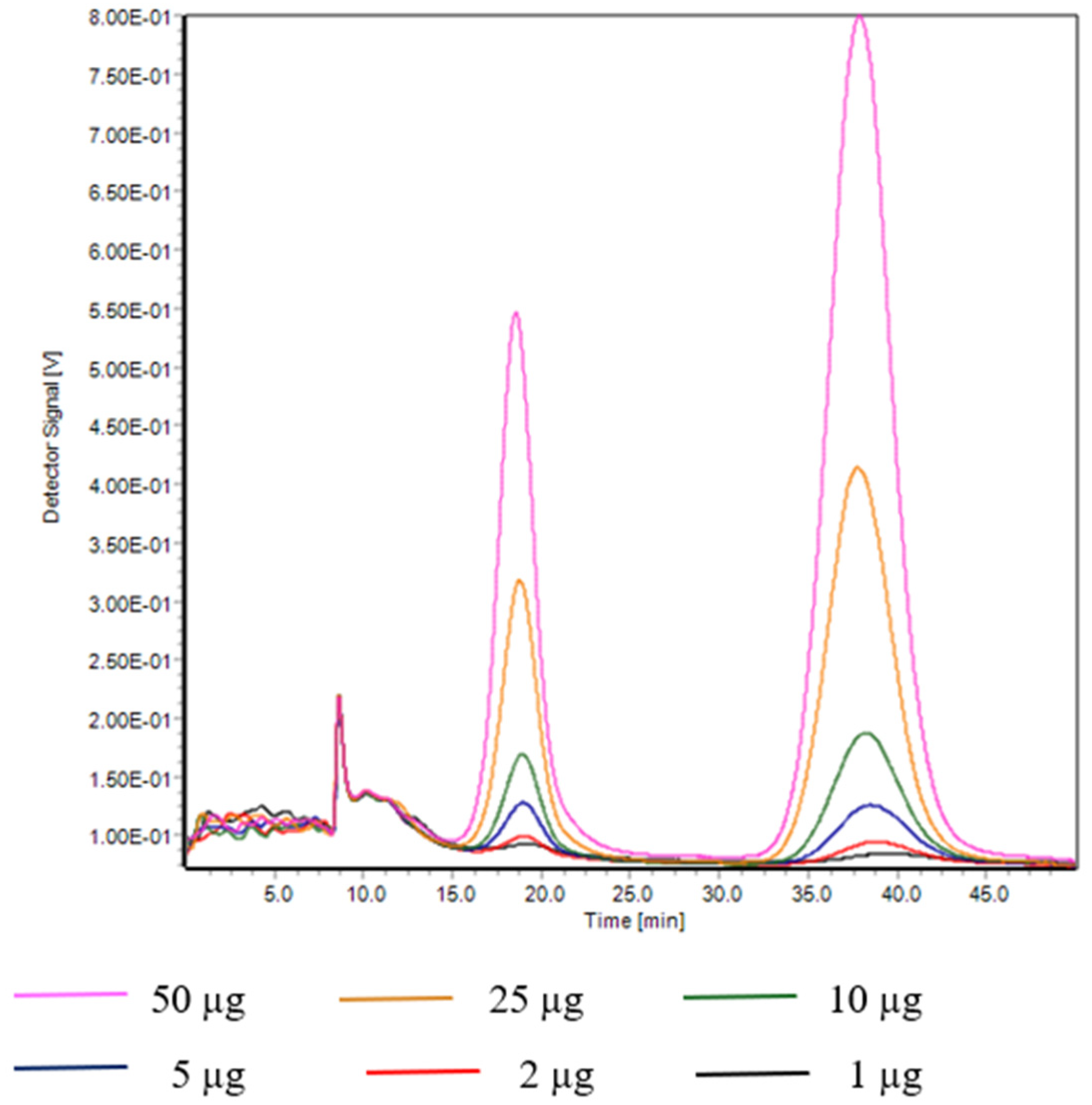
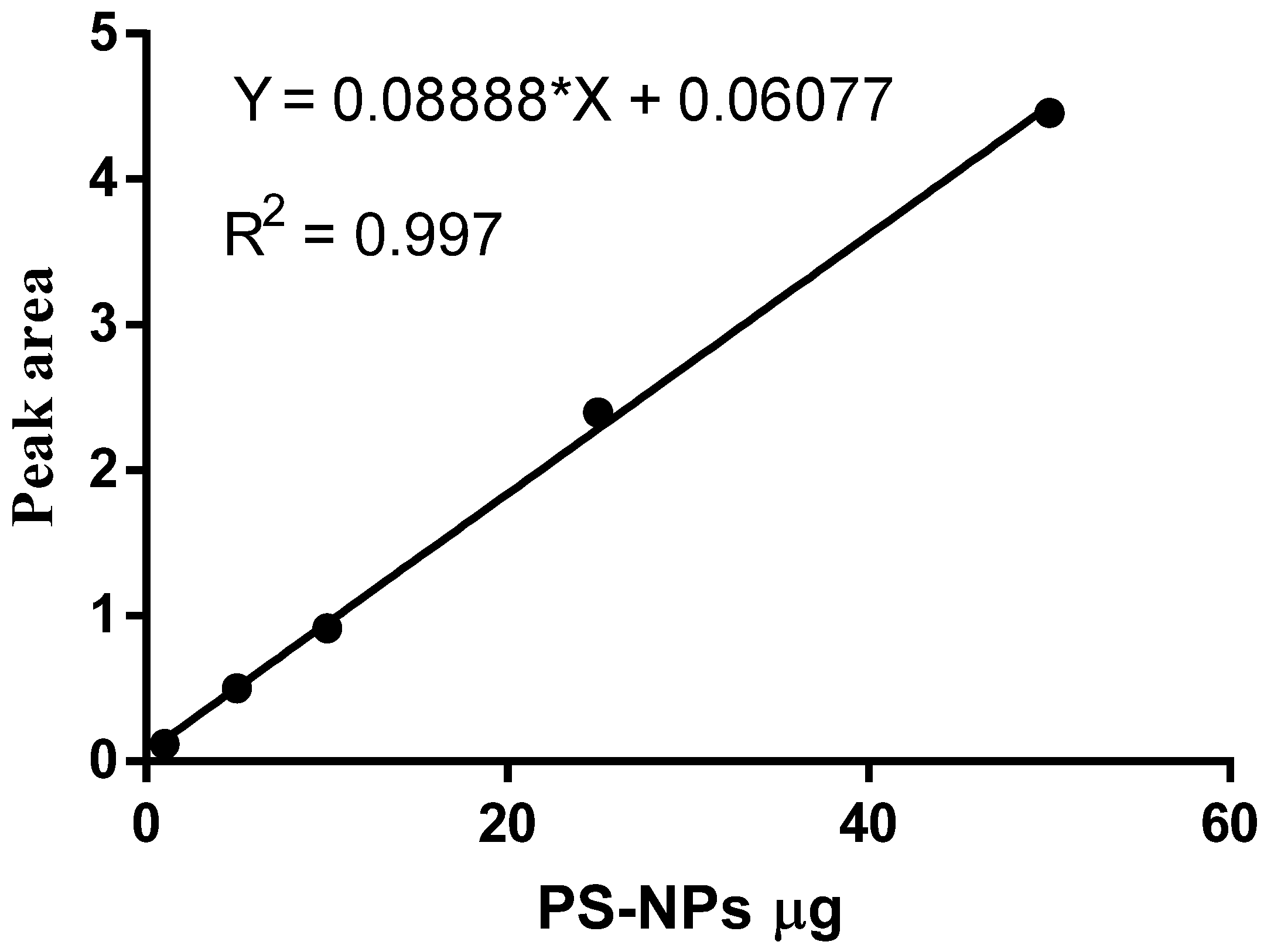
A calibration curve for the AF4 method was prepared using two different sizes of PS-NP particles (50 nm and 500 nm) at six different masses: 1.0, 2.0, 5, 10, 25 and 50 µg. The calibration and linearity range was assessed by injecting the PS-NPs in increasing amounts and then measuring the UV signal for each PS peak in the fractogram (Figure 1). Calibration curves (Figure 2) were obtained by plotting the calculated peak areas versus the PS-NP mass. The limit of detection (LOD, 0.157 µg) and limit of quantification (LOQ, 0.477 µg) were determined for AF4-UV-DLS measurements.

2.5. Pyrolysis–GCMS Calibration Curve

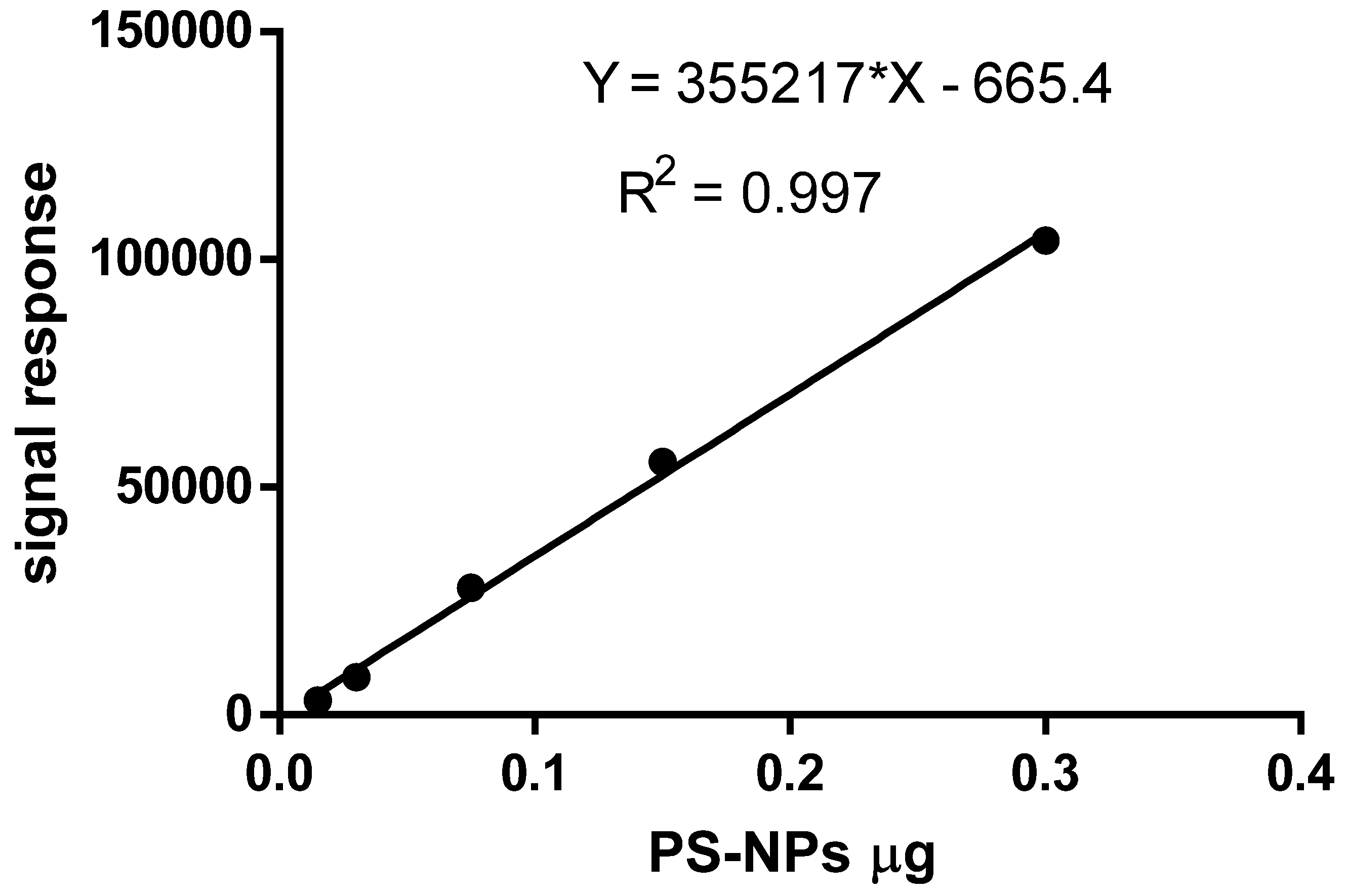
A calibration curve for the pyro-GCMS method was prepared using the PS-NPs (500 nm) at five different masses: 0.015, 0.03, 0.075, 0.15 and 0.3 µg. The calibration and linearity range was assessed by injecting the PS-NPs in increasing amounts and then measuring the response signal for each PS peak in the fractogram. M/Z 104 was used for quantification of the styrene peak. Calibration curves (Figure 3) were obtained by plotting the calculated peak areas versus the PS-NP mass. For simplicity, the lowest calibration standard included in the calibration curve was used as the limit of detection of the instrument. Due to different volumes of the samples analyzed, the method’s detection limit (MDL) ranged from 1 to 3.75 µg for samples first collected from the AF4, and from 0.5 to 0.75 µg for sample extracts analyzed directly by pyro-GCMS.

2.6. Optimization of NPs Extraction Protocol for Rodent Tissues Spiked with Known Amounts of PS-NPs

The calibration curves were established in ultrapure water; this was followed by developing and modifying extraction methods of PS-NPs from various tissue samples including the intestine, liver, kidney and spleen. Rodent tissues were spiked with 50 nm (70.2 µg) and 500 nm (54 µg) spherical PS-NPs and placed in a glass tube. These concentrations were chosen because they produced an explicitly visible readout on the AF4-UV-DLS system. Several digestion protocols were tested as described in Table 4 for various tissues and compared. The appropriate digestion buffer was added to the tissue in the ratio outlined. The samples were then allowed to digest under agitating conditions using the temperatures and digestion lengths outlined in Table 4 unless stated otherwise.

2.7. In Vivo Experiment

Twelve male C57BL/6 mice (weighing between 12 and 18 g) were obtained from Charles River Laboratories Inc. (St.-Constant, QC, Canada) and acclimatized for a period of seven days before treatment began. Animal handling and treatment procedures were conducted according to the Guidelines of the Canadian Council of Animal Care and were approved by the Health Canada Animal Care Committee (Ottawa, ON, Canada). Mice were identified by tattoo markings on the tail. Animals had ad libitum access to Purina Rodent Chow 5001 (Agribands Purina Canada, East Strathroy, ON, Canada) and DI water. Male mice were singly housed. The temperature and humidity of the room were targeted for 18–26 °C and 30–70%, respectively, and continuously monitored. The animals were divided into 3 groups with 1 group being the control and thus receiving only the carrier solution, one group being dosed with 50 nm diameter beads and one group being dosed with 500 nm beads. Four animals in each group were gavaged with PS-NPs of 50 or 500 nm in diameter with a single dose of 2 mg/kg of body weight. The high dose was chosen due to the short nature of the experiment and to ensure that the maximum possible amount of PS-NPs would cross the intestinal barrier and be potentially detected in tissues. After 24 h of exposure, the animals of each group were sacrificed by exsanguination via the abdominal aorta under isoflurane anesthesia. The intestines, liver and kidney were collected, snap frozen in liquid nitrogen and stored at −80 °C until analysis.

2.8. Sample Preparation for AF4 and Pyro-GCMS

Tissue digestion was performed using the ratios specified in Table 4 in 10 mL glass vessels (i.e., 0.25 g of tissue in 7.5 mL of KOH/NaClO buffer). The vessels were capped and gently shaken for the times specified in Table 4 at 37 °C. Following tissue digestion, the digestate was divided up into 2 mL microfuge tubes and spun at 14,000 g for 15 min. The supernatant was carefully pipetted off and aliquoted into 15 mL tubes for subsequent use. The pellet was resuspended in 2 mL of water and filtered through a 2 µm or 1.2 µm glass fiber syringe filter into 15 mL conical tubes. The filter was pre-wetted with DI water prior to filtration of the sample. Following sample filtration, a volume of DI water equivalent to the original sample volume was run through the filter to ensure all MP particles were passed through, as previous experience has shown that they can be retained in the membrane despite being below the pore size cutoff. The filtrate was then spun at 4000 rpm for 40 min. The supernatant was removed and the remaining pellet resuspended in 100 µL of DI water and placed into a glass sample vial.
The supernatant obtained earlier was subjected to AMICON concentration. Supernatants were loaded into 0.5 mL AMICON filter units and spun at 14,000 g for 15 min. The flow-through was discarded while the retentate was mixed with 200 µL of DI water to resuspend any sedimented microplastics and put into a fresh tube. The filter unit was reused until all of the digested supernatant was exhausted. Finally, the pooled retentate was subjected to AMICON filtration one last time resulting in a final retentate volume of approximately 0.1–0.25 mL. This was then added to the pellet obtained from the previous filtration step to produce the sample that would be run for analysis.
For amounts of tissue that require more than 7 mL of digestion buffer, the digested tissue was poured into 15 mL tubes and spun at 4000 rpm for 40 min. The resulting pellet was processed as described above. The supernatant was loaded onto 15 mL capacity AMICON spin columns and spun at 4000 rpm for 40 min. The resulting retentate was then subjected to AMICON filtration using 0.5 mL capacity spin columns as described above until the retentate was concentrated to a volume of approximately 1 mL.
For livers, the digested tissue was pelleted and processed as described above. The supernatant was loaded onto a 15 mL AMICON spin column and spun at 4000 rpm for 40 min. The concentrated supernatant was then diluted in water to 7.5 mL and 3.5 mL of 95% ethanol was added for a final concentration of 30% ethanol. The sample was heated at 55 °C for 25 min to facilitate lipid dissolution. Afterwards, the supernatant was once again loaded onto a 15 mL AMICON spin column, spun at 4000 rpm for 40 min and then added to its respective pellet to create one combined sample as described previously.

2.9. Optimization of NPs Extraction Protocol for Rodent Tissues

To achieve a quantitative extraction of PS-NPs from tissue samples, several digestion protocols were tested—hereafter described and summarized in Table 4. Rodent tissues were spiked with PS beads of 50 and 500 nm in size and placed in a glass tube. The appropriate digestion buffer was added to the tissue at the ratio and concentration outlined in Table 4. The samples were then allowed to digest under agitating conditions using the temperatures and digestion lengths outlined below unless stated otherwise.

2.10. PS-NP Recovery Rate

We spiked the mixtures of PS-NPs (50 and 500 nm) at different levels (5, 25 and 50 µg) in water (Table 5). The mixtures were separated by AF4-UV-DLS; the fractions were collected and then lyophilized and analyzed using pyro-GCMS. Secondly, different rodent tissues from the control samples were weighed and spiked with the PS mixture (50 and 500 nm) of PS-NP solutions of similar sizes (Table 6). Each sample was extracted as outlined above, and a non-spiked sample was run as the blank.

2.11. Quality Assurance/Quality Control

To minimize the risk of contamination, all vials were thoroughly rinsed with ultrapure water. Nitrile gloves and 100% cotton lab coats were consistently worn in the laboratory. Cotton lab coats and polymer-free nitrile gloves were utilized throughout the sampling and laboratory procedures and were carefully washed before use. Furthermore, samples stored in containers were covered with aluminum foil to protect them from airborne contamination [27].

3. Results

The hazard characterization and exposure assessment of MNPs has been hampered by a lack of reliable and reproducible quantification methods in various matrices. The extraction methodologies for MNPs can vary significantly, each offering distinct advantages and limitations. This study was designed to implement the best methods suited for various organs and attempting to take into account tissue-specific factors that may influence downstream MNP quantification.

3.1. Tissue Digestion Efficiencies

The AF4-UV-DLS and pyro-GCMS method depends on high sample quality and organic matter clearance. Thus, first, the efficiency and tissue clearance of some well-known methods of organic tissue digestion were evaluated, specifically proteinase K, nitric acid, potassium hydroxide and related potassium hydroxide derivative buffers, as well as TMAH, as outlined and summarized in Table 4, with our summarized findings presented in Table 7. Clearance in our evaluation was defined as a dissolution of solid organic matter and creation of a transparent solution with no debris visible to the naked eye.

3.2. Proteinase K (PK) Digestion

PK digestion has been used extensively [14,28,29] to process organic tissues for downstream processing in microplastic research. The technique is known to be particularly gentle since it relies on the enzymatic breakdown of tissues in mild buffering solutions and temperature conditions which result in excellent preservation of microplastic. In this study, PK digestion was able to produce good clearance in less complex tissues such as the spleen. Twenty-four-hour digestion was needed to achieve full dissociation of organic matter to allow for downstream processing with the filtration methods described in this protocol.
More complex tissues, such as the kidney and liver, require a digestion period of 3 to 4 days, which is insufficient for complete digestion. The filtration methods described in this protocol were insufficient in the case of kidney and liver tissues having undergone PK digestion and resulted in frequent filter clogging and sample loss. Unfiltered samples could potentially be utilized for other assays depending on the tolerability of the instrument to debris but were unsuited for our downstream applications of AF4-UV-DLS and pyro-GCMS analyses.
The conclusion from this evaluation is that PK digestion is suitable for less complex, homogenous tissues and perhaps for tissue culture/organoid purposes where production of large-scale debris is not a concern. For more complex tissues and larger tissue samples, other protocols should be considered.

3.3. Nitric Acid Digestion

Nitric acid is a strong acid that has been used widely to remove organic components in both environmental studies, as well as marine biology, and more recently in MP studies involving rodents [30,31,32]. Nitric acid digestion, especially under conditions of increased temperature, can lead to rapid degradation of soft tissue and organic matter within a very short time-span of a few hours. Several permutations of nitric acid digestion of mouse tissues began with the technique developed by Deng et al. [32]. Digestions of varying acidic strength (30% and 67%), different digestion temperatures (21, 37, 50 and 60 °C) and different digestion times (1 h, 2 h, 5 h and 15 h) have been attempted. Organic matter clearance was indeed excellent; however, every variation in nitric acid digestion resulted in the almost total loss of all PS-NPs present in the sample with every tissue tested, including the protocol developed by Deng et al. [32]. Deng et al. propose that PS-NPs absorbed into tissues through ingestion may be offered some protection by the surrounding organic matter during digestion than particles which are simply injected into the tissue. However, nitric acid exposure has a long and well-documented history of causing broad-spectrum MP degradation [30,33,34,35] which may increase the likelihood of quantification artefacts in PS-NP studies aiming for precise particle quantification readouts. Due to its destructive properties and inability to successfully isolate meaningful amounts of PS-NPs without significant destruction of the plastic material, we decided not to pursue this digestion method further.

3.4. Potassium Hydroxide/Hypochlorite Digestion

Digestion using potassium hydroxide (KOH) at a concentration of 10% w/v has enjoyed widespread use in several scientific fields of study as the routine buffer used for organic removal. In general, digestion using strong bases appears to sacrifice digestion time and organic matter removal capability in favor of preserving the inorganic structures of interest when compared to acid-based digestion buffers [14,35,36]. The effects of KOH on the degradation of MPs are well known [30,36,37], which may be an important consideration for some studies.
In this study, KOH digestion was trialed on every major organ and tissue and produced satisfactory organic matter clearance and plastic recovery for most tissues. The only exception was the kidney, where KOH digestion resulted in poor PS-NP recovery and poor organic matter clearance compared to other tissues. The optimal digestion time for most tissues was 24 h with the exception of the kidney and skeletal muscle, which required 72 and 36 h of digestion, respectively, to produce sufficient clearance of organic matter for downstream processing.
Due to the popularity of KOH digestion, other studies have attempted to improve on this method, such as the work by Enders et al. [30] which uses a KOH/hypochlorite buffer, combining a strong base with an oxidative agent. In the present study, the KOH/hypochlorite protocol was adapted exactly as explained in Enders et al. [30] and produced results comparable to or slightly better than KOH alone, especially in kidney tissue. Conversely, we found that using KOH/hypochlorite on spleen and heart tissues produced excellent clearance, although precipitation of protein structures was observed which may affect downstream recovery. However, for most tissues the organic matter clearance was usually slightly better than KOH alone, which made filtration and AMICON-assisted concentration of the sample easier to perform.

3.5. TMAH Digestion

Various reports have utilized TMAH digestion to extract particles from both organic and inorganic matrices [17], and it is a well-used derivatizing agent in pyrolysis-coupled chromatography. In this study, TMAH was found to be inferior compared to other alkaline methods due to the increased time required for digestion and insufficient organic matter clearance, which was determined by increased sample opacity when compared to KOH and KOH/NaClO protocols. However, TMAH combined with isopropanol aided lipid clearance and was found to produce the best results in brain tissue digestates; thus, it is the recommended method for this particular tissue.

3.6. Tissue Digestion Summary

A summary of the pros and cons of the methods tested is presented in Table 8. The use of oxidative agents such as concentrated hydrogen peroxide (H2O2 30%) is also quite popular. However, in these experiments, H2O2 caused significant gas production and required very long digestion times, often exceeding 72 h. Combined with poor clearance of high-density tissues like skeletal muscle, these limitations led us to abandon this method. Table 7 presents the method and buffer that yielded the best tissue clearance results for every specific tissue, as well as any peculiar tissue-specific details that can assist in the digestion and downstream analysis process.

3.7. Analysis of PS-NPs with AF4-UV-DLS

The AF4 separation condition was developed and optimized based on previous report with little modification [38]. When the AF4 is connected to conventional mass detectors, such as UV, the detection of PS-NP fractions results in peaks in the AF4 fractograms as shown in Figure 1. These peaks correspond to the retention time, with particles of greater size being retained longer; for example, 500 nm particles elute at around 37 min, while 50 nm particles elute at around 19 min. The retention time and area of each peak correspond to the hydrodynamic diameter and mass concentration of the nanoplastics fraction, respectively [39], as can be seen in Figure 2. This method can be used for a qualitative evaluation of particle size, as well as being a tool for quantifying the amount of plastic in the sample.

3.8. Evaluation of PS-NPs Using the Pyro-GCMS Method Analysis

The acquisition method parameters used for PS-NP quantification are detailed in Table 3. Closed-bottomed quartz tubes were preconditioned by heating at 700 °C under helium gas flow. Lyophilized AF4 fractions were resuspended in a known amount of ultrapure water with sonication. In total, 30 μL of this suspension was transferred to a conditioned quartz tube using a glass syringe. For tissue samples analyzed directly (without AF4 separation), 30 μL of sample was transferred directly to a conditioned quartz tube using a glass syringe or pre-diluted in ultrapure water if necessary prior to transfer to the quartz tube. Quartz tubes were heated gently in an oven until all liquid was evaporated, and then the dried sample quartz tube was analyzed via pyro-GCMS. The challenges and limitations of the direct analysis of biological samples have been documented [40,41].

3.9. Spiked the PS-NPs in Water and Rodent Tissue

The recovery of spiked water samples was used to measure the reproducibility of AF4-UV-DLS quantification and compare it to quantifications obtained via pyro-GCMS. Water samples were spiked with known quantities of PS-NPs (5 µg, 25 µg or 50 µg) at either 50 nm or 500 nm in diameter and then quantified using AF4-UV-DLS. Following AF4-UV-DLS quantification, fractions were collected corresponding to the peak eluted and subjected to quantification via pyro-GC/MS, and the results were compared between the two methods. Overall, the results indicated that recovery ranged from 94.9% to 106.1%, with CV less than 6% at all evaluated concentrations by AF4-UV-DLS. In contrast, recovery ranged 69.8% to 107.3% as evaluated by pyro-GCMS. The summarized results are presented in Table 5. Overall, the results obtained through AF4-UV-DLS correlated well with the initial concentration; however, pyro-GCMS showed a decreasing trend of recovery with increasing PS-NP mass.
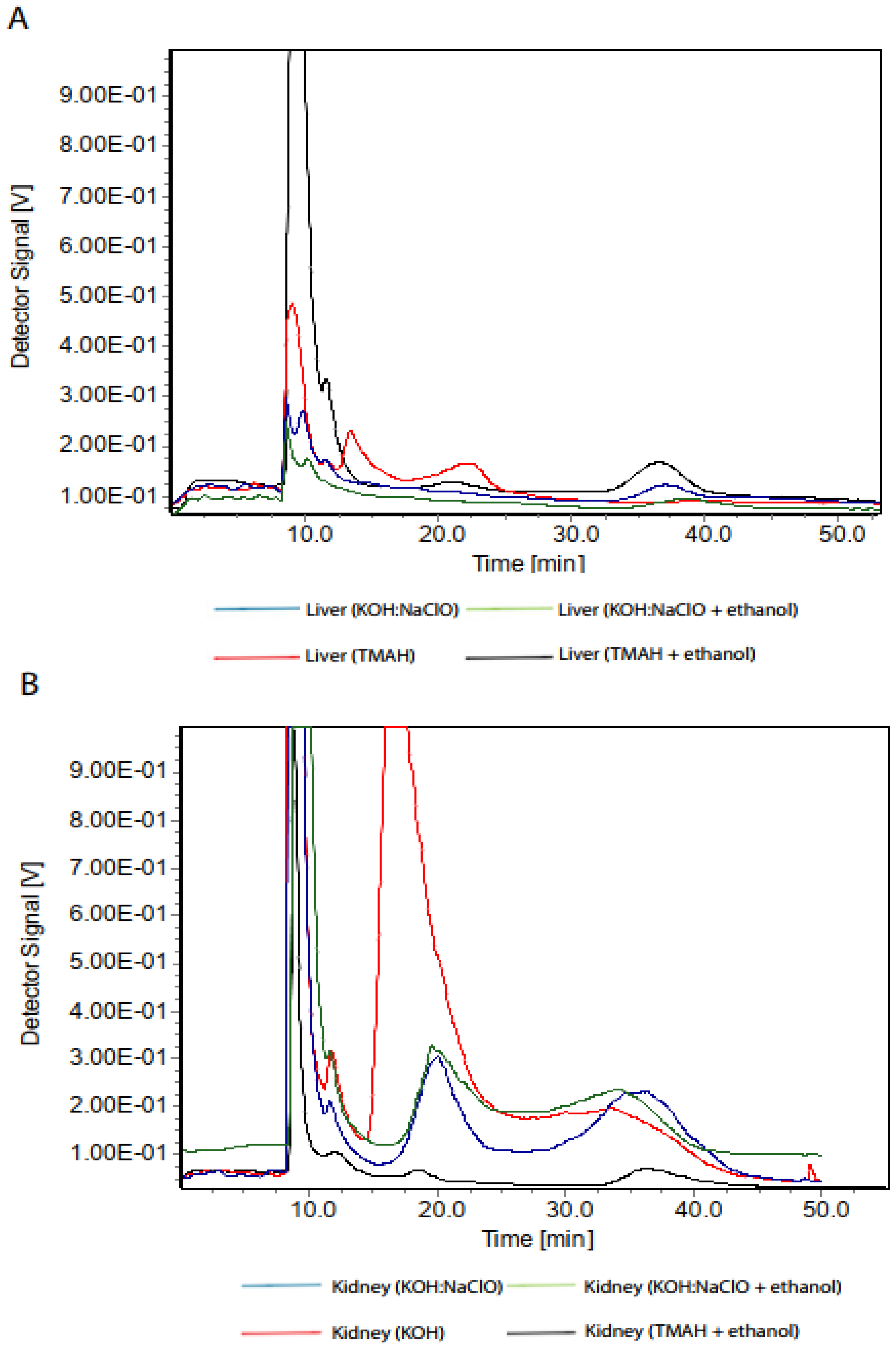
A summary of experiments conducted with rodent tissues spiked with PS-NPs can be found in Table 6. Tissues were spiked using 70.2 µg and 54 µg of 50 nm and 500 nm PS-NPs, respectively, and then processed using the tissue-specific methodology and digestions as outlined above. The recovery using AF4-UV-DLS for the 50 nm particles was the highest in the liver (81.5%), followed by the intestine (79.5%), spleen (78.3%) and kidney (68.9%). For the 500 nm spiked tissues, the recovery was approximately 100% in both intestine and liver, whereas in the spleen and kidney, the recovery was approximately 83% and 48.0%, respectively. Some sample AF4 fractograms are presented in Figure 4 showing varying rates of recovery in the liver (Figure 4A) and kidney (Figure 4B) using different digestion buffers. Using pyro-GCMS, the recovery for 50 nm particles was much lower: spleen (47.0%), kidney (24.3%), intestine (34.9%) and liver (30.2%). Recovery for the 500 nm particles was as follows: spleen (51.2%), intestine (69.6%), liver (55.1%) and the kidney (40.9%). In summary, quantification via AF4-UV-DLS shows good recovery for most organs, with the possible exception of the kidney. Following AF4-UV-DLS peak isolation and subsequent pyro-GCMS, analysis shows decreasing recovery rates similar to those found in the water experiments presented in Table 6 for the equivalent mass of particles analyzed. The data shows that even with optimized protocols, handling methods and matrix effects still result in a significant but predictable loss in quantifiable mass with more pronounced loss in the pyro-GCMS method of analysis.

3.10. Detection of PS-NPs in Mouse Organs 24 h After Exposure to PS-NPs

Nine-week-old C57BL/6 mice were obtained from Charles River Laboratories Inc. and orally gavaged at a concentration of 2 mg/kg body weight with either control, 50 nm or 500 nm PS-NPs. The mice were sacrificed 24 h post-administration, with livers, kidneys and intestines being harvested for analysis of which 0.25 g was used for downstream analysis.
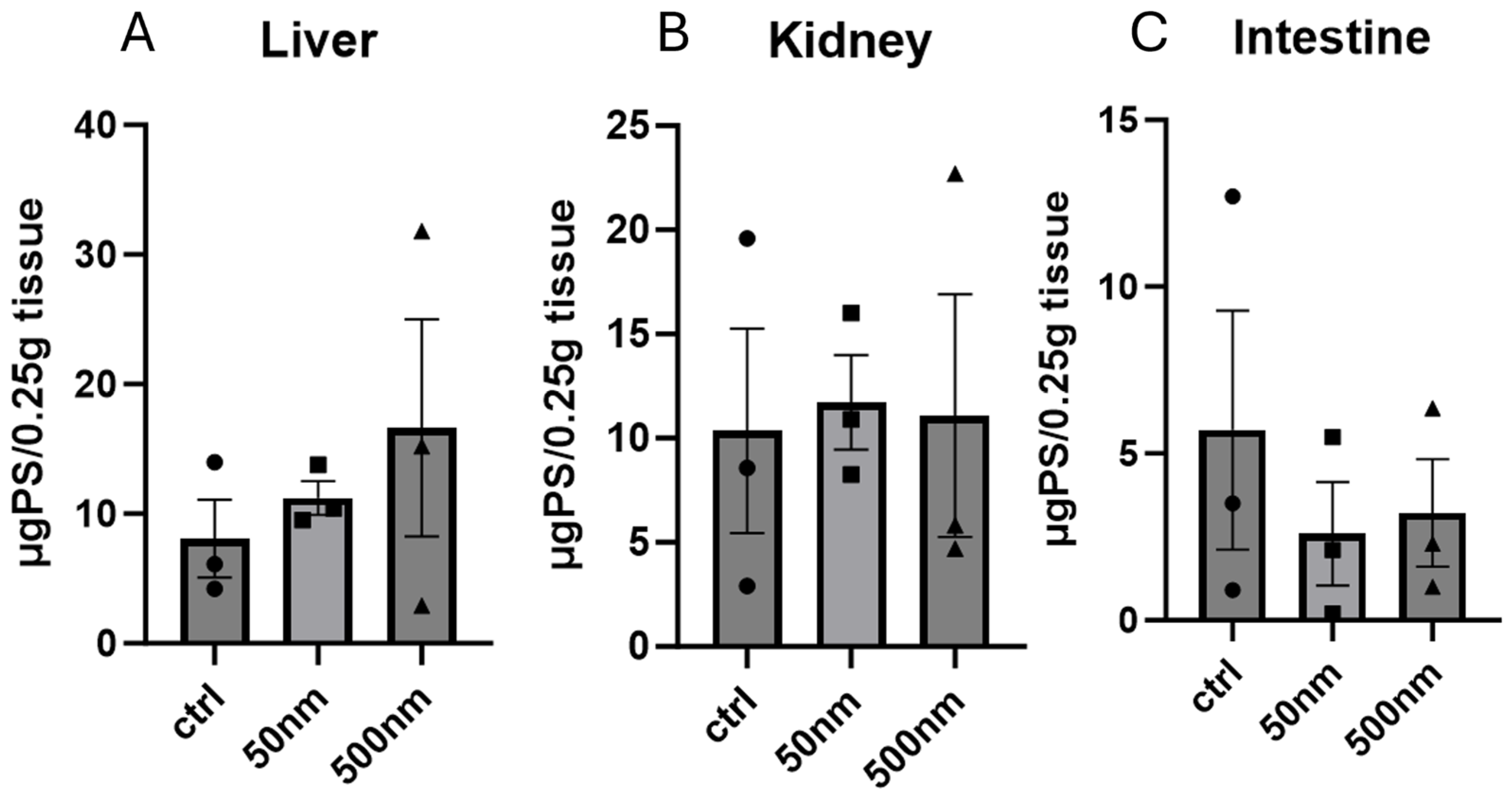
AF4 analysis was unable to detect any PS-NPs in rodent tissue after 24 h of exposure to either 50 or 500 nm PS-NPs; thus, the samples were used directly for pyro-GCMS. Using this method, we were able to recover varying amounts of PS from various tissues. Although some biological matrix remained, PS-NP was progressively detected in the liver (Figure 5A) and kidney (Figure 5B). In contrast, intestinal sample results were too inconsistent to reach a conclusion about PS-NP detection (Figure 5C). Our method of tissue digestion and pyro-GCMS presented in this work has been able to detect PS-NPs in the liver and kidneys of mice exposed to PS-NPs in vivo even without AF4 processing, demonstrating its viability as a method of PS-NP quantification in biological tissues at very low concentrations.

4. Discussion

Sensitive and reliable methods are required for the chemical identification and quantification of PS-NPs in different matrices for estimating human exposure and for health risk assessment. Recently, there has been an increase in publications attempting to determine the presence of the various MNP polymers in biological tissues; however, the quantification and analysis is still hampered by several factors, including the lack of harmonized and standardized protocols and technical challenges in the extraction and quantification of microplastics. In this study, we evaluated different enzymatic and chemical methods for hydrolysis of tissues, followed by drafting tissue-specific conditions which achieve optimal matrix clearance as required for our methodology. For detection and quantification, we used a combined method of AF4-UV-DLS and pyro-GCMS to quantify PS-NPs in different tissues. PS-NP detection was conducted in tissues spiked with known quantities of PS-NPs, as well as in vivo exposure where PS-NPs were detected in the liver and kidney tissues of mice subjected to a single bolus dose of PS-NPs.
The results of this study show that recovery using the pyro-GCMS method varied from tissue to tissue. This is due the fact that inorganic and organic materials are known to interfere with the efficiency of pyrolysis [23,42,43]. In addition, analytical techniques are complicated and compromised by matrix effects that have the potential to interfere with analysis, including after the pre-treatment/purification of the sample [25].
Pre-treatment methods for biological samples mainly consist of chemical or enzymatic digestions for the removal of organic matter. Chemical digestions can be acidic (e.g., nitric and/or hydrochloric acid [44]), basic (e.g., potassium hydroxide [45] or sodium hydroxide [33]) or oxidizing (e.g., hydrogen peroxide [46], Fenton’s reagent [47], or sodium hypochlorite [30]). Biological matrix removal can also be achieved through enzymatic digestion, such as trypsin, papain, collagenase or proteinase K digestion [28]. In this study, different digestion protocols for the pre-treatment of biological samples were evaluated in terms of their impact on the efficiency of recovery of PS-NPs. Tissues can have vastly different consistencies ranging from simply immune cells as found in the spleen to high fat and high protein content as found in the liver and brain tissues. A “one-size-fits-all” approach will lead to inefficiency and underestimation/overestimation due to poor digestion or unacceptable rates of loss. The aim of this work is to develop a protocol that is reliable, reproducible and achieves optimal tissue clearance combined with predictable recovery with minimal loss to combat the clear underestimation that is occurring in the field of microplastics. Finally, we aim to provide an initial set of steps and conditions which can be expanded and improved upon when attempting to quantify MNPs, specifically in the submicron range, which have thus been mostly neglected in the published literature.
For detection and quantification, both the AF4-UV-DLS and pyrolysis–GCMS methods were used. The method of detection for 50 and 500 nm was performed initially using a simple matrix composed of ultrapure water. Calibration curves for PS-NPs were developed for both 50 and 500 nm on both AF4 and pyro-GCMS. In ultrapure water, the recovery for both 50 and 500 nm using AF4-UV-DLS was 90% or more and for pyro-GCMS it was usually 80% or above. For pyro-GCMS, recovery tended to decrease as the total mass in the sample increased, perhaps due to the systems showing increased sensitivity at lower particle concentrations. Once the methodology was established using a simple matrix of water, it was then applied to the analysis of rodent tissues spiked with both 50 nm and 500 nm PS-NPs. Due to the complexity of the tissues, one digestion method was not effective for all tissue types. For instance, kidney tissue required 72 h in 15% KOH and 5% NaClO, whereas liver tissue required 96 h in 15% KOH and 5% NaClO and an added solvent clearance step to create a digestate suitable for downstream analysis. Spiked samples were analyzed using AF4-UV-DLS, after which the fraction was collected, lyophilized and reconstituted in ultrapure water, followed by pyro-GCMS analysis. For the liver and intestine, the recovery ranged from 79% to 100%, respectively, for 50 and 500 nm PS-NPs. The recovery was lower using pyro-GCMS compared to AF4-UV-DLS. The lower recovery in pyro-GCMS could be due to contaminants of the organic matrix products, which could interfere with thermal processes [48]. However, as established in our water matrix experiments, the recovery loss associated with higher concentrations of PS-NPs in pyro-GCMS correlated fairly well with our loss in complex matrices; the extra loss is likely due to the digestion procedure, which requires a lot of handling, and also due to matrix products leftover in the sample. These experiments enabled a predictable rate of loss and recovery for both AF4-UV-DLS and pyro-GCMS, which would be valuable for future studies utilizing both of these methods. Future method development will aim to improve on these initial observations to reduce the rate of loss through modifying the tissue-to-buffer ratio, as well as exploring a variety of solvents to aid in the digestion of complex tissues.
After establishing the methodology for detecting PS in various rodent tissues, we conducted a single gavage exposure (2 mg/kg of body mass) with 50 and 500 nm PS-NPs. No PS was detected using the AF4-UV-DLS methodology in the liver and kidney, etc., which is likely due to either low sensitivity of the instruments or the single dosage being too small to promote any significant accumulation in tissues. However, when pyro-GCMS was used, it was able to detect PS-NPs in the liver and kidney tissues, and to a lesser extent in the intestine, proving that the methodology presented here is capable of detecting particles in peripheral tissues even at very low concentrations after a single high-exposure dose. The presence of PS-NPs in the control likely forms part of the natural background due to matrix contamination or from daily food consumption and inhalation exposures, since it has been demonstrated that MNP pollution is essentially ubiquitous. The method presented here is able to concentrate and isolate particles down to the 50 nm range reliably. Combined with the sensitive detection capabilities of pyro-GCMS, we are also capturing more background pollution than other PS-NP isolation and detection techniques. Studies [49] have identified the liver as a potential target organ for MNP exposure, while deposition in various organs has also been observed in previous studies where mice were exposed to MPs for several hours, up to four weeks [50,51,52,53,54]. Smaller particles have been shown to traverse various biological barriers and possibly accumulate various tissues [54]. However, the isolation and characterization of these particles have been a persistent challenge. The work presented here has shown that both AF4-UV-DLS and pyro-GCMS can be used for quantification of PS-NPs down to a minimum 50 nm and perhaps even further with more method refinement, following isolation and concentration of tissue digestates using our optimized methods as presented above. From the work presented here, it can be seen that due to tissue-specific differences in MNP yield, a lack of focus on MNPs below 1 μm in the literature and the predictable loss characteristics of pyro-GCMS, most studies conducting MNP quantification from tissues and/or the environment are likely underestimates. This study provides a proof of concept, and the methodologies presented here are the first step in hopefully spurring the creation of a universal protocol for MNP studies looking to examine the MNP body burden. Likewise, it aims to provide a reliable, predictable but easily modifiable method to isolate submicron particles from various biological samples.

5. Conclusions

AF4-UV-DLS and pyro-GCMS, combined with tissue-specific digestion, were used to optimize the recovery of PS-NPs. Both methods achieved approximately 100% recovery in ultrapure water. In spiked tissues with high concentrations of PS-NPs, both techniques detected polystyrene nanoplastics of 50 and 500 nm. Recovery rates determined by AF4-UV-DLS in the liver, spleen and intestine were approximately 80%, while the kidney showed a 50% recovery rate for both PS-NP sizes. Using pyro-GCMS, recovery in these tissues ranged from 30% to 55%. This variation may be due to residual biological organic compounds interfering with the pyrolysis process. After tissue removal from gavaged animals, AF4-UV-DLS did not detect PS-NPs, whereas pyro-GCMS did.

Author Contributions

Conceptualization—G.S.; methodology—G.S., C.M., L.V., M.S. and K.A.M.; software—C.M., L.V. and G.S.; formal analysis—C.M., L.V. and M.S.; investigation—G.S., S.G. and M.S.; data curation—M.S., C.M., L.V. and G.S.; writing—original draft preparation—G.S., M.S. and S.G.; writing—review and editing, C.M., L.V., M.S. and K.A.M.; visualization—M.S. and G.S.; supervision—G.S. and S.G.; project administration—G.S.; funding acquisition—G.S. and S.G. All authors have read and agreed to the published version of the manuscript.

Funding

This research received no external funding.

Institutional Review Board Statement

The animal study protocol was approved by the Health Canada Animal Care Committee (Ottawa, ON, Canada), (protocol code: 2023-012; date of approval: 29 November 2023).

Data Availability Statement

The original contributions presented in this study are included in the article. Further inquiries can be directed to the corresponding author.

Acknowledgments

We thank Soheyl Tadjiki, Xu-Liang Cao, Dharani Das, Catherine Smith, and Anastase Rulibikiye for reviewing the manuscript.

Conflicts of Interest

The author declares no conflicts of interest.

Abbreviations

The following abbreviations are used in this manuscript:
AF4Asymmetric flow field-flow fractionation
DLSDynamic light scattering
MNPsMicro/nanoplastics
MPsMicroplastics
NPsNanoplastics
PSPolystyrene
PS-NPsPolystyrene nanoplastics
Pyro-GCMSPyrolysis–gas chromatography mass spectroscopy
UV–VisUltraviolet–visible spectrophotometer
UPWUltrapure water

References

  1. Thompson, R.C.; Swan, S.H.; Moore, C.J.; Vom Saal, F.S. Our Plastic Age; The Royal Society Publishing: London, UK, 2009; Volume 364, pp. 1973–1976. [Google Scholar]
  2. PlasticsEurope. Plastics—The Facts 2022. Available online: https://plasticseurope.org/knowledge-hub/plastics-the-facts-2022/ (accessed on 20 October 2025).
  3. Eriksen, M.; Cowger, W.; Erdle, L.M.; Coffin, S.; Villarrubia-Gómez, P.; Moore, C.J.; Carpenter, E.J.; Day, R.H.; Thiel, M.; Wilcox, C. A growing plastic smog, now estimated to be over 170 trillion plastic particles afloat in the world’s oceans—Urgent solutions required. PLoS ONE 2023, 18, e0281596. [Google Scholar] [CrossRef]
  4. da Silva Antunes, J.C.; Sobral, P.; Branco, V.; Martins, M. Uncovering layer by layer the risk of nanoplastics to the environment and human health. J. Toxicol. Environ. Health—Part B Crit. Rev. 2025, 28, 63–121. [Google Scholar] [CrossRef]
  5. Jenner, L.C.; Rotchell, J.M.; Bennett, R.T.; Cowen, M.; Tentzeris, V.; Sadofsky, L.R. Detection of microplastics in human lung tissue using μFTIR spectroscopy. Sci. Total Environ. 2022, 831, 154907. [Google Scholar] [CrossRef] [PubMed]
  6. Fotopoulou, K.N.; Karapanagioti, H.K. Degradation of Various Plastics in the Environment. In Hazardous Chemicals Associated with Plastics in the Marine Environment; Takada, H., Karapanagioti, H.K., Eds.; Springer International Publishing: Cham, Switzerland, 2019; pp. 71–92. [Google Scholar] [CrossRef]
  7. EFSA. Presence of microplastics and nanoplastics in food, with particular focus on seafood. EFSA J. 2016, 14, e04501. [Google Scholar] [CrossRef] [PubMed]
  8. Hartmann, N.B.; Hüffer, T.; Thompson, R.C.; Hassellöv, M.; Verschoor, A.; Daugaard, A.E.; Rist, S.; Karlsson, T.; Brennholt, N.; Cole, M.; et al. Are We Speaking the Same Language? Recommendations for a Definition and Categorization Framework for Plastic Debris. Environ. Sci. Technol. 2019, 53, 1039–1047. [Google Scholar] [CrossRef] [PubMed]
  9. Alava, J.J.; Jahnke, A.; Bergmann, M.; Aguirre-Martínez, G.V.; Bendell, L.; Calle, P.; Domínguez, G.A.; Faustman, E.M.; Falman, J.; Kazmiruk, T.N.; et al. A Call to Include Plastics in the Global Environment in the Class of Persistent, Bioaccumulative, and Toxic (PBT) Pollutants. Environ. Sci. Technol. 2023, 57, 8185–8188. [Google Scholar] [CrossRef]
  10. Weis, J.S.; Alava, J.J. (Micro)Plastics Are Toxic Pollutants. Toxics 2023, 11, 935. [Google Scholar] [CrossRef]
  11. Battistini, B.; Petrucci, F.; Bocca, B. In-house validation of AF4-MALS-UV for polystyrene nanoplastic analysis. Anal. Bioanal. Chem. 2021, 413, 3027–3039. [Google Scholar] [CrossRef]
  12. Baner, A.L. Case study: Styrene monomer migration into dairy products in single serve portion packs. In Plastic Packaging Materials for Food: Barrier Function, Mass Transport, Quality Assurance, and Legislation; Wiley-VCH: Weinheim, Germany, 2000; pp. 427–443. [Google Scholar]
  13. Kontou, S.; Dessipri, E.; Lampi, E. Determination of styrene monomer migrating in foodstuffs from polystyrene food contact articles using HS-SPME-GC-MS/MS: Results from the Greek market. Food Addit. Contam. Part A 2022, 39, 415–427. [Google Scholar] [CrossRef]
  14. Correia, M.; Loeschner, K. Detection of nanoplastics in food by asymmetric flow field-flow fractionation coupled to multi-angle light scattering: Possibilities, challenges and analytical limitations. Anal. Bioanal. Chem. 2018, 410, 5603–5615. [Google Scholar] [CrossRef]
  15. Mowla, M.; Shakiba, S.; Louie, S.M. Selective quantification of nanoplastics in environmental matrices by asymmetric flow field-flow fractionation with total organic carbon detection. Chem. Commun. 2021, 57, 12940–12943. [Google Scholar] [CrossRef]
  16. H.Valido, I.; Fuentes-Cebrian, V.; Hernández, A.; Valiente, M.; López-Mesas, M. Validated method for polystyrene nanoplastic separation in aqueous matrices by asymmetric-flow field flow fraction coupled to MALS and UV–Vis detectors. Microchim. Acta 2023, 190, 285. [Google Scholar] [CrossRef]
  17. Zhou, X.-X.; He, S.; Gao, Y.; Chi, H.-Y.; Wang, D.-J.; Li, Z.-C.; Yan, B. Quantitative Analysis of Polystyrene and Poly(methyl methacrylate) Nanoplastics in Tissues of Aquatic Animals. Environ. Sci. Technol. 2021, 55, 3032–3040. [Google Scholar] [CrossRef] [PubMed]
  18. Singh, B.; Kumar, A. Advances in microplastics detection: A comprehensive review of methodologies and their effectiveness. TrAC—Trends Anal. Chem. 2024, 170, 117440. [Google Scholar] [CrossRef]
  19. Moteallemi, A.; Dehghani, M.H.; Momeniha, F.; Azizi, S. Nanoplastics as emerging contaminants: A systematic review of analytical processes, removal strategies from water environments, challenges and perspective. Microchem. J. 2024, 207, 111884. [Google Scholar] [CrossRef]
  20. Adhikari, S.; Kelkar, V.; Kumar, R.; Halden, R.U. Methods and challenges in the detection of microplastics and nanoplastics: A mini-review. Polym. Int. 2022, 71, 543–551. [Google Scholar] [CrossRef]
  21. Vitali, C.; Peters, R.J.B.; Janssen, H.G.; Nielen, M.W.F.; Ruggeri, F.S. Microplastics and nanoplastics in food, water, and beverages, part II. Methods. TrAC—Trends Anal. Chem. 2022, 157, 116819. [Google Scholar] [CrossRef]
  22. Wang, Y.; Xiang, L.; Amelung, W.; Elsner, M.; Gan, J.; Kueppers, S.; Christian, L.; Jiang, X.; Adu-Gyamfi, J.; Heng, L.; et al. Micro- and nanoplastics in soil ecosystems: Analytical methods, fate, and effects. TrAC—Trends Anal. Chem. 2023, 169, 117309. [Google Scholar] [CrossRef]
  23. Picó, Y.; Barceló, D. Pyrolysis gas chromatography-mass spectrometry in environmental analysis: Focus on organic matter and microplastics. TrAC—Trends Anal. Chem. 2020, 130, 115964. [Google Scholar] [CrossRef]
  24. Shao, K.; Zou, R.; Zhang, Z.; Mandemaker, L.D.B.; Timbie, S.; Smith, R.D.; Durkin, A.M.; Dusza, H.M.; Meirer, F.; Weckhuysen, B.M.; et al. Advancements in Assays for Micro- and Nanoplastic Detection: Paving the Way for Biomonitoring and Exposomics Studies. Annu. Rev. Pharmacol. Toxicol. 2025, 65, 567–585. [Google Scholar] [CrossRef]
  25. Di Fiore, C.; Ishikawa, Y.; Wright, S.L. A review on methods for extracting and quantifying microplastic in biological tissues. J. Hazard. Mater. 2024, 464, 132991. [Google Scholar] [CrossRef]
  26. Huang, M.; Si, C.; Qiu, C.; Wang, G. Microplastics analysis: From qualitative to quantitative. Environ. Sci. Adv. 2024, 3, 1652–1668. [Google Scholar] [CrossRef]
  27. Xu, Y.; Ou, Q.; Wang, X.; Hou, F.; Li, P.; van der Hoek, J.P.; Liu, G. Assessing the Mass Concentration of Microplastics and Nanoplastics in Wastewater Treatment Plants by Pyrolysis Gas Chromatography-Mass Spectrometry. Environ. Sci. Technol. 2023, 57, 3114–3123. [Google Scholar] [CrossRef]
  28. Geppner, L.; Karaca, J.; Wegner, W.; Rados, M.; Gutwald, T.; Werth, P.; Henjakovic, M. Testing of Different Digestion Solutions on Tissue Samples and the Effects of Used Potassium Hydroxide Solution on Polystyrene Microspheres. Toxics 2023, 11, 790. [Google Scholar] [CrossRef]
  29. Prihandari, R.; Karnpanit, W.; Kittibunchakul, S.; Kemsawasd, V. Development of optimal digesting conditions for microplastic analysis in dried seaweed gracilaria fisheri. Foods 2021, 10, 2118. [Google Scholar] [CrossRef]
  30. Enders, K.; Lenz, R.; Beer, S.; Stedmon, C.A. Extraction of microplastic from biota: Recommended acidic digestion destroys common plastic polymers. ICES J. Mar. Sci. 2017, 74, 326–331. [Google Scholar] [CrossRef]
  31. Claessens, M.; Van Cauwenberghe, L.; Vandegehuchte, M.B.; Janssen, C.R. New techniques for the detection of microplastics in sediments and field collected organisms. Mar. Pollut. Bull. 2013, 70, 227–233. [Google Scholar] [CrossRef]
  32. Deng, Y.; Zhang, Y.; Lemos, B.; Ren, H. Tissue accumulation of microplastics in mice and biomarker responses suggest widespread health risks of exposure. Sci. Rep. 2017, 7, srep46687. [Google Scholar] [CrossRef] [PubMed]
  33. Pfeiffer, F.; Fischer, E.K. Various Digestion Protocols Within Microplastic Sample Processing—Evaluating the Resistance of Different Synthetic Polymers and the Efficiency of Biogenic Organic Matter Destruction. Front. Environ. Sci. 2020, 8, 572424. [Google Scholar] [CrossRef]
  34. Catarino, A.I.; Thompson, R.; Sanderson, W.; Henry, T.B. Development and optimization of a standard method for extraction of microplastics in mussels by enzyme digestion of soft tissues. Environ. Toxicol. Chem. 2017, 36, 947–951. [Google Scholar] [CrossRef] [PubMed]
  35. Karami, A.; Golieskardi, A.; Choo, C.K.; Romano, N.; Ho, Y.B.; Salamatinia, B. A high-performance protocol for extraction of microplastics in fish. Sci. Total Environ. 2017, 578, 485–494. [Google Scholar] [CrossRef] [PubMed]
  36. Lopes, C.; Fernández-González, V.; Muniategui-Lorenzo, S.; Caetano, M.; Raimundo, J. Improved methodology for microplastic extraction from gastrointestinal tracts of fat fish species. Mar. Pollut. Bull. 2022, 181, 113911. [Google Scholar] [CrossRef] [PubMed]
  37. Thiele, C.J.; Hudson, M.D.; Russell, A.E. Evaluation of existing methods to extract microplastics from bivalve tissue: Adapted KOH digestion protocol improves filtration at single-digit pore size. Mar. Pollut. Bull. 2019, 142, 384–393. [Google Scholar] [CrossRef] [PubMed]
  38. Schwaferts, C.; Sogne, V.; Welz, R.; Meier, F.; Klein, T.; Niessner, R.; Elsner, M.; Ivleva, N.P. Nanoplastic Analysis by Online Coupling of Raman Microscopy and Field-Flow Fractionation Enabled by Optical Tweezers. Anal. Chem. 2020, 92, 5813–5820. [Google Scholar] [CrossRef]
  39. Huynh, K.A.; Siska, E.; Heithmar, E.; Tadjiki, S.; Pergantis, S.A. Detection and Quantification of Silver Nanoparticles at Environmentally Relevant Concentrations Using Asymmetric Flow Field-Flow Fractionation Online with Single Particle Inductively Coupled Plasma Mass Spectrometry. Anal. Chem. 2016, 88, 4909–4916. [Google Scholar] [CrossRef]
  40. Grafinger, K.E.; Ochiai, C.; Zhou, H.X.; Hettich, T.; Büttler, A.; Álvarez Troncoso, R.; Zenker, A.; Gaugler, S. Towards quantitative microplastic analysis using pyrolysis-gas chromatography coupled with mass spectrometry. Polym. Test. 2024, 140, 108620. [Google Scholar] [CrossRef]
  41. Rauert, C.; Charlton, N.; Bagley, A.; Dunlop, S.A.; Symeonides, C.; Thomas, K.V. Assessing the Efficacy of Pyrolysis-Gas Chromatography-Mass Spectrometry for Nanoplastic and Microplastic Analysis in Human Blood. Environ. Sci. Technol. 2025, 59, 1984–1994. [Google Scholar] [CrossRef]
  42. Ivleva, N.P. Chemical Analysis of Microplastics and Nanoplastics: Challenges, Advanced Methods, and Perspectives. Chem. Rev. 2021, 121, 11886–11936. [Google Scholar] [CrossRef]
  43. Hankett, J.M.; Holtz, J.L.; Walker-Franklin, I.; Shaffer, K.; Jourdan, J.; Batiste, D.C.; Garcia, J.M.; Kaczan, C.; Wohlleben, W.; Ferguson, L. Matrix Matters: Novel insights for the extraction, preparation, and quantitation of microplastics in a freshwater mesocosm study. Microplast. Nanoplast. 2023, 3, 13. [Google Scholar] [CrossRef]
  44. Cole, M.; Lindeque, P.; Halsband, C.; Galloway, T.S. Microplastics as contaminants in the marine environment: A review. Mar. Pollut. Bull. 2011, 62, 2588–2597. [Google Scholar] [CrossRef]
  45. Foekema, E.M.; De Gruijter, C.; Mergia, M.T.; van Franeker, J.A.; Murk, A.J.; Koelmans, A.A. Plastic in north sea fish. Environ. Sci. Technol. 2013, 47, 8818–8824. [Google Scholar] [CrossRef] [PubMed]
  46. Zhou, Q.; Chen, J.; Zhang, D.; Pan, X. Evaluation of organic matter removal by H2O2 from microplastic surface by nano-physicochemical methods. Green Anal. Chem. 2022, 3, 100035. [Google Scholar] [CrossRef]
  47. Huang, K.; Xie, L.; Gu, X.; Xie, J.; Li, J.; Gao, S.; Ji, R.; Zhou, D. Comprehensive assessment of various digestion protocols for extraction microplastics from organic-rich environmental matrices. Water Res. 2025, 282, 123935. [Google Scholar] [CrossRef]
  48. Primpke, S.; Fischer, M.; Lorenz, C.; Gerdts, G.; Scholz-Böttcher, B.M. Comparison of pyrolysis gas chromatography/mass spectrometry and hyperspectral FTIR imaging spectroscopy for the analysis of microplastics. Anal. Bioanal. Chem. 2020, 412, 8283–8298. [Google Scholar] [CrossRef]
  49. Zhang, Y.; Yuan, J.; Mao, T. Impact of microplastics exposure on liver health: A comprehensive meta-analysis. Comp. Biochem. Physiol. Part C Toxicol. Pharmacol. 2025, 288, 110080. [Google Scholar] [CrossRef]
  50. Tao, H.; Wei, S.; Yuan, D.; Cui Hong, J.; Ying Long, B.; Jun, N.; Yuan, G.; Guo Wei, P.; Zuo Sen, Y.; Ling Jun, Y. The uptake and distribution evidence of nano-and microplastics in vivo after a single high dose of oral exposure. Biomed. Environ. Sci. 2024, 37, 31–41. [Google Scholar]
  51. Tsou, T.-Y.; Lee, S.-H.; Kuo, T.-H.; Chien, C.-C.; Chen, H.-C.; Cheng, T.-J. Distribution and toxicity of submicron plastic particles in mice. Environ. Toxicol. Pharmacol. 2023, 97, 104038. [Google Scholar] [CrossRef]
  52. Ding, Y.; Zhang, R.; Li, B.; Du, Y.; Li, J.; Tong, X.; Wu, Y.; Ji, X.; Zhang, Y. Tissue distribution of polystyrene nanoplastics in mice and their entry, transport, and cytotoxicity to GES-1 cells. Environ. Pollut. 2021, 280, 116974. [Google Scholar] [CrossRef]
  53. Walczak, A.P.; Hendriksen, P.J.; Woutersen, R.A.; van der Zande, M.; Undas, A.K.; Helsdingen, R.; van den Berg, H.H.; Rietjens, I.M.; Bouwmeester, H. Bioavailability and biodistribution of differently charged polystyrene nanoparticles upon oral exposure in rats. J. Nanopart. Res. 2015, 17, 231. [Google Scholar] [CrossRef]
  54. Du, B.; Li, T.; He, H.; Xu, X.; Zhang, C.; Lu, X.; Wang, Y.; Cao, J.; Lu, Y.; Liu, Y. Analysis of biodistribution and in vivo toxicity of varying sized polystyrene micro and nanoplastics in mice. Int. J. Nanomed. 2024, 19, 7617–7630. [Google Scholar] [CrossRef] [PubMed]
Figure 1. PS-NP (50 and 500 nm) mass response with AF4 fractogram showing detection of 50 nm and 500 nm at masses ranging from 1 µg to 50 µg. Peak height and subsequently area under the curve corresponds to the mass of PS-NPs present in the sample.
Microplastics 05 00002 g001
Figure 2. PS-NP calibration curve AF4-UV. Standard curves created using known quantities of microplastic particles in the 50 and 500 nm ranges. Unknown samples can be quantified using this standard curve.
Microplastics 05 00002 g002
Figure 3. PS-NPs calibration curve pyro-GCMS. Standard curve created using known quantities of PS-NPs analyzed by pyro-GCMS.
Microplastics 05 00002 g003
Figure 4. AF4 readouts of various digestion protocols on PS-MNP—(A) spiked liver and (B) kidney tissues. AF4 fractograms showing varying recovery efficiencies of livers and kidneys spiked with 50 and 500 nm PS beads using different digestion methods.
Microplastics 05 00002 g004
Figure 5. PS-NP accumulation in mouse organs 24 h post-bolus dose PS-NPs. (A) Mouse livers, (B) kidneys and (C) intestines were processed as described and analyzed via pyro-GC/MS. Results are posted as total mass of PS-MNPs present in 0.25 g of each tissue. Symbols for each dose represent individual animals for their respective dose groups.
Microplastics 05 00002 g005
Table 1. Optimize separation conditions of the AF4 system for DLS calibration using polystyrene standard mixture (50 and 500 nm PS-NPs).
AF4UnitValue
Cross flow ratemL/min1
Focus pump flow ratemL/min1
Detector flow ratemL/min0.5
Injection timeMin10
Elution timeMin45
Injection volumeµL100
UV–VisNm254
Spacerµm350
Mobile phase-FL 70 0.05%
Table 2. Instrumental conditions of DLS system for the study of PS-NP dispersions.
Continuous DLSTemperature25 °C
Acquisition time5.0 s
Measurement position4.2 mm
Attenuator11
Batch DLSTemperature25 °C
Equilibration time120 s
Measurement angle173° (NIBS default)
Acquisition time10.0 s
PositionSeek for optimum positions
AttenuatorAutomatic
Table 3. Pyrolysis GCMS conditions.
Thermal Desorption Conditions
TDU: Splitless 50 °C (min)
700 °C/min ramp, 300 °C (2.68 min)
CIS 4: 300 °C
Pyrolysis
Carrier Gas: Helium
Pyrolysis Temperature: 100–800 °C
Temperature Ramp: 5 °C/s
Hold Time: 0.10 min
TDU Transfer Temp: 340 °C
Gas Chromatograph: Agilent 6890N
Injector: Split/Splitless
Mode: Split 50:1
Temperature: 40–320 °C
Temperature Ramp: 15 °C/min
Column: Agilent J&W (HP-5MSi); 30 m × 0.25 mm ID, film thickness 0.25 µm
Flow (constant): 1 mL/min
Temperature Program: 40 °C (1 min) → 320 °C (10 min) at 15 °C/min
Transfer Line Temperature: 280 °C
Mass spectrometer: Agilent 5973 inert
Ionization Energy: 70 eV
Scan Rate: 2.7 scans/s
Scan Range: 60–600 amu
Table 4. Digestion methods tested using different rodent tissues.
Digestion MethodDigestion Time (Hours)Ratio Tissue/Digestion BufferTissue TestedTemperature of
Digestion Tested
Nitric acid (65%)2 h, 3 h, 24 h1:10Spleen, kidneyRT, 37 °C, 70 °C
Proteinase K (1 mg/mL)24 h, 72 h1:5Spleen, kidneyRT, 37 °C
KOH 10%24 h1:30Spleen, kidney, liver, heart, gut, skeletal muscle, brainRT, 37 °C
KOH:NaClO 15%:5%96 h for livers
TMAH 15%24 h1:30Spleen, kidney, liver, brainRT, 37 °C
72 h for brain
Table 5. Recovery of PS-NPs (50 and 500 nm) determined by AF4-UV-DLS and Py-GCMS in spiked water.
MatrixSize of PS (nm)Mass PS
Spiked (µg)
Analysis by AF4-UV-DLSAnalysis by Pyro-GCMS
Mass PS
Detected (µg)
CV %Recovery (%)Mass PS
Detected (µg)
CV%Recovery (%)
water5054.82 ± 0.285.996.45.37 ± 0.6211.52107.3
2523.73 ± 0.331.3994.922.70 ± 5.9726.390.8
5050.20 ± 5.3210.59100.440.03 ± 6.7216.7880.1
50055.1 ± 0.295.771024.24 ± 1.3431.6184.8
2526.2 ± 0.140.54104.817.55 ± 2.7315.5570.2
5053.07 ± 0.741.39106.134.88 ± 7.9122.6969.8
Table 6. Recovery of PS-NPs (50 and 500 nm) determined by AF4-UV-DLS and Py-GCMS in spiked various rodent’s tissue.
OrganMass PS-NPs Spiked (µg)PS-NPs Size (nm)Extraction MethodAnalysis by AF4-UV-DLSAnalysis by Py-GCMS
Mass PS Detected (µg)Recovery (%)Mass PS Detected (µg)Recovery (%)
Spleen70.250KOH5578.33347
54500KOH44.88327.651.2
Kidney70.250NaClO48.468.917.124.3
54500NaClO25.94822.140.9
Intestine70.250KOH55.879.524.534.9
54500KOH62.8116.237.669.6
Liver70.250KOH:NaClO57.281.521.230.2
54500KOH:NaClO56.3104.329.755.1
Table 7. Summary of tissue-specific observations.
TissueOptimal BufferTime to DigestionNotes/Observations
Brain15% TMAH72 hVery few solids remaining after digestion.
Requires solvent assisted clearance.
Heart10% KOH only24 hVery clean digestion, few solids remaining.
Increasing buffer/tissue ratio permits lowering of digestion time to 16 h.
Lung15% KOH:5% NaClO48 hSmaller tissue amounts are ideal.
Larger tissue mass causes increase in dissolved surfactant lipids which require solvent-aided clearance.
Kidney15% KOH:5% NaClO72 hClean digestion; few solids remaining.
Digestion time is critical; lowering the digestion time results in MP sample loss.
Gut10%KOH 24 hClean digestion; few solids remaining.
orProper washing of gut is critical, remaining fecal matter interacts negatively with buffers and will ruin sample.
15% KOH:5% NaClOIncreasing buffer/tissue ratio permits lowering of digestion time to 16 h.
Liver15% TMAH96 hTime of digestion is critical. Significant sample loss occurs prior to 96 h digestion.
orRequires solvent-assisted clearance.
15% KOH:5% NaClOBuffer/tissue ratio is absolutely critical and does not seem to scale in a linear fashion. For every 0.1 g increase in tissue mass, we recommend a 0.2× increase in buffer volume.
Spleen10% KOH only24 hClean digestion; few solids remaining.
10% KOH buffer produced the best clearance.
Skeletal muscle15% KOH:5% NaClO24 hSome solids persist after digestion.
24 h digestion time is critical; lowering it results in insufficient clearance despite increasing the buffer/tissue ratio.
Table 8. Advantages and disadvantages of the various digestion methods.
Digestion MethodChemical(s) UsedAdvantagesDisadvantages
EnzymaticProteinase K
-
Gentle
-
Slow (36–48 h minimum digestion time)
-
Preserves MP integrity
-
Can produce high-viscosity solution hampering downstream processing
Strong acids67% Nitric acid
-
Very fast digestion time
-
Harsh; known effects on MP degradation
-
Inexpensive
-
Can induce aggregate formation
Strong bases10% KOH
-
Gentler than strong acids
15% TMAH
-
Fairly fast (24 h minimum)
-
MP degradation a concern but less so than with strong acids
-
Poor clearance of high density tissues such as muscle or kidney
Combination buffers15% KOH:5% NaClO
-
Fairly fast (24 h minimum)
-
Poor fatty tissue clearance; requires solvent assistance
-
Very good clearance of high density tissues
Disclaimer/Publisher’s Note: The statements, opinions and data contained in all publications are solely those of the individual author(s) and contributor(s) and not of MDPI and/or the editor(s). MDPI and/or the editor(s) disclaim responsibility for any injury to people or property resulting from any ideas, methods, instructions or products referred to in the content.