
Multi-Level Multi-Technology Underwater Networks: Challenges and Opportunities for Marine Monitoring



Abstract
1. Introduction
2. Related Work
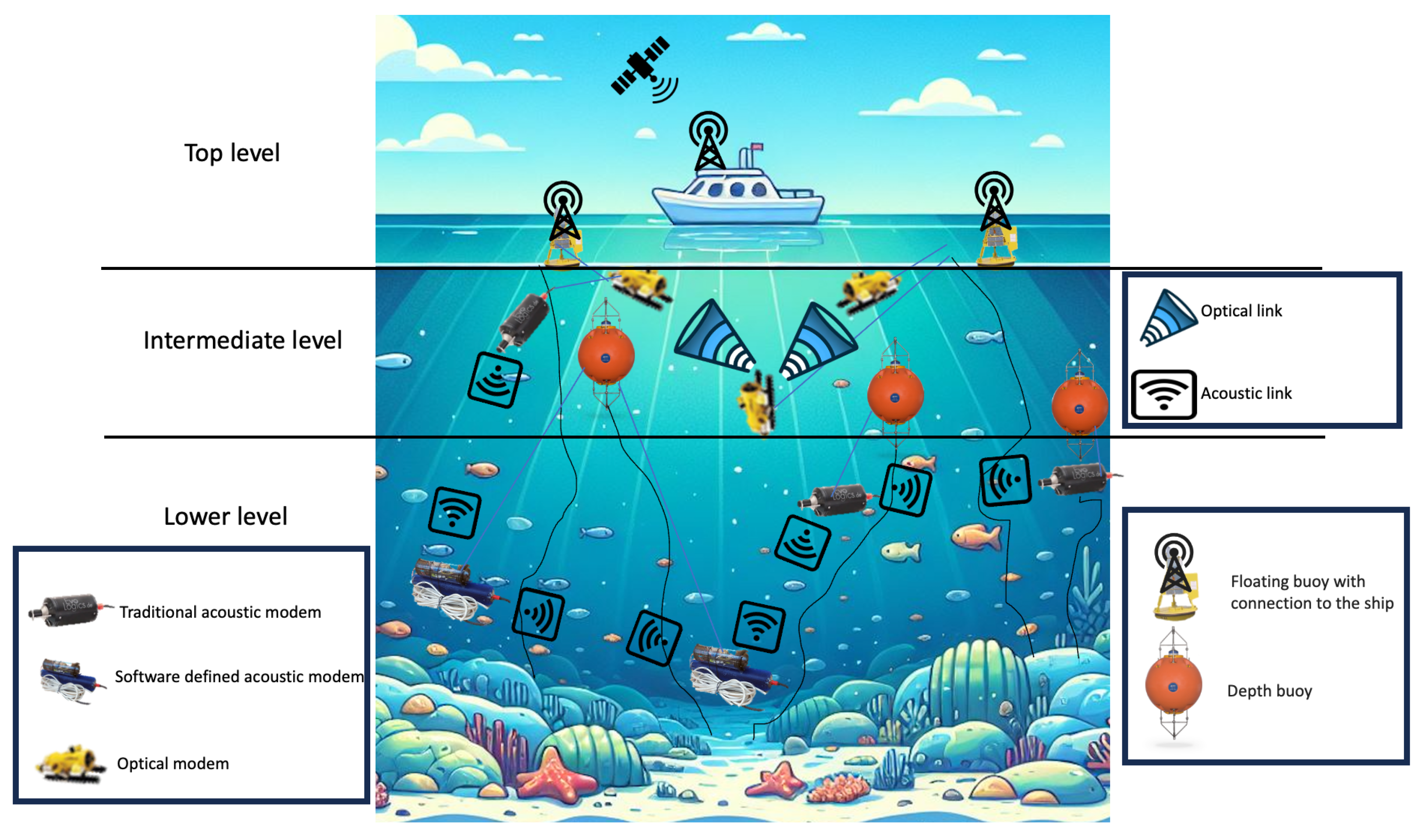
2.1. Opto-Acoustic Multi-Technology UW Networks
2.2. Software-Defined Acoustic Nodes
3. Strengths and Weaknesses of Optical vs. Acoustic Technologies for UW Communications
3.1. Optical Technology
- High Data Rate. UOC systems excel in handling significantly higher data rates as compared to UAC systems. This advantage stems from the broader bandwidth available in the optical spectrum, enabling the rapid transmission of large volumes of data. Optical communications typically utilize blue or green light waves (450 nm to 500 nm), as these wavelengths offer superior penetration in water as compared to red, yellow, or orange wavelengths, which are absorbed quickly. This characteristic makes UOC ideal for data-intensive applications, such as high-definition video streaming and rapid data collection from sensor networks.
- Low Latency Delay. Optical communication systems exhibit significantly lower transmission delay than acoustic systems due to the faster propagation speed of light in water as compared to sound. This low latency makes UOC systems particularly suitable for real-time applications that demand immediate data transmission and quick response times, such as underwater exploration and surveillance.
- Limited Contribution to Marine Noise. Unlike acoustic communication, which could potentially disrupt marine life sensitive to sound, UOC systems rely on light waves that are non-intrusive to marine ecosystems. This environmental-friendly approach is especially advantageous in ecologically sensitive areas, where minimizing interference with marine life is of paramount importance.
- Energy Efficiency. UOC systems combine high data rates and low latency with exceptional energy efficiency. Compared to UAC systems, UOC systems transmit data more efficiently per bit, consuming less power to transmit larger volumes of data. This energy efficiency is crucial in underwater environments, where power resources are often limited, and the operational lifespan of battery-powered devices must be extended.
- Limited Communication Range. The communication range of UOC systems is significantly constrained by the inherent properties of light propagation in water. Water molecules and suspended particles absorb and scatter light, leading to signal attenuation over distance. In turbid or rich-of-sediments water, where impurities and turbidity levels are higher, these effects are exacerbated, thus further limiting the communication range. As a result, UOC systems are better suited for short-range, high-data-rate applications rather than long-range communication.
- Alignment and Directivity Issues. Due to the directional nature of light, UOC systems require precise alignment between the transmitter and receiver. Misalignment can result from water current, natural movement of underwater vehicles, or installation in dynamic environments, causing signal loss. While the narrow beam width of optical systems minimizes interference and enhances security, it also increases the complexity of maintaining alignment in the three-dimensional, dynamic underwater environment. Ensuring accurate alignment is technically challenging but critical for the effective operation of UOC devices.
- High Dependancy on Water Clarity. The efficiency of UOC systems is heavily influenced by water clarity. In clear water, light experiences minimal absorption and scattering, enabling higher communication ranges and data transfer rate. However, in turbid or murky waters, elevated concentrations of particulate matter lead to significant scattering and absorption, thus reducing the reliability and consistency of communication. This dependency on water clarity presents a challenge for deploying UOC systems in challenging aquatic environments, ranging from sediment-rich coastal waters to harbor settings.
3.2. Acoustic Technology
- Long-Range Communications. Acoustic signals can propagate over long distances underwater, which provides a significant advantage over optical communications that suffer severe attenuation in such an environment. Although sound waves travel at approximately 1500 m/s, a speed much slower than light, they maintain their integrity over extended distances due to their mechanical wave nature [31,32].
- Robustness. UAC exhibits exceptional robustness and reliability in challenging underwater conditions, such as murky and turbid waters where optical signals are severely attenuated. This durability arises from the physical properties of acoustic waves, which propagate through seawater via compression and rarefaction. Consequently, acoustic waves can traverse suspended particles and turbidity with minimal energy loss, highlighting their strength and reliability in harsh underwater environments.
- Flexibility and Scalability. UAC systems are notably flexible and scalable, benefiting from their non-reliance on line-of-sight (LoS) connections. They adapt well to environmental dynamics and variability, including changes in temperature, salinity, and pressure. While these factors can influence system performance, particularly the velocity of sound waves, UAC systems remain highly scalable. Additional nodes, such as underwater sensors, buoys, and AUVs, can be easily integrated into the network in various configurations.
- Limited Bandwidth. UAC systems suffer from restricted bandwidth as compared to RF and optical communication systems. This limitation stems primarily from the absorption of sound in water, which increases with frequency, causing significant attenuation over longer distances. For long-distance UAC, bandwidth is restricted to a few kHz, limiting data rates to a few kbps. Channel bandwidth varies depending on communication distance and bit rate requirements, ranging from a few kHz to a few hundred kHz. Moreover, factors such as scattering, path loss, reverberation, and the exponential absorption of sound further restrict achievable data rates over long distances [33,34].
- Propagation Delay. The speed of sound underwater is substantially slower than the speed of light, resulting in significant propagation delay over long distances. This delay impedes communication synchronization and can cause packet loss, retransmissions, and inefficiencies in real-world applications. Environmental factors such as temperature, salinity, and pressure further influence sound speed. For instance, the average speed of sound waves increases with an increase in temperature in the underwater transmission medium. Variability in these parameters introduces dynamic delay, thus complicating real-time communication [34].
- Noise. Acoustic communication is susceptible to interference from noise, which can originate from both human activities, such as shipping, and natural phenomena, including rain, tides, underwater earthquakes, and aquatic life sounds. Ambient or background noise, such as bubbles, also degrades the received SNR, further complicating reliable communication in underwater channels [35,36].
- Absorption. Attenuation in UAC is primarily caused by the absorption phenomena, where the acoustic energy is converted into heat or absorbed by dissolved substances, suspended particles, or other materials in the water. It further depends on the signal frequency and distance. As the frequency and distance increase [37], the absorption becomes worse, resulting in greater energy loss and a reduction in signal strength.
4. Multi-Level Multi-Technology UW Architecture Design
4.1. Intermediate Level
4.1.1. Physical Layer Design in Underwater Optical Networks (UOCs)
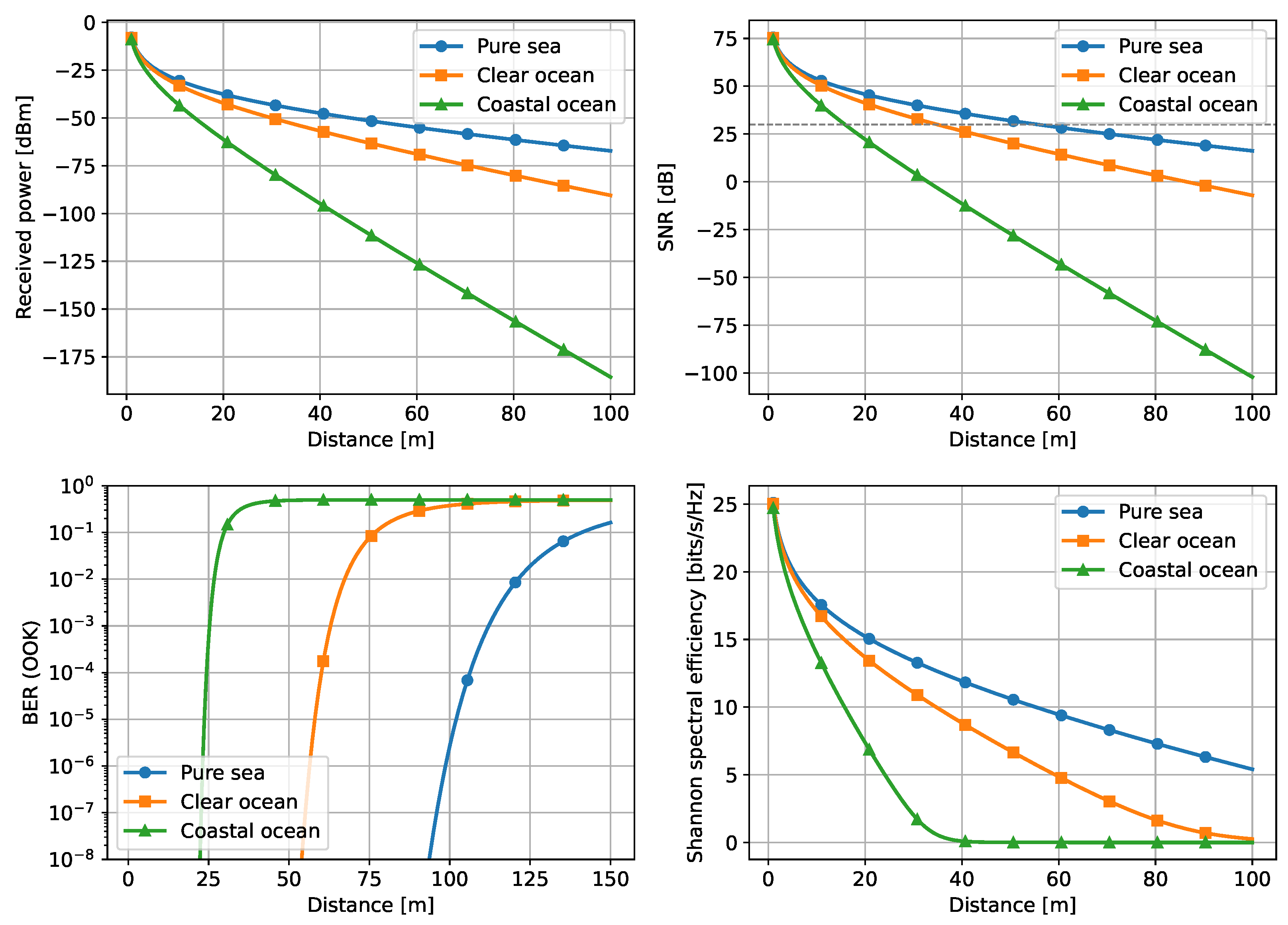
- Signal Modulation and Demodulation: The Physical Layer in UOC plays a crucial role in ensuring the reliable transmission of optical signals at high data rates, even in challenging underwater environments. For effective transmission, digital data must be converted into optical signals, which can be achieved through various techniques. Among single-carrier modulation schemes, On-Off Keying (OOK), Pulse Position Modulation (PPM), and Pulse Width Modulation (PWM) are the most commonly employed, due to their simplicity, low implementation complexity, and cost-effectiveness [39,40]. However, these techniques suffer for Inter-Symbol Interference (ISI) at higher data rates. In contrast, multi-carrier modulation schemes such as Orthogonal Frequency Division Multiplexing (OFDM) mitigate ISI by transmitting data across multiple parallel sub-carriers. Both single-carrier and multi-carrier modulation schemes typically operate under Single Input Single Output (SISO) architectures, which are energy-efficient due to the simplified hardware (e.g., no need for a DAC) and lower power consumption as compared to their Multiple Input Multiple Output (MIMO) counterparts. Despite SISO simplicity, ambient light interference remains a concern; however, it can be mitigated through suppression techniques, such as optical bandpass filters or LCD-based adaptive apertures, which apply to both SISO and MIMO configurations. Meanwhile, advanced MIMO-based techniques—including Superposition Modulation (SM) and Constrained Superposition Intensity Modulation (CSIM)—offer spatial multiplexing and diversity gains, thereby boosting data rates and reliability. Nevertheless, these advantages come at the cost of increased computational complexity, synchronization requirements, and system coordination, making them less practical for power-constrained underwater networks [39,41,42].In addition to the previous discussion and to further investigate the impact of water quality on the optical physical layer, we present typical link parameters and performance graphs for a representative laser diode (LD)-based OOK UOC link. Table 4 outlines key parameters considered, including a wavelength of 520 nm, a transmit power of 1 W, a receiver bandwidth of 1 MHz, a sensitivity of −53.4 dBm, and extinction coefficients for pure sea, clear ocean, and coastal ocean water. Utilizing these parameters and the Beer–Lambert attenuation model [43], Figure 2 depicts the resultant received power, SNR, OOK BER, and Shannon spectral efficiency as they vary with distance for the three types of water. The graphs demonstrate that coastal ocean water causes a more rapid decline in SNR and capacity as compared to pure and clear water, and they show the typical operating ranges (tens of meters in clear water and only a few tens of meters in coastal water) for the modulation scheme under consideration.
- Channel Coding: The severe absorption and scattering in UOC lead to high attenuation, which directly impacts the BER. To address this, FEC and channel coding techniques are implemented at the physical layer of UOC. These techniques reduce BER, even in an extremely low SNR environment. FEC works by adding extra redundant bits to the transmitted signal, enabling the receiver to detect and correct errors without requiring retransmission. Commonly used FEC and channel coding techniques include Low-Density Parity-Check (LDPC) codes, Turbo Codes (TC), Polar Codes, Reed–Solomon (RS) codes, Bose–Chaudhuri–Hocquenghem (BCH) codes [39], and Trellis-Coded Modulation (TCM). Among these, LDPC and Turbo Codes offer high error correction capabilities and are particularly effective for burst error correction. However, they are computationally complex, which can be a limitation in resource-constrained underwater systems. On the other hand, Reed–Solomon (RS) and BCH codes are simpler and have lower computational costs, making them robust and easy to implement. However, their error correction capabilities are relatively lower, especially in highly challenging underwater environments with severe attenuation and scattering [44,45].
- Synchronization: In general, it is important to receive data accurately, and, accordingly, the transmitter and receiver should align in time and frequency with each other in this aim. In UOC, synchronization is particularly challenging due to the unique characteristics of the optical channel, which includes high attenuation, scattering, absorption, beam divergence, misalignment, and ambient noise. Along with these challenges, optical link’s high data rate itself demands very precise timing and frame and carrier synchronization. Different synchronization techniques such as preamble-based synchronization, pilot symbol-based, blind synchronization, frame and time synchronization sequence-based [46,47], OFDM-based (cyclic prefix and pilot subcarriers), phase locked loop, and adaptive beam steering are reported in the literature with their advantages and drawbacks. For instance, preamble-based synchronization techniques are simple and effective for burst mode data but require additional overhead and struggle against low SNR conditions. On the other hand, OFDM-based synchronization schemes perform better in multi-path scenarios and can effectively mitigate ISI by using a cyclic prefix. To enhance the efficiency of the system, advanced methods such as pilot-assisted synchronization and adaptive clock recovery methods must be preferred instead of symbol and frame synchronization alone, as they suffer more from the timing drift, jitter, and misalignment issues [48,49,50].
4.1.2. Data Link Layer Design in UOC
- Multi-access protocols: UOC systems require resource allocation schemes, advanced MAC protocols, and multi-carrier transmission techniques. Various approaches have been reported in the literature, including the use of Time Division Multiple Access (TDMA), Frequency Division Multiple Access (FDMA), Code Division Multiple Access (CDMA), Wavelength Division Multiple Access (WDMA), and Space Division Multiple Access (SDMA). TDMA is among the simplest techniques, offering energy-efficient and low-latency solutions for UOC systems due to lower propagation delay [51,52]. However, TDMA-based approaches require efficient scheduling to avoid interference, whereas FDMA-based methods handle interference more effectively through non-overlapping frequency allocation. Although OFDM is not energy efficient, it has been extensively studied in UOC systems due to its robustness against ISI and superior spectral efficiency [53,54,55]. Similarly, CDMA-based schemes are promising for UOC networks due to their higher spectral efficiency, distributive access to network resources, and asynchronous operation. Extensive research highlights the potential of CDMA in UOC systems [56,57], though challenges such as power control, mobility, and coverage remain unresolved. On the other hand, WDMA reduces signal processing complexity by multiplexing multiple signals based on wavelengths [39], but it significantly increases hardware complexity and cost. While adaptive wavelength allocation could enhance efficiency, practical implementations are still lacking. In contrast to WDMA, SDMA utilizes beam directionality and spatial separation to enable simultaneous multi-user transmission, thereby improving throughput. However, it requires highly precise LoS alignment and beam steering, which is extremely challenging in underwater turbulent environments [58,59].
- Error Detection and Correction: At the Data Link Layer, error detection approaches such as CRC and the use of checksum and retransmission schemes, e.g., ARQ and HARQ, are the primary techniques for ensuring reliable frame-level communication in UOC. Methods like network coding and frame-level FEC can offer additional reliability, while adaptive techniques promise to enhance adaptability in dynamic underwater environments. These approaches complement the Physical Layer FEC schemes to provide end-to-end reliability in UOC systems.
4.1.3. Network Layer in UOC
- Connectivity: The connectivity between underwater optical nodes is inherently restrained by the dynamic environment and highly directional optical links requirement. Sparse deployment of optical nodes can further complicate the connectivity [60]. Different methods, such as optical base stations with multi-faceted transceivers [61], transmitters with a broader field of viewing angles, and tailored routing protocols, can help elevate the connectivity issues.
- Relaying and forwarding: Appropriate techniques can be implemented to extend the optical nodes’ communication range. There are several relaying methods available to overcome the inherent limitations of optical propagation underwater. Key relaying techniques include serial relaying (multi-hop transmission) and parallel relaying (cooperative transmission). Additionally, there are various packet forwarding methods such as decode-and-forward, amplify-and-forward, and bit-detect-and-forward available for use. Serial relaying uses narrow-beam optical transmitters to extend the communication range and concentrate the received signals’ power at the detector’s aperture area. However, it requires fast and accurate tracking and localization information, which might be difficult for underwater scenarios. On the other hand, parallel relaying leverages cooperation among neighboring nodes for improved diversity [62].
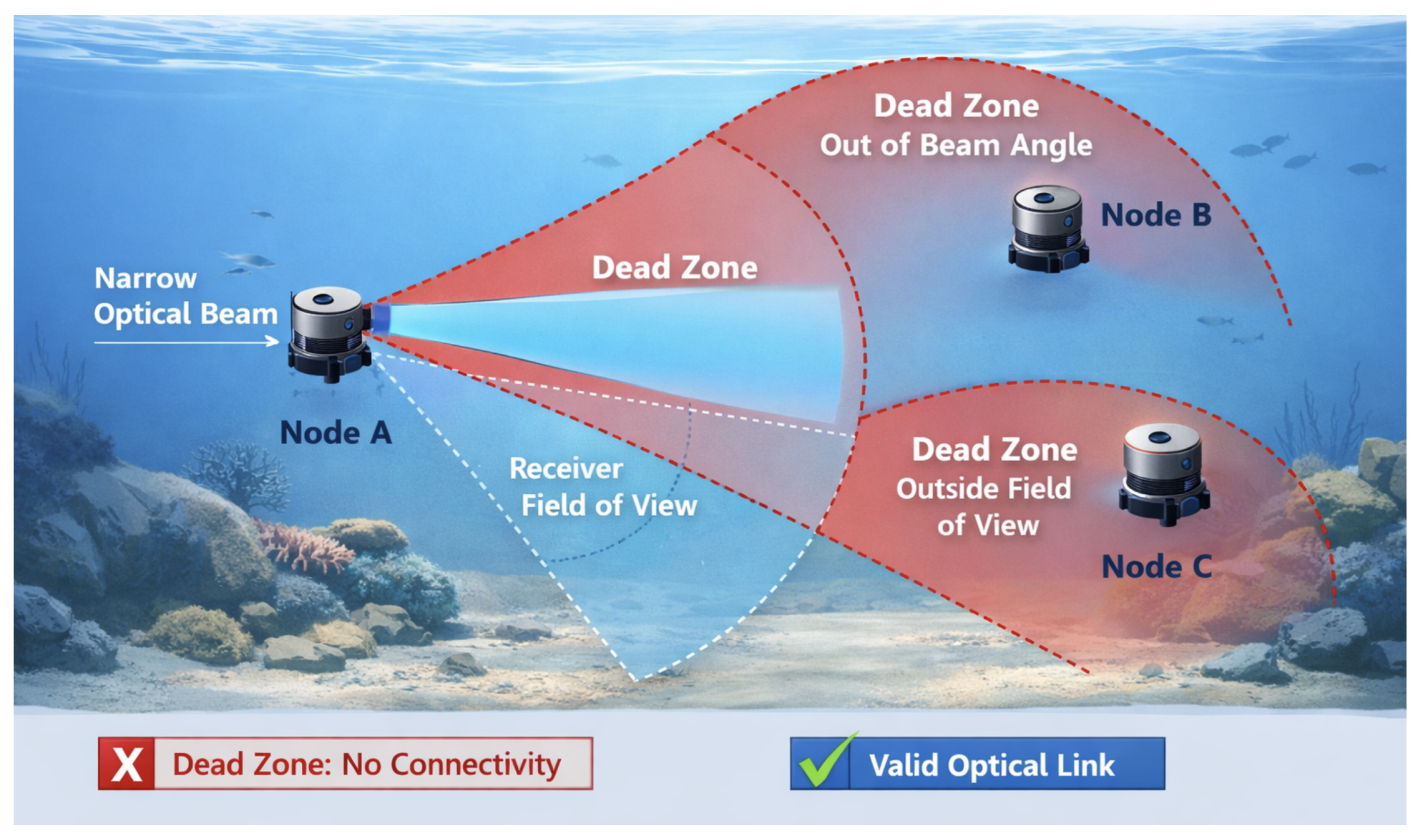
- Routing schemes: Underwater optical communication (UOC) networks face significant routing challenges at the network layer due to the highly directional nature of optical links and the strict angular constraints imposed by transmitter beam divergence and receiver field-of-view. Unlike acoustic systems, physical proximity between nodes does not guarantee connectivity, as valid links can only be established when precise geometric alignment conditions are met. This results in the formation of angular “dead zones,” i.e., spatial regions where nodes are physically reachable but logically disconnected from the network topology, as shown in Figure 3. Consequently, neighborhood discovery becomes asymmetric and unreliable, and conventional distance- or location-based routing strategies often fail when packets encounter routing voids caused by misaligned beams. These effects lead to fragile multi-hop paths, frequent route disruptions, and increased control overhead, making routing in UOC networks fundamentally different from and more complex than in omnidirectional underwater communication systems. The routing schemes are broadly categorized into centralized routing protocols [63,64], which rely on global network information, whereas distributed routing protocols make localized decisions to reduce the energy consumption and communication overhead [65]. Additionally, opportunistic routing [66] has emerged as a viable strategy to enhance packet delivery by exploiting the broadcast nature of optical links in dynamic underwater environments. Recently, a dual-hop routing technique [67,68] has been proposed to enhance the overall route optimization and reduce the risk of packets entering void regions as compared to single-hop [69] routing by extending topology awareness to two hops.
4.2. Lower Level
4.2.1. Physical Layer in Underwater Acoustic Networks
- Signal Modulation and Demodulation: Since the UAC network operates in a highly dynamic environment where communication parameters frequently change, modulation schemes must be designed based on realistic scenarios that reflect the actual underwater conditions. Non-coherent modulation schemes that do not require phase synchronization information at the receiver side, such as On-Off Keying (OOK) and Frequency-Shift Keying (FSK), are examples of highly power-efficient and reliable modulation techniques, albeit achieving lower bandwidth efficiency [23]. Coherent modulation schemes are introduced to enhance bandwidth efficiency and achieve higher data rates in underwater communication networks. One example is Phase-Shift Keying (PSK), that requires the receiver to maintain synchronization with the phase of the transmitted signal. Similarly, Quadrature Amplitude Modulation (QAM), Orthogonal Frequency Division Multiplexing (OFDM), and Spread Spectrum (SS) are also classified as coherent modulation schemes [72]. Also, recently, approaches that exploit AI to perform dynamic tuning of modulation parameters based on the current channel conditions appeared. Specifically, Multi-Armed Bandit (MAB) algorithms offer a simpler yet effective solution to this selection of modulation schemes to trade off Packet Error Rate (PER) and energy consumption. This is in the view of preserving both reliability and energy efficiency [73].
- Channel Coding: The physical layer uses channel encoding techniques for error detection and correction to reduce the effects of noise, multi-path propagation, and Inter-Symbol Interference (ISI). There are different possible channel encoding schemes like convolutional codes exhibiting better performance in dynamic underwater conditions, or turbo codes that have better reliability with their parallel concatenated structures. Similarly, Low-Density Parity-Check (LDPC) codes can perform well in various underwater dynamic conditions due to their iterative decoding efficiency and flexibility in code rate and block length. However, for burst errors which are common in underwater communications, Reed–Solomon codes can perform better due to their robustness against multiple bits error handling [74].
- Synchronization: It is an essential component at the physical layer of UAC networks due to the challenges such as coping with the Doppler effect that is particularly relevant in the case of UAC systems, or multi-path propagation, and dynamic channel conditions. In an underwater dynamic environment, motion-induced fluctuations cause incoherence in timing, frequency, and phase between transmitter and receiver signals. Thus, efficient synchronization protocols must be implemented to address these issues. Synchronization is typically accomplished using techniques such as pilot tones, cyclic prefixes, and code tracking loops. These techniques, collectively, guarantee reliability and efficient data transfer in the hostile underwater environment [75].
4.2.2. Data Link Layer in UAC
- Channel Access Protocols: The medium access layer is a core component in UACs for managing the channel control mechanism on a shared medium, allowing multiple nodes to communicate. Protocols such as distance aware collision avoidance protocol (DACAP) [79] and sender and receiver concurrent reservation (SRCR) [80] maximize channel utilization and improve throughput and delay, whilst coordinated transmission MAC (CT-MAC) [81] uses immediate neighbors to share information and employs a relay mechanism to obtain global information, thus optimizing energy efficiency and reducing delay time. Traditional protocols such as ALOHA and Slotted-ALOHA have problems in dealing with bursty traffic and multi-hop underwater scenarios due to the very long propagation delay. This leads to the possibility to employ handshake-based protocols such as MACA and FAMA, which use RTS/CTS signaling to reduce collisions and resolve hidden/exposed node problems, further enhanced with simultaneous RTS/CTS handshake procedures for better throughput and network efficiency [82]. However, the long propagation delay again can cause relevant inefficiency due to the need for additional signaling and the possible change in channel status as related to the carrier sense phase.
- Error Detection and Correction: The LLC layer ensures data reliability by implementing error detection mechanisms like Cyclic Redundancy Check (CRC) and error correction protocols, e.g., Automatic Repeat Request (ARQ). FEC at the physical layer requires the receiver to perform error correction and does not require any retransmission, though demanding for more computational resources. CRC, which is an error detection mechanism, adds a checksum to each data frame, allowing the receiver to recognize errors. In contrast to FEC, the data link layer employs ARQ and HARQ mechanisms to perform error correction at the transmitter side at the cost of use of too many retransmissions, which, in case of slow acoustic communications, can be unfeasible. On the other hand, use of retransmissions or FEC can compensate for the high error rate induced by noise, multi-path effects, and channel fluctuations, as typical of underwater channels [83,84].
4.2.3. Network Layer in UAC
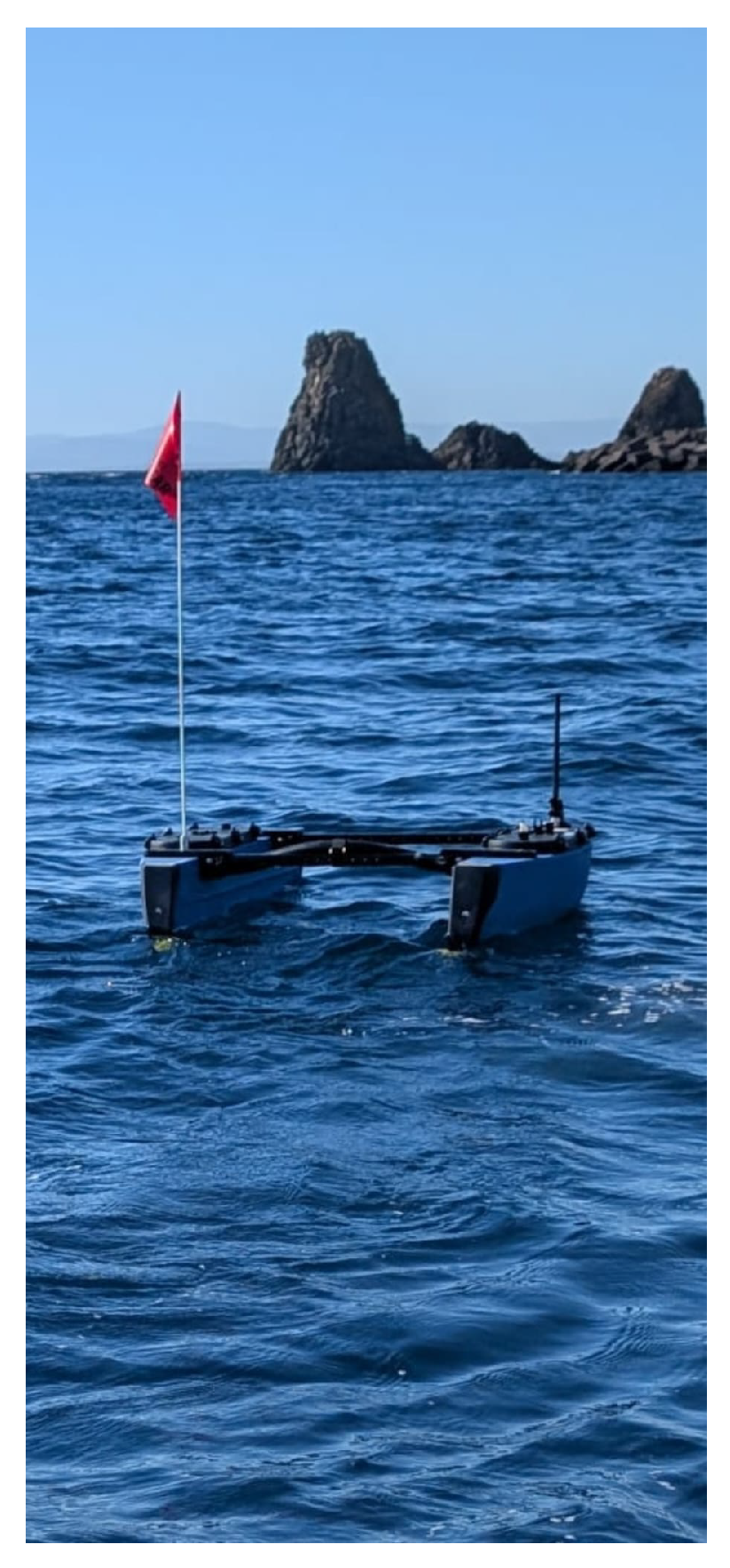
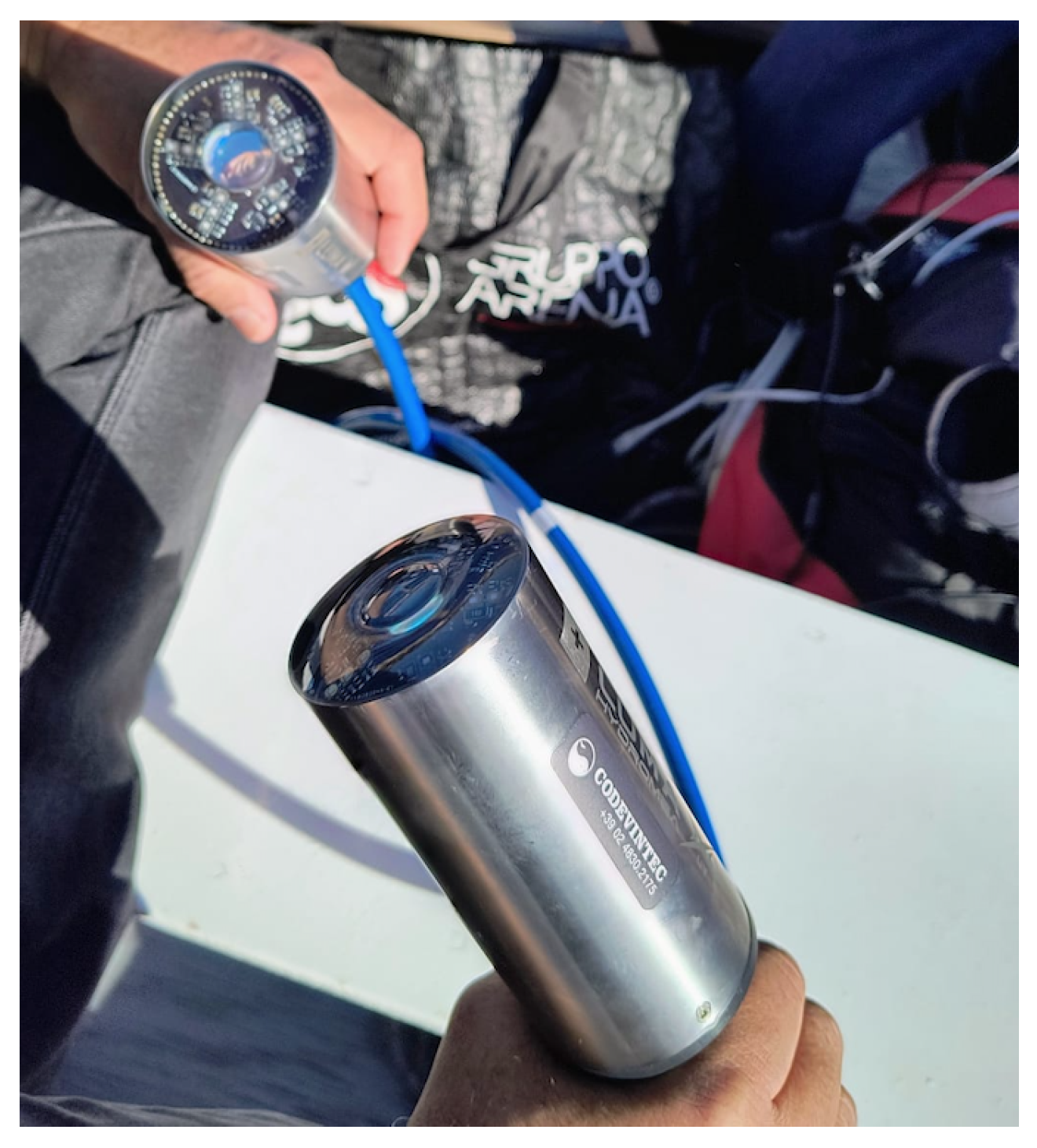
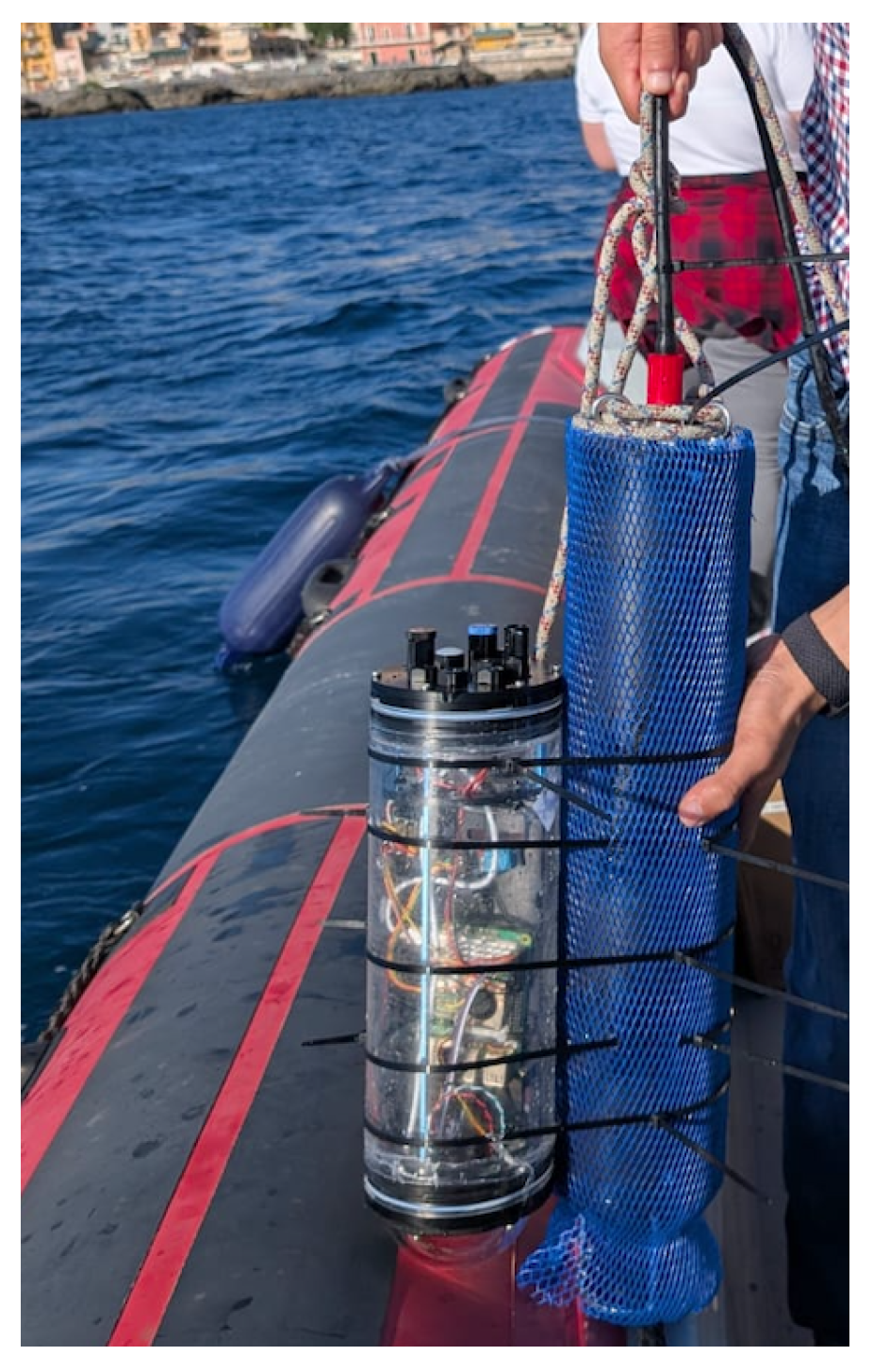
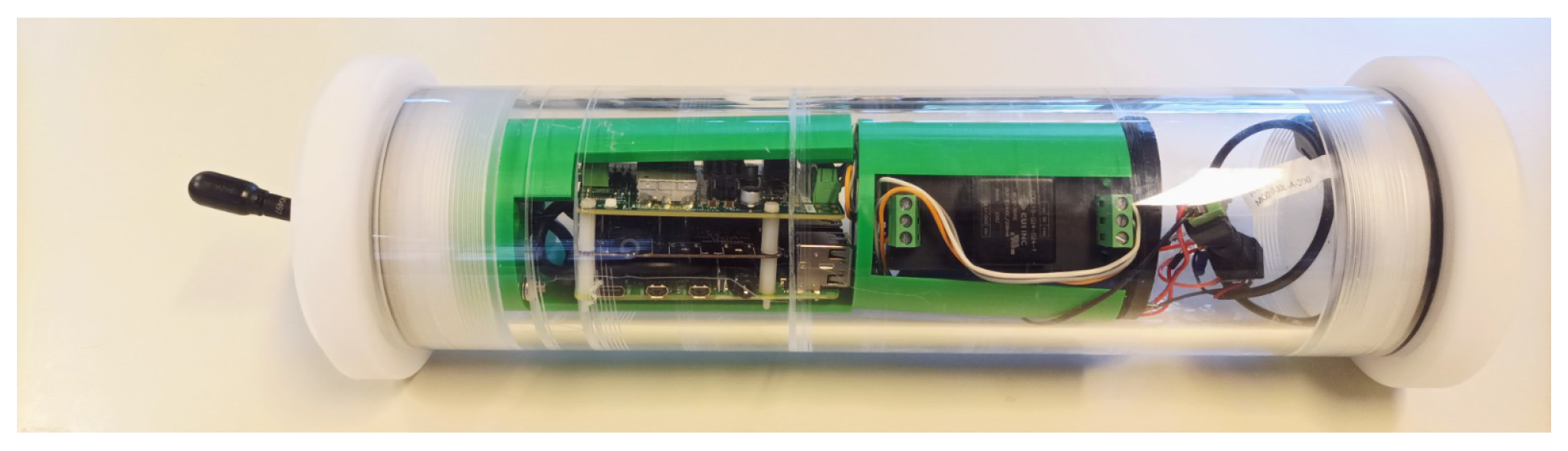
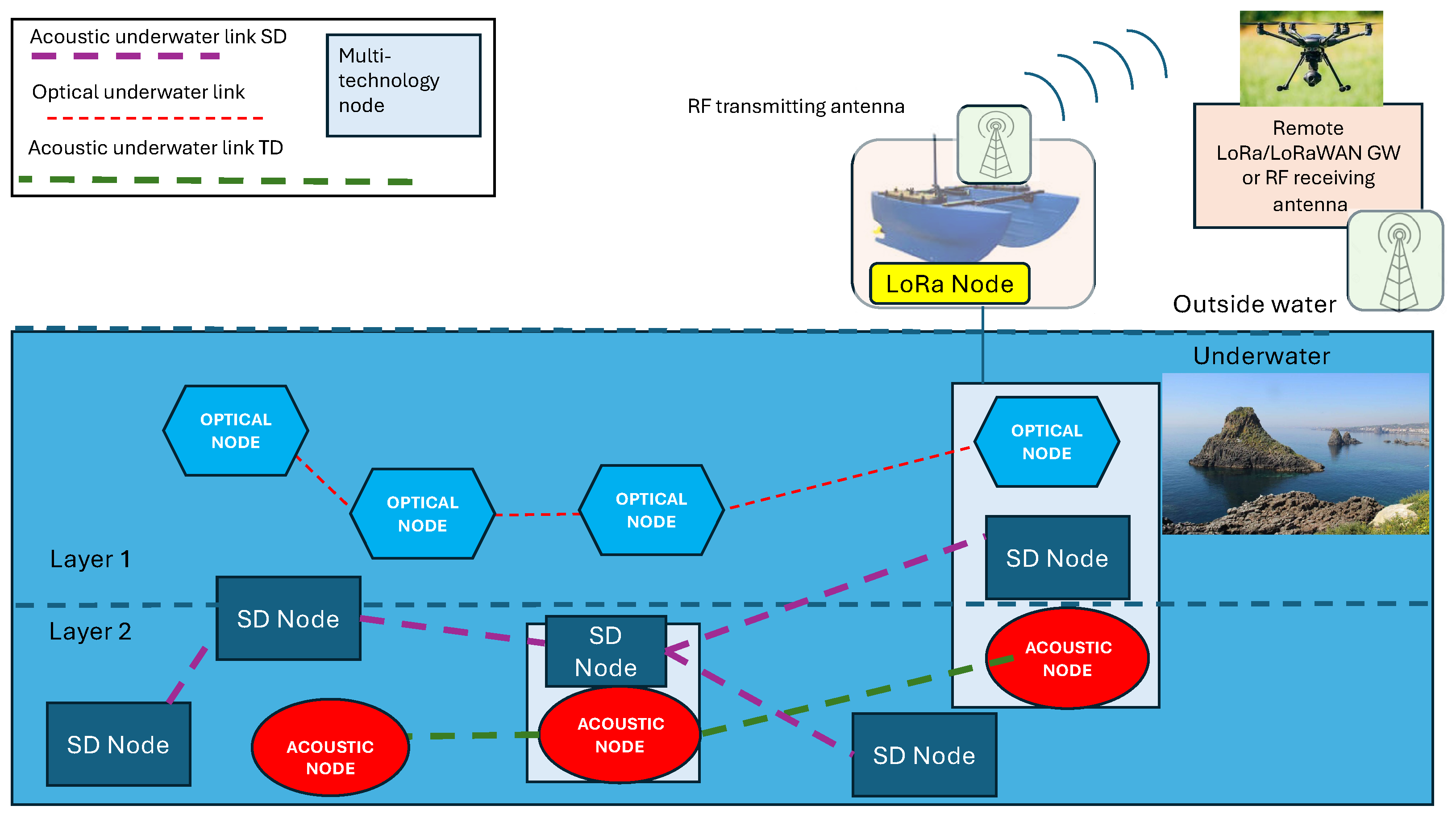
5. Multi-Technology Multi-Level Testbed: A PoC at the University of Catania
6. Challenges and Open Issues
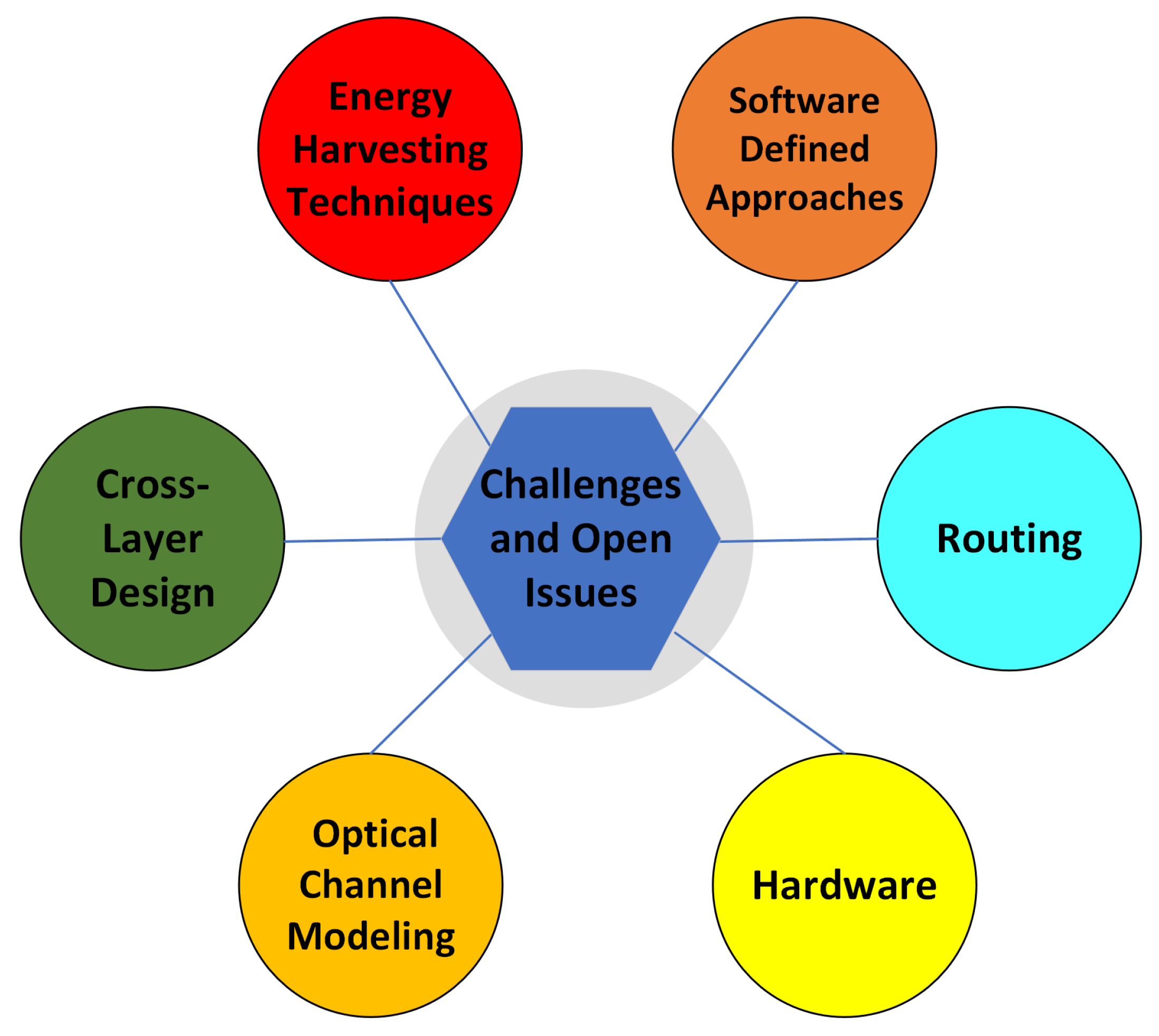
- Energy Harvesting and Hardware Design. The development of efficient energy harvesting techniques is crucial for the prolonged deployment of underwater nodes. Among the available methods, piezoelectric materials, bio-energy harvesting, and solar-based approaches have gained significant attention. Piezoelectric materials or strips convert underwater pressure and wave energy into electrical energy, providing a sustainable power source for underwater systems. Similarly, bio-fuel cells utilize the metabolic processes of micro-organisms to convert organic matter into electrical energy, offering an innovative and environmentally friendly solution for energy generation in underwater environments. Concerning hardware design, integration of multifaceted light detectors (receivers) can enhance link quality, reduce disruptions caused by waves and currents, and improve reception diversity.
- Deployment of Software-Defined Approaches. Software-defined optical or opto-acoustic systems would allow for dynamic adjustments of key parameters such as modulation scheme parameters, transmission power levels, coding schemes, and divergence angles in response to changes in the underwater environment. These systems could enable adaptive operation by tailoring communication settings to environmental characteristics. However, these technologies are still at an infancy phase, and only preliminary studies in this direction have been started, as in [61,103,104]. Challenges in this perspective are also posed by real-world deployments and hardware limitations.
- Routing. Routing protocols for UAC have been better studied due to the need to support communications in networks of significant extension. In contrast, UOC systems face unique challenges such as connectivity issues and link failures caused by range, alignment, and angle constraints. Also, the limited coverage range granted by the technology in underwater scenarios poses many critical requirements on the possibility to implement indeed routing among nodes. Multi-hop routing can reduce latency in UAC by leveraging the shortest path through nearby nodes, but efficient routing schemes are essential for achieving this improvement. For UOC, when designing geographic or localization-based routing combined with multi-hop strategies, it is necessary to address connectivity issues. In general, there is an urgent need for routing protocols in multi-technology architectures that incorporate void hole avoidance, fault tolerance, and congestion-aware features.
- Hardware Constraints and Optical Alignment. From a hardware perspective, underwater optical transceivers generally operate with narrow beams and receivers with a limited field of view. Consequently, even minor hardware movements, waves, and currents can easily disrupt the line of sight. Traditional gimbal control and heuristic scanning methods can increase acquisition time and energy consumption, posing significant challenges for mobile AUV-based links and long-term deployments. Thus, relaxing these stringent alignment requirements has emerged as a critical hardware issue for UOC systems.Recent studies have begun leveraging AI techniques to address the stringent alignment requirements of UOC systems. In [105], the alignment of optical beams between AUVs is formulated as a partially observable Markov decision process, and a soft actor–critic reinforcement learning policy is employed to maintain the link amidst navigation disturbances. In [106], a camera-based acquisition, pointing, and tracking system is implemented, which automatically re-aligns an optical link within tens of milliseconds in a bubbly underwater channel. Additionally, refs. [107,108] utilize deep neural networks and transformer-based detectors trained on dedicated underwater light-spot datasets to localize the beam and drive gimbal alignment in real time. These AI-driven alignment schemes suggest that learning-based PAT is becoming a crucial enabler for robust, high-rate optical links in dynamic underwater environments.
- Optical Channel Modeling. Although significant progress has been made in optical channel modeling, most existing studies focus on horizontal links only. Vertical communication links, especially in view of implementing multi-level architecture, must account for unique parameters, including temperature gradients, absorption, scattering, turbulence, salinity, and depth-dependent refractive index variations. The development of reliable underwater-specific turbulence channel models, in contrast to free-space optical (FSO) models, and extensive experimental validation are essential to address these challenges. Vertical UOC channel models are critical for ensuring reliable communication in underwater applications, such as deep-sea exploration and data relay between submerged nodes and surface systems [109].
- Cross-Layer Design. While substantial research exists on cross-layer designs in acoustic underwater sensor networks, opto-acoustic multi-modal systems remain underexplored. Integrating cross-layer designs in multi-technology architectures can address challenges such as limited bandwidth, high latency, and energy efficiency. By enabling inter-level information exchange, advanced protocols can be developed to optimize system performance and enhance reliability in multi-technology networks [61]. In this context, defining generic and scalable cross-layer approaches for heterogeneous acoustic–optical networks remains a key open issue. The goal is to couple the application layer QoS requirements with MAC decisions and physical-layer mode selection without introducing excessive signaling overhead or implementation complexity.
7. Conclusions
Author Contributions
Funding
Data Availability Statement
Conflicts of Interest
Abbreviations
| U2SeCo | Underwater and Underground Wireless Sensing and Communications |
| IoU2T | Internet of Underwater and Underground Things |
| UWSN | Underwater Sensor Network |
| AC | Acoustic communication |
| OC | Optical communication |
| RF | Radio frequency |
| SDMA | Space-division multiple access |
| TDMA | Time-division multiple access |
| UWSN | Underwater wireless sensor networks |
| CBR | Constant bit rate |
| CCA | Cognitive Communication Architecture |
| PDR | Packet delivery ratio |
| UOC | Underwater optical communication |
| UAC | Underwater acoustic communication |
| LoS | Line-of-sight |
| AUV | Autonomous underwater vehicles |
| PAT | Positioning-acquisition-tracking |
| LPWAN | Low power wide area network |
| OOK | On-Off Keying |
| PPM | Pulse Position Modulation |
| PWM | Pulse Width Modulation |
| ISI | Inter-Symbol Interference |
| OFDM | Orthogonal Frequency Division Multiplexing |
| SISO | Single Input Single Output |
| MIMO | Multiple Input Multiple Output |
| SM | Superposition Modulation |
| CSIM | Constrained Superposition Intensity Modulation |
| FEC | Forward error correction |
| SNR | Signal-to-noise ratio |
| BER | Bit Error Rate |
| LDPC | Low Density Parity-Check |
| BCH | Bose–Chaudhuri–Hocquenghem |
| TCM | Trellis-Coded Modulation |
| RS | Reed–Solomon |
| CDMA | Code Division Multiple Access |
| WDMA | Wavelength Division Multiple Access |
| FDMA | Frequency Division Multiple Access |
| CRC | Cyclic redundancy check |
| ARQ | Automatic Repeat reQuest |
| HARQ | Hybrid Automatic Repeat reQuest |
| FSK | Frequency-Shift Keying |
| QAM | Quadrature Amplitude Modulation |
| SS | Spread Spectrum |
| PSK | Phase-Shift Keying |
| MAB | Multi-Armed Bandit |
| PER | Packet Error Rate |
| DACAP | Distance Aware Collision Avoidance Protocol |
| SRCR | Sender and Receiver Concurrent Reservation |
| CT-MAC | Coordinated Transmission MAC |
| FSO | Free-Space Optical |
References
- International Telecommunication Union (ITU). Submarine Cable Resilience. 2024. Available online: https://www.itu.int/en/mediacentre/backgrounders/Pages/submarine-cable-resilience.aspx (accessed on 4 December 2025).
- Subsea Cables. Invisible Infrastructure, Visible Chaos: Building B2B Continuity in a Subsea-Dependent World. 2025. Available online: https://www.subseacables.net/reports-and-coverage/invisible-infrastructure-visible-chaos-building-b2b-continuity-in-a-subsea-dependent-world/ (accessed on 4 December 2025).
- Theocharidis, T.; Kavallieratou, E. Underwater communication technologies: A review. Telecommun. Syst. 2025, 88, 54. [Google Scholar] [CrossRef] [Scilit]
- Li, Z.; Li, W.; Sun, K.; Fan, D.; Cui, W. Recent Progress on Underwater Wireless Communication Methods and Applications. J. Mar. Sci. Eng. 2025, 13, 1505. [Google Scholar] [CrossRef] [Scilit]
- Stojanovic, M.; Preisig, J. Underwater acoustic communication channels: Propagation models and statistical characterization. IEEE Commun. Mag. 2009, 47, 84–89. [Google Scholar] [CrossRef] [Scilit]
- Zayed, M.M.; Shokair, M. Modeling and simulation of optical wireless communication channels in IoUT considering water types turbulence and transmitter selection. Sci. Rep. 2025, 15, 28381. [Google Scholar] [CrossRef] [Scilit] [PubMed]
- Alahmad, R.; Alraie, H.; Hasaba, R.; Eguchi, K.; Matsushima, T.; Fukumoto, Y.; Ishii, K. Performance Analysis of Underwater Radiofrequency Communication in Seawater: An Experimental Study. J. Mar. Sci. Eng. 2024, 12, 2104. [Google Scholar] [CrossRef] [Scilit]
- Wang, J.; Shi, W.; Xu, L.; Zhou, L.; Niu, Q.; Liu, J. Design of optical-acoustic hybrid underwater wireless sensor network. J. Netw. Comput. Appl. 2017, 92, 59–67. [Google Scholar] [CrossRef] [Scilit]
- Câmara Júnior, E.P.; Vieira, L.F.; Vieira, M.A. CAPTAIN: A data collection algorithm for underwater optical-acoustic sensor networks. Comput. Netw. 2020, 171, 107145. [Google Scholar] [CrossRef] [Scilit]
- Han, S.; Noh, Y.; Liang, R.; Chen, R.; Cheng, Y.J.; Gerla, M. Evaluation of underwater optical-acoustic hybrid network. China Commun. 2014, 11, 49–59. [Google Scholar] [CrossRef] [Scilit]
- Islam, K.Y.; Ahmad, I.; Habibi, D.; Zahed, M.I.A.; Kamruzzaman, J. Green Underwater Wireless Communications Using Hybrid Optical-Acoustic Technologies. IEEE Access 2021, 9, 85109–85123. [Google Scholar] [CrossRef] [Scilit]
- Vasilescu, I.; Detweiler, C.; Rus, D. AquaNodes: An underwater sensor network. In WUWNet ’07: Proceedings of the 2nd Workshop on Underwater Networks, Montreal, QC, Canada, 14 September 2007; Association for Computing Machinery: New York, NY, USA, 2007; pp. 85–88. [Google Scholar] [CrossRef] [Scilit]
- Han, S.; Noh, Y.; Lee, U.; Gerla, M. Optical-acoustic hybrid network toward real-time video streaming for mobile underwater sensors. Ad Hoc Netw. 2019, 83, 1–7. [Google Scholar] [CrossRef] [Scilit]
- Quintas, J.; Petroccia, R.; Pascoal, A.; Cruz, J.; Gois, P.; Morlando, L.; Stipanov, M. Hybrid acoustic-optical underwater communication networks for next-generation cooperative systems: The EUMR experience. In Proceedings of the OCEANS 2021: San Diego—Porto, San Diego, CA, USA, 20–23 September 2021; pp. 1–7. [Google Scholar] [CrossRef] [Scilit]
- Bhatnagar, R.; Garg, P. Performance analysis of hybrid underwater wireless system for shallow sea monitoring. Photonic Netw. Commun. 2023, 46, 78–89. [Google Scholar] [CrossRef] [Scilit]
- He, J.; Li, J.; Zhu, X.; Xiong, S.; Chen, F. Design and Analysis of an Optical–Acoustic Cooperative Communication System for an Underwater Remote-Operated Vehicle. Appl. Sci. 2022, 12, 5533. [Google Scholar] [CrossRef] [Scilit]
- Bu, F.; Luo, H.; Ma, S.; Li, X.; Ruby, R.; Han, G. AUV-Aided Optical—Acoustic Hybrid Data Collection Based on Deep Reinforcement Learning. Sensors 2023, 23, 578. [Google Scholar] [CrossRef] [Scilit]
- Zhang, D.; N’Doye, I.; Ballal, T.; Al-Naffouri, T.Y.; Alouini, M.S.; Laleg-Kirati, T.M. Localization and Tracking Control Using Hybrid Acoustic–Optical Communication for Autonomous Underwater Vehicles. IEEE Internet Things J. 2020, 7, 10048–10060. [Google Scholar] [CrossRef] [Scilit]
- Fan, T.; Zhang, X.; Hu, G.; Hu, S.; Zhou, T. Underwater optical-acoustic interactive communication system and demonstration experiment. Opt. Contin. 2025, 4, 2794–2800. [Google Scholar] [CrossRef] [Scilit]
- Zhang, X.; Zhao, R.; Li, N.; Yi, X. Cross-Layer-based Opportunistic Routing for Underwater Acoustic-Optical Hybrid Networks. In Proceedings of the OCEANS 2024—Singapore, Singapore, 15–18 April 2024; pp. 1–4. [Google Scholar] [CrossRef] [Scilit]
- Gorodilov, A.; Zhilin, I.; Sakhnini, A.; Simonjan, J.; Akyildiz, I. UniSDM Proof of Concept: A Multimode Software Defined Modem for Underwater Communications. In Proceedings of the 2025 IEEE Wireless Communications and Networking Conference (WCNC), Milan, Italy, 24–27 March 2025; pp. 1–3. [Google Scholar] [CrossRef] [Scilit]
- Dol, H.S.; Casari, P.; van der Zwan, T.; Otnes, R. Software-Defined Underwater Acoustic Modems: Historical Review and the NILUS Approach. IEEE J. Ocean. Eng. 2017, 42, 722–737. [Google Scholar] [CrossRef] [Scilit]
- Akyildiz, I.F.; Pompili, D.; Melodia, T. Underwater Acoustic Sensor Networks: Research Challenges. Ad Hoc Netw. 2005, 3, 257–279. [Google Scholar] [CrossRef] [Scilit]
- Kreutz, D.; Ramos, F.M.V.; Verissimo, P. Software-Defined Networking: A Comprehensive Survey. Proc. IEEE 2015, 103, 14–76. [Google Scholar] [CrossRef] [Scilit]
- Chitre, M.; Shahabudeen, S.; Stojanovic, M. UnetStack: An Agent-Based Software Stack and Emulator for Underwater Networks. In Proceedings of the 2014 Oceans—St. John’s, St. John’s, NL, Canada, 14–19 September 2014. [Google Scholar]
- Masiero, R.; Azad, S.; Favaro, F.; Petrani, M.; Toso, G.; Guerra, F.; Casari, P.; Zorzi, M. DESERT Underwater: An NS-Miracle-Based Framework to Design, Simulate, Emulate, and Realize Underwater Network Protocols. In Proceedings of the 2012 Oceans—Yeosu, Yeosu, Republic of Korea, 21–24 May 2012. [Google Scholar]
- Coccolo, E.; Francescon, R.; Campagnaro, F.; Zorzi, M. Field tests of the software defined modem prototype for the moda project. In Proceedings of the 2022 Sixth Underwater Communications and Networking Conference (UComms), Lerici, Italy, 30 August–1 September 2022; IEEE: New York, NY, USA, 2022; pp. 1–5. [Google Scholar]
- Francescon, R.; Campagnaro, F.; Favaro, F.; Guerra, F.; Zorzi, M. Software Defined Underwater Communications: An Experimental Platform for Research. In Proceedings of the OCEANS 2023—Limerick, Limerick, Ireland, 5–8 June 2023; pp. 1–6. [Google Scholar] [CrossRef] [Scilit]
- Montanari, A.; Marin, F.; Cimino, V.; Spinosa, D.; Donegà, F.; Cosimo, D.; Bazzarello, L.; Natale, D.; Campagnaro, F.; Zorzi, M. Experimenting Various JANUS Frequency Bands with the Subsea Software-Defined Acoustic Modem. In Proceedings of the 2024 Seventh Underwater Communications and Networking Conference (UComms), Sestri Levante, Italy, 3–5 September 2024; pp. 1–5. [Google Scholar] [CrossRef] [Scilit]
- Hydromea. Hydromea|Revolutionizing Subsea Inspection. Available online: https://www.hydromea.com/ (accessed on 17 November 2025).
- Alraie, H.; Alahmad, R.; Ishii, K. Double the data rate in underwater acoustic communication using OFDM based on subcarrier power modulation. J. Mar. Sci. Technol. 2024, 29, 457–470. [Google Scholar] [CrossRef] [Scilit]
- Li, Z.; Chitre, M.; Stojanovic, M. Underwater acoustic communications. Nat. Rev. Electr. Eng. 2025, 2, 83–95. [Google Scholar] [CrossRef] [Scilit]
- Luo, H.; Wu, K.; Ruby, R.; Liang, Y.; Guo, Z.; Ni, L.M. Software-Defined Architectures and Technologies for Underwater Wireless Sensor Networks: A Survey. IEEE Commun. Surv. Tutor. 2018, 20, 2855–2888. [Google Scholar] [CrossRef] [Scilit]
- Lanbo, L.; Shengli, Z.; Jun-Hong, C. Prospects and problems of wireless communication for underwater sensor networks. Wirel. Commun. Mob. Comput. 2008, 8, 977–994. [Google Scholar] [CrossRef] [Scilit]
- Li, D.; Du, Z.; Wang, Q.; Wang, J.; Du, L. Recent advances in acoustic technology for aquaculture: A review. Rev. Aquac. 2024, 16, 357–381. [Google Scholar] [CrossRef] [Scilit]
- Bello, O.; Zeadally, S. Internet of underwater things communication: Architecture, technologies, research challenges and future opportunities. Ad Hoc Netw. 2022, 135, 102933. [Google Scholar] [CrossRef] [Scilit]
- Lucani, D.E.; Stojanovic, M.; Médard, M. On the relationship between transmission power and capacity of an underwater acoustic communication channel. In Proceedings of the OCEANS 2008-MTS/IEEE Kobe Techno-Ocean, Kobe, Japan, 8–11 April 2008; IEEE: New York, NY, USA, 2008; pp. 1–6. [Google Scholar]
- Pal, A.; Campagnaro, F.; Ashraf, K.; Rahman, M.R.; Ashok, A.; Guo, H. Communication for Underwater Sensor Networks: A Comprehensive Summary. ACM Trans. Sen. Netw. 2022, 19, 22. [Google Scholar] [CrossRef] [Scilit]
- Hoeher, P.A.; Sticklus, J.; Harlakin, A. Underwater Optical Wireless Communications in Swarm Robotics: A Tutorial. IEEE Commun. Surv. Tutor. 2021, 23, 2630–2659. [Google Scholar] [CrossRef] [Scilit]
- Zhu, S.; Chen, X.; Liu, X.; Zhang, G.; Tian, P. Recent progress in and perspectives of underwater wireless optical communication. Prog. Quantum Electron. 2020, 73, 100274. [Google Scholar] [CrossRef] [Scilit]
- Chi, N.; Shi, M. Advanced modulation formats for underwater visible light communications. Chin. Opt. Lett. 2018, 16, 120603. [Google Scholar] [CrossRef] [Scilit]
- Rajbhandari, S.; McKendry, J.J.D.; Herrnsdorf, J.; Chun, H.; Faulkner, G.; Haas, H.; Watson, I.M.; O’Brien, D.; Dawson, M.D. A review of gallium nitride LEDs for multi-gigabit-per-second visible light data communications. Semicond. Sci. Technol. 2017, 32, 023001. [Google Scholar] [CrossRef] [Scilit]
- Zayed, M.M.; Shokair, M. Performance analysis and optimization of modulation techniques for underwater optical wireless communication in varied aquatic environments. Sci. Rep. 2025, 15, 32570. [Google Scholar] [CrossRef] [Scilit]
- Zeng, Z.; Fu, S.; Zhang, H.; Dong, Y.; Cheng, J. A Survey of Underwater Optical Wireless Communications. IEEE Commun. Surv. Tutor. 2017, 19, 204–238. [Google Scholar] [CrossRef] [Scilit]
- Yu, X.; Jin, W.; Sui, M.; Lan, Z. Evaluation of Forward Error Correction Scheme for Underwater Wireless Optical Communication. In Proceedings of the 2011 Third International Conference on Communications and Mobile Computing, Qingdao, China, 18–20 April 2011; pp. 527–530. [Google Scholar] [CrossRef] [Scilit]
- Weng, Y.; Matsuda, T.; Sekimori, Y.; Pajarinen, J.; Peters, J.; Maki, T. Time Synchronization Scheme of Underwater Platforms Using Wireless Acoustic and Optical Communication. In Proceedings of the 2022 IEEE/OES Autonomous Underwater Vehicles Symposium (AUV), Singapore, 19–21 September 2022; pp. 1–6. [Google Scholar] [CrossRef] [Scilit]
- Hei, X.; Zhu, Q.; Gai, L.; Chen, X.; Liu, C.; Gu, Y.; Li, W. Photon-counting-based underwater wireless optical communication employing orbital angular momentum multiplexing. Opt. Express 2023, 31, 19990–20004. [Google Scholar] [CrossRef] [Scilit]
- Huang, N.; Zhu, Y.; Liu, W.; Xu, Z. Improved Synchronization Scheme for the Photon- Counting-Based Underwater Optical Wireless Communication System. IEEE Photonics J. 2023, 15, 1–6. [Google Scholar] [CrossRef] [Scilit]
- Fang, C.; Li, S.; Wang, Y.; Wang, K. High-Speed Underwater Optical Wireless Communication with Advanced Signal Processing Methods Survey. Photonics 2023, 10, 811. [Google Scholar] [CrossRef] [Scilit]
- Zhu, Y.; Huang, N.; Liu, W.; Li, S.; Xu, Z. A Novel Frame Synchronization Scheme for Underwater Optical Wireless Communication with Reduced Complexity. In Proceedings of the 2022 13th International Symposium on Communication Systems, Networks and Digital Signal Processing (CSNDSP), Porto, Portugal, 20–22 July 2022; pp. 779–783. [Google Scholar] [CrossRef] [Scilit]
- Huang, J.; Lu, Y.; Xiao, Z.; Wang, X. A novel distributed multi-slot TDMA-based MAC protocol for LED-based UOWC networks. J. Netw. Comput. Appl. 2023, 218, 103703. [Google Scholar] [CrossRef] [Scilit]
- Wang, Y.; Du, J.; Chen, R.; Tian, J.; Zhang, G.; Hong, X.; Fei, C. An Acoustic/Optic Hybrid MAC Protocol Based on TDMA for Underwater Optical Wireless Networks. In Proceedings of the 2021 Asia Communications and Photonics Conference (ACP), Shanghai, China, 24–27 October 2021; pp. 1–3. [Google Scholar]
- Razak, N.A.; Geldard, C.T.; Guler, E.; Popoola, W.O. Orthogonal Frequency Division Multiplexing for Underwater Optical Wireless Communications. In Proceedings of the 2022 International Conference on Broadband Communications for Next Generation Networks and Multimedia Applications (CoBCom), Graz, Austria, 12–14 July 2022; pp. 1–6. [Google Scholar] [CrossRef] [Scilit]
- Lu, I.C.; Liu, Y.L. 205 Mb/s LED-Based Underwater Optical Communication Employing OFDM Modulation. In Proceedings of the 2018 OCEANS—MTS/IEEE Kobe Techno-Oceans (OTO), Kobe, Japan, 28–31 May 2018; pp. 1–4. [Google Scholar] [CrossRef] [Scilit]
- Wang, Z.; Zhang, L.; Wei, Z.; Dong, Y.; Wei, G.; Fu, H. Beyond 25 Gbps OFDM UOWC System Based on Green and Blue Laser Diodes with Wavelength and Polarization Multiplexing. In ICCBN ’21: Proceedings of the 2021 9th International Conference on Communications and Broadband Networking, Shanghai, China, 25–27 February 2021; Association for Computing Machinery: New York, NY, USA, 2021; pp. 329–332. [Google Scholar] [CrossRef] [Scilit]
- Akhoundi, F.; Jamali, M.V.; Hassan, N.B.; Beyranvand, H.; Minoofar, A.; Salehi, J.A. Cellular Underwater Wireless Optical CDMA Network: Potentials and Challenges. IEEE Access 2016, 4, 4254–4268. [Google Scholar] [CrossRef] [Scilit]
- Hammadi, M.M.A.; Islam, M.J. Performance evaluation of underwater wireless optical CDMA system for different water types. Photonic Netw. Commun. 2020, 39, 246–254. [Google Scholar] [CrossRef] [Scilit]
- Qian, Y.; Chen, C.; Du, P.; Liu, M. Hybrid Space Division Multiple Access and Quasi-Orthogonal Multiple Access for Multi-User Underwater Visible Light Communication. IEEE Photonics J. 2023, 15, 1–7. [Google Scholar] [CrossRef] [Scilit]
- Li, Y.; Mohsan, S.A.H.; Chen, X.; Tehseen, R.; Li, S.; Wang, J. Research on Power Allocation in Multiple-Beam Space Division Access Based on NOMA for Underwater Optical Communication. Sensors 2023, 23, 1746. [Google Scholar] [CrossRef] [Scilit]
- Vavoulas, A.; Sandalidis, H.G.; Varoutas, D. Underwater Optical Wireless Networks: A k-Connectivity Analysis. IEEE J. Ocean. Eng. 2014, 39, 801–809. [Google Scholar] [CrossRef] [Scilit]
- Celik, A.; Saeed, N.; Shihada, B.; Al-Naffouri, T.Y.; Alouini, M.S. A Software-Defined Opto-Acoustic Network Architecture for Internet of Underwater Things. IEEE Commun. Mag. 2020, 58, 88–94. [Google Scholar] [CrossRef] [Scilit]
- Saeed, N.; Celik, A.; Al-Naffouri, T.Y.; Alouini, M.S. Underwater optical wireless communications, networking, and localization: A survey. Ad Hoc Netw. 2019, 94, 101935. [Google Scholar] [CrossRef] [Scilit]
- Celik, A.; Saeed, N.; Shihada, B.; Al-Naffouri, T.Y.; Alouini, M.S. End-to-End Performance Analysis of Underwater Optical Wireless Relaying and Routing Techniques Under Location Uncertainty. IEEE Trans. Wirel. Commun. 2020, 19, 1167–1181. [Google Scholar] [CrossRef] [Scilit]
- Celik, A.; Saeed, N.; Al-Naffouri, T.Y.; Alouini, M.S. Modeling and performance analysis of multihop underwater optical wireless sensor networks. In Proceedings of the 2018 IEEE Wireless Communications and Networking Conference (WCNC), Barcelona, Spain, 15–18 April 2018; pp. 1–6. [Google Scholar] [CrossRef] [Scilit]
- Alghamdi, R.; Saeed, N.; Dahrouj, H.; Al-Naffouri, T.Y.; Alouini, M.S. On distributed routing in underwater optical wireless sensor networks. arXiv 2018, arXiv:1811.05308. [Google Scholar] [CrossRef] [Scilit]
- Celik, A.; Saeed, N.; Shihada, B.; Al-Naffouri, T.Y.; Alouini, M.S. SectOR: Sector-Based Opportunistic Routing Protocol for Underwater Optical Wireless Networks. In Proceedings of the 2019 IEEE Wireless Communications and Networking Conference (WCNC), Marrakesh, Morocco, 15–18 April 2019; pp. 1–6. [Google Scholar] [CrossRef] [Scilit]
- Dai, Y.; Ji, J.; Qiu, Y. A dual-hop topology-aware routing protocol for underwater optical wireless sensor networks. Opt. Switch. Netw. 2022, 45, 100682. [Google Scholar] [CrossRef] [Scilit]
- Ji, J.; Dai, Y.; Qiu, Y. A distance adaptive dual-hop routing algorithm for underwater optical wireless networks. Opt. Switch. Netw. 2024, 54, 100782. [Google Scholar] [CrossRef] [Scilit]
- Han, D.; Du, X.; Liu, X. CELR: Connectivity and Energy Aware Layering Routing Protocol for UANs. IEEE Sens. J. 2021, 21, 7046–7057. [Google Scholar] [CrossRef] [Scilit]
- Awan, K.M.; Shah, P.A.; Iqbal, K.; Gillani, S.; Ahmad, W.; Nam, Y. Underwater wireless sensor networks: A review of recent issues and challenges. Wirel. Commun. Mob. Comput. 2019, 2019, 6470359. [Google Scholar] [CrossRef] [Scilit]
- Heidemann, J.; Stojanovic, M.; Zorzi, M. Underwater sensor networks: Applications, advances and challenges. Philos. Trans. R. Soc. Math. Phys. Eng. Sci. 2012, 370, 158–175. [Google Scholar] [CrossRef] [Scilit]
- Junejo, N.U.R.; Sattar, M.; Adnan, S.; Sun, H.; Adam, A.B.M.; Hassan, A.; Esmaiel, H. A Survey on Physical Layer Techniques and Challenges in Underwater Communication Systems. J. Mar. Sci. Eng. 2023, 11, 885. [Google Scholar] [CrossRef] [Scilit]
- Busacca, F.; Galluccio, L.; Palazzo, S.; Panebianco, A.; Raftopoulos, R. AMUSE: A Multi-Armed Bandit framework for energy-efficient Modulation Adaptation in Underwater Acoustic Networks. IEEE Open J. Commun. Soc. 2025, 6, 2766–2779. [Google Scholar] [CrossRef] [Scilit]
- Zhao, Y.; Hao, S.; Tong, F.; Zhou, Y.; Chen, D. Advances and Trends in Channel Codes for Underwater Acoustic Communications. J. Mar. Sci. Eng. 2023, 11, 2323. [Google Scholar] [CrossRef] [Scilit]
- Sameer Babu, T.P.; Ameer, P.M.; David Koilpillai, R. Synchronization techniques for underwater acoustic communications. Int. J. Commun. Syst. 2023, 36, e5563. [Google Scholar] [CrossRef] [Scilit]
- Torres, D.; Friedman, J.; Schmid, T.; Srivastava, M.B. Software-defined underwater acoustic networking platform. In WUWNet ’09: Proceedings of the 4th International Workshop on Underwater Networks, Berkeley, CA, USA, 3 November 2009; Association for Computing Machinery: New York, NY, USA, 2009. [Google Scholar] [CrossRef] [Scilit]
- Demirors, E.; Sklivanitis, G.; Santagati, G.E.; Melodia, T.; Batalama, S.N. A High-Rate Software-Defined Underwater Acoustic Modem With Real-Time Adaptation Capabilities. IEEE Access 2018, 6, 18602–18615. [Google Scholar] [CrossRef] [Scilit]
- Campagnaro, F.; Francescon, R.; Coccolo, E.; Montanari, A.; Zorzi, M. A Software-Defined Underwater Acoustic Modem for Everyone: Design and Evaluation. IEEE Internet Things Mag. 2023, 6, 102–107. [Google Scholar] [CrossRef] [Scilit]
- Peleato, B.; Stojanovic, M. Distance aware collision avoidance protocol for ad-hoc underwater acoustic sensor networks. IEEE Commun. Lett. 2007, 11, 1025–1027. [Google Scholar] [CrossRef] [Scilit]
- Yang, J.; Guo, P.; Jiang, T.; Zhang, K. SRCR: A novel MAC protocol for underwater acoustic networks with concurrent reservation. In Proceedings of the 2012 IEEE International Conference on Communications (ICC), Ottawa, ON, Canada, 10–15 June 2012; pp. 435–439. [Google Scholar] [CrossRef] [Scilit]
- Luo, Y.; Pu, L.; Peng, Z.; Zhou, Z.; Cui, J.H. CT-MAC: A MAC protocol for underwater MIMO based network uplink communications. In WUWNet ’12: Proceedings of the 7th International Conference on Underwater Networks & Systems, Los Angeles, CA, USA, 5–6 November 2012; Association for Computing Machinery: New York, NY, USA, 2012. [Google Scholar] [CrossRef] [Scilit]
- Zenia, N.Z.; Aseeri, M.; Ahmed, M.R.; Chowdhury, Z.I.; Shamim Kaiser, M. Energy-efficiency and reliability in MAC and routing protocols for underwater wireless sensor network: A survey. J. Netw. Comput. Appl. 2016, 71, 72–85. [Google Scholar] [CrossRef] [Scilit]
- Wei, X.; Guo, H.; Wang, X.; Wang, X.; Qiu, M. Reliable Data Collection Techniques in Underwater Wireless Sensor Networks: A Survey. IEEE Commun. Surv. Tutor. 2022, 24, 404–431. [Google Scholar] [CrossRef] [Scilit]
- Jiang, S. On Reliable Data Transfer in Underwater Acoustic Networks: A Survey From Networking Perspective. IEEE Commun. Surv. Tutor. 2018, 20, 1036–1055. [Google Scholar] [CrossRef] [Scilit]
- Khisa, S.; Moh, S. Survey on Recent Advancements in Energy-Efficient Routing Protocols for Underwater Wireless Sensor Networks. IEEE Access 2021, 9, 55045–55062. [Google Scholar] [CrossRef] [Scilit]
- Ismail, A.S.; Wang, X.; Hawbani, A.; Alsamhi, S.; Aziz, S.A. Routing protocols classification for underwater wireless sensor networks based on localization and mobility. Wirel. Netw. 2022, 28, 797–826. [Google Scholar] [CrossRef] [Scilit]
- Rodoshi, R.T.; Song, Y.; Choi, W. Reinforcement Learning-Based Routing Protocol for Underwater Wireless Sensor Networks: A Comparative Survey. IEEE Access 2021, 9, 154578–154599. [Google Scholar] [CrossRef] [Scilit]
- Mertens, J.S.; Panebianco, A.; Surudhi, A.; Prabagarane, N.; Galluccio, L. Network intelligence vs. jamming in underwater networks: How learning can cope with misbehavior. Front. Commun. Netw. 2023, 4, 1179626. [Google Scholar] [CrossRef] [Scilit]
- Basagni, S.; Petrioli, C.; Petroccia, R.; Spaccini, D. CARP: A Channel-aware routing protocol for underwater acoustic wireless networks. Ad Hoc Netw. 2015, 34, 92–104. [Google Scholar] [CrossRef] [Scilit]
- Jiang, J.; Han, G.; Lin, C. A survey on opportunistic routing protocols in the Internet of Underwater Things. Comput. Netw. 2023, 225, 109658. [Google Scholar] [CrossRef] [Scilit]
- Mhemed, R.; Phillips, W.; Comeau, F.; Aslam, N. Void Avoiding Opportunistic Routing Protocols for Underwater Wireless Sensor Networks: A Survey. Sensors 2022, 22, 9525. [Google Scholar] [CrossRef] [Scilit] [PubMed]
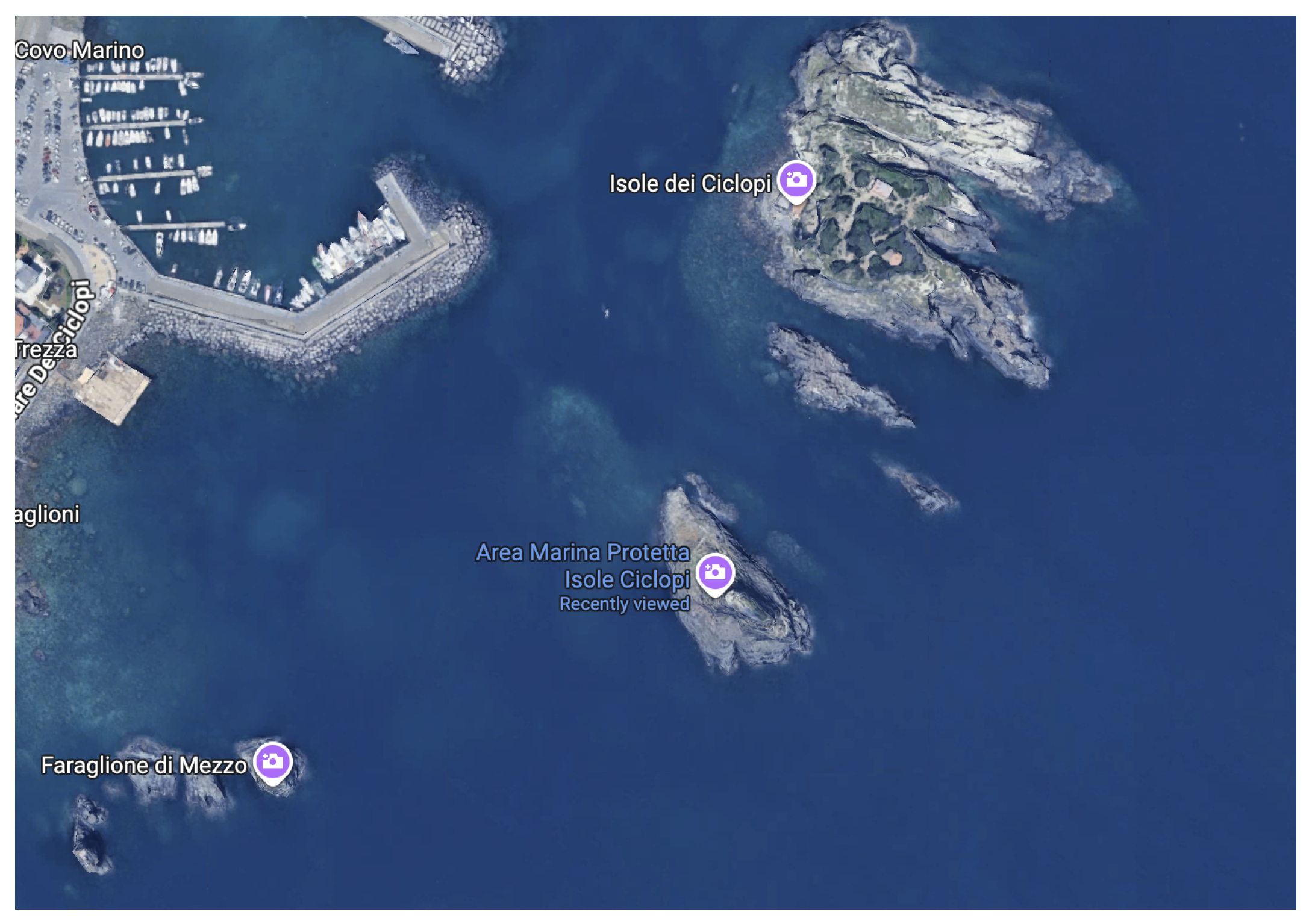
- Area Marina Protetta Isole dei Ciclopi. Area Marina Protetta “Isole Ciclopi”. Available online: https://www.isoleciclopi.it/ (accessed on 17 November 2025).
- EvoLogics. S2C M 18/34|EvoLogics. Available online: https://www.evologics.de/product/s2c-m-18-34-8 (accessed on 17 November 2025).
- Wireless and More. Wireless and More–Home. Available online: https://www.wirelessandmore.it/ (accessed on 17 November 2025).
- Dragino. Dragino: Open IoT Solution Limited. Available online: https://www.dragino.com/ (accessed on 17 November 2025).
- BlueRobotics. Blue Robotics—Underwater ROVs, USVs, Thrusters and Sonars! Available online: https://www.bluerobotics.com/ (accessed on 17 November 2025).
- DJI. DJI Enterprise—Drone Solutions for Your Business. Available online: https://enterprise.dji.com/cn (accessed on 17 November 2025).
- Brincat, A.; Busacca, F.; Galluccio, L.; Mertens, J.; Musumeci, A.; Palazzo, S.; Panebianco, A. An integrated acoustic/LoRa system for transmission of multimedia sensor data over an Internet of Underwater Things. Comput. Commun. 2022, 192, 132–142. [Google Scholar] [CrossRef] [Scilit]
- Busacca, F.; Galluccio, L.; Mertens, J.; Orto, D.; Palazzo, S. An experimental testbed of an Internet of Underwater Things. In WiNTECH ’20: Proceedings of the 14th International Workshop on Wireless Network Testbeds, Experimental Evaluation & Characterization, London, UK, 21 September 2020; Association for Computing Machinery: New York, NY, USA, 2020. [Google Scholar]
- UGEAR. UGEAR. Available online: https://www.uugear.com/ (accessed on 17 November 2025).
- DESERT Underwater. DESERT Underwater—DEsign, Simulate, Emulate and Realize Test-Beds for Underwater Network Protocols. Available online: https://github.com/signetlabdei/DESERT_Underwater (accessed on 17 November 2025).
- Busacca, F.; Galluccio, L.; Palazzo, S.; Panebianco, A.; Raftopoulos, R. A Distributed Multi-Armed Bandit Approach for Modulation Adaptation in Underwater Networks. In Proceedings of the 2025 IEEE Wireless Communications and Networking Conference (WCNC), Milan, Italy, 24–27 March 2025. [Google Scholar]
- Cai, J.; Mayberry, S.; Zhang, F. First Step Towards Low-Cost, Open-Source Optical Modem for Underwater Communication with Experimental Results. In WUWNet ’22: Proceedings of the 16th International Conference on Underwater Networks & Systems, Boston, MA, USA, 14–16 November 2022; Association for Computing Machinery: New York, NY, USA, 2022. [Google Scholar] [CrossRef] [Scilit]
- Unal, D.; Falleni, S.; Enhos, K.; Demirors, E.; Basagni, S.; Melodia, T. Design and performance evaluation of SEANet, a software-defined networking platform for the Internet of Underwater Things. Comput. Netw. 2024, 250, 110579. [Google Scholar] [CrossRef] [Scilit]
- Weng, Y.; Pajarinen, J.; Akrour, R.; Matsuda, T.; Peters, J.; Maki, T. Reinforcement Learning Based Underwater Wireless Optical Communication Alignment for Autonomous Underwater Vehicles. IEEE J. Ocean. Eng. 2022, 47, 1231–1245. [Google Scholar] [CrossRef] [Scilit]
- Lin, J.; Du, Z.; Yu, C.; Ge, W.; Lü, W.; Deng, H.; Zhang, C.; Chen, X.; Zhang, Z.; Xu, J. Machine-vision-based acquisition, pointing, and tracking system for underwater wireless optical communications. Chin. Opt. Lett. 2021, 19, 050604. [Google Scholar] [CrossRef] [Scilit]
- Jia, B.; Ge, W.; Cheng, J.; Du, Z.; Wang, R.; Song, G.; Zhang, Y.; Cai, C.; Qin, S.; Xu, J. Deep Learning-Based Cascaded Light Source Detection for Link Alignment in Underwater Wireless Optical Communication. IEEE Photonics J. 2024, 16, 1–12. [Google Scholar] [CrossRef] [Scilit]
- Liang, H.; Li, H.; Wu, M.; Zhang, J.; Ni, W.; Hu, B.; Ai, Y. Design of an Underwater Optical Communication System Based on RT-DETRv2. Photonics 2025, 12, 991. [Google Scholar] [CrossRef] [Scilit]
- Elamassie, M.; Uysal, M. Vertical Underwater Visible Light Communication Links: Channel Modeling and Performance Analysis. IEEE Trans. Wirel. Commun. 2020, 19, 6948–6959. [Google Scholar] [CrossRef] [Scilit]





| Study | Methodology | Key Results | Strengths | Limitations |
|---|---|---|---|---|
| 2017 [8] | Hybrid opto-acoustic system with multi-hop OC, SDMA for data link layer, and reverse route search. | Effective for short-range, high-data-rate OC and long-range AC for control/localization messages. | SNR-based adaptive switching; scalable multi-level design. | Frequent mode switching increases energy and delay; limited real-world testing. |
| 2020 [9] | Clustering-based hybrid framework using optical intra-cluster and acoustic inter-cluster communications. | Achieves 73% energy savings and reduced latency as compared to shortest path routing. | Energy-efficient clustering, scalability, high throughput. | Energy-intensive inter-cluster AC links; high latency in dense networks. |
| 2014 [10] | Simulation study using CBR traffic to compare standalone vs. hybrid opto-acoustic systems. | Hybrid mode achieves higher throughput as compared to standalone systems. | Proves hybrid performance; realistic packet configurations for OC and AC. | Environmental factors, like turbidity, are ignored; lacks adaptability to dynamic conditions. |
| 2021 [11] | Hierarchical structure for OC (short-range) and AC (long-range) with power optimization framework. | Achieves 23% power savings as compared to standalone systems. | Efficient power management. | Computationally intensive optimization; scalability issues in complex networks. |
| 2007 [12] | Practical multimodal design with OC for data and AC for control/localization. | OC: 320 kbps over 2 m; AC: 330 bps over 400 m. | Real-world validation. | Limited OC range; AC low data rate unsuitable for data demanding applications. |
| 2019 [13] | Hybrid system for real-time video streaming using OC for video and AC for control/alignment. | Validates real-time streaming with compressed image transmission. | Proves feasibility of underwater video; effective compression techniques. | Computational overhead; lacks adaptability for larger-scale networks. |
| 2021 [14] | Modular cognitive communication architecture (CCA) for hybrid systems with adaptive protocol selection. | Achieves 95% PDR in simulations; validated with Medusa-class vehicles. | Adaptive protocol improves efficiency; real-world validation with vehicles. | Line-of-sight absence reduces efficiency; frequent reliance on AC affects hybrid performance. |
| 2023 [15] | Hybrid dual-hop DF relay with -F (acoustic) and EGG (optical) models. | Closed-form expressions for outage probability, ABER, ergodic capacity. | Novel physical layer analysis; realistic composite fading models. | Line-of-sight optical vulnerability; static topology; no field validation. |
| 2022 [16] | ROV with LED-based optical and acoustic modems; optical for data transmission, acoustic for signaling and ARQ. | Achieves 5 Mb/s over 7.6 m laboratory pool; estimated 3.125 MB/s over 11 m in clear seawater. | Practical ROV implementation; cost-effective design; experimental validation in controlled environment. | Laboratory-only testing; seawater estimates based on attenuation coefficients, not field-validated; ARQ overhead in lossy conditions. |
| 2023 [17] | DRL-based AUV path planning with adaptive optical–acoustic selection; considers AoI, packet size. | Reduces weighted AoI and energy vs. single modality; demonstrates energy–AoI trade-offs. | DRL approach for multi-modal selection; steering angle optimization. | Omits optical alignment time; assumes omni-directional modems; static network topology. |
| 2020 [18] | Hybrid acoustic–optical; phase-based AoA localization; adaptive MPC and PD controllers; 2D control. | MPC 53% better than PD; maintains QoS within cone. | Position-error feedback; unknown dynamics handling. | 2D control (no 3D attitude); perfect alignment assumption; clear-water model. |
| 2025 [19] | Optical–acoustic hybrid with adaptive parameter control via acoustic feedback. | 100 Mbps at 22 m (lab); 66 m equivalent range in Jerlov I water; BER . | Practical integration; seamless Ethernet compatibility; adaptive alignment. | Lab-only; no ocean trials; turbidity effects unknown. |
| 2024 [20] | Acoustic links for control/position broadcast, optical links for DATA forwarding via sector-based candidate areas. | Simulations in a 500 m × 500 m network (60–150 nodes) show higher delivery ratio, lower delay, and less energy consumption as compared to acoustic or optical links. | Exploits complementary acoustic/optical properties; uses local information (distance, residual energy, neighbor count) for distributed next-hop selection. | Evaluation is simulation-only in 2D; idealized localization; no experimental or 3D mobility validation. |
| 2025 [21] | Multi-mode SDR modem with acoustic, optical, MI, and RF heads. | Lab PoC with 3-node setup showing acoustic–optical relaying, Ethernet tunneling, video streaming, and multi-mode test tools. | Highly flexible architecture; supports multiple media and protocols. | Demo-scale only; real-environment performance not evaluated. |
| Optical | Acoustic | |
|---|---|---|
| Application scenario | clear, seawater, coastal ocean water | deep, shallow water |
| Communication Distance | tens of meters | kilometers |
| Propagation Speed | 2.25 × 10⁸ m/s | 1500 m/s |
| Data Rate | Gbps | Kbps |
| Latency | low latency due to high propagation speed | high latency resulting from slower sound speed in water |
| Energy Efficiency | highly energy efficient approximately 30,000 bits/Joules | highly energy inefficient with only 100 bits/Joules |
| Transmission Power | few W | tens of W |
| Frequency Band | 545 THz to 667 THz | 10 KHz to few hundreds KHz |
| Factors Impacting on Performance | absorption, turbidity, organic matter | salinity, temperature, pressure |
| Deployment Complexity | moderate complexity, requires precise alignment | established technology with well-understood deployment practices |
| Environmental Impact | low environmental impact | potential to disturb marine life due to sound propagation |
| Benefits | very high data rate, high cost | widely used, long communication range |
| Drawbacks | affected by scattering, absorption, moderate transmission range, LOS communication | low data rate, shadow zones, very high latency |
| Parameter | Optical | Acoustic |
|---|---|---|
| Conductivity |   | |
| Permittivity | | |
| Absorption | | |
| Turbidity | | |
| Organic Matter | | |
| Salinity | | |
| Temperature | | |
| Pressure | | |
| Frequency | | |
| Antenna Design | | |
| Alignment | | |
| Beam Divergence | | |
| Ambient Noise | | |
| Multipath Propagation | | |
| Parameter | Value |
|---|---|
| Wavelength | 520 nm |
| Transmit power | 1 W |
| Receiver bandwidth | 1 MHz |
| Receiver sensitivity | −53.4 dBm |
| Water type (pure sea) | 0.0451 m−1 |
| Water type (clear ocean) | 0.09868 m−1 |
| Water type (coastal ocean) | 0.31756 m−1 |
| Parameter | Value (Mean & Range) |
|---|---|
| Water Temperature | 14–28 °C |
| Salinity | 37.5–38.8 PSU |
| Turbidity | 10–30 m |
| Depth Profile | 20–40 m (Shelf) |
| pH | 8.15–8.36 |
Disclaimer/Publisher’s Note: The statements, opinions and data contained in all publications are solely those of the individual author(s) and contributor(s) and not of MDPI and/or the editor(s). MDPI and/or the editor(s) disclaim responsibility for any injury to people or property resulting from any ideas, methods, instructions or products referred to in the content. |
© 2025 by the authors. Licensee MDPI, Basel, Switzerland. This article is an open access article distributed under the terms and conditions of the Creative Commons Attribution (CC BY) license.
Share and Cite
Rehman, A.; Galluccio, L. Multi-Level Multi-Technology Underwater Networks: Challenges and Opportunities for Marine Monitoring. Network 2026, 6, 2. https://doi.org/10.3390/network6010002
Rehman A, Galluccio L. Multi-Level Multi-Technology Underwater Networks: Challenges and Opportunities for Marine Monitoring. Network. 2026; 6(1):2. https://doi.org/10.3390/network6010002
Chicago/Turabian StyleRehman, A., and L. Galluccio. 2026. "Multi-Level Multi-Technology Underwater Networks: Challenges and Opportunities for Marine Monitoring" Network 6, no. 1: 2. https://doi.org/10.3390/network6010002
APA StyleRehman, A., & Galluccio, L. (2026). Multi-Level Multi-Technology Underwater Networks: Challenges and Opportunities for Marine Monitoring. Network, 6(1), 2. https://doi.org/10.3390/network6010002