
Article

Thickness Effect on Microwave Permeability of CoFeB Films on Flexible Substrate

by
Nikita A. Buznikov
*,
Pavel A. Ivanov
,
Ilya V. Komarov
,
Andrey N. Lagarkov
,
Sergey A. Maklakov
,
Sergey S. Maklakov
,
Alexey V. Osipov
,
Konstantin N. Rozanov
,
Artem O. Shiryaev
and
Polina A. Zezyulina
Institute for Theoretical and Applied Electromagnetics, Russian Academy of Sciences, Moscow 125412, Russia
*
Author to whom correspondence should be addressed.
Magnetism 2025, 5(4), 30; https://doi.org/10.3390/magnetism5040030
Submission received: 30 October 2025 / Revised: 17 November 2025 / Accepted: 20 November 2025 / Published: 28 November 2025

Abstract

Microwave permeability of amorphous Co67Fe7B26 films deposited on a flexible substrate was studied in a wide range of film thicknesses up to 1.40 μm. Microwave permeability measurements were carried out using the coaxial technique in the frequency range from 0.1 to 10 GHz. It was found that both the static permeability and the ferromagnetic resonance frequency depend weakly on the film thickness. Analysis of the microwave data showed that the studied films possess in-plane magnetic anisotropy. The influence of the skin effect on the frequency dependence of the microwave permeability was modeled using an analytical approach. It was demonstrated that the decrease in the peak of the imaginary part of the microwave permeability with film thickness growth is related to the skin effect. The results obtained may be useful for microwave applications of soft magnetic CoFeB films.

1. Introduction

Microwave properties of ferromagnetic films are currently being intensively studied [1,2,3,4,5,6]. Static and dynamic magnetic properties of these films are of interest both from a fundamental point of view and for numerous potential applications in microwave devices. The key parameter governing the properties of a ferromagnetic material in the microwave range is the dynamic permeability, which has certain limitations. For bulk magnetic materials, according to the Snoek limit, the initial permeability is inversely proportional to the ferromagnetic resonance frequency under a certain saturation magnetization [7]. Ferromagnetic films with in-plane magnetic anisotropy have some advantages over other magnetic materials in their microwave behavior, since they can exceed the Snoek limit, allowing for a wider operating frequency range of microwave devices [8,9,10]. This is associated with a strongly pronounced shape anisotropy, which prevents the exit of the magnetization from the film plane. To attain high values of the microwave permeability, ferromagnetic films should possess a high saturation magnetization and anisotropy field. Furthermore, to reduce the skin effect, the films should also have high resistivity [11]. In recent decades, much attention has been paid to the study of microwave properties of various nanocrystalline soft magnetic films that possess the above-mentioned properties. In addition to nanocrystalline films, amorphous films with high saturation magnetization are promising for microwave applications.
Amorphous CoFeB films exhibit excellent soft magnetic properties and have a ferromagnetic resonance frequency above 1 GHz [12,13]. The dynamic magnetic properties of CoFeB films on rigid [4,6,12,13,14,15,16,17,18,19,20,21,22,23,24,25] and flexible [26,27,28,29,30,31] substrates have been investigated over the past decades. However, all studies of CoFeB films were carried out for ultra-thin films and were limited to a film thickness of 500 nm. Investigations of the dynamic magnetic properties for thicker CoFeB films are lacking.
At the same time, some applications of ferromagnetic films require relatively high film thickness. It is well known that in ferromagnetic films, an increase in film thickness leads to changes in the microstructure and magnetic anisotropy. Out-of-plane magnetic anisotropy can appear in various nanocrystalline [32,33,34] and amorphous [18,35,36,37,38,39] films with the growth of film thickness. The origin of out-of-plane anisotropy in amorphous films is associated with magnetoelastic effects. It has been found that the appearance of out-of-plane magnetic anisotropy depends on the film thickness, amorphous alloy composition, fabrication process and distribution of residual stress [36,38,39]. The appearance of out-of-plane magnetic anisotropy in a film leads to a decrease in the ferromagnetic resonance frequency, which worsens the microwave magnetic performance of the films.
Another mechanism affecting the microwave magnetic properties of ferromagnetic films is related to the skin effect. For relatively thick ferromagnetic films, the frequency dependence of the dynamic permeability can be governed by the effect of eddy currents, which leads to a sharp decrease in the permeability at high frequencies [40]. Therefore, the study of physical reasons leading to a decrease in the dynamic permeability with the growth of film thickness is an important task from the point of view of microwave applications.
In this paper, we systematically investigate the thickness effect on the microwave properties of amorphous Co67Fe7B26 films on a flexible substrate obtained by DC magnetron sputtering. The microwave permeability was measured using the coaxial technique. The measured frequency dependences of permeability were approximated by the Lorentzian dispersion law. The possible appearance of out-of-plane magnetic anisotropy with the film thickness growth and the influence of the skin effect on the frequency dependence of the microwave permeability are analyzed.

2. Materials and Methods

CoFeB amorphous films were deposited using DC magnetron sputtering onto a flexible polyethylene terephthalate (PET) substrate. Co67Fe7B26 alloy was used as a target material. This composition was chosen due to its high saturation magnetization and high dynamic permeability in the range of several GHz [13]. The films were deposited in an argon atmosphere at a pressure of 10−3 Torr. The PET substrate of a thickness of 12 μm was fixed on a rotating barrel-type substrate holder. The sputtering target to substrate distance was 5 cm. Films with thicknesses in the range from 0.19 to 1.40 µm were obtained.
The thickness of the obtained films was determined by two methods: measuring the film mass and monitoring the film cross-section using scanning electron microscopy (SEM) JEOL JCM-7000 (JEOL, Tokyo, Japan). To obtain the thickness by the mass of the film, the mass of a 20 × 20 cm2 square was measured before and after deposition of the film on a PET substrate. The density of the magnetic layer was found by measuring the volume and mass of the target material. To obtain SEM images, a sharp blade was used to cut off a smooth edge of the film, with the film cut oriented parallel to the incident electron beam. The film thickness was evaluated by the average value obtained from the SEM image data analysis at several points of the film. A typical SEM image is shown in Figure 1 for a 1.40 µm thick film. Note that the two methods mentioned above give similar results for a film thickness within 0.01 µm.
The film resistivity was measured using the four-probe method for a 1.40 µm thick film. The resistivity value was 140 μOhm·cm. Magnetostatic properties were studied using a vibrating sample magnetometer (VSM). For the VSM measurements, the 7 mm diameter discs were cut from the film. Hysteresis loops were measured in the film plane in a magnetic field range of ±1 kOe.
The microwave permeability was studied using a 7/3 coaxial measurement line. A detailed description of the measurement method can be found elsewhere [41,42]. Samples for microwave measurements were 5 mm wide strips cut from film. The strips were cut perpendicular to the direction of the barrel axis. The strips were wound into a hollow cylindrical roll with inner and outer diameters of 3 and 7 mm, respectively. The frequency dependence of microwave permeability was measured in the range of 0.1 to 10 GHz using the Nicolson–Ross–Weir technique. Additionally, microwave measurements were determined under a bias magnetic field of up to 800 Oe. The bias magnetic field was applied along the axis of the measurement line.
Measurements of resistivity, magnetostatic and microwave properties were carried out at room temperature.
The measured frequency dependence of the permeability μ = μ′ + ″ was approximated by the Lorentzian dispersion law:
μ = 1 + μ s 1 1 i β ( f / f res ) ( f / f res ) 2 .
Here, μs is the static permeability, β is the damping factor, f is the frequency and fres is the ferromagnetic resonance frequency.
As a result of the fitting, the static permeability μs and the ferromagnetic resonance frequency fres of the film were estimated. Based on the static permeability and the ferromagnetic resonance frequency, the microwave magnetic performance of the films was analyzed by using the Acher parameter kA, which is defined as follows [10]:
k A = ( μ s 1 ) f res 2 ( γ 4 π M 0 ) 2 ,
where M0 is the saturation magnetization of the material, and γ ≈ 3 GHz/kOe is the gyromagnetic ratio.
The Acher parameter describes the fraction of magnetic moments of a material that are involved in the precession excited by a microwave magnetic field. For a uniformly magnetized film with in-plane magnetic anisotropy, the Acher parameter equals unity when the microwave magnetic field is transverse to the anisotropy axis of the film. The case of kA < 1 may be related to the appearance of out-of-plane magnetic anisotropy [10,43,44].

3. Results and Discussion

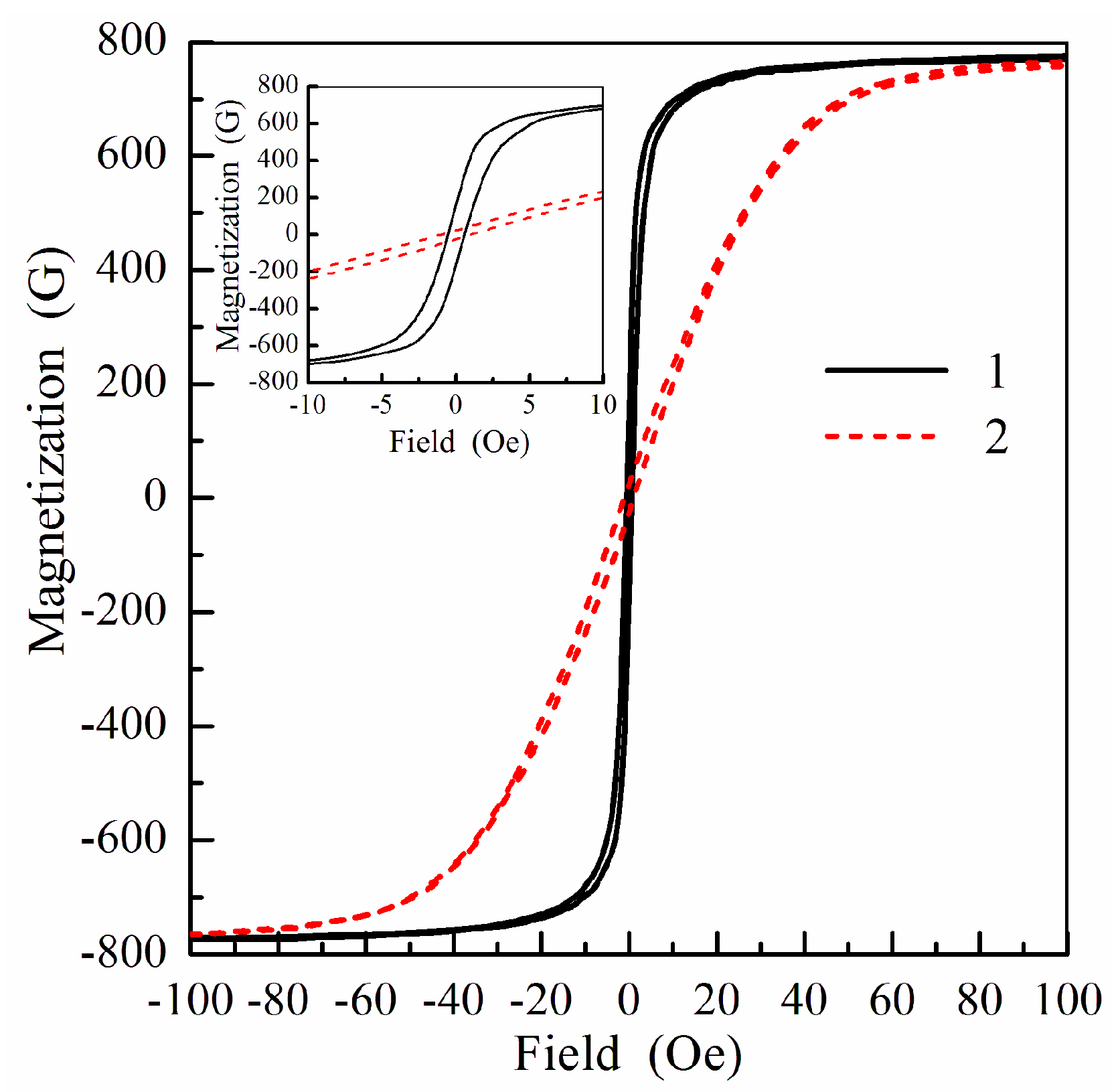
Figure 2 shows the in-plane hysteresis loops for a 0.63 µm thick film. The measurements were carried out in a field directed along the symmetry axis of the barrel and perpendicular to this axis. The film exhibited uniaxial in-plane magnetic anisotropy. The easy magnetization axis coincided with the axis of the barrel. The coercivity values were 1.7 and 1.9 Oe for easy and hard axes, respectively. The measured saturation magnetization was 780 G. Note that the hysteresis loops for the other films under study had a shape similar to that shown in Figure 2.
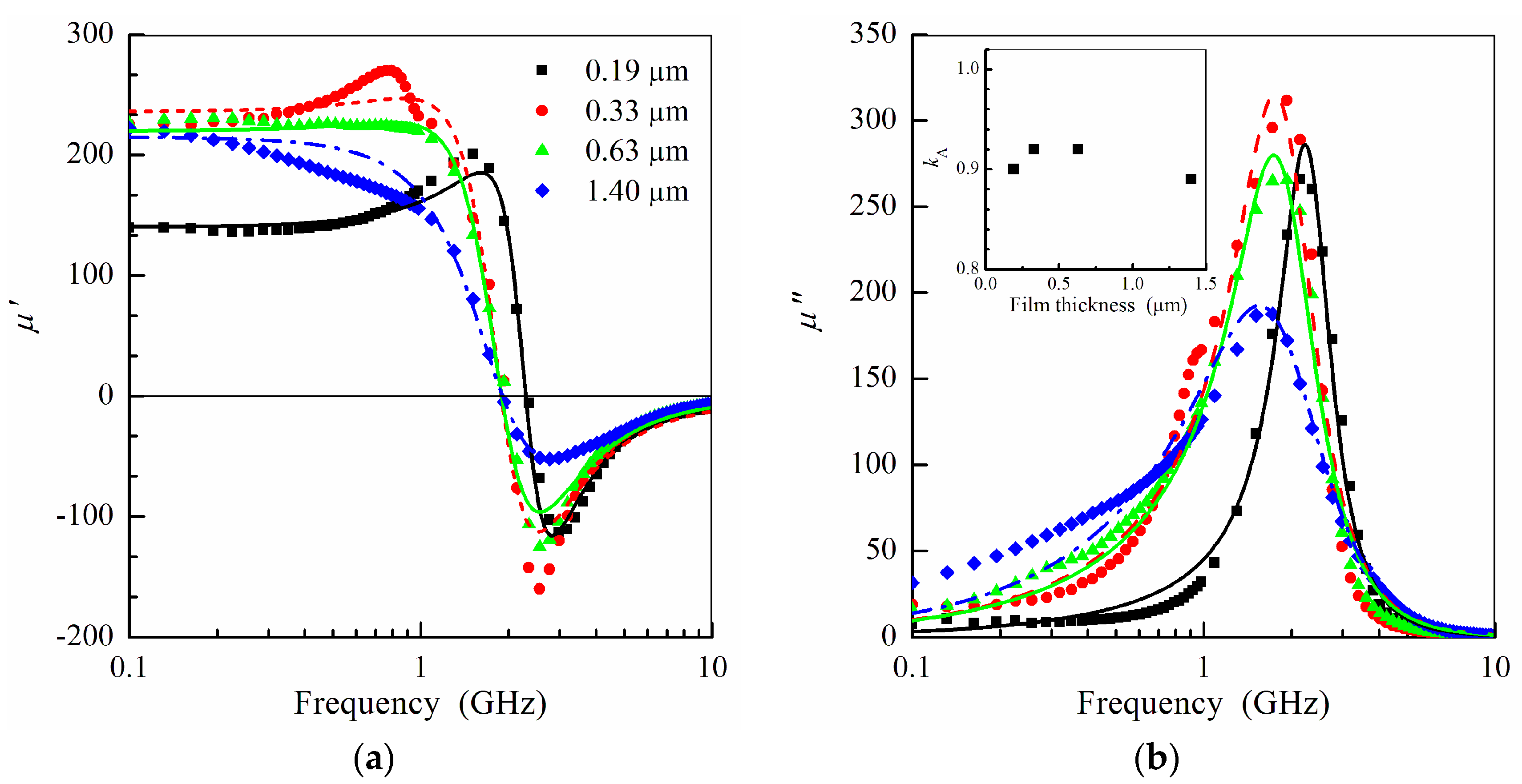
The measured frequency dependence of the microwave permeability for films of various thicknesses is presented in Figure 3. The lines in Figure 3 show the fitting of the measured permeability by the Lorentzian dispersion law, Equation (1). The frequency dependence of the imaginary part of the permeability for all films shows one peak, which is attributed to the ferromagnetic resonance. For films of thickness 0.33 µm or higher, both the static permeability and the ferromagnetic resonance frequency depend weakly on the film thickness. The resonance frequency is approximately 2 GHz.
The film of 0.19 µm in thickness has a lower value of the static permeability and a higher resonance frequency of 2.3 GHz. This is due to a higher magnetic anisotropy field in the thinnest film under study. The increase in the anisotropy field in this film is probably related to the magnetoelastic effect, which has been shown to be significant in amorphous CoFeB films [26,45,46]. When the studied film is rolled into a cylinder for the microwave measurements, stresses arise in the film that result in an additional contribution to the anisotropy field [42]. It was shown previously for cobalt films [47] that the relative contribution of the magnetoelastic effect to the microwave properties is significant for thin films and decreases with increasing film thickness. However, further studies of the influence of the magnetoelastic effect on the dynamic permeability of CoFeB films are needed.
It follows from Figure 3 that for films with a thickness of 0.33 µm and higher, the peak of the imaginary part of the permeability broadens, and the peak amplitude decreases with increasing film thickness. This may be related to the appearance of out-of-plane magnetic anisotropy and the exit of magnetization from the film plane. The Acher parameter kA was calculated by using the fitting of the measured frequency dependences of the permeability by the Lorentzian dispersion law in order to study the appearance of out-of-plane magnetic anisotropy. To calculate the Acher parameter, we use the saturation magnetization value M0 = 780 G obtained from magnetostatic measurements. The calculated Acher parameter depends slightly on the film thickness, and kA ≈ 0.9 (see inset in Figure 3b).
The appearance of out-of-plane magnetic anisotropy has been observed previously in various nanocrystalline films. In particular, out-of-plane magnetic anisotropy in permalloy films can lead to the transition into a “transcritical state” [33,34,48,49,50]. This transition takes place when the film thickness exceeds a certain critical value. The critical thickness depends on the substrate properties and the film sputtering conditions and is typically several hundred nanometers [33,49]. The transition to a “transcritical state” leads to an increase in the coercivity of the film and a deterioration in its soft magnetic properties. As for the microwave properties of permalloy films, the appearance of out-of-plane magnetic anisotropy is accompanied by a decrease in both the static permeability and the ferromagnetic resonance frequency. As a result, the Acher parameter drops sharply by approximately two orders of magnitude with an increase in the film thickness [44,51]. A significant decrease in the Acher parameter was also observed in cobalt films on a PET substrate when the film thickness exceeded 100 nm [47]. In the studied CoFeB films, the Acher parameter is nearly constant up to a film thickness of 1.40 µm, and its value is close to unity. Therefore, thick CoFeB films retain in-plane magnetic anisotropy, and these films have an advantage over nanocrystalline films.
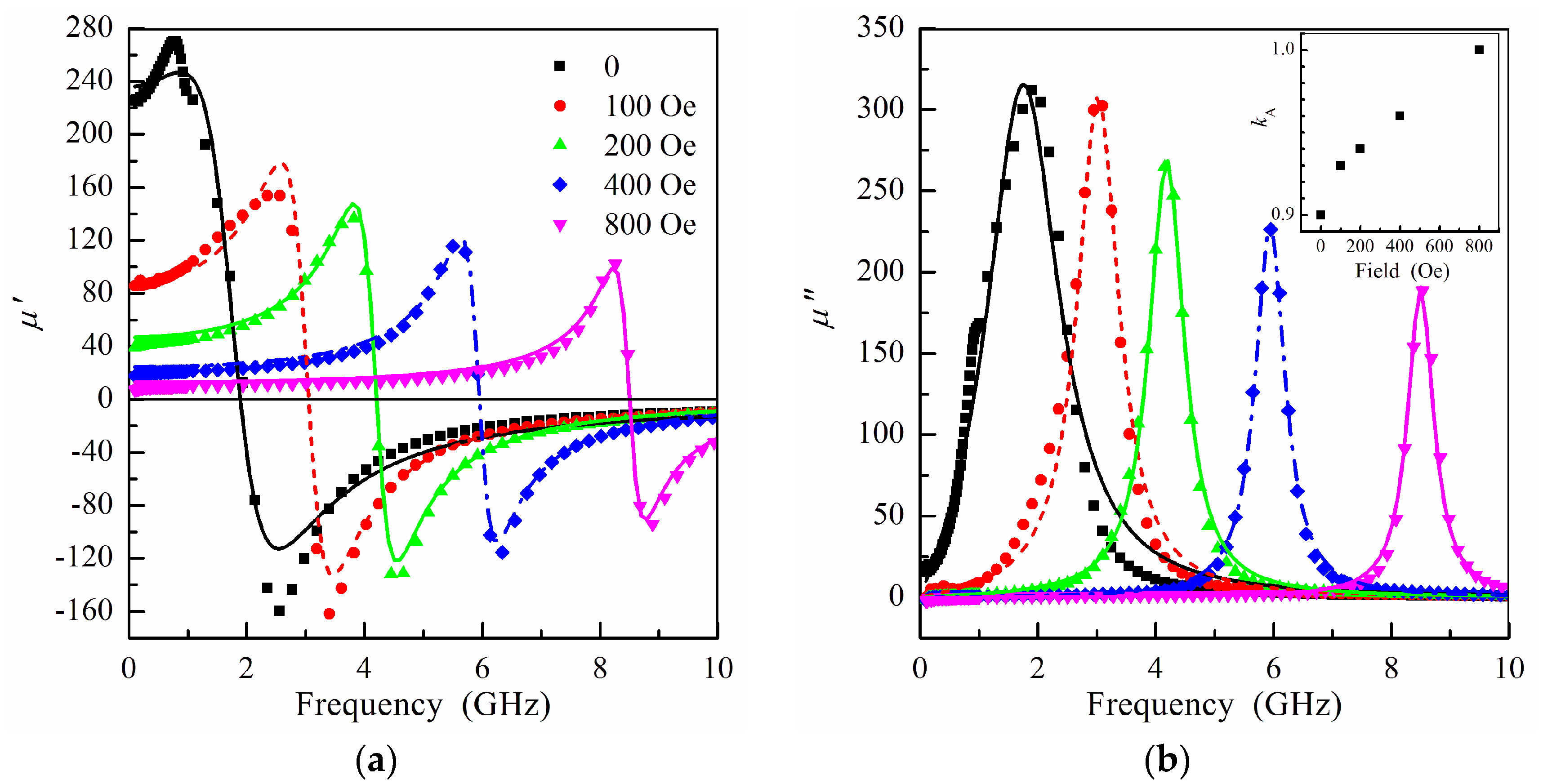
The deviation of the Acher parameter from unity may be related to the scattering of the anisotropy axis directions in the films under study. To suppress magnetic non-uniformity, the frequency dependence of the microwave permeability was measured under the bias magnetic field applied along the axis of the coaxial line. Figure 4 shows the measured frequency dependence of the permeability for the 0.33 µm thick film at different values of the bias field. With the magnetic field increase, the resonance frequency shifts toward higher frequencies, and the width of the peak of the imaginary part of the permeability becomes narrower. The calculated values of the Acher parameter increase monotonically from 0.90 to 1 with the bias field (see inset in Figure 4b). For all the films studied, the Acher parameter is equal to unity at a magnetic field of 800 Oe, which indicates that the films are in a saturated isotropic state.
Since out-of-plane magnetic anisotropy does not appear in the CoFeB films under study, it could be assumed that an increase in the damping factor β with the film thickness is related to the skin effect. The skin effect is caused by eddy currents induced by the microwave magnetic field. As a result of the influence of eddy currents, the measured permeability μ differs from the intrinsic permeability of the material μin [52]. The relationship between the measured and intrinsic permeability for a film of thickness d is given by the well-known expression [53]:
μ = μ in tan h ( k d / 2 ) k d / 2 .
k = ( 1 i ) 2 π ( μ in f / ρ c 2 ) 1 / 2
Here, k is the wave propagation constant, ρ is the film resistivity, and c is the speed of light in a vacuum.
In the case of a strong skin effect, kd/2 >> 1, the frequency dependence of the imaginary part of the permeability splits into two distinct peaks. The low-frequency peak is associated with the skin effect, and the high-frequency peak is due to the ferromagnetic resonance [10]. At a weak skin effect, kd/2 << 1, a broadening of the single peak at the resonance frequency can be observed. The latter corresponds to experimental data, so below, the case of a weak skin effect is analyzed.
Further, we assume that the frequency dependence of the intrinsic permeability is described by the Lorentzian law (1) with β = βin corresponding to the damping factor of the material. In the case of a weak skin effect, kd/2 << 1, Equation (3) can be rewritten as follows [52]:
μ = μ in [ 1 ( k d / 2 ) 2 / 3 ] .
Substituting Equation (1) with β = βin into Equation (5) and taking into account that μs >> 1, after simple algebraic transformations, we obtain for the measured permeability:
μ = μ s 1 i β 1 ( f / f res ) ( f / f res ) 2 .
Here, the damping factor β1 is given by
β 1 = β in + 8 π 2 d 2 μ s f res 3 ρ c 2
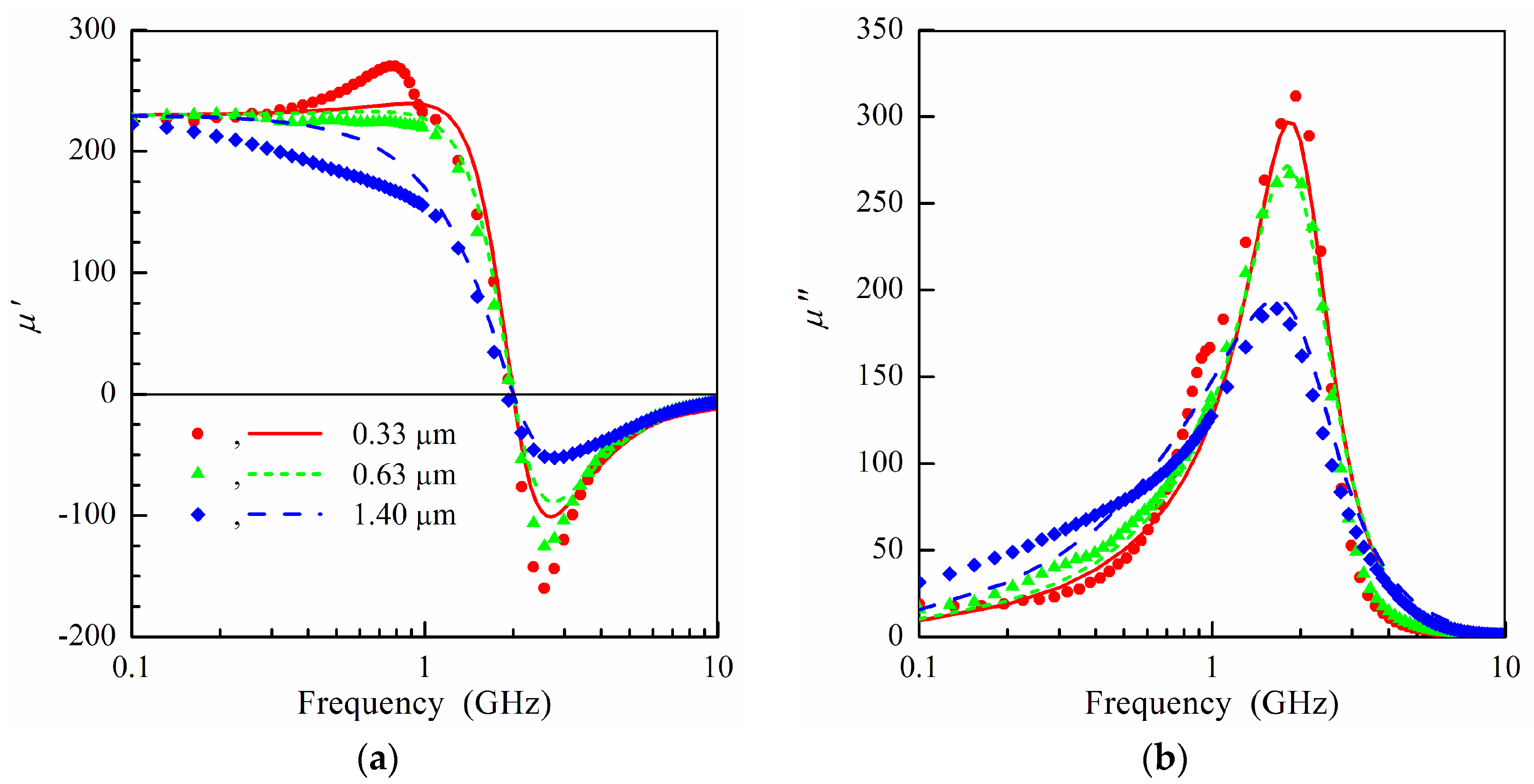
The last term on the right-hand side of Equation (7) is responsible for the broadening of the Lorentzian curve due to the skin effect. Figure 5 shows a comparison of the measured and calculated frequency dependences of the dynamic permeability for different values of the film thickness. The calculations were carried out using Equations (6) and (7). The value of the resistivity ρ = 140 μOhm·cm used in the calculations was measured for a 1.40 µm thick film. The static permeability μs and ferromagnetic resonance frequency fres were found from the approximation of experimental data by the Lorentzian frequency dispersion law. The only fitting parameter used in the calculations was the damping factor βin of the material.
It follows from Figure 5b that the calculated frequency dependences of the imaginary part of the dynamic permeability are in good agreement with the measurement data. The highest discrepancy between the measurement and calculation results is observed for a film with a thickness of 1.40 µm.
Table 1 presents a comparison of the damping factor β estimated from the approximation of experimental data by Equation (1) and the damping factor β1 calculated using Equation (7) at different values of the film thicknesses. The difference in factors β and β1 is insignificant, even for a 1.40 µm thick film. Note that for the thickest film studied, there is another contribution to the damping, which may be related to the greater non-uniformity of the film. Thus, it was concluded that in the films under study, changes in the frequency dependence of the dynamic permeability with film thickness are mainly due to the skin effect.

4. Conclusions

The thickness effect on the microwave permeability of amorphous Co67Fe7B26 films deposited on a flexible substrate was studied. It was observed that both the static permeability and the ferromagnetic resonance frequency remain unchanged even for relatively thick films, while the peak in the imaginary part of the microwave permeability decreases with film thickness growth. The Acher parameter, Equation (2), was used to analyze the change in the microwave permeability as a function of the film thickness. It was found that the Acher parameter for all studied CoFeB films is close to unity, which indicates the presence of in-plane magnetic anisotropy in the films.
The influence of the skin effect on the frequency dependence of the microwave permeability of CoFeB films was studied within the framework of a simple analytical model. The calculated results satisfactorily describe the changes in the microwave permeability with film thickness growth. The analysis shows that an increase in the damping factor with the film thickness is indeed due to the skin effect. The results obtained demonstrate that relatively thick, soft magnetic amorphous CoFeB films may be promising for various microwave applications.

Author Contributions

Conceptualization, N.A.B., S.S.M. and A.V.O.; methodology, N.A.B. and A.V.O.; validation, I.V.K., A.V.O. and A.O.S.; formal analysis, N.A.B. and A.V.O.; investigation, P.A.I., I.V.K., A.V.O., A.O.S. and P.A.Z.; resources, I.V.K. and S.A.M.; writing—original draft preparation, N.A.B.; writing—review and editing, N.A.B., A.V.O. and K.N.R.; visualization, N.A.B. and I.V.K.; supervision, A.N.L., S.S.M. and K.N.R.; funding acquisition, A.N.L. All authors have read and agreed to the published version of the manuscript.

Funding

This research was funded by the Russian Science Foundation, grant number 25-19-00393.

Institutional Review Board Statement

Not applicable.

Informed Consent Statement

Not applicable.

Data Availability Statement

The original contributions presented in this study are included in the article. Further inquiries can be directed to the corresponding author.

Conflicts of Interest

The authors declare no conflicts of interest.

References

  1. Jiang, X.; Zhang, J.; Song, X.; Wang, H.; Zhang, K.; He, Z.; Wu, C.; Yu, Z.; Lan, Z.; Sun, K. Tunable resonance frequency of NiFe thin films by oblique deposition. J. Magn. Magn. Mater. 2022, 547, 168946. [Google Scholar] [CrossRef]
  2. Izotov, A.V.; Belyaev, B.A.; Boev, N.M.; Burmitskikh, A.V.; Leksikov, A.A.; Skomorokhov, G.V.; Solovev, P.N. Tailoring the microwave properties of thin Permalloy films using a periodically grooved substrate. Phys. B 2022, 629, 413654. [Google Scholar] [CrossRef]
  3. Goldman, S.; Celinski, Z. Magnetic properties of (Ni0.81Fe0.19/SiO2)n multilayers for high frequency on-wafer inductor applicati ons. J. Magn. Magn. Mater. 2023, 569, 170440. [Google Scholar] [CrossRef]
  4. Li, Q.; Jiang, Y.; Wu, C.; Jiang, X.; Li, Z.; Sun, K.; Lan, Z.; Yu, Z. Tailoring the in-plane magnetic anisotropy and permeability spectra of obliquely deposited Fe40Co40B20 films for 5G communications. J. Magn. Magn. Mater. 2023, 578, 170811. [Google Scholar] [CrossRef]
  5. Lei, T.; Zhang, W.; Bo, G.; Feng, C.; Li, N.; Zhao, R.; Ji, L.; Zhang, J.; Zhang, X. Tuning the ferromagnetic resonance frequency of microstructured permalloy film on flexible substrate. Phys. Status Solidi RRL 2024, 18, 2400081. [Google Scholar] [CrossRef]
  6. Kumar, P.; Kumar, R.; Sharma, V.; Khanna, M.K.; Kuanr, B.K. Influence of growth temperature on the magnetization dynamics of sputtered CoFeB thin films on various substrates and their microwave device functionality. J. Alloys Compd. 2024, 988, 174314. [Google Scholar] [CrossRef]
  7. Snoek, J.L. Dispersion and absorption of magnetic ferrites at frequencies above 1 MHz. Physica 1948, 14, 207–217. [Google Scholar] [CrossRef]
  8. Perrin, G.; Acher, O.; Peuzin, J.C.; Vucadinovic, N. Sum rules for gyromagnetic permeability of ferromagnetic thin films: The oretical and experimental results. J. Magn. Magn. Mater. 1996, 157/158, 289–290. [Google Scholar] [CrossRef]
  9. Acher, O.; Adenot, A.L. Bounds on the dynamic properties of magnetic materials. Phys. Rev. B 2000, 62, 11324–11327. [Google Scholar] [CrossRef]
  10. Rozanov, K.N.; Koledintseva, M.Y. Application of generalized Snoek’s law over a finite frequency range: A case study. J. Appl. Phys. 2016, 119, 073901. [Google Scholar] [CrossRef]
  11. Fergen, I.; Seemann, K.; Weth, A.v.d.; Shüppen, A. Soft ferromagnetic thin films for high frequency applications. J. Magn. Magn. Mater. 2002, 242–245, 146–151. [Google Scholar] [CrossRef]
  12. Klemmer, T.J.; Ellis, K.A.; Chen, L.H.; van Dover, B.; Jin, S. Ultrahigh frequency permeability of sputtered Fe–Co–B thin films. J. Appl. Phys. 2000, 87, 830–833. [Google Scholar] [CrossRef]
  13. Munakata, M.; Namikawa, M.; Motoyama, M.; Yagi, M.; Shimada, Y.; Yamaguchi, M.; Arai, K.I. Magnetic properties and fre quency characteristics of (CoFeB)x–(Si01.9)1–x and CoFeB films for RF applications. Trans. Magn. Soc. Jpn. 2002, 2, 388–393. [Google Scholar] [CrossRef]
  14. Kim, I.; Kim, J.; Kim, K.H.; Yamaguchi, M. Effects of boron contents on magnetic properties of Fe-Co-B thin films. IEEE Trans. Magn. 2004, 40, 2706–2708. [Google Scholar] [CrossRef]
  15. Bilzer, C.; Devolder, T.; Kim, J.-V.; Counil, G.; Chappert, C.; Cardoso, S.; Freitas, P.P. Study of the dynamic magnetic properties of soft CoFeB films. J. Appl. Phys. 2006, 100, 053903. [Google Scholar] [CrossRef]
  16. Liu, B.; Yang, Y.; Tang, D.; Zhang, B.; Lu, M.; Lu, H.; Shi, Y. Research on double resonance peaks and abnormal frequency shift in permeability spectra of annealed FeCoB films. J. Magn. Magn. Mater. 2011, 323, 375–378. [Google Scholar] [CrossRef]
  17. Xu, F.; Huang, Q.; Liao, Z.; Li, S.; Ong, C.K. Tuning of magnetization dynamics in sputtered CoFeB thin film by gas pressure. J. Appl. Phys. 2012, 111, 07A304. [Google Scholar] [CrossRef]
  18. Venkat Swamy, G.; Rakshit, R.K.; Pant, R.P.; Basheed, G.A. Origin of ‘in-plane’ and ‘out-of-plane’ magnetic anisotropies in as-deposited and annealed CoFeB ferromagnetic thin films. J. Appl. Phys. 2015, 117, 17A312. [Google Scholar] [CrossRef]
  19. Jhajhria, D.; Pandya, D.K.; Chaudhary, S. Interplay of composition and anisotropy on evolution of microstructural, static and dynamic magnetic properties of CoFeB thin films on annealing. J. Alloys Compd. 2018, 763, 728–735. [Google Scholar] [CrossRef]
  20. O’Dell, R.A.; Phillips, A.B.; Georgiev, D.G.; Jones, J.G.; Brown, G.J.; Heben, M.J. Post-deposition annealing effects on ferro magnetic CoFeB thin films. IEEE Trans. Magn. 2018, 54, 2800807. [Google Scholar]
  21. Arteaga-Duran, Á.; Sáenz-Hernandez, R.; Santillan-Rodriguez, C.; Botello-Zubiate, M.; Grijalva-Castillo, M.; Matutes-Aquino, J. Effects of thickness and thermal annealing of FeCoB thin films on ferromagnetic resonance and microwave propagation pro perties. IEEE Trans. Magn. 2019, 55, 2800303. [Google Scholar] [CrossRef]
  22. O’Dell, R.A.; Phillips, A.B.; Georgiev, D.G.; Jones, J.G.; Brown, G.J.; Heben, M.J. Substrate heating effects on composition, structure and ferromagnetic resonance properties of CoFeB thin films. J. Magn. Magn. Mater. 2019, 476, 516–523. [Google Scholar] [CrossRef]
  23. Gayen, A.; Modak, R.; Srinivasan, A.; Srinivasu, V.V.; Alagarsamy, P. Thickness dependent magneto-static and magneto-dynamic properties of CoFeB thin films. J. Vacuum Sci. Technol. A 2019, 37, 031513. [Google Scholar] [CrossRef]
  24. Arif, M.; Zhang, X.; Amir, M.; Liu, E.; Xu, F. Tailoring the magnetism and spin dynamics in CoFeB thin films by post annealing for spintronics applications. J. Mater. Sci. Mater. Electron. 2023, 34, 574. [Google Scholar] [CrossRef]
  25. Liu, J.; Zhang, Y.; Zhang, Y.; Dai, B.; Ren, Y.; Chen, M. Improvement of high-frequency magnetic properties of CoFeB thin film using oblique deposition for spin wave electronic devices. J. Mater. Sci. Mater. Electron. 2024, 35, 281. [Google Scholar] [CrossRef]
  26. Liu, Y.W.; Wang, B.M.; Zhan, Q.F.; Tang, Z.H.; Yang, H.L.; Liu, G.; Zuo, Z.H.; Zhang, X.S.; Xie, Y.L.; Zhu, X.J.; et al. Positive temperature coefficient of magnetic anisotropy in polyvinylidene fluoride (PVDF)-based magnetic com posites. Sci. Rep. 2014, 4, 6615. [Google Scholar]
  27. Tang, Z.; Ni, H.; Lu, B.; Zheng, M.; Huang, Y.A.; Lu, S.G.; Tang, M.; Gao, J. Thickness dependence of magnetic anisotropy and domains in amorphous Co40Fe40B20 thin films grown on PET flexible substrates. J. Magn. Magn. Mater. 2017, 426, 444–449. [Google Scholar] [CrossRef]
  28. Zhang, Q.; Peng, B.; Zhao, Y.; Li, C.; Zhu, S.; Shi, K.; Zhou, Z.; Zhang, X.; Liu, M.; Pan, J. Flexible CoFeB/silk films for biocompa tible RF/microwave applications. ACS Appl. Mater. Interfaces 2020, 12, 51654–51662. [Google Scholar] [CrossRef]
  29. Liu, J.; Chen, J.; Zhang, Y.; Fu, S.; Chai, G.; Cao, C.; Zhu, X.; Guo, Y.; Cheng, W.; Jiang, D.; et al. Stretching-tunable high-frequency magnetic properties of wrinkled CoFeB films grown on PDMS. ACS Appl. Mater. Interfaces 2021, 13, 29975–29983. [Google Scholar] [CrossRef]
  30. Yabukami, S.; Nozawa, K.; Tonthat, L.; Okita, K.; Sai, R. Impact of complex permeability measurements up to millimeter-wave frequency range. IEEE Trans. Magn. 2021, 57, 6100405. [Google Scholar] [CrossRef]
  31. Fu, S.; Xue, K.; Chai, G.; Xu, Y.; Shang, T.; Cheng, W.; Jiang, D.; Zhan, Q. Positive stretching dependence of resonance frequency in CoFeB films modulated by lateral growth pre-strain. J. Alloys Compd. 2022, 926, 166955. [Google Scholar] [CrossRef]
  32. Ben Youssef, J.; Vukadinovic, N.; Billet, D.; Labrune, M. Thickness-dependent magnetic excitations in permalloy films with nonuniform magnetization. Phys. Rev. B 2004, 69, 174402. [Google Scholar] [CrossRef]
  33. Svalov, A.V.; Aseguinolaza, I.R.; Garcia-Arribas, A.; Barandiaran, J.M.; Alonso, J.; Fernández-Gubieda, M.L.; Orue, I.; Kurlyandskaya, G.V. Structure and magnetic properties of thin Permalloy films near the “transcritical” state. IEEE Trans. Magn. 2010, 46, 333–336. [Google Scholar] [CrossRef]
  34. Silva, E.F.; Corrêa, M.A.; Della Pace, R.D.; Plá Cid, C.C.; Kern, P.R.; Carara, M.; Chesman, C.; Alves Santos, O.; Rodríguez-Suárez, R.L.; Azevedo, A.; et al. Thickness dependence of the magnetic anisotropy and dynamic magnetic response of ferromagnetic NiFe films. J. Phys. D Appl. Phys. 2017, 50, 185001. [Google Scholar] [CrossRef]
  35. Yua, J.; Chang, C.; Karns, D.; Ju, G.; Kubota, Y.; Eppler, W.; Brucker, C.; Weller, D. Thermal annealing effect on FeCoB soft underlayer for perpendicular magnetic recording. J. Appl. Phys. 2002, 91, 8357–8359. [Google Scholar] [CrossRef]
  36. Sharma, P.; Kimura, H.; Inoue, A.; Arenholz, E.; Guo, J.-H. Temperature and thickness driven spin-reorientation transition in amorphous Co-Fe-Ta-B thin films. Phys. Rev. B 2006, 73, 052401. [Google Scholar] [CrossRef]
  37. Coïsson, M.; Vinai, F.; Tiberto, P.; Celegato, F. Magnetic properties of FeSiB thin films displaying stripe domains. J. Magn. Magn. Mater. 2009, 321, 806–809. [Google Scholar] [CrossRef]
  38. Gayen, A.; Prasad, G.K.; Mallik, S.; Bedanta, S.; Perumal, A. Effects of composition, thickness and temperature on the magnetic properties of amorphous CoFeB thin films. J. Alloys Compd. 2017, 694, 823–832. [Google Scholar] [CrossRef]
  39. Lordan, D.; Wei, G.; McCloskey, P.; O’Mathuna, C.; Masood, A. Origin of perpendicular magnetic anisotropy in amorphous thin film. Sci. Rep. 2021, 11, 3734. [Google Scholar] [CrossRef]
  40. van de Riet, E.; Roozeboom, F. Ferromagnetic resonance and eddy currents in high-permeable thin films. J. Appl. Phys. 1997, 81, 350–354. [Google Scholar] [CrossRef]
  41. Rozanov, K.N.; Simonov, N.A.; Osipov, A.V. Microwave measurements of the magnetic film permeability. J. Commun. Technol. Electron. 2002, 47, 210–216. [Google Scholar]
  42. Iakubov, I.T.; Kashurkin, O.Y.; Lagarkov, A.N.; Maklakov, S.A.; Osipov, A.V.; Rozanov, K.N.; Ryzhikov, I.A.; Starostenko, S.N. A contribution from the magnetoelastic effect to measured microwave permeability of thin ferromagnetic films. J. Magn. Magn. Mater. 2012, 324, 3385–3388. [Google Scholar] [CrossRef]
  43. Buznikov, N.A.; Rozanov, K.N. The effect of stripe domain structure on dynamic permeability of thin ferromagnetic films with out-of-plane uniaxial anisotropy. J. Magn. Magn. Mater. 2005, 285, 314–326. [Google Scholar] [CrossRef]
  44. Buznikov, N.A.; Lagarkov, A.N.; Maklakov, S.A.; Maklakov, S.S.; Osipov, A.V.; Rozanov, K.N.; Zezyulina, P.A. Analysis of relationship between microwave magnetic properties and magnetic structure of permalloy films. Sensors 2024, 24, 6165. [Google Scholar] [CrossRef] [PubMed]
  45. Tang, Z.H.; Wang, B.M.; Yang, H.L.; Xu, X.Y.; Liu, Y.W.; Sun, D.D.; Xia, L.X.; Zhan, Q.F.; Chen, B.; Tang, M.H.; et al. Magneto-mechanical coupling effect in amorphous Co40Fe40B20 films grown on flexible substrates. Appl. Phys. Lett. 2014, 105, 103504. [Google Scholar] [CrossRef]
  46. Zhang, H.; Li, Y.Y.; Yang, M.Y.; Zhang, B.; Yang, G.; Wang, S.G.; Wang, K.Y. Tuning the magnetic anisotropy of CoFeB grown on flexible substrates. Chin. Phys. B 2015, 24, 077501. [Google Scholar] [CrossRef]
  47. Bobrovskii, S.Y.; Iakubov, I.T.; Lagarkov, A.N.; Maklakov, S.A.; Maklakov, S.S.; Osipov, A.V.; Rozanov, K.N.; Ryzhikov, I.A.; Petrov, D.A.; Zezyulina, P.A. Variation of microwave magnetic properties for thin films of ferromagnetic metals with the film thickness. J. Magn. Magn. Mater. 2018, 459, 20–25. [Google Scholar] [CrossRef]
  48. Sugita, Y.; Fujiwara, H.; Sato, T. Critical thickness and perpendicular anisotropy of evaporated permalloy films with stripe domains. Appl. Phys. Lett. 1967, 10, 229–231. [Google Scholar] [CrossRef]
  49. Svalov, A.V.; Kurlyandskaya, G.V.; Hammer, H.; Savin, P.A.; Tutynina, O.I. Modification of the “transcritical” state in NiFeCuMo films produced by RF sputtering. Tech. Phys. 2004, 49, 868–871. [Google Scholar] [CrossRef]
  50. Amos, N.; Fernandez, R.; Ikkawi, R.; Lee, B.; Lavrenov, A.; Krichevsky, A.; Litvinov, D.; Khizroev, S. Magnetic force microscopy study of magnetic stripe domains in sputter deposited Permalloy thin films. J. Appl. Phys. 2008, 103, 07E732. [Google Scholar] [CrossRef]
  51. Zezyulina, P.A.; Iakubov, I.T.; Lagarkov, A.N.; Maklakov, S.A.; Maklakov, S.S.; Naboko, A.S.; Osipov, A.V.; Petrov, D.A.; Rozanov, K.N.; Ryzhikov, I.A. The effect of the perpendicular anisotropy and eddy currents on the microwave performance of single-layer and multi-layer permalloy films. IEEE Magn. Lett. 2016, 7, 3705804. [Google Scholar] [CrossRef]
  52. Acher, O.; Dubourg, S. Generalization of Snoek’s law to ferromagnetic films and composites. Phys. Rev. B 2008, 77, 104440. [Google Scholar] [CrossRef]
  53. Bozorth, R.M. Ferromagnetism; D. Van Nostrand: Princeton, NJ, USA, 1951. [Google Scholar]
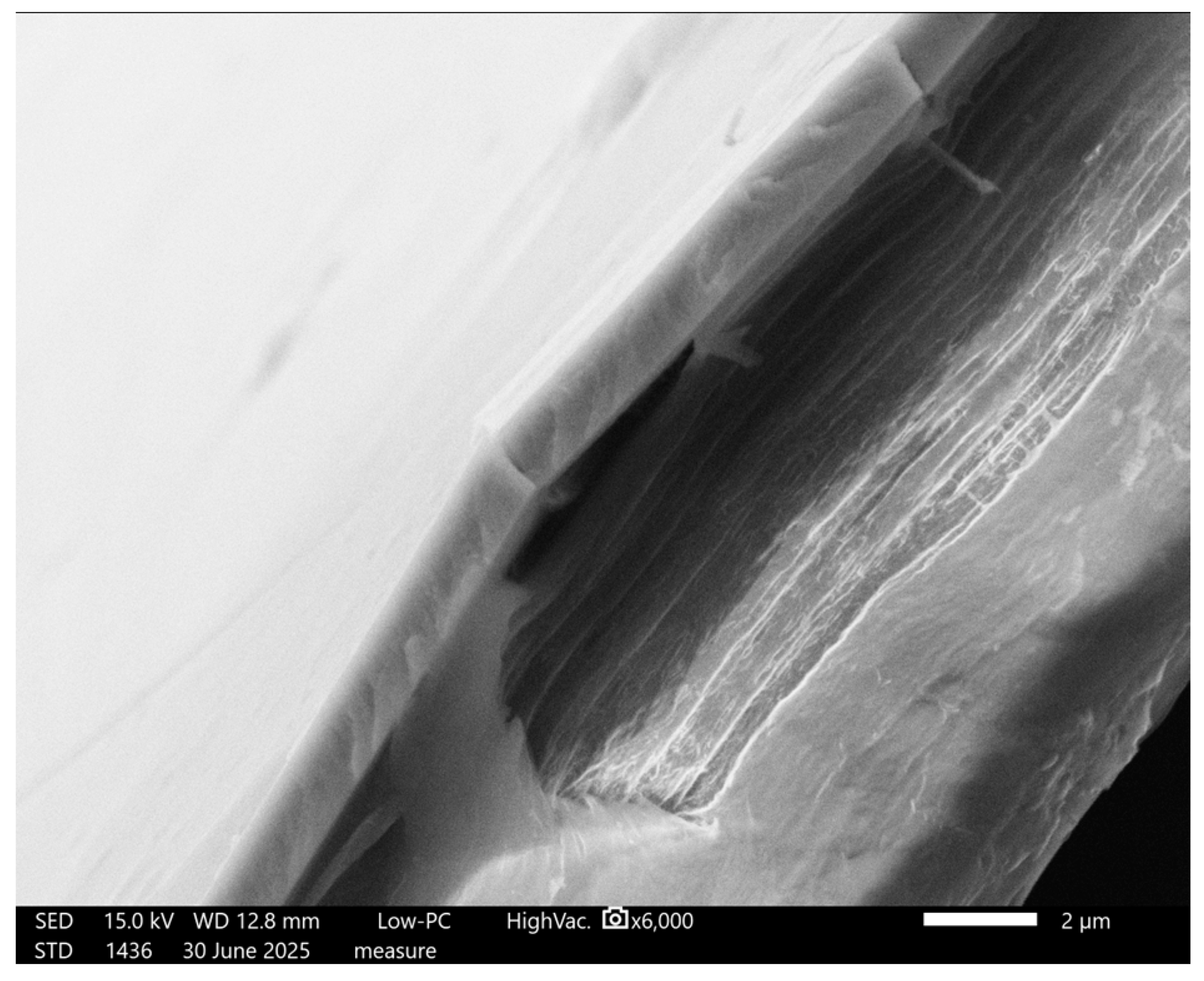
Figure 1. SEM image of a 1.40 µm thick film.
Magnetism 05 00030 g001
Figure 2. The measured in-plane hysteresis loops for the film of 0.63 µm in thickness for the field applied parallel to a symmetry axis of the barrel (Curve 1) and perpendicular to this axis (Curve 2). Inset shows hysteresis loops at low fields.
Magnetism 05 00030 g002
Figure 3. The measured frequency dependences of the real (a) and imaginary (b) parts of the microwave permeability at different values of the film thickness. Lines show the fitting of the measured data by the Lorentzian dispersion law, Equation (1). Inset presents the Acher parameter kA as a function of the film thickness.
Magnetism 05 00030 g003
Figure 4. The measured frequency dependences of the real (a) and imaginary (b) parts of the microwave permeability for the film of 0.33 µm in thickness at different values of the bias magnetic field. Lines show the fitting of the measured data by the Lorentzian dispersion law, Equation (1). Inset presents the Acher parameter kA as a function of the bias field.
Magnetism 05 00030 g004
Figure 5. Comparison of the measured (symbols) and calculated (lines) frequency dependences of the real (a) and imaginary (b) parts of the microwave permeability at different values of the film thickness. Parameters used for calculation are μs = 220, fres = 2 GHz, βin = 0.77 and ρ = 140 μOhm·cm.
Magnetism 05 00030 g005
Table 1. The values of the damping factors β and β1 as a function of the film thickness d. The factor β was estimated by fitting experimental data according to the Lorentzian frequency dispersion law, Equation (1). The factor β1 was calculated using Equation (7).
Film Thickness d, μmDamping Factor βDamping Factor β1
0.330.800.79
0.630.890.85
1.401.271.17
Disclaimer/Publisher’s Note: The statements, opinions and data contained in all publications are solely those of the individual author(s) and contributor(s) and not of MDPI and/or the editor(s). MDPI and/or the editor(s) disclaim responsibility for any injury to people or property resulting from any ideas, methods, instructions or products referred to in the content.