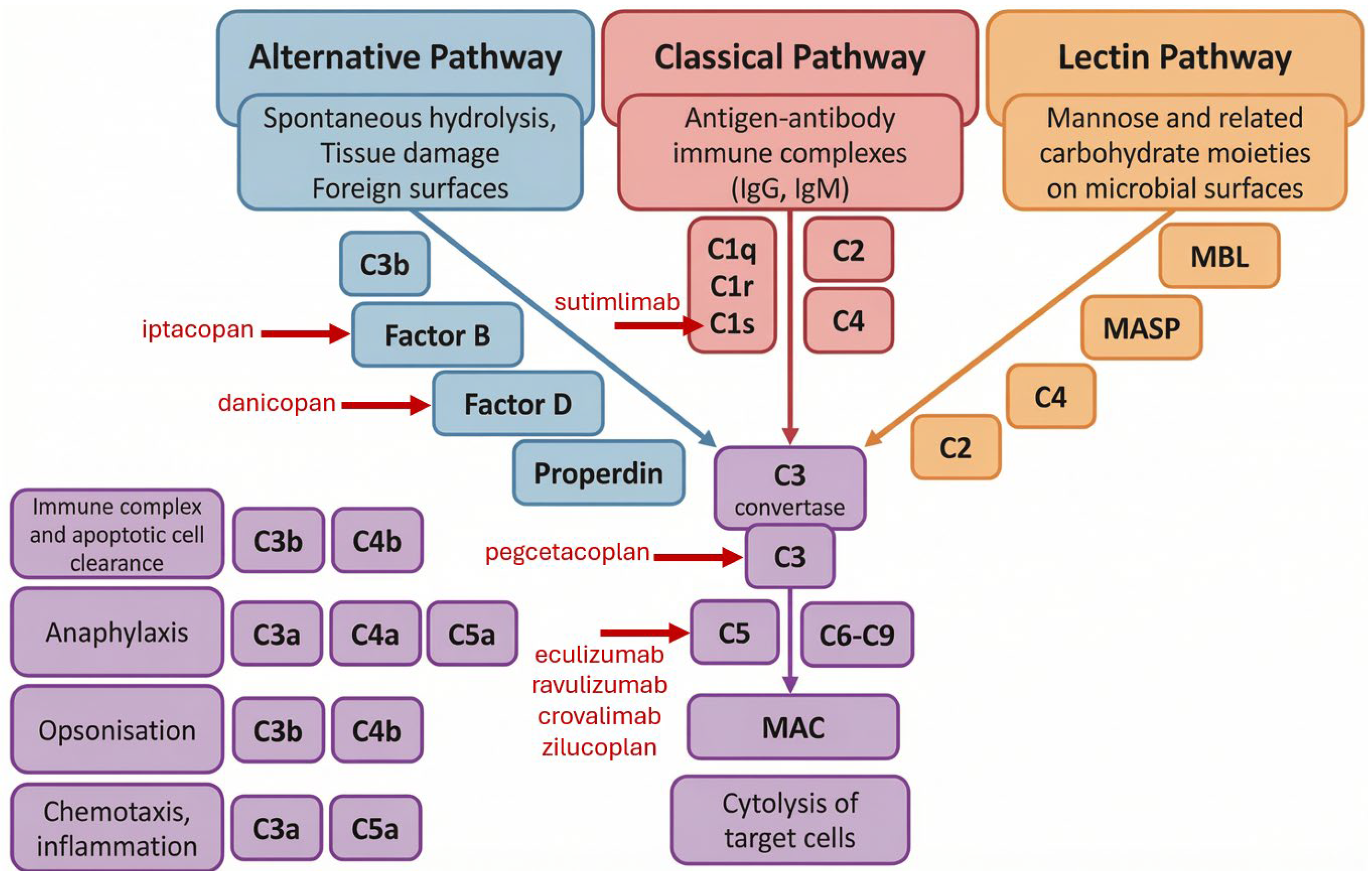

Complement Inhibitors and the Risk of (Breakthrough) Infections—Critical Analysis and Preventive Strategies

 , , , and
Abstract
1. The Complement System and Its Role in Infection Prevention
2. Complement Inhibition as a Therapeutic Strategy
2.1. Risk of Infections During Complement Inhibitor Therapy
Proximal Versus Distal Complement Inhibition
2.2. Prevention of Infections—Vaccination and Antibiotic Prophylaxis
2.3. Breakthrough Infections After Vaccination
3. Future Directions
4. Conclusions
Author Contributions
Funding
Institutional Review Board Statement
Informed Consent Statement
Data Availability Statement
Conflicts of Interest
Abbreviations
| AChR | Acetylcholine receptor |
| aHUS | Atypical haemolytic uraemic syndrome |
| AQP4 | Aquaporin 4 |
| C1q | Complement component 1q |
| C1s | Complement component C1s |
| C3 | Complement component 3 |
| C3a | Complement component 3a |
| C3b/iC3b | Complement component 3b/inactivated C3b |
| C3d | Complement component 3d |
| C3G | C3 glomerulopathy |
| C4 | Complement component 4 |
| C4b | Complement component 4b |
| C5 | Complement component 5 |
| C5a | Complement component 5a |
| C5aR1 | C5a receptor 1 |
| CAD | Cold agglutinin disease |
| CD14 | Cluster of differentiation 14 |
| CH | Switzerland |
| CI | Complement inhibitor |
| CMV | Cytomegalovirus |
| CR1 | Complement receptor 1 |
| CR2 | Complement receptor 2 |
| CR3 | Complement receptor 3 |
| CR4 | Complement receptor 4 |
| EEA | European Economic Area |
| EMA | The European Medicines Agency |
| EU | European Union |
| FDA | Food and Drug Administration |
| gMG | Generalised myasthenia gravis |
| HBV | Hepatitis B virus |
| HSV | Herpes simplex virus |
| IC | Immune complex |
| IC-MPGN | Immune-complex–mediated membranoproliferative glomerulonephritis |
| IgA | Immunoglobulin A |
| IVIG | Intravenous immunoglobulin |
| JP | Japan |
| MAC/C5b-9 | Membrane attack complex/terminal complement complex |
| MBL | Mannose-binding lectin |
| MenACWY | Quadrivalent meningococcal conjugate vaccine (serogroups A, C, W, Y) |
| MenB | Meningococcal serogroup B vaccine |
| NETosis | Neutrophil extracellular trap formation |
| NK | Natural killer |
| NMOSD | Neuromyelitis optica spectrum disorder |
| PAMPs | Pathogen-associated molecular patterns |
| PCV20 | 20-valent pneumococcal conjugate vaccine |
| PCV21 | 21-valent pneumococcal conjugate vaccine |
| PNH | Paroxysmal nocturnal haemoglobinuria |
| RNA | Ribonucleic acid |
| SARS-CoV-2 | Severe acute respiratory syndrome coronavirus 2 |
| SBA | Serum bactericidal activity |
| TLR | Toll-like receptor |
| TME | Tumour microenvironment |
| US | United States |
References
- Walport, M.J. Complement. First of two parts. N. Engl. J. Med. 2001, 344, 1058–1066. [Google Scholar] [CrossRef] [Scilit]
- Walport, M.J. Complement. Second of two parts. N. Engl. J. Med. 2001, 344, 1140–1144. [Google Scholar] [CrossRef] [Scilit]
- Killick, J.; Morisse, G.; Sieger, D.; Astier, A.L. Complement as a regulator of adaptive immunity. Semin. Immunopathol. 2018, 40, 37–48. [Google Scholar] [CrossRef] [Scilit] [PubMed]
- Azoulay, E.; Zuber, J.; Bousfiha, A.A.; Long, Y.; Tan, Y.; Luo, S.; Essafti, M.; Annane, D. Complement system activation: Bridging physiology, pathophysiology, and therapy. Intensive Care Med. 2024, 50, 1791–1803. [Google Scholar] [CrossRef] [Scilit]
- Wen, L.; Atkinson, J.P.; Giclas, P.C. Clinical and laboratory evaluation of complement deficiency. J. Allergy Clin. Immunol. 2004, 113, 585–593. [Google Scholar] [CrossRef] [Scilit]
- Mannes, M.; Savukoski, S.; Ignatius, A.; Halbgebauer, R.; Huber-Lang, M. Crepuscular rays—The bright side of complement after tissue injury. Eur. J. Immunol. 2024, 54, e2350848. [Google Scholar] [CrossRef] [Scilit] [PubMed]
- Brodszki, N.; Frazer-Abel, A.; Grumach, A.S.; Kirschfink, M.; Litzman, J.; Perez, E.; Seppänen, M.R.J.; Sullivan, K.E.; Jolles, S. European Society for Immunodeficiencies (ESID) and European Reference Network on Rare Primary Immunodeficiency, Autoinflammatory and Autoimmune Diseases (ERN RITA) Complement Guideline: Deficiencies, Diagnosis, and Management. J. Clin. Immunol. 2020, 40, 576–591. [Google Scholar] [CrossRef] [Scilit] [PubMed]
- Benamu, E.; Montoya, J.G. Infections associated with the use of eculizumab: Recommendations for prevention and prophylaxis. Curr. Opin. Infect. Dis. 2016, 29, 319–329. [Google Scholar] [CrossRef] [Scilit]
- Zhong, J.; Chen, C.; Xu, Y.; He, Y.; Tan, J.; Xiong, D. Viral infections and related fatal adverse events associated with complement inhibitors for PNH: A real-world pharmacovigilance analysis in FAERS. Front. Pharmacol. 2025, 16, 1639685. [Google Scholar] [CrossRef] [Scilit]
- Mellors, J.; Tipton, T.; Longet, S.; Carroll, M. Viral Evasion of the Complement System and Its Importance for Vaccines and Therapeutics. Front. Immunol. 2020, 11, 1450. [Google Scholar] [CrossRef] [Scilit]
- Ricklin, D.; Hajishengallis, G.; Yang, K.; Lambris, J.D. Complement: A key system for immune surveillance and homeostasis. Nat. Immunol. 2010, 11, 785–797. [Google Scholar] [CrossRef] [Scilit]
- Dhanoa, R.K.; Selvaraj, R.; Shoukrie, S.I.; Zahra, A.; Malla, J.; Selvamani, T.Y.; Venugopal, S.; Hamouda, R.K.; Hamid, P. Eculizumab’s Unintentional Mayhem: A Systematic Review. Cureus 2022, 14, e25640. [Google Scholar] [CrossRef] [Scilit]
- Apicella, M.A. Epidemiology of Neisseria meningitidis infection. In UpToDate; Wolters Kluwer: Waltham, MA, USA, 2025; Available online: http://112.2.34.14:9095/contents/epidemiology-of-neisseria-meningitidis-infection?topicRef=1274&source=see_link (accessed on 18 September 2025).
- Grumach, A.S.; Kirschfink, M. Are complement deficiencies really rare? Overview on prevalence, clinical importance and modern diagnostic approach. Mol. Immunol. 2014, 61, 110–117. [Google Scholar] [CrossRef] [Scilit]
- Apicella, M.A. Treatment and prevention of meningococcal infection. In UpToDate; Wolters Kluwer: Waltham, MA, USA, 2025; Available online: http://112.2.34.14:9095/contents/treatment-and-prevention-of-meningococcal-infection/print (accessed on 18 September 2025).
- Lewis, L.A.; Ram, S. Complement interactions with the pathogenic Neisseriae: Clinical features, deficiency states, and evasion mechanisms. FEBS Lett. 2020, 594, 2670–2694. [Google Scholar] [CrossRef] [Scilit] [PubMed]
- Molnár, L.; Bánovčin, P.; Prohászka, Z.; Petrovičová, O.; Markocsy, A.; Jeseňák, M. Recurrent meningococcal infections as a sign of inborn error immunity. Epidemiol. Mikrobiol. Imunol. 2024, 73, 165–172. [Google Scholar] [CrossRef] [Scilit]
- Alashkar, F.; Vance, C.; Herich-Terhürne, D.; Preising, N.; Dührsen, U.; Röth, A. Serologic response to meningococcal vaccination in patients with paroxysmal nocturnal hemoglobinuria (PNH) chronically treated with the terminal complement inhibitor eculizumab. Ann. Hematol. 2017, 96, 589–596. [Google Scholar] [CrossRef] [Scilit] [PubMed]
- McNamara, L.A.; Topaz, N.; Wang, X.; Hariri, S.; Fox, L.; MacNeil, J.R. High Risk for Invasive Meningococcal Disease Among Patients Receiving Eculizumab (Soliris) Despite Receipt of Meningococcal Vaccine. MMWR Morb. Mortal. Wkly. Rep. 2017, 66, 734–737. [Google Scholar] [CrossRef] [Scilit] [PubMed]
- Applegate, A.O.; Fong, V.C.; Tardivel, L.; Lippold, S.A.; Zarate, S. Notes from the Field: Meningococcal Disease in an International Traveler on Eculizumab Therapy—United States, 2015. MMWR Morb. Mortal. Wkly. Rep. 2016, 65, 696–697. [Google Scholar] [CrossRef] [Scilit]
- Crew, P.E.; McNamara, L.; Waldron, P.E.; McCulley, L.; Jones, S.C.; Bersoff-Matcha, S.J. Antibiotic prophylaxis in vaccinated eculizumab recipients who developed meningococcal disease. J. Infect. 2020, 80, 350–371. [Google Scholar] [CrossRef] [Scilit]
- Antonucci, L.; Thurman, J.M.; Vivarelli, M. Complement inhibitors in pediatric kidney diseases: New therapeutic opportunities. Pediatr. Nephrol. 2024, 39, 1387–1404. [Google Scholar] [CrossRef] [Scilit]
- Socié, G.; Caby-Tosi, M.P.; Marantz, J.L.; Cole, A.; Bedrosian, C.L.; Gasteyger, C.; Mujeebuddin, A.; Hillmen, P.; Vande Walle, J.; Haller, H. Eculizumab in paroxysmal nocturnal haemoglobinuria and atypical haemolytic uraemic syndrome: 10-year pharmacovigilance analysis. Br. J. Haematol. 2019, 185, 297–310. [Google Scholar] [CrossRef] [Scilit]
- West, E.E.; Woodruff, T.; Fremeaux-Bacchi, V.; Kemper, C. Complement in human disease: Approved and up-and-coming therapeutics. Lancet 2024, 403, 392–405. [Google Scholar] [CrossRef] [Scilit] [PubMed]
- Wiendl, H.; Abicht, A.; Chan, A.; Della Marina, A.; Hagenacker, T.; Hekmat, K.; Hoffmann, S.; Hoffmann, H.S.; Jander, S.; Keller, C.; et al. Guideline for the management of myasthenic syndromes. Ther. Adv. Neurol. Disord. 2023, 16, 17562864231213240. [Google Scholar] [CrossRef] [Scilit]
- Girmenia, C.; Barcellini, W.; Bianchi, P.; Di Bona, E.; Iori, A.P.; Notaro, R.; Sica, S.; Zanella, A.; De Vivo, A.; Barosi, G.; et al. Management of infection in PNH patients treated with eculizumab or other complement inhibitors: Unmet clinical needs. Blood Rev. 2023, 58, 101013. [Google Scholar] [CrossRef] [Scilit]
- Narayanaswami, P.; Sanders, D.B.; Wolfe, G.; Benatar, M.; Cea, G.; Evoli, A.; Gilhus, N.E.; Illa, I.; Kuntz, N.L.; Massey, J.; et al. International Consensus Guidance for Management of Myasthenia Gravis. Neurology 2021, 96, 114–122. [Google Scholar] [CrossRef] [Scilit] [PubMed]
- Mannes, M.; Dopler, A.; Zolk, O.; Lang, S.J.; Halbgebauer, R.; Höchsmann, B.; Skerra, A.; Braun, C.K.; Huber-Lang, M.; Schrezenmeier, H.; et al. Complement inhibition at the level of C3 or C5: Mechanistic reasons for ongoing terminal pathway activity. Blood 2021, 137, 443–455. [Google Scholar] [CrossRef] [Scilit] [PubMed]
- Lewis, L.A.; Ram, S. Meningococcal disease and the complement system. Virulence 2014, 5, 98–126. [Google Scholar] [CrossRef] [Scilit]
- Watanabe-Kusunoki, K.; Anders, H.J. Balancing efficacy and safety of complement inhibitors. J. Autoimmun. 2024, 145, 103216. [Google Scholar] [CrossRef] [Scilit]
- Padilla Kelley, T.; King, H.; Malhotra, A.; DeLoughery, T.G.; Martens, K.; Shatzel, J.J. Advancements in complement inhibition for PNH and primary complement-mediated thrombotic microangiopathy. Blood Adv. 2025, 9, 3937–3945. [Google Scholar] [CrossRef] [Scilit]
- Al-Shaikhly, T.; Hayward, K.; Basiaga, M.L.; Allenspach, E.J. Bacterial infections in a pediatric cohort of primary and acquired complement deficiencies. Pediatr. Rheumatol. 2020, 18, 74. [Google Scholar] [CrossRef] [Scilit]
- Ricklin, D.; Barratt-Due, A.; Mollnes, T.E. Complement in clinical medicine: Clinical trials, case reports and therapy monitoring. Mol. Immunol. 2017, 89, 10–21. [Google Scholar] [CrossRef] [Scilit]
- Konar, M.; Granoff, D.M. Eculizumab treatment and impaired opsonophagocytic killing of meningococci by whole blood from immunized adults. Blood 2017, 130, 891–899. [Google Scholar] [CrossRef] [Scilit] [PubMed]
- Earhart, A.P.; Alburquerque, R.A.; Starick, M.; Nallapu, A.; Garnica, L.; Ozanturk, A.N.; Maurya, R.K.; Wu, X.; Haspel, J.A.; Kulkarni, H.S. The C3-C3aR axis modulates trained immunity in alveolar macrophages. bioRxiv 2024. [Google Scholar] [CrossRef] [Scilit]
- Shim, E.H.; Kim, S.H.; Kim, D.J.; Jang, Y.S. Complement C5a Receptor Signaling in Macrophages Enhances Trained Immunity Through mTOR Pathway Activation. Immune Netw. 2024, 24, e24. [Google Scholar] [CrossRef] [Scilit]
- Peffault de Latour, R.; Röth, A.; Kulasekararaj, A.G.; Han, B.; Scheinberg, P.; Maciejewski, J.P.; Ueda, Y.; de Castro, C.M.; Di Bona, E.; Fu, R.; et al. Oral Iptacopan Monotherapy in Paroxysmal Nocturnal Hemoglobinuria. N. Engl. J. Med. 2024, 390, 994–1008. [Google Scholar] [CrossRef] [Scilit]
- Röth, A.; Barcellini, W.; D’Sa, S.; Miyakawa, Y.; Broome, C.M.; Michel, M.; Kuter, D.J.; Jilma, B.; Tvedt, T.H.A.; Fruebis, J.; et al. Sutimlimab in Cold Agglutinin Disease. N. Engl. J. Med. 2021, 384, 1323–1334. [Google Scholar] [CrossRef] [Scilit] [PubMed]
- Röth, A.; Barcellini, W.; D’Sa, S.; Miyakawa, Y.; Broome, C.M.; Michel, M.; Kuter, D.J.; Jilma, B.; Tvedt, T.H.A.; Weitz, I.C.; et al. Sustained inhibition of complement C1s with sutimlimab over 2 years in patients with cold agglutinin disease. Am. J. Hematol. 2023, 98, 1246–1253. [Google Scholar] [CrossRef] [Scilit] [PubMed]
- Mbaeyi, S.A.; Bozio, C.H.; Duffy, J.; Rubin, L.G.; Hariri, S.; Stephens, D.S.; MacNeil, J.R. Meningococcal Vaccination: Recommendations of the Advisory Committee on Immunization Practices, United States, 2020. MMWR Recomm. Rep. 2020, 69, 1–41. [Google Scholar] [CrossRef] [Scilit]
- Kobayashi, M.; Leidner, A.J.; Gierke, R.; Farrar, J.L.; Morgan, R.L.; Campos-Outcalt, D.; Schechter, R.; Poehling, K.A.; Long, S.S.; Loehr, J.; et al. Use of 21-Valent Pneumococcal Conjugate Vaccine Among U.S. Adults: Recommendations of the Advisory Committee on Immunization Practices—United States, 2024. MMWR Morb. Mortal. Wkly. Rep. 2024, 73, 793–798. [Google Scholar] [CrossRef] [Scilit]
- Merck. European Commission Approves Merck’s Capvaxive Pneumococcal 21-Valent Conjugate Vaccine for Prevention of Invasive Pneumococcal Disease and Pneumococcal Pneumonia in Adults. 2025. Available online: https://www.merck.com/news/european-commission-ec-approves-mercks-capvaxive-pneumococcal-21-valent-conjugate-vaccine-for-prevention-of-invasive-pneumococcal-disease-and-pneumococcal-pneumonia-in-adults/ (accessed on 18 September 2025).
- Curtis, J.R.; Johnson, S.R.; Anthony, D.D.; Arasaratnam, R.J.; Baden, L.R.; Bass, A.R.; Calabrese, C.; Gravallese, E.M.; Harpaz, R.; Kroger, A.; et al. American College of Rheumatology Guidance for COVID-19 Vaccination in Patients with Rheumatic and Musculoskeletal Diseases: Version 5. Arthritis Rheumatol. 2023, 75, E1–E16. [Google Scholar] [CrossRef] [Scilit]
- Wagenhäuser, I.; Reusch, J.; Gabel, A.; Höhn, A.; Lâm, T.-T.; Almanzar, G.; Prelog, M.; Krone, L.B.; Frey, A.; Schubert-Unkmeir, A.; et al. Immunogenicity and safety of coadministration of COVID-19 and influenza vaccination. Eur. Respir. J. 2023, 61, 2201390. [Google Scholar] [CrossRef] [Scilit]
- Haut Conseil de la Santé Publique (HCSP). Prevention of Invasive Infections in Patients Treated with Complement Inhibitors. Report, HCSP. 2022. Available online: https://www.hcsp.fr/explore.cgi/avisrapportsdomaine?clefr=1204 (accessed on 18 September 2025).
- Centers for Disease Control and Prevention (CDC). Clinical Guidance for Managing Meningococcal Disease Risk in Patients Receiving Complement Inhibitor Therapy. 2024. Available online: https://www.cdc.gov/meningococcal/hcp/clinical-guidance/complement-inhibitor.html (accessed on 18 September 2025).
- Ispasanie, E.; Muri, L.; Schmid, M.; Schubart, A.; Thorburn, C.; Zamurovic, N.; Holbro, T.; Kammüller, M.; Pluschke, G. In vaccinated individuals serum bactericidal activity against B meningococci is abrogated by C5 inhibition but not by inhibition of the alternative complement pathway. Front. Immunol. 2023, 14, 1180833. [Google Scholar] [CrossRef] [Scilit] [PubMed]
- Yee, W.X.; Barnes, G.; Lavender, H.; Tang, C.M. Meningococcal factor H-binding protein: Implications for disease susceptibility, virulence, and vaccines. Trends Microbiol. 2023, 31, 805–815. [Google Scholar] [CrossRef] [Scilit] [PubMed]
- Carrillo Infante, C.; Mujeebuddin, A. Eculizumab and ravulizumab clinical trial and real-world pharmacovigilance of meningococcal infections across indications. PLoS ONE 2025, 20, e0332073. [Google Scholar] [CrossRef] [Scilit]
- Che, M.; Wang, C.; Li, Y.; Li, L.; Wang, H.; Chen, Y.; Liu, Z.; Li, L.; Liu, H.; Fu, R. A single-centre, real-world study on the efficacy and recovery of inflammatory cytokine levels of C5 complement inhibitor therapy in patients with paroxysmal nocturnal haemoglobinuria. Br. J. Haematol. 2025, 207, 2109–2117. [Google Scholar] [CrossRef] [Scilit] [PubMed]
- Nishimura, J.I.; Kawaguchi, T.; Ito, S.; Murai, H.; Shimono, A.; Matsuda, T.; Fukamizu, Y.; Akiyama, H.; Hayashi, H.; Nakano, T.; et al. Real-world safety profile of eculizumab in patients with paroxysmal nocturnal hemoglobinuria, atypical hemolytic uremic syndrome, or generalized myasthenia gravis: An integrated analysis of post-marketing surveillance in Japan. Int. J. Hematol. 2023, 118, 419–431. [Google Scholar] [CrossRef] [Scilit]
- Langereis, J.D.; van den Broek, B.; Franssen, S.; Joosten, I.; Blijlevens, N.M.A.; de Jonge, M.I.; Langemeijer, S. Eculizumab impairs Neisseria meningitidis serogroup B killing in whole blood despite 4CMenB vaccination of PNH patients. Blood Adv. 2020, 4, 3615–3620. [Google Scholar] [CrossRef] [Scilit]
- Muri, L.; Schubart, A.; Thorburn, C.; Zamurovic, N.; Holbro, T.; Kammüller, M.; Pluschke, G.; Ispasanie, E. Inhibition of the different complement pathways has varying impacts on the serum bactericidal activity and opsonophagocytosis against Haemophilus influenzae type b. Front. Immunol. 2022, 13, 1020580. [Google Scholar] [CrossRef] [Scilit]
- Poland, G.A. Prevention of Meningococcal Disease: Current Use of Polysaccharide and Conjugate Vaccines. Clin. Infect. Dis. 2010, 50, S45–S53. [Google Scholar] [CrossRef] [Scilit]
- Tomlinson, S.; Thurman, J.M. Tissue-targeted complement therapeutics. Mol. Immunol. 2018, 102, 120–128. [Google Scholar] [CrossRef] [Scilit]
- Merle, N.S.; Church, S.E.; Fremeaux-Bacchi, V.; Roumenina, L.T. Complement System Part I—Molecular Mechanisms of Activation and Regulation. Front. Immunol. 2015, 6, 262. [Google Scholar] [CrossRef] [Scilit]
- Mastellos, D.C.; Ricklin, D.; Lambris, J.D. Clinical promise of next-generation complement therapeutics. Nat. Rev. Drug Discov. 2019, 18, 707–729. [Google Scholar] [CrossRef] [Scilit]
- Reuters. US FDA Approves Roche’s Drug for a Chronic Blood Disorder. 2024. Available online: https://www.reuters.com/business/healthcare-pharmaceuticals/us-fda-approves-roches-drug-chronic-blood-disorder-2024-06-21/ (accessed on 18 September 2025).
- McCaleb, M.L.; Hughes, S.G.; Grossman, T.R.; Frazer-Abel, A.; Jung, B.; Yin, L.; Henry, S.P.; Monia, B.P.; Schneider, E.; Geary, R.; et al. Inhibiting the alternative pathway of complement by reducing systemic complement factor B: Randomized, double-blind, placebo-controlled phase 1 studies with Sefaxersen. Immunobiology 2025, 230, 152876. [Google Scholar] [CrossRef] [Scilit]
- Huber-Lang, M.; Barratt-Due, A.; Pischke, S.E.; Sandanger, Ø.; Nilsson, P.H.; Nunn, M.A.; Denk, S.; Gaus, W.; Espevik, T.; Mollnes, T.E. Double blockade of CD14 and complement C5 abolishes the cytokine storm and improves morbidity and survival in polymicrobial sepsis in mice. J. Immunol. 2014, 192, 5324–5331. [Google Scholar] [CrossRef] [Scilit]
- Bjerkhaug, A.U.; Granslo, H.N.; Cavanagh, J.P.; Høiland, I.; Ludviksen, J.K.; Lau, C.; Espevik, T.; Mollnes, T.E.; Klingenberg, C. Dual inhibition of complement C5 and CD14 attenuates inflammation in a cord blood model. Pediatr. Res. 2023, 94, 512–519. [Google Scholar] [CrossRef] [Scilit]
- Liu, F.; Wawersik, S.; Tomlinson, S.; Thurman, J.M.; Holers, V.M. Tissue-targeted regulators of complement for amelioration of human disease: Rationale and novel therapeutic strategies. J. Immunol. 2025, 214, 2138–2149. [Google Scholar] [CrossRef] [Scilit] [PubMed]
- Fahnoe, K.C.; Liu, F.; Morgan, J.G.; Ryan, S.T.; Storek, M.; Stark, E.G.; Taylor, F.R.; Holers, V.M.; Thurman, J.M.; Wawersik, S.; et al. Development and optimization of bifunctional fusion proteins to locally modulate complement activation in diseased tissue. Front. Immunol. 2022, 13, 869725. [Google Scholar] [CrossRef] [Scilit] [PubMed]
- Kon, S.P.; Coupes, B.; Short, C.D.; Solomon, L.R.; Raftery, M.J.; Mallick, N.P.; Brenchley, P.E. Urinary C5b-9 excretion and clinical course in idiopathic human membranous nephropathy. Kidney Int. 1995, 48, 1953–1958. [Google Scholar] [CrossRef] [Scilit] [PubMed]
- Brenchley, P.E.; Coupes, B.; Short, C.D.; O’Donoghue, D.J.; Ballardie, F.W.; Mallick, N.P. Urinary C3dg and C5b-9 indicate active immune disease in human membranous nephropathy. Kidney Int. 1992, 41, 933–937. [Google Scholar] [CrossRef] [Scilit]
- Yu, B.C.; Park, J.H.; Lee, K.H.; Oh, Y.S.; Choi, S.J.; Kim, J.K.; Park, M.Y. Urinary C5b-9 as a prognostic marker in IgA nephropathy. J. Clin. Med. 2022, 11, 820. [Google Scholar] [CrossRef] [Scilit]
- Kesarwani, V.; Bukhari, M.H.; Kahlenberg, J.M.; Wang, S. Urinary complement biomarkers in immune-mediated kidney diseases. Front. Immunol. 2024, 15, 1357869. [Google Scholar] [CrossRef] [Scilit]
- van der Pol, P.; de Vries, D.K.; van Gijlswijk, D.J.; van Anken, G.E.; Schlagwein, N.; Daha, M.R.; Aydin, Z.; de Fijter, J.W.; Schaapherder, A.F.; van Kooten, C. Pitfalls in urinary complement measurements. Transpl. Immunol. 2012, 27, 55–58. [Google Scholar] [CrossRef] [Scilit]
- Thurman, J.M.; Fremeaux-Bacchi, V. Alternative pathway diagnostics. Immunol. Rev. 2023, 313, 225–238. [Google Scholar] [CrossRef] [Scilit] [PubMed]
- Willrich, M.A.V.; Braun, K.M.P.; Moyer, A.M.; Jeffrey, D.H.; Frazer-Abel, A. Complement testing in the clinical laboratory. Crit. Rev. Clin. Lab. Sci. 2021, 58, 447–478. [Google Scholar] [CrossRef] [Scilit] [PubMed]
- Wehling, C.; Amon, O.; Bommer, M.; Hoppe, B.; Kentouche, K.; Schalk, G.; Weimer, R.; Wiesener, M.; Hohenstein, B.; Tönshoff, B.; et al. Monitoring of complement activation biomarkers and eculizumab in complement-mediated renal disorders. Clin. Exp. Immunol. 2017, 187, 304–315. [Google Scholar] [CrossRef] [Scilit] [PubMed]


| Complement Function | Molecular/Mechanistic Basis | Immunological Consequence | References |
|---|---|---|---|
| Pathogen lysis | Formation of MAC/C5b-9 | Lysis of bacteria and target cells | [1,2] |
| Opsonisation | Deposition of C3b/iC3b and C4b on pathogens | Enhancement of phagocytosis via CR1/CR3 | [1,3,5] |
| Anaphylatoxin generation | Release of C3a and C5a | Chemotaxis, activation of neutrophils and monocytes, oxidative burst | [1,3,4] |
| Clearance of ICs and apoptotic cells | C1q binding; CR1/CR3-mediated uptake | Removal of ICs and apoptotic cells; prevention of autoimmunity | [4,5,7] |
| Modulation of adaptive immunity | C3d–CR2 signalling; intracellular complement (complosome) | Activation of B-cells, antibody affinity maturation, and T-cell regulation | [3,4,6] |
| Crosstalk with innate immunity | Complement–TLR interactions; C5a–C5aR1 axis | Amplification of cytokine responses; activation of NK cells and neutrophils | [3,4,6,8] |
| Antiviral activity | Opsonisation of viral particles (C3b, C4b); enhancement of phagocytic uptake; modulation of inflammatory responses (C3a, C5a) | Promotion of early viral clearance | [3,6,9,10,11] |
| Antifungal defence | Recognition of fungal PAMPs via MBL/ficolins; opsonophagocytosis | Recruitment of phagocytes and fungal killing | [8,12] |
| Intracellular complement (complosome) | Noncanonical roles of C3 and C5 inside cells | Regulation of cell metabolism, survival, gene expression, and modulation of immune responses | [3] |
| Tissue homeostasis and repair | Clearance of apoptotic cells, angiogenesis, and regulation of regeneration | Maintenance of tolerance, tissue integrity, and immune homeostasis | [6,11] |
| Tumour immunity modulation | C5a–C5aR1 signalling; complement interactions within TME | Modulation of T-cell and myeloid responses within tumours | [3] |
| Molecule | Brand Name | Approved Region(s) | Characteristics | Indications | Age |
|---|---|---|---|---|---|
| Eculizumab | Soliris® | US, EU/EEA, other* | Humanised monoclonal anti-C5 antibody | PNH, aHUS | US: adults and children ≥ 1 month and ≥5 kg; EU/EEA: adults and children ≥ 5 kg |
| gMG (anti-AChR positive) | ≥6 years | ||||
| NMOSD (anti-AQP4 positive) | ≥18 years | ||||
| Eculizumab-aeeb | Bkemv® | US | Biosimilar to Eculizumab | PNH, aHUS | same as for Soliris® |
| gMG (anti-AChR positive) | ≥18 years | ||||
| Eculizumab-aagh | Epysqli® | US | Biosimilar to Eculizumab | PNH, aHUS | same as for Soliris® |
| gMG (anti-AChR positive) | ≥18 years | ||||
| ABP959/Elizaria® | Elizaria® (ABP959) | Russia and selected Eastern European countries | Biosimilar to Eculizumab | PNH, aHUS | ≥18 years |
| Ravulizumab | Ultomiris® | US, EU/EEA, other* | Humanised monoclonal anti-C5 antibody | PNH, aHUS | US: adults and children ≥ 1 month and ≥5 kg; EU/EEA: adults and children ≥ 10 kg |
| gMG (anti-AChR positive) | ≥18 years | ||||
| NMOSD (anti-AQP4 positive) | ≥18 years | ||||
| Pegcetacoplan | Aspaveli® | EU/EEA, CH, other* | PEGylated peptide targeting C3 | PNH | ≥18 years |
| Empaveli® | US | PNH | ≥18 years | ||
| C3G, primary IC-MPGN (to reduce proteinuria) | Adults and children ≥ 12 years | ||||
| Zilucoplan | Zilbrysq® | US, EU/EEA | Cyclic peptide targeting C5 | gMG (anti-AChR positive) | ≥18 years |
| Danicopan | Voydeya® | JP, US, EU/EEA, other* | Factor D inhibitor | PNH (add-on to C5 inhibition; extravascular haemolysis) | ≥18 years |
| Iptacopan | Fabhalta® | US; EU/EEA | Factor B inhibitor | US: PNH; IgA nephropathy (accelerated approval based on reduction of proteinuria), C3G (to reduce proteinuria) EU/EEA: PNH, C3G (to reduce proteinuria) | ≥18 years |
| Crovalimab | Piasky® | US, EU/EEA, CH, other* | Humanised monoclonal anti-C5 antibody | PNH | US: adults and children ≥ 13 years and ≥40 kg; EU/EEA/CH: adults and children ≥ 12 years and ≥40 kg |
| Sutimlimab | Enjaymo® | US, EU/EEA, JP, other* | Humanised monoclonal anti-C1s antibody | CAD | ≥18 years |
| Immunological Mechanism (Molecular Target) | Associated Inhibitor Class | Primary Consequence | Immediate Functional Effect | Clinical Implications | References |
|---|---|---|---|---|---|
| Reduced opsonophagocytosis (C3b/iC3b) and reduced C5a-mediated neutrophil/macrophage activation (via C5aR1, chemotaxis, oxidative burst, NETosis) | C3 inhibitors; C5 inhibitors; factor B inhibitors and factor D inhibitors (attenuated effects) | Impaired pathogen tagging and uptake by neutrophils/macrophages; impaired NETosis | Delayed pathogen clearance; reduced extracellular trapping | Increased susceptibility to encapsulated bacteria (N. meningitidis, S. pneumoniae, H. influenzae type B) | [11,29,33,34] |
| Blunted chemotaxis and cytokine signalling | C3 inhibitors; C5 inhibitors | Delayed early inflammatory responses | Slower recruitment of immune cells | Broader susceptibility to bacterial and viral infections | [8,9,34] |
| Compromised adaptive immunity (C3d–CR2) | C3 inhibitors | Reduced T-/B-cell activation; altered germinal centre responses | Reduced antibody affinity and memory B-cell formation | Lower vaccine efficacy and broad-spectrum susceptibility | [3,18,30] |
| MAC (C5b-9) formation abolished | C5 inhibitors | Loss of SBA | Inability to lyse bacteria directly | Predominant risk of invasive meningococcal infections | [16,29] |
| Impaired IC clearance (CR1/CR3) | C3 inhibitors (primary); factor B inhibitors (partial); factor D inhibitors (minimal) | Delayed IC removal | Persistence of circulating ICs | Secondary bacterial/viral risk, potential inflammation | [5,33] |
| Impaired antiviral defence | C3 inhibitors (primary); C5 inhibitors (partial) | Reduced complement-mediated opsonisation of viral particles; attenuated early inflammatory signalling | Slower early viral clearance | Reported viral infections and reactivation (influenza, HSV, HBV, CMV, SARS-CoV-2) | [9,10,24,33] |
| Impaired fungal clearance | C3 inhibitors (primary); C5 inhibitors (partial) | Reduced opsonophagocytosis and neutrophil recruitment; impaired recognition of fungal PAMPs (mannans, β-glucans) | Delayed fungal elimination | Rare reported cases of invasive Candida and Aspergillus infections | [8,12] |
| Selective blockade of the classical pathway (C1s) | C1s inhibitors | Loss of classical-pathway activation with intact lectin and alternative pathway function | Preserved opsonisation and MAC formation via non-classical pathways | Mild increase in susceptibility to encapsulated bacteria, lower than with C3/C5 inhibition | [24,38,39] |
| Drug | Adult Dose | Paediatric Dose | Notes |
|---|---|---|---|
| V-Penicillin | 500 mg twice daily | ≥3 years: 250 mg twice daily <3 years: 125 mg twice daily | Recommended as first-line prophylaxis |
| Azithromycin | 250–500 mg once daily | 5 mg/kg once daily (max. 500 mg) | For patients allergic to penicillin; higher dose (500 mg) may be used during the first 1–2 weeks in high-risk settings |
| Amoxicillin | 500 mg twice daily | 20 mg/kg/day | - |
| Ciprofloxacin | 500 mg twice daily | Not recommended | - |
Disclaimer/Publisher’s Note: The statements, opinions and data contained in all publications are solely those of the individual author(s) and contributor(s) and not of MDPI and/or the editor(s). MDPI and/or the editor(s) disclaim responsibility for any injury to people or property resulting from any ideas, methods, instructions or products referred to in the content. |
© 2026 by the authors. Licensee MDPI, Basel, Switzerland. This article is an open access article distributed under the terms and conditions of the Creative Commons Attribution (CC BY) license.
Share and Cite
Halacova, N.; Brndiarova, M.; Slenker, B.; Ruzinak Bobcakova, A.; Schniederova, M.; Markocsy, A.; Urbancikova, I.; Jesenak, M. Complement Inhibitors and the Risk of (Breakthrough) Infections—Critical Analysis and Preventive Strategies. Biologics 2026, 6, 3. https://doi.org/10.3390/biologics6010003
Halacova N, Brndiarova M, Slenker B, Ruzinak Bobcakova A, Schniederova M, Markocsy A, Urbancikova I, Jesenak M. Complement Inhibitors and the Risk of (Breakthrough) Infections—Critical Analysis and Preventive Strategies. Biologics. 2026; 6(1):3. https://doi.org/10.3390/biologics6010003
Chicago/Turabian StyleHalacova, Nikola, Miroslava Brndiarova, Branislav Slenker, Anna Ruzinak Bobcakova, Martina Schniederova, Adam Markocsy, Ingrid Urbancikova, and Milos Jesenak. 2026. "Complement Inhibitors and the Risk of (Breakthrough) Infections—Critical Analysis and Preventive Strategies" Biologics 6, no. 1: 3. https://doi.org/10.3390/biologics6010003
APA StyleHalacova, N., Brndiarova, M., Slenker, B., Ruzinak Bobcakova, A., Schniederova, M., Markocsy, A., Urbancikova, I., & Jesenak, M. (2026). Complement Inhibitors and the Risk of (Breakthrough) Infections—Critical Analysis and Preventive Strategies. Biologics, 6(1), 3. https://doi.org/10.3390/biologics6010003