
The Role of Pulmonary Rehabilitation Programs in Patients with Lung Cancer: A Narrative Review


 ,
,  ,
,
Abstract
1. Introduction
2. Materials and Methods
2.1. Study Design
2.2. Exclusion Criteria
2.3. Search Strategy
2.4. Study Selection
2.5. Data Extraction and Synthesis
2.6. Intervention Classification
3. Results
3.1. Preoperative Phase
3.2. Perioperative Phase
3.3. Postoperative Phase
3.3.1. Functional Recovery and Exercise Capacity
3.3.2. Pulmonary Function and Respiratory Mechanics
3.3.3. Symptoms of Dyspnoea and Cough
3.3.4. Health-Related Quality of Life and Psychological Outcomes
3.3.5. Postoperative Complications and Length of Stay

| Study (Year) | Design | Duration | Population | Intervention | Comparator | Main Outcomes | Key Results |
|---|---|---|---|---|---|---|---|
| [43] | Retrospective outpatient | 6 weeks | Post resection (n = 57 referred 52 completed) | PR (3–4 h, 3 days/week): endurance + strength + IMT + education | None | 6MWT, Wmax, PiMax, strength, CAT | ↑ 6MWT ↓ CAT no Aes 91% completion |
| [44] | Retrospective cohort | 3 weeks | Post-lobectomy NSCLC ± COPD | 3-week inpatient PR (6 days/week: breathing + cycling+ airway clearance + relaxation + education + psych + nutrition) | Basic postoperative physiotherapy and control standard care | 6MWT, SGRQ, spirometry, | ↑ 6MWT ↓ SGRQ spirometry ns |
| [45] | Prospective non-randomised cohort | 8 weeks | Post-resection NSCLC (n = 66) | Outpatient PR (2×/week) + home exercises | Breathing exercises only | 6MWD, dyspnoea, SGRQ/SF-36,HADS spirometry | PR: ↑ FVC ↑ 6MWD ↓ dyspnoea ↑ QoL control: small symptom gains only |
| [46] | RCT | 3 months | Post-VATS lobectomy (n = 88) | PR + albuterol nebuliser for 3 months | Albuterol only | PFTs, 6MWT, dyspnoea, chest-tube time, LOS | ↑ PF, ↓ dyspnoea ↓ LOS and tube time ↑ 6MWT |
| [47] | Prospective randomised controlled study | 14 days | NSCLC post-VATS lobectomy (n = 86) | Conventional PR + manual techniques (14 days) | Conventional PR only | PEF/FEV1/FEV1/FVC, 6MWT, PPCs, tube time, LOS | ↑ FEV1 and PEF ↓ tube time and LOS 6MWT/PPCs similar |
| [48] | Prospective cohort | 12 weeks | NSCLC post-treatment PR (mostly post-surgical) (n = 56) | Supervised PR (aerobic + resistance + RMT + education) | None | CPET (VO2peak etc.), RM strength, HRQoL, Borg | ↑ MIP PFTs ns HRQoL improved |
| [49] | Retrospective comparative cohort | Not mentioned | NSCLC post-VATS lobectomy (PR 81 vs. 195) | Post-op hospital + home PR (breathing + airway clearance + stretching + aerobic) | “Traditional rehab” | Cough + LCQ6-mo PFTs complications/LOS | ↓ Cough (day 3 and 6 months) ↑ LCQ6-mo ↑ PFTs complications/ LOS: ns |
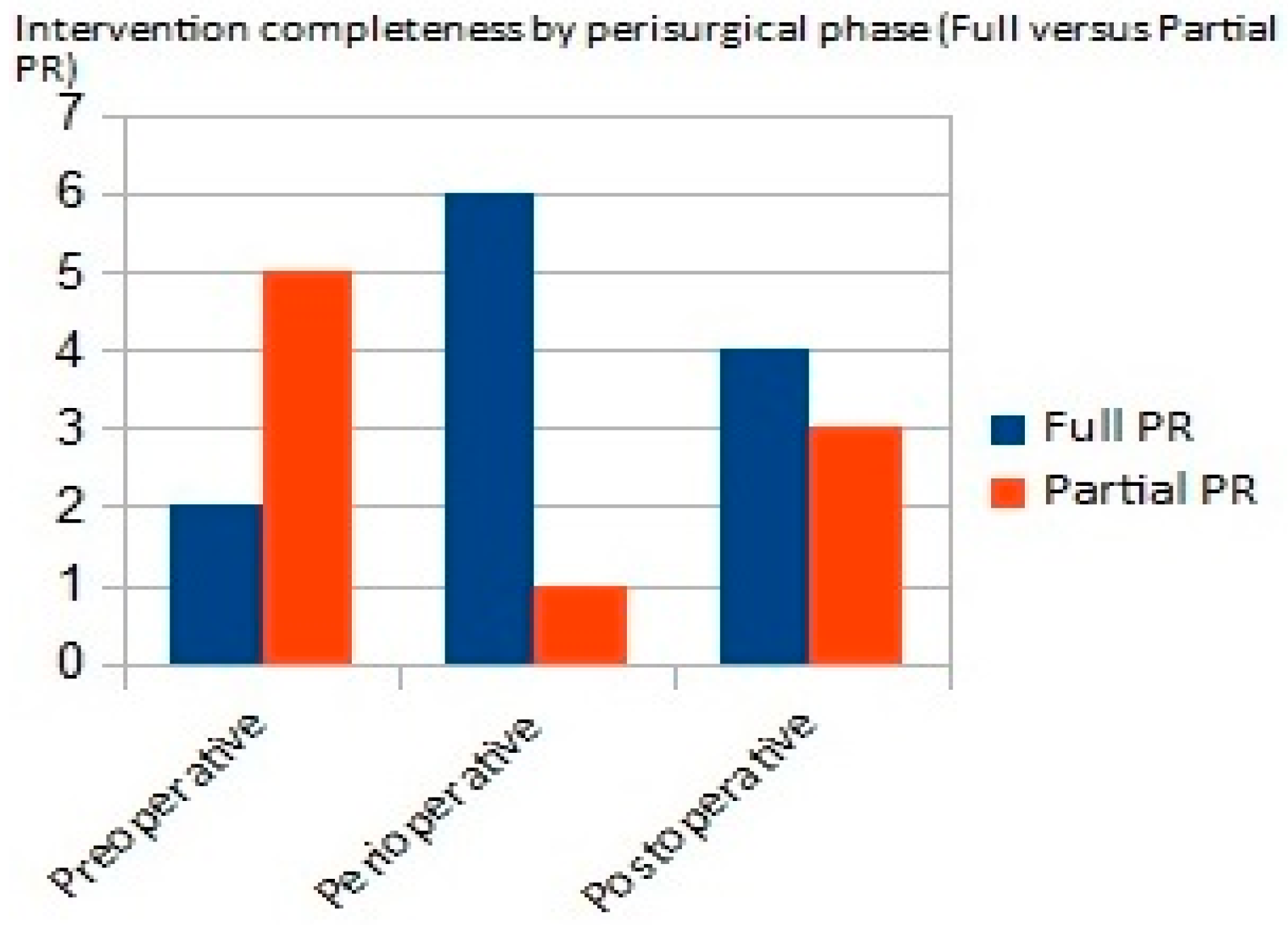
3.4. Full Versus Partial Pulmonary Rehabilitation
| Study | Category | Exercise Capacity | Pulmonary Function | Symptoms (Dyspnoea/Cough/Fatigue) | HRQoL | PPCs | LOS/Recovery |
|---|---|---|---|---|---|---|---|
| [28] | Pre-op | — | ↑ DLCO ↓ VE/VCO2 | ↑ mood/↓ stress | ↑ | ↓ | ↓ |
| [33] | Pre-op | ↑ ISWT ↑ 5STS (better physical performance) | — | ↓ pre-op dyspnoea | ↑ global QoL fewer patients with QoL deterioration | — | ns |
| [34] | Pre-op | ↑ capacity | — | — | ↑ | — | ↓ LOS |
| [31] | Pre-op | ↑ performance | — | — | ↑ | ns | — |
| [30] | Pre-op | ↑ functional capacity | — | — | ↑ | ↓ | ↓ |
| [35] | Pre-op | ns recovery to baseline | — | ↑ | ↑ | — | → |
| [44] | post-op | ↑ 6MWD | ns | — | ↑ | — | — |
| [48] | Pre-op | ↑ exercise tolerance | ↑ ventilatory indices | ↑ | ↑ | — | → |
| [38] | Peri-op | ↑ 6MWD | ↑ FEV1/FVC | ↑ | ↑ nutrition | ↓ | ↓ |
| [40] | Peri-op | ↑ 6MWD | ↑ FEV1/FVC | — | — | ↓ | ↓ |
| [41] | Peri-op | — | — | ↑ cough strength | — | ns | ns |
| [36] | Peri-op | — | — | — | — | ↓ | ns |
| [39] | Peri-op | — | — | ↓ (QoL domain) | ↑ | ↓ | ↓ |
| [32] | Peri-op | — | ns | — | — | ↓ | ↓ |
| [46] | Peri-op | ↑ 6MWD | ↑ | ↓ dyspnoea index | — | — | — |
| [37] | Peri-op | — | ns | — | ↑ | ↓ | ns |
| [42] | Post-op | ↑ walking capacity | ns | ns | ns | ns | ns |
| [43] | Post-op | ↑ 6MWD | ↑ PiMax spirometry ns | ↓ CAT (improved respiratory symptoms incl. dyspnoea item) | — | — | — |
| [45] | Post-op | ↑ 6MWD | — | ↓ dyspnoea (mMRC) | ↑ | — | — |
| [47] | Post-op | ns | ↑ PEF, FEV1, FEV1/FVC | ↓ dyspnoea (Borg) | — | ns | ↓ |
| [49] | Post-op | — | ↑ lung function | ↓ cough | — | ns | ns |
| Study (Year) | Exercise Training (A) | Respiratory Component (B) | Education/Behaviour (C) | Nutrition/Psych (D) | Category (Final) |
|---|---|---|---|---|---|
| [28] | ✖ | ✔ | ✔ | ✔ | Partial PR |
| [33] | ✔ | ✖ | ✔ | ✖ | Partial PR |
| [34] | ✔ | ✔ | ✔ | ✖ | Full PR |
| [31] | ✔ | ✔ | ✔ | ✖ | Full PR |
| [32] | ✖ | ✔ | ✔ | ✖ | Partial PR |
| [35] | ✔ | ✖ | ✔ | ✔ | Partial PR |
| [30] | ✔ | ✔ | ✖ | ✖ | Partial PR |
| [41] | ✔ | ✔ | ✔ | ✖ | Full PR |
| [40] | ✔ | ✔ | ✔ | ✖ | Full PR |
| [38] | ✔ | ✔ | ✖ | ✔ | Full PR |
| [42] | ✔ | ✔ | ✔ | ✖ | Full PR |
| [39] | ✔ | ✔ | ✔ | ✖ | Full PR |
| [37] | ✖ | ✔ | ✔ | ✖ | Partial PR |
| [27] | ✔ | ✔ | ✔ | ✖ | Full PR |
| [44] | ✔ | ✔ | ✔ | ✔ | Full PR |
| [43] | ✔ | ✔ | ✔ | ✖ | Full PR |
| [45] | ✔ | ✔ | ✖ | ✖ | Partial PR |
| [47] | ✔ | ✔ | ✔ | ✖ | Full PR |
| [49] | ✔ | ✔ | ✖ | ✖ | Partial PR |
| [48] | ✔ | ✔ | ✔ | ✖ | Full PR |
| [46] | ✔ | ✔ | ✖ | ✖ | Partial PR |
4. Discussion
4.1. Overview of Main Findings
4.2. PR Completeness and Intervention Heterogeneity
4.3. Effects Across the Perioperative Continuum
4.4. Outcome Measurement Challenges and the Need for Standardisation
4.5. Barriers to Implementation of Pulmonary Rehabilitation
- Patient-related factors, including symptom burden, fatigue, anxiety and reduced motivation.
- Disease-related factors, such as advanced stage, comorbidities and treatment-related toxicity.
- Accessibility and distance, particularly for centre-based programmes.
- Adherence challenges, especially in unsupervised or home-based models.
- Organisational and resource constraints, including staffing and funding limitations.
- Lack of standardisation in PR content and outcome measurement.
4.6. Study Limitations
4.7. Clinical Implications and Future Directions
5. Conclusions
Author Contributions
Funding
Institutional Review Board Statement
Informed Consent Statement
Data Availability Statement
Conflicts of Interest
Abbreviations
| Abbreviation | Definition |
| RCT | Randomised controlled trial |
| IG | Intervention group |
| CG | Control group |
| LOS | Length of stay |
| PPCs | Postoperative pulmonary complications |
| ARDS | Acute respiratory distress syndrome |
| ERAS | Enhanced recovery after surgery |
| PHET | Preoperative home-based exercise training |
| PR | Pulmonary rehabilitation |
| IMT | Inspiratory muscle training |
| RMT | Respiratory muscle training |
| HIIT | High-intensity interval training |
| FITT | Frequency, Intensity, Time, Type |
| MICT | Moderate-intensity continuous training |
| BiPAP | Bilevel positive airway pressure |
| CPET | Cardiopulmonary exercise test |
| WR | Work rate |
| Wmax | Maximal workload |
| VE | Minute ventilation |
| VCO2 | Carbon dioxide production |
| MVV | Maximum voluntary ventilation |
| MIP | Maximal inspiratory pressure |
| MEP | Maximal expiratory pressure |
| PiMax | Maximal inspiratory pressure |
| Pemax | Maximal expiratory pressure |
| PEF | Peak expiratory flow |
| ABGs | Arterial blood gases |
| PFTs | Pulmonary function tests |
| FVC | Forced vital capacity |
| FEV1 | Forced expiratory volume in 1 s |
| FEV1%pred | Percentage of predicted FEV1 |
| 6MWD | 6 min walk distance |
| 6MWT | 6 min walk test |
| 5STS | Five-times sit-to-stand test |
| ISWT | Incremental shuttle walk test |
| POD | Postoperative day |
| SAEs | Serious adverse events |
| AEs | Acute exacerbations |
| NS | Non-significant |
| QoL | Quality of life |
| HRQoL | Health-related quality of life |
| SGRQ | St. George’s Respiratory Questionnaire |
| CAT | COPD Assessment Test |
| HADS | Hospital Anxiety and Depression Scale |
| FACT-L | Functional Assessment of Cancer Therapy–Lung |
| EQ-5D | EuroQol five dimensions questionnaire |
| EORTC QLQ-C30 | European Organisation for the Research and Treatment of Cancer Quality of Life Questionnaire |
| TNM | Tumour, Node, Metastasis |
| SCSS | Semiquantitative cough strength score |
| MGS | Melbourne Group Score |
| PSM | Propensity score matched |
| NSCLC | Non-small cell lung cancer |
| VATS | Video-assisted thoracoscopic surgery |
| MFS | Move For Surgery |
References
- Sung, H.; Ferlay, J.; Siegel, R.L. Global Cancer Statistics 2020: GLOBOCAN Estimates of Incidence and Mortality Worldwide for 36 Cancers in 185 Countries. CA Cancer J. Clin. 2021, 71, 209–249. [Google Scholar] [CrossRef]
- Bray, F.; Laversanne, M.; Weiderpass, E.; Soerjomataram, I. Global cancer statistics 2022: GLOBOCAN estimates of incidence and mortality worldwide for 36 cancers in 185 countries. CA Cancer J. Clin. 2024, 74, 229–263. [Google Scholar] [CrossRef]
- May, L.; Shows, K.; Nana-Sinkam, P.; Li, H.; Landry, J.W. Sex Differences in lung cancer. Cancers 2023, 15, 3111. [Google Scholar] [CrossRef]
- Bryant-Genevier, J.; Kava, C.M.; Melkonian, S.C.; Siegel, D.A. State and regional trends in incidence and early detection of lung cancer among US adults, 2010–2020. Prev. Chronic Dis. 2024, 21, E55. [Google Scholar] [CrossRef]
- Buja, A.; Di Pumpo, M.; Rugge, M.; Zorzi, M.; Rea, F.; Pantaleo, I.; Scroccaro, G.; Conte, P.; Rigon, L.; Arcara, G.; et al. Patterns of comorbidities in lung cancer patients and survival. Cancers 2025, 17, 1577. [Google Scholar] [CrossRef]
- Pluchart, H.; Chanoine, S.; Moro-Sibilot, D.; Chouaid, C.; Frey, G.; Villa, J.; Degano, B.; Giaj Levra, M.; Bedouch, P.; Toffart, A.C. Lung cancer, comorbidities, and medication: The infernal trio. Front. Pharmacol. 2024, 14, 1016976. [Google Scholar] [CrossRef]
- Avancini, A.; Sartori, G.; Gkountakos, A.; Casali, M.; Trestini, I.; Tregnago, D.; Bria, E.; Jones, L.W.; Milella, M.; Lanza, M.; et al. Physical Activity and Exercise in Lung Cancer Care: Will Promises Be Fulfilled? Oncologist 2020, 25, e555–e569. [Google Scholar] [CrossRef]
- Bade, B.C.; Faiz, S.A.; Ha, D.M.; Tan, M.; Barton-Burke, M.; Cheville, A.L.; Escalante, C.P.; Gozal, D.; Granger, C.L.; Presley, C.J.; et al. Cancer-related Fatigue in Lung Cancer: A Research Agenda: An Official American Thoracic Society Research Statement. Am. J. Respir. Crit. Care Med. 2023, 207, e6–e28. [Google Scholar] [CrossRef]
- Arbee-Kalidas, N.; Moutlana, H.J.; Moodley, Y.; Kebalepile, M.M.; Motshabi Chakane, P. The association between cardiopulmonary exercise testing and postoperative outcomes in patients with lung cancer undergoing lung resection surgery: A systematic review and meta-analysis. PLoS ONE 2023, 18, e0295430. [Google Scholar] [CrossRef]
- Salati, M.; Andolfi, M.; Roncon, A.; Guiducci, G.M.; Xiumè, F.; Tiberi, M.; Nanto, A.C.; Cingolani, S.; Ricci, E.; Refai, M. Does the Performance of a Six-Minute Walking Test Predict Cardiopulmonary Complications After Uniportal Video-Assisted Thoracic Surgery Anatomic Lung Resection? Cancers 2025, 17, 32. [Google Scholar] [CrossRef]
- Ha, D.; Ries, A.L.; Mazzone, P.J.; Lippman, S.M.; Fuster, M.M. Exercise capacity and cancer-specific quality of life following curative intent treatment of stage I–IIIA lung cancer. Support. Care Cancer 2018, 26, 2459–2469. [Google Scholar]
- Au, P.C.M.; Li, H.L.; Lee, G.K.Y.; Li, G.H.Y.; Chan, M.; Cheung, B.M.Y.; Wong, I.C.K.; Lee, V.H.F.; Mok, J.; Yip, B.H.K.; et al. Sarcopenia and mortality in cancer: A meta-analysis. Osteoporos. Sarcopenia 2021, 7, S28–S33. [Google Scholar]
- Takaoka, T.; Yaegashi, A.; Watanabe, D. Prevalence of and Survival with Cachexia among Patients with Cancer: A Systematic Review and Meta-Analysis. Adv. Nutr. 2024, 15, 100282. [Google Scholar]
- Fernandez-Bustamante, A.; Frendl, G.; Sprung, J.; Kor, D.J.; Subramaniam, B.; Martinez Ruiz, R.; Lee, J.W.; Henderson, W.G.; Moss, A.; Mehdiratta, N.; et al. Postoperative Pulmonary Complications, Early Mortality, and Hospital Stay Following Noncardiothoracic Surgery: A Multicenter Study by the Perioperative Research Network Investigators. JAMA Surg. 2017, 152, 157–166. [Google Scholar] [CrossRef]
- Cheung Christina, T.Y.; Chan Eva, Y.F. Postoperative pulmonary complications and their prevention. Anaesth. Intensive Care Med. 2022, 23, 688–695. [Google Scholar]
- Lee, A.H.; Seyednejad, N.; Yang, Y.; Gilbert, S.; Jones, D.; Maziak, D.E.; Sundaresan, R.S.; Villeneuve, P.J.; Seely, A.J.E. Analysis of pulmonary complications and predicted postoperative FEV1 after oncologic lung resection. J. Thorac. Dis. 2024, 16, 1474–1486. [Google Scholar] [CrossRef]
- Roungeris, L.; Cantarella, G.; Botteri, E.; Griva, P. Prediction of Postoperative Complications after Major Lung Resection: A Narrative Review. Clin. Pract. 2024, 1, 14. [Google Scholar]
- Daniel, M.; Lang, E.; Huynh, T.M.; Martin, J.; Brebion, M.; Guessous, K.; Zlotnik, D.; Gouzien, L.; Chaouch, O.; Delval, P.; et al. Prevalence and time-course of diaphragmatic dysfunction following lung resection: A repeated ultrasonic assessment. Anaesth. Crit. Care Pain. Med. 2022, 41, 101024. [Google Scholar] [CrossRef]
- Kocjan, J.; Gzik-Zroska, B.; Nowakowska-Lipiec, K.; Burkacki, M.; Suchoń, S.; Michnik, R.; Czyżewski, D.; Adamek, M. Thoracic surgery may alter body static balance via diaphragm function impairment: A prospective observational study. PLoS ONE 2022, 17, e0273641. [Google Scholar]
- Arroyo-Hernández, M.; Maldonado, F.; Lozano-Rueda, G.; Muñoz-Montaño, W. Radiation-induced lung injury: Current evidence. Clin. Transl. Oncol. 2021, 23, 2293–2303. [Google Scholar]
- Cravereau, O.; Bourbonne, V.; Vaugier, L.; Lucia, F.; Tinier, F.L.; Cadranel, J.; Duchemann, B.; Habert, P.; Martz, N.; Gehin, W.; et al. AFSOS-SFRO Guidelines on Radiation-Induced Lung Injury. Clin. Lung Cancer 2025, 26, 527–540. [Google Scholar]
- Zaborowska-Szmit, M.; Krzakowski, M.; Kowalski, D.M.; Szmit, S. Cardiovascular Complications of Systemic Therapy in Non-Small-Cell Lung Cancer. J. Clin. Med. 2020, 9, 1268. [Google Scholar] [CrossRef]
- Long, K.; Suresh, K. Pulmonary toxicity of systemic lung cancer therapy. Respirology 2020, 25, 72–79. [Google Scholar] [CrossRef] [PubMed]
- Hines, J.B.; Bowar, B.; Levine, E.; Esposito, A.; Garassino, M.C.; Bestvina, C.M. Targeted toxicities: Protocols for monitoring the adverse events of targeted therapies used in the treatment of non-small cell lung cancer. Int. J. Mol. Sci. 2023, 24, 9429. [Google Scholar] [CrossRef]
- Spruit, M.A.; Singh, S.J.; Garvey, C.; ZuWallack, R.; Nici, L.; Rochester, C.; Hill, K.; Holland, A.E.; Lareau, S.C.; Man, W.D.C.; et al. An Official American Thoracic Society/European Respiratory Society Statement: Key Concepts and Advances in Pulmonary Rehabilitation. Am. J. Respir. Crit. Care Med. 2013, 188, e13–e64. [Google Scholar] [CrossRef] [PubMed]
- Troosters, T.; Janssens, W.; Demeyer, H.; Rabinovich, R.A. Pulmonary rehabilitation and physical interventions. In European Respiratory Review; ERS Review Summarizing Current Implementation and Evidence; European Respiratory Society: Sheffield, UK, 2023. [Google Scholar]
- Zhong, J.; Trinh, I.; Raju, S.; Hsu, M. Pulmonary Rehabilitation in Patients with Operable Non-Small Cell Lung Cancer. J. Clin. Med. 2025, 14, 770. [Google Scholar] [CrossRef] [PubMed]
- Brat, K.; Sova, M.; Homolka, P.; Plutinsky, M.; Genzor, S.; Pokorna, A.; Dosbaba, F.; Imrichova, B.; Chovanec, Z.; Mitas, L.; et al. Multimodal prehabilitation before lung resection surgery: A multicentre randomised controlled trial. Br. J. Anaesth. 2025, 135, 188–196. [Google Scholar] [CrossRef]
- Licker, M.; Karenovics, W.; Diaper, J.; Frésard, I.; Triponez, F.; Ellenberger, C.; Schorer, R.; Kayser, B.; Bridevaux, P.O. Short-Term Preoperative High-Intensity Interval Training in Patients Awaiting Lung Cancer Surgery: A Randomized Controlled Trial. J. Thorac. Oncol. 2017, 12, 323–333. [Google Scholar]
- Zhou, N.; Ripley-Gonzalez, J.W.; Zhang, W.; Xie, K.; You, B.; Shen, Y.; Cao, Z.; Qiu, L.; Li, C.; Fu, S.; et al. Preoperative exercise training decreases complications of minimally invasive lung cancer surgery: A randomized controlled trial. J. Thorac. Cardiovasc. Surg. 2025, 169, 516–528.e10. [Google Scholar] [CrossRef]
- Gravier, F.E.; Smondack, P.; Boujibar, F.; Prieur, G.; Medrinal, C.; Combret, Y.; Muir, J.F.; Baste, J.M.; Cuvelier, A.; Debeaumont, D.; et al. Prehabilitation sessions can be provided more frequently in a shortened regimen with similar or better efficacy in people with non-small cell lung cancer: A randomised trial. J. Physiother. 2022, 68, 43–50. [Google Scholar] [CrossRef]
- Kökez, H.; Keskin, H.; Ergin, M.; Erdoğan, A. Is preoperative pulmonary rehabilitation effective in the postoperative period after lung resection? Afri. Health Sci. 2023, 23, 646–655. [Google Scholar] [CrossRef]
- Machado, P.; Pimenta, S.; Garcia, A.L.; Nogueira, T.; Silva, S.; Dos Santos, C.L.; Martins, M.V.; Canha, A.; Oliveiros, B.; Martins, R.A.; et al. Effect of Preoperative Home-Based Exercise Training on Quality of Life After Lung Cancer Surgery: A Multicenter Randomized Controlled Trial. Ann. Surg. Oncol. 2024, 31, 847–859. [Google Scholar]
- Patel, Y.S.; Sullivan, K.A.; Churchill, I.F.; Beauchamp, M.K.; Wald, J.; Mbuagbaw, L.; Fahim, C.; Hanna, W.C. Preconditioning program reduces the incidence of prolonged hospital stay after lung cancer surgery: Results from the Move For Surgery randomized clinical trial. Br. J. Surg. 2023, 110, 1467–1472. [Google Scholar] [CrossRef] [PubMed]
- Ferreira, V.; Minnella, E.M.; Awasthi, R.; Gamsa, A.; Ferri, L.; Mulder, D.; Sirois, C.; Spicer, J.; Schmid, S.; Carli, F. Multimodal Prehabilitation for Lung Cancer Surgery: A Randomized Controlled Trial. Ann. Thorac. Surg. 2021, 112, 1600–1608. [Google Scholar] [CrossRef] [PubMed]
- Zheng, Y.; Mao, M.; Li, F.; Wang, L.; Zhang, X.; Zhang, X.; Wang, H.; Zhou, H.; Ji, M.; Wang, Y.; et al. Effects of enhanced recovery after surgery plus pulmonary rehabilitation on complications after video-assisted lung cancer surgery: A multicentre randomised controlled trial. Thorax 2023, 78, 574–586. [Google Scholar] [CrossRef] [PubMed]
- Chen, B.; Yan, X.; Wang, X.; Mao, Y. Effectiveness of precise and quantitative rapid pulmonary rehabilitation nursing program for elderly patients with lung cancer during the perioperative period: A randomized controlled trial. Pak. J. Med. Sci. 2023, 39, 572–577. [Google Scholar] [CrossRef]
- Li, J.; Zheng, J. Effect of lung rehabilitation training combined with nutritional intervention on patients after thoracoscopic resection of lung cancer. Oncol. Lett. 2024, 27, 118. [Google Scholar] [CrossRef]
- Alzahrani, M.; Mehta, R.; Kadiri, S.; Algaeed, S.; Osman, A.; Alsanad, M.; Duda, J.; Gao, F.; Naidu, B. Effect of pulmonary rehabilitation on lung cancer surgery outcomes: A matched-case analysis. Perioper. Med. 2025, 14, 35. [Google Scholar] [CrossRef]
- Niu, C.; Lin, H.; Zhang, Z.; Wang, Q.; Wei, Y. Impact of pulmonary rehabilitation on exercise capacity, health-related quality of life, and cardiopulmonary function in lung surgery patients: A retrospective propensity score-matched analysis. Front. Med. 2024, 11, 1450711. [Google Scholar]
- Han, D.; Wang, X.; Sun, X.; Cao, Y.; Li, C.; Guo, W.; Hu, Y.; Hang, J.; Li, J.; Xie, Q.; et al. Ultra-short-period perioperative pulmonary rehabilitation on short-term outcomes after surgery in smoking patients with lung cancer: A randomized clinical trial. Int. J. Surg. 2025, 111, 581–588. [Google Scholar] [CrossRef] [PubMed]
- Tenconi, S.; Mainini, C.; Rapicetta, C.; Braglia, L.; Galeone, C.; Cavuto, S.; Merlo, D.F.; Costi, S.; Paci, M.; Piro, R.; et al. Rehabilitation for lung cancer patients undergoing surgery: Results of the PUREAIR randomized trial. Eur. J. Phys. Rehabil. Med. 2021, 57, 1002–1011. [Google Scholar] [PubMed]
- Illini, O.; Valipour, A.; Gattinger, D.; Petrovic, M.; Fabikan, H.; Hochmair, M.J.; Zwick, R.H. Effectiveness of Outpatient Pulmonary Rehabilitation in Patients with Surgically Resected Lung Cancer: A Retrospective Real-World Analysis. Cancers 2022, 14, 3479. [Google Scholar] [CrossRef]
- Klimczak, M.; Piekielny, D.; Antczak, A.; Śmigielski, J.; Tworek, D. Effectiveness of pulmonary rehabilitation in patients with chronic obstructive pulmonary disease after lobectomy due to non-small cell lung cancer—A single-center retrospective study. Adv. Respir. Med. 2021, 89, 247–253. [Google Scholar]
- Şahin, H.; Naz, İ.; Aksel, N.; Güldaval, F.; Gayaf, M.; Yazgan, S.; Ceylan, K.C. Outcomes of pulmonary rehabilitation after lung resection in patients with lung cancer. Turk. J. Thorac. Cardiovasc. Surg. 2022, 30, 227–234. [Google Scholar] [CrossRef]
- Tao, W.; Huang, J.; Jin, Y.; Peng, K.; Zhou, J. Effect of Pulmonary Rehabilitation Exercise on Lung Volume and Respiratory Muscle Recovery in Lung Cancer Patients Undergoing Lobectomy. Altern. Ther. Health Med. 2024, 30, 90–96. [Google Scholar]
- Zhou, T.; Sun, C. Effect of physical manipulation pulmonary rehabilitation on lung cancer patients after thoracoscopic lobectomy. Thorac. Cancer 2022, 13, 308–315. [Google Scholar]
- Huang, C.Y.; Hsieh, M.S.; Hsieh, P.C.; Wu, Y.K.; Yang, M.C.; Huang, S.Y.; Tzeng, I.S.; Lan, C.C. Pulmonary rehabilitation improves exercise capacity, health-related quality of life, and cardiopulmonary function in patients with non-small cell lung cancer. BMC Cancer 2024, 24, 211. [Google Scholar]
- Luo, N.; Dai, F.; Wang, X.; Hu, B.; Zhang, L.; Zhao, K. Pulmonary Rehabilitation Exercises Effectively Improve Chronic Cough After Surgery for Non-small Cell Lung Cancer. Cancer Control 2024, 31, 10732748241255824. [Google Scholar] [CrossRef]
- Guo, Y.; Pan, M.; Xiong, M.; Liu, M.; Zhu, N.; Dong, H.; Zhang, C. Efficacy of preoperative pulmonary rehabilitation in lung cancer patients: A systematic review and meta-analysis of randomized controlled trials. Discov. Oncol. 2025, 16, 56. [Google Scholar] [CrossRef]
- Lai, Y.; Huang, J.; Yang, M.; Su, J.; Liu, J.; Che, G. Seven-day intensive preoperative rehabilitation for elderly patients with lung cancer: A randomized controlled trial. J. Surg. Res. 2016, 209, 30–36. [Google Scholar] [PubMed]
- Granger, C.; Cavalheri, V. Preoperative exercise training for people with non-small cell lung cancer. Cochrane Database Syst. Rev. 2022, 9, CD012020. [Google Scholar]
- Edbrooke, L.; Granger, C.L.; Francis, J.J.; John, T.; Kaadan, N.; Halloran, E.; Connolly, B.; Denehy, L. Rehabilitation outcomes for people with lung cancer (UNITE): Protocol for the development of a core outcome set. BMJ Open Respir. Res. 2023, 10, e001571. [Google Scholar] [CrossRef]
- Voorn, M.J.J.; Franssen, R.F.W.; Hoogeboom, T.J.; van Kampen-van den Boogaart, V.E.M.; Bootsma, G.P.; Bongers, B.C.; Janssen-Heijnen, M.L.G. Evidence base for exercise prehabilitation suggests favourable outcomes for patients undergoing surgery for non-small cell lung cancer despite being of low therapeutic quality: A systematic review and meta-analysis. Eur. J. Surg. Oncol. 2023, 49, 879–894. [Google Scholar] [CrossRef]
- Bobbio, A.; Chetta, A.; Ampollini, L.; Primomo, G.L.; Internullo, E.; Carbognani, P.; Rusca, M.; Olivieri, D. Preoperative pulmonary rehabilitation in patients undergoing lung resection for non-small cell lung cancer. Eur. J. Cardiothorac. Surg. 2008, 33, 95–98. [Google Scholar] [CrossRef]
- Quarterman, R.L.; McMillan, A.; Ratcliffe, M.B.; Block, M.I. Effect of preoperative delay on prognosis for patients with early stage non-small cell lung cancer. J. Thorac. Cardiovasc. Surg. 2003, 125, 108–114. [Google Scholar] [CrossRef]
- Niu, Z.; Wu, Y.; Jin, R.; Li, H.M. Assessment of surgery delay-associated risk in resectable stages I–IIIA non-small-cell lung cancer. Int. J. Surg. 2024, 110, 5847–5849. [Google Scholar] [CrossRef]
- Sommer, M.; Staerkind, M.; Christensen, J.; Vibe-Petersen, J.; Larsen, K.; Pedersen, J.; Langberg, H. Effect of postsurgical rehabilitation programmes in patients operated for lung cancer: A systematic review and meta-analysis. J. Rehabil. Med. 2018, 50, 236–245. [Google Scholar] [CrossRef] [PubMed]
- Missel, M.; Pedersen, J.H.; Hendriksen, C.; Tewes, M.; Adamsen, L. Exercise intervention for patients diagnosed with operable non-small cell lung cancer: A qualitative longitudinal feasibility study. Support. Care Cancer 2015, 23, 2311–2318. [Google Scholar] [CrossRef] [PubMed]
- Mathioudakis, A.G.; Souto-Miranda, S. Beyond survival: Improving lung cancer rehabilitation through standardised outcomes. ERJ Open Res. 2025, 11, 00434–02025. [Google Scholar] [CrossRef] [PubMed]

| Study (Year) | Design | Duration | Population | Intervention | Comparator | Main Outcomes | Key Results |
|---|---|---|---|---|---|---|---|
| [28] | RCT | 14 days | High-risk lung resection candidates | Multimodal prehab (RMT/IMT + exercise + education + smoking cessation + psych + nutrition) | Usual care | PPCs, LOS, chest drain, CPET/VE/VCO2 | ↓ PPCs, ↓ LOS and chest drain ↓ VE/VCO2 slope ↑ QoL |
| [30] | Prospective RCT | 16-days alternate supervised exercise | NSCLC, planned VATS lobectomy | HIIT/MICT | Usual care | PPCs, LOS, QoL | ↓ PPCs ↓ LOS before surgery ↑ QoL ↑ functional capacity |
| [31] | Active-comparator RCT | 3 weeks/5 weeks | Adults with NSCLC presurgery | Supervised high-intensity multimodal prehab (interval aerobic + resistance + IMT + education) dense vs. distributed schedules | Active comparator (no usual care arm) | VO2peak, VE/VCO2, MIP, quad strength, QoL, PPCs | Physiology ↑ (VO2peak, MIP, strength), ↓ VE/VCO2, ↑ emotional QoL no diff. dense vs. distributed underpowered for PPCs |
| [32] | RCT | 7 days | Thoracotomy lung resections | Intensive supervised pre-op physio (≈3 h/day): breathing + BiPAP + education | None/usual | ABGs resp function, PPCs, LOS | ↓ LOS ↓ PPCs ABGs, respiratory function = ns |
| [33] | RCT | 4 weeks | NSCLC presurgery | Home-based exercise + education + weekly phone supervision | Usual care (+ attention calls) | HRQoL (QLQ-C30), ISWT, 5STS, postop exercise capacity, LOS | ↑ Global QoL pre- and post-op better function ↑ postop exercise capacity LOS = ns |
| [34] | Blinded single-site RCT | 3–4 weeks | Early-stage NSCLC for resection (≈51/arm) | Home-based “Move for Surgery” (activity tracker + breathing + lifestyle/education) | Usual care | Prolonged LOS > 5 days, LOS, HRQoL | ↓ Prolonged LOS (7% vs. 24%), LOS ↓ (~1.77 days) ↑ EQ-5D-5L pain ↓ POD1 |
| [35] | RCT | 4 weeks before the operation (PREHAB, n = 52) or 8 weeks after (REHAB, n = 43). | NSCLC resection | Home multimodal (aerobic + resistance + whey protein + anxiety-reduction) | Same programme delivered post-op | 6MWD over time | No between-group diff. recovery to baseline by 8 weeks > 75% regained capacity |
| Study (Year) | Design | Population | Intervention | Comparator | Main outcomes | Key Results |
|---|---|---|---|---|---|---|
| [36] | RCT | Patients scheduled for VATS | ERAS + PR nursing programme | ERAS alone | PPCs, chest drain removal time, LOS | ↓ PPCs, drain time and LOS ns |
| [37] | RCT | Older adults undergoing thoracoscopic surgery | Nurse-led peri-op breathing + airway clearance + education | Usual care | PPCs, EQ-5D, spirometry, LOS | PPCs ↓ (11.9%→3.7%) EQ-5D ↑ spirometry/LOS ns |
| [38] | Single-centre RCT | NSCLC scheduled thoracoscopic resection (n = 169) | Peri-op PR + individualised nutrition (start 2 weeks preop, restart 2 weeks postop; breathing trainer + walking + diet) | Usual care | FACT-L, spirometry, 6MWD, nutrition indices, PPCs, LOS, costs | Better QoL + improved pulmonary function/6MWD and nutritional indices ↓ PPCs/LOS/costs |
| [39] | PSM cohort | Lung cancer surgery patients receiving PR vs. not | PR (programme details in study) | Usual care | PPCs, LOS, QoL | ↓ PPCs ↓ LOS ↑ QoL |
| [40] | Cohort + PSM | NSCLC surgery cohort (n = 420 PSM 46 vs. 46) | PR (aerobic + strength + flexibility + IMT + education) | No PR | CPET, spirometry, HRQoL, muscle loss | FEV1/FVC and fitness ↑ less muscle loss symptoms/CAT better |
| [41] | Randomised prospective single-centre controlled trial | Smokers ≥ 20 pack-years candidates for lobectomy (n = 194) | Pre-op 3 days endurance + IMT postop IMT until discharge (ERAS in both) | ERAS only | PPCs, LOS/cost, drainage; cough strength, pain/fatigue walking distance POD1–2 | PPCs ns (24.5% vs. 33.0%), LOS, fatigue ns ↑ cough strength ↑ walking distance |
| [42] | Single-centre RCT (PUREAIR) | Thoracic surgery patients | Perioperative “rehab bundle” (early mobilisation, cough/breathing training etc.) | Usual care | Exercise capacity 1 m/6 m 6MWT, PFTs, PPCs, LOS, QoL, HADS | ↑ 6MWT PFTs, PPCs, LOS, QoL, HADS = ns |
Disclaimer/Publisher’s Note: The statements, opinions and data contained in all publications are solely those of the individual author(s) and contributor(s) and not of MDPI and/or the editor(s). MDPI and/or the editor(s) disclaim responsibility for any injury to people or property resulting from any ideas, methods, instructions or products referred to in the content. |
© 2026 by the authors. Licensee MDPI, Basel, Switzerland. This article is an open access article distributed under the terms and conditions of the Creative Commons Attribution (CC BY) license.
Share and Cite
Andreadou, S.; Tanti, A.; Gkiliri, F.; Chatzikonstantinou, K.; Vatista, E.; Christakou, A. The Role of Pulmonary Rehabilitation Programs in Patients with Lung Cancer: A Narrative Review. BioMed 2026, 6, 8. https://doi.org/10.3390/biomed6010008
Andreadou S, Tanti A, Gkiliri F, Chatzikonstantinou K, Vatista E, Christakou A. The Role of Pulmonary Rehabilitation Programs in Patients with Lung Cancer: A Narrative Review. BioMed. 2026; 6(1):8. https://doi.org/10.3390/biomed6010008
Chicago/Turabian StyleAndreadou, Stiliani, Angeliki Tanti, Foteini Gkiliri, Kriton Chatzikonstantinou, Eleni Vatista, and Anna Christakou. 2026. "The Role of Pulmonary Rehabilitation Programs in Patients with Lung Cancer: A Narrative Review" BioMed 6, no. 1: 8. https://doi.org/10.3390/biomed6010008
APA StyleAndreadou, S., Tanti, A., Gkiliri, F., Chatzikonstantinou, K., Vatista, E., & Christakou, A. (2026). The Role of Pulmonary Rehabilitation Programs in Patients with Lung Cancer: A Narrative Review. BioMed, 6(1), 8. https://doi.org/10.3390/biomed6010008