Article

Autophagy Activation in Mesenchymal Stem Cells with Lithium Chloride and Trehalose: Implications for Regenerative Medicine


1
Zoology Department, Faculty of Science, Mansoura University, Mansoura 35516, Egypt
2
Biotechnology Department, Faculty of Pharmacy, Nahda University, New Benisuef 72427, Egypt
*
Author to whom correspondence should be addressed.
Submission received: 11 December 2025 / Revised: 8 January 2026 / Accepted: 9 January 2026 / Published: 16 January 2026

Abstract

Background/Objectives: Mesenchymal stem cells (MSCs) are deemed to be a highly safe model for autologous and allogeneic cellular therapy, owing to their inherent lack of HLA-DR expression, immunomodulatory properties, homing ability, and plasticity allowing differentiation into different cell types. The interest in activating autophagic signaling in MSCs has recently grown due to its significant potential in maintaining stemness, enhancing paracrine signaling, and providing therapeutic benefits for cancer and neurodegenerative diseases. This study aimed to explore the impact of autophagy induction on enhancing the therapeutic potential of MSCs by maintaining their plasticity and to assess different induction agents. Methods: In this study, MSCs were first extracted from the fat tissue of Sprague–Dawley (SD) rats and characterized phenotypically and molecularly by their positive expression of stemness markers CD29, CD106, and CD44, and their negative expression of hematopoietic surface markers CD14, CD34, and CD45, using a flow cytometry approach. Isolated MSCs were then treated separately with two FDA-approved autophagy inducers: Lithium Chloride and Trehalose, following assessment of autophagy activity. Results: Treated MSCs showed significant increases in autophagic activity at both the transcriptional and translational levels. The successful induction of autophagy in MSCs was confirmed through the elevated expression of autophagy-related genes such as ATG3, ATG13, ATG14, P62, and ULK1. These data were confirmed by the significant upregulation in LC3 protein expression and the formation of autophagosomes, which was detected using a transmission electron microscope. Furthermore, the expression of Oct4, Sox2, and Nanog genes was significantly enhanced after treatment with Trehalose and Lithium Chloride compared with untreated control MSCs which may indicate an upregulation of pluripotency. Meanwhile, Lithium Chloride and Trehalose did not significantly induce cellular apoptosis, indicated by the Bax/Bcl-2 expression ratio, and significantly decreased the expression of the antioxidant markers SOD and GPx. Conclusions: Treatment of MSCs with Trehalose and, in particular, Lithium Chloride significantly activated autophagic signaling, which showed a profound effect in enhancing cells’ pluripotency, reinforcing the usage of treated MSCs for autologous and/or allogenic cellular therapy. However, further in vivo studies for activating autophagy in cellular grafts should be conducted before their use in clinical trials.

1. Introduction

In recent decades, stem cells (SCs) have generated significant interest as a promising platform for cell-based therapy and regenerative medicine. Among them are MSCs, particularly in the adult multipotent stem cell population. MSCs and their osteogenic properties were first discovered in bone marrow tissue in the late 1960s by Alexander Friedenstein [1]. Based on their origin—not their biology—stem cells are divided into two groups: adult tissue-derived multipotent stem cells and embryonic-derived pluripotent stem cells. MSCs are a type of multipotent adult stem cell, alongside hematopoietic stem cells and tissue-specific stem cells, and are considered the safest type owing to their inherent lack of tumorigenic potential compared with embryonic stem cells and induced pluripotent stem cells, self-renewal and proliferation capabilities, ability to be isolated from various tissues with minimal invasiveness, and immunomodulatory properties, characterized by a low expression of human leukocyte antigen-DR (HLA-DR) [2]. Additionally, MSCs possess angiogenesis and vascularity functions [3], anti-inflammatory [4] and anti-apoptotic properties [5], and homing abilities to damaged tissues [6]. Alongside co-culture experiments, MSCs are widely used for their protective role through cell-to-cell contact and/or paracrine signaling. The paracrine function of MSCs leads to the secretion of soluble factors to enhance immunomodulatory, angiogenic, anti-apoptotic, and antioxidant effects [7]. However, MSCs represent a heterogeneous population with uncertainty in their nomenclature and variance between donors, culture conditions, and various tissues [8]. In addition to the lack of unique surface markers for separation, MSCs exhibit only a moderate trans-differentiation capacity under chemically defined protocols [9]. These specific functions allow MSCs to be used in autologous and/or allogeneic stem cell transplantation with a minimal risk of donor-to-recipient immunological rejection. However, several studies have mentioned the activation of HLA-DR of MSCs under several conditions [10]. Therefore, enhancing the quality of MSCs before applying further approaches with differentiated mature cells or undifferentiated stem cells has generated a lot of interest, especially for clinical applications.
Macroautophagy, referred to as autophagy, is an intracellular catabolic process that acts as a cellular defense mechanism, occurring in all eukaryotic cells in response to stress, such as nutrient or growth factor deficiencies. This self-digestion process involves the breakdown of cytosolic components, including proteins, lipids, and organelles, to promote survival during periods of starvation and to eliminate oxidatively damaged macromolecules while maintaining cellular homeostasis [11]. Autophagy targets molecules through autophagosomes, which engulf these substances and fuse with lysosomes for degradation via autolysosomes [12]. In this study, we explored the effects of two FDA-approved drugs, Lithium Chloride and Trehalose, as autophagy inducers in MSCs rather than general activators of autophagy. Lithium Chloride is considered to be one of the important and most well-studied mood stabilizers in the treatment of bipolar disorder and in clinical trials over the past fifty years [13]. Also, Lithium has demonstrated anti-apoptotic activity, and recent studies have shown that it can enhance the proliferation and stemness of stem cells [14]. It activates autophagy by inhibiting inositol monophosphatase (IMPase), leading to lower levels of free inositol and myo-inositol-1,4,5-triphosphate (IP3) [15]. Additionally, Lithium Chloride can activate autophagy by inhibiting GSK-3β, which stimulates the Wnt pathway and reduces mTOR signaling [16]. Trehalose, a naturally occurring, non-reducing disaccharide, helps protect cells from environmental stress [17] and acts as an mTOR-independent autophagy inducer by facilitating the recruitment of LC3B to the autophagosome membrane [18]. Trehalose is also a well-studied and commonly used pharmaceutical drug for several conditions [19].
The self-renewal and differentiation capacities of multipotent MSCs depend on cellular energy management, which involves regulating mitochondrial metabolism and enhancing lysosomal biogenesis and function to eliminate unnecessary molecules [20]. Thus, autophagy is crucial for maintaining MSC quality, as previously reported [21]. Blocking autophagy has been shown to reduce the self-renewal and differentiation capacities of adult MSCs [22]. Hence, this study aims to analyze and compare the impact of two autophagy inducers, Lithium Chloride (LiCl) and Trehalose, on MSCs, as well as monitor apoptotic activity, antioxidant activity, and pluripotency in response to autophagy activation.

2. Materials and Methods

2.1. Experimental Animals

Sprague–Dawley (SD) rats were sourced from the Medical Experimental Research Center (MERC) at the Faculty of Medicine, Mansoura University. The rats were housed individually under a 12 h light/dark cycle with a light intensity of 180–200 lx, and they had continuous access to food and water. This study was approved by the ethical committee of the faculty of science, Mansoura University (Sci-Z-ph-2020-6).

2.2. Isolation and Expansion of Rat-Adipose-Tissue MSCs

Adipose tissue was isolated from the SD rats under sterile conditions and then washed twice with sterile ice-cold phosphate-buffered saline (PBS) supplemented with 1% penicillin–streptomycin antibiotic (Biowest, Nuaillé, France). An additional washing step was performed with the same washing buffer after replacing the PBS with the cell culture medium. Rat adipose tissue was then subjected to enzymatic treatment through incubation in 15 mL sterile tubes containing 0.0075 g of sterile type-I collagenase enzyme dissolved in ice-cold PBS (Sigma-Aldrich, St. Louis, MO, USA) for 30 min in a shaking water bath at 37 °C. Afterwards, collagenase activity was then inactivated by adding twice the volume of ice-cold PBS as a stop solution. Purification was conducted by centrifugation at 1000× g for 5 min at 4 °C, and the pellet was resuspended in sterile pre-warmed PBS. A 14 µm cell strainer filtering step was performed to remove debris after the first wash. After that, the purification step was repeated two or three times until the cell pellet appeared clear. The cell pellet was then resuspended in low-glucose Dulbecco’s Modified Eagle Medium (DMEM) (Biowest, Nuaillé, France) supplemented with 10% HyClone fetal bovine serum (FBS) (Biowest, Nuaillé, France) and 1% penicillin–streptomycin antibiotic (Biowest, Nuaillé, France). The cells were cultured in cell culture flasks within a 5% CO2 incubator at 37 °C. After two to three days, the non-adherent cells and debris were removed, while adherent homogeneous cells with spindle- and fibroblast-like shapes were trypsinized using 25% trypsin–EDTA (Biowest, Nuaillé, France) and then sub-cultured with complete, low-glucose DMEM cell culture medium.

2.3. Phenotyping Analysis of Isolated Rat MSCs by Flow Cytometery

After the primary culture, a surface marker analysis of mesenchymal and hematopoietic markers of the isolated cells was performed using flow cytometric analysis. The isolated cells were collected using trypsin enzyme after centrifugation at 100× g for 10 min at 4 °C. The cells were then resuspended in PBS at a concentration of 1 × 10⁶ cells/mL and immunolabeled against CD14, CD45, and CD44 (FITC), as well as CD34, CD29, and CD106, using phycoerythrin-conjugated antibodies (Becton, Dickinson, Franklin Lakes, NJ, USA) for 1 h in the dark at 4 °C. The labeled cells were analyzed using an argon-ion laser at an excitation wavelength of 488 nm on a BD Accuri™ C6 Plus (Becton, Dickinson, ND, USA). A total of ten thousand events were measured and analyzed using Cell Quest software Version 5.0.1 (Becton, Dickinson, Franklin Lakes, NJ, USA). Unstained rat MSCs were used as a negative control.

2.4. Pharmacological Induction of Autophagy by FDA-Approved Drugs

After the fifth passage, cultured rat MSCs were divided into three groups at the same passage to initiate the induction of the autophagy methodology and for further characterization. The first group was incubated with 100 mM Trehalose for 48 h at 37 °C (Sigma Aldrich, Cat. Number: L9650). The second group was incubated with 5 mM Lithium Chloride (LiCl) for 24 h at 37 °C (Sigma Aldrich, Cat. Number: T9531). The third group served as the untreated control, consisting of untreated MSCs. The agents were dissolved according to the manufacturer’s instructions and then diluted in low-glucose DMEM supplemented with 10% FBS and 1% penicillin–streptomycin antibiotic.

2.5. Immunohistochemistry of LC3 Protein Expression

After autophagy induction, rat MSCs from the three groups were collected for immunohistochemical (IHC) detection using an anti-LC3A/B rabbit monoclonal antibody (12741 Cell Signaling Technology, Danvers, MA, USA). Cells were resuspended in PBS at a final count of 5 × 10⁴ cells/mL. The cytospin method was performed for cell fixation on a microscope slide. Then, cells were fixed with 4% paraformaldehyde for 15 min, followed by permeabilization with 0.25% Triton X-100 in PBS for 10 min. Bovine Serum Albumin (BSA) was used to block nonspecific binding by incubating the cells for 30 min. Afterwards, the slides were then immunostained with rabbit anti-rat LC3A/B, and staining locations were examined under a light microscope (Olympus, Tokyo, Japan).

2.6. Gene Expression Analysis Using qPCR

Treated and untreated MSCs from the three groups were washed once with PBS and lysed by the addition of TRIzol RNA Isolation Reagents (Invitrogen, Waltham, MA, USA) with incubation for five minutes at RT. Chloroform was added to the samples, which were shaken gently and incubated for three minutes at RT. The mixtures were centrifuged at 12,000× g for 15 min at 4 °C to separate the solution into three different phases. An equal volume of 70% ethanol was added to the transferred upper-aqueous phase. Following total RNA extraction, the RNA concentration was measured, and agarose-gel electrophoresis was performed to validate the extracted total RNA. After that, the concentration of all RNA samples was normalized. A total of 1 µg of total RNA was reverse-transcribed into complementary Deoxyribonuclease cDNA using the SensiFAST cDNA Synthesis kit (Meridian Bioscience, Cincinnati, OH, USA). Gene expression was evaluated for the targeted genes; primers were designed using the National Center for Biotechnology Information’s website (Table 1). The targeted genes were divided into two groups: autophagy-related genes; and apoptotic markers and pluripotency markers. The autophagy-related genes included ATG3 (Autophagy-related gene 3), ATG13 (Autophagy-related gene 13), ATG14 (Autophagy-related gene 14), ULK1 (Unc-51-like kinase 1), and p62, also known as Sequestosome 1 (SQSTM1). The pluripotent markers included Homeobox protein NANOG (hNanog), SOX2 (SRY-box transcription factor 2), and Oct-4 (octamer-binding transcription factor 4), also known as POU5F1 (POU domain, class 5, transcription factor 1). Untreated control MSCs served as a negative control sample, while GAPDH (Glyceraldehyde-3-Phosphate Dehydrogenase) was utilized as an internal reference control for mathematical calculations. A Polymerase Chain Reaction (PCR) was conducted in a 25 µL reaction volume per well, which included 12.5 µL of 2× SYBR Green Rox Master Mix (Qiagen, Singapore), 100 ng of cDNA template, primers, and nuclease-free water. The plate was placed in a CFX96 real-time system (Bio-Rad, Hercules, CA, USA) and programmed according to the manufacturer’s instructions. A mathematical model introduced by Pfaffl was employed for the relative quantification of target genes [23]. In this study, the data are expressed relative to those obtained for untreated MSCs.

2.7. Transmission Electron Microscopy for Autophagosomes Detection

To detect autophagosomes, the cell culture medium was removed, and the cells were centrifuged at 1000× g for 15 min. A washing step was performed by immersing the cells in 8% (0.2 M) sucrose in 0.1 M phosphate buffer (PB) three times for 15 min or overnight. Following this, post-fixation was conducted in 1% osmium tetroxide in 0.1 M PB for 1 h, and the cells were again immersed in 8% (0.2 M) sucrose in 0.1 M PB three times for 15 min each. Dehydration was achieved by immersing the cells in 50% ethanol for 15 min, 70% ethanol for 15 min, 95% ethanol for 15 min, and 100% ethanol twice for 15 min before using 100% acetone for 1 h. Next, embedding was performed by immersing the cells in a 1:1 mixture of EMBed 812 and propylene oxide for 1 to 2 h, followed by a 2:1 mixture of EMBed 812 and propylene oxide overnight in a desiccator with the top off. The samples were then embedded in beam capsules and baked in a 60 °C oven for 48 h. Cells were sectioned into thick sections (0.5–1.0 µm) on a slide and dried on a slide warmer, after which they were stained with Toluidine Blue stain for 2–5 min. The sections were observed under a microscope to identify precise locations for cutting ultrathin sections (60–90 nm thick), which were collected on grids [24]. Finally, the ultrathin sections were examined using a transmission electron microscope (JEM-2100, 1-2, Musashino 3-chome, Akishima, Tokyo 196-8558, Japan) operated at a voltage of 160 kV.

2.8. Enzyme-Linked Immunosorbent Assay

Cells from the three groups were dissociated using trypsin enzyme, then centrifuged at 1000× g for 5 min and washed with PBS; this washing step was repeated twice. The cell membranes were ruptured by subjecting the cells to repetitive freeze–thaw cycles, with freezing at −80 °C and thawing in a water bath at 37 °C for five cycles. The cells were then centrifuged at 1500× g for 15 min, and the supernatant was collected for further analysis. To normalize the protein concentration of the samples, Pierce™ BCA Protein Assay Kits (Thermo Fisher Scientific, Waltham, MA, USA) were utilized to detect and normalize the protein concentration for further quantification. The expression of apoptotic markers, including anti-rat Bcl-2-associated X protein (Bax) (Biovision, 64 E Uwchlan Ave #273, Exton, PA 19341, USA) and anti-rat B-cell lymphoma-2 (Bcl-2) (Biovision, United States), was assessed. Additionally, to confirm the induction of autophagy, anti-rat LC3 (AFG Scientific, 3209 N Wilke Rd 104 Arlington Heights, IL 60004, USA) was tested, along with antioxidant markers, anti-rat glutathione peroxidase (GPX) (AFG Scientific, 3209 N Wilke Rd 104 Arlington Heights, IL 60004 USA) and anti-rat superoxide dismutase (SOD) (CUSABIO, Houston, TX 77054, USA).

2.9. Statistical Analyses

Statistical analyses were conducted using the SPSS 16 program. The results were expressed as mean ± standard error of the mean value (Mean  ±  SEM) and used at least 3 values for the samples (n = 3). Comparisons of the measurement data between two groups were performed using an independent-samples t-test; all statistical tests were two-tailed, with a p-value of less than 0.05 considered statistically significant. For comparisons of the measurement data between three groups, a one-way ANOVA test was employed, followed by a post hoc test (Bonferroni’s correction), with a p-value of less than 0.05 also deemed statistically significant.

3. Results

3.1. General Characterization of Isolated Rat MSCs

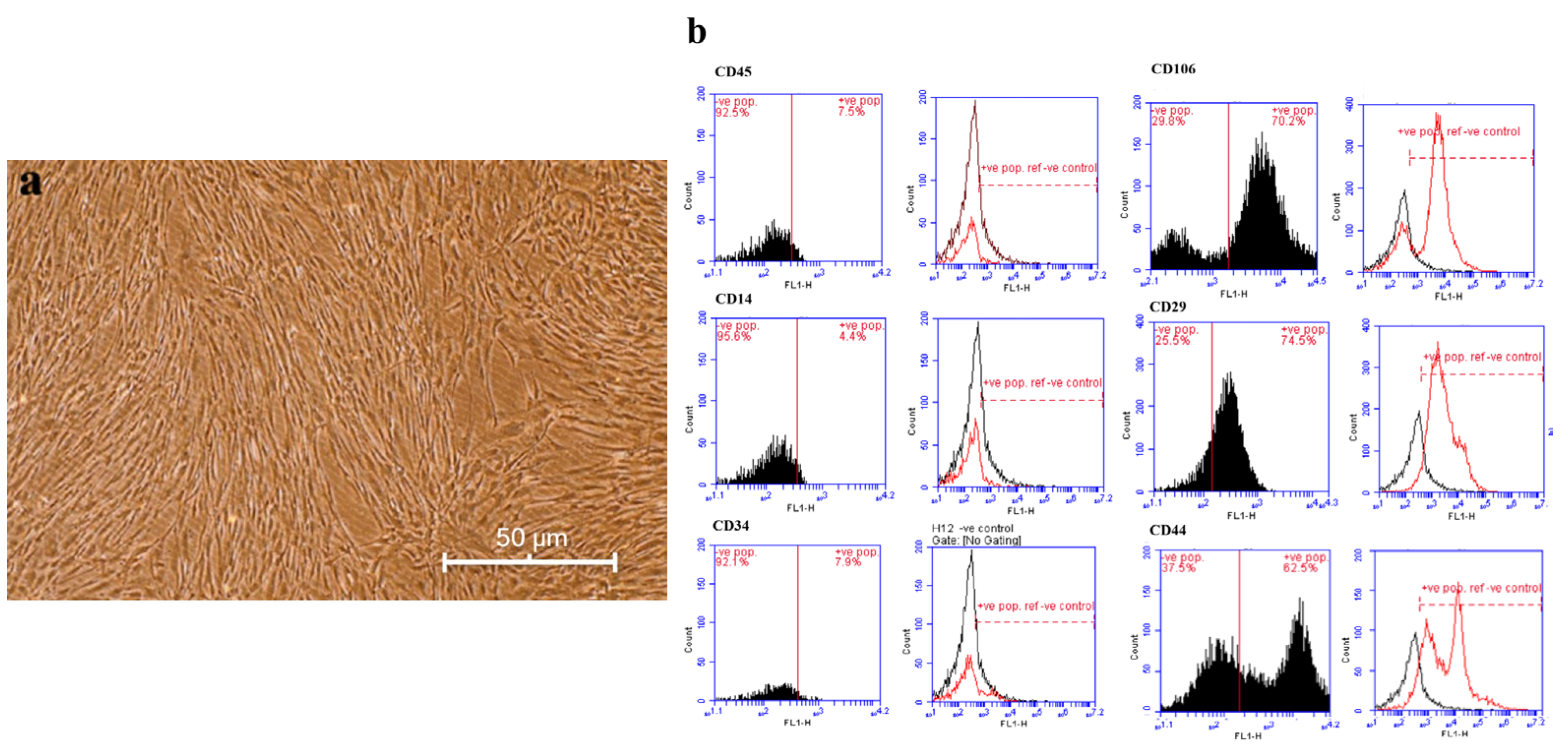
The cultured MSCs from isolated rat adipose tissue showed plastic adherence potential and exhibited a typical spindle-shaped, fibroblast-like morphology, confirming their purity (Figure 1a). MSCs are characterized by their high positivity to mesenchymal surface markers and their negativity to hematopoietic surface markers. Therefore, isolated MSCs were highly positive for mesenchymal surface markers (CD29, CD106, and CD44), while the expression of hematopoietic surface markers was negligible (CD14, CD34, and CD45), confirming the purity and stemness of the isolated rat MSCs (Figure 1b).

3.2. Confirmation of Autophagy Induction

3.2.1. LC3 Expression by IHC

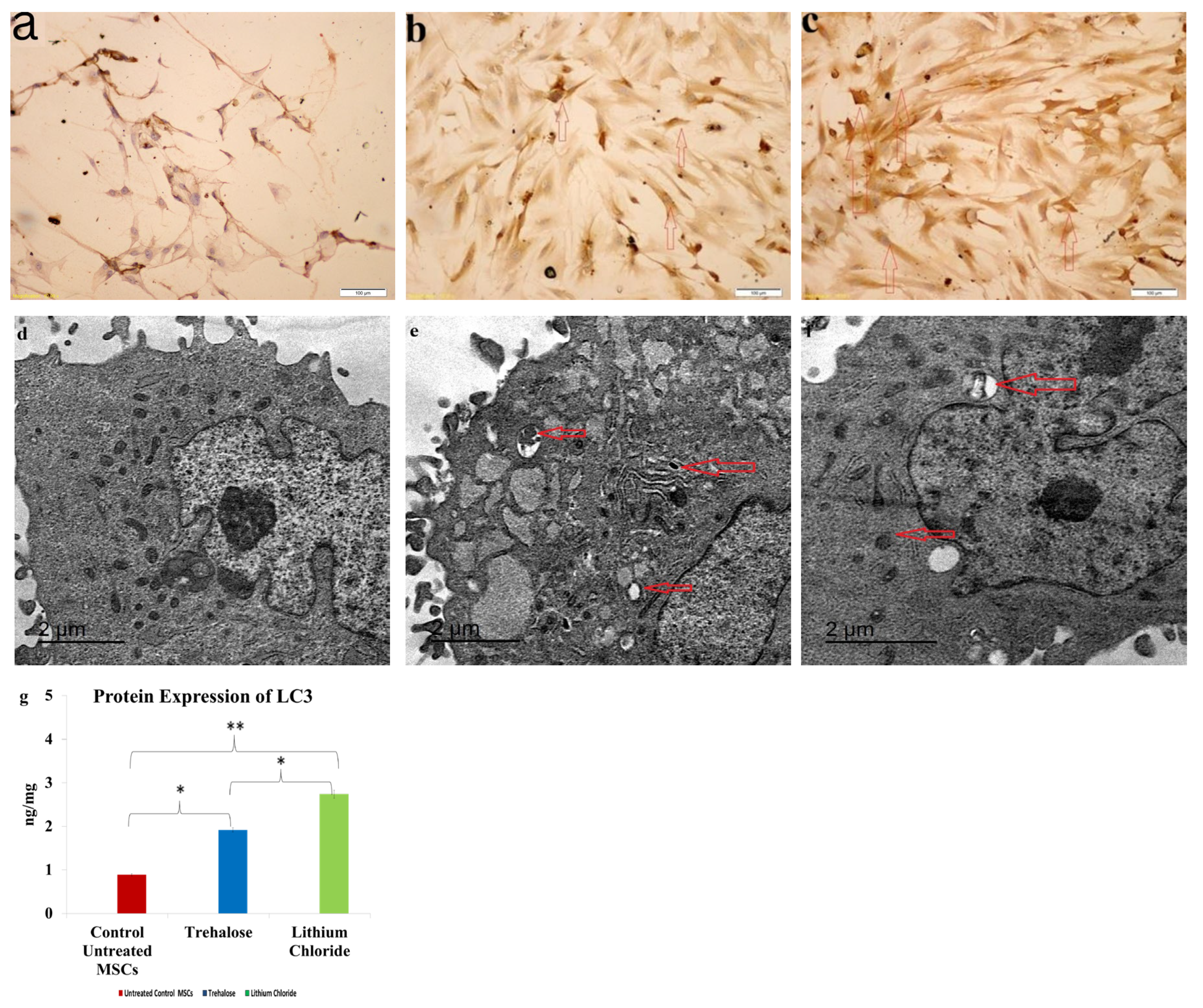
LC3 protein expression was detected after autophagy induction to confirm the successful induction of autophagy and its effect on the morphological characteristics of the treated MSCs. The two treated groups, Lithium Chloride and Trehalose, were probed with anti-LC3 by IHC analysis. The results showed a high expression of LC3 with counterstaining using hematoxylin eosin in treated cells compared with untreated cells (Figure 2a–c; scale bar of 100 µm). Additionally, the morphological characteristics of the treated cells displayed a spindle-shaped and fibroblast-like appearance, along with plastic adherence, indicating that the time- and dose-dependent effects of the autophagy inducers did not affect the cells differently compared with the untreated cells. LC3 expression was weakly observed in the untreated group; in contrast, both of the treated groups showed strong positivity.

3.2.2. Detection of Autophagosomes by Transmission Electron Microscope

The formation of double-membrane autophagosomes was detected under a transmission electron microscope (TEM) after uranyl acetate–lead citrate staining. Treated cells showed the appearance of autophagic vacuoles (AVs), which were identified clearly as double-membrane autophagosomes in comparison with untreated MSCs (Figure 2d–f). Thus, the autophagy mechanism was fully active until the final stage.

3.2.3. Quantitatively Detecting LC3 Protein Expression by ELISA

The protein expression of LC3 from the two treated groups and untreated rat MSCs (the negative control), as measured by ELISA after normalization, demonstrated an increase in the treated cells, indicating autophagy induction (Figure 2g). However, Lithium Chloride-treated MSCs showed double the expression of the Trehalose-treated MSCs groups and two-fold higher expression than the untreated control MSCs group.

3.2.4. Gene Expression of Autophagy-Related Genes and Pluripotent Markers

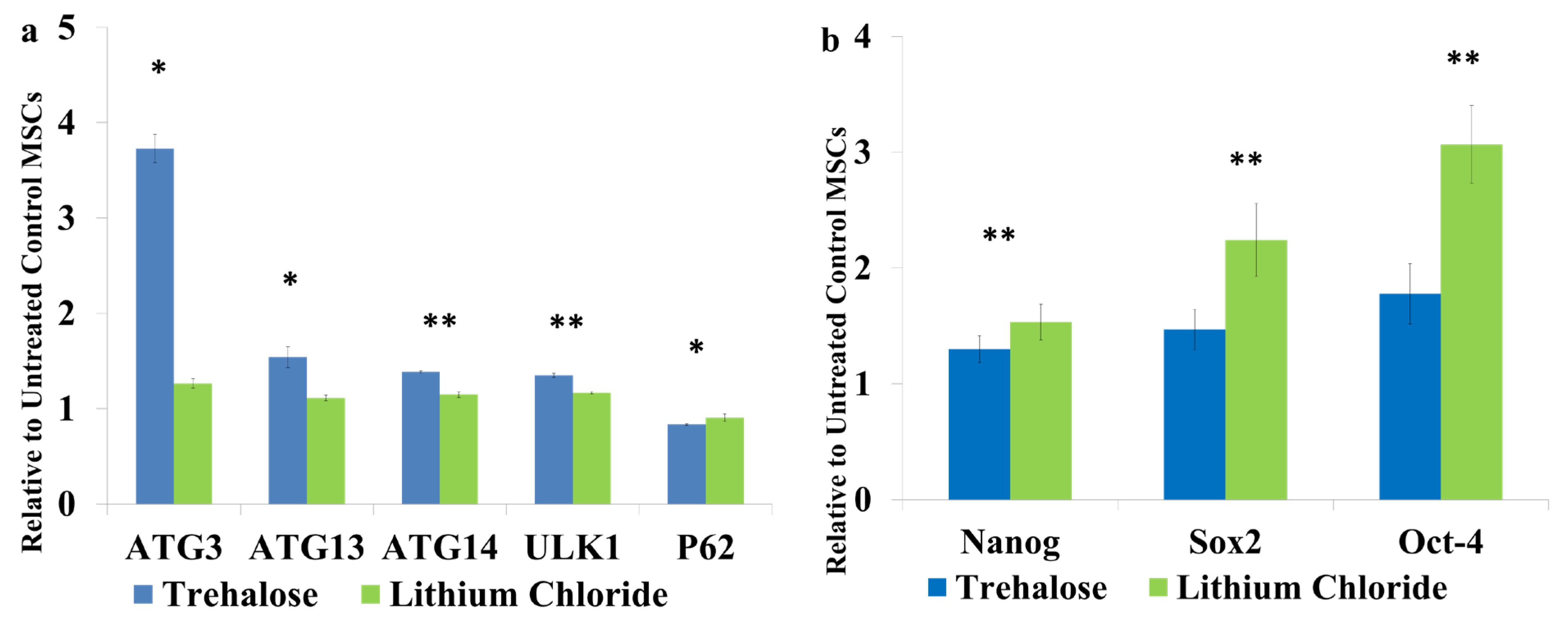
The quantitative gene expression analysis of autophagy-related genes, including ATG3, ATG13, ATG14, p62, and ULK1, revealed upregulation in both the Trehalose- and Lithium Chloride-treated cells compared with the control MSCs (Figure 3a); however, the Trehalose-treated group showed a higher expression of autophagy-related genes compared with the Lithium Chloride group. The pluripotent genes, Nanog, Sox2, and OCT-4, are considered vital markers of pluripotency and are used to induce this state; these genes were detected and showed similar upregulation in response to autophagy activation relative to the untreated control MSCs (Figure 3b). Interestingly, the Lithium Chloride-treated group showed a higher expression of pluripotency markers compared with the Trehalose group.

3.3. Detecting Apoptotic Activity

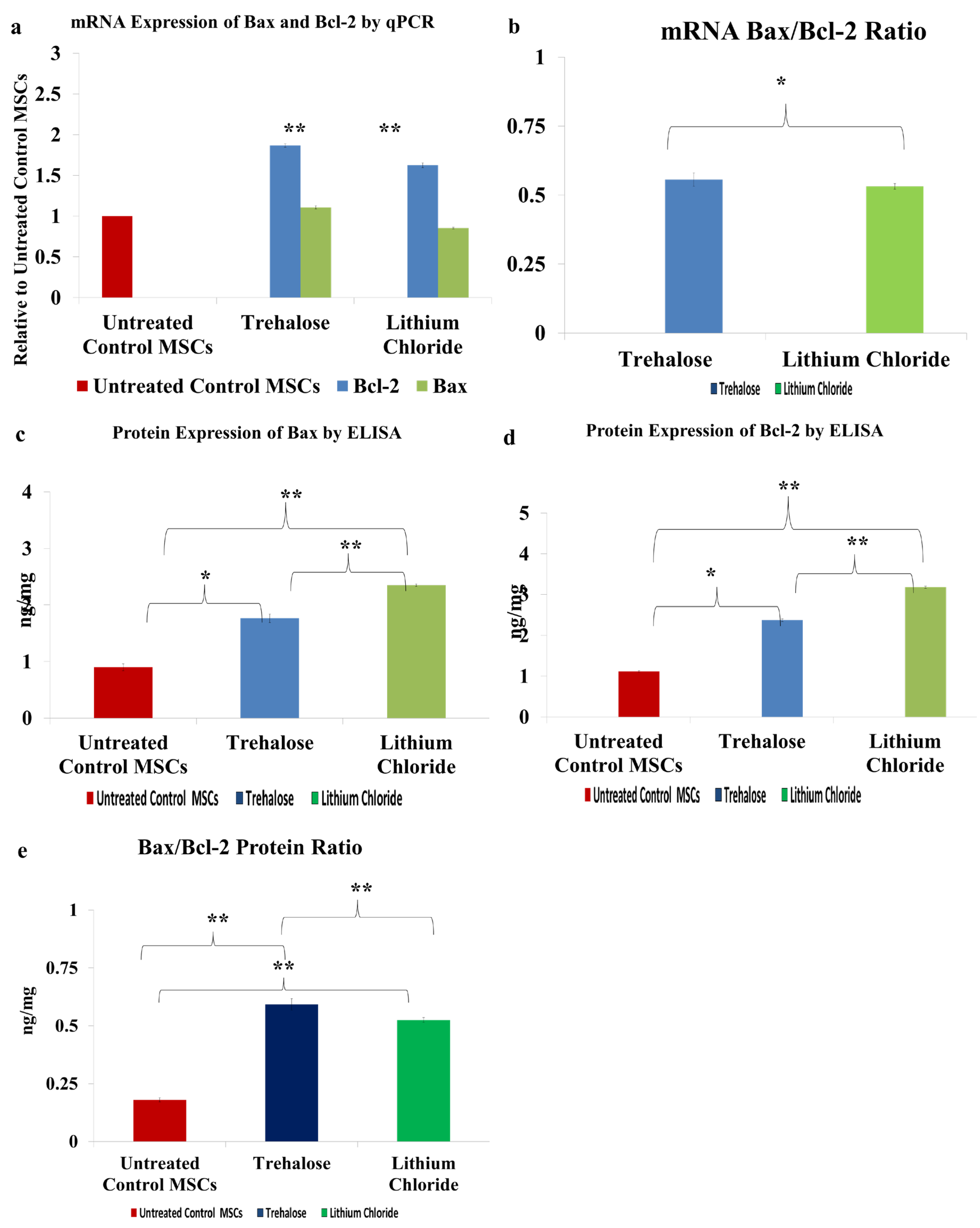
A gene expression analysis of apoptotic markers Bax and Bcl-2 was conducted to assess apoptotic activity (Figure 4a) at the transcriptional level using qPCR. At the translational level, the ELISA assay revealed higher expression levels of Bax and Bcl-2 compared with the untreated cells (Figure 4b). The Bax/Bcl-2 ratio was determined at both the transcriptional and translational levels, indicating no apoptotic activity in response to autophagy induction (Figure 4c).

3.4. Detecting Antioxidant Marker Activity

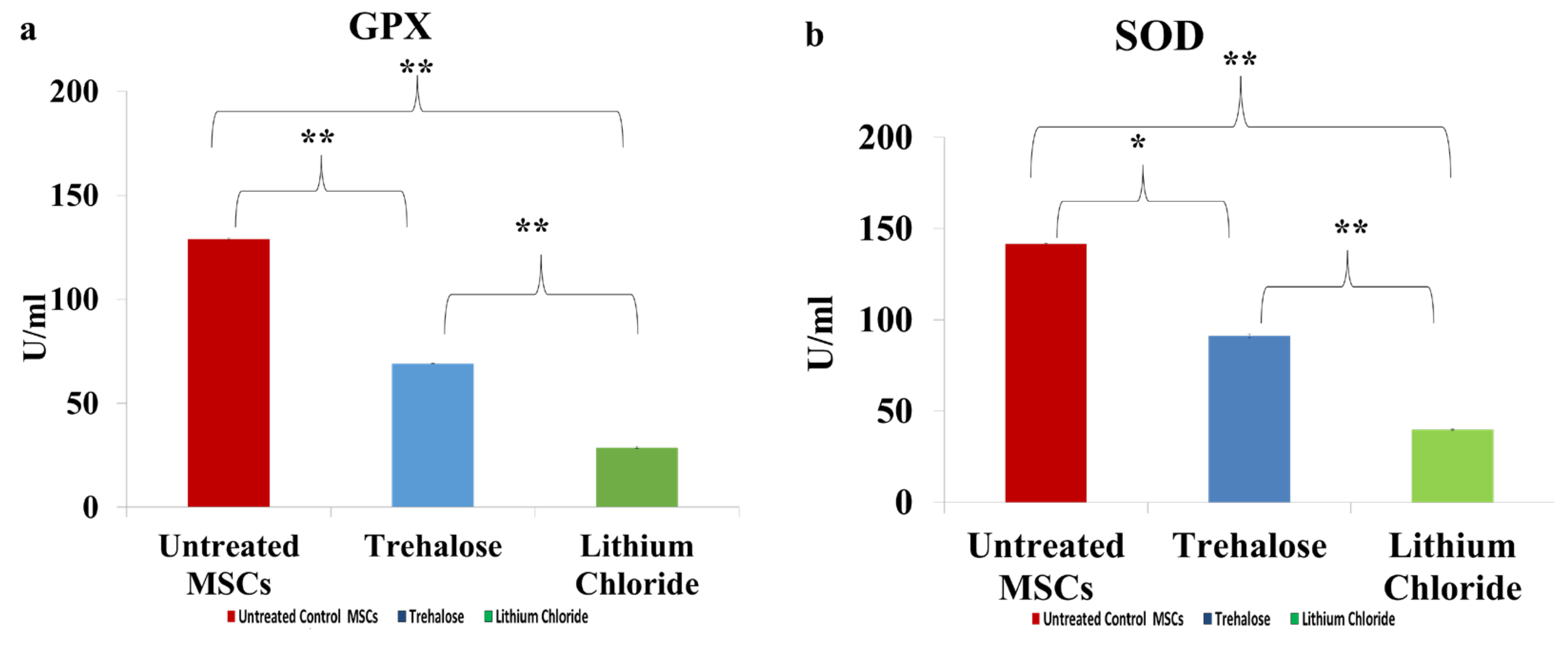
The antioxidant markers SOD and GPX1 were observed to screen the effect of autophagy induction on other cellular mechanisms, such as apoptosis and stemness. The SOD and GPX1 markers were downregulated relative to the untreated control MSCs, indicating autophagy induction (Figure 5).

4. Discussion

The regenerative potential of MSCs is primarily attributed to two characteristics: firstly, their differentiation capacity into osteocytes, chondrocytes, and adipocytes [3], as well as their trans-differentiation potential into other cell types such as skin, liver, neurons, and insulin-producing cells [25,26]; secondly, their paracrine effects, which make MSCs suitable for use as co-culture protective cells, with properties including angiogenesis/vasculogenesis [27], anti-inflammatory function, immunomodulatory properties [27] and a lack of HLA-DR expression [2], contributing to their therapeutic efficacy. MSCs are identified by three main properties: plastic adherence, differentiation capacity, and the expression of mesenchymal surface markers alongside the negative expression of hematopoietic surface markers. However, MSCs display considerable heterogeneity, consisting of various subpopulations that perform different functions, despite the lack of surface-marker identification [28,29]. This variability poses challenges for the manipulation of MSCs in vitro and complicates the identification of unique surface markers, making standardization difficult [9]. Moreover, the percentage of differentiated MSCs following chemically defined induction protocols remains modest, necessitating alternative physiological methods to maximize their differentiation potential for translational and regenerative medicine purposes.
Autophagy serves as an intrinsic cellular-recycling mechanism that significantly impacts cell fate, including that of stem cells. The role of autophagy in maintaining the homeostasis of proteins and peptides, such as growth and transcription factors, directly controls cellular proliferation, differentiation, aging, and metabolism [30]. In the current study, MSCs were successfully isolated and tested for purity through surface-marker analysis and plastic adherence potential [2]. The IHC analysis of Lithium Chloride- and Trehalose-treated MSCs demonstrated a marked increase in the expression of LC3A/B, indicating that the dose- and time-dependent effects of Lithium Chloride and Trehalose effectively activate autophagy in MSCs. Transmission electron microscopy further confirmed autophagy induction through the formation of multiple double-membrane vacuoles identified as autophagosomes. Meanwhile, at the transcriptional level, the expression of autophagy-related genes was shown to be upregulated compared with the untreated control MSCs. Notably, ATG3, which contributes to phagophore elongation and cell differentiation [31], exhibited a significant increase in Trehalose-treated cells compared with Lithium Chloride-treated cells. ATG13 is involved in autophagosome formation by targeting mTOR kinase signaling and the ULK1 complex [32,33]; it was significantly increased in Trehalose-treated cells relative to Lithium Chloride-treated cells. Additionally, ATG14 initiates autophagy by encoding the autophagy-specific subunit of phosphatidylinositol (PtdIns) 3-kinase complex I and promotes autophagosome fusion with endolysosomes [34]. However, no differences in expression were observed between the Trehalose and Lithium Chloride groups, yet modest increases were noted relative to control MSCs. ULK1, which is implicated in the regulation of autophagy, showed expression levels similar to ATG14, further emphasizing its potential role in stem cell behavior [35]. Interestingly, another study indicated that ULK1 mRNA expression levels decreased after 6 h of autophagy induction [36]. The levels of p62, which is a negative regulator whose degradation can indicate autophagy flux, could be restored after a few hours [37].
Programmed cell death, which is a type of cell death mechanism, is a basic cellular pathway that eliminates and degrades damaged cells and plays a vital role in tissue remodeling [38]. Autophagy is a cellular defense mechanism during stress; therefore, autophagy activation could lead to autophagic cell death due to the excessive degradation of cellular components [39]. Apoptosis is also a programmed cell death mechanism. The crosstalk between autophagy and apoptosis is related; therefore, we focused on monitoring apoptotic activity after autophagy induction. The expression of the apoptotic factors, Bcl-2 and Bax, showed an upregulation of approximately two-fold relative to untreated MSCs. Bcl-2 and Bax are crucial regulators of cell death through either apoptosis or autophagic cell death [40]. The interplay between autophagy and apoptosis during cellular stress is complex and remains an area of ongoing research [41]. Therefore, we assessed apoptotic markers to observe any abnormal expression resulting from autophagy induction.
Despite the low pluripotency function observed in MSCs, as multipotent stem cells, this suggests that they comprise a heterogeneous population with different pluripotent subpopulations, as previously reported and identified as adult pluripotent subpopulations [42,43]. Our results indicated the modest upregulation of Nanog, Sox2, and OCT-4 after autophagy induction, with approximately two-fold upregulation compared with the untreated control MSCs, which may indicate an upregulation of pluripotency. Previous reports explained the role of autophagy in regulating pluripotency, showing that embryonic stem cells with a higher expression of pluripotent markers express a higher level of autophagic flux [44]. In addition, autophagy plays a vital role in the process of reprogramming somatic cells into pluripotent cells [45].
At the translational level, the ELISA technique revealed an upregulation in LC3 protein expression in both Lithium Chloride- and Trehalose-treated cells, indicating no post-translational activity. It should be noted that the absence of direct ROS measurements precludes a comprehensive mechanistic interpretation. The dysregulation of antioxidants such as SOD and GPX1, compared with untreated MSCs, indicates a complex relationship where reactive oxygen species (ROS) play a role in inducing autophagy by activating AMPK, which negatively regulates mTOR and/or directly phosphorylates ULK1 [46]. Moreover, the dysregulation of GPX1 has been shown to promote autophagy [47], while the overexpression of SOD can inhibit autophagy activation [48]. The modest upregulation of Bax and Bcl-2, along with a Bax/Bcl-2 ratio of less than one at both the transcriptional and translational levels, suggests there was no significant apoptotic activity as a result of autophagy induction.

5. Conclusions

In conclusion, the present study provides strong evidence for the successful induction of autophagy in MSCs using FDA-approved drugs, with no concomitant evidence of apoptotic activity. This induction appears to potentially enhance the therapeutic potential of MSCs, suggesting that manipulated autophagy can be leveraged to improve their therapeutic potential. Nevertheless, the modest expression of Sox-2, Nanog, and Oct-4 and the continued heterogeneity of MSC populations highlight the necessity for further research. Future investigations should focus on exploring the differentiation capacity of these induced cells, potentially assessing differentiation across various lineages to enhance the percentage of differentiated cells and maximize the therapeutic potential of MSCs. Additionally, understanding the relationships between autophagy, antioxidant status, and stem cell functionality will be vital in optimizing MSC-based therapies for regenerative medicine and related clinical applications.

Author Contributions

A.F. conceptualized, designed, wrote, performed the work, interpreted the data, and drafted the manuscript. E.A. Supervised the work processes. Y.E. Conceptualized and designed the work. M.A. Analyzed and interpreted the data. All authors have read and agreed to the published version of the manuscript.

Funding

This research received no external funding..

Institutional Review Board Statement

This study is approved by the ethical committee of the faculty of science, Mansoura University (Sci-Z-ph-2020-6), on 23 June 2026.

Informed Consent Statement

Not applicable.

Data Availability Statement

Data are available by the authors on request.

Conflicts of Interest

The authors declare no conflicts of interest.

Abbreviations

MSCsMesenchymal Stem Cells
SCsStem Cells
HLA-DRHuman Leukocyte Antigen-DR
IMPaseinositol monophosphatase
IP3myo-inositol-1,4,5-triphosphate
LiCHLithium Chloride
PBSPhosphate-Buffered Saline
DMEMDulbecco’s Modified Eagle Medium
FBSFetal Bovine Serum
PEPhycoerythrin
BSABovine Serum Albumin
PBPhosphate Buffer
SEStandard Error
IHCImmunohistochemistry
AVAutophagic Vacuoles
ELISAEnzyme-Linked Immunosorbent Assay
PtdInsPhosphatidylinositol
ROSReactive Oxygen Species

References

  1. Friedenstein, A.; Chailakhjan, R.; Lalykina, K. The development of fibroblast colonies in monolayer cultures of guinea-pig bone marrow and spleen cells. Cell Prolif. 1970, 3, 393–403. [Google Scholar] [CrossRef]
  2. Dominici, M. Minimal criteria for defining multipotent mesenchymal stromal cells. The International Society for Cellular Therapy position statement. Cytotherapy 2006, 8, 315–317. [Google Scholar] [CrossRef]
  3. Thi, V.; Pham, K.; Thi, H.; Pham, P. Mesenchymal stem cells and the angiogenic regulatory network with potential incorporation and modification for therapeutic development. Biocell 2024, 48, 173. [Google Scholar] [CrossRef]
  4. Pura, L.; Putri, R.D.; Prahmana, M.A.; Wijaya, M.P.; Bandiara, R.; Faried, A.; Supriyadi, R. Mesenchymal Stem Cells as Anti-Inflammatory Agents in Chronic Kidney Disease: A Systematic Review and Meta-Analysis. Cells 2025, 14, 1313. [Google Scholar] [CrossRef]
  5. Giacomini, C.; Granéli, C.; Hicks, R.; Dazzi, F. The critical role of apoptosis in mesenchymal stromal cell therapeutics and implications in homeostasis and normal tissue repair. Cell. Mol. Immunol. 2023, 20, 570–582. [Google Scholar] [CrossRef]
  6. Sajjad, U.; Ahmed, M.; Iqbal, M.Z.; Riaz, M.; Mustafa, M.; Biedermann, T.; Klar, A.S. Exploring mesenchymal stem cells homing mechanisms and improvement strategies. Stem Cells Transl. Med. 2024, 13, 1161–1177. [Google Scholar] [CrossRef] [PubMed]
  7. Yang, R.-l.; Chen, S.-y.; Fu, S.-p.; Zhao, D.-z.; Wan, W.-h.; Yang, K.; Lei, W.; Yang, Y.; Zhang, Q.; Zhang, T. Antioxidant mechanisms of mesenchymal stem cells and their therapeutic potential in vitiligo. Front. Cell Dev. Biol. 2023, 11, 1293101. [Google Scholar] [CrossRef] [PubMed]
  8. Li, J.; Wu, Z.; Zhao, L.; Liu, Y.; Su, Y.; Gong, X.; Liu, F.; Zhang, L. The heterogeneity of mesenchymal stem cells: An important issue to be addressed in cell therapy. Stem Cells Res. Ther. 2023, 14, 381. [Google Scholar] [CrossRef]
  9. Santoro, A.; Grimaldi, M.; Marino, C.; Napolitano, E.; Buonocore, M.; D’Ursi, A.M. Cell Surface Markers of Mesenchymal Stem Cells: Current Knowledge and Advances in Characterization Technologies. Life 2025, 16, 10. [Google Scholar] [CrossRef]
  10. Kuçi, Z.; Piede, N.; Vogelsang, K.; Pfeffermann, L.-M.; Wehner, S.; Salzmann-Manrique, E.; Stais, M.; Kreyenberg, H.; Bonig, H.; Bader, P. Expression of HLA-DR by mesenchymal stromal cells in the platelet lysate era: An obsolete release criterion for MSCs? J. Transl. Med. 2024, 22, 39. [Google Scholar] [CrossRef]
  11. Gómez-Virgilio, L.; Silva-Lucero, M.-d.-C.; Flores-Morelos, D.-S.; Gallardo-Nieto, J.; Lopez-Toledo, G.; Abarca-Fernandez, A.-M.; Zacapala-Gómez, A.-E.; Luna-Muñoz, J.; Montiel-Sosa, F.; Soto-Rojas, L.O. Autophagy: A key regulator of homeostasis and disease: An overview of molecular mechanisms and modulators. Cells 2022, 11, 2262. [Google Scholar] [CrossRef] [PubMed]
  12. Nakatogawa, H. Mechanisms governing autophagosome biogenesis. Nat. Rev. Mol. Cell Biol. 2020, 21, 439–458. [Google Scholar] [CrossRef]
  13. Belmaker, R.H. At 75 Years, Is Lithium the Gold Standard in Bipolar Disorder? Pharmaceuticals 2025, 18, 1850. [Google Scholar] [CrossRef]
  14. Wang, Z.; Chai, Z.; Xu, X.; Piao, Y.; Gong, L. Lithium chloride-treated human umbilical cord mesenchymal stem cells-derived exsomes promote hair growth by regulating miR-146a-5p-wnt pathway. Stem Cells Transl. Med. 2025, 14, szaf049. [Google Scholar] [CrossRef]
  15. Zanni, G.; Di Martino, E.; Omelyanenko, A.; Andäng, M.; Delle, U.; Elmroth, K.; Blomgren, K. Lithium increases proliferation of hippocampal neural stem/progenitor cells and rescues irradiation-induced cell cycle arrest in vitro. Oncotarget 2015, 6, 37083. [Google Scholar] [CrossRef]
  16. Sarkar, S.; Floto, R.A.; Berger, Z.; Imarisio, S.; Cordenier, A.; Pasco, M.; Cook, L.J.; Rubinsztein, D.C. Lithium induces autophagy by inhibiting inositol monophosphatase. J. Cell Biol. 2005, 170, 1101–1111. [Google Scholar] [CrossRef] [PubMed]
  17. Chen, Q.; Haddad, G.G. Role of trehalose phosphate synthase and trehalose during hypoxia: From flies to mammals. J. Exp. Biol. 2004, 207, 3125–3129. [Google Scholar] [CrossRef] [PubMed]
  18. Sarkar, S.; Davies, J.E.; Huang, Z.; Tunnacliffe, A.; Rubinsztein, D.C. Trehalose, a novel mTOR-independent autophagy enhancer, accelerates the clearance of mutant huntingtin and α-synuclein. J. Biol. Chem. 2007, 282, 5641–5652. [Google Scholar] [CrossRef]
  19. Luyckx, J.; Baudouin, C. Trehalose: An intriguing disaccharide with potential for medical application in ophthalmology. Clin. Ophthalmol. 2011, 5, 577–581. [Google Scholar] [CrossRef]
  20. Fujimaki, K.; Li, R.; Chen, H.; Della Croce, K.; Zhang, H.H.; Xing, J.; Bai, F.; Yao, G. Graded regulation of cellular quiescence depth between proliferation and senescence by a lysosomal dimmer switch. Proc. Natl. Acad. Sci. USA 2019, 116, 22624–22634. [Google Scholar] [CrossRef]
  21. Zhao, K.; Chan, I.T.; Tse, E.H.; Xie, Z.; Cheung, T.H.; Zeng, Y.A. Autophagy in adult stem cell homeostasis, aging, and disease therapy. Cell Regen. 2025, 14, 14. [Google Scholar] [CrossRef]
  22. Menshikov, M.; Zubkova, E.; Stafeev, I.; Parfyonova, Y. Autophagy, mesenchymal stem cell differentiation, and secretion. Biomedicines 2021, 9, 1178. [Google Scholar] [CrossRef]
  23. Pfaffl, M.W. A new mathematical model for relative quantification in real-time RT–PCR. Nucleic Acids Res. 2001, 29, e45. [Google Scholar] [CrossRef]
  24. Cheville, N.; Stasko, J. Techniques in electron microscopy of animal tissue. Vet. Pathol. 2014, 51, 28–41. [Google Scholar] [CrossRef]
  25. Kaviarasan, V.; Deka, D.; Balaji, D.; Pathak, S.; Banerjee, A. Signaling pathways in trans-differentiation of mesenchymal stem cells: Recent advances. In Stem Cells and Lineage Commitment: Methods and Protocols; Spring: Berlin/Heidelberg, Germany, 2023; pp. 207–223. [Google Scholar]
  26. Gabr, M.M.; Zakaria, M.M.; Refaie, A.F.; Khater, S.M.; Ashamallah, S.A.; Rashed, S.A.; Fouad, A.M.; Ismail, A.M.; Ghoneim, M.A. PRDX6 Promotes the Differentiation of Human Mesenchymal Stem (Stromal) Cells to Insulin-Producing Cells. BioMed Res. Int. 2020, 2020, 7103053. [Google Scholar] [CrossRef] [PubMed]
  27. Alvites, R.; Branquinho, M.; Sousa, A.C.; Lopes, B.; Sousa, P.; Maurício, A.C. Mesenchymal stem/stromal cells and their paracrine activity—Immunomodulation mechanisms and how to influence the therapeutic potential. Pharmaceutics 2022, 14, 381. [Google Scholar] [CrossRef]
  28. Fouad, A.M.; Gabr, M.M.; Abdelhady, E.K.; Zakaria, M.M.; Khater, S.M.; Ismail, A.M.; Refaie, A.F. In vitro differentiation of human multilineage differentiating stress-enduring (Muse) cells into insulin producing cells. J. Genet. Eng. Biotechnol. 2018, 16, 433–440. [Google Scholar] [CrossRef]
  29. Rashed, S.; Gabr, M.; Abdel-Aziz, A.-A.; Zakaria, M.; Khater, S.; Ismail, A.; Fouad, A.; Refaie, A. Differentiation potential of nestin (+) and nestin (-) cells derived from human bone marrow mesenchymal stem cells into functional insulin producing cells. Int. J. Mol. Cell. Med. 2019, 8, 1. [Google Scholar]
  30. Wei, Y.; Zheng, Z.; Zhang, Y.; Sun, J.; Xu, S.; Di, X.; Ding, X.; Ding, G. Regulation of mesenchymal stem cell differentiation by autophagy. Open Med. 2024, 19, 20240968. [Google Scholar] [CrossRef] [PubMed]
  31. Fang, D.; Xie, H.; Hu, T.; Shan, H.; Li, M. Binding features and functions of ATG3. Front. Cell Dev. Biol. 2021, 9, 685625. [Google Scholar] [CrossRef] [PubMed]
  32. Bhattacharya, A.; Torggler, R.; Reiter, W.; Romanov, N.; Licheva, M.; Ciftci, A.; Mari, M.; Kolb, L.; Kaiser, D.; Reggiori, F. Decoding the function of Atg13 phosphorylation reveals a role of Atg11 in bulk autophagy initiation. EMBO Rep. 2024, 25, 813–831. [Google Scholar] [CrossRef]
  33. Rong, Z.; Zheng, K.; Chen, J.; Jin, X. Function and regulation of ULK1: From physiology to pathology. Gene 2022, 840, 146772. [Google Scholar] [CrossRef]
  34. Popli, P.; Oestreich, A.K.; Maurya, V.K.; Rowen, M.N.; Zhang, Y.; Holtzman, M.J.; Masand, R.; Lydon, J.P.; Akira, S.; Moley, K. The autophagy protein ATG14 safeguards against unscheduled pyroptosis activation to enable embryo transport during early pregnancy. eLife 2025, 13, RP97325. [Google Scholar] [CrossRef]
  35. Huang, T.; Zhang, C.; Shang, Z.; Shuai, Q.; Nie, L.; Ren, J.; Hou, S.; Xie, J. Bone mesenchymal stem cells improve cholestatic liver fibrosis by targeting ULK1 to regulate autophagy through PI3K/AKT/mTOR pathway. Stem Cells Transl. Med. 2024, 13, 648–660. [Google Scholar] [CrossRef]
  36. Nazio, F.; Carinci, M.; Valacca, C.; Bielli, P.; Strappazzon, F.; Antonioli, M.; Ciccosanti, F.; Rodolfo, C.; Campello, S.; Fimia, G.M. Fine-tuning of ULK1 mRNA and protein levels is required for autophagy oscillation. J. Cell Biol. 2016, 215, 841–856. [Google Scholar] [CrossRef] [PubMed]
  37. Kumar, A.V.; Mills, J.; Lapierre, L.R. Selective autophagy receptor p62/SQSTM1, a pivotal player in stress and aging. Fron. Cell Develop. Biol. 2022, 10, 793328. [Google Scholar] [CrossRef] [PubMed]
  38. Chen, Y. Research progress on morphology and mechanism of programmed cell death. Cell Death Dis. 2024, 15, 327. [Google Scholar] [CrossRef]
  39. Denton, D.; Kumar, S. Autophagy-dependent cell death. Cell Death Differ. 2019, 26, 605–616. [Google Scholar] [CrossRef]
  40. Marquez, R.T.; Xu, L. Bcl-2: Beclin 1 complex: Multiple, mechanisms regulating autophagy/apoptosis toggle switch. Am. J. Cancer Res. 2012, 2, 214. [Google Scholar]
  41. Sorice, M. Crosstalk of autophagy and apoptosis. Cells 2022, 11, 1479. [Google Scholar] [CrossRef] [PubMed]
  42. Fouad, A.M. Down-regulation of pluripotency and expression of SSEA-3 surface marker for mesenchymal Muse cells by in vitro expansion passaging. Egypt. J. Basic Appl. Sci. 2019, 6, 68–72. [Google Scholar] [CrossRef]
  43. Liu, R.; Ratajczak, M.Z. Enumeration of very small embryonic-like stem cells in peripheral blood. In Stem Cell Mobilization: Methods and Protocols; Spring: Berlin/Heidelberg, Germany, 2012; pp. 207–219. [Google Scholar]
  44. Sharif, T. Autophagic homeostasis is required for the pluripotency of cancer stem cells. Autophagy 2017, 13, 264–284. [Google Scholar] [CrossRef]
  45. Wang, S. Transient activation of autophagy via Sox2-mediated suppression of mTOR is an important early step in reprogramming to pluripotency. Cell Stem Cell 2013, 13, 617–625. [Google Scholar] [CrossRef]
  46. Li, L.; Chen, Y.; Gibson, S.B. Starvation-induced autophagy is regulated by mitochondrial reactive oxygen species leading to AMPK activation. Cell. Signal. 2013, 25, 50–65. [Google Scholar] [CrossRef]
  47. Meng, Q. GPx1 is involved in the induction of protective autophagy in pancreatic cancer cells in response to glucose deprivation. Cell Death Dis. 2018, 9, 1187. [Google Scholar] [CrossRef] [PubMed]
  48. Chen, Y.; Azad, M.; Gibson, S. Superoxide is the major reactive oxygen species regulating autophagy. Cell Death Differ. 2009, 16, 1040–1052. [Google Scholar] [CrossRef] [PubMed]
Figure 1. (a) Morphological features of isolated rat MSCs showing the typical spindle-shape and fibroblast-like structure of MSCs. (b) Flow cytometric analysis of isolated rat MSCs for mesenchymal surface markers (CD29, CD106, and CD44) and hematopoietic surface markers (CD14, CD34, and CD45); control unstained MSCs were used as negative controls, and the number of events was stopped at 10,000 counts.
Biomed 06 00004 g001
Figure 2. Expression of LC3 by immunohistochemistry counterstaining with Hematoxylin Eosin; (a) Trehalose-treated MSCs, (b) Lithium Chloride-treated MSCs, (c) untreated normal MSCs. Transmission electron microscope analysis showed numerous cytoplasmic vacuoles that are identified as autophagosomes after uranyl acetate–lead citrate staining: (d) untreated MSCs, (e) Lithium Chloride-treated MSCs, (f) Trehalose-treated MSCs. Scale bar in figures is 2 µm. (g) LC3 protein expression results by ELISA method; data is shown as mean ± standard error relative to control MSCs. Significance was denoted ** as p  <  0.05, and non-significance was denoted * as p > 0.05, as compared to control untreated MSCs.
Biomed 06 00004 g002
Figure 3. Gene expression by qPCR of (a) autophagy-related genes, (b) pluripotent genes. Data is shown as mean ± standard error relative to control untreated MSCs. Significance was denoted ** as p  <  0.05, and non-significance was denoted * as p > 0.05, as compared to control untreated MSCs.
Biomed 06 00004 g003
Figure 4. Gene expression by qPCR and protein expression by ELISA were used for (a) mRNA expression of apoptotic markers Bax and Bcl-2, (b) mRNA ratio of Bax and Bcl-2, (c) protein expression of Bax, (d) protein expression of Bcl-2, (e) protein expression ratio of Bax and Bcl-2. Data is shown as mean ± standard error relative to control MSCs. Significance was denoted ** as p  <  0.05, and non-significance was denoted * as p > 0.05, as compared to control untreated MSCs.
Biomed 06 00004 g004
Figure 5. Quantitative expression of ROS markers: (a) GPX and (b) SOD in Trehalose- and Lithium Chloride-treated cells in comparison to control MSCs. Data is shown as mean ± standard error relative to untreated control MSCs. Significance was denoted ** as p  <  0.05, and non-significance was denoted * as p > 0.05, as compared to control untreated MSCs.
Biomed 06 00004 g005
Table 1. List of Primers.
GeneForward PrimerReverse PrimerAccession Number
ATG3GGCTATGATGAGCAACGGCATGCAGGGGTGAACTGAACACNM_134394.2
ATG13GGCTTCCAGACAGTTCGTGTCCTCTCAAATTGCCTGGTGGANM_001271212.1
ATG14GCGACCGGGAGAGGTTTATTCCGTTTTCCTTCCATGGCCTNM_001107258.1
ULK1CATCCGAAGGTCAGGTAGCATCTGGGATGGTTCCCACTTGNM_001108341.1
P62AGCTTCTCTCATAGCCGCTGGCTGATGGAGCAGAAGCCGACNM_175843.4
BcL-2GACTGAGTACCTGAACCGGCAGTTCCACAAAGGCATCCCAGNM_016993.1
BaxATCCACCAAGAAGCTGAGCGTCCACATCAGCAATCATCCTCTGNM_017059.2
NanogAGCAACGGCCTGACTCAGAAGGGACGCGTTCATCAGATAGCCCTNM_001100781.1
Sox2TCAAGTCCGAGGCCAGTTCCGCTGATCATGTCCCGGAGGTNM_001109181.1
OCT-4ACCGTGTGAGGTGGAACCTGCCACACTCGAACCACATCCCTNM_001009178.2
GAPDHTGCCACTCAGAAGACTGTGGTGGTACATGACAAGGTGCGGNM_017008.4
Disclaimer/Publisher’s Note: The statements, opinions and data contained in all publications are solely those of the individual author(s) and contributor(s) and not of MDPI and/or the editor(s). MDPI and/or the editor(s) disclaim responsibility for any injury to people or property resulting from any ideas, methods, instructions or products referred to in the content.