Article

Predicting Hungry Bone Syndrome: Risk Stratification After Parathyroidectomy in CKD-Related Hyperparathyroidism


by
Joaquín Rodelo-Ceballos
1,2,
Víctor De La Espriella-Palmett
1,
Mauricio Restrepo-Escobar
3,*,
Ligia Lorena Calderón
2 and
Alejandro Román-González
4
1
Division of Nephrology, Department of Internal Medicine, University of Antioquia, Medellín 050010, Colombia
2
Division of Nephrology, Hospital San Vicente Fundación, Medellín 050010, Colombia
3
Division of Rheumatology, Department of Internal Medicine, University of Antioquia, Medellín 050010, Colombia
4
Division of Endocrinology, Department of Internal Medicine, University of Antioquia, Medellín 050010, Colombia
*
Author to whom correspondence should be addressed.
Kidney Dial. 2026, 6(2), 41; https://doi.org/10.3390/kidneydial6020041
Submission received: 6 April 2026 / Revised: 15 May 2026 / Accepted: 29 May 2026 / Published: 5 June 2026

Abstract

Background: Hungry bone syndrome (HBS) is a frequent and potentially severe complication following parathyroidectomy in patients with chronic kidney disease (CKD) and secondary (SHPT) or tertiary hyperparathyroidism (THPT). We aimed to identify preoperative risk factors associated with the development of HBS in this population. Methods: We conducted a retrospective cohort study including 99 adult patients with CKD-associated SHPT or THPT who underwent parathyroidectomy at Hospital San Vicente Fundación between 2018 and 2024. HBS was defined as corrected serum calcium <8.5 mg/dL requiring intravenous calcium supplementation for at least 72 h postoperatively. Clinical, biochemical, and histopathological variables were evaluated. Multivariable logistic regression analysis was performed to identify independent predictors of HBS, and model discrimination was assessed using the area under the receiver operating characteristic curve (AUC). Results: Overall, 40.4% of patients developed HBS after parathyroidectomy. Compared with patients without HBS, those with HBS more frequently had preoperative musculoskeletal symptoms (82.5% vs. 32.2%), higher preoperative intact parathyroid hormone levels (2135 vs. 1561 pg/mL), and parathyroid adenoma on histology (57.5% vs. 25.4%). In multivariable analysis, preoperative musculoskeletal symptoms (OR 10.92; 95% CI 2.32–51.43) and parathyroid adenoma (OR 6.16; 95% CI 1.38–27.54) were independently associated with increased risk of HBS. Conversely, higher preoperative calcium levels (OR 0.36; 95% CI 0.16–0.85) and the use of calcitriol or vitamin D receptor activators (OR 0.24; 95% CI 0.07–0.81) were protective factors. The final model demonstrated good discrimination (AUC = 0.86; 95% CI 0.77–0.93). Conclusions: HBS is a common complication after parathyroidectomy in patients with CKD-associated SHPT or THPT. Preoperative musculoskeletal symptoms and parathyroid adenoma were associated with increased risk, whereas higher calcium levels and calcitriol/vitamin D receptor activator use appeared protective. Early identification of high-risk patients may facilitate perioperative risk stratification and targeted management strategies.

1. Introduction

Hungry bone syndrome (HBS) is an uncommon but potentially serious complication that may occur following parathyroidectomy, particularly in patients with secondary (SHPT) or tertiary hyperparathyroidism (THPT) associated with chronic kidney disease (CKD) [1,2]. It is characterized by a rapid and profound decline in serum calcium levels due to a sudden shift from high bone turnover with predominant osteoclastic activity to increased osteoblastic activity and net bone formation following abrupt withdrawal of excess parathyroid hormone (PTH) [3,4,5]. Consequently, calcium is avidly deposited in the bone, resulting in prolonged hypocalcemia often accompanied by hypophosphatemia and/or hypomagnesemia [6,7,8]. Although HBS is well recognized in the management of hyperparathyroidism, its diagnosis and treatment remain clinically challenging due to limited understanding of the factors that are predisposing to its development [2,9,10].
End-stage kidney disease (ESKD) is associated with significant disturbances in mineral and bone metabolism, commonly leading to renal osteodystrophy. This includes a spectrum of skeletal abnormalities such as fibrous osteitis, adynamic bone disease, osteomalacia, and mixed uremic osteodystrophy. Among these, fibrous osteitis-linked to sustained hyperparathyroidism—is particularly associated with high-turnover bone disease and increased risk for HBS following parathyroidectomy. The disrupted calcium-phosphate-vitamin D axis in ESKD further amplifies parathyroid gland activity to restore homeostasis [11,12,13].
In patients with SHPT or THPT, the risk of developing HBS appears to be influenced by the duration of kidney disease, severity of hyperparathyroidism, age, calcium and vitamin D supplementation, and comorbidities such as diabetes and hypertension. However, despite ongoing research efforts, the literature remains inconclusive regarding the specific determinants of HBS, limiting the ability to prevent or mitigate this complication effectively [2,14,15].
In this context, this study aimed to identify potential risk factors associated with HBS following parathyroidectomy in patients with SHPT or THPT secondary to ESKD.

2. Materials and Methods

2.1. Study Design and Setting

We conducted a retrospective cohort study of patients with chronic kidney disease (CKD) diagnosed with secondary hyperparathyroidism (SHPT) or tertiary hyperparathyroidism (THPT) who underwent parathyroidectomy at Hospital San Vicente Fundación between 1 January 2018, and 15 March 2024. A non-probabilistic consecutive sampling strategy was used to include all eligible patients identified through systematic review of the institution’s electronic medical records.

2.2. Data Collection

Data were manually extracted from electronic medical records and compiled into a structured database. Demographic variables included age, sex, weight, body mass index, and geographic origin. Clinical information included CKD etiology and duration, dialysis modality, comorbidities, and symptoms associated with hyperparathyroidism, such as bone pain, pathological fractures, refractory pruritus, and cardiovascular complications.
Preoperative laboratory data included hemoglobin, corrected serum calcium, phosphorus, alkaline phosphatase, 25-hydroxyvitamin D [25(OH)D], and intact parathyroid hormone (iPTH). Postoperative biochemical variables, including corrected serum calcium, phosphorus, magnesium, potassium, and early postoperative iPTH, were collected when available. In a secondary analysis, postoperative iPTH levels and percentage reduction in iPTH from baseline were compared between patients with and without hungry bone syndrome (HBS) and stratified according to surgical extent.

2.3. Surgical Indications and Procedures

Parathyroidectomy was indicated in patients with persistently elevated iPTH levels (>800 pg/mL) and severe clinical manifestations, including refractory hypercalcemia, hyperphosphatemia despite treatment, calciphylaxis, or disabling skeletal symptoms. Surgery was also considered in patients with iPTH levels > 1000 pg/mL sustained for more than six months despite treatment with calcimimetics and vitamin D receptor activators (VDRA).
The decision to perform subtotal parathyroidectomy or total parathyroidectomy with autotransplantation was made by the head and neck surgery team according to intraoperative findings. When performed, autotransplantation consisted of implanting parathyroid tissue into the forearm or sternocleidomastoid muscle. All surgical specimens underwent histopathological confirmation. Histopathological classification was abstracted directly from institutional pathology reports and categorized as adenoma or hyperplasia according to the reported diagnosis.

2.4. Outcome Definition

The primary outcome was the development of hungry bone syndrome (HBS), defined as corrected serum calcium < 8.5 mg/dL requiring intravenous calcium supplementation for at least 72 h after surgery. Patients who did not develop hypocalcemia or who experienced only transient hypocalcemia not requiring intravenous supplementation, or lasting less than 72 h, were classified as not having HBS.

2.5. Statistical Analysis

Statistical analyses were performed using Stata v16. Continuous variables were summarized as mean ± standard deviation or median and interquartile range (IQR), according to data distribution assessed using the Shapiro–Wilk test. Categorical variables were reported as frequencies and percentages.
Comparisons between groups were performed using the Chi-square test or Fisher’s exact test for categorical variables, and Student’s t-test or Mann–Whitney U test for continuous variables, as appropriate. A multivariable logistic regression model was constructed to identify independent risk factors associated with HBS, adjusting for clinically relevant covariates including age, sex, CKD duration, and preoperative calcium and iPTH levels. Results are presented as odds ratios (ORs) with 95% confidence intervals (CIs), and statistical significance was defined as p < 0.05. A predictive model was subsequently developed based on the final regression model, and its discriminative performance was evaluated using the area under the receiver operating characteristic (ROC) curve (AUC).

3. Results

3.1. Incidence of Hungry Bone Syndrome and Patient Characteristics

A total of 99 patients with SHPT or THPT associated with CKD were included. Among them, 40 patients (40.4%) developed hungry bone syndrome (HBS) following parathyroidectomy. Baseline characteristics stratified by HBS status are shown in Table 1. The median age was 42 years (IQR 32–53), and 43.4% of the patients were male. Most of the cohort (89.9%) identified as mestizo. There were no statistically significant differences between groups regarding age, sex, or ethnicity.

3.2. Factors Associated with HBS

Hypertension was the most prevalent comorbidity (93.9%) and was significantly more common in the HBS group (100% vs. 89.8%, p = 0.037). Other comorbidities-including diabetes (18.2%), obesity (30.3%), dyslipidemia (80.8%), and a history of major adverse cardiovascular events (34.3%)—were similarly distributed between groups without statistically significant differences. Hemodialysis was the predominant form of kidney replacement therapy, used in 74% of the overall cohort, with similar rates among patients with and without HBS (75% vs. 73%, p = 0.707). Preoperative symptoms attributable to hyperparathyroidism-specifically bone pain or fractures-were present in 52.5% of patients and were significantly more common in the HBS group (82.5%) compared to the non-HBS group (32.2%, p < 0.001).
In laboratory assessments, median preoperative iPTH levels were significantly higher in the HBS group (2135 pg/mL, IQR 1451–2602) compared to those without HBS (1561 pg/mL, IQR 1200–2000; p < 0.001). Preoperative corrected calcium levels were similar between groups (9.0 vs. 9.3 mg/dL, p = 0.167), as were phosphorus (p = 0.965), potassium (p = 0.973), and magnesium levels (p = 0.745). Vitamin D levels were slightly lower in the HBS group (18.7 vs. 19.0 ng/mL), though the difference was not statistically significant (p = 0.679). Regarding preoperative medical treatment, 41.4% of patients received calcitriol/VDRA, with significantly higher use in the non-HBS group (52.5% vs. 25.0%, p = 0.006). Cinacalcet use was low overall (13.1%) and did not differ between groups (p = 0.878).
Total parathyroidectomy was performed in 20.2% of patients and was significantly more common in those who developed HBS (32.5% vs. 11.9%, p = 0.012). Histopathological analysis showed a higher prevalence of parathyroid adenoma in the HBS group (57.5%) compared to the non-HBS group (25.4%, p = 0.001). Length of hospital stay was significantly longer in patients with HBS (median 17 days, IQR 14–23) compared to those without HBS (median 3 days, IQR 2–4; p < 0.0001).

3.3. Multivariable Predictors of HBS

In multivariable logistic regression analysis, the presence of preoperative symptoms was independently associated with HBS development (odds ratio [OR] 10.92; 95% confidence interval [CI], 2.32–51.43; p = 0.002). Histopathological diagnosis of parathyroid adenoma was also significantly associated with increased risk of HBS (OR 6.16; 95% CI, 1.38–27.54; p = 0.017). Although patients with preoperative iPTH levels > 1700 pg/mL showed a trend toward increased HBS risk, this did not reach statistical significance (Table 2).
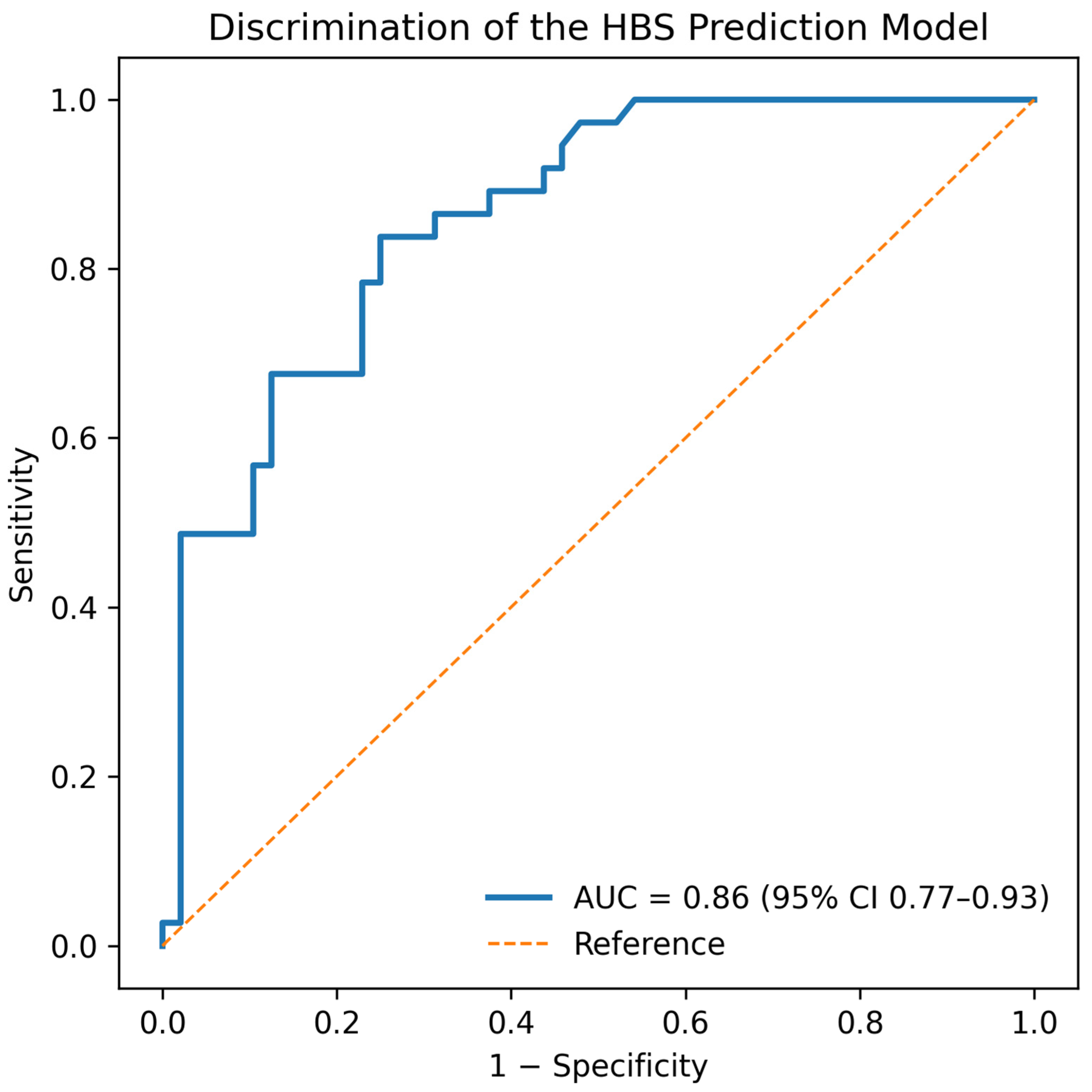
Conversely, two variables were identified as protective factors against HBS: higher preoperative corrected calcium (OR 0.36; 95% CI, 0.16–0.85; p = 0.019) and the use of calcitriol/VDRA prior to surgery (OR 0.24; 95% CI, 0.07–0.81; p = 0.022). The predictive model, constructed from four key variables (preoperative symptoms, adenoma histology, reduced calcium levels, and absence of calcitriol/VDRA therapy) exhibited outstanding discriminative performance for HBS, with an AUC of 0.86 (95% CI 0.77–0.93) on the ROC curve (Figure 1).
Postoperative iPTH values were available in 89 patients. Median postoperative iPTH was 137.7 pg/mL (IQR 52.9–299.3) in the HBS group and 251.0 pg/mL (IQR 40.4–561.8) in the non-HBS group (p = 0.211). The percentage reduction in iPTH was significantly greater in patients with HBS: 93.7% (IQR 85.5–97.2) versus 82.3% (IQR 65.0–95.2), p = 0.027. Postoperative calcium and phosphorus were also significantly lower in the HBS group (Supplementary Table S1). These findings support the interpretation that HBS was associated with abrupt withdrawal of PTH stimulation and increased skeletal mineral uptake rather than being explained solely by undetectable postoperative PTH.

4. Discussion

In this retrospective cohort of patients with SHPT or THPT associated with CKD who underwent parathyroidectomy, HBS occurred in 40.4% of cases, highlighting the substantial postoperative metabolic burden associated with severe CKD-related hyperparathyroidism. This frequency is consistent with previous reports describing HBS rates ranging from 25% to more than 50% among CKD populations undergoing parathyroidectomy [10,16]. Nevertheless, the true incidence of HBS remains difficult to establish because there is no universally accepted diagnostic definition. Across studies, diagnostic criteria vary considerably, ranging from isolated biochemical hypocalcemia to more stringent definitions incorporating hypophosphatemia, persistence of hypocalcemia over time, symptomatic disease, or the need for prolonged intravenous calcium replacement.
This heterogeneity has major implications when comparing incidence estimates between cohorts. For instance, in a study of 198 patients undergoing parathyroidectomy for primary hyperparathyroidism, HBS was defined as a serum calcium level < 8.5 mg/dL together with serum phosphate < 3.0 mg/dL on the third postoperative day, yielding an incidence of 13% [17]. In contrast, studies in dialysis-dependent patients with SHPT using broader or clinically driven definitions-such as the requirement for intravenous calcium replacement due to symptomatic hypocalcemia or serum calcium < 8.4 mg/dL within 72 h after surgery—have reported incidences as high as 82% [18]. Beyond differences in diagnostic thresholds, these discrepancies likely also reflect variation in perioperative calcium supplementation protocols, severity and duration of preoperative hyperparathyroidism, dialysis exposure, and the extent of underlying high-turnover bone disease.
The clinical relevance of HBS goes beyond postoperative hypocalcemia, as it is associated with increased morbidity and more complex postoperative management in patients with CKD-related hyperparathyroidism. In our cohort, patients who developed HBS had significantly longer hospital stays compared with those who did not (median 17 vs. 3 days, p < 0.0001), highlighting the important clinical and healthcare burden associated with this complication. Similar findings have been reported in previous studies, where HBS has been linked to prolonged hospitalization and increased postoperative resource utilization [19,20]. Management of HBS usually requires close biochemical monitoring, prolonged intravenous calcium replacement, high-dose oral calcium supplementation, and calcitriol therapy [3,4]. Although HBS is often perceived primarily as a metabolic complication, severe cases may result in clinically significant manifestations such as tetany, muscle spasms, seizures, QT interval prolongation, cardiac arrhythmias, or worsening cardiovascular instability. From a health systems perspective, these complications are particularly relevant in resource-limited settings, where prolonged hospitalization and intensive electrolyte monitoring may substantially increase healthcare utilization [16,21,22]. Taken together, these findings support the importance of identifying patients at high risk for HBS before surgery to optimize perioperative calcium and vitamin D management.
Our findings identified several factors independently associated with the development of HBS. Among them, the presence of preoperative musculoskeletal symptoms—particularly bone pain and pathological fractures—showed a strong association with postoperative HBS, supporting previous evidence suggesting that severe high-turnover bone disease increases skeletal calcium uptake after parathyroidectomy [5]. This association is biologically plausible, as prolonged exposure to elevated PTH levels promotes intense bone remodeling with increased osteoclastic resorption followed by compensatory osteoblastic activity. After surgery, the abrupt decline in PTH favors rapid skeletal remineralization, leading to marked calcium influx into bone and persistent hypocalcemia [23,24,25]. Bone pain and pathological fractures likely represent clinical manifestations of advanced skeletal involvement and increased bone calcium avidity. Similar associations between symptomatic bone disease and postoperative HBS have been described in previous studies of CKD-related hyperparathyroidism, particularly among patients with severe osteitis fibrosa and prolonged exposure to uncontrolled secondary hyperparathyroidism [26,27]. Objective markers such as total ALP, bone-specific ALP, and DXA-derived BMD would further support this mechanism. However, ALP at the time of surgery and BMD were not systematically available in our retrospective dataset. In clinical environments where these objective markers are unavailable, systematic preoperative assessment of bone pain and fractures may provide a pragmatic, low-cost surrogate for severe skeletal involvement and may help identify patients requiring intensified perioperative calcium and vitamin D strategies.
In addition, histopathological diagnosis of parathyroid adenoma was significantly associated with the development of HBS. This finding is in line with previous reports suggesting that large or functionally dominant parathyroid lesions may be associated with more severe bone turnover abnormalities and greater postoperative calcium requirements after parathyroidectomy. One possible explanation is that these lesions are associated with higher and more sustained PTH secretion, leading to more advanced skeletal remodeling before surgery [28,29]. However, this association should be interpreted cautiously in the context of CKD-related hyperparathyroidism. In patients with SHPT or THPT, routine histopathological evaluation may not always clearly differentiate a true adenoma from a dominant nodular hyperplastic gland arising within diffuse parathyroid hyperplasia. This distinction is clinically relevant because nodular hyperplasia is often associated with more autonomous secretory behavior, reduced sensitivity to calcimimetics and vitamin D receptor activators, and more prolonged exposure to elevated PTH levels. This distinction is biologically relevant because dominant nodular lesions may exhibit greater autonomous secretory activity, resistance to medical therapy, and more severe bone remodeling burden, potentially explaining their association with postoperative HBS [18].
Conversely, preoperative treatment with calcitriol/VDRAs was associated with a lower risk of postoperative HBS. This finding is consistent with previous studies suggesting that optimization of vitamin D status before parathyroidectomy may attenuate the severity of postoperative hypocalcemia by reducing excessive bone turnover and improving calcium homeostasis [30,31]. In patients with CKD-related hyperparathyroidism, VDRAs suppress PTH secretion and may partially stabilize the imbalance between bone resorption and bone formation prior to surgery [32,33]. Another possible explanation is that patients receiving calcitriol or VDRAs before surgery may have undergone closer nephrology follow-up and more intensive management of CKD-MBD, potentially resulting in better preoperative metabolic control. Although our study design does not allow us to establish causality, the observed association supports the potential role of preoperative metabolic optimization in reducing the risk and severity of HBS.
The role of calcimimetics such as cinacalcet remains less well defined. While some reports have described the occurrence of HBS despite prior cinacalcet exposure [34], other studies have demonstrated improvement in biochemical markers of bone turnover after treatment with calcimimetics [35]. These apparently conflicting findings may reflect differences in treatment duration, severity of hyperparathyroidism, adherence, or timing of surgery. In our cohort, cinacalcet use was infrequent overall (13.1%) and did not differ significantly between patients who developed HBS and those who did not (p = 0.878). This limited exposure may reflect barriers in access, late referral for surgery, intolerance, or variability in prescribing practices over the study period, and may have reduced our ability to detect a potential association between calcimimetic therapy and postoperative HBS risk.
Lower preoperative calcium levels were independently associated with the development of HBS in our cohort (OR 0.36; 95% CI 0.16–0.85; p = 0.019). Although this finding may initially appear counterintuitive in the setting of hyperparathyroidism, it is biologically plausible in patients with advanced CKD-related high-turnover bone disease. Persistent exposure to markedly elevated PTH levels promotes continuous bone resorption and accelerated skeletal remodeling, eventually leading to substantial mineral depletion and increased skeletal calcium demand. In this context, lower serum calcium concentrations before surgery may reflect a state of limited mineral reserve and heightened skeletal avidity rather than milder disease activity [12,13]. Notably, despite relatively similar median calcium values between groups (9.0 vs. 9.3 mg/dL), even modest differences in preoperative calcium appeared to have prognostic significance after multivariable adjustment, suggesting that subtle biochemical differences may reflect important underlying differences in bone metabolic activity.
Following parathyroidectomy, the abrupt decline in PTH removes the stimulus for osteoclastic bone resorption while osteoblastic activity and bone remineralization continue, favoring rapid transfer of calcium from the extracellular compartment into bone [3,9]. Supporting this interpretation, patients who developed HBS in our cohort experienced a significantly greater postoperative reduction in iPTH levels (93.7% vs. 82.3%, p = 0.027), despite similar absolute postoperative iPTH concentrations between groups. Together, these findings reinforce the concept that HBS is driven not only by postoperative hormonal suppression itself, but also by the interaction between abrupt PTH withdrawal and severe pre-existing skeletal mineral depletion.
Interestingly, variables such as preoperative phosphorus, magnesium, potassium levels, dialysis modality, and common comorbidities—including diabetes, obesity, dyslipidemia, and prior cardiovascular disease—were not significantly associated with HBS in our cohort. Hemodialysis was the predominant form of kidney replacement therapy and was similarly distributed between groups (75% vs. 73%, p = 0.707), suggesting that the type of dialysis itself may have less influence on postoperative calcium dynamics than the severity of underlying bone disease [36]. Likewise, preoperative phosphorus and magnesium levels were remarkably similar between groups despite their known role in bone metabolism. One possible explanation is that serum electrolyte measurements may not accurately reflect total body mineral balance or the degree of skeletal mineral depletion in advanced CKD. In addition, phosphorus and magnesium concentrations in dialysis populations are strongly influenced by factors such as dialysis prescription, dietary intake, phosphate binders, and medication use, which may limit their utility as isolated predictors of postoperative skeletal calcium uptake. Overall, these findings suggest that markers more directly related to skeletal turnover and chronic hyperparathyroid burden may be more clinically relevant for predicting HBS than general metabolic parameters or cardiovascular comorbidity profiles.
Furthermore, we developed a predictive model incorporating four clinically relevant variables: preoperative musculoskeletal symptoms, adenoma on histopathology, lower preoperative calcium levels, and absence of calcitriol/VDRA therapy. This model demonstrated good discriminatory performance, with an AUC of 0.86 (95% CI 0.77–0.93), suggesting a potentially useful role for early perioperative risk stratification. Importantly, the variables included in the model are routinely available in most clinical settings and do not depend on advanced biomarkers or specialized imaging, which may increase its practical applicability, particularly in resource-limited environments. The model also reflects different dimensions of HBS pathophysiology, integrating clinical manifestations of severe bone disease, biochemical evidence of altered mineral metabolism, histopathological characteristics of parathyroid involvement, and the potential protective effect of preoperative vitamin D receptor activation. From a clinical perspective, identifying patients at high risk for HBS before surgery could facilitate closer biochemical monitoring, earlier initiation of aggressive calcium and vitamin D supplementation, and more appropriate planning of postoperative hospitalization and dialysis management. Although the model showed strong discrimination in our cohort, its performance should be interpreted cautiously given the retrospective single-center design and the relatively limited sample size. External validation in independent CKD populations will be necessary before broader clinical implementation.
Several limitations should be acknowledged. First, ALP at the time of surgery, bone-specific ALP, DXA-derived BMD, and longitudinal preoperative calcium trajectories were not systematically available and could not be incorporated into the statistical model. Second, although postoperative iPTH values were available for most patients and did not suggest universal profound PTH suppression among HBS cases, the retrospective design did not allow standardized timing of postoperative iPTH measurement. Third, histopathological classification was based on routine pathology reports, and more granular differentiation between true adenoma, dominant nodular hyperplasia, and diffuse hyperplasia was not consistently available.

5. Conclusions

In patients with CKD and secondary or tertiary hyperparathyroidism undergoing parathyroidectomy, preoperative musculoskeletal symptoms and parathyroid adenoma histology were the strongest predictors of hungry bone syndrome. Lower serum calcium and absence of calcitriol/VDRA use also increased risk. These findings provide clinically useful markers for early risk stratification and support targeted strategies to prevent postoperative complications.

Supplementary Materials

The following supporting information can be downloaded at: https://www.mdpi.com/article/10.3390/kidneydial6020041/s1, Supplementary Table S1. Postoperative biochemical variables by HBS status.

Author Contributions

Conceptualization, J.R.-C. and V.D.L.E.-P.; methodology, J.R.-C.; formal analysis, J.R.-C. and M.R.-E.; investigation, A.R.-G., L.L.C. and V.D.L.E.-P.; data curation, A.R.-G. and L.L.C.; writing—original draft preparation, J.R.-C., M.R.-E., A.R.-G. and L.L.C.; writing—review and editing, J.R.-C., A.R.-G., L.L.C. and V.D.L.E.-P.; supervision, J.R.-C. All authors have read and agreed to the published version of the manuscript.

Funding

This research received no external funding.

Institutional Review Board Statement

The study protocol was reviewed and approved by the Ethics Committee of Hospital San Vicente Fundación (HUSVF) under Acta No. 21-2024, dated 29 July 2024. The study adhered to Resolution No. 008430 of 1993 issued by the Colombian Ministry of Health and to the ethical principles outlined in the 2013 Declaration of Helsinki. Given its retrospective design, the absence of interventions, and the use of anonymized data, the study was classified as minimal-risk research. The ethics committee waived the requirement for informed consent. No animal experiments were conducted.

Informed Consent Statement

Due to the retrospective nature of the study and the use of anonymized data, the requirement for informed consent was waived by the Institutional Review Board.

Data Availability Statement

The data that support the findings of this study are available from the corresponding author upon reasonable request, subject to institutional and ethical regulations.

Acknowledgments

Generative artificial intelligence (GenAI) tools were used during the preparation of this manuscript to assist with language refinement, improvement of scientific writing clarity, restructuring of selected discussion sections, and enhancement of academic style. The authors also used GenAI-assisted support for organizing literature-based concepts related to hungry bone syndrome and chronic kidney disease–associated hyperparathyroidism. All outputs generated by these tools were critically reviewed, revised, and verified against the original scientific literature and the study dataset by the authors. No GenAI tool was used for autonomous data analysis, statistical calculations, generation of primary results, image manipulation, or independent interpretation of findings. No generative artificial intelligence tool or large language model was listed as an author. All authors fulfill the journal’s authorship criteria and are fully responsible for the originality, integrity, accuracy, and interpretation of the data presented in this manuscript.

Conflicts of Interest

The authors declare no conflicts of interest.

Abbreviations

The following abbreviations are used in this manuscript:
25(OH)D25-hydroxyvitamin D
AUCArea Under the Curve
CIConfidence Interval
CKDChronic Kidney Disease
ESKDEnd-Stage Kidney Disease
HBSHungry Bone Syndrome
HUSVFHospital San Vicente Fundación
iPTHIntact Parathyroid Hormone
IQRInterquartile Range
MACEMajor Adverse Cardiovascular Events
OROdds Ratio
PTHParathyroid Hormone
ROCReceiver Operating Characteristic
SHPTSecondary Hyperparathyroidism
THPTTertiary Hyperparathyroidism

References

  1. Goldfarb, M.; Gondek, S.S.; Lim, S.M.; Farra, J.C.; Nose, V.; Lew, J.I. Postoperative Hungry Bone Syndrome in Patients with Secondary Hyperparathyroidism of Renal Origin. World J. Surg. 2012, 36, 1314–1319. [Google Scholar] [CrossRef]
  2. Mehta, R.; Rao, K.N.; Nagarkar, N.M.; Ghosh, A.; Sakale, H. Hungry Bone Syndrome Following Parathyroidectomy: A Comprehensive Systematic Review of Risk Factors. Indian J. Surg. 2023, 86, 27–39. [Google Scholar] [CrossRef]
  3. Jain, N.; Reilly, R.F. Hungry Bone Syndrome. Curr. Opin. Nephrol. Hypertens. 2017, 26, 250–255. [Google Scholar] [CrossRef]
  4. Cartwright, C.; Anastasopoulou, C. Hungry Bone Syndrome; StatPearls: St. Petersburg, FL, USA, 2025. [Google Scholar]
  5. Materazzi, G.; Coman, A.; Tarta, C.; Marian, M.; Popa, D.I.; Olariu, S.; Rosu, M.; Utu, D.; Buleu, F.; Macovei-Oprescu, A.-M.; et al. Hungry Bone Syndrome After Parathyroidectomy for Secondary Hyperparathyroidism: Pathogenesis and Contemporary Clinical Considerations. J. Clin. Med. 2025, 14, 7104. [Google Scholar] [CrossRef]
  6. Altun, E.; Paydas, S.; Kaya, B.; Balal, M. Prolonged Hypophosphatemia Following Parathyroidectomy in Chronic Hemodialysis Patients. Saudi J. Kidney Dis. Transpl. 2015, 26, 976–979. [Google Scholar] [PubMed]
  7. Tavakoli, F.; Yaghoubi, F.; Dalil, D.; Rezaei, M. Multiple Fractures Due to Hungry Bone Syndrome Following Parathyroidectomy: A Clinical Case Report and Review of Literature. Clin. Diabetes Endocrinol. 2024, 10, 25. [Google Scholar] [CrossRef] [PubMed]
  8. Alexander, R.T.; Dimke, H. Effects of Parathyroid Hormone on Renal Tubular Calcium and Phosphate Handling. Acta Physiol. 2023, 238, e13959. [Google Scholar] [CrossRef]
  9. Tai, Y.L.; Shen, H.Y.; Nai, W.H.; Fu, J.F.; Wang, I.K.; Huang, C.C.; Weng, C.H.; Lee, C.C.; Huang, W.H.; Yang, H.Y.; et al. Hungry Bone Syndrome After Parathyroid Surgery. Hemodial. Int. 2023, 27, 134–145. [Google Scholar] [CrossRef] [PubMed]
  10. Carsote, M.; Nistor, C. Forestalling Hungry Bone Syndrome After Parathyroidectomy in Patients with Primary and Renal Hyperparathyroidism. Diagnostics 1953, 13, 1953. [Google Scholar] [CrossRef]
  11. Ketteler, M.; Block, G.A.; Evenepoel, P.; Fukagawa, M.; Herzog, C.A.; McCann, L.; Moe, S.M.; Shroff, R.; Tonelli, M.A.; Toussaint, N.D.; et al. Executive Summary of the 2017 KDIGO Chronic Kidney Disease–Mineral and Bone Disorder (CKD-MBD) Guideline Update: What’s Changed and Why It Matters. Kidney Int. 2017, 92, 26–36. [Google Scholar] [CrossRef]
  12. Magagnoli, L.; Ciceri, P.; Cozzolino, M. Secondary Hyperparathyroidism in Chronic Kidney Disease: Pathophysiology, Current Treatments and Investigational Drugs. Expert Opin. Investig. Drugs 2024, 33, 775–789. [Google Scholar] [CrossRef]
  13. Salera, D.; Merkel, N.; Bellasi, A.; de Borst, M.H. Pathophysiology of Chronic Kidney Disease-Mineral Bone Disorder (CKD-MBD): From Adaptive to Maladaptive Mineral Homeostasis. Clin. Kidney J. 2025, 18, i3–i14. [Google Scholar] [CrossRef] [PubMed]
  14. Cheng, J.; Lv, Y.; Zhang, L.; Liu, Y. Construction and Validation of a Predictive Model for Hypocalcemia after Parathyroidectomy in Patients with Secondary Hyperparathyroidism. Front. Endocrinol. 2022, 13, 1040264, Correction in Front. Endocrinol. 2022, 16, 1777571. [Google Scholar] [CrossRef]
  15. Wang, M.; Chen, B.; Zou, X.; Wei, T.; Gong, R.; Zhu, J.; Li, Z. A Nomogram to Predict Hungry Bone Syndrome After Parathyroidectomy in Patients with Secondary Hyperparathyroidism. J. Surg. Res. 2020, 255, 33–41. [Google Scholar] [CrossRef] [PubMed]
  16. Witteveen, J.E.; van Thiel, S.; Romijn, J.A.; Hamdy, N.A. Hungry Bone Syndrome: Still a Challenge in the Post-Operative Management of Primary Hyperparathyroidism: A Systematic Review of the Literature. Eur. J. Endocrinol. 2013, 168, R45–R53. [Google Scholar] [CrossRef] [PubMed]
  17. Brasier, A.R.; Nussbaum, S.R. Hungry Bone Syndrome: Clinical and Biochemical Predictors of Its Occurrence after Parathyroid Surgery. Am. J. Med. 1988, 84, 654–660. [Google Scholar] [CrossRef]
  18. Kritmetapak, K.; Kongpetch, S.; Chotmongkol, W.; Raruenrom, Y.; Sangkhamanon, S.; Pongchaiyakul, C. Incidence of and Risk Factors for Post-Parathyroidectomy Hungry Bone Syndrome in Patients with Secondary Hyperparathyroidism. Ren. Fail. 2020, 42, 1118–1126. [Google Scholar] [CrossRef]
  19. Alsafran, S.; Sherman, S.K.; Dahdaleh, F.S.; Ruhle, B.; Mercier, F.; Kaplan, E.L.; Angelos, P.; Grogan, R.H. Preoperative Calcitriol Reduces Postoperative Intravenous Calcium Requirements and Length of Stay in Parathyroidectomy for Renal-Origin Hyperparathyroidism. Surgery 2019, 165, 151–157. [Google Scholar] [CrossRef]
  20. Ishani, A.; Liu, J.; Wetmore, J.B.; Lowe, K.A.; Do, T.; Bradbury, B.D.; Block, G.A.; Collins, A.J. Clinical Outcomes after Parathyroidectomy in a Nationwide Cohort of Patients on Hemodialysis. Clin. J. Am. Soc. Nephrol. 2015, 10, 90–97. [Google Scholar] [CrossRef]
  21. Madorin, C.; Owen, R.P.; Fraser, W.D.; Pellitteri, P.K.; Radbill, B.; Alessandra, R.; Seethala, R.R.; Shaha, A.R.; Silver, C.E.; Suh, M.Y.; et al. The Surgical Management of Renal Hyperparathyroidism. Eur. Arch. Oto-Rhino-Laryngol. 2011, 269, 1565–1576. [Google Scholar] [CrossRef]
  22. Ferreira, J.L.; de Brito Marques, F.; Freire, L.; Soares, V.; Guerreiro, L.; Silva, S.; Guedes, C. Intensive Calcium Monitoring Improves Outcomes on Hungry Bone Syndrome in Hyperparathyroidism. Endocr. Regul. 2021, 55, 30–41. [Google Scholar] [CrossRef]
  23. Ge, Y.; Yang, G.; Wang, N.; Zha, X.; Yu, X.; Mao, H.; Sun, B.; Zeng, M.; Zhang, B.; Xing, C. Bone Metabolism Markers and Hungry Bone Syndrome after Parathyroidectomy in Dialysis Patients with Secondary Hyperparathyroidism. Int. Urol. Nephrol. 2019, 51, 1443–1449. [Google Scholar] [CrossRef]
  24. Ho, L.Y.; Wong, P.N.; Sin, H.K.; Wong, Y.Y.; Lo, K.C.; Chan, S.F.; Lo, M.W.; Lo, K.Y.; Mak, S.K.; Wong, A.K.M. Risk Factors and Clinical Course of Hungry Bone Syndrome after Total Parathyroidectomy in Dialysis Patients with Secondary Hyperparathyroidism. BMC Nephrol. 2017, 18, 12. [Google Scholar] [CrossRef]
  25. Leiker, A.J.; Yen, T.W.F.; Eastwood, D.C.; Doffek, K.M.; Szabo, A.; Evans, D.B.; Wang, T.S. Factors That Influence Parathyroid Hormone Half-Life: Determining If New Intraoperative Criteria Are Needed. JAMA Surg. 2013, 148, 602–606. [Google Scholar] [CrossRef]
  26. De La Flor Merino, J.C.; Justo, P.; Domínguez, J.J.; Gómez-Berrocal, A.; Seva, A.E.; Marschall, A.; Rodeles, M. Multiple Brown Tumors—Forgotten Pathology in Times of Calcimimetics: A Case Report and Literature Review. SAGE Open Med. Case Rep. 2021, 9, 2050313X211039383. [Google Scholar] [CrossRef] [PubMed]
  27. Bransky, N.; Iyer, N.R.; Cannon, S.M.; Tyan, A.H.; Mylavarapu, P.; Orosco, R.; Hom, D.B.; Moazzam, A.A. Three Rare Concurrent Complications of Tertiary Hyperparathyroidism: Maxillary Brown Tumor, Uremic Leontiasis Ossea, and Hungry Bone Syndrome. J. Bone Metab. 2020, 27, 217–226. [Google Scholar] [CrossRef]
  28. Alvarez-Payares, J.C.; Ribero, M.E.; Ramírez-Urrea, S.; Fragozo-Ramos, M.C.; Agámez-Gómez, J.E.; Román-González, A.; Arias, L.F.; Arenas, R.B.; López-Urbano, F. Giant Parathyroid Adenoma-Associated Fracture, Not All Lytic Bone Lesions Are Cancer: A Case-Based Review. Case Rep. Med. 2022, 2022, 3969542. [Google Scholar] [CrossRef]
  29. Rutledge, S.; Harrison, M.; O’Connell, M.; O’Dwyer, T.; Byrne, M.M. Acute Presentation of a Giant Intrathyroidal Parathyroid Adenoma: A Case Report. J. Med. Case Rep. 2016, 10, 286. [Google Scholar] [CrossRef] [PubMed]
  30. Xiang, Z.; Wang, M.; Miao, C.; Jin, D.; Wang, H. Mechanism of Calcitriol Regulating Parathyroid Cells in Secondary Hyperparathyroidism. Front. Pharmacol. 2022, 13, 1020858. [Google Scholar] [CrossRef]
  31. Chindris, A.M.; Desai, K.; Ozgursoy, S.K.; Heckman, M.G.; Casler, J.D. A Parathyroid Hormone–Guided Calcium and Calcitriol Supplementation Protocol Reduces Hypocalcemia-Related Readmissions Following Total Thyroidectomy. Endocr. Pract. 2023, 29, 260–265. [Google Scholar] [CrossRef] [PubMed]
  32. Silva, B.C.; Bilezikian, J.P. Parathyroid Hormone: Anabolic and Catabolic Actions on the Skeleton. Curr. Opin. Pharmacol. 2015, 22, 41–50. [Google Scholar] [CrossRef]
  33. Evenepoel, P.; Bover, J.; Ureña Torres, P. Parathyroid Hormone Metabolism and Signaling in Health and Chronic Kidney Disease. Kidney Int. 2016, 90, 1184–1190. [Google Scholar] [CrossRef] [PubMed]
  34. Koubar, S.H.; Qannus, A.A.; Medawar, W.; Abu-Alfa, A.K. Hungry Bone Syndrome Two Weeks After Starting Cinacalcet: A Call for Caution. CEN Case Rep. 2017, 7, 21–23. [Google Scholar] [CrossRef] [PubMed]
  35. Yano, S.; Suzuki, K.; Sumi, M.; Tokumoto, A.; Shigeno, K.; Himeno, Y.; Sugimoto, T. Bone Metabolism after Cinacalcet Administration in Patients with Secondary Hyperparathyroidism. J. Bone Miner. Metab. 2010, 28, 49–54. [Google Scholar] [CrossRef]
  36. Yeh, H.; Yeh, H.; Chiang, C.-C.; Yen, J.-C.; Wang, I.-K.; Liu, S.-H.; Lee, C.-C.; Weng, C.-H.; Huang, W.-H.; Hsu, C.-W.; et al. Hungry Bone Syndrome in Peritoneal Dialysis Patients after Parathyroid Surgery. Endocr. Connect. 2023, 12, e230107. [Google Scholar] [CrossRef] [PubMed]
Figure 1. Evaluation of the discriminatory performance of the model using the area under the ROC curve (AUC).
Kidneydial 06 00041 g001
Table 1. Baseline Characteristics of the Cohort According to Outcome.
VariableTotal (n = 99)HBS (n = 40)No HBS (n = 59)p-Value
Age in years (IQR)42 (32–53)39 (28–51)45 (34–53)0.093
Male sex (%)43 (43.4)15 (37.5)28 (47.5)0.327
Mestizo ethnicity (%)89 (89.9)37 (92.5)52 (88.1)0.633
Diabetes (%)18 (18.2)8 (20)10 (17)0.699
Hypertension (%)93 (93.9)40 (100)53 (89.8)0.037
Obesity (%)30 (30.3)12 (30)18 (30.5)0.957
MACE (%)34 (34.3)15 (37.5)19 (32.2)0.586
Dyslipidemia (%)80 (80.8)34 (85)46 (78)0.383
Hemodialysis as RRT (%)73 (74)30 (75)43 (73)0.707
Pre-op symptoms: fracture or bone pain (%)52 (52.5)33 (82.5)19 (32.2)<0.001
Pre-op PTH (pg/dL) (IQR)1699 (1226–2208)2135 (1451–2602)1561 (1200–2000)<0.001
Pre-op Calcium (mg/dL) (IQR)9.1 (8.5–9.9)9 (8.3–9.8)9.3 (8.5–10)0.167
Pre-op Phosphorus (mg/dL) (IQR)5.6 (4–6.7)5.4 (3.9–6.7)5.6 (4.4–6.7)0.965
Pre-op Vitamin D (mg/dL) (IQR)19 (13.6–32)18.7 (13.6–33.8)19 (16.8–23.2)0.679
Pre-op Potassium (mg/dL) (IQR)5.4 (4.8–5.8)5.4 (4.8–6.1)5.4 (5.1–5.8)0.973
Pre-op Magnesium (mg/dL) (IQR)2.1 (1.9–2.3)2.1 (1.9–2.2)2.1 (1.9–2.4)0.745
Calcitriol/VDRA use (%)41 (41.4)10 (25)31 (52.5)0.006
Cinacalcet use (%)13 (13.1)12 (12.5)8 (13.6)0.878
Total parathyroidectomy (%)20 (20.2)13 (32.5)7 (11.9)0.012
Histopathology: adenoma (%)38 (38.4)23 (57.5)15 (25.4)0.001
VDRA: vitamin D receptor activators.
Table 2. Parsimonious multivariable logistic regression model for hungry bone syndrome after parathyroidectomy.
VariableOR95% CIp-Value
Age0.9580.893–1.0270.230
Sex (male)1.6390.405–6.6260.488
Diabetes4.4320.575–34.7470.153
Obesity0.8950.221–3.6320.877
MACE0.6370.128–1.6390.581
Dyslipidemia1.6160.301–8.6870.576
Pre-op symptoms10.9212.319–51.4370.002
Pre-op PTH1.00.999–1.0010.700
Pre-op Calcium0.3650.157–0.8490.019
Pre-op Potassium1.0590.725–1.5480.767
Pre-op Magnesium0.6490.304–1.3840.263
Calcitriol/VDRA0.240.07–0.810.022
Total Parathyroidectomy1.160.270–4.9730.842
Histopathology (adenoma)6.1591.377–27.5300.017
Hypertension was not included in the final model because of complete separation, as all patients with HBS had hypertension. Complete-case n = 85.
Disclaimer/Publisher’s Note: The statements, opinions and data contained in all publications are solely those of the individual author(s) and contributor(s) and not of MDPI and/or the editor(s). MDPI and/or the editor(s) disclaim responsibility for any injury to people or property resulting from any ideas, methods, instructions or products referred to in the content.