Systematic Review

Early Versus Late Initiation of Dialysis in End-Stage Kidney Disease Patients with Diabetes Mellitus: A Systematic Review, Meta-Analysis, and Meta-Regression on Mortality Risk


by
Prettysun Ang Mellow
1,2,3,4,5,
Bendix Samarta Witarto
6,
Andro Pramana Witarto
7,8,
I Ketut Adi Suryana
1,2,3,4,
Artaria Tjempakasari
1,2,3,4,
Widodo Basoeki
1,2,3,4 and
Djoko Santoso
1,2,3,4,*
1
Division of Nephrology and Hypertension, Department of Internal Medicine, Dr. Soetomo General Academic Hospital, Surabaya 60286, Indonesia
2
Division of Nephrology and Hypertension, Department of Internal Medicine, Faculty of Medicine, Universitas Airlangga, Surabaya 60132, Indonesia
3
Internal Medicine Subspecialist Study Program, Department of Internal Medicine, Dr. Soetomo General Academic Hospital, Surabaya 60286, Indonesia
4
Internal Medicine Subspecialist Study Program, Department of Internal Medicine, Faculty of Medicine, Universitas Airlangga, Surabaya 60132, Indonesia
5
Faculty of Medicine, Widya Mandala Catholic University, Surabaya 60112, Indonesia
6
Medical Program, Faculty of Medicine, Universitas Airlangga, Surabaya 60132, Indonesia
7
Internal Medicine Specialist Study Program, Department of Internal Medicine, Dr. Soetomo General Academic Hospital, Surabaya 60286, Indonesia
8
Internal Medicine Specialist Study Program, Department of Internal Medicine, Faculty of Medicine, Universitas Airlangga, Surabaya 60132, Indonesia
*
Author to whom correspondence should be addressed.
Kidney Dial. 2026, 6(2), 39; https://doi.org/10.3390/kidneydial6020039
Submission received: 21 January 2026 / Revised: 19 May 2026 / Accepted: 29 May 2026 / Published: 3 June 2026

Abstract

Introduction: Chronic kidney disease represents a significant global health burden, with dialysis as the most prevalent modality for end-stage kidney disease (ESKD) treatment. One of the major causes of ESKD is diabetes mellitus. Diabetic patients undergoing dialysis have higher mortality risk so optimal timing for its initiation is critical in maximizing survival and quality of life. This study aimed to explore the mortality risk of early versus late dialysis initiation in ESKD patients with diabetes. Methods: Systematic searches were conducted according to the PRISMA 2020 guidelines on PubMed, Scopus, ProQuest, and several databases through Web of Science up to 20 May 2025 (PROSPERO CRD420251074686). Effect sizes were presented as hazard ratios (HRs) with 95% confidence intervals (CIs) and 95% prediction intervals (PIs), pooled using a restricted maximum likelihood random-effects model. Subgroup and meta-regression analyses were also performed to search for potential confounding variables. Results: Eight studies involving 303,116 patients were included. Two studies defined early and late dialysis initiation using an estimated glomerular filtration rate (eGFR) cut-off of 5.0 mL/min/1.73 m2, while the remaining studies used cut-offs ranging from 7.0 to 7.7 mL/min/1.73 m2. The pooled hazard ratio (HR) showed no significant difference in the mortality risk between early and late initiation of dialysis in ESKD patients with diabetes mellitus (HR 1.02, 95% CI 0.79–1.31, p = 0.90, I2 = 97.87%, 95% PI 0.45–2.32). Sensitivity analysis showed that the pooled HR was robust. Subgroup analysis demonstrated no significant difference in the pooled HR according to different study designs. Meta-regressions also showed that the year of population sampling, mean age, and follow-up duration of mortality risk did not have significant associations with the pooled HR. Conclusions: Early dialysis initiation does not appear to confer a survival benefit in ESKD patients with diabetes mellitus. However, given the limited and heterogeneous evidence, further high-quality studies are needed. We suggest that dialysis initiation in this specific population should be guided by clinical indications.

1. Introduction

Chronic kidney disease (CKD) represents a significant global health burden, with an estimated worldwide prevalence of 13.4% (95% CI: 11.7–15.1%), affecting over 850 million individuals [1,2]. Among this population, an estimated 4.9 to 7 million people progress to end-stage kidney disease (ESKD) and require renal replacement therapy (RRT), which predominantly involves dialysis or, less commonly, kidney transplantation [2]. Hemodialysis (HD) is more prevalent than peritoneal dialysis (PD) as a dialysis modality for ESKD in most countries [3].
While dialysis is an effective, life-prolonging treatment, the optimal timing for initiating it in patients with ESKD is a crucial consideration. A delayed start to dialysis often results in a “crash start” or an unplanned dialysis initiation, which predisposes patients to higher risks of morbidity, mortality, prolonged hospitalization, and frequent readmissions, with high treatment costs [4,5]. Conversely, a premature start may expose patients to the risks of dialysis-related complications (cardiovascular events and infections), accelerated loss of residual kidney function, increased healthcare costs, and the significant burden of being tethered to a dialysis center before it is clinically necessary [6].
For decades, a significant controversy has persisted regarding the optimal timing for dialysis initiation, often framed as the “early” (eGFR 10–15 mL/min/1.73 m2) versus “late” (eGFR below 5–7 mL/min/1.73 m2) debate [7]. The decision to initiate dialysis is therefore complex and multifactorial, based on an integrated assessment of the estimated glomerular filtration rate (eGFR), the presence of uremic syndrome, fluid, electrolyte, and acid-base balance, nutritional status, age, and comorbidities (particularly diabetes mellitus and cardiovascular disease) [8].
Historically, dialysis was reserved for patients presenting with critical uremia. This conservative standard was challenged following the 1996 CANUSA study [9]. Although the study was primarily an investigation into dialysis adequacy in continuous PD patients, its findings were initially interpreted as showing a survival benefit for patients with higher total solute clearance, which is the sum of the patient’s residual renal function and the dialysis dose. A re-analysis of the CANUSA data later revealed that this survival benefit was confounded by the patient’s residual renal function itself [10]. Patients with higher GFR at initiation survived longer not necessarily because they started earlier, but because preserved residual renal function is independently associated with better nutritional status, fluid balance, and overall health. Nevertheless, this interpretation contributed to a substantial shift in clinical practice. United States Renal Data System (USRDS) data confirms this trend: between 1996 and 2010, the proportion of patients starting dialysis with an eGFR of 10–14.9 mL/min/1.73 m2 nearly tripled (9.5% to 27.9%), and those starting at >15 mL/min/1.73 m2 increased almost fivefold (3.0% to 14.7%) [3].
This trend shifted again when the landmark Initiating Dialysis Early and Late (IDEAL) study, a multicenter, randomized controlled trial published in 2010, found no significant difference in survival or the frequency of adverse events (cardiovascular events, infections, or dialysis complications) between early- and late-initiation groups [7]. This finding has been corroborated by several observational studies and registry analyses, which have shown no benefit, and in some cases harm, associated with early dialysis [11,12,13,14]. This led to a partial reversal of clinical practice. USRDS data indicate that the percentage of patients starting RRT with an eGFR ≥10 mL/min per 1.73 m2 decreased from 42.6% in 2010 to 40.5% in 2012 [3].
Currently, clinical guidelines from Kidney Disease: Improving Global Outcomes (KDIGO) emphasize a patient-centric, symptom-based approach over strict numerical eGFR thresholds. They suggest that dialysis is initiated when one or more of the following are present: symptoms or signs attributable to kidney failure (serositis, acid-base or electrolyte abnormalities, pruritus); inability to control volume status or blood pressure; a progressive deterioration in nutritional status refractory to dietary intervention; or cognitive impairment. This often but not invariably occurs in the eGFR range between 5 and 10 mL/min/1.73 m2 [15]. As a result, this approach requires close observation to avoid missing the optimal time and reducing the risk of a crash start of dialysis. In developed countries with sufficient resources, this approach can be applied more effectively than in countries with limited resources [16,17].
Despite the importance of a symptom-based approach, studies about the eGFR at which dialysis should be initiated are still needed as a framework for clinicians and patients. This is because eGFR can confirm if symptoms are highly related to kidney failure. It is also used as a timeframe to initiate dialysis [15,16]. There is significant global variation in the timing of dialysis initiation. In developed countries such as the United States and Canada, the initiation eGFR tends to be higher (9–11 mL/min/1.73 m2) [3,9,18]. Conversely, in countries like China, initiation often occurs at a lower eGFR (approximately 5.7–5.9 mL/min/1.73 m2) [19]. The most pronounced delays occur in African countries, where patients with ESKD are frequently referred late and unable to initiate dialysis due to limited healthcare infrastructures and prohibitive treatment costs [20].
The eGFR to initiate dialysis for diabetic patients is higher compared to non-diabetic patients. Liu et al. [19] reported that in China (2012 to 2014), the median eGFR at dialysis initiation was higher among diabetic patients, at 7.91 (5.26–9.18) mL/min/1.73 m2, compared to 5.79 (4.04–7.04) mL/min/1.73 m2 in non-diabetic patients. Using data from USRDS (1995 to 2005; 896,546 ESKD patients), Wright et al. [11] reported that 64.1% of patients initiating dialysis at an eGFR of 10–15 mL/min/1.73 m2 and 66.2% of those initiating dialysis at an eGFR >15 mL/min/1.73 m2 had a history of diabetes mellitus.
Diabetic patients with CKD differ from non-diabetic CKD populations, as they may present with symptoms that mimic uremic syndrome, such as gastroparesis, neuropathy, pruritus, weight loss, and cognitive impairment. Consequently, relying solely on clinical symptoms to guide dialysis initiation may lead to premature initiation of dialysis [15,16]. In addition, ESKD patients with diabetes have a higher risk of cardiovascular events compared to those without diabetes. Registry data demonstrates that one-year mortality following dialysis initiation is significantly elevated among diabetic patients. Moreover, the five-year survival rate for diabetic patients is substantially lower, ranging from 20 to 30%, compared with rates exceeding 40% in non-diabetic patients [3].
As the global prevalence of diabetes continues to rise, the number of ESKD patients with diabetes mellitus requiring RRT is also expected to increase, making the determination of the optimal timing for dialysis initiation an important clinical issue. This situation revives the long-standing debate: “Does early initiation of dialysis confer a survival benefit in the high-risk subpopulation of ESKD patients with diabetes mellitus?” To address this question, we conducted a meta-analysis of studies comparing early versus late initiation of dialysis in ESKD patients with diabetes mellitus.

2. Material and Methods

2.1. Study Design

This systematic review and meta-analysis were conducted following the Preferred Reporting Items for Systematic Reviews and Meta Analyses (PRISMA) 2020 statement [21]. The completed PRISMA checklist of this study is presented in Supplementary Table S1. Our study protocol has been registered on the International Prospective Register of Systematic Reviews (PROSPERO) with the record number CRD420251074686. At the time of registration (18 June 2025), the pilot and study identification stage had been completed; however, screening of records against the inclusion criteria had not yet commenced. This is consistent with PROSPERO guidance, which allows registration provided the review has not progressed beyond the inclusion criteria screening stage. To ensure full transparency, all deviations from the registered protocol, along with their rationales and potential impact on results, are documented in Supplementary Table S2.

2.2. Search Strategy

We conducted a systematic computerized data search on PubMed, Scopus, ProQuest, and other databases through Web of Science, including the Web of Science Core Collection, Grants Index, KCI-Korean Journal Database, MEDLINE, ProQuest Dissertations & Theses Citation Index, and SciELO Citation Index, from inception to 20 May 2025. The following primary keywords were established: “chronic kidney disease”, “end-stage kidney disease”, “dialysis initiation”, “early”, “late”, and “diabetes mellitus”. Synonyms and other free-text terms combined with Boolean operators were then incorporated to the database-specific full search terms. There were no publication date and language restrictions. The complete search strings for each database are provided in Supplementary Table S3.

2.3. Selection Studies

The search results were collectively imported to Google Sheets (Google LLC., Mountain View, CA, USA) to be processed further. Duplicates were then removed, and the records were primarily screened based on their title and abstract. Next, the remaining studies with available full texts were retrieved and underwent secondary full-text screening following the pre-determined eligibility criteria. To ensure blinded assessment, each reviewer was provided with a separate, identical copy of the Google Sheets content and evaluated records independently. Database searching and screening of each record were performed by three independent investigators (P.A.M., I.K.A.S., and B.S.W.). Discrepancies were promptly resolved with a fourth independent investigator (A.P.W.). On each screening step, each investigator was required to declare the relevant reasoning for the exclusion of articles. Inter-rater agreement between the three primary screeners was assessed using Fleiss’ kappa coefficient. Agreement was excellent for title and abstract screening (κ = 0.948) and for full-text screening (κ = 0.877).

2.4. Eligibility Criteria

Studies were included if the following criteria were met: (1) the study employed either a randomized or non-randomized controlled design, including cohort and case–control studies; (2) study subjects involved adult CKD (or EKSD) patients aged ≥ 18 years that underwent HD or PD; and (3) the study investigated the association between early versus late initiation of dialysis on mortality risk. Studies with irretrievable full texts and articles in the form of literature reviews, systematic reviews, meta-analyses, case reports, case series, and letter to editors were excluded.

2.5. Data Extraction

Relevant data extraction was performed by four investigators (P.A.M., B.S.W., A.P.W., and I.K.A.S.) independently using a pre-specified checklist to ensure accuracy. Disagreements were immediately resolved in a consensus involving all authors. From each study, the following data were retrieved: the first author’s name, publication year, study location, study design, eGFR equation, definition of early versus late dialysis, type of dialysis, year of population sampling, follow-up period, and characteristics for overall population and diabetic patients (e.g., sample size, sex, age, baseline serum creatinine, and baseline eGFR), number of deaths and survived patients during follow-up, and outcome measures on mortality risk. HR values were preferred over odds ratios (ORs) and risk ratios (RRs). OR or RR values were calculated if the study reported the raw data in the form of a 2 × 2 contingency table.

2.6. Study Quality Assessment

Randomized controlled trials (RCTs) were assessed with the Risk of Bias 2 (RoB 2) tool [22], while non-randomized studies were assessed using the Risk of Bias in Non-randomized Studies of Interventions version 2 (ROBINS-I V2) [23]. RoB-2 assesses risk of bias arising from five following domains: (1) randomization process, (2) deviation from intended intervention, (3) missing outcome data, (4) measurement of outcomes, and (5) selection of the reported result. The overall risk of bias is then judged as either “low”, “some concerns”, or “high”. In ROBINS-I V2, seven domains were considered for evaluating risk of bias: (1) confounding factors, (2) classification of intervention, (3) selection into the study, (4) deviations from intended intervention, (5) missing data, (6) measurement of outcomes, and (7) selection of reported result. The overall risk of bias is judged as “low”, “moderate”, “serious”, or “critical”. The quality assessment was conducted by three authors independently (P.A.M., A.P.W., I.K.A.S.), and the final decision was taken based on agreements involving all authors. The final results were visualized using plots generated by the “robvis” tool (https://mcguinlu.shinyapps.io/robvis/ [accessed on 11 August 2025]).

2.7. Statistical Analysis

All statistical analyses were conducted using Stata 17 (Stata Corporation, College Station, TX, USA). A meta-analysis was performed to evaluate the mortality risk associated with early versus late dialysis initiation using hazard ratio (HR) as the summary statistic, with a 95% confidence interval (CI). A 95% prediction interval (PI) was also calculated when at least three studies were included in the meta-analysis. In the case where HR was reported in the form of graphs or plots, the numerical values were extracted using an online digitizer tool (PlotDigitizer version 3.1.6; https://plotdigitizer.com/app [accessed on 20 August 2025]). Additionally, where only the Kaplan–Meier curve was reported, we estimated the HR value from the curve using an online tool (IPDfromKM version 1.2.5.0; https://biostatistics.mdanderson.org/shinyapps/IPDfromKM/ [accessed on 21 August 2025]) developed by Liu, Zhou, and Lee, 2021 [24]. This process consisted of two steps: first, raw data coordinates were extracted from the Kaplan–Meier curve; and second, these data were used to reconstruct individual patient data using statistical estimation, allowing HRs to be calculated.
Heterogeneity across studies was assessed using the Cochran’s Q statistic, and its level was further categorized using the Higgins’ I2 statistic, with 25%, 50%, and 70% indicating low, moderate, and high heterogeneity, respectively. A restricted maximum likelihood (REML) random-effects model meta-analysis was primarily applied since heterogeneity between studies was expected. A p-value < 0.05 was considered statistically significant. Publication bias was assessed using a funnel plot and Egger’s test. Sensitivity analyses were carried out by: (1) using the leave-one-out method; (2) excluding studies with high, serious, or critical risk of bias; and (3) excluding studies that reported unadjusted HR values.
To explore potential factors that may cause heterogeneity and influence the pooled outcome, we performed subgroup analyses and meta-regressions. Subgroup analyses were performed based on: (1) eGFR cut-off, (2) study design, (3) type of dialysis, (4) eGFR equation, and (5) study region. Tests for subgroup differences were conducted only when at least two studies were available within each subgroup. Otherwise, results were presented descriptively and considered exploratory. Meta-regressions were conducted on the following factors: (1) year of population sampling, (2) population mean age, and (3) follow-up duration of HR mortality risk.

3. Results

3.1. Overview of the Study Selection Process

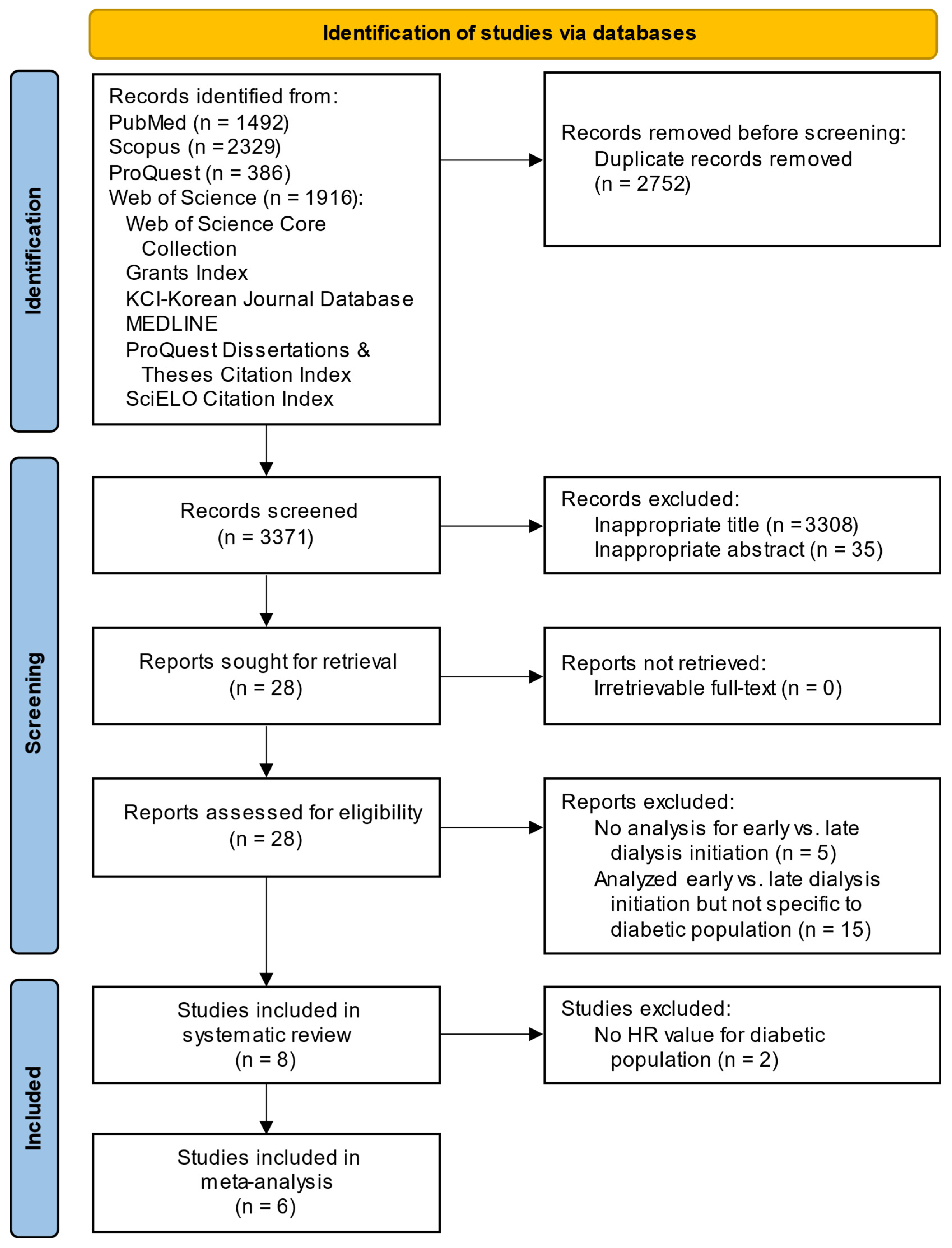
Searches from four databases resulted in 6123 hits (Figure 1). After removing 2752 duplicates, records were screened based on their title and abstract, and 28 reports remained and were sought for retrieval. All 28 reports were then thoroughly assessed and several were excluded due to the following: (1) no analysis for early versus late initiation of dialysis (n = 5); and (2) conducted analysis for early versus late initiation of dialysis but not specific to diabetic patients (n = 15). The details for these excluded studies along with their reasons for exclusion are provided in Supplementary Table S4. Accordingly, eight studies [7,11,12,25,26,27,28,29] were included in the systematic review. Due to unavailability of HR values, the studies by Panaput et al. [28] and Selim et al. [29] were excluded, leaving six studies included in the meta-analysis.

3.2. Characteristics and Outcomes of the Included Studies

Table 1 summarizes the basic study characteristics. Of the eight studies, one by Coronel, Cigarrán and Herrero [25] included only diabetic patients as the whole population, while the rest included a non-specific population with diabetic patients as a smaller subgroup. Characteristics for the diabetic and overall study population were presented separately in Supplementary Table S5 and Supplementary Table S6, respectively. Due to being a subgroup, most characteristics data for patients with diabetes mellitus were missing. The total patients with diabetes mellitus were 303,116 with a year of population sampling ranging from 1982 to 2017. Using overall study population data, the mean age ranged from 52.03 to 71.9 years. Three studies were conducted in Asia, one in Australia, one in America, and three in Europe. Study designs were varied, with one RCT, four common non-randomized cohort studies, and three non-randomized cohort studies using additional analysis to minimize bias. The eGFR cut-offs used to define early and late initiation of dialysis varied across studies, but most fell within the range of 7.0 to 7.7 mL/min/1.73 m2. Panaput et al. [28] and Selim et al. [29] included HD patients only, and Coronel, Cigarrán and Herrero [25] included PD patients only, while the rest included both HD and PD patients. The total number of patients undergoing early and late dialysis could not be determined as one study by Fu et al. [26] did not report the exact numbers due to its study design.
The outcomes reported by the included studies were presented in Supplementary Table S7. The HR value for subgroup of patients with diabetes mellitus in Cooper et al. [7] was extracted using the digitizer tool, while the HR value in Coronel, Cigarrán and Herrero [25] was estimated from the Kaplan–Meier curve. Additionally, RR values from Panaput et al. [28] and Selim et al. [29] were calculated manually using the number of deaths and surviving patients. Follow-up durations for the mortality risk analysis ranged from 1 to 12 years. Out of the six studies that reported HR values, two by Fu et al. [26] and Wright et al. [11] included adjustments for various variables.

3.3. Quality of the Included Studies

According to RoB 2, the RCT by Cooper et al. [7] was considered to have a low risk of bias in all domains, thus having a low overall bias risk (Supplementary Figure S1). The results of the quality assessment of the non-randomized studies using ROBINS-I V2 (Supplementary Figure S2) showed that three studies [12,26,27] had a low risk of bias, three studies [11,25,28] had a serious risk of bias, and one study [29] had a critical risk of bias. Among non-randomized studies with a serious or critical risk of bias, the results in the first domain (i.e., risk of bias due to confounding) were considered the most significant contributor to the overall risk-of-bias results, since these studies did not control for important confounding factors that could influence the study outcome.

3.4. Mortality Risk of Early Versus Late Dialysis Initiation

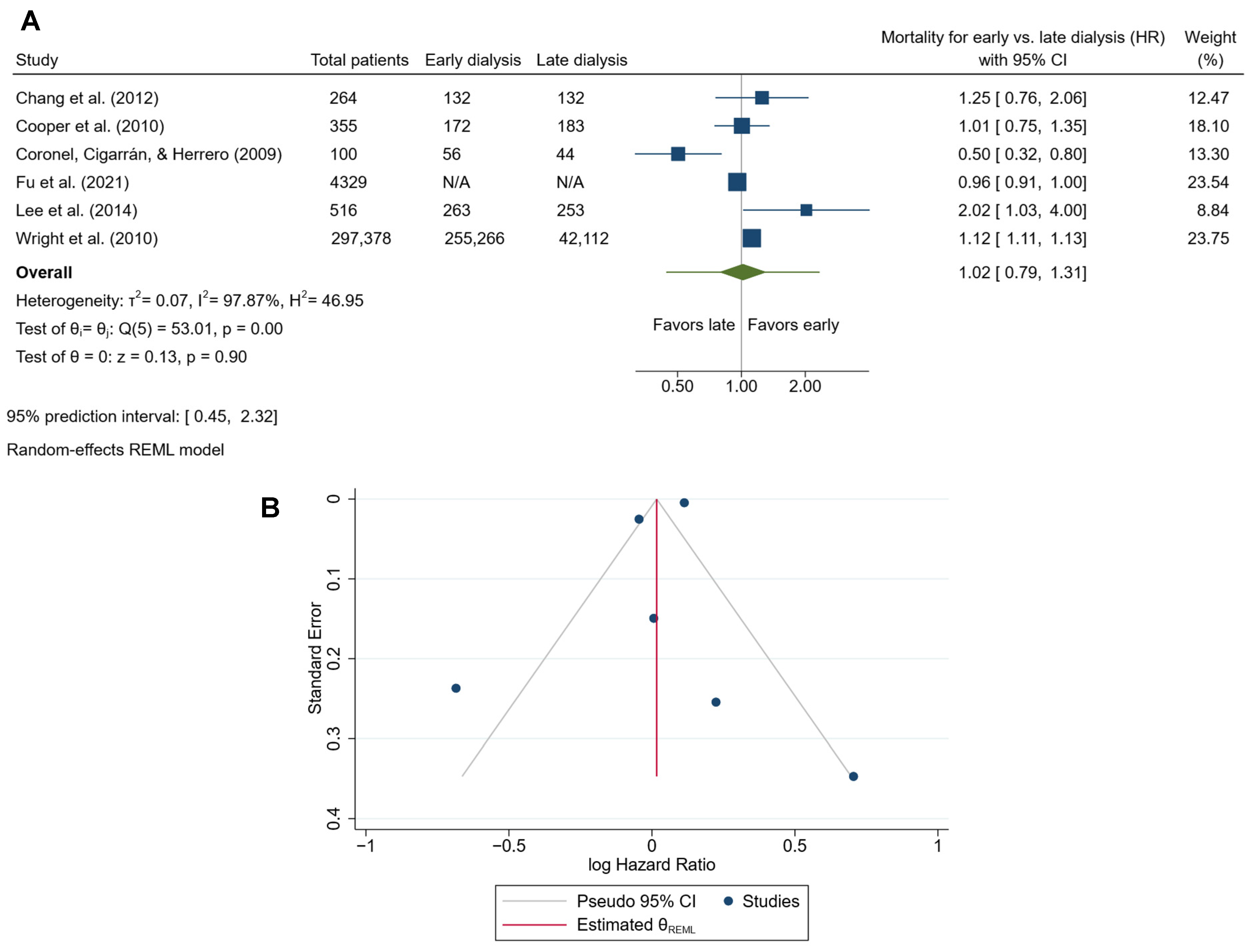
This meta-analysis included six studies reporting HR values. For Fu et al. [26], we used the HR value that compared the intermediate-start group versus the late-start group to be included in our analysis, since the most commonly used eGFR cut-off was approximately 7 mL/min/1.73 m2. The pooled result (Figure 2A) showed no significant difference in the mortality risk for initiating dialysis earlier compared to later in ESKD patients with diabetes mellitus (HR 1.02, 95% CI 0.79–1.31, p = 0.90, 95% PI 0.45–2.32). The heterogeneity level was high (I2 = 97.87%). Assessment of the funnel plot (Figure 2B) using Egger’s test (Z = 0.38, p = 0.703) did not indicate significant asymmetry. However, given that the number of included studies was small, the statistical power of the test is limited and the possibility of publication bias cannot be excluded.
Leave-one-out sensitivity analysis (Supplementary Figure S3) showed that the pooled result was robust and was not significantly affected by any single study. Sensitivity analyses by excluding studies with a serious risk of bias demonstrated that the pooled result remained non-significant (HR 1.05, 95% CI 0.87–1.26, p = 0.62, I2 = 39.38%, 95% PI 0.54–2.03). Similarly, exclusion of studies reporting unadjusted HR values did not change the significancy of the pooled result (HR 1.04, 95% CI 0.89–1.21, p = 0.65, I2 = 97.38%). A 95% PI was not calculated since only two studies were included.
Two studies with RR data, Panaput et al. [28] (RR 0.66, 95% CI 0.22–1.96, p = 0.453) and Selim et al. [29] (RR 0.74, 95% CI 0.43–1.26, p = 0.269), also showed no significant difference in the mortality risk of early versus late dialysis initiation in patients with diabetes mellitus (Supplementary Table S7).
The results of the subgroup analyses and descriptive subgroup summaries are presented in Table 2. There was no subgroup difference on mortality risk of early versus late initiation of dialysis in patients with diabetes mellitus based on different study designs (p = 0.47). Results for other covariates are presented as descriptive summaries. The pooled result within the subgroup involving five studies using an eGFR cut-off of 7.0–7.7 mL/min/1.73 m2 showed no significant difference in the mortality risk of early versus late dialysis initiation (HR 1.00, 95% CI 0.69–1.45, p = 0.99, 95% PI 0.27–3.68). Although some subgroups showed statistically significant results, these findings were based on a single study, limiting the strength of the conclusions and warranting further investigation.
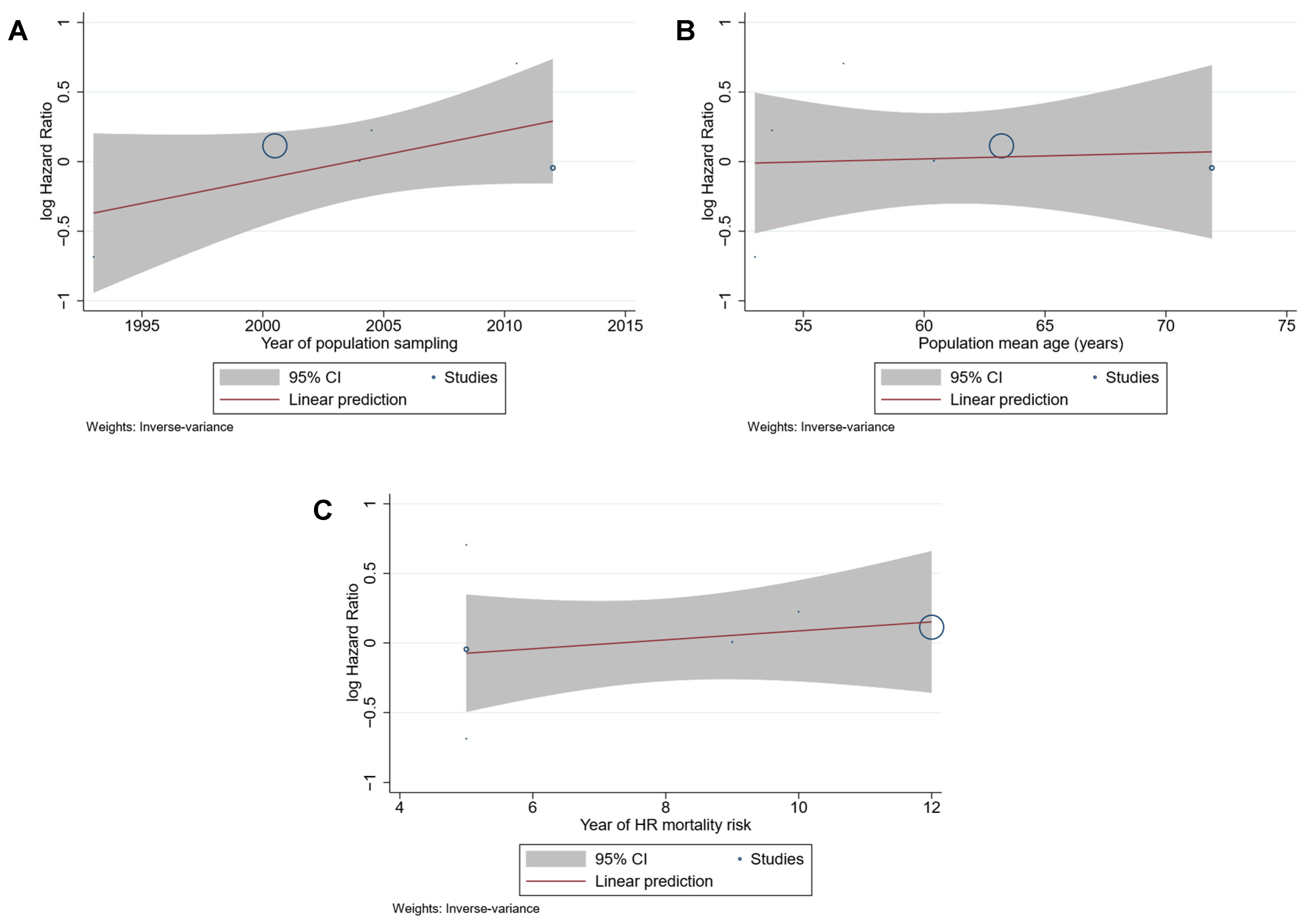
Meta-regression analyses exploring different years of population sampling (Z = 1.52, p = 0.129, Figure 3A), population mean age (Z = 0.17, p = 0.863, Figure 3B), and different follow-up durations (Z = 0.62, p = 0.537, Figure 3C) did not indicate statistically significant associations with the pooled HR. Yet, given the small number of studies included, the statistical power of these analyses was limited.

4. Discussion

The timing of dialysis initiation in ESKD patients with diabetes mellitus presents a critical clinical dilemma, balancing potential metabolic benefits against inherent procedural risks. Despite the hypothesis that early initiation offers survival advantages, our meta-analysis found no significant mortality benefit. Specifically, initiating dialysis at an eGFR of >7.0–7.7 mL/min/1.73 m2 yielded outcomes comparable to late initiation (eGFR < 7.0 mL/min/1.73 m2). This result remained robust after conducting sensitivity analyses.
Previous meta-analyses evaluating the timing of dialysis initiation have reported results that differ from those observed in the present study. For example, Pan et al. (2012) [30] analyzed 15 cohort studies involving more than 1.2 million patients and reported that earlier dialysis initiation was associated with increased mortality (OR 1.33, 95% CI 1.18–1.49, p < 0.001). Similarly, Lin et al. (2016) [31], which focused on East Asian populations, also found that early initiation at a higher eGFR was associated with higher mortality risk (adjusted HR 1.36, 95% CI 1.0–1.85, p < 0.05). However, these meta-analyses primarily included cohort studies from the general CKD population. Differences between our findings and those reported by Pan et al. may also be caused by differences in outcome measurement. Pan et al. synthesized mortality using ORs, which do not account for differences in follow-up time across studies. In contrast, the present analysis primarily used HRs derived from time-to-event analyses, which are generally considered more appropriate for evaluating mortality outcomes in longitudinal cohort studies.
In addition, a previous systematic review by Nacak et al. (2016) [32] evaluated the timing of dialysis initiation in the context of diabetes by including 11 studies. However, most of the included studies did not report diabetes-specific effect estimates. Instead, several studies were included, since at least 30% of the participants within the study had diabetes, making conclusions largely derived from mixed CKD populations. The present meta-analysis included only studies reporting mortality estimates specifically for patients with diabetes mellitus, allowing a more direct synthesis of evidence.
ESKD patients with diabetes mellitus differ significantly from the general CKD population, as their clinical presentation is often confounded by chronic complications mimicking uremic toxicity [15]. This meta-analysis supports the approach that dialysis initiation should not be based solely on eGFR thresholds, but should instead emphasize distinguishing between chronic diabetic complications and true uremic toxicity.
Several factors could explain the non-significant survival benefits in the “early-start” groups. (1) The bias and design of the studies; most included studies were observational, making them susceptible to selection bias (where sicker patients started dialysis earlier), lead-time bias (which can artificially prolong observed survival time without improving true outcomes), and survivor or immortal time bias (where patients must survive long enough to initiate dialysis, potentially excluding those who die during the pre-dialysis period). (2) The creatinine paradox; where patients with low muscle mass produce less creatinine, leading to a falsely elevated eGFR in patients with malnutrition when initiating dialysis [11]. (3) Cardiovascular events (CVEs) in the dialysis initiation period. The transition to dialysis is a period of extreme physiological vulnerability. Baik et al. [33] demonstrated that the risk of CVEs, including stroke and myocardial infarction, is the highest immediately after HD initiation, peaking within the first 10 days and gradually declining over the subsequent 1 to 2 months. Given that HD was the predominant modality in our study, these procedural risks may offset any theoretical benefits of early uremic clearance.
The studies that supported the early dialysis initiation are Fu et al. [26] and Coronel et al. [25]. Fu et al. [26] demonstrated that while very early initiation (eGFR 15–16 mL/min/1.73 m2) statistically outperformed late initiation (eGFR 6–7 mL/min/1.73 m2), the clinical benefit was negligible, amounting to only a 1.6-month survival difference over five years of follow-up. Coronel et al. [25] found a benefit for early PD in diabetic patients. However, the limited sample size (n = 100) lacked sufficient power to influence the overall meta-analysis.
On the other hand, Lee et al. [27] indicated that early dialysis initiation in diabetic patients was associated with higher mortality (HR 2.024; 95% CI 1.025–3.996), while the primary causes of death, including cardiovascular, cerebrovascular, and infectious causes, were similar between the early-start and late-start groups. Similarly, Wright et al. [11] identified that patients initiating dialysis at eGFR < 6 mL/min/1.73 m2 had the best survival rates, while those starting at eGFR > 15 mL/min/1.73 m2 had the highest mortality (HR 1.43; 95% CI 1.41–1.45). This trend was consistent across age groups and comorbidities [11].
The only RCT, IDEAL by Cooper et al. [7], found no mortality difference between groups. Although 75.9% of participants in the late-start group initiated dialysis earlier than the protocol eGFR threshold due to emerging clinical indications, this was allowed in the study protocol. Consequently, the mean eGFR difference between the early-start and late-start group remained relatively small (12 vs. 9.8 mL/min/1.73 m2) and there was a short time difference in initiation (approximately 6 months). This result suggests that symptom-guided initiation, rather than initiation based solely on eGFR thresholds, is a safe strategy for ESKD patients [7].
It is also important to acknowledge that PD is frequently initiated at a higher eGFR compared to HD, with the specific clinical objective of preserving residual renal function. Since the majority of our included studies pooled HD and PD populations, this difference in initiation timing between modalities acts as a potential confounding factor that could not be isolated in the primary analysis. Nevertheless, current evidence from Panaput et al. [28] and Selim et al. [29], which exclusively included HD patients, demonstrated non-significant mortality RRs for early versus late initiation of dialysis among patients with diabetes mellitus.
Finally, the substantial heterogeneity observed across studies requires careful interpretation of the pooled estimate. While our meta-analysis demonstrated no statistically significant difference in mortality between early and late dialysis initiation, the 95% PI (0.45–2.32) indicates a wide range of potential effects, within which the true effect of a future study is expected to lie. The wide interval observed in the present analysis suggests that the effect of early dialysis initiation may vary considerably depending on patient characteristics, dialysis modality, and clinical practice patterns. Importantly, the prediction interval spans both clinically meaningful benefit and harm. Therefore, these findings support that dialysis initiation should be individualized and primarily guided by clinical symptoms and metabolic complications rather than eGFR thresholds alone.
This study provides several important clinical messages. First, it reinforces the principle that the decision to initiate dialysis should be based on a comprehensive assessment of the patient, including their physical (fluid overload, uremic syndrome, refractory hypertension, or electrolyte disturbances), mental, financial, and social considerations, availability of dialysis facilities, and eGFR values [15]. The absence of a survival benefit with early dialysis initiation in this study supports a watchful waiting approach in ESKD patients with diabetes. Accordingly, the optimal strategy is to prepare for early dialysis while aiming for a timely initiation. We suggest that this initiation should be carried out in a planned manner, preferably in an outpatient setting, with a mature arteriovenous fistula for HD or a properly placed Tenckhoff catheter for PD [17]. Second, once dialysis is initiated, close hemodynamic monitoring is essential due to the high risk of CVEs during the first week to the first month of HD, especially in those with diabetes mellitus [33]. Therefore, aggressive CVE prevention strategies should be implemented in this population.

5. Limitations and Future Directions

The authors acknowledge that the available evidence is largely non-randomized and of low-to-moderate quality. The heterogeneity among included studies was substantial, with differences in the definitions of early versus late initiation. Despite the high heterogeneity observed, pooling was considered appropriate because all included studies investigated similar clinical questions. Under a random-effects model, variability in effect sizes across studies is expected and reflects actual differences in patient populations, healthcare systems, and dialysis practices. In this context, the pooled estimate represents the average effect across a distribution of true effects, rather than a single universal treatment effect. To improve interpretability, prediction intervals were further calculated to reflect the potential range of true effects for future studies.
Another limitation is that most included estimates were derived from subgroup analyses of larger cohorts. Although some studies used designs intended to control confounding, such as RCT or propensity score matching, these methods were applied at the overall cohort level and covariate balance within the diabetes subgroup was not consistently verified. This may limit the internal validity of the subgroup-specific estimates. In addition, the assessment of publication bias and the meta-regression analyses were limited by the small number of included studies. Several subgroup categories were represented by only a single study, which precludes meaningful between-subgroup comparisons. Consequently, these analyses should be interpreted as exploratory rather than confirmatory.
A limitation related to the literature search strategy should also be noted. The search did not incorporate controlled vocabulary terms such as MeSH terms and was developed without formal consultation with an information specialist. As a result, the sensitivity and comprehensiveness of the search may have been reduced.
Future research should prioritize several areas, including the use of clinical indications for initiating dialysis; consideration of quality of life as an outcome; evaluation of increasing versus standard dialysis strategies at different initiation timings; separate analysis of HD versus PD cohorts to account for differences in initiation timing between modalities; and investigation of vascular histopathology and molecular changes during arteriovenous fistula creation to better understand how uremic toxins impair the vascular wall prior to dialysis initiation.
Finally, although this review was registered in PROSPERO, the registration was retrospective since the database search had already been completed prior to registration. In addition, a full protocol document and complete search strategy were not publicly available at the time of registration. These factors may increase the risk of outcome-driven methodological decisions and may be perceived as reduced transparency. However, all key methodological decisions reflect standard and widely accepted approaches for this type of meta-analysis. Additionally, all deviations from the protocol have been transparently documented to minimize the risk of bias and allow full appraisal by readers.

6. Conclusions

Current evidence does not demonstrate a clear survival benefit of earlier dialysis initiation in ESKD patients with diabetes mellitus; however, the available evidence remains limited and heterogeneous, requiring further high-quality studies. We suggest that management should focus on planned, timely initiation based on clinical symptoms to minimize procedural mortality.

Supplementary Materials

The following supporting information can be downloaded at https://www.mdpi.com/article/10.3390/kidneydial6020039/s1, Table S1: PRISMA 2020 checklist; Table S2: Protocol deviations from the PROSPERO registration; Table S3: Detailed database search strategies; Table S4: Articles excluded during screening at final stage; Table S5: Characteristics of population with diabetes mellitus of the included studies; Table S6: Characteristics of the overall study population of the included studies; Table S7: Outcomes in population with diabetes mellitus of the included studies; Figure S1: Summary barplot and traffic-light plot for quality assessment of randomized controlled trials using RoB 2; Figure S2: Summary barplot and traffic-light plot for quality assessment of non-randomized studies using ROBINS-I V2; Figure S3: Leave-one-out sensitivity analysis plot for HR meta-analysis of mortality risk in early versus late initiation of dialysis in patients with diabetes mellitus.

Author Contributions

Conceptualization, P.A.M., B.S.W. and A.P.W.; methodology, P.A.M., B.S.W. and A.P.W.; software, B.S.W. and A.P.W.; validation, P.A.M., B.S.W., A.P.W., A.T., W.B. and D.S.; formal analysis, B.S.W. and A.P.W.; investigation, P.A.M., B.S.W., A.P.W. and I.K.A.S.; resources, P.A.M., I.K.A.S., A.T., W.B. and D.S.; data curation, P.A.M., B.S.W., A.P.W., A.T., W.B. and D.S.; writing—original draft preparation, P.A.M., B.S.W., A.P.W. and I.K.A.S.; writing—review and editing, P.A.M., B.S.W., A.P.W., I.K.A.S., A.T., W.B. and D.S.; visualization, B.S.W. and A.P.W.; supervision, D.S.; project administration, P.A.M., B.S.W., A.P.W. and I.K.A.S.; funding acquisition, P.A.M. All authors have read and agreed to the published version of the manuscript.

Funding

This research received no external funding.

Institutional Review Board Statement

Not applicable.

Informed Consent Statement

Not applicable.

Data Availability Statement

The original contributions presented in this study are included in the article and Supplementary Material. Further inquiries can be directed to the corresponding author(s).

Conflicts of Interest

The authors declare that they have no conflicts of interest.

Abbreviations

CANUSA: Canada–USA peritoneal dialysis study; CI: confidence interval; CKD: chronic kidney disease; CKD-EPI: chronic kidney disease epidemiology collaboration; CVE: cardiovascular event; eGFR: estimated glomerular filtration rate; DM: diabetes mellitus; ESKD: end-stage kidney disease; HD: hemodialysis; HR: hazard ratio; IDEAL: initiating dialysis early and late; KDIGO: Kidney Disease: Improving Global Outcomes; MDRD: modification of diet in renal disease; N/A: not available; OR: odds ratio; PD: peritoneal dialysis; PI: prediction interval; PRISMA: preferred reporting items for systematic reviews and meta-analysis; RCTs: randomized controlled trials; REML: restricted maximum likelihood; ROBINS-1 V2: risk of bias in non-randomized studies of interventions version 2; RoB-2: risk of bias 2; RR: risk ratio; RRT: renal replacement therapy; USRDS: United States renal data system.

References

  1. Francis, A.; Harhay, M.N.; Ong, A.C.M.; Tummalapalli, S.L.; Ortiz, A.; Fogo, A.B.; Fliser, D.; Roy-Chaudhury, P.; Fontana, M.; Nangaku, M.; et al. Chronic kidney disease and the global public health agenda: An international consensus. Nat. Rev. Nephrol. 2024, 20, 473–485. [Google Scholar] [CrossRef]
  2. Lv, J.C.; Zhang, L.X. Prevalence and Disease Burden of Chronic Kidney Disease. In Renal Fibrosis: Mechanisms and Therapies, Advances in Experimental Medicine and Biology; Liu, B.-C., Lan, H.-Y., Lv, L.-L., Eds.; Springer: Berlin/Heidelberg, Germany, 2019; Volume 1165. [Google Scholar]
  3. United States Renal Data System. 2022 USRDS Annual Data Report: Epidemiology of Kidney Disease in the United States; National Institute of Diabetes and Digestive and Kidney Diseases: Bethesda, MD, USA, 2022.
  4. Nagata, A.; Yabe, H.; Takahashi, R.; Yamaguchi, T.; Ikeno, K.; Togawa, A. The impact of planned versus unplanned initiation of hemodialysis on physical function during hospitalization in patients with end-stage renal disease. Ren. Replace. Ther. 2026, 12, 9. [Google Scholar] [CrossRef]
  5. Wong, L.P.; Ghosh, A.; Li, J.; Rizk, M.K.; Hohman, J.A. Dialysis costs for a health system participating in value-based care. Am. J. Manag. Care. 2023, 29, e235–e241. [Google Scholar] [PubMed]
  6. Abdel-Rahman, E.M.; Hasan, I.; Abdelrazeq, A.S.; Rawabdeh, A.; Liu, M.; Ghahramani, N.; Sheikh-Hamad, D.; Murea, M.; Kadambi, P.; Ikizler, T.A.; et al. Early versus late initiation of dialysis in CKD stage 5: Time for a consensus. Kidney Int. Rep. 2024, 10, 54–74. [Google Scholar] [CrossRef]
  7. Cooper, B.A.; Branley, P.; Bulfone, L.; Collins, J.F.; Craig, J.C.; Fraenkel, M.B.; Harris, A.; Johnson, D.W.; Kesselhut, J.; Li, J.J.; et al. A randomized, controlled trial of early versus late initiation of dialysis. N. Engl. J. Med. 2010, 363, 609–619. [Google Scholar] [CrossRef] [PubMed]
  8. Rzeszotarski, J.; Grzelakowski, P.; Manitius, J.; Naruszewicz, R. Initiation of hemodialysis and sudden cardiac death—A constant challenge on the threshold of new therapy. Ren. Dis. Transplant. Forum 2023, 16, 14–20. [Google Scholar] [CrossRef]
  9. Canada-USA (CANUSA) Peritoneal Dialysis Study Group. Adequacy of dialysis and nutrition in continuous peritoneal dialysis: Association with clinical outcomes. J. Am. Soc. Nephrol. 1996, 7, 198–207. [Google Scholar] [CrossRef]
  10. Bargman, J.M.; Thorpe, K.E.; Churchill, D.N. Relative contribution of residual renal function and peritoneal clearance to adequacy of dialysis: A reanalysis of the CANUSA study. J. Am. Soc. Nephrol. 2001, 12, 2158–2162. [Google Scholar] [CrossRef]
  11. Wright, S.; Klausner, D.; Baird, B.; Williams, M.E.; Steinman, T.; Tang, H.; Ragasa, R.; Goldfarb-Rumyantzev, A.S. Timing of dialysis initiation and survival in ESRD. Clin. J. Am. Soc. Nephrol. 2010, 5, 1828–1835. [Google Scholar] [CrossRef]
  12. Chang, J.H.; Rim, M.Y.; Sung, J.; Ko, K.P.; Kim, D.K.; Jung, J.Y.; Lee, H.H.; Chung, W.; Kim, S. Early start of dialysis has no survival benefit in end-stage renal disease patients. J. Korean Med. Sci. 2012, 27, 1177–1181. [Google Scholar] [CrossRef]
  13. Peng, Y.; Ye, H.; Yi, C.; Xiao, X.; Huang, X.; Liu, R.; Diao, X.; Mao, H.; Yu, X.; Yang, X. Early initiation of PD therapy in elderly patients is associated with increased risk of death. Clin. Kidney J. 2020, 14, 1649–1656. [Google Scholar] [CrossRef]
  14. Laham, G.; Pujol, G.S.; Guzman, J.; Boccia, N.; Abib, A.; Diaz, C.H. Early start hemodialysis with a catheter may be associated with greater mortality: A propensity score analysis. Semin. Dial. 2023, 36, 294–302. [Google Scholar] [CrossRef]
  15. Kidney Disease: Improving Global Outcomes (KDIGO) CKD Work Group. KDIGO 2024 Clinical Practice Guideline for the Evaluation and Management of Chronic Kidney Disease. Kidney Int. 2024, 105, S117–S314. [Google Scholar] [CrossRef]
  16. Shimizu, Y.; Nakata, J.; Yanagisawa, N.; Shirotani, Y.; Fukuzaki, H.; Nohara, N.; Suzuki, Y. Emergent initiation of dialysis is related to an increase in both mortality and medical costs. Sci. Rep. 2020, 10, 19638. [Google Scholar] [CrossRef] [PubMed]
  17. Wang, X.; Tian, K.; Hu, J.; Kang, S.; Deng, S.; Gao, X.; Mo, Y. Patients’ transition experience and care from predialysis to dialysis: A theory-guided integrative review. BMC Nephrol. 2025, 26, 182. [Google Scholar] [CrossRef] [PubMed]
  18. Ferguson, T.W.; Garg, A.X.; Sood, M.M.; Rigatto, C.; Chau, E.; Komenda, P.; Naimark, D.; Nesrallah, G.E.; Soroka, S.D.; Beaulieu, M.; et al. Association between the publication of the Initiating Dialysis Early and Late trial and the timing of dialysis initiation in Canada. JAMA Intern. Med. 2019, 179, 934–941. [Google Scholar] [CrossRef]
  19. Liu, Y.; Wang, L.; Han, X.; Wang, Y.; Sun, X.; Jiang, H.; Shi, W.; Liu, W.; Fu, P.; Ding, X.; et al. The profile of timing dialysis initiation in patients with end-stage renal disease in China: A cohort study. Kidney Blood Press. Res. 2020, 45, 180–193. [Google Scholar] [CrossRef]
  20. Japiong, M.; Landy, C.K.; Fox, M.T.; Mensah, J.; Adatara, P. Factors affecting access to dialysis for patients with end-stage kidney disease in Sub-Saharan Africa: A scoping review. Nurs. Open 2023, 10, 6724–6748. [Google Scholar] [CrossRef]
  21. Page, M.J.; McKenzie, J.E.; Bossuyt, P.M.; Boutron, I.; Hoffmann, T.C.; Mulrow, C.D.; Shamseer, L.; Tetzlaff, J.M.; Akl, E.A.; Brennan, S.E.; et al. The PRISMA 2020 statement: An updated guideline for reporting systematic reviews. Syst. Rev. 2021, 10, 89. [Google Scholar] [CrossRef] [PubMed]
  22. Sterne, J.A.C.; Savović, J.; Page, M.J.; Elbers, R.G.; Blencowe, N.S.; Boutron, I.; Cates, C.J.; Cheng, H.Y.; Corbett, M.S.; Eldridge, S.M.; et al. RoB 2: A revised tool for assessing risk of bias in randomised trials. BMJ 2019, 366, l4898. [Google Scholar] [CrossRef]
  23. Cochrane Bias Methods Group; the Cochrane Non-Randomised Studies Methods Group. ROBINS-I V2 Tool. 2024. Available online: https://www.riskofbias.info/welcome/robins-i-v2 (accessed on 3 August 2025).
  24. Liu, N.; Zhou, Y.; Lee, J.J. IPDfromKM: Reconstruct individual patient data from published Kaplan-Meier survival curves. BMC Med. Res. Methodol. 2021, 21, 111. [Google Scholar] [CrossRef]
  25. Coronel, F.; Cigarran, S.; Herrero, J.A. Early initiation of peritoneal dialysis in diabetic patients. Scand. J. Urol. Nephrol. 2009, 43, 148–153. [Google Scholar] [CrossRef] [PubMed]
  26. Fu, E.L.; Evans, M.; Carrero, J.J.; Putter, H.; Clase, C.M.; Caskey, F.J.; Szymczak, M.; Torino, C.; Chesnaye, N.C.; Jager, K.J.; et al. Timing of dialysis initiation to reduce mortality and cardiovascular events in advanced chronic kidney disease: Nationwide cohort study. BMJ 2021, 375, e066306. [Google Scholar] [CrossRef]
  27. Lee, J.; An, J.N.; Hwang, J.H.; Kim, Y.L.; Kang, S.W.; Yang, C.W.; Kim, N.-H.; Oh, Y.K.; Lim, C.S.; Lee, J.P. Effect of dialysis initiation timing on clinical outcomes: A propensity-matched analysis of a prospective cohort study in Korea. PLoS ONE 2014, 9, e105532. [Google Scholar] [CrossRef]
  28. Panaput, T.; Domrongkitchaiporn, S.; Thinkhamrop, B.; Sirivongs, D.; Praderm, L.; Anukulanantachai, J.; Kanokkantapong, C.; Tungkasereerak, P.; Pongskul, C.; Anutrakulchai, S.; et al. Early as compared to late initiation of twice-weekly hemodialysis and short-term survival among end-stage renal disease patients. Hemodial. Int. 2022, 26, 509–518. [Google Scholar] [CrossRef] [PubMed]
  29. Selim, G.; Stojceva-Taneva, O.; Spasovski, G.; Tozija, L.; Grozdanovski, R.; Georgievska-Ismail, L.; Zafirova-Ivanovska, B.; Dzekova, P.; Trajceska, L.; Gelev, S.; et al. Timing of nephrology referral and initiation of dialysis as predictors for survival in hemodialysis patients: 5-year follow-up analysis. Int. Urol. Nephrol. 2015, 47, 153–160. [Google Scholar] [CrossRef]
  30. Pan, Y.; Xu, X.D.; Guo, L.L.; Cai, L.L.; Jin, H.M. Association of early versus late initiation of dialysis with mortality: Systematic review and meta-analysis. Nephron Clin. Pract. 2012, 120, c121–c131. [Google Scholar] [CrossRef]
  31. Lin, X.; Zeng, X.Z.; Ai, J. The Glomerular Filtration Rate (GFR) at Dialysis Initiation and Mortality in Chronic Kidney Disease (CKD) in East Asian Populations: A Meta-analysis. Intern. Med. 2016, 55, 3097–3104. [Google Scholar] [CrossRef] [PubMed]
  32. Nacak, H.; Bolignano, D.; Van Diepen, M.; Dekker, F.; Van Biesen, W. Timing of start of dialysis in diabetes mellitus patients: A systematic literature review. Nephrol. Dial. Transplant. 2016, 31, 306–316. [Google Scholar] [CrossRef] [PubMed]
  33. Baik, M.; Jeon, J.; Yoo, J.; Nam, H.S.; Heo, J.H.; Kim, J.; Kim, Y.D. Risk of cardiovascular events following hemodialysis initiation: A self-controlled case series study. Kidney Res. Clin. Pract. 2024; in press.
Figure 1. PRISMA flowchart of the study selection process. HR, hazard ratio; PRISMA, Preferred Reporting Items for Systematic Reviews and Meta-Analyses.
Kidneydial 06 00039 g001
Figure 2. Forest plot (A) and funnel plot (B) of HR meta-analysis for mortality risk in early versus late initiation of dialysis in patients with diabetes mellitus [7,11,12,25,26,27]. Horizontal line extending from the overall effect diamond of the forest plot indicates 95% prediction interval. CI, confidence interval; HR, hazard ratio; N/A, not available.
Kidneydial 06 00039 g002
Figure 3. Bubble plots of meta-regressions based on year of population sampling (A), population mean age (B), and follow-up duration of HR mortality risk (C) in early versus late initiation of dialysis in patients with diabetes mellitus. Population mean age used was imputed from the overall study population age. CI, confidence interval; HR, hazard ratio.
Kidneydial 06 00039 g003
Table 1. Characteristics of the included studies.
Author (Year)Study LocationStudy DesigneGFR EquationDefinition of Early vs. Late Initiation of DialysisDialysis Type in PopulationYear of Population SamplingFollow-Up DurationEnd Follow-Up PeriodTotal Patients with DM
(Early Start/Late Start)
Chang et al. (2012) [12]South Korea, AsiaNon-randomized retrospective cohort with propensity score matchingMDRDEarly: eGFR ≥ 7.74 mL/min/1.73 m2
Late: eGFR < 7.74 mL/min/1.73 m2
HD and PD2000–2009Early group: mean 41.9 months Late group: mean 44.2 monthsUntil 31 December 2010 or death264
(132/132)
Cooper et al. (2010) [7]/IDEAL studyAustralia and New Zealand, AustraliaRandomized controlled trialCockroft-GaultEarly: eGFR 10–14 mL/min/1.73 m2
Late: eGFR 5–7 mL/min/1.73 m2
HD and PD2000–2008Early group: median 3.64 years (range 0.03 to 9.15)
Late group: median 3.57 years (range 0.02 to 8.78)
Until November 2009 or death355
(172/183)
Coronel, Cigarrán and Herrero (2009) [25]Spain, EuropeNon-randomized retrospective cohortMDRD-7Early: eGFR > 7.7 mL/min/1.73 m2
Late: eGFR ≤ 7.7 mL/min/1.73 m2
PD only1982–2004N/AUp to 5 years or until death100
(56/44)
Fu et al. (2021) [26]Sweden, EuropeNon-randomized retrospective cohort with cloning, censoring, and weighting method mimicking a clinical trialCKD-EPIEarly: eGFR 10–14 mL/min/1.73 m2
Intermediate: eGFR 7–10 mL/min/1.73 m2
Late: eGFR 5–7 mL/min/1.73 m2
HD and PD2007–2017N/AUp to 5 years, until 1 June 2017, or death4329
(N/A/N/A) a
Lee et al. (2014) [27]South Korea, AsiaNon-randomized prospective cohort with propensity score matchingCKD-EPIEarly: eGFR > 7.372 mL/min/1.73 m2
Late: eGFR < 7.372 mL/min/1.73 m2
HD and PD2008–2013N/AUntil October 2013 or death516
(263/253)
Panaput et al. (2022) [28]Thailand, AsiaNon-randomized retrospective cohortCKD-EPIEarly: eGFR ≥ 5 mL/min/1.73 m2
Late: eGFR < 5 mL/min/1.73 m2
HD only2011–2012Mean 12.1 monthsUntil 15 months after recruitment or death135
(48/87)
Selim et al. (2015) [29]North Macedonia, EuropeNon-randomized retrospective cohortCockcroft–Gault corrected for body surface areaEarly: eGFR ≥ 7.5 mL/min/1.73 m2
Late: eGFR < 7.5 mL/min/1.73 m2
HD only1994–2004Median 60 monthsUp to 5 years, until 31 January 2009, or death39
(29/10)
Wright et al. (2010) [11]United States, AmericaNon-randomized retrospective cohortMDRDEarly: eGFR > 5–10 mL/min/1.73 m2
Late: eGFR ≤ 5 mL/min/1.73 m2
HD and PD1995–2006N/AUntil 30 September 2006, or death297,378
(255,266/42,112)
a Exact number of patients was not available due to the study design. CKD-EPI, Chronic Kidney Disease Epidemiology Collaboration; DM, diabetes mellitus; eGFR, estimated glomerular filtration rate; HD, hemodialysis; MDRD, Modification of Diet in Renal Disease; N/A, not available; PD, peritoneal dialysis.
Table 2. Subgroup analyses and descriptive subgroup summaries for meta-analysis of mortality risk in early versus late initiation of dialysis in patients with diabetes mellitus.
Overall/SubgroupsTotal StudiesTotal SubjectsHR for Mortality RiskHeterogeneityp-Value for Subgroup Differences
Value95% CIp-Value95% PII2 (%)p-Value
Overall6302,9421.020.79–1.310.900.45–2.3297.87<0.01N/A
eGFR cut-off for early vs. late initiation of dialysis N/A a
5.0 mL/min/1.73 m21297,3781.121.11–1.13<0.001N/AN/AN/A
7.0–7.7 mL/min/1.73 m2555641.000.69–1.450.990.27–3.6884.640.01
Study design 0.47
Common cohort studies2297,4780.780.36–1.700.53N/A91.18<0.01
Studies with designs to minimize bias (including RCT)454641.050.87–1.260.620.54–2.0339.380.12
Type of dialysis N/A a
Combined HD and PD population5302,8421.070.94–1.210.320.73–1.5588.55<0.01
PD only population11000.500.32–0.800.004N/AN/AN/A
eGFR equation N/A a
CKD-EPI248451.280.63–2.630.49N/A78.470.03
Cockcroft–Gault13551.010.75–1.350.97N/AN/AN/A
MDRD3297,7420.910.53–1.540.720.001–566.4485.91<0.01
Study regions N/A a
America1297,3781.121.11–1.13<0.001N/AN/AN/A
Asia27801.500.95–2.370.08N/A19.920.26
Australia13551.010.75–1.350.97N/AN/AN/A
Europe244290.720.39–1.350.31N/A86.130.01
a Test for subgroup differences was not conducted as several categories contained only one study. CI, confidence interval; CKD-EPI, Chronic Kidney Disease Epidemiology Collaboration; eGFR, estimated glomerular filtration rate; HD, hemodialysis; HR, hazard ratio; MDRD, Modification of Diet in Renal Disease; N/A, not available; PD, peritoneal dialysis; PI: prediction interval; RCT, randomized controlled trial.
Disclaimer/Publisher’s Note: The statements, opinions and data contained in all publications are solely those of the individual author(s) and contributor(s) and not of MDPI and/or the editor(s). MDPI and/or the editor(s) disclaim responsibility for any injury to people or property resulting from any ideas, methods, instructions or products referred to in the content.