Communication

Microbiome Collapse in the Ornamental Fish Trade: A Hidden Driver of Post-Purchase Mortality

1
School of Science and Technology, Hong Kong Metropolitan University, Hong Kong SAR, China
2
Department of Food Science and Nutrition, Faculty of Science, The Hong Kong Polytechnic University, Hung Hom, Kowloon, Hong Kong SAR, China
*
Authors to whom correspondence should be addressed.
Appl. Microbiol. 2026, 6(3), 38; https://doi.org/10.3390/applmicrobiol6030038
Submission received: 12 January 2026 / Revised: 21 February 2026 / Accepted: 26 February 2026 / Published: 1 March 2026

Abstract

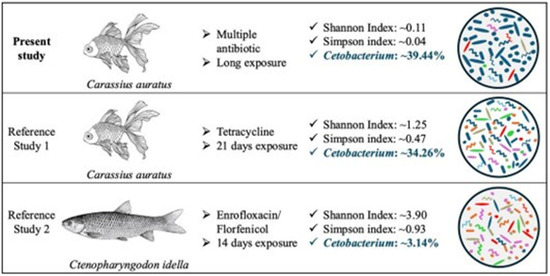
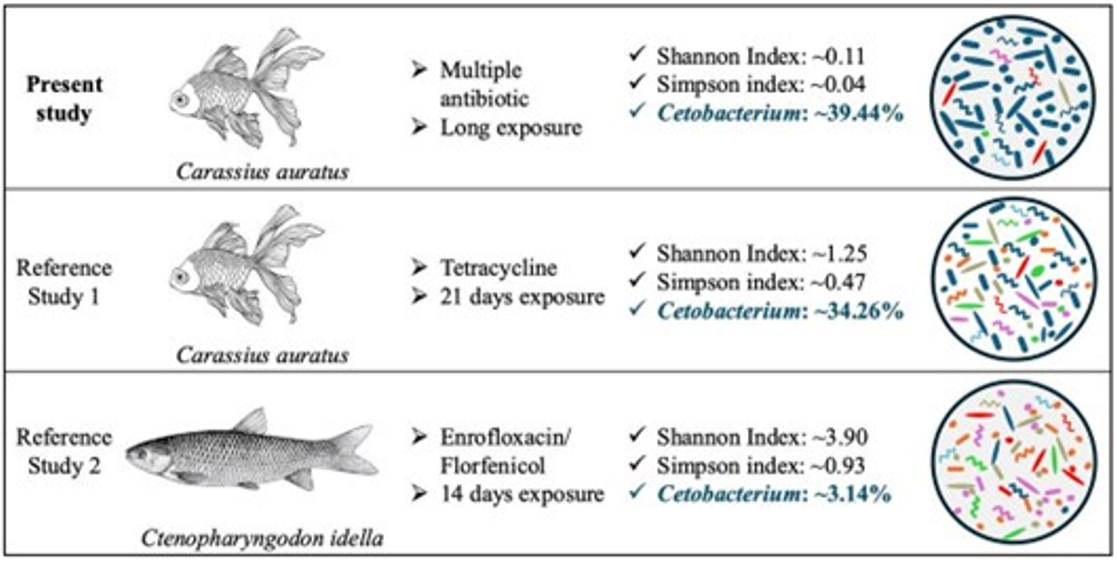
Prophylactic antibiotic use in high-density ornamental aquaculture aims to mitigate infections, yet it is hypothesized to induce severe gut microbiome dysbiosis, contributing to high post-purchase mortality of goldfish purchased from retail stores by end consumers. This study utilized 16S rRNA gene amplicon sequencing, a rapid and high-resolution tool to characterize gut bacterial communities in six goldfish (Carassius auratus) sourced from antibiotic-intensive retail market in Hong Kong SAR, China. Diversity metrics were compared to unexposed reference controls and experimentally antibiotic-exposed cyprinid groups from published datasets. Market-sourced goldfish showed a profound collapse in alpha diversity (mean Shannon index 0.107 ± 0.141), far lower than controls (typically 2.0–4.5) and experimental groups (1.06–4.34). The microbiota exhibited extreme oligodominance by Cetobacterium and Vibrio, with near-total loss of beneficial commensal taxa. Principal coordinates analysis (PCoA) revealed distinct clustering, indicating fundamental and likely irreversible microbial restructuring. These findings show that chronic antibiotic exposure in ornamental supply chains induces a depauperate microbiome state, compromising host resilience and physiological homeostasis during environmental transitions. This dysbiosis provides a microbiological explanation for widespread post-purchase die-off, highlighting a major animal welfare and biosecurity concern. High-throughput sequencing offers quick, in-depth microbiome health assessment, essential for developing interventions to improve husbandry and reduce antimicrobial reliance in the global ornamental fish trade.

Graphical Abstract

1. Introduction

The global ornamental fish trade is a burgeoning industry valued at USD 15–30 billion annually, representing one of the largest and most complex live animal movements worldwide [1]. Ornamental fish are currently the third most popular companion animal globally; in high-density urban centres like Hong Kong SAR, approximately 14% of households maintain home aquaria [2,3]. Owing to limited local supply, Hong Kong depends heavily on imports and ranked as the world’s fourteenth largest ornamental fish importer in 2024 [4].
Imported fish are concentrated in densely stocked retail hubs such as the Goldfish Market in Mong Kok, where multiple environmental stressors, including chronic crowding (high stocking density), handling (netting, transport, and physical manipulation), suboptimal water quality (e.g., elevated organic load, fluctuating dissolved oxygen, pH shifts, and ammonia/nitrite accumulation), and poor nutrient/organic management (leading to high nutrient loads and toxic waste build-up) collectively act synergistically to create ideal conditions for pathogen proliferation facilitating opportunistic bacterial diseases including streptococcosis, columnaris, fin rot, and mycobacteriosis [2,5,6].
To mitigate the risk of pre-sale mortality, retailers in the ornamental fish trade commonly administer prophylactic antibiotics throughout the supply chain including transport (via carriage water) and retail holding/display tanks [7,8]. Multiple antimicrobial classes, including tetracyclines (e.g., oxytetracycline, doxycycline), fluoroquinolones (e.g., enrofloxacin), quinolones (e.g., oxolinic acid), and amphenicols (e.g., florfenicol) have been detected at high concentrations in ornamental fish carriage and display water from ornamental fish shops [2,9]. Because ornamental fish are not included in food safety regulations, antimicrobial use in this sector remains largely unregulated and application rates often exceed those of industrial food production [6,10]. Consequently, antibiotic-resistant bacteria such as species of Aeromonas, Pseudomonas, Streptococcus, and Mycobacterium carrying multiple resistance determinants are increasingly reported from ornamental fish systems worldwide [7,8,11]. However, beyond the emergence of resistant pathogens, the broader effects of chronic, multi-class antibiotic exposure on the ornamental fish gut microbiota remain poorly understood. Evidence from other teleost models suggested that repeated exposure to multiple antimicrobials imposes intense selective pressure that preferentially eliminates sensitive commensal taxa while facilitating the dominance of resistant or opportunistic organisms, with potential consequences for host health and resilience [12,13].
In this context, we postulated that prolonged, multi-class antibiotic exposure across the ornamental fish supply chain is associated with altered gut microbial diversity and composition, potentially reducing microbiome stability following transfer to “antibiotic-free” home aquaria. To address this gap, we characterized the gut bacterial communities of the goldfish (Carassius auratus), a species selected for its status as the most traded ornamental fish globally and its established role as a model organism in teleost physiological research. We utilized 16S rRNA gene amplicon sequencing to provide a rapid, high-resolution, and cost-effective assessment of the bacterial community structure. By comparing our findings with published reference controls and antibiotic-exposed conspecific baselines, this study aims to provide a mechanistic explanation for the high post-purchase mortality observed in the trade, highlighting a critical but overlooked animal welfare and biosecurity challenge.

2. Materials and Methods

2.1. Fish Sampling and Study Location

The animal study protocol was approved by the Research Ethics Committee, Hong Kong Metropolitan University (protocol code AE–RGC2023/ST11; approved 28 February 2024). Six live ornamental goldfish (Carassius auratus; mean weight 35 ± 5 g) were purchased on a single day in July 2025 from two different retailers in the Goldfish Market, Mong Kok, Hong Kong SAR, China. Fish 1–3 were obtained from one retailer and had been housed in the same holding tank; fish 4–6 were obtained from a second retailer and held in a separate tank. This retail hub serves as a representative site for intensive ornamental trade, where prophylactic antibiotics (e.g., tetracyclines and fluoroquinolones) are routinely administered to holding tanks. Previous environmental monitoring of tank and carriage water at this location has confirmed the presence of multiple antimicrobial residues, including doxycycline (0.0155–0.0836 µg L−1), oxytetracycline (0.0102–29.0 µg L−1), tetracycline (0.0350–0.244 µg L−1), enrofloxacin (0.00107–0.247 µg L−1), and oxolinic acid (n.d.–0.514 µg L−1) [2,9]. The purchased goldfish were transported to the laboratory in the original package bags (filled with carriage water and atmospheric gas) and processed within 60 min of arrival.

2.2. Sample Collection

Fish were euthanised by immersion in tricaine methanesulfonate (MS-222; 250 mg L−1) until complete cessation of opercular movement. Dissection and sampling were performed using aseptic technique on a bench wiped with 70% ethanol and covered with fresh sterile aluminium foil. A Bunsen burner flame was kept continuously burning nearby throughout the procedure to create a localised sterile air curtain and reduce airborne contamination. All instruments, including forceps, scissors, scalpels, and inoculation loops, were autoclaved or sterile single-use items, and were additionally flame-sterilised by brief passage through t burner flame immediately before and after each use. Nitrile gloves were changed between individual fish. To minimise external contamination, each fish was rinsed sequentially with 75% ethanol and sterile phosphate-buffered saline (PBS) prior to dissection. To characterize the gut-associated microbiota, the intestinal tract was excised via ventral midline incision using sterile instruments. Digesta and mucosal samples were collected specifically from the hindgut (defined as the posterior 8–10 cm of the tract). Hindgut digesta (HD) were gently emptied into sterile microcentrifuge tubes by gently squeezing, while hindgut mucosal (HM) material was collected by aseptically scraping the inner intestinal wall with a sterile loop to minimize digesta carryover. All samples were immediately frozen and stored at −80 °C until downstream DNA extraction.

2.3. DNA Extraction and 16S rRNA Gene Amplicon Sequencing

Genomic DNA was extracted using the QIAamp Fast DNA Stool Mini Kit (Qiagen, Hilden, Germany) according to the manufacturer’s instructions. Extracted DNA was submitted to Groken Bioscience (Beijing, China) for 16S rRNA gene amplicon sequencing. Sequencing libraries were prepared using the MetaVX Library Prep Kit (Genewiz/Groken Bioscience, Beijing, China). Briefly, 20–50 ng of genomic DNA was used as template to amplify the V3–V4 hypervariable regions of the bacterial 16S rRNA gene with the following primers: Forward: 5′-ACTCCTACGGGAGGCAGCAG-3′ and Reverse: 5′-GGACTACHVGGGTWTCTAAT-3′. Amplicons were purified, and library quality was assessed by determining DNA concentration with a microplate reader (Tecan Infinite 200 Pro, Tecan Trading AG, Männedorf, Switzerland) and fragment size verification via 1.5% agarose gel electrophoresis (expected size ≈ 600 bp). Paired-end sequencing was performed on an Illumina MiSeq platform (Illumina, San Diego, CA, USA) following the manufacturer’s standard protocols for cluster generation and sequencing.

2.4. Sequence Processing and Taxonomic Analysis

Sequence data were processed and analysed using OmicsBox software v3.5.3 (BioBam, Valencia, Spain). The quality of paired-end raw reads was first assessed with FastQC [14], after which adapter sequences and low-quality reads were removed using Trimmomatic [15]. Only reads passing quality filters were retained for downstream analysis.
Taxonomic classification was carried out using Kraken2, a k-mer-based classifier, against the curated NCBI RefSeq 2024-11 whole-genome shotgun (WGS) prokaryotic reference database (RefSeq release, November 2024) [16]. Kraken2 assigns reads to taxonomic nodes by matching k-mers to the lowest common ancestor (LCA) in the reference database, allowing classification across multiple taxonomic levels from phylum to species. This approach was selected for its computational efficiency, accuracy at genus and species level resolution, and suitability for broad community structure analyses, including assessments of relative abundance and beta diversity. Benchmarking studies have demonstrated that Kraken2 performs comparably to, or better than, ASV-based pipelines such as DADA2/QIIME2 on 16S amplicon data [17]. No amplicon sequence variant (ASV) or operational taxonomic unit (OTU) clustering was applied, as the analysis focused on read-level taxonomic classification rather than denoised variant resolution. Reads assigned to mitochondria, chloroplasts, or non-bacterial taxa were excluded prior to downstream processing.
Alpha diversity indices were calculated using the full set of bacterial taxa assigned by Kraken2, without OTU clustering or ASV inference. Each taxonomic assignment, nominally resolved to the species level in the reference database, was treated as a discrete feature for diversity calculations. For downstream comparisons, read counts were normalised to relative abundance, expressed as proportions of total classified reads per sample.
The Shannon diversity index (H′), which integrates taxon richness and evenness (with greater weight on rare taxa), was computed as
H = i = 1 S p i   l n   ( p i )
where S is the number of observed taxa, p i is the proportional abundance of taxon i (relative frequency of assigned reads, with p i = 1 ), and l n denotes the natural logarithm (base e). The normalised Shannon index was reported as H / l n   ( N ) , where N is the total number of classified bacterial reads per sample after normalisation, to mitigate bias from differences in sequencing depth.
The Simpson dominance index (D), which is more sensitive to abundant taxa and represents the probability that two randomly selected reads belong to the same taxon, was calculated as
D = i = 1 S p i 2
The reported Simpson index is the complement (Gini–Simpson index): 1 D , representing the probability that two randomly selected reads belong to different taxa (values increase toward 1 with greater diversity). These metrics follow conventional formulations implemented in OmicsBox v3.5.3 for metagenomic abundance tables.
Rarefaction was not applied for primary statistical comparisons to avoid unnecessary data loss, consistent with current recommendations for relative abundance-based analyses in microbiome datasets with uneven sequencing depth [18].
For beta diversity visualisation, Principal Coordinates Analysis (PCoA) was performed on a Bray–Curtis dissimilarity matrix derived from relative abundance data filtered to taxa present at ≥0.1% (phylum level) and ≥1% (genus level) of total classified reads per sample. This filtering step focused the analysis on dominant community members while reducing noise introduced by low-abundance taxa. PCoA was chosen as the ordination method for its ability to preserve inter-sample dissimilarities in low-dimensional space, consistent with standard practice in microbiome beta diversity analyses [19]. Group differences were tested using PERMANOVA with 9999 permutations.
For contextual comparison, previously published 16S rRNA gene amplicon datasets from Carassius auratus (BioProject PRJNA543931; [20]) and Ctenopharyngodon idella (BioProject PRJEB55267; [21]) were retrieved from the NCBI Sequence Read Archive and reanalysed using the same Kraken2-based pipeline described above. This ensured that differences in community composition between studies reflected biological rather than methodological variation. In reference study 1 by Jia et al. [20], goldfish were exposed to tetracycline in water at 0.285 μg/L (low dose) or 2.85 μg/L (high dose) continuously for up to 21 days, with sampling at 7 and 21 days post-exposure. In reference study 2, Shi et al. [21], grass carp received enrofloxacin or florfenicol separately via feed at 10 mg/kg for 14 days, followed by post-treatment gut microbiome sampling. Technical differences (e.g., primer regions, extraction methods, gut sections) between the present and reference studies, based on the information provided in the original articles are detailed in Supplementary Table S2.

3. Results

3.1. Alpha Diversity of the Gut Bacterial Communities

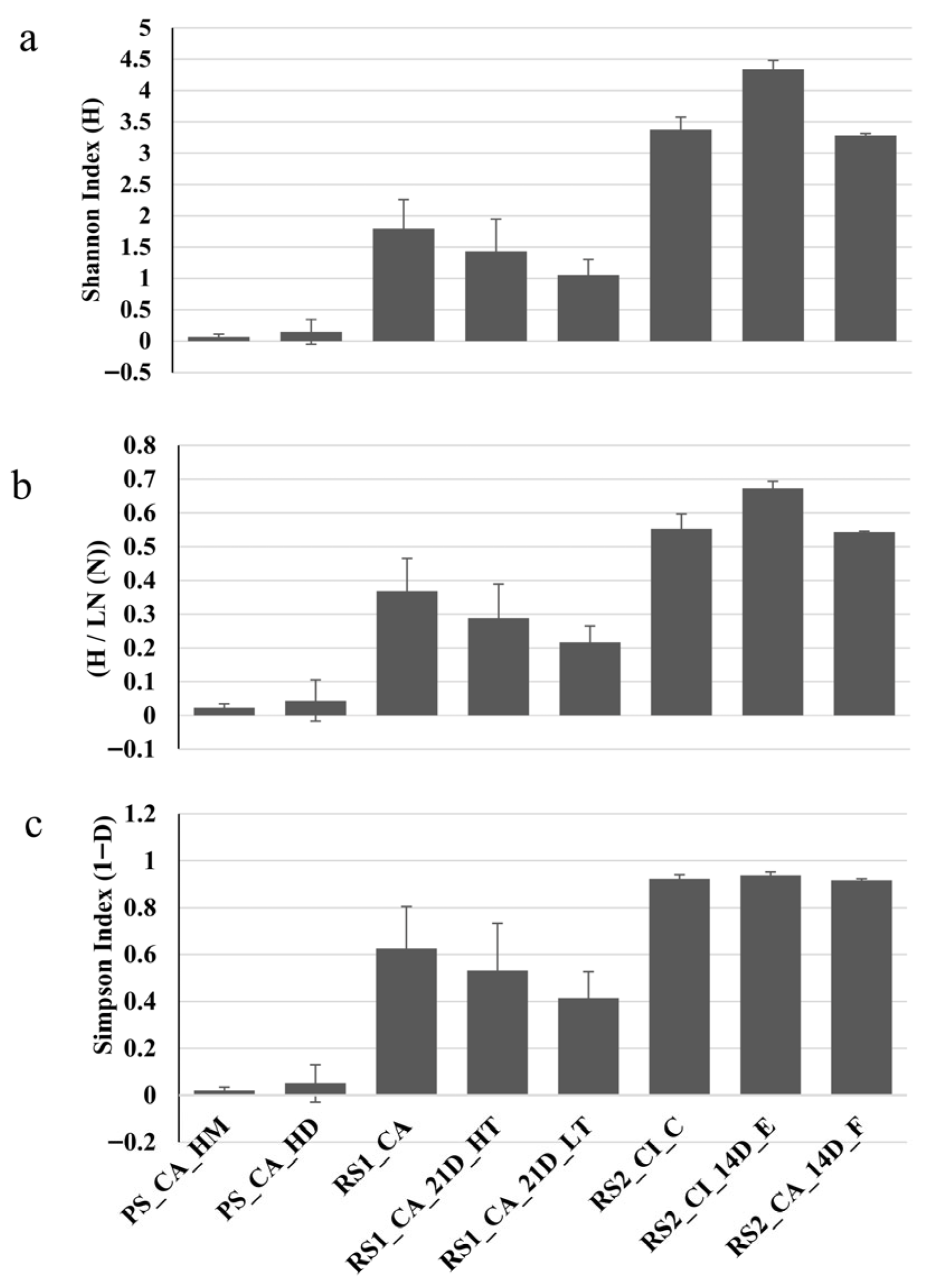
Sequencing depth after quality filtering and classification ranged from 96,054 to 342,201 reads per sample (196,023 ± 77,471; detailed per-sample metrics in Supplementary Table S1). Alpha diversity analysis at the species level revealed a dramatic collapse in bacterial community complexity in ornamental goldfish sourced from antibiotic-intensive commercial retail markets in Hong Kong SAR, China, compared with published reference datasets from experimentally controlled cyprinid populations (Table S1; Figure 1).
Hindgut mucous samples collected from the present study (PS_CA_HM; n = 6) displayed extremely low diversity, with a mean Shannon index of 0.068 ± 0.039 (range: 0.024–0.119). Hindgut digesta samples (PS_CA_HD; n = 6) exhibited slightly higher but still severely depressed values (mean Shannon index: 0.145 ± 0.196; range: 0.018–0.540), primarily due to a single outlier. Pooled across all market-sourced goldfish gut samples (n = 12), the mean Shannon index was 0.107 ± 0.141.
By contrast, reference control groups showed substantially higher diversity. RS1_CA_Control (C. auratus; n = 3) yielded a mean Shannon index of 1.791 ± 0.464 (range: 1.353–2.278), while RS2_CL_Control (Ctenopharyngodon idella; n = 3) averaged 3.374 ± 0.203 (range: 3.255–3.608). The pooled reference controls (n = 6) exhibited an approximate mean of 2.58. Even reference groups exposed to controlled antibiotic treatments (RS1_21D_HT/LT and RS2_14D_E/F) retained considerably greater diversity (means ranging from approximately 1.06 to 4.34) than the market samples in the present study.
Consistent patterns emerged for normalized Shannon index (H/ln(N)) and Simpson’s index (1 − D), which underscored extremely low evenness and strong dominance by a restricted number of taxa in the market-sourced samples (Figure 1).
These exceptionally low alpha diversity values, orders of magnitude below those typically reported for reference controls (commonly ranging from 2 to 4 in aquaculture conspecifics) are indicative of profound dysbiosis.

3.2. Beta Diversity and Community Structure

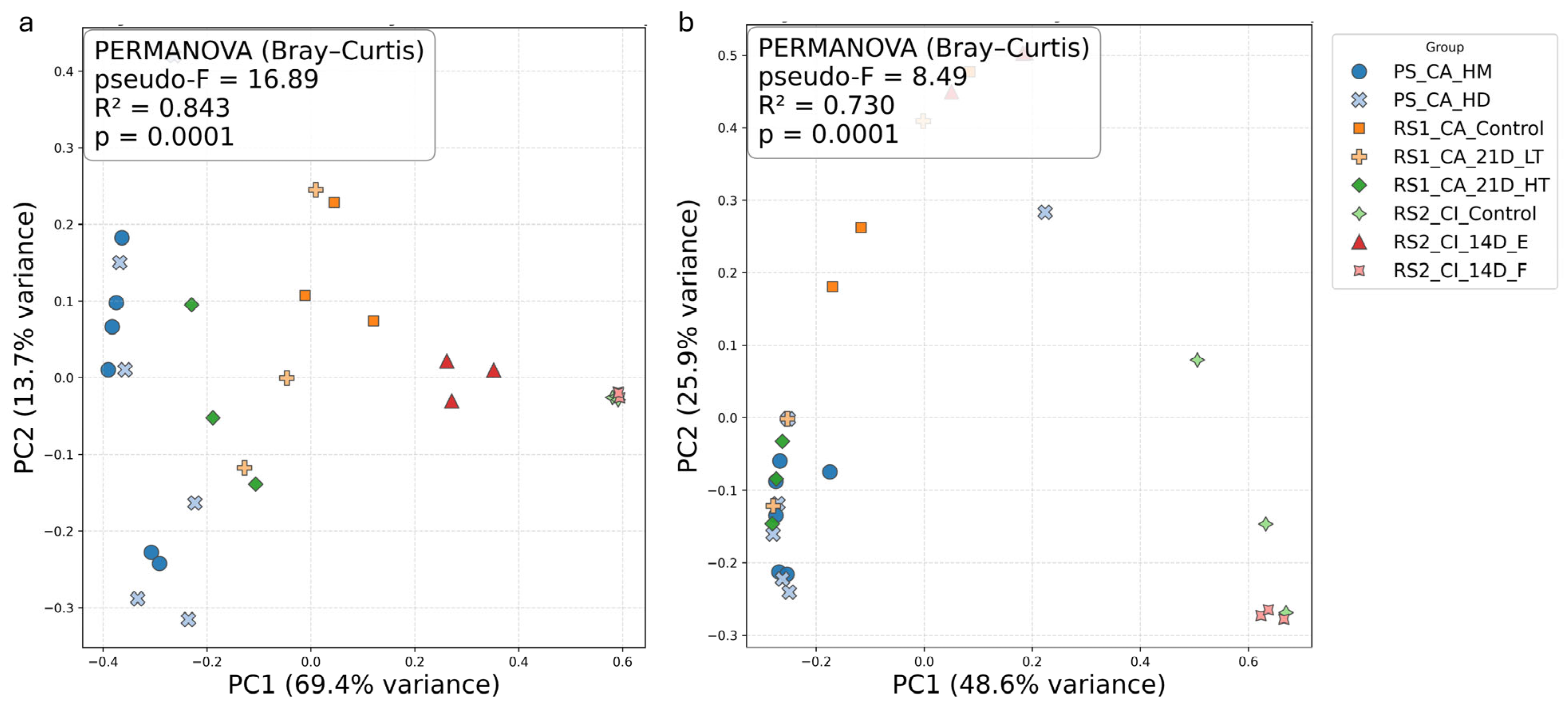
Beta diversity patterns in the hindgut microbiota were evaluated using Principal Coordinates Analysis (PCoA) based on Bray–Curtis dissimilarity of relative abundance profiles. Two ordinations were generated: one at the phylum level (Figure 2a) and one at the genus level (Figure 2b), with taxa filtered at ≥0.1% and ≥1% of total classified reads per sample, respectively.
At the phylum level (Figure 2a), PC1 explained 69.4% of the total variance and PC2 accounted for 13.7% (cumulative: 83.1%). Hindgut samples from market-sourced goldfish (PS_CA_HM and PS_CA_HD groups) formed a tight cluster on the strongly negative side of PC1 (coordinates predominantly between −0.4 and −0.1), indicating marked compositional homogeneity at higher taxonomic ranks. By contrast, reference control samples (RS1_CA_Control, RS2_CI_Control) and groups from published antibiotic-exposure experiments (RS1_CA_21D_LT/HT, RS2_CI_14D_E/F) were distributed across a much broader region on the positive side of PC1 (coordinates mostly 0.0 to +0.6), reflecting greater phylum-level dispersion. PERMANOVA confirmed highly significant differentiation by sample origin (pseudo-F = 16.89, R2 = 0.843, p = 0.0001; 9999 permutations), with group identity accounting for 84.3% of the phylum-level compositional variation.
At the genus level (Figure 2b), variance was distributed more evenly across the first two axes (PC1: 48.6%, PC2: 25.9%; cumulative: 74.5%). Despite the more balanced ordination, the same fundamental pattern persisted: market-sourced hindgut samples clustered tightly in the lower-left quadrant, while reference and experimentally exposed groups were positioned centrally to the right. PERMANOVA again demonstrated strong and highly significant group separation (pseudo-F = 8.49, R2 = 0.730, p = 0.0001; 9999 permutations), with 73.0% of genus-level variation attributable to sample category.
The pronounced shift along the dominant axis in the phylum-level ordination (Figure 2a), together with the persistent tight clustering at genus level (Figure 2b), is consistent with severe dysbiosis in retail-sourced ornamental goldfish. The high R2 values (0.730–0.843) and pseudo-F statistics suggest that the microbiome composition of market-sourced fish is fundamentally distinct from that of healthy or transiently antibiotic-exposed teleost gut communities.
These findings provide quantitative support for the hypothesis that prolonged antimicrobial pressure in high-density retail environments drives a profound restructuring of the gut microbiota, which may offer a microbiological basis for the post-purchase mortality commonly reported in the ornamental fish trade.

3.3. Taxonomic Composition and Relative Abundance

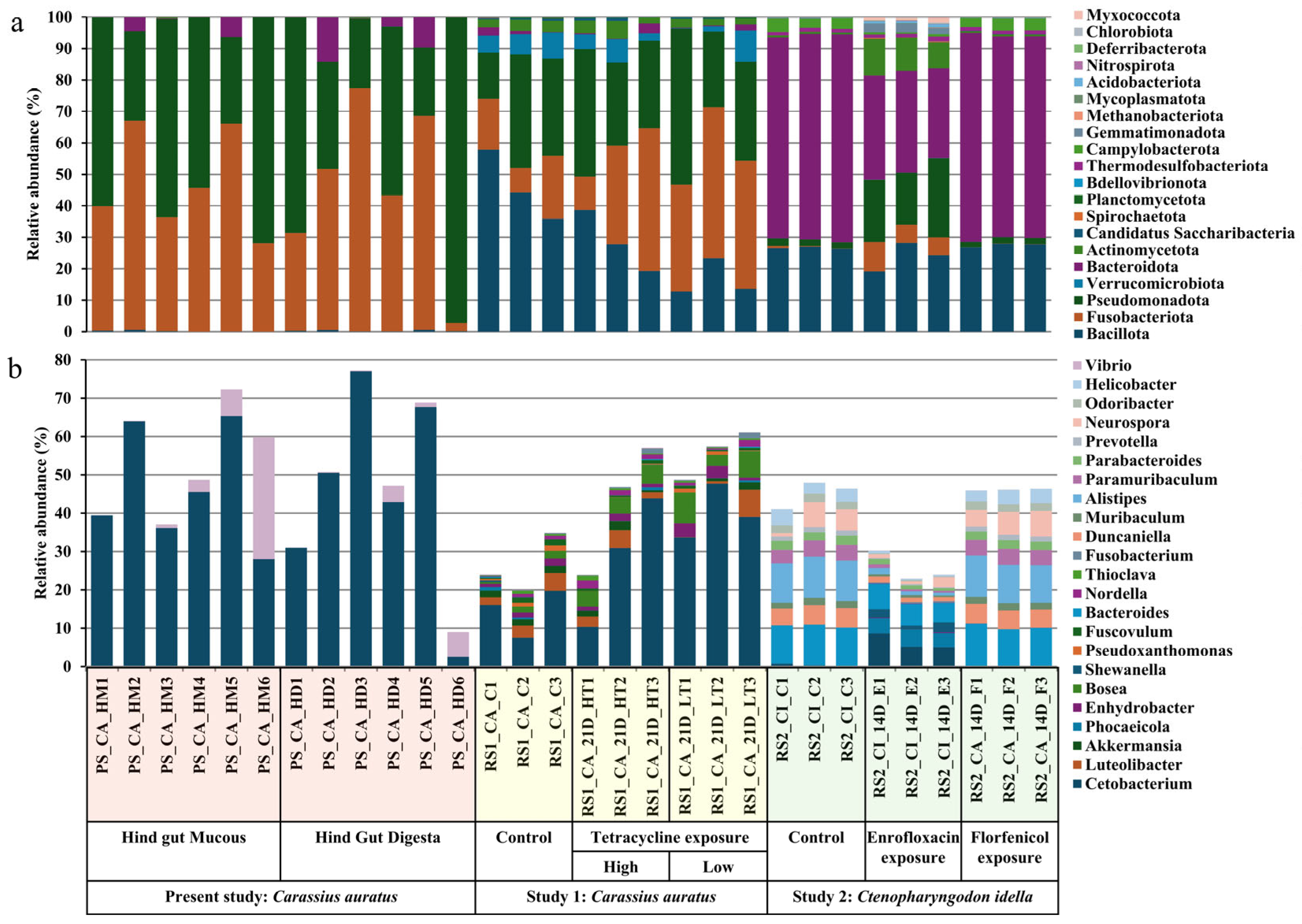
The gut bacterial communities of market-acquired ornamental goldfish (Carassius auratus) displayed extreme taxonomic simplification at both phylum and genus levels, consistent with severe dysbiosis induced by chronic antibiotic exposure (Figure 3). At the phylum level (considering taxa ≥0.1% relative abundance), communities were overwhelmingly dominated by Pseudomonadota (formerly Proteobacteria), Fusobacteriota, and Bacteroidota, which collectively accounted for the vast majority of sequences. This pattern contrasts sharply with reference controls (as exemplified by RS1 and RS2), where phylogenetically and functionally diverse commensal phyla, such as Firmicutes (Bacillota), Fusobacteriota, Bacteroidota, and Actinobacteriota, typically predominate in balanced proportions. At the genus level (considering taxa ≥1% relative abundance), the microbiomes of market-sourced goldfish were characterized by extreme oligodominance, with Cetobacterium (phylum Fusobacteriota) exhibiting the highest relative abundance (30–77% across samples) and Vibrio (phylum Pseudomonadota) as the only other taxon consistently exceeding 1%. In contrast, reference control groups harboured at least 10 distinct genera with abundances >0.1%, including diverse representatives from Aeromonas, Shewanella, Lactobacillus, Bacteroides, and others that probably contribute to nutrient metabolism, short-chain fatty acid production, and colonization resistance.

4. Discussion

The gut microbiomes of retail-sourced ornamental goldfish in Hong Kong exhibited a degree of dysbiosis that appears considerably more severe than that reported in controlled laboratory antibiotic trials. Alpha diversity collapsed to near-undetectable levels (mean Shannon index 0.107 ± 0.141 across hindgut mucosa and digesta samples), with communities dominated by only a handful of taxa and minimal phylogenetic evenness. These values are markedly lower than the 2.0–4.5 range commonly reported for healthy cyprinids, and fall even below those recorded in short-term antibiotic-exposed fish, in which partial diversity typically persists [20,21,22]. Principal Coordinates Analysis (PCoA) based on Bray–Curtis dissimilarity further supported this interpretation: market samples clustered tightly in a region of coordinate space clearly distinct from both untreated controls and experimentally dosed groups, suggesting a fundamental and potentially irreversible restructuring of the microbial ecosystem rather than a transient reduction in richness [23].
This dysbiotic state was characterised by extreme oligodominance, primarily involving Cetobacterium (Fusobacteriota) and Vibrio (Pseudomonadota), which frequently co-occurred and collectively dominated the hindgut communities of market-sourced goldfish. Cetobacterium is traditionally recognised as a beneficial core symbiont in freshwater teleosts, contributing to host health through the production of vitamin B12 and acetate [24,25]. The unusually high relative abundances recorded here (>50–80% in many samples) therefore deviate from the depletion typically reported under acute antibiotic stress [20,21], and instead point to selective survival under the chronic, multi-class antibiotic regimes characteristic of the ornamental supply chain. Prolonged exposure to multiple antimicrobials appears to favour tolerant anaerobes such as Cetobacterium, which carries reported tolerance traits relevant to bile and certain antibiotics including vancomycin [24,25,26], while systematically eliminating the phylogenetically diverse commensal taxa responsible for nutrient metabolism, mucosal integrity, and colonisation resistance. The resulting microbiome lacks functional redundancy, rendering it ecologically fragile and poorly equipped to buffer the host against the environmental transitions that accompany transfer to antibiotic-free home aquaria.
Vibrio co-dominated with Cetobacterium, consistently exceeding 1% relative abundance and contributing to the oligodominant community structure. As opportunistic pathogens and recognised carriers of antimicrobial resistance (AMR) determinants, Vibrio spp. are well-documented in ornamental aquaculture systems [2,6]. Their persistence under chronic antibiotic exposure is consistent with the stress tolerance and competitive advantage that these organisms are known to exhibit in high-density environments, where disruption of the resident microbiota may create niche vacancies that favour opportunistic taxa [27]. The dual dominance of a traditionally beneficial anaerobe (Cetobacterium) and a potentially pathogenic genus (Vibrio) define a dysbiotic configuration that may compromise host resilience and increase susceptibility to secondary infections, potentially contributing to post-purchase mortality.
This profound dysbiosis offers a compelling microbiological explanation for the elevated post-purchase mortality commonly reported in the ornamental fish trade. The transfer of fish from antibiotic-supplemented retail environments to unmedicated home aquaria represents an abrupt ecological transition: the sudden removal of chemical suppression, combined with shifts in water chemistry, pH, and host immune status, eliminates the external constraints that have kept opportunistic pathogens in check [27,28,29]. In the absence of a diverse commensal community capable of maintaining colonisation resistance, these pathogens can proliferate largely unchallenged. Compounding this, the loss of microbial diversity impairs the host’s capacity to metabolise novel diets and detoxify environmental stressors during the critical acclimation period [29,30]. These converging pressures plausibly underlie the acute mortality that frequently occurs within days of purchase, a pattern consistent with reports of stress-induced pathogen proliferation across global ornamental supply chains [11].
Comparison with published reference datasets further underscores the magnitude of microbiome disruption in retail fish. A likely driver is the routine prophylactic use of multiple antimicrobial classes throughout the supply chain—from transport to prolonged retail holding—to suppress disease under high-density, stressful conditions [2,7,10,11]. Unlike the single-exposure laboratory trials that form much of the existing literature, real-world ornamental fish systems involve heterogeneous and repeated antimicrobial exposures without veterinary oversight, generating a cumulative selective pressure that destabilises the microbiome far more profoundly than short-term experimental treatments [31,32].
Several limitations of this study warrant consideration. First, the analysis was based on a modest sample size (six individuals, 12 gut samples) obtained opportunistically from a single high-turnover retail market in Hong Kong, which limits both statistical power and broader generalisability. That said, the severe dysbiosis observed—reflected by a Shannon index of 0.107 ± 0.141—was highly consistent across individuals, suggesting a dominant and reproducible effect of chronic antibiotic exposure rather than individual variation. Larger, multi-site surveys spanning different markets, suppliers, and sampling timepoints will be necessary to establish the prevalence and geographic extent of this pattern. Second, cross-study comparisons with published datasets (PRJNA543931; PRJEB55267) are constrained by inherent methodological heterogeneity. Differences in 16S rRNA primer regions, gut segments sampled (hindgut mucosa and digesta in the present study versus whole intestine or foregut in reference datasets), DNA extraction protocols, and sequencing depth (Supplementary Table S2) can introduce study-specific biases in taxonomic profiles and diversity estimates [33]. While these technical factors likely account for some between-study variation, the magnitude of the alpha diversity collapse observed here (Shannon index of approximately 0.1 compared with approximately 2.58 in controls) and the clear PCoA separation far exceed what would be expected from methodological noise alone, supporting a predominantly biological signal. Third, reliance on relative abundance profiles precludes any assessment of absolute bacterial load. The apparent oligodominance of Cetobacterium and Vibrio could therefore reflect genuine proliferation of these taxa, proportional enrichment driven by an overall reduction in microbiota biomass, or a combination of both. Resolving this ambiguity would require absolute quantification approaches such as genus-specific 16S qPCR, flow cytometry, or microscopy-based enumeration [12]. Comparable quantitative data are also absent from the reference datasets, preventing direct cross-study comparison of bacterial load dynamics. Future work integrating relative profiling with absolute quantification methods will be essential to fully interpret the functional implications of the patterns described here.
Despite these limitations, the consistent and extreme dysbiotic signature observed across taxonomic levels and analytical approaches provides strong preliminary evidence that chronic antibiotic exposure in ornamental aquaculture induces a depauperate gut microbiome state with meaningful consequences for host resilience and post-purchase survival. Given the rapid turnover and biosecurity risks inherent in the global ornamental fish trade, these findings highlight an urgent and largely overlooked animal welfare concern, and underscore the need for larger-scale investigation of microbial depletion across supply chains. By documenting the microbiome-level damage associated with unregulated prophylactic antibiotic use, this study advocates for immediate improvements in antimicrobial stewardship and positions the gut microbiome as a critical health indicator in future aquaculture research. Microbiome-centred interventions, including probiotics (Bacillus, Lactobacillus, and Pediococcus spp.), prebiotics, and synbiotics, offer promising avenues for restoring community diversity and bolstering innate immunity [34,35,36,37,38,39]. When combined with enhanced biosecurity measures and alignment with international antimicrobial stewardship frameworks [40,41], such strategies could substantially reduce dysbiosis and AMR risk, supporting a more sustainable and ethically responsible ornamental aquaculture industry.

5. Conclusions

Ornamental goldfish sourced from antibiotic-intensive retail chains harbor severely depauperate gut microbiomes characterized by collapsed alpha diversity, distinct community structuring, and profound taxonomic simplification. This dysbiotic state compromises microbial resilience and host physiological homeostasis, likely serving as a primary driver of the elevated post-purchase mortality observed during the transition to clean home aquaria. These preliminary findings underscore the long-term detrimental impact of prophylactic antibiotic reliance on the ecological health of the fish gut highlighting the urgent need for large scale, multi-site studies. The inclusion of microbiome assessment as a routine health indicator would provide a quantitative benchmark for animal welfare, enabling stakeholders to move beyond visual inspections and proactively identify individuals at high risk of post-purchase mortality. The study also emphasizes the need for alternative health-management strategies; transitioning toward microbiome-supportive husbandry (incorporating probiotics, prebiotics, and enhanced biosecurity) holds significant potential to improve survival rates, align the industry with global health security standards, and ensure the environmental sustainability of the ornamental fish.

Supplementary Materials

The following supporting information can be downloaded at: https://www.mdpi.com/article/10.3390/applmicrobiol6030038/s1, Table S1: Diversity at species level. Table S2: Overview of gut sections, DNA extraction methods, primer systems, and sequencing depth in the present and previously published reference studies.

Author Contributions

Conceptualization, W.-Y.M., F.W.-F.L., V.B. and E.S.-W.W.; methodology, V.B., W.-H.W. and W.-Y.M.; software, V.B. and W.-H.W.; formal analysis, V.B. and W.-H.W.; resources, F.W.-F.L., S.J.-L.X. and W.-Y.M.; data curation, V.B.; writing—original draft preparation, V.B. and W.-H.W.; writing—review and editing, C.A.-Y., F.W.-F.L. and W.-Y.M.; supervision, K.-L.L., S.J.-L.X., F.W.-F.L. and W.-Y.M.; project administration, F.W.-F.L. and W.-Y.M.; funding acquisition, F.W.-F.L., S.J.-L.X., W.-Y.M. and E.S.-W.W. All authors have read and agreed to the published version of the manuscript.

Funding

The work described in this paper was fully supported by grants from the Research Grants Council of the Hong Kong Special Administrative Region, China (UGC/FDS16/M08/24), and Team-based Research Fund (TBRF/2024/1.9) and Next Generation Scientist Incubation (NGS-i) Programme (GUS2023/01) of Hong Kong Metropolitan University.

Institutional Review Board Statement

The animal study protocol was approved by the Research Ethics Committee, Hong Kong Metropolitan University (AE–RGC2023/ST11 and 28 February 2024).

Informed Consent Statement

Not applicable.

Data Availability Statement

Raw sequence data for the samples analysed in this study are publicly available in the NCBI Sequence Read Archive under BioProject accession numbers PRJNA1398548.

Acknowledgments

During the preparation of this manuscript, the author(s) used Gemini 3 for language editing. The authors have reviewed and edited the output and take full responsibility for the content of this publication.

Conflicts of Interest

The authors declare no conflicts of interest. The funders had no role in the design of the study; in the collection, analyses, or interpretation of data; in the writing of the manuscript; or in the decision to publish the results.

Abbreviations

The following abbreviations are used in this manuscript:
PSPresent study
RS1Reference study 1
RS2Reference study 2
CACarassius auratus
CICtenopharyngodon idella
HMHindgut mucus
HDHindgut digesta
21D21-day exposure
14D14-day exposure
LTLow tetracycline dose
HTHigh tetracycline dose
EEnrofloxacin
FFlorfenicol

References

  1. Evers, H.G.; Pinnegar, J.K.; Taylor, M.I. Where are they all from? sources and sustainability in the ornamental freshwater fish trade. J. Fish Biol. 2019, 94, 909–916. [Google Scholar] [CrossRef] [PubMed]
  2. Au-Yeung, C.; Lam, K.L.; Choi, M.H.; Chan, K.W.; Cheung, Y.S.; Tsui, Y.L.; Mo, W.Y. Impact of prophylactic antibiotic use in ornamental fish tanks on microbial communities and pathogen selection in carriage water in Hong Kong retail shops. Microorganisms 2024, 12, 1184. [Google Scholar] [CrossRef] [PubMed]
  3. Borges, A.K.M.; Oliveira, T.P.R.; Alves, R.R.N. Marine or freshwater: The role of ornamental fish keeper’s preferences in the conservation of aquatic organisms in Brazil. PeerJ 2022, 10, e14387. [Google Scholar] [CrossRef] [PubMed]
  4. World Integrated Trade Solution (WITS). Available online: https://wits.worldbank.org/trade/comtrade/en/country/ALL/year/2024/tradeflow/Imports/partner/WLD/product/030110 (accessed on 25 February 2026).
  5. Chong, R. Pathology of Cultured Fish in Hong Kong, 1st ed.; Agriculture, Fisheries and Conservation Department: Hong Kong, China, 2015; pp. 145–146.
  6. Au-Yeung, C.; Tsui, Y.L.; Choi, M.H.; Chan, K.W.; Wong, S.N.; Ling, Y.K.; Lam, C.M.; Lam, K.L.; Mo, W.Y. Antibiotic Abuse in Ornamental Fish: An Overlooked Reservoir for Antibiotic Resistance. Microorganisms 2025, 13, 937. [Google Scholar] [CrossRef]
  7. Verner-Jeffreys, D.W.; Welch, T.J.; Schwarz, T.; Pond, M.J.; Woodward, M.J.; Haig, S.J.; Rimmer, G.S.; Roberts, E.; Morrison, V.; Baker-Austin, C. High prevalence of multidrug-tolerant bacteria and associated antimicrobial resistance genes isolated from ornamental fish and their carriage water. PLoS ONE 2009, 4, e8388. [Google Scholar] [CrossRef]
  8. Preena, P.G.; Swaminathan, T.R.; Kumar, V.J.R.; Singh, I.S.B. Antimicrobial resistance in aquaculture: A crisis for concern. Biologia 2020, 75, 1497–1517. [Google Scholar] [CrossRef]
  9. Au-Yeung, C.; Lam, K.L.; Chan, K.W.; Mo, W.Y. Uses of antibiotics in ornamental fish in Hong Kong and the antibiotic resistance in the associated zoonotic pathogens. J. Xenobiot. 2022, 12, 365–377. [Google Scholar] [CrossRef]
  10. Lulijwa, R.; Rupia, E.J.; Alfaro, A.C. Antibiotic use in aquaculture, policies and regulation, health and environmental risks: A review of the top 15 major producers. Rev. Aquac. 2020, 12, 640–663. [Google Scholar] [CrossRef]
  11. Preena, P.G.; Arathi, D.; Raj, N.S.; Arun Kumar, T.V.; Arun Raja, S.; Reshma, R.N.; Raja Swaminathan, T. Diversity of antimicrobial-resistant pathogens from a freshwater ornamental fish farm. Lett. Appl. Microbiol. 2020, 71, 108–116. [Google Scholar] [CrossRef]
  12. Payne, C.J.; Turnbull, J.F.; MacKenzie, S.; Crumlish, M. The effect of oxytetracycline treatment on the gut microbiome community dynamics in rainbow trout (Oncorhynchus mykiss) over time. Aquaculture 2022, 560, 738559. [Google Scholar] [CrossRef]
  13. Huang, J.; Yong, H.; Huang, J.; Che, Y.; Klümper, U.; Yu, K.; Zhang, J.; Honda, R.; Li, X.; Berendonk, T.U.; et al. Microbial risks triggered by oral administration of antibiotics in fish aquaculture persist long after the legally mandated antibiotic withdrawal time. Nat. Water 2025, 3, 1057–1069. [Google Scholar] [CrossRef]
  14. Andrews, S. FastQC: A Quality Control Tool for High Throughput Sequence Data. Available online: http://www.bioinformatics.babraham.ac.uk/projects/fastqc/ (accessed on 1 November 2025).
  15. Bolger, A.M.; Lohse, M.; Usadel, B. Trimmomatic: A flexible trimmer for Illumina sequence data. Bioinformatics 2014, 30, 2114–2120. [Google Scholar] [CrossRef]
  16. Wood, D.E.; Lu, J.; Langmead, B. Improved metagenomic analysis with Kraken 2. Genome Biol. 2019, 20, 257. [Google Scholar] [CrossRef] [PubMed]
  17. Odom, A.R.; Faits, T.; Castro-Nallar, E.; Crandall, K.A.; Johnson, W.E. Metagenomic profiling pipelines improve taxonomic classification for 16S amplicon sequencing data. Sci. Rep. 2023, 13, 13957. [Google Scholar] [CrossRef] [PubMed]
  18. McMurdie, P.J.; Holmes, S. Waste not, want not: Why rarefying microbiome data is inadmissible. PLoS Comput. Biol. 2014, 10, e1003531. [Google Scholar] [CrossRef] [PubMed]
  19. Knight, R.; Vrbanac, A.; Taylor, B.C.; Aksenov, A.; Callewaert, C.; Debelius, J.; Gonzalez, A.; Kosciolek, T.; McCall, L.I.; McDonald, D.; et al. Best practices for analysing microbiomes. Nat. Rev. Microbiol. 2018, 16, 410–422. [Google Scholar] [CrossRef]
  20. Jia, J.; Cheng, M.; Xue, X.; Guan, Y.; Wang, Z. Characterization of tetracycline effects on microbial community, antibiotic resistance genes and antibiotic resistance of Aeromonas spp. in gut of goldfish Carassius auratus Linnaeus. Ecotoxicol. Environ. Saf. 2020, 191, 110182. [Google Scholar] [CrossRef]
  21. Shi, F.; Huang, Y.; Yang, M.; Lu, Z.; Li, Y.; Zhan, F.; Lin, L.; Qin, Z. Antibiotic-induced alternations in gut microflora are associated with the suppression of immune-related pathways in grass carp (Ctenopharyngodon idellus). Front. Immunol. 2022, 13, 970125. [Google Scholar] [CrossRef]
  22. Xavier, R.; Severino, R.; Silva, S.M. Signatures of dysbiosis in fish microbiomes in the context of aquaculture. Rev. Aquac. 2024, 16, 706–731. [Google Scholar] [CrossRef]
  23. Goodrich, J.K.; Di Rienzi, S.C.; Poole, A.C.; Koren, O.; Walters, W.A.; Caporaso, J.G.; Knight, R.; Ley, R.E. Conducting a microbiome study. Cell 2014, 158, 250–262. [Google Scholar] [CrossRef]
  24. Qi, X.; Zhang, Y.; Zhang, Y.; Luo, F.; Song, K.; Wang, G.; Ling, F. Vitamin B12 produced by Cetobacterium somerae improves host resistance against pathogen infection through strengthening the interactions within gut microbiota. Microbiome 2023, 11, 135. [Google Scholar] [CrossRef] [PubMed]
  25. Wang, A.; Zhang, Z.; Ding, Q.; Yang, Y.; Bindelle, J.; Ran, C.; Zhou, Z. Intestinal Cetobacterium and acetate modify glucose homeostasis via parasympathetic activation in zebrafish. Gut Microbes 2021, 13, 1–15. [Google Scholar] [CrossRef] [PubMed]
  26. Tsuchiya, C.; Sakata, T.; Sugita, H. Novel ecological niche of Cetobacterium somerae, an anaerobic bacterium in the intestinal tracts of freshwater fish. Lett. Appl. Microbiol. 2008, 46, 43–48. [Google Scholar] [CrossRef] [PubMed]
  27. Ringø, E.Z.Z.V.; Zhou, Z.; Vecino, J.G.; Wadsworth, S.; Romero, J.; Krogdahl, Å.; Olsen, R.E.; Dimitroglou, A.; Foey, A.; Davies, S.; et al. Effect of dietary components on the gut microbiota of aquatic animals. A never-ending story? Aquac. Nutr. 2016, 22, 219–282. [Google Scholar] [CrossRef]
  28. Butt, R.L.; Volkoff, H. Gut microbiota and energy homeostasis in fish. Front. Endocrinol. 2019, 10, 9. [Google Scholar] [CrossRef]
  29. Llewellyn, M.S.; Boutin, S.; Hoseinifar, S.H.; Derome, N. Teleost microbiomes: The state of the art in their characterization, manipulation and importance in aquaculture and fisheries. Front. Microbiol. 2014, 5, 207. [Google Scholar] [CrossRef]
  30. Tarnecki, A.M.; Burgos, F.A.; Ray, C.L.; Arias, C.R. Fish intestinal microbiome: Diversity and symbiosis unravelled by metagenomics. J. Appl. Microbiol. 2017, 123, 2–17. [Google Scholar] [CrossRef]
  31. Parshukov, A.N.; Fokina, N.N.; Sukhovskaya, I.V.; Kantserova, N.P.; Lysenko, L.A. Infection and antibiotic treatment have prolonged effects on gut microbiota, muscle and hepatic fatty acids in rainbow trout (Oncorhynchus mykiss). J. Appl. Microbiol. 2022, 133, 1709–1724. [Google Scholar] [CrossRef]
  32. Zhou, L.; Limbu, S.M.; Qiao, F.; Du, Z.Y.; Zhang, M. Influence of long-term feeding antibiotics on the gut health of zebrafish. Zebrafish 2018, 15, 340–348. [Google Scholar] [CrossRef]
  33. Tremblay, J.; Singh, K.; Fern, A.; Kirton, E.S.; He, S.; Woyke, T.; Lee, J.; Chen, F.; Dangl, J.L.; Tringe, S.G. Primer and platform effects on 16S rRNA tag sequencing. Front. Microbiol. 2015, 6, 771. [Google Scholar] [CrossRef]
  34. Amenyogbe, E. Application of probiotics for sustainable and environment-friendly aquaculture management—A review. Cogent Food Agric. 2023, 9, 2226425. [Google Scholar] [CrossRef]
  35. Hoseinifar, S.H.; Faheem, M.; Liaqat, I.; Van Doan, H.; Ghosh, K.; Ringø, E. Promising Probiotic Candidates for Sustainable Aquaculture: An Updated Review. Animals 2024, 14, 3644. [Google Scholar] [CrossRef]
  36. Mohammed, E.A.H.; Ahmed, A.E.M.; Kovács, B.; Pál, K. The significance of probiotics in aquaculture: A review of research trend and latest scientific findings. Antibiotics 2025, 14, 242. [Google Scholar] [CrossRef]
  37. Hoseinifar, S.H.; Maradonna, F.; Faheem, M.; Harikrishnan, R.; Devi, G.; Ringø, E.; Van Doan, H.; Ashouri, G.; Gioacchini, G.; Carnevali, O. Sustainable ornamental fish aquaculture: The implication of microbial feed additives. Animals 2023, 13, 1583. [Google Scholar] [CrossRef]
  38. Wu, L.; Wang, L.; Cui, S.; Peng, Z.; Liu, Z.; Li, M.; Han, Y.; Ren, T. Effects of dietary compound probiotics and heat-killed compound probiotics on antioxidative capacity, plasma biochemical parameters, intestinal morphology, and microbiota of Cyprinus carpio haematopterus. Aquac. Int. 2023, 31, 2199–2219. [Google Scholar] [CrossRef]
  39. Li, S.; Tran, N.T. Paraprobiotics in aquaculture. In Probiotics in Aquaculture; Austin, B., Sharifuzzaman, S., Eds.; Springer: Cham, Switzerland, 2022. [Google Scholar] [CrossRef]
  40. FAO. Responsible Use of Antimicrobials in Aquaculture; FAO Fisheries and Aquaculture Technical Paper; FAO: Rome, Italy, 2020. [Google Scholar]
  41. WHO. Global Action Plan on Antimicrobial Resistance; World Health Organization: Geneva, Switzerland, 2015. [Google Scholar]
Figure 1. Diversity (a) Shannon Index, (b) (H/LN(N)) and (c) Simpson index at species level of bacterial domain. (PS_CA_HM: n = 6; PS_CA_HD: n = 6; S1_CA_Control: n = 3; S1_CA_21D_HT: n = 3; S1_CA_21D_LT: n = 3; S2_CI_Control: n = 3; S2_CI_14D_E: n = 3; S2_CA_14D_F: n = 3). PS: present study; RS1: reference study 1; RS2: reference study 2; CA: Carassius auratus; CI: Ctenopharyngodon idella; HM: hindgut mucous; HD: hindgut digesta; 21D: 21-day antibiotic exposure; 14D: 14-day antibiotic exposure; HT: high tetracycline exposure, LT: low tetracycline exposure; E: enrofloxacin exposure; F: florfenicol exposure; C: control.
Applmicrobiol 06 00038 g001
Figure 2. Beta-diversity ordination of hindgut microbiota in ornamental goldfish at phylum and genus levels. Principal Coordinates Analysis (PCoA) based on Bray–Curtis dissimilarity of filtered relative abundances. (a) Phylum-level ordination (PC1: 69.4%, PC2: 13.7%). (b) Genus-level ordination (PC1: 48.6%, PC2: 25.9%). Samples are colored and shaped according to replicate group (PS_CA_HM: n = 6; PS_CA_HD: n = 6; S1_CA_Control: n = 3; S1_CA_21D_HT: n = 3; S1_CA_21D_LT: n = 3; S2_CI_Control: n = 3; S2_CI_14D_E: n = 3; S2_CA_14D_F: n = 3) (legend). PERMANOVA statistics (9999 permutations) are displayed in the upper-left corner of each panel. PS: present study; RS1: reference study 1; RS2: reference study 2; CA: Carassius auratus; CI: Ctenopharyngodon idella; HM: hindgut mucous; HD: hindgut digesta; 21D: 21-day antibiotic exposure; 14D: 14-day antibiotic exposure; HT: high tetracycline exposure, LT: low tetracycline exposure; E: enrofloxacin exposure; F: florfenicol exposure; C: control.
Applmicrobiol 06 00038 g002
Figure 3. Relative abundance of bacterial (a) phyla and (b) genera across three studies and 8 experimental groups (n = 30 samples total). Taxa with relative abundance ≥0.1% at the phylum level and ≥1% at the genus level of total identified bacterial reads were included in the analysis. PS: present study; RS1: reference study 1; RS2: reference study 2; CA: Carassius auratus; CI: Ctenopharyngodon idella; HM: hindgut mucous; HD: hindgut digesta; 21D: 21-day antibiotic exposure; 14D: 14-day antibiotic; HT: high tetracycline exposure, LT: low tetracycline exposure; E: enrofloxacin exposure; F: florfenicol exposure; C: control.
Applmicrobiol 06 00038 g003
Disclaimer/Publisher’s Note: The statements, opinions and data contained in all publications are solely those of the individual author(s) and contributor(s) and not of MDPI and/or the editor(s). MDPI and/or the editor(s) disclaim responsibility for any injury to people or property resulting from any ideas, methods, instructions or products referred to in the content.