1. Introduction
Table olives are widely consumed fermented plant-based foods, and early-stage hygiene can influence the subsequent microbiological stability of the product [
1]. Although table olives are not typically classified among the highest-risk foods for outbreaks, reducing the initial microbial load prior to brining may help limit spoilage, support controlled fermentation, and reduce persistence of fungal and bacterial contaminants that may tolerate saline environments [
2,
3]. Therefore, practical surface decontamination interventions applied at the pre-brining stage are relevant for process hygiene and product quality assurance.
Several non-thermal or minimally invasive decontamination approaches have been investigated in table olives and related food matrices, including Ultraviolet-C (UV-C) and ozone-based treatments, while evidence for ultrasound as a standalone intervention remains inconsistent and often context-dependent [
4,
5,
6]. Finally, ethanol (EtOH)-based technologies are commonly employed either as disinfectants in the food industry or extend shelf-life of certain food products [
7]. While these disinfection technologies are well-established in other food matrices, their efficacy is highly surface-dependent. To date, there is no systematic data regarding their application specifically on Greek Kalamon table olives, a product with distinct physicochemical surface characteristics (dark pigmentation, specific topography). The current study addresses this gap by establishing a quantitative baseline for EtOH (70%), UV-C irradiation (6 and 12 min), and Ultrasound (15 min) efficacy against
Candida albicans,
Aspergillus brasiliensis, and
Listeria innocua under defined pre-brining conditions.
2. Materials and Methods
2.1. Microbial Strains
For the experiments conducted the following microbial strains were used: The yeast C. albicans NCPF 3255, the mould A. brasiliensis WDCM 00053 and the bacterium L. innocua NCTC 11288. The strains were obtained from the National Collection of Pathogenic Fungi (NCPF) and the National Collection of Type Cultures (NCTC), supplied by Public Health England (PHE, London, UK). These strains were tested separately in each technical replication of the experiments. C. albicans lenticule® disc was rehydrated in 1 mL of Sabouraud Dextrose Broth (SDB, Oxoid, Basingstoke, UK) and 0.1 mL was cultured in 15 mL of the same medium in a shaking incubator for 46 h at 25 °C, 170 rpm. Aliquots were made with the addition of sterile 80% glycerol for a final concentration of 20% and were kept at −20 °C as frozen stock of the culture. A. brasiliensis Vitroid™ was suspended in 20 mL SDB and cultured for 3 days at 25 °C, 170 rpm, whereas L. innocua lenticule® disc was cultured in 20 mL Tryptone Soya Broth (TSB, Oxoid, Basingstoke, UK) for 19 h at 37 °C, 170 rpm, before frozen stocks were made for both cultures.
2.2. Inoculum Preparation
In each experiment only one of the three microbes was cultured and prepared as an inoculum. For C. albicans and L. innocua, the initial culture was prepared from the corresponding lenticule as described above. Thereafter, all experimental replicates were performed using working cultures derived from frozen stocks incubated under the same conditions. These cultures were used directly to inoculate the table olive samples, with final concentrations of approximately 107 and 109 CFU/mL, respectively. For A. brasiliensis, a further subculture was made by spread plating in Sabouraud Glucose Agar (SGA, PanReac-AppliChem, Darmstadt, Germany) and incubating for at least 7 days at 22 ± 2 °C until abundant spores were produced approximately 106–107 CFU/mL. Sterile distilled water (dH2O) was then poured into the plate, and the mycelium was rubbed using a bent glass Pasteur pipette. Using the resulting suspension containing hyphae and spores, this subculturing process was repeated and a second suspension produced. This was filtered through sterile pharmaceutical gauge into a conical tube, so it contained only spores at a concentration of 106 spores/mL and used as inoculum. The inoculum concentration was calculated by making serial decimal dilutions in 9 mL of Buffered Peptone Water (BPW, Oxoid, Basingstoke, UK), spread plating in SGA for C. albicans and A. brasiliensis or PALCAM (Oxoid, Basingstoke, UK) for L. innocua and incubating for 3–5 days at 22 ± 2 °C or 48 h at 37 ± 1 °C respectively.
2.3. Sample Preparation and Inoculation
Olea europaea var. Kalamon table olives were provided by a certified local olive processing plant and inspected to ensure uniformity in size, texture, and ripening stage. All olives were kept at −20 °C, until the day of the experiment. After thawing at room temperature for 1–2 h, olives were washed twice in a glass beaker under manual agitation using sterile dH
2O at a volume equal to twice their weight: an initial wash for 10 min followed by a second wash for 1 min, in order to reduce surface dirt and residual microflora. Using sterile forceps and scalpel, each drupe was cut longitudinally in half and pitted, before the pieces were placed with the pulp side down on sterile aluminum foil to prepare 10 g samples (approximately 4 halves per sample). This cutting procedure was performed to create a stable, standardized surface area for precise inoculation and to minimize shadowing effects during UV-C exposure, serving as a static experimental model rather than a proposed industrial form. Afterwards, using one of the three microbial inoculums, 0.1 mL was pipetted and let in drops on the skin of the olive pieces constituting one sample. A sample acting as negative control was inoculated with 0.1 mL sterile dH
2O. The samples were left to dry overnight at room temperature so the microbes would better attach to the olive surface. After inoculation and drying, olive pieces were carefully removed from the aluminum foil with sterile forceps and placed straight into sterile stomacher bags for microbiological examination. No material was scraped from the foil surface, microbial recovery was based on organisms that separated from the olive skin during stomaching, allowing for measurement of bacteria adhering to the olive surface. The resulting baseline microbial load on the olive surface was approximately 10
6 CFU/g for
C. albicans, 10
5–10
6 CFU/g for
A. brasiliensis, and 10
8 CFU/g for
L. innocua, serving as the baseline for microbial reduction calculations. All treatments were performed in three independent replicates (
n = 3). The ISO 7218:2007/Amd 1:2013 method was followed for yeasts and molds [
8].
2.4. Sample Disinfection Methods
2.4.1. Ethanol (EtOH)
A beaker (100 mL) containing 40 mL 70% EtOH was used to submerge and hand agitate the samples for 3 min at room temperature. The 70% EtOH concentration and 3 min contact time were selected based on evidence from CDC guidelines, which identify 70% EtOH as highly effective within exposure periods ranging from seconds to minutes [
9]. EtOH was discarded and 40 mL sterile dH
2O was poured into the beaker for 1 min, twice, to remove its residue from the samples. The samples were then left to dry on sterile aluminum foil at room temperature. The EtOH treatment was designed to simulate a typical surface sanitation step used in food production environments.
2.4.2. Ultraviolet-C
The samples were placed inside a custom-made unit with internal dimensions (length × width × height) of 790 mm × 390 mm × 745 mm, equipped on the ceiling with four UV-C 95 W lamps 500 mm in length (Baro Applied Technology Limited, Athens, Greece). Their distance from the lamps was 17 cm, corresponding to incident light intensity of 5 mW/cm
2 and were treated for 6 or 12 min at dosages 1.8 and 3.6 J/cm
2, respectively. This setup is in line with the conditions used in previous UV-C disinfection studies on table olives [
4]. A thermometer was used to check if the temperature inside the unit remained at levels acceptable for microbial viability. Untreated inoculated samples were used as positive controls.
2.4.3. Ultrasound (US)
An ultrasonic cleaner with a capacity of 5.75 L, Elmasonic P60H (Elma Schmidbauer GmbH, Singen, Germany) was filled with dH2O and set to operate at 37 kHz and 100% power, effectively generating 180 W of ultrasound. Samples were submerged in 30 mL of sterile dH2O inside conical tubes (50 mL) which in turn were placed in the cleaner tank and treated for 15 min in ambient temperature. Samples in sterile dH2O not treated with US were used as positive controls. 10 mL of contaminated H2O was then collected for analysis from both treated and control samples before the olive pieces were left to dry on sterile aluminum foil.
2.5. Microbiological Analysis
Each 10 g sample was dropped into a sterile stomacher bag (BagPage, Interscience, St Nom la Bretêche, France) containing 90 mL BPW and pummelling in a stomacher (BagMixer, Interscience, St Nom la Bretêche, France) for 3 min. From the suspension, serial decimal dilutions in 9 mL of BPW were prepared and 0.1 mL was spread plated in SGA for
C. albicans and
A. brasiliensis or PALCAM for
L. innocua. The plates were incubated for 3–5 days at 22 ± 2 °C or 48 h at 37 ± 1 °C, respectively. Plates from samples inoculated with
A. brasiliensis were read on the 3rd day since mycelial growth would cause colonies to overlap with each other, and again on the 4th and 5th days to confirm their growth or detect new ones. A portion of 10 mL contaminated water collected from control and US-treated samples were also analyzed in this way. Results were calculated as CFU/g of food samples. The ISO 21527-1:2008 method was followed for yeasts and molds [
10].
2.6. Statistical Analysis
Experiments with each individual microorganism were replicated at least three times. The microbial reductions after the disinfection treatments were expressed using the equation R = log
10(
N0/
N) where
N is the microbial load in disinfected samples, and
N0 is the initial microbial load in control samples. The result from each replication was used to calculate the mean microbial reduction for each disinfection treatment. IBM SPSS Statistics for Windows, version 27 (IBM Corp., Armonk, NY, USA) was used to analyze data for statistical significance (
Table 1,
Figure 1). Results were compared by an analysis of variance followed by Tukey’s method with a significance level of
p < 0.05. Tukey’s post hoc test was applied separately for each microbial species to determine significant differences between treatments.
3. Results
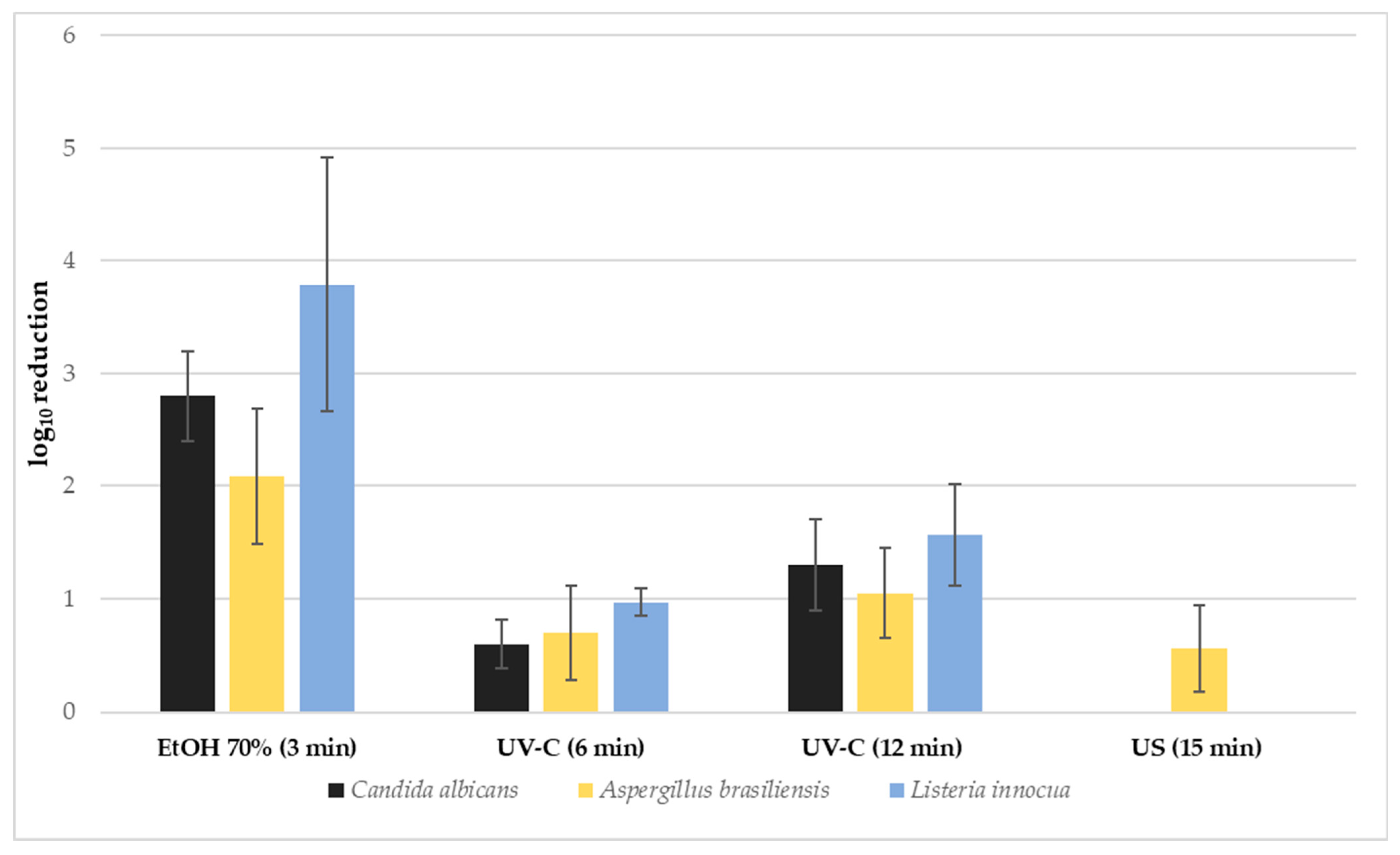
The efficacy of the disinfection treatments differed among the tested microorganisms (
C. albicans,
A. brasiliensis, and
L. innocua), with ethanol showing the highest antimicrobial activity (
Table 1). Ethanol reduced
C. albicans from approximately 10
6 to 1.6 × 10
3 CFU/g (2.80 log
10 reduction),
A. brasiliensis from approximately 10
6 to 8.1 × 10
3 CFU/g (2.09 log
10 reduction), and
L. innocua from 10
8 to 1.62 × 10
4 CFU/g (3.79 log
10 reduction). UV-C treatment exhibited a time-dependent effect, with 12 min exposure resulting in greater microbial inactivation than 6 min across all microorganisms tested. Specifically, UV-C (12 min) reduced
C. albicans to 5.0 × 10
4 CFU/g (1.30 log
10 reduction),
A. brasiliensis to 8.9 × 10
4 CFU/g (1.05 log
10 reduction), and
L. innocua to 2.7 × 10
6 CFU/g (1.57 log
10 reduction). For all microorganisms, reductions achieved by UV-C were significantly lower than those obtained with ethanol (
p < 0.05). Ultrasound treatment (15 min) resulted in minimal microbial reduction.
C. albicans remained at approximately 10
6 CFU/g (0.01 log
10 reduction),
A. brasiliensis was reduced to 2.8 × 10
5 CFU/g (0.56 log
10 reduction), and
L. innocua showed no measurable reduction. No statistically significant differences were observed between ultrasound-treated samples and water-only controls (
p > 0.05).
Figure 1 presents a consolidated comparison of log
10 (Y axis) reductions across all treatments and microorganisms, illustrating the overall higher efficacy of ethanol, the exposure-dependent effect of UV-C, and the limited effect of US.
4. Discussion
This study compares the efficacy of ethanol, UV-C, and ultrasound as surface disinfection methods used on Kalamon table olives prior to brining. Among the investigated treatments, ethanol displayed the best antimicrobial activity across all microorganisms, followed by UV-C in a time-dependent manner, whereas ultrasound alone had no impact.
Ethanol’s powerful antimicrobial performance is consistent with its well-documented broad-spectrum activity and fast mechanism of action, which is principally responsible for membrane disruption and protein denaturation [
9]. Although ethanol is frequently employed in food-processing settings and disinfection formulations, it is often utilized for surface sanitation rather than direct food treatment due to potential sensory effects and regulatory limits [
11,
12,
13,
14]. In the current study, ethanol was utilized primarily as a comparative benchmark rather than a proposed industrial solution. While not a standard washing agent for table olives, its inclusion establishes a high-efficacy baseline, effectively highlighting the performance gap that physical non-thermal methods, such as UV-C, must bridge to achieve comparable decontamination levels. This distinction addresses questions regarding the absence of traditional agents like vinegar (acetic acid) in this comparative assessment. While vinegar is a standard preservation medium acting over long fermentation periods, this study focused exclusively on rapid sanitation technologies (<15 min contact time) suitable for the pre-brining stage. Therefore, ethanol served solely as a ‘positive control’ for rapid disinfection, distinct from the long-term acidification effects of vinegar.
UV-C treatment resulted in moderate but constant microbial reductions, with longer exposures (12 min) producing much more inactivation than shorter exposures (6 min), in line with accepted UV-C inactivation principles [
15,
16]. However, the reductions produced by UV-C were less than those obtained with ethanol, illustrating the intrinsic limits of UV-C therapy on complex food surfaces. Surface curvature, irregularities, and shadowing effects, which have been frequently observed in solid food matrices, are expected to limit effective UV-C exposure and lead to uneven microbial inactivation. Furthermore, UV-C is a line-of-sight intervention, which means that only directly exposed surfaces receive the intended dose. In our static configuration (pitted side down), any inoculum that spread to non-exposed locations (e.g., edges or the bottom of the olive pieces) would not be properly treated, which could explain the moderate reductions reported. Future research should look into dual-sided exposure and/or mechanical rotation/agitation of olive pieces during UV-C treatment to reduce shadowing and enhance dose uniformity over the entire surface.
Ultrasound therapy had the lowest antimicrobial effectiveness across all pathogens. Although ultrasound’s cavitation effects can damage microbial cells under certain conditions, its efficiency as a single disinfection approach is uneven and matrix-dependent [
17]. The minimal reductions observed in this study are likely attributable to the surface topography of Kalamon olives, where microscopic irregularities may shield microorganisms from cavitation-induced shear forces. Furthermore, to avoid cross-contamination between repetitions, olive samples were placed in sterile 50 mL tubes within the ultrasonic bath before applying ultrasound. This design may reduce cavitation energy transfer compared to direct exposure in an open bath, potentially ’shielding’ the olive surface from full ultrasonic intensity and contributing to the minimal reductions seen. Previous research has shown that ultrasound provides more microbial inactivation when paired with other barriers such as heat or chemical agents, but ultrasound alone frequently results in modest reductions, particularly on solid food surfaces [
18,
19]. The study’s minimal reductions confirm these conclusions. Future research should look into direct-bath (open) arrangements and/or coupled hurdles (such as thermosonication or sonochemistry) to improve ultrasonic efficacy on olive surfaces.
Several limitations in the current work should be noted. The evaluation focused on a single set of treatment circumstances chosen to reflect practical and manageable processing situations; further optimization of exposure parameters was outside the scope of this study. Chlorine-based treatments, while frequently used as industrial sanitation benchmarks, were purposefully removed to allow for a more concentrated study of non-chlorine options, limiting direct comparability with traditional disinfection procedures. In addition, ethanol residues and associated sensory effects were not evaluated.
It is acknowledged that optimizing treatment parameters (e.g., varying ethanol concentrations or ultrasound frequencies) and exploring hurdle technologies could yield higher reduction rates. However, the primary scope of this work was to establish the standalone efficacy of these methods on the Kalamon variety, identifying which merit further inclusion in complex hurdles. Our results suggest that while US alone is ineffective in this matrix, UV-C shows promise for optimization, whereas ethanol serves primarily as a high-efficacy benchmark for experimental validation.
Overall, this study provides a baseline for comparing the performance of ethanol, UV-C, and ultrasound on table olive surfaces prior to brining. The results emphasize ethanol’s excellent antimicrobial efficacy but limited practical application, UV-C’s moderate and exposure-dependent potential, and ultrasound’s poor value when used alone. These findings promote further research into improved or combination disinfection techniques for enhancing microbial control while retaining product quality.