Abstract
The gut microbiome plays a vital role in metabolism and can be significantly influenced by body mass index (BMI). This study investigated the variations in gut microbial composition and function across different BMI categories by analyzing 16S rRNA sequencing data of 126 stool samples. While our analysis of microbial diversity did not reveal significant differences among BMI groups, a differential abundance analysis identified specific bacterial genera associated with BMI status. Notably, Lachnospira, Lactobacillus, and Roseburia were enriched in non-obese individuals, while Phascolarctobacterium showed greater abundance in obese subjects. Functional profiling utilizing PICRUSt2 and DESeq2 revealed fifteen KEGG pathways that exhibited significant alterations across varying BMI groups. Notably, several of these pathways were associated with short-chain fatty acid (SCFA)-producing taxa, including Lactobacillales and Tannerellaceae. Additionally, covariance network analysis identified the microbial genera Alistipes and Bilophila as central participants in multiple metabolic pathways, particularly those associated with steroid biosynthesis and pathogenic Escherichia coli, which showed a notable enrichment in individuals with obesity. These findings suggest that BMI influences the composition and metabolic potential of the gut microbiome, highlighting the importance of functional profiling to better understand the mechanisms underlying obesity.
1. Introduction
The human gut microbiomes are crucial for regulating metabolism, immune responses, and overall health. This is achieved via the production of short-chain fatty acids (SCFAs), immune modulation, and pathogen defense [1,2]. Certain microbial genera and families are vital for metabolic regulation and weight maintenance. For example, Lactobacilli, Lachnospira, and Christensenellaceae, which exhibit potential protective effects against obesity and associated metabolic disorders [3,4]. Lactobacilli, known for their probiotic properties, contribute to the maintenance of mucosal barrier integrity, suppression of inflammation, and promotion of favorable lipid and glucose metabolism [5]. A growing body of evidence indicates that various Lactobacillus species are inversely correlated with adiposity and insulin resistance, underscoring their critical role in energy homeostasis [5,6]. Lactobacillus, Lachnospira, and Christensenellaceae are among the bacterial genera that have been linked to advantageous metabolic outcomes. However, generalization across the genus is complicated by strain-specific variations within Lactobacillus, and these correlations are primarily correlative rather than causal. In human and animal models, certain strains have shown lipid-modulating or anti-inflammatory qualities, while others have neutral or even opposing effects. As a result, connections found in some research are referred to as “potential protective effects” in this context rather than direct causal proof.
This metabolite is known to enhance colonic epithelial function, reduce gut permeability, and exhibit anti-inflammatory effects. The genus Lachnospira, a member of the Lachnospiraceae family that produces short-chain fatty acids (SCFAs), promotes gut health by fermenting dietary fibers into butyrate, a metabolite associated with enhanced epithelial integrity and decreased inflammation. Lachnospira is typically linked to advantageous metabolic profiles, even if its contribution in comparison to other SCFA makers varies depending on the situation [7]. Decreased levels of Lachnospira have been observed in individuals with obesity and metabolic syndrome, suggesting its role in mitigating low-grade inflammation and dysbiosis [4]. Christensenellaceae, a relatively recent discovery within the phylum Firmicutes, has been associated with leanness and increased microbial diversity. Comparably, Christensenellaceae frequently co-occur with other taxa that produce SCFA, such as Lactobacillus and Lachnospira, perhaps forming microbial communities that are functionally synergistic. Even though these connections have been found in a number of studies, they are still inferential and need to be validated through focused network analyses [8]. First identified in 2012, Christensenella minuta is now recognized as a core member of the gut microbiota in metabolically healthy individuals [9]. Notably, Christensenellaceae frequently co-occur with SCFA-producing taxa such as Lachnospira and Lactobacilli, forming a tightly interconnected microbial network [10]. These taxa are frequently observed together in healthy cohorts, but evidence for functional synergy remains limited to co-occurrence patterns [11]. These taxa are frequently observed together in healthy cohorts, but evidence for functional synergy remains limited to co-occurrence patterns.
Disruption of this microbial balance, commonly referred to as dysbiosis, can lead to a reduction in beneficial microbial populations, resulting in increased gut permeability, endotoxemia, and low-grade systemic inflammation. Such alterations are often implicated in the pathogenesis of chronic conditions, including obesity, type 2 diabetes, and cardiovascular diseases [11].
Obesity remains a pressing global health challenge, with particularly high prevalence rates observed in the Middle East and North Africa (MENA) region, where nearly half of the adult population is classified as obese [11,12]. Given the accumulating evidence linking gut microbial profiles to body mass index (BMI) and metabolic markers, there is a critical need to characterize microbial signatures associated with leanness in this specific population. Rapid urbanization, dietary westernization, and reduced physical activity are the main causes of the obesity pandemic in the MENA area, which is among the fastest-growing in the world. Regional dietary practices, which are typified by low fiber intake and high consumption of refined carbs and saturated fats, may significantly alter the composition of gut microbes as compared to cultures in the West. In order to identify population-specific microbial and metabolic trends that can guide culturally appropriate therapies, it is crucial to integrate global microbiome discoveries into this local context.
The present study aims to investigate the presence and relative abundance of Christensenellaceae, Lactobacilli, and Lachnospira within the gut microbiota of individuals from the MENA region and to explore their associations with distinct BMI categories. Through a comprehensive analysis of stool samples from individuals exhibiting a range of BMI values, this research aims to elucidate whether these microbial taxa serve as potential markers or mediators of metabolic health. By identifying patterns of microbial co-occurrence and abundance, the findings may inform future strategies for microbiome-targeted interventions aimed at preventing and managing obesity.
2. Materials and Methods
2.1. Study Population
In this cross-sectional observational study, between October 2022 and July 2023, participants were recruited from community health centers and outpatient clinics located throughout northern Jordan. Adults between the ages of 18 and 70 who had not used antibiotics, probiotics, or prebiotics within three months after sample collection were eligible for inclusion. Pregnancy, recent infection, and persistent gastrointestinal disorders were among the exclusion criteria. The sample size (n = 126) represents the greatest number of qualified individuals who fit these requirements over the course of the study. The dataset has the statistical power to discover differentially abundant species with moderate effect sizes under DESeq2 (FDR < 0.05), despite being modest for microbiome research. Each participant provided written informed consent in accordance with the Declaration of Helsinki. The project was approved by the Yarmouk University Ethics Committee (IRB/2022/82). Participants were divided into two BMI categories: obese (BMI > 30) and non-obese (BMI < 30). Age was considered a continuous covariate in the DESeq2 model, whereas BMI was included as a categorical variable. Instead of rarefying the data for alpha and beta diversity studies, the Phyloseq 1.46.0 package’s built-in relative abundance normalization was used to reduce data loss while preserving sample comparability.
2.2. Data and Sample Processing
Each participant was given a sterile stool sample container, along with instructions and a collecting spoon. They transferred two to four grams of fresh stool into the sterilized containers. Additionally, participants received a questionnaire that included clinical and demographic characteristics, as well as a short food frequency questionnaire on dietary fiber intake (DFI-FFQ) [13]. Sterile containers prefilled with DNA/RNA Shield (Zymo Research, Irvine, CA, USA) were used to collect stool samples at participants’ homes to stabilize microbial DNA. Samples were kept at 4 °C and delivered to the lab within a day, where they were frozen at −80 °C after being aliquoted. A260/280 between 1.8 and 2.0, and DNA concentration requirements of at least 20 ng/µL were needed for inclusion. Agarose gel electrophoresis and the presence of high-molecular-weight fragments were used to establish DNA integrity.
2.3. Sequencing of the Bacterial 16S rRNA Genes’ V3 and V4 Hypervariable Regions
16S rRNA sequencing was conducted on the MiSeq platform, focusing on the V3 and V4 hypervariable regions using isolated microbial DNA. The amplification of the V3 and V4 regions of the bacterial 16S rRNA gene was performed with a specific primer pair (Integrated DNA Technologies, Coralville, IA, USA), resulting in a single amplicon of approximately 460 bp. Primers 341F (5′-CCTACGGGNGGCWGCAG-3′) and 806R (5′-GACTACHVGGGTATCTAATCC-3′) were used to amplify the V3–V4 regions. Each sample had an average sequencing depth of 45,000 reads. To track contamination and batch effects, experimental materials were sequenced alongside negative extraction controls and a mock microbial community (ZymoBIOMICS, Irvine, CA, USA). Reads were truncated at 250 bp (forward) and 200 bp (reverse) during DADA2 processing (v1.28), with maxEE = c(2,2), truncQ = 2, and chimera elimination enabled. Taxonomic assignments with less than 80% bootstrap support were eliminated. The SILVA v138 database was used to assign taxonomy. Rarefaction was not used; instead, diversity and differential analyses were preceded by relative abundance normalization. The primer sequences were optimized for Illumina sequencing according to the 16S Metagenomic Sequencing Library Preparation Protocol (Illumina Part No. 15044223 Rev. B), which facilitated the processing of overhang adapter sequences. To index the 16S V3 and V4 region-specific amplicons, the Illumina Nextera XT Index Kit Set A was employed. Following the Illumina metagenomics workflow, the obtained libraries were purified and pooled and then loaded onto the MiSeq using the MiSeq V2 300-cycle reagent kit (Illumina, Inc., San Diego, CA, USA). Using DADA2 parameters (maximum expected error < 2 and Phred score ≥ 30), raw reads were quality filtered and trimmed. Chimeric sequences were eliminated, and sequence counts per sample were verified to guarantee acceptable depth (>10,000 reads). To ensure excellent reproducibility across sequencing runs, replicate libraries were examined for consistency, and negative extraction controls were included to assess contamination, as shown in Figures S1–S3.
2.4. Statistical Methods
The raw data were processed using the DADA2 package in RStudio (version 3.4.1) to generate Amplicon Sequence Variants (ASVs) and to perform taxonomic identification [14]. The taxonomic information was assigned down to the genus level using the SILVA library [15]. Subsequently, the relative abundance of each genus among the participants was calculated and aggregated according to Body Mass Index (BMI) categories. The phyloseq method ‘phyloseq::plot_richness’ was utilized to compute alpha diversity metrics, including Chao1, Simpson, and Shannon indices. For beta diversity analysis, the ‘phyloseq::distance’ and ‘phyloseq::ordinate’ functions were employed, using Bray–Curtis as the distance metric. Differential abundances of the gut microbiome were assessed using the DESeq2 R package 1.50.2, guided by the design formula ‘~Age + BMI’, where age is treated as a numerical variable, and BMI is categorized accordingly. Unnormalized genus counts were used to determine metabolic pathway abundances, following the PICRUSt2 standard pipeline executed within a Conda environment [16]. KEGG ko metabolic pathways were generated by averaging their KO abundances using the mapping method ‘keggLink’ in the R 1.50.2. package KEGGREST. Significant differences in pathway abundance were identified between healthy and obese cohorts using the same DESeq2 pipeline, with the ‘glmGamPoi’ fit type applied and age included as a covariate. A covariance network analysis was carried out using Spearman’s correlation on the significant genes and pathways identified in the differential expression analysis. Abundances were transformed by centered-log ratio (CLR) utilizing the microbiome R package. A correlation between the genus and metabolic pathways was considered significant if the false discovery rate (FDR) q-value was less than 0.05. The visualization of the network was created using the igraph package in R. DESeq2’s ability to handle overdispersed count data was a key factor in its selection. Despite the compositional nature of microbiome data, DESeq2 normalization using size factors successfully reduces library-size disparities. Additionally, centered log-ratio (CLR) transformations were used to cross-validate the results in complementary analyses, which produced consistent patterns. Benjamini–Hochberg FDR correction (q < 0.05) was used to modify all p-values for multiple testing. Using multiplicative replacement (the zCompositions R 1.5.0_4 package), zero counts were imputed before CLR modification.
2.5. Functional Analysis
Using PICRUSt2 with KEGG Orthology (KO) mapping against the 2023 KEGG release, and functional prediction was carried out. Prior to utilizing DESeq2 with the glmGamPoi fit type, pathway abundances were normalized using relative proportions. For consistency with taxonomic differential analysis, DESeq2 was employed even if compositional effects are acknowledged. Pathways with fewer than 1000 total counts in less than 10% of samples were not included. FDR correction was applied to all results (q < 0.05).
2.6. Covariance Network Analysis
Correlation analyses were performed using Spearman’s method on CLR-transformed data after zero imputation. This network approach was validated using the SparCC algorithm to confirm the robustness of the observed associations, despite its exploratory nature. Edges were included if |r| > 0.3 and FDR q < 0.05.
3. Results
3.1. Demographics
The samples from different BMI categories are matched for sex and diet. The population difference is significant only in terms of age, where a higher age is correlated with a higher BMI, as shown in Table 1.
Table 1.
Demographics of the participants.
The Participants’ self-reported levels of physical activity and dietary patterns were evaluated in addition to their age and BMI. While 58% of participants reported low or sedentary activity levels, about 42% reported moderate physical activity at least three times per week. Although the non-obese group reported slightly higher intake, both BMI categories’ mean daily fiber intake was below regional nutritional recommendations. Fasting glucose and lipid profile data were also provided by a subgroup of participants (n = 60). The results showed that obese people had higher fasting glucose and triglyceride levels (p < 0.05), which is consistent with known metabolic risk patterns as shown in Figures S4–S8.
3.2. Intra and Inter-Individual Gut Microbiome Variation Based on the BMI Categories
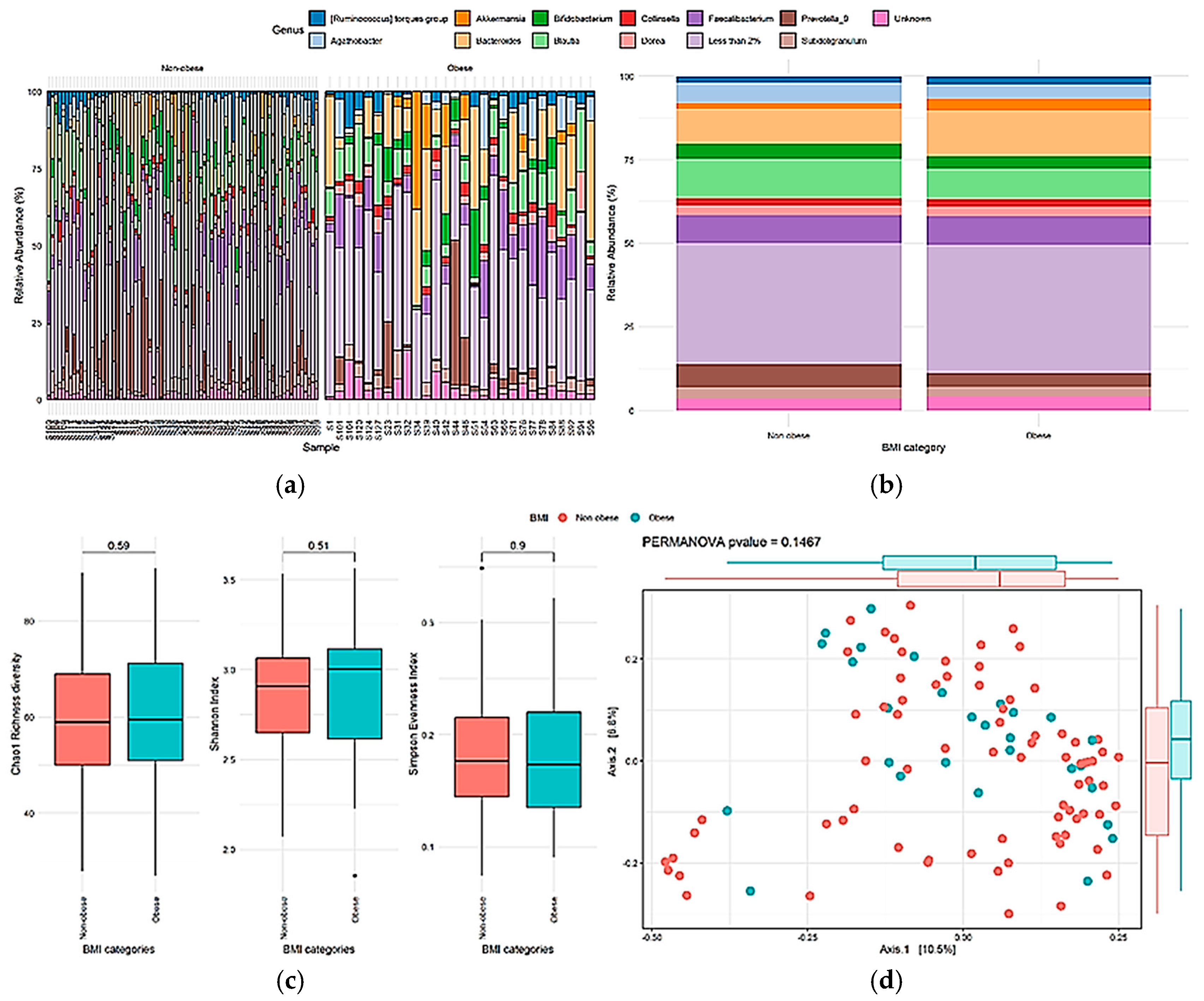
The gut microbiome is an important factor that varies significantly depending on the BMI of its host. To find these differences, we analyzed the gut microbiome by first comparing the relative abundance of the genera of each patient independently. The alpha diversity of the BMI cohorts, including the Chao1, the Shannon, and the Simpson indices, using a Wilcoxon test, and the overall differences of the cohorts are compared using a one-way ANOVA method. If the genus has a relative abundance of less than 2% it is aggregated together into one category. The beta diversity was also analyzed using the Bray–Curtis distance metric plotted in a PCoA plot, with the differences between the cohorts calculated using the adonis2 PERMANOVA method, as shown in Figure 1.
Figure 1.
There is no significant difference between the BMI categories. (a) This plot shows the relative abundances of genera within the individual participants’ gut microbiome, subdivided according to their BMI categories. (b) shows the average relative abundance. (c) The alpha diversity of the different BMI categories. A Wilcoxon signed-rank test was performed to compare the healthy group with the other BMI groups and identify significant differences. (d) The beta diversity uses the Bray Curtis distance metric and is plotted in a PCoA. Additionally, density curves illustrate the distribution of participants within each BMI cohort on the x and y axes.
3.3. Differential Expressions Show That the Genera Parabacteroides Is the Most Significantly Enriched in the Obese Cohort
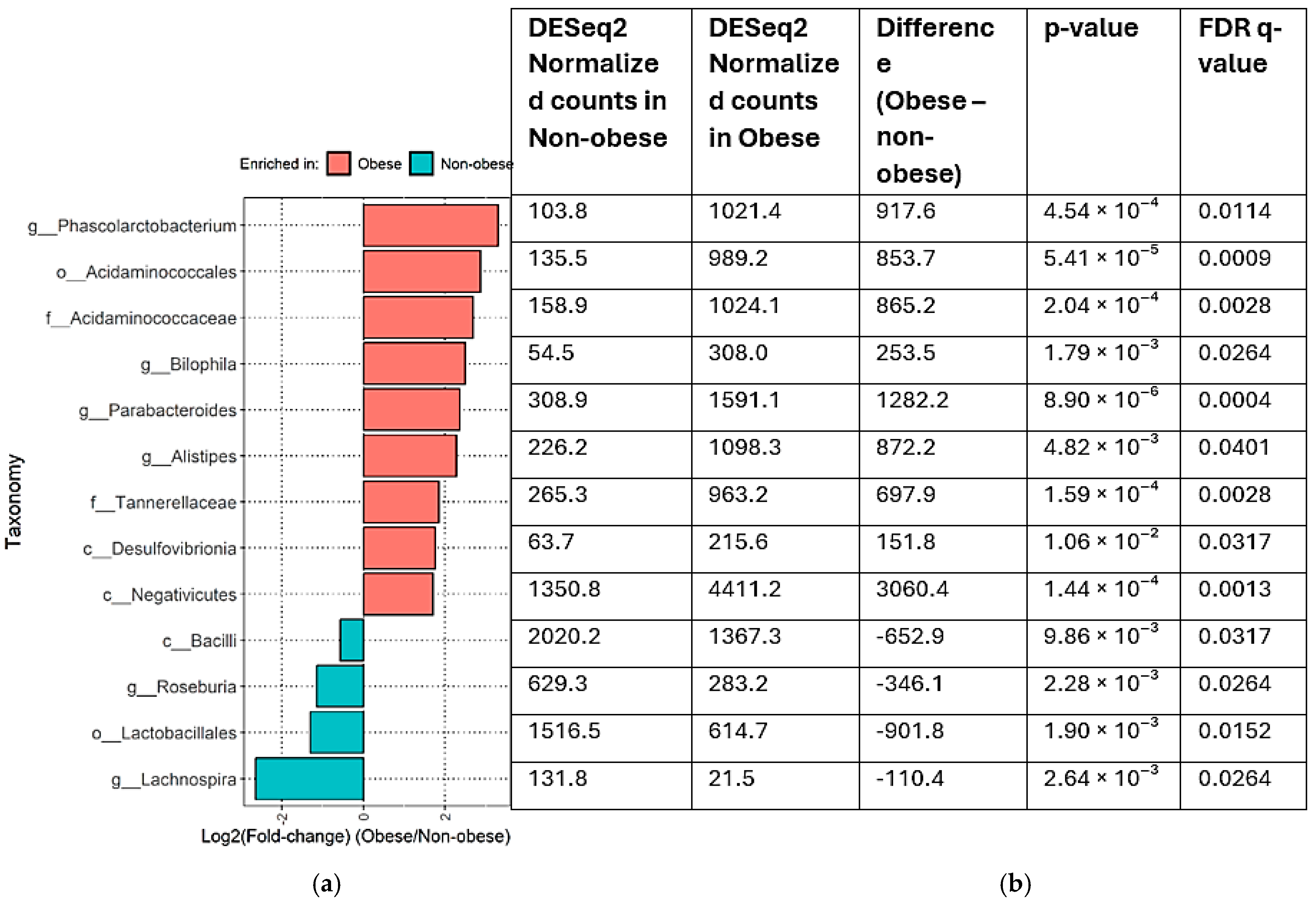
The gut microbiome in Figure 1 showed no significant difference in alpha and beta diversity between the different BMI cohorts. However, a differential abundance analysis reveals significant genera that distinguish between the BMI groups. The standard pipeline of the DESeq2 package in R was used, with fitType set to glmGamPoi, and a design of ~BMI, to compare the BMI cohorts [17]. Bacterial genera were considered significant if the FDR q-value was less than 0.05 to control for multiple comparisons, as shown in Figure 2.
Figure 2.
The differential abundance plot shows Parabacteroides genera that are significantly differentially expressed in obese vs. non_obese participants. (a) The plot shows a total of thirteen significantly differentially abundant taxa between obese and non-obese individuals. Nine are enriched in obese, while non-obese have four enriched. The significantly differentially expressed taxa are shown in descending order of log fold change. (b) The accompanying table shows the averaged variance-stabilized normalized counts in each of the cohorts, the difference between them, and the p-value and FDR q_value as calculated in DESeq2.
Several species showed differential enrichment between BMI groups, in addition to Parabacteroides. Roseburia, Lactobacillus, and Lachnospira were significantly more abundant in those who were not obese. These genera are well known for their capacity to produce short-chain fatty acids (SCFA) and have been linked to metabolic and anti-inflammatory advantages in the past. The idea that these taxa facilitate improved metabolic profiles and energy control is supported by their enrichment in the non-obese group. To account for any confounding effects, age was incorporated as a covariate in the DESeq2 model shown in Figure S9. The covariate did not demonstrate a significant connection with microbial abundance, suggesting that the observed taxonomic differences are predominantly driven by BMI status rather than age. The robustness of these correlations was further confirmed by a sensitivity analysis employing an age-matched subgroup of individuals, which produced consistent differential abundance patterns as shown in Figure S10.
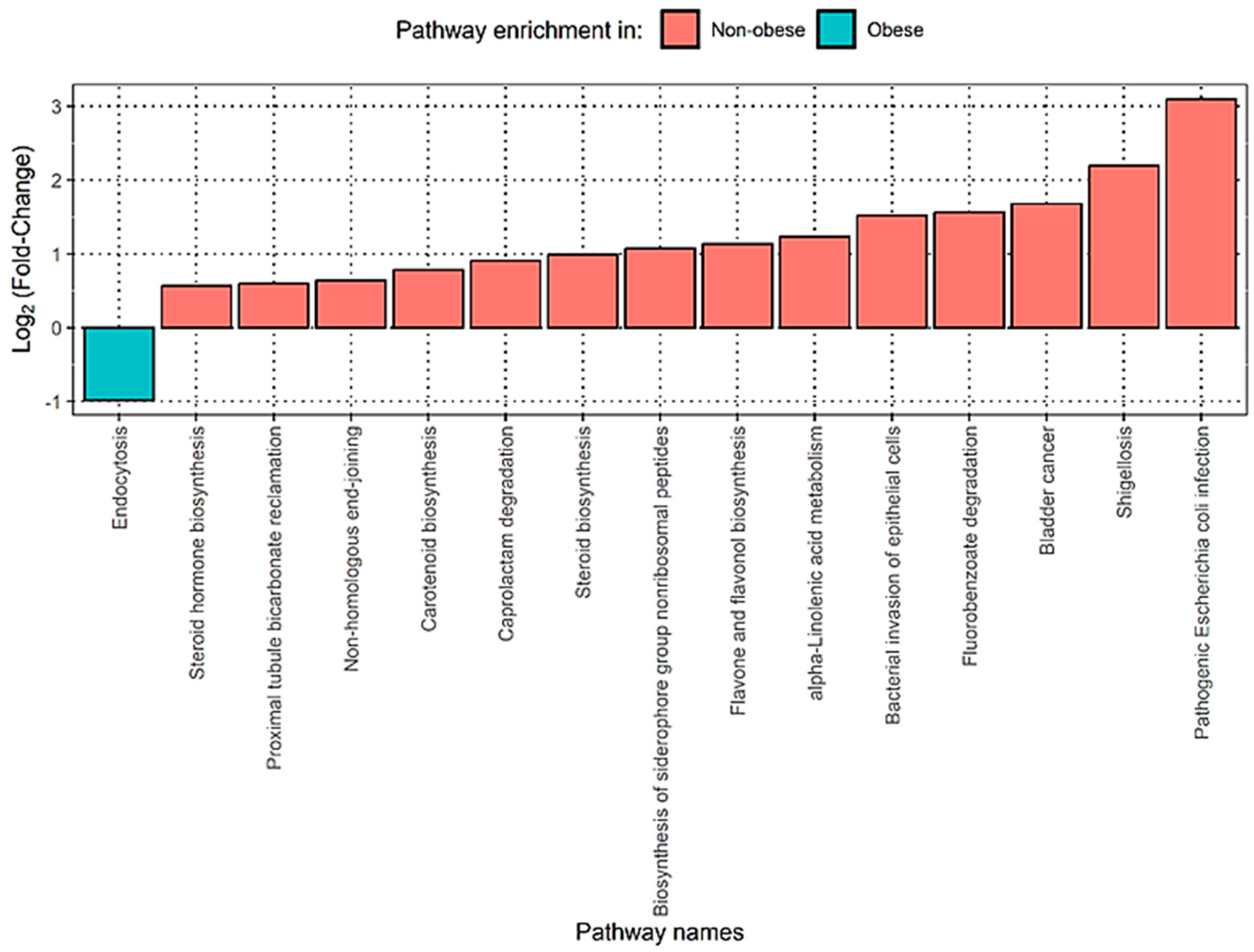
3.4. Functional Analysis Shows That Obese Patients Have Significantly Enriched Pathways Related to Bacterial Infections in the Gut Microbiome
A major factor in understanding the role the gut microbiome plays in our health is understanding the metabolic pathways that are affected. Furthermore, we can classify the metabolic pathways into their respective pathway superclasses, as multiple significant pathways may provide the same function in the human body. Therefore, we estimated pathway abundance using PICRUSt2, following the standard conda pipeline [16]. The resulting pathway abundances were processed in the ggpicrust2 pipeline by taking the KO abundance and converting it to the KEGG abundance with the method ko2kegg_abundance [18]. The pathways were prefiltered to require at least 1000 abundance in 10% or more of the samples that were applied. The pathways were then analyzed using edgeR as the method for differential abundance. Pathways were considered significant if their FDR q_value was less than 0.05 and their KO pathways were annotated with the method pathway annotation, as shown in Figure 3.
Figure 3.
The plot displays a total of 15 KEGG pathways that are significantly differentially expressed between the obese and nonobese cohorts. The one pathway that is significantly enriched in the non_obese cohort is blue, while the fourteen (14) pathways enriched in the obese cohort are denoted in red. The pathway plot is ordered from the smallest to the largest fold change.
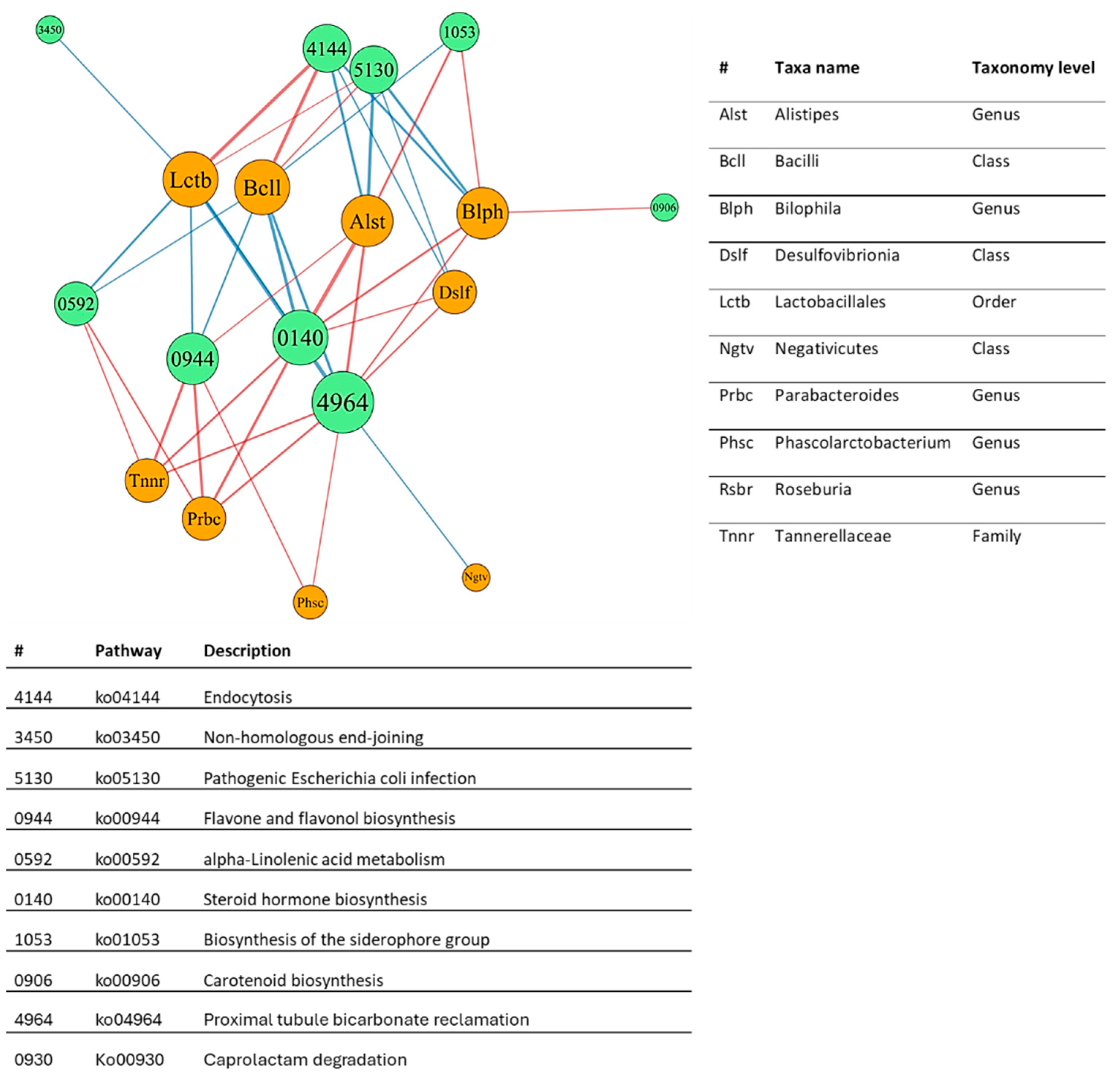
3.5. Covariance Network Analysis Shows That the Genus Alistipes and Bilophia Are the Most Significant Features, Correlated to the Most Metabolic Pathways
An important aspect of understanding the effects that BMI has on the human body is by linking the gut microbiome with the metabolic profile of the bacterial genera. Figure 2 shows that an elevated BMI is associated with a significant reduction in the relative abundance of four bacterial genera. Figure 3 shows an overall enrichment of pathogenic metabolic pathways in obese patients. Combining these two figures would allow for an understanding of the metabolic mechanism that the significant genera enact on the host body. The implementation of this involved normalizing the pathway and bacterial genus abundances by center-log ratio using the microbiome::transform method in R1.50.2 [19]. Only significant pathways and genera seen in Figure 2 and Figure 3 were considered. The resulting normalized abundances were correlated with each other using Spearman’s method and graphically represented as a graph, with nodes representing the significant pathways and the corresponding genus. If two nodes were found to be significantly correlated, defined as having an FDR q-value less than 0.05 and a correlation coefficient greater than 0.3 (or less than −0.3), then an edge connects the two as shown in Figure 4.
Figure 4.
Alistipes and Bilophila are the most significant bacterial genera in the network, significantly correlated to the highest number of metabolic pathways. The nodes in the network analysis represent the significant genera and pathways, while the edges denote a significant correlation between them. The genera nodes have the acronym of their name on them. Node size is proportional to the number of edges connecting to it. Red edges denote a positive significant correlation, while blue represents a significant negative correlation between the two nodes.
A simplified schematic illustrating the structure of the covariance network, highlighting how significant bacterial genera connect with metabolic pathways, as shown in Figure S11. This overview provides readers with a clearer conceptual understanding of the analytical framework used in Figure 4.
4. Discussion
This study comprehensively examines the complex relationship between body mass index (BMI) and both the composition and functional characteristics of the gut microbiome [20]. Initial analyses indicated that metrics of overall diversity, specifically alpha diversity indices such as Chao1, Shannon, and Simpson indices, as well as beta diversity assessed through Bray–Curtis distance, did not reveal statistically significant distinctions across varying BMI classifications. However, subsequent investigations revealed significant disparities among specific microbial taxa, notably highlighting Lachnospira, a genus that exhibited pronounced variations in abundance across these groups. These findings imply that the presence of beneficial microbes may be a more precise indicator of metabolic status, contrasting with broader assessments of overall microbial diversity [21]. The absence of significant differences in both alpha and beta diversity suggests that the richness and structural composition of microbial communities remain largely stable across different BMI categories, unlike other Western cohorts [22]. Nevertheless, this apparent stability may obscure critical taxonomic and functional distinctions that hold substantial implications for metabolic health. The differential abundance analysis revealed specific taxa associated with BMI status, with a particular emphasis on the significant enrichment of Lachnospira in non-obese individuals and its potential role in metabolic regulation.
Lachnospira, a member of the Lachnospiraceae family, is integral to the production of short-chain fatty acids (SCFAs), particularly butyrate [23]. This SCFA is essential for various physiological functions, including maintaining gut barrier integrity, modulating immune responses, and regulating host energy metabolism [24]. The higher prevalence of Lachnospira in individuals with lower BMI aligns with existing literature that correlates this genus with favorable phenotypic traits, such as leanness, reduced inflammatory markers, and enhanced metabolic health [25]. The abundance of Lachnospira may thus serve as a biomarker indicative of a fiber-rich diet, which is vital for cultivating a robust and effectively functioning gut ecosystem. In contrast, the cohort classified as obese demonstrated a significantly heightened abundance of Phascolarctobacterium, a genus whose metabolic functions remain incompletely characterized and whose associations with health outcomes are frequently ambiguous. Although Phascolarctobacterium is also involved in SCFA production, its elevated levels in individuals with obesity could suggest altered fermentation processes or modifications in the energy extraction efficiency of the gut microbiota [4]. That said, a new study observed an association between Phascolarctobacterium faecium and non-obese adults, as well as anti-obesogenic properties in mice [26]. Mechanistically, Lachnospira promotes energy balance by producing butyrate and propionate, which control the integrity of the intestinal barrier and appetite signals through the GLP-1 and PYY pathways. Hepatic gluconeogenesis and lipid metabolism, on the other hand, may be impacted by Phascolarctobacterium through the production of propionate and the use of succinate. Their conflicting links with obesity may be partially explained by these complementary yet different metabolic roles. Such observations suggest potential changes in microbial functions and community dynamics, which may contribute to metabolic connections with obesity.
To further elucidate these dynamics, functional profiling was conducted using advanced computational methodologies, specifically PICRUSt2 and DESeq2, which led to the identification of fifteen KEGG pathways exhibiting statistically significant alterations across the BMI groups. Noteworthy pathways, including those related to alpha-linolenic acid metabolism and steroid hormone biosynthesis, were associated with SCFA-producing taxa, notably members of the Lactobacillales and Tannerellaceae families. The established connections between Lachnospira and these functional changes, although indirect, are plausible given its acknowledged role in fiber fermentation and systemic metabolic regulation [27]. Similarly, Christensenellaceae has been consistently associated with a lean phenotype and is hypothesized to play a crucial role in maintaining metabolic homeostasis [28]. The potential synergistic interactions among these beneficial microbes, including Lachnospira, may be integral to preserving a healthy gut environment, which is essential for optimal metabolic functionality.
To advance the understanding of the metabolic mechanisms by which specific bacterial genera influence host physiology, a covariance network analysis was performed. This analytical approach established connections between gut microbial composition and functional metabolic outputs by correlating the normalized abundances of bacterial genera with KEGG pathways, as illustrated in Figure 2 and Figure 3. Notably, the genera Alistipes and Bilophila emerged as prominent features, exhibiting strong correlations with various metabolic pathways, such as steroid biosynthesis and pathogenic E. coli, consistent with previous literature [29,30]. The results of this integrative analysis revealed a distinct enrichment of pathogenic metabolic pathways in obese individuals, accompanied by a reduction in the relative abundance of several key bacterial genera. These insights highlight the potential mechanistic connections between alterations in microbial composition and metabolic disturbances associated with obesity. Furthermore, they highlight the functional significance of specific taxa, such as Alistipes and Bilophila, in modulating these metabolic outcomes.
The KEGG pathways found to be enriched in obese individuals—many of which are associated with pathogenic and infection-related mechanisms—are based on 16S rRNA-derived inference through PICRUSt2 rather than direct metagenomic sequencing, so it is crucial to interpret the functional predictions cautiously. Therefore, insufficient functional annotation or biases in the reference genome may affect these predictions. Future research using metabolomics or shotgun metagenomics will be useful for confirming these deduced functional relationships. Age was statistically controlled for in all differential analyses and did not significantly affect microbial abundance patterns, despite the obese group’s tendency to be older. Sensitivity tests using age-matched subgroups also yielded consistent patterns, confirming the stability of the microbiome-BMI associations found.
Age was statistically controlled for in all differential analyses and did not significantly affect microbial abundance patterns, despite the obese group’s tendency to be older. Sensitivity tests using age-matched subgroups also yielded consistent patterns, confirming the stability of the microbiome-BMI associations found. One significant disadvantage is the comparatively small and uneven sample size (75 non-obese vs. 28 obese). The availability of participants and stringent inclusion criteria that required comprehensive dietary and clinical data limited recruitment. Despite the sample size limitations on statistical power and generalizability, the danger of false positives is decreased by the multiple-testing corrections and strong standardization. It should be the goal of future research to confirm these results in bigger, more representative samples. Despite the strengths inherent in this analysis, several limitations warrant careful consideration. While appropriate statistical adjustments were implemented for age and fiber intake, additional confounding variables, such as the levels of physical activity, were not adequately controlled. Furthermore, reliance on 16S rRNA gene-based predictions for functional profiling, although informative, does not fully capture the complexities of actual gene expression or the resultant metabolite outputs of the microbiome. While 16S rRNA sequencing enables extensive taxonomic and functional profiling, strain-level diversity and actual gene expression may not be captured by inferred functions utilizing PICRUSt2, which rely on reference genome databases. Predicted KEGG pathway enrichments should therefore be viewed as suggestive rather than conclusive. Future work would benefit from metagenomic and metabolomic validation. Thus, future research employing more comprehensive methodologies, such as metagenomics and metabolomics, is essential for validating the inferred functional characteristics of these microbial communities.
Potential directions for microbiome-targeted therapies are suggested by the observed enrichment of SCFA-producing genera, such as Lactobacillus and Lachnospira, among non-obese people. Probiotic formulations including these taxa or dietary measures that boost fiber and prebiotic intake may help improve metabolic outcomes and restore beneficial microbial balance. Dietary guidelines tailored to the MENA region that make use of regional food sources high in fermentable fibers may provide culturally viable strategies for preventing obesity.
5. Conclusions
The findings of this study highlight the crucial importance of identifying specific microbial taxa, particularly Lachnospira, in distinguishing gut microbiome profiles across various BMI categories. Through the correlation of significant bacterial genera and associated metabolic pathways, this study also identified Alistipes and Bilophila as important taxa closely associated with a range of metabolic functions, particularly those that are enriched in individuals with obesity. While traditional measures of microbial diversity provide valuable insights, a more focused examination of specific taxa may yield a deeper understanding of their roles in metabolism and health.
Supplementary Materials
The following supporting information can be downloaded at https://www.mdpi.com/article/10.3390/applmicrobiol5040141/s1. Figure S1: Quality Control: Sequencing depth distribution; Figure S2: Quality Control: DNA quantity vs A260/280 purity ratio; Figure S3: Quality Control: High molecular weight DNA integrity score distribution; Figure S4: Expanded Demographics: Age distribution by BMI group; Figure S5: Expanded Demographics: Proportional activity levels (Low/Moderate/High) by BMI group; Figure S6: Expanded Demographics: Daily fiber intake (g) by BMI group; Figure S7: Expanded Demographics: Fasting glucose by BMI group; Figure S8: Expanded Demographics: Triglycerides by BMI group; Figure S9: Differentially abundant genera between obese and non-obese groups obtained using DESeq2 (design: ~Age + BMI). Points show log2 fold-change; lines indicate direction and magnitude. Positive values indicate enrichment in non-obese; Figure S10: Sensitivity Analysis: Age-matched subset DESeq2 results (significant taxa); Figure S11: Simplified schematic of covariance network analysis linking bacterial genera and metabolic pathways.
Author Contributions
Conceptualization, W.A. and M.A.; methodology, A.B. (Andre Barreiros); software, A.B. (Andre Barreiros); validation, D.A.-T., M.B., K.A., and A.B. (Ali BaniHani); formal analysis, M.A.; investigation, L.A., and R.A.; resources, W.A.; data curation, A.B. (Andre Barreiros); writing—original draft preparation, M.A.; writing—review and editing, W.A.; visualization, D.A.-T.; supervision, M.A.; project administration, W.A. All authors have read and agreed to the published version of the manuscript.
Funding
This research received no external funding.
Institutional Review Board Statement
The study was conducted in accordance with the Declaration of Helsinki and approved by the Institutional Review Board of the Yarmouk University Ethics Committee (IRB/2022/82) in 18 December 2022.
Informed Consent Statement
Informed consent was obtained from all subjects involved in the study.
Data Availability Statement
The data presented in this study are available on request from the corresponding author due to ethical restrictions.
Acknowledgments
We acknowledge all participants.
Conflicts of Interest
The authors declare no conflicts of interest.
Abbreviations
The following abbreviations are used in this manuscript:
| BMI | Body mass index |
| SCFA | Short-chain fatty acid |
| PICRUSt2 | Phylogenetic Investigation of Communities by Reconstruction of Unobserved States |
References
- Fan, Y.; Pedersen, O. Gut microbiota in human metabolic health and disease. Nat. Rev. Microbiol. 2021, 19, 55–71. [Google Scholar] [CrossRef] [PubMed]
- Rastogi, S.; Singh, A. Gut microbiome and human health: Exploring how the probiotic genus Lactobacillus modulate immune responses. Front. Pharmacol. 2022, 13, 1042189. [Google Scholar] [CrossRef]
- Lin, Y.-C.; Chen, Y.-T.; Li, K.-Y.; Chen, M.-J. Investigating the mechanistic differences of obesity-inducing Lactobacillus kefiranofaciens M1 and anti-obesity Lactobacillus mali APS1 by microbolomics and metabolomics. Front. Microbiol. 2020, 11, 1454. [Google Scholar] [CrossRef]
- Burakova, I.; Smirnova, Y.; Gryaznova, M.; Syromyatnikov, M.; Chizhkov, P.; Popov, E.; Popov, V. The effect of short-term consumption of lactic acid bacteria on the gut microbiota in obese people. Nutrients 2022, 14, 3384. [Google Scholar] [CrossRef]
- Lu, J.; Shataer, D.; Yan, H.; Dong, X.; Zhang, M.; Qin, Y.; Cui, J.; Wang, L. Probiotics and non-alcoholic fatty liver disease: Unveiling the mechanisms of Lactobacillus plantarum and Bifidobacterium bifidum in modulating lipid metabolism, inflammation, and intestinal barrier integrity. Foods 2024, 13, 2992. [Google Scholar] [CrossRef]
- Deng, K.; Shuai, M.; Zhang, Z.; Jiang, Z.; Fu, Y.; Shen, L.; Zheng, J.-S.; Chen, Y.-M. Temporal relationship among adiposity, gut microbiota, and insulin resistance in a longitudinal human cohort. BMC Med. 2022, 20, 171. [Google Scholar] [CrossRef]
- Martin-Gallausiaux, C.; Marinelli, L.; Blottière, H.M.; Larraufie, P.; Lapaque, N. SCFA: Mechanisms and functional importance in the gut. Proc. Nutr. Soc. 2021, 80, 37–49. [Google Scholar] [CrossRef]
- Waters, J.L.; Ley, R.E. The human gut bacteria Christensenellaceae are widespread, heritable, and associated with health. BMC Biol. 2019, 17, 83. [Google Scholar] [CrossRef]
- Mazier, W.; Le Corf, K.; Martinez, C.; Tudela, H.; Kissi, D.; Kropp, C.; Coubard, C.; Soto, M.; Elustondo, F.; Rawadi, G.; et al. A new strain of Christensenella minuta as a potential biotherapy for obesity and associated metabolic diseases. Cells 2021, 10, 823. [Google Scholar] [CrossRef] [PubMed]
- Safarchi, A.; Al-Qadami, G.; Tran, C.D.; Conlon, M. Understanding dysbiosis and resilience in the human gut microbiome: Biomarkers, interventions, and challenges. Front. Microbiol. 2025, 16, 1559521. [Google Scholar] [CrossRef] [PubMed]
- Xu, C.; Jiang, H.; Feng, L.-J.; Jiang, M.-Z.; Wang, Y.-L.; Liu, S.-J. Christensenella minuta interacts with multiple gut bacteria. Front. Microbiol. 2024, 15, 1301073. [Google Scholar] [CrossRef]
- Nikoloski, Z.; Williams, G. Obesity in Middle East, in Metabolic Syndrome; Springer: Berlin/Heidelberg, Germany, 2015; pp. 1–20. [Google Scholar]
- Healey, G.; Brough, L.; Murphy, R.; Hedderley, D.; Butts, C.; Coad, J. Validity and reproducibility of a habitual dietary fibre intake short food frequency questionnaire. Nutrients 2016, 8, 558. [Google Scholar] [CrossRef] [PubMed]
- Callahan, B.J.; Mcmurdie, P.J.; Rosen, M.J.; Han, A.W.; Johnson, A.J.A.; Holmes, S.P. DADA2: High-resolution sample inference from Illumina amplicon data. Nat. Methods 2016, 13, 581–583. [Google Scholar] [CrossRef] [PubMed]
- Pruesse, E.; Quast, C.; Knittel, K.; Fuchs, B.M.; Ludwig, W.; Peplies, J.; Glöckner, F.O. SILVA: A comprehensive online resource for quality checked and aligned ribosomal RNA sequence data compatible with ARB. Nucleic Acids Res. 2007, 35, 7188–7196. [Google Scholar] [CrossRef]
- Douglas, G.M.; Maffei, V.J.; Zaneveld, J.R.; Yurgel, S.N.; Brown, J.R.; Taylor, C.M.; Huttenhower, C.; Langille, M.G.I. PICRUSt2 for prediction of metagenome functions. Nat. Biotechnol. 2020, 38, 685–688. [Google Scholar] [CrossRef]
- Ahlmann-Eltze, C.; Huber, W. glmGamPoi: Fitting Gamma-Poisson generalized linear models on single cell count data. Bioinformatics 2020, 36, 5701–5702. [Google Scholar] [CrossRef] [PubMed]
- Yang, C.; Mai, J.; Cao, X.; Burberry, A.; Cominelli, F.; Zhang, L. ggpicrust2: An R package for PICRUSt2 predicted functional profile analysis and visualization. Bioinformatics 2023, 39, btad470. [Google Scholar] [CrossRef]
- Lahti, L.; Shetty, S. Microbiome R Package; Bioconductor: Seattle, WA, USA, 2017. [Google Scholar]
- Duan, M.; Wang, Y.; Zhang, Q.; Zou, R.; Guo, M.; Zheng, H. Characteristics of gut microbiota in people with obesity. PLoS ONE 2021, 16, e0255446. [Google Scholar] [CrossRef]
- Kim, M.-H.; Yun, K.E.; Kim, J.; Park, E.; Chang, Y.; Ryu, S.; Kim, H.-L.; Kim, H.-N. Gut microbiota and metabolic health among overweight and obese individuals. Sci. Rep. 2020, 10, 19417. [Google Scholar] [CrossRef]
- Le Chatelier, E.; Nielsen, T.; Qin, J.; Prifti, E.; Hildebrand, F.; Falony, G.; Almeida, M.; Arumugam, M.; Batto, J.-M.; Kennedy, S.; et al. Richness of human gut microbiome correlates with metabolic markers. Nature 2013, 500, 541–546. [Google Scholar] [CrossRef]
- Fusco, W.; Lorenzo, M.B.; Cintoni, M.; Porcari, S.; Rinninella, E.; Kaitsas, F.; Lener, E.; Mele, M.C.; Gasbarrini, A.; Collado, M.C.; et al. Short-chain fatty-acid-producing bacteria: Key components of the human gut microbiota. Nutrients 2023, 15, 2211. [Google Scholar] [CrossRef]
- Liu, L.; Li, Q.; Yang, Y.; Guo, A. Biological function of short-chain fatty acids and its regulation on intestinal health of poultry. Front. Vet. Sci. 2021, 8, 736739. [Google Scholar] [CrossRef]
- Companys, J.; Gosalbes, M.J.; Pla-Pagà, L.; Calderón-Pérez, L.; Llauradó, E.; Pedret, A.; Valls, R.M.; Jiménez-Hernández, N.; Sandoval-Ramirez, B.A.; del Bas, J.M.; et al. Gut microbiota profile and its association with clinical variables and dietary intake in overweight/obese and lean subjects: A cross-sectional study. Nutrients 2021, 13, 2032. [Google Scholar] [CrossRef]
- Liébana-García, R.; López-Almela, I.; Olivares, M.; Romaní-Pérez, M.; Manghi, P.; Torres-Mayo, A.; Tolosa-Enguís, V.; Flor-Duro, A.; Bullich-Vilarrubias, C.; Rubio, T.; et al. Gut commensal Phascolarctobacterium faecium retunes innate immunity to mitigate obesity and metabolic disease in mice. Nat. Microbiol. 2025, 10, 1310–1322. [Google Scholar] [CrossRef]
- Myhrstad, M.C.W.; Tunsjø, H.; Charnock, C.; Telle-Hansen, V.H. Dietary fiber, gut microbiota, and metabolic regulation—Current status in human randomized trials. Nutrients 2020, 12, 859. [Google Scholar] [CrossRef] [PubMed]
- Tavella, T.; Rampelli, S.; Guidarelli, G.; Bazzocchi, A.; Gasperini, C.; Pujos-Guillot, E.; Comte, B.; Barone, M.; Biagi, E.; Candela, M.; et al. Elevated gut microbiome abundance of Christensenellaceae, Porphyromonadaceae and Rikenellaceae is associated with reduced visceral adipose tissue and healthier metabolic profile in Italian elderly. Gut Microbes 2021, 13, 1880221. [Google Scholar] [CrossRef] [PubMed]
- Lv, Y.; Qin, X.; Jia, H.; Chen, S.; Sun, W.; Wang, X. The association between gut microbiota composition and BMI in Chinese male college students, as analysed by next-generation sequencing. Br. J. Nutr. 2019, 122, 986–995. [Google Scholar] [CrossRef] [PubMed]
- Tang, Y.; Lin, T.-C.; Yang, H.; Zhou, Y.; Sibeko, L.; Liu, Z. High-fat diet during early life reshapes the gut microbiome and is associated with the disrupted mammary microenvironment in later life in mice. Nutr. Res. 2024, 127, 1–12. [Google Scholar] [CrossRef]
Disclaimer/Publisher’s Note: The statements, opinions and data contained in all publications are solely those of the individual author(s) and contributor(s) and not of MDPI and/or the editor(s). MDPI and/or the editor(s) disclaim responsibility for any injury to people or property resulting from any ideas, methods, instructions or products referred to in the content. |
© 2025 by the authors. Licensee MDPI, Basel, Switzerland. This article is an open access article distributed under the terms and conditions of the Creative Commons Attribution (CC BY) license (https://creativecommons.org/licenses/by/4.0/).