Article

Effect of K-Solubilizing Purple Nonsulfur Bacteria on Soil K Content, Plant K Uptake, and Yield of Hybrid Maize Grown on Alluvial Soil in a Dyke Area in Field Conditions


1
Faculty of Crop Science, College of Agriculture, Can Tho University, Can Tho 94000, Vietnam
2
Faculty of Physiology-Biochemistry, College of Agriculture, Can Tho University, Can Tho 94000, Vietnam
*
Author to whom correspondence should be addressed.
Appl. Microbiol. 2025, 5(4), 137; https://doi.org/10.3390/applmicrobiol5040137
Submission received: 26 October 2025 / Revised: 19 November 2025 / Accepted: 25 November 2025 / Published: 26 November 2025

Abstract

Microorganisms are considered a potential source of biofertilizers for mobilizing nutrients from insoluble mineral potassium (K). This study was conducted to evaluate the effects of liquid potassium-solubilizing bacteria, Cereibacter sphaeroides M-Sl-09, Rhodopseudomonas thermotolerans M-So-11, and Rhodopseudomonas palustris M-So-14 (LPS-PNSB), on soil K content, plant K uptake, growth, and yield of hybrid maize cultivated on alluvial soil in the dyke-protected area of An Phu, An Giang, Vietnam. Results showed that the application of LPS-PNSB significantly improved exchangeable soil K from 0.428 to 0.460–0.470 meq 100 g−1, total plant K uptake from 181.5 to 205.8–259.4 kg ha−1, and yield from 11.1 to 12.2–12.6 ton ha−1, compared with the recommended 100% NPK fertilization. The addition of LPS-PNSB allowed a 100% reduction in K fertilizer compared with the recommended rate while still maintaining yield. Hybrid maize grain yield further increased when 100% recommended K was applied in combination with LPS-PNSB, surpassing the yield obtained with 100% K alone.

1. Introduction

Hybrid maize is a major cereal crop widely used as livestock feed and serves as a primary source of animal nutrition [1]. The nutritional content of 100 g of hybrid maize ranges from approximately 380.0 to 400.0 kcals, 1.00 to 3.00 g sugar, 1.00 to 5.00 g fat, 8.00 to 12.0 g protein, 1.21 to 2.23 mg iron, 76.0 to 85.0 g total carbohydrates, 103.0 to 155.0 mg Mg, and 283.0 to 445.0 mg K [2]. In 2021, the global maize cultivation area was about 205.0 million ha, with an average yield of 5.8 t ha−1, producing 1.20 billion tons. In 2022, the cultivated area decreased to 203.0 million ha, with an average yield of 5.7 t ha−1 and a total production of 1.16 billion tons. However, in 2023, the cultivated area increased by 1.43% compared with 2021, reaching 208.0 million ha, with an average yield of 5.9 t ha−1 and production of 1.24 billion tons [3].
In Vietnam, maize was cultivated on approximately 800.0 thousand ha, with an average yield of 5.04 t ha−1 and production of 4.43 million tons in 2023 [3]. Among the provinces, An Giang has a relatively large maize cultivation area and production [4]. Maize in An Giang is mainly cultivated on alluvial soil in dyke-protected areas, which are not replenished annually by new alluvial deposits as in other alluvial regions [5]. Consequently, soil nutrient levels are relatively low. Furthermore, unlike rice cultivation, where straw is returned to the field, maize stover is commonly used as livestock feed after harvest, resulting in reduced biomass return to the soil [6]. Plant biomass is considered an important source of K when incorporated into the soil [7]. Moreover, soil K predominantly exists in insoluble mineral forms that are unavailable to plants [8].
Currently, biotechnology applications in agriculture are being widely adopted worldwide, and commercialized biotechnological products are increasingly accessible to farmers [9,10]. Among these, the use of microorganisms is considered a promising approach [11,12]. Potassium-solubilizing bacteria have been isolated and utilized to mobilize K from soil mineral sources [13]. As K in soil is mainly present in insoluble mineral forms that plants cannot absorb [14], these bacteria secrete organic acids that contribute to bioweathering, releasing K from mineral surfaces and enhancing K use efficiency in soils [15,16]. In particular, Rhodopseudomonas spp. and Cereibacter spp., members of the purple nonsulfur bacteria (PNSB), possess multiple functions, including nitrogen fixation, phosphate solubilization, and production of plant growth-promoting substances, lipopeptides, and exopolymeric substances (EPSs). These properties enable their application in agriculture as both nutrient providers and biocontrol agents [17,18,19]. Moreover, their anoxygenic photosynthesis provides reducing power that may support organic acid secretion and mineral weathering [20,21]. However, field-based evidence of the K-solubilizing capacity of PNSB strains remains scarce. Additionally, the K-solubilizing ability of PNSB has been demonstrated in a limited number of laboratory and greenhouse studies [22,23]. These PNSB strains can release K from insoluble mineral forms in soil through organic acid secretion, thereby increasing soil exchangeable K content [24]. However, for the practical application and commercialization of K-solubilizing PNSB, more research is needed to evaluate their efficiency in solubilizing K from minerals and to determine their potential for reducing chemical K fertilizer use. In the meantime, Cereibacter sphaeroides M-Sl-09, Rhodopseudomonas thermotolerans M-So-11, and Rhodopseudomonas palustris M-So-14 have been isolated in the dyke-protected area of An Phu District, An Giang Province, Vietnam [25]. They hold promising traits for improving soil nutrient dynamics, plant K uptake, growth performance, and grain yield of hybrid maize cultivated [25].
The objectives of this research were to determine whether liquid PNSB inoculation can (i) enhance soil exchangeable K and associated nutrients; (ii) improve plant K uptake and biomass accumulation; and (iii) maintain or increase grain yield while reducing chemical K fertilizer inputs. This study aims to contribute practical knowledge toward sustainable nutrient management and the potential integration of PNSB into commercial biofertilizer programs.

2. Materials and Methods

2.1. Experimental Materials

Duration: This study was conducted from November 2024 to May 2025.
Location: The experiment was carried out in a farmer’s field belonging to Tran Thi Nang, Phuoc Hoa Hamlet, Phuoc Hung Commune, An Phu District, An Giang Province, Vietnam (10°52′11.6″ N 105°05′33.4″ E), and in the Plant Morphology and Nutrition Laboratory, Faculty of Crop Science, College of Agriculture, Can Tho University.
Maize variety: The hybrid maize cultivar DK6919S (DEKALB Vietnam Co., Ltd., Ho Chi Minh City, Vietnam) was used, with a growth duration of 90–100 days.
Liquid PNSB inoculants: Potassium-solubilizing purple nonsulfur bacteria (LPS-PNSB) strains in liquid form were used, including Cereibacter sphaeroides M-Sl-09, Rhodopseudomonas thermotolerans M-So-11, and Rhodopseudomonas palustris M-So-14 [25], preserved at the Faculty of Crop Science, College of Agriculture, Can Tho University.
Commercial microbial inoculant (CMI): This contained Trichoderma spp. (1 × 10⁸ CFU g−1), Bacillus subtilis (1 × 10⁸ CFU g−1), and Streptomyces spp. (1 × 10⁸ CFU g−1).

2.2. Experimental Methods

Experimental design: The experiment was arranged in a completely randomized block design with 12 treatments, four replications, and each plot measuring 20 m2. Treatments were as follows: (i) 100% N, P, K; (ii) 100% N, P + 75% K; (iii) 100% N, P + 50% K; (iv) 100% N, P + 25% K; (v) 100% N, P + 0% K; (vi) 100% N, P, K + LPS-PNSB; (vii) 100% N, P + 75% K + LPS-PNSB; (viii) 100% N, P + 50% K + LPS-PNSB; (ix) 100% N, P + 25% K + LPS-PNSB; (x) 100% N, P + 0% K + LPS-PNSB; (xi) 100% N, P + 75% K + CMI; (xii) farmer’s fertilization practice (FFP).
Experimental procedure: Maize seeds were surface-sterilized with 70% ethanol for 3 min, followed by 1% sodium hypochlorite for 10 min, then rinsed three times with sterilized demineralized water. Seeds were incubated in the dark for 24 h for germination. When germinated, one-third of the seeds were soaked in a liquid suspension of LPS-PNSB (109 CFU mL−1) for 1 h; one-third in the commercial microbial inoculant; and the remaining one-third in sterilized distilled water. After soaking, two seeds were sown per hole. The LPS-PNSB suspension (30 mL) was applied at 10, 20, and 45 days after sowing (DAS), achieving final bacterial populations theoretically around 5.75 × 10⁴ CFU g−1 dry soil.
Fertilizer recommendations: The recommended fertilizer rate was 200 N–90 P2O5–80 K2O kg ha−1, applied in four splits: Basal application: entire P dose; 10 DAS: 1/3 N + ½ K2O (as KCl); 20 DAS: 1/3 N; 45 DAS: 1/3 N + ½ K2O [26]. The farmer’s fertilizer practice (FFP) was 208 N–41.1 P2O5–114 K2O kg ha−1. Chemical fertilizers: urea (46% N), superphosphate (16% P2O5, 20% CaO), and potassium chloride (60% K2O) were used.
Crop management: irrigation: plots were irrigated twice per week by pumping water from the canal; pest and disease management was carried out as needed throughout the growing season; harvest was conducted when stems and leaves turned yellow and kernels showed a black layer at the base.
Agronomic trait measurement: Evaluations were conducted at physiological maturity (R6, ~100 DAS) using 20 representative plants per plot:
  • Plant height (cm): measured from the soil surface to the top of the highest leaf.
  • Stem diameter (cm): measured at the basal, middle, and upper parts of the stem, then averaged.
  • Number of leaves (leaves plant−1): counted as the total number of leaves per plant.
  • Ear set height (cm): measured from the soil surface to the node of the first ear.
  • Ear length (cm): measured from the base to the tip of the ear.
  • Number of rows per ear (rows ear−1): total number of rows of kernels on each ear.
  • Ear diameter (cm): measured at three positions along the ear and averaged.
  • Number of kernels per row (kernels row−1): counted on one kernel row of the ear.
  • Hundred-kernel weight (g): weight of one hundred kernels from each plot.
  • Grain yield (t ha−1): all ears in each plot were harvested, weighed fresh, air-dried, shelled, and adjusted to 15.5% moisture content.
Dry biomass: Entire plants from each plot were harvested and separated into stems, leaves, husks, kernels, and cobs. The fresh biomass of each component was recorded. A 10% subsample of fresh biomass was oven-dried at 70 °C to constant weight to determine dry biomass, which was then extrapolated to total biomass.
Plant nutrient analysis: Potassium content in leaves, stems, husks, cobs, and kernels at physiological maturity was determined following Houba et al. [27]. Dried, ground plant samples were digested with concentrated H2SO4, salicylic acid, and 30% H2O2 at 180 °C. The digest was diluted to 50 mL with distilled water, and K was measured using atomic absorption spectrophotometry at 766.5 nm. K uptake in each plant part = K concentration × dry biomass of that part.
Soil analysis (after the experiment): Chemical properties were analyzed according to Sparks et al. [28]:
  • pH (H2O and KCl) was determined by extracting soil with distilled water and 1.0 M KCl at a ratio of 1:2.5, then measured with a pH meter. Electrical conductivity (EC) was measured from the soil–water extract used for pH (H2O).
  • Total N was determined by the Kjeldahl method and titrated with 0.01 N H2SO4. Available N (NH4+ and NO3) was determined from soil extracted with 2.0 M KCl at a ratio of 1:10, then measured spectrophotometrically at 650.0 and 540.0 nm, respectively.
  • Soluble P was determined by Bray II extraction. Total P was determined by digesting soil with concentrated H2SO4 and HClO4. Insoluble P (Al-P, Fe-P, Ca-P) was extracted sequentially with 25 mL 0.5 M NH4F, 25 mL 0.1 M NaOH, and 25 mL 2.5 M H2SO4, respectively. All P fractions were measured spectrophotometrically at 880.0 nm.
  • Organic matter was determined by the Walkley–Black method.
  • Exchangeable cations (K+, Na+, Ca2+, Mg2+) were extracted with 0.1 N BaCl2 and measured by atomic absorption spectrophotometry at 766.5, 589.0, 422.7, and 285.5 nm, respectively. For cation-exchange capacity (CEC), the cation-extracted soil was subsequently extracted with 0.02 M MgSO4, and the solution was titrated with 0.01 M EDTA.
  • Bacterial density: The density of the PNSB was counted by the most probable number method [29] in the basic isolation medium specified for PNSB [30]. The CMI counted total potassium-solubilizing bacteria.
Statistical analysis: Data were compiled using Microsoft Excel 2016 and analyzed using SPSS 13.0. Treatment means were compared using Duncan’s test at a 5% significance level.

3. Results

3.1. Effects of Liquid Potassium-Solubilizing Purple Nonsulfur Bacteria on Soil Properties of Alluvial Soil in the Dyke-Protected Area of An Phu, An Giang

As shown in Table 1, treatments with 25–100% K supplemented with LPS-PNSB had similar pH (H2O) values, which were higher than those in the 75% K + CMI treatment and the farmer’s fertilization practice (FFP), with values of 7.27–7.32 compared with 7.07–7.08, respectively. In contrast, the highest EC value was recorded in the 75% K + CMI treatment (0.717 mS cm−1), whereas treatments with LPS-PNSB showed lower values (0.363–0.400 mS cm−1).
Furthermore, treatments with 50–75% K + LPS-PNSB showed higher contents of NH4+, NO3, and soluble P than chemical fertilizer-only treatments, with values of 8.49–8.57 > 7.20–7.44 mg kg−1, 61.4–61.6 > 45.5–46.8 mg kg−1, and 147.7–149.8 > 110.3–123.6 mg kg−1, respectively. In addition, Al-P and Fe-P contents in the 25% K + LPS-PNSB treatment were lower than in chemical fertilizer-only treatments and the FFP, with 341.0 < 435.1–451.9 mg kg−1 (Al-P) and 455.1 < 531.9–553.4 mg kg−1 (Fe-P). However, Ca-P content in the 75% K + LPS-PNSB treatment was lower than in chemical fertilizer-only treatments and in the 75% K + CMI treatment, with 125.7 < 142.2–158.4 mg kg−1 (Table 1).
Exchangeable K content in treatments supplemented with LPS-PNSB was similar among them and higher than in the remaining treatments, with values of 0.460–0.470 > 0.335–0.437 meq 100 g−1, respectively. Similarly, LPS-PNSB supplementation reduced Na+ content compared with the FFP, with 0.090–0.109 < 0.128 meq 100 g−1 (Table 1). Meanwhile, pH (KCl), CEC, organic matter, Ca2+, and Mg2+ contents were similar among treatments, ranging from 6.76 to 7.09, 17.0 to 18.2 meq 100 g−1, 1.09 to 1.19%C, 11.8 to 12.9 meq 100 g−1, and 2.28 to 2.32 meq 100 g−1, respectively (Table 1).
The application of LPS-PNSB resulted in significantly higher bacterial populations in the maize rhizosphere compared with chemical fertilizer-only treatments (Figure 1). Soils receiving LPS-PNSB reached bacterial densities of approximately 5.5–5.6 MPN g−1 DSW, statistically higher than both the full NPK treatment and the FFP, which remained below 3.0 × 10⁴ MPN g−1 DSW. The CMI produced an intermediate population level, significantly higher than uninoculated treatments but lower than all LPS-PNSB treatments. No significant differences were observed among LPS-PNSB treatments across the different K fertilizer rates, indicating that the inoculant was successfully established in the soil regardless of chemical K input.

3.2. Effects of Liquid Potassium-Solubilizing Purple Nonsulfur Bacteria on K Uptake in Hybrid Maize Grown on Alluvial Soil in the Dyke-Protected Area of An Phu, An Giang

Dry biomass: Application of 100% K resulted in higher dry biomass of leaves, stems, husks, kernels, and cobs compared with the 0% K treatment, with values of 2.95 > 2.73, 2.58 > 2.39, 1.25 > 1.11, 9.85 > 8.95, and 1.34 > 1.25 t ha−1, respectively. Treatments with 50–100% K + LPS-PNSB produced similar leaf dry biomass, which was higher than the remaining treatments, with 3.74–3.76 > 2.71–3.60 t ha−1. Moreover, stem, husk, and cob dry biomass in the 75% K + LPS-PNSB treatment were higher than in the 100% NPK, 75% K + CMI, and FFP treatments, with 3.35 > 2.48–2.58 t ha−1, 1.57 > 1.14–1.25 t ha−1, and 1.62 > 1.20–1.34 t ha−1, respectively. Kernel dry biomass was highest in the 100% K + LPS-PNSB treatment (11.7 t ha−1). Notably, in the absence of chemical K fertilizer, the LPS-PNSB treatment had higher dry biomass in all plant parts compared with the treatment without PNSB supplementation, with 3.55 vs. 2.73 (leaves), 2.87 vs. 2.39 (stems), 1.51 vs. 1.11 (husks), 10.9 vs. 8.95 (kernels), and 1.56 vs. 1.25 t ha−1 (cobs) (Table 2).
Plant K concentration: On soils without K fertilization, LPS-PNSB supplementation increased K concentrations in leaves (2.47 vs. 2.20%) and in stems, husks, kernels, and cobs (0.752 vs. 0.708%, 0.730 vs. 0.656%, 0.718 vs. 0.596%, and 0.464 vs. 0.381%), respectively. The 75% K + LPS-PNSB treatment had higher K concentrations in leaves, stems, husks, kernels, and cobs compared with the 100% NPK and 75% K + CMI treatments, with values of 2.85 > 2.50 > 2.35%, 1.01 > 0.935 > 0.756%, 0.770 > 0.736 > 0.681%, 0.811 > 0.705~0.651%, and 0.466 > 0.376~0.397%, respectively. Moreover, the 50% K + LPS-PNSB treatment resulted in higher K concentrations in leaves, stems, husks, and kernels than the FFP, with 2.50 > 2.05%, 0.791 > 0.904%, 0.725 > 0.653%, and 0.711 > 0.646%, respectively (Table 3).
K uptake in plant parts: In the 100% NPK treatment, K uptake in leaves, stems, husks, kernels, and cobs was 73.7, 24.1, 9.26, 69.4, and 5.05 kg ha−1, higher than in the 100% NP treatment (60.0, 16.9, 7.26, 53.4, and 4.77 kg ha−1, respectively). Treatments supplemented with LPS-PNSB showed higher K uptake in all plant parts compared with the corresponding chemical fertilizer-only treatments. Moreover, 75% K + LPS-PNSB resulted in higher K uptake in leaves, stems, husks, kernels, and cobs than the 75% K + CMI treatment, with 106.7 > 87.6 kg ha−1, 33.8 > 21.6 kg ha−1, 12.1 > 8.54 kg ha−1, 93.5 > 63.3 kg ha−1, and 7.53 > 5.19 kg ha−1, respectively. Similarly, the 100% NP + LPS-PNSB treatment showed higher K uptake than the 100% NP treatment in leaves (87.6 vs. 60.0 kg ha−1), stems (21.6 vs. 16.9 kg ha−1), husks (11.0 vs. 7.26 kg ha−1), kernels (78.4 vs. 53.4 kg ha−1), and cobs (7.22 vs. 4.77 kg ha−1). The total K uptake in treatments with 0–100% K + LPS-PNSB was higher than in the 100% NPK and FFP treatments, ranging from 205.8 to 259.1 compared with 153.1–181.5 kg ha−1 (Table 4).

3.3. Effects of Liquid Potassium-Solubilizing Purple Nonsulfur Bacteria on the Growth of Hybrid Maize Grown on Alluvial Soil in the Dyke-Protected Area of An Phu, An Giang

As shown in Table 5, the tallest plants were recorded in the 100% K + LPS-PNSB treatment (265.5 cm), while the shortest were in the 100% N, P + 0% K treatment (241.6 cm). Treatments with 25–100% K + LPS-PNSB had similar ear set height and stem diameter values, both higher than in chemical fertilizer-only treatments, with ranges of 106.3–108.0 > 95.3–102.8 cm and 1.33–1.34 > 1.02–1.19 cm, respectively. Leaf width and number of green leaves per plant in treatments with 0–100% K + LPS-PNSB were similar among them and higher than in the other treatments, with values of 9.12–9.39 > 8.21–8.44 cm and 10.5–11.0 > 9.15–9.40 leaves, respectively. Additionally, the 50% K + LPS-PNSB treatment produced greater leaf length than the 100% NPK and FFP treatments, with 84.5 vs. 80.9–81.3 cm. In contrast, differences in ear set leaf position among treatments were not statistically significant, ranging from 6.95 to 7.47. Furthermore, the total number of leaves per plant in the 75% K + LPS-PNSB treatment was higher than in the FFP and the 75% K + CMI treatment, with 14.1 > 13.2–13.3 leaves.

3.4. Effects of Liquid Potassium-Solubilizing Purple Nonsulfur Bacteria on the Yield of Hybrid Maize Grown on Alluvial Soil in the Dyke-Protected Area of An Phu, An Giang

Yield components: Application of 100% NPK resulted in longer ear length and larger ear diameter compared with the 0% K treatment, with values of 17.5 vs. 15.6 cm and 3.70 vs. 3.38 cm, respectively. Treatments with 0–100% K + LPS-PNSB produced similar ear length, cob length, and number of kernels per row, all higher than the 100% NPK treatment, with 18.4–18.9 > 17.5 cm, 17.9–18.2 > 16.8 cm, and 38.4–39.6 > 36.4 kernels, respectively. Ear diameter was similar among treatments supplemented with LPS-PNSB, CMI, and the FFP, ranging from 3.76 to 3.86 cm. Cob diameter was higher in the 50–75% K + LPS-PNSB treatments compared with chemical fertilizer-only treatments, with values of 2.20–2.26 > 2.01–2.11 cm, respectively. The number of rows per ear and 100-kernel weight did not differ significantly among treatments, ranging from 12.8 to 14.0 rows and 33.0 to 34.8 g, respectively (Table 6).
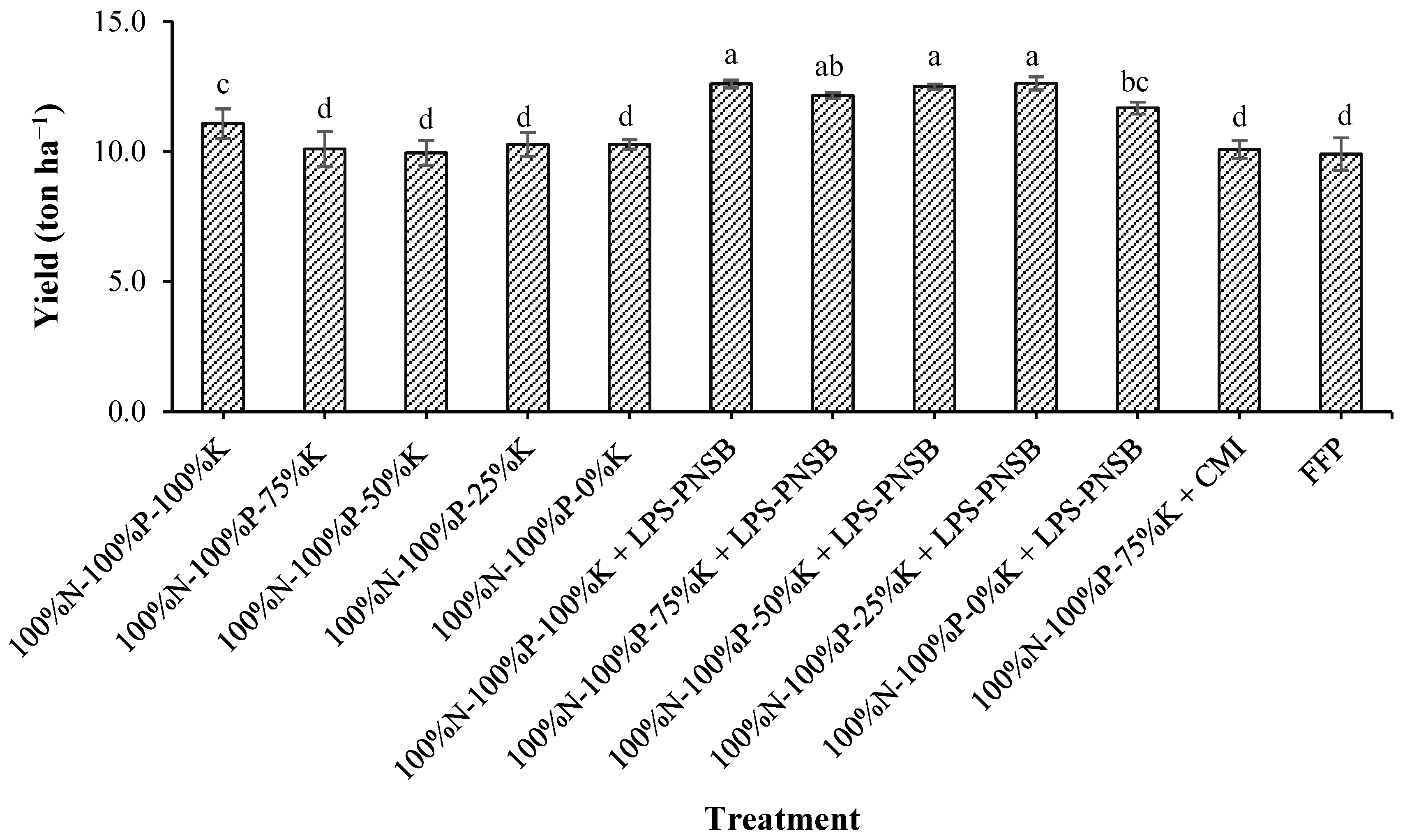
Grain yield: Treatments with 25–100% K + LPS-PNSB achieved similar grain yields, all higher than the 100% K (recommended rate) and FFP treatments, with 12.2–12.6 > 9.90–11.1 t ha−1. The 75% K + LPS-PNSB treatment produced higher grain yield than the 75% K + CMI treatment at the same K level, with 12.2 > 10.1 t ha−1. Notably, the 0% K + LPS-PNSB treatment achieved a grain yield equivalent to the 100% NPK treatment (11.7 vs. 11.1 t ha−1) (Figure 2).

4. Discussion

The application of liquid potassium-solubilizing purple nonsulfur bacteria (LPS-PNSB) demonstrated notable effects on soil nutrient availability, plant K uptake, and grain yield of hybrid maize cultivated on alluvial soil in the dyke-protected area of An Phu District, An Giang Province, Vietnam. The findings support the potential role of PNSB as a complementary or partial substitute for chemical K fertilization, yet several mechanistic and environmental factors must be considered for accurate interpretation.

4.1. Soil Properties of Alluvial Soil in the Dyke-Protected Area Under Hybrid Maize Cultivation

The addition of LPS-PNSB allowed a 100% reduction in chemical K fertilizer while increasing soil exchangeable K by 7.48–9.81% compared with 100% NPK, due to their ability to solubilize K from insoluble soil minerals (Table 1). Potassium-solubilizing microorganisms act directly through H+ release, secretion of organic acids, and complexation with Al3+, Fe2+, and Si4+. The H+ ions from organic acids displace K+ in clay mineral lattices, releasing K into the soil solution [31]. For example, Burkholderia sp. PKS041 has been shown to solubilize K by secreting organic acids such as gluconic acid (2.793 mmol L−1) and oxalic acid (1.292 mmol L−1), which strongly complexes Al3+ and Fe3+, thereby breaking down silicate mineral structures and releasing K+. Additional acids such as acetic (1.527 mmol L−1), pyruvic (0.856 mmol L−1), and lactic acid (0.700 mmol L−1) further contribute to mineral solubilization through acidification and ion-exchange mechanisms [32,33].
In addition, LPS-PNSB supplementation increased NH4+ (9.00–16.9%), NO3 (30.5–35.1%), and soluble P (19.5–31.8%) compared with 100% NPK (Table 1). The strains Cereibacter sphaeroides M-Sl-09, Rhodopseudomonas thermotolerans M-So-11, and Rhodopseudomonas palustris M-So-14 have been confirmed to fix N, solubilize P, and secrete plant growth-promoting substances such as IAA, ALA, and siderophores [25]. The presence of the nifH gene further confirms the biological nitrogen fixation potential of PNSB [34]. This explains the observed increase in available soil nutrients under LPS-PNSB treatments, consistent with mechanisms of N fixation and P solubilization reported by Thu et al. [22]. Similarly, Trong et al. [35] demonstrated that Rhodopseudomonas spp. increased available N (14.8%), soluble P (18.5%), and exchangeable K (40.6%), while decreasing Al-P (41.4%), Fe-P (17.1%), and Ca-P (25.2%) compared with no bacterial inoculation. In the present study, LPS-PNSB reduced insoluble P fractions, with Al-P decreasing by 20.5–26.0% and Fe-P by 16.2–26.1%, while enabling a 25–50% reduction in chemical K fertilization (Table 1).
The elevated bacterial populations observed in the LPS-PNSB treatments confirm successful establishment and proliferation of the applied inoculants in the rhizosphere (Figure 1). The superior population densities relative to the commercial microbial product suggest that the PNSB strains adapted effectively to the field environment and may have been more competitive or metabolically suited to the soil conditions. That LPS-PNSB populations remained high even under 0% chemical K fertilization indicates that the introduced bacteria were not dependent on added mineral K for establishment. However, although BIM, a PNSB-specific medium [30], was used, molecular tracking in future studies would be valuable to confirm colonization dynamics of each inoculated strain and to link population behavior more directly to soil nutrient transformations and plant responses.
Altogether, LPS-PNSB significantly increased soil exchangeable K, NH4+, NO3, and soluble P, and bacterial density, compared with chemical fertilizer-only treatments. These effects are consistent with the known functional traits of Cereibacter sphaeroides, Rhodopseudomonas thermotolerans, and Rhodopseudomonas palustris, including nitrogen fixation, phosphate solubilization, and potential release of organic acids that mobilize mineral-bound K [25,36,37]. The observed reductions in Al-P and Fe-P fractions suggest enhanced P transformation into more plant-available forms. While organic acid secretion is a plausible mechanism, direct quantification was not conducted in this study, and thus mechanistic attribution remains inferential.

4.2. Potassium Uptake in Hybrid Maize Grown on Alluvial Soil in the Dyke-Protected Area

Supplementation with 0–100% K + LPS-PNSB improved K uptake in leaves (48.7–86.4%), stems (28.6–51.3%), husks (48.0–70.9%), kernels (33.8–62.3%), and cobs (27.8–35.4%), and increased total K uptake by 34.4–69.2% compared with the FFP, except in stems under the 0% K treatment (Table 4). Similarly, inoculation with Pseudomonas fluorescens improved dry biomass of stems and leaves (80.9%) and roots (112.5%), while increasing K concentration in stems and leaves (39.0%) and roots (66.0%) compared with uninoculated plants [38]. Moreover, potassium-solubilizing bacteria increased maize biomass by 32.0% compared with uninoculated plants [39]. Pantoea agglomerans KSB37 and Rahnella aquatilis KSB39 enabled a 50% reduction in chemical K fertilizer while maintaining K uptake in both kernels and stover equivalent to 100% K fertilization [40]. In addition, Acinetobacter baumanii JHKSB4 combined with mica increased total K uptake by 30.0% in wheat and 20.3% in rice compared with uninoculated controls [41]. Likewise, Phares et al. [42] reported that potassium-solubilizing bacteria enhanced K uptake in maize compared with 100% NPK for two consecutive years, with increases of 31.6% in 2020 and 18.4% in 2021, while reducing chemical fertilizer input by 50%. Bacillus cereus inoculation increased available soil K and enhanced K uptake in potato tubers by 62.0% compared with uninoculated controls [43]. Similarly, co-inoculation of Bacillus licheniformis and Aspergillus violaceofuscus solubilizing K–mica improved shoot and root biomass as well as K concentration in tomato plants [44]. Therefore, supplementation with potassium-solubilizing microorganisms enhances crop biomass and improves K concentration and uptake in multiple plant organs, confirming their crucial role in optimizing K use efficiency and promoting crop growth.

4.3. Growth of Hybrid Maize Grown on Alluvial Soil in the Dyke-Protected Area

Inoculation with Pantoea ananatis KM977993, Rahnella aquatilis KM977991, or Enterobacter sp. KM977992 improved the plant height, stem diameter, root length, and leaf area of rice by 4.09–10.8%, 4.07–10.4%, 8.00–13.1%, and 19.8–21.4%, respectively, compared with uninoculated controls [45]. Similarly, in the present study, 25% reduction in chemical K combined with LPS-PNSB increased plant height, leaf length, leaf width, and number of green leaves per plant compared with 100% NPK, by 1.00%, 4.33%, 11.8%, and 15.2%, respectively (Table 5). Potassium-solubilizing bacteria isolated from tea soil produced plant growth-promoting hormones IAA and GA3, with Bacillus subtilis producing 186.5 µg IAA mL−1 and 12.2 µg GA3 mL−1, Burkholderia cepacia 200.1 µg IAA mL−1 and 13.0 µg GA3 mL−1, and Pseudomonas putida 263.3 µg IAA mL−1 and 14.9 µg GA3 mL−1 [46]. Similarly, inoculation with Acinetobacter pittii L4/1 improved rice plant height by 14.2% under normal conditions, 7.41% under 4 dS m−1 salinity, 34.0% under 8 dS m−1, and 34.3% under 12 dS m−1 [47]. Likewise, Klebsiella oxytoca KSB17 increased maize plant height and root length by 5.18% and 7.93%, respectively, compared with uninoculated controls under 100% K fertilization [48]. These findings indicate that LPS-PNSB not only improved morphological traits such as plant height, leaf length, leaf width, and leaf number but also contributed to enhanced root and stem development. Such improvements highlight the role of LPS-PNSB in promoting plant growth and establishing the foundation for higher yield and quality in sustainable crop production. In other words, maize plants treated with LPS-PNSB exhibited increased K uptake across all tissues, accompanied by improvements in plant height, stem diameter, leaf area, and ear development. These benefits may arise from combined effects of nutrient mobilization, increased nitrogen availability, and production of plant growth-promoting substances such as IAA [36]. However, because PNSB colonization was assessed only through total culturable population counts rather than strain-specific detection, the degree of root-associated colonization by the inoculated strains could not be confirmed. This limitation restricts the ability to directly link plant responses to specific microbial activities.

4.4. Grain Yield of Hybrid Maize Grown on Alluvial Soil in the Dyke-Protected Area

LPS-PNSB supplementation increased ear length and number of kernels per row compared with treatments without PNSB (Table 6). Similarly, Goswami and Maurya [49] found that reducing chemical K fertilizer by 50% combined with inoculation of KSB2 increased ear length, rows per ear, and kernels per ear by 21.1%, 23.9%, and 56.9% in 2017, and 22.0%, 20.6%, and 88.0% in 2018, respectively, thereby increasing maize grain yield by 70.9% (2017) and 75.5% (2018). In the present study, application of 25–100% recommended K with LPS-PNSB increased grain yield by 12.6% compared with 100% K (Figure 2). Furthermore, potassium-solubilizing bacteria combined with 25–50% reduction in chemical K increased grain yield by 20.3–31.6% compared with 100% K fertilization alone [50]. These results suggest that LPS-PNSB act as effective bio-agents for enhancing K use efficiency in maize, optimizing nutrient allocation for kernel formation and accumulation. In the context of rising potassium fertilizer costs and environmental impacts of overuse, partial substitution of chemical K with LPS-PNSB ensures yield maintenance while promoting sustainable agriculture. This result aligns with previous reports of PNSB enhancing nutrient use efficiency in other cropping systems [51,52,53]. Therefore, the findings of this study both have practical implications for sustainable maize production and highlight the potential of microbial inoculants in future nutrient management strategies. Nonetheless, the magnitude of fertilizer reduction observed here should be interpreted cautiously, as it derives from a single season under favorable environmental conditions.

5. Conclusions

Supplementation with liquid potassium-solubilizing purple nonsulfur bacteria (LPS-PNSB) improved soil nutrient availability, plant growth, and yield of hybrid maize cultivated on alluvial soil in the dyke-protected area of An Phu, An Giang Province. Specifically, LPS-PNSB enhanced soil exchangeable K, NH4+, NO3, and soluble P contents, while reducing insoluble P fractions (Al-P and Fe-P). This contributed to improved nutrient uptake, particularly K uptake, in leaves, stems, husks, kernels, and cobs. In addition, LPS-PNSB inoculation increased plant height, ear set height, stem diameter, leaf size, and number of leaves per plant. Yield components such as ear length and number of kernels per row were also enhanced, leading to higher grain yield compared with chemical fertilizer-only treatments. Notably, even without chemical K fertilization, inoculation with LPS-PNSB resulted in grain yield equivalent to that of 100% NPK application. Overall, the results demonstrate that LPS-PNSB can effectively replace a significant portion of chemical K fertilizer, thereby improving fertilizer use efficiency, reducing production costs, and contributing to sustainable maize cultivation on alluvial soils. However, there are several limitations such as a single one-site season and lack of strain-specific colonization, mineralogical forms of soil K, and environmental factors influencing PNSB activities. Therefore, future work should involve multi-season and multi-location trials, molecular verification of strain colonization, soil mineralogical analyses, and monitoring of environmental conditions that affect PNSB performance. Such studies will help clarify the mechanisms underlying PNSB-mediated K mobilization and refine recommendations for agricultural use.

Author Contributions

Conceptualization, N.Q.K. and L.K.Q.; methodology, N.Q.K., L.K.Q. and T.T.K.N.; validation, N.Q.K., L.K.Q., P.T.P.T., N.D.T. and L.T.M.T.; formal analysis, N.D.T., L.T.M.T., V.Y.N., L.T.Q. and L.C.T.; investigation, N.Q.K., L.K.Q. and T.T.K.N.; writing—original draft preparation, N.Q.K.; writing—review and editing, P.T.P.T. and L.T.Q. All authors have read and agreed to the published version of the manuscript.

Funding

This work was supported by Can Tho University [grant number CTCS2024-14-04].

Data Availability Statement

The raw data supporting the conclusions of this article will be made available by the authors on request.

Conflicts of Interest

The authors declare no conflicts of interest.

Abbreviations

The following abbreviations are used in this manuscript:
ALA5-aminolevulinic acid
CECCation-exchange capacity
CFUColony-forming unit
CMICommercial microbial inoculant
ECElectrical conductivity
EPSsExopolymeric substances
GAGibberellic acid
IAAIndole-3-acetic acid
KPotassium
LPS-PNSBLiquid potassium-solubilizing purple nonsulfur bacteria
PNSBPurple nonsulfur bacteria

References

  1. Alvarenga, I.C.; Dainton, A.N.; Aldrich, C.G. A Review: Nutrition and Process Attributes of Corn in Pet Foods. Crit. Rev. Food Sci. Nutr. 2022, 62, 8567–8576. [Google Scholar] [CrossRef]
  2. Oas, S.E.; Adams, K.R. The Nutritional Content of Five Southwestern US Indigenous Maize (Zea Mays L.) Landraces of Varying Endosperm Type. Am. Antiq. 2022, 87, 284–302. [Google Scholar] [CrossRef]
  3. FAOSTAT. Crops and Livestock Products. 2025. Available online: https://www.fao.org/faostat/en/#data/QCL (accessed on 3 September 2025).
  4. Nguyen, P.C.; Vu, P.T.; Minh, V.Q.; Tri, L.Q.; Khuong, N.Q. Development of Criteria for High-Technology Rice and Corn Suitability Assessment—A Case Study in the An Giang Province, Viet Nam. J. Ecol. Eng. 2023, 24, 239–247. [Google Scholar] [CrossRef]
  5. Da, C.T.; Lan, T.H.P.; Labor, F.; Long, T.X.; Dinh, T.T.; Tam, N.T.; Duc, V.T.; Berg, H. Farmers’ Perceived Impact of High-Dikes on Rice and Wild Fish Yields, Water Quality, and Use of Fertilizers in the Mekong Delta, Vietnam. ACS EST Water 2024, 4, 3235–3243. [Google Scholar] [CrossRef]
  6. Sutaryono, Y.A.; Putra, R.A.; Mardiansyah, M.; Yuliani, E.; Harjono, H.; Mastur, M.; Sukarne, S.; Enawati, L.; Dahlanuddin, D. Mixed Leucaena and Molasses Can Increase the Nutritional Quality and Rumen Degradation of Corn Stover Silage. J. Adv. Vet. Anim. Res. 2023, 10, 118. [Google Scholar] [CrossRef] [PubMed]
  7. Thenveettil, N.; Reddy, K.N.; Reddy, K.R. Effects of Potassium Nutrition on Corn (Zea mays L.) Physiology and Growth for Modeling. Agriculture 2024, 14, 968. [Google Scholar] [CrossRef]
  8. Samantray, J.; Anand, A.; Dash, B.; Ghosh, M.K.; Behera, A.K. Silicate Minerals—Potential Source of Potash—A Review. Miner. Eng. 2022, 179, 107463. [Google Scholar] [CrossRef]
  9. Ranjha, M.M.A.N.; Shafique, B.; Khalid, W.; Nadeem, H.R.; Mueen-ud-Din, G.; Khalid, M.Z. Applications of Biotechnology in Food and Agriculture: A Mini-Review. Proc. Natl. Acad. Sci. India Sect. B Biol. Sci. 2022, 92, 11–15. [Google Scholar] [CrossRef] [PubMed]
  10. Xiao, Z.; Kerr, W.A. Biotechnology in China—Regulation, Investment, and Delayed Commercialization. GM Crops Food 2022, 13, 86–96. [Google Scholar] [CrossRef]
  11. Ortiz, A.; Sansinenea, E. Recent Advancements for Microorganisms and Their Natural Compounds Useful in Agriculture. Appl. Microbiol. Biotechnol. 2021, 105, 891–897. [Google Scholar] [CrossRef]
  12. Glockow, T.; Kaster, A.K.; Rabe, K.S.; Niemeyer, C.M. Sustainable Agriculture: Leveraging Microorganisms for a Circular Economy. Appl. Microbiol. Biotechnol. 2024, 108, 452. [Google Scholar] [CrossRef] [PubMed]
  13. Gao, J.N.; Xu, M.T.; Uwiringiyimana, E. Isolation of Highly Efficient Potassium Solubilizing Bacteria and Their Effects on Nutrient Acquisition and Growth Promotion in Tobacco Seedlings. BMC Plant Biol. 2025, 25, 745. [Google Scholar] [CrossRef]
  14. Karpinets, T.V.; Greenwood, D.J. Potassium Dynamics. In Handbook of Processes and Modeling in the Soil-Plant System; Nieder, R., Benbi, D., Eds.; CRC Press: Boca Raton, FL, USA, 2024; pp. 525–559. [Google Scholar]
  15. Jini, D.; Ganga, V.S.; Greeshma, M.B.; Sivashankar, R.; Thirunavukkarasu, A. Sustainable Agricultural Practices Using Potassium-Solubilizing Microorganisms (KSMs) in Coastal Regions: A Critical Review on the Challenges and Opportunities. Environ. Dev. Sustain. 2024, 26, 13641–13664. [Google Scholar] [CrossRef]
  16. Awoniyi, A.S.; Adeyemo, A.J.; Agbenin, J.O.; Ilori, A.O.; da Silva Oliveira, D.M.; de Freitas, D.A.F. Potassium Release from K-Bearing Minerals Treated with Organic Acids under Laboratory Conditions. Discov. Soil 2025, 2, 69. [Google Scholar] [CrossRef]
  17. Su, P.; Zhang, D.; Zhang, Z.; Chen, A.; Hamid, M.R.; Li, C.; Du, J.; Cheng, J.; Tan, X.; Zhen, L.; et al. Characterization of Rhodopseudomonas palustris Population Dynamics on Tobacco Phyllosphere and Induction of Plant Resistance to Tobacco Mosaic Virus. Microb. Biotechnol. 2019, 12, 1453–1463. [Google Scholar] [CrossRef]
  18. Sundar, L.S.; Yen, K.S.; Chang, Y.T.; Chao, Y.Y. Utilization of Rhodopseudomonas palustris in Crop Rotation Practice Boosts Rice Productivity and Soil Nutrient Dynamics. Agriculture 2024, 14, 758. [Google Scholar] [CrossRef]
  19. Wu, J.Y.; Chen, H.W.; Sundar, L.S.; Tu, Y.K.; Chao, Y.Y. Exploring the Potential of Purple Non-Sulfur Bacteria Strains A3-5 and F3-3 in Sustainable Agriculture: A Study on Nutrient Solubilization, Plant Growth Promotion, and Acidic Stress Tolerance. J. Soil Sci. Plant Nutr. 2025, 25, 2294–2313. [Google Scholar] [CrossRef]
  20. Maeda, I. Potential of Phototrophic Purple Nonsulfur Bacteria to Fix Nitrogen in Rice Fields. Microorganisms 2022, 10, 28. [Google Scholar] [CrossRef]
  21. Petushkova, E.; Mayorova, E.; Tsygankov, A. TCA Cycle Replenishing Pathways in Photosynthetic Purple Non-Sulfur Bacteria Growing with Acetate. Life 2021, 11, 711. [Google Scholar] [CrossRef] [PubMed]
  22. Thu, L.T.M.; Quang, L.T.; Ngoc, V.Y.; Thuan, V.M.; Qui, N.Q.; Trong, N.D.; Nguyen, T.T.K.; Xuan, L.N.T.; Thuc, L.V.; Khuong, N.Q. Purple Nonsulfur Bacteria Affect Nutrient Uptake, Growth, and Yield of Hybrid Maize by Solubilizing Potassium in Dyked Alluvial Soil. Heliyon, 2025; accepted. [Google Scholar]
  23. Ge, H.; Zhang, F. Growth-Promoting Ability of Rhodopseudomonas palustris G5 and Its Effect on Induced Resistance in Cucumber against Salt Stress. J. Plant Growth Regul. 2019, 38, 180–188. [Google Scholar] [CrossRef]
  24. Lo, S.C.; Tsai, S.Y.; Chang, W.H.; Wu, I.C.; Sou, N.L.; Hung, S.H.W.; Chiang, E.I.; Huang, C.C. Characterization of the Pyrroloquinoline Quinone Producing Rhodopseudomonas palustris as a Plant Growth-Promoting Bacterium under Photoautotrophic and Photoheterotrophic Culture Conditions. Int. J. Mol. Sci. 2023, 24, 14080. [Google Scholar] [CrossRef]
  25. Thu, L.T.M.; Xuan, L.N.T.; Nhan, T.C.; Quang, L.T.; Trong, N.D.; Thuan, V.M.; Nguyen, T.T.K.; Nguyen, P.C.; Thuc, L.V.; Khuong, N.Q. Characterization of Novel Species of Potassium-Dissolving Purple Nonsulfur Bacteria Isolated from In-Dyked Alluvial Upland Soil for Maize Cultivation. Life 2024, 14, 1461. [Google Scholar] [CrossRef] [PubMed]
  26. Khuong, N.Q.; Thuc, L.V.; Duc, H.H.; Huu, T.N.; Van, T.T.; Thu, L.T.; Quang, L.T.; Xuan, D.T.; Nhan, T.C.; Xuan, N.T.; et al. Potential of N2-Fixing Endophytic Bacteria Isolated from Maize Roots as Biofertiliser to Enhance Soil Fertility, N Uptake, and Yield of Zea mays L. Cultivated in Alluvial Soil in Dykes. Aust. J. Crop Sci. 2022, 16, 461–470. [Google Scholar] [CrossRef]
  27. Houba, V.J.G.; Van Der Lee, J.J.; Novozamsky, I. Extraction of Trace Elements with 0.43 M Nitric Acid. In Soil and Plant Analysis, Part 1; Wageningen University: Wageningen, The Netherlands, 1997. [Google Scholar]
  28. Sparks, D.L.; Page, A.L.; Helmke, P.A.; Loeppert, R.H.; Soltanpour, P.N.; Tabatabai, M.A.; Johnston, C.T.; Sumner, M.E. Methods of Soil Analysis. Chemical Methods; Soil Science Society of America: Madison, WI, USA, 1996; Volume 3, pp. 1125–1131. [Google Scholar] [CrossRef]
  29. Harada, N.; Nishiyama, M.; Otsuka, S.; Matsumoto, S. Effects of Inoculation of Phototrophic Purple Bacteria on Grain Yield of Rice and Nitrogenase Activity of Paddy Soil in a Pot Experiment. Soil Sci. Plant Nutr. 2005, 51, 361–367. [Google Scholar] [CrossRef]
  30. Brown, J.W. Enrichment and Isolation of Purple Non-Sulfur Bacteria; Department of Biological Sciences, College of Sciences, North Carolina State University: Raleigh, NC, USA, 2013. [Google Scholar]
  31. Najafi-Ghiri, M.; Niazi, M.; Khodabakhshi, M.; Boostani, H.R.; Owliaie, H.R. Mechanisms of Potassium Release from Calcareous Soils to Different Salt, Organic Acid and Inorganic Acid Solutions. Soil Res. 2019, 57, 301–309. [Google Scholar] [CrossRef]
  32. Zhang, L.; Tan, C.; Li, W.; Lin, L.; Liao, T.; Fan, X.; Peng, H.; An, Q.; Liang, Y. Phosphorus-, Potassium-, and Silicon-Solubilizing Bacteria from Forest Soils Can Mobilize Soil Minerals to Promote the Growth of Rice (Oryza sativa L.). Chem. Biol. Technol. Agric. 2024, 11, 103. [Google Scholar] [CrossRef]
  33. Lodi, L.A.; Klaic, R.; Bortoletto-Santos, R.; Ribeiro, C.; Farinas, C.S. Unveiling the Solubilization of Potassium Mineral Rocks in Organic Acids for Application as K-Fertilizer. Appl. Biochem. Biotechnol. 2022, 194, 2431–2447. [Google Scholar] [CrossRef] [PubMed]
  34. Ettadili, H.; Aksoy, B.N.; Vural, C. Exploring the Plant Growth-Promoting Potential of a Purple Non-Sulfur Bacterium: Cereibacter sphaeroides PW15. Curr. Microbiol. 2025, 82, 405. [Google Scholar] [CrossRef]
  35. Trong, N.D.; Trang, T.T.T.; Quang, L.T.; Oanh, T.O.; Nguyen, P.C.; Nhan, T.C.; Khuong, N.Q. Effects of Rhodopseudomonas palustris and Rhodopseudomonas pentothenatexigens on Reducing Chemical NPK Fertilizer Used for Rice in Acid Sulfate Soil under Field Conditions. Paddy Water Environ. 2025, 23, 491–510. [Google Scholar] [CrossRef]
  36. Lee, S.K.; Lur, H.S.; Liu, C.T. From Lab to Farm: Elucidating the Beneficial Roles of Photosynthetic Bacteria in Sustainable Agriculture. Microorganisms 2021, 9, 2453. [Google Scholar] [CrossRef]
  37. Wang, Y.; Peng, S.; Hua, Q.; Qiu, C.; Wu, P.; Liu, X.; Lin, X. The Long-Term Effects of Using Phosphate-Solubilizing Bacteria and Photosynthetic Bacteria as Biofertilizers on Peanut Yield and Soil Bacteria Community. Front. Microbiol. 2021, 12, 693535. [Google Scholar] [CrossRef]
  38. Ashrafi-Saeidlou, S.; Rasouli-Sadaghiani, M.; Samadi, A.; Barin, M.; Sepehr, E. Study of Silicate-Solubilizing Microorganisms Impact on the Dissolution of Soil Non-Exchangeable Potassium, Growth Indices of Maize (Zea mays L.), and Nutrient Uptake. Appl. Soil Res. 2025, 12, 15–29. [Google Scholar]
  39. Kumar, K.V.; Mehera, B. Effect of Bio-Fertilizers and Potassium on Growth and Yield of Maize (Zea mays L.). Pharma Innov. J. 2022, 11, 2348–2351. [Google Scholar]
  40. Khanghahi, M.Y.; Pirdashti, H.; Rahimian, H.; Nematzadeh, G.; Ghajar Sepanlou, M. Potassium Solubilising Bacteria (KSB) Isolated from Rice Paddy Soil: From Isolation, Identification to K Use Efficiency. Symbiosis 2018, 76, 13–23. [Google Scholar] [CrossRef]
  41. Rani, K.; Biswas, D.R.; Basak, B.B.; Bhattacharyya, R.; Biswas, S.; Das, T.K.; Agarwal, B.K. Exploring Waste Mica as an Alternative Potassium Source Using a Novel Potassium Solubilizing Bacterium and Rice Residue in K Deficient Alfisol. Plant Soil 2025, 509, 611–630. [Google Scholar] [CrossRef]
  42. Phares, C.A.; Amoakwah, E.; Danquah, A.; Afrifa, A.; Beyaw, L.R.; Frimpong, K.A. Biochar and NPK Fertilizer Co-Applied with Plant Growth Promoting Bacteria (PGPB) Enhanced Maize Grain Yield and Nutrient Use Efficiency of Inorganic Fertilizer. J. Agric. Food Res. 2022, 10, 100434. [Google Scholar] [CrossRef]
  43. Ali, A.M.; Awad, M.Y.; Hegab, S.A.; Gawad, A.M.A.E.; Eissa, M.A. Effect of Potassium Solubilizing Bacteria (Bacillus cereus) on Growth and Yield of Potato. J. Plant Nutr. 2021, 44, 411–420. [Google Scholar] [CrossRef]
  44. Muthuraja, R.; Muthukumar, T. Co-Inoculation of Halotolerant Potassium Solubilizing Bacillus licheniformis and Aspergillus violaceofuscus Improves Tomato Growth and Potassium Uptake in Different Soil Types under Salinity. Chemosphere 2022, 294, 133718. [Google Scholar] [CrossRef]
  45. Bakhshandeh, E.; Pirdashti, H.; Lendeh, K.S. Phosphate and Potassium-Solubilizing Bacteria Effect on the Growth of Rice. Ecol. Eng. 2017, 103, 164–169. [Google Scholar] [CrossRef]
  46. Bagyalakshmi, B.; Ponmurugan, P.; Balamurugan, A. Potassium Solubilization and Plant Growth Promoting Substances by Potassium Solubilizing Bacteria (KSB) from Southern Indian Tea Plantation Soil. Biocatal. Agric. Biotechnol. 2017, 12, 116–124. [Google Scholar] [CrossRef]
  47. Zahedi, H. Growth-Promoting Effect of Potassium-Solubilizing Microorganisms on Some Crop Species. In Potassium Solubilizing Microorganisms for Sustainable Agriculture; Meena, V., Maurya, B., Verma, J., Meena, R., Eds.; Springer: New Delhi, India, 2016; pp. 23–37. [Google Scholar] [CrossRef]
  48. Imran, M.; Shahzad, S.M.; Arif, M.S.; Yasmeen, T.; Ali, B.; Tanveer, A. Inoculation of Potassium Solubilizing Bacteria with Different Potassium Fertilization Sources Mediates Maize Growth and Productivity. Pak. J. Agric. Sci. 2020, 57, 1045–1055. [Google Scholar]
  49. Goswami, S.P.; Maurya, B.R. Impact of Potassium Solubilizing Bacteria (KSB) and Sources of Potassium on Yield Attributes of Maize (Zea mays L.). J. Pharmacogn. Phytochem. 2020, 9, 1610–1613. [Google Scholar]
  50. Ahmad, A.; Chattopadhyay, N.; Mandal, J.; Mandal, N.; Ghosh, M. Effect of Potassium Solubilizing Bacteria and Waste Mica on Potassium Uptake and Dynamics in Maize Rhizosphere. J. Indian Soc. Soil Sci. 2020, 68, 431–442. [Google Scholar] [CrossRef]
  51. Yen, K.S.; Sundar, L.S.; Chao, Y.-Y. Foliar Application of Rhodopseudomonas palustris Enhances the Rice Crop Growth and Yield under Field Conditions. Plants 2022, 11, 2452. [Google Scholar] [CrossRef] [PubMed]
  52. Sundar, L.S.; Chang, Y.T.; Chao, Y.Y. Investigating the efficacy of purple non-sulfur bacteria (PNSB) inoculation on djulis (Chenopodium Formosanum Koidz.) growth, yield, and maturity period modulation. Plant Soil 2024, 496, 289–317. [Google Scholar] [CrossRef]
  53. Huu, T.N.; Giau, T.T.N.; Ngan, P.N.; Van, T.T.B.; Khuong, N.Q. Potential of phosphorus solubilizing purple nonsulfur bacteria isolated from acid sulfate soil in improving soil property, nutrient uptake, and yield of pineapple (Ananas comosus L. Merrill) under acidic stress. Appl. Environ. Soil Sci. 2022, 2022, 8693479. [Google Scholar] [CrossRef]
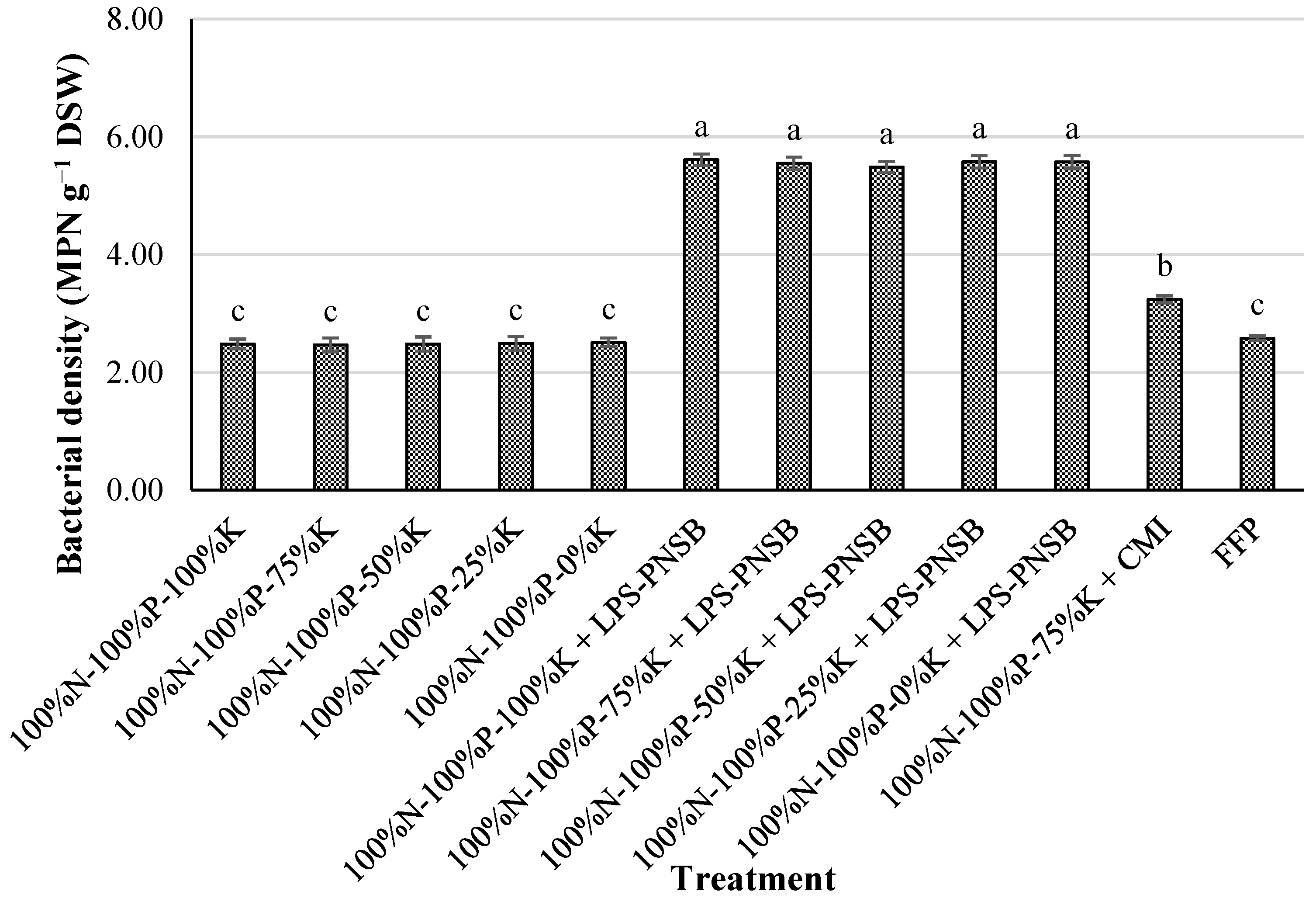
Figure 1. Effects of liquid potassium-solubilizing purple nonsulfur bacteria (Cereibacter sp. and Rhodopseudomonas spp.) on bacterial density in soil growing hybrid maize in the dyke-protected area of An Phu, An Giang. Note: Bars with different letters are significantly different at the 5% level. LPS-PNSB: a mixture of three strains (Cereibacter sphaeroides M-Sl-09, Rhodopseudomonas thermotolerans M-So-11, and Rhodopseudomonas palustris M-So-14); CMI: commercial microbial inoculant; FFP: farmer’s fertilization practice; MPN: most probable number; DSW: dry soil weight.
Applmicrobiol 05 00137 g001
Figure 2. Effects of liquid potassium-solubilizing purple nonsulfur bacteria (Cereibacter sp. and Rhodopseudomonas spp.) on grain yield of hybrid maize grown on alluvial soil in the dyke-protected area of An Phu, An Giang. Note: Bars with different letters are significantly different at the 5% level. LPS-PNSB: a mixture of three strains (Cereibacter sphaeroides M-Sl-09, Rhodopseudomonas thermotolerans M-So-11, and Rhodopseudomonas palustris M-So-14); CMI: commercial microbial inoculant; FFP: farmer’s fertilization practice.
Applmicrobiol 05 00137 g002
Table 1. Effects of liquid potassium-solubilizing purple nonsulfur bacteria (Cereibacter sp. and Rhodopseudomonas spp.) on soil properties of alluvial soil in the dyke-protected area under hybrid maize cultivation in An Phu, An Giang.
TreatmentpHH2OpHKClECCECK+Na+Ca2+Mg2+
--mS cm−1meq 100 g−1
100%N-100%P-100%K7.15 bc7.090.500 b17.20.428 bc0.140 abc12.32.28
100%N-100%P-75%K 7.13 c6.900.477 b17.10.423 bc0.153 a12.92.29
100%N-100%P-50%K 7.16 bc6.920.455 bc17.80.427 bc0.133 bc12.22.30
100%N-100%P-25%K7.14 bc6.940.501 b17.40.432 bc0.146 ab12.22.31
100%N-100%P-0%K 7.05 c6.850.470 b17.10.335 d0.128 cd12.72.30
100%N-100%P-100%K + LPS-PNSB7.32 a6.950.400 d17.10.461 a0.105 e12.22.29
100%N-100%P-75%K + LPS-PNSB7.29 a7.020.370 d17.40.460 a0.109 e12.52.30
100%N-100%P-50%K + LPS-PNSB7.31 a6.790.387 d18.00.463 a0.104 e12.22.31
100%N-100%P-25%K + LPS-PNSB7.27 ab6.980.415 cd17.90.462 a0.109 e11.82.29
100%N-100%P-0%K + LPS-PNSB7.16 bc6.850.363 d18.20.470 a0.090 f12.22.30
100%N-100%P-75%K + CMI7.07 c6.760.717 a17.00.409 c0.116 de12.32.31
FFP7.08 c6.800.500 b17.30.437 b0.128 cd12.52.32
Significance*ns*ns**nsns
CV (%)1.142.727.265.313.297.784.550.73
TreatmentOMNH4+NO3Soluble PAl-PFe-PCa-P
%Cmg kg−1
100%N-100%P-100%K1.137.33 c45.9 d123.6 c435.1 a548.8 ab151.3 abc
100%N-100%P-75%K 1.127.44 c46.3 d112.5 d449.7 a552.1 a152.7 ab
100%N-100%P-50%K 1.127.33 c46.8 d118.7 cd448.8 a531.9 b154.9 a
100%N-100%P-25%K1.167.36 c45.6 d110.3 d449.2 a536.3 ab158.4 a
100%N-100%P-0%K 1.127.20 c45.5 d113.3 d451.9 a540.6 ab157.3 a
100%N-100%P-100%K + LPS-PNSB1.188.45 ab61.2 a151.0 b336.4 c452.9 e127.9 ef
100%N-100%P-75%K + LPS-PNSB1.198.57 a61.6 a149.8 b345.9 bc438.6 ef125.7 f
100%N-100%P-50%K + LPS-PNSB1.168.49 ab61.4 a147.7 b361.6 b476.3 d139.3 cde
100%N-100%P-25%K + LPS-PNSB1.148.33 ab62.0 a153.6 b341.0 c455.1 e127.0 ef
100%N-100%P-0%K + LPS-PNSB1.167.99 b59.9 ab162.9 a342.5 bc429.6 g136.4 def
100%N-100%P-75%K + CMI1.097.01 c52.1 c113.9 d346.9 bc507.2 c142.2 bc
FFP1.197.14 c57.9 b115.9 cd435.8 a553.4 a136.9 def
Significancens******
CV (%)10.54.393.914.523.142.245.68
Note: In the same column, values followed by different letters are significantly different at the 5% level (*). ns: not significantly different; LPS-PNSB: a mixture of three strains (Cereibacter sphaeroides M-Sl-09, Rhodopseudomonas thermotolerans M-So-11, and Rhodopseudomonas palustris M-So-14); CMI: commercial microbial inoculant; FFP: farmer’s fertilization practice.
Table 2. Effects of liquid potassium-solubilizing purple nonsulfur bacteria (Cereibacter sp. and Rhodopseudomonas spp.) on the dry biomass of hybrid maize grown on alluvial soil in the dyke-protected area of An Phu, An Giang.
TreatmentDry Biomass (Tons ha−1)
LeavesStemsHusksKernelsCobs
100%N-100%P-100%K2.95 c2.58 e1.25 d9.85 e1.34 c
100%N-100%P-75%K2.84 d2.54 ef1.14 e9.42 f1.29 cd
100%N-100%P-50%K2.84 d2.52 ef1.14 e9.01 g1.27 d
100%N-100%P-25%K2.71 e2.44 gh1.11 e8.97 g1.27 d
100%N-100%P-0%K2.73 e2.39 h1.11 e8.95 g1.25 de
100%N-100%P-100%K + LPS-PNSB3.76 a3.33 a1.59 a11.7 a1.66 a
100%N-100%P-75%K + LPS-PNSB3.74 a3.35 a1.57 ab11.5 b1.62 ab
100%N-100%P-50%K + LPS-PNSB3.74 a3.16 b1.54 bc11.3 c1.58 b
100%N-100%P-25%K + LPS-PNSB3.60 b2.97 c1.52 bc11.2 c1.59 b
100%N-100%P-0%K + LPS-PNSB3.55 b2.87 d1.51 c10.9 d1.56 b
100%N-100%P-75%K + CMI2.81 d2.48 fg1.25 d9.73 e1.31 cd
FFP2.87 d2.49 fg1.14 e9.07 g1.20 e
Significance*****
CV (%)1.591.752.460.932.75
Note: In the same column, values followed by different letters are significantly different at the 5% level (*). ns: not significantly different; LPS-PNSB: a mixture of three strains (Cereibacter sphaeroides M-Sl-09, Rhodopseudomonas thermotolerans M-So-11, and Rhodopseudomonas palustris M-So-14); CMI: commercial microbial inoculant; FFP: farmer’s fertilization practice.
Table 3. Effects of liquid potassium-solubilizing purple nonsulfur bacteria (Cereibacter sp. and Rhodopseudomonas spp.) on K concentration in different parts of hybrid maize grown on alluvial soil in the dyke-protected area of An Phu, An Giang.
TreatmentPlant K Concentration (%)
LeavesStemsHusksKernelsCobs
100%N-100%P-100%K2.50 bc0.935 c0.736 cd0.705 cd0.376 b
100%N-100%P-75%K2.54 b0.865 d0.713 d0.671 cde0.379 b
100%N-100%P-50%K2.41 cd0.933 c0.668 e0.600 f0.371 b
100%N-100%P-25%K2.39 cd0.816 e0.657 e0.613 f0.377 b
100%N-100%P-0%K2.20 e0.708 g0.656 e0.596 f0.381 b
100%N-100%P-100%K + LPS-PNSB2.92 a1.02 a0.800 a0.812 a0.456 a
100%N-100%P-75%K + LPS-PNSB2.85 a1.01 a0.770 b0.811 a0.466 a
100%N-100%P-50%K + LPS-PNSB2.57 b1.04 a0.744 bc0.766 ab0.483 a
100%N-100%P-25%K + LPS-PNSB2.50 bc0.971 b0.725 cd0.711 bc0.467 a
100%N-100%P-0%K + LPS-PNSB2.47 bc0.752 f0.730 cd0.718 bc0.464 a
100%N-100%P-75%K + CMI2.35 d0.756 f0.681 e0.651 def0.397 b
FFP2.05 f0.904 c0.653 e0.646 ef0.468 a
Significance*****
CV (%)2.932.562.595.364.62
Note: In the same column, values followed by different letters are significantly different at the 5% level (*). ns: not significantly different; LPS-PNSB: a mixture of three strains (Cereibacter sphaeroides M-Sl-09, Rhodopseudomonas thermotolerans M-So-11, and Rhodopseudomonas palustris M-So-14); CMI: commercial microbial inoculant; FFP: farmer’s fertilization practice.
Table 4. Effects of liquid potassium-solubilizing purple nonsulfur bacteria (Cereibacter sp. and Rhodopseudomonas spp.) on K uptake of hybrid maize grown on alluvial soil in the dyke-protected area of An Phu, An Giang.
TreatmentPlant K Uptake (kg ha−1)Total K Uptake
(kg ha−1)
LeavesStemsHusksKernelsCobs
100%N-100%P-100%K73.7 d24.1 c9.26 d69.4 d5.05 c181.5 e
100%N-100%P-75%K72.4 de22.0 d8.13 ef63.1 de4.88 c170.4 f
100%N-100%P-50%K68.4 ef23.5 cd7.64 fg54.1 f4.72 c158.3 gh
100%N-100%P-25%K64.9 f19.9 e7.25 g55.0 f4.78 c151.8 h
100%N-100%P-0%K60.0 g16.9 f7.26 g53.4 f4.77 c142.3 i
100%N-100%P-100%K + LPS-PNSB109.8 a33.9 a12.7 a95.1 a7.57 a259.1 a
100%N-100%P-75%K + LPS-PNSB106.7 a33.8 a12.1 b93.5 a7.53 a253.4 a
100%N-100%P-50%K + LPS-PNSB96.1 b32.7 a11.4 c86.5 b7.65 a234.4 b
100%N-100%P-25%K + LPS-PNSB89.9 c28.8 b11.0 c80.0 c7.42 a217.2 c
100%N-100%P-0%K + LPS-PNSB87.6 c21.6 d11.0 c78.4 c7.22 a205.8 d
100%N-100%P-75%K + CMI66.1 f18.8 e8.54 e63.3 de5.19 bc161.9 g
FFP58.9 g22.4 dc7.43 g58.6 ef5.65 b153.1 h
Significance******
CV (%)3.603.363.835.915.582.52
Note: In the same column, values followed by different letters are significantly different at the 5% level (*). ns: not significantly different; LPS-PNSB: a mixture of three strains (Cereibacter sphaeroides M-Sl-09, Rhodopseudomonas thermotolerans M-So-11, and Rhodopseudomonas palustris M-So-14); CMI: commercial microbial inoculant; FFP: farmer’s fertilization practice.
Table 5. Effects of liquid potassium-solubilizing purple nonsulfur bacteria (Cereibacter sp. and Rhodopseudomonas spp.) on growth traits of hybrid maize grown on alluvial soil in the dyke-protected area of An Phu, An Giang.
TreatmentPlant HeightEar Set HeightStem
Diameter
Leaf LengthLeaf WidthEar Set Leaf PositionGreen Leaf NumberTotal Leaf Number
cm Leaves
100%N-100%P-100%K259.2 c101.6 bc1.19 b80.9 b8.36 b7.069.20 b13.5 ab
100%N-100%P-75%K252.6 de102.8 b1.15 b80.5 bc8.44 b7.439.15 b13.7 ab
100%N-100%P-50%K247.5 f102.0 bc1.13 b78.4 a8.40 b7.109.15 b13.0 bc
100%N-100%P-25%K245.4 fg101.7 bc1.11 b78.5 a8.24 b7.009.30 b12.4 cd
100%N-100%P-0%K241.6 h95.3 d1.02 c79.3 bc8.48 b7.159.40 b12.3 cd
100%N-100%P-100%K+ LPS-PNSB265.5 a106.8 a1.34 a83.8 a9.39 a7.1510.8 a13.6 ab
100%N-100%P-75%K + LPS-PNSB261.8 b108.0 a1.34 a84.4 a9.35 a7.1610.6 a14.1 a
100%N-100%P-50%K + LPS-PNSB254.2 d106.3 a1.33 a84.5 a9.34 a6.9511.0 a13.5 ab
100%N-100%P-25%K+ LPS-PNSB247.1 fg107.4 a1.34 a83.6 a9.32 a7.2010.5 a13.4 ab
100%N-100%P-0%K + LPS-PNSB244.7 f99.4 c1.10 b85.9 a9.12 a7.1510.6 a12.1 d
100%N-100%P-75%K + CMI251.4 e102.5 bc1.18 b80.9 b8.21 b7.479.40 b13.2 b
FFP250.8 e102.2 bc1.33 a81.3 b8.39 b7.109.30 b13.3 b
Significance*****ns**
CV (%)0.6562.014.491.732.893.765.093.46
Note: In the same column, values followed by different letters are significantly different at the 5% level (*). ns: not significantly different; LPS-PNSB: a mixture of three strains (Cereibacter sphaeroides M-Sl-09, Rhodopseudomonas thermotolerans M-So-11, and Rhodopseudomonas palustris M-So-14); CMI: commercial microbial inoculant; FFP: farmer’s fertilization practice.
Table 6. Effects of liquid potassium-solubilizing purple nonsulfur bacteria (Cereibacter sp. and Rhodopseudomonas spp.) on yield components of hybrid maize grown on alluvial soil in the dyke-protected area of An Phu, An Giang.
TreatmentEar LengthEar
Diameter
Number of Rows per EarCob LengthCob DiameterNumber of Kernels per Row100-Kernel Weight
cmRowscmKernelsgram
100%N-100%P-100%K17.5 bc3.70 a13.516.8 bc2.11 cdef36.4 d33.9
100%N-100%P-75%K17.3 bc3.68 a13.316.4 c2.10 cdef36.1 d33.6
100%N-100%P-50%K16.8 cd3.38 b13.716.2 c2.06 efg36.6 d33.1
100%N-100%P-25%K16.5 d3.30 b12.816.1 c2.01 f36.4 d33.9
100%N-100%P-0%K15.6 e3.38 b13.315.3 c2.03 fg36.4 d33.3
100%N-100%P-100%K + LPS-PNSB18.7 a3.86 a13.518.1 a2.26 a39.6 a34.0
100%N-100%P-75%K + LPS-PNSB18.6 a3.83 a13.717.9 a2.21 ab38.8 ab34.8
100%N-100%P-50%K + LPS-PNSB18.9 a3.78 a13.418.0 a2.20 ab38.7 ab34.6
100%N-100%P-25%K + LPS-PNSB18.6 a3.84 a13.517.9 a2.17 bcd39.5 a33.1
100%N-100%P-0%K + LPS-PNSB18.4 a3.78 a14.018.2 a2.09 def38.4 abc33.7
100%N-100%P-75%K + CMI17.7 b3.76 a13.717.2 b2.14 bcde37.6 bcd33.1
FFP16.9 cd3.77 a13.516.3 c2.18 abc37.0 cd33.2
Significance**ns***ns
CV (%)2.373.175.692.452.442.582.85
Note: In the same column, values followed by different letters are significantly different at the 5% level (*). ns: not significantly different; LPS-PNSB: a mixture of three strains (Cereibacter sphaeroides M-Sl-09, Rhodopseudomonas thermotolerans M-So-11, and Rhodopseudomonas palustris M-So-14); CMI: commercial microbial inoculant; FFP: farmer’s fertilization practice.
Disclaimer/Publisher’s Note: The statements, opinions and data contained in all publications are solely those of the individual author(s) and contributor(s) and not of MDPI and/or the editor(s). MDPI and/or the editor(s) disclaim responsibility for any injury to people or property resulting from any ideas, methods, instructions or products referred to in the content.