Review

Rethinking Immunotherapy Drug Development in Head and Neck Squamous Cell Carcinoma: The Role of Biologic Context and Treatment Sequencing

1
Department of Internal Medicine, Sunrise Health GME Consortium, Las Vegas, NV 89128, USA
2
Touro University Nevada College of Osteopathic Medicine, Las Vegas, NV 89014, USA
3
Department of Internal Medicine at Mount Sinai Morningside/West, New York, NY 10025, USA
4
Department of Internal Medicine, HCA Healthcare/USF Morsani College of Medicine GME: HCA Healthcare Florida Citrus Hospital, Inverness, FL 33606, USA
5
Department of Internal Medicine, Kirk Kerkorian School of Medicine at UNLV, Las Vegas, NV 89154, USA
6
Division of Hematology and Medical Oncology, Comprehensive Cancer Centers of Nevada, Central Valley, Las Vegas, NV 89169, USA
*
Authors to whom correspondence should be addressed.
Submission received: 26 May 2026 / Revised: 10 July 2026 / Accepted: 22 July 2026 / Published: 31 July 2026

Simple Summary

Immune checkpoint inhibitors (ICIs) have transformed cancer treatments across multiple malignancies, but when it comes to head and neck squamous cell carcinoma (HNSCC), their clinical benefit varies substantially across different disease settings. This review provides a biological framework to explain why similar immunotherapy agents produce different outcomes in recurrent/metastatic, locally advanced, and perioperative HNSCC. Instead of simply summarizing various clinical trial outcomes, we integrate evidence from randomized studies with the current understanding of tumor biology and host immunity. The review highlights the consistent benefit of ICI use in recurrent/metastatic disease, as well as in the perioperative setting. On the other hand, it also examines the repeated failure of ICIs in unresected locally advanced disease settings. We propose that the success of ICIs in recurrent/metastatic and perioperative disease, versus their repeated failure in locally advanced disease, is due to the presence of intact tumor antigen and preserved host immune competence, whereas treatment delivered during or after cytotoxic therapy is limited by lymphopenia and reduced antigen exposure. Hence, unlike multiple previous reviews that primarily summarize clinical trial outcomes, this review examines current randomized clinical trial data through a biologically grounded framework and offers a hypothesis that may guide future treatment sequencing and biomarker-driven patient selection and the design of precision immunotherapy trials in HNSCC.

Abstract

Head and neck squamous cell carcinoma (HNSCC) remains a significant global health burden with limited survival improvement in locally advanced disease despite multimodal therapy. Immune checkpoint inhibitors (ICIs) targeting the PD-1/PD-L1 pathway have demonstrated substantial clinical benefit in recurrent or metastatic HNSCC, establishing PD-1 blockade as a standard of care. Similar approaches in locally advanced disease, including concurrent administration with chemoradiotherapy or use in the adjuvant setting, have not demonstrated improvement in survival outcomes across multiple randomized trials. Perioperative strategies incorporating neoadjuvant and adjuvant checkpoint inhibition have shown improved event-free and disease-free survival in resectable disease. Meta-analyses of concurrent and adjuvant approaches confirm limited benefit in unselected populations, with modest improvements restricted to biologically defined subgroups. Trial outcomes across disease settings demonstrate a consistent pattern in which therapeutic efficacy varies despite the use of similar agents. Rather than simply summarizing these clinical findings, this review integrates evidence across recurrent/metatstatic, unresected locally advanced and perioperative disease settings into a biologically focused framework to help explain the varying efficacies of immune checkpoint inhibition in HNSCC. Current evidence indicates that the effectiveness of immunotherapy in HNSCC is determined by the biologic context of treatment, including tumor antigen availability, host immune competence, and timing of immune activation. Administration of checkpoint blockade in the presence of intact tumor antigen and preserved immune function is associated with improved outcomes, whereas treatment delivered during or after cytotoxic therapy is limited by lymphopenia and reduced antigen exposure. By synthesizing randomized clinical evidence through this biologic framework, the review provides a conceptual perspective that may help explain previous trial outcomes and inform future biomarker-driven patient selection and treatment sequencing. Optimization of immunotherapy in HNSCC will depend on the integration of immune activation with disease context rather than an escalation of therapeutic intensity.

1. Background

The term “head and neck cancer (HNC)” comprises malignancies involving the oral cavity, lip, pharynx, hypopharynx, larynx, nasal cavity, paranasal sinuses, and salivary glands [1,2]. Head and neck squamous cell carcinoma (HNSCC) arises from the squamous epithelium lining the mucosal surfaces of the upper aerodigestive tract and represents the predominant histologic subtype of HNC. Collectively, these malignancies represent the seventh-most common cancer worldwide, reflecting a substantial global health burden [2]. According to the Global cancer Observatory (GLOBOCAN) 2022, HNC accounted for approximately 947,211 new cancer cases and 482,428 deaths globally [2,3]. However, the regional patterns of HNC vary considerably; in North America, oropharyngeal cancers account for 44% cases of HNC cases [2]. In the United States, the Surveillance, Epidemiology, and End Results program estimated that cancers of the oral cavity and pharynx accounted for nearly 60,000 cases and resulted in around 13,000 deaths in 2025 [4]. The epidemiology of HNSCC in the United States has also shifted with the rise in human papillomavirus (HPV)-associated disease. Between 1988 and 2004, the incidence of HPV-positive oropharyngeal SCC in the US increased by 225%, whereas HPV-negative cancers declined by approximately 50% [5]. HPV status is now a major biologic and prognostic factor in oropharyngeal cancer. These epidemiologic trends underscore both the persistent burden and the evolving biologic landscape of HNSCC.
Outcomes in locally advanced head and neck squamous cell carcinoma (LA-HNSCC) have improved only modestly over the past several decades, despite advances in surgery and chemoradiotherapy (CRT). Treatment has historically relied on combinations of surgery, radiotherapy, and platinum-based chemotherapy, with limited progress in long-term survival. Prognosis in recurrent or metastatic disease also remains poor, with survival measured in months rather than years. Hence, the need for more effective systemic treatment strategies has remained a central challenge in the management of HNSCC.
Immune checkpoint inhibitors (ICIs) targeting the programmed death-1 (PD-1) and programmed death ligand-1 (PD-L1) pathway have transformed cancer treatment across multiple malignancies. In non-small-cell lung cancer and melanoma, checkpoint blockade has demonstrated clinically meaningful survival benefits and has redefined standards of care in both metastatic and earlier disease settings [6,7,8,9,10]. HNSCC is often characterized by features that theoretically support susceptibility to immune checkpoint blockades, including relatively high mutation burden, viral antigenicity in HPV-associated tumors, and a tumor microenvironment enriched with immune infiltrates [11]. These intrinsic features, along with the success of ICIs in other malignancies, generated substantial enthusiasm for evaluating the role of ICIs in HNSCC.
Early randomized trials demonstrated that the use of ICIs could improve overall survival in recurrent or metastatic head and neck squamous cell carcinoma (R/M-HNSCC). CheckMate 141, a phase III clinical trial, demonstrated improved overall survival in patients with platinum-refractory, recurrent HNSCC treated with nivolumab compared to those treated with the investigator’s choice single-agent chemotherapy [12,13]. Similarly, the KEYNOTE-048 trial established that first-line pembrolizumab and pembrolizumab with chemotherapy resulted in improved overall survival outcomes versus cetuximab with chemotherapy in patients with R/M-HNSCC [14,15].
Attempts to translate these results to locally advanced disease have been less successful. Several trials evaluating the use of ICIs concurrently with radiotherapy and/or chemotherapy or in the adjuvant setting failed to demonstrate clinically and statistically significant improvements in event-free survival, progression-free survival, and locoregional disease control [16,17,18,19,20,21]. These repeatedly negative findings prompted reconsideration of how ICIs should be best incorporated into the treatment of locally advanced HNSCC.
Perioperative strategies have demonstrated more encouraging results. Trials evaluating immune checkpoint blockades before surgery, followed by postoperative therapy, as well as adjuvant ICI-based approaches combined with CRT, have shown significant improvements in survival outcomes [22,23]. The divergence between outcomes with ICIs when used at different stages of disease suggests that therapeutic efficacy may depend not only on the checkpoint inhibitor employed but also on the biologic context in which immune activation occurs. Rather than representing isolated positive and negative trials, these studies collectively suggest that disease setting, treatment sequencing, and preservation of host immune competence may be major determinants of response.
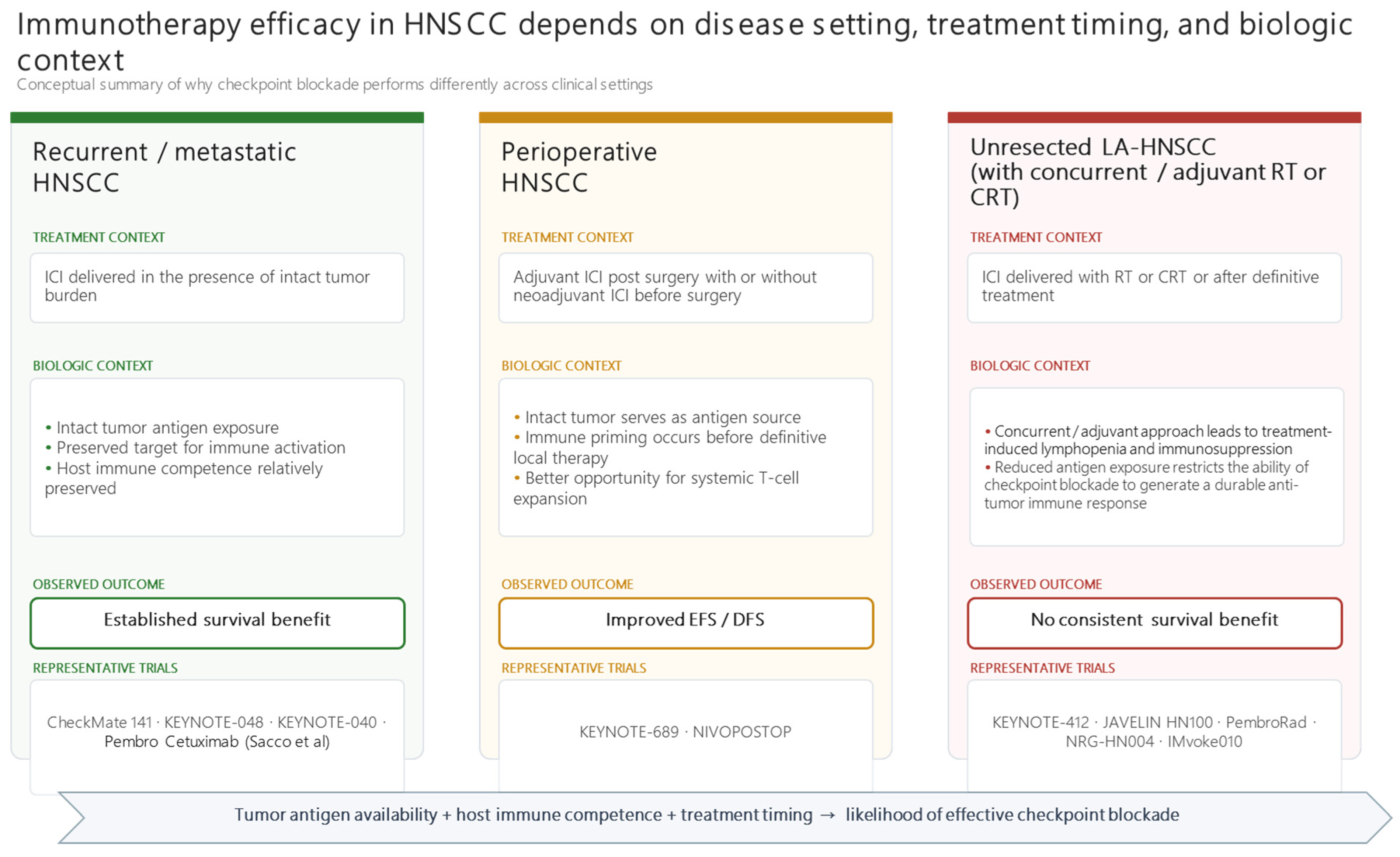
Immunotherapy in HNSCC has been widely reviewed, with many existing reviews focusing on describing pertinent trial results as well as some addressing treatment sequencing, clinical decision making and biomarker development. These reviews have provided important summaries of emerging clinical evidence and evolving therapeutic strategies. However, what distinguishes this review is that it does not simply summarize immunotherapy trials, but instead interprets these studies through a biologically grounded framework centered on tumor antigen exposure, host immune competence, and treatment sequencing across not one but all HNSCC disease settings. The divergent outcomes observed across disease settings raise an important question: why do similar checkpoint inhibitors produce durable benefits in some clinical settings but not others? We propose that one biologically plausible explanation is that treatment timing relative to tumor antigen availability and host immune competence influences the effectiveness of immune activation and subsequently immune checkpoint blockade. Available evidence shows that ICIs have improved outcomes in recurrent or metastatic disease and in perioperative approaches for resectable locally advanced disease. On the other hand, concurrent or maintenance strategies delivered during or after definitive chemoradiotherapy have generally failed to improve outcomes in unresected locally advanced disease. These results suggest that efficacy of immunotherapy may depend less on the specific ICI used and more on when it is introduced during the course of treatment. Concurrent and adjuvant strategies in LA-HNSCC have generally failed to improve outcomes, possibly because checkpoint blockade is administered during periods of treatment-related immune suppression or after tumor antigen exposure is already diminished, thereby limiting effective immune priming. In contrast, perioperative approaches preserve the intact tumor as a source of antigen, which may facilitate a more robust systemic T-cell expansion before definitive therapy. When viewed from this perspective, future immunotherapy development in HNSCC may depend more on biologically aligned treatment sequencing than on further escalation of therapy. Accordingly, this review synthesizes current evidence through a biologically grounded framework to explain divergent trial outcomes and to inform future biomarker-driven and sequencing-based immunotherapy strategies in HNSCC. As summarized in Figure 1, the clinical activity of immune checkpoint blockade in HNSCC appears to depend on disease setting, treatment timing, tumor antigen availability, and preservation of host immune competence.

2. Locally Advanced HNSCC: Concurrent and Adjuvant Immunotherapy

The current standard of care for locally advanced head and neck squamous cell carcinoma (LA-HNSCC) consists of a multimodal approach including surgery, radiotherapy, and systemic chemotherapy, depending on tumor site, stage, and resectability [24]. Unresectable disease is treated with a concurrent cisplatin-based chemoradiotherapy (CRT) regimen, while surgery followed by radiotherapy or chemotherapy is recommended for resectable disease with high-risk features [24].
The success of ICIs in recurrent or metastatic disease drove efforts to incorporate ICIs into the treatment of LA-HNSCC. Given the established role of CRT in unresectable LA-HNSCC, early trials explored the addition of ICIs either concurrently with CRT or radiotherapy alone, or in the adjuvant setting [16,17,18,19,20,21].
Radiotherapy has been shown to promote tumor antigen release and augment immune priming, providing a theoretical framework for combining radiotherapy with immune checkpoint inhibition [25,26]. Hence, the rationale for these strategies was likely based on studies showing that interactions between co-stimulatory and inhibitory molecules regulating T-cell responses can be targeted to enhance the CRT antitumor immune response in the tumor microenvironment [25,26]. Importantly, these negative findings were reproduced across multiple randomized studies evaluating different checkpoint inhibitors, treatment schedules, and patient populations. This consistency suggests that the absence of benefit is unlikely to reflect failure of an individual drug and instead raises the possibility that the biologic environment during definitive chemoradiotherapy may be less favorable for effective immune activation (Table 1).
The KEYNOTE-412 trial evaluated the addition of pembrolizumab (ICI) to CRT in 804 patients with high-risk unresected LA-HNSCC. Patients were randomized to receive pembrolizumab plus CRT or placebo plus CRT [16]. Pembrolizumab was administered concurrently with cisplatin-based chemotherapy and accelerated or standard fractionation radiotherapy, followed by ICI maintenance therapy [16]. However, the addition of pembrolizumab did not significantly improve the primary endpoint of event-free survival compared with chemoradiotherapy alone (hazard ratio 0.83; 95% CI 0.68–1.03) [16], although a numerical trend toward benefit was observed. In the PD-L1 combined positive score (CPS) ≥ 1 subgroup, a greater effect size was seen (hazard ratio 0.80; 95% CI 0.64–1.00), without meeting the prespecified threshold for statistical significance [16].
The JAVELIN Head and Neck 100 trial evaluated the addition of avelumab in combination with CRT in 697 patients with previously untreated LA HNSCC [17]. Patients were randomly assigned to receive avelumab concurrently with CRT (cisplatin plus intensity-modulated radiotherapy), followed by ICI maintenance therapy versus placebo with CRT [17]. The trial was stopped early for futility. Progression-free survival was not improved, and outcomes favored the control arm (hazard ratio 1.21; 95% CI 0.93–1.57) [17].
Additionally, other studies have investigated the use of checkpoint inhibition in cisplatin-ineligible patients. The GORTEC 2015-01 PembroRad trial compared pembrolizumab with radiotherapy to cetuximab with radiotherapy in cisplatin-ineligible, stage III-IV, unresected LA HNSCC [18]. No improvement was observed in locoregional control rate 15 months after radiotherapy (odds ratio 1.05; 95% CI 0.–2.59), progression-free survival (hazard ratio 0.85; 95% CI 0.55–1.32), or overall survival (hazard ratio 0.83; 95% CI 0.49–1.40) [18]. However, the treatment regimen of pembrolizumab with radiotherapy appeared less toxic in unfit patients with LA-HNSCC [18].
Similarly, the NRG-HN004 trial evaluated the use of durvalumab with radiotherapy compared with cetuximab and radiotherapy in cisplatin-ineligible patients with stage III-IVB, p16-negative, or unfavorable stage I-III, p16-positive LA-HNSCC [20]. However, phase II accrual was suspended following interim futility analysis, and therefore, phase III was not conducted [20]. Results showed that durvalumab plus radiotherapy did not demonstrate statistically significant improvement in the primary endpoint, progression-free survival, compared to cetuximab plus radiotherapy (hazard ratio 1.33; 95% CI 0.84–2.12) [20]. Hence, this study also failed to demonstrate the superiority of immunotherapy over cetuximab-based therapy, further underscoring the difficulty of replacing established radiosensitizing agents with immune checkpoint inhibitors in LA-HNSCC.
The GORTEC 2017-01 REACH, phase III, multi-arm randomized controlled trial explored the use of avelumab with cetuximab and radiotherapy, followed by ICI maintenance therapy in patients eligible for cisplatin versus those ineligible for cisplatin [19]. This approach aimed to enhance immune activation through combining checkpoint blockade and epidermal growth factor receptor (EGFR) inhibition. However, outcomes differed by cisplatin eligibility. Among cisplatin-unfit patients, adding avelumab to cetuximab-radiotherapy produced a favorable effect on progression-free survival and distant metastases, but not overall survival [19]. By contrast, in cisplatin-fit patients, standard cisplatin-radiotherapy was superior to cetuximab, avelumab, and radiotherapy [19], showing that ICI-based regimen may be beneficial in select patient populations with LA-HNSCC.
Lastly, beyond concurrent treatment strategies, investigators have also evaluated the use of ICIs as adjuvant therapy in the treatment of LA-HNSCC. The IMvoke010 phase III, double-blind, randomized clinical trial, investigating the use of atezolizumab vs placebo as maintenance therapy after multimodal definitive treatment in patients with stage IVa-IVb or HPV-negative oropharynx or stage III HPV-positive oropharynx LA-HNSCC without disease progression after multimodal definitive treatment. However, despite the theoretical appeal of eliminating residual micrometastatic disease through immune activation, the study failed to demonstrate improvements in survival outcomes with atezolizumab maintenance therapy after multimodal definitive treatment [21]. There was no improvement shown in the primary endpoint, event-free survival (hazard ratio 0.94; 95% CI, 0.70–1.26), and no difference in overall survival between atezolizumab and placebo in patients with LA HNSCC at high risk of disease progression [21].
Randomized trials evaluating ICIs administered concurrently with definitive CRT in unresected LA-HNSCC have not demonstrated statistically significant improvements in survival outcomes. These include KEYNOTE-412, JAVELIN Head and Neck 100, PembroRad, and NRG-HN004. Maintenance atezolizumab following definitive treatment also failed to improve outcomes. Despite differences in trial design, patient populations, and ICI used, none of the major randomized trials demonstrated significant improvements in patient survival outcomes. The mechanisms underlying these results remain incompletely defined. However, the reproducibility of these findings across multiple independent phase III trials suggests that treatment context, rather than individual study design, may explain the observed lack of benefit. These consistently negative findings support the hypothesis that treatment-induced lymphopenia, altered antigen presentation, and disruption of immune homeostasis during definitive chemoradiotherapy may reduce the ability of checkpoint blockade to generate durable antitumor immunity.
Outcomes differ in resectable disease. Perioperative strategies, including neoadjuvant and adjuvant checkpoint inhibition, have demonstrated significant improvements in survival endpoints in recent phase III trials [22,23]. These findings indicate that therapeutic efficacy in LA-HNSCC is dependent on disease setting and treatment sequencing. The observed activity of perioperative approaches suggests that timing of immune checkpoint inhibition relative to tumor burden and host immune status may influence therapeutic efficacy.

3. Pooled Evidence for Immunotherapy in Locally Advanced HNSCC

To determine whether individually negative randomized trials concealed clinically meaningful treatment effects, several meta-analyses pooled available evidence evaluating concurrent or adjuvant immune checkpoint inhibition in unresected locally advanced HNSCC. A systematic review and meta-analysis of cisplatin-ineligible patients pooled data from the PembroRad and NRG-HN004 trials, including 319 patients treated with ICI-radiotherapy or cetuximab-radiotherapy [22]. However, no significant difference was observed in progression-free survival (hazard ratio 1.09; 95% CI 0.84–1.42) or overall survival (hazard ratio 1.08; 95% CI 0.79–1.48) [22]. Subgroup analysis suggested worse outcomes in p16-negative disease (hazard ratio 1.48; 95% CI 1.05–2.09), although these findings require prospective validation [22]. Toxicity findings from this pooled analysis showed no significant difference in overall grade 3 or higher adverse events. ICI-radiotherapy was associated with lower rates of grade 3 or higher radiation dermatitis and mucositis, but with a higher incidence of any-grade xerostomia [22].
A separate pooled analysis of patients enrolled in KEYNOTE-412, JAVELIN Head and Neck 100, and NRG-HN004 trials was conducted to evaluate 1687 patients treated with ICIs in combination with radiotherapy or chemoradiotherapy in LA HNSCC [23]. The results showed that the addition of ICIs to CRT or radiotherapy was associated with improved 2-year progression-free survival (PFS) among patients with PD-L1-positive LA-HNSCC (HR 0.81; 95% CI 0.67–0.99), whereas outcomes were inferior in the PD-L1-negative cohort (HR 1.34; 95% CI 1.02–1.76) [23]. Since NRG-HN004 enrolled only cisplatin-ineligible patients and demonstrated that immunoradiotherapy was inferior to radiation plus cetuximab, a subset analysis of cisplatin-eligible LA-HNSCC, including KEYNOTE-412 and JAVELIN Head and Neck 100 trials, was also conducted. Results demonstrated improved progression-free survival with the addition of ICIs to standard CRT in the PD-L1-positive cohort (hazard ratio 0.78; 95% CI 0.63–0.97) [23]. No overall survival benefit was observed in PD-L1-positive disease overall or in the cisplatin-eligible subgroup [23]. These findings highlight the mixed benefits seen with concurrent immunotherapy in LA-HNSCC, but also suggest that benefits may be confined to biologically selected subgroups, while also underscoring the limitations of applying ICI-based intensification broadly across unselected patient populations. However, interpretation of these findings requires caution. The pooled analysis combined trials with substantial clinical and methodological heterogeneity, including cisplatin-eligible and cisplatin-ineligible populations, radiotherapy alone versus chemoradiotherapy, and different checkpoint inhibitors and PD-L1 assays [23]. The reported PD-L1 subgroup effects are hypothesis-generating rather than definitive and require prospective validation.
Additional meta-analyses of toxicity have shown broadly comparable safety profiles between ICI-based therapy and standard CRT, with some evidence of increased high-grade odynophagia in ICI-treated cohorts [24,27]. Toxicity findings are not uniform across meta-analyses and vary according to the populations and treatment strategies included.
These pooled analyses reinforce the conclusions reached by the individual randomized trials. Although exploratory signals were observed within biologically defined subgroups, the overall evidence does not support routine incorporation of concurrent or maintenance checkpoint inhibition in unselected patients with unresected locally advanced HNSCC. Signals of improved progression-free survival in PD-L1-positive disease and p16-positive subgroups have been reported but remain exploratory and have not translated into a consistent overall survival benefit. These findings apply to concurrent or maintenance strategies in unresected disease and should not be generalized to perioperative approaches in resectable or resected LA-HNSCC, where randomized phase III trials have demonstrated improved survival outcomes.

4. The Emergence of Perioperative Immunotherapy

In contrast to concurrent chemoradiotherapy studies, perioperative approaches incorporating immune checkpoint inhibitors have consistently demonstrated clinically meaningful improvements in event-free survival and disease-free survival in resectable locally advanced HNSCC, representing the first major therapeutic advance in this setting in approximately 20 years.
The phase III, KEYNOTE-689 trial explored the benefits of adding perioperative pembrolizumab to standard-of-care surgery and adjuvant therapy for patients with LA-HNSCC. A total of 363 patients were randomized to receive two cycles of neoadjuvant pembrolizumab, followed by adjuvant pembrolizumab in addition to standard of care (surgery and adjuvant radiotherapy with or without concomitant cisplatin) or standard of care alone [28]. The trial demonstrated a significant improvement in the primary outcome of event-free survival with the addition of neoadjuvant and adjuvant pembrolizumab to the standard of care [28]. In patients whose tumors expressed programmed death-ligand 1 (PD-L1) with a CPS ≥ 10, event-free survival at 36 months was 59.8% in the pembrolizumab group and 45.9% in the control group (hazard ratio 0.66; 95% CI 0.49–0.88) [28]. In those with a CPS ≥ 1, 36-month event-free survival was 58.25% in the pembrolizumab group and 44.9% in the control group (hazard ratio, 0.70; 95% CI, 0.55–0.89), and, finally, in the total population, 57.6% and 46.4%, respectively (hazard ratio, 0.73; 95% CI 0.58 to 0.92) [28]. KEYNOTE-689 also demonstrated a reduction in distant metastases. Benefit was consistent across PD-L1-defined populations, although the trial was not powered to determine efficacy in the small CPS < 1 subgroup. Rather than demonstrating superiority of a specific checkpoint inhibitor, these findings suggest that preservation of intact tumor antigen exposure before definitive local therapy may enhance immune priming and improve subsequent systemic antitumor responses.
Additional support for the perioperative immunotherapy approach came from the GORTEC 2018-01 (NIVOPOSTOP) trial, which evaluated the addition of nivolumab to standard postoperative CRT versus standard postoperative CRT alone in patients with high-risk resected LA-HNSCC [29]. High-risk features included extranodal extension, microscopically positive margins, four or more involved cervical lymph nodes without extranodal extension, or multiple perineural invasions. In this randomized phase III trial, a total of 680 patients were enrolled following surgical resection and assigned to receive nivolumab followed by standard-of-care CRT (cisplatin and radiotherapy) with nivolumab, and followed by nivolumab maintenance therapy versus standard-of-care CRT only [29]. Results showed that adjuvant Nivolumab added to CRT led to clinically and statistically significant improvement in disease-free survival in PD-L1 all-comers patients (hazard ratio 0.76; 95% CI 0.60–0.98) [29], with 3-year disease-free survival of 63.1% versus 52.5% at a median follow-up of 30.3 months [29]. Benefit was driven primarily by improved locoregional control. The effect was observed irrespective of PD-L1 expression, although subgroup analyses suggested less benefit in laryngeal tumors and p16-positive oropharyngeal cancer. Overall survival data remain immature, although results supported the role of checkpoint inhibition in the perioperative management of LA-HNSCC.
The encouraging results of recent perioperative trials have supported the incorporation of pembrolizumab into current guideline-based perioperative management of LA-HNSCC [30]. Pembrolizumab received FDA approval in June 2025 for resectable LA-HNSCC with PD-L1 CPS ≥ 1 and perioperative pembrolizumab is now incorporated into guideline-based management for selected patients with resectable disease [30].
Clinical outcomes from perioperative trials demonstrated significant clinical benefits that were not observed in trials of concurrent immunotherapy with definitive chemoradiotherapy in unresected disease or in adjuvant maintenance strategies after definitive treatment. KEYNOTE-689 and NIVOPOSTOP differ in design and pattern of benefit: KEYNOTE-689 reduced distant metastases in a broader resectable population, whereas NIVOPOSTOP improved locoregional control in a high-risk resected population.
The biologic basis for these differences remains incompletely defined. One potential explanation is that perioperative approaches allow checkpoint blockade to be administered prior to standard chemoradiotherapy, when immune function and the tumor microenvironment remain relatively preserved [11]. These observations are consistent with the framework shown in Figure 1, in which preserved tumor antigen exposure and host immune competence may create more favorable conditions for immune priming and therapeutic benefit. However, these mechanisms remain hypothesis-driven and require further investigation.
Collectively, these studies shift the interpretation of immunotherapy development in HNSCC. Instead of indicating that checkpoint inhibition is uniformly effective across treatment settings, they suggest that therapeutic efficacy is strongly influenced by the biologic context in which immune activation occurs. Perioperative checkpoint inhibition has demonstrated meaningful clinical benefit in resectable locally advanced disease (Table 2). Overall survival data from both KEYNOTE-689 and NIVOPOSTOP remain immature, and longer follow-up is needed to define the full magnitude of benefit.

5. Immunotherapy in Recurrent/Metastatic Disease

The consistent efficacy observed in recurrent or metastatic disease provides an important point of comparison with the largely negative experience in unresected locally advanced disease and supports evaluation of biologic factors that differ between these treatment settings. Before the introduction of checkpoint blockade, systemic therapy options consisted of platinum-based chemotherapy and cetuximab-containing regimens, most notably the EXTREME regimen, which combined cetuximab with platinum and 5-fluorouracil. Even with the EXTREME regimen, median overall survival rarely exceeded 10 months [31]. However, recent randomized trials evaluating the use of ICIs in R/M-HNSCC have demonstrated meaningful improvements in survival outcomes (Table 3). Subsequently, the current NCCN guidelines also recognize pembrolizumab-based therapy, either in combination with platinum-based chemotherapy or as monotherapy in tumors with PD-L1 CPS ≥ 1, as the preferred first-line regimen for recurrent/metastatic non-nasopharyngeal cancers [30].
The KEYNOTE-048 trial was one of the largest phase III trials to establish the role of ICIs as first-line therapy in the treatment of R/M-HNSCC. Patients with a history of untreated locally incurable recurrent or metastatic HNSCC were stratified by PD-L1 expression, p16 status, and performance status and randomly allocated to pembrolizumab alone, pembrolizumab plus a platinum and 5-fluorouracil (pembrolizumab with chemotherapy), or cetuximab plus a platinum and 5-fluorouracil (cetuximab and chemotherapy) [14]. Results of this trial showed that pembrolizumab monotherapy improved overall survival in the CPS ≥ 20 population (HR 0·61; 95% CI 0.45–0.83), as well as in the CPS ≥ 1 population (HR 0.78; 95% CI 0.64–0.96), and was non-inferior in the total population [14]. While pembrolizumab with chemotherapy improved overall survival versus cetuximab and chemotherapy in the total population (HR 0.77; 95% CI 0.63–0.93), as well as in the CPS ≥ 20 population (HR 0.60; 95% CI 0.45–0.82) and CPS ≥ 1 population (HR 0.65; 95% CI 0.53–0.80) [14]. Median overall survival with pembrolizumab-chemotherapy was 14.7 months versus 11.0 months in CPS ≥ 20 disease, 13.6 months versus 10.4 months in CPS ≥ 1 disease, and 13.0 months versus 10.7 months in the total population [15]. At 5 years, overall survival in the total population was 14.4% with pembrolizumab monotherapy versus 6.5% with EXTREME, and 16.0% with pembrolizumab-chemotherapy versus 5.2% with EXTREME [15]. Furthermore, pembrolizumab monotherapy resulted in the least grade 3 or worse all-cause adverse event [14].
Hence, the trial established that pembrolizumab plus platinum and 5-fluorouracil is an appropriate first-line therapy for R/M-HNCC, while pembrolizumab monotherapy is an appropriate first-line treatment for PD-L1-positive R/M-HNSCC, leading to a major shift in systemic management of R/M-HNSCC [14,15].
On the other hand, the first phase III trial to demonstrate a survival advantage with ICIs in the management of platinum-refractory R/M-HNSCC was CheckMate-141. In this trial, a total of 361 patients with platinum-refractory R/M-HNSCC were randomized to receive nivolumab or standard, single-agent systemic therapy with methotrexate, docetaxel, or cetuximab [12]. Results demonstrated that median overall survival was significantly longer in the nivolumab group compared to the single-agent systemic therapy group (hazard ratio 0.70; 97.73% CI 0.51–0.96), and the estimates of the 1-year survival rate were approximately 19 percentage points higher with nivolumab than with standard therapy (36.0% vs. 16.6%). Furthermore, the response rate was found to be higher with nivolumab, while the treatment-related adverse events were found to be lower in this group. The 1-year update and subgroup analysis of nivolumab as first-line therapy in patients with R/M HNSCC also showed consistently improved overall survival and objective response rate [13]. Hence, establishing the role of ICIs as an effective treatment option for patients with platinum-refractory disease.
Additional studies have also reinforced ICI use in this setting. The KEYNOTE-040 trial also demonstrated improved overall survival with pembrolizumab compared to the investigator’s choice of standard doses of methotrexate, docetaxel, or cetuximab in patients with platinum-refractory R/M-HNSCC, further confirming the role of ICIs in the treatment of platinum-resistant disease [32]. Pembrolizumab prolonged median overall survival from 6.9 to 8.4 months (hazard ratio 0.80; 95% CI 0.65–0.98) [32]. Benefit was greater in PD-L1-positive disease. CheckMate-141, KEYNOTE-048, and KEYNOTE-040 established PD-1 blockade as the therapeutic backbone of recurrent or metastatic HNSCC. The consistency of benefit observed across these studies contrasts sharply with concurrent chemoradiotherapy trials in locally advanced disease and further supports the hypothesis that treatment context influences checkpoint inhibitor efficacy.
Earlier phase studies, including KEYNOTE-012 and KEYNOTE-055, demonstrated that pembrolizumab could induce durable responses with manageable toxicity in pretreated R/M HNSCC, providing the initial signal that checkpoint inhibition could yield clinically meaningful activity in this disease [33,34]. More exploratory efforts, including KEYNOTE-669, evaluated the efficacy and safety of pembrolizumab, plus epacadostat, pembrolizumab monotherapy, and the EXTREME regimen, and showed that Pembrolizumab-based regimens provided a similar response rate to EXTREME and demonstrated a manageable safety profile in patients with R/M HNSCC [35]. Although these studies were generally limited by smaller sample sizes, early discontinuation, or the absence of mature survival data, they supported the need for continued research for the use of ICI in R/M-HNSCC.
However, despite the groundbreaking success of PD-1 inhibition in improving survival outcomes in the treatment of previously untreated as well as platinum-refractory R/M-HNSCC, attempts to improve outcomes through dual checkpoint blockade of PD-L1-directed strategies have produced mixed results.
The CheckMate 651 trial evaluated nivolumab plus ipilimumab versus the EXTREME regimen as first-line therapy for R/M-HNSCC. Yet, the trial failed to demonstrate a statistically significant difference in the primary outcome of overall survival in all randomly assigned and programmed death-ligand 1 combined positive score (CPS) ≥ 20 populations [36]. On the other hand, the study did show improvement in median overall survival in patients with CPS ≥ 1 (HR, 0.82; 95% CI 0.69 to 0.97), and also showed a favorable safety profile compared with EXTREME in all patients [36]. Similarly, the CheckMate 714 trial also failed to show improvement in its primary endpoints of objective response rate (ORR) and duration of response with nivolumab plus ipilimumab compared to nivolumab alone in patients with platinum-refractory R/M-HNSCC [37].
On the other hand, trials have also studied the use of durvalumab, either as monotherapy or in combination with tremelimumab, and have demonstrated limited results. In the phase II Condor trial, patients with platinum-refractory, PD-L1-low/negative, R/M-HNSCC were randomized to receive durvalumab monotherapy, tremelimumab monotherapy, or a combined durvalumab and tremelimumab regimen. All three regimens showed manageable toxicity; however, durvalumab-containing arms demonstrated only modest clinical benefit, with minimal difference between durvalumab alone and the combination [38]. Similarly, the phase III EAGLE trial, which studied the use of durvalumab monotherapy versus durvalumab plus tremelimumab versus standard of care, showed no statistically significant differences in overall survival [39]. Treatment-related adverse reactions were lower in the ICI groups compared to standard of care [39]. Furthermore, higher survival rates at 12 to 24 months, and response rates demonstrated clinical activity for durvalumab [39]. The Kestrel trial evaluated the efficacy of durvalumab with or without tremelimumab versus the EXTREME regimen in patients with R/M HNSCC, and showed that durvalumab with or without tremelimumab was not superior to the EXTREME regimen for overall survival, despite durable responses and fewer treatment-related adverse events in the immunotherapy groups [40]. Finally, the single-arm HAWK study showed modest antitumor activity with acceptable safety in PD-L1-high patients with platinum-refractory HNSCC [41]. Collectively, these studies suggest that although durvalumab-based regimens may offer improved tolerability and occasional durable responses, they have not consistently translated into superior survival outcomes in R/M HNSCC.
More recently, combination strategies with ICIs combined with cetuximab have demonstrated promising results. In the phase II trial by Sacco et al., patients with platinum-resistant or platinum-ineligible R/M-HNSCC were treated with a combination of pembrolizumab and cetuximab, and the regimen showed promising clinical activity for R/MHNSCC [42]. Similarly, the phase I and II study by Chung et al., showed that the combination of cetuximab and nivolumab was well tolerated, and patients with no prior ICI use showed a trend toward more favorable progression-free survival [43]. These findings suggest that modulation of the tumor microenvironment through EGFR inhibition may enhance immune activation and improve responsiveness to checkpoint blockade. However, cetuximab and ICIs might not have significant synergy compared ICI monotherapy. Hence, further randomized studies are required to determine whether such combinations translate into meaningful survival improvements.
Despite the establishment of the PD-1 blockade as the backbone of systemic therapy for R/M-HNSCC, treatment selection and sequencing remain individualized and influenced by multiple clinical and biologic factors. Recent consensus analyses emphasize that PD-L1 combined positive score (CPS), tumor burden, disease tempo, symptom burden, prior treatment exposure, performance status, comorbidities, and patient preference are important considerations when selecting between pembrolizumab monotherapy, pembrolizumab-based chemotherapy, and subsequent treatment options after progression [44]. In particular, patients with high PD-L1 expression, lower disease burden, and less aggressive disease biology may derive durable benefit from pembrolizumab monotherapy, whereas patients with rapidly progressive, symptomatic, or high-volume disease may require the higher response rates associated with chemoimmunotherapy combinations [44]. Furthermore, the increasing use of immunotherapy in earlier lines of treatment has highlighted the importance of understanding post-ICI treatment strategies, including the potential role of chemotherapy, EGFR-directed therapy, and clinical trial enrollment after checkpoint inhibitor failure [44]. These considerations underscore that, while PD-L1 CPS remains the most clinically validated biomarker for treatment selection, optimal sequencing strategies and additional predictive biomarkers remain areas of ongoing investigation.
In summary, several randomized trials have demonstrated clinically and statistically significant survival benefits with the use of immune checkpoint inhibition, particularly PD-1 blockade as a central component for systemic therapy in R/M-HNSCC, and, subsequently, have been incorporated as first-line therapy into current NCCN guidelines [30]. PD-L1 combined positive score was noted to be a clinically relevant predictive biomarker for pembrolizumab monotherapy, with greater benefit observed at higher expression levels. However, treatment selection increasingly incorporates additional clinical factors, including disease burden, tumor kinetics, performance status, prior therapies, and patient goals, reflecting the complexity of treatment sequencing in the immunotherapy era [44]. By contrast, outcomes with PD-L1-directed strategies and dual checkpoint inhibition have been less consistent, and cetuximab-based immunotherapy combinations remain investigational. While the current literature establishes PD-1 inhibitors as the standard of care in R/M-HNSCC, future research should focus on integrating molecular, immune, and clinical biomarkers to refine patient selection and optimize sequencing strategies.
Table 3. Checkpoint inhibition strategies in recurrent/metastatic-head and neck squamous cell carcinoma (R/M-HNSCC).
Trial Line of Therapy ICIComparison GroupTotal n Primary Endpoint Effect Size (HR/OR)Result Key Findings
KEYNOTE 0481 L Pembrolizumab only
Pembrolizumab plus platinum and 5-fluorouracil
Cetuximab plus platinum and 5-fluorouracil 882OS
PFS
HR:
Pembro alone (CPS ≥ 20): 0.61
Pembro alone (CPS ≥ 1): 0.78
Pembro + CT: 0.77
PositivePembrolizumab plus CT improves OS in the total population
Pembrolizumab monotherapy improves OS in PD-L1-positive R/M HNSCC
KEYNOTE 040 2 LPembrolizumabMethotrexate, docetaxel, or cetuximab495OSHR: 0.80Positive Pembrolizumab prolonged overall survival
Benefit was greater in PD-L1-positive disease
CheckMate 141 2 LNivolumab Single-agent systemic therapy (methotrexate, docetaxel, or cetuximab)361OSHR: 0.70Positive Nivolumab resulted in longer OS in patients with platinum-refractory R/M-HNSCC
CheckMate 714 1 LNivolumab + Ipilimab Nivolumab alone 425ORR Platinum-refractory group OR 0.68 Negative No ORR benefit observed with first-line nivolumab plus ipilimumab vs. nivolumab alone in platinum-refractory R/M HNSCC
CheckMate 651 1 LNivolumab + Ipilimab EXTREME regimen **947OS * HR: 0.95
HR (CPS ≥ 20): 0.78
NegativeDid not meet its primary endpoints
Showed improvement in median OS in patients with CPS ≥ 1
Also showed a favorable safety profile compared with EXTREME in all patients
CONDOR ≥2 L (PD-L1-low/neg)Durvalumab + TremelimumabDurvalumab only
Tremelimumab only
267ORR-EquivocalAll arms showed acceptable toxicity in pretreated, PD-L1-low/negative, R/M HNSCC Durvalumab-containing arms demonstrated only modest clinical benefit
HAWK ≥2 L (PD-L1-high)DurvalumabSingle-arm 111ORR-Positive Durvalumab demonstrated antitumour activity with acceptable safety in PD-L1-high patients with platinum-refractory R/M HNSCC
KESTREL1 LDurvalumab ± Tremelimumab EXTREME regimen **823OSHR~1.00NegativeDurvalumab was not superior to the EXTREME regimen for OS In high PD-L1 expression ICIs demonstrated durable responses and reduced TRAEs versus the EXTREME regimen
EAGLE ≥2 LDurvalumab ± Tremelimumab SoC regimen ***736OS Dara only HR 0.88
D + T HR 1.04
Negative No statistically significant differences in OS
Higher survival rates at 12 to 24 months and response rates noted with Durvalumab
Pembro Cetuximab A c et al. Lancet Oncology 2021 [42]2 LPembrolizumab + CetuximabN/A33ORR-PositivePembrolizumab combined with cetuximab shows promising clinical activity for recurrent or metastatic HNSCC
OS: overall survival; PFS: progression-free survival; CPS: combined positive score; CT: chemotherapy; ORR: objective response rate; ICIs: immune checkpoint inhibitors; TRAEs: treatment-related adverse effects; * OS in all randomly assigned or CPS ≥20 populations ** EXTREME regimen: cetuximab with a platinum (carboplatin or cisplatin) and 5-fluorouracil. *** SoC: cetuximab, a taxane, methotrexate, or a fluoropyrimidine.

6. Discussion and Future Directions

Clinical evidence regarding the utility of ICIs in HNSCC has shown variable results across disease settings. In R/M-HNSCC, PD-1 blockade has demonstrated consistent and reproducible survival benefits [12,13,14,15,32,42,43] and is now embedded in guideline-based management of recurrent or metastatic disease [30], reflecting that HNSCC is not intrinsically resistant to immunotherapy. In contrast, randomized trials in LA-HNSCC where ICIs were incorporated concurrently with chemoradiotherapy or in the adjuvant setting have yielded less-promising results [16,17,18,19,20,21,22,23,24,27]. However, more recently, the use of perioperative pembrolizumab and nivolumab has shown clinically and statistically significant survival benefits in patients with resectable locally advanced disease [28,29].
Emerging evidence from phase III trials suggests that treatment sequencing may influence immunotherapy efficacy in HNSCC, although the mechanisms underlying differential outcomes across disease settings remain incompletely defined. Biologically, the intrinsic characteristics of the tumor itself, such as antigen presentation, mutational landscape, interferon signaling pathways, and immune-evasive oncogenic signaling pathways, influence the priming, activation, and recruitment of T-cells to the tumor microenvironment, all of which are critical in determining response to immune checkpoint blockade [45,46]. Immune checkpoint inhibitors function primarily by the activation of pre-existing tumor-reactive T-cells [46], rather than directly generating new immune responses. As a result, their efficacy is likely to be highly dependent on the presence of adequate antigen presentation and the presence of functional cytotoxic lymphocytes, particularly CD8+ cytotoxic T lymphocytes, at the time of treatment initiation [46]. This proposed relationship between disease setting, tumor antigen availability, host immune competence, and treatment timing is also summarized in Figure 1.
With concurrent and/or adjuvant ICI use in LA-HNSCC, high-dose radiation and cytotoxic chemotherapy can alter the tumor microenvironment, leading to decreased tumor neoantigen presentation, and can induce profound lymphopenia and systemic immune suppression, potentially limiting the effective immune priming and, subsequently, the ability of ICIs to generate durable antitumor immune response, primarily through CD8+ T-cell activation. In contrast, with recurrent/metastatic and perioperative strategies, where the tumor microenvironment is generally preserved, the intact tumor may facilitate effective immune priming during the initial phase of immune activation, potentially facilitating activation of T-cells. Thus, clinical trial design may benefit from incorporating timing of immune activation relative to tumor antigen exposure as a variable, though this concept requires prospective validation.
Combination strategies may benefit from focusing on biologically complementary mechanisms rather than empiric treatment intensification. Approaches under investigation include combinations of checkpoint inhibitors with chemotherapy in the neoadjuvant setting, stereotactic body radiation therapy, and agents targeting the tumor microenvironment to enhance antigen presentation, reverse immune suppression, and improve T-cell trafficking. Dual checkpoint blockade has demonstrated inconsistent results in HNSCC, and the optimal combination strategies remain to be defined. Additional investigational approaches include novel immune targets such as LAG-3, TIM-3, and TIGIT inhibitors, bispecific antibodies, EGFR-targeted immune cell engagers, chimeric antigen receptor (CAR) T-cell therapies, oncolytic virotherapy, and cancer vaccines.
Future biomarker development will likely require the integration of genomic, spatial, and circulating immune biomarkers rather than reliance on a single predictive marker, allowing patient selection to better reflect the dynamic interaction between tumor biology and host immunity [47]. PD-L1 CPS is the only clinically validated biomarker for immunotherapy selection in HNSCC, although its predictive value is modest and does not fully capture tumor immunogenicity. Additional biomarkers under investigation include tumor mutational burden, which is FDA-approved for TMB-high solid tumors, T-cell-inflamed gene expression profiles, interferon signaling pathways, antigen presentation machinery, and immune cell infiltration. Recent multi-omics studies have further expanded the spectrum of candidate predictive biomarkers by integrating genomic, transcriptomic, epigenomic, proteomic, metabolomic, and single-cell sequencing data to better characterize tumor-immune interactions and mechanisms of immune resistance [47]. Such approaches have identified immune-related gene expression signatures, spatial immune cell organization, cytokine and chemokine networks, metabolic reprogramming, and tumor-associated microbiome profiles as additional biomarkers that may improve prediction of response to immune checkpoint inhibition beyond PD-L1 expression alone [47]. Furthermore, human papillomavirus (HPV) and p16 status are also known to be important prognostic factors and are associated with improved outcomes with immunotherapy, although they do not currently guide treatment selection.
Future progress in HNSCC immunotherapy may depend on the alignment of treatment timing, tumor biology, and host immune competence. The variability in outcomes across disease settings suggests that treatment sequencing and patient selection are important determinants of therapeutic efficacy, although the underlying mechanisms require further investigation. In recurrent/metastatic disease, optimization of sequencing strategies following checkpoint inhibitor exposure remains an important clinical challenge, particularly as increasing numbers of patients receive immunotherapy earlier in the treatment course [44]. In the future, adaptive trial designs and biomarker-enriched cohorts are required to identify subgroups most likely to benefit from immunotherapy. Relevant approaches include umbrella trials, platform trials, biomarker-stratified studies, and window-of-opportunity designs using pathologic response as a surrogate endpoint. Circulating biomarkers, including circulating tumor DNA and peripheral immune signatures, may further refine patient selection and enable real-time monitoring of treatment response. Integration of multi-omics platforms with circulating biomarkers and spatial profiling may further improve precision immunotherapy in HNSCC by enabling dynamic characterization of both tumor biology and the immune microenvironment throughout treatment [47]. As reviewed, the broad application of checkpoint inhibitors in unselected populations has demonstrated limited efficacy in unresectable locally advanced disease, supporting the need for precision-based strategies in the future.

7. Conclusions

Immune checkpoint inhibition has transformed the management of HNSCC, although its clinical benefit varies substantially across disease settings. Randomized evidence consistently supports PD-1 blockade in recurrent or metastatic disease and now supports perioperative immunotherapy in selected patients with resectable locally advanced HNSCC. In contrast, concurrent or maintenance checkpoint inhibition during the definitive treatment of unresected locally advanced disease has repeatedly failed to improve survival despite evaluation across multiple randomized clinical trials.
Rather than representing isolated successes and failures, these findings support a unifying biologic framework in which therapeutic efficacy is influenced by disease setting, treatment timing, tumor antigen availability, and preservation of host immune competence. The collective evidence suggests that checkpoint inhibitors achieve their greatest benefit when administered in biologic environments favorable for effective immune priming, whereas efficacy appears diminished during periods of treatment-induced immune disruption. Although these mechanisms remain hypothesis-generating, they provide a biologically plausible explanation for the divergent outcomes observed across contemporary clinical trials.
Future progress in HNSCC immunotherapy will likely depend less on intensifying therapy than on optimizing patient selection, treatment sequencing, and biologically informed trial design. The prospective validation of predictive biomarkers and an improved understanding of tumor-immune interactions will be essential for advancing precision immunotherapy in HNSCC.

Author Contributions

S.S. contributed to the conception of the manuscript and was a major contributor in writing the manuscript and trial analysis/interpretation. M.D.A. contributed to the literature review and writing of several sections of the manuscript. A.H. worked on trials to be included, and the literature review. D.T.J. was a major contributor in writing multiple sections of the manuscript and data analysis/interpretation. R.K.N. helped with generating tables and with writing some parts of the manuscript. R.S. contributed to proof reading and editing. J.T. helped with reviewing and editing. A.A.H. was responsible for final revisions, including Onco journal-specific revisions. R.H. helped with proof reading and writing some sections of the manuscript. K.Z.T. was the major contributor toward the conception of the manuscripts, trials to be included and review design. H.G. helped with finals edits, proof reading and mentorship. All authors have read and agreed to the published version of the manuscript.

Funding

This research was supported (in whole or in part) by HCA Healthcare and/or an HCA Healthcare affiliated entity. The views expressed in this publication represent those of the author(s) and do not necessarily represent the official views of HCA Healthcare or any of its affiliated entities.

Institutional Review Board Statement

Not applicable.

Informed Consent Statement

Not applicable.

Data Availability Statement

All data analyzed during this study is included in this published article.

Conflicts of Interest

The authors declare that they have no competing interests.

Abbreviations

HNCHead and neck cancer
HNSCCHead and neck squamous cell carcinoma
HPVHuman papillomavirus
LA-HNSCCLocally advanced head and neck squamous cell carcinoma
CRTChemoradiotherapy
ICIsImmune checkpoint inhibitors
PD-1Programmed death-1
PD-L1Programmed death ligand-1
R/M-HNSCCRecurrent or metastatic head and neck squamous cell carcinoma
CPSCombined positive score
EGFREpidermal growth factor receptor
EFSEvent-free survival
PFSProgression-free survival
LRCLocoregional control
RTRadiation therapy
IMRTIntensity-modulated radiation therapy
SOCStandard of care
DFSDisease-free survival
CTChemotherapy
ORRObjective response rate
TRAEsTreatment-related adverse effects
DORDuration of response

References

  1. Barsouk, A.; Aluru, J.S.; Rawla, P.; Saginala, K.; Barsouk, A. Epidemiology, Risk Factors, and Prevention of Head and Neck Squamous Cell Carcinoma. Med. Sci. 2023, 11, 42. [Google Scholar] [CrossRef] [PubMed] [PubMed Central]
  2. Sun, H.; Yu, M.; An, Z.; Liang, F.; Sun, B.; Liu, Y.; Zhang, S. Global burden of head and neck cancer: Epidemiological transitions, inequities, and projections to 2050. Front. Oncol. 2025, 15, 1665019. [Google Scholar] [CrossRef] [PubMed]
  3. Bray, F.; Laversanne, M.; Sung, H.; Ferlay, J.; Siegel, R.L.; Soerjomataram, I.; Jemal, A. Global cancer statistics 2022: GLOBOCAN estimates of incidence and mortality worldwide for 36 cancers in 185 countries. CA Cancer J. Clin. 2024, 74, 229–263. [Google Scholar] [CrossRef] [PubMed]
  4. National Cancer Institute. SEER Cancer Stat Facts: Oral Cavity and Pharynx Cancer. Available online: https://seer.cancer.gov/statfacts/html/oralcav.html (accessed on 3 March 2026).
  5. Chaturvedi, A.K.; Engels, E.A.; Pfeiffer, R.M.; Hernandez, B.Y.; Xiao, W.; Kim, E.; Jiang, B.; Goodman, M.T.; Sibug-Saber, M.; Cozen, W.; et al. Human Papillomavirus and Rising Oropharyngeal Cancer Incidence in the United States. J. Clin. Oncol. 2023, 41, 3081–3088. [Google Scholar] [CrossRef] [PubMed]
  6. Reck, M.; Rodríguez-Abreu, D.; Robinson, A.G.; Hui, R.; Csőszi, T.; Fülöp, A.; Gottfried, M.; Peled, N.; Tafreshi, A.; Cuffe, S.; et al. Pembrolizumab versus Chemotherapy for PD-L1–Positive Non–Small-Cell Lung Cancer. N. Engl. J. Med. 2016, 375, 1823–1833. [Google Scholar] [CrossRef] [PubMed]
  7. Gandhi, L.; Rodríguez-Abreu, D.; Gadgeel, S.; Esteban, E.; Felip, E.; De Angelis, F.; Domine, M.; Clingan, P.; Hochmair, M.J.; Powell, S.F.; et al. Pembrolizumab plus Chemotherapy in Metastatic Non–Small-Cell Lung Cancer. N. Engl. J. Med. 2018, 378, 2078–2092. [Google Scholar] [CrossRef] [PubMed]
  8. Borghaei, H.; Paz-Ares, L.; Horn, L.; Spigel, D.R.; Steins, M.; Ready, N.E.; Chow, L.Q.; Vokes, E.E.; Felip, E.; Holgado, E.; et al. Nivolumab versus Docetaxel in Advanced Nonsquamous Non-Small-Cell Lung Cancer. N. Engl. J. Med. 2015, 373, 1627–1639. [Google Scholar] [CrossRef] [PubMed]
  9. Robert, C.; Schachter, J.; Long, G.V.; Arance, A.; Grob, J.J.; Mortier, L.; Daud, A.; Carlino, M.S.; McNeil, C.; Lotem, M.; et al. Pembrolizumab versus Ipilimumab in Advanced Melanoma. N. Engl. J. Med. 2015, 372, 2521–2532. [Google Scholar] [CrossRef] [PubMed]
  10. Larkin, J.; Chiarion-Sileni, V.; Gonzalez, R.; Grob, J.-J.; Cowey, C.L.; Lao, C.D.; Schadendorf, D.; Dummer, R.; Smylie, M.; Rutkowski, P.; et al. Combined Nivolumab and Ipilimumab or Monotherapy in Untreated Melanoma. N. Engl. J. Med. 2015, 373, 23–34. [Google Scholar] [CrossRef] [PubMed]
  11. Ferris, R.L. Immunology and Immunotherapy of Head and Neck Cancer. J. Clin. Oncol. 2015, 33, 3293–3304. [Google Scholar] [CrossRef] [PubMed]
  12. Ferris, R.L.; Blumenschein, G., Jr.; Fayette, J.; Guigay, J.; Colevas, A.D.; Licitra, L.; Harrington, K.; Kasper, S.; Vokes, E.E.; Even, C.; et al. Nivolumab for Recurrent Squamous-Cell Carcinoma of the Head and Neck. N. Engl. J. Med. 2016, 375, 1856–1867. [Google Scholar] [CrossRef] [PubMed]
  13. Gillison, M.L.; Blumenschein, G.; Fayette, J.; Guigay, J.; Colevas, A.D.; Licitra, L.; Harrington, K.J.; Kasper, S.; Vokes, E.E.; Even, C.; et al. CheckMate 141: 1-Year Update and Subgroup Analysis of Nivolumab as First-Line Therapy in Patients with Recurrent/Metastatic Head and Neck Cancer. The Oncologist 2018, 23, 1079–1082. [Google Scholar] [CrossRef] [PubMed]
  14. Burtness, B.; Harrington, K.J.; Greil, R.; Soulières, D.; Tahara, M.; de Castro, G., Jr.; Psyrri, A.; Basté, N.; Neupane, P.; Bratland, A.; et al. Pembrolizumab alone or with chemotherapy versus cetuximab with chemotherapy for recurrent or metastatic squamous cell carcinoma of the head and neck (KEYNOTE-048): A randomised, open-label, phase 3 study. Lancet 2019, 394, 1915–1928. [Google Scholar] [CrossRef] [PubMed]
  15. Harrington, K.J.; Burtness, B.; Greil, R.; Soulières, D.; Tahara, M.; de Castro, G.; Psyrri, A.; Brana, I.; Basté, N.; Neupane, P.; et al. Pembrolizumab with or Without Chemotherapy in Recurrent or Metastatic Head and Neck Squamous Cell Carcinoma: Updated Results of the Phase III KEYNOTE-048 Study. J. Clin. Oncol. 2023, 41, 790–802. [Google Scholar] [CrossRef] [PubMed]
  16. Machiels, J.-P.; Tao, Y.; Licitra, L.; Burtness, B.; Tahara, M.; Rischin, D.; Alves, G.; Lima, I.P.F.; Hughes, B.G.M.; Pointreau, Y.; et al. Pembrolizumab plus concurrent chemoradiotherapy versus placebo plus concurrent chemoradiotherapy in patients with locally advanced squamous cell carcinoma of the head and neck (KEYNOTE-412): A randomised, double-blind, phase 3 trial. Lancet Oncol. 2024, 25, 572–587. [Google Scholar] [CrossRef] [PubMed]
  17. Yu, Y.; Lee, N.Y. JAVELIN Head and Neck 100: A Phase III Trial of Avelumab and Chemoradiation for Locally Advanced Head and Neck Cancer. Future Oncol. 2018, 15, 687–694. [Google Scholar] [CrossRef] [PubMed]
  18. Tao, Y.; Biau, J.; Sun, X.; Sire, C.; Martin, L.; Alfonsi, M.; Prevost, J.; Modesto, A.; Lafond, C.; Tourani, J.; et al. Pembrolizumab versus cetuximab concurrent with radiotherapy in patients with locally advanced squamous cell carcinoma of head and neck unfit for cisplatin (GORTEC 2015-01 PembroRad): A multicenter, randomized, phase II trial. Ann. Oncol. 2022, 34, 101–110. [Google Scholar] [CrossRef] [PubMed]
  19. Tao, Y.; Auperin, A.; Sun, X.; Liem, X.; Sire, C.; Martin, L.; Pointreau, Y.; Borel, C.; Kaminsky-Forrett, M.-C.; Miroir, J.; et al. 854MO Avelumab-cetuximab-radiotherapy (RT) versus standards of care in patients with locally advanced squamous cell carcinoma of head and neck (LA-SCCHN): Final analysis of randomized phase III GORTEC 2017-01 REACH trial. Ann. Oncol. 2024, 35, S616. [Google Scholar] [CrossRef]
  20. Mell, L.K.; Torres-Saavedra, P.A.; Wong, S.J.; Kish, J.A.; Chang, S.S.; Jordan, R.C.; Liu, T.; Truong, M.T.; Winquist, E.W.; Takiar, V.; et al. Radiotherapy with cetuximab or durvalumab for locoregionally advanced head and neck cancer in patients with a contraindication to cisplatin (NRG-HN004): An open-label, multicentre, parallel-group, randomised, phase 2/3 trial. Lancet Oncol. 2024, 25, 1576–1588. [Google Scholar] [CrossRef] [PubMed]
  21. Haddad, R.; Fayette, J.; Teixeira, M.; Prabhash, K.; Mesia, R.; Kawecki, A.; Dechaphunkul, A.; Dinis, J.; Guo, Y.; Masuda, M.; et al. Atezolizumab in High-Risk Locally Advanced Squamous Cell Carcinoma of the Head and Neck. JAMA 2025, 333, 1599. [Google Scholar] [CrossRef] [PubMed]
  22. Tun, T.; Khalid, T.; Aboaid, H.; Jones, D.; Nanda, R.; Win, Z.; Afifi, S.; Srinivasmurthy, R.; Ta, J.; Bigcas, J.; et al. Efficacy and Safety of Immunotherapy vs. Cetuximab Concurrent with Radiotherapy in Cisplatin-Ineligible Locally Advanced Head and Neck Squamous Cell Carcinoma: A Systematic Review and Meta-Analysis. Int. J. Radiat. Oncol. 2025, 123, e388–e389. [Google Scholar] [CrossRef]
  23. Aboaid, H.; Khalid, T.; Jones, D.T.; Nanda, R.K.; Ta, J.; Srinivasmurthy, R.; Nguyen, K.; Fama, K.; Aamer, S.; Myat, Y.M.; et al. Efficacy of definitive radiotherapy with concurrent and adjuvant immune checkpoint inhibitors in patients with locally advanced head and neck squamous cell carcinoma (LA HNSCC). J. Clin. Oncol. 2025, 43, 6062. [Google Scholar] [CrossRef]
  24. Nanda, R.K.; Jones, D.T.; Khalid, T.; Aboaid, H.; Ta, J.; Srinivasmurthy, R.; Do, K.; Nguyen, K.; Fama, K.; Aamer, S.; et al. Abstract B044: A Systematic Review and Meta-Analysis of Phase III Randomized Controlled Trials to Assess Risk of Locoregional Adverse Events in Patients with Locally Advanced Head and Neck Squamous Cell Carcinoma Treated with Immune Checkpoint Inhibitors. Cancer Immunol. Res. 2025, 13, B044. [Google Scholar] [CrossRef]
  25. Derer, A.; Deloch, L.; Rubner, Y.; Fietkau, R.; Frey, B.; Gaipl, U.S. Radio-Immunotherapy-Induced Immunogenic Cancer Cells as Basis for Induction of Systemic Anti-Tumor Immune Responses—Pre-Clinical Evidence and Ongoing Clinical Applications. Front. Immunol. 2015, 6, 505. [Google Scholar] [CrossRef] [PubMed]
  26. Frey, B.; Rubner, Y.; Kulzer, L.; Werthmöller, N.; Weiss, E.-M.; Fietkau, R.; Gaipl, U.S. Antitumor immune responses induced by ionizing irradiation and further immune stimulation. Cancer Immunol. Immunother. 2013, 63, 29–36. [Google Scholar] [CrossRef] [PubMed]
  27. Srinivasmurthy, R.; Ta, J.; Jones, D.T.; Hattin, R.; Nanda, R.K.; Khalid, T.; Hussain, A.; Do, K.; Tian, S.; Bigcas, J.-L.; et al. Abstract C057: Locoregional toxicities associated with immunotherapy plus chemoradiation in locally advanced head and neck cancer: A meta-analysis of phase 3 trials. Mol. Cancer Ther. 2025, 24, C057. [Google Scholar] [CrossRef]
  28. Uppaluri, R.; Haddad, R.I.; Tao, Y.; Le Tourneau, C.; Lee, N.Y.; Westra, W.; Chernock, R.; Tahara, M.; Harrington, K.J.; Klochikhin, A.L.; et al. Neoadjuvant and Adjuvant Pembrolizumab in Locally Advanced Head and Neck Cancer. N. Engl. J. Med. 2025, 393, 37–50. [Google Scholar] [CrossRef] [PubMed]
  29. Bourhis, J.; Aupérin, A.; Borel, C.; Lefebvre, G.; Racadot, S.; Geoffrois, L.; Sun, X.S.; Saada, E.; Cirauqui, B.; Rutkowski, T.; et al. Nivolumab added to cisplatin and radiotherapy versus cisplatin and radiotherapy alone after surgery for people with squamous cell carcinoma of the head and neck at a high risk of relapse (GORTEC 2018-01 NIVOPOST-OP): A randomised, open-label, phase 3 trial. Lancet 2025, 407, 363–374. [Google Scholar] [CrossRef] [PubMed]
  30. National Comprehensive Cancer Network. NCCN Clinical Practice Guidelines in Oncology: Head and Neck Cancers. Available online: https://www.nccn.org/professionals/physician_gls/pdf/head-and-neck.pdf (accessed on 4 March 2026).
  31. Vermorken, J.B.; Mesia, R.; Rivera, F.; Remenar, E.; Kawecki, A.; Rottey, S.; Erfan, J.; Zabolotnyy, D.; Kienzer, H.-R.; Cupissol, D.; et al. Platinum-Based Chemotherapy plus Cetuximab in Head and Neck Cancer. N. Engl. J. Med. 2008, 359, 1116–1127. [Google Scholar] [CrossRef] [PubMed]
  32. Cohen, E.E.W.; Soulières, D.; Le Tourneau, C.; Dinis, J.; Licitra, L.; Ahn, M.J.; Soria, A.; Machiels, J.P.; Mach, N.; Mehra, R.; et al. Pembrolizumab versus methotrexate, docetaxel, or cetuximab for recurrent or metastatic head-and-neck squamous cell carcinoma (KEYNOTE-040): A randomised, open-label, phase 3 study. Lancet 2019, 393, 156–167, Erratum in Lancet 2019, 393, 132. https://doi.org/10.1016/S0140-6736(18)33261-6. [Google Scholar] [CrossRef] [PubMed]
  33. Chow, L.Q.M.; Haddad, R.; Gupta, S.; Mahipal, A.; Mehra, R.; Tahara, M.; Berger, R.; Eder, J.P.; Burtness, B.; Lee, S.H.; et al. Antitumor Activity of Pembrolizumab in Biomarker-Unselected Patients with Recurrent and/or Metastatic Head and Neck Squamous Cell Carcinoma: Results from the Phase Ib KEYNOTE-012 Expansion Cohort. J. Clin. Oncol. 2016, 34, 3838–3845. [Google Scholar] [CrossRef] [PubMed]
  34. Bauml, J.; Seiwert, T.Y.; Pfister, D.G.; Worden, F.; Liu, S.V.; Gilbert, J.; Saba, N.F.; Weiss, J.; Wirth, L.; Sukari, A.; et al. Pembrolizumab for Platinum- and Cetuximab-Refractory Head and Neck Cancer: Results From a Single-Arm, Phase II Study. J. Clin. Oncol. 2017, 35, 1542–1549. [Google Scholar] [CrossRef] [PubMed]
  35. Cho, B.C.; Braña, I.; Cirauqui, B.; Aksoy, S.; Couture, F.; Hong, R.-L.; Miller, W.H.; Chaves-Conde, M.; Teixeira, M.; Leopold, L.; et al. Pembrolizumab plus epacadostat in patients with recurrent/metastatic head and neck squamous cell carcinoma (KEYNOTE-669/ECHO-304): A phase 3, randomized, open-label study. BMC Cancer 2024, 23, 1254. [Google Scholar] [CrossRef] [PubMed]
  36. Haddad, R.I.; Harrington, K.; Tahara, M.; Ferris, R.L.; Gillison, M.; Fayette, J.; Daste, A.; Koralewski, P.; Zurawski, B.; Taberna, M.; et al. Nivolumab Plus Ipilimumab Versus EXTREME Regimen as First-Line Treatment for Recurrent/Metastatic Squamous Cell Carcinoma of the Head and Neck: The Final Results of CheckMate 651. J. Clin. Oncol. 2023, 41, 2166–2180. [Google Scholar] [CrossRef] [PubMed]
  37. Harrington, K.J.; Ferris, R.L.; Gillison, M.; Tahara, M.; Argiris, A.; Fayette, J.; Schenker, M.; Bratland, Å.; Walker, J.W.T.; Grell, P.; et al. Efficacy and Safety of Nivolumab Plus Ipilimumab vs Nivolumab Alone for Treatment of Recurrent or Metastatic Squamous Cell Carcinoma of the Head and Neck. JAMA Oncol. 2023, 9, 779–789. [Google Scholar] [CrossRef] [PubMed]
  38. Siu, L.L.; Even, C.; Mesía, R.; Remenar, E.; Daste, A.; Delord, J.-P.; Krauss, J.; Saba, N.F.; Nabell, L.; Ready, N.E.; et al. Safety and Efficacy of Durvalumab with or Without Tremelimumab in Patients with PD-L1-Low/Negative Recurrent or Metastatic HNSCC. The Phase 2 CONDOR Randomized Clinical Trial. JAMA Oncol. 2019, 5, 195–203. [Google Scholar] [CrossRef] [PubMed]
  39. Ferris, R.; Haddad, R.; Even, C.; Tahara, M.; Dvorkin, M.; Ciuleanu, T.; Clement, P.; Mesia, R.; Kutukova, S.; Zholudeva, L.; et al. Durvalumab with or without tremelimumab in patients with recurrent or metastatic head and neck squamous cell carcinoma: EAGLE, a randomized, open-label phase III study. Ann. Oncol. 2020, 31, 942–950. [Google Scholar] [CrossRef] [PubMed]
  40. Psyrri, A.; Fayette, J.; Harrington, K.; Gillison, M.; Ahn, M.-J.; Takahashi, S.; Weiss, J.; Machiels, J.-P.; Baxi, S.; Vasilyev, A.; et al. Durvalumab with or without tremelimumab versus the EXTREME regimen as first-line treatment for recurrent or metastatic squamous cell carcinoma of the head and neck: KESTREL, a randomized, open-label, phase III study. Ann. Oncol. 2022, 34, 262–274. [Google Scholar] [CrossRef] [PubMed]
  41. Zandberg, D.P.; Algazi, A.P.; Jimeno, A.; Good, J.S.; Fayette, J.; Bouganim, N.; Ready, N.E.; Clement, P.M.; Even, C.; Jang, R.W.; et al. Durvalumab for recurrent or metastatic head and neck squamous cell carcinoma: Results from a single-arm, phase II study in patients with ≥25% tumour cell PD-L1 expression who have progressed on platinum-based chemotherapy. Eur. J. Cancer 2019, 107, 142–152. [Google Scholar] [CrossRef] [PubMed]
  42. Sacco, A.G.; Chen, R.; Worden, F.P.; Wong, D.J.L.; Adkins, D.; Swiecicki, P.; Chai-Ho, W.; Oppelt, P.; Ghosh, D.; Bykowski, J.; et al. Pembrolizumab plus cetuximab in patients with recurrent or metastatic head and neck squamous cell carcinoma: An open-label, multi-arm, non-randomised, multicentre, phase 2 trial. Lancet Oncol. 2021, 22, 883–892. [Google Scholar] [CrossRef] [PubMed]
  43. Chung, C.H.; Bonomi, M.; Steuer, C.E.; Li, J.; Bhateja, P.; Johnson, M.; Masannat, J.; Song, F.; Hernandez-Prera, J.C.; Wenig, B.M.; et al. Concurrent Cetuximab and Nivolumab as a Second-Line or beyond Treatment of Patients with Recurrent and/or Metastatic Head and Neck Squamous Cell Carcinoma: Results of Phase I/II Study. Cancers 2021, 13, 1180. [Google Scholar] [CrossRef] [PubMed]
  44. Szturz, P.; Fuereder, T.; Guo, Y.; Licitra, L.; Mesia, R.; Ivanyi, P.; Falco, A.; Tahara, M.; Solbes, N.M.; Venturini, F.; et al. Treatment Decision-Making Factors and Sequencing in Recurrent and/or Metastatic Squamous Cell Carcinoma of the Head and Neck. Cancer Treat. Rev. 2025, 135, 102910. [Google Scholar] [CrossRef] [PubMed]
  45. Kalbasi, A.; Ribas, A. Tumour-intrinsic resistance to immune checkpoint blockade. Nat. Rev. Immunol. 2019, 20, 25–39. [Google Scholar] [CrossRef] [PubMed]
  46. Zhou, X.; Ni, Y.; Liang, X.; Lin, Y.; An, B.; He, X.; Zhao, X. Mechanisms of tumor resistance to immune checkpoint blockade and combination strategies to overcome resistance. Front. Immunol. 2022, 13, 915094. [Google Scholar] [CrossRef] [PubMed]
  47. Liu, X.H.; Wang, G.R.; Zhong, N.N.; Wang, W.Y.; Liu, B.; Li, Z.; Bu, L.L. Multi-omics in Immunotherapy Research for HNSCC: Present Situation and Future Perspectives. npj Precis. Oncol. 2025, 9, 93. [Google Scholar] [CrossRef] [PubMed]
Figure 1. Proposed conceptual model for divergent immunotherapy outcomes in head and neck squamous cell carcinoma. Clinical efficacy appears to vary according to disease setting, timing of treatment, tumor antigen availability, and preservation of host immune competence. Recurrent/metastatic and perioperative settings may provide more favorable conditions for immune priming, whereas concurrent or maintenance approaches delivered during or after definitive chemoradiotherapy in unresected locally advanced disease may be constrained by treatment-related immune suppression and diminished antigen exposure.
Onco 06 00037 g001
Table 1. Locally advanced head and neck squamous cell carcinoma (LA-HNSCC).
TrialSettingICI GroupComparison GroupnTiming of ICIPrimary EndpointEffect Size (HR/OR)ResultKey Findings
Keynote 412High-risk, unresected, LA-HNSCCPembrolizumab + CRTPlacebo +
CRT
n = 402
in each group
Concurrent + Maintenance EFSHR 0.83NegativePembrolizumab plus CRT did not significantly improve EFS compared with placebo
JAVELIN HN100High-risk, unresected,
LA-HNSCC
Avelumab + CRTPlacebo + CRT Avelumab group (n = 350)
Placebo group (n = 347).
Concurrent + Maintenance PFSn/aNegative Avelumab plus CRT did not improve PFS
GORTEC 2015-01 (PembroRad)Stage III–IV, unresected HNSCCPrembolizumab + RTCetuximab + RTCetuximab group (n = 64)
Pembrolizumab group (n = 65)
Concurrent LRCOR 1.05NegativePembrolizumab—RT did not improve LRC or PFS, but appeared less toxic in unfit patients with LA-HNSCC
GORTEC 2017-01
(REACH)
Stage III-IV, cisplatin-fit vs cisplatin-unfit patients Avelumab + Cetuximab + IMRT
With cisplatin
Avelumab + Cetuximab + IMRT
Without
cisplatin
Cisplatin group (n = 430)
w/o Cisplatin group (n = 277)
Concurrent + maintenance PFSHR 0.80favorable PFS signal in cisplatin-unfit cohortCisplatin-unfit pts, a favorable effect of adding avelumab to cetuximab-RT was seen on PFS and distant metastases but not on OS. In cisplatin-fit pts, the SOC cisplatin-RT was superior
NRG-HN004Stage III–IVB p16-negative HNSCC or unfavorable stage I–III p16-positive HNSCC, ineligible for cisplatin, LA-HNSCCDurvalumab + RTCetuximab + RTDurvalumab group (n = 123)
Cetuximab group (n = 63)
Concurrent PFS HR 1.33Negative Durvalumab did not improve PFS compared to Cetuximab in patients with HNSCC wih contraindications to cisplatin
IMvoke010Stage IVa/IVb HPV-negative or Stage III HPV-positive, LA-HNSCC after definitive treatment.Atezolizumab Placebo n = 203 in both groups Adjuvant EFSHR 0.94NegativeAtezolizumab did not improve clinical outcomes in patients with LA HNSCC at high risk of progression after multimodal definitive treatment
HR: hazard ratio; OR: odds ratio; EFS: event-free survival; CRT: chemoradiotherapy; PFS: progression-free survival; LRC: locoregional control; RT: radiation therapy; IMRT: intensity-modulated radiation therapy; SOC: standard of care.
Table 2. Perioperative.
TrialSettingICI StrategyNeoadjuvantAdjuvantTotal nPrimary EndpointHRResultKey Findings
Keynote 689LA-HNSCCPembrolizumab + surgery + RT ± cisplatinYesYes714EFS0.73 *PositiveAddition of neoadjuvant and adjuvant pembrolizumab to the standard of care significantly improved EFS
GORTEC 2018-01
(NIVOPOSTOP)
Resected, high-risk LA-HNSCC Nivolumab followed by CRT NoYes680DFS0.76Positive Adjuvant nivolumab added to CRT after surgery led to a statistically significant improvement in DFS
LA-HNSCC: locally advanced head and neck squamous cell carcinoma; RT: radiation therapy; EFS: event-free survival; CRT: chemoradiotherapy; DFS: disease-free survival. * HR in total population.
Disclaimer/Publisher’s Note: The statements, opinions and data contained in all publications are solely those of the individual author(s) and contributor(s) and not of MDPI and/or the editor(s). MDPI and/or the editor(s) disclaim responsibility for any injury to people or property resulting from any ideas, methods, instructions or products referred to in the content.