Article

Remote Sensing-Based Mapping of Forest Above-Ground Biomass and Its Relationship with Bioclimatic Factors in the Atacora Mountain Chain (Togo) Using Google Earth Engine


by
Demirel Maza-esso Bawa
1,2,3,*,
Fousséni Folega
2,
Kueshi Semanou Dahan
4,
Cristian Constantin Stoleriu
3,
Bilouktime Badjaré
2,
Jasmina Šinžar-Sekulić
1,
Huaguo Huang
5,
Wala Kperkouma
2 and
Batawila Komlan
2
1
Faculty of Biology, Institute of Botany and Botanical Garden “Jevremovac”, University of Belgrade, Takovska 43, 11000 Belgrade, Serbia
2
Laboratory of Botany and Plant Ecology, Department of Botany, Faculty of Sciences, University of Lomé, Lomé 01 BP 1515, Togo
3
Department of Geography, Faculty of Geography and Geology, Alexandru Ioan Cuza University of Iaşi (UAIC), Bd. Carol I 20A, 700505 Iaşi, Romania
4
Leibniz Centre for Agricultural Landscape Research (ZALF), Eberswalder Str. 84, 15374 Müncheberg, Germany
5
State Forestry and Grassland Administration Key Laboratory of Forest Resources and Environmental Management, Beijing Forestry University, Beijing 100083, China
*
Author to whom correspondence should be addressed.
Geomatics 2026, 6(1), 8; https://doi.org/10.3390/geomatics6010008 (registering DOI)
Submission received: 8 December 2025 / Revised: 18 January 2026 / Accepted: 19 January 2026 / Published: 22 January 2026

Abstract

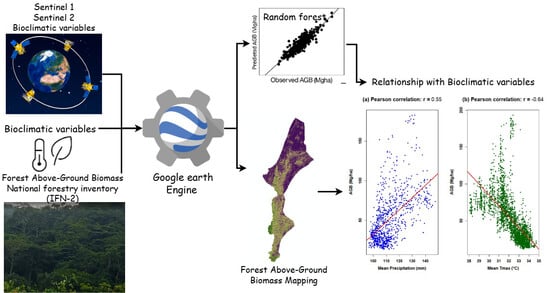
Accurate estimation of above-ground biomass (AGB) is vital for carbon accounting, biodiversity conservation, and sustainable forest management, especially in tropical regions under strong anthropogenic pressure. This study estimated and mapped AGB in the Atacora Mountain Chain, Togo, using a multi-source remote sensing approach within Google Earth Engine (GEE). Field data from 421 plots of the 2021 National Forest Inventory were combined with Sentinel-1 Synthetic Aperture Radar, Sentinel-2 multispectral imagery, bioclimatic variables from WorldClim, and topographic data. A Random Forest regression model evaluated the predictive capacity of different variable combinations. The best model, integrating SAR, optical, and climatic variables (S1S2allBio), achieved R2 = 0.90, MAE = 13.42 Mg/ha, and RMSE = 22.54 Mg/ha, outperforming models without climate data. Dense forests stored the highest biomass (124.2 Mg/ha), while tree/shrub savannas had the lowest (25.38 Mg/ha). Spatially, ~60% of the area had biomass ≤ 50 Mg/ha. Precipitation correlated positively with AGB (r = 0.55), whereas temperature showed negative correlations. This work demonstrates the effectiveness of integrating multi-sensor satellite data with climatic predictors for accurate biomass mapping in complex tropical landscapes. The approach supports national forest monitoring, REDD+ programs, and ecosystem restoration, contributing to SDGs 13, 15, and 12 and offering a scalable method for other tropical regions.

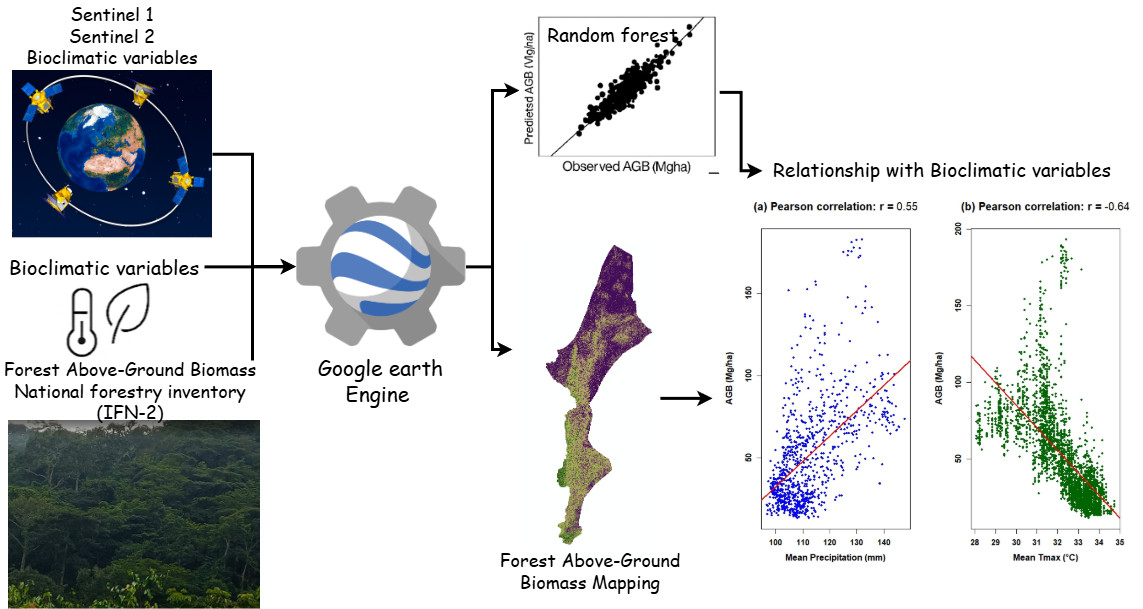
Graphical Abstract

1. Introduction

The degradation of forest ecosystems and the loss of biodiversity are today critical challenges for human societies, particularly in tropical countries of sub-Saharan Africa, where forests play a fundamental role in climate regulation, biodiversity conservation, and supporting the livelihoods of rural populations [1,2]. These ecosystems ensure carbon storage, timber production, and the provision of other essential ecosystem services. Accurate estimation of above-ground biomass (AGB) has become a priority for sustainable forest resource management policies and for the implementation of carbon offset mechanisms such as REDD+ (Reducing Emissions from Deforestation and Forest Degradation), the AFR100 (African Forest Landscape Restoration Initiative), PALCC+ (Support Program for Climate Change Mitigation+), or other national and international initiatives like the FIP (Forest Investment Program), GCF (Green Climate Fund), or UN-REDD (United Nations Collaborative Program on Reducing Emissions from Deforestation and Forest Degradation in Developing Countries) [3,4]. However, biomass mapping in West Africa remains limited, particularly due to the lack of accurate data, the high cost of traditional forest inventories, and the ecological variability of forest landscapes, often composed of complex mosaics of forests, savannas, and human-modified areas [5]. This limitation is particularly concerning in Togo, where the Atacora mountain chain in the northwest of the country represents an important refuge for plant and animal species, while facing increasing anthropogenic pressure [6].
The Atacora chain represents a study area of great ecological and biogeographical importance. Located at the crossroads of eco-floristic zones II and IV of Togo, it encompasses a wide variety of vegetation types, from dense humid forests to wooded savannas, as well as several protected areas, including the Fazao-Malfakassa National Park (FMNP) [7]. Its rugged topography, varied rainfall patterns, and floristic diversity make it an ideal natural laboratory to study the spatial variability of biomass and the interactions between climate, vegetation, and relief. However, this area remains under-explored in terms of AGB mapping, and no comprehensive study has, until now, integrated multi-source remote sensing data with strong field data support in this region. The study by Folega et al. [8] represents a first approach to AGB mapping in the Atacora chain but has several methodological limitations. It relies mainly on visual interpretation of SAVI imagery to define biomass classes, which introduces significant subjectivity and lacks scientific rigor. The absence of field data to calibrate and validate the results significantly reduces the reliability of the estimates produced. The study also does not exploit the potential of multi-source remote sensing data (Sentinel, Landsat, GEDI…), nor does it offer a real quantification of biomass. These shortcomings call for a more integrated approach, based on quantitative methods, robust field data, and the combined use of satellite sensors for accurate and reproducible biomass mapping.
In response to this situation, innovative approaches that combine remote sensing, geographic information systems (GIS), and machine learning have emerged as promising alternatives to overcome the limitations of traditional methods [9,10]. Satellite remote sensing, thanks to the availability of free high-resolution time series data, now enables monitoring of vegetation structure and dynamics over large areas. In particular, data from the Sentinel-1 (SAR) and Sentinel-2 (optical) sensors of the European Copernicus program offer spatio-temporal resolutions suitable for biomass mapping [11,12]. Sentinel-1 radar imagery is less affected by cloud cover, a major advantage in tropical regions, and is sensitive to the vertical structure of vegetation, while Sentinel-2 optical imagery provides spectral information on vegetation vigor and density through indices such as NDVI, EVI, or SAVI [13,14]. The combination of these two data sources within a machine learning modeling framework, such as the Random Forest algorithm, has proven effective in several tropical regions to improve the accuracy of AGB estimations [15]. Several previous studies have demonstrated the effectiveness of this image fusion approach [16,17,18].
In West Africa, several recent studies have demonstrated the growing effectiveness of combining open satellite data with machine learning to overcome field-data scarcity and heterogeneous vegetation structure. Forkuor et al. [5] provided one of the first regional demonstrations of AGB modeling using Sentinel-1 and Sentinel-2, showing that multi-sensor fusion improves prediction accuracy in savanna-forest mosaics. More recent work has expanded this trend by integrating Sentinel imagery with LiDAR and structural metrics to strengthen biomass estimation across diverse landscapes in West Africa, including agroforestry systems using multi-sensor fusion of Sentinel-1, Sentinel-2, ALOS and GEDI [19], assessments of ecosystem-scale structural variability and environmental controls in semi-arid savannas [20], and plot-level biomass estimation using quantitative structure models and close-range photogrammetry [21].
Along the same lines, Google Earth Engine (GEE) offers an innovative platform that facilitates the access, processing, and analysis of geospatial data at scale. By integrating cloud processing capabilities with a vast library of satellite data, GEE enables the automation of biophysical variable mapping, reduction in computing time, and enhanced reproducibility of studies [22]. Its use becomes particularly relevant in developing countries, where computing resources and field data are often limited. The integration of bioclimatic variables such as mean annual temperature, precipitation seasonality, or thermal extremes can enrich predictive models by capturing environmental factors that directly influence biomass growth and distribution [17,23]. These variables can be integrated through global databases such as WorldClim, also available in GEE.
Parallel methodological advances confirm that Random Forest (RF) remains among the most accurate and widely applied algorithms for biomass estimation, although comparative assessments highlight strong performance of ensemble alternatives such as gradient boosting (XGBoost) or multi-model fusion [23,24]. In addition, several studies emphasize that integrating topographic and climatic variables enhances AGB prediction by capturing environmental gradients overlooked in optical or radar data alone [15,17]. Growing comparative analyses show that Sentinel-2 optical predictors, particularly red-edge and SWIR bands, often outperform Sentinel-1 SAR alone, but that combined use consistently yields the best results when biomass varies across physiographic and disturbance gradients [11,15,18]. Together, these recent contributions underline a continental trend toward multi-sensor fusion, climate-informed modeling, and cloud-native machine learning, situating the need for updated AGB assessments in under-studied regions such as northern Togo.
In this context, the present study aims to estimate and map AGB in the agro-ecological zone of the Atacora mountain chain in Togo, by combining field data from the National Forest Inventory (IFN-2), Sentinel-1 and Sentinel-2 satellite imagery, as well as bioclimatic variables derived from the WorldClim database. The specific objectives of the study are as follows: (i) to develop a landscape-scale biomass estimation model using a machine learning algorithm (Random Forest) on the GEE platform; (ii) to compare the performance of different models according to the combinations of predictive variables used (SAR, optical, biophysical, bioclimatic, topographic); (iii) to produce a continuous AGB map over the entire study area; and (iv) to analyze the relationships between AGB and dominant bioclimatic factors in this mountainous region.

2. Materials and Methods

2.1. Study Area

The study area covers a total surface area of 16,830.41 km2, or 1,683,041.55 hectares, and includes two of the ecofloristic zones defined in Togo: Ecofloristic Zones II and IV, as delineated by Ern [25] in his classification of the country’s five main ecofloristic zones. These two zones constitute the Atacora Mountain Chain, a West African mountainous massif extending in a southwest-northeast direction, crossing Togo, northwestern Benin, and east-central Ghana.
Ecofloristic Zone II covers an area of 11,184.82 km2, or 1,118,482.28 hectares. It is located in the northern part of the country, between 0°22′ and 1°34′ East longitude, and 8°18′ and 10°07′ North latitude (Figure 1). The zone is characterized by a combination of Sudanian climate in the plains and humid mountain climate in the highlands [6]. This region has two main seasons: a rainy season from April to October, and a dry season from November to March. Annual rainfall ranges from 1200 mm to 1500 mm, with temperatures between 20 °C and 34 °C. The hydrographic network includes both permanent and seasonal watercourses, such as the Kara River, and the Mô, Kpéwa, Timbou, Sara, Kpaza, and Féléna Rivers, among others. This zone corresponds to the mountainous regions of northern Togo, characterized by dense dry forests dominated by Anogeissus leiocarpa and Uapaca togoensis, as well as open forests with Isoberlinia species [2,7]. Among the protected areas in this zone, the most significant is the FMNP, which spans 192,000 hectares. It was established in 1975 by merging two classified forests: Fazao Forest (classified by Decree No. 425/51/EF of 15 April 1951) and Malfakassa Forest (30,000 ha, classified by Decree No. 425/51/EF of 19 June 1951). The main socio-economic activities in this area are agriculture, livestock farming, and handicrafts.
Ecofloristic Zone IV covers an area of 5645.59 km2, or 564,559.27 hectares, and is located between 0°31′ and 1°04′ East longitude, and 6°44′ and 8°19′ North latitude. It is subject to a transitional subequatorial climate [26], with annual rainfall between 1300 mm and 1500 mm, making it the wettest region in Togo. The hydrographic network is divided among three major watersheds: the Volta, Mono, and Zio basins. It includes both permanent and seasonal rivers, such as the Assoukoko and its tributaries, the Wawa River, Akpè River, Takpla, and Aka, among others. The vegetation is dominated by semi-deciduous forests rich in species such as Terminalia superba, Parinari glabra, Erythrophleum suaveolens, Milicia excelsa, Antiaris africana, and Khaya grandifoliola. Zone IV includes protected areas such as the Missahoé Classified Forest (MCF), which was designated in 1953 by Decree No. 185/53/EF and covers an area of 1450 hectares. The main economic activities in this region are agriculture and trade.

2.2. Satellite Data Collection and Preprocessing

Satellite data from Sentinel-1 and Sentinel-2, part of the Copernicus program of the European Union and provided by the European Space Agency (ESA), were used in this study. The Sentinel-1 sensor is a C-band (5.405 GHz) Synthetic Aperture Radar (SAR) system, which has the advantage of being unaffected by cloud cover. It enables the capture of the three-dimensional structure of vegetation cover through radar backscatter, the detection of variations in vegetation volume (trees, branches, stems), and the generation of radar textures and roughness indices. The Sentinel-2 sensor is equipped with a MultiSpectral Instrument (MSI), designed to acquire images of the Earth’s surface across different wavelengths of the electromagnetic spectrum. It allows for the generation of vegetation indices such as NDVI and its red-edge bands (705, 740, 783 nm), which are particularly sensitive to vegetation structure, facilitating the estimation of various biophysical parameters. The effectiveness of combining radar and optical data for estimating AGB has been demonstrated in several studies [27,28].
For this research, Sentinel-1 data covering the year 2021 were downloaded from GEE, and an annual composite image was generated. The data used were of the GRD (Ground Range Detected) type with a spatial resolution of 10 m, acquired in Interferometric Wide Swath (IW) mode with dual polarization (VH and VV). In addition to backscatter values, the sum (VH + VV) and difference (VH − VV) of the polarization bands were computed. These combinations, based on values already converted to decibels (dB), provide specific information on vegetation structure [12].
High-resolution Sentinel-2 imagery was selected and processed in GEE to produce an annual composite representative of vegetation conditions for 2021, while accounting for the specific climatic constraints of the study area. As noted by Forkuor et al. [5], the lack of optical images during certain months in Sub-Saharan Africa is mainly due to persistent cloud cover. To address this, a cloud and shadow masking function was applied using the Scene Classification Layer (SCL) band, automatically excluding pixels corresponding to cloud shadows, medium and high probability clouds, cirrus, snow, and ice. The Sentinel-2 Surface Reflectance collection (S2_SR) was then spatially filtered to match the boundaries of the Area of Interest (AOI) and temporally restricted to the year 2021. An additional filter retained only images with overall cloud cover below 10%, ensuring higher radiometric quality of the data. The spectral bands essential for vegetation characterization (B2 to B12, including the red-edge bands) were retained, and vegetation indices such as NDVI and EVI were calculated using a dedicated function (addIndices). Each image was then converted to surface reflectance by multiplying the values by a factor of 0.0001, according to the scale of the S2_SR products. A median composite was generated from the filtered images, reducing the influence of residual atmospheric artifacts and transient phenological variations. This process produced a synthetic image representing average conditions for the year. The final image was clipped to the spatial extent of the AOI to be used in the AGB modeling process. Additional indices and biophysical parameters (LAI, FCOVER, FAPAR) were also extracted to enrich the model’s explanatory variables (Table 1).

2.3. Field Data

The data used in this study were obtained from the second National Forest Inventory (NFI-2) conducted in Togo between March and July 2021. A total of 421 sampling plots were established and measured across the entire study area. These plots were distributed among four major types of vegetation formations of the agro-ecological zone of Atacora chain: crops/fallows, open forests/wooded savannas, dense forests, and tree/shrub savannas. Each plot had a circular shape with a radius of 20 m, corresponding to a surface area of 1256.64 m2, calculated using the formula for the area of a circle (A = πr2). On each plot, dendrometric measurements were taken on only trees with a diameter at breast height (DBH) ≥ 10 cm. These measurements included DBH at 1.3 m above ground, bole height, total tree height, and canopy cover. The collected data were used to characterize the stand structure, tree density, species richness, and to compute basal area per hectare. Table 2 below provides a summary of these characteristics by vegetation type. The 421 plots were proportionally distributed based on the spatial representation of each vegetation type within the study area: 44 plots in crops/fallows, 145 in open forests/wooded savannas, 130 in dense forests, and 102 in tree/shrub savannas.

2.4. Bioclimatic Data

In this study, ten bioclimatic variables (Table 3) from the “WORLDCLIM/V1/BIO” database were used in GEE to model AGB. Specific preprocessing was applied to the temperature-related variables, which are expressed in tenths of degrees Celsius (°C × 10), including BIO01, BIO05, BIO06, and BIO08. These variables were normalized by dividing their values by 10 to convert them into actual degrees Celsius. The other variables, expressed in millimeters or relative indices, were retained as they were, since they were already suitable for analysis. All ten variables were then combined into a single multiband image for use in the modeling process.
Monthly climatic data for the year 2021, including precipitation, maximum temperatures (Tmax), and minimum temperatures (Tmin), were downloaded from the “https://www.worldclim.org/data/monthlywth.html, accessed on 1 August 2025” platform as multiband raster files (one band per month). To assess the correlation between AGB and these climatic variables, two types of analyses were conducted in R using the raster package. First, mean annual precipitation, Tmax, and Tmin were calculated by averaging the 12 respective monthly bands. The predicted AGB map was resampled to match the spatial resolution and extent of the climatic variables. Pearson correlation coefficients were then computed between AGB and each of the annual mean climatic variables (precipitation, Tmax, Tmin), followed by the fitting of simple linear models. In a second step, a spatio-temporal analysis was conducted by comparing monthly AGB values with the three climatic variables. After harmonizing spatial resolutions, a loop was used to extract monthly pixel values between AGB and each climatic variable. Pearson correlations were calculated for each month, allowing the temporal and spatial dynamics of linear relationships between AGB and monthly climatic conditions to be evaluated. The resulting coefficients were labeled from January to December to facilitate temporal interpretation.

2.5. AGB Modeling

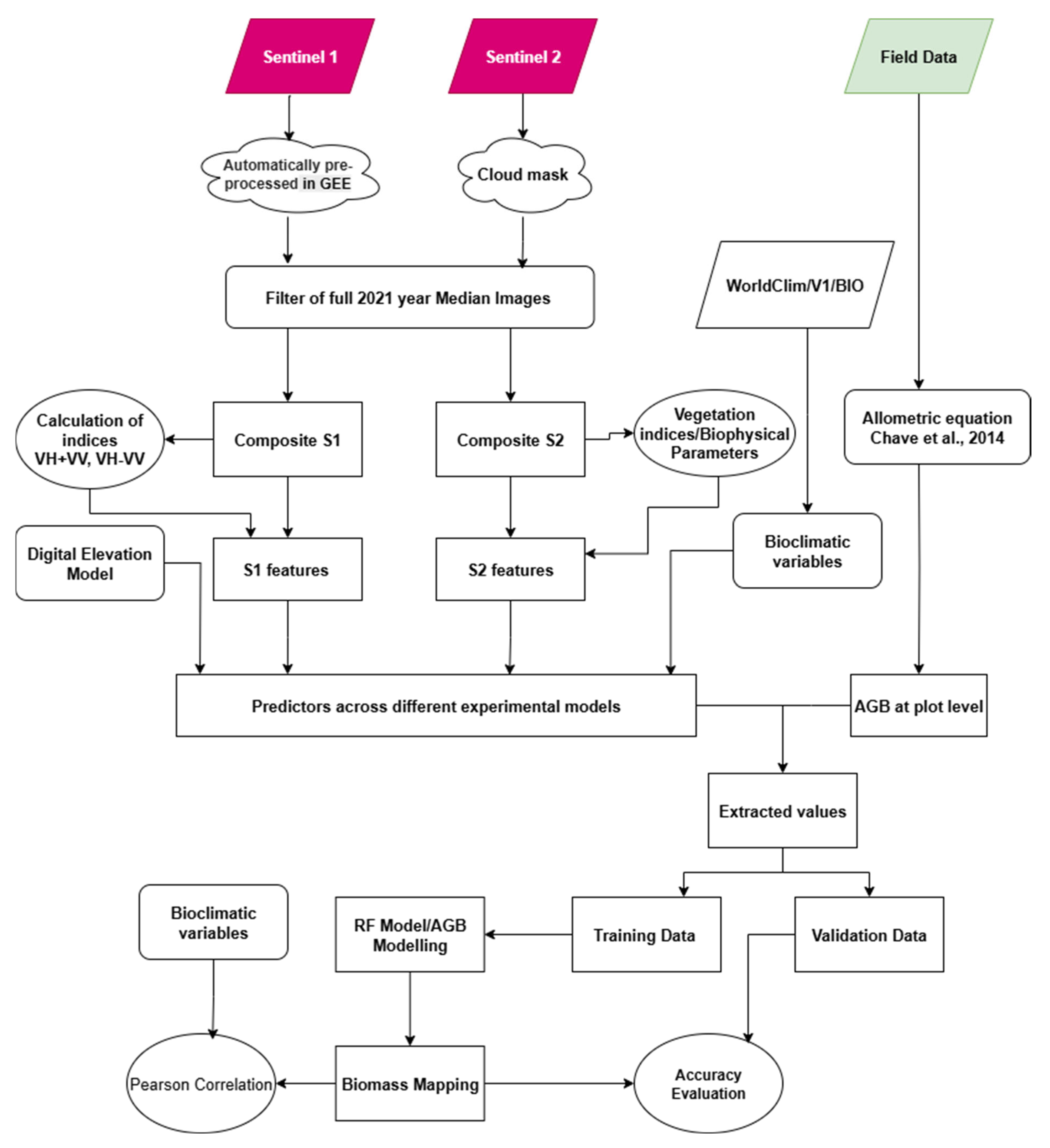
AGB modeling was conducted by combining satellite data from Sentinel-1 (SAR radar) and Sentinel-2 (optical) with field measurements from the NFI-2 (Figure 2). The explanatory variables extracted included vegetation indices (NDVI, EVI, etc.), altitude, biophysical parameters, bioclimatic variables, spectral bands, as well as textural and backscatter parameters (VV, VH) derived from radar data. The main steps of the AGB modeling process were: (1) Preparation of forest inventory data; (2) Extraction of explanatory variables; (3) Statistical or machine learning modeling; (4) Model performance evaluation; and (5) Biomass mapping.

2.5.1. AGB Calculation from Field Data

AGB of trees was estimated from forest inventory data using a pantropical allometric equation developed by Chave et al. [34], expressed as:
A G B = 0.0673 × ( ρ × D 2 × H ) 0.976
where
-
AGB is the aboveground biomass (in kg);
-
ρ is wood density (g/cm3);
-
D is the diameter at breast height (DBH) in cm;
-
H is the total tree height in meters;
and the constants 0.0673 and 0.976 are derived from the calibration of the model on diverse tropical datasets.
Wood density values ( ρ ) were assigned to the identified species using the Global Wood Density Database [35,36]. For species not listed in the database, a default value of 0.5 g/cm3 was applied, in accordance with standard recommendations for tropical areas. This equation was selected for its broad applicability and demonstrated performance in several studies across West Africa. Atsri et al. [37] used it to estimate aboveground biomass in the forests and savannas of FMNP in Togo. Likewise, Forkuor et al. [5], applied this equation in the dry forests of Ghana, Burkina Faso, Togo, and Benin, confirming its relevance for dry tropical ecosystems in the subregion. For each tree measured within a 20 m radius circular plot (surface area of 1256.64 m2), individual biomass was calculated and then extrapolated to one hectare to obtain the aboveground biomass per hectare (Mg/ha) for each plot. Carbon stock was estimated by multiplying the biomass by a factor of 0.5 [5,38].

2.5.2. Predictive Variables

The extraction of explanatory variables is a crucial step in AGB modeling, as it enables the linkage of field observations to satellite data. This process involved overlaying the geographic coordinates of forest inventory plots on preprocessed images from Sentinel-1 (radar) and Sentinel-2 (optical) satellites, in order to extract relevant statistical values for each plot. To ensure accurate alignment between inventory plots and the spatial resolution of satellite imagery, bounding boxes (based on the axes of the four cardinal points) were calculated around each plot and used for the extraction of spatial variables and for model validation. The extracted variables include spectral bands, vegetation indices, radar parameters, elevation, and ten bioclimatic variables. In total, 36 predictive variables were derived, categorized as follows: 10 Sentinel-2 spectral bands, 2 Sentinel-1 radar backscatter bands (VV and VH polarizations), 2 radar indices (products and ratios of VV and VH bands), 8 vegetation index bands from Sentinel-2, 3 bands related to biophysical parameters derived from Sentinel-2 (LAI, FAPAR, and FCOVER), elevation, and 10 bioclimatic variables (Table 1). These variables represent biophysical and structural signatures of vegetation, related to forest stand density, cover, and vigor. They were compiled into a structured database, associated with the biomass values measured in the field and calculated in the previous section, to constitute the input dataset used to train regression or machine learning models.

2.5.3. Statistical or Machine Learning Modeling

The combined use of Sentinel-1 (S1), Sentinel-2 (S2), and Landsat 8 (L8) data for AGB modeling has proven to be both powerful and effective due to the complementary information provided by these sensors. Sentinel-1 offers synthetic aperture radar (SAR) data in VV and VH bands, which are useful for detecting vegetation structure and roughness, even under cloudy conditions. These parameters are sensitive to vegetation density and vertical structure, making them indirect but relevant indicators of biomass [39]. In addition, Sentinel-2 or Landsat 8 provide multispectral optical data that allow the derivation of vegetation indices such as NDVI, EVI, or SAVI, which are correlated with chlorophyll content and photosynthetic productivity, and thus with biomass [13,14]. Integrating these datasets into a machine learning model, such as Random Forest, allows for the exploitation of both the textural (structural) information provided by S1 and the spectral (functional) information captured by S2 or L8 [5]. Several studies have shown that the fusion of S1 and S2 significantly improves the accuracy of biomass prediction models by reducing uncertainty and increasing the coefficient of determination (R2), compared to the use of optical or radar data alone [11,23]. We also incorporated bioclimatic variables to test their importance in AGB modeling across the Atacora mountain chain. Multiple models with different combinations of input variables were tested for AGB prediction (Table 4).
The entire dataset, comprising field-measured AGB values and explanatory variables extracted from satellite imagery, was randomly split into two subsets: 80% of the plots were used for model training, and 20% for validation. This random partitioning is a commonly used method in machine learning and remote sensing to ensure a robust and independent evaluation of model performance [9,17].
The Random Forest (RF) model was selected for AGB prediction due to its high performance and robustness. The RF algorithm, natively integrated in GEE, works by constructing numerous decision trees, each trained on a random subsample of the training data. The final prediction is obtained by aggregating the results of all trees (via averaging for regression tasks) [40]. This model offers several advantages: it can capture complex non-linear relationships between predictors and AGB, it is less prone to overfitting, it handles noisy or redundant data efficiently, and it provides variable importance measures to identify the most influential predictors. Furthermore, it does not require normally distributed data or prior transformation. Due to its flexibility and robustness, RF is widely used in environmental remote sensing studies for biomass mapping [10,15,41].

2.5.4. Model Performance Assessment

The performance evaluation of the AGB prediction model was conducted using 20% of the dataset that was not used for training. This subset served as a robust validation sample to compare the model’s predicted values with the observed field data. The coefficient of determination (R2) measures the proportion of the variance in observed AGB explained by the model; a value close to 1 indicates strong explanatory power. The Mean Absolute Error (MAE) provides an average estimate of the absolute difference between observed and predicted values, expressed in the same units as AGB (Mg/ha), making it easy to interpret. The Root Mean Square Error (RMSE), which is more sensitive to large errors than MAE, quantifies the square root of the mean of squared differences between observed and predicted values. The Symmetric Mean Absolute Percentage Error (sMAPE) offers a normalized measure of error, expressed as a percentage, which is useful for comparing prediction accuracy independently of measurement units. Together, these metrics assess the model’s reliability, accuracy, and robustness by accounting for both absolute and relative errors, as well as extreme deviations. Low values of MAE, RMSE, and sMAPE, combined with a high R2, indicate good model performance.
M A E = 1 n i = 1 n y i   ŷ i
R M S E = 1 n i = 1 n ( y ŷ ) 2
s M A P E = 1 n i = 1 n y i   ŷ i ( y i +   ŷ i / 2 )
R 2 = 1 i = 1 n y i ŷ i 2 i = 1 n y i ȳ i 2
y i : is the observed value;
ŷ i : is the predicted value;
y - i : is the mean of the observed values;
n : is the total number of samples.

2.5.5. Biomass Mapping

The composite image of predictor variables was input into a pre-trained RF machine learning algorithm. The classify(rf) function in GEE was used to apply the RF model across all image pixels, generating a continuous prediction map of AGB. The output represents an estimate of AGB (in Mg/ha) for each pixel across the Atacora mountain chain.

3. Results

3.1. Statistical Ground Truth

Table 4 presents the descriptive statistics of AGB, in Mg/ha, across four land cover types: dense forests, open forests/wooded savannas, tree/shrub savannas, and crops/fallows. The results show that dense forests store the highest average biomass (124.20 Mg/ha), reflecting their high carbon storage capacity due to dense and mature vegetation. Open forests/wooded savannas and crops/fallows show intermediate values, with 59.71 Mg/ha and 47.52 Mg/ha, respectively. Tree/shrub savannas have the lowest biomass (25.38 Mg/ha), indicating a sparser vegetation cover and lower biological productivity.

3.2. AGB Modeling Accuracy

The validation results of the various biomass mapping models reveal contrasting performances depending on the combinations of input data used (Table 5). Model (a) (S1S2allBio), which integrates all available predictors (SAR, optical, and bioclimatic data), shows the best performance, with a high coefficient of determination (R2) of 0.90, a mean absolute error (MAE) of 13.42, a root mean square error (RMSE) of 22.54, and a symmetric mean absolute percentage error (sMAPE) of 27.63%. This confirms the relevance of an integrated approach for biomass modeling. Model (b) (S2allBio), which excludes SAR data but retains bioclimatic variables, also performs well (R2 = 0.86), suggesting a strong correlation between these variables and biomass. In contrast, models (c) (S1S2all) and (d) (S2all), which do not include bioclimatic variables, show a clear drop in performance (R2 = 0.54 and 0.52, respectively), highlighting the critical importance of bioclimatic factors. Model (e) (S1S2allD), which replaces bioclimatic variables with the Digital Elevation Model (DEM), leads to a moderate improvement in accuracy (R2 = 0.66), indicating that topography influences biomass distribution, although to a lesser extent than bioclimatic variables. Model F (S1all), based solely on radar and elevation data, shows the lowest performance (R2 = 0.42), confirming that SAR data alone are insufficient for reliable biomass estimation. These results clearly indicate that the integration of multi-source data, particularly bioclimatic variables, is essential for improving the accuracy of AGB maps.

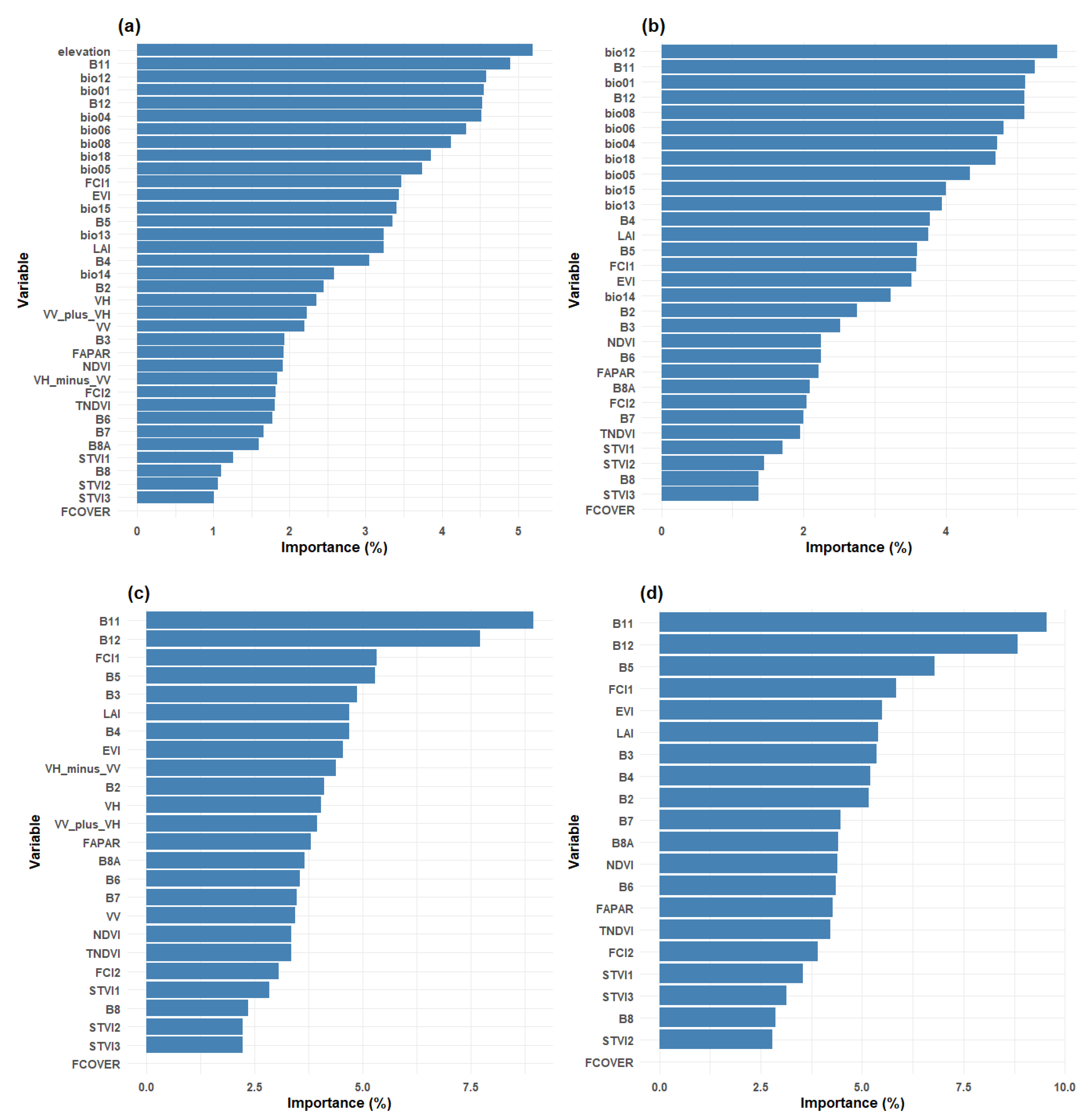
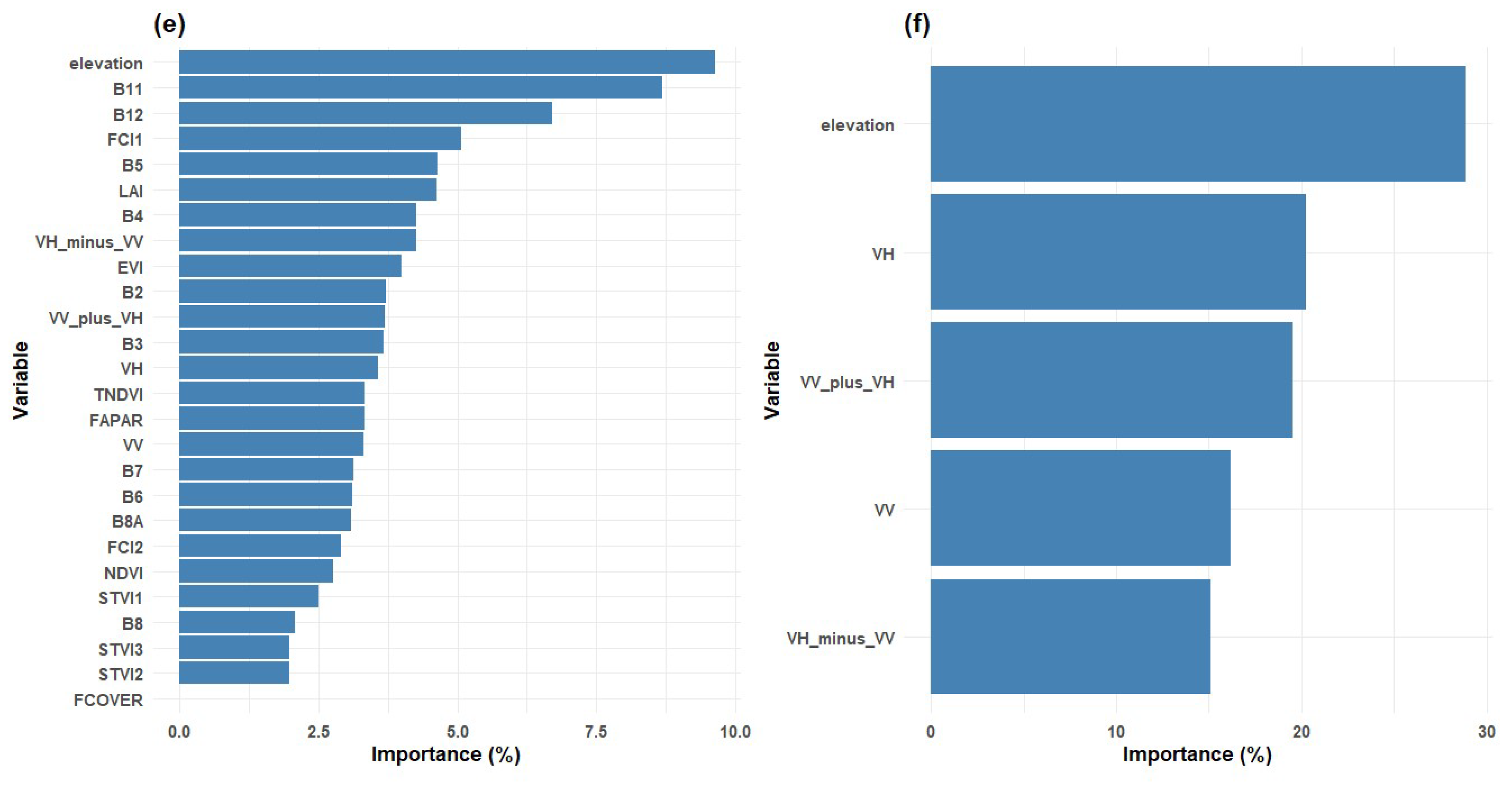
3.3. Relevant Variables in Different Experimental Models

Figure 3 illustrates the importance of the various predictors used in different experimental scenarios for estimating AGB in the Atacora mountain chain. It highlights the most influential variables in the prediction models. The spectral bands from Sentinel-2, particularly B11, B12, and B5, along with variables such as LAI (Leaf Area Index) and FCI (Fractional Canopy Index), emerge as dominant predictors in most models (Figure 3a–e). Altitude also appears as a key factor in the models when it was included (Figure 3a,e,f), underscoring its influence on the spatial distribution of biomass, likely linked to altitudinal ecological gradients. Radar-based variables (VV, VH, and their combinations) exhibit relatively lower importance, although model (a) shows a more pronounced influence, especially for the VV + VH combination. VV polarization is generally more informative than VH in all models incorporating Sentinel-1 data (Figure 3a,c,e,f). In the Atacora chain, radar variables proved to be less explanatory, except for VV + VH in model (a). Bioclimatic variables (bio1 to bio19) show a strong contribution in the models presented in Figure 3a,b, surpassing spectral variables, with the notable exception of B11. Among vegetation indices, only EVI stands out with a significant contribution (Figure 3a,b,d,e), while other indices (NDVI, TNDVI, etc.) have a marginal influence, suggesting limited relevance for AGB estimation in this context. The biophysical variable FCOVER does not provide any significant information, confirming its lack of effect on biomass modeling in this study.

3.4. Spatial Mapping of AGB

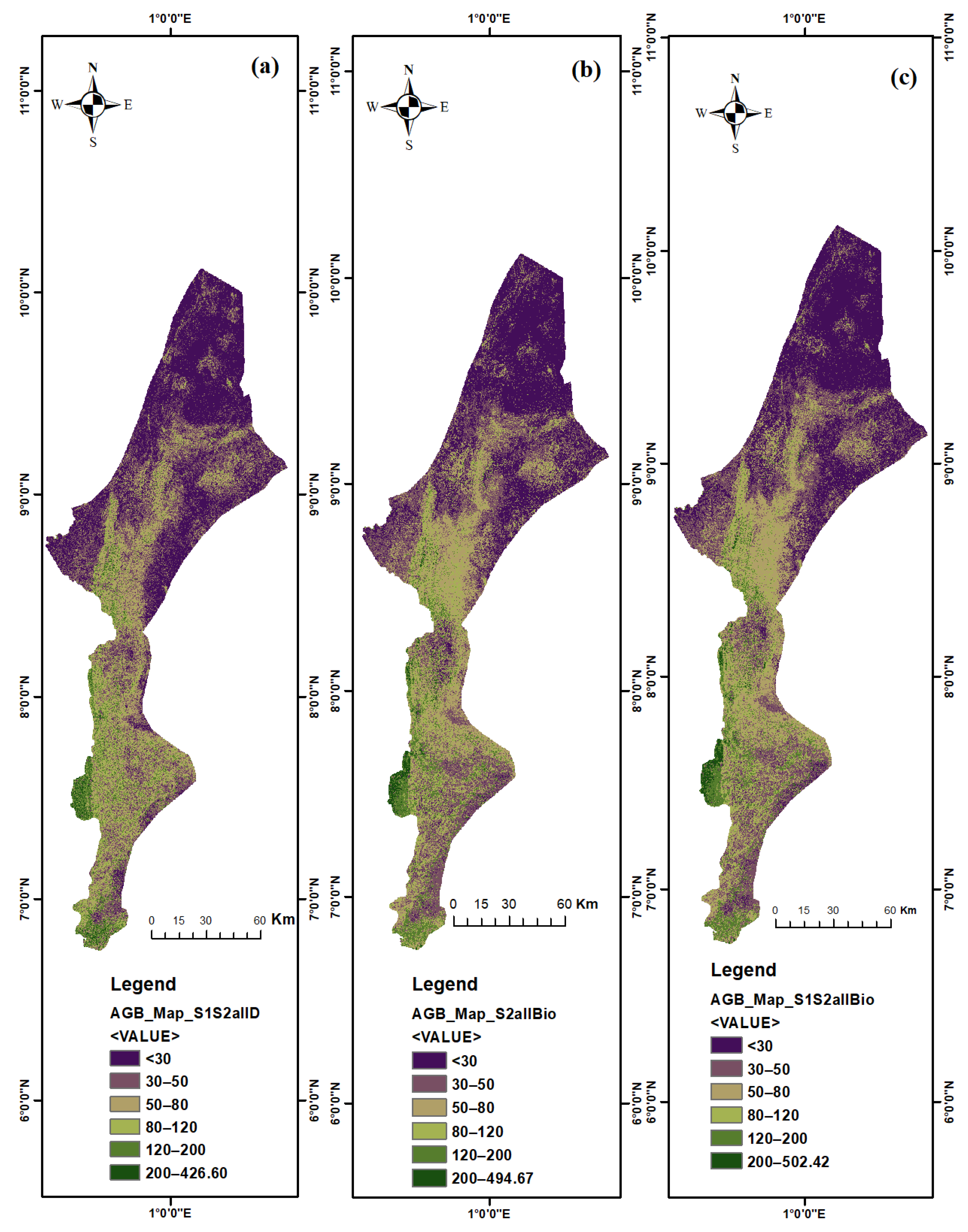
The comparative analysis of AGB maps generated from the three best-performing experimental models in terms of accuracy (R2), S1S2allBio, S1S2allD, and S2allBio, reveals differences in the spatial distribution and surface area occupied by different biomass classes (Figure 4). Overall, all models show a strong predominance of low biomass values (<50 Mg/ha), covering more than 59% of the area for S1S2allBio, 62% for S2allBio, and up to 62.48% for S1S2allD. This reflects either an advanced state of ecosystem degradation or low vegetative productivity across large portions of the modeled territory. However, the S2allBio model, based solely on optical and bioclimatic data, assigns a larger share to the intermediate biomass class (50–80 Mg/ha), accounting for 21.92%, compared to the models integrating SAR data. This suggests a better ability of this model to discriminate moderate biomass levels in mosaic landscapes. Conversely, the S1S2allD model, which excludes bioclimatic variables but combines radar (SAR) and DEM data, further accentuates the dominance of low values. This may indicate systematic underestimation in the absence of essential climate information. Regarding high biomass values (>120 Mg/ha), all models converge toward a marginal representation (approximately 7 to 8%), reflecting the spatially limited extent of dense forests or highly productive vegetation formations. These results highlight that the S1S2allBio model, incorporating all available variables (SAR, optical, bioclimatic, and topographic), provides a more balanced and nuanced mapping of aboveground biomass, especially in the intermediate and high biomass classes. This model thus stands out as the most robust and reliable, with a coefficient of determination (R2) of 0.87, the highest among all tested models.

3.5. AGB and Bioclimatic Relationship

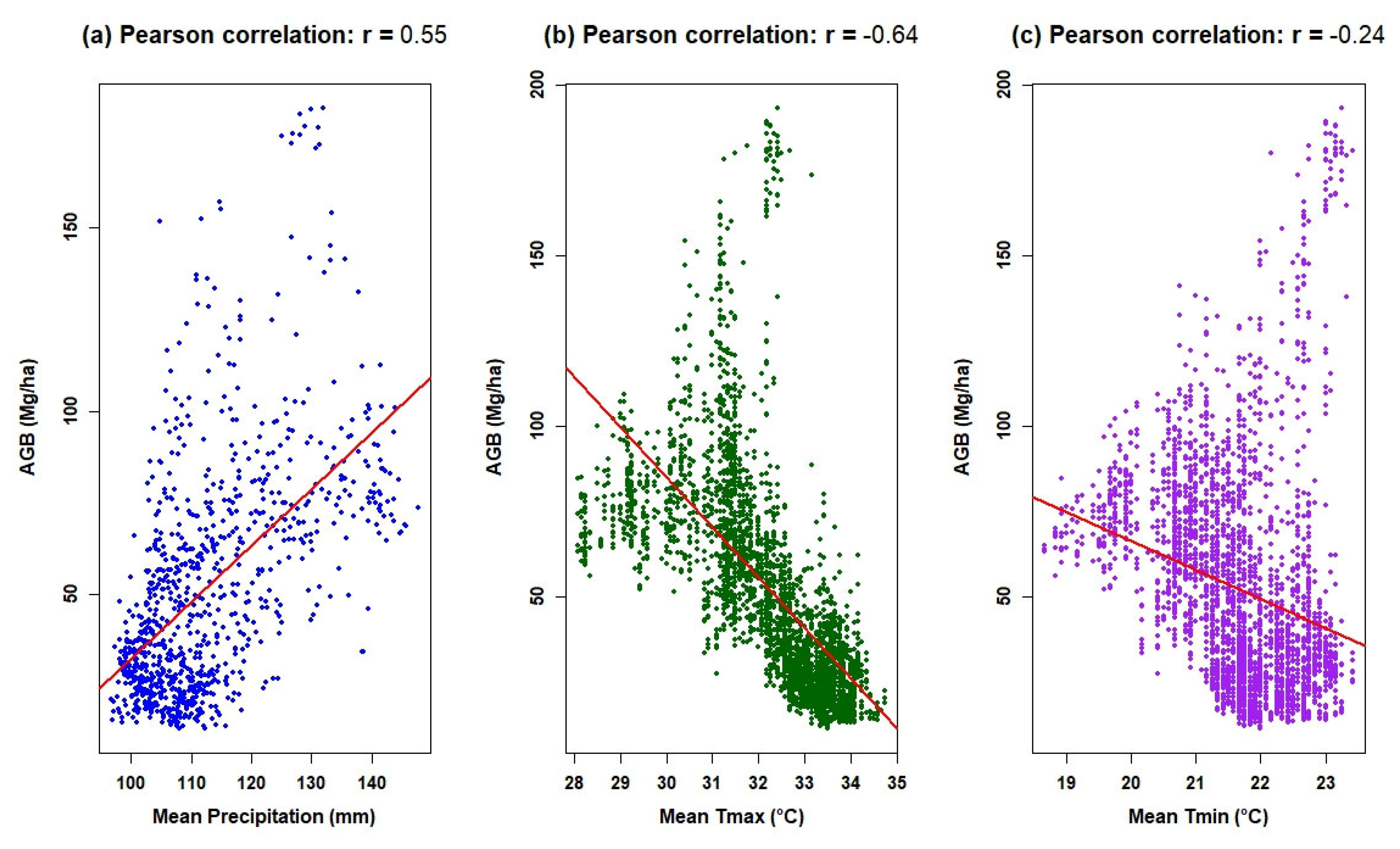
The results presented in Figure 5 show Pearson correlation coefficients between AGB predicted (Figure 4c) and three mean climatic variables: precipitation, maximum temperature (Tmax), and minimum temperature (Tmin). AGB exhibits a moderate positive correlation with mean annual precipitation (r = 0.55) (Figure 5a), indicating that water availability is a major limiting factor for ecosystem productivity. In contrast, its relationships with temperature are negative. The correlation between AGB and Tmax (Figure 5b) is r = −0.64, while that between AGB and Tmin (Figure 5c) is even weaker, at r = −0.24. These negative correlations suggest that high temperatures, whether maximum or minimum, may limit ecosystem productivity, potentially by increasing evapotranspiration and water stress. Monthly analysis reveals that precipitation positively influences AGB during the months of January to April and September to November, with strong correlations (r > 0.66). However, an inverse effect is observed in July and August (r = −0.58 to −0.72) (Table 6), possibly due to water saturation or combined heat and moisture stress. Temperatures, on the other hand, consistently show negative correlations throughout the year, suggesting that extreme thermal conditions constrain photosynthesis and lead to biomass loss through increased evapotranspiration.

4. Discussion

4.1. AGB in Dense Forests

The average AGB of dense forests is the highest among the four vegetation types studied, with a maximum value reaching 518.24 Mg/ha, equivalent to 259.12 t/ha of carbon stock. This confirms their fundamental role as carbon sinks, as emphasized by Pan et al. [42] in their assessment of global forest carbon stocks. This high biomass, compared to other vegetation types, can be attributed to several ecological factors, including topography, soil characteristics, and the presence of fast-growing forest species such as Ceiba pentandra and Antiaris toxicaria. Furthermore, Folega et al. [43] demonstrated that ten tree species, led by Daniellia oliveri, contribute to the AGB of forest ecosystems within Togo’s riparian forest landscapes.
The Atacora Mountain Chain, a mountainous area characterized by steep slopes and alluvial valley soils, promotes the development of large-diameter and tall trees, which significantly increases aboveground biomass. This observation was confirmed by Atsri et al. [2] in their estimation of AGB in FMNP. The average AGB value obtained in this study (124.2 Mg/ha) is comparable to that reported by Jibrin and Abdulkadir [44] in Nigeria, where a closed-canopy forest formation showed an average of 133.8 ± 12.9 Mg/ha. However, this value remains lower than those reported in some dense-canopy forests in the subregion, by N’Gbala et al. [45] in Côte d’Ivoire (343.5 ± 67.9 Mg/ha) and by Koranteng et al. [46] in Ghana (412.8 Mg/ha). These differences may be explained by local climatic conditions, biomass estimation methodologies, and the intensity of anthropogenic pressures. In this regard, Atsri et al. [2], highlighted various human pressures (agriculture, fire, logging) affecting biomass dynamics in FMNP. In contrast, wooded and shrubby savannas recorded the lowest biomass (25.38 Mg/ha), reflecting a naturally sparse vegetation cover subjected to frequent disturbances such as bushfires and deforestation, a situation commonly observed in African savanna ecosystems [47].

4.2. Sentinel-1, Sentinel-2, and Environmental Variables in AGB Modeling

The results of this study reveal that Sentinel-2 optical data outperformed Sentinel-1 radar data for biomass estimation in the Atacora Mountain Chain. This finding corroborates the observations of Forkuor et al. [5], who also reported limited effectiveness of radar data in savanna and woodland areas of sub-Saharan Africa. The poor performance of Sentinel-1 radar data in biomass estimation can be attributed to several limitations: signal saturation in areas of high biomass, low sensitivity to vegetation vertical structure, influence from external factors such as soil moisture and surface roughness, and the absence of vegetation-specific spectral bands. In contrast, Sentinel-2 optical data, thanks to their spectral richness and high resolution, allow for a better characterization of vegetation, making them a more suitable tool in the context of the Atacora Mountain Chain.
Comparative studies on the performance of optical and radar (SAR) data in AGB modeling have yielded sometimes contrasting results. For example, studies by Tavasoli and Arefi [48] and Xu et al. [49] highlighted better performance of Sentinel-1 data in AGB estimation. Conversely, several other studies, those of Forkuor et al. [5], Nandy et al. [15], and Zhang et al. [50], confirmed the superiority of Sentinel-2 optical data for this type of modeling, in line with the findings of this study. Nandy et al. [15] specifically identified shortwave infrared (SWIR) bands as among the most relevant predictive variables. Our results align with this conclusion, with Sentinel-2 bands B11 and B12 showing the highest importance in the predicted AGB model.
Vegetation indices derived from Sentinel-2 data played a decisive role in improving the accuracy of AGB modeling in the Atacora Mountain Chain. Among all the variables tested, two indices stood out as particularly influential: FC1 and EVI, which emerged as the most important predictors in the model. The contribution of vegetation indices to AGB modeling has already been highlighted in several previous studies [51,52]. Chrysafis et al. [51] found a strong correlation between EVI and high biomass levels, which could explain the relevance of this index in the context of this study, characterized by relatively high AGB values.
Biophysical variables generally did not exert a significant influence on AGB modeling in this study. With the exception of LAI, which showed moderate importance, indicators such as FCOVER and FAPAR were found to be minimally contributive and ranked among the least influential variables. Although previous studies have highlighted the relevance of these variables in biomass estimation [53], their contribution in our case appears limited, which could be explained by specific local conditions or a lower sensitivity of these parameters to biomass variability in the Atacora Mountain Chain.
The integration of bioclimatic variables represents one of the major advances of this study in improving the accuracy and robustness of AGB modeling in the Atacora Mountain Chain. These variables significantly enhanced the predictive performance of the model, as demonstrated by the results of experiments (a), (b), and (c) (Table 5). Models (a) and (b), which included bioclimatic variables, achieved the best validation scores, with high coefficients of determination (R2 = 0.90 and 0.86), low mean absolute errors (MAE = 13.42 and 15.23), and RMSE and sMAPE values markedly lower than those of model (c). The latter, which combined only optical and radar data without bioclimatic variables, showed significantly degraded performance (R2 = 0.54; MAE = 30.49; RMSE = 48.87; sMAPE = 47.22%). This improvement can be explained by the fact that bioclimatic variables such as temperature, precipitation, and humidity play a fundamental role in vegetation dynamics and ecosystem productivity. Indeed, water availability and thermal energy directly influence growth processes, leaf density, and consequently the amount of stored biomass [54]. Altitude was found to be an important predictive variable in AGB modeling in the Atacora Mountain Chain. Its inclusion significantly improved model accuracy. This importance can be explained by the mountainous relief of the region, which strongly influences ecological conditions and vegetation distribution. This result is consistent with other studies conducted in topographically complex environments [16,17].

4.3. Spatial Distribution of AGB

The best-performing prediction model (S1S2allBio), presented in Figure 4c, reveals that 33.05% of the Atacora mountain chain has an AGB below 30 Mg/ha, while 26.72% falls within the range of 30 to 50 Mg/ha. Thus, nearly 59.77% of the study area exhibits an AGB less than or equal to 50 Mg/ha. This proportion remains relatively moderate compared to the findings of Forkuor et al. [5], and Bouvet et al. [55], who estimated that 81% and 89%, respectively, of the savanna mosaics in Burkina Faso, northern Togo, Ghana, and Benin have an AGB between 0.1 and 50 Mg/ha.
This difference may be explained by the nature and structure of the dominant vegetation types in each study area. In contrast to the areas investigated by Forkuor et al. [5] and Bouvet et al. [55], which are mainly composed of shrub savannas, agroforestry parklands, and croplands, the Atacora chain is characterized by the significant presence of denser vegetation formations such as wooded savannas, open forests, and dry dense forests. This feature is supported by biomass measurements from field inventories, which indicate generally higher values in protected forest areas intersected by the Atacora chain (such as the FMNP, MCF, and reserves). Although less widespread, higher biomass classes remain significant: 21.56% of the area has an AGB between 50 and 80 Mg/ha, 10.97% between 80 and 120 Mg/ha, 6.57% between 120 and 200 Mg/ha, and 1.14% displays high biomass values ranging from 200 to 500 Mg/ha. This distribution reflects strong ecological variability at the landscape scale and highlights the influence of topographic, climatic, and protection-status gradients on the spatial distribution of biomass in the Atacora chain.
As noted by Folega et al. [8], the dynamics of aboveground biomass in this region showed a regressive trend between 1987 and 2011. Although their study did not specify the percentage distribution of biomass classes, current data indicate that, in 2021, AGB loss compared to 2011 levels remains noticeable. This loss, although moderate, appears to have been mitigated by conservation initiatives (REDD+) and the resilience of forest ecosystems. The observed AGB degradation seems to be linked to increasing anthropogenic pressure, notably due to population growth, which was estimated at 8,095,498 inhabitants according to the latest census [56], compared to 5,753,324 in 2011.

4.4. Influence of Climatic Variables on AGB

The results shown in Figure 5a and Table 6 confirm that precipitation is the main climatic factor positively influencing aboveground biomass, especially during key growth months. This trend is consistent with productivity models indicating that water availability is one of the primary determinants of plant growth in tropical environments [57]. Temperature sensitivity, while generally negative, remains moderate, reflecting a certain resilience of local ecosystems to thermal variations, likely due to the ecological adaptation of the species present. Bilouktime et al. [58] also reported no correlation between net primary productivity and temperature in Togo. However, the pronounced negative effects observed during the wettest months (July–August) in Togo may indicate a combined heat, humidity stress, a phenomenon increasingly common under climate change [59]. This stress may hinder productivity through mechanisms such as stomatal closure, reduced photosynthesis, and increased respiration [60]. These findings align with observations from other tropical studies [61,62], emphasizing that while water remains the dominant factor, heat can become a critical modulator of productivity, particularly in the context of intensified climate change.

4.5. AGB Mapping with GEE

Annual mapping of AGB using GEE offers significant advantages for ecological monitoring, carbon accounting, and conservation planning, particularly in resource-limited contexts such as Togo. GEE provides online access to an extensive archive of satellite imagery, including Landsat, Sentinel, and other datasets, enabling researchers to produce large-scale annual biomass estimates without the need for expensive computing infrastructure [22]. The platform facilitates the integration of optical and radar data with field measurements and environmental variables such as elevation, precipitation, and land cover, thereby enhancing the accuracy of biomass models through machine learning or regression approaches [4,63]. Its near-real-time processing capability allows for the rapid detection of biomass losses due to deforestation, degradation, or fires, as well as the monitoring of forest regeneration and the outcomes of restoration actions over time [3]. These features are critical for supporting national greenhouse gas inventories, REDD+ initiatives, and sustainable land management strategies [64]. Furthermore, GEE’s free and reproducible nature fosters collaborative research and transparency, aligning with global commitments to climate change mitigation and biodiversity conservation. In the context of Togo’s diverse ecological zones and high anthropogenic pressure, annual AGB mapping via GEE provides a cost-effective and scalable solution for understanding the spatial and temporal trends of biomass and guiding evidence-based conservation policies.

4.6. Importance of This Study for Forest Management and Its Implications for Achieving the Sustainable Development Goals

The study on AGB mapping in the Atacora mountain chain of Togo holds strategic importance for sustainable forest management and the achievement of the Sustainable Development Goals (SDGs), particularly SDG 13 (Climate Action), SDG 15 (Life on Land), and SDG 12 (Responsible Consumption and Production). By combining multisource data (Sentinel-1, Sentinel-2, bioclimatic variables) with machine learning methods (Random Forest), this research offers a reproducible and cost-effective approach for estimating forest carbon stocks, which are essential for compensation mechanisms such as REDD+ [3,5]. The results show that dense forests, although limited in extent, store a high average biomass (124.2 Mg/ha), underlining their role as carbon sinks [42]. GEE emerges here as a key tool, enabling continuous and accessible monitoring of forest cover in resource-constrained countries [22]. This approach promotes evidence-based planning, essential for strengthening the resilience of forest ecosystems and meeting targets 15.1 (conservation of terrestrial ecosystems), 13.1 (strengthen resilience and adaptive capacity to climate-related hazards and natural disasters in all countries), and 12.2 (achieve the sustainable management and efficient use of natural resources). By integrating climatic parameters, the study also demonstrates that environmental variability strongly influences biomass distribution, reinforcing the need for an ecosystem-based approach to forest governance [54]. This work thus provides both scientific and operational leverage for sustainable forest management, aligned with climate and environmental commitments.

5. Conclusions

This study demonstrates that integrating multi-source remote sensing data with field measurements and bioclimatic variables in Google Earth Engine enables accurate, spatially explicit mapping of above-ground biomass in the Atacora Mountain Chain of Togo. The Random Forest model incorporating Sentinel-1 SAR, Sentinel-2 optical imagery, and climatic predictors achieved the highest predictive performance (R2 = 0.90), clearly surpassing models without climatic data. This confirms that environmental gradients, particularly precipitation and temperature, are key determinants of biomass distribution in the region. Dense forests emerged as critical carbon reservoirs, with average AGB values exceeding 124 Mg/ha, whereas tree/shrub savannas displayed much lower stocks (~25 Mg/ha), reflecting differences in vegetation structure and anthropogenic pressures. The spatial distribution of AGB revealed that nearly 60% of the area contains ≤ 50 Mg/ha, highlighting the prevalence of low-biomass formations and the urgent need for restoration efforts. The strong positive correlation between biomass and precipitation underscores the role of water availability in sustaining productivity, while negative temperature correlations suggest potential vulnerability to heat stress under climate change. These findings align with broader tropical forest studies and stress the importance of integrating climate considerations into forest management.
Based on a rigorous and reproducible remote sensing and field-based modeling framework, this study provides an up-to-date assessment of aboveground biomass distribution across the Atacora Mountain agro-ecological zone and deepens understanding of carbon stock patterns in Togo’s agro-ecological landscape. The results offer a valuable baseline for future forest inventories and support national strategies related to climate change mitigation, REDD+ implementation, and sustainable land use planning (SDG 13, Climate Action). By highlighting spatial variations in biomass across vegetation types, the study also contributes to biodiversity conservation initiatives, prioritization of restoration efforts, and improved management of ecologically sensitive mountain ecosystems (SDG 15, Life on Land). Importantly, the methodological workflow developed, integrating Sentinel-1 and Sentinel-2 data, bioclimatic variables, and machine-learning modeling on the GEE platform, can be readily adapted and transferred to other regions with similar forest–savanna dynamics. In doing so, this research advances evidence-based decision-making for natural resource governance in Togo and strengthens the scientific foundation for environmentally sustainable development.

Author Contributions

Conceptualization, D.M.-e.B. and F.F.; methodology, D.M.-e.B.; software, D.M.-e.B. and C.C.S.; validation, D.M.-e.B., J.Š.-S. and H.H.; formal analysis, D.M.-e.B.; investigation, D.M.-e.B., K.S.D. and B.B.; resources, W.K. and B.K.; data curation, D.M.-e.B.; writing—original draft preparation, D.M.-e.B.; writing—review and editing, J.Š.-S., F.F. and C.C.S.; visualization, D.M.-e.B.; supervision, J.Š.-S. and F.F.; project administration, D.M.-e.B. All authors have read and agreed to the published version of the manuscript.

Funding

This research received no external funding.

Data Availability Statement

All satellite imagery used in this study is fully described in the manuscript. The script of GEE developed AGB mapping is available at: https://code.earthengine.google.com/4ef17cecee5c754467b20e315d60e81a (accessed on 10 July 2025).

Acknowledgments

The authors express their sincere gratitude to the Faculty of Geography and Geology of Alexandru Ioan Cuza University of Iași (Romania) for the warm welcome and excellent support provided during the doctoral research stay funded by the 2025 Eugène Ionesco scholarship. This opportunity significantly contributed to the advancement of the present work. Special thanks are extended to the Romanian Ministry of Foreign Affairs and the Agence Universitaire de la Francophonie (AUF) for making this mobility possible through their generous financial and institutional support. We also acknowledge the Laboratory of Botany and Plant Ecology of the University of Lomé (Togo) for their diverse support. Particular appreciation is given to Moussa Samarou for his availability and assistance in obtaining the data used in this study. The authors further thank the SPIRIT project (No. 193032) for its valuable support in facilitating this research.

Conflicts of Interest

The authors declare no conflicts of interest.

References

  1. Rajasugunasekar, D.; Patel, A.; Devi, K.; Singh, A.; Selvam, P.; Chandra, A. An integrative review for the role of forests in combating climate change and promoting sustainable development. Int. J. Environ. Clim. Change 2023, 13, 4331–4341. [Google Scholar] [CrossRef]
  2. Atsri, H.K.; Konko, Y.; Cuni-Sanchez, A.; Abotsi, K.E.; Kokou, K. Changes in the West African forest-savanna mosaic, insights from central Togo. PLoS ONE 2018, 13, e0203999. [Google Scholar] [CrossRef] [PubMed]
  3. Avitabile, V.; Herold, M.; Heuvelink, G.B.; Lewis, S.L.; Phillips, O.L.; Asner, G.P.; Armston, J.; Ashton, P.S.; Banin, L.; Bayol, N. An integrated pan-tropical biomass map using multiple reference datasets. Glob. Change Biol. 2016, 22, 1406–1420. [Google Scholar] [CrossRef]
  4. Baccini, A.; Goetz, S.J.; Walker, W.; Laporte, N.; Sun, M.; Sulla-Menashe, D.; Hackler, J.; Beck, P.; Dubayah, R.; Friedl, M. Estimated carbon dioxide emissions from tropical deforestation improved by carbon-density maps. Nat. Clim. Change 2012, 2, 182–185. [Google Scholar] [CrossRef]
  5. Forkuor, G.; Zoungrana, J.-B.B.; Dimobe, K.; Ouattara, B.; Vadrevu, K.P.; Tondoh, J.E. Above-ground biomass mapping in West African dryland forest using Sentinel-1 and 2 datasets-A case study. Remote Sens. Environ. 2020, 236, 111496. [Google Scholar] [CrossRef]
  6. Woegan, Y.A.; Akpavi, S.; Dourma, M.; Atato, A.; Wala, K.; Akpagana, K. Etat des connaissances sur la flore et la phytosociologie de deux aires protégées de la chaîne de l’Atakora au Togo: Parc National Fazao-Malfakassa et Réserve de Faune d’Alédjo. Int. J. Biol. Chem. Sci. 2013, 7, 1951–1962. [Google Scholar] [CrossRef]
  7. Dourma, M.; Batawila, K.; Guelly, K.A.; Bellefontaine, R.; Foucault, B.d.; Akpagana, K. La flore des forêts claires à Isoberlinia spp. en zone soudanienne au Togo Titre courant: Flore des forêts claires à Isoberlinia. Acta Bot. Gall. 2012, 159, 395–409. [Google Scholar] [CrossRef]
  8. Folega, F.; Woegan, Y.A.; Marra, D.; Wala, K.; Batawila, K.; Seburanga, J.L.; Zhang, C.-y.; Peng, D.-l.; Zhao, X.-h.; Akpagana, K. Long term evaluation of green vegetation cover dynamic in the Atacora Mountain chain (Togo) and its relation to carbon sequestration in West Africa. J. Mt. Sci. 2015, 12, 921–934. [Google Scholar] [CrossRef]
  9. Belgiu, M.; Drăguţ, L. Random forest in remote sensing: A review of applications and future directions. ISPRS J. Photogramm. Remote Sens. 2016, 114, 24–31. [Google Scholar] [CrossRef]
  10. Morais, T.G.; Teixeira, R.F.; Figueiredo, M.; Domingos, T. The use of machine learning methods to estimate aboveground biomass of grasslands: A review. Ecol. Indic. 2021, 130, 108081. [Google Scholar] [CrossRef]
  11. David, R.M.; Rosser, N.J.; Donoghue, D.N. Improving above ground biomass estimates of Southern Africa dryland forests by combining Sentinel-1 SAR and Sentinel-2 multispectral imagery. Remote Sens. Environ. 2022, 282, 113232. [Google Scholar] [CrossRef]
  12. Laurin, G.V.; Balling, J.; Corona, P.; Mattioli, W.; Papale, D.; Puletti, N.; Rizzo, M.; Truckenbrodt, J.; Urban, M. Above-ground biomass prediction by Sentinel-1 multitemporal data in central Italy with integration of ALOS2 and Sentinel-2 data. J. Appl. Remote Sens. 2018, 12, 016008. [Google Scholar] [CrossRef]
  13. Immitzer, M.; Neuwirth, M.; Böck, S.; Brenner, H.; Vuolo, F.; Atzberger, C. Optimal input features for tree species classification in Central Europe based on multi-temporal Sentinel-2 data. Remote Sens. 2019, 11, 2599. [Google Scholar] [CrossRef]
  14. Bolívar-Santamaría, S.; Reu, B. Detection and characterization of agroforestry systems in the Colombian Andes using sentinel-2 imagery. Agrofor. Syst. 2021, 95, 499–514. [Google Scholar] [CrossRef]
  15. Nandy, S.; Srinet, R.; Padalia, H. Mapping forest height and aboveground biomass by integrating ICESat-2, Sentinel-1 and Sentinel-2 data using Random Forest algorithm in northwest Himalayan foothills of India. Geophys. Res. Lett. 2021, 48, e2021GL093799. [Google Scholar] [CrossRef]
  16. Shendryk, Y. Fusing GEDI with earth observation data for large area aboveground biomass mapping. Int. J. Appl. Earth Obs. Geoinf. 2022, 115, 103108. [Google Scholar] [CrossRef]
  17. Xu, Y.; Qin, Y.; Li, B.; Li, J. Estimating vegetation aboveground biomass in Yellow River Delta coastal wetlands using Sentinel-1, Sentinel-2 and Landsat-8 imagery. Ecol. Inform. 2025, 87, 103096. [Google Scholar] [CrossRef]
  18. Zhang, L.; Yin, X.; Wang, Y.; Chen, J. Aboveground Biomass Mapping in SemiArid Forests by Integrating Airborne LiDAR with Sentinel-1 and Sentinel-2 Time-Series Data. Remote Sens. 2024, 16, 3241. [Google Scholar] [CrossRef]
  19. Kanmegne, T.D.; Latifi, H.; Ullmann, T.; Baumhauer, R.; Bayala, J.; Thiel, M. Estimation of aboveground biomass in agroforestry systems over three climatic regions in West Africa using sentinel-1, sentinel-2, ALOS, and GEDI data. Sensors 2022, 23, 349. [Google Scholar] [CrossRef]
  20. Dimobe, K.; Kuyah, S.; Ouédraogo, K.; Tondoh, E.J.; Thiombiano, A. Aboveground Biomass in West African Semi-Arid Ecosystems: Structural Diversity, Taxonomic Contributions and Environmental Drivers. J. Sustain. Agric. 2025, 4, e70047. [Google Scholar] [CrossRef]
  21. Laly, F.G.; Atindogbe, G.; Akpo, H.A.; Fonton, N.H. Estimation of aboveground biomass of savanna trees using quantitative structure models and close-range photogrammetry. Trees For. People 2025, 19, 100791. [Google Scholar] [CrossRef]
  22. Gorelick, N.; Hancher, M.; Dixon, M.; Ilyushchenko, S.; Thau, D.; Moore, R. Google Earth Engine: Planetary-scale geospatial analysis for everyone. Remote Sens. Environ. 2017, 202, 18–27. [Google Scholar] [CrossRef]
  23. Jiang, W.; Zhang, L.; Zhang, X.; Gao, S.; Gao, H.; Sun, L.; Yan, G. Multi-Decision Vector Fusion Model for Enhanced Mapping of Aboveground Biomass in Subtropical Forests Integrating Sentinel-1, Sentinel-2, and Airborne LiDAR Data. Remote Sens. 2025, 17, 1285. [Google Scholar] [CrossRef]
  24. Marino, S.; Brugiapaglia, E.; Miraglia, N.; Persichilli, C.; De Angelis, M.; Pilla, F.; Di Brita, A. Modelling of the above-ground biomass and ecological composition of semi-natural grasslands on the strenght of remote sensing data and machine learning algorithms. Ecol. Inform. 2024, 82, 102740. [Google Scholar] [CrossRef]
  25. Ern, H. Die Vegetation Togos. Gliederung, Gefährdung, Erhaltung. Willdenowia 1979, 9, 295–312. [Google Scholar]
  26. Adjossou, K. Diversité, Structure et Dynamique de la Végétation Dans les Fragments de Forêts Humides du Togo: Les Enjeux pour la Conservation de la Biodiversité. Ph.D. Thesis, Université de Lomé, Lomé, Togo, 2009. [Google Scholar]
  27. Moghimi, A.; Darestani, A.T.; Mostofi, N.; Fathi, M.; Amani, M. Improving forest above-ground biomass estimation using genetic-based feature selection from Sentinel-1 and Sentinel-2 data (case study of the Noor forest area in Iran). Kuwait J. Sci. 2024, 51, 100159. [Google Scholar] [CrossRef]
  28. Qasim, M.; Csaplovics, E. AGB estimation using Sentinel-2 and Sentinel-1 datasets. Environ. Monit. Assess. 2024, 196, 299. [Google Scholar] [CrossRef] [PubMed]
  29. Rouse, J.W., Jr.; Haas, R.H.; Deering, D.; Schell, J.; Harlan, J.C. Monitoring the Vernal Advancement and Retrogradation (Green Wave effect) of Natural Vegetation; Progress Report RSC 1978-1; Texas A&M Univ.: College Station, TX, USA, 1973. [Google Scholar]
  30. Rezzouk, F.Z.; Gracia-Romero, A.; Kefauver, S.C.; Gutiérrez, N.A.; Aranjuelo, I.; Serret, M.D.; Araus, J.L. Remote sensing techniques and stable isotopes as phenotyping tools to assess wheat yield performance: Effects of growing temperature and vernalization. Plant Sci. 2020, 295, 110281. [Google Scholar] [CrossRef]
  31. Perry, C.R., Jr.; Lautenschlager, L.F. Functional equivalence of spectral vegetation indices. Remote Sens. Environ. 1984, 14, 169–182. [Google Scholar] [CrossRef]
  32. Thenkabail, P.S.; Ward, A.D.; Lyon, J.G.; Merry, C.J. Thematic mapper vegetation indices for determining soybean and corn growth parameters. Photogramm. Eng. Remote Sens. 1994, 60, 437–442. [Google Scholar]
  33. Becker, S.J.; Daughtry, C.S.; Russ, A.L. Robust forest cover indices for multispectral images. Photogramm. Eng. Remote Sens. 2018, 84, 505–512. [Google Scholar] [CrossRef]
  34. Chave, J.; Réjou-Méchain, M.; Búrquez, A.; Chidumayo, E.; Colgan, M.S.; Delitti, W.B.; Duque, A.; Eid, T.; Fearnside, P.M.; Goodman, R.C. Improved allometric models to estimate the aboveground biomass of tropical trees. Glob. Change Biol. 2014, 20, 3177–3190. [Google Scholar] [CrossRef] [PubMed]
  35. Zanne, A.; Lopez-Gonzalez, G.; Coomes, D.; Ilic, J.; Jansen, S.; Lewis, S.; Miller, R.; Swenson, N.; Wiemann, M.; Chave, J. Global Wood Density Database: Dryad Digital Repository. 2009. Available online: https://datadryad.org/dataset/doi:10.5061/dryad.234 (accessed on 18 January 2026).
  36. Chave, J.; Coomes, D.; Jansen, S.; Lewis, S.L.; Swenson, N.G.; Zanne, A.E. Towards a worldwide wood economics spectrum. Ecol. Lett. 2009, 12, 351–366. [Google Scholar] [CrossRef]
  37. Atsri, H.K.; Kokou, K.; Abotsi, K.E.; Kokutse, A.D.; Cuni-Sanchez, A. Above-ground biomass and vegetation attributes in the forest-savannah mosaic of Togo, West Africa. Afr. J. Ecol. 2020, 58, 733–745. [Google Scholar] [CrossRef]
  38. Lung, M.; Espira, A. The influence of stand variables and human use on biomass and carbon stocks of a transitional African forest: Implications for forest carbon projects. For. Ecol. Manag. 2015, 351, 36–46. [Google Scholar] [CrossRef]
  39. Argamosa, R.J.L.; Blanco, A.C.; Baloloy, A.B.; Candido, C.G.; Dumalag, J.B.L.C.; Dimapilis, L.L.C.; Paringit, E.C. Modelling above ground biomass of mangrove forest using Sentinel-1 imagery. ISPRS Ann. Photogramm. Remote Sens. Spat. Inf. Sci. 2018, 4, 13–20. [Google Scholar] [CrossRef]
  40. Breiman, L. Random forests. Mach. Learn. 2001, 45, 5–32. [Google Scholar] [CrossRef]
  41. Torre-Tojal, L.; Bastarrika, A.; Boyano, A.; Lopez-Guede, J.M.; Grana, M. Above-ground biomass estimation from LiDAR data using random forest algorithms. J. Comput. Sci. 2022, 58, 101517. [Google Scholar] [CrossRef]
  42. Pan, Y.; Birdsey, R.A.; Fang, J.; Houghton, R.; Kauppi, P.E.; Kurz, W.A.; Phillips, O.L.; Shvidenko, A.; Lewis, S.L.; Canadell, J.G. A large and persistent carbon sink in the world’s forests. Sci. Total Environ. 2011, 333, 988–993. [Google Scholar] [CrossRef]
  43. Folega, F.; Diwediga, B.; Guuroh, R.T.; Kperkouma, W.; AKPAGANA, K. Riparian and stream forests carbon sequestration in the context of high anthropogenic disturbance in Togo. Moroc. J. Agric. Sci. 2020, 1, 39–49. [Google Scholar]
  44. Jibrin, A.; Abdulkadir, A. Allometric models for biomass estimation in savanna woodland area, Niger State, Nigeria. WASET Int. J. Environ. Chem. Ecol. Geol. Geophys. Eng. 2015, 9, 283–291. [Google Scholar]
  45. N’Gbala, F.N.G.; Guéi, A.M.; Tondoh, J.E. Carbon stocks in selected tree plantations, as compared with semi-deciduous forests in centre-west Côte d’Ivoire. Agric. Ecosyst. Environ. Dev. Sustain. 2017, 239, 30–37. [Google Scholar] [CrossRef]
  46. Koranteng, A.; Adu-Poku, I.; Zawila-Niedzwiecki, T. Drivers of land use change and carbon mapping in the savannah area of Ghana. Folia For. Polonica. Ser. A For. 2017, 59, 287–311. [Google Scholar] [CrossRef]
  47. Atakpama, W.; Amegnaglo, K.; Afelu, B.; Folega, F.; Batawila, K.; Akpagana, K. Biodiversité et biomasse pyrophyte au Togo. VertigO Rev. Électronique Sci. L’environnement 2019, 19, 21. [Google Scholar] [CrossRef]
  48. Tavasoli, N.; Arefi, H. Comparison of capability of SAR and optical data in mapping forest above ground biomass based on machine learning. Environ. Sci. Proc. 2020, 5, 13. [Google Scholar] [CrossRef]
  49. Xu, C.; Ding, Y.; Zheng, X.; Wang, Y.; Zhang, R.; Zhang, H.; Dai, Z.; Xie, Q. A comprehensive comparison of machine learning and feature selection methods for maize biomass estimation using sentinel-1 SAR, sentinel-2 vegetation indices, and biophysical variables. Remote Sens. 2022, 14, 4083. [Google Scholar] [CrossRef]
  50. Zhang, L.; Zhang, X.; Shao, Z.; Jiang, W.; Gao, H. Integrating Sentinel-1 and 2 with LiDAR data to estimate aboveground biomass of subtropical forests in northeast Guangdong, China. Int. J. Digit. Earth 2023, 16, 158–182. [Google Scholar] [CrossRef]
  51. Chrysafis, I.; Mallinis, G.; Siachalou, S.; Patias, P. Assessing the relationships between growing stock volume and Sentinel-2 imagery in a Mediterranean forest ecosystem. Remote Sens. Lett. 2017, 8, 508–517. [Google Scholar] [CrossRef]
  52. Thinley, J.; Pickering, C.; Ndehedehe, C. Using vegetation and chlorophyll indices to model above ground biomass over time in an urban arboretum in subtropical queensland. Remote Sens. Appl. Soc. 2024, 34, 101202. [Google Scholar] [CrossRef]
  53. Chen, L.; Yu, Z.; Liang, J.; Liao, Y.; Ma, X. Co-pyrolysis of chlorella vulgaris and kitchen waste with different additives using TG-FTIR and Py-GC/MS. Energy Convers. Manag. 2018, 177, 582–591. [Google Scholar] [CrossRef]
  54. Álvarez-Dávila, E.; Cayuela, L.; González-Caro, S.; Aldana, A.M.; Stevenson, P.R.; Phillips, O.; Cogollo, Á.; Penuela, M.C.; Von Hildebrand, P.; Jiménez, E. Forest biomass density across large climate gradients in northern South America is related to water availability but not with temperature. PLoS ONE 2017, 12, e0171072. [Google Scholar] [CrossRef]
  55. Bouvet, A.; Mermoz, S.; Le Toan, T.; Villard, L.; Mathieu, R.; Naidoo, L.; Asner, G.P. An above-ground biomass map of African savannahs and woodlands at 25 m resolution derived from ALOS PALSAR. Remote Sens. Environ. 2018, 206, 156–173. [Google Scholar] [CrossRef]
  56. INSEED. Résultats Définitifs du RGPH-5 de Novembre 2022; Institut de la Statistique et des Etudes Economiques et Démographiques-Togo: Lomé, Togo, 2022. [Google Scholar]
  57. Nemani, R.R.; Keeling, C.D.; Hashimoto, H.; Jolly, W.M.; Piper, S.C.; Tucker, C.J.; Myneni, R.B.; Running, S.W. Climate-driven increases in global terrestrial net primary production from 1982 to 1999. Sci. Total Environ. 2003, 300, 1560–1563. [Google Scholar] [CrossRef] [PubMed]
  58. Bilouktime, B.; Fousséni, F.; Maza-esso, B.D.; Weiguo, L.; Hua Guo, H.; Kpérkouma, W.; Komlan, B. Monitoring the Net Primary Productivity of Togo’s Ecosystems in Relation to Changes in Precipitation and Temperature. Geomatics 2024, 4, 342–361. [Google Scholar] [CrossRef]
  59. IPCC. The Physical Science Basis Contribution of Working Group I to the Sixth Assessment Report of the Intergovernmental Panel on Climate; Cambridge University Press: Cambridge, UK; New York, NY, USA, 2021. [Google Scholar] [CrossRef]
  60. Duffy, P.B.; Brando, P.; Asner, G.P.; Field, C.B. Projections of future meteorological drought and wet periods in the Amazon. Proc. Natl. Acad. Sci. USA 2015, 112, 13172–13177. [Google Scholar] [CrossRef] [PubMed]
  61. Zhao, M.; Running, S.W. Drought-induced reduction in global terrestrial net primary production from 2000 through 2009. Sci. Total Environ. 2010, 329, 940–943. [Google Scholar] [CrossRef]
  62. Allen, C.D.; Macalady, A.K.; Chenchouni, H.; Bachelet, D.; McDowell, N.; Vennetier, M.; Kitzberger, T.; Rigling, A.; Breshears, D.D.; Hogg, E.T. A global overview of drought and heat-induced tree mortality reveals emerging climate change risks for forests. For. Ecol. Manag. 2010, 259, 660–684. [Google Scholar] [CrossRef]
  63. Lang, X.; Wu, D.; Mao, W. Comparison of supervised machine learning methods to predict ship propulsion power at sea. Ocean. Eng. 2022, 245, 110387. [Google Scholar] [CrossRef]
  64. Le Toan, T.; Quegan, S.; Davidson, M.; Balzter, H.; Paillou, P.; Papathanassiou, K.; Plummer, S.; Rocca, F.; Saatchi, S.; Shugart, H. The BIOMASS mission: Mapping global forest biomass to better understand the terrestrial carbon cycle. Remote Sens. Environ. 2011, 115, 2850–2860. [Google Scholar] [CrossRef]
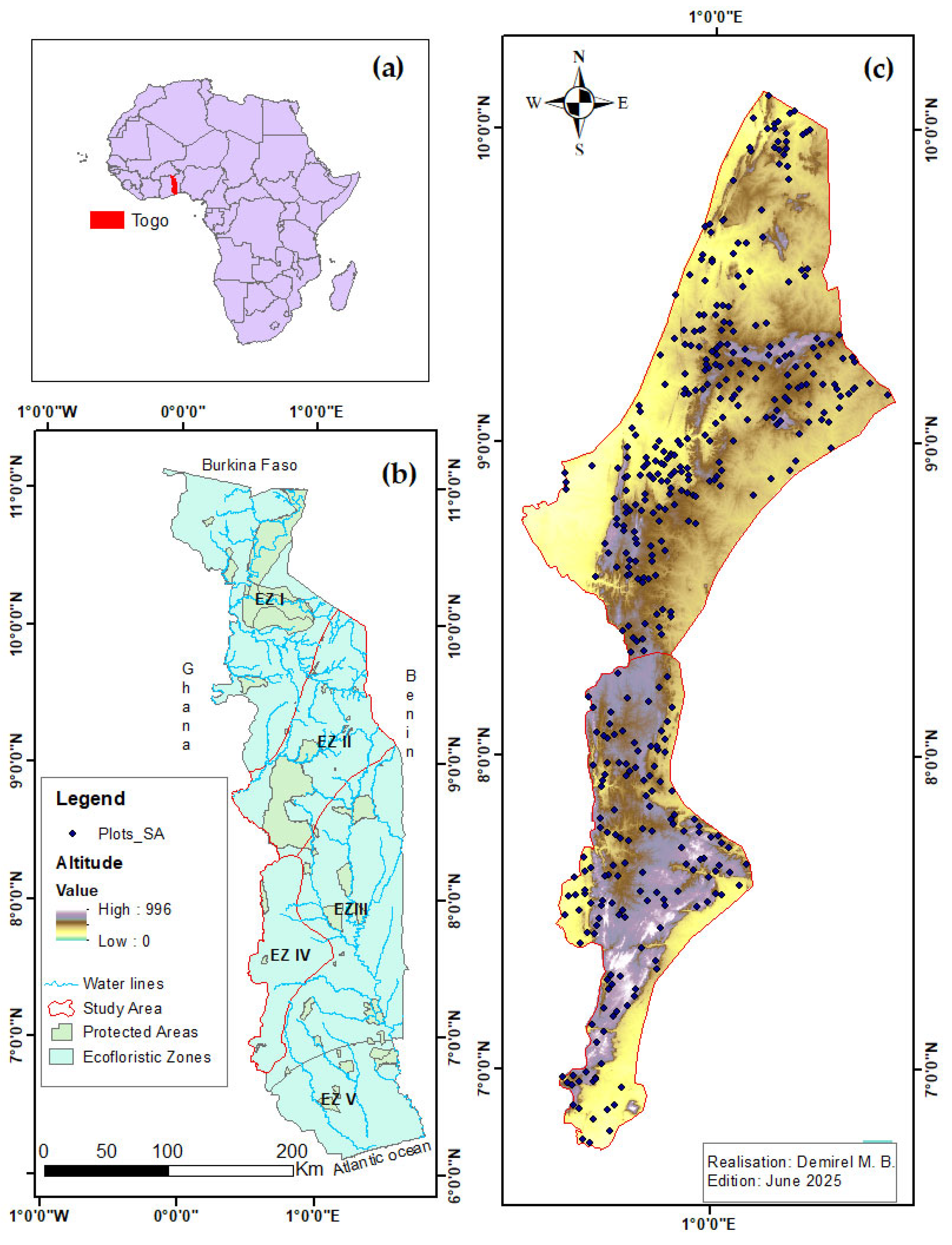
Figure 1. Location of the Atacora Mountain Chain in Togo. (a) Map of Africa, (b) ecofloristic zones of Togo, and (c) distribution of the 421 forest inventory plots: 44 in crops/fallows, 145 in open forests/wooded savannas, 130 in dense forests, and 102 in tree/shrub savannas.
Geomatics 06 00008 g001
Figure 2. Workflow diagram illustrating the approach applied in this study (Allometric equation refer to Chave et al., 2014 [34]).
Geomatics 06 00008 g002
Figure 3. Importance of explanatory variables in different aboveground biomass (AGB) estimation models under various experimental scenarios. (a): S2S2allBIO, (b): S2allBio, (c): S1S2all, (d): S2all, (e): S1S2allD, (f): S1all.
Geomatics 06 00008 g003aGeomatics 06 00008 g003b
Figure 4. Spatial distribution maps of aboveground biomass (AGB) modeled using three distinct approaches. Legend: (a): S1S2allD, integrating SAR data (Sentinel-1), optical data (Sentinel-2), and the Digital Elevation Model (DEM); (b): S2allBio, based on optical data (Sentinel-2) and bioclimatic variables; (c): S1S2allBio, combining SAR, optical, and bioclimatic data.
Geomatics 06 00008 g004
Figure 5. Pearson correlations between aboveground biomass (AGB) and average climatic variables (precipitation, maximum temperature, and minimum temperature). Caption: This figure illustrates the linear relationships between AGB and annually aggregated climatic variables, showing a positive influence of precipitation and a negative effect of temperature on biomass accumulation.
Geomatics 06 00008 g005
Table 1. Remote Sensing Data and Predictive Variables.
Data and Acquisition PeriodPredictive VariableDefinition and Reference
Sentinel-1 (1 January 2021–31 December 2021)Polarization VHVertical transmit, horizontal receive
Polarization VVVertical transmit, vertical receive
Product (VH + VV)Sum of VH and VV backscatter values [12]
Quotient (VH − VV)Difference between VH and VV backscatter values [12]
Sentinel-2 (1 January 2021–31 December 2021)Band 2Blue band (490 nm)
Band 3Green band (560 nm)
Band 4Red band (665 nm)
Band 5Red Edge 1 (705 nm)
Band 6Red Edge 2 (740 nm)
Band 7Red Edge 3 (783 nm)
Band 8NIR (842 nm)
Band 8ANarrow NIR (865 nm)
Band 11SWIR 1 (1610 nm)
Band 12SWIR 2 (2190 nm)
Vegetation Indices and Biophysical Parameters (1 January 2021–31 December 2021)NDVINormalized Difference Vegetation Index
N I R R E D N I R + R E D
[29]
EVIEnhanced Vegetation Index
2.5 × ( N I R R E D ) ( N I R + 6 × E D 7.5 × B L U E + 1 )
[30]
TNDVITransformed NDVI
N I R R E D N I R + R E D + 0.5
[31]
STVI1Soil-Adjusted Transformed VI 1
( S W I R   1 × R E D ) N I R
[32]
STVI2Soil-Adjusted Transformed VI 2
N I R ( R E D × S W I R   2 )
[32]
STVI3Soil-Adjusted Transformed VI 3
N I R ( R E D × S W I R   1 )
[32]
FCIForest Canopy Index I [33]
FCIIForest Canopy Index II [33]
LAILAI Leaf Area Index
FCOVERFCOVERFraction of Vegetation Cover
FAPARFAPARFraction of Absorbed PAR
Terrain factorAltitudeElevation above mean sea level (in meters), derived from the NASA Shuttle Radar Topography Mission (SRTM) Digital Elevation Model
Table 2. Dendrometric characteristics of plots by vegetation type.
Vegetation TypeArea_HaNo_PlotsNo_TreesDBH_MeanHeight_MeanDensityRichness
Crops/Fallows5.534486321.94 ± 0.5110.77 ± 0.20686.75 ± 103.53127
Open forests/Wooded Savannas18.22145564818.71 ± 0.139.52 ± 0.068989.07 ± 746.50158
Dense forests16.34130484722.49 ± 0.2411.93 ± 0.093857.12 ± 338.29262
Tree/Shrub Savannas12.82102298916.09 ± 0.147.92 ± 0.065946.42 ± 588.78124
Legend: Area_ha refers to the total area (in hectares) covered by each vegetation type, No_plots indicates the number of inventory plots sampled within each vegetation type class, No_trees represents the total number of individual trees recorded across all plots in each class, DBH_mean = Mean Diameter at Breast Height (cm) (±standard error), Height_mean = Mean tree height (m) (±standard error), Density = Number of trees per hectare (±standard error), Richness = Number of tree species.
Table 3. Bioclimatic Variables.
CodeBioclimatic VariableDescriptionUnit
BIO1Annual Mean TemperatureAverage temperature over the year°C
BIO12Annual PrecipitationTotal precipitation over the yearmm
BIO4Temperature SeasonalityStandard deviation × 100% (relative index)
BIO15Precipitation SeasonalityCoefficient of variation of monthly precipitation%
BIO5Max Temperature of Warmest MonthHighest average temperature in the warmest month°C
BIO6Min Temperature of Coldest MonthLowest average temperature in the coldest month°C
BIO13Precipitation of Wettest MonthTotal precipitation in the wettest monthmm
BIO14Precipitation of Driest MonthTotal precipitation in the driest monthmm
BIO18Precipitation of Warmest QuarterTotal precipitation in the warmest three-month periodmm
BIO8Mean Temperature of Wettest QuarterAverage temperature during the wettest quarter°C
Table 4. Descriptive statistics of AGB by vegetation type.
Vegetation TypeMean (Mg/ha)SDNSECVMinMaxRange
Crops/Fallows47.5249447.391.030.14215.24215.1
Open forests/Wooded Savannas59.7141.331453.430.690.62228.28227.66
Dense forests124.294.151308.260.769518.24509.25
Tree/Shrub
Savannas
25.3820.681022.050.821.22122.28121.06
Legend: SD (Standard Deviation), N: number of plots, SE (Standard Error), CV (Coefficient of Variation), Min (Minimum), Max (Maximum).
Table 5. Comparative performance of aboveground biomass prediction models based on different combinations of input data (SAR, optical, bioclimatic, and topographic variables).
Experimented ModelAbbreviationAssociated Data/ObjectivesR2MAERMSEsMAPE
(a): All SAR, optical, and bioclimatic dataS1S2allBioIncludes all available predictors (SAR, optical, bioclimatic)0.9013.4222.5427.64
(b): Optical and bioclimatic data onlyS2allBioSentinel-2 optical data, vegetation indices, biophysical factors, and bioclimatic variables0.8615.2327.0729.57
(c): SAR and optical dataS1S2allSAR and optical data only (no bioclimatic variables)0.5430.4948.8747.22
(d): Optical data onlyS2allOnly Sentinel-2 data and its derived indices0.5231.3150.0248.35
(e): SAR, optical, and DEM dataS1S2allDAll predictors except bioclimatic variables (including DEM)0.6626.7142.0743.44
(f): SAR data onlyS1allOnly Sentinel-1 polarizations, backscatter values, and elevation0.4236.0254.8656.66
Table 6. Monthly Pearson correlations between aboveground biomass (AGB) and climatic variables (precipitation, maximum temperature, and minimum temperature). Caption: This table details the monthly variations in correlation coefficients between AGB and climatic variables, highlighting key periods of positive or negative influence on vegetation productivity.
MonthJanFebMarAprMayJunJulAugSepOctNovDec
Precipitation0.660.730.760.77−0.090.18−0.58−0.720.590.70.760.21
Tmax−0.24−0.24−0.26−0.25−0.23−0.20−0.20−0.19−0.19−0.22−0.24−0.23
Tmin−0.06−0.15−0.24−0.21−0.20−0.18 −0.19−0.17−0.16−0.17−0.09−0.05
Disclaimer/Publisher’s Note: The statements, opinions and data contained in all publications are solely those of the individual author(s) and contributor(s) and not of MDPI and/or the editor(s). MDPI and/or the editor(s) disclaim responsibility for any injury to people or property resulting from any ideas, methods, instructions or products referred to in the content.