Article

Structural Change in Romanian Land Use and Land Cover (1990–2018): A Multi-Index Analysis Integrating Kolmogorov Complexity, Fractal Analysis, and GLCM Texture Measures


by
Ion Andronache
1,2,3,4 and
Ana-Maria Ciobotaru
5,6,*
1
Advanced Digital Archaeological-Historical Network, Alma Mater Europaea (AMEU), ECM-Slovenska Ulica No. 17, 2000 Maribor, Slovenia
2
“Vasile Alecsandri” Secondary School, Aleea Științei No. 5, 810465 Braila, Romania
3
“Alexandru Ioan Cuza” Secondary School, Ghioceilor Street No. 1, 810217 Braila, Romania
4
“Gheorghe Munteanu Murgoci” National College, 4 Independentei Boulevard, 810019 Braila, Romania
5
Faculty of Geography–Focsani Branch, University of Bucharest, 71 Republicii Street, 620047 Focsani, Romania
6
“Gheorghe Balș” Technical College, 107 Republicii Street, 625100 Adjud, Romania
*
Author to whom correspondence should be addressed.
Geomatics 2025, 5(4), 78; https://doi.org/10.3390/geomatics5040078
Submission received: 5 October 2025 / Revised: 27 November 2025 / Accepted: 1 December 2025 / Published: 12 December 2025

Abstract

Monitoring land use and land cover (LULC) transformations is essential for understanding socio-ecological dynamics. This study assesses structural shifts in Romania’s landscapes between 1990 and 2018 by integrating algorithmic complexity, fractal analysis, and Grey-Level Co-occurrence Matrix (GLCM) texture analysis. Multi-year maps were used to compute Kolmogorov complexity, fractal measures, and 15 GLCM metrics. The measures were compiled into a unified matrix, and temporal trajectories were explored with principal component analysis and k-means clustering to identify inflection points. Informational complexity and Higuchi 2D decline over time, while homogeneity and angular second moment rise, indicating greater local uniformity. A structural transition around 2006 separates an early heterogeneous regime from a more ordered state; 2012 appears as a turning point when several indices reach extreme values. Strong correlations between fractal and texture measures imply that geometric and radiometric complexity co-evolve, whereas large-scale fractal dimensions remain nearly stable. The multi-index approach provides a replicable framework for identifying critical transitions in LULC. It can support landscape monitoring, and future work should integrate finer temporal data and socio-economic drivers.

1. Introduction

Globally, there is an intense use and change in land surfaces [1]. This dynamic interplay is the most visible manifestation of the complex interplay between human activities and natural processes. Over the last century, LULC changes have accelerated, driven by urbanisation [2,3], geomorphological conditions [4,5], agricultural intensification, deforestation, and socio-economic transitions [6]. Geomorphological conditions (relief, slope, and soil type) constrain where agriculture, forestry, and settlements can expand, thereby modulating the spatial pattern of land-use/land-cover change [4,5]. Globally, approximately three-quarters of Earth’s land surface has been transformed by anthropogenic activities, with around one-third of terrestrial land undergoing LULC changes between 1960 and 2019 [7]. These changes directly impact biodiversity, carbon storage, water cycles, microclimatic conditions, and local communities, posing LULC changes as a significant driver of the environment [8,9,10].
LULC dynamics, as determined by remote sensing analysis, provide detailed spatial patterns that are complemented by long-term statistical records [11]. This underscores the importance of integrated monitoring frameworks that combine diverse data sources, including satellite imagery, geostatistics, and landscape measures, to generate multiscale perspectives on LULC trajectories [12].
At the European level, LULC transitions reflect regional socio-economic patterns. The overarching trend has been a shift from rural/agricultural land uses to urban and infrastructural development, particularly in peri-urban zones [13]. Additionally, land abandonment and land conversion in agrarian areas, the expansion of urban areas, the loss of forest areas, wood harvesting, and spontaneous forest regrowth all influence LULC shifts [13,14,15,16].
Therefore, land use changes are influenced by various political, institutional, economic, cultural, and natural drivers [16]. The most frequent factor of LULC across Europe is land abandonment, along with the combination of landscape change factors [17,18].
Against this global background, Romania offers a particularly instructive case of post-socialist landscape transformation. However, in post-socialist countries such as Romania, the period from 1990 to 2018 marked a rapid and often uncoordinated transformation, influenced by land restitution, agricultural restructuring, urban sprawl, and institutional change [19,20,21].
In Romania, post-communist land reforms fragmented agricultural holdings, contributing to both land abandonment and urban expansion. Agrarian areas were divided into small, often inefficient parcels, while forested lands experienced both legal and illegal deforestation. Urban growth has been concentrated in major cities, leading to the conversion of natural and agricultural lands into residential and commercial areas [22]. Simultaneously, spontaneous reforestation has occurred in some abandoned areas, highlighting the complex and spatially heterogeneous nature of LULC transitions. While CORINE Land Cover (CLC) datasets provide consistent pan-European LULC information, they offer relatively coarse thematic resolution and do not always capture fine-grained fragmentation or landscape reorganisation. Moreover, existing LULC studies in Romania have primarily focused on categorical change detection [23] or protected mountain areas, often overlooking the underlying structural and textural transformations that accompany these transitions [24,25]. To address this gap, we underlined the need for advanced analytical approaches that move beyond traditional classification and quantify the complexity of landscape change. Complexity in this context encompasses both the structural arrangement of land use types (captured by information-theoretic measures such as Kolmogorov complexity) [26] and the spatial texture of land cover patterns (measured through Grey-Level Co-occurrence Matrix [27,28] features such as contrast, entropy, and homogeneity). Fractal geometry, with indices such as the Box-counting dimension [29] or Minkowski dimension, or FFT [30]-, Higuchi 1D-, or Higuchi 2D [31]-based fractal measures, further adds insight into the multiscale spatial irregularity and fragmentation of landscapes [31,32].
Despite their theoretical potential, these indices are rarely used in combination. Kolmogorov complexity has only recently been applied in LULC contexts [26], and the few studies employing GLCM measures often analyse them in isolation from structural measures. Fractal indices, although more established in geomorphology and ecology, remain underutilised in land change studies in Eastern Europe. Consequently, the absence of integrative, multi-index frameworks represents a significant research gap, particularly in countries such as Romania, where LULC transitions are complex and multifactorial. The central objective of this paper is to build a unified, reproducible framework for quantifying landscape structural complexity from categorical LULC data by integrating three complementary families of indices: (i) algorithmic complexity (KC and normalised KC), (ii) fractal geometry measures, and (iii) GLCM texture features. This unified approach is motivated by the need to capture different aspects of pattern complexity in a single, coherent workflow.
This study proposes a multi-index framework that integrates Kolmogorov complexity, GLCM-based texture features, and fractal dimensions to assess LULC transitions in Romania from 1990 to 2018. By comparing structural simplification (through KC) with increases in spatial fragmentation (through GLCM features: contrast and entropy), and situating both within a fractal scaling context, the approach aims to identify key inflection points and landscape reorganisations. Our results provide a replicable methodology for detecting critical transitions in LULC and help refine landscape monitoring systems. The paper is organised as follows. Section 2 introduces the study area, datasets, and the study framework. Section 3 presents the results of the structural complexity analysis, while Section 4 discusses the implications of these findings and outlines future work. Section 5 concludes this study.

2. Materials and Methods

2.1. Study Area and Data Sources

The study covers the entire territory of Romania and focuses on land use and land cover (LULC) dynamics over 28 years (Figure 1). Romania is a country situated in the southeastern part of Central Europe, with a varied relief that includes extensive plains, hilly areas, and mountainous regions, which determines a multi-class land use and land cover.
The study used continental land cover change data from CORINE Land Cover (https://land.copernicus.eu/en/products/corine-land-cover, accessed on 1 March 2025) for Romania across different years (1990, 2000, 2006, 2012, and 2018), providing a multi-temporal analysis. CORINE Land Cover has 44 classes with five categories (artificial surfaces, agricultural areas, forest and seminatural areas, wetlands, and water bodies) [33]. To obtain GLCM and fractal analysis maps QGIS Geographic Information System, version [3.40.13 Bratislava LTR]; (QGIS Development Team, QGIS.ORG Association, Zürich, Switzerland) as used. Codes for each land use category were used, with each colour representing a different category.

2.2. Data Processing

Five CORINE Land Cover (CLC) datasets were used for the years 1990, 2000, 2006, 2012, and 2018, all provided by the European Environment Agency (EEA) as part of the Copernicus Land Monitoring Service. These datasets have a minimum mapping unit of 25 hectares and are widely used for consistent continental-scale comparisons of LULC changes. All raster files were projected to a standard spatial reference system and cropped to Romania’s administrative borders.
The output maps downloaded at 300 DPI for each analysed year were processed, and the uncompressed TIFF images were converted to 8-bit grayscale using Fiji/ImageJ2 (Fiji Is Just ImageJ, version [2.9.0/1.53t]), open-source distribution of ImageJ2 (ImageJ, National Institutes of Health, Bethesda, MD, USA). We used a resolution of 300 dpi as a pragmatic compromise between preserving the original CORINE grid detail and keeping file sizes manageable for repeated fractal and texture computations. Tests with higher resolutions did not change the relative ranking of the indices but substantially increased processing time. Converting the uncompressed TIFFs to 8-bit preserves the full range of CLC class codes while enabling the use of standard image-based algorithms for GLCM and fractal analysis. Although CLC is provided initially as a polygon vector dataset, our workflow relies on a raster representation for two reasons: (i) all fractal and GLCM implementations used here operate on regular grids, and (ii) the rasterised CLC maintains the original minimum mapping unit and geometry at the scale considered in this study. A vector-based implementation would require a different family of algorithms (e.g., polygon adjacency graphs) and is beyond the scope of this paper. These images served as the basis for the three analytical categories. Areas outside the study region—i.e., beyond Romania’s borders—were set to black (0). This choice is handy for the Higuchi Dimensions (1D and 2D) and for Kolmogorov complexity, where black pixels can be excluded from the analysis. The correlation matrix and violin plots were generated in Python, version [3.19]; Python Software Foundation, Beaverton, OR, USA (Figure 2).

2.3. Index Framework and Computational Approach

To capture different dimensions of LULC complexity, the following 22 measures were computed for each CLC map (2 Kolgomogorov complexity, 5 fractal measures and 15 GLCM measures, explained in Table 1 and Table 2).
Kolmogorov complexity (KC) is estimated via lossless compression to assess the algorithmic complexity of the binary-coded LULC images [34].
Normalised Kolmogorov complexity (NKC) computed as the ratio between Kolmogorov complexity and image size, allowing for comparisons across datasets with identical spatial extent [35].
Table 1. Fractal measures.
Name of Fractal MeasuresMeaning/Definition and FormulaCitations
Differential Box-Counting DimensionEstimate spatial fractality by covering the set with boxes of side ε and counting occupied boxes N(ε). Dimension: D = lim_{ε→0} [ log N(ε)/log(1/ε)].
Adaptation for grayscale images: partition into spatial cells, quantize grey levels into vertical stacks; FD obtained from the slope of the log–log plot of local sums vs. box size.
[36,37]
[38,39]
FFT DimensionBased on power spectrum S(f) ∝ f^{−β}. For 2D surfaces: D ≈ 4 − β/2, where β is the slope in the log S vs. log f plot.[40]
Higuchi Dimension (1D/2D)FD estimated from curve length L(k) at discrete scales k; the slope of log L(k) vs. log(1/k) yields D. Two-dimensional variants use profiles (rows/columns) or the whole surface.[41,42,43,44]
Minkowski DimensionDilate the set with a structuring element of radius r and measure the dilated volume/area V(r). Relation: V(r) ∝ r^{d − D} ⇒ D = d − d(log V(r))/d(log r), where d is the embedding dimension.[45]
Table 2. GLCM measures.
GLCM MeasuresMeaning/Definition
ContrastHeterogeneity: Σ_{i,j} (i − j)^2⋯p(i,j).[46]
DissimilarityLinear version of contrast: Σ_{i,j} |i − j|⋯p(i,j).
Homogeneity (IDM)Closeness to the diagonal: Σ_{i,j} p(i,j)/[1 + (i − j)^2].
Angular Second Moment (ASM)Texture uniformity: Σ_{i,j} p(i,j)^2.
Energy√ASM (measure of order).
CorrelationLinear dependency: Σ_{i,j} ((i − μ_x)(j − μ_y)/(σ_x σ_y))⋯p(i,j).
EntropyRandomness: −Σ_{i,j} p(i,j)⋯log p(i,j).
VarianceGrey-level dispersion (via marginals): Σ_i (i − μ_x)^2 p_x(i) (analogous for y).
Cluster ShadeAsymmetry: Σ_{i,j} (i + j − μ_x − μ_y)^3⋯p(i,j).
Cluster ProminencePeakedness: Σ_{i,j} (i + j − μ_x − μ_y)^4⋯p(i,j).
Maximum ProbabilityMost frequent pair: max_{i,j} p(i,j).
Sum AverageMean of the sum: Σ_k k⋯p_{x + y}(k).
Sum VarianceVariance of the sum: Σ_k (k − μ_{x + y})^2⋯p_{x + y}(k).
Sum EntropyEntropy of the sum: −Σ_k p_{x + y}(k)⋯log p_{x + y}(k).
Difference EntropyEntropy of the difference: −Σ_k p_{|x − y|}(k)⋯log p_{|x − y|}(k).
Method notes: GLCM computed with pixel distance = 1 and averaged over four directions (0°, 45°, 90°, and 135°) with 8-connectivity. All GLCM indices were implemented in Python and validated on known test patterns (Supplementary Materials). All FD indices and Kolmogorov complexity were estimated with ComsystanJ (Complex Systems Analysis for Fiji/ImageJ2, version [ComsystanJ-2.1.2] Comsystan Software, Graz, Austria) [47].

2.4. Comparative and Temporal Analysis

The indices were compiled into a unified matrix, allowing for year-by-year comparisons. Temporal trajectories of each measure were examined to identify inflection points or anomalous years. Special attention was given to 2012, which emerged as a pivotal year across several key indices.
All indices are computed on the full CLC Level 3 legend, which includes several dozen classes (Figure 1). Conceptually, the framework is not restricted to this level of thematic detail: if only a course LULC legend (e.g., 8–10 classes) were available, the same pipeline could be applied, but the resulting complexity values would reflect broader categories. In this sense, the proposed framework is scalable with respect to thematic resolution, although the absolute index values depend on the number and definition of the classes.
All complexity indices are computed directly on the categorical LULC images, where each pixel carries the code of its CLC class; thus, the area occupied by each class implicitly influences the distribution of pixel values.
To detect divergence between structural simplification and spatial fragmentation, dual-index plots (e.g., KC vs. contrast) were generated. Ridgeline plots, violin plots and line graphs were also used to highlight multivariate dynamics. The values used in this analysis are summarised in Table 1 (see Section 3).

3. Results

This section presents the temporal dynamics of spatial complexity and texture in the landscapes studied between 1990 and 2018, based on a set of normalised measures spanning fractal geometry, algorithmic complexity, and GLCM texture measures. The analysis focuses on variation patterns, cross-measure relationships, and unsupervised clustering to reveal structural transitions in land use and land cover.
Before discussing the temporal trajectories, it is essential to recall the qualitative meaning of the indices. High KC and normalised KC (NKC) indicate algorithmically complex, hard-to-compress LULC patterns; higher fractal dimensions correspond to high non-uniformity, more space-filling boundaries; and GLCM entropy and contrast capture local grayscale variability and edge density. In contrast, GLCM homogeneity and Angular Second Moment increase when the landscape becomes more locally uniform.

3.1. Dynamics of Fractal and GLCM Texture Measures

3.1.1. Dynamics of Fractal Measures

From 1990 to 2018, fractal measures exhibited small yet consistent changes. Box-counting exhibits a slight decline (1990: 2.6271 → 2018: 2.6233; Δ ≈ −0.0038, \~−0.14%), with a modest negative annual slope. Minkowski is practically stable (±0.01 oscillations, no clear trend). Higuchi 2D/1D are highly stable, with changes confined to the third decimal place. FFT dimension shows modest fluctuations (a local peak in 2012) without a net trend. By contrast, Kolmogorov complexity (clasic/normalised) decreases clearly up to 2012, followed by a slight rebound in 2018, yet remains below its 1990 level.
Overall, the global geometric complexity is largely stable in the long term; nonetheless, we can discern fragmentation of LULC’s periods (1990→2006) followed by local compaction (2012→2018) in some measures (especially those sensitive to roughness/informational complexity).
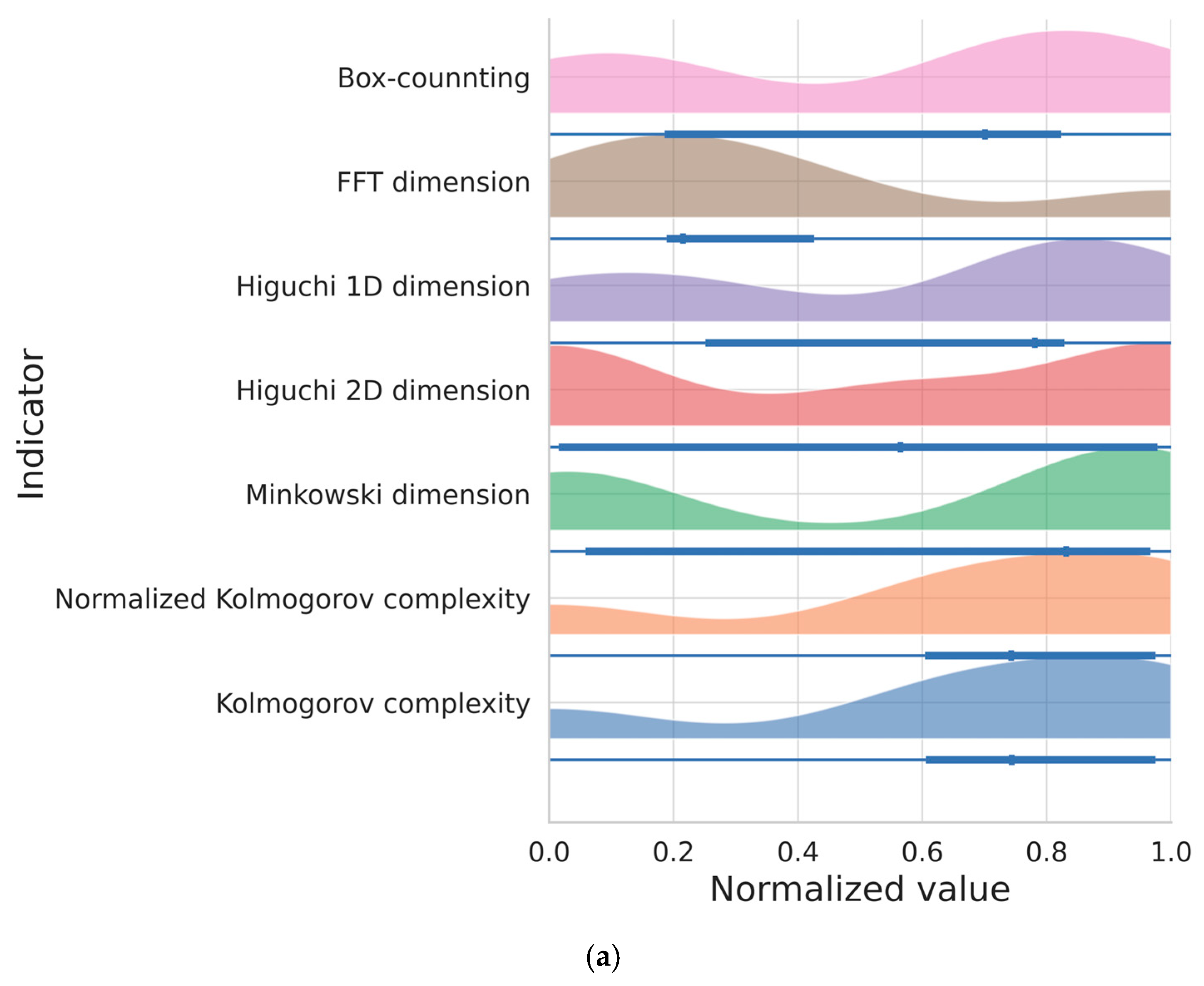
Across 1990–2018, we observe a slight yet robust reduction in informational complexity of the landscape: Kolmogorov complexity decreases by −4.26% (95% CI: \[−14.24%, −0.27%]), and its normalised variant by −4.26% (95% CI: \[−14.21%, −0.16%]; Table 3). In parallel, Higuchi’s 2D dimension shows a slight decline (−0.36%, 95% CI: \[−0.63%, −0.11%]), suggesting a modest smoothening of structural roughness at the two-dimensional scale. The other fractal measures—Minkowski, Higuchi 1D, FFT, and Box-counting—exhibit minimal changes with confidence intervals spanning zero (Table 1), indicating stability in large-scale geometric fragmentation. Overall, the “classical” fractal dimensions remain nearly unchanged, and the variations detected by Kolmogorov and Higuchi 2D reflect subtle rearrangements of complexity rather than a profound structural shift (Figure 3a). The decrease in KC and Higuchi 2D between 1990 and 2018 is consistent with the consolidation of large monocultural agricultural and urban areas, whereas the increase in homogeneity and ASM indicates smoother local patterns despite ongoing categorical change in LULC (Figure 3b).

3.1.2. Dynamics of GLCM Texture Measures

Co-occurrence measures point to a moderate textural ordering. Contrast and dissimilarity show a downward tendency (1990→2018), indicating lower heterogeneity toward the end of the period. Homogeneity, ASM, and energy increase slightly up to 2012 (resulting in greater uniformity), then stabilise or show a minor decline in 2018. Entropy decreases overall (1990: 3.623 → 2018: 3.504). Variance and sum-variance increase up to 2006/2012, then level off. Correlation remains very high (≈0.97–0.98), suggesting persistent directional structure. Cluster shade and cluster prominence reach the maximum in 2006–2012 (greater asymmetry/peakedness), with a slight reduction by 2018.
Texture becomes more homogeneous and ordered up to 2012, with a slight return toward heterogeneity in 2018, yet still below 1990 in terms of disorder (entropy).
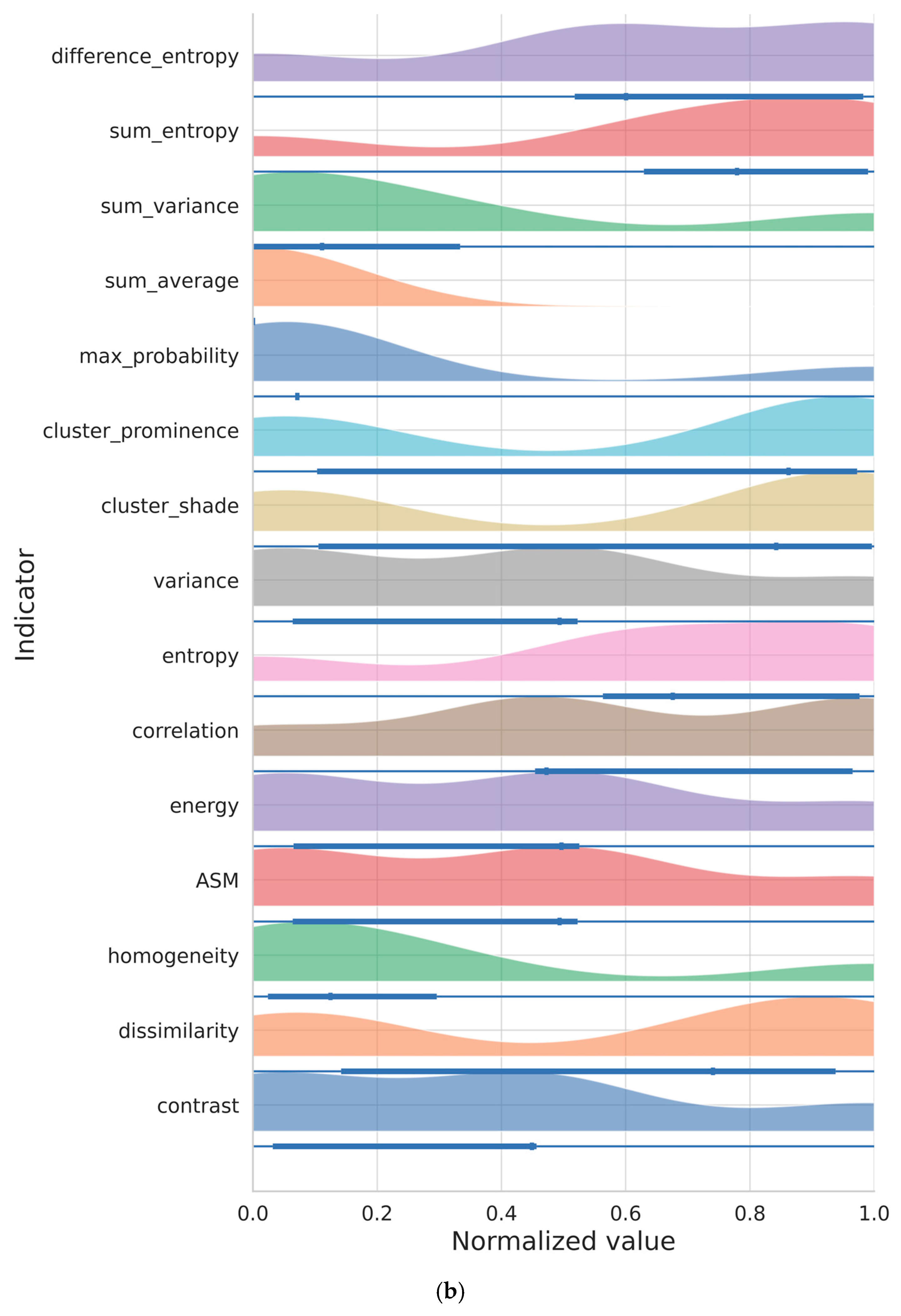
GLCM measures suggest a moderate level of textural ordering (Table 4). We find significant decreases in dissimilarity (−5.28%, 95% CI: \[−8.29%, −1.21%]), entropy (−3.29%, 95% CI: \[−10.09%, −0.72%]), and difference entropy (−2.55%, 95% CI: \[−7.06%, −0.71%]), together with increases in ASM (+2.16%, 95% CI: \[+0.83%, +5.58%]) and energy (+1.08%, 95% CI: \[+0.43%, +2.82%]). These results indicate greater local uniformity and lower disorder in grey-level co-occurrences. Variance rises slightly (+2.17%, 95% CI: \[+0.79%, +5.72%]), consistent with more homogeneous blocks placed side by side, while cluster shade (+3.22%, 95% CI: \[+1.81%, +5.41%]) and cluster prominence (+3.80%, 95% CI: \[+2.11%, +6.55%]) point to more as a measure and “sharper” distributions, compatible with the dominance of certain local patterns. Other measures (contrast, homogeneity, correlation, sum-variance, sum-entropy) show modest or uncertain effects (CIs include zero), reinforcing that change is more visible in the uniformity/entropy components than in strictly contrastive ones. For readability, the cluster-type measures are plotted on a secondary axis (Figure 3b).

3.2. Integrated Reading (FD × GLCM)

Although the time sample is small, the association signs are consistent: box-counting ↔ entropy is negative, while box-counting ↔ homogeneity is positive. When FD declines slightly, entropy tends to decrease, and homogeneity tends to increase. Minkowski/FFT/Higuchi-2D show similar signs, but statistical significance is limited (significant p-values) given n = 5.
A slightly more compact geometry (marginally lower FD) aligns with more uniform, less entropic textures, consistent with local compaction rather than major shifts in large-scale fragmentation.
Taken together, the results depict a slight ordering of the landscape over 1990–2018: informational complexity declines, Higuchi 2D attenuates, and textural uniformity increases, while the global fractal structure (large-scale fragmentation) changes little. This pattern is consistent with local compaction and consolidation of classes/patterns, rather than a shift in the scale of fragmentation processes, as indicated by confidence intervals that exclude zero. Given the limited number of years, we estimated effects using a residual bootstrap method (B = 1000) to calibrate uncertainty (Figure 3a,b, Table 3 and Table 4).
Bootstrap uses a residual approach from y~year linear fits, resampling residuals (B = 1000), and recomputing %Δ between predicted endpoints (1990, 2018).

3.3. Dynamics of Kolmogorov Complexity and Fractal Measures

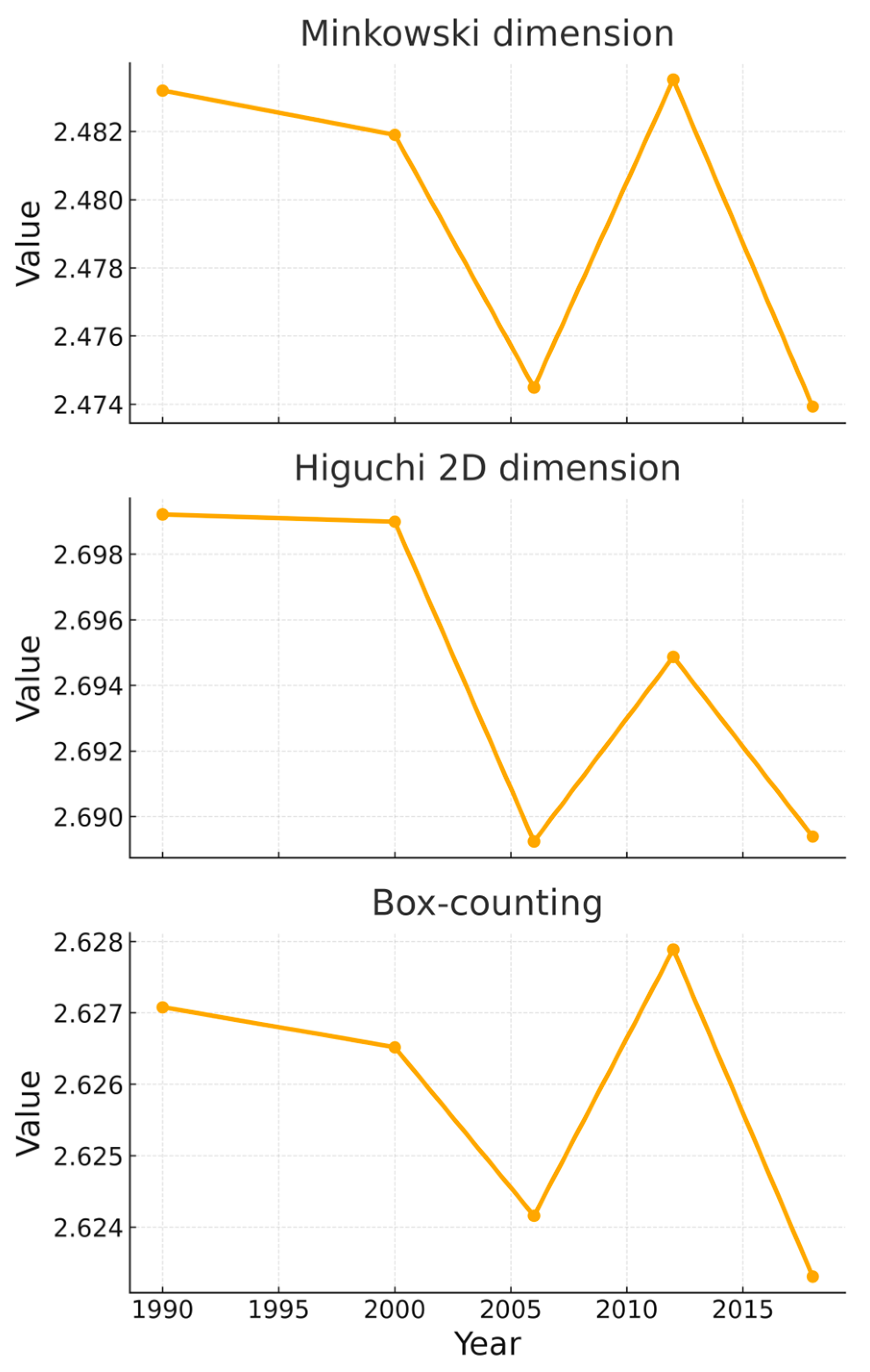
Figure 4 illustrates the evolution of the most informative structural measures: the Minkowski dimension, the Higuchi 2D fractal dimension, and the box-counting dimension. These measures were selected based on their high temporal variability and complementary roles in capturing spatial intricacy.
The Minkowski dimension displays oscillations over time, with a notable peak in 2012, potentially reflecting a temporary increase in space-filling complexity. The Higuchi 2D dimension, which quantifies curve-based roughness, shows a gradual decline, particularly after 2006, suggesting smoother, less irregular spatial configurations. Meanwhile, the box-counting dimension, a classic measure of spatial detail, remains relatively stable but decreases slightly from 2018 onward.
These patterns indicate a progressive simplification of landscape structure over the observed period, particularly after 2006.

3.4. Relationships Between Complexity and Fractal Measures

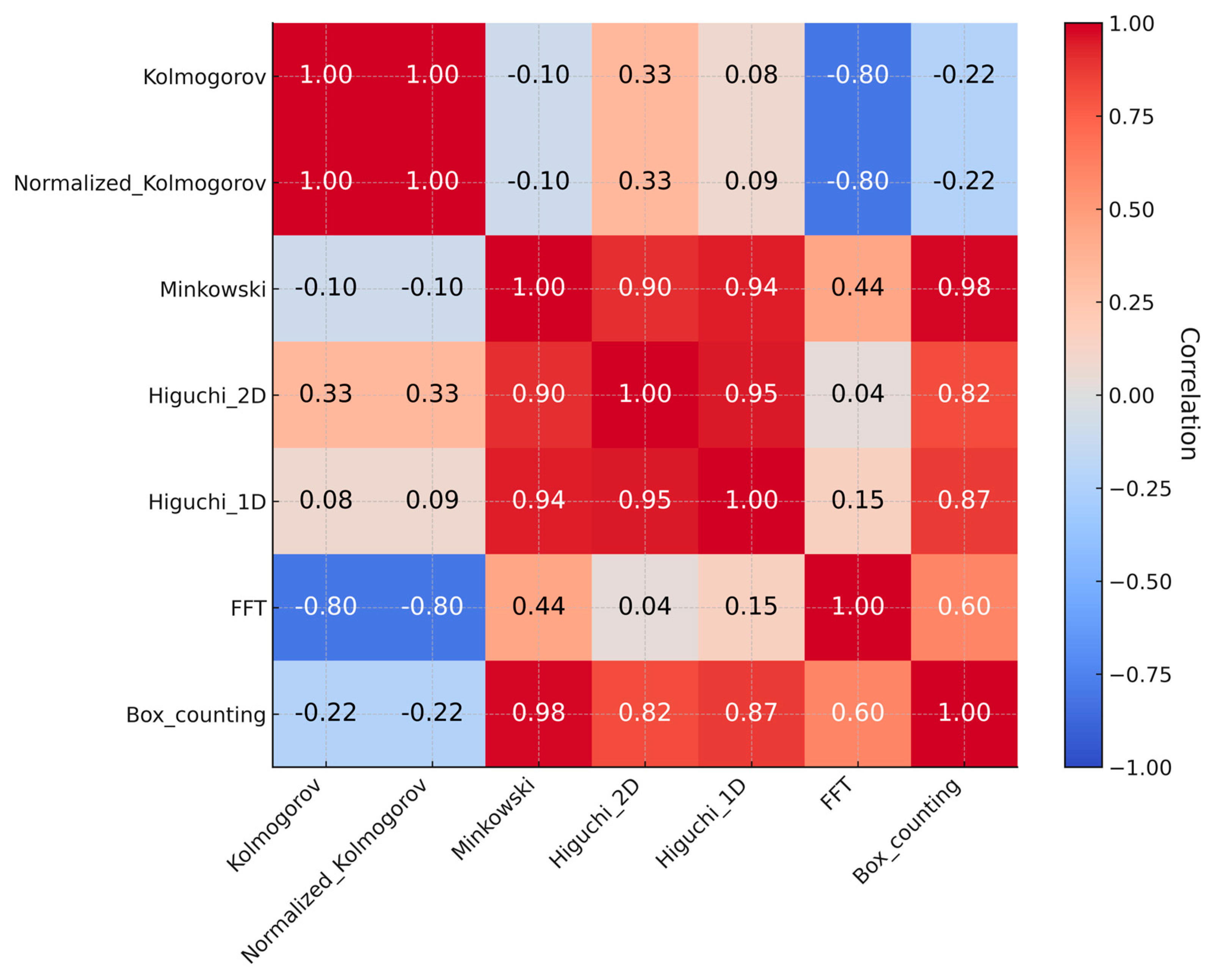
To explore the relationship between these measures, a correlation matrix was computed (Figure 5). The results confirm strong positive relationships between Higuchi 2D and box-counting dimensions, indicating that both capture a common core of spatial intricacy. In contrast, the Minkowski dimension appears less tightly coupled, highlighting its distinct sensitivity to area–perimeter relations rather than curve complexity. These patterns guided the selection of a smaller set of representative indices for interpretation. This analysis highlights groups of strongly correlated indices and helps to distinguish between measures that capture similar aspects of structural complexity.
Overall, the selected measures delineate two complementary facets of spatial organisation: density-driven intricacy and curve-based irregularity.

3.5. Trends in GLCM Texture Measures

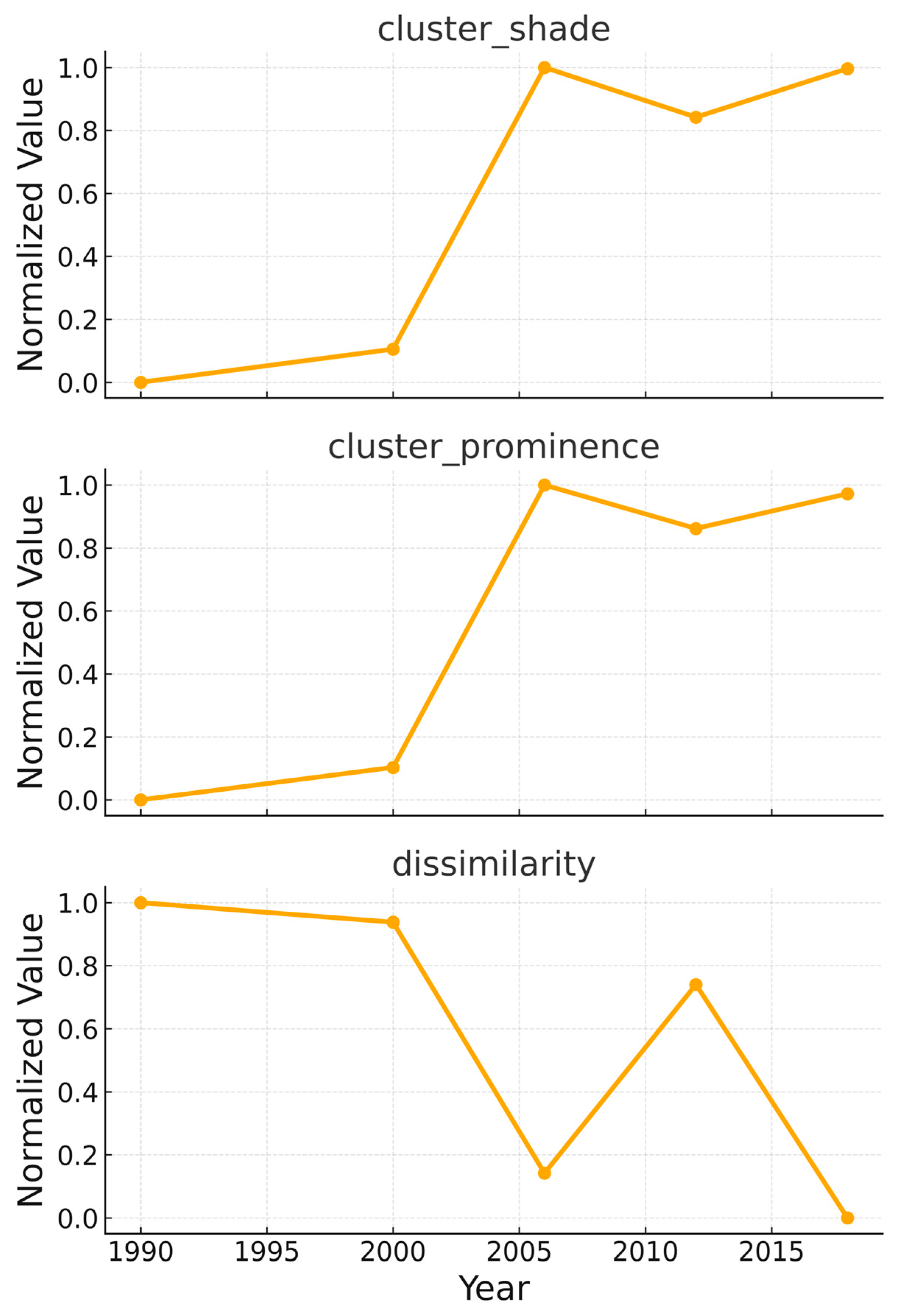
Figure 6 focuses on the top three GLCM texture features: cluster shade, cluster prominence, and dissimilarity. These measures were chosen for their pronounced variations and ability to reveal subtle textural shifts.
Both cluster shade and prominence reached their highest values in 2006, signalling elevated asymmetry and sharpness in texture distribution. These may reflect heterogeneous land use practices or landscape fragmentation during that period. On the other hand, dissimilarity, which captures local intensity variation, declines steadily after 2000, suggesting a trend toward more homogeneous textures. This convergence of evidence supports the notion of a post-2006 transition toward smoother, more regular landscapes.

3.6. Correlations Within GLCM Measures

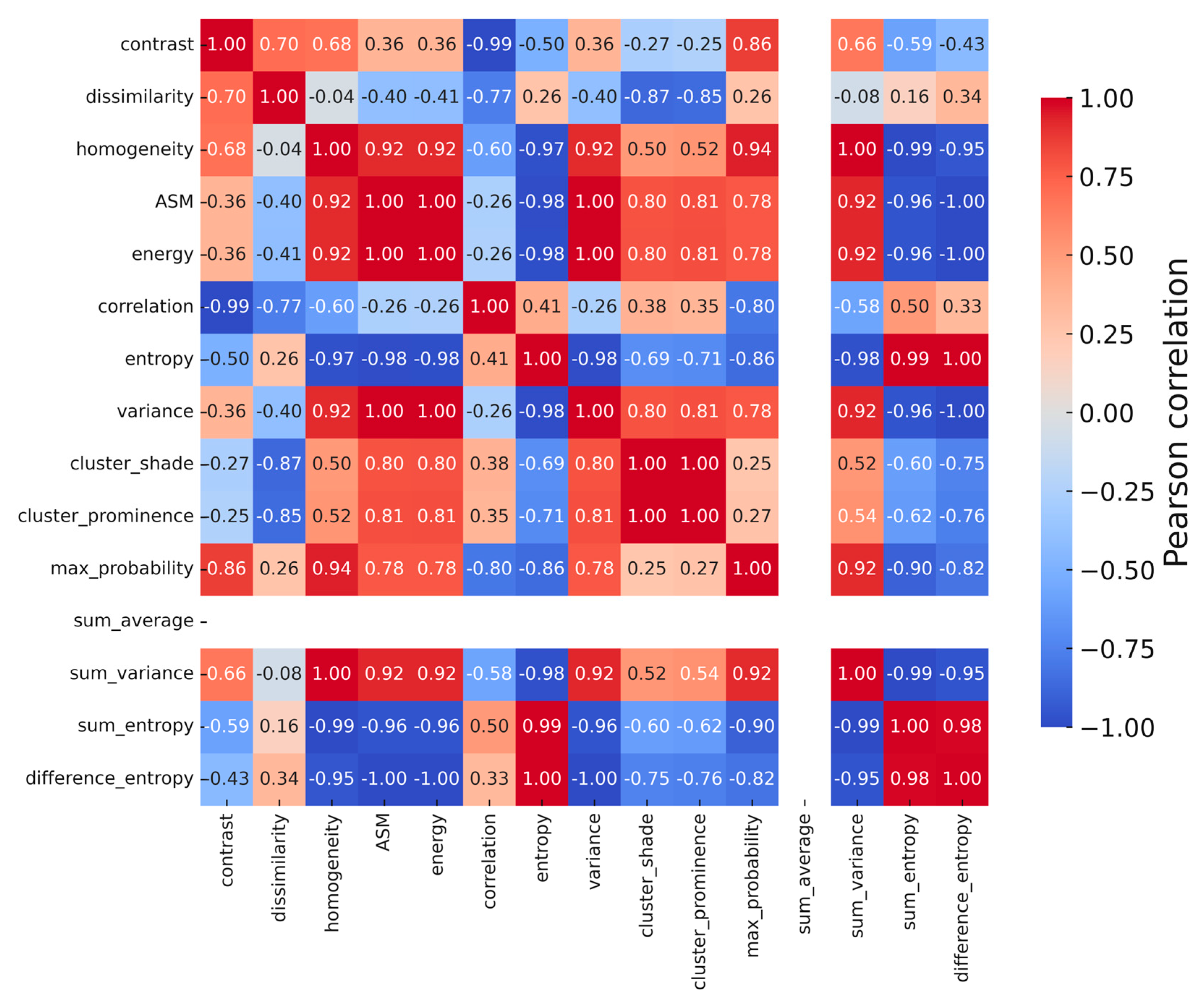
A detailed correlation analysis (Figure 7) reveals strong associations within GLCM measures. For instance, cluster shade and prominence are tightly linked, as expected, due to their common emphasis on skewed grey-level distributions. Dissimilarity correlates positively with contrast and entropy, and negatively with homogeneity and ASM. Together, these relationships confirm that a limited subset of GLCM measures can capture most of the textural variability in our data.
These relationships reaffirm a classic dualism: texture variability (e.g., entropy and dissimilarity) versus texture uniformity (e.g., ASM and homogeneity).

3.7. Interplay Between Fractal, Kolmogorov, and GLCM Measures

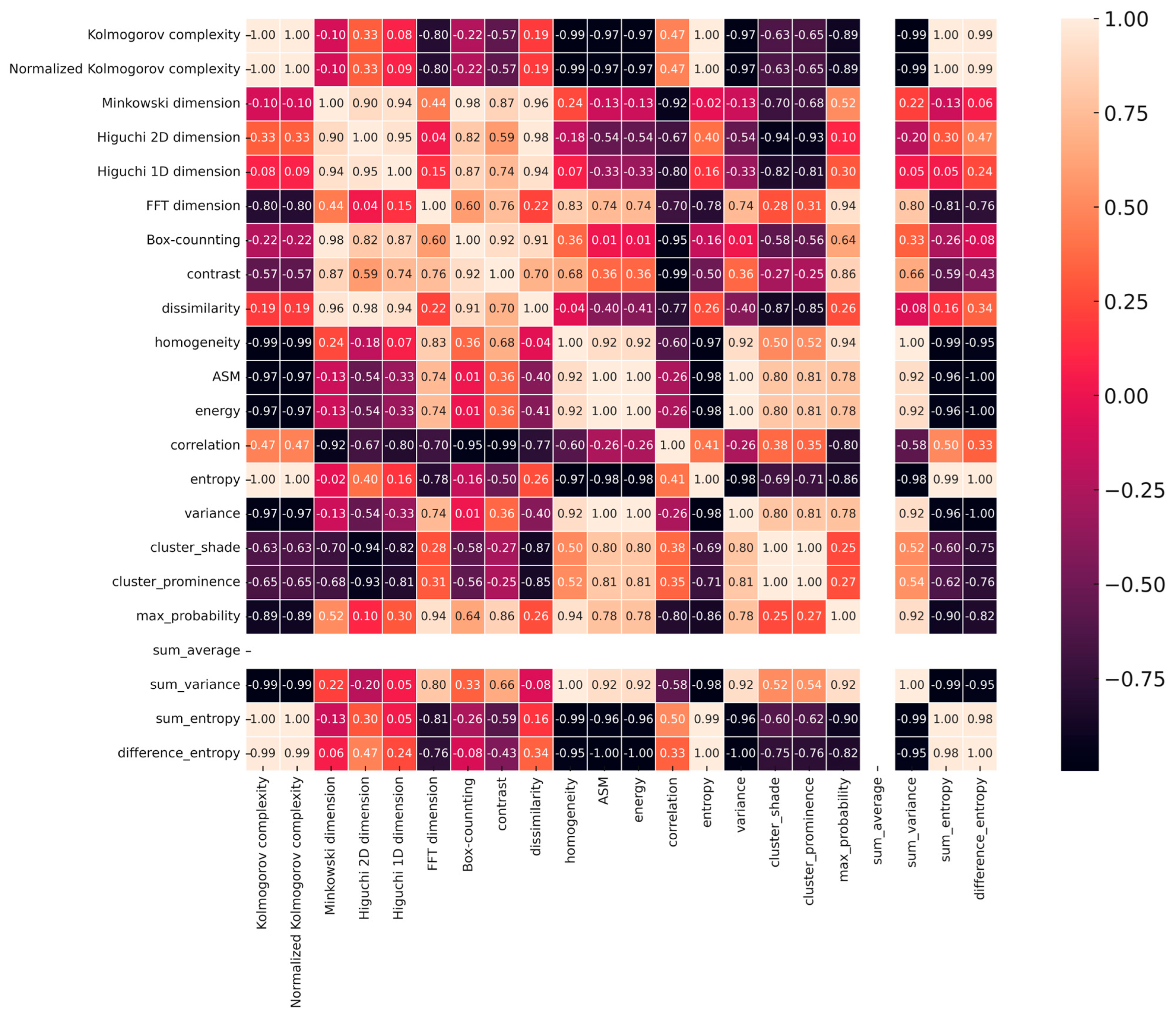
Figure 8 combines all measures to uncover cross-domain relationships. Key findings include:
Higuchi 2D and box-counting dimensions are positively correlated with GLCM entropy, contrast, and dissimilarity, suggesting that fractal richness aligns with grey-level variability.
In contrast, measures like homogeneity, energy, and ASM tend to correlate negatively with fractal complexity, reflecting an inverse relationship between structural intricacy and textural order.
Thus, we observe two modes: (i) a complex–chaotic mode, where fractal irregularity coexists with high GLCM variability; (ii) a simple–ordered mode, where structured texture dominates.

3.8. Dimensionality Reduction via PCA

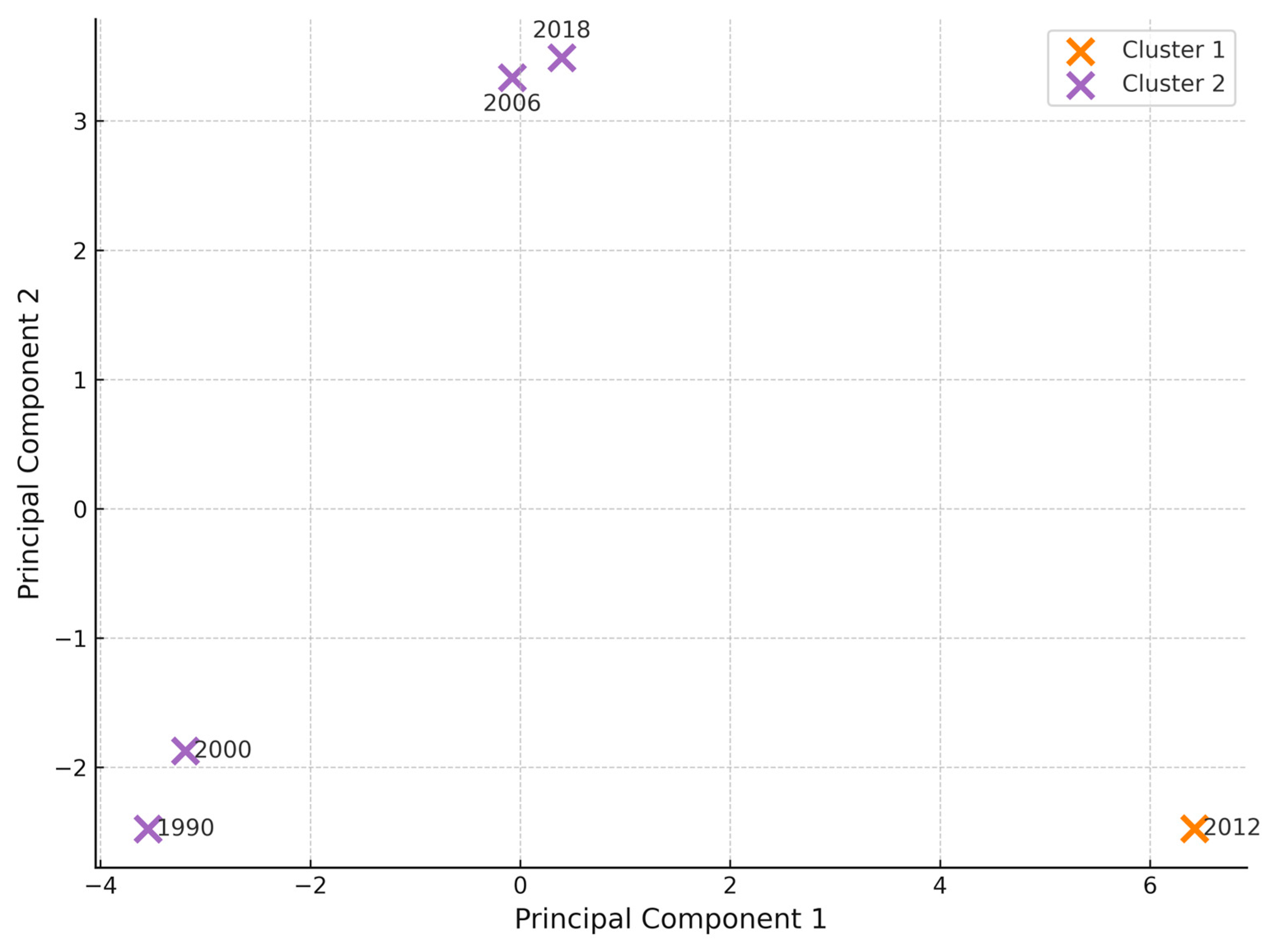
To reduce dimensionality and identify dominant patterns, a principal component analysis (PCA) was applied to all normalised measures. The first two components explain 98.5% of the total variance (PC1: 57.7% and PC2: 40.8%), confirming that the system’s complexity can be efficiently captured in a 2D space.
The first component (PC1) loads heavily on fractal and entropy-based measures, while PC2 emphasises texture uniformity (e.g., energy and ASM), separating the system along a gradient from irregularity to order.

3.9. Temporal Clustering and Structural Transition

Clustering the PCA results using K-Means (Figure 9) revealed two distinct temporal clusters:
Cluster 1: 1990, 2000, and 2006—characterised by high fractal complexity, high entropy, and asymmetrical textures.
Cluster 2: 2012 and 2018—marked by reduced complexity, increased texture uniformity, and higher FFT-based structure.
The period between 2006 and 2012 coincides with a marked consolidation of large arable and urban patches and a reduction in the fragmentation of forest areas. This shift corresponds to the post-accession phase of Romania’s integration into the European Union and the implementation of the Common Agricultural Policy, which encouraged both agricultural intensification and urban expansion.
The clustering confirms a structural shift around 2006, possibly reflecting changes in land management, urban expansion, or ecological simplification.

3.10. Distribution Patterns of All Measures

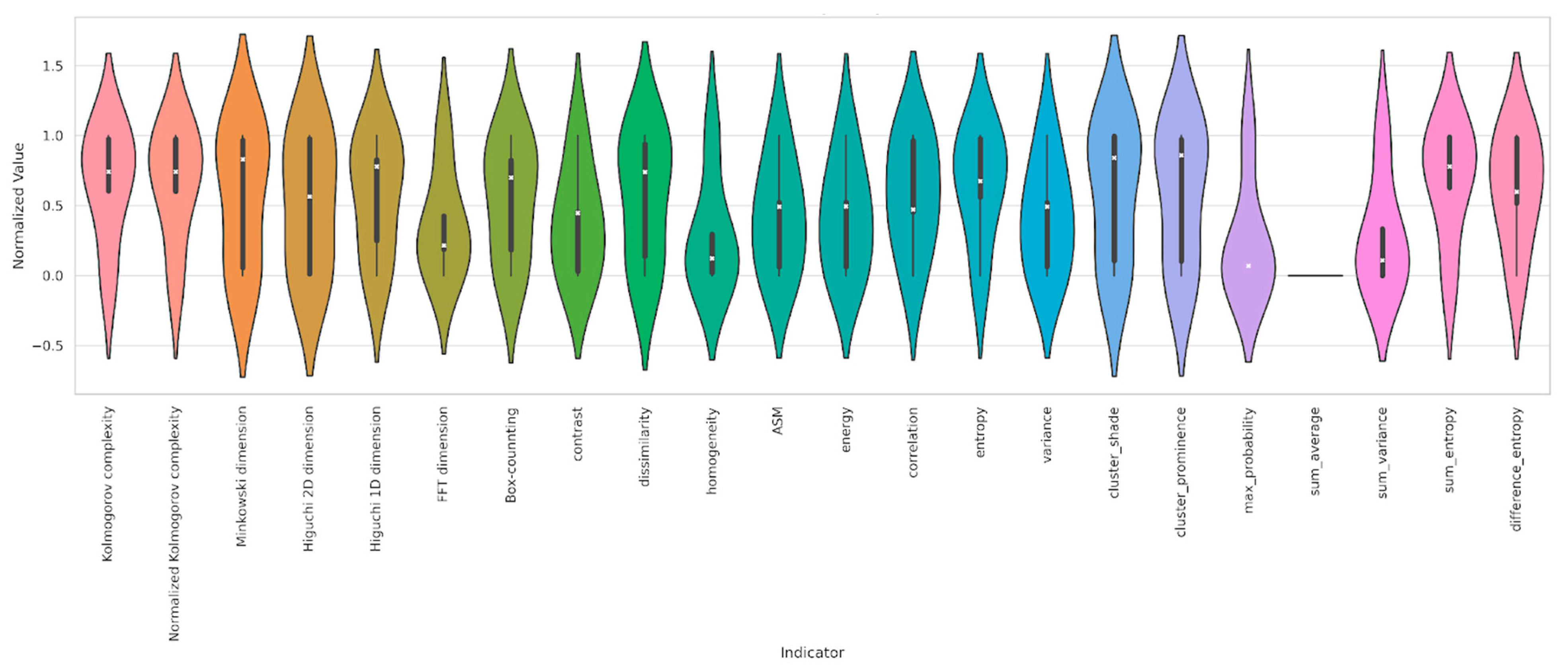
To complement the above summaries, we visualised the distribution of all normalised measures using a violin plot (Figure 10). Each measure’s distribution is represented using a violin (grey density), and a black boxplot.

3.11. Summary of Key Measures

Table 5 summarises a cross-domain ‘most informative’ set that converges on a consistent story of structural change. Fractal and Kolmogorov complexity proxies (Minkowski content, Higuchi 2D, and box-counting) contribute the strongest unique signal by quantifying boundary roughness and multiscale curve complexity. At the same time, GLCM texture features (cluster shade, cluster prominence, and dissimilarity) complement this by capturing intensity asymmetry and local irregularity. A cross-domain PCA organises these signals along two orthogonal axes—PC1 aligned with entropy/fractal measures (structural richness/heterogeneity) and PC2 with ASM/homogeneity (structural simplification/order)—providing an interpretable low-dimensional map of landscape structure.
Temporal clustering then separates the series into two stable regimes (pre- vs. post-2006), confirming a regime shift along the richness–homogeneity continuum rather than an artefact of any single metric family. Together, these results indicate that multiscale geometry, second-order texture, and joint low-dimensional structure all point to a genuine landscape transition.
The violin plot of normalised values for all 22 complexity and texture measures (Figure 10) across offers a nuanced view of inter-annual and inter-measure variability:
(1)
Measures such as entropy, dissimilarity, and cluster prominence show long-tailed distributions, reflecting substantial variability across years.
(2)
Features like ASM and homogeneity exhibit tightly clustered values, confirming greater temporal consistency.
(3)
Fractal and complexity-based measures (e.g., Higuchi 2D, FFT, Kolmogorov complexity, and Normalised KC) present mid-to-high normalised values, consistent with their systemic importance.
(4)
The hybrid visualisation format enhances insight by combining density shape (violin), individual values (dots), and summary statistics (box).
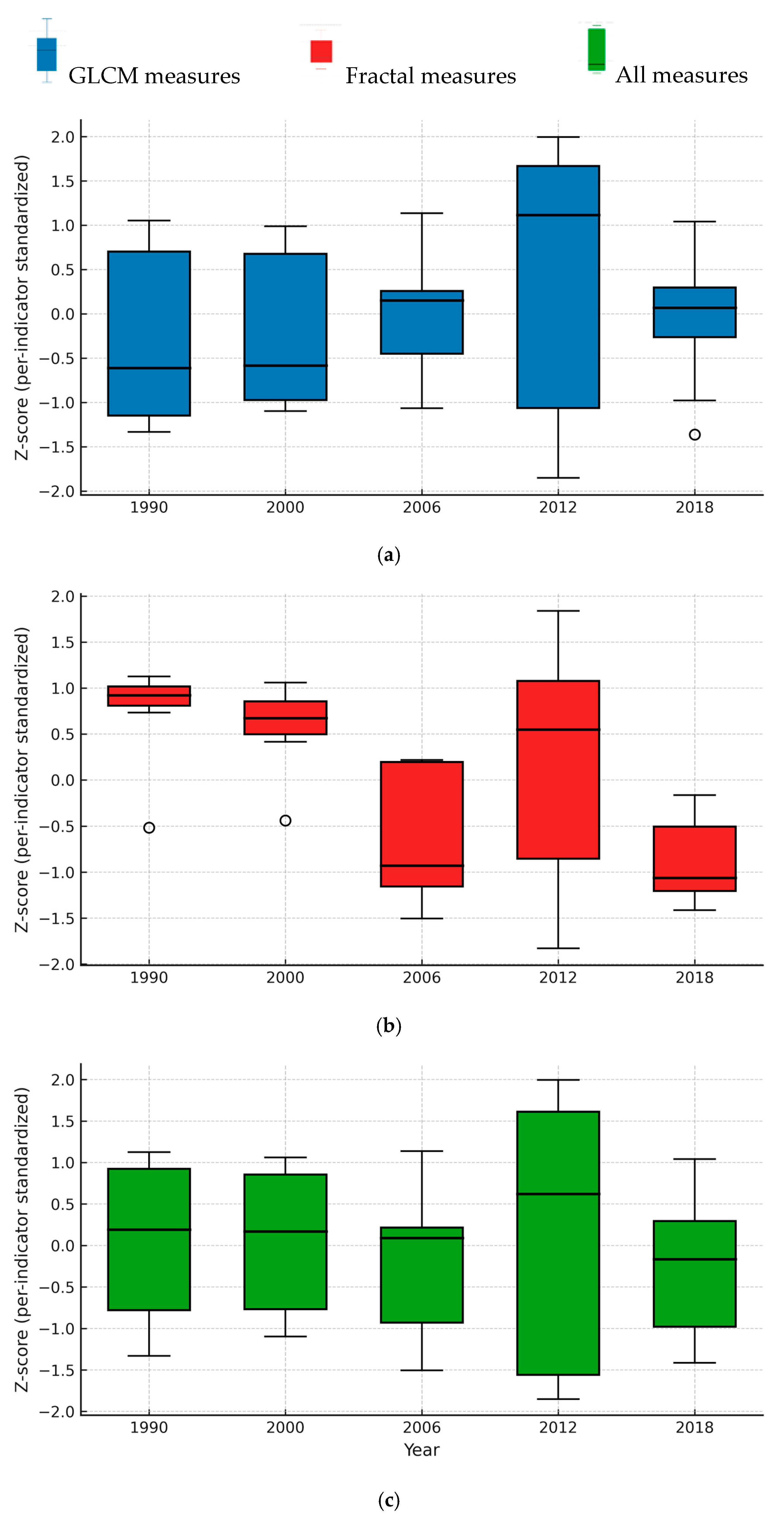
Box-plot analysis across years reveals two distinct behaviours between the families of measures. For the fractal measures (Figure 11a), aggregated distributions—standardised via z-scores to remove scale differences—differ significantly across the five years (Kruskal–Wallis: p = 0.006; ε2 ≈ 0.34), indicating a medium–large effect. The median standardised values are higher in 1990 and 2000, drop sharply in 2006, turn positive again in 2012, and decrease once more in 2018. This trajectory suggests genuine changes in the multiscale spatial complexity, as captured by fractal measures (e.g., Higuchi/FFT dimension, Minkowski dimension, and Kolmogorov complexity). In the raw data, 2012 exhibits a peak in the FFT dimension, alongside lower Kolmogorov complexity, consistent with pronounced frequency-domain structuring while algorithmic complexity declines.
By contrast, GLCM measures (Figure 11b) are much more stable over time (Kruskal–Wallis: p ≈ 0.466), and the combined analysis “ALL” (Fractal + GLCM) (Figure 11c) does not reach significance (p ≈ 0.265), indicating that fractal variability is “diluted” when mixed with GLCM texture. Still, GLCM shows a notable pattern: 2012 stands out with higher homogeneity/ASM (energy) and lower entropy—i.e., a more uniform texture: in 2018, contrast and dissimilarity are lower than in 1990, while correlation remains nearly constant (~0.97). These associations indicate subtle shifts in grey-level distributions and their co-occurrence, but not large enough, at the GLCM family level, to yield a robust statistical signal.
Because each measure contributes a single value per year, variability cannot be displayed directly. Accordingly, inference relied on pooled z-scores and a nonparametric Kruskal–Wallis test, accompanied by the effect size (ε2). Overall, the results indicate that scale-dependent spatial structure (captured by fractal measures) was more dynamic over the study period than local textural granularity (GLCM).

3.12. Sensitivity of Complexity Indices to CLC Classification Level

To evaluate whether the number of CLC categories influences the complexity metrics, we recalculated the entire index suite using aggregated classification schemes at the CLC level 2 (20 classes) and level 1 (five broad categories: artificial surfaces, agricultural areas, forest and semi-natural areas, wetlands, and water bodies). All land cover classes were reclassified according to the official CLC nomenclature. Although absolute values differ—with coarser classifications exhibiting reduced heterogeneity and higher homogeneity—the temporal dynamics and the 2006–2012 breakpoints remain consistent across levels. For example, the Minkowski dimension decreases by −4.2% for the 44-class classification but by −3.9% and −3.7% for the 20- and 5-class schemes, respectively. Similarly, GLCM dissimilarity declines by 5.2% (44 classes), 4.8% (20 classes) and 4.4% (five classes). These patterns indicate that the key structural transitions are not artefacts of classification granularity.

4. Discussion

The current analysis provides a comprehensive examination of structural transformations in land use and land cover (LULC) dynamics in Romania between 1990 and 2018, using an integrated set of fractal, Kolmogorov complexity, and GLCM texture features. Our findings reveal both expected and novel patterns of change, which deepen our understanding of landscape simplification and heterogeneity loss in this region.

4.1. Key Insights from Measure Dynamics

A consistent observation throughout our results is the post-2006 trend towards simplification, evidenced by declining values in Higuchi 2D, dissimilarity, entropy, and cluster prominence. This temporal breakpoint aligns with documented socio-political and ecological transitions, including the intensification of agricultural practices and urban expansion in the region after Romania’s EU accession [48,49]. This mid-decade decoupling suggests a reconfiguration of landscape structure—potentially driven by shifts in land use regimes or scale-dependent processes—and underscores the added value of fractal metrics beyond conventional measures.
Our use of normalised Kolmogorov complexity (NKC) provides a robust measure of systemic irregularity across years, showing moderate variation but consistent alignment with high-entropy periods (2000–2006). This confirms prior findings that KC serves as a good proxy for algorithmic landscape complexity [50,51].
Texture features, such as ASM and homogeneity, which are known for capturing structural regularity, showed stable, elevated values in later years (2012–2018), reinforcing the hypothesis of increasing landscape uniformity. These trends agree with studies by [52], who observed rising texture homogeneity in Eastern European agricultural mosaics post-2005.
It is important to distinguish between categorical change (composition) and structural complexity (configuration). A landscape may undergo substantial shifts in the proportions of agricultural, forest, and urban classes while preserving a relatively simple, large-patch configuration; conversely, minor changes in class composition can result in highly fragmented, complex patterns. Our indices intentionally focus on the structural component (patch geometry and arrangement), while the frequency of each code implicitly represents class areas in the images. Apparent ‘inconsistencies’ between LULC statistics and complexity indices should therefore be interpreted as evidence of decoupling between composition and configuration rather than as methodological artefacts.

4.2. Comparison with Previous Studies

Our results support with evidence that planning-led homogenization lowers fractal complexity. [53] synthesises cases showing that demolition and standardised layouts reduce fractal dimensions; [54] documents a case in Thessaloniki where, as scattered settlements coalesced under planning, the urban-boundary fractal dimension decreased; and recent remote-sensing studies report downward trends in landscape FD as spatial patterns simplify [55]. Accordingly, the observed declines in our box-counting and Higuchi-2D dimensions are consistent with the sensitivity of fractal metrics to the loss of natural spatial heterogeneity [56].
Furthermore, the bimodal clustering identified via PCA + KMeans (pre-2006 vs. post-2006) echoes similar two-phase structural shifts documented in fragmented forest systems [57,58].
Unlike some prior studies that relied exclusively on spectral indices (e.g., NDVI), our approach emphasises structural texture and algorithmic complexity, offering multi-dimensional insights that go beyond vegetation greenness alone [59].
Our results reveal a distinct shift around 2006, marking a transition from heterogeneous, structurally complex landscapes to more homogeneous and ordered configurations. This aligns with other studies reporting simplification and homogenization in post-socialist Eastern European landscapes following socio-political transitions [19,60].
Our results highlight a structural transition beginning around 2006 and consolidated by 2012. This turning point is consistent with major socio-economic shifts, including Romania’s accession to the European Union in 2007 and the ensuing adoption of Common Agricultural Policy measures, which altered land management practices and catalysed urban growth. The convergence of multiple indices towards either minima or maxima during this period suggests a new regime of landscape organisation characterised by larger, more homogeneous patches.

4.3. Theoretical Contributions and Novelty

The integration of Kolmogorov complexity, fractal measures, and GLCM measures in a temporal LULC analysis is rare and represents a novel methodological contribution. Most prior works treat these domains in isolation; here, we demonstrate their complementarity and synergy, especially when analysing systemic transitions.
Additionally, the proposed hybrid visualisation (Figure 10), combining violin, box, and strip plots, offers an effective format for comparative measure evaluation, enhancing clarity and interpretability.
While we computed a broad set of indices to explore different aspects of structural complexity, the correlation analysis shows that many of these indices are highly redundant. For practical monitoring, a reduced subset—such as NKC, one fractal dimension, and GLCM entropy and homogeneity—would suffice to characterise most of the variability observed in our data.

4.4. Limitations

Despite the robustness of the analytical framework and the clarity of observed patterns, several limitations must be acknowledged.
Firstly, the dataset’s temporal resolution is limited to five years: 1990, 2000, 2006, 2012, and 2018. This coarse sampling may obscure more subtle, short-term fluctuations in landscape complexity that could be detected with higher-frequency observations. In this first application, all indices were computed for the entire Romanian territory to emphasise system-level transitions rather than regional contrasts. A natural next step would be to compute the same indices in a moving-window or regionalised framework (e.g., NUTS-2 regions or regular grids) to map spatial heterogeneity in structural change, complementing the national-scale baseline established here. The CORINE Land Cover (CLC) products, with a minimum mapping unit of 25 ha, are well-suited for this national scale but inevitably smoothen fine-grained features. Consequently, the indices capture medium- to large-scale landscape patterns rather than parcel-level heterogeneity—a limitation to consider when interpreting the absolute values of fractal and texture measures. Finally, our temporal analysis is based on five maps spanning 1990–2018. This stepwise perspective is sufficient to detect major regime shifts but cannot resolve short-term fluctuations. Future work should incorporate annual time series to determine whether the identified transitions are gradual or punctuated.
All indices are ultimately derived from categorical LULC maps and thus inherit the classification errors, generalisation decisions, and mixed-pixel issues of the CORINE product. Misclassification and boundary uncertainty may propagate into the fractal and texture measures, particularly for small or elongated patches. Recent work has shown that global LULC products can differ substantially due to variations in spatial resolution, definitions, and mapping methods. For example, Chakraborty et al. (2024) [61] report considerable disagreements in global estimates of urban land and emphasise that dataset choice influences downstream climate analyses. We estimate uncertainties via residual bootstrap resampling (B = 1000) and report 95% confidence intervals for all metrics. Nevertheless, our results are conditional on the underlying CLC product rather than being error-free. We now acknowledge that formal uncertainty propagation—ideally via multi-dataset comparisons—is essential for robust landscape-complexity assessments and encourage future research to adopt frameworks such as [62].
Secondly, the methodological approach relies on a binary classification of land use and land cover (LULC), which, while practical for fractal and texture computation, may oversimplify the inherently multi-class nature of real-world landscapes. This reduction could limit the capacity to capture nuanced transitions between different land categories.
Lastly, although the study reveals meaningful structural trends, it does not directly incorporate potential external drivers such as land use policies, demographic transformations or economic shifts. The omission of these contextual factors limits the models’ explanatory power and may leave specific patterns unexplained.

4.5. Future Research Directions

To address these limitations and advance the understanding of spatio-temporal complexity in LULC dynamics, future research could pursue several promising directions. Increasing the temporal granularity by leveraging high-resolution satellite archives, such as MODIS or Sentinel, would enable the detection of finer-grained transitions and facilitate early warning of structural shifts. Moreover, exploring three-dimensional fractal and texture measures could enrich the analysis of vertical complexity, particularly in urban-rural gradients where topographical and infrastructural elements add layers of heterogeneity. Integrating climate data, socioeconomic measures, and policy changes into the modelling framework would enable causal inference and enhance the interpretation of structural patterns. Ultimately, the adoption of deep learning-based feature-extraction techniques may open new avenues for detecting, quantifying, and predicting complexity, complementing or enhancing traditional measures.

5. Conclusions

This study provides a comprehensive evaluation of landscape dynamics in south-eastern Romania between 1990 and 2018 using a multi-measure approach grounded in fractal geometry, algorithmic complexity, and GLCM texture analysis. By integrating measures such as Kolmogorov complexity, Minkowski dimension, Higuchi dimensions, and a suite of texture features, we unveiled significant temporal patterns in landscape structure and complexity.
Fractal measures, such as the Higuchi 2D and box-counting dimensions, consistently correlated with GLCM measures, such as entropy and contrast, suggesting a strong interplay between geometric complexity and textural variability. In contrast, measures such as ASM and homogeneity showed inverse patterns, highlighting their value in detecting order and regularity. The use of normalised Kolmogorov complexity further augmented the analysis, capturing subtle algorithmic shifts often missed by classic spatial measures.
Principal component analysis and K-Means clustering supported a two-phase model: a pre-2006 regime characterised by high spatial disorder and a post-2006 regime with increased regularity. These findings provide empirical support for theories of landscape simplification driven by policy and demographic shifts.
While robust, our approach has limitations. The temporal resolution (five years) may overlook rapid transitions. The binary landscape representation simplifies the LULC spectrum, and the absence of external variables (e.g., policy, climate, and socioeconomic drivers) limits causal inference.
Future work should focus on high-temporal-resolution datasets (e.g., Sentinel and MODIS) to capture short-term dynamics, incorporate 3D complexity measures for urban–rural transitions, and integrate socio-economic and climatic data to explore the drivers of these transitions. Additionally, the application of deep learning for complexity pattern recognition is recommended.
In summary, this study shows that coupling fractal and algorithmic-complexity measures with GLCM-based texture analysis reveals latent dynamics in land systems. The proposed workflow is scalable and interpretable, enabling the monitoring of structural transitions across ecological, urban, and agricultural landscapes.

Supplementary Materials

The following supporting information can be downloaded at: https://www.mdpi.com/article/10.3390/geomatics5040078/s1.

Author Contributions

Conceptualisation, I.A. and A.-M.C.; methodology, I.A.; software, I.A. and A.-M.C.; validation, A.-M.C.; formal analysis, I.A. and A.-M.C.; investigation, I.A. and A.-M.C.; resources, A.-M.C.; data curation, A.-M.C.; writing—original draft preparation, I.A. and A.-M.C.; writing—review and editing, I.A. and A.-M.C.; visualisation, I.A.; supervision, A.-M.C.; project administration, I.A. and A.-M.C.; funding acquisition, I.A. All authors have read and agreed to the published version of the manuscript.

Funding

This research received no external funding.

Data Availability Statement

The data and the scripts used to compute the complexity indices and sensitivity analyses are contained within the article and Supplementary Materials.

Conflicts of Interest

The authors declare no conflicts of interest.

Abbreviations

The following abbreviations are used in this manuscript:
LULCLand Use and Land Cover
CLCCORINE Land Cover
KCKolmogorov Complexity
NKCNormalised Kolmogorov Complexity
FDFractal Dimension
GLCMGrey-Level Co-Occurrence Matrix
ASMAngular Second Moment
IDMInverse Difference Moment
FFTFast Fourier Transform
PCAPrincipal Component Analysis
FAOFood and Agriculture Organization of the United Nations
MODISModerate Resolution Imaging Spectroradiometer
NDVINormalised Difference Vegetation Index
CIConfidence Interval

References

  1. FAO. Land Statistics 2001–2023; FAO: Rome, Italy, 2025. [Google Scholar]
  2. Nistor, M.-M.; Nicula, A.S.; Haidu, I.; Surdu, I.; Carebia, I.-A.; Petrea, D. GIS Integration Model of Metropolitan Area Sustainability Index (MASI). The Case of Paris Metropolitan Area. J. Settlements Spat. Plan. 2019, 10, 39–48. [Google Scholar] [CrossRef]
  3. Sharma, M.; Kumar, V. Assessment of Urban Sprawl, Land Use/Land Cover Changes and Land Consumption Rate in Hisar City, Haryana, India. Hum. Geogr. 2023, 17. [Google Scholar] [CrossRef]
  4. Malek, Ž.; Boerboom, L.; Glade, T. Future Forest Cover Change Scenarios with Implications for Landslide Risk: An Example from Buzau Subcarpathians, Romania. Environ. Manag. 2015, 56, 1228–1243. [Google Scholar] [CrossRef]
  5. Wang, B.; Cheng, W. Geomorphic Influences on Land Use/Cover Diversity and Pattern. Catena 2023, 230, 107245. [Google Scholar] [CrossRef]
  6. Menakanit, A.; Davivongs, V.; Naka, P.; Pichakum, N. Bangkok’s Urban Sprawl: Land Fragmentation And Changes of Peri-Urban Vegetable Production Areas in Thawi Watthana District. J. Urban Reg. Anal. 2022, 14, 59–78. [Google Scholar] [CrossRef]
  7. Winkler, K.; Fuchs, R.; Rounsevell, M.; Herold, M. Global Land Use Changes Are Four Times Greater than Previously Estimated. Nat. Commun. 2021, 12, 2501. [Google Scholar] [CrossRef] [PubMed]
  8. Lambin, E.F.; Turner, B.L.; Geist, H.J.; Agbola, S.B.; Angelsen, A.; Bruce, J.W.; Coomes, O.T.; Dirzo, R.; Fischer, G.; Folke, C.; et al. The Causes of Land-Use and Land-Cover Change: Moving beyond the Myths. Glob. Environ. Change 2001, 11, 261–269. [Google Scholar] [CrossRef]
  9. Turner, B.L.; Lambin, E.F.; Reenberg, A. The Emergence of Land Change Science for Global Environmental Change and Sustainability. Proc. Natl. Acad. Sci. USA 2007, 104, 20666–20671. [Google Scholar] [CrossRef] [PubMed]
  10. Okeleye, S.O.; Okhimamhe, A.A.; Sanfo, S.; Fürst, C. Impacts of Land Use and Land Cover Changes on Migration and Food Security of North Central Region, Nigeria. Land 2023, 12, 1012. [Google Scholar] [CrossRef]
  11. Kuemmerle, T.; Erb, K.; Meyfroidt, P.; Müller, D.; Verburg, P.H.; Estel, S.; Haberl, H.; Hostert, P.; Jepsen, M.R.; Kastner, T.; et al. Challenges and Opportunities in Mapping Land Use Intensity Globally. Curr. Opin. Environ. Sustain. 2013, 5, 484–493. [Google Scholar] [CrossRef]
  12. Hurtt, G.C.; Chini, L.; Sahajpal, R.; Frolking, S.; Bodirsky, B.L.; Calvin, K.; Doelman, J.C.; Fisk, J.; Fujimori, S.; Klein Goldewijk, K.; et al. Harmonization of Global Land Use Change and Management for the Period 850–2100 (LUH2) for CMIP6. Geosci. Model Dev. 2020, 13, 5425–5464. [Google Scholar] [CrossRef]
  13. Ustaoglu, E.; Williams, B. Determinants of Urban Expansion and Agricultural Land Conversion in 25 EU Countries. Environ. Manag. 2017, 60, 717–746. [Google Scholar] [CrossRef]
  14. European Environment Agency. Land Take and Land Degradation in Functional Urban Areas; European Environment Agency: Copenhagen, Denmark, 2021. [Google Scholar]
  15. European Environment Agency. EEA Environmental Statement 2021; Publications Office: Luxembourg, 2022. [Google Scholar]
  16. Plieninger, T.; Draux, H.; Fagerholm, N.; Bieling, C.; Bürgi, M.; Kizos, T.; Kuemmerle, T.; Primdahl, J.; Verburg, P.H. The Driving Forces of Landscape Change in Europe: A Systematic Review of the Evidence. Land Use Policy 2016, 57, 204–214. [Google Scholar] [CrossRef]
  17. Fayet, C.M.J.; Verburg, P.H. Modelling Opportunities of Potential European Abandoned Farmland to Contribute to Environmental Policy Targets. Catena 2023, 232, 107460. [Google Scholar] [CrossRef]
  18. Imbrechts, L.; Azevedo, J.C.; Verburg, P. Trajectories and Drivers Signalling the End of Agricultural Abandonment in Trás-Os-Montes, Portugal. Reg. Environ. Change 2024, 24, 159. [Google Scholar] [CrossRef]
  19. Kuemmerle, T.; Müller, D.; Griffiths, P.; Rusu, M. Land Use Change in Southern Romania after the Collapse of Socialism. Reg. Environ. Change 2009, 9, 1–12. [Google Scholar] [CrossRef]
  20. Müller, D.; Kuemmerle, T.; Rusu, M.; Griffiths, P. Lost in Transition: Determinants of Post-Socialist Cropland Abandonment in Romania. J. Land Use Sci. 2009, 4, 109–129. [Google Scholar] [CrossRef]
  21. Taff, G.N.; Müller, D.; Kuemmerle, T.; Ozdeneral, E.; Walsh, S.J. Reforestation in Central and Eastern Europe After the Breakdown of Socialism. In Reforesting Landscapes; Nagendra, H., Southworth, J., Eds.; Landscape Series; Springer: Dordrecht, The Netherlands, 2009; Volume 10, pp. 121–147. [Google Scholar]
  22. Grigorescu, I.; Mitrică, B.; Kucsicsa, G.; Popovici, E.-A.; Dumitraşcu, M.; Cuculici, R. Post-Communist Land Use Changes Related to Urban Sprawl in the Romanian Metropolitan Areas. Hum. Geogr. 2012, 6, 35–46. [Google Scholar] [CrossRef]
  23. Petrişor, A.-I.; Petrişor, L.E. Recent Land Cover and Use in Romania: A Conservation Perspective. Present Environ. Sustain. Dev. 2021, 15, 81–92. [Google Scholar] [CrossRef]
  24. Nistor, M.M.; Nicula, A.S.; Cervi, F.; Man, T.C.; Irimuş, I.A.; Surdu, I. Groundwater Vulnerability GIS Models in the Carpathian Mountains Under Climate and Land Cover Changes. Appl. Ecol. Environ. Res. 2018, 16, 5095–5116. [Google Scholar] [CrossRef]
  25. Popescu, S.M.; Mititelu-Ionuș, O.; Ștefănescu, D.M. Linking Land Use and Land Cover Changes and Ecosystem Services’ Potential in Natura 2000 Site “Nordul Gorjului de Vest” (Southwest Romania). Land 2024, 13, 650. [Google Scholar] [CrossRef]
  26. Papadimitriou, F. The Algorithmic Complexity of Landscapes. Landsc. Res. 2012, 37, 591–611. [Google Scholar] [CrossRef]
  27. Ciobotaru, A.-M.; Andronache, I.; Ahammer, H.; Jelinek, H.F.; Radulovic, M.; Pintilii, R.-D.; Peptenatu, D.; Drăghici, C.-C.; Simion, A.-G.; Papuc, R.-M.; et al. Recent Deforestation Pattern Changes (2000–2017) in the Central Carpathians: A Gray-Level Co-Occurrence Matrix and Fractal Analysis Approach. Forests 2019, 10, 308. [Google Scholar] [CrossRef]
  28. Park, Y.; Guldmann, J.-M. Measuring Continuous Landscape Patterns with Gray-Level Co-Occurrence Matrix (GLCM) Indices: An Alternative to Patch Metrics? Ecol. Indic. 2020, 109, 105802. [Google Scholar] [CrossRef]
  29. Wang, J.; Ogawa, S. Fractal Analysis Of Colors And Shapes For Natural And Urbanscapes URBANSCAPES. Int. Arch. Photogramm. Remote Sens. Spat. Inf. Sci. 2015, XL-7/W3, 1431–1438. [Google Scholar] [CrossRef]
  30. Andronache, I. Application of Fractal Analysis in Interpreting 2D and 3D Grayscale Images: Methodologies and Case Studies. J. Bulg. Geogr. Soc. 2025, 52, 157–182. [Google Scholar] [CrossRef]
  31. Simion, A.G.; Andronache, I.; Ahammer, H.; Marin, M.; Loghin, V.; Nedelcu, I.D.; Popa, C.M.; Peptenatu, D.; Jelinek, H.F. Particularities of Forest Dynamics Using Higuchi Dimension. Parâng Mountains as a Case Study. Fractal Fract. 2021, 5, 96. [Google Scholar] [CrossRef]
  32. Ciobotaru, A.-M.; Andronache, I.; Ahammer, H.; Radulovic, M.; Peptenatu, D.; Pintilii, R.-D.; Drăghici, C.-C.; Marin, M.; Carboni, D.; Mariotti, G.; et al. Application of Fractal and Gray-Level Co-Occurrence Matrix Indices to Assess the Forest Dynamics in the Curvature Carpathians—Romania. Sustainability 2019, 11, 6927. [Google Scholar] [CrossRef]
  33. Rujoiu-Mare, M.-R.; Mihai, B.-A. Mapping Land Cover Using Remote Sensing Data and GIS Techniques: A Case Study of Prahova Subcarpathians. Procedia Environ. Sci. 2016, 32, 244–255. [Google Scholar] [CrossRef]
  34. Zenil, H. A Review of Methods for Estimating Algorithmic Complexity: Options, Challenges, and New Directions. Entropy 2020, 22, 612. [Google Scholar] [CrossRef]
  35. Peptenatu, D.; Andronache, I.; Ahammer, H.; Taylor, R.; Liritzis, I.; Radulovic, M.; Ciobanu, B.; Burcea, M.; Perc, M.; Pham, T.D.; et al. Kolmogorov Compression Complexity May Differentiate Different Schools of Orthodox Iconography. Sci. Rep. 2022, 12, 10743. [Google Scholar] [CrossRef]
  36. Mandelbrot, B.B. The Fractal Geometry of Nature; W.H. Freeman: San Francisco, CA, USA, 1982. [Google Scholar]
  37. Falconer, K.J. Fractal Geometry: Mathematical Foundations and Applications, 3rd ed.; Wiley: Chichester, UK, 2014. [Google Scholar]
  38. Sarkar, N.; Chaudhuri, B.B. An Efficient Differential Box-Counting Approach to Compute Fractal Dimension of Image. IEEE Trans. Syst. Man Cybern. 1994, 24, 115–120. [Google Scholar] [CrossRef]
  39. Jin, X.C.; Ong, S.H. Jayasooriah a Practical Method for Estimating Fractal Dimension. Pattern Recognit. Lett. 1995, 16, 457–464. [Google Scholar] [CrossRef]
  40. Anguiano, E.; Pancorbo, M.; Aguilar, M. Fractal Characterization by Frequency Analysis. I. Surfaces. J. Microsc. 1993, 172, 223–232. [Google Scholar] [CrossRef]
  41. Higuchi, T. Approach to an Irregular Time Series on the Basis of the Fractal Theory. Phys. D Nonlinear Phenom. 1988, 31, 277–283. [Google Scholar] [CrossRef]
  42. Ahammer, H. Higuchi Dimension of Digital Images. PLoS ONE 2011, 6, e24796. [Google Scholar] [CrossRef]
  43. Ahammer, H.; Sabathiel, N.; Reiss, M.A. Is a Two-Dimensional Generalization of the Higuchi Algorithm Really Necessary? Chaos Interdiscip. J. Nonlinear Sci. 2015, 25, 073104. [Google Scholar] [CrossRef]
  44. Spasić, S. On 2D Generalization of Higuchi’s Fractal Dimension. Chaos Solitons Fractals 2014, 69, 179–187. [Google Scholar] [CrossRef]
  45. Dubuc, B.; Zucker, S.W.; Tricot, C.; Quiniou, J.F.; Wehbi, D. Evaluating the Fractal Dimension of Surfaces. Proc. R. Soc. Lond. A 1989, 425, 113–127. [Google Scholar] [CrossRef]
  46. Haralick, R.M.; Shanmugam, K.; Dinstein, I. Textural Features for Image Classification. IEEE Trans. Syst. Man Cybern. 1973, SMC-3, 610–621. [Google Scholar] [CrossRef]
  47. Ahammer, H.; Reiss, M.A.; Hackhofer, M.; Andronache, I.; Radulovic, M.; Labra-Spröhnle, F.; Jelinek, H.F. ComsystanJ: A Collection of Fiji/ImageJ2 Plugins for Nonlinear and Complexity Analysis in 1D, 2D and 3D. PLoS ONE 2023, 18, e0292217. [Google Scholar] [CrossRef]
  48. Ianăș, A.-N.; Ivan, R. Post-Communist Land Cover and Use Changes in Romanian Banat, Based on Corine Land Cover Data. Rev. Hist. Geogr. Toponomast. 2022, XVII, 155–174. [Google Scholar]
  49. Drăguleasa, I.-A.; Niță, A.; Mazilu, M.; Curcan, G. Spatio-Temporal Distribution and Trends of Major Agricultural Crops in Romania Using Interactive Geographic Information System Mapping. Sustainability 2023, 15, 14793. [Google Scholar] [CrossRef]
  50. Fu, B.; Liang, D.; Lu, N. Landscape Ecology: Coupling of Pattern, Process, and Scale. Chin. Geogr. Sci. 2011, 21, 385–391. [Google Scholar] [CrossRef]
  51. Hesselbarth, M.H.K.; Nowosad, J.; De Flamingh, A.; Simpkins, C.E.; Jung, M.; Gerber, G.; Bosch, M. Computational Methods in Landscape Ecology. Curr. Landsc. Ecol. Rep. 2024, 10, 2. [Google Scholar] [CrossRef]
  52. Kupidura, P. The Comparison of Different Methods of Texture Analysis for Their Efficacy for Land Use Classification in Satellite Imagery. Remote Sens. 2019, 11, 1233. [Google Scholar] [CrossRef]
  53. Jahanmiri, F.; Parker, D.C. An Overview of Fractal Geometry Applied to Urban Planning. Land 2022, 11, 475. [Google Scholar] [CrossRef]
  54. Lagarias, A. Fractal Analysis of the Urbanization at the Outskirts of the City: Models, Measurement and Explanation. Cybergeo 2007, 12, 391. [Google Scholar] [CrossRef]
  55. Li, Y.; Zhen, W.; Luo, B.; Shi, D.; Li, Z. Analyzing Spatial–Temporal Characteristics and Influencing Mechanisms of Landscape Changes in the Context of Comprehensive Urban Expansion Using Remote Sensing. Remote Sens. 2024, 16, 2113. [Google Scholar] [CrossRef]
  56. Batty, M.; Longley, P.A. Fractal Cities: A Geometry of Form and Function; Academic Press: London, UK, 1994. [Google Scholar]
  57. Turner, M.G.; Gardner, R.H. Landscape Metrics. In Landscape Ecology in Theory and Practice; Springer: New York, NY, USA, 2015; pp. 97–142. [Google Scholar]
  58. Pardini, R.; Bueno, A.D.A.; Gardner, T.A.; Prado, P.I.; Metzger, J.P. Beyond the Fragmentation Threshold Hypothesis: Regime Shifts in Biodiversity Across Fragmented Landscapes. PLoS ONE 2010, 5, e13666. [Google Scholar] [CrossRef]
  59. Stefanov, W.L.; Netzband, M. Assessment of ASTER Land Cover and MODIS NDVI Data at Multiple Scales for Ecological Characterization of an Arid Urban Center. Remote Sens. Environ. 2005, 99, 31–43. [Google Scholar] [CrossRef]
  60. Griffiths, P.; Müller, D.; Kuemmerle, T.; Hostert, P. Agricultural Land Change in the Carpathian Ecoregion after the Breakdown of Socialism and Expansion of the European Union. Environ. Res. Lett. 2013, 8, 045024. [Google Scholar] [CrossRef]
  61. Chakraborty, T.; Venter, Z.; Demuzere, M.; Zhan, W.; Gao, J.; Zhao, L.; Qian, Y. Large disagreements in estimates of urban land across scales and their implications. Nat. Commun. 2024, 15, 9165. [Google Scholar] [CrossRef] [PubMed]
  62. Goodchild, M.F. How Well Do We Really Know the World? Uncertainty in GIScience. J. Spat. Inf. Sci. 2020, 20, 97–102. [Google Scholar] [CrossRef]
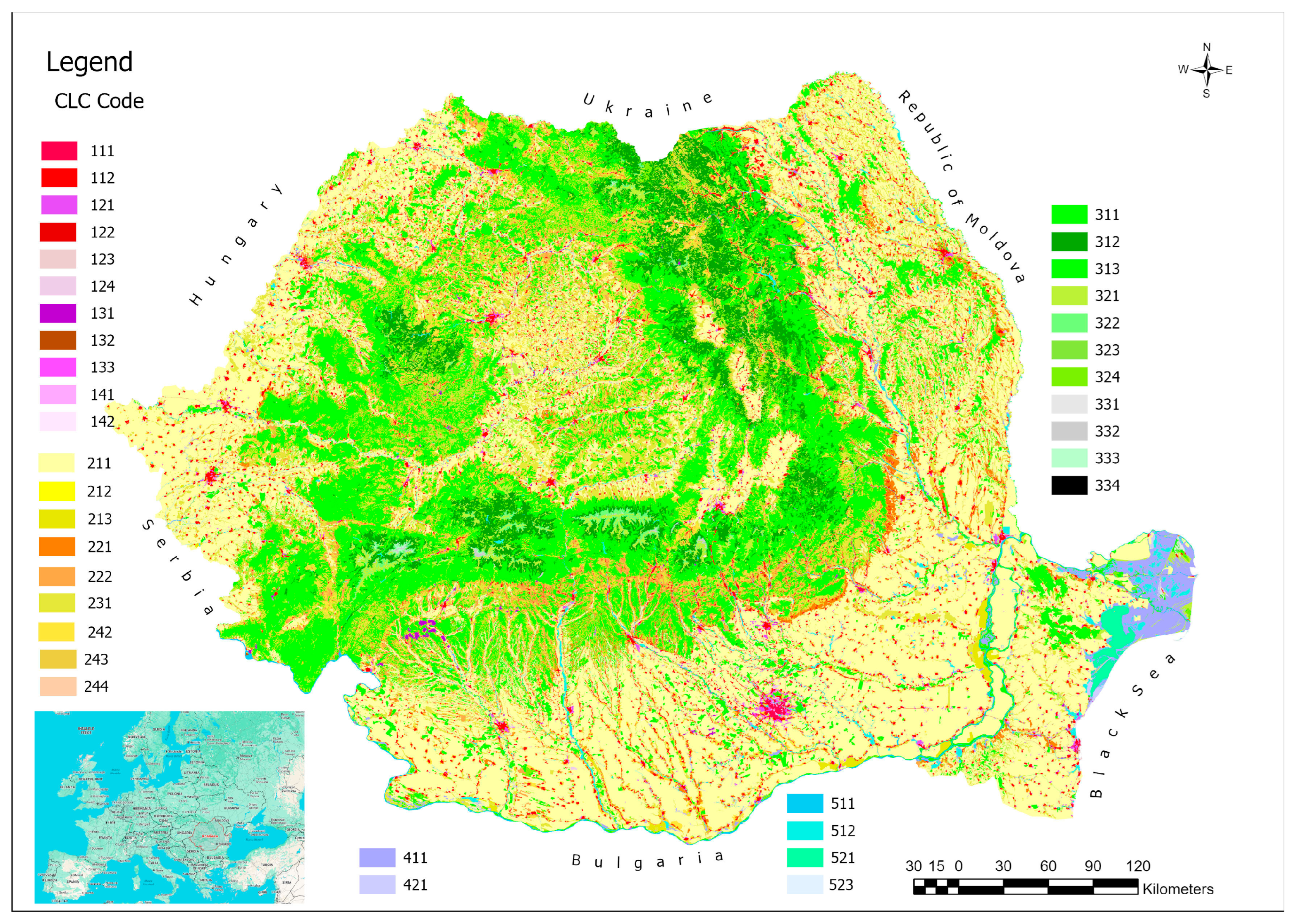
Figure 1. Land use and land cover—Romania. CLC codes signifies: 111—Continuous urban fabric; 112—Discontinuous urban fabric; 121—Industrial or commercial units; 122—Road and rail networks and associated land; 123—Port areas; 124—Airports; 131—Mineral extraction sites; 132—Dump sites; 133—Construction sites; 141—Green urban areas; 142—Sport and leisure facilities; 211—Non-irrigated arable land; 212—Permanently irrigated land; 213—Rice fields; 221—Vineyards; 222—Fruit trees and berry plantations; 231—Pastures; 242—Complex cultivation patterns; 243—Land principally occupied by agriculture; 244—Agro-forestry areas; 311—Broad-leaved forest; 312—Coniferous forest; 313—Mixed forest; 321—Natural grassland; 322—Moors and heathland; 323—Sclerophyllous vegetation; 324—Transitional woodland shrub; 331—Beaches, dunes, and sand plains; 332—Bare rock; 333—Sparsely vegetated areas; 334—Burnt areas (Data used according to https://land.copernicus.eu/en/products/corine-land-cover, accessed on 1 March 2025).
Geomatics 05 00078 g001
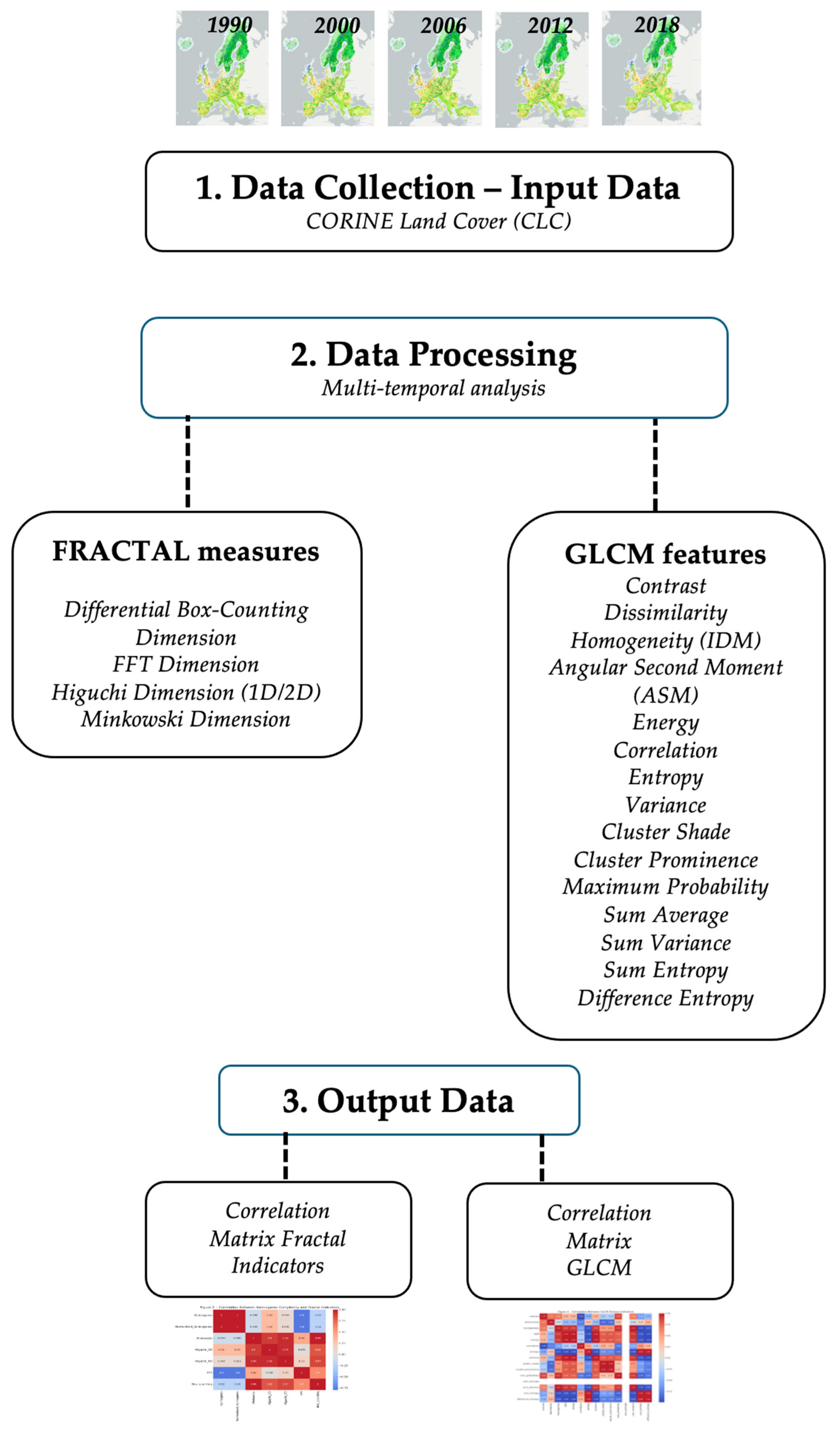
Figure 2. Study flowchart (There are three main steps to analyse the CORINE Land Cover maps for the years 1990, 2000, 2006, 2012 and 2018. In the processing stage, two categories of descriptors are extracted: (i) Fractal measures and (ii) GLCM texture features. The output stage generates correlation matrices for both fractal indicators and GLCM features, enabling the comparative evaluation of structural and textural dynamics across time).
Geomatics 05 00078 g002
Figure 3. Ridgeline plots of normalized indicators: (a) KC, NKC and fractal-based complexity measures and (b) GLCM texture metrics for the study period 1990–2018. For each indicator, the coloured ridge shows the kernel-density estimate of its normalized values (0–1), while the blue horizontal segment beneath the ridge provides a boxplot-style summary (minimum, lower quartile, median, upper quartile, maximum). The ridgeline distributions show that all fractal indicators occupy predominantly the upper half of the normalized scale (values > 0.5), confirming a generally high geometric complexity of the forest patterns in all years. Kolmogorov and normalized Kolmogorov complexity, FFT dimension and box-counting are strongly concentrated toward high normalized values, with narrow boxes and short whiskers, indicating limited year-to-year variability. Minkowski and the Higuchi dimensions have slightly lower medians and wider boxes, suggesting that these indices are more sensitive to subtle structural changes and provide most of the within-period dispersion among the fractal measures. GLCM texture measures display more heterogeneous patterns than the fractal indicators. Contrast, dissimilarity and entropy are skewed towards high normalized values, while homogeneity and ASM remain in the lower–intermediate range, which is consistent with a landscape composed of structurally heterogeneous forest patches. Sum average and max probability show low values and very compact boxplots, indicating almost no temporal variation. In contrast, cluster shade, cluster prominence and the multiscale metrics (sum variance, sum entropy and difference entropy) span a broad portion of the 0–1 range and exhibit wide boxes and whiskers, highlighting them as the most discriminative GLCM descriptors for differences between years.
Geomatics 05 00078 g003aGeomatics 05 00078 g003b
Figure 4. Temporal evolution of Minkowski dimension, Higuchi 2D fractal dimension, and box-counting dimension.
Geomatics 05 00078 g004
Figure 5. Correlation between Kolmogorov complexity and fractal indicators.
Geomatics 05 00078 g005
Figure 6. Cluster shade, cluster proeminence, and dissimilarity.
Geomatics 05 00078 g006
Figure 7. Correlation matrix among selected GLCM texture measures.
Geomatics 05 00078 g007
Figure 8. Cross-domain correlation matrix combining KC, fractal, and GLCM measures.
Geomatics 05 00078 g008
Figure 9. K-Means clustering based on PCA of all normalised measures (2 clusters).
Geomatics 05 00078 g009
Figure 10. Normalised distribution of complexity and texture indicators.
Geomatics 05 00078 g010
Figure 11. (a). GLCM measures; (b) fractal measures; (c) all measures.
Geomatics 05 00078 g011
Table 3. Percent change (1990→2018) with 95% bootstrap CI—fractal measures.
Measure%Δ (2018 vs. 1990)95% CI (Bootstrap)
Kolmogorov complexity−4.258[−14.244%, −0.265%]
Normalised Kolmogorov complexity−4.26[−14.214%, −0.155%]
Minkowski dimension−0.373[−0.640%, 0.064%]
Higuchi 2D dimension−0.364[−0.626%, −0.105%]
Higuchi 1D dimension−0.375[−0.719%, 0.080%]
FFT dimension−0.374[−1.443%, 2.157%]
Box-counting−0.144[−0.243%, 0.046%]
Table 4. Percent change (1990→2018) with 95% bootstrap CI—GLCM measures.
Measure%Δ (2018 vs. 1990)95% CI (Bootstrap)
contrast−7.943[−17.513%, 15.902%]
dissimilarity−5.279[−8.290%, −1.209%]
homogeneity1.086[−0.632%, 4.927%]
ASM2.164[0.825%, 5.578%]
energy1.077[0.428%, 2.820%]
correlation0.257[−0.337%, 0.584%]
entropy−3.292[−10.089%, −0.722%]
variance2.165[0.794%, 5.717%]
cluster_shade3.22[1.808%, 5.407%]
cluster_prominence3.804[2.111%, 6.545%]
max_probability−0.003[−0.023%, 0.044%]
sum_average0.0[0.000%, 0.000%]
sum_variance2.727[−0.761%, 12.260%]
sum_entropy−3.617[−12.890%, 0.368%]
difference_entropy−2.545[−7.062%, −0.706%]
Table 5. Synthesis of the most informative measures across domains and their interpretation.
DomainMost Informative measuresInterpretation
Fractal/KCMinkowski, Higuchi 2D, Box-countingCapture, geometric and curve-based complexity
GLCM TextureCluster shade, Cluster prominence, DissimilarityHighlight asymmetry and textural irregularity
Cross-Domain PCAPC1: entropy/fractals; PC2: ASM/homogeneityStructural simplification vs. richness
Temporal Clustering2 stable clusters (pre-/post-2006)Landscape transition confirmed
Disclaimer/Publisher’s Note: The statements, opinions and data contained in all publications are solely those of the individual author(s) and contributor(s) and not of MDPI and/or the editor(s). MDPI and/or the editor(s) disclaim responsibility for any injury to people or property resulting from any ideas, methods, instructions or products referred to in the content.