
Mobility and Quality of Life: A Cross-Sectional Psychometric Evaluation of the Validity and Reliability of a Dutch Translation of the MobQoL-7D Outcome Measure



Abstract
1. Introduction
- Manual wheelchairs;
- Power wheelchairs (including power assist devices);
- Mobility scooters;
- Transfer aids (standing device, active, passive, and stairlift);
- Bicycles (including tricycles, handbikes and special bikes);
- Other (toilet/shower chairs, custom moulded seating supports, comfort chairs, disability chairs, and wheelchair cushions).
Aims and Objectives
2. Materials and Methods
2.1. Data Collection and Outcome Measures
- Demographic and personal characteristics including gender, age, employment status, medical diagnosis and perceived stability of health.
- Information about the type of mobility aid used, and duration/frequency of use.
- MobQoL-7D Dutch translation.
- Additional outcome measures (translated into Dutch):
- ◦
- Unvalidated translation of the EQ-5D-5L;
- ◦
- Unvalidated translation of the ICEpop CAPability measure for Adults (ICECAP-A);
- ◦
- Unvalidated translation of the Psychosocial Impact of Assistive Devices Scale (PIADS).
2.2. Translations of Measures
2.3. Recruitment and Sampling
2.4. Inclusion and Exclusion Criteria
- Aged 18 years or over;
- Have a long-term (i.e., lasting or expected to last >6 months) impairment, injury or condition which necessitates the use of any form of mobility aid to improve or facilitate independent mobility;
- Capacity to provide informed consent;
- Ability to communicate in Dutch (at least Level B1 according to the Common European Framework of Reference for Languages [25]).
2.5. Data Handling and Ethical Approval
2.6. Analyses
2.6.1. Basic Measurement Properties, Interpretability and Reliability
- Missing data: The threshold for problematic measurement was set at >4% missing data per item. High levels of missing data can indicate that respondents find a tool to be too difficult, confusing, long or intrusive.
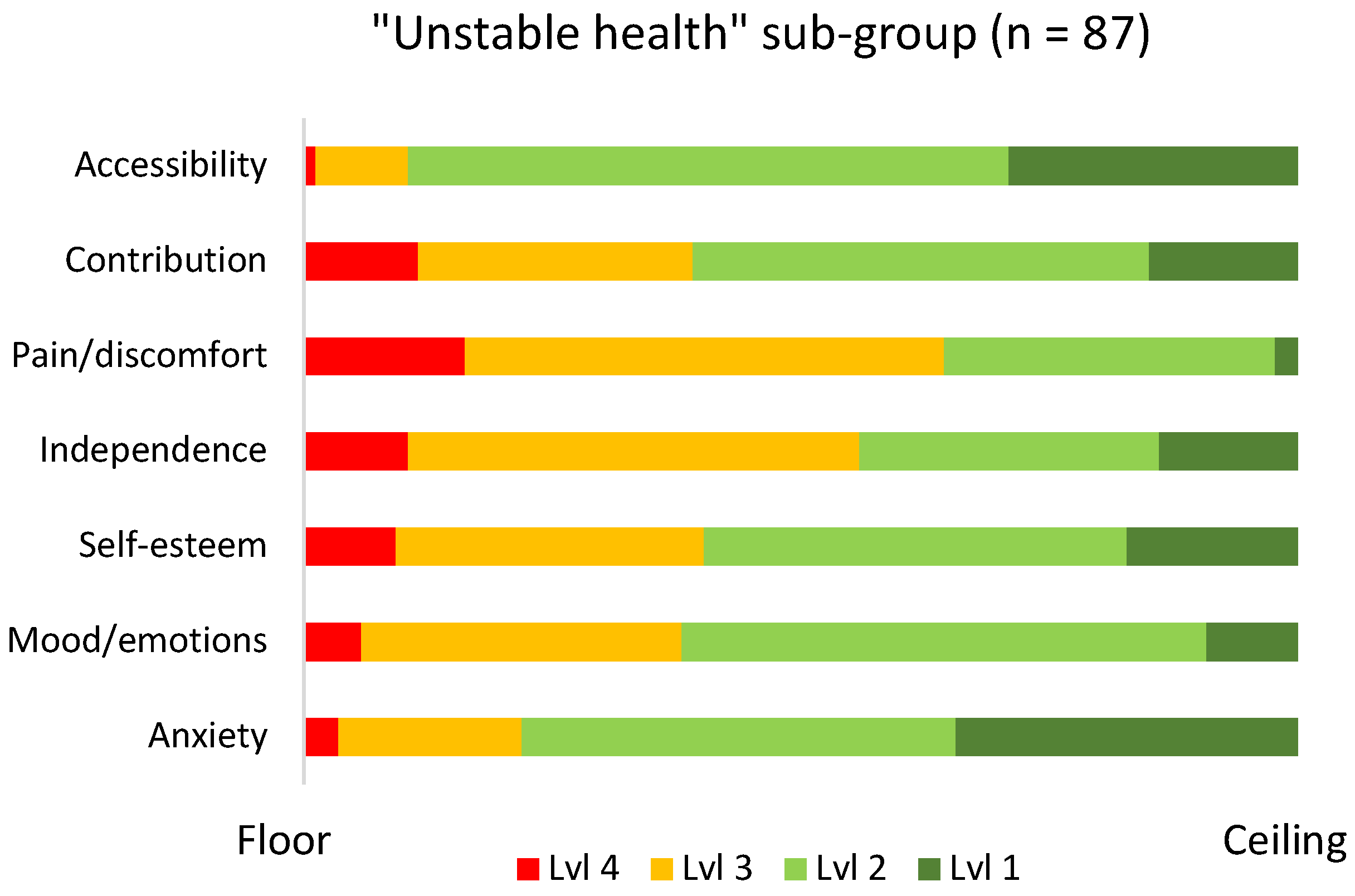
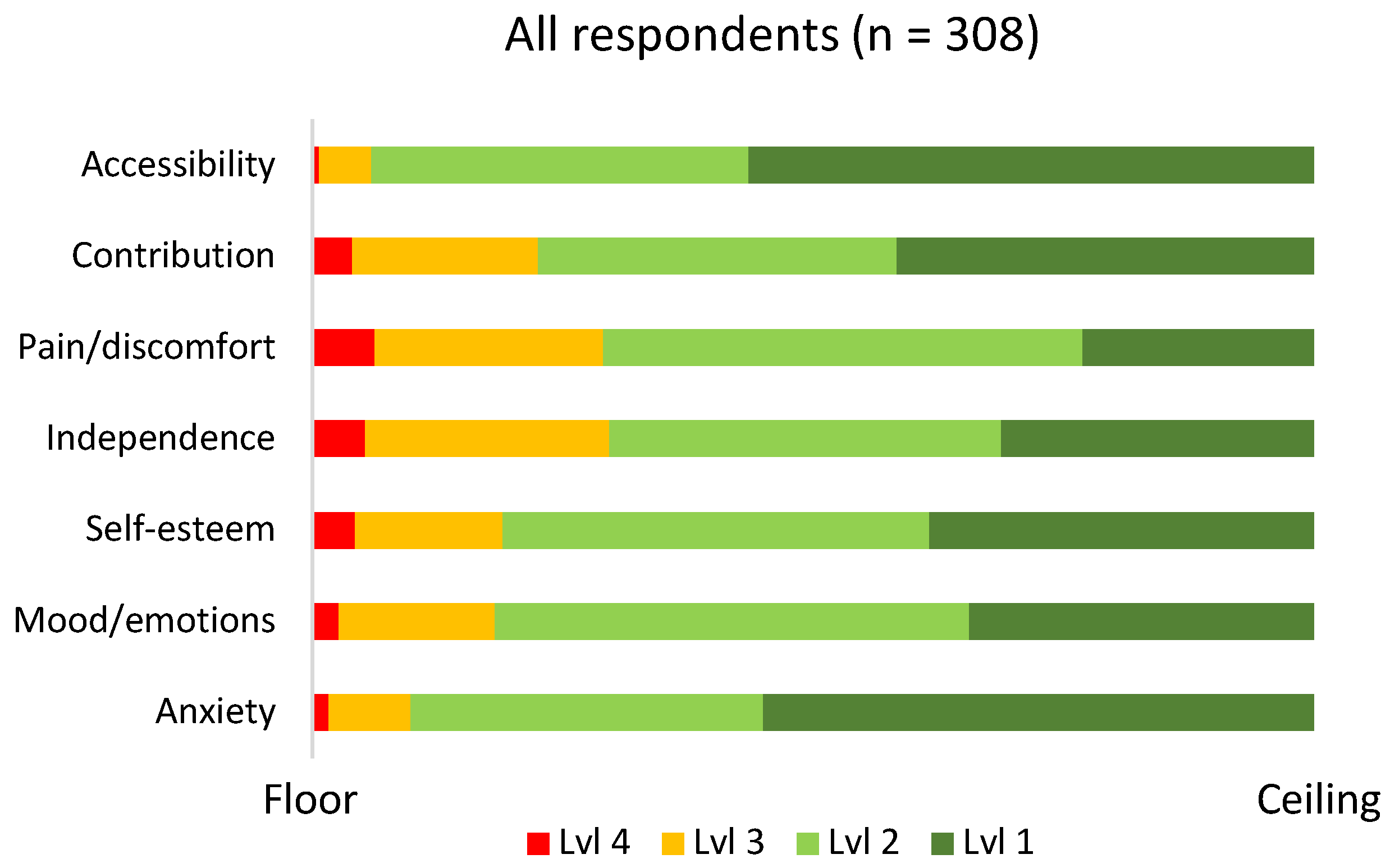
- Floor/ceiling effects: Floor and ceiling effects can indicate a lack of sensitivity in the measurement scale. For overall index values, a ceiling effect was defined as ≥15% of respondents reporting the best possible health state (i.e., choosing level 1 for each item; 1111111); and a floor effect was defined as ≥15% of respondents reporting the worst possible health state (i.e., choosing level 4 for each item; 4444444). COSMIN guidance does not specifically state a threshold for floor/ceiling effects; however, ≥15% is generally considered to be an appropriate threshold [28]. Although floor/ceiling effects are principally evaluated at the scale level (i.e., total score), in the interest of transparency, we also assessed floor/ceiling effects for the individual items. The threshold was again set at ≥15% of responses on the first (level 1; ceiling) or last (level 4; floor) response choice for each item. Level 1 represents the ‘best’ response choice (i.e., no problems) for each item and is thus the ‘ceiling’; likewise, Level 4 represents the ‘worst’ response choice (i.e., extreme problems) for each item and is thus the ‘floor’.
- Test–retest reliability: This provides an indication of whether a tool is reliably and consistently measuring a construct over time. As per COSMIN guidance [29], test–retest reliability was assessed using Intraclass Correlation Coefficient (ICC) (two-way random effects model, based on absolute agreement) for the overall index value and weighted Cohen’s kappa (using quadratic weights) for the individual items. ICC values between 0.75 and 0.90 indicate good reliability, and values greater than 0.90 indicate excellent reliability [30]. A minimum kappa value of ≥0.60 is the recommend threshold for adequate agreement between measurements [31].
2.6.2. Structural Validity
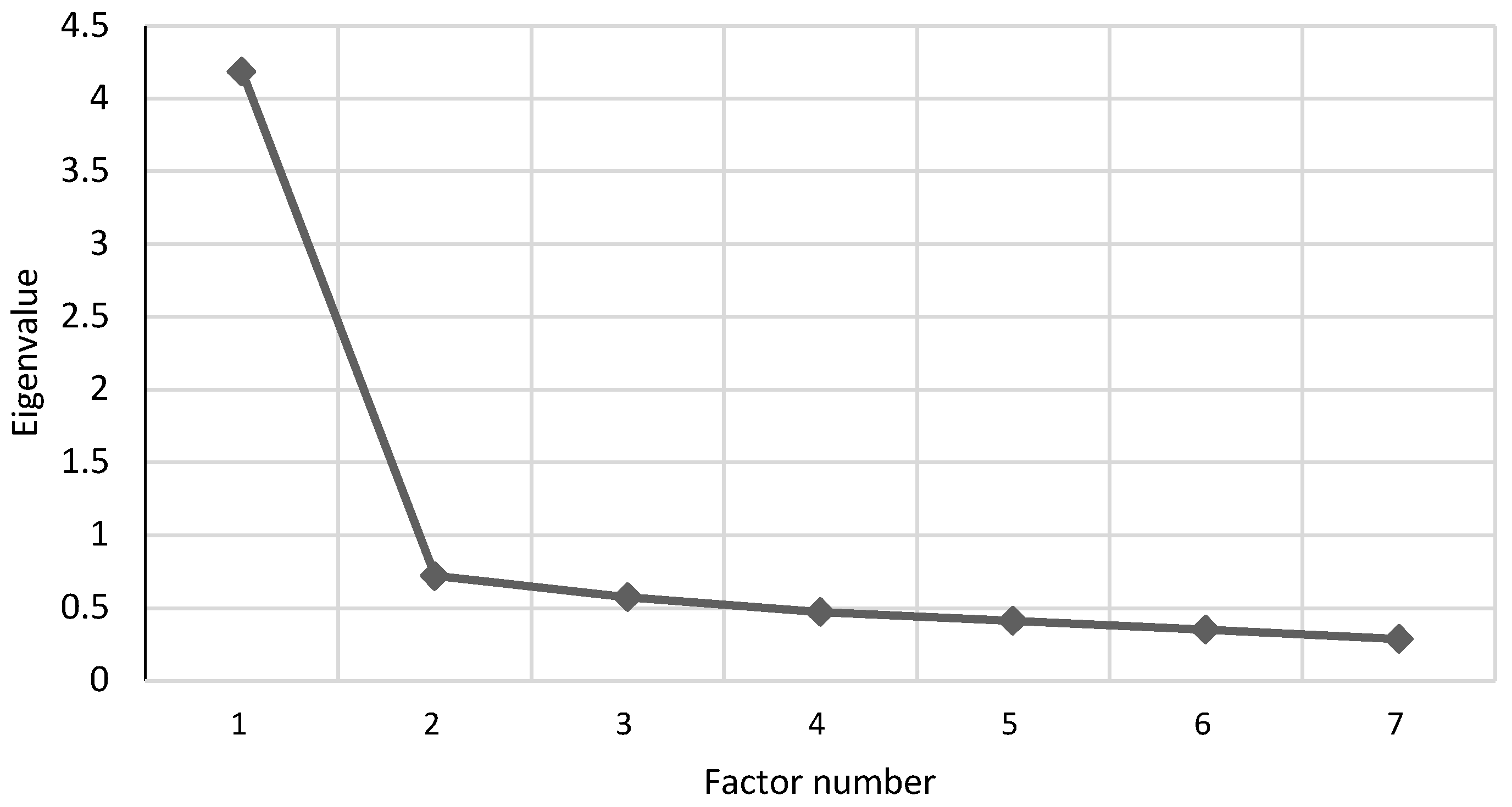
- Exploratory factor analysis (EFA): As the MobQoL-7D Dutch is a novel PROM translation, EFA was undertaken to examine the inter-relationship between items and underlying factorial structure [32]. Due to the ordinal nature of the 4-point Likert-type scale utilised in the MobQoL-7D Dutch, EFA was performed using Principal Axis Factoring and with polychoric correlation. Rotation was not required, as only one factor was identified. Sampling adequacy was assessed using the Kaiser–Meyer–Olkin (KMO) test (KMO ≥ 0.90 indicates excellent sample adequacy), and Bartlett’s test of sphericity was used to test the adequacy of correlations between items (p < 0.05 confirms data suitability for EFA) [33]. The number of independent factors was determined by eigenvalues ≥ 1 [33] and interpretation of the screeplot. As per COSMIN guidance, relevant fit indices included factor loadings for each item and variance across the items explained by the identified factor (COSMIN thresholds: factor loadings ≥ 0.30 per item and explained variance ≥ 50%, respectively) [29].
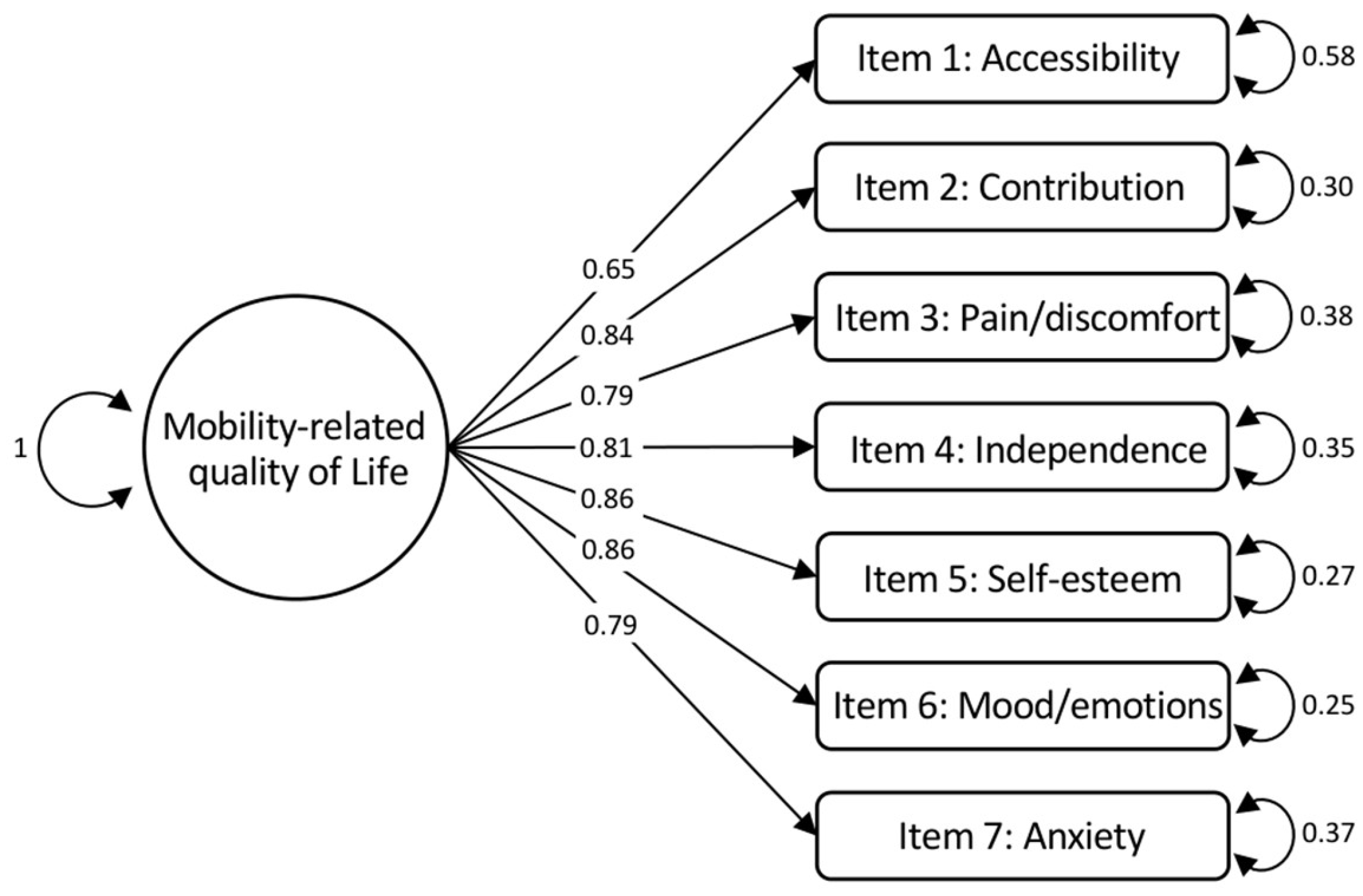
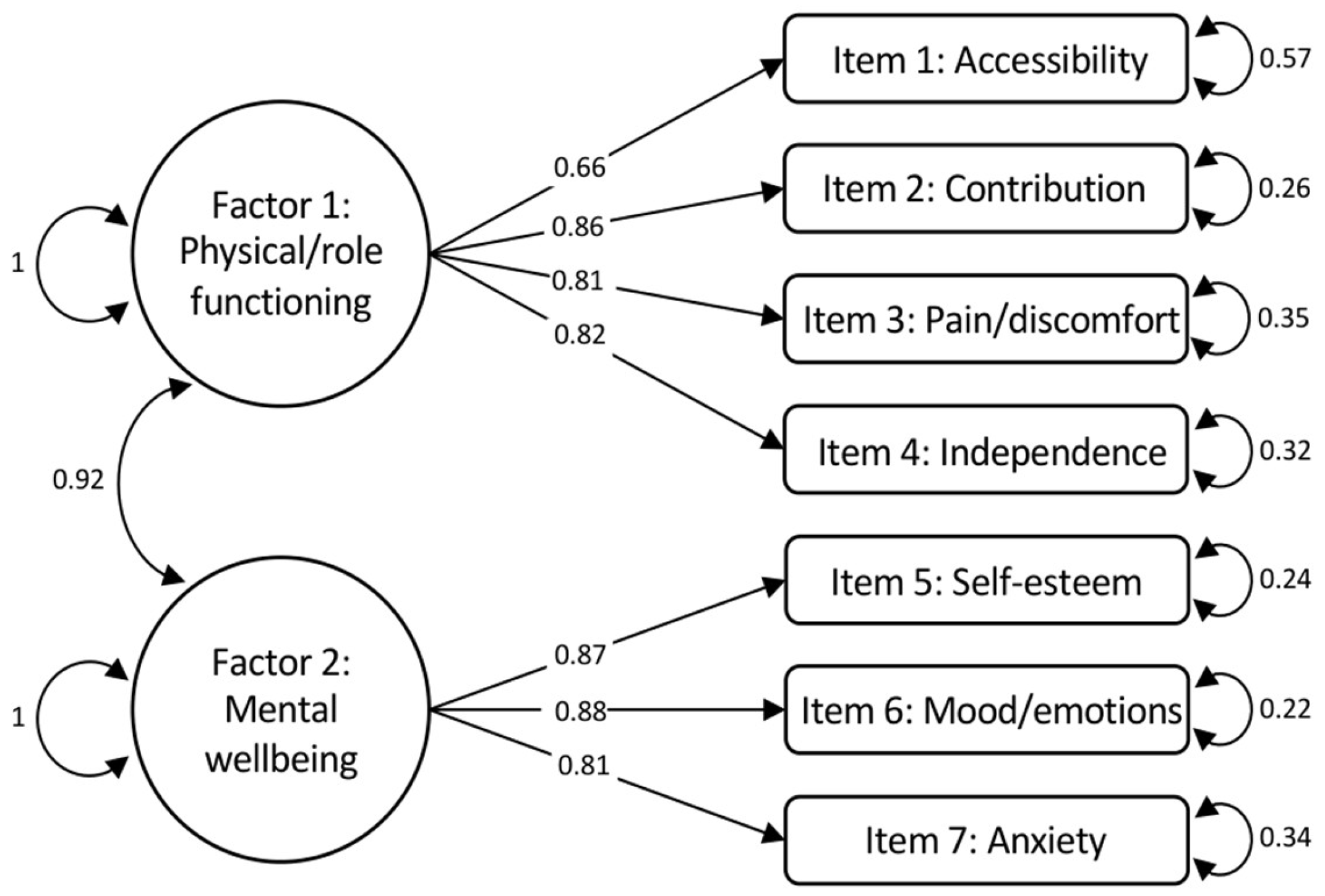
- Confirmatory factor analysis (CFA): This was undertaken to further validate the factorial structure identified by the EFA and to also examine potential factorial fit with the two-factor structure of the original MobQoL-7D (factor 1: physical/role function related to mobility; and factor 2: mental well-being related to mobility). The CFA models were estimated using weighted least square mean and variance (WLSMV), which is considered most appropriate for ordinal data (e.g., Likert scales) [34]. A range of model fit statistics were examined using the following minimum thresholds defined by COSMIN: Comparative Fit Index (CFI) > 0.95; Tucker–Lewis Index (TLI) > 0.95; Root Mean Square Error of Approximation (RMSEA) < 0.06; and Standardised Root Mean Square Residual (SRMR) < 0.08 [29]. Standardised factor loadings for each item were also evaluated, with a desired minimum loading of ≥0.50 per item.
- Internal consistency: Cronbach’s α coefficient was used to confirm the internal consistency of the scale following confirmation of unidimensionality via factor analysis; a threshold of α ≥ 0.7 was used to confirm acceptable internal consistency [29].
2.6.3. Hypothesis Testing
- Known-group validity: This was undertaken to test the ability of the MobQoL-7D Dutch to discriminate between groups expected to have different outcomes. The Mann–Whitney U test was used; this compares the difference between the mean ranks of two independent groups. Mann–Whitney U is considered to be more suitable than independent t tests when comparing data from ordinal variables [35]. Our unvalidated translation of the PIADS outcome measure was used to define three pairs of “known” groups, based on the three PIADS sub-scales (Competence, Adaptability and Self-Esteem). For each sub-scale participants were grouped by whether they had experienced positive (≥0; i.e., “positive effect” group) or negative impacts (<0; i.e., “negative effect” group) associated with assistive technology use and mobility impairment. The paired groups were then compared to determine whether their answers were significantly different on each MobQoL-7D Dutch item and the overall index value, with the hypothesis that those in the “negative effect” groups would have worse outcomes comparatively. Respondents were also categorised into a further pair of “known” groups based on perceived stability of health; the two groups were defined as having “stable health” or “unstable health” based on participants’ dichotomous self-rating of health stability at baseline. Individual item scores and overall index values were assessed for significant (p < 0.05) differences between defined “known” group pairs, based on the hypothesis that those in the “unstable health” group would have worse outcomes comparatively.
- Convergent validity: This was analysed using Spearman’s Rho correlation coefficient; we examined the correlation between the MobQoL-7D Dutch and our unvalidated translations of the EQ-5D-5L and ICECAP-A. The aim was to understand whether the MobQoL-7D Dutch accurately measures specified constructs in accordance with other outcome measures. Convergent validity was determined by an item’s strongest correlation being with a hypothesised equivalent item from a comparable measure. The strength of correlations was defined as such: very weak (rs = 0.00 to 0.19), weak (rs = 0.20 to 0.39), moderate (rs = 0.40 to 0.59), strong (rs = 0.60–0.79) and very strong (rs > 0.79) [36], with moderate-to-strong correlations (>0.40) demonstrating expected convergent validity.
- The MobQoL-7D Dutch “Accessibility” item will be most correlated with the “Mobility” item of the EQ-5D-5L (unvalidated Dutch translation).
- The MobQoL-7D Dutch “Contribution” item will be most correlated with the “Usual activities” item of the EQ-5D-5L (unvalidated Dutch translation).
- The MobQoL-7D Dutch “Pain/discomfort” item will be most correlated with the “Pain/discomfort” item of the EQ-5D-5L (unvalidated Dutch translation).
- The MobQoL-7D Dutch “Independence” item will be most correlated with the “Self-care” or “Usual activities” items of the EQ-5D-5L (unvalidated Dutch translation).
- The MobQoL-7D Dutch “Self-esteem”, “Mood/emotions” and “Anxiety” items will be most correlated with the “Anxiety/depression” item of the EQ-5D-5L (unvalidated Dutch translation).
- The MobQoL-7D Dutch “Accessibility” item will be most correlated with the “Being independent” item of the ICECAP-A (unvalidated Dutch translation).
- The MobQoL-7D Dutch “Contribution” item will be most correlated with the “Being independent” item or “Achievement and progress” item of the ICECAP-A (unvalidated Dutch translation).
- The MobQoL-7D Dutch “Independence” item will be most correlated with the “Being independent” item of ICECAP-A (unvalidated Dutch translation).
- The MobQoL-7D Dutch “Self-esteem” and “Anxiety” items will be most correlated with the “Feeling settled and secure” item of the ICECAP-A (unvalidated Dutch translation).
- The MobQoL-7D Dutch “Mood and emotions” item will be most correlated with the “Feeling settled and secure” item or “Enjoyment and pleasure” item of the ICECAP-A (unvalidated Dutch translation).
3. Results
3.1. Sample and Demographics
- Competence: 9.4% (n = 29) experienced negative impacts on feelings of competence and efficacy relating to their assistive technology use, compared to 79.6% (n = 245) who experienced positive impacts.
- Adaptability: 13.0% (n = 40) experienced negative impacts on their willingness to try out new things and to take risks relating to their assistive technology use, compared to 76.0% (n = 234) who experienced positive impacts.
- Self-esteem: 16.6% (n = 51) experienced negative impacts on their feelings of emotional health and happiness relating to their assistive technology use, compared to 72.4% (n = 223) who experienced positive impacts.
3.2. Basic Measurement Properties, Interpretability and Reliability
3.2.1. Missing Data and Floor/Ceiling Effects
3.2.2. Test/Retest Reliability
3.3. Structural Validity
3.3.1. Exploratory Factor Analysis
3.3.2. Confirmatory Factor Analysis
3.4. Hypothesis Testing
3.4.1. Known-Group Validity
3.4.2. Convergent Validity
- The MobQoL-7D Dutch “Accessibility” item was most correlated with the “Mobility” item (rs = 0.52) of the EQ-5D-5L (unvalidated Dutch translation).
- The MobQoL-7D Dutch “Pain/discomfort” item was most correlated with the “Pain/discomfort” item (rs = 0.79; these were also the most correlated items) of the EQ-5D-5L (unvalidated Dutch translation).
- The MobQoL-7D Dutch “Mood/emotions” and “Anxiety” items were most correlated with the “Anxiety/depression” item (rs = 0.56 for both) of the EQ-5D-5L (unvalidated Dutch translation).
- The MobQoL-7D Dutch “Accessibility”, “Contribution” and “Independence” items were all most correlated with the “Being independent” item (rs = 0.47, 0.56 and 0.56, respectively) of the ICECAP-A (unvalidated Dutch translation).
- MobQoL-7D Dutch “Self-esteem”, “Mood/emotions” and “Anxiety” items were all most correlated with the “Feeling settled and secure” item (rs = 0.51, 0.54 and 0.56, respectively) of the ICECAP-A (unvalidated Dutch translation).
4. Discussion
5. Conclusions
Supplementary Materials
Author Contributions
Funding
Institutional Review Board Statement
Informed Consent Statement
Data Availability Statement
Conflicts of Interest
Disability Language/Terminology Positionality Statement
References
- World Health Organization. Wheelchair Provision Guidelines; World Health Organization: Geneva, Switzerland, 2023. [Google Scholar]
- Jansen, P.; Jenneboer, L.; Pansier-Mast, L.; van der Zee, V. Eindrapportage Verkenning Vereenvoudiging Hulpmiddelen; Bureau HHM: The Hague, The Netherlands, 2022. [Google Scholar]
- Government of The Netherlands. Health Insurance. Available online: https://www.government.nl/topics/health-insurance (accessed on 27 March 2026).
- Government of The Netherlands. Long Term Care Act (WLZ). Available online: https://www.government.nl/topics/nursing-homes-and-residential-care/long-term-care-act-wlz (accessed on 27 March 2026).
- Government of The Netherlands. Care and Support at Home. Available online: https://www.government.nl/topics/care-and-support-at-home (accessed on 27 March 2026).
- Government of The Netherlands. Applying for Disability Support in Case of Sickness or Occupational Disability. Available online: https://www.government.nl/topics/working-with-an-occupational-disability/applying-for-an-equipment-or-support-allowance-as-an-employee-in-the-case-of-sickness-or-disability (accessed on 27 March 2026).
- Leidelmeijer, K. Hulpmiddelen in de Zorg—Kwantitatieve Verkenning van de Overlap Tussen Domeinen; Bureau HHM: The Hague, The Netherlands, 2022. [Google Scholar]
- Versteegh, M.; Vermeulen, K.; Evers, S.M.A.A.; de Wit, G.A.; Prenger, R.; Stolk, E.A. Dutch tariff for the five-level version of EQ-5D. Value Health 2016, 19, 343–352. [Google Scholar] [CrossRef] [Scilit] [PubMed]
- Aaronson, N.K.; Muller, M.; Cohen, P.D.; Essink-Bot, M.L.; Fekkes, M.; Sanderman, R.; Sprangers, M.A.; te Velde, A.; Verrips, E. Translation, validation, and norming of the Dutch language version of the SF-36 health survey in community and chronic disease populations. J. Clin. Epidemiol. 1998, 51, 1055–1068. [Google Scholar] [CrossRef] [Scilit] [PubMed]
- Kruithof, N.; Haagsma, J.A.; Karabatzakis, M.; Cnossen, M.C.; de Munter, L.; van de Ree, C.L.P.; de Jongh, M.A.C.; Polinder, S. Validation and reliability of the abbreviated World Health Organization Quality of Life Instrument (WHOQOL-BREF) in the hospitalized trauma population. Injury 2018, 49, 1796–1804. [Google Scholar] [CrossRef] [Scilit] [PubMed]
- Bray, N.; Spencer, L.H.; Edwards, R.T. Preference-based measures of health-related quality of life in congenital mobility impairment: A systematic review of validity and responsiveness. Health Econ. Rev. 2020, 10, 9. [Google Scholar] [CrossRef] [Scilit]
- Enemark Larsen, A.; Wehberg, S.; Christensen, J.R. Looking into the content of the Canadian Occupational Performance Measure (COPM): A Danish cross-sectional study. Occup. Ther. Int. 2020, 2020, 9573950. [Google Scholar] [CrossRef] [Scilit]
- Wessels, R.D.; De Witte, L.P. Reliability and validity of the Dutch version of QUEST 2.0 with users of various types of assistive devices. Disabil. Rehabil. 2003, 25, 267–272. [Google Scholar] [CrossRef] [Scilit]
- Post, M.W.; van der Zee, C.H.; Hennink, J.; Schafrat, C.G.; Visser-Meily, J.M.; van Berlekom, S.B. Validity of the Utrecht scale for evaluation of rehabilitation-participation. Disabil. Rehabil. 2012, 34, 478–485. [Google Scholar] [CrossRef] [Scilit]
- Cardol, M.; de Haan, R.J.; de Jong, B.A.; van den Bos, G.A.; de Groot, I.J. Psychometric properties of the Impact on Participation and Autonomy Questionnaire. Arch. Phys. Med. Rehabil. 2001, 82, 210–216. [Google Scholar] [CrossRef] [Scilit]
- Bray, N.; Tudor Edwards, R. Preference-based measurement of mobility-related quality of life: Developing the MobQoL-7D health state classification system. Disabil. Rehabil. 2022, 44, 2915–2929. [Google Scholar] [CrossRef] [Scilit]
- Bray, N.; Tudor Edwards, R.; Schneider, P. Development of a value-based scoring system for the MobQoL-7D: A novel tool for measuring quality-adjusted life years in the context of mobility impairment. Disabil. Rehabil. 2024, 46, 5345–5356. [Google Scholar] [CrossRef] [Scilit]
- Mokkink, L.B.; Prinsen, C.A.C.; Patrick, D.L.; Alonso, J.; Bouter, L.M.; de Vet, H.C.W.; Terwee, C.B. COSMIN Study Design Checklist for Patient-Reported Outcome Measurement Instruments. 2019. Available online: https://www.cosmin.nl/wp-content/uploads/COSMIN-study-designing-checklist_final.pdf# (accessed on 27 March 2026).
- Herdman, M.; Gudex, C.; Lloyd, A.; Janssen, M.F.; Kind, P.; Parkin, D.; Bonsel, G.; Badia, X. Development and preliminary testing of the new five-level version of EQ-5D (EQ-5D-5L). Qual. Life Res. 2011, 20, 1727–1736. [Google Scholar] [CrossRef] [Scilit] [PubMed]
- Al-Janabi, H.; Peters, T.J.; Brazier, J.; Bryan, S.; Flynn, T.N.; Clemens, S.; Moody, A.; Coast, J. An investigation of the construct validity of the ICECAP-A capability measure. Qual. Life Res. 2013, 22, 1831–1840. [Google Scholar] [CrossRef] [Scilit] [PubMed]
- National Institute for Health and Care Excellence. Developing NICE Guidelines: The Manual; National Institute for Health and Care Excellence: London, UK, 2014. [Google Scholar]
- Mitchell, P.M.; Roberts, T.E.; Barton, P.M.; Coast, J. Assessing sufficient capability: A new approach to economic evaluation. Soc. Sci. Med. 2015, 139, 71–79. [Google Scholar] [CrossRef] [Scilit] [PubMed]
- Day, H.; Jutai, J. Measuring the psychosocial impact of assistive devices: The PIADS. Can. J. Rehabil. 1996, 9, 159–168. [Google Scholar]
- ISO 24495 1:2023; Plain Language—Part 1: Governing Principles and Guidelines. International Organization for Standardization: Geneva, Switzerland, 2023. Available online: https://www.iso.org/standard/78907.html (accessed on 27 March 2026).
- Council of Europe. Common European Framework of Reference for Languages: Learning, Teaching, Assessment; Cambridge University Press: Cambridge, UK, 2001. [Google Scholar]
- ZorgFocuz. About ZorgFocuz. Available online: www.zorgfocuz.nl (accessed on 27 March 2026).
- White, M. Sample size in quantitative instrument validation studies: A systematic review of articles. Heliyon 2021, 8, e12223. [Google Scholar] [CrossRef] [Scilit]
- Terwee, C.B.; Bot, S.D.; de Boer, M.R.; van der Windt, D.A.; Knol, D.L.; Dekker, J.; Bouter, L.M.; de Vet, H.C. Quality criteria were proposed for measurement properties of health status questionnaires. J. Clin. Epidemiol. 2007, 60, 34–42. [Google Scholar] [CrossRef] [Scilit]
- Mokkink, L.B.; Elsman, E.B.; Terwee, C.B. COSMIN guideline for systematic reviews of patient-reported outcome measures version 2.0. Qual. Life. Res. 2024, 33, 2929–2939. [Google Scholar] [CrossRef] [Scilit]
- Koo, T.K.; Li, M.Y. A Guideline of Selecting and Reporting Intraclass Correlation Coefficients for Reliability Research. J. Chiropr. Med. 2016, 15, 155–163. [Google Scholar] [CrossRef] [Scilit]
- McHugh, M.L. Interrater reliability: The kappa statistic. Biochem. Medica 2012, 22, 276–282. [Google Scholar] [CrossRef] [Scilit]
- Fayers, P.M.; Machin, D. Quality of Life: The Assessment, Analysis and Reporting of Patient-Reported Outcomes, 3rd ed.; John Wiley & Sons: Chichester, UK, 2016. [Google Scholar]
- Williams, B.; Brown, T.; Onsman, A. Exploratory factor analysis: A five-step guide for novices. Australas. J. Paramed. 2010, 8, 1–13. [Google Scholar] [CrossRef] [Scilit]
- Li, C.H. Confirmatory factor analysis with ordinal data: Comparing robust maximum likelihood and diagonally weighted least squares. Behav. Res. 2016, 48, 936–949. [Google Scholar] [CrossRef] [Scilit]
- Laerd Statistics. Statistical Tutorials and Software Guides: Mann-Whitney U Test Using SPSS Statistics. Available online: https://statistics.laerd.com/spss-tutorials/mann-whitney-u-test-using-spss-statistics.php (accessed on 27 March 2026).
- Statstutor. Spearman’s Correlation. Available online: https://www.statstutor.ac.uk/resources/uploaded/spearmans.pdf (accessed on 27 March 2026).
- Field, A. Discovering Statistics Using IBM SPSS Statistics, 5th ed.; Sage: London, UK, 2017. [Google Scholar]



| % | N | ||
|---|---|---|---|
| Gender | Female | 39.9 | 123 |
| Male | 59.1 | 182 | |
| Other | 0.3 | 1 | |
| Not stated a | 0.7 | 2 | |
| Age Category (years) | 18–24 | 2.9 | 9 |
| 25–34 | 18.2 | 56 | |
| 35–44 | 25.0 | 77 | |
| 45–54 | 12.7 | 39 | |
| 55–64 | 19.2 | 59 | |
| 65+ | 20.5 | 63 | |
| Not stated a | 1.6 | 5 | |
| Employment Status | Full-time | 27.6 | 85 |
| Part-time | 27.9 | 86 | |
| Unemployed | 9.7 | 30 | |
| Full-time carer | 3.9 | 12 | |
| Retired | 19.5 | 60 | |
| Student | 0.7 | 2 | |
| Sick leave | 10.1 | 31 | |
| Not stated a | 0.7 | 2 | |
| Self-rated Health Stability | Stable | 70.1 | 216 |
| Unstable | 28.3 | 87 | |
| Not stated a | 1.6 | 5 |
| % | N | ||
|---|---|---|---|
| Frequency of Mobility Aid Use | Whole day | 21.1 | 65 |
| Almost daily | 49.7 | 153 | |
| Weekly | 17.2 | 53 | |
| Monthly | 8.1 | 25 | |
| Not stated a | 3.9 | 12 | |
| Primary Mobility Aid | Manual wheelchair | 21.8 | 67 |
| Special support aid (insoles, support cushions, etc.) | 4.5 | 14 | |
| Power wheelchair (including power assist devices) | 2.9 | 9 | |
| Mobility scooter | 14.0 | 43 | |
| Bicycle (including tricycles, handbikes and special bikes) | 5.2 | 16 | |
| Other (toilet/shower chairs, custom seating supports, etc.) | 6.8 | 21 | |
| Walking aid (crutches, rollator) | 11.7 | 36 | |
| Car (adaptations) | 11.4 | 35 | |
| Home modification | 1.0 | 3 | |
| Not stated a | 20.8 | 64 | |
| Primary Diagnosis: International Classification of Diseases (ICD-10) Category | I Certain infectious and parasitic diseases | 0.3 | 1 |
| II Neoplasms | 0.3 | 1 | |
| IV Endocrine, nutritional and metabolic diseases | 1.0 | 3 | |
| VI Diseases of the nervous system | 5.5 | 17 | |
| VII Diseases of the eye and adnexa | 0.7 | 2 | |
| IX Diseases of the circulatory system | 1.6 | 5 | |
| X Diseases of the respiratory system | 2.3 | 7 | |
| XIII Diseases of the musculoskeletal system and connective tissue | 14.6 | 45 | |
| XIV Diseases of the genitourinary system | 0.7 | 2 | |
| XVII Congenital malformations, deformations and chromosomal abnormalities | 0.7 | 2 | |
| XVIII Symptoms, signs and abnormal clinical and laboratory findings, not elsewhere classified | 5.5 | 17 | |
| XIX Injury, poisoning and certain other consequences of external causes | 4.2 | 13 | |
| XXI Factors influencing health status and contact with health services | 1.0 | 3 | |
| Not stated a | 61.7 | 190 |
| Test–Retest Reliability a | % Missing Data | Distribution of Response Choices (%) | Known-Group Validity (Significance [p] and Effect Size [r]) | ||||||||
|---|---|---|---|---|---|---|---|---|---|---|---|
| Lvl 1 d | Lvl 2 | Lvl 3 | Lvl 4 e | Health Stability | Competence f | Adaptability f | Self- Esteem f | ||||
| MobQoL-7D Dutch Index Value | 0.95 (0.91–0.98) * | 2.9 | 12.3 b | 0.0 c | p < 0.001; r = 0.50 ** | p < 0.001; r = 0.34 ** | p < 0.001; r = 0.29 ** | p < 0.001; r = 0.26 ** | |||
| MobQoL-7D Dutch Items | Accessibility | 0.51 (0.10–0.92) * | 0.6 | 56.5 | 37.6 | 5.2 | 0.7 | p < 0.001; r = 0.35 ** | p < 0.001; r = 0.24 ** | p = 0.003; r = 0.18 ** | p = 0.021; r = 0.14 ** |
| Contribution | 0.74 (0.53–0.94) * | 0.3 | 41.7 | 35.8 | 18.6 | 3.9 | p < 0.001; r = 0.37 ** | p < 0.001; r = 0.30 ** | p < 0.001; r = 0.30 ** | p < 0.001; r = 0.31 ** | |
| Pain/discomfort | 0.87 (0.77–0.98) * | 0.3 | 23.1 | 47.9 | 22.8 | 6.2 | p < 0.001; r = 0.51 ** | p < 0.001; r = 0.28 ** | p = 0.040; r = 0.12 ** | p < 0.001; r = 0.22 ** | |
| Independence | 0.69 (0.43–0.95) * | 1.3 | 31.3 | 39.1 | 24.3 | 5.3 | p < 0.001; r = 0.36 ** | p < 0.001; r = 0.25 ** | p < 0.001; r = 0.25 ** | p < 0.001; r = 0.20 ** | |
| Self-esteem | 0.78 (0.68–0.91) * | 0.3 | 38.4 | 42.7 | 14.7 | 4.2 | p < 0.001; r = 0.36 ** | p < 0.001; r = 0.26 ** | p < 0.001; r = 0.25 ** | p < 0.001; r = 0.22 ** | |
| Mood/emotions | 0.82 (0.71–0.94) * | 0.0 | 34.4 | 47.4 | 15.6 | 2.6 | p < 0.001; r = 0.40 ** | p < 0.001; r = 0.30 ** | p < 0.001; r = 0.28 ** | p < 0.001; r = 0.25 ** | |
| Anxiety | 0.62 (0.45–0.79) * | 0.3 | 55.1 | 35.2 | 8.1 | 1.6 | p < 0.001; r = 0.30 ** | p < 0.001; r = 0.31 ** | p < 0.001; r = 0.28 ** | p < 0.001; r = 0.23 ** | |
| Distribution of Response Choices (%) | |||||
|---|---|---|---|---|---|
| Lvl 1 c | Lvl 2 | Lvl 3 | Lvl 4 d | ||
| MobQoL-7D Dutch Index Value | 1.2 a | 0.0 b | |||
| MobQoL-7D Dutch Items | Accessibility | 29.1 | 60.5 | 9.3 | 1.2 |
| Contribution | 14.9 | 46.0 | 27.6 | 11.5 | |
| Pain/discomfort | 2.3 | 33.3 | 48.3 | 16.1 | |
| Independence | 14.0 | 30.2 | 45.4 | 10.5 | |
| Self-esteem | 17.2 | 42.5 | 31.0 | 9.2 | |
| Mood/emotions | 9.2 | 52.9 | 32.2 | 5.8 | |
| Anxiety | 34.5 | 43.7 | 18.4 | 3.5 | |
| Factor | Initial Eigenvalues | Extraction Sums of Squared Loadings | ||||
|---|---|---|---|---|---|---|
| Total | % of Variance | Cumulative % | Total | % of Variance | Cumulative % | |
| 1 | 4.19 | 59.8 | 59.9 | 3.74 | 53.4 | 53.4 |
| 2 | 0.72 | 10.3 | 70.1 | |||
| 3 | 0.57 | 8.2 | 78.3 | |||
| 4 | 0.47 | 6.7 | 85.2 | |||
| 5 | 0.41 | 5.9 | 91.0 | |||
| 6 | 0.35 | 5.0 | 95.9 | |||
| 7 | 0.29 | 4.1 | 100 | |||
| MobQoL-7D Dutch Items | Factor Loadings * |
|---|---|
| Accessibility | 0.55 |
| Contribution | 0.78 |
| Pain/discomfort | 0.73 |
| Independence | 0.76 |
| Self-esteem | 0.78 |
| Mood/emotions | 0.78 |
| Anxiety | 0.70 |
| EQ-5D-5L Items * | ICECAP-A Items * | ||||||||||
|---|---|---|---|---|---|---|---|---|---|---|---|
| Mobility | Self-Care | Usual Activities | Pain/ Discomfort | Anxiety/ Depression | Feeling Settled and Secure | Love, Friendship and Support | Being Independent | Achievement and Progress | Enjoyment and Pleasure | ||
| MobQoL-7D Dutch items | Accessibility | 0.52 | 0.43 | 0.45 | 0.49 | 0.33 | 0.40 | 0.37 | 0.47 | 0.38 | 0.40 |
| Contribution | 0.63 | 0.47 | 0.59 | 0.55 | 0.46 | 0.49 | 0.36 | 0.56 | 0.54 | 0.50 | |
| Pain/ Discomfort | 0.66 | 0.46 | 0.65 | 0.79 | 0.32 | 0.45 | 0.39 | 0.52 | 0.61 | 0.42 | |
| Independence | 0.54 | 0.49 | 0.55 | 0.55 | 0.36 | 0.51 | 0.38 | 0.56 | 0.52 | 0.47 | |
| Self-esteem | 0.48 | 0.44 | 0.52 | 0.54 | 0.50 | 0.51 | 0.35 | 0.49 | 0.49 | 0.47 | |
| Mood/ Emotions | 0.49 | 0.50 | 0.54 | 0.54 | 0.56 | 0.54 | 0.41 | 0.46 | 0.51 | 0.53 | |
| Anxiety | 0.41 | 0.52 | 0.47 | 0.43 | 0.56 | 0.56 | 0.35 | 0.51 | 0.38 | 0.43 | |
Disclaimer/Publisher’s Note: The statements, opinions and data contained in all publications are solely those of the individual author(s) and contributor(s) and not of MDPI and/or the editor(s). MDPI and/or the editor(s) disclaim responsibility for any injury to people or property resulting from any ideas, methods, instructions or products referred to in the content. |
© 2026 by the authors. Licensee MDPI, Basel, Switzerland. This article is an open access article distributed under the terms and conditions of the Creative Commons Attribution (CC BY) license.
Share and Cite
Snijders, L.L.M.J.; Nooijen, C.F.J.; Bray, N. Mobility and Quality of Life: A Cross-Sectional Psychometric Evaluation of the Validity and Reliability of a Dutch Translation of the MobQoL-7D Outcome Measure. Disabilities 2026, 6, 35. https://doi.org/10.3390/disabilities6020035
Snijders LLMJ, Nooijen CFJ, Bray N. Mobility and Quality of Life: A Cross-Sectional Psychometric Evaluation of the Validity and Reliability of a Dutch Translation of the MobQoL-7D Outcome Measure. Disabilities. 2026; 6(2):35. https://doi.org/10.3390/disabilities6020035
Chicago/Turabian StyleSnijders, Leonie Lena Maria Johanna, Carla Francina Johanna Nooijen, and Nathan Bray. 2026. "Mobility and Quality of Life: A Cross-Sectional Psychometric Evaluation of the Validity and Reliability of a Dutch Translation of the MobQoL-7D Outcome Measure" Disabilities 6, no. 2: 35. https://doi.org/10.3390/disabilities6020035
APA StyleSnijders, L. L. M. J., Nooijen, C. F. J., & Bray, N. (2026). Mobility and Quality of Life: A Cross-Sectional Psychometric Evaluation of the Validity and Reliability of a Dutch Translation of the MobQoL-7D Outcome Measure. Disabilities, 6(2), 35. https://doi.org/10.3390/disabilities6020035