Emotional Intelligence Measurement Tools and Deaf and Hard-of-Hearing People—Scoping Review

 , ,
, ,
Abstract
1. Introduction
1.1. The Nature and Function of Emotions
1.2. Emotional Intelligence in Deaf and Hard-of-Hearing Individuals
1.3. Testing Emotional Intelligence
1.4. Study Aims
- Which instruments or approaches are used to evaluate emotional intelligence in individuals who are deaf or hard-of-hearing?
- What assessment instrument is most commonly used?
- What modifications have been implemented to accommodate limited language competencies?
- Are there any age or gender differences among respondents?
2. Materials and Methods (Criteria for Considering Studies for This Review)
2.1. Inclusive Criteria
- By the age of seven, children typically reach a certain level of cognitive development that enables them to understand more complex concepts, including emotions, more effectively.
- According to Jean Piaget’s theory [39] of cognitive development, this age is often associated with transitioning from the pre-operational stage of cognitive development to the stage of concrete operations.
- Children tend to understand cause and effect more effectively and can better process emotional information.
- By age seven, children with access to effective means of communication have sufficiently developed language skills to express their emotions better and understand the emotions of others.
- For deaf children who use sign language or other forms of communication, this age is essential for solidifying these skills.
- Around seven, children become more involved in more complex social interactions and relationships, such as those at school and in other social settings.
2.2. Search Methods for Identification of Studies
2.3. Data Collection and Analysis
2.4. Data Synthesis and Presentation
- Characteristics of the Evidence Base: Summarizing study characteristics, including design, population, and EI assessment instrument usage.
- Key Findings: Thematic analysis was conducted to identify and describe recurring themes related to the measurement of emotional intelligence in the population which is deaf or hard-of-hearing.
3. Results
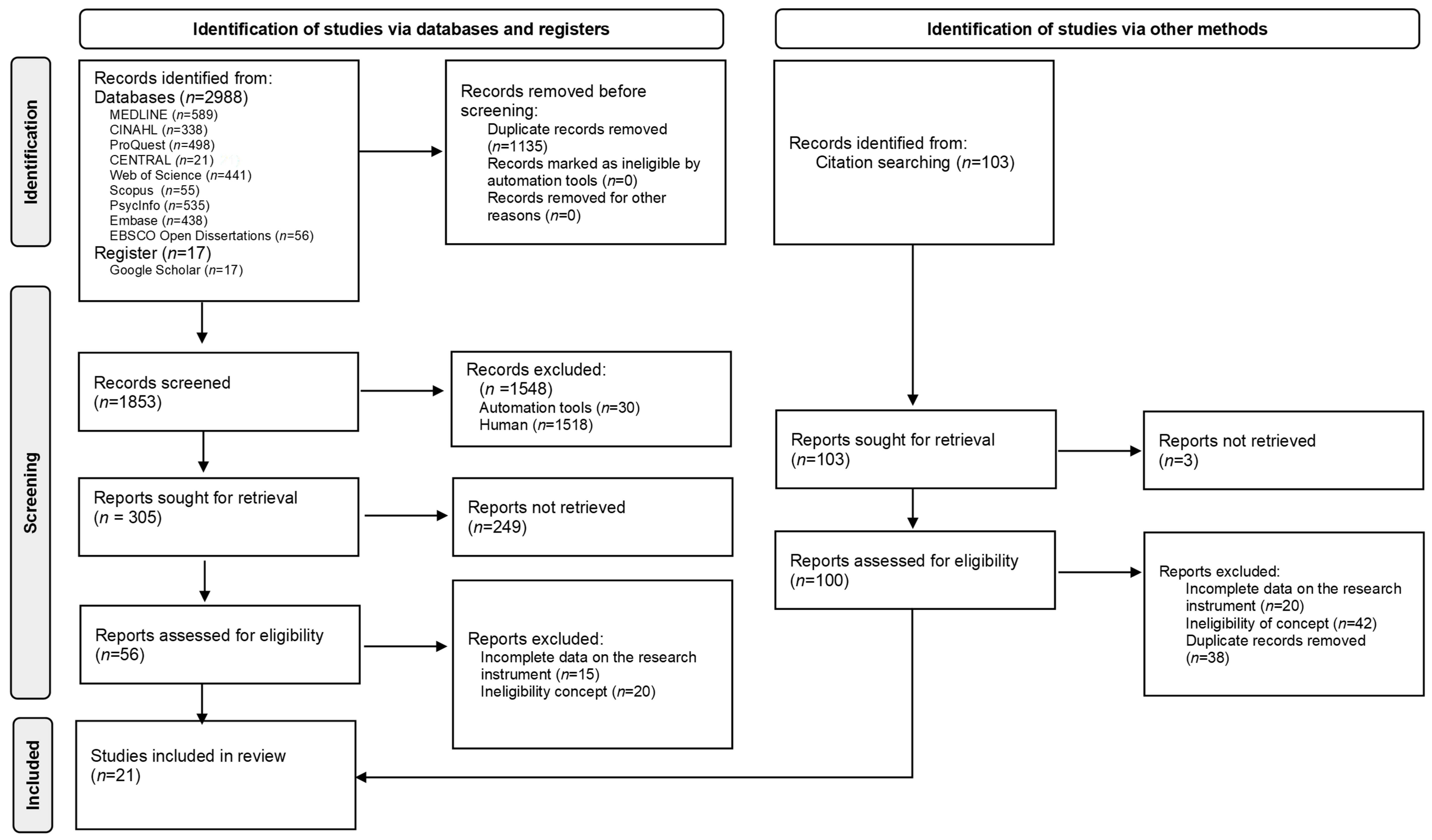
3.1. Results of the Search
3.2. Excluded Studies
3.3. Included Studies
3.4. General Characteristics of Sources

| Authors and Publication Date | Country | Sample | |||
|---|---|---|---|---|---|
| Number N (n) | Gender | Age | Characteristics of Deaf or Hard-of-Hearing | ||
| Laughen, Jacobsen, Rieffe, and Wichstrøm (2017) [53] | Norway | 165 (35) | NS | 4–5 y | using hearing aids in one or both ears, partially using speech, no cochlear implant |
| Martins, Faísca, Vieira, and Gonçalves (2019) [54] | Portugal | 30 (15) | 7 M 8 F | average age 32.4 y | congenitally hearing-impaired |
| Rieffe (2011) [50] | The Netherlands | 52 (26) | NS | average age 11 years | deaf or hard-of-hearing minimum 90 dB, hearing parents in mainstream schools, use SSD (Sign-Supported Dutch) |
| Rieffe, Broekhof, Eichengreen, Kouwenberg, Veiga, da Silva, van der Laan, and Frijns (2018) [55] | The Netherlands | 350 (75 mainstream education + 48 special education) | NS | 9–15 y | NS |
| Sidera, Amadó, and Martínez (2017) [56] | Spain | 166 (75) | 41 M 34 F | 3–8 y | NS |
| Eichengreen, Broekhof, Tsou, and Rieffe (2023) [52] | The Netherlands | 307 (80) | 37 M 43 F | 9–15 y | at least 40 dB in the better ear |
| Hintermair, Sarimski, and Lang (2017) [51] | Germany | 182 (182) | NS | 18–36 m | have hearing loss < 70 dB |
| Mancini, Giallini, Prosperini, D’alessandro, Guerzoni, Murri, Cuda, Ruoppolo, De Vincentiis, and Nicastri (2016) [46] | Italy | 72 (72) | 32 M 40 F | 8–12 y | CI users for at least 36 months |
| Briccetti (1994) [47] | USA | 39 (39) | NS | 9–12 y | prelingual deaf |
| Dyck, Farrugia, Shochet, and Holmes-Brown (2004) [7] | Australia | 121 (49) | NS | 6–11 and 12–18 y | NS |
| Akram and Hameed (2014) [57] | Pakistan | 1519 (469) | 272 M 197 F | adolescents | NS |
| Annalakshmi and Ragitha (2012) [58] | India | 171 (81) | NS | 14–19 y | NS |
| Pei (2013) [59] | PRC | 209 (105) | NS | middle schools | NS |
| Satapathy and Singhal (2001) [60] | India | 159 (80) | NS | 13–21 y | NS |
| Simon (2011) [61] | USA | 176 (88) | 47 M 41 F | 18–35 y | NS |
| Delveschio (1999) [62] | USA | 129 (79) | NS | 5.1–10.7 y | NS |
| Ellala and Ellala (2020) [63] | United Arab Emirates and Saudi Arabia | 115 (56) | 28 M 28 F | undergraduate students | NS |
| Peňacoba, Garvi, Gómez, and Álvarez (2020) [31] | Spain | 192 (146) | NS | NS | NS |
| Hintermair, Sarimski, and Lang (2017) [48] | Germany | 128 (128) | NS | 2–36 m | NS |
| de Gracia, de Rosnay, and Hawes (2021) [64] | Philippines | 205 (102) | 62 M 40 F | 8–22 y | NS |
| Potter (1982) [49] | UK | 93 (93) | 53 M 40 F | 7–16 y | NS |
3.5. Research Information of Sources
| Authors and Publication Date | Research Design | Methods Used | The Aim | Instruments | Outputs |
|---|---|---|---|---|---|
| Laughen, Jacobsen, Rieffe, and Wichstrøm (2017) [53] | Quasi-experimental Research Design | Student’s t-test | The difference in emotional intelligence between individuals who are deaf or hard-of-hearing and those with typical hearing. | The Test of Emotional Comprehension (TEC) Complementary: the Peabody Picture Vocabulary test (PPVT-III) | There are no statistically significant differences between individuals with typical hearing and individuals who are deaf or hard-of-hearing. However, differences in scores exist between children and parents. Children score three, parents of children who are deaf or hard-of-hearing score 5, and those of children with typical hearing score 6. |
| Martins, Faísca, Vieira, and Gonçalves (2019) [54] | Quasi-experimental Research Design | Chi-Square | Long-term effect of individuals who are deaf or hard-of-hearing on recognition of emotions compared to individuals with typical hearing. | The Florida Affect Battery (FAB), The Empathy Quotient scale (EQ) | Individuals with typical hearing scores better than individuals who are deaf or hard-of-hearing, but the difference is not significant. EQ—again, there is no significant difference, except for cognitive empathy, which is significantly lower for individuals who are deaf or hard-of-hearing. |
| Rieffe (2011) [50] | Quasi-experimental Research Design | Student’s t-test | Understanding one’s own emotions—a comparison of individuals who are deaf or hard-of-hearing and individuals with typical hearing. | The Emotion Identification Task (three questions) The Multiple Emotions task (reactions to a story: 1. using four pictures, 2. a scale of the strength of emotions) The emotion regulation task (personal reactions to pictures) | Test 1: No differences Test 2: Individuals with typical hearing identified more sadness than individuals who are deaf or hard-of-hearing; Individual with typical hearing identified more emotions in one story, especially negative emotions—not significant Test 3: Individuals who are deaf or hard-of-hearing reacts more strongly to peer provocation or cannot respond. However, nothing is significant—more research is needed. |
| Rieffe, Broekhof, Eichengreen, Kouwenberg, Veiga, da Silva, van der Laan, and Frijns (2018) [55] | Quasi-experimental Research Design | Chi-Square, Student’s t-test, F-test | The relationship between emotion control and friendship quality in individuals who are deaf or hard-of-hearing and individuals with typical hearing | The Emotion Awareness Questionnaire-Revised (EAQ-R 30)—two scales out of six; complementary: The Best Friend Index (BFI) The Coping Scale | pre-adolescents who are deaf or hard-of-hearing in special education showed lower levels of emotional control and lower friendship quality than both their individuals who are deaf or hard-of-hearing and peers with typical hearing in mainstream education. They benefited less from the same emotion regulation strategies that were helpful for the people who are deaf or hard-of-hearing and participants with typical hearing. However, pre-adolescents who are deaf or hard-of-hearing in mainstream education faced challenges, too, as this study found that their friendships had fewer positive features. |
| Sidera, Amadó, and Martínez (2017) [56] | Quasi-experimental Research Design | Chi-Square | The relationship of verbal competence to emotion recognition—a comparison of individuals who are deaf or hard-of-hearing and individuals with typical hearing. | The Emotion Recognition Task (created to assess the capacity to link emotion words with facial emotional expressions) The Naming Vocabulary subtest of the second edition of the British Ability Scales; complementary: Test of non-verbal reasoning | The results show a delay in deaf children’s capacity to recognize some emotions (scared, surprised, and disgusted) but not others (happy, sad, and angry). Notably, they recognized emotions in a similar order to hearing children. Moreover, linguistic skills were found to be related to emotion recognition skills, even when controlling for age. |
| Eichengreen, Broekhof, Tsou, and Rieffe (2023) [52] | Quasi-experimental Research Design | Cronbach’s Alpha, Multivariate analysis of variance (MANOVA) | Emotion awareness (EA) and regulation (ER) comparison of individuals who are deaf or hard-of-hearing and individuals with typical hearing | The Emotion Awareness Questionnaire-Revised (EAQ-R) complementary: Wechsler Intelligence Scale for Children (WISC-III) The Clinical Evaluation of Language Fundamentals—Fourth edition (CELF) Coping Scale (Dutch version) | No developmental trends were observed to differentiate emotions, and there was a notable lack of bodily awareness and effective communication of emotions. No differences were found between the participants who are deaf or hard-of-hearing and hearing participants in baseline levels or in the developmental trends of EA and ER skills. |
| Hintermair, Sarimski, and Lang (2017) [51] | Quasi-experimental Research Design | Cronbach’s Alpha, Student’s t-test, F-test | Social–emotional skills—comparison of individuals who are deaf or hard-of-hearing and individuals with typical hearing | Infant Toddler Social Emotional Assessment (ITSEA) Social Emotional Assessment—Evaluation Measure (SEAM) | Potential difficulties specific to children with hearing loss occur in areas related to language and socio-cognitive domains (such as emotion regulation and empathy). |
| Mancini, Giallini, Prosperini, D’alessandro, Guerzoni, Murri, Cuda, Ruoppolo, De Vincentiis, and Nicastri (2016) [46] | Descriptive research design | Analysis of variance (ANOVA), Pearson correlation | To describe the emotion comprehension skills of CI users. | The Test of Emotion Comprehension (TEC); complementary: Raven’s Colored Progressive Matrices (CMP); The Peabody Picture Vocabulary Test (PPVT) | In their TEC score, 57 children showed everyday range performances (79.17% of recipients), and 15 fell below average (20.83%). 16.63% of the older subjects aged eight to 12 did not master Stage 3 (reflective), which is typically acquired by the age of eight, and failed two or all three items of this component. Subjects who received a cochlear implant in the research study within 18 months of age had better emotion comprehension skills. The TEC results also correlated positively with early diagnosis, extended implant use, and improved auditory skills. |
| Briccetti (1994) [47] | Descriptive research Design | Student’s t-test, F-test | Validation of the Draw-A-Person: Screening Procedure for Emotional Disturbance. | The Draw-A-Person: Screening Procedure for Emotional Disturbance (DAP: SPED) | More than half of the subjects from each group were misclassified using the DAP: SPED system. The results indicate that DAP: SPED is not a valid screening instrument for use with deaf children, and there is a need for separate normative data for this group. |
| Dyck, Farrugia, Shochet, and Holmes-Brown (2004) [7] | Quasi-experimental Research Design | Chi-Square, F-test, Student’s t-test | This study assesses whether children who are deaf or hard-of-hearing have consistent delays in acquiring the ability to recognize and understand emotions | The Emotion Recognition Scales (ERS) complementary: Wechsler Intelligence Scale for Children (WISC-III) | The results indicate that when compared with their age peers, HI children and adolescents have significant delays or deficits in all Emotion Recognition Scales (ERS). Compared with a group of children matched for verbal ability (Wechsler verbal scales), the achievement of children with HI on ERS equals or exceeds that of the controls. Conclusions: HI children’s performance on emotion recognition and emotion understanding tasks reflects delayed acquisition of a broad range of language-mediated abilities. |
| Akram and Hameed (2014) [57] | Quasi-experimental Research Design | Pearson correlation, Student’s t-test, factorial analyses | The study was conducted to explore the levels of adaptive emotional abilities of those who are deaf or hard-of-hearing as well as to find the roles of sociodemographic factors. Variables in the development of their emotional abilities. | The Adaptive Emotional Abilities Scale (AEAS) | The study results showed that the HI adolescents scored significantly lower than the hearing adolescents. The study indicates poor social–emotional adjustment and low social–emotional abilities in deaf children. On the other hand, it was found that sociodemographic variables such as access to hearing assessment and speech services, the time of the intervention, the presence of an HI family member, the preferred language of the family, and the preferred language of the participants themselves, regardless of their hearing loss, play important roles in developing the adaptive emotional abilities of the HI adolescents. The results indicated that hearing loss is not the only reason for the poor performance of adolescents with hearing loss. |
| Annalakshmi and Ragitha (2012) [58] | Quasi-experimental Research Design | F-test, Pearson correlation | To describe the psychological distress and psychological well-being of the subjects. | The Berkeley Expressivity Questionnaire (BEQ) complementary: General Well-Being | The HI subjects had higher psychological distress and lower psychological well-being compared to the TH subjects. |
| Pei (2013) [59] | Quasi-experimental Research Design | Student’s t-test, F-test | Relationship between regulatory emotional self-efficacy and coping style | Regulatory Emotional Self-Efficacy (RESE) Complementary: Coping Style Scale for Middle School Students (CSSMSS) | Individuals who are deaf or hard-of-hearing scored lower in three dimensions of RESE: problem-solving, support-seeking, rationalized explanation, and CSM patience. |
| Satapathy and Singhal (2001) [60] | Quasi-experimental Research Design | F-test, Pearson correlation | This study examines the relationship between psychosocial and contextual conditions as correlates of social adaptation of individuals who are deaf or hard-of-hearing and individuals with typical hearing. | The Meadow/Kendall Social–Emotional Assessment Inventory for Deaf Students complementary: Self-Confidence Questionnaire (SCQ) | Behavioral problems, stress, and academic performance as predictors influenced both groups’ social–emotional adjustment levels. |
| Simon (2011) [61] | Quasi-experimental Research Design | Chi-Square, Analysis of variance (ANOVA) | Differences between individuals who are deaf or hard-of-hearing and individuals with typical hearing in expressive reactions and acculturation | The International Survey of Emotional Antecedents and Reactions—deaf version (ISEAR-D). Complementary: The Deaf Acculturation Scale with 58 items (DAS-58). | There are differences between individuals who are deaf or hard-of-hearing and individuals with typical hearing. Deaf people seemed to expect negative emotions to happen more often. Deaf people would report higher non-verbal expression, ergotropic, and trophotropic arousal. Higher levels of deaf acculturation are associated with a greater impact of negative emotions in relationships and lower self-esteem. |
| Delveschio (1999) [62] | Quasi-experimental Research Design | Student’s t-test | Compared the ages at which three groups of children, individuals who are deaf or hard-of-hearing and individuals with typical hearing, achieved four increasingly complex levels of emotional understanding | The Meadow/Kendall Social–Emotional Assessment Inventory for Deaf Students complementary: Attitudes Towards Deafness Scale | Age has no significant effect. Boys who are deaf or hard-of-hearing are generally more delayed than their peers. For girls, it varies—those with parents who are deaf or hard-of-hearing and parents with typical hearing are almost at the same level. Girls who are deaf or hard-of-hearing with parents with typical hearing are slightly more delayed. |
| Ellala and Ellala (2020) [63] | Quasi-experimental Research Design | F-test | The study aims to determine differences in emotional intelligence between individuals who are deaf or hard-of-hearing and individuals with typical hearing. | Chapman’s Scale of Emotional Intelligence | This reveals that there are differences in statistical function (α ≥ 0.05) in students’ performance on Chapman’s five-dimensional emotional intelligence scale, attributed to the student variable (deaf vs. standard), in favor of the standard students. The two researchers consider this result normal due to the impact of hearing loss on various aspects of personality, including self-efficacy, emotions, and control. A individuals who are deaf or hard-of-hearing cannot compare themself to others as they have only one option: self-control. They cannot communicate socially with others except through signs, a language that few can communicate through. Individuals with typical hearing also excels in linguistic intelligence, which individuals who are deaf or hard-of-hearing lacks. The two researchers could not compare their study with another one as no such study had been conducted before. |
| Peňacoba, Garvi, Gómez, and Álvarez (2020) [31] | Quasi-experimental Research Design | Cronbach’s Alpha, Multivariate analysis of variance (MANOVA), Pearson correlation, Analysis of variance (ANOVA) | The study explored the possible relationship between emotional intelligence and psychological well-being. | Trait Meta-Mood Scale (TMMS-24) complementary: Toronto Alexithymia Scale (TAS-20) Hospitality Anxiety and Depression Scale (HADS) Psychological Well-Scale (PWBS) | Significant differences were found between deaf and hearing participants regarding anxiety, depression, alexithymia, and psychological well-being. No differences were found between deaf and typically hearing participants in terms of emotional functioning. The differences observed between deaf and participants with typical hearing regarding psychological well-being are discussed in terms of higher rates of depression among the former. |
| Hintermair, Sarimski, and Lang (2017) [48] | Descriptive research design | Chi-Square, Student’s t-test | Explore the usefulness of an instrument that was developed for very young children. | The Social–Emotional Assessment Measure (SEAM) | The SEAM child competencies scale’s reliability (internal consistency) was comparable to that reported in the manual. The reliability of the ITSEA scales was satisfactory, except for the “Peer relations” scale in the younger age group. This applies to both the mothers’ ratings and the early intervention providers’ ratings. In both age groups, the total competence score had perfect internal consistency when completed by mothers and early intervention providers. This indicates that parents evaluated their toddler’s social–emotional competence more favorably than the intervention provider working with the family. |
| de Gracia, de Rosnay, and Hawes (2021) [64] | Quasi-experimental Research Design | Linear regressions | The study examined associations between deafness, understanding emotions, and affective recognition between individuals who are deaf or hard-of-hearing and individuals with typical hearing. | The Test of Emotion Comprehension (TEC) complementary: Diagnostic Assessment of Nonverbal Accuracy-2 (DANVA-2) The Expressive Vocabulary Test, 2nd edition | Results from hierarchical linear regressions indicate that, after controlling for age and verbal ability, both groups performed similarly in terms of total ARL skills. In contrast, the deaf cohort performed worse on total EU than the hearing controls, even after accounting for age and verbal ability. In the final model, age, verbal ability, and hearing status were all statistically significant predictors of EU. Thus, the hearing participants had a significantly better understanding of emotions than the deaf group, but not more extraordinary ARL ability. Through this study, we demonstrated that for Filipino deaf persons, the delays in social cognitive skills first observed in ToM extend to understanding emotions, signaling a general impairment of mental abilities. |
| Potter (1982) [49] | Descriptive research design | The Kendall Rank Correlation Coefficient, Pearson correlation | The applicability of using an assessment scale designed to assess social–emotional functioning in hearing children with a deaf population, and the functioning of the assessment scale as a diagnostic instrument for deaf children. | The Meadow/Kendall Social–Emotional Assessment Inventory for Deaf Students complementary: The Rutter Children’s Behavior Questionnaire | Comparing the two scales (the Rutter Children’s Behavior Questionnaire, a screening instrument designed for hearing children, and the Meadow/Kendall Social Emotional Assessment Inventory) to test the applicability of the Rutter Children’s Behavior Questionnaire test for deaf and hard–of–hearing children. All three scales identified nearly one-third of the population as having social–emotional problems, while the Rutter scale, designed to “over-identify,” identified just over one-third. These results raise questions about using the SEAI as anything other than a screening instrument. Finally, additional analyses were conducted to examine the reliability of the two rating scales and teacher judgment. All three measures had high reliability. However, the results do not support a recommendation of validity for the mentioned instruments. |
3.6. Outputs
4. Discussion
4.1. Main Findings
4.2. Assessment Instruments
4.3. Modifications
4.4. Effect of Age and Gender
4.5. Limitations and Potential Biases in the Review Process
4.6. Agreements and Disagreements with Other Studies or Reviews
4.6.1. Evaluation of Emotional Intelligence (EI) in Individuals Who Are Deaf or Hard-of-Hearing
4.6.2. Adaptation of Psychological Tests
4.6.3. Communication Considerations
4.6.4. Challenges in Standard Psychological Tests
4.6.5. Modifications to Emotional Intelligence Assessments
4.6.6. Gender and Age Differences
4.6.7. Authors’ Conclusions
5. Conclusions
6. Implications for Further Research and Practice
Supplementary Materials
Author Contributions
Funding
Institutional Review Board Statement
Informed Consent Statement
Data Availability Statement
Acknowledgments
Conflicts of Interest
Disability Language/Terminology Positionality Statement
References
- Gu, S.; Wang, F.; Patel, N.P.; Bourgeois, J.A.; Huang, J.H. A Model for Basic Emotions Using Observations of Behavior in Drosophila. Front. Psychol. 2019, 10, 781. [Google Scholar] [CrossRef]
- Celeghin, A.; Diano, M.; Bagnis, A.; Viola, M.; Tamietto, M. Basic Emotions in Human Neuroscience: Neuroimaging and Beyond. Front. Psychol. 2017, 8, 1432. [Google Scholar] [CrossRef] [PubMed]
- Ellsworth, P.C. Appraisal Theory: Old and New Questions. Emot. Rev. 2013, 5, 125–131. [Google Scholar] [CrossRef]
- Tsou, Y.T.; Li, B.; Eichengreen, A.; Frijns, J.H.M.; Rieffe, C. Emotions in Deaf and Hard-of-Hearing and Typically Hearing Children. J. Deaf Stud. Deaf Educ. 2021, 26, 469–482. [Google Scholar] [CrossRef]
- Calderon, R.; Greenberg, M.T. Social and Emotional Development of Deaf Children: Family, School, and Program Effects. In Oxford University Press eBooks; Oxford University Press: New York, NY, USA, 2012; pp. 188–199. [Google Scholar]
- Deneault, J.; Ricard, M. Are Emotion and Mind Understanding Differently Linked to Young Children’s Social Adjustment? Relationships between Behavioral Consequences of Emotions, False Belief, and SCBE. J. Genet. Psychol. 2013, 174, 88–116. [Google Scholar] [CrossRef] [PubMed]
- Dyck, M.J.; Farrugia, C.J.; Shochet, I.M.; Holmes-Brown, M. Emotion Recognition/Understanding Ability in Hearing or Vision-Impaired Children: Do Sounds, Sights, or Words Make the Difference? J. Child Psychol. Psychiatry 2004, 45, 789–800. [Google Scholar] [CrossRef] [PubMed]
- Verduyn, P.; Delaveau, P.; Rotge, J.-Y.; Fossati, P.; Van Mechelen, I. Determinants of Emotion Duration and Underlying Psychological and Neural Mechanisms. Emot. Rev. 2015, 7, 330–335. [Google Scholar] [CrossRef]
- Nesse, R.M. Evolutionary Explanations of Emotions. Hum. Nat. 1990, 1, 261–289. [Google Scholar] [CrossRef]
- Fredrickson, B.L. What Good Are Positive Emotions? Rev. Gen. Psychol. 1998, 2, 300–319. [Google Scholar] [CrossRef]
- Fredrickson, B.L.; Branigan, C. Positive Emotions Broaden the Scope of Attention and Thought-Action Repertoires. Cogn. Emot. 2005, 19, 313–332. [Google Scholar] [CrossRef]
- Mauss, I.B.; Levenson, R.W.; McCarter, L.; Wilhelm, F.H.; Gross, J.J. The Tie That Binds? Coherence among Emotion Experience, Behavior, and Physiology. Emotion 2005, 5, 175–190. [Google Scholar] [CrossRef] [PubMed]
- Scherer, K.R. What Are Emotions? Moreover, How Can They Be Measured? Soc. Sci. Inf. 2005, 44, 695–729. [Google Scholar] [CrossRef]
- Davidson, R.J.; Scherer, K.R.; Goldsmith, H.H. Handbook of Affective Sciences; Oxford University Press: Oxford, UK, 2002. [Google Scholar] [CrossRef]
- Hall, J.A.; Coats, E.J.; LeBeau, L.S. Nonverbal Behavior and the Vertical Dimension of Social Relations: A Meta-Analysis. Psychol. Bull. 2005, 131, 898–924. [Google Scholar] [CrossRef]
- Salovey, P.; Grewal, D. The Science of Emotional Intelligence. Curr. Dir. Psychol. Sci. 2005, 14, 281–285. [Google Scholar] [CrossRef]
- Mayer, J.D.; Salovey, P.; Caruso, D.R. Emotional Intelligence: New Ability or Eclectic Traits? Am. Psychol. 2008, 63, 503–517. [Google Scholar] [CrossRef]
- Cherniss, C. Emotional Intelligence: Toward Clarification of a Concept. Ind. Organ. Psychol. 2010, 3, 110–126. [Google Scholar] [CrossRef]
- Joseph, D.L.; Newman, D.A. Emotional Intelligence: An Integrative Meta-Analysis and Cascading Model. J. Appl. Psychol. 2010, 95, 54–78. [Google Scholar] [CrossRef]
- Marschark, M.; Shaver, D.M.; Nagle, K.M.; Newman, L.A. Predicting the Academic Achievement of Deaf and Hard-of-Hearing Students from Individual, Household, Communication, and Educational Factors. Except. Child. 2015, 81, 350–369. [Google Scholar] [CrossRef]
- Humphries, T.; Kushalnagar, P.; Mathur, G.; Napoli, D.J.; Padden, C.; Rathmann, C.; Smith, S.R. Language Acquisition for Deaf Children: Reducing the Harms of Zero Tolerance to the Use of Alternative Approaches. Harm Reduct. J. 2012, 9, 16. [Google Scholar] [CrossRef]
- Maes, J.H.R.; Scheper, A.R.; Hermans, D.; Vissers, C.T.W.M. Incidental Learning and Social-Communicative Abilities in Children with Developmental Language Disorder: Further Evaluating the Implicit Learning Deficit Hypothesis. Int. J. Lang. Commun. Disord. 2025, 60, e70017. [Google Scholar] [CrossRef]
- Rott, S. The Effect of Exposure Frequency on Intermediate Language Learners’ Incidental Vocabulary Acquisition and Retention through Reading. Stud. Second Lang. Acquis. 1999, 21, 589–619. [Google Scholar] [CrossRef]
- Convertino, C.; Borgna, G.; Marschark, M.; Durkin, A. Word and World Knowledge among Deaf Learners with and without Cochlear Implants. J. Deaf Stud. Deaf Educ. 2014, 19, 471–483. [Google Scholar] [CrossRef]
- Marschark, M.; Hauser, P.C. Cognitive Underpinnings of Learning by Deaf and Hard-of-Hearing Students. In Oxford University Press eBooks; Oxford University Press: Oxford, UK, 2008; pp. 3–23. [Google Scholar] [CrossRef]
- Moeller, M.P. Early Intervention and Language Development in Children Who Are Deaf and Hard of Hearing. Pediatrics 2000, 106, e43. [Google Scholar] [CrossRef]
- Hall, M.L. The Input Matters: Assessing Cumulative Language Access in Deaf and Hard of Hearing Individuals and Populations. Front. Psychol. 2020, 11, 1407. [Google Scholar] [CrossRef]
- Hall, W.C.; Levin, L.L.; Anderson, M.L. Language Deprivation Syndrome: A Possible Neurodevelopmental Disorder with Sociocultural Origins. Soc. Psychiatry Psychiatr. Epidemiol. 2017, 52, 761–776. [Google Scholar] [CrossRef]
- Intxaustegi, A.; Serrat, E.; Amadó, A.; Sidera, F. Language and Hidden Emotion Understanding in Deaf and Hard-of-Hearing Children: The Role of Mentalistic Verbs. Behav. Sci. 2025, 15, 1106. [Google Scholar] [CrossRef]
- Vaccari, C.; Marschark, M. Communication between Parents and Deaf Children: Implications for Social-Emotional Development. J. Child Psychol. Psychiatry 1997, 38, 793–801. [Google Scholar] [CrossRef]
- Peñacoba, C.; Garvi, D.; Gómez, L.; Álvarez, A. Psychological Well-Being, Emotional Intelligence, and Emotional Symptoms in Deaf Adults. Am. Ann. Deaf 2020, 165, 436–452. [Google Scholar] [CrossRef] [PubMed]
- MacCann, C.; Jiang, Y.; Brown, L.E.R.; Double, K.S.; Bucich, M.; Minbashian, A. Emotional Intelligence Predicts Academic Performance: A Meta-Analysis. Psychol. Bull. 2019, 146, 150–186. [Google Scholar] [CrossRef]
- O’Connor, P.J.; Hill, A.; Kaya, M.; Martin, B. The Measurement of Emotional Intelligence: A Critical Review of the Literature and Recommendations for Researchers and Practitioners. Front. Psychol. 2019, 10, 1116. [Google Scholar] [CrossRef] [PubMed]
- Jonson, J.L. Fairness in Educational and Psychological Testing: Examining Theoretical, Research, Practice, and Policy Implications of the 2014 Standards; American Educational Research Association: Washington, DC, USA, 2022. [Google Scholar] [CrossRef]
- Ashori, M.; Jalil-Abkenar, S.S. Emotional Intelligence: Quality of Life and Cognitive Emotion Regulation of Deaf and Hard-of-Hearing Adolescents. Deaf. Educ. Int. 2020, 23, 84–102. [Google Scholar] [CrossRef]
- Pourmohamadreza-Tajrishi, M.; Ashori, M.; Jalilabkenar, S.S. The Effectiveness of Emotional Intelligence Training on the Mental Health of Male Deaf Students. Iran. J. Public Health 2013, 42, 1174–1180. [Google Scholar]
- Cochrane Database of Systematic Reviews. Available online: https://www.cochranelibrary.com/ (accessed on 8 September 2024).
- Tricco, A.C.; Lillie, E.; Zarin, W.; O’Brien, K.K.; Colquhoun, H.; Levac, D.; Moher, D.; Peters, M.D.J.; Horsley, T.; Weeks, L.; et al. PRISMA Extension for Scoping Reviews (PRISMA-ScR): Checklist and Explanation. Ann. Intern. Med. 2018, 169, 467–473. [Google Scholar] [CrossRef]
- Piaget, J.; Inhelder, B. The Psychology of the Child; Basic Books: New York, NY, USA, 1972. [Google Scholar]
- Carl, M. Representationalism and Enactivism in Cognitive Translation Studies: A Predictive Processing Perspective. Information 2025, 16, 751. [Google Scholar] [CrossRef]
- Carney, J. Thinking avant la lettre: A Review of 4E Cognition. Evol. Stud. Imaginative Cult. 2020, 4, 77–90. [Google Scholar] [CrossRef] [PubMed]
- Potměšilová, P.; Potměšil, M.; Marečková, J. PROTOCOL: Instruments for the Evaluation of Emotional Intelligence in Persons with Hearing Impairments: A Scoping Review. Campbell Syst. Rev. 2022, 18, e1261. [Google Scholar] [CrossRef] [PubMed]
- Munn, Z.; Aromataris, E.; Tufanaru, C.; Stern, C.; Porritt, K.; Farrow, J.; Lockwood, C.; Stephenson, M.; Moola, S.; Lizarondo, L.; et al. The Development of Software to Support Multiple Systematic Review Types: The Joanna Briggs Institute System for the Unified Management, Assessment and Review of Information (JBI SUMARI). JBI Evid. Implement. 2019, 17, 36–43. [Google Scholar] [CrossRef]
- Popay, J.; Roberts, H.; Sowden, A.; Petticrew, M.; Arai, L.; Rodgers, M.; Britten, N.; Roen, K.; Duffy, S. Guidance on the Conduct of Narrative Synthesis in Systematic Reviews: A Product from the ESRC Methods Programme; Version I; University of Lancaster: Lancaster, UK, 2006. [Google Scholar]
- Page, M.J.; McKenzie, J.E.; Bossuyt, P.M.; Boutron, I.; Hoffmann, T.C.; Mulrow, C.D.; Shamseer, L.; Tetzlaff, J.M.; Akl, E.A.; Brennan, S.E.; et al. The PRISMA 2020 Statement: An Updated Guideline for Reporting Systematic Reviews. BMJ 2021, 372, n71. [Google Scholar] [CrossRef] [PubMed]
- Mancini, P.; Giallini, I.; Prosperini, L.; D’Alessandro, H.D.; Guerzoni, L.; Murri, A.; Cuda, D.; Ruoppolo, G.; De Vincentiis, M.; Nicastri, M. Level of Emotion Comprehension in Children with Mid to Long Term Cochlear Implant Use: How Basic and More Complex Emotion Recognition Relates to Language and Age at Implantation. Int. J. Pediatr. Otorhinolaryngol. 2016, 87, 219–232. [Google Scholar] [CrossRef]
- Briccetti, K.A. Emotional Indicators of Deaf Children on the Draw-a-Person Test. Am. Ann. Deaf 1994, 139, 500–505. [Google Scholar] [CrossRef]
- Hintermair, M.; Sarimski, K.; Lang, M. Sozial-Emotionale Kompetenzen Hörgeschädigter Kleinkinder [Social-Emotional Competences in Deaf and Hard-of-Hearing Toddlers—Results from an Empirical Study with Two Current Parent Questionnaires]. Z. Kinder Jugendpsychiatr. Psychother. 2017, 45, 128–140. [Google Scholar] [CrossRef]
- Potter, A.M. Social-Emotional Assessment of Deaf Children: A Comparison of Two Measures. Master’s Thesis, University of British Columbia, Vancouver, BC, Canada, 1982. [Google Scholar]
- Rieffe, C. Awareness and Regulation of Emotions in Deaf Children. Br. J. Dev. Psychol. 2011, 30, 477–492. [Google Scholar] [CrossRef]
- Hintermair, M.; Sarimski, K.; Lang, M. Preliminary Evidence Assessing Social-Emotional Competences in Deaf and Hard of Hearing Infants and Toddlers Using a New Parent Questionnaire. J. Deaf Stud. Deaf Educ. 2017, 22, 143–154. [Google Scholar] [CrossRef] [PubMed]
- Eichengreen, A.; Broekhof, E.; Tsou, Y.T.; Rieffe, C. Longitudinal Effects of Emotion Awareness and Regulation on Mental Health Symptoms in Adolescents with and without Hearing Loss. Eur. Child Adolesc. Psychiatry 2023, 32, 705–724. [Google Scholar] [CrossRef] [PubMed]
- Laugen, N.J.; Jacobsen, K.H.; Rieffe, C.; Wichstrøm, L. Emotion Understanding in Preschool Children with Mild-to-Severe Hearing Loss. J. Deaf Stud. Deaf Educ. 2017, 22, 155–163. [Google Scholar] [CrossRef] [PubMed]
- Martins, A.T.; Faísca, L.; Vieira, H.; Gonçalves, G. Emotional Recognition and Empathy Both in Deaf and Blind Adults. J. Deaf Stud. Deaf Educ. 2019, 24, 119–127. [Google Scholar] [CrossRef]
- Rieffe, C.; Broekhof, E.; Eichengreen, A.; Kouwenberg, M.; Veiga, G.; da Silva, B.M.S.; van der Laan, A.; Frijns, J.H.M. Friendship and Emotion Control in Pre-Adolescents with or without Hearing Loss. J. Deaf Stud. Deaf Educ. 2018, 23, 209–218. [Google Scholar] [CrossRef]
- Sidera, F.; Amadó, A.; Martínez, L. Influences on facial emotion recognition in deaf children. J. Deaf. Stud. Deaf. Educ. 2016, 22, 164–177. [Google Scholar] [CrossRef]
- Akram, B.; Hameed, A. Adaptive Emotional Abilities of Adolescents with Hearing Impairment. Pak. J. Psychol. Res. 2014, 29, 103–123. [Google Scholar]
- Annalakshmi, N.; Ragitha, R. General Well-Being and Emotional Expressivity among Hearing Impaired and Non-Hearing Impaired Adolescents. J. Indian Acad. Appl. Psychol. 2012, 38, 134–137. [Google Scholar]
- Pei, L. Regulatory Emotional Self-Efficacy and Coping Style in Deaf-Mute Students. Chin. Ment. Health J. 2013, 27, 452. [Google Scholar]
- Satapathy, S.; Singhal, S. Predicting Social-Emotional Adjustment of the Sensory Impaired Adolescents. J. Pers. Clin. Stud. 2001, 17, 85–93. [Google Scholar]
- Simon, M. A Study of Emotional Antecedents and Reactions in Deaf College Students. Ph.D. Thesis, Columbia University, New York, NY, USA, 2011. [Google Scholar]
- Delvecchio, D.R. The Development of Deaf and Hearing Children’s Understanding of Multiple Emotions of Varying Valence and Intensity. Ph.D. Thesis, Columbia University, New York, NY, USA, 1999. [Google Scholar]
- Ellala, Z.K.; Ellala, S.K. A Comparative Study of Emotional Intelligence between Deaf and Other Students and Its Correlation to Gender Variables. Int. J. Innov. Creat. Chang. 2020, 11, 627–648. [Google Scholar]
- de Gracia, M.R.L.; de Rosnay, M.; Hawes, D.J.; Perez, M.V.T. Differences in Emotion Knowledge among Filipino Deaf Children, Adolescents, and Young Adults. Pers. Individ. Differ. 2021, 180, 110967. [Google Scholar] [CrossRef]
- Ehrenreich, J.T.; Fairholme, C.P.; Buzzella, B.A.; Ellard, K.K.; Barlow, D.H. The Role of Emotion in Psychological Therapy. Clin. Psychol. Sci. Pract. 2007, 14, 422–428. [Google Scholar] [CrossRef]
- Polat, F. The Turkish Standardization of the Meadow-Kendall Social-Emotional Assessment Inventory for Deaf and Hearing-Impaired Students. Am. Ann. Deaf 2006, 151, 32–41. [Google Scholar] [CrossRef]
- Rieffe, C.; Oosterveld, P.; Miers, A.C.; Terwogt, M.M.; Ly, V. Emotion Awareness and Internalizing Symptoms in Children and Adolescents: The Emotion Awareness Questionnaire Revised. Pers. Individ. Differ. 2008, 45, 756–761. [Google Scholar] [CrossRef]
- American Psychological Association. Guidelines for Assessment of and Intervention with Persons with Disabilities. Am. Psychol. 2012, 67, 43–62. [Google Scholar] [CrossRef] [PubMed]
- Šumak, B.; Kous, K.; Martínez-Normand, L.; Pekša, J.; Pušnik, M. Identification of Challenges and Best Practices for Including Users with Disabilities in User-Based Testing. Appl. Sci. 2023, 13, 5498. [Google Scholar] [CrossRef]
- Thompson, T.; Coleman, J.M.; Riley, K.; Snider, L.A.; Howard, L.J.; Sansone, S.M.; Hessl, D. Standardized Assessment Accommodations for Individuals with Intellectual Disability. Contemp. Sch. Psychol. 2018, 22, 443–457. [Google Scholar] [CrossRef] [PubMed]
- Dahlstrom-Hakki, I.H.; Alstad, Z.G. Challenges Assessing the Conceptual Understanding of Students with Disabilities in Statistics. Learn. Disabil. Q. 2019, 42, 175–185. [Google Scholar] [CrossRef]
- Gaeta, L.; Azzarello, J.; Baldwin, J.; Ciro, C.; Hudson, M.A.; Johnson, C.E.; John, A.B. The Impact of Amplification on Cognitive Screening Test Scores. J. Gerontol. Nurs. 2022, 48, 31–37. [Google Scholar] [CrossRef] [PubMed]
- Deal, J.A.; Gross, A.L.; Sharrett, A.R.; Abraham, A.G.; Coresh, J.; Carlson, M.; Griswold, M.; Mosley, T.; Power, M.C.; Ramulu, P.; et al. Hearing impairment and missing cognitive test scores in a population-based study of older adults: The Atherosclerosis Risk in Communities neurocognitive study. Alzheimer’s Dement. 2021, 17, 1725–1734. [Google Scholar] [CrossRef]
- De Bruin, E. The Psychotherapist and the Sign Language Interpreter. J. Deaf Stud. Deaf Educ. 2006, 11, 360–368. [Google Scholar] [CrossRef]
- Molander, P.; Andersson, G.; Hesser, H. Psychological Acceptance in Adults with Hearing Loss—Psychometric Evaluation and Validation of the Hearing Acceptance Questionnaire. Ear Hear. 2022, 43, 1752–1760. [Google Scholar] [CrossRef]
- Miller, M.; Thomas-Presswood, T.N.; Metz, K.; Lukomski, J. Psychological and Psychoeducational Assessment of Deaf and Hard of Hearing Children and Adolescents; Gallaudet University Press: Washington, DC, USA, 2015. [Google Scholar]
- Hearing Loss, Deafness and Psychometric Testing Practical Advice for Test Users Managing the Testing of People Who Are Deaf or Have a Hearing Loss. Available online: https://cms.bps.org.uk/sites/default/files/2022-07/ptc25_hearing_loss_and_deafness_web_0.pdf (accessed on 17 December 2025).
- Cawthon, S.; Leppo, R.; Carr, T.; Kopriva, R. Toward Accessible Assessments: The Promises and Limitations of Test Item Adaptations for Students with Disabilities and English Language Learners. Educ. Assess. 2013, 18, 73–98. [Google Scholar] [CrossRef]
- Hess, U. Nonverbal Communication. In Elsevier eBooks; Elsevier: Amsterdam, The Netherlands, 2023; pp. 647–659. [Google Scholar]
- Page, L. Social Interactions. In Cambridge University Press eBooks; Cambridge University Press: Cambridge, UK, 2022; pp. 127–128. [Google Scholar]
- Stein, S.J.; Deonarine, J.M. Current Concepts in the Assessment of Emotional Intelligence. In Springer eBooks; Springer: Cham, Switzerland, 2014; pp. 381–402. [Google Scholar]
- Syiem, I. Emotional Intelligence: Why It Matters in Teaching. IOSR J. Humanit. Soc. Sci. 2012, 2, 42–43. [Google Scholar] [CrossRef]
- Radley, K.C.; O’Handley, R.D.; Labrot, Z.C. A Comparison of Momentary Time Sampling and Partial-Interval Recording for Assessment of Effects of Social Skills Training. Psychol. Sch. 2015, 52, 363–378. [Google Scholar] [CrossRef]
- Hanson, S.L.; Bruyere, S.; Forber-Pratt, A.; Reesman, J.; Sung, C. Guidelines for Assessment and Intervention with Persons with Disabilities: An Executive Summary. Am. Psychol. 2023, 78, 995–1009. [Google Scholar] [CrossRef]
- Pujar, L.; Patil, S. Emotional Intelligence among Hearing Impaired Children. Int. J. Curr. Microbiol. App. Sci. 2019, 8, 1818–1824. [Google Scholar] [CrossRef]
- Christensen, J.A.; Sis, J.; Kulkarni, A.M.; Chatterjee, M. Effects of Age and Hearing Loss on the Recognition of Emotions in Speech. Ear Hear. 2019, 40, 1069–1083. [Google Scholar] [CrossRef] [PubMed]
- Anderson, K.L.; Arnoldi, K. Building Skills for Success in the Fast-Paced Classroom: Optimizing Achievement for Students with Hearing Loss; Butte Publications: St. Paul, MN, USA, 2011. [Google Scholar]
- Day, L.A.; Adams Costa, E.B.; Raiford, S.E. Testing Children Who Are Deaf or Hard of Hearing; WISC-V Technical Report #2, Issue; Pearson: Bloomington, MN, USA, 2015. [Google Scholar]
- Maller, S.J.; Braden, J.P. Intellectual Assessment of Deaf People: A Critical Review of Core Concepts and Issues. In Oxford University Press eBooks; Oxford University Press: New York, NY, USA, 2012; pp. 473–485. [Google Scholar]

Disclaimer/Publisher’s Note: The statements, opinions and data contained in all publications are solely those of the individual author(s) and contributor(s) and not of MDPI and/or the editor(s). MDPI and/or the editor(s) disclaim responsibility for any injury to people or property resulting from any ideas, methods, instructions or products referred to in the content. |
© 2026 by the authors. Licensee MDPI, Basel, Switzerland. This article is an open access article distributed under the terms and conditions of the Creative Commons Attribution (CC BY) license.
Share and Cite
Potmesilova, P.; Potmesil, M.; Guo, L.; Ruzickova, V.; Spinarova, G.; Kvintova, J. Emotional Intelligence Measurement Tools and Deaf and Hard-of-Hearing People—Scoping Review. Disabilities 2026, 6, 10. https://doi.org/10.3390/disabilities6010010
Potmesilova P, Potmesil M, Guo L, Ruzickova V, Spinarova G, Kvintova J. Emotional Intelligence Measurement Tools and Deaf and Hard-of-Hearing People—Scoping Review. Disabilities. 2026; 6(1):10. https://doi.org/10.3390/disabilities6010010
Chicago/Turabian StylePotmesilova, Petra, Milon Potmesil, Ling Guo, Veronika Ruzickova, Gabriela Spinarova, and Jana Kvintova. 2026. "Emotional Intelligence Measurement Tools and Deaf and Hard-of-Hearing People—Scoping Review" Disabilities 6, no. 1: 10. https://doi.org/10.3390/disabilities6010010
APA StylePotmesilova, P., Potmesil, M., Guo, L., Ruzickova, V., Spinarova, G., & Kvintova, J. (2026). Emotional Intelligence Measurement Tools and Deaf and Hard-of-Hearing People—Scoping Review. Disabilities, 6(1), 10. https://doi.org/10.3390/disabilities6010010