Next Article in Journal
Sustainability in the Textile Sector: Wool Dyeing with Hydrolyzate from Black Soldier Fly
Previous Article in Journal
Circular Valorization of Post-Industrial Textile Waste in Thermal-Insulating Cementitious Ceiling Sheets
 
 
Due to scheduled maintenance work on our servers, there may be short service disruptions on this website between 11:00 and 12:00 CEST on March 28th.
Review

Recent Development on Sorting of Textiles Waste by Fibre Type for Recycling: A Mini Review

1
School of Computing and Engineering, University of Huddersfield, Queensgate, Huddersfield HD1 3DH, UK
2
Technical Textiles Research Centre, University of Huddersfield, Queensgate, Huddersfield HD1 3DH, UK
3
School of Applied Sciences, University of Huddersfield, Queensgate, Huddersfield HD1 3DH, UK
*
Authors to whom correspondence should be addressed.
Textiles 2026, 6(1), 28; https://doi.org/10.3390/textiles6010028
Submission received: 16 December 2025 / Revised: 31 January 2026 / Accepted: 13 February 2026 / Published: 2 March 2026

Abstract

With the rapid expansion of the global textile sector and increasing awareness of the environmental pollution caused by textile waste, enhancing the recycling of textile waste has become essential to reduce the volume of materials sent to landfill or incineration. As recycling technologies advance, automated sorting systems that are capable of handling large waste streams and accurately identifying materials for appropriate recycling pathways are increasingly recognised as being critical for efficient textile-waste management. Since 2015, over 20 studies have specifically explored technologies and strategies for automating textile sorting of textile wastes. This mini review introduces various textile fibre identification technologies, including traditional visual and tactile examination; label checking and modern identification technology; and NIR, FT-IR, RFID tags. It summarises the current state of sorting processes, with particular emphasis on the development of AI-assisted, fibre-type-based sorting technologies. Commercial scale automated sorting is not established yet for textile waste recycling, due to the complexity of materials used in textiles, the equipment identification limits and high cost of processing, while machine learning and artificial neural networks provide opportunities for future research advancement and commercialisation.

1. Introduction

The confluence of population growth, improvements in living standards, an expanding array of textile materials, and the accelerated life cycle of textile products have synergistically led to a marked escalation in global fibre consumption [1,2]. One of the primary reasons is that the fast fashion industry, which is characterised by the rapid production and consumption of low-cost garments, has witnessed exponential growth in recent years [3,4,5]. However, this model of fast-paced production and disposable fashion has led to detrimental consequences for the environment [4,6]. The fast fashion industry heavily relies on the production of raw materials, such as cotton, wool, and synthetic fibres, which require significant amounts of water, energy, and chemicals for production [7,8]. This production contributes to environmental degradation and the depletion of finite resources [9]. Moreover, the accelerated pace of fashion trends and consumer behaviour has resulted in a throwaway culture, where garments are discarded after minimal use, exacerbating the problem of textile waste [10,11].
This surge in consumption has also resulted in the generation of significant amounts of post-industrial and post-consumer fibre waste [12]. The magnitude of textile waste is a cause for concern. It was estimated that in 2017, global textile waste exceeded 92 million tonnes [1,13]. According to a report published by the Ellen MacArthur Foundation in 2017, globally, around 87% of textiles end up in landfills or incinerators, approximately 12% are re-marketed through charity shops or downcycled into low-quality products, and less than 1% of textiles are recycled for new fibre generation [1,14,15]. The decomposition of textiles in landfills releases greenhouse gases, contributing to climate change [16,17,18]. There is a growing demand for the recycling of textile waste worldwide. Recycling textile waste not only extends the lifespan of textiles, but also diverts them from landfills, minimises waste generation, reduces the environmental impact of the fashion and textile sectors and reduces the demand for virgin textile production [19,20]. Additionally, textile recycling contributes to the conservation of valuable resources, such as water and natural fibres, by reducing the need for virgin materials [21,22]. The importance of sustainable practices in the fashion and textile sectors cannot be overstated. The adoption of textile recycling supports the transition towards a more sustainable and circular economy [23,24].
Textile waste can be recycled through mechanical, chemical, or biological processes, as extensively reviewed in several high-impact reports [16,25]. In brief, mechanical recycling involves the application of physical forces, such as shredding, cutting and grinding, to separate yarns or fibres from the textile matrix. Chemical recycling, in contrast, depolymerises natural and/or synthetic fibres into their constituent monomers, which can subsequently be repolymerised into new fibres or transformed into other value-added products. Biological recycling employs enzymatic hydrolysis to break down cellulose or polyethylene terephthalate into monomers or short-chain oligomers, which can then be regenerated into target products, such as regenerated fibres. Across all these approaches, efficient sorting of textile waste according to fibre type plays a critical role in improving process efficiency and ensuring the selection of the most cost-effective recycling technology [25].
As pointed out by several researchers, one of the key challenging factors in textile waste recycling is the lack of viable sorting processes. Especially for fibre-to-fibre recycling, garments need to be sorted by fibre content to enable the subsequent mechanical recycling of either polyester-based garments or cotton-based garments. Currently, the majority of existing textile waste sorting units still rely heavily on manual sorting, which is time consuming and laborious. Furthermore, manual sorting can also be unreliable, due to missing, faded or incorrect labels [26,27]. To provide a more accurate, efficient, and sustainable sorting process, advances in the automated machine-based textile waste sorting methodology are essential to facilitate the processing of increasingly demanding textile waste worldwide.
The objective of this mini review paper is to provide a comprehensive overview of the various methods and technologies available for automating the sorting process of textiles by fibre type in the context of recycling. By analysing the existing literature and research studies, the review paper seeks to identify the strengths, limitations, and potential areas for improvement in automated sorting methods for post-consumer textiles. The ultimate goal is to contribute to the advancement of automated sorting technologies, enabling better resource recovery, higher recycling rates, and reduced waste in the textile recycling industry.

2. Review Methodology

This mini review focuses on textile fibre-type identification for the purpose of sorting waste textiles. In this section, the search strategy, inclusion criteria and related work are described.

2.1. Search Strategy

A comprehensive search using Google Scholar and Scopus was conducted between March and May 2025, and key words related to textile waste sorting were collected. No specific dates have been set for inclusion. The resulting keyword search combinations used were: (textile OR (textile AND waste) OR (textile AND fibre)) AND (sort* OR identif* OR classif*). Both libraries were used equally, due to differing search results. In addition, the reference lists of the collected studies were checked to maximise completeness.

2.2. Inclusion Criteria

To select the relevant literature to include in this review, several criteria were employed:
  • Articles must be peer-reviewed;
  • Articles must be written in English;
  • Articles should contain a formal description of at least one method for sorting textiles by fibre content for the purpose of sorting postconsumer waste textiles;
  • Articles related to textile or fibre sorting/identification for the purpose of identifying archaeological or historical samples were excluded.
For the general discussion of policy and industry context, both peer-reviewed papers and online sources were used.

2.3. Related Work

The primary motivation behind this review is to cover the field of sorting textile waste by fibre type for recycling purposes. Significant focus has been devoted to reviewing the latest research in applying artificial intelligence to the development of automated sorting system for recycling textile waste. To the best of our knowledge, no other survey has been performed on this research problem; as such, this is the first to systematically analyse the current literature.

3. Fibre-Type Identification for Fibre-Type-Based Recycling

The evolution of textile fibre identification is a journey from human-centric empirical techniques towards increasingly instrument-based analytical methods. Historically, the identification of textile fibres relied almost exclusively on manual methods [28], where experienced workers used visual inspection, tactile assessment (such as hand feeling of fibres), and basic burn tests—observing flame, odour, and residue—to categorise materials like cotton, wool, silk, and linen [29]. These methods, while easy to establish, were inherently subjective, slow, and difficult for identification of complex blends. In the mid-20th century, scientific laboratory techniques, such as microscopic analysis for characterising fibre morphology and simple chemical solubility tests [30], have been utilised in fibre identification. These methods improved the fibre identification accuracy, particularly for blended fibres. A pivotal shift began with the adaptation of spectroscopic methods, particularly near-infrared (NIR) spectroscopy, from the 1990s onwards in the textile industry. The spectroscopic methods have the benefits of rapid, non-destructive identification of some major fibre types in bulk. This inspired the development of a range of the latest fibre identification methods with the integration of advanced sensor technologies, such as hyperspectral imaging and RFID. This historical progression underscores a continuous trend: each technological leap has been driven by the need to overcome the limitations of the previous generation in the face of growing volume and material complexity.
Accurate identification of fibre type is a critical yet challenging step in textile waste recycling, particularly in the development of automated sorting processes for large-scale industrial applications. Table 1 summarises the key characters of the fibre identification methods that have been developed so far. For textile waste recycling, the fibre identification method of choice should ideally be non-destructive, rapid, and cost-effective. Based on these criteria, the following fibre identification techniques are reviewed and evaluated.

3.1. Label Inspection and Barcode Inspection

Label inspection represents one of the most straightforward and non-destructive approaches to textile fibre identification in waste streams. In most of the regions, textile products are required by law to contain labels indicating the fibre type and fibre composition, in accordance with standards such as the UK Textile Products (Labelling and Fibre Composition) Regulations 2012 and the EU Textile Regulation (EU) No. 1007/2011. The examination of these labels allows for rapid classification of textile waste without the need for laboratory analysis, thereby facilitating initial sorting processes in recycling and waste management operations.
To facilitate fast recognition of textile product identity by machine, the introduction of a low-cost, machine-recognisable Quick Response (QR) barcode in the textile label has gained increasing attention [31]. It enables basic identification and categorisation of textile products throughout the recycling chain. However, their reliance on line-of-sight scanning machines limits automation and scalability in high-volume recycling processes. Similarly to garment labels, the barcode could be lost or fade with usage and washing [32].

3.2. Radio Frequency Identification (RFID) Tags

Adding radio frequency identification (RFID) tags in garments is increasingly being explored as an effective tool for enhancing traceability and efficiency in textile waste recycling [32,33]. RFID tags provide advanced data storage and wireless communication capabilities, allowing for remote identification, bulk reading, and the integration of detailed information such as fibre composition, production history, and previous use cycles. The adoption of RFID in textiles would promote recycling by facilitating more accurate sorting of materials. However, the cost of RFID implementation and challenges associated with the durability of the tag’s recyclability remain critical barriers [33].

3.3. Visual and Tactile Examination

Visual and tactile examination is a traditional, low-cost, non-destructive method for preliminary classification of textile fibres, which can be used for fibre-type identification in waste textile management. This method replies on a combination of assessments of observable and perceptible characteristics such as surface appearance, lustre, drape, and hand feel to differentiate between fibre categories, including natural, regenerated, and synthetic fibres. Although this method offers immediacy and does not require specialised equipment, the identification is subjective and is dependent on the assessor’s expertise. Furthermore, factors such as fabric finishing treatments, wear, and contamination in post-consumer waste streams may further complicate correct identification.
Table 1. A comparison of methods for identifying textiles by fibre type.
Fibre Identification MethodAdvantagesDisadvantagesCostThroughput
(Item/h)
Environmental ImpactTRL *
Label inspectionFast, simple to implement, low costFor post-consumer textiles only, rely on the availability and accuracy of the labelLow>100Sustainable, minimal waste generation6–7
Visual and tactile examinationSimple to implement, low initial costSlow, prone to human error, labour-intensiveLow~100Sustainable, minimal waste generation Not suitable
Near-infrared (NIR) Fast, requires no sample preparationLimited scope, sensitive to environmental factorsLow>500Sustainable, minimal waste generation8–9
Fourier transform infrared (FT-IR)Fast, simple to implement, could detect dye chemical as wellLong sample preparation timeLow>100Sustainable, minimal waste generation4–6
Hyperspectral imaging (HIS)Fast, can analyse multiple components simultaneouslyHigh cost, sensitive to environmental factorsHigh>100Sustainable if used effectively4–6
MicroscopyHigh precision, could be detailed analysisTime-consuming requires skilled personnelModerate10–100Sustainable in controlled environments3–4
Burning test, solubility testProvides consistent measurement, regulatory complianceDeconstructive method, long sample preparation timeModerate10–100Sustainable dependence on waste handling Not suitable
DNA recognitionHigh specificity, can identify contaminationHigh cost, requires specialist equipment, long sample preparation timeHigh10–100Sustainable for specialised applications1–3
Differential calorimetryAccuracy thermal property analysisRequires calibration, can be complex, long sample preparation timeModerate10–100Sustainable with proper waste handling1–3
Thermogravimetric analysisEffective for material characterisationMay not provide complete information, long sample preparation timeModerate<10Sustainable dependent on disposal methods1–3
Gas chromatographyHigh sensitivity, can analyse complex mixturesRequires expensive equipment and trained personnel, long sample preparation timeHigh<10Sustainable dependent on waste handling1–3
* Estimated technology readiness levels (TRL) for automated sorting system. A 1-to-9 scale (lowest to highest) used to indicate a technology’s maturity in terms of usage in automated sorting of textile waste, from basic research (TRL 1) to proven operational use (TRL 9).

3.4. Near-Infrared (NIR) Spectroscopy

Near-infrared spectroscopy is a powerful technology used in the sorting process of various materials, including textiles. NIR spectroscopy involves analysing the interaction between near-infrared light and the molecular structure of materials, providing valuable information about the chemical composition, physical properties, and quality of textiles. The near-infrared (NIR) spectrum covers the electromagnetic range between 780 and 2526 nm. This spectrum range corresponds to the multiple and combined vibrational frequencies of key organic molecule groups. The direct correlation between different molecular groups and their characteristic spectral regions allows for the identification and composition prediction of fibre types. This non-destructive technology, which requires no sample preparation, is ideal for fast, accurate, and low-carbon sorting of waste textiles [34]. However, challenges remain, including the need for a comprehensive database of textiles with known compositions, alignment of sorting categories with emerging recycling technologies, and consideration of coatings, additives, and dyes that may impact spectral analysis. Additionally, multilayer textiles and core yarns containing elastane pose difficulties due to NIR radiation’s penetration depth limitations of up to 150 µm [35]. For dark textile materials, NIR spectroscopy is ineffective for fibre-type identification, due to their low reflectance, which imposes stringent sensitivity requirements on the equipment [36]. Despite these challenges, the integration of NIR spectroscopy into industrial practices presents significant potential for establishing defined input streams for future recycling initiatives and advancing toward a circular textile economy.

3.5. Fourier Transform Infrared (FT-IR) Spectroscopy

Fourier transform infrared spectroscopy is a widely used analytical technique for the identification and characterisation of textile fibres. FT-IR measures the absorption of infrared radiation by a material, providing a molecular “fingerprint” that reveals information about its chemical structure and functional groups. The infrared spectrum typically spans the range of 2500–25,000 nm (4000–400 cm−1 in wavenumbers), corresponding to the fundamental vibrational frequencies of molecular bonds. Distinct absorption bands are directly associated with specific chemical bonds in natural, synthetic, and blended fibres, enabling accurate fibre-type identification and assessment of chemical modifications. This method offers rapid, reliable, and precise analysis for potential textile fibres for fibre recycling applications [37].

3.6. Hyperspectral Imaging

A hyperspectral imaging system has been utilised for analysing textile properties [38], primarily focusing on fibre or foreign object identification and predicting the properties of textiles after lamination or finishing procedures [39,40]. The hyperspectral imaging system captures detailed spectral information across a wide range of wavelengths, enabling the identification and classification of materials, based on their unique spectral signatures, making it a powerful tool in the sorting process of textiles and other materials.
The fundamental principle of hyperspectral imaging is based on the idea that materials respond to light differently, depending on the wavelength. Hyperspectral cameras capture images across numerous narrow and contiguous wavelength bands within the electromagnetic spectrum [41], including visible, near-infrared, and sometimes short-wave infrared regions. Each pixel in these images contains extensive spectral data, facilitating detailed analysis and material identification. The imaging methodology involves collecting a sequence of images, each corresponding to a specific wavelength band, using specialised cameras equipped with spectral filters or dispersive components like prisms or gratings. This results in an image cube that encompasses two spatial dimensions (x and y) alongside one spectral dimension (wavelength or frequency).
Hyperspectral imaging enables advanced spectral evaluation of textiles by analysing the image cube it generates. Various algorithms, including spectral unmixing, feature extraction, and machine learning techniques, are used to extract relevant information and identify spectral patterns associated with different materials [41]. This technology allows for precise identification and classification of textiles, based on their unique spectral signatures, which reflect distinct patterns of absorption, reflection, or scattering [42]. By comparing these signatures to established reference spectra, hyperspectral imaging can accurately categorise textiles in real time, based on criteria such as fibre composition, dye types, and quality metrics. The benefits of hyperspectral imaging include comprehensive insights into textile composition and quality, high throughput processing, reduced reliance on manual inspection, and enhanced operational efficiency. This technology significantly aids the recycling sector by promoting the effective segregation and resource recovery of various textile types.
The main limitations of hyperspectral imaging for textile sorting include high costs and sensitivity to factors such as lighting, contaminants and blended textiles. The high cost of HSI is attributed to its hardware requirements, including advanced sensors (e.g., InGaAs), specialised optics for spatial–spectral imaging and its niche, small-scale applications, which preclude the cost reductions achieved through mass production. Challenges with scalability limit its ability to be integrated into large-scale recycling operations.

3.7. Microscopic Analysis

Microscopic analysis is a non-destructive and well-established method for the identification of textile fibres. The technique involves examining the fibre morphology under optical or electron microscopy to observe diagnostic structural features, including cross-sectional geometry, longitudinal surface characteristics, and the presence of distinctive markings or inclusions. Natural fibres typically exhibit characteristic morphologies: cotton displays a flattened, twisted ribbon-like structure with convolutions and wool and other animal hairs possess overlapping cuticle scales, whereas synthetic fibres generally present smooth, uniform surfaces with consistent diameters [30]. Detailed examination of cross-sectional features and surface patterns can also aid in determining the botanical or zoological origin of natural fibres. Although differentiating synthetic fibres produced from different monomers remains challenging, microscopic analysis is highly effective for separating natural fibres from synthetic fibres and for distinguishing cellulosic fibres from animal hairs.

4. Manual Sorting of Textile Waste

Conventional sorting techniques for textile recycling primarily rely on manual or semi-automated processes that have long been used to categorise textile materials for reuse or recycling [28]. Manual sorting of textile waste represents one of the first steps in textile-containing waste management and remains the dominant commercial sorting practice, particularly in small scale local sorting centres [29]. Manual sorting methods often have limited criteria, focusing primarily on fabric type, colour, and condition [43,44]. According to the four-level sorting hierarchy proposed by Nørup et al. (2018), manual sorting was considered as levels 1 and 2, in which textile items are separated from other objects, such as shoes and bags within mixed waste streams [45]. However, extending manual sorting to level 3—where separation is based on fibre type—is both challenging and unreliable.
Traditional fibre identification techniques, such as label inspection and visual–tactile examination, offer low cost, simple-to-implement benefits and are therefore widely used in small-scale textile recycle sites, such as charity shops, small retailers and local recycle sites. However, the accuracy of label inspection is contingent upon the legibility, integrity, and correctness of the information at the post-consumer stage. Factors such as label loss, wear-induced fading, and manufacturing mislabelling can significantly reduce its reliability [46,47]. Consequently, manual sorting is subjective, labour-intensive, and highly susceptible to human error [48,49]. Accurate identification and segregation of materials are essential for maintaining the quality and value of recycled outputs [50,51], yet manual sorting based on product labels remains unreliable [32,52]. In the trial reported by Nørup et al., 2018, within the ~3% textile materials in the 1563 kg waste collected from 100 households over 2 weeks, only 30–40% of the fibre types were identifiable based on label inspection [45].
Visual–tactile examination offers immediacy and requires no specialised equipment, but its effectiveness depends heavily on operator expertise and is compromised by finishing treatments, wear, and contamination in post-consumer waste streams [47]. This method generally enables sorting according to the predominant fibre type (e.g., primarily cotton-based or primarily polyester-based textiles) but cannot reliably determine the quantitative composition of fibre blends. Additionally, direct handling of post-consumer textiles may expose workers to health risks associated with potential biological or chemical contamination.
To improve accuracy and speed, manual sorting can be supplemented with portable commercially available textile composition identification devices, such as FabriTell (HandHeld) and trinamiX analysers [53,54]. These tools offer on-site, swift fibre identification based on spectroscopy, such as NIR. These tools offer notable enhancements in reliability compared with traditional manual methods. Nonetheless, manual workflows remain fundamentally constrained by the processing capacity: the volume of textile waste requiring classification exceeds what can feasibly be handled by human operators at a commercial scale. Therefore, the development and deployment of automated sorting systems—incorporating high-speed fibre-type identification, robotic picking technologies, and automated material transport (e.g., conveyor systems)—is essential for achieving scalable and economically viable textile-waste recycling.

5. Automatic Sorting of Textile Waste

Machine learning (ML) and artificial neural networks (ANNs) are powerful tools for automating the classification and sorting of textiles by fibre type [55]. ML algorithms enable systems to learn patterns from large datasets, making them particularly effective for analysing complex and high-dimensional data. ANNs are a subset of ML inspired by the structure and function of biological neural networks. They are adept at identifying subtle variations in spectral or imaging data for the purpose of distinguishing different fibre types.
ML algorithms work by identifying patterns in data and using these patterns to make predictions or decisions without being explicitly programmed. In supervised learning, the most common approach, algorithms are trained on labelled datasets where the input data are paired with known outputs. The model learns to map inputs to outputs by minimising the error between its predictions and the actual label through iterative optimisation processes, such as the gradient descent. These types of models are ideal for classification tasks such as classifying textiles by fibre type. The primary limitation of these approaches for classification is the need for extensive training data that accurately represent the variability expected in real-world deployment.
Alongside different machine learning models, other statistical methods have been utilised in the research for sorting the textile data. For this reason, the following literature sections are sorted into two main classes, according to the approach implemented to perform automated sorting: statistical and traditional machine learning methods and artificial neural networks. These two sections explore in detail the selected works gathered in the search, while the fibre identification methods, dataset and sorting results were summarised in Table 2.

5.1. Statistical and Traditional Machine Learning Methods

In a recent study, Cura et al. used a ProFOSS NIR process analyser with Metrohm Vision™ software to construct a recognition model to recognise six classes of cotton, polyester and viscose [26]. Achieving a 73% accuracy rate, their model successfully classifies textile samples, even those with blended compositions. However, challenges arose in identifying blends with smaller fibre increments (10% or less), leading to misclassifications as pure samples of the other fibre type.
Davis et al. employed the soft independent modelling of class analogy (SIMCA), a supervised classification technique based on principal component analysis (PCA). Utilising diffuse NIR spectra for six pure textile classes (acetate, cotton, polyester, rayon, silk and wool), they achieved impressive accuracy rates ranging from 89% to 98% per class [56]. They highlight the ability of their model to be able to correctly identify counterfeit silk as polyester. Notably, their study featured a larger library of textile samples, with 758 samples over six classes, enhancing the model’s robustness. In a similar study, Zhou et al. also applied SIMCA with NIR spectra, obtaining a 97% recognition rate for classifying various pure composition textile samples [57]. Their optimised NIR model successfully distinguished cotton, polyester, polyamide, acrylic, silk, and wool during external validation, attributing its success to spectral pre-processing and wave-number range optimisation.
Blanch Perez del Notario et al. made use of hyperspectral imaging (HSI) in the visual near-infrared (VNIR) range for classifying waste textile samples based on colour and material composition [58]. They highlighted the advantages of using VNIR over short-wave infrared (SWIR), emphasising faster sample inspection. However, they acknowledged VNIR limitations in spectral information due to textile colour: a challenge that is absent in SWIR. Also utilising HSI spectral data, Mäkelä et al. uses regression methods to determine the polyester content in 33 textile samples, achieving an average prediction error of 4.5% [59]. They suggested that increasing the number of samples could further reduce the prediction error.
Bonifazi et al. investigated the viability of NIR spectroscopy, employing HSI and a portable spectroradiometer to identify end-of-life textile fibres, including cotton, silk, viscose, and blends. Achieving precision rates of over 99.2% for HSI and 100% for the spectroradiometer experiments using partial least squares—discriminant analysis (PLS-DA) demonstrated successful classification of fabric types, including blended textiles [60]. Owing to the limited sample size (only five samples per class), the findings are at risk of overfitting, which limits their statistical power. Future studies should therefore validate these results using a larger dataset.
Peets et al. explored attenuated total reflection Fourier-transform infrared (ATR-FT-IR) spectroscopy and chemometric methods, facing challenges in distinguishing between cellulose-based pure fibres and addressing issues with blended fibres due to spectral similarity [61]. Riba et al. also used ATR-FT-IR spectroscopy with various multivariate mathematical models, including PCA, canonical variate analysis (CVA), and k-NN algorithms, to analyse a dataset of 350 textile samples, boasting a 100% recognition rate [62]. However, their study lacked analysis of blended samples, which potentially impacts the prediction accuracy. Peets et al. further investigated the application of reflectance Fourier-transform infrared (r-FT-IR) spectroscopy for non-destructive analysis of textile fibres, comparing it with attenuated total reflection (ATR) methods. Using random forest classification, accuracy scores of 90% for reflectance mode and 96% for ATR-FT-IR were achieved [63].
Sun et al. focused on measuring the cotton content in blended cotton/polyester textiles using NIR spectra [64]. Their partial least squares (PLS) model results, gaining a coefficient of prediction (rp) of 98.8% and a root mean square error of prediction (RMSEP) of 2.1%, show that by using NIR spectra, there is potential to not only classify textiles categorically but also to quantify the fibre content depending on the requirements of the sorting facilities.
Becker et al. performed multiple experiments with pure and blended samples to determine the sortability of polyester-containing textiles using NIR and QCI [35]. One notable experiment investigates the ability of sorting wet textiles. They determine that the NIR spectra of wet samples can be identified; however, their sorting model needs to be taught the spectra for the wet textiles alongside the dry textiles.
In a novel method, Riba et al. combined NIR and mid infrared (MIR) spectra to identify pure textiles, addressing challenges in NIR with dark-coloured (low reflectance of radiation) and wet textiles (distorted spectra) [65]. Data fusion of NIR and MIR spectra outperformed the use of NIR alone in distinguishing blended textiles, albeit with the drawback of MIR spectroscopy being less applicable on an industrial scale.
In a departure from NIR, Bonifazi et al. adopted SWIR, employing a portable spectrophotometer to collect SWIR reflectance spectra for various end-of-life textiles [66]. Statistical techniques, including PCA and PLS-DA, demonstrated promising accuracy results of 98.4%. Misclassifications were attributed to blended textiles with unknown fibre percentages.

5.2. Artificial Neural Networks

Several studies have explored the application of artificial neural networks in textile classification tasks. Huang et al. employed a diverse set of methods including traditional machine learning algorithms (K-nearest neighbours (KNN), support vector machine (SVM), random forest (RF), PLS-DA) and neural networks (back propagation neural network (BPNN) and 1D-CNN) to classify HSI data for 25 samples of pure and blended textiles [67]. Among traditional machine learning methods, RF exhibited the highest accuracy at 91.4%, while the 1D-CNN outperformed it, achieving an impressive 98.6% classification accuracy on test data.
A convolutional neural network (CNN) is used by Du et al. to sort waste textiles into 13 categories, achieving over 95% accuracy by converting NIR spectra into a 2D image format, and then developing a sorting strategy based on the 2D images [68]. While they included blended textiles, they did not differentiate them by the fibre amount, treating all compositions of a specific blend type as a single category, which is beneficial in scenarios prioritising fibre presence over quantity. Similarly, Liu et al. proposed the CNN-based model textile recycling net (Tr-Net) for qualitative analysis of waste textiles through NIR spectroscopy [69]. This CNN processed pixelated waveform images, achieving a notable 96.2% classification accuracy, showcasing superiority over traditional methods like SVMs and multi-layer perception (MLP).
Riba et al. also utilised a CNN model with NIR spectra in three experiments to classify pure textile samples, blended samples of viscose and polyester in different percentages and blended samples of cotton and polyester in different percentages [70]. In three experiments, when employing PCA and CVA for dimensionality reduction on the spectra, the CNN performs with higher accuracy (with only zero or one classification errors) than training the CNN solely on the measured spectra without PCA and CVA (three or four classification errors).
Liu et al. focused on quantitative measurements of fibre contents in blended textiles using BPNN and optimising parameters, such as the number of hidden neurons and wavelet decomposition scale, for high prediction precision [71]. Their BPNN model demonstrated superior accuracy, with correlation coefficients of 99.8% for cotton and terylene contents, outperforming the PLS model and proving suitable for quantitative fibre content analysis. Also utilising BPNN, Li et al. tackled waste textile classification with NIR data for an extensive dataset of 892 samples. The model achieved a classification accuracy exceeding 99%, with misclassifications primarily occurring when a sample contained less than 5% of a specific component [72].
In a study to address one of the issues faced when dealing with post-consumer textile waste, wet textiles, Qiu et al. evaluates the effectiveness of the external parameter orthogonalisation (EPO) algorithm in correcting variations in the NIR spectra when moisture is introduced to the textiles [73]. When trained with data treated by the EPO algorithm, both deep learning and traditional machine learning models performed with a greatly reduced prediction error.
Across the literature, high classification accuracies and precisions are reported, regardless of the specific sorting algorithm employed. However, models based on artificial neural networks often demonstrate improved performance compared with traditional approaches, suggesting potential benefits for future research and practical applications.
Table 2. Investigation of fibre-type identification for potential automatic sorting (All abbreviations can be found in the list of abbreviations at the end of the paper).
Fibre Identification MethodIdentification
or Quantitative
DatasetSorting MethodValidationResultsRef.
NIRQuantitative51 samples, cotton/terylene and cotton/wool, pure and blendsBPNNTrain/test split99.8% correlation coefficient[71]
NIRIdentification and quantitative892 samples, 11 classes, polyester, cotton, wool, viscose, nylon, silk, acrylic, polyester/nylon, polyester/cotton, polyester/wool and silk/cotton, pure and blendsBPNNExternal validation set99% accuracy[72]
NIRIdentification263 samples, polyester, wool, cotton, nylon, polyester/wool, polyester/cotton, polyester/nylon, pure and blendsCNN (Tr-Net)Train/test split96.2% accuracy[69]
NIRIdentification30 samples, cotton, polyester, elastane, viscose, acrylic and wool, pure and blendsQCI, CNNNot reportedUp to 100% accuracy for pure, 90–100% for binary mixtures, 0.1–0.3 s/item[35]
NIRIdentification2764 samples, 13 classes, polyester, cotton, wool, silk, viscose, nylon, acrylic, polyester/cotton, polyester/wool, polyester/nylon, polyester/viscose, nylon/spandex and silk/cotton, pure and blendsCNNExternal validation setOver 95% accuracy[68]
NIRIdentification and quantitativeMultiple datasets, polyester and viscose, dry and wet, blendsMultiple machine and deep learning modelsTrain/test splitImproved accuracy for all models with addition of external parameter orthogonalisation (EPO) to NIR data[73]
NIRIdentification194 samples, cotton and polyester, pure and blendsPLSK-fold cross validationPrediction coef. 98.8%, RMSEP 2.1%[64]
NIRIdentificationMultiple datasets, cotton, linen, wool, silk, polyester, polyamide, viscose, viscose/polyester or cotton/polyester pure and blendsPCA, CVA, K-NNTrain/test split98.4% accuracy[70]
NIRIdentification253 samples, cotton, polyester, viscose, cotton/polyester, cotton/elastane, wool/cashmere wool/polyamide/elastane, pure and blendsREISKAtex sorting lab pilotNot reported73% accuracy, 2 s/ item[26]
NIRIdentification758 samples, 6 classes, acetate, cotton, polyester, rayon, silk and wool, pure onlySIMCCross validation89–98% accuracy per class[56]
NIRIdentification525 spectra, 7 classes, cotton, Tencel, wool, cashmere, polyester, polylactic acid, polypropylene, pure onlySIMCTrain/test splitUp to 100% recognition[57]
NIR and MIRIdentificationMultiple datasets (natural, synthetic and mixed fibre), pure and blendsPCA, CVA, K-NNTrain/test splitRRMSE 0.0235–0.7378 depending on experiment[65]
SWIRIdentification36 samples, 12 classes (3 for animal-derived, 4 for plant-derived and 5 for artificial textiles), pure and blendsPLS-DAK-fold cross validation98% accuracy[66]
ATR-FT-IRIdentification89 samples, 26 classes (11 one- and 15 two-component textiles), pure and blendsDiscriminant AnalysisTrain/test splitSuccessful with pure samples[61]
ATR-FT-IRIdentification350 samples, 7 classes (cotton, linen, wool, silk, viscose, polyamide, polyester 50 each), pure onlyPCA, CVA, K-NNTrain/test split100% recognition rate[62]
ATR-FT-IRIdentification61 samples, 16 classes, wool, silk, cotton, linen, jute, sisal, viscose, cellulose acetate, Tencel™ (lyocell), fibreglass, polyester, polyamide, polyacrylic, elastane, polyethylene and polypropylene, pure onlyRandom ForestNot reported99% accuracy reflectance, 96% accuracy ATR[63]
HSIIdentificationMultiple datasets, cotton, polyester, wool, viscose, polyamide, silk, acrylic and cotton blends, pure and blendsSVM, PCA, QDCTrain/test splitUp to 100% accuracy with pure samples, blends misclassified, 10 s/item[58]
HSIIdentification33 samples, polyester, cotton, synthetic cotton, pure and blendsImage RegressionTrain/test splitPrediction error 2.2–4.5%[59]
HSIIdentification25 samples, 5 plant fibres, 4 animal fibres, 2 synthetic fibres, pure and blendsMultiple machine and deep learning modelsTrain/test splitBest accuracy 99.6% for 1D-CNN[67]
HSI, PSPRQuantitative5 samples, cotton, silk, viscose, cotton–viscose, cotton-silk, pure and blendsPLS-DATrain/test split99.2% precision HSI, 100% precision spectrophotoradiometer[60]

6. Commercial Development, Challenges and Future Direction

The current research shows promising results with controlled datasets of textile samples; however, several challenges must be addressed before automated sorting of post- consumer textiles becomes routine. This section highlights the remaining challenges and explores potential future research directions to overcome them.

6.1. Commercial Development of Automatic Sorting System

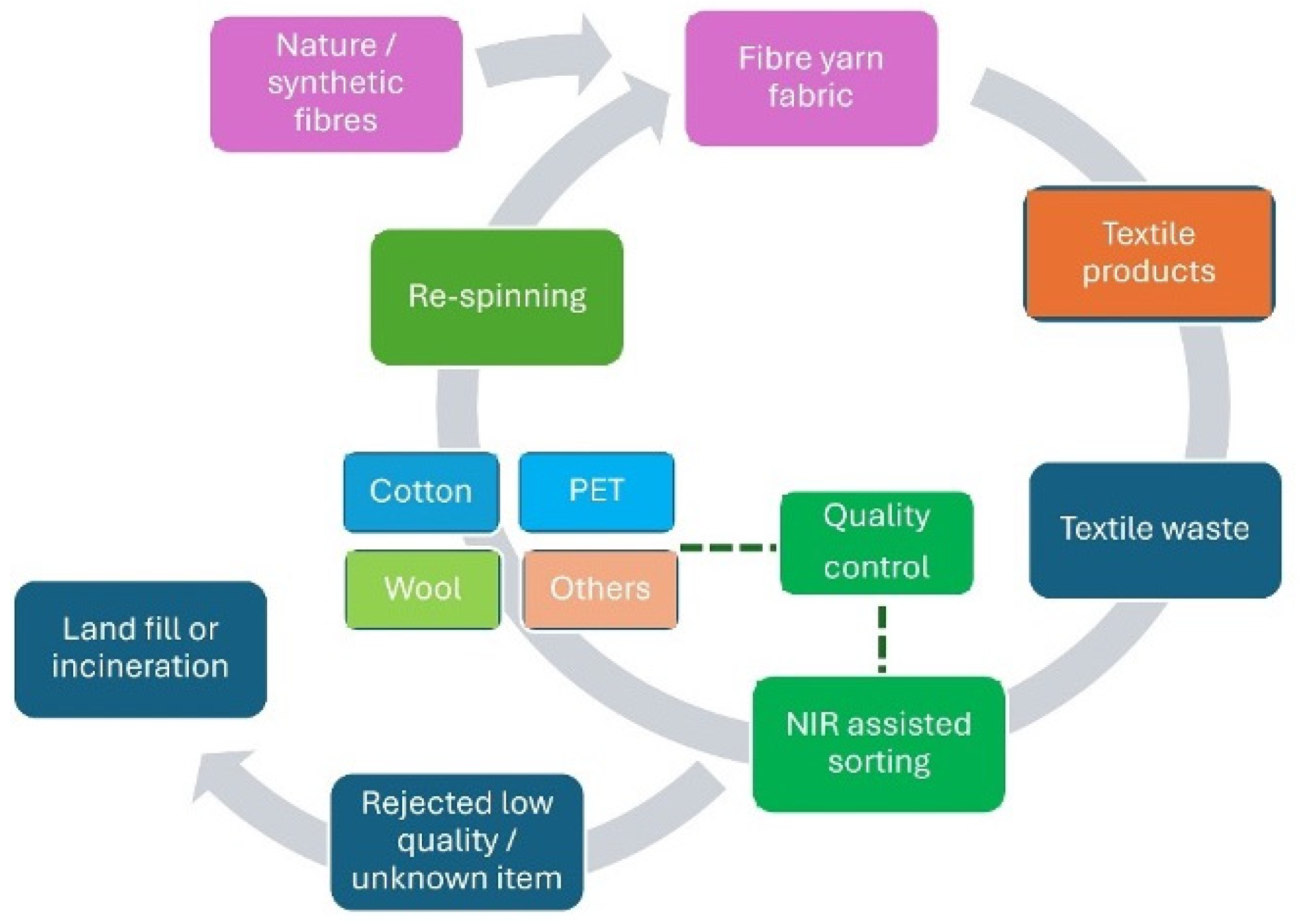
There has been significant interest around the prominent commercial or near-commercial automated recognition and sorting systems [27,29]. These systems mainly utilise NIR as fibre identification technology. A schematic diagram of a typical automated sorting system, such as the SIPTex system [74], is shown in Figure 1. These systems have received considerable acclaim. The European Union’s mandate for the separate collection of textile waste, set to take effect in 2025, is anticipated to accelerate the development of cost-efficient textile sorting facilities [75]. There are some limitations that hinder the deployment of these methods on a wider scale, including their ability to handle the volume of waste and deal with complex blends.

6.2. Volume of Waste

One major challenge facing the sorting of textile waste is the sheer volume of waste produced. With the primary method of sorting currently manual sorting, the vast majority of textile waste is incinerated or sent to landfill. Even with these new technologies starting to become available in industry, such as Fibersort or SIPTex, their early stages and limitations mean that significant amounts of manual sorting is still required. As manual sorting is laborious, requiring months of training to ensure accurate sorting into hundreds of categories, and is often unreliable, automated systems need to be improved to reduce or eliminate the need for intensive manual sorting.

6.3. Blended Textiles

While there are studies investigating sorting fabrics based on their blended fibre contents, it is clear that pure textiles provide better sorting results. In many of the studies, the number of samples used for training is quite small [68]. These results would be more reliable if the sample size could be expanded [67]. It would be advantageous to train the models used with a larger set of samples [35] to allow the models to learn more about how to identify and separate the blended fabrics.
It is also worth looking into the recycling methods that will be used for different fibre types. In certain cases, widening the window for the recognition class, for example 50–90% cotton/50–10% PET, rather than smaller increments such as 80–90% cotton/20–10% PET, to improve sorting accuracy may be beneficial and have little effect on the way the textiles are handled after sorting. Similarly, it may be possible to accept small amounts of blended fibre (10% or less for example) in a pure category [26] if the recycling method allows.

6.4. Multi-Layered Textiles

With NIR spectroscopy forming the basis of almost all the research on textile sorting, it is important to note the limitations of the method. The nature of spectroscopy in the NIR region means that only the surface of a sample is analysed; this means that textiles with multiple layers or coatings are not able to be analysed below that surface layer [68]. Therefore, textiles with multiple layers, including laminated layers or coatings, pose challenges in terms of accurately identifying and separating the different components during sorting.

6.5. Wet and Soiled Textile Waste

With NIR spectroscopy, the spectra of a textile can be distorted by the presence of moisture [67]. This means that any garments which are analysed when wet will struggle to be identified correctly due to the changes in the spectra of fibres. The water’s O-H absorption bands near 1450 nm and 1940 nm overlap the peaks that are used to identify cotton and viscose [73].
Furthermore, it is not unlikely that some post-consumer waste will arrive at a sorting facility dirty or soiled with unknown substances. Depending on the severity of the soiling, it may also affect the spectra of the fibres, thus hindering the sorting process. Further research is needed to determine methods of dealing with wet and soiled garments [62].

6.6. Machine Learning and Artificial Neural Networks

While ML algorithms and ANNs show huge potential for sorting and classifying waste textiles, they still face some limitations. One key challenge is the need for high-quality, labelled datasets that accurately represent the variability in textiles, including blended fibres, dyes and finishes. To date, the datasets used in studies are able to cover only a small subsection of the variety that can be found in real textile waste centres.
Overfitting, where models perform well on training data but poorly on unseen samples, is another potential limitation, particularly when datasets are small. Furthermore, the computational requirements for training and deploying ML models can be resource intensive.

6.7. Economic Feasibility

The commercial economic feasibility of automated sorting systems is intrinsically linked to the processing scale. A key metric for industrial adoption is the break-even point—the annual throughput at which the capital investment and operational costs of the automatic sorting system are offset by the value of recovered materials. According to a recent report published by WRAP on the textile waste automated sorting system, a model of processing 25,000 tonnes per annum of worn-out textile waste was considered [76]. It suggested that achieving the scale of automation for this value-chain segment would unlock significant efficiency gains, drive down sector-wide costs, and elevate the quality of feedstock for textile recycling. Future developments in system modularity, reduced fibre identification equipment costs, and policy incentives for high volume processing could lower this break-even point, making automated sorting accessible to a broader range of operators.

7. Conclusions

The transition from traditional manual sorting of post-consumer textiles to automated sorting systems is essential for enhancing recycling efficiency and sustainability. The limitations of manual methods underscore the need for innovative technologies that can streamline the sorting process, especially with regard to sorting by fibre type. In this paper, state-of-the-art sorting algorithms are reviewed. Non-destructive methods, including near-infrared (NIR) spectroscopy and hyperspectral imaging, accompanied by statistical and machine learning algorithms, show promise in automating the sorting process. However, challenges such as the volume of waste, sorting blended fibres, issues with multilayered textiles, and handling wet and soiled garments underscore the need for future research to refine and enhance automated sorting technologies, fostering sustainability in the textile industry through improved recycling practices. Looking ahead, the future of textile recycling will likely see increased adoption of automated sorting methods, foster better resource recovery and contribute to a circular economy. Emphasising research and development in this field will be crucial for overcoming the existing hurdles and maximising the potential of textile recycling.

Author Contributions

Conceptualisation, P.G. and C.D.; methodology, M.R.; formal analysis, M.R.; investigation, M.R.; data curation, M.R.; writing—original draft preparation, M.R.; writing—review and editing, S.G., F.Q., C.D., P.G. and M.V.; visualisation, M.R., S.G. and F.Q.; supervision, C.D., P.G. and M.V.; project administration, C.D.; funding acquisition, C.D., M.V. and P.G. All authors have read and agreed to the published version of the manuscript.

Funding

The authors were supported by the Engineering and Physical Sciences Research Council, UK (EPSRC; EP/Y003888/1), and the Biotechnology and Biological Sciences Research Council, UK (BBSRC; BB/X011577/1).

Data Availability Statement

Not applicable.

Acknowledgments

The authors thank Alan Wheeler for his great support and insights.

Conflicts of Interest

The authors declare no conflicts of interest.

Abbreviations

The following abbreviations are used in this manuscript:
ATR-FT-IRAttenuated total reflectance-Fourier transform infrared
BPNNBack-propagation neural network
CNNConvolutional neural network
CVACanonical variate analysis
EPOOrthogonalisation of external parameters
FT-NIRFourier transform near-infrared
HSIHyperspectral imaging
K-NNK-nearest neighbours
MIRMid-infrared
NIRNear-infrared
PCAPrincipal component analysis
PLSPartial least squares
PLS-DAPartial least squares discriminant analysis
QCIQuantitative chemical imaging
QDCQuadratic discriminant classifier
r-FT-IRReflectance Fourier transform infrared
RMSEPRoot mean square error of prediction
RRMSERelative root mean square error
SIMCASoft independent modelling of class analogy
SVMSupport vector machine
SWIRShort-wave infrared

References

  1. Ellen MacArthur Foundation. A New Textiles Economy: Redesigning Fashion’s Future. 2017. Available online: https://www.ellenmacarthurfoundation.org/a-new-textiles-economy (accessed on 12 January 2026).
  2. Wang, Y. Fiber and Textile Waste Utilization. Waste Biomass Valorization 2010, 1, 135–143. [Google Scholar] [CrossRef]
  3. Claudio, L. Waste Couture: Environmental Impact of the Clothing Industry. Environ. Health Perspect. 2007, 115, A449–A454. [Google Scholar] [CrossRef] [PubMed]
  4. Niinimäki, K.; Peters, G.; Dahlbo, H.; Perry, P.; Rissanen, T.; Gwilt, A. The environmental price of fast fashion. Nat. Rev. Earth Environ. 2020, 1, 189–200. [Google Scholar] [CrossRef]
  5. Pervez, M.N.; Mondal, M.; Cai, Y.; Zhao, Y.; Naddeo, V. Textile waste management and environmental concerns. In Fundamentals of Natural Fibres and Textiles; Woodhead Publishing: Cambridge, UK, 2021; pp. 719–739. [Google Scholar] [CrossRef]
  6. Bailey, K.; Basu, A.; Sharma, S. The Environmental Impacts of Fast Fashion on Water Quality: A Systematic Review. Water 2022, 14, 1073. [Google Scholar] [CrossRef]
  7. Rana, N. Threaded Harmony: A Sustainable Approach to Fashion; Emerald Publishing Limited: Leeds, UK, 2024; Volume 7. [Google Scholar]
  8. Stenton, M.; Kapsali, V.; Blackburn, R.S.; Houghton, J.A. From Clothing Rations to Fast Fashion: Utilising Regenerated Protein Fibres to Alleviate Pressures on Mass Production. Energies 2021, 14, 5654. [Google Scholar] [CrossRef]
  9. Mukherjee, S. Environmental and Social Impact of Fashion: Towards an Eco-friendly, Ethical Fashion. J. Interdiscip. Multidiscip. Res. 2025, 9, 22–35. [Google Scholar]
  10. Lewis, T. Apparel disposal and reuse. In Sustainable Apparel; Blackburn, R., Ed.; Publishing Series in Textiles; Woodhead Publishing: Cambridge, UK, 2015; pp. 233–250. [Google Scholar]
  11. Nayak, R.; Nguyen, L.; Patnaik, A.; Khandual, A. Fashion waste management problem and sustainability: A developing country perspective. In Waste Management in the Fashion and Textile Industries; Woodhead Publishing: Cambridge, UK, 2021; pp. 3–29. [Google Scholar] [CrossRef]
  12. Patti, A.; Cicala, G.; Acierno, D. Eco-Sustainability of the Textile Production: Waste Recovery and Current Recycling in the Composites World. Polymers 2021, 13, 134. [Google Scholar] [CrossRef]
  13. Chen, X.; Memon, H.A.; Wang, Y.; Marriam, I.; Tebyetekerwa, M. Circular economy and sustainability of the clothing and textile industry. Mater. Circ. Econ. 2021, 3, 12. [Google Scholar] [CrossRef]
  14. Moazzem, S.; Wang, L.; Daver, F.; Crossin, E. Environmental impact of discarded apparel landfilling and recycling. Resour. Conserv. Recycl. 2020, 166, 105338. [Google Scholar] [CrossRef]
  15. Fernando, P.R.; Hebden, A.; Du, C.; Goswami, P. Focused Parameter Study of Dye Removal from PET Textiles Using Cyrene: Toward Sustainable Textile Recycling. Environ. Chall. 2025, 20, 101284. [Google Scholar] [CrossRef]
  16. Pensupa, N.; Leu, S.Y.; Hu, Y.; Du, C.; Liu, H.; Jing, H.; Wang, H.; Lin, C.S.K. Recent trends in sustainable textile waste recycling methods: Current situation and future prospects. Top. Curr. Chem. 2017, 375, 76. [Google Scholar] [CrossRef] [PubMed]
  17. Blair, J.; Mataraarachchi, S. A Review of Landfills, Waste and the Nearly Forgotten Nexus with Climate Change. Environments 2021, 8, 73. [Google Scholar] [CrossRef]
  18. Shen, M.; Huang, W.; Chen, M.; Song, B.; Zeng, G.; Zhang, Y. (Micro)plastic crisis: Un-ignorable contribution to global greenhouse gas emissions and climate change. J. Clean. Prod. 2020, 254, 120138. [Google Scholar] [CrossRef]
  19. Sandin, G.; Peters, G.M. Environmental impact of textile reuse and recycling—A review. J. Clean. Prod. 2018, 184, 353–365. [Google Scholar] [CrossRef]
  20. Sandvik, I.; Stubbs, W. Circular fashion supply chain through textile-to-textile recycling. J. Fash. Mark. Manag. Int. J. 2019, 23, 366–381. [Google Scholar] [CrossRef]
  21. Pandit, P.; Singha, K.; Shrivastava, S.; Ahmed, S. Overview on Recycling from Waste in Fashion and Textiles. In Recycling from Waste in Fashion and Textiles; John Wiley & Sons, Ltd.: Hoboken, NJ, USA, 2020; pp. 1–18. [Google Scholar]
  22. Okafor, C.; Madu, C.; Ajaero, C.; Ibekwe, J.; Nzekwe, C. Sustainable management of textile and clothing. Clean Technol. Recycl. 2021, 1, 70–87. [Google Scholar] [CrossRef]
  23. Köksal, D.; Strähle, J.; Müller, M.; Freise, M. Social Sustainable Supply Chain Management in the Textile and Apparel Industry—A Literature Review. Sustainability 2017, 9, 100. [Google Scholar] [CrossRef]
  24. Wren, B. Sustainable supply chain management in the fast fashion Industry: A comparative study of current efforts and best practices to address the climate crisis. Clean. Logist. Supply Chain 2022, 4, 100032. [Google Scholar] [CrossRef]
  25. Juanga-Labayen, J.P.; Labayen, I.V.; Yuan, Q. A review on textile recycling practices and challenges. Textiles 2022, 2, 174–188. [Google Scholar] [CrossRef]
  26. Cura, K.; Rintala, N.; Kamppuri, T.; Saarimaki, E.; Heikkila, P. Textile Recognition and Sorting for Recycling at an Automated Line Using Near Infrared Spectroscopy. Recycling 2021, 6, 11. [Google Scholar] [CrossRef]
  27. Wilting, J.; van Duijn, H. Clothing Labels: Accurate or Not? 2020. Available online: https://www.circle-economy.com/ (accessed on 31 October 2025).
  28. Cura, K.; Mäkelä, M. Sorting and Composition Analyses of Discarded Textiles. In Recycling and Lifetime Management in the Textile and Fashion Sector; CRC Press: Boca Raton, FL, USA, 2024; pp. 144–160. [Google Scholar]
  29. Stubbe, B.; Van Vrekhem, S.; Huysman, S.; Tilkin, R.G.; De Schrijver, I.; Vanneste, M. White Paper on Textile Fibre Recycling Technologies. Sustainability 2024, 16, 618. [Google Scholar] [CrossRef]
  30. Nayak, R.; Houshyar, S.; Khandual, A.; Padhye, R.; Fergusson, S. Identification of natural textile fibres. In Handbook of Natural Fibres; Woodhead Publishing: Cambridge, UK, 2020; pp. 503–534. [Google Scholar]
  31. Domskienė, J.; Gaidule, E. An overview of technological challenges in implementing the digital product passport in the textile and clothing industry. AUTEX Res. J. 2024, 24, 20240002. [Google Scholar] [CrossRef]
  32. Iezzi, B.; Coon, A.; Cantley, L.; Perkins, B.; Doran, E.; Wang, T.; Rothschild, M.; Shtein, M. Polymeric Photonic Crystal Fibers for Textile Tracing and Sorting. Adv. Mater. Technol. 2023, 8, 2201099. [Google Scholar] [CrossRef]
  33. Nayak, R.; Singh, A.; Padhye, R.; Wang, L. RFID in textile and clothing manufacturing: Technology and challenges. Fash. Text. 2015, 2, 9. [Google Scholar] [CrossRef]
  34. Quintero Balbas, D.; Lanterna, G.; Cirrincione, C.; Fontana, R.; Striova, J. Non-invasive identification of textile fibres using near-infrared fibre optics reflectance spectroscopy and multivariate classification techniques. Eur. Phys. J. Plus 2022, 137, 85. [Google Scholar] [CrossRef]
  35. Becker, A.; Datko, A.; Kroell, N.; Küppers, B.; Greiff, K.; Gries, T. Near-infrared-based sortability of polyester-containing textile waste. Resour. Conserv. Recycl. 2024, 206, 107577. [Google Scholar] [CrossRef]
  36. Daikos, O.; Scherzer, T. In-line monitoring of the residual moisture in impregnated black textile fabrics by hyperspectral imaging. Prog. Org. Coat. 2022, 163, 106610. [Google Scholar] [CrossRef]
  37. Sharma, V.; Mahara, M.; Sharma, A. On the textile fibre’s analysis for forensics, utilizing FTIR spectroscopy and machine learning methods. Forensic Chem. 2024, 39, 100576. [Google Scholar] [CrossRef]
  38. Mäkelä, M.; Geladi, P.; Rissanen, M.; Rautkari, L.; Dahl, O. Hyperspectral near infrared image calibration and regression. Anal. Chim. Acta 2020, 1105, 56–63. [Google Scholar] [CrossRef]
  39. Mirschel, G.; Daikos, O.; Scherzer, T.; Steckert, C. Near-infrared chemical imaging used for in-line analysis of inside adhesive layers in textile laminates. Anal. Chim. Acta 2016, 932, 69–79. [Google Scholar] [CrossRef]
  40. Mirschel, G.; Daikos, O.; Scherzer, T.; Steckert, C. Near-infrared chemical imaging used for in-line analysis of functional finishes on textiles. Talanta 2018, 188, 91–98. [Google Scholar] [CrossRef] [PubMed]
  41. Zahra, A.; Qureshi, R.; Sajjad, M.; Sadak, F.; Nawaz, M.; Khan, H.A.; Uzair, M. Current advances in imaging spectroscopy and its state-of-the-art applications. Expert Syst. Appl. 2024, 238, 122172. [Google Scholar] [CrossRef]
  42. Webpage. Hyperspectral Imaging Reducing Textile Waste. 2020. Available online: www.recycling-magazine.com/2020/09/01/hyperspectral-imaging-reducing-textile-waste (accessed on 31 October 2025).
  43. Goyal, A. Automation in fabric inspection. In Automation in Garment Manufacturing; Nayak, R., Padhye, R., Eds.; The Textile Institute Book Series; Woodhead Publishing: Cambridge, UK, 2018; pp. 75–107. [Google Scholar]
  44. Suzianti, A. Macroergonomic Approach for Improving the Municipal Waste Management System in Jakarta. Int. J. Innov. Manag. Technol. 2013, 4, 560–564. [Google Scholar] [CrossRef]
  45. Nørup, N.; Pihl, K.; Damgaard, A.; Scheutz, C. Development and testing of a sorting and quality assessment method for textile waste. Waste Manag. 2018, 79, 8–21. [Google Scholar] [CrossRef] [PubMed]
  46. Dhir, Y.J. Sustainable fashion material procurement. In Supply Chain Management and Logistics in the Global Fashion Sector; Routledge: Abingdon, UK, 2020. [Google Scholar]
  47. Eppinger, E. Recycling technologies for enabling sustainability transitions of the fashion industry: Status quo and avenues for increasing post-consumer waste recycling. Sustain. Sci. Pract. Policy 2022, 18, 114–128. [Google Scholar] [CrossRef]
  48. Hall, C. Design for Recycling Knitwear: A Framework for Sorting, Blending and Cascading in the Mechanical Textile Recycling Industry. Ph.D. Thesis, University of the Arts London, London, UK, 2021. [Google Scholar]
  49. Hanbay, K.; Talu, M.F.; Ozguven, O.F. Fabric defect detection systems and methods—A systematic literature review. Optik 2016, 127, 11960–11973. [Google Scholar] [CrossRef]
  50. Allwood, J.M. Squaring the Circular Economy: The Role of Recycling within a Hierarchy of Material Management Strategies. In Handbook of Recycling; Worrell, E., Reuter, M.A., Eds.; Elsevier: Boston, MA, USA, 2014; pp. 445–477. [Google Scholar]
  51. Araujo-Andrade, C.; Bugnicourt, E.; Philippet, L.; Rodriguez-Turienzo, L.; Nettleton, D.; Hoffmann, L.; Schlummer, M. Review on the photonic techniques suitable for automatic monitoring of the composition of multi-materials wastes in view of their posterior recycling. Waste Manag. Res. 2021, 39, 631–651. [Google Scholar] [CrossRef]
  52. Cura, K.; Heikkilä, J.; Hinkka, V.; Ikonen, T.; Kamppuri, T.; Knuutila, H.; Kokko, M.; Lankiniemi, S.; Lehtinen, L.; Mäkiö, I.; et al. Telaketju: Towards Circularity of Textiles; VTT Research Report; VTT Technical Research Centre of Finland: Espoo, Finland, 2019. [Google Scholar]
  53. Webpage—Fabrics Textile Carpet Scanner. Available online: https://solidscanner.com/nir-spectrometer/trinamix/fabrics-textile-carpet-scanner (accessed on 11 August 2025).
  54. Fabrics Identification. Available online: https://www.matoha.com/fabrics-identification (accessed on 11 August 2025).
  55. Sikka, M.; Sarkar, A.; Garg, S. Artificial intelligence (AI) in textile industry operational modernization. Res. J. Text. Appar. 2022, 28, 67–83. [Google Scholar] [CrossRef]
  56. Davis, C.; Busch, K.; Rabbe, D.; Busch, M.; Lusk, J. Rapid, Non-Destructive, Textile Classification Using SIMCA on Diffuse Near-Infrared Reflectance Spectra. J. Mod. Phys. 2015, 6, 711–718. [Google Scholar] [CrossRef]
  57. Zhou, J.; Yu, L.; Ding, Q.; Wang, R. Textile Fiber Identification Using Near-Infrared Spectroscopy and Pattern Recognition. Autex Res. J. 2019, 19, 201–209. [Google Scholar] [CrossRef]
  58. Blanch-Perez-del-Notario, C.; Saeys, W.; Lambrechts, A. Hyperspectral imaging for textile sorting in the visible–near infrared range. J. Spectr. Imaging 2019, 8, a17. [Google Scholar] [CrossRef]
  59. Mäkelä, M.; Rissanen, M.; Sixta, H. Machine vision estimates the polyester content in recyclable waste textiles. Resour. Conserv. Recycl. 2020, 161, 105007. [Google Scholar] [CrossRef]
  60. Bonifazi, G.; Gasbarrone, R.; Palmieri, R.; Serranti, S. End-of-Life Textile Recognition in a Circular Economy Perspective: A Methodological Approach Based on Near Infrared Spectroscopy. Sustainability 2022, 14, 10249. [Google Scholar] [CrossRef]
  61. Peets, P.; Leito, I.; Pelt, J.; Vahur, S. Identification and classification of textile fibres using ATR-FT-IR spectroscopy with chemometric methods. Spectrochim. Acta Part A Mol. Biomol. Spectrosc. 2017, 173, 175–181. [Google Scholar] [CrossRef]
  62. Riba, J.; Cantero, R.; Canals, T.; Puig, R. Circular economy of post-consumer textile waste: Classification through infrared spectroscopy. J. Clean. Prod. 2020, 272, 123011. [Google Scholar] [CrossRef]
  63. Peets, P.; Kaupmees, K.; Vahur, S.; Leito, I. Reflectance FT-IR spectroscopy as a viable option for textile fiber identification. Herit. Sci. 2019, 7, 93. [Google Scholar] [CrossRef]
  64. Sun, X.; Zhou, M.; Sun, Y. Variables selection for quantitative determination of cotton content in textile blends by near infrared spectroscopy. Infrared Phys. Technol. 2016, 77, 65–72. [Google Scholar] [CrossRef]
  65. Riba, J.; Cantero, R.; Puig, R. Classification of Textile Samples Using Data Fusion Combining Near- and Mid-Infrared Spectral Information. Polymers 2022, 14, 3073. [Google Scholar] [CrossRef]
  66. Bonifazi, G.; Gasbarrone, R.; Palmieri, R.; Serranti, S. A Characterization Approach for End-of-Life Textile Recovery Based on Short-Wave Infrared Spectroscopy. Waste Biomass Valorization 2024, 15, 1725–1738. [Google Scholar] [CrossRef]
  67. Huang, J.; He, H.; Lv, R.; Zhang, G.; Zhou, Z.; Wang, X. Non-destructive detection and classification of textile fibres based on hyperspectral imaging and 1D-CNN. Anal. Chim. Acta 2022, 1224, 340238. [Google Scholar] [CrossRef]
  68. Du, W.; Zheng, J.; Li, W.; Liu, Z.; Wang, H.; Han, X. Efficient Recognition and Automatic Sorting Technology of Waste Textiles Based on Online Near infrared Spectroscopy and Convolutional Neural Network. Resour. Conserv. Recycl. 2022, 180, 106157. [Google Scholar] [CrossRef]
  69. Liu, Z.; Li, W.; Wei, Z. Qualitative classification of waste textiles based on near infrared spectroscopy and the convolutional network. Text. Res. J. 2020, 90, 1057–1066. [Google Scholar] [CrossRef]
  70. Riba, J.; Cantero, R.; Riba-Mosoll, P.; Puig, R. Post-Consumer Textile Waste Classification through Near-Infrared Spectroscopy, Using an Advanced Deep Learning Approach. Polymers 2022, 14, 2475. [Google Scholar] [CrossRef]
  71. Liu, L.; Yan, L.; Xie, Y.; Xu, J. Determination of Fiber Contents in Blended Textiles by NIR Combined with BP Neural Network. Int. Sch. Res. Not. 2013, 2013, e546481. [Google Scholar] [CrossRef]
  72. Li, W.; Wei, Z.; Liu, Z.; Du, Y.; Zheng, J.; Wang, H.; Zhang, S. Qualitative identification of waste textiles based on near-infrared spectroscopy and the back propagation artificial neural network. Text. Res. J. 2021, 91, 2459–2467. [Google Scholar] [CrossRef]
  73. Qiu, X.; Liu, Y.; Zhang, X.; Liu, D.; Wang, R.; Wang, C.; Liu, J.; Liu, W.; Gong, Y. Moisture insensitive analysis of polyester/viscose waste textiles using Near-Infrared spectroscopy and Orthogonalization of external parameters algorithm. J. Ind. Text. 2023, 53, 1–21. [Google Scholar] [CrossRef]
  74. Bolinius, D.J. Siptex—Swedish Innovation Platform for Textile Sorting. In A Summary Report of the Final Stage of the Project; Technical Report; VL Swedish Environmental Research Institute: Stockholm, Sweden, 2022. [Google Scholar]
  75. Chioatto, E.; Sospiro, P. Transition from waste management to circular economy: The European Union roadmap. Environ. Dev. Sustain. 2022, 25, 249–276. [Google Scholar] [CrossRef]
  76. ACT UK—The Business Case for Advanced Textile Sorting and Pre-Processing Facilities. Wrap Report. 21 May 2025. Available online: https://www.wrap.ngo/resources/report/act-uk-business-case-advanced-textile-sorting-and-pre-processing-facilities (accessed on 12 January 2026).
Figure 1. Schematic diagram of a simplified SIPTex pipeline.
Textiles 06 00028 g001
Disclaimer/Publisher’s Note: The statements, opinions and data contained in all publications are solely those of the individual author(s) and contributor(s) and not of MDPI and/or the editor(s). MDPI and/or the editor(s) disclaim responsibility for any injury to people or property resulting from any ideas, methods, instructions or products referred to in the content.