Article

Adsorption Performance of Cu-Impregnated Carbon Derived from Waste Cotton Textiles: Single and Binary Systems with Methylene Blue and Pb(II)

1
School of Resources and Environment, Wuhan Textile University, Wuhan 430073, China
2
Engineering Research Centre for Clean Production of Textile Dyeing and Printing, Wuhan Textile University, Ministry of Education, Wuhan 430073, China
*
Author to whom correspondence should be addressed.
Textiles 2026, 6(1), 12; https://doi.org/10.3390/textiles6010012
Submission received: 29 October 2025 / Revised: 7 January 2026 / Accepted: 16 January 2026 / Published: 19 January 2026

Abstract

Waste textiles may contain heavy metals, which can originate from dyes, mordants, or other chemical treatments used during manufacturing. To explore the impact of heavy metals on the adsorption properties of activated carbon derived from discarded textiles through pyrolysis and to mitigate heavy metal migration, this study investigated the adsorption behavior of copper-impregnated pyrolytic carbon toward typical pollutants—methylene blue and lead—in simulated dyeing wastewater. Aqueous copper nitrate was used to impregnate the waste pure cotton textiles (WPCTs) to introduce copper species as precursors for creating additional active sites. The study systematically examined adsorption mechanisms, single and binary adsorption systems, adsorption kinetics, adsorption isotherms, adsorption thermodynamics, and the influence of pH. Key findings and conclusions are as follows: Under optimal conditions, the copper-containing biochar (Cu-BC) demonstrated maximum adsorption capacities of 36.70 ± 1.54 mg/g for Pb(II) and 104.93 ± 8.71 mg/g for methylene blue. In a binary adsorption system, when the contaminant concentration reached 80 mg/L, the adsorption capacity of Cu-BC for Pb(II) was significantly enhanced, with the adsorption amount increasing by over 26%. However, when the Pb(II) concentration reached 40 mg/L, it inhibited the adsorption of contaminants, reducing the adsorption amount by 20%. SEM, XRD, Cu LMM, FTIR and XPS result analysis proves that the adsorption mechanism of methylene blue involves π–π interactions, hydrogen bonding, electrostatic interactions, and pore filling. For Pb(II) ions, the adsorption likely occurs via electrostatic interactions, complexation with functional groups, and pore filling. This study supplements the research content on the copper adsorption mechanism supported by biochar for heavy metal adsorption research and broadens the application scope of biochar in the field of heavy metal adsorption.

1. Introduction

Heavy metals are ubiquitous in industrial production, and the discharge of effluent containing these pollutants into the natural environment leads to severe heavy metal contamination, particularly lead, posing significant risks to both human health and ecological safety due to its persistence. Among them, lead is widely present in the textile printing and dyeing industry, with notably high concentrations in associated wastewater. Due to its strong migration capacity and resistance to natural degradation, lead pollution exhibits broad spatial distribution and long-term persistence. Moreover, lead is highly toxic: ingestion of lead-contaminated plants or animals can cause damage to the heart, kidneys, nervous system, and immune system [1,2]. Therefore, effective treatment of lead pollution is of great importance. Dyes have been used across various industries since ancient times. While they add color to daily life, their high toxicity and persistence cannot be overlooked. Methylene blue, one of the most widely used dyes, impairs the self-purification capacity of aquatic ecosystems. Human exposure to this dye can lead to skin diseases, respiratory and neurological disorders, and even cancer. The risk is further amplified when methylene blue coexists with Pb(II) ions in water [3]. Allowing such pollutants to be released into the environment would have irreversible consequences for ecosystems and human populations.
The activated carbon adsorption method is widely used in water treatment due to its adaptability to various precursor materials, simple preparation, low cost, recyclability, and high removal efficiency, making it particularly suitable for treating printing and dyeing wastewater containing mixed pollutants [4]. In preliminary experiments, we evaluated the adsorption performance of unimpregnated cotton biochar toward Pb(II) and methylene blue, with results indicating limited adsorption capacity: the maximum adsorption capacity for Pb(II) was 14.97 mg/g, and for methylene blue it was 55.88 mg/g. Studies have demonstrated that copper-containing carbon compounds are effective in removing methylene blue and lead ions. For example, Salah Ud Din et al. [5] developed a zero-valent copper-biochar composite for lead adsorption, achieving a capacity of 29.57 mg/g. The study indicates that copper species (CuO, Cu2O) can undergo cation exchange with Pb(II) or form surface precipitates. Similarly, Shu et al. [6] prepared a copper-containing activated carbon via microwave heating of copper nitrate, which exhibited a methylene blue adsorption capacity of 373 mg/g, confirming its effectiveness as a dye adsorbent. The study indicates that the introduction of copper can increase surface charge, alter oxygen-containing functional groups, or provide specific coordination sites.
The annual generation of approximately 22 million tons of waste textiles in China poses severe environmental challenges. Conventional disposal methods like landfilling and incineration cause soil, water, and air pollution, while mechanical recycling yields low-value products. Although chemical recycling can convert waste into high-quality raw materials, it has not been industrialized due to high costs and technical complexities. Therefore, developing efficient and eco-friendly recycling technologies is scientifically critical to mitigate environmental impacts and achieve resource circularity. In our previous study [7], we investigated catalytic hydrogen production from waste cotton textiles and copper passivation in solid products. Optimal conditions were established for simultaneously enhancing hydrogen production and passivation efficiency, yielding copper-containing biochar in the process. The study also examined copper speciation in the biochar, revealing that the pyrolysis process facilitates the transformation of copper from a weak acid-extractable state to a residual state. This transition enhances copper fixation within the pyrolytic carbon matrix and reduces its potential ecotoxicity. However, excessive pyrolysis temperatures may inhibit the conversion of copper into more stable forms, potentially leading to copper leaching. The study also systematically evaluated the leaching behavior of copper. TCLP results indicate that the leached copper concentrations of all materials are below the limit value (100 mg/L) specified in the Hazardous Waste Identification Standard—Leaching Toxicity Identification (GB 5085.3—2007) [8], posing no environmental risk. Additionally, the study also found that a pyrolysis temperature of ~700 °C combined with 0.25 wt% Cu(NO3)2 solution maximizes hydrogen yield while minimizing copper leaching (50.32 ± 2.95 mg/L)—thus providing a scientific basis for material preparation in this work. Under these conditions, the resulting copper-containing biochar from waste textiles demonstrates significant potential as an adsorbent for lead and methylene blue removal. In comparison with previous studies, the material developed in this work demonstrates a unique combination of advantages: it adheres to circular economy principles by valorizing waste, requires minimal pretreatment (only cutting into small pieces), is low-cost, and features highly dispersed copper species.
Based on these findings, this study systematically evaluated the adsorption performance of copper-containing waste cotton textile pyrolysis carbon on methylene blue and lead ions in monomer and binary systems through kinetics, isotherms, and thermodynamic analysis, and elucidated their adsorption mechanisms. The results confirm that, while optimizing hydrogen production and reducing environmental risks, copper-containing waste cotton textile pyrolysis carbon serves as an effective adsorbent for methylene blue and lead, providing a broader prospect for the resource utilization of waste textile pyrolysis products.

2. Materials and Methods

2.1. Materials and Instruments

The primary pharmaceuticals and instruments utilized in this experiment are shown in Table 1 and Table 2, respectively.

2.2. Preparation

The waste pure cotton textiles (WPCT) used in this study were obtained from a spinning facility in Nantong, Jiangsu Province, China. The fabric type is woven, with an areal density of 80 g/m2 and a yarn linear density of 15 tex. The fabric was cut into 5 × 5 mm pieces and impregnated by immersing in a 0.25 wt% Cu(NO3)2 solution for 24 h at 25 °C. After immersion, the samples were dried overnight at 60 °C in an oven, and the resulting material was designated as 0.25−WPCT. Subsequently, approximately 1 g of 0.25−WPCT was accurately weighed and placed in a quartz boat, which was then positioned in the central zone of a tubular furnace equipped with a transparent quartz tube (inner diameter: 60 mm; length: 1000 mm). Prior to pyrolysis, the system was purged with high-purity nitrogen (99.999%) for 15 min at a flow rate of 200 mL/min to ensure an oxygen-free environment. The pyrolysis process was carried out under a continuous N2 flow of 100 mL/min. The furnace was heated from ambient temperature to 700 °C [7] at a rate of 10 °C/min, held at the target temperature for 30 min, and then allowed to cool naturally to room temperature under N2 atmosphere, resulting in a total heating duration of approximately 120 min. The solid product obtained after pyrolysis was labeled as Cu-BC.

2.3. Adsorption Experimental Methods

2.3.1. Standard Curve for Methylene Blue Solution

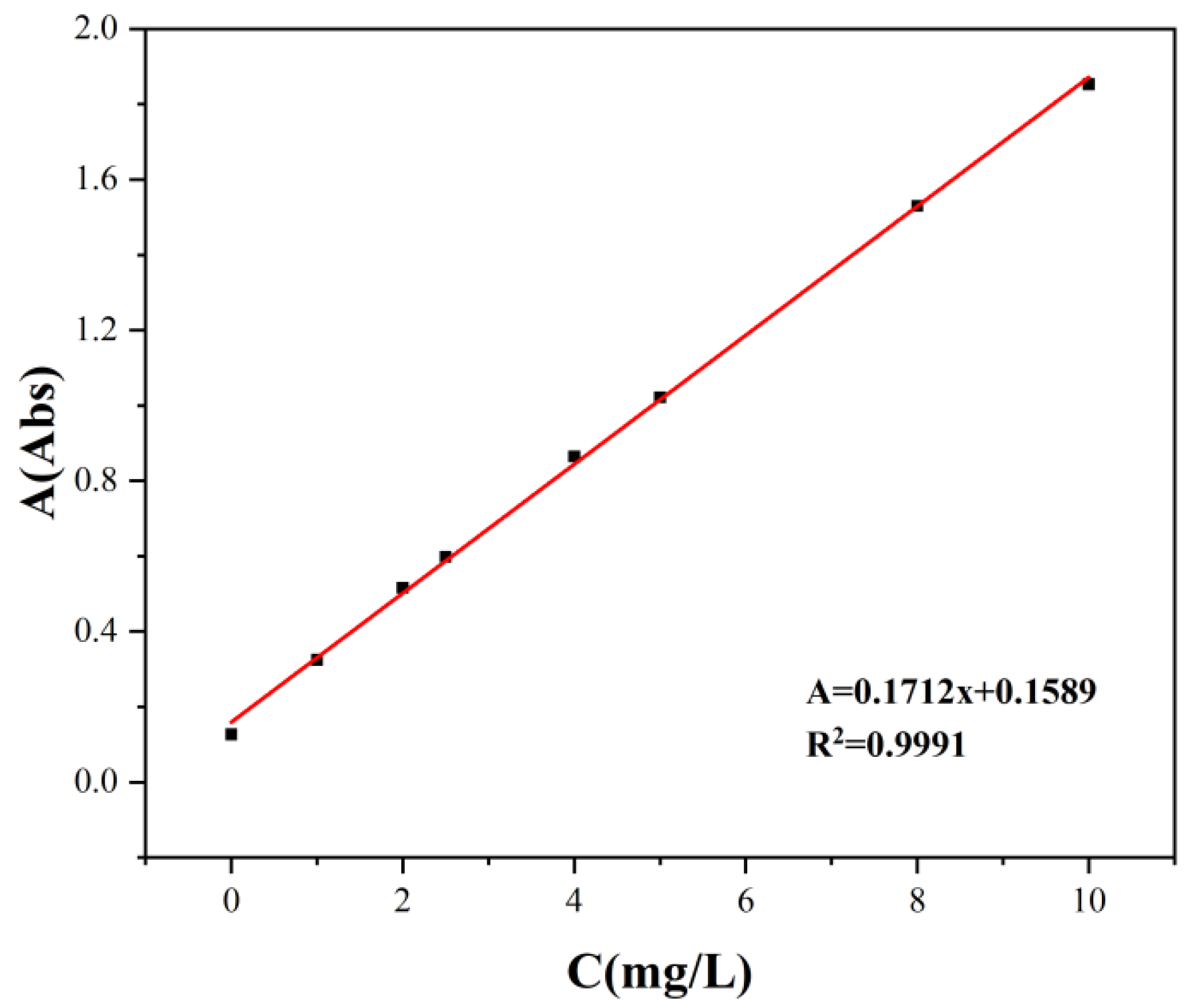
The concentration of methylene blue (MB) solution was determined using an ultraviolet spectrophotometer at a detection wavelength of 664 nm. A standard calibration curve was established by performing linear regression on the absorbance values measured for a series of MB solutions with known concentrations. For each concentration level, three independent samples were prepared and measured, and the average absorbance value was used for the construction of the calibration curve.
Figure 1 depicts the standard curve of methylene blue solution, and the standard curve equation obtained from fitting is y = 0.1712x + 0.1589, R2 = 0.9991 ± 0.001.

2.3.2. Impact of Initial Solution pH on Adsorption

The influence of initial solution pH on adsorption performance was investigated. Due to the tendency of Pb(II) to hydrolyze and precipitate as lead hydroxide at near-neutral pH, the experiments were conducted under acidic conditions. Specifically, Pb(II) solutions were tested at pH 2.0, 3.0, 4.0, 5.0, and 6.0. For MB, a stable dye across a wide pH range, tests were conducted from pH 2.0 to 10.0 to cover conditions from strong acid to strong alkali, the latter being relevant to some textile effluents [9]. The adsorption experiments were conducted by adding 0.4 g/L of pyrolytic carbon to each solution, followed by shaking at 150 rpm for 12 h in a temperature-controlled shaker maintained at 25 °C. After shaking, withdraw the solution from the conical flask using a syringe, then filter the withdrawn solution through a 0.45 μm pore size membrane filter. After filtration, the residual MB concentration was analyzed using a UV spectrophotometer, and the remaining Pb(II) concentration was determined by atomic absorption spectrometry. All experiments were performed in triplicate, and the reported data represent the average values. The point of zero charge (pHzpc) of the pyrolytic carbon was determined using the acid-base titration method [10]. The adsorption capacity for each pollutant was calculated according to Equation (1).
q = C e C 0 × V m
In this equation, q (mg/g) represents the adsorption capacity of the pyrolytic carbon at equilibrium; C0 (mg/L) denotes the initial concentration of the pollutant before adsorption; Ce (mg/L) is the residual concentration of the pollutant at adsorption equilibrium; V (L) refers to the initial volume of the pollutant solution; and m (g) indicates the mass of pyrolytic carbon used in the adsorption experiment.

2.3.3. Adsorption Kinetics

The following are the experimental procedures for determining the adsorption kinetics of Pb(II) ions and methylene blue by pyrolytic carbon in a single system: A conical flask was filled with 100 mL of methylene blue solution and a Pb(II) ion solution at a specific concentration. The solution was then brought to the ideal pH and 40 mg of pyrolytic carbon was added using a precision balance. The conical flask was then placed in a thermostatic gas-bath shaker and oscillated for a day. The temperature was preset at 25 °C, and the rotational rate was established at 150 r/min. The solution in the conical flask was rapidly drained with a syringe during the adsorption period by taking different time points in the range of 1 to 1440 min. Three models—the pseudo-first-order kinetic model (PFO), pseudo-second-order kinetic model (PSO), and intraparticle diffusion model (IPD)—were used to match the adsorption data from the adsorption kinetics experiment in order to gain a better understanding of the adsorption process of pyrolytic carbon. The three models’ mathematical formulas were as follows (Equations (2)–(4)) [11,12]:
PFO:
q t = q e 1 e k 1 t
PSO:
q t = k 2 q e 2 t / k 2 q e t + 1
IPD:
q t = k i , d t 0.5 + C
The adsorbed amount at adsorption equilibrium is indicated by qe (mg/g); the adsorption capacity at time point t is represented by qt (mg/g); the adsorption experiment’s time scale is t (min); the rate constants for the proposed primary and secondary kinetic models are k1 (min−1); k2 (g mg−1 min−1) and ki,d (mgg−1 min1/2) separately; and C is the intercept with respect to the thickness of the boundary layer.

2.3.4. Adsorption Isotherm

The adsorption mechanism was investigated by isothermal adsorption experiments. 20 mg of pyrolytic charcoal were added to conical flasks that held 50 mL of methylene blue solution and 50 mL of Pb(II) ion solution, respectively. Methylene blue solution concentrations varied from 5 to 100 mg/L, whereas Pb(II) ion solution concentrations differed from 5 to 40 mg/L. These initial pollutant concentrations were altered while the pH was adjusted to the optimal level. The conical flasks were placed into a constant temperature gas-bath oscillator for oscillatory adsorption at 25 °C, 35 °C, and 45 °C. The oscillator speed was set to 150 r/min, and the adsorption time was 24 h. The solution was extracted from the conical flasks using a syringe and filtered through a membrane with 0.45 μm holes after oscillation. The absorbance of the filtrate was measured. The adsorption isotherm models adopted in this paper are the Langmuir model (Equation (5)), the Freundlich model (Equation (6)), and the Temkin model (Equation (7)) [13]. The mathematical formulas of the three isotherm models are as follows:
Langmuir model:
C e = 1 q m K L + C e q m
Freundlich model:
ln q e = ln K F + 1 n ln C e
Temkin model:
q e = K T ln f + K T ln C e
The residual concentration of methylene blue solution and Pb(II) ion solution at equilibrium adsorption is expressed by Ce (mg/L) in these models; the adsorption capacity of pyrolytic carbon for methylene blue and Pb(II) ion at equilibrium adsorption is represented by qe (mg/g); qm (mg/g) represents the maximum adsorption capacity of pyrolytic carbon for methylene blue and Pb(II) ions obtained from fitting. KL is the Langmuir model’s equilibrium constant; the equilibrium constant and adsorption strength characteristic parameter of the Freundlich model is KF and n; and the pertinent characteristic constants of the Temkin model are KT and f.
In the Langmuir model, the ease of the adsorption procedure can be assessed by calculating the separation factor RL [14], which is calculated as follows (Equation (8)):
R L = 1 / 1 + C 0 K L
where C0 represents the initial concentration of methylene blue solution and Pb(II) ion solution. When RL = 0, the adsorption procedure is nonreversible; When RL is between 0 and 1, the adsorption procedure is easy; When RL = 1, the adsorption procedure is linear; When RL > 1, the adsorption procedure is difficult. The related thermodynamic mathematical Equations (9) and (10) are shown below [13,15,16]:
Δ G ° = R T ln K C
ln K C = Δ H ° R T + Δ S ° R
where ∆G° (kJ/mol) is the Gibbs free energy of the adsorption procedure; ∆H° (kJ/mol) is the enthalpy change of the adsorption procedure; ∆S° (kJ/(K mol)) is the entropy change of the adsorption procedure; R (8.314 J/(K mol)) is the ideal gas constant; T (K) is the temperature of the adsorption process; and KC is the dimensionless thermodynamic equilibrium constant.

2.3.5. Co-Adsorption Experiments

Pyrolytic charcoal’s adsorption performance in a binary system may differ from that in a single system; hence, it is essential to conduct a co-adsorption experiment with pyrolytic charcoal in a binary system including methylene blue and Pb(II). The binary co-adsorption experiments proceeded as follows: the initial pH value of the binary system was set to 6.0, the initial concentration of methylene blue was set at 5 mg/L to 100 mg/L, and the concentrations of Pb(II) ions in the binary system were adjusted to 10 mg/L, 20 mg/L, and 40 mg/L, respectively. The methylene blue concentrations in the binary system were adjusted to 10 mg/L, 40 mg/L, and 80 mg/L, respectively, while the initial concentration of Pb(II) ions was set between 5 and 35 mg/L. In accordance with the adsorption experimental procedures in a single system, the adsorption tests were conducted on pyrolytic charcoal in a binary system. Each experiment was repeated three times, and the average of the three sets of parallel data was taken.

3. Results and Discussion

3.1. Impact of pH on Adsorption

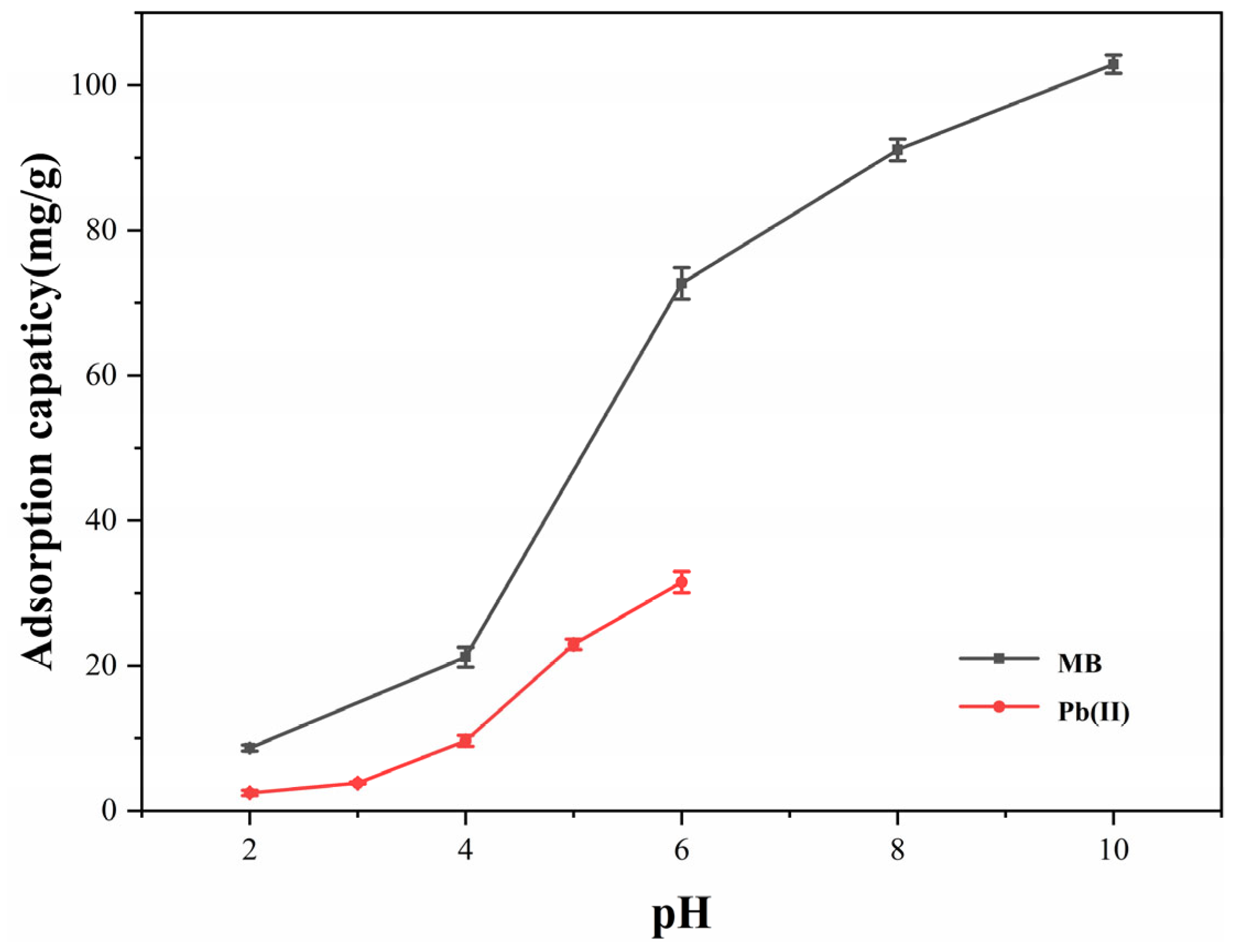
Figure 2 illustrates how the Cu-BC adsorption performance for methylene blue and Pb(II) ions is influenced by the initial pH value of the solution. The starting concentration of the methylene blue solution is 100 mg/L, while the concentration of the Pb(II) ion solution is 40 mg/L. Figure 2 shows that the efficiency of Cu-BC in adsorbing Pb(II) ions progressively improves as pH rises. When the pH increases from 2.0 to 6.0, Cu-BC’s adsorption capacity for Pb(II) ions increases from 2.46 mg/g to 31.52 mg/g. In the meantime, the adsorption capacity of Cu-BC for methylene blue rose from 8.65 mg/g to 102.89 mg/g as the pH rose from 2 to 10, indicating that the adsorption performance of Cu-BC for methylene blue also increased gradually as the pH rose. As a result, Cu-BC’s ability to adsorb MB and Pb(II) ions depends on pH.
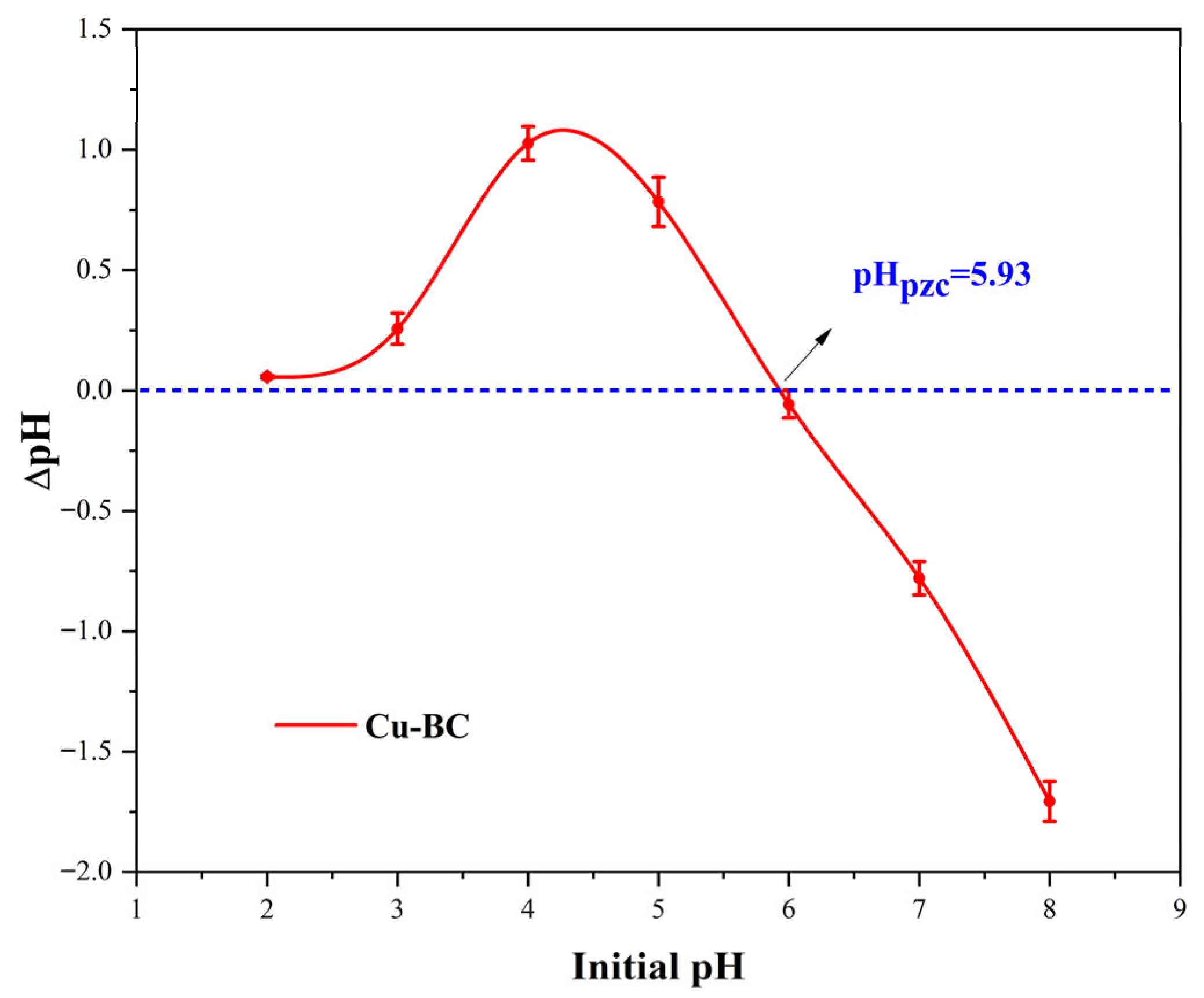
As illustrated in Figure 3, when the pH of the solution falls below 5.93, the Cu-BC surface in the solution exhibits a positive charge. This may be attributed to the protonation of surface functional groups under low pH conditions, resulting in the acquisition of a positive charge [17]. The positively charged Pb(II) ion will experience electrostatic repulsion with MB and Cu-BC when the pH of the solution is less than 5.93 [18], which will affect the adsorption performance of Cu-BC. As the pH rises, the Cu-BC surface’s negative charge increases, facilitating the electrostatic adsorption of MB and positively charged Pb(II) ions. Therefore, the adsorption of Pb(II) ions and methylene blue by Cu-BC was enhanced with the increase in pH, and this trend indicates the inclusion of electrostatic interactions in the adsorption process.

3.2. Adsorption Kinetics

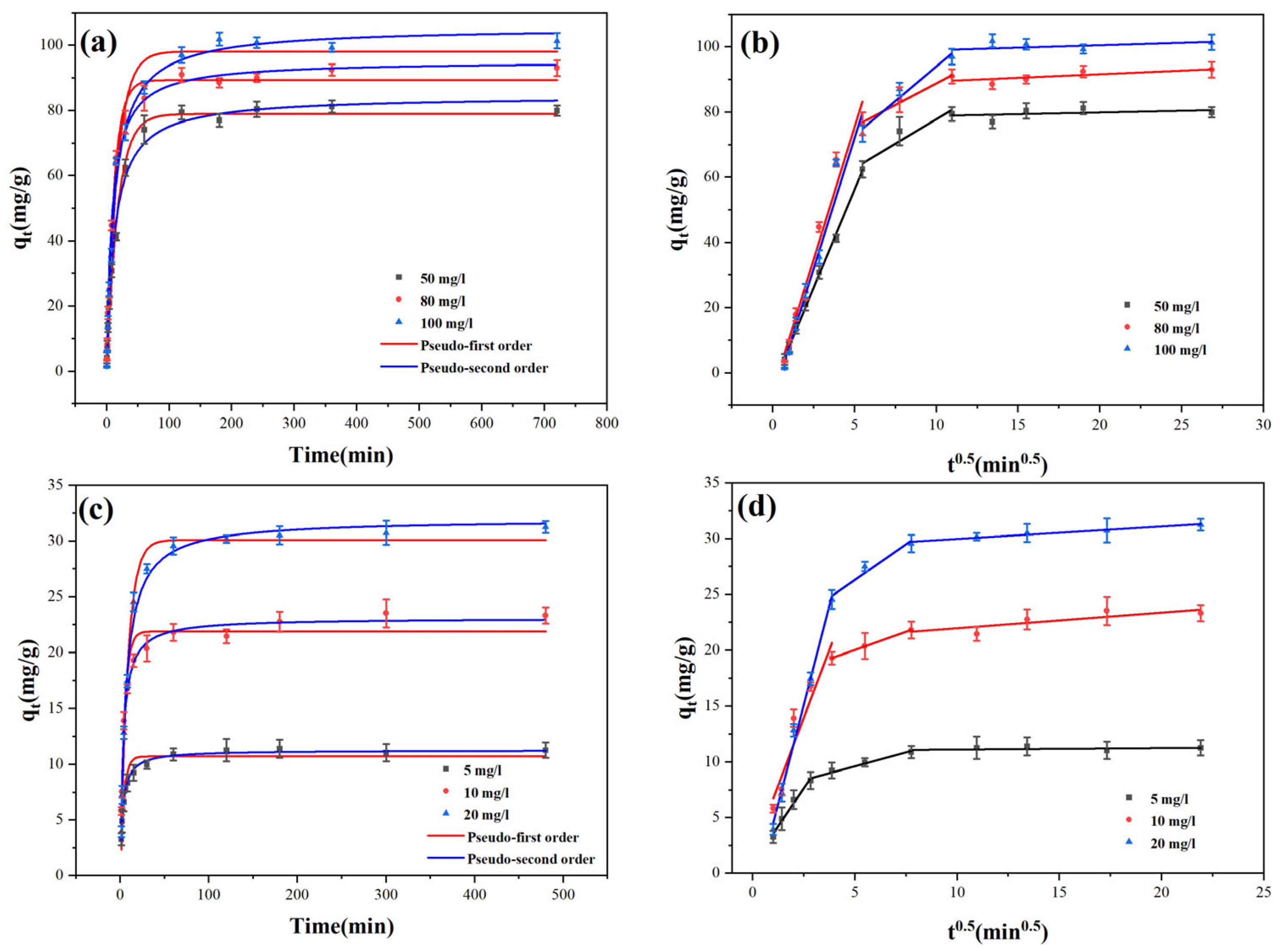
Further fitting of the pseudo-first-order kinetic model, the pseudo-second-order kinetic model, and the intraparticle diffusion kinetic model was performed on the adsorption data of methylene blue and Pb(II) ions. Figure 4 displays the fitting findings, while Table 3 and Table 4 provide a summary of the kinetic parameters of the relevant models. According to Figure 4a,c, Pb(II) ions and methylene blue on Cu-BC were adsorbed rapidly during the first 15 and 30 min, indicating that the active site on the Cu-BC surface was rapidly bound to MB and Pb(II) ions in a short time. From 120 to 180 min, the adsorption of Pb(II) ions and MB by Cu-BC increased gradually. After 200 min, it tended towards equilibrium. This indicates that the contaminant’s binding is gradually saturated, and the limited binding site on Cu-BC is gradually occupied. The adsorption capacity of Cu-BC, however, rose when the concentration of Pb(II) ionic solution and MB solution increased, according to the kinetic data at various initial concentrations. The adsorption capacity of MB increased from 79.89 ± 1.54 mg/g to 101.44 ± 2.33 mg/g, and the adsorption capacity of Pb(II) increased from 11.26 ± 0.69 mg/g to 31.26 ± 0.52 mg/g. However, with the continuously increasing concentration, the adsorption capacity will eventually reach an upper limit because the binding site of Cu-BC is limited.
According to Table 3 and Table 4, the PSO of Cu-BC adsorption of methylene blue and Pb(II) ions has higher R2 values compared to the first-order kinetic model. This implies that Cu-BC’s adsorption behavior is more in line with the PSO and that chemical interaction regulates the adsorption rate [19]. The intraparticle diffusion model fitting results (C ≠ 0, with the regression line not going through the origin) indicate that while chemisorption contributes to the adsorption process, it is not the sole governing mechanism, while diffusion mechanisms are also operating simultaneously [20,21]. The adsorption data are divided into three straight lines, indicating that there are three different stages in the adsorption process of MB and Pb(II) ions by Cu-BC. In the first stage, MB and Pb(II) ions diffuse from the liquid phase to the outer surface of Cu-BC. The maximum k1 value indicates that the rate of this process is the fastest [22,23]. In the second stage, impurities from the exterior spread within Cu-BC’s pores and into its inside. The k3 value of the third stage is quite minimal, indicating that at this time, the adsorption operation has basically established the equilibrium. This sequential progression demonstrates that while chemisorption dominates the overall mechanism, the adsorption rate is jointly influenced by both surface reaction kinetics and mass transport limitations [24].

3.3. Adsorption Isotherm

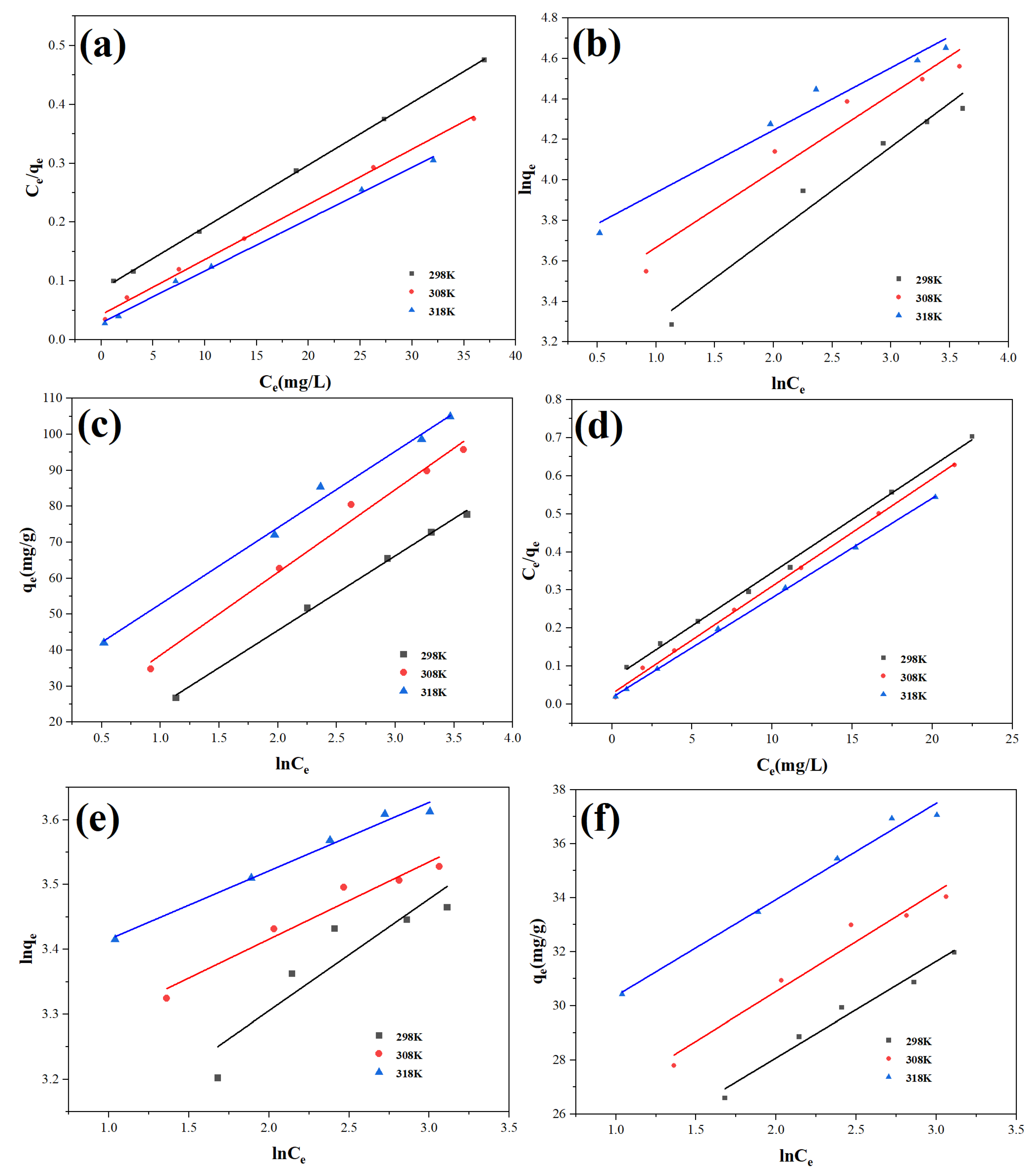
The adsorption data at 25 °C, 35 °C, and 45 °C were analyzed using an isotherm technique in order to further forecast the adsorption of MB and Pb(II) ions on Cu-BC. The Langmuir model can prove the occurrence of mono-layer adsorption, while the Freundlich model can be employed to assess whether the adsorption process is multi-layer, and the Temkin model can identify whether the adsorption process is chemisorbed [25].
Figure 5 displays the isotherm’s fitting findings, and Table 5 and Table 6 provide a summary of the corresponding values for the three models. Among the three models, the Langmuir model has the highest R2, and the Langmuir model most closely matches the adsorption data, exhibiting that the adsorbed MB and Pb(II) ions are monolayers on the Cu-BC surface, as well as even adsorption sites on the surface [26]. As the temperature rose, Cu-BC’s adsorption efficiency for Pb(II) and methylene blue (MB) ions increased. At 25 °C, 35 °C, and 45 °C, the highest adsorption capacities (qm) were measured at 94.43, 106.72, and 113.64 mg/g for MB, and 35.79, 36.06, and 38.24 mg/g for Pb(II), respectively, demonstrating improved adsorption efficiency with increasing temperature [2,27]. The RL values of MB were 0.0746, 0.617, 0.04305, 0.3765, and 0.032, 0.3982, respectively, and the RL values of Pb(II) ions were 0.046, 0.056, 0.322, 0.0245, 0.167, 0.0672 and 0.017, 0.1218, indicating that their adsorption process on Cu-BC was easy [28]. The R2 value of the Temkin model is second only to the Langmuir model, which works very well, indicating that the adsorption process involves electrostatic interaction [23,29].
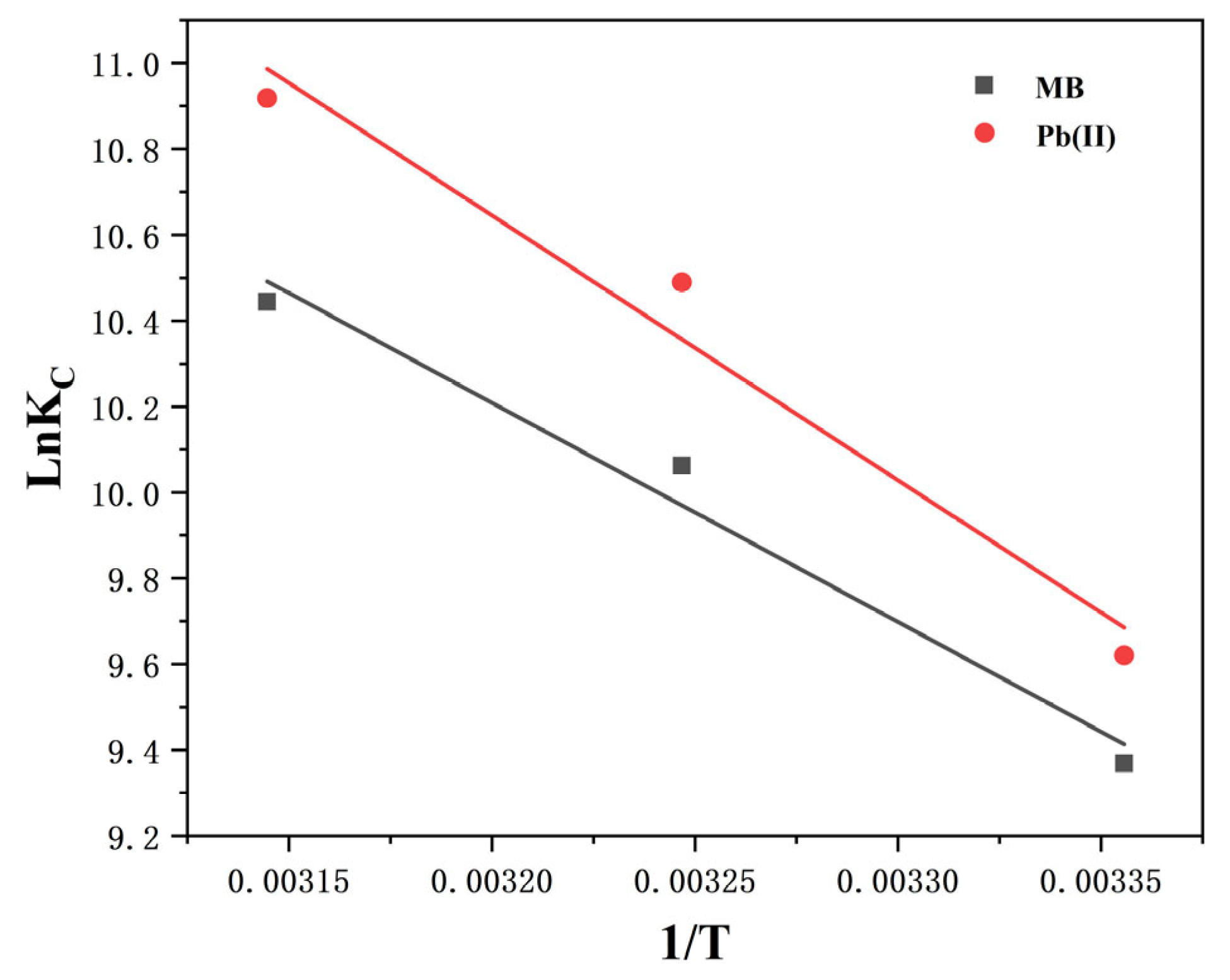
The thermodynamic parameters (∆G°, ∆H°, and ∆S°) derived from the temperature-dependent Langmuir isotherm fits are shown in Table 7, the regression results of which are graphically displayed in Figure 6. At 25 °C–45 °C, the ∆G° of Pb(II) ions and MB are negative, indicating that their adsorption on Cu-BC is a spontaneous process [30]. The key is that a positive ∆H° value indicates that these spontaneous processes are essentially endothermic [31]. This phenomenon—the coexistence of spontaneity and endothermic properties—reveals a key physical and chemical essence: the driving force of this adsorption process is not energy release, but entropy increase. A positive ∆H° indicates the need to absorb energy to overcome certain energy barriers, which is likely related to the dehydration process of adsorbate ions or solute molecules before adsorption [32,33]. Therefore, the spontaneity of the entire process (∆G° is negative) is achieved by favorable entropy increase (∆S° is positive), which offsets unfavorable enthalpy terms. Additionally, as the temperature rises, their ∆G° value decreases, indicating that the temperature pushes Cu-BC adsorption, specifically the Cu-BC adsorption capacity of MB and Pb(II) ions, enhancing with the temperature.
The maximal adsorption capacities (qm) of several adsorbents for Pb(II) and MB in aqueous solutions are shown in Table 8. It is clear that Cu-BC has a beneficial effect on Pb(II) and MB, two water pollutants.

3.4. Adsorption Properties Under the Binary System

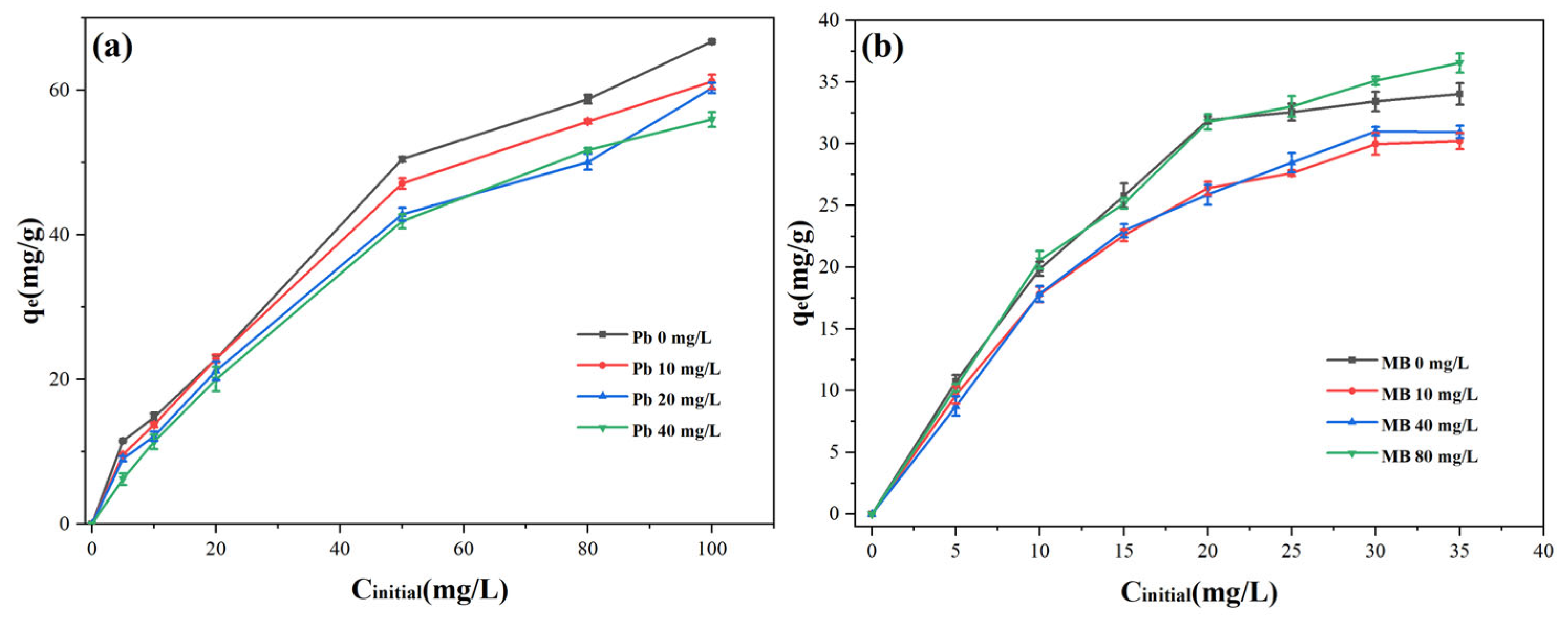
Dye and heavy metals usually coexist in dyeing effluents. The MB and Pb(II) coexistence system was examined with the aim of looking into the adsorption capabilities of Cu-BC on dye effluent. The potential interaction between MB and Pb(II) ions may alter Cu-BC’s adsorption ability when they coexist. To assess competitive adsorption behavior, co-adsorption studies were systematically conducted in binary-component systems. The outcomes of the simultaneous adsorption of Cu-BC under a binary system are displayed in Figure 7. The addition of Pb(II) ions hindered Cu-BC’s adsorption capacity on MB (Figure 7a), resulting in a maximum adsorption capacity drop of 20%. The mechanisms of site competition and electrostatic repulsion between the positively charged species (MB and Pb(II)) work together to produce this inhibitory effect [3]. Interestingly, the ability of Cu-BC to absorb Pb(II) ions after the addition of MB was initially inhibited, but later improved as the concentration of MB continued to increase (Figure 7b). This is because MB adsorbed on Cu-BC has nitrogen-containing groups that can complex Pb(II) ions, thus providing a new site for adsorption [38]. Overall, in binary systems, methylene blue inhibits the adsorption of Pb(II) ions at low concentrations but promotes it at high concentrations, whereas Pb(II) ions inhibit the adsorption of methylene blue on Cu-BC [39,40].

3.5. Adsorption Mechanism

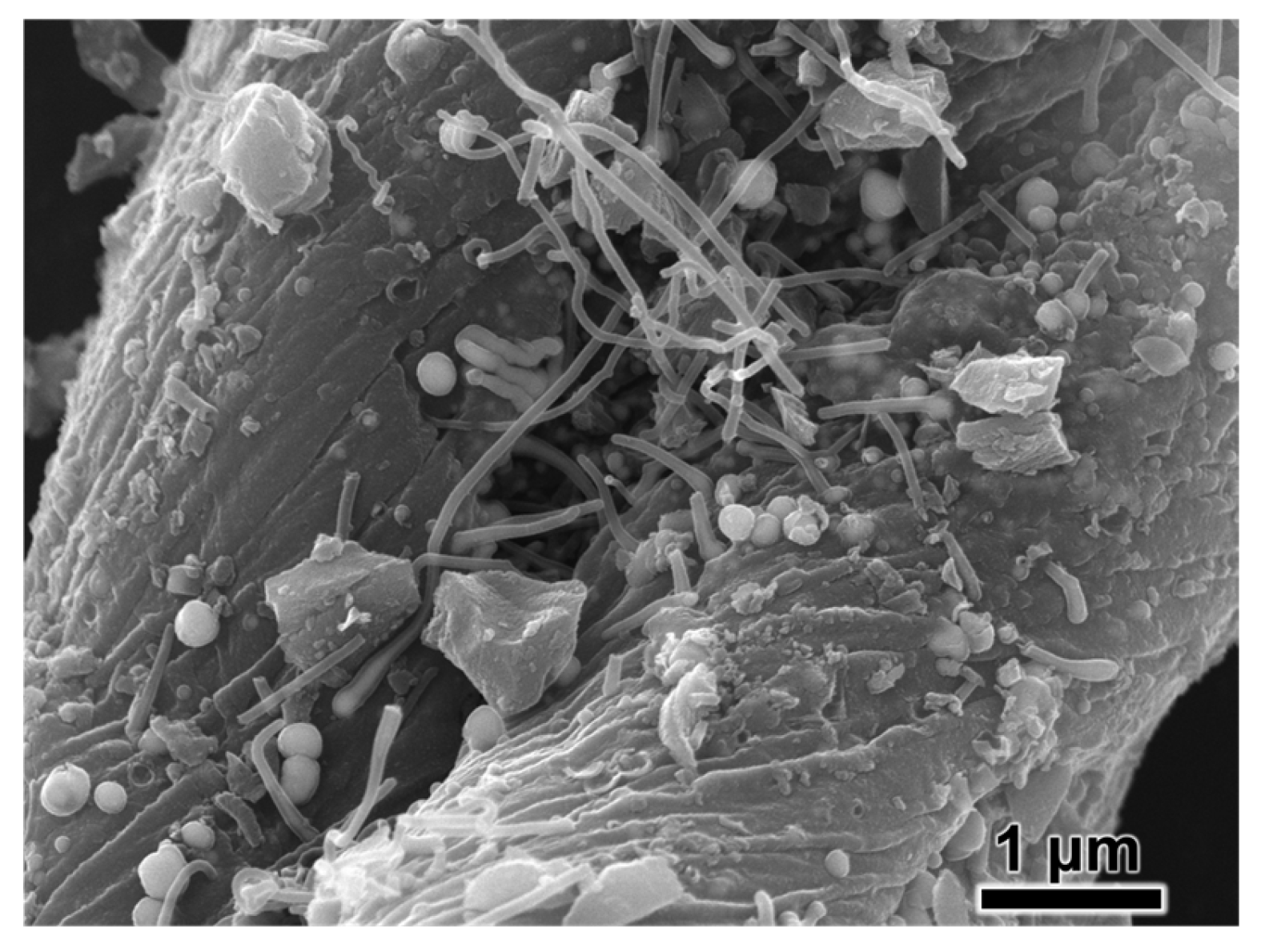
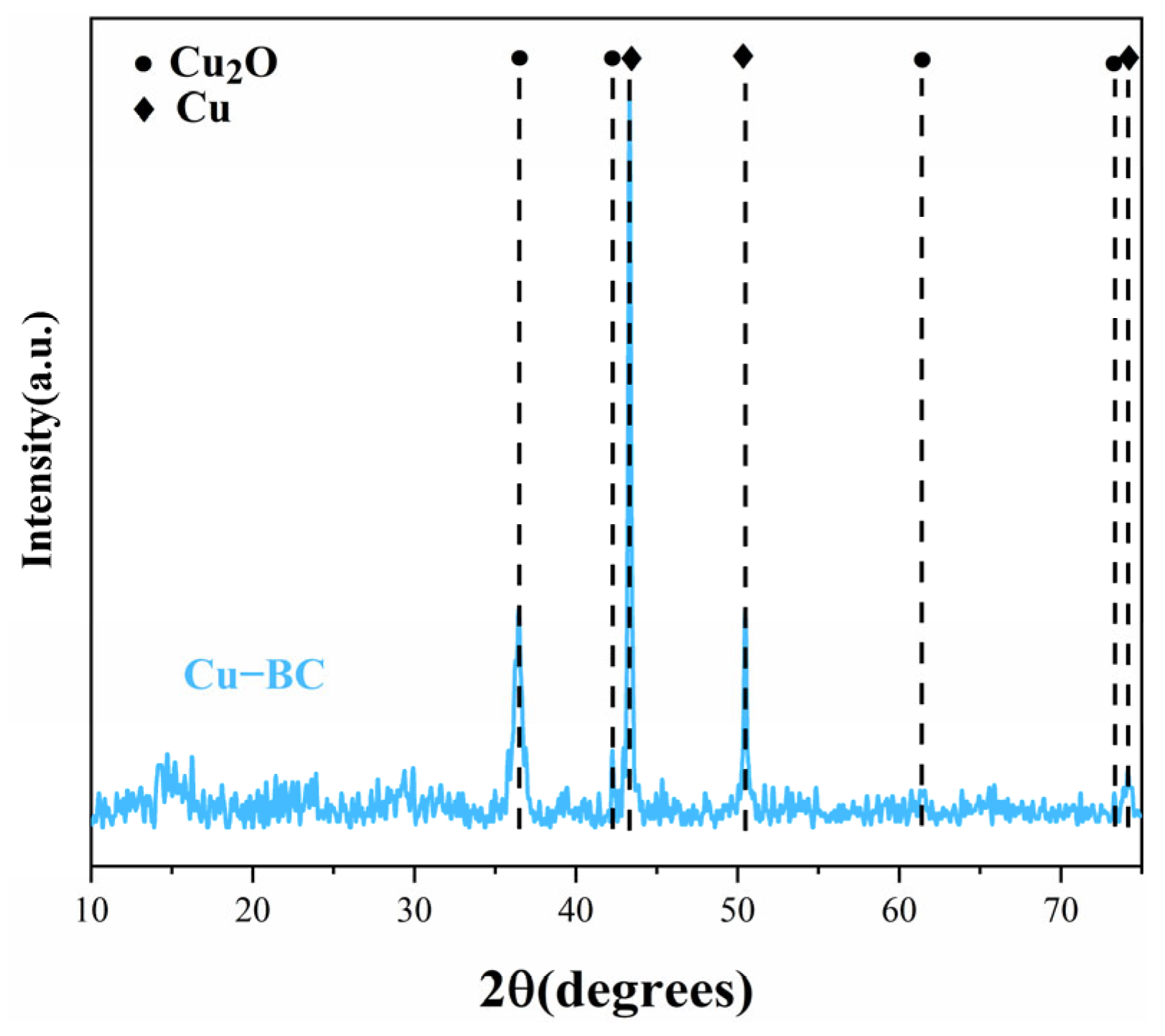
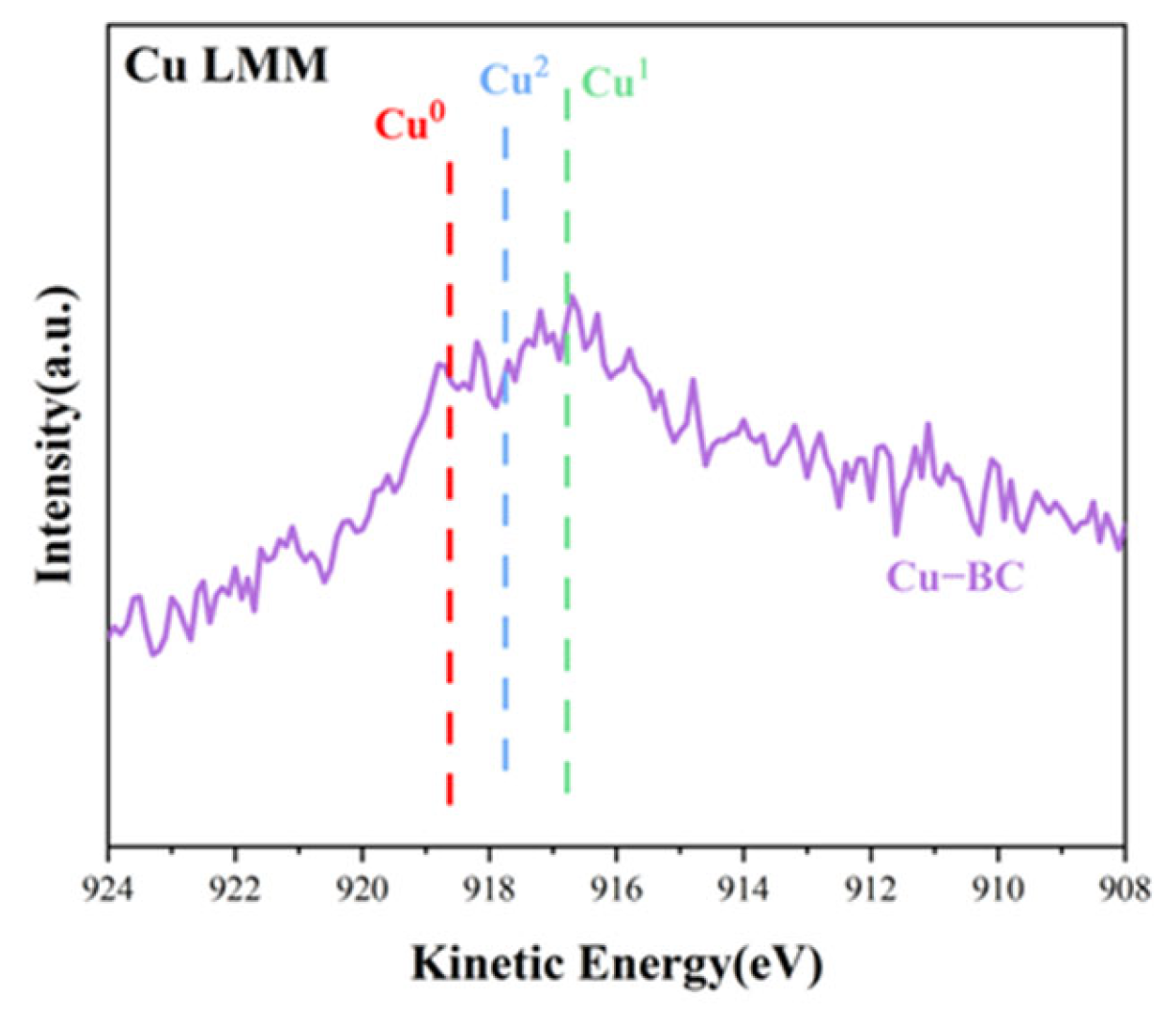
MB and Pb(II) ion adsorption on Cu-BC is a complicated process. As shown in the SEM image (Figure 8), a large number of small white balls are evenly dispersed on the surface of Cu-BC. According to the XRD results (Figure 9) and Cu LMM results (Figure 10), these small white balls are various forms of copper (metal Cu0, Cu2O, and CuO), which may promote the photocatalytic degradation of MB [6,41], thus enhancing the removal of MB. However, the narrow and winding gaps and large holes of the Cu-BC surface indicate that physical adsorption, such as pore filling and surface diffusion, may be one of the most vital adsorption mechanisms of Cu-BC. According to the results of adsorption dynamics, the adsorption process of MB and Pb(II) ions on Cu-BC is dominated by chemisorption. The effect of pH value shows that there is electrostatic interaction between Cu-BC and the contaminant, which is also proved by the result of pH zero point potential (pHPZC) of Cu-BC, and the fitting of the Temkin isotherm model shows that electrostatic interaction is one of the most important forms.
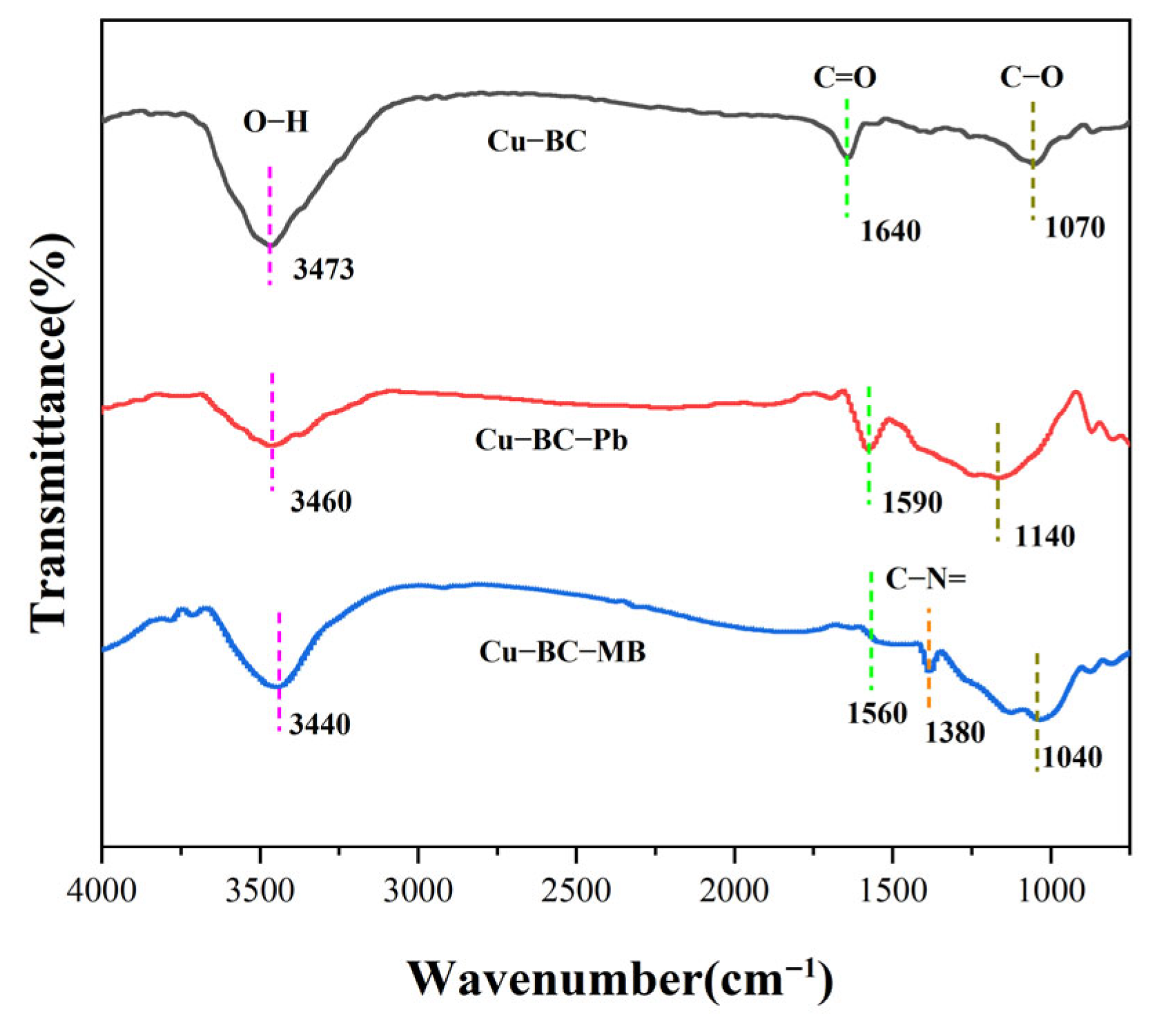
Surface functional groups of Cu-BC before and after adsorption of MB and Pb(II) ions were analyzed via FTIR (Thermo Fischer, Nicolet is5, Waltham, MA, USA, resolution 4 cm−1, 32 scans, covering wavenumber range 400 cm−1 to 4000 cm−1) to monitor changes in peak intensity and position, which reflect vibrational modifications of surface functional groups, thereby elucidating their role in the adsorption process. As shown in Figure 11, the Cu-BC surface is characterized by functional groups exhibiting peaks at 3473 cm−1 (O–H stretching), 1640 cm−1 (C=O stretching), and 1070 cm−1 (C–O symmetric stretching) [42]. After Pb(II) adsorption, the C=O stretch red-shifts from 1640 cm−1 to 1590 cm−1, indicating coordination between Pb(II) and carbonyl oxygen atoms. Concurrently, the C–O stretching vibration shifts from 1070 cm−1 to 1140 cm−1. This shift to a higher wavenumber is attributed to the formation of a stable C–O–Pb coordination bond, which increases the bond force constant [43]. The broad O–H peak shifting to 3460 cm−1 further indicates potential involvement of hydroxyl groups in metal complexation [44]. Following MB adsorption, the C=O peak shifts to 1560 cm−1, and the C–O peak shifts to 1040 cm−1. The decrease in wavenumber for the C–O stretch implies a different interaction mechanism, possibly involving π–π interactions or hydrogen bonding with the MB molecule [45]. The appearance of a new, distinct peak at 1380 cm−1, assigned to the C–N= stretching vibration of the dye’s aromatic structure [46], provides direct evidence for the successful loading of MB. The shift of the O–H peak to 3440 cm−1 also indicates the formation of hydrogen bonds between MB and surface hydroxyls [47].
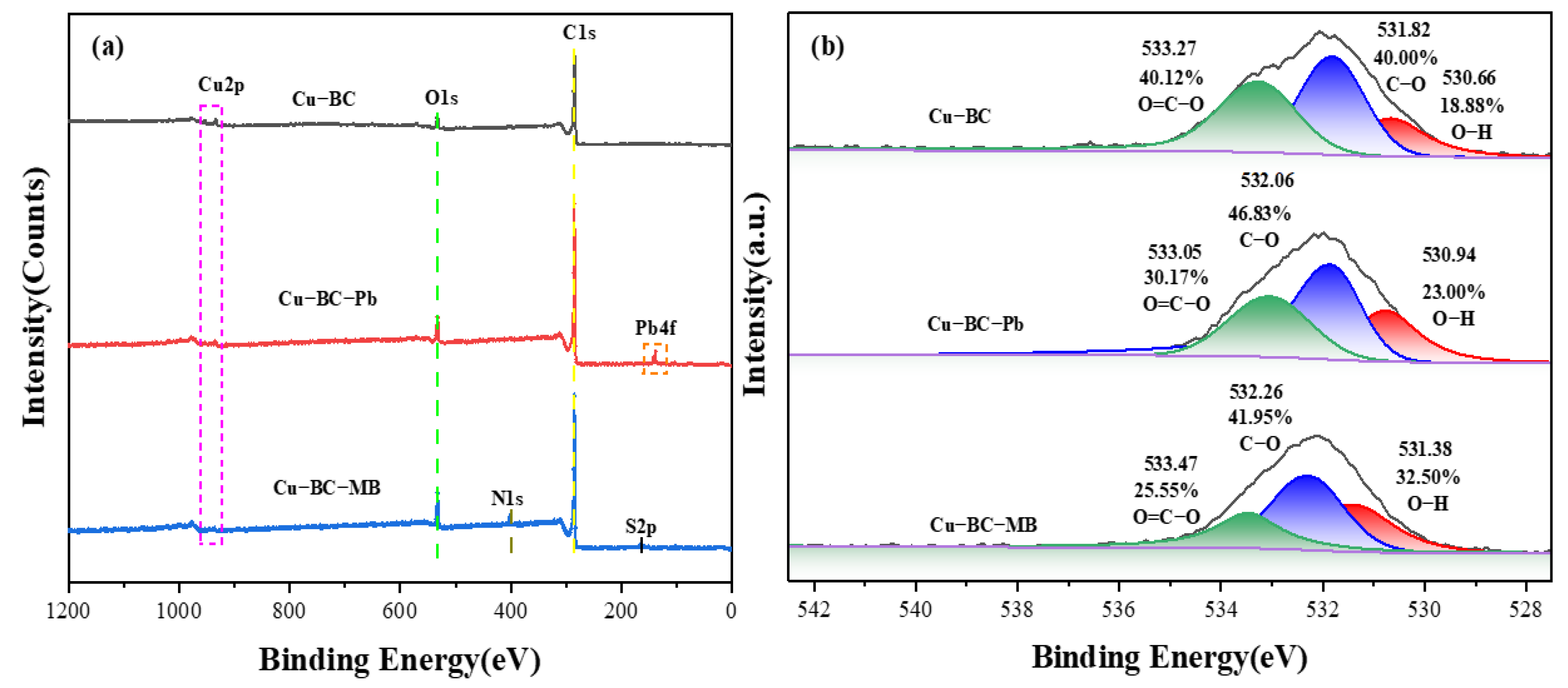
To investigate the adsorption mechanism, XPS was used to further evaluate the chemical properties of Cu-BC during the adsorption of Pb(II) and methylene blue ions. As can be seen in Figure 12a, the full spectrum of 284.66 eV, 531.82 eV, 932.43 eV, and 952.10 eV correspond to C1s, O1s, and Cu 2 p, separately. Peaks close to the binding energy of 138 eV and 143 eV, which correspond to Pb 4f7/2 and Pb 4f5/2, respectively, are seen following the adsorption of Pb(II) ions [48], while after the adsorption of methylene blue, a new peak of S2p at 165.2 eV and a binding energy of 400.1 eV at N1s appeared on the full spectrum of the XPS scan. The appearance of these new peaks proves that the Pb(II) ions and methylene blue are successfully adsorbed on the Cu-BC surface. For O1s (Figure 12b), the peak with binding energy at 530.66 eV on Cu-BC corresponds to OH (18.88%), the peak with binding energy at 531.82 eV corresponds to CO (40.00%), while the peak at 533.27 eV corresponds to O=C–O (40.12%) [49]. Following adsorption, the OH group’s peaks were moved to 530.94 eV and 531.98 eV, with their relative abundances increasing to 23.00% and 32.50%, respectively; the CO group’s peaks were moved to 532.06 eV and 532.26 eV, with their relative abundances increasing to 46.83% and 41.95%, respectively; and the O=C–O group’s peaks were moved to 533.05 eV and 533.47 eV, with their relative abundances increasing to 30.17% and 25.55%, respectively. These changes indicate that these groups may form hydrogen bonds [50] or have π–π interaction [51], and may complex with Pb(II) ions [52]. This phenomenon is consistent with the FTIR analysis’s conclusions.

4. Conclusions and Perspectives

4.1. Conclusions

This study demonstrates that Cu-BC, derived from copper-containing waste cotton textiles, serves as an effective adsorbent for both methylene blue (MB) and Pb(II) ions in aqueous solutions. Its maximum adsorption capacities (104.93 ± 8.71 mg/g for MB and 36.70 ± 1.54 mg/g for Pb(II)) are competitive with other reported biochar-based adsorbents. The adsorption process was determined to be endothermic and monolayer-based, primarily governed by chemisorption. While this work highlights the potential of Cu-BC for resource recovery and wastewater treatment, the study is limited to laboratory-scale experiments using synthetic wastewater. Future research should focus on adsorbent regeneration and performance validation in complex, real-world effluents to assess its practical applicability.

4.2. Future Perspectives

This study has several limitations, such as: it did not use actual dye wastewater for research; no regeneration tests were conducted; and the incomplete comparative characterization of the raw biochar. To bridge the gap between laboratory research and practical application, the following aspects are proposed for future work:
(i)
Performance in real matrices: Evaluating the adsorbent’s selectivity and capacity in authentic industrial wastewater (e.g., from dyeing or metal-plating processes) is crucial to assess its efficiency in the presence of competing ions, organic matter, and complex backgrounds.
(ii)
Long-term stability and regeneration: Investigating the long-term stability of the adsorbent under realistic dynamic flow conditions, along with developing and optimizing robust regeneration protocols (e.g., using acidic or chelating eluents), is essential for economic viability and reducing secondary waste.
(iii)
Techno-economic and environmental assessment: Conducting preliminary techno-economic analysis (TEA) and life cycle assessment (LCA) will be necessary to evaluate the overall cost-effectiveness and environmental footprint of the proposed adsorption process at a larger scale, guiding its potential industrial implementation.
(iv)
Detailed comparative characterization directly correlates XPS, FTIR, SEM, and other characterization results (e.g., detection of copper species, new functional groups, successful copper loading) with improvements in adsorption performance—quantitatively or qualitatively—to further elucidate the respective contributions of the carbon matrix and copper species to the adsorption process.

Author Contributions

Conceptualization, X.Z. and L.Z.; Methodology, S.C. and X.Y.; Validation, X.Z. and X.Y.; Formal Analysis, S.C.; Investigation, X.Z.; Resources, S.C.; Data Curation, X.Z.; Writing—Original Draft Preparation, X.Z. and X.Y.; Writing—Review and Editing, X.Z., X.Y. and S.C.; Visualization, X.Z. and L.Z.; Supervision, S.C.; Project Administration, S.C. and L.Z.; Funding Acquisition, S.C. and L.Z. All authors have read and agreed to the published version of the manuscript.

Funding

This work was supported by the National Natural Science Foundation of China (Grant No. 52100161). Chen Si has received research support from the National Natural Science Foundation of China.

Data Availability Statement

The original contributions presented in the study are included in the article; further inquiries can be directed to the corresponding author.

Acknowledgments

This study was supported by National Natural Science Foundation of China (No. 52100161).

Conflicts of Interest

The authors declare no conflicts of interest.

References

  1. Zhang, B.; Wang, Y.; Li, M.; Wei, Z.; Yang, J.; Shen, Y.; Liu, J. Nano-confined MnFe2O4/sepiolite composite for selective and energy-efficient Pb2+ removal via capacitive deionization. Desalination 2026, 620, 119631. [Google Scholar] [CrossRef]
  2. Doumic, L.I.; Ferro Orozco, A.M.; Cassanello, M.C.; Ayude, M.A. Prussian Blue–Alumina as Stable Fenton-Type Catalysts in Textile Dyeing Wastewater Treatment. Processes 2025, 13, 3656. [Google Scholar] [CrossRef]
  3. Chen, T.; Wen, X.C.; Li, X.Y.; He, J.H.; Yan, B.; Fang, Z.Q.; Zhao, L.Z.; Liu, Z.Y.; Han, L.F. Single/co-adsorption and mechanism of methylene blue and lead by 13-cyclodextrin modified magnetic alginate/biochar. Bioresour. Technol. 2023, 381, 129130. [Google Scholar] [CrossRef]
  4. Fang, X.T.; Guo, H.Y.; Yang, F.F.; Bai, X.Y. Synthesis and Dyes Adsorption Properties of Calix 4 crown-grafted Chitosan Chelating Polymer. Chem. Res. Chin. Univ. 2015, 31, 1051–1055. [Google Scholar] [CrossRef]
  5. Din, S.U.; Awan, J.M.; Imran, M.; Zain Ul, A.; Haq, S.; Hafeez, M.; Hussain, S.; Khan, M.S. Novel nanocomposite of biochar-zerovalent copper for lead adsorption. Microsc. Res. Tech. 2021, 84, 2598–2606. [Google Scholar] [CrossRef]
  6. Shu, J.H.; Cheng, S.; Xia, H.Y.; Zhang, L.B.; Peng, J.H.; Li, C.Y.; Zhang, S.Z. Copper loaded on activated carbon as an efficient adsorbent for removal of methylene blue. RSC Adv. 2017, 7, 14395–14405. [Google Scholar] [CrossRef]
  7. Zhou, L.; Li, J.P.; Zhong, M.Q.; Zhang, Y.X.; Wang, T.; Liu, J.X.; Mei, M.; Chen, S. Study on the hydrogen production promotion effect and immobilization mechanisms of copper during the pyrolysis process of waste cotton textiles. J. Environ. Chem. Eng. 2024, 12, 111896. [Google Scholar] [CrossRef]
  8. GB 5085.3-2007; Identification Standards for Hazardous Wastes—Identification for Extraction Toxicity. China Environmental Science Press: Beijing, China, 2007.
  9. Fazal, T.; Faisal, A.; Mushtaq, A.; Hafeez, A.; Javed, F.; Alaud Din, A.; Rashid, N.; Aslam, M.; Rehman, M.S.U.; Rehman, F. Macroalgae and coal-based biochar as a sustainable bioresource reuse for treatment of textile wastewater. Biomass Convers. Biorefinery 2019, 11, 1491–1506. [Google Scholar] [CrossRef]
  10. Gatabi, M.P.; Moghaddam, H.M.; Ghorbani, M. Point of zero charge of maghemite decorated multiwalled carbon nanotubes fabricated by chemical precipitation method. J. Mol. Liq. 2016, 216, 117–125. [Google Scholar] [CrossRef]
  11. Tang, F.; Yu, H.Y.; Abdalkarim, S.Y.H.; Sun, J.H.; Fan, X.M.; Li, Y.Z.; Zhou, Y.; Tam, K.C. Green acid-free hydrolysis of wasted pomelo peel to produce carboxylated cellulose nanofibers with super absorption/flocculation ability for environmental remediation materials. Chem. Eng. J. 2020, 395, 125070. [Google Scholar] [CrossRef]
  12. Ait Ichou, A.; Benhiti, R.; Abali, M.; Dabagh, A.; Carja, G.; Soudani, A.; Chiban, M.; Zerbet, M.; Sinan, F. Characterization and sorption study of Zn2[FeAl]-CO3 layered double hydroxide for Cu(II) and Pb(II) removal. J. Solid State Chem. 2023, 320, 123869. [Google Scholar] [CrossRef]
  13. Chen, S.; Qin, C.X.; Wang, T.; Chen, F.Y.; Li, X.L.; Hou, H.B.; Zhou, M. Study on the adsorption of dyestuffs with different properties by sludge-rice husk biochar: Adsorption capacity, isotherm, kinetic, thermodynamics and mechanism. J. Mol. Liq. 2019, 285, 62–74. [Google Scholar] [CrossRef]
  14. Feng, M.L.; Yu, S.C.; Wu, P.C.; Wang, Z.W.; Liu, S.H.; Fu, J.W. Rapid, high-efficient and selective removal of cationic dyes from wastewater using hollow polydopamine microcapsules: Isotherm, kinetics, thermodynamics and mechanism. Appl. Surf. Sci. 2021, 542, 148633. [Google Scholar] [CrossRef]
  15. Lima, E.C.; Hosseini-Bandegharaei, A.; Moreno-Piraján, J.C.; Anastopoulos, I. A critical review of the estimation of the thermodynamic parameters on adsorption equilibria. Wrong use of equilibrium constant in the Van’t Hoof equation for calculation of thermodynamic parameters of adsorption. J. Mol. Liq. 2019, 273, 425–434. [Google Scholar] [CrossRef]
  16. Milonjic, S. A consideration of the correct calculation of thermodynamic parameters of adsorption. J. Serbian Chem. Soc. 2007, 72, 1363–1367. [Google Scholar] [CrossRef]
  17. Carraro, P.S.; Spessato, L.; Crespo, L.H.S.; Yokoyama, J.T.C.; Fonseca, J.M.; Bedin, K.C.; Ronix, A.; Cazetta, A.L.; Silva, T.L.; Almeida, V.C. Activated carbon fibers prepared from cellulose and polyester-derived residues and their application on removal of Pb2+ ions from aqueous solution. J. Mol. Liq. 2019, 289, 111150. [Google Scholar] [CrossRef]
  18. Fei, Y.H.; Li, M.Z.; Ye, Z.F.; Guan, J.Y.; Huang, Z.H.; Xiao, T.F.; Zhang, P. The pH-sensitive sorption governed reduction of Cr(VI) by sludge derived biochar and the accelerating effect of organic acids. J. Hazard. Mater. 2022, 423, 127205. [Google Scholar] [CrossRef]
  19. Li, M.; Liu, Q.; Guo, L.J.; Zhang, Y.P.; Lou, Z.J.; Wang, Y.; Qian, G.R. Cu(II) removal from aqueous solution by Spartina alterniflora derived biochar. Bioresour. Technol. 2013, 141, 83–88. [Google Scholar] [CrossRef]
  20. Lv, M.; Li, D.Y.; Zhang, Z.H.; Logan, B.E.; Liu, G.H.; Sun, M.C.; Dai, C.C.; Feng, Y.J. Unveiling the correlation of Fe3O4 fractions upon the adsorption behavior of sulfamethoxazole on magnetic activated carbon. Sci. Total Environ. 2021, 757, 143717. [Google Scholar] [CrossRef]
  21. Jiao, M.; Jacquemin, J.; Zhang, R.; Zhao, N.; Liu, H. The Prediction of Cu(II) Adsorption Capacity of Modified Pomelo Peels Using the PSO-ANN Model. Molecules 2023, 28, 6957. [Google Scholar] [CrossRef]
  22. Chen, G.; Shen, Z.; Mao, T.; Liu, K.; Xie, Z.; Qiao, J. A novel biochar prepared by co-pyrolysis of corn straw and arsenic-containing gypsum for the treatment of Pb pollution in water. J. Water Process Eng. 2025, 77, 108559. [Google Scholar] [CrossRef]
  23. Liu, Y.; Hu, L.; He, N.; Jiang, Z.; Gong, J.; Jiang, C.; Zhao, H. Lead and cadmium adsorption by Phanerochaete chrysosporium under the protection of phosphorus-containing biochar: Effects and mechanisms. J. Environ. Chem. Eng. 2025, 13, 117330. [Google Scholar] [CrossRef]
  24. Chen, J.P.; Wu, S.; Chong, K.-H. Surface modification of a granular activated carbon by citric acid for enhancement of copper adsorption. Carbon 2003, 41, 1979–1986. [Google Scholar] [CrossRef]
  25. Mahmoud, M.E.; Mohamed, A.K.; Salam, M.A. Self-decoration of N-doped graphene oxide 3-D hydrogel onto magnetic shrimp shell biochar for enhanced removal of hexavalent chromium. J. Hazard. Mater. 2021, 408, 124951. [Google Scholar] [CrossRef]
  26. Wang, X.Y.; Shi, C.; Hao, X.D.; Wu, Y.Y. Phosphate recovery from sludge-incinerated ash by adsorption with hydrotalcite synthesized by metals in the ash. Sci. Total Environ. 2023, 905, 167263. [Google Scholar] [CrossRef]
  27. Zhang, M.; Zhang, X.; Shi, E.; Liu, S.; Zhang, S.; Zou, Y. Molecular dynamics study on structures and adsorption capacity of activated carbon prepared from corn straw and sewage sludge by molten salt method. Appl. Phys. A 2024, 130, 117. [Google Scholar] [CrossRef]
  28. Feng, Y.; Yang, F.; Wang, Y.; Ma, L.; Wu, Y.; Kerr, P.G.; Yang, L. Basic dye adsorption onto an agro-based waste material–Sesame hull (Sesamum indicum L.). Bioresour. Technol. 2011, 102, 10280–10285. [Google Scholar] [CrossRef]
  29. Kallel, F.; Chaari, F.; Bouaziz, F.; Bettaieb, F.; Ghorbel, R.; Chaabouni, S.E. Sorption and desorption characteristics for the removal of a toxic dye, methylene blue from aqueous solution by a low cost agricultural by-product. J. Mol. Liq. 2016, 219, 279–288. [Google Scholar] [CrossRef]
  30. Wang, Y.; Hu, L.; Zhang, G.; Yan, T.; Yan, L.; Wei, Q.; Du, B. Removal of Pb(II) and methylene blue from aqueous solution by magnetic hydroxyapatite-immobilized oxidized multi-walled carbon nanotubes. J. Colloid Interface Sci. 2017, 494, 380–388. [Google Scholar] [CrossRef]
  31. Parashar, A.; Jain, R.; Thakur, K.S.; Jain, R. Equilibrium, Kinetic and Thermodynamic Studies of Adsorption Behaviour of 3D Porous NiFe Nanoparticles for The Removal of Antacid Drug Ranitidine from Waste Water. Anal. Chem. Lett. 2022, 12, 615–628. [Google Scholar] [CrossRef]
  32. Fu, K.; Luo, J. Rebuttal to Correspondence on “Superselective Hg(II) Removal from Water Using a Thiol-Laced MOF-Based Sponge Monolith: Performance and Mechanism”. Environ. Sci. Technol. 2023, 57, 13543–13545. [Google Scholar] [CrossRef] [PubMed]
  33. Borges-Machado, A.L.; Neves-Martins, M.J.; Ribeiro-Sanches, M.A.; Pereira, L.S.; dos Santos, P.A.; Telis-Romero, J. Desorption properties of taioba (Xanthosoma taioba E.G. Gonç.) leaves: A non-conventional edible plant. Food Biosci. 2024, 59, 104093. [Google Scholar] [CrossRef]
  34. Kandasamy, S.; Madhusoodanan, N.; Senthilkumar, P.; Muneeswaran, V.; Manickam, N.; Myneni, V.R. Adsorption of methylene blue dye by animal dung biomass-derived activated carbon: Optimization, isotherms and kinetic studies. Biomass Convers. Biorefinery 2023, 15, 30187–30201. [Google Scholar] [CrossRef]
  35. Jaber, L.; Ihsanullah, I.; Almanassra, I.W.; Backer, S.N.; Abushawish, A.; Khalil, A.K.A.; Alawadhi, H.; Shanableh, A.; Atieh, M.A. Adsorptive Removal of Lead and Chromate Ions from Water by Using Iron-Doped Granular Activated Carbon Obtained from Coconut Shells. Sustainability 2022, 14, 10877. [Google Scholar] [CrossRef]
  36. Poonam; Bharti, S.K.; Kumar, N. Kinetic study of lead (Pb2+) removal from battery manufacturing wastewater using bagasse biochar as biosorbent. Appl. Water Sci. 2018, 8, 119. [Google Scholar] [CrossRef]
  37. Chi, T.; Zuo, J.; Liu, F.L. Performance and mechanism for cadmium and lead adsorption from water and soil by corn straw biochar. Front. Environ. Sci. Eng. 2017, 11, 15. [Google Scholar] [CrossRef]
  38. Huang, W.W.; Hu, Y.H.; Li, Y.Y.; Zhou, Y.B.; Niu, D.C.; Lei, Z.F.; Zhang, Z.Y. Citric acid-crosslinked β-cyclodextrin for simultaneous removal of bisphenol A, methylene blue and copper: The roles of cavity and surface functional groups. J. Taiwan Inst. Chem. Eng. 2018, 82, 189–197. [Google Scholar] [CrossRef]
  39. Huang, S.; Song, S.; Zhang, R.; Wen, T.; Wang, X.; Yu, S.; Song, W.; Hayat, T.; Alsaedi, A.; Wang, X. Construction of Layered Double Hydroxides/Hollow Carbon Microsphere Composites and Its Applications for Mutual Removal of Pb(II) and Humic Acid from Aqueous Solutions. ACS Sustain. Chem. Eng. 2017, 5, 11268–11279. [Google Scholar] [CrossRef]
  40. Ijaz, I.; Bukhari, A.; Nazir, A.; Gilani, E.; Zain, H.; Hussain, S.; Attia, S.; Lfseisi, A.A.; Ahmad, H. Enhanced selective adsorption capacity of lead (II) from complex wastewater by aminopropyltriethoxysilane-functionalized biochar grafted on the MXene based on anion-synergism. Mater. Chem. Phys. 2024, 314, 128929. [Google Scholar] [CrossRef]
  41. Ndolomingo, M.J.; Meijboom, R. Kinetic analysis of catalytic oxidation of methylene blue over γ-Al2O3 supported copper nanoparticles. Appl. Catal. A-Gen. 2015, 506, 33–43. [Google Scholar] [CrossRef]
  42. Yang, J.P.; Zhao, Y.C.; Ma, S.M.; Zhu, B.B.; Zhang, J.Y.; Zheng, C.G. Mercury Removal by Magnetic Biochar Derived from Simultaneous Activation and Magnetization of Sawdust. Environ. Sci. Technol. 2016, 50, 12040–12047. [Google Scholar] [CrossRef]
  43. Contreras-Rascón, J.I.; Díaz-Reyes, J.; Luna-Suárez, S.; Carrillo-Torres, R.C.; Sánchez-Zeferino, R. Characterisation of chemical bath deposition PbS nanofilms using polyethyleneimine, triethanolamine and ammonium nitrate as complexing agents. Thin Solid Film. 2019, 692, 137609. [Google Scholar] [CrossRef]
  44. Pantcheva, I.; Stamboliyska, R.; Petkov, N.; Tadjer, A.; Simova, S.; Stoyanova, R.; Kukeva, R.; Dorkov, P. Dinuclear vs. Mononuclear Copper(II) Coordination Species of Tylosin and Tilmicosin in Non-Aqueous Solutions. Molecules 2022, 27, 3899. [Google Scholar] [CrossRef] [PubMed]
  45. Chakraborty, A.; Henkel, S.; Schwaab, G.; Havenith, M. Structural Characterization of Pyruvic Acid Dimers Formed inside Helium Nanodroplets by Infrared Spectroscopy and Ab Initio Study. J. Phys. Chem. A 2024, 128, 5307–5313. [Google Scholar] [CrossRef] [PubMed]
  46. Xu, R.K.; Xiao, S.C.; Yuan, J.H.; Zhao, A.Z. Adsorption of methyl violet from aqueous solutions by the biochars derived from crop residues. Bioresour. Technol. 2011, 102, 10293–10298. [Google Scholar] [CrossRef]
  47. Li, S.; Zhao, C.; Wang, Y.; Li, H.; Li, Y. Synthesis and electrochemical properties of electroactive aniline-dimer-based benzoxazines for advanced corrosion-resistant coatings. J. Mater. Sci. 2018, 53, 7344–7356. [Google Scholar] [CrossRef]
  48. Zhao, T.C.; Ma, X.L.; Cai, H.; Ma, Z.C.; Liang, H.F. Study on the Adsorption of CuFe2O4-Loaded Corncob Biochar for Pb(II). Molecules 2020, 25, 3456. [Google Scholar] [CrossRef]
  49. Qu, J.H.; Zhang, B.; Tong, H.; Liu, Y.; Wang, S.Q.; Wei, S.Q.; Wang, L.; Wang, Y.F.; Zhang, Y. High-efficiency decontamination of Pb(II) and tetracycline in contaminated water using ball-milled magnetic bone derived biochar. J. Clean. Prod. 2023, 385, 135683. [Google Scholar] [CrossRef]
  50. Qu, J.H.; Li, Z.R.; Wu, Z.H.; Bi, F.X.; Wei, S.Q.; Dong, M.; Hu, Q.; Wang, Y.F.; Yu, H.; Zhang, Y. Cyclodextrin-functionalized magnetic alginate microspheres for synchronous removal of lead and bisphenol a from contaminated soil. Chem. Eng. J. 2023, 461, 142079. [Google Scholar] [CrossRef]
  51. Ohemeng-Boahen, G.; Sewu, D.D.; Tran, H.N.; Woo, S.H. Enhanced adsorption of congo red from aqueous solution using chitosan/hematite nanocomposite hydrogel capsule fabricated via anionic surfactant gelation. Colloids Surf. A-Physicochem. Eng. Asp. 2021, 625, 126911. [Google Scholar] [CrossRef]
  52. Law, X.N.; Cheah, W.Y.; Chew, K.W.; Ibrahim, M.F.; Park, Y.K.; Ho, S.H.; Show, P.L. Microalgal-based biochar in wastewater remediation: Its synthesis, characterization and applications. Environ. Res. 2022, 204, 111966. [Google Scholar] [CrossRef]
Figure 1. Standard curve of methylene blue solution.
Textiles 06 00012 g001
Figure 2. Influence of initial pH on MB and Pb(II) sorption.
Textiles 06 00012 g002
Figure 3. Point of zero charge (pHpzc) of Cu-BC.
Textiles 06 00012 g003
Figure 4. Pseudo-first-order and pseudo-second-order (a), intra-particle diffusion (b) model fitting of Cu-BC for MB; pseudo-first-order and pseudo-second-order (c), intra-particle diffusion (d) model fitting of Cu-BC for Pb(II).
Textiles 06 00012 g004
Figure 5. Langmuir (a), Freundlich (b) and Temkin (c) model fitting of Cu-BC for MB; Langmuir (d), Freundlich (e) and Temkin (f) model fitting of Cu-BC for Pb(II).
Textiles 06 00012 g005
Figure 6. Thermodynamic fitting of Cu-BC for MB and Pb(II) adsorption.
Textiles 06 00012 g006
Figure 7. The effect on Cu-BC for MB adsorption by Pb(II) (a); for Pb(II) adsorption by MB (b).
Textiles 06 00012 g007
Figure 8. Surface morphological characteristics of Cu-BC-700.
Textiles 06 00012 g008
Figure 9. XRD patterns of biochar pyrolysis.
Textiles 06 00012 g009
Figure 10. High-resolution XPS spectra of sample Cu LMM AES spectra.
Textiles 06 00012 g010
Figure 11. The FTIR spectra analysis of Cu-BC before and after adsorption of MB and Pb(II).
Textiles 06 00012 g011
Figure 12. XPS survey spectra (a) and high-resolution O1s spectra (b) of Cu-BC before and after MB and Pb(II) adsorption.
Textiles 06 00012 g012
Table 1. List of experimental chemical reagents.
Chemical ReagentsMolecular FormulaSpecificationsManufacturer
Trihydrate methylene blueC16H18ClN3S·3H2Obiological stainShanghai National Pharmaceutical Group, Shanghai, China
lead nitratePb(NO3)2ARShanghai National Pharmaceutical Group, Shanghai, China
hydrochloric acidHClARShanghai National Pharmaceutical Group, Shanghai, China
nitric acidHNO3ARShanghai National Pharmaceutical Group, Shanghai, China
sodium hydroxideNaOHARShanghai National Pharmaceutical Group, Shanghai, China
Table 2. List of experimental equipment.
Equipment NameEquipment ModelEquipment Manufacturer
pH MeterPHS−3EShanghai Yidian Scientific Instrument Co., Ltd., Shanghai, China
Precision BalanceATY244Shimadzu Corporation, Kyoto,
Japan
Electric constant temperature blast drying ovenDHG−9240AShanghai Sanfa Scientific Instrument Co., Ltd., Shanghai, China
UV–Visible spectrophotometerUV−5500PCShanghai Yuanxi Instrument Co., Ltd., Shanghai, China
Atomic Flame Absorption SpectrometerNOVAA−800Jena Analytical Instruments GmbH, Jena, Germany
Pure water analyzerASKL−10Chengdu Eco Technology Co., Ltd., Chengdu, China
Digital cryogenic gas bath oscillatorSHZ−221282ABChangzhou Ronghua Instrument Manufacturing Co., Ltd., Changzhou, China
Ultrasonic cleaning machineCJ−100SShenzhen Chaojie Technology, Shenzhen, China
Table 3. Kinetic model parameters for MB adsorption onto Cu-BC.
Kinetic ModelParametersValues
50 mg/L80 mg/L100 mg/L
Pseudo-first-orderqe (mg/g)78.98789.39298.152
K1 (min−1)0.056460.08410.05924
R20.99090.99280.9866
Pseudo-second-orderqe (mg/g)84.51495.189105.554
k2 (g mg−1 min−1)0.000940.001220.00076
R20.99290.99450.9939
Intra-particle diffusionki,1 (mgg−1 min1/2)12.052416.245716.0198
C−3.9444−5.6793−7.961
R20.99850.96920.9658
ki,2 (mgg−1 min1/2)3.00722.63414.2314
C47.80262.536251.751
R20.90500.98820.9631
ki,3 (mgg−1 min1/2)0.10250.21770.1494
C77.87687.31497.561
R20.81930.86470.8466
Table 4. Kinetic model parameters for Pb(II) adsorption over Cu-BC.
Kinetic ModelParametersValues
5 mg/L10 mg/L20 mg/L
Pseudo-first-orderqe (mg/g)10.716321.906530.0921
k1 (min−1)0.24890.21840.1185
R20.93170.95770.9906
Pseudo-second-orderqe (mg/g)11.272123.101131.9469
k2 (g mg−1 min−1)0.032730.013650.00528
R20.99360.98690.994
Intra-particle diffusionki,1 (mgg−1 min1/2)2.71764.84527.088
C0.88351.906−2.5401
R20.98150.95880.9925
ki,2 (mgg−1 min1/2)0.49580.65071.2716
C7.147616.795519.9655
R20.97350.99960.9598
ki,3 (mgg−1 min1/2)0.0130.13980.1119
C10.986920.588128.855
R20.89540.84790.9623
Table 5. Parameters of the isotherm models for MB adsorption onto Cu-BC.
ModelsParametersValues
298K308K318K
Langmuirqm94.4287106.7236113.6364
KL0.12410.21970.3022
RL0.0746–0.6170.0435–0.47650.032–0.3982
R20.99980.99720.9977
FreundlichKF17.566326.798137.694
n2.31182.64473.2436
R20.96810.94950.9715
TemkinKT20.72623.01421.233
f1.2151.96794.4217
R20.99790.98740.9926
Table 6. Parameters of the isotherm models for Pb(II) adsorption onto Cu-BC.
ModelsParametersValues
298K308K318K
Langmuirqm35.79136.07538.2409
KL0.42120.99641.4424
RL0.056–0.3220.0245–0.16720.017–0.1218
R20.99790.99850.9996
FreundlichKF19.319223.969727.3783
n5.80528.37179.4563
R20.83540.95440.985
TemkinKT3.56763.68633.568
f354.1114534.99111824.8475
R20.97450.96210.9866
Table 7. Results of thermodynamics model for MB and Pb(II) adsorption onto Cu-BC.
T (K)△H° (kJ/mol)△S° (kJ/(K mol))△G° (kJ/mol)
MB29842.4720.220−23.221
308−25.771
318−27.611
Pb(II)29851.2690.252−23.892
308−26.862
318−28.862
Table 8. Comparison of maximum adsorption capacities of various biochars.
Adsorbentsqm (mg/g)Ref.
MBPb(II)
Straw biochar activated with ZnCl2186.65 [27]
Sludge biochar activated with ZnCl279.97 [27]
goat dung biochar activated with KOH24.81 [34]
Coconut Shells biochar doped with Fe2O3 11.9[35]
bagasse biochar 12.741[36]
corn straw biochar 28.99[37]
Cu-BC113.6438.24This study
Disclaimer/Publisher’s Note: The statements, opinions and data contained in all publications are solely those of the individual author(s) and contributor(s) and not of MDPI and/or the editor(s). MDPI and/or the editor(s) disclaim responsibility for any injury to people or property resulting from any ideas, methods, instructions or products referred to in the content.