Review

Reversible Thermochemical Routes for Carbon Neutrality: A Review of CO2 Methanation and Steam Methane Reforming


by
Marisa Martins
1,
Carlos Andrade
1 and
Amadeu D. S. Borges
1,2,3,*
1
Laboratory of Thermal Sciences and Sustainability, University of Trás-os-Montes e Alto Douro, 5001-801 Vila Real, Portugal
2
Engineering Department, University of Trás-os-Montes e Alto Douro, 5001-801 Vila Real, Portugal
3
CQ-VR, Chemistry Research Centre-Vila Real, University of Trás-os-Montes e Alto Douro, 5001-801 Vila Real, Portugal
*
Author to whom correspondence should be addressed.
Physchem 2025, 5(3), 29; https://doi.org/10.3390/physchem5030029

Submission received: 27 May 2025 / Revised: 9 July 2025 / Accepted: 21 July 2025 / Published: 23 July 2025
(This article belongs to the Section Kinetics and Thermodynamics)

Abstract

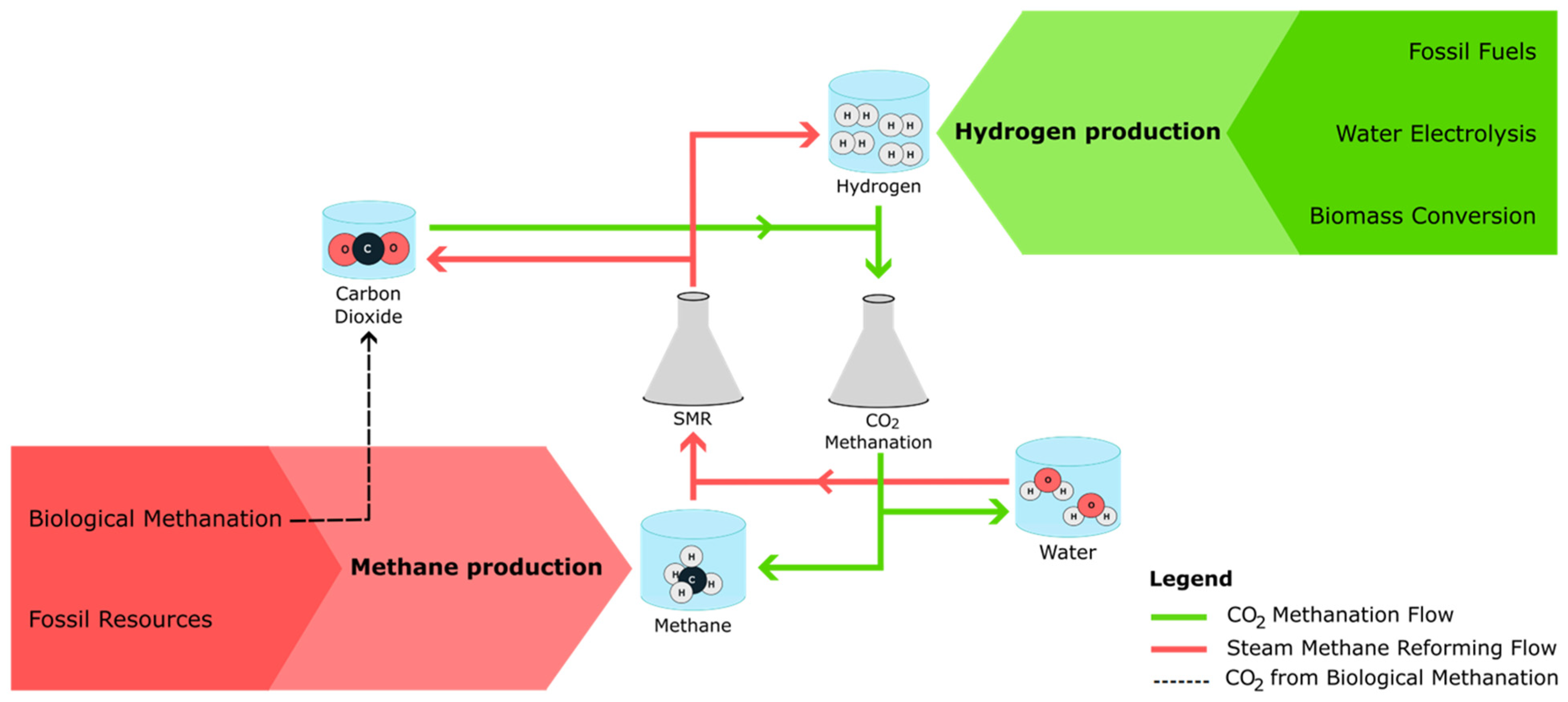
This review explores CO2 methanation and steam methane reforming (SMR) as two key thermochemical processes governed by reversible reactions, each offering distinct contributions to carbon-neutral energy systems. The objective is to provide a comparative assessment of both processes, highlighting how reaction reversibility can be strategically leveraged for decarbonization. The study addresses methane production via CO2 methanation and hydrogen production via SMR, focusing on their thermodynamic behaviors, catalytic systems, environmental impacts, and economic viability. CO2 methanation, when powered by renewable hydrogen, can result in emissions ranging from −471 to 1076 kg CO2-equivalent per MWh of methane produced, while hydrogen produced from SMR ranges from 90.9 to 750.75 kg CO2-equivalent per MWh. Despite SMR’s lower production costs (USD 21–69/MWh), its environmental footprint is considerably higher. In contrast, methanation offers environmental benefits but remains economically uncompetitive (EUR 93.53–204.62/MWh). Both processes rely primarily on Ni-based catalysts, though recent developments in Ru-based and bimetallic systems have demonstrated improved performance. The review also examines operational challenges such as carbon deposition and catalyst deactivation. By framing these technologies through the shared lens of reversibility, this work outlines pathways toward integrated, efficient, and circular energy systems aligned with long-term sustainability and climate neutrality goals.
Keywords: CO2 methanation; steam methane reforming; catalyst; technologies; environmental impact; costs CO2 methanation; steam methane reforming; catalyst; technologies; environmental impact; costs