


Abstract
Offshore wind farm construction faces significant geotechnical challenges posed by tidal mudflat sediments, including high moisture content, low bearing capacity, and high sensitivity to disturbance. Utilizing MgO—a material characterized by abundant raw materials, low embodied energy, and environmental compatibility—for the stabilization of such soft soils represents a promising and sustainable approach worthy of further investigation. This study elucidates the carbonation-induced stabilization mechanism of coastal mucky soil from Ningbo, Zhejiang Province, through systematic monitoring of reaction temperature and unconfined compressive strength (UCS) testing under varying levels of reactive MgO content, carbonation duration, and initial moisture content. Microstructural characterization was performed using X-ray diffraction (XRD), scanning electron microscopy (SEM) and mercury intrusion porosimetry (MIP) to reveal the evolution of mineralogical and pore structure features associated with carbonation. The results indicate that increasing MgO content leads to higher peak reaction temperatures and shorter time-to-peak values. However, the rate of reduction in time-to-peak diminishes beyond 20% MgO. A secondary temperature rise is commonly observed between 3–3.5 h of carbonation in most specimens. When the MgO content is below 30%, UCS peaks within 6–10 h, with the peak time decreasing as MgO content increases. When MgO exceeds 45%, strength deterioration occurs due to structural damage. The correlation between deformation modulus and UCS is found to be comparable to that of conventional cement-stabilized soils. Microstructural analysis reveals that, with increased MgO dosage and prolonged carbonation, carbonation products progressively fill voids and bind soil particles, resulting in reduced total porosity and a refinement of pore size distribution—evidenced by a leftward shift in the most probable pore diameter. Nevertheless, at excessively high MgO levels (e.g., 50%), crystallization pressure from rapid product formation may generate macro-pores, compromising soil fabric integrity. This study presents a low-carbon and efficient ground improvement approach for access road construction in tidal mudflat wind farm developments.
1. Introduction
The global energy structure is undergoing an accelerated transformation, during which offshore wind power—valued for its cleanliness, sustainability, and high energy density—has become a pivotal component of national energy strategies. According to the latest data from the International Renewable Energy Agency [1], the global installed capacity of offshore wind power grew at an average annual rate exceeding 20% between 2010 and 2024, with projections indicating a total capacity of 180 GW by 2030. Concurrently, the global levelized cost of electricity decreased significantly from USD 0.208/kWh to USD 0.079/kWh, representing a cumulative reduction of 62%. These trends indicate that offshore wind power has transitioned from an early-stage high-cost “luxury” to a market-competitive clean energy solution. As a significant offshore wind development configuration, tidal mudflat wind projects—benefiting from proximity to shorelines, convenient construction and operation, and lower capital costs—have been widely implemented in coastal regions of China in recent years. However, such projects face numerous engineering challenges, among which the stability and durability of access roads are particularly critical.
Tidal mudflat sediments are typically characterized by high moisture content, large void ratios, and low shear strength, resulting in severely inadequate bearing capacity [2,3,4,5]. Moreover, prolonged exposure to complex marine environments—including tidal fluctuations, wave erosion, sea spray, and seasonal climatic variations—poses significant challenges to the stability, durability, and erosion resistance of nearshore roads. Chemical stabilization is commonly employed for treating such sediments, involving the addition of binders such as cement, lime, and fly ash. These materials induce hydration reactions and ion exchange processes that reduce moisture content, fill voids, and bind soil particles, thereby enhancing the soil’s strength, load-bearing capacity, and deformation modulus [6,7,8,9]. However, the production of conventional binders is associated with high energy consumption, substantial resource depletion, and significant CO2 emissions [10,11,12], prompting researchers to develop novel stabilization technologies that are resource-abundant, rapidly curing, and environmentally sustainable.
Against the backdrop of the “carbon peak and carbon neutrality” strategy, reactive MgO carbonation-based stabilization has emerged as a highly promising technology with significant advantages. Compared to conventional cement, MgO is derived from abundant raw materials, requires lower calcination temperatures, and generates substantially lower direct CO2 emissions during production [13,14,15,16,17]. More importantly, this technology enables accelerated carbonation, driving the stabilized matrix to actively sequester CO2 and in situ precipitate magnesium carbonate minerals with high binding strength, thereby achieving “carbon-negative” or “low-carbon” stabilization [18,19,20]. This study systematically investigates the influence of reactive MgO dosage, carbonation duration, and initial moisture content on the stabilization efficacy of tidal mudflat sediments. By integrating analyses of macro-mechanical behavior, microstructural characteristics, and mineralogical evolution, the underlying mechanisms of MgO carbonation stabilization are elucidated, aiming to provide a low-carbon and efficient geotechnical solution for nearshore road construction in tidal mudflat wind farms.
2. Materials and Methods
2.1. Materials
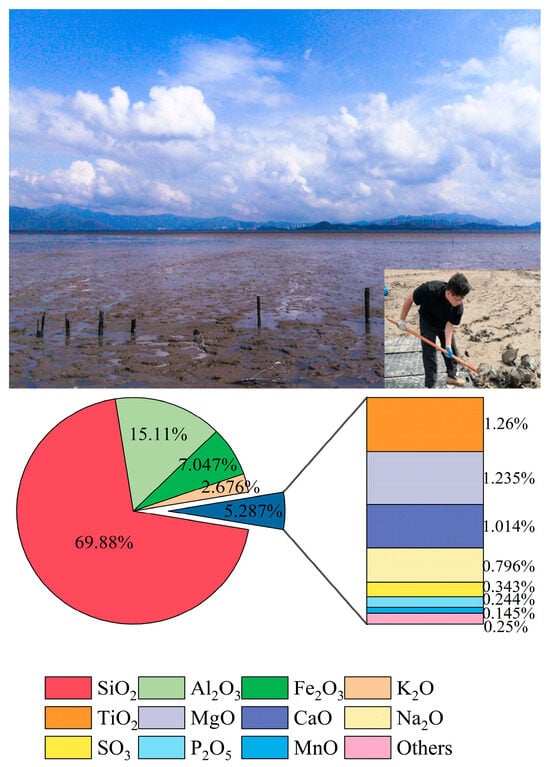
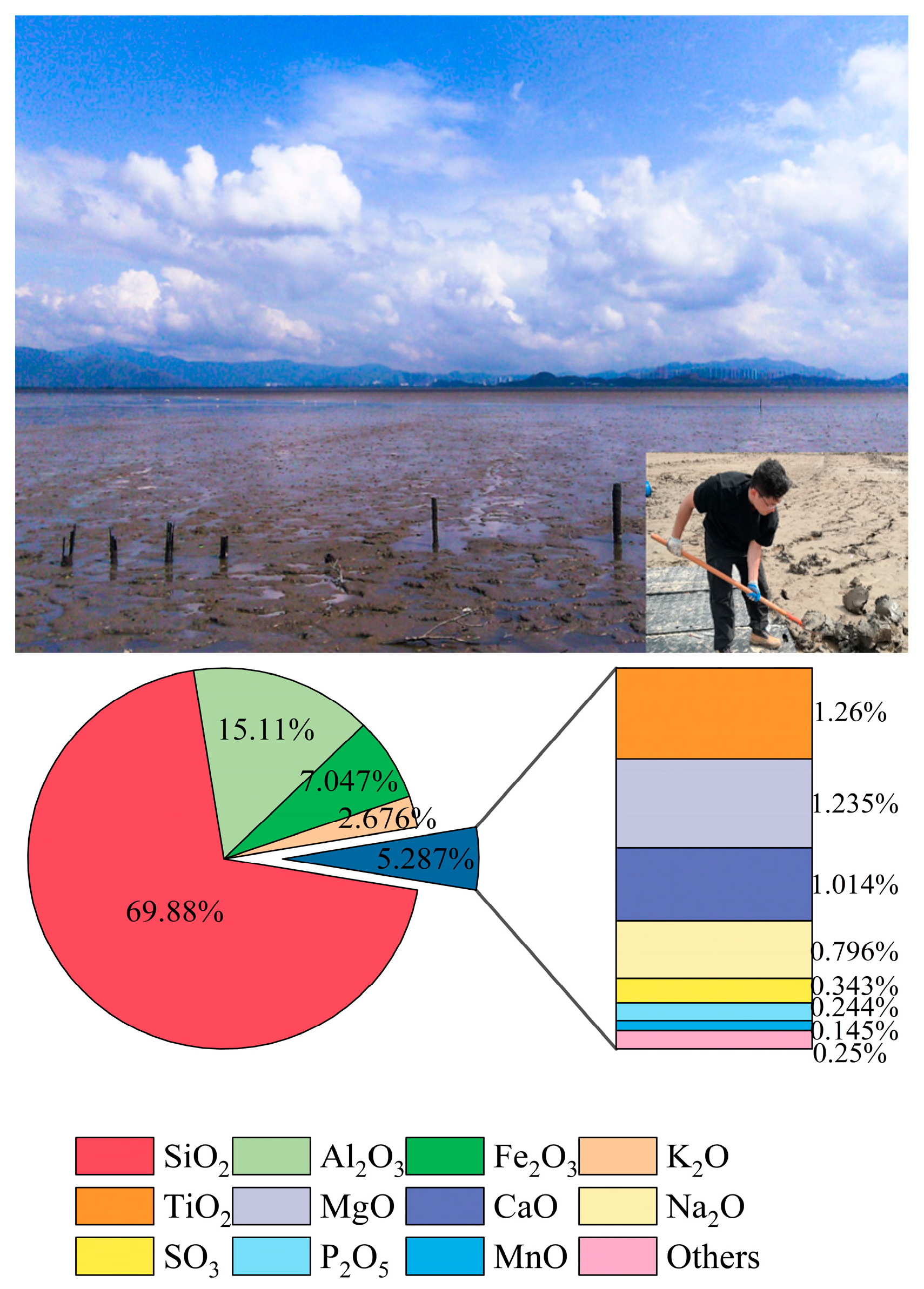
The sediment used in the experiments was collected from mucky soil deposits along the coastal area of Ningbo, Zhejiang Province [21,22]. Basic physical characteristics of the soil sample were determined in accordance with the Standard for Soil Test Methods (GB/T 50123–2019) [23] and the Specifications for Soil Tests of Highway (JTG 3430–2020) [24], with results presented in Table 1. Chemical composition analysis was conducted using X-ray fluorescence spectroscopy, revealing that SiO2 and Al2O3 are the dominant constituents, as shown in Figure 1. The reactive magnesium oxide (MgO) used in the tests was supplied by Magnesium Sunrise Technology Co., Ltd., located in Shijiazhuang, Hebei Province, China, with a MgO mass fraction exceeding 91.6% and an activity value of 25 s measured via citric acid neutralization. Industrial-grade CO2 gas with a purity of at least 99% was used in the experiments.
Table 1.
Basic physical characteristics of tidal mudflat sediments.
Figure 1.
Field appearance and chemical composition of tidal mudflat sediments.
2.2. Test Methods
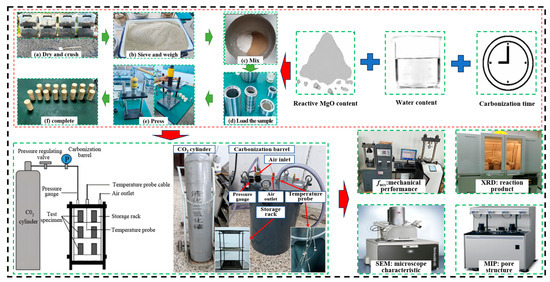
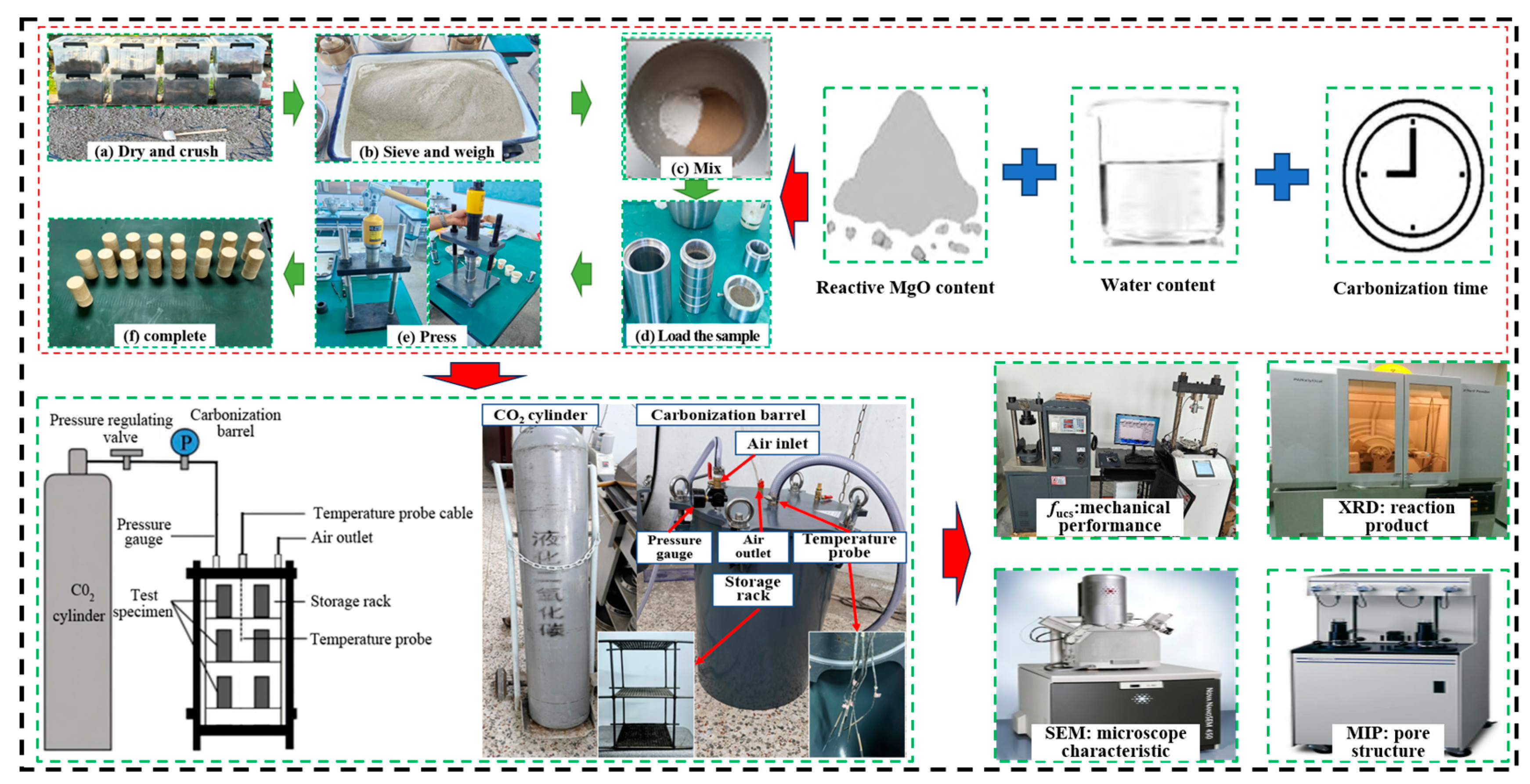
Using the natural soil density (1.78 g/cm3), the required masses of reactive MgO and dry soil were calculated and precisely weighed, then thoroughly homogenized. A predetermined amount of water was subsequently added, and the mixture was remixed to ensure uniformity. The homogeneous mixture was compacted in layers into a stainless steel mold (φ39.1 mm × 80 mm) with its inner wall lightly coated with petroleum jelly, using a hydraulic jack to apply static compaction. The mold was then mounted on a demolding apparatus, and the specimen was extruded axially at a constant rate, ensuring alignment between the mold and apparatus axes. Three replicate specimens were prepared for each mix proportion. After preparation, initial dimensions and mass were recorded, and specimens were transferred to a carbonation chamber for CO2 exposure. Carbonation was conducted at a constant pressure of 200 kPa and a compaction degree of (89 ± 2)%, following the procedure described by Liu et al. [25]. Temperature evolution at the specimen center was monitored in real time using a PT100 resistance temperature detector supplied by Zhongyi Jiumao Co., Ltd. (Shanghai, China). Upon completion of carbonation, final dimensions and mass were measured. UCS tests [23] were performed using a dynamic triaxial testing system (TP-CTS-01), equipped with a pressure sensor having an accuracy of 0.1% F.S. and operated at a constant axial displacement rate of 1 mm/min until specimen failure. Based on UCS results, representative specimens were selected for microstructural characterization via XRD, SEM, and MIP. The overall experimental procedure is shown in Figure 2.
Figure 2.
Overall test flowchart.
The experimental program encompassed 10 MgO content levels (5%, 10%, 15%, 20%, 25%, 30%, 35%, 40%, 45%, 50%), 8 carbonation durations (0, 0.5, 1, 1.5, 2, 4, 6, and 12 h), and 3 initial moisture contents (20%, 30%, and 42%). These factors were systematically combined based on specific experimental objectives to form a comprehensive test matrix, as summarized in Table 2. Among these, a moisture content of 42% was selected as the key test condition for two reasons: (i) preliminary tests demonstrated that the MgO hydration–carbonation reaction at this moisture level yields the most pronounced temperature increase, offering a reliable indicator of its exothermic behavior; and (ii) this value aligns with the in situ moisture content of the soil at the sampling site, thereby improving the fidelity of the experimental setup to real-world engineering conditions and enhancing the practical relevance of the findings.
Table 2.
Test scheme.
3. Performance and Influencing Factors of Carbonated Stabilization of Tidal Mudflat Sediments
3.1. Variation of Reaction Temperature
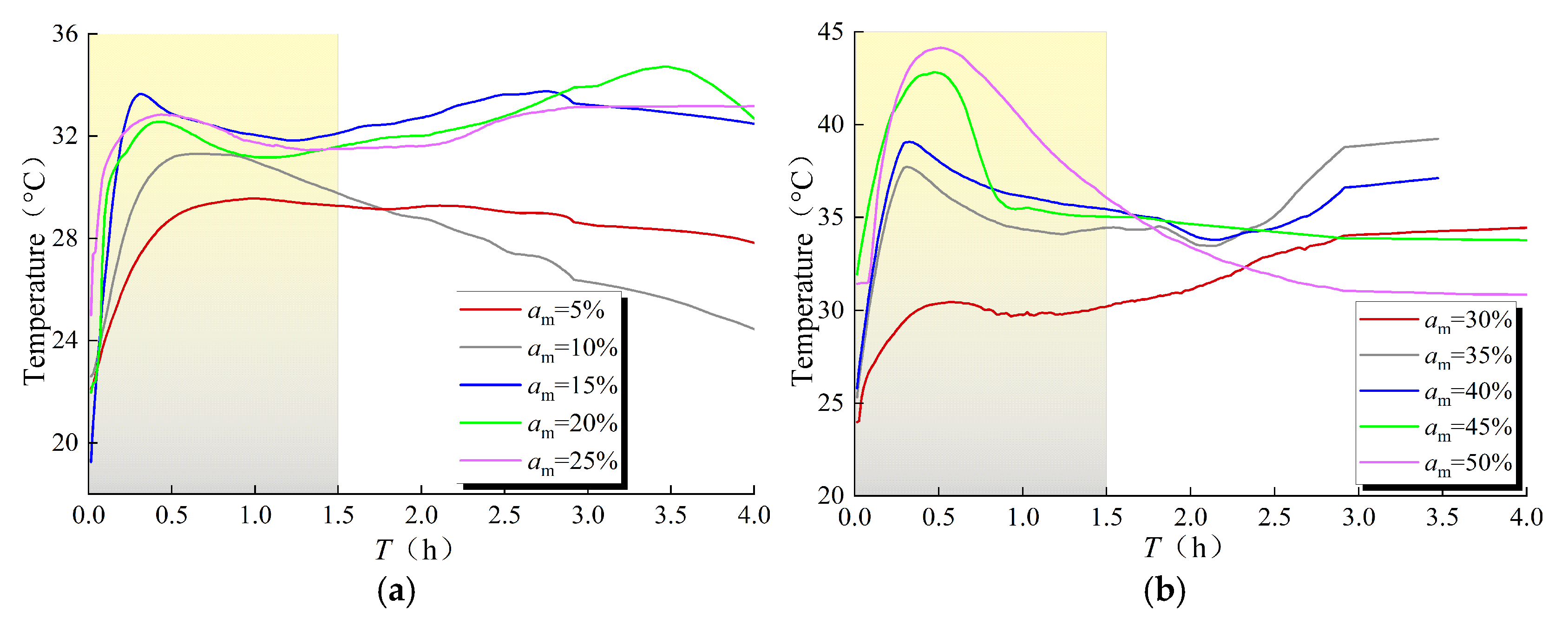
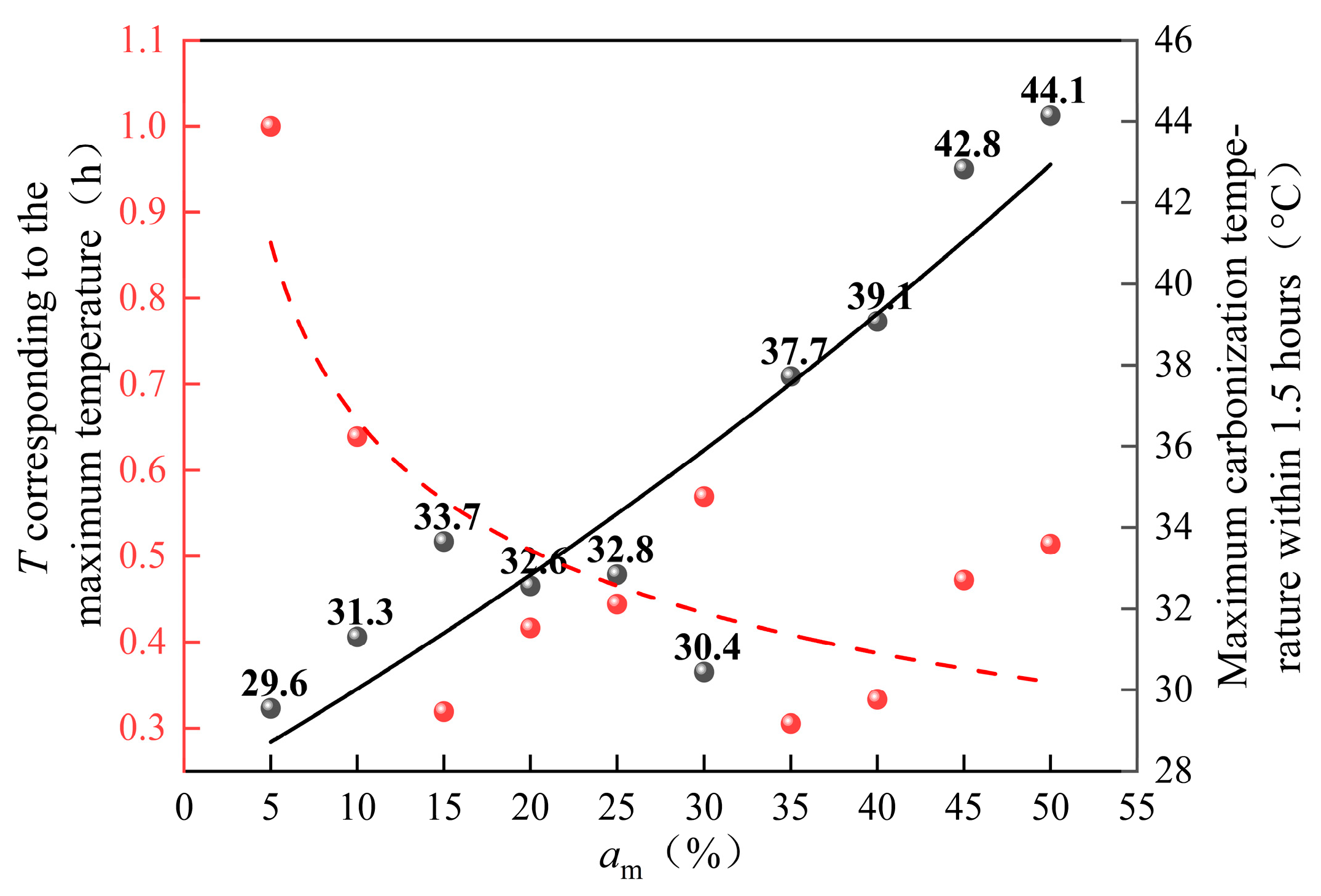
Figure 3 presents the temperature evolution of stabilized soil specimens as a function of MgO content, under a carbonation duration of 4 h and an initial moisture content of 42%. As shown in Figure 3a, both peak temperature and its occurrence time vary significantly among specimens with different MgO contents during the initial 1.5 h of carbonation. For 5% MgO, the peak temperature of approximately 29.6 °C is reached at 1.0 h. When MgO content increases to 15%, the peak occurs earlier at 0.32 h, with a temperature rise to 33.7 °C. In the high-content range (Figure 3b), this trend intensifies: the 40% MgO specimen reaches 39.1 °C at 0.33 h, while the 50% MgO specimen achieves a maximum of 44.1 °C at 0.51 h–49.0% higher than the 5% MgO specimen. To elucidate the relationship between MgO content and thermal response, Figure 4 plots the maximum temperature within 1.5 h and its corresponding time-to-peak against MgO dosage. The peak temperature increases monotonically with MgO content, whereas the time-to-peak decreases overall. Notably, beyond a threshold of 20% MgO, the rate of decrease in time-to-peak slows markedly and approaches a plateau, indicating that the accelerating effect of MgO on reaction initiation becomes saturated above this level.
Figure 3.
Temperature evolution during carbonation of MgO-stabilized soil at varying dosages: (a) am = 5–25%; (b) am = 30–50%.
Figure 4.
Peak temperature and corresponding carbonation time of carbonated silty soil as a function of MgO dosage.
Notably, a “secondary temperature rise” is observed in most specimens between 3 and 3.5 h of carbonation, with the 20% and 35% MgO specimens exhibiting post-peak temperature increases that surpass their initial peak values recorded within the first 1.5 h. This behavior can be attributed to the following mechanism: during the initial stage of carbonation, the process is primarily governed by MgO hydration (MgO + H2O → Mg(OH)2) and early-stage carbonation. Under these conditions, MgCO3 crystals precipitate on the surface of MgO particles, forming a dense, passivating layer that restricts CO2 diffusion into the unreacted core. This diffusion barrier leads to a deceleration of the reaction rate and a consequent thermal decline. However, as carbonation progresses to 3–3.5 h, progressive moisture loss and accumulating crystallization stress induce microcracking within the passivating layer. These cracks serve as preferential pathways for CO2 ingress, enabling renewed reaction with residual MgO and triggering a secondary exothermic phase. The resulting heat release manifests as the observed “secondary temperature rise.” This phenomenon suggests that, at specific MgO contents, carbonation proceeds in a stepwise fashion, where the transition from the initial to the secondary exothermic stage is mechanistically coupled to the formation and fracture of the surface reaction layer.
3.2. Variation of UCS
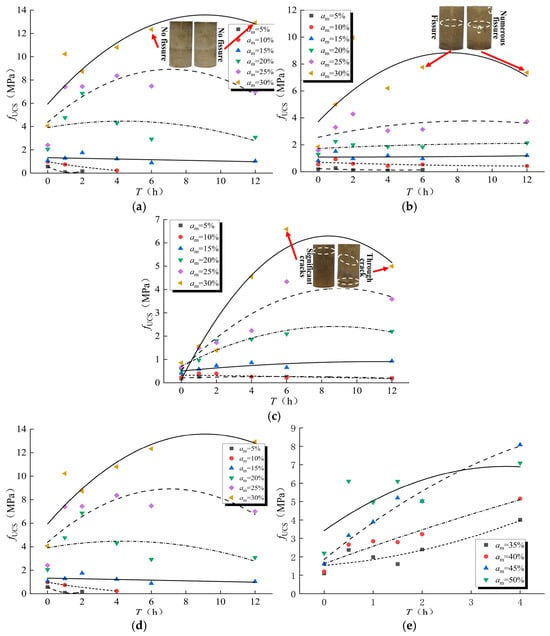
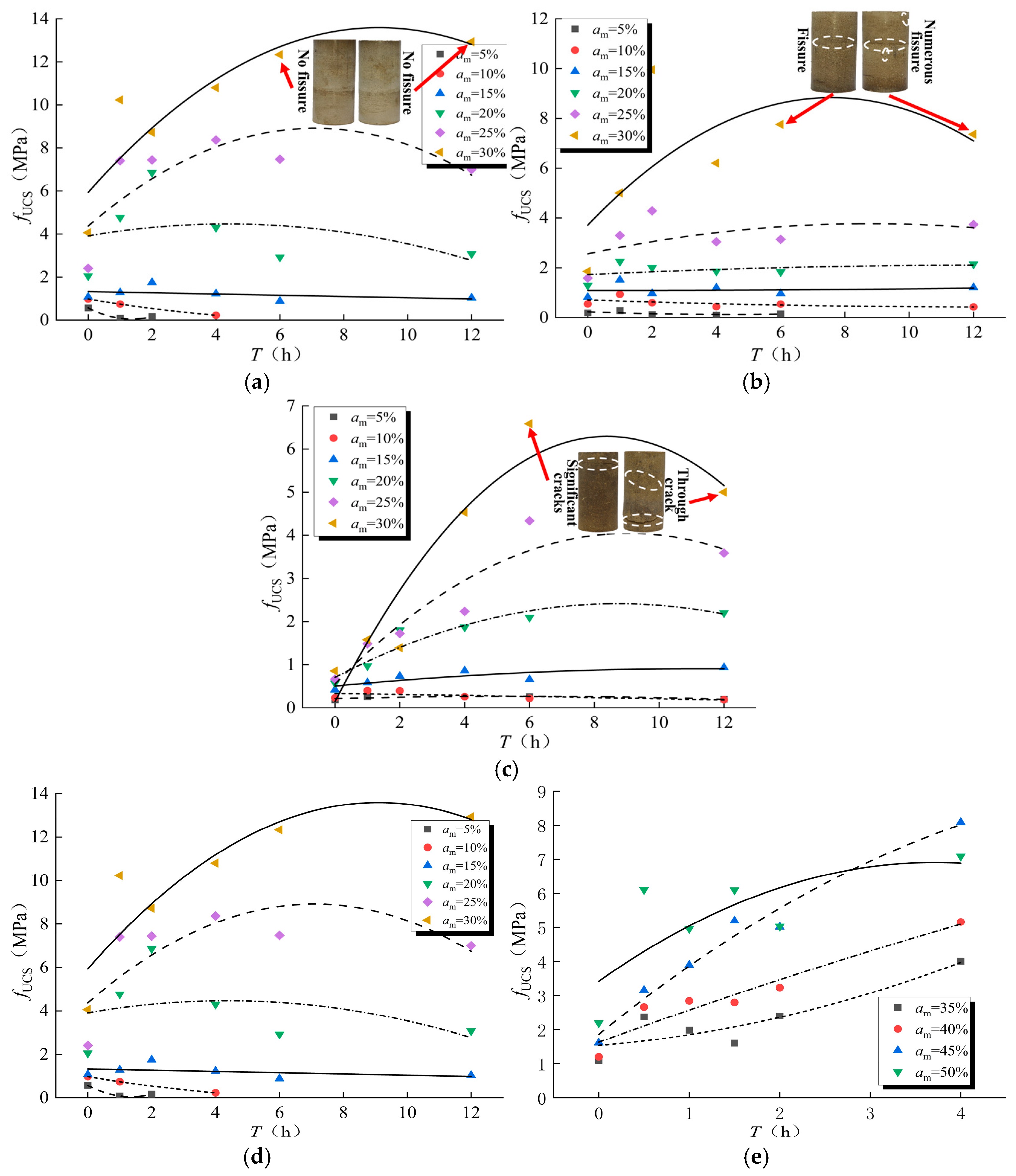
From the perspective of mechanical response mechanisms in the carbonated stabilization of silty soil, at low MgO contents (corresponding to Figure 5a–c), the UCS exhibits limited sensitivity to carbonation duration when the MgO content is below 15%. In some cases, strength even slightly decreases with prolonged carbonation. This behavior stems from insufficient reactive components supplied by MgO at low dosages, resulting in limited formation of cementitious products and inadequate enhancement of the soil matrix. In contrast, when the MgO content exceeds 20%, the strength evolution follows a “first-increase-then-decrease” trend, characterized by a critical carbonation duration (approximately 6–10 h). Within this period, continuous generation of carbonation-derived binders promotes strength development. Beyond this threshold, however, microstructural degradation induced by over-carbonation becomes dominant, leading to strength deterioration.
Figure 5.
Effect of carbonation duration on the strength of carbonated soil: (a) ω = 20%; (b) ω = 30%; (c) ω = 42%; (d) ω = 30%; (e) ω = 42%.
Under identical MgO content and carbonation duration, the UCS decreases with increasing initial moisture content. Macroscopically, this is reflected in the progressive development of surface cracking—from isolated microcracks to through-going fractures. In high-MgO-content scenarios (Figure 5d,e), specimens with 30% moisture content exhibit the same “first-increase-then-decrease” trend, but with a significantly shortened critical duration (approximately 2–4 h). This is attributed to the accelerated reaction kinetics between MgO and the carbonation medium at higher dosages, which promotes rapid binder formation but also increases the risk of internal stress concentration. When the moisture content increases to 42%, the UCS of specimens with 35–45% MgO content continues to increase with carbonation time. This is primarily due to the abundant moisture acting as an effective mass-transfer medium, which mitigates reaction heterogeneity and alleviates internal stress accumulation under high MgO dosages.
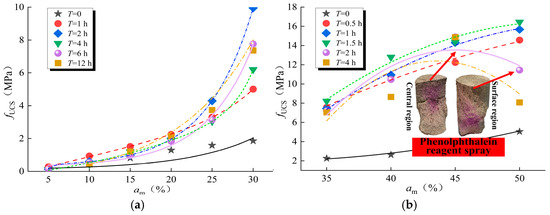
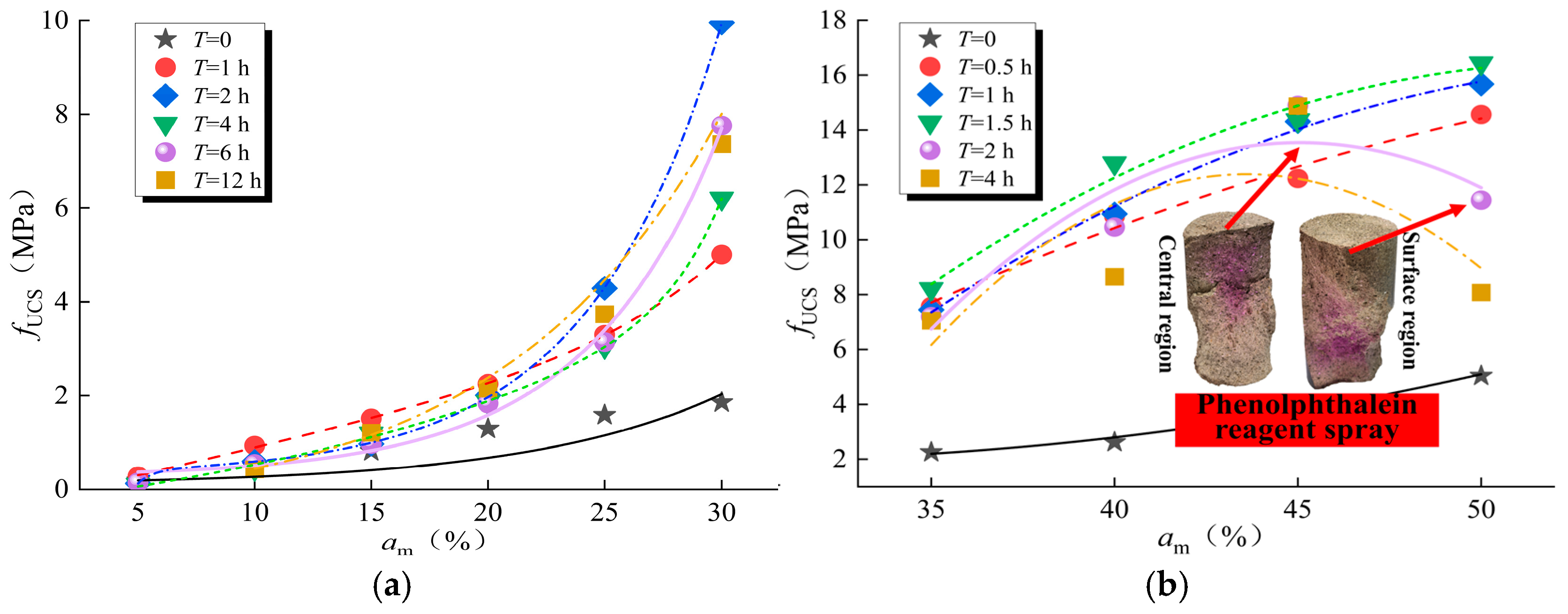
Figure 6 further illustrates the relationship between MgO dosage and UCS: below 30%, UCS increases with MgO content following a power-law trend [26]; between 30% and 35%, the rate of strength gain gradually diminishes; and beyond 45%, UCS begins to decline. Phenolphthalein spraying tests reveal that for crushed specimens with 45% MgO, red coloration is predominantly distributed in the core region; in contrast, specimens with 50% MgO exhibit coloration concentrated at the surface. This phenomenon is attributed to excessive physicochemical reactions induced by high MgO dosage, leading to mesostructural instability in the carbonated stabilized soil. In summary, the UCS of carbonated specimens generally increases with carbonation duration but decreases with increasing initial moisture content.
Figure 6.
Influence of MgO dosage on UCS: (a) am = 5–30%; (b) am = 35–50%.
3.3. Variation of Deformation Modulus
The deformation modulus is a key parameter for evaluating the ability of MgO-carbonated stabilized silty soil to resist elastoplastic deformation. Given the nonlinear stress–strain behavior of carbonated stabilized soils, the secant modulus (E50) is commonly used to characterize their deformation response. Specifically, E50 is defined as the ratio of stress to strain at 50% of the axial strain corresponding to peak strength [27].
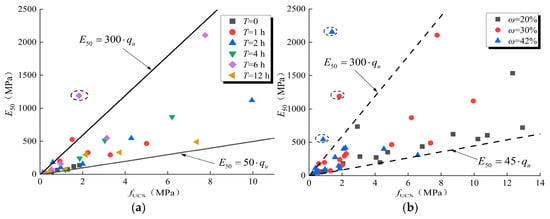
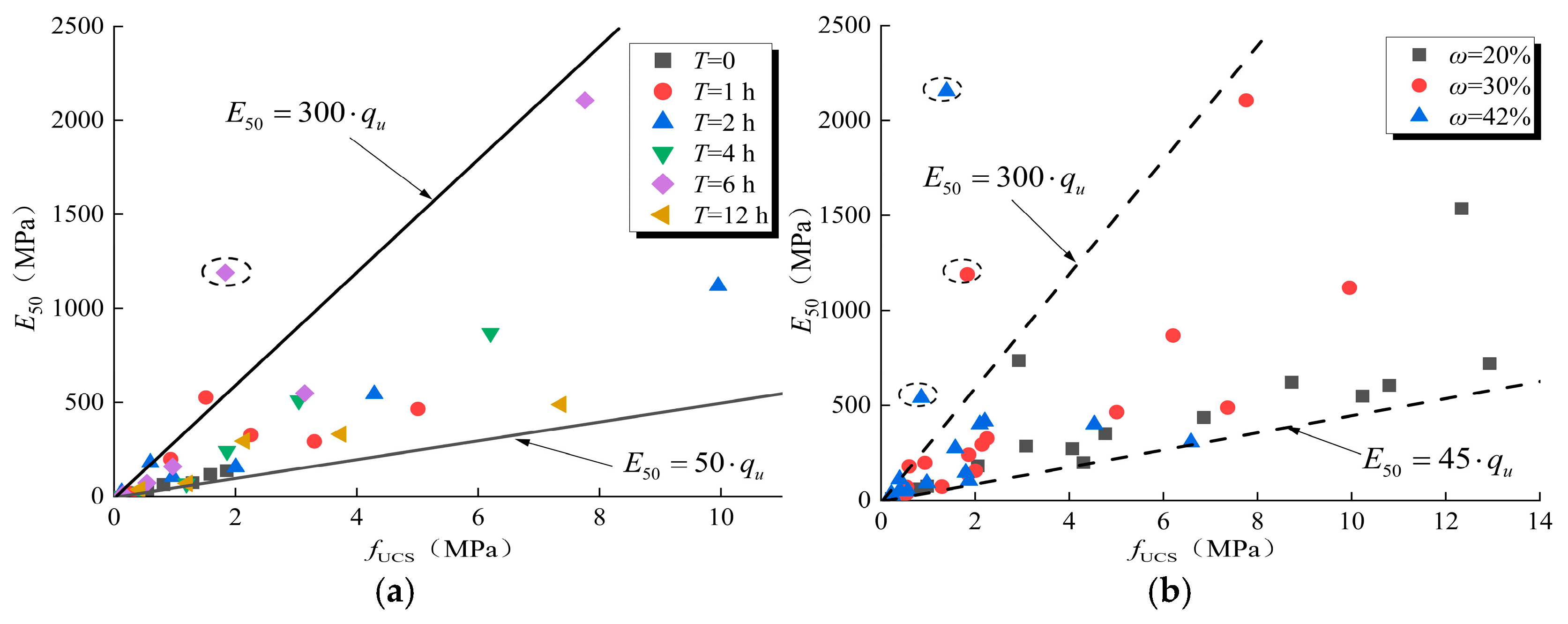
Figure 7 presents the relationship between the E50 and UCS (qu) of MgO-carbonated stabilized soil under varying MgO content, carbonation duration, and initial moisture content. As shown, E50 generally increases with qu, and the data points are primarily distributed within a triangular envelope. Under the influence of MgO content and carbonation duration, the relationship can be expressed as E50 = (50–300) qu (Figure 7a). When varying initial moisture content, the relationship is E50 = (45–300) qu (Figure 7b). Considering all test conditions, the overall relationship between E50 and qu for MgO-carbonated stabilized soil can be generalized as: E50 = (30–300) qu. For comparison, Du et al. [28,29] investigated the deformation characteristics of cement-stabilized lead-contaminated soil and zinc-contaminated kaolin, reporting E50 = (18–53) qu and E50 = (75–250) qu, respectively. Tsz [30] measured E50 = (70–239) qu for cement-stabilized Hong Kong marine clay using global LVDTs. The Technical Code for Foundation Treatment (JGJ 79–2012) [31] recommends a deformation modulus range of (100–120) qu for cement-treated soils. These comparisons indicate that the E50/ qu ratio range for MgO-carbonated stabilized soil is comparable to that of conventional cement-stabilized soils. In conjunction with its UCS, failure strain, and deformation modulus, these results demonstrate that MgO-carbonated stabilized silty soil exhibits mechanical properties suitable for soft soil foundation improvement applications.
Figure 7.
Relationship between E50 and UCS: (a) Varying am and T; (b) Varying ω.
4. Micro-Mechanisms Underlying Carbonated Stabilization of Tidal Mudflat Sediments
4.1. Phase Composition Analysis
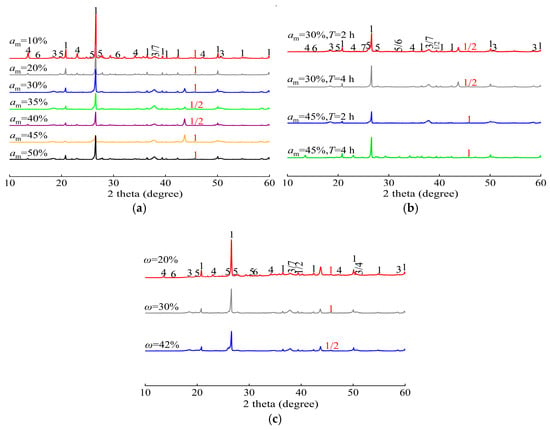
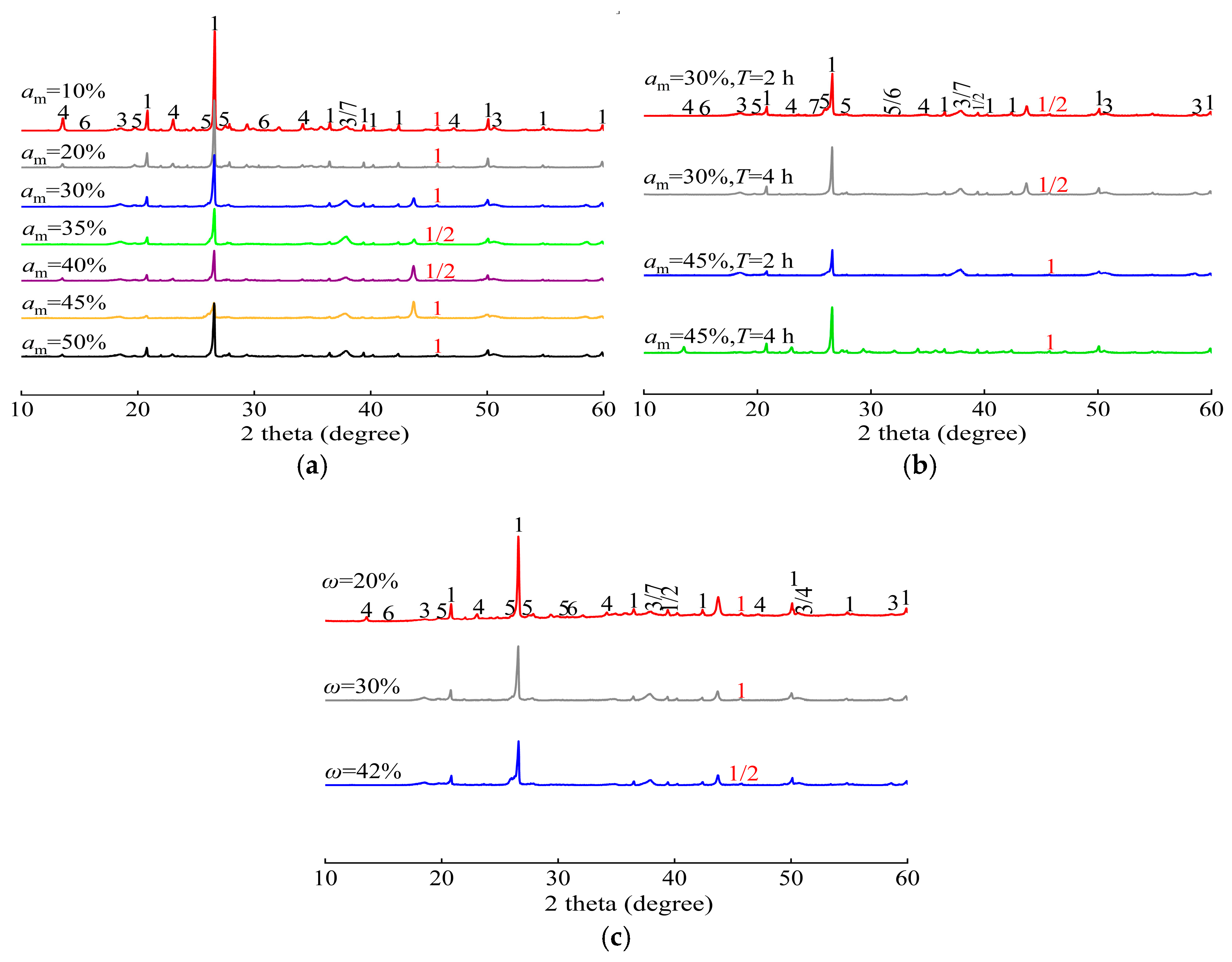
Figure 8 presents the XRD patterns of reactive MgO-carbonated silty soil specimens under varying MgO content, carbonation duration, and initial moisture content. Major carbonation products were identified using Jade software 9.0, and diffraction peaks corresponding to individual crystalline phases were indexed accordingly. The phase composition of the carbonation products is summarized in Table 3. A comprehensive analysis indicates that reactive MgO-carbonated silty soil exhibits the following characteristics:
Figure 8.
XRD patterns of carbonated soil under different conditions: (a) T = 2 h, ω = 42%, varying am; (b) ω = 42%, varying am and T; (c) am = 30%, T = 4 h, varying ω.
Table 3.
Summary of phases detected from XRD.
(1) Following carbonation treatment, magnesium carbonate phases were consistently generated in reactive MgO-stabilized silty soil, primarily including hydromagnesite [Mg5(CO3)4(OH)2·4H2O], nesquehonite (MgCO3·3H2O), dypingite [Mg5(CO3)4(OH)2·5H2O], and brucite [Mg(OH)2]. Residual unhydrated periclase (MgO) and a clinochrysotile-type Clinochrysotile [Mg3Si2O5(OH)4] were also detected in certain samples, indicating incomplete hydration and carbonation under the tested conditions.
(2) As shown in Figure 8a, increasing the MgO content (am) from 10% to 50% resulted in a non-monotonic variation in the nesquehonite diffraction peak intensity: it peaked at 10% MgO (corresponding phase content: 35.1%), then decreased to a minimum of 10.2% at 35% MgO. This nonlinear behavior suggests that MgO dosage alone does not govern carbonate formation in a predictable manner. However, comparison of Figure 8a,b reveals that extending carbonation duration significantly enhances carbonation efficiency, particularly at higher MgO contents. At am = 45%, T = 4 h, and ω = 42%, the intensities of carbonate mineral peaks reached their maximum values, indicating that simultaneously increasing reactant concentration and reaction time can effectively counteract the inhibitory effect of high moisture on CO2 diffusion, thereby promoting more complete carbonation.
(3) Figure 8b illustrates that, with MgO content held constant at 45%, prolonging carbonation time from 2 h to 4 h led to a significant increase in nesquehonite peak intensity, accompanied by a marked reduction in brucite peaks—identified as an intermediate hydration product. This trend indicates that under high-moisture conditions, extended carbonation duration improves CO2 diffusion and advances reaction kinetics, facilitating the conversion of brucite into stable carbonate phases. Consequently, both the overall carbonation degree and the yield of cementitious minerals are enhanced.
(4) As depicted in Figure 8c, increasing the initial moisture content (ω) from 20% to 42% caused a substantial decrease in nesquehonite peak intensity, while brucite peaks gradually intensified. This trend confirms that excessive initial moisture hinders the carbonation process. Although sufficient water is essential for MgO hydration (as evidenced by increased brucite formation), surplus water occupies pore space and restricts CO2 gas transport through the matrix. Under fixed MgO content and carbonation duration, higher initial moisture leads to incomplete carbonation, resulting in the accumulation of brucite and reduced precipitation of nesquehonite.
4.2. Development of Microstructural Fabric
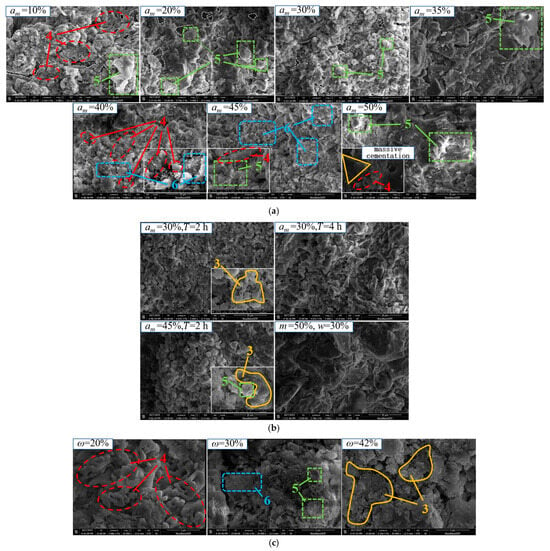
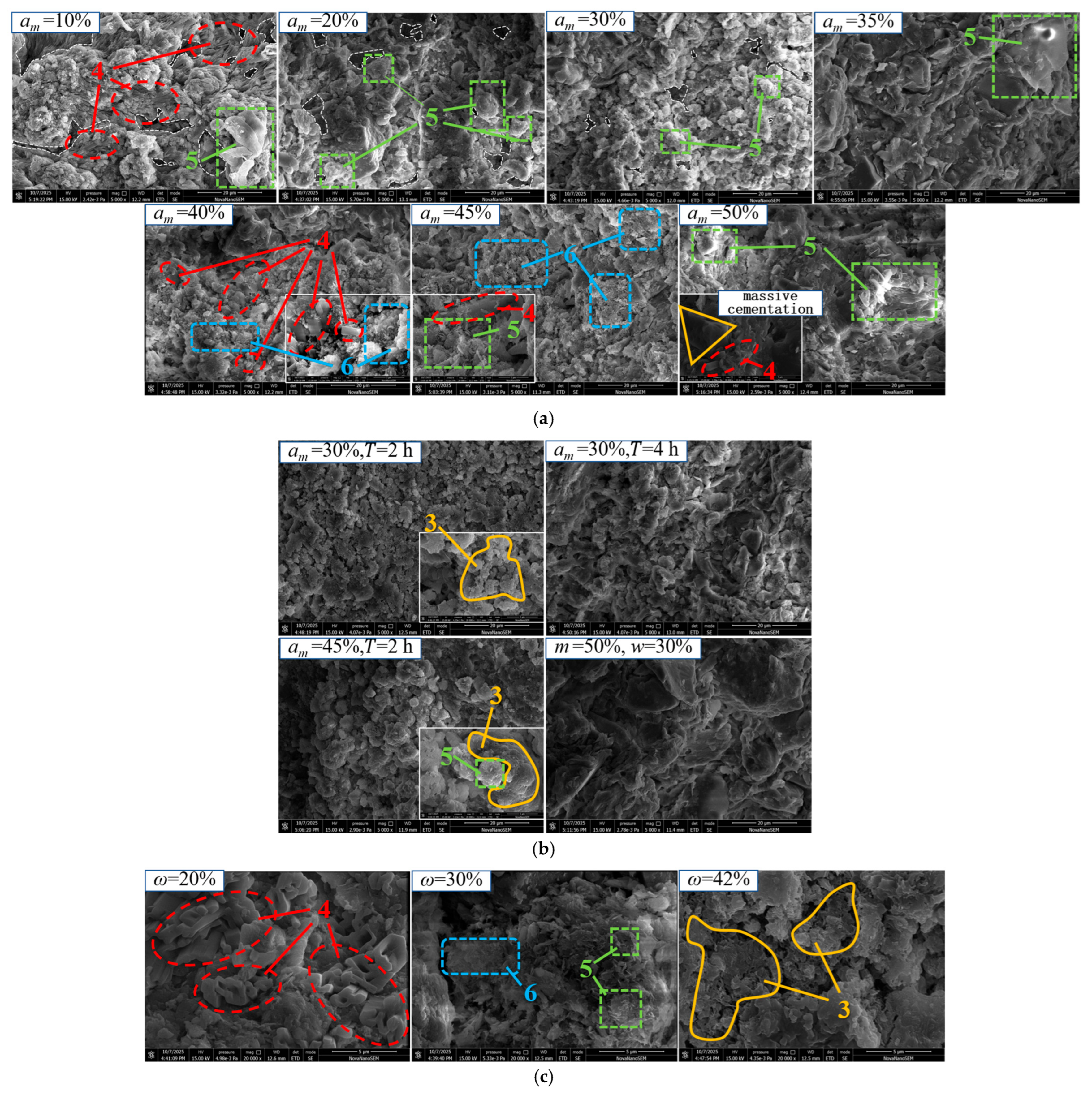
Figure 9 showcases SEM images of carbonated silty soil under diverse experimental settings, highlighting the formation and cementation characteristics of carbonate minerals on soil particle surfaces. With increasing MgO content and carbonation duration, original pores within the soil are progressively filled with Mg(OH)2 hydration products and various carbonation products, including prismatic or needle-like nesquehonite, spherulitic dypingite formed from aggregated lamellar crystals, and fibrous hydromagnesite [32,33,34].
Figure 9.
SEM images of carbonated soil specimens under different conditions: (a) T = 2 h, ω = 42%, varying am (main image scale: 20 μm, inset image scale: 5 μm); (b) ω = 4 2%, varying am and T (main image scale: 20 μm, inset image scale: 5 μm); (c) am = 30%, T = 4 h, varying ω (inset image scale: 5 μm). In Figure 9a–c, the labels 3 to 6 represent different carbonation products: 3-Brucite, 4-Nesquehonite, 5-Dypingite, and 6-Hydromagnesite, as detailed in Table 3.
In Figure 9a, which examines specimens containing 10–50% MgO after 2 h of carbonation, there is a noticeable trend: as MgO content increases, both low- and high-magnification SEM images show a progressive development of carbonation products such as nesquehonite, dypingite, and hydromagnesite, along with evidence of phase transformation among these compounds. At MgO contents between 10% and 30%, pore structures become significantly refined, leading to more uniform distributions of soil particles and pores, blurred particle boundaries, and surface coatings by reaction products of varying morphologies, facilitating initial interparticle cementation. However, when MgO content reaches 50%, local supersaturation occurs due to excessively high reactant concentrations and insufficient carbonation time, resulting in non-uniform precipitation and the formation of massive aggregates (as indicated by the triangular inset in the lower right of Figure 9a), lacking an effective cementation network. These microstructural features explain why the strength of the specimen with 50% MgO is lower than that with 45% MgO (refer to Figure 6b). The findings suggest that a moderate increase in MgO content can promote the generation of carbonation products, forming a continuous cementation framework that effectively bonds soil particles, fills pores, and enhances interlocking, thereby substantially enhancing soil strength. Nevertheless, beyond a critical threshold, overly rapid reaction kinetics lead to uneven product distribution and discontinuous cementation networks, ultimately compromising overall mechanical performance.
Figure 9b demonstrates that, following 2 h of carbonation, soil particles appear loosely distributed with weak interparticle cementation and pore filling. High-magnification images reveal abundant, loosely structured, incompletely carbonated brucite, alongside minor amounts of newly formed dypingite, but well-crystallized nesquehonite is not observed. Extending the carbonation period to 4 h results in significant reductions in interparticle pores, most soil particles being encapsulated by dense carbonation products, and markedly enhanced cementation and filling effects, contributing to a denser overall structure.
Figure 9c presents SEM images of specimens containing 30% MgO after 2 h of carbonation at different initial moisture contents. It becomes evident that at 20% moisture content, distinct prismatic nesquehonite is present, and particles are tightly interconnected; at 30% moisture content, spherulitic dypingite and fibrous hydromagnesite aggregates are observed; and at 42% moisture content, soil particle size decreases while carbonation products are enveloped by abundant fluffy brucite, forming loose aggregates—a sign of incomplete carbonation consistent with XRD analysis results.
4.3. Multiscale Pore Structure Evolution
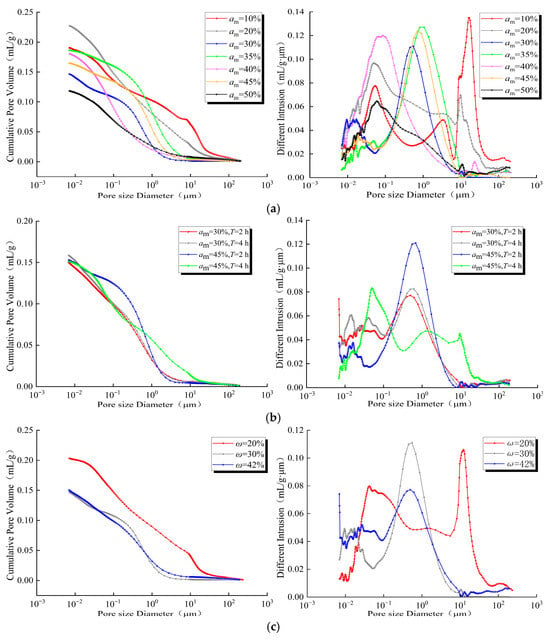
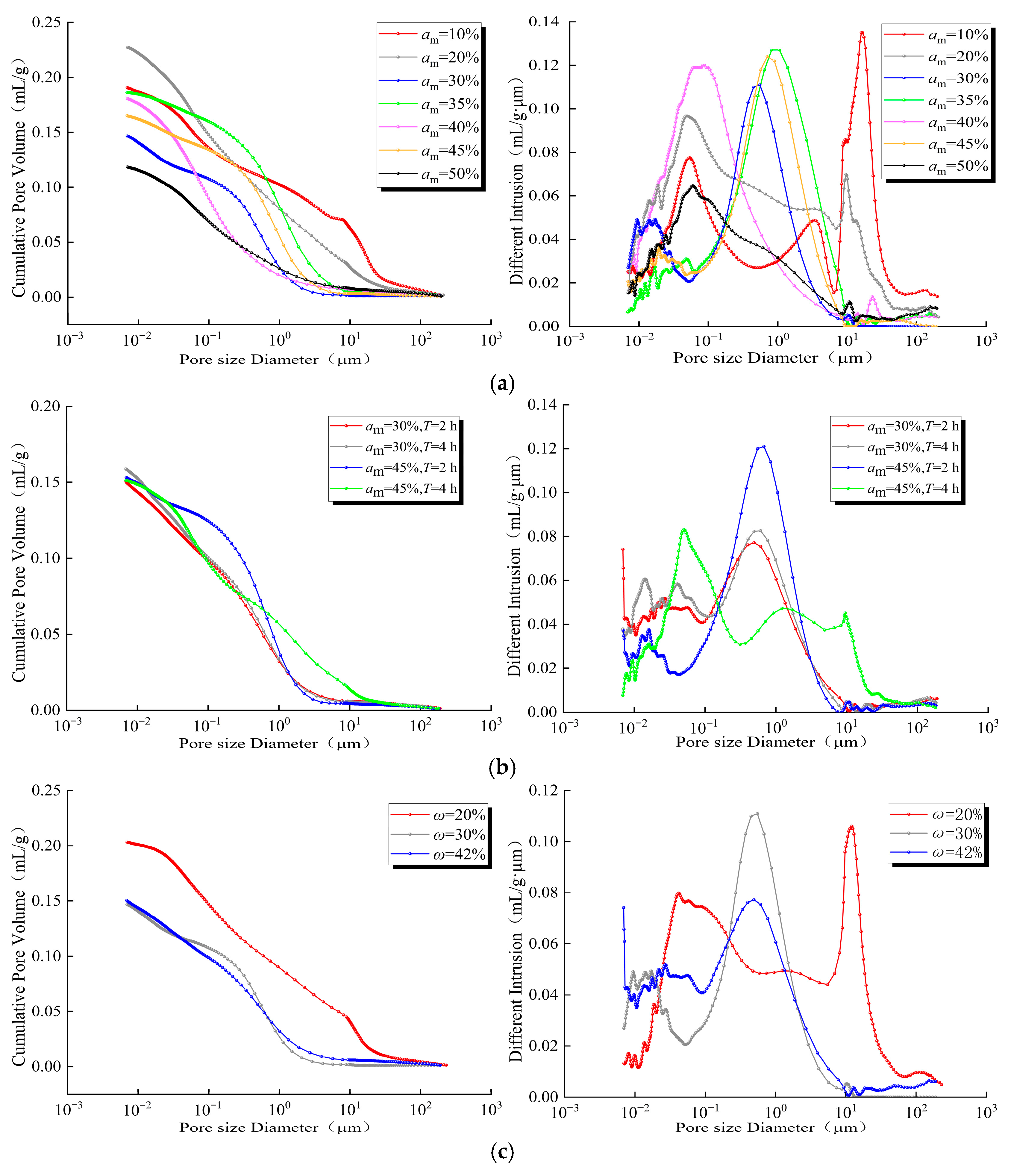
Figure 10 presents MIP results for carbonated silty soil. As shown in Figure 10a, cumulative mercury intrusion generally decreases from 0.191 to 0.118 mL/g as MgO content increases from 10% to 50%, with measured values of 0.191, 0.227, 0.147, 0.187, 0.181, 0.165, and 0.118 mL/g, respectively. Compared to the 10% MgO specimen, cumulative intrusion is reduced by 23.0% at 30% MgO and by 38.2% at 50% MgO, indicating that reactive MgO carbonation significantly refines the pore structure of silty soil. As illustrated in Figure 10b, increasing MgO content leads to a progressive evolution of the pore size distribution from trimodal to bimodal and eventually toward unimodal—a trend consistent with prior studies [35,36,37]. Concurrently, the main peak of the most probable pore diameter shifts toward smaller sizes with reduced intensity, reflecting substantial filling of macropores (d > 40 μm) and large pores (4 μm < d ≤ 40 μm), while the relative proportions of mesopores (0.4 μm < d ≤ 4 μm), small pores (0.04 μm < d ≤ 0.4 μm), and micropores (d ≤ 0.04 μm) increase [13], thereby enhancing overall soil compactness. However, when MgO content rises from 45% to 50%, although the most probable pore diameter continues to shift leftward and the peak intensity further diminishes, a new peak emerges in the large-pore range. This behavior is attributed to the rapid hydration of excess MgO, generating abundant Mg(OH)2 that swiftly reacts with CO2 to form dense carbonation products. These products crystallize quickly within confined pore spaces, exerting mutual pressure and generating significant “crystallization pressure,” which induces microcracking or expansion of pre-existing micropores and promotes the formation of secondary large pores. Additionally, the rapid deposition of carbonation products partially blocks pore channels, limiting CO2 diffusion and resulting in incomplete and spatially heterogeneous carbonation. This microstructural heterogeneity explains the lack of improvement—or even reduction—in UCS, as observed in Figure 5.
Figure 10.
Pore characteristics of carbonated soil specimens under different conditions: (a) = 2 h, ω = 42%, varying am; (b) ω = 42%, varying am and T; (c) am = 30%, T = 4 h, varying ω.
In Figure 10b, extending the carbonation time from 2 h to 4 h results in only minor changes in total pore volume for specimens with 30% and 45% MgO content. For the 30% MgO specimen, the most probable pore diameter remains stable, but pore density decreases, the number of pores in the 10–100 nm range increases, and pore throat sizes enlarge—indicating an overall deterioration of the pore structure. In contrast, for the 45% MgO specimen, the most probable pore diameter shifts to smaller values, yet the relative abundance of macropores and large pores increases significantly. This phenomenon, consistent with earlier analysis, arises from prolonged carbonation promoting continuous accumulation of carbonation products and associated “crystallization pressure,” leading to localized pore expansion. Nevertheless, the newly formed larger pores may act as preferential pathways for CO2 transport, facilitating deeper penetration into the specimen and enhancing internal carbonation, which contributes to the continued increase in UCS.
As shown in Figure 10c, total pore volume decreases with increasing initial moisture content, but the rate of reduction plateaus beyond 30% moisture content (pore volume reduction declines from 27.6% to 2.0% as moisture content increases from 20% to 42%). The main peak of the most probable pore diameter gradually shifts to smaller diameters with higher moisture content. At 42% moisture content, its value is similar to that at 30%, but the proportion of micropores (d ≤ 0.04 μm) increases, while that of small pores (0.04 μm < d ≤ 0.4 μm) correspondingly decreases.
5. Conclusions
Existing studies have primarily focused on low-to-moderate MgO dosages (≤20%) and low initial moisture contents (<30%), typically yielding stabilized soils with maximum UCS below 4 MPa. However, nearshore wind farm access road construction frequently encounters tidal flat soft clays with moisture contents exceeding 30%—and in some areas, substantially higher. Moreover, engineering requirements for vehicular traffic specify a minimum subgrade bearing capacity of ≥0.5 MPa, which corresponds to a UCS of approximately 4 MPa [38]. Consequently, current research findings are insufficient to meet practical engineering demands. To bridge this gap, this study systematically investigates the mechanical response and microstructural mechanisms of carbonation-based stabilization of tidal flat soft clay across the full range of MgO dosages (low, moderate, and high) and a broad spectrum of initial moisture contents. The influence mechanisms of key process parameters on stabilization performance are thereby elucidated. The main conclusions are as follows: (1) All specimens reached their peak temperature within 1 h of carbonation, and most exhibited a “temperature rebound” at 3–3.5 h. Combined with macroscopic observations, this indicates that the initial carbonation reaction is hindered by a dense product layer but resumes upon microcrack formation, confirming a two-stage reaction mechanism and thereby elucidating the staged kinetic behavior of the carbonation–solidification process. (2) UCS first increased and then decreased with rising MgO content, peaking at approximately 45%. For MgO contents ≥ 35%, UCS exceeding 6 MPa was achieved after only 0.5 h of carbonation. Microstructural analyses reveal that carbonation products enhance soil structure by filling pores and cementing particles. Moreover, increasing MgO content and extending carbonation time reduce total pore volume and shift the most probable pore diameter toward smaller sizes, refining the pore structure. However, when MgO exceeds 45%, rapid crystallization generates excessive crystallization pressure, inducing macropores that compromise structural integrity and cause strength loss—highlighting an intrinsic trade-off between carbonation reaction rate and soil structural stability.
(3) E50 shows a strong positive correlation with UCS, expressed as E50 = (30–300) qu, comparable to conventional cement-treated soils, demonstrating favorable load-bearing and deformation control capacity. Furthermore, this method enables in situ CO2 mineralization, aligning with the national “dual-carbon” (carbon peaking and neutrality) strategy and offering particular suitability for coastal engineering projects where low carbon footprint, tight schedules, and rapid strength development are critical.
Author Contributions
Conceptualization, E.L. and H.L.; methodology, H.L. and Z.B.; formal analysis, Q.Z., Z.B. and L.G.; investigation, H.L.; resources, Z.B. and L.G.; data curation, H.L. and Z.S.; writing—original draft preparation, H.L.; writing—review and editing, E.L.; visualization, Q.Z. All authors have read and agreed to the published version of the manuscript.
Funding
This research received no external funding.
Institutional Review Board Statement
Not applicable.
Informed Consent Statement
Not applicable.
Data Availability Statement
The raw data supporting the conclusions of this article will be made available by the authors on request.
Acknowledgments
The authors sincerely thank yancheng institute of technology for their collaboration in the tests.
Conflicts of Interest
The authors declare no conflicts of interest.
References
- International Renewable Energy Agency (IRENA). Renewable Capacity Statistics 2025; International Renewable Energy Agency (IRENA): Masdar City, United Arab Emirates, 2025. [Google Scholar]
- Wang, X.; Luo, X.; Zheng, T. Study on constitutive model parameters of hardening soil for typical silt soil in the Pearl River Delta region. China Harb. Eng. 2024, 1, 44–50. [Google Scholar] [CrossRef]
- Huang, X. Experimental study on the influence of loading methods on consolidation characteristics of muddy soil. North. Build. 2025, 10, 123–126. [Google Scholar] [CrossRef]
- He, B.; Xiong, G.; Zhang, B.; Pan, H.; Wang, K. Experimental study on mechanical properties of offshore gassy clay—Taking Jiaxin NO. 1 offshore wind farm as an example. Acta Energiae Solaris Sin. 2023, 44, 23–28. [Google Scholar] [CrossRef]
- Zhu, C.; Wen, X.; Wu, J.; Wen, W.; Li, C.; Sun, Z. Experimental investigation on consolidation of soft soil in mudflat of offshore wind farm based on MICP technology. Acta Energiae Solaris Sin. 2024, 45, 467–476. [Google Scholar] [CrossRef]
- Huang, J. Application of sludge solidification technology in river dredging project. Hydro Sci. Cold Zone Eng. 2024, 2, 65–67. [Google Scholar] [CrossRef]
- Shi, Z.; Xue, D.; Peng, M.; Chen, Y. Experiment on modified-curing and strength properties of waste mud from slurry shield tunnel. J. Eng. Geol. 2018, 26, 103–111. [Google Scholar] [CrossRef]
- Zhu, Y.; Bian, Y.; Min, F.; Zhu, W. Improvement of metro shield muck to controlled low-strength material. China Civ. Eng. J. 2020, 53, 245–251. [Google Scholar] [CrossRef]
- Tong, J.; Zhang, S.; Li, R.; Xia, B.; Wang, N. Mechanism of electro-chemical stabilization for modifying Zhuhai soft clay. Rock Soil Mech. 2025, 46, 262–270. [Google Scholar] [CrossRef]
- Ye, Y.; Liu, S.; Cai, G. Study on the rapid carbonization and stabilization technique and its micromechanism of muddy soil. J. Ground Improv. 2020, 2, 91–97. [Google Scholar] [CrossRef]
- Min, F.; Shen, Z.; Li, Y.; Yuan, D.; Chen, J.; Li, K. Solidification and carbonization experimental study on magnesium oxide in shield waste soil and its carbonization mechanism. Rock Soil Mech. 2024, 45, 364–374. [Google Scholar] [CrossRef]
- Tao, C.; Li, W.; He, M.; Liang, Q.; Jiang, W.; Wang, M.; Zhong, P.; Chen, Y. Process reengineering for in-situ carbon capture in the cement industry and its demonstration application under the dual-carbon policy framework. Cem. Guide New Epoch. 2025, 6, 1–7. [Google Scholar] [CrossRef]
- Kong, X.; Liang, Y.; Cui, S.; Wang, X.; Zhang, S. Influencing factors and mechanism of dredged sediment carbonated and solidified with reactive MgO. J. Build. Mater. 2024, 27, 620–628. [Google Scholar] [CrossRef]
- Sun, Z.; Yan, L.; Li, W.; Wang, J.; Chen, Y. Physico-mechanical properties of clay stabilized by magnesium oxide-mediated indirect carbonation. Chin. J. Geotech. Eng. 2025, 47, 164–169. [Google Scholar] [CrossRef]
- Chen, X.; Ban, R.; Song, Y.; Li, H.; Pan, Z.; Wang, J. Effect of initial water content on characteristics of reactive MgO carbonated red clay. China Sci. 2022, 17, 1317–1324. [Google Scholar]
- Zheng, C.; Cai, G.; Zhong, Y.; Du, G. Experimental study of carbide slag-MgO stabilized mud under carbonation condition. Sci. Technol. Ind. 2023, 23, 233–238. [Google Scholar]
- Min, F.; Li, Y.; Qi, Y.; Shen, Z.; Yao, Z.; Zhao, X.; Li, B. Mechanism and performance of recycled shield spoil treated by MgO stabilization-carbonation for sustainable subgrade construction. China J. Highw. Transp. 2025, 1–14. [Google Scholar]
- Cao, Z.; Shen, K.; Mao, T.; Xiao, L.; Zhuang, J. Experimental research on the carbonation granulation method for silty drilling residue and its strength growth mechanism. China J. Highw. Transp. 2024, 37, 217–227. [Google Scholar] [CrossRef]
- Song, Y.; Ding, S.; Chen, K.; Jiang, J.; Yang, C.; Chen, Y.; Zhang, J.; Zheng, J. Dissolution characterization of zinc-contaminated soils cured by activated magnesium oxide based on carbonation. Rock Soil Mech. 2025, 46, 92–105+120. [Google Scholar] [CrossRef]
- Liu, Z.; He, H.; Li, M.; Zheng, S.; Liu, S.; Zhang, D. Factors and mechanism research of carbonation mineralization with MgO in recycled fine aggregate. J. Southeast Univ. (Nat. Sci. Ed.) 2025, 55, 735–742. [Google Scholar]
- Sun, H. Mechanical properties and strength prediction model of cement stabilized beach silt in Ningbo city. Low Temp. Archit. Technol. 2020, 42, 106–111. [Google Scholar] [CrossRef]
- Li, J.; Wang, K.; Wang, M.; Dan, Z.; Cai, Z.; Hong, Y. In-situ behaviour of sensitive clayey ground subjected to high pressure jet grouting for planned offshore wind farm. Acta Energiae Solaris Sin. 2021, 42, 287–292. [Google Scholar] [CrossRef]
- GB/T 50123-2019; Standard for Geotechnical Testing Method. Ministry of Housing and Urban-Rural Development of the People’s Republic of China: Beijing, China; China Planning Press: Beijing, China, 2019.
- JTG 3430-2020; Test Methods of Soils for Highway Engineering. Ministry of Transport of the People’s Republic of China: Beijing, China; People’s Communications Press: Beijing, China, 2020.
- Liu, S.; Cao, J.; Cai, G. Micro-mechanism of silty clay solidified by carbonation of reactive magnesia. Rock Soil Mech. 2018, 39, 1543–1552+1563. [Google Scholar] [CrossRef]
- Cai, G.; Liu, S.; Cao, J. Micro-mechanism of silt solidified by carbonation of reactive magnesia oxide. China Civ. Eng. J. 2017, 50, 105–113+128. [Google Scholar] [CrossRef]
- Liu, S. Theory and Technology of Carbonation Solidification for Soft Soils; Science Press: Beijing, China, 2021; pp. 159–161. [Google Scholar]
- Du, Y.; Jiang, J.; Liu, S.; Jin, F.; Singh, D.; Puppala, A. Engineering properties and microstructural characteristics of cement-stabilized zinc-contaminated kaolin. Can. Geotech. J. 2014, 51, 289–302. [Google Scholar] [CrossRef] [Scilit]
- Du, Y.; Wei, M.; Jin, F.; Zhi, B. Stress-strain relation and strength characteristics of cement treated zinc-contaminated clay. Eng. Geol. 2013, 167, 20–26. [Google Scholar] [CrossRef] [Scilit]
- Ho, T.; Chen, W.; Yin, J.; Wu, P.; Tsang, D. Stress-Strain behaviour of Cement-Stabilized Hong Kong marine deposits. Constr. Build. Mater. 2021, 274, 122103. [Google Scholar] [CrossRef] [Scilit]
- JGJ 79-2012; Technical Code for Ground Treatment of Buildings. Ministry of Housing and Urban-Rural Development of the People’s Republic of China: Beijing, China; China Architecture & Building Press: Beijing, China, 2012.
- Liska, M. Performance of Reactive Magnesia Cement and Porous Construction Products. Ph.D. Thesis, University of Cambridge, Cambridge, UK, 2009. [Google Scholar]
- Yi, Y.L. New Technology and Theory of Mixing Pile Based on Sustainable Development. Ph.D. Thesis, Southeast University, Nanjing, China, 2013. [Google Scholar]
- Wu, D.; Wang, Y.; Wu, H.; Ma, L.; Luo, B.; Zhang, Q. Research on preparation and morphology evolution of magnesium carbonate tri-hydrate. J. Synth. Cryst. 2014, 3, 27. [Google Scholar] [CrossRef]
- Ding, J.; Hong, Z.; Liu, S. Microstructure study of flow-solidified soil of dredged clays by mercury intrusion porosimetry. Rock Soil Mech. 2011, 32, 3591–3596. [Google Scholar] [CrossRef]
- Zhang, X.; Kong, L. Characterization of pore features of marine clay by SEM, MIP and nitrogen adsorption method. Rock Soil Mech. 2013, 34, 134–142. [Google Scholar] [CrossRef]
- Sun, L.; Wang, X.; Feng, Z.; Shao, H.; Zeng, H.; Gao, B.; Jiang, H. Formation mechanisms of nano-scale pores/fissures and shale oil enrichment characteristics for Gulong shale, Songliao Basin. Oil Gas Geol. 2023, 44, 1350–1365. [Google Scholar] [CrossRef]
- GB/T 50007-2011; Code for Design of Building Foundation. Ministry of Housing and Urban-Rural Development of the People’s Republic of China: Beijing, China; China Architecture & Building Press: Beijing, China, 2011.

Disclaimer/Publisher’s Note: The statements, opinions and data contained in all publications are solely those of the individual author(s) and contributor(s) and not of MDPI and/or the editor(s). MDPI and/or the editor(s) disclaim responsibility for any injury to people or property resulting from any ideas, methods, instructions or products referred to in the content. |
© 2026 by the authors. Licensee MDPI, Basel, Switzerland. This article is an open access article distributed under the terms and conditions of the Creative Commons Attribution (CC BY) license.