
Track Transition Performance: A Sensor-Centric Literature Review and Optical Sensing Advances


Abstract
1. Introduction
2. Research Objective and Methodology
3. Field Performance Monitoring and Numerical Modelling of Track Transition
3.1. Field Investigations
3.2. Numerical Studies
4. Discussion: Directions for Advancing Track Transition Performance Assessment
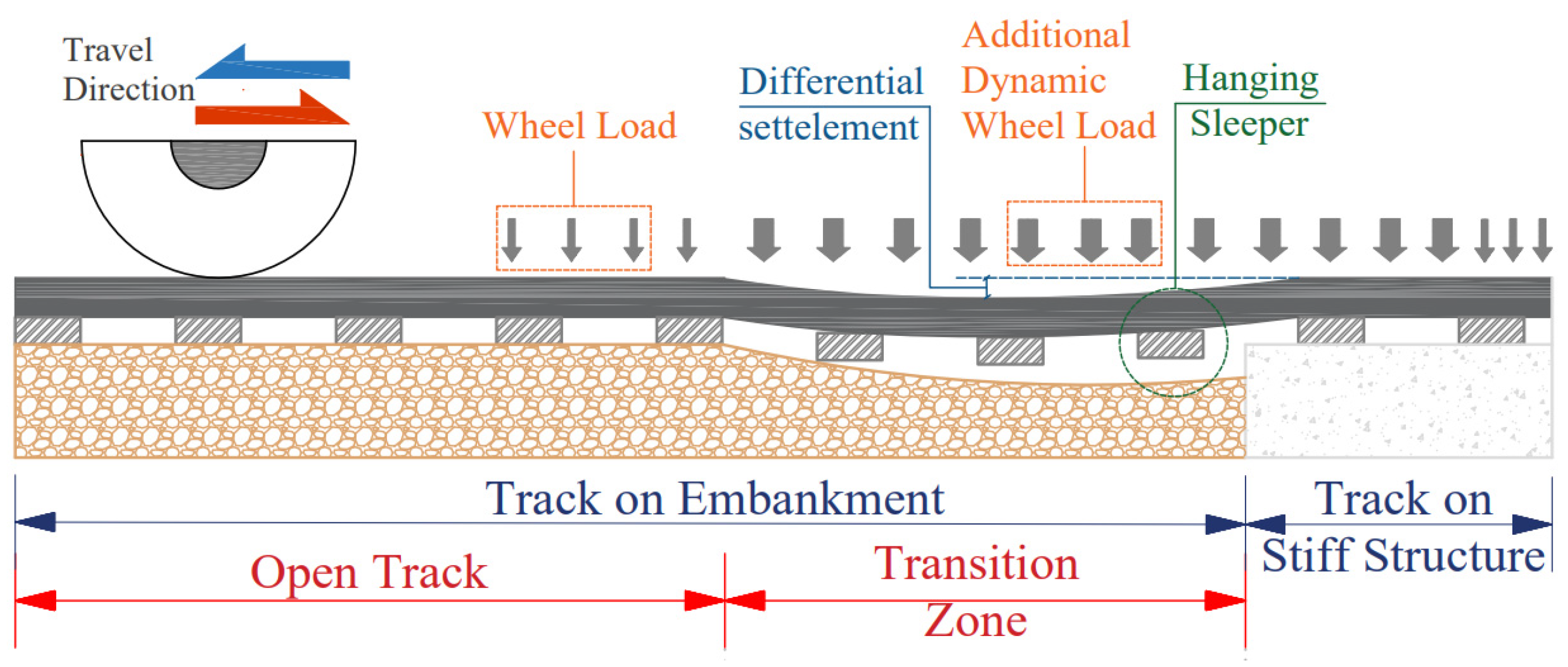
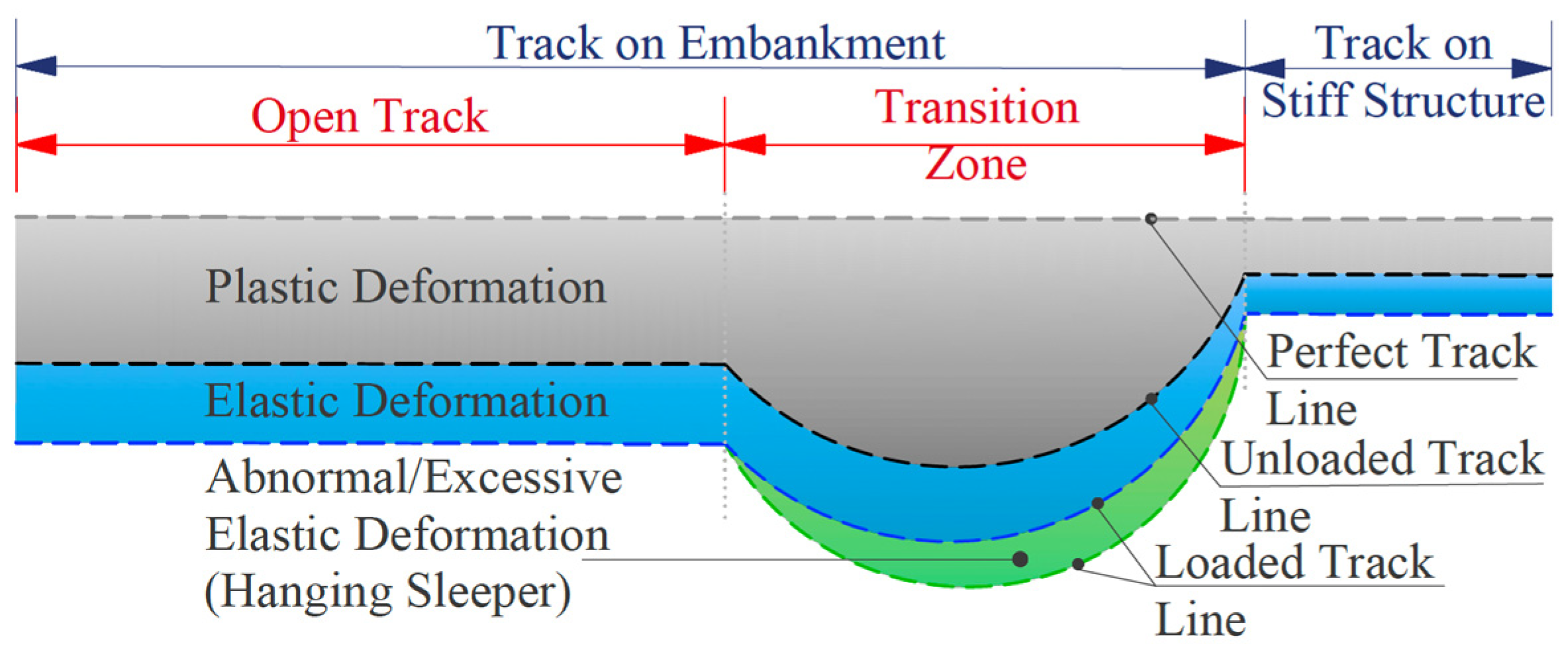
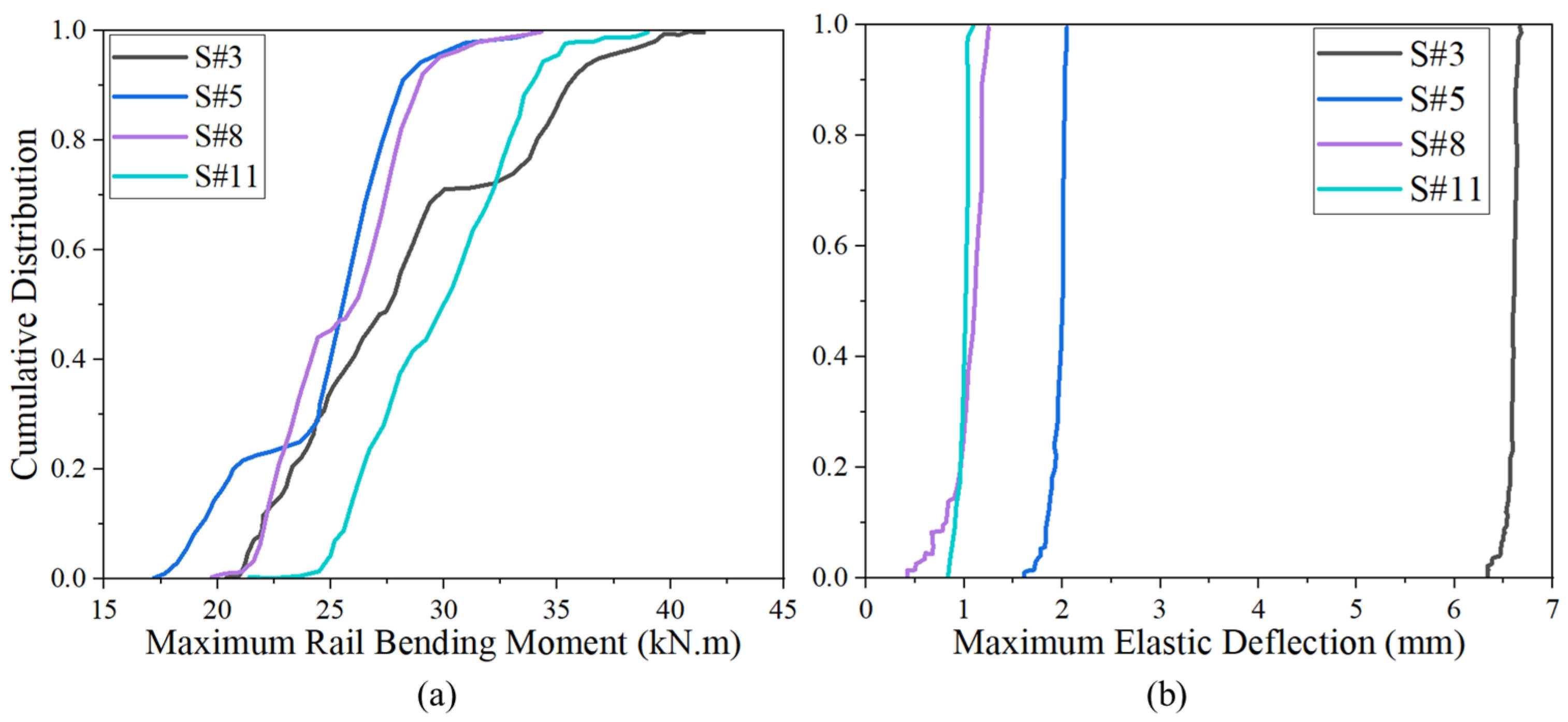
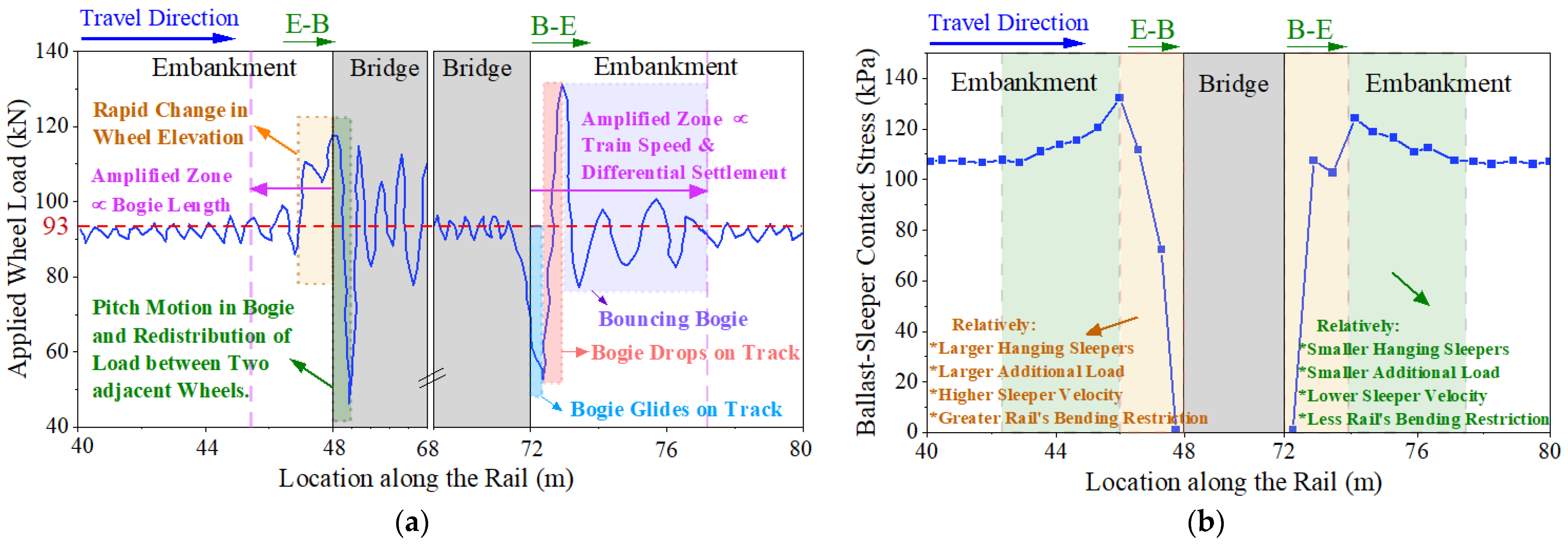
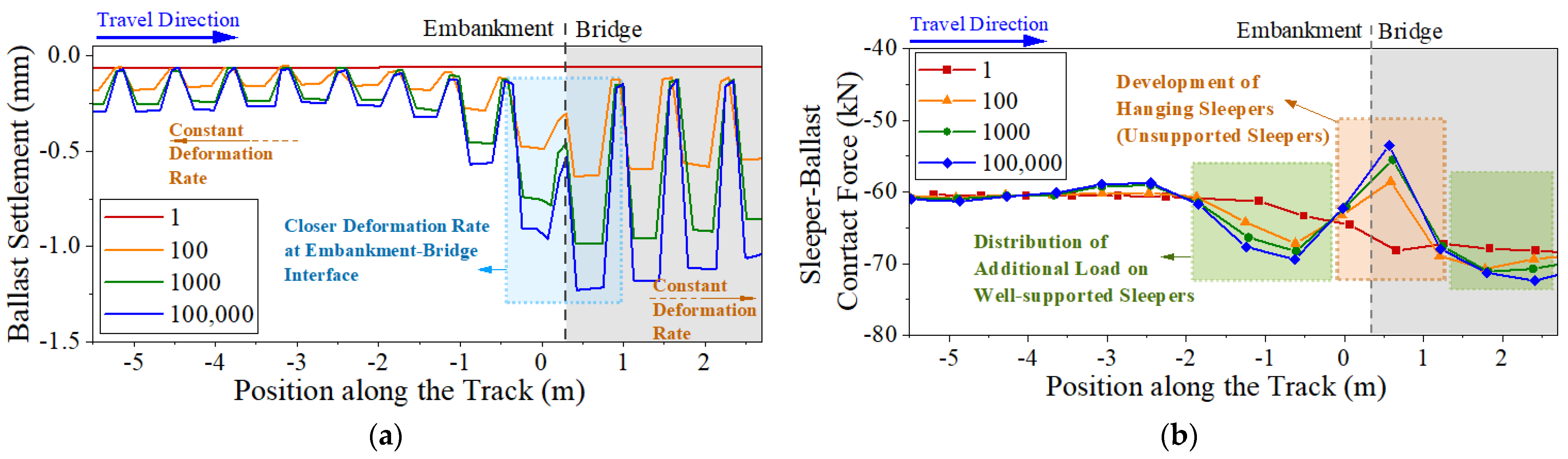
- Track transition behavior is complex, and measuring a single parameter cannot detect its actual performance. For example, measuring sleeper acceleration alone does not give information on the support condition, and it should be interpreted in combination with deformation measurement. Similarly, the rail vertical deflection measurement should be combined with the sleeper reaction force measurement to recognize and quantify the hanging sleeper. Therefore, multiple measurements are required at a single point. Conventional monitoring systems are electrical-based and need extensive wiring and support equipment. However, there are space constraints for installing and running conventional monitoring systems on railroad tracks.
- A limited number of studies have specifically addressed the track transition behavior over stiff structures. Current research indicates that variations in track design significantly affect their long-term mechanical response. These variations comprise ballasted or ballastless configurations on bridge decks and embedded rail systems. Track deformation, applied loads, and stress distribution over stiff structures require further investigation under both short- and long-term conditions to better understand their interaction with adjacent softer zones.
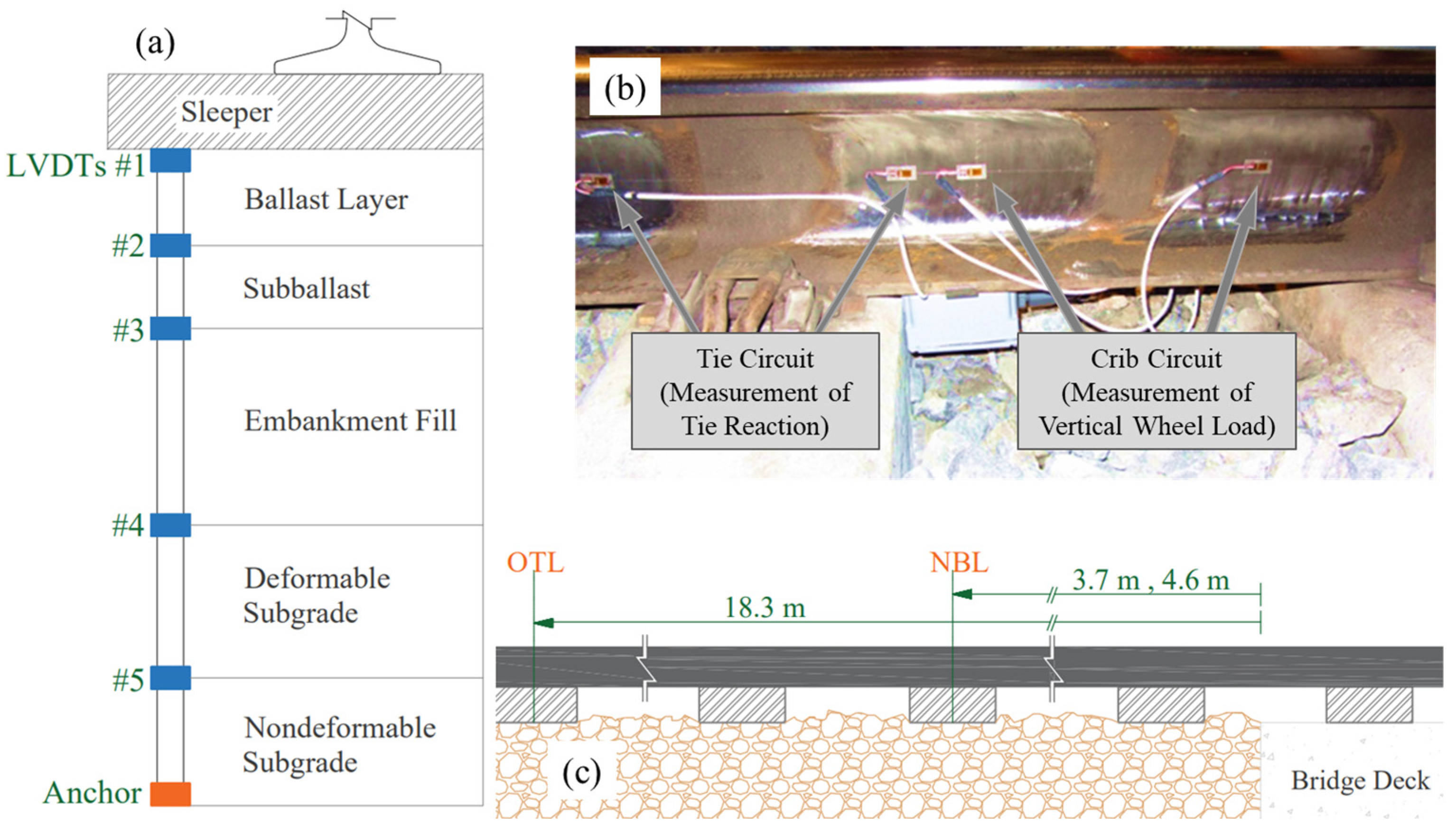
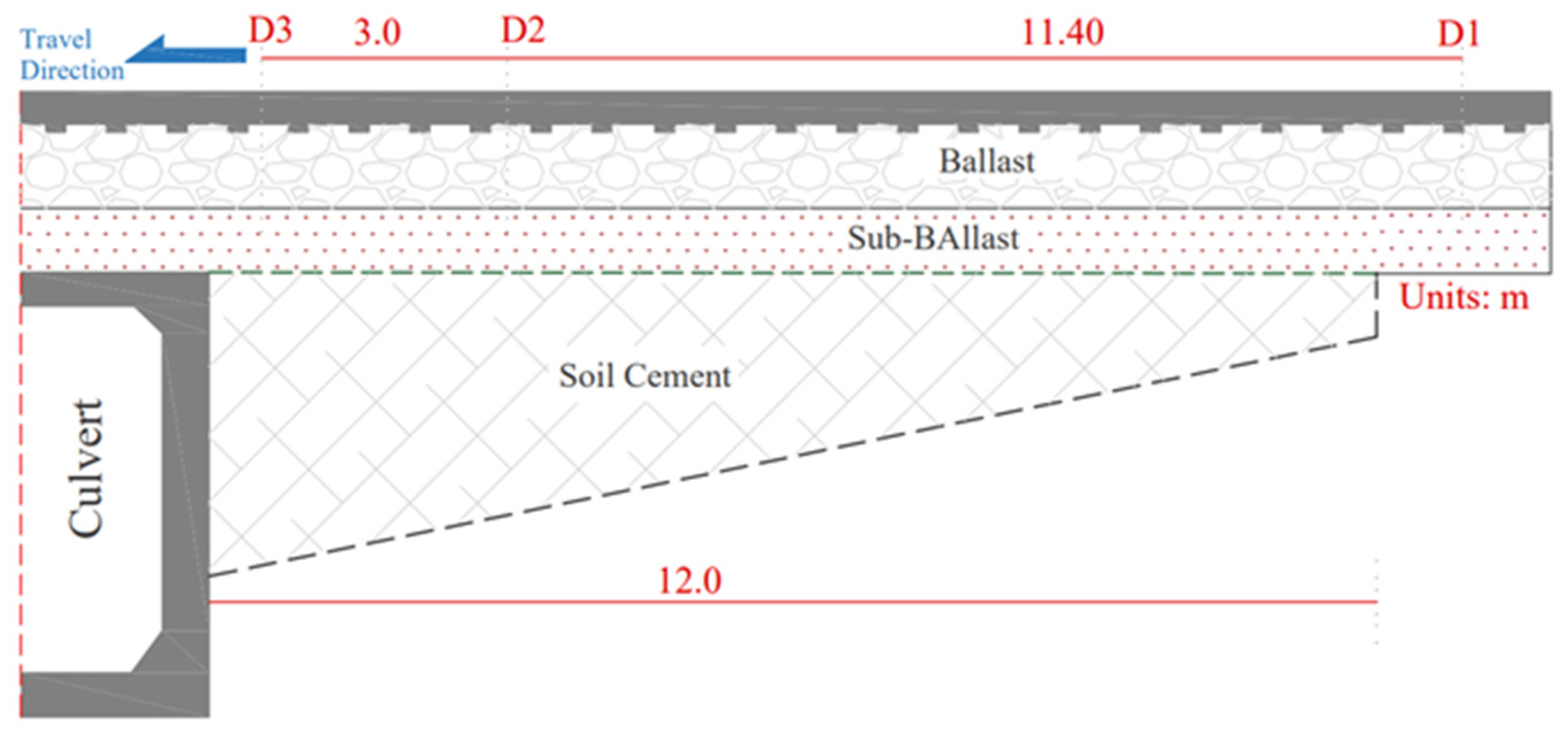
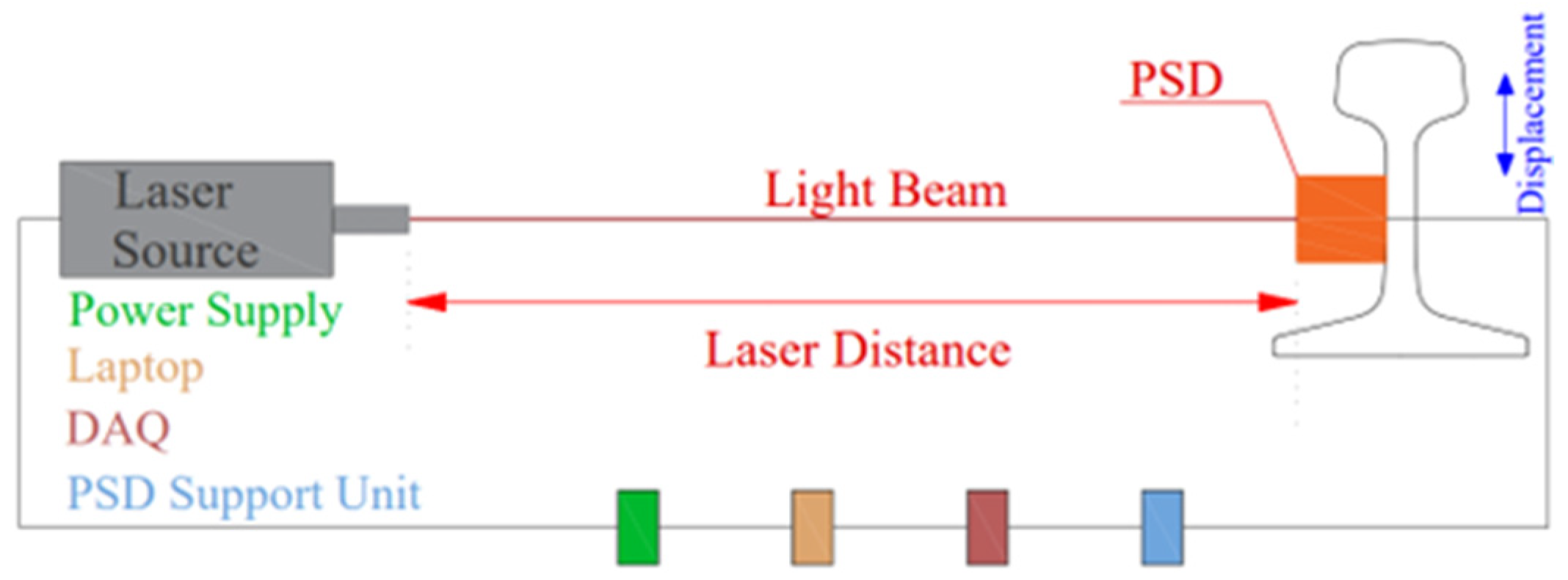
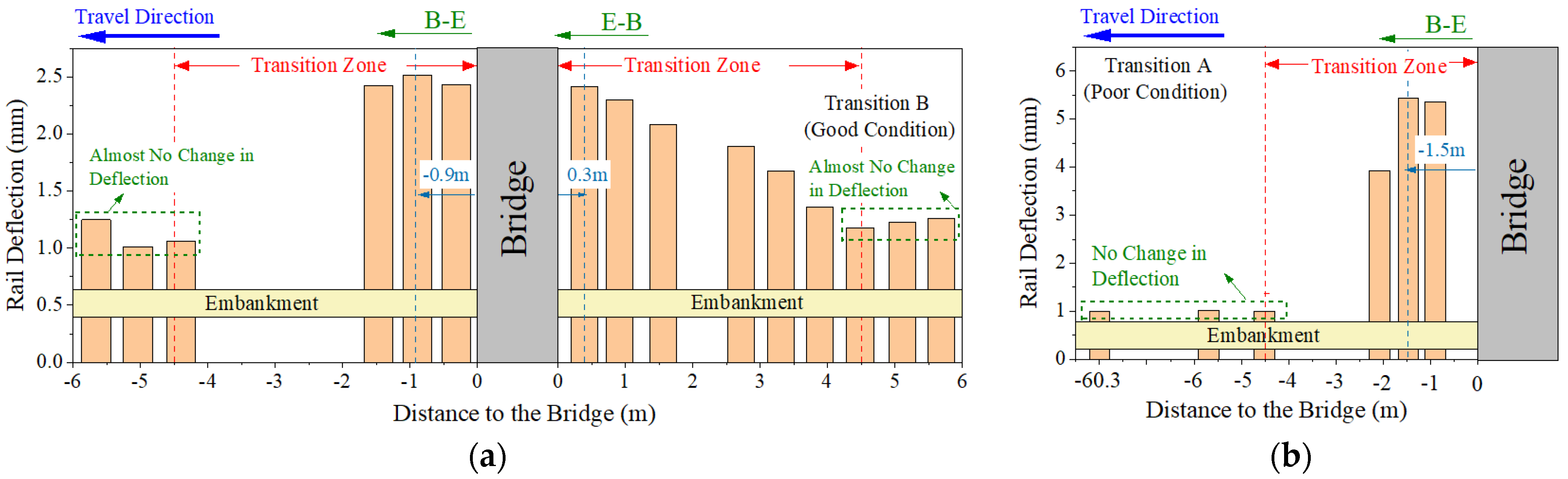
- Track transition zones span a long segment of railway lines, which makes both the monitoring setup and data collection challenging. To date, field monitoring of these zones has relied on conventional electrical sensors, such as DIC, LVDTs, accelerometers, and strain gauges. These instrumentation systems provide point-based measurements. However, practical assessment of transition zones requires monitoring over extended lengths. Additionally, the simultaneous deployment of multiple traditional sensors is costly, time-consuming, and demands extensive calibration procedures and multiple data acquisition units.
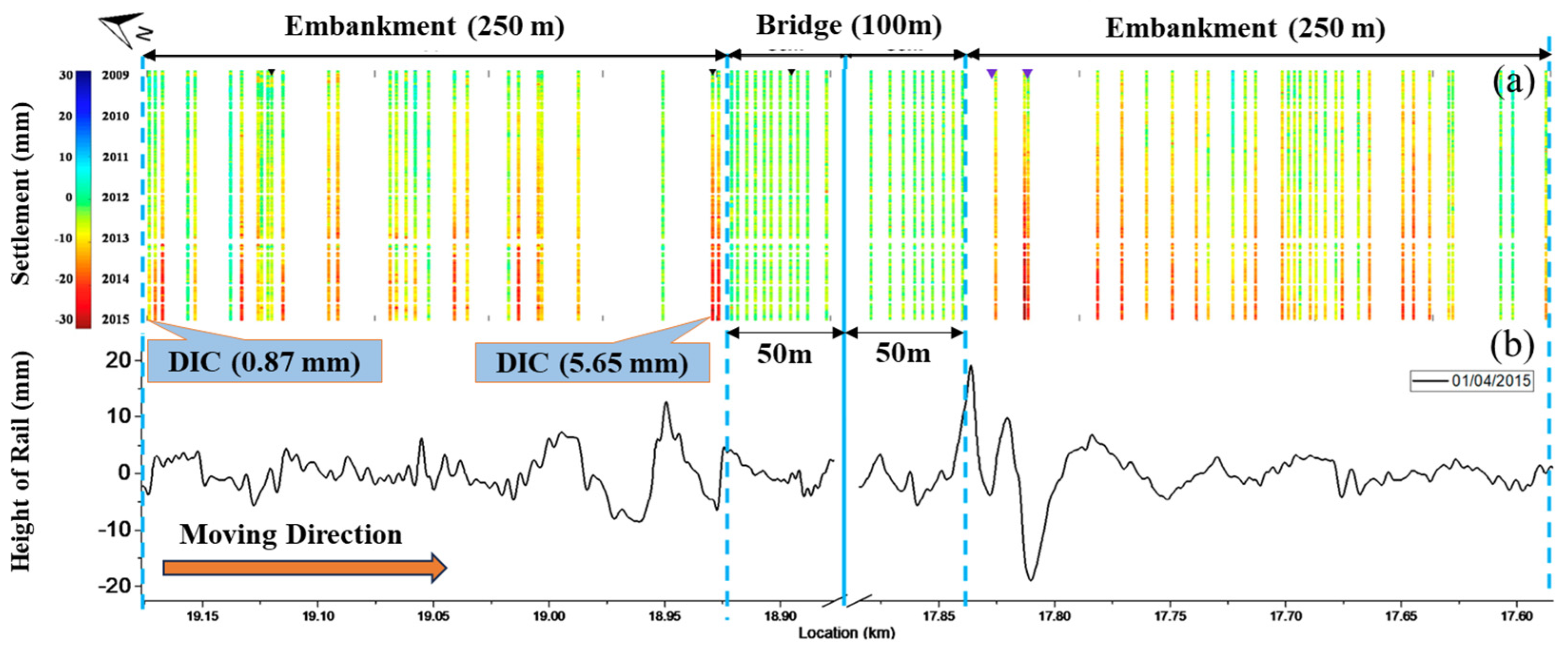
- Considering the challenges and progressive deterioration in transition zones, their behavior is time-dependent, which necessitates temporal continuous monitoring systems. However, few field investigations have addressed the long-term performance of these zones with real-time monitoring approaches. The current understanding of track transition behavior is mainly based on short-term measurements and transient response analyses. Certain monitoring systems, such as DIC, are not sustainable for long-term conditions due to their limitations in stability, durability, and operational feasibility. The most used sensors for long-term performance monitoring, such as strain gauges and LVDTs, also pose challenges in terms of quantity, multiplexing, and installation difficulties. A few monitoring plans have explored less common methods like InSAR, providing continuous measurement. However, their limited measurement frequency and lack of real-time data make them less effective for transient analyses.
5. Necessity and Application of Optical Fiber Sensors for Railroad Track Monitoring
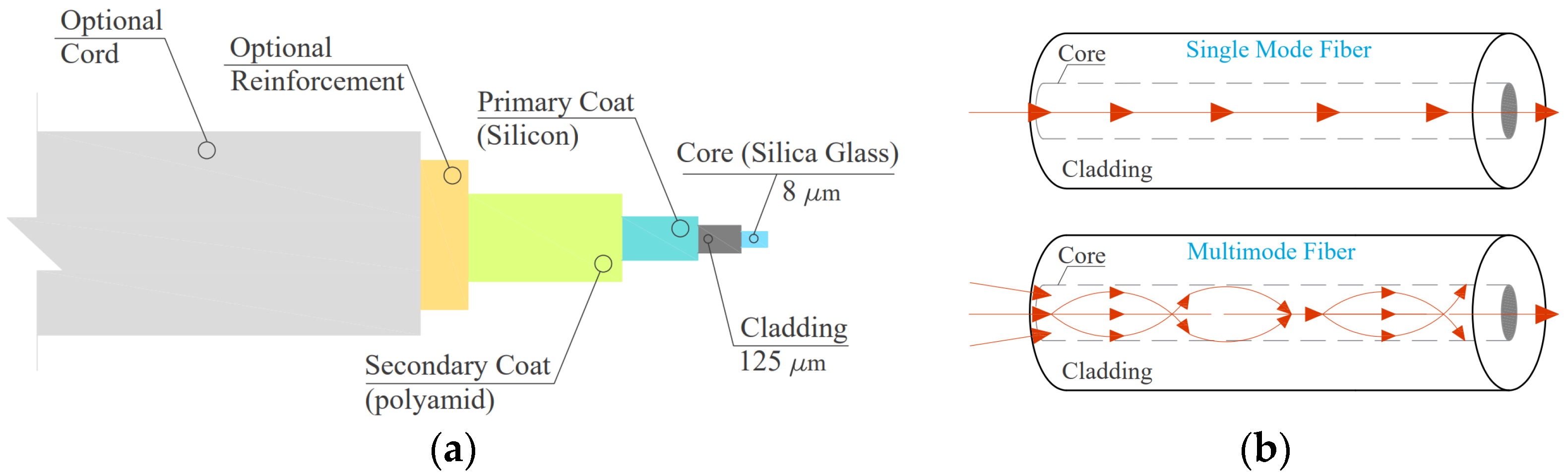
5.1. Introduction to Optical Fiber Sensors (OFSs)
5.2. Operating Principles and Mechanisms of Grating-, Interferometry-, and Reflectometry-Based Sensors
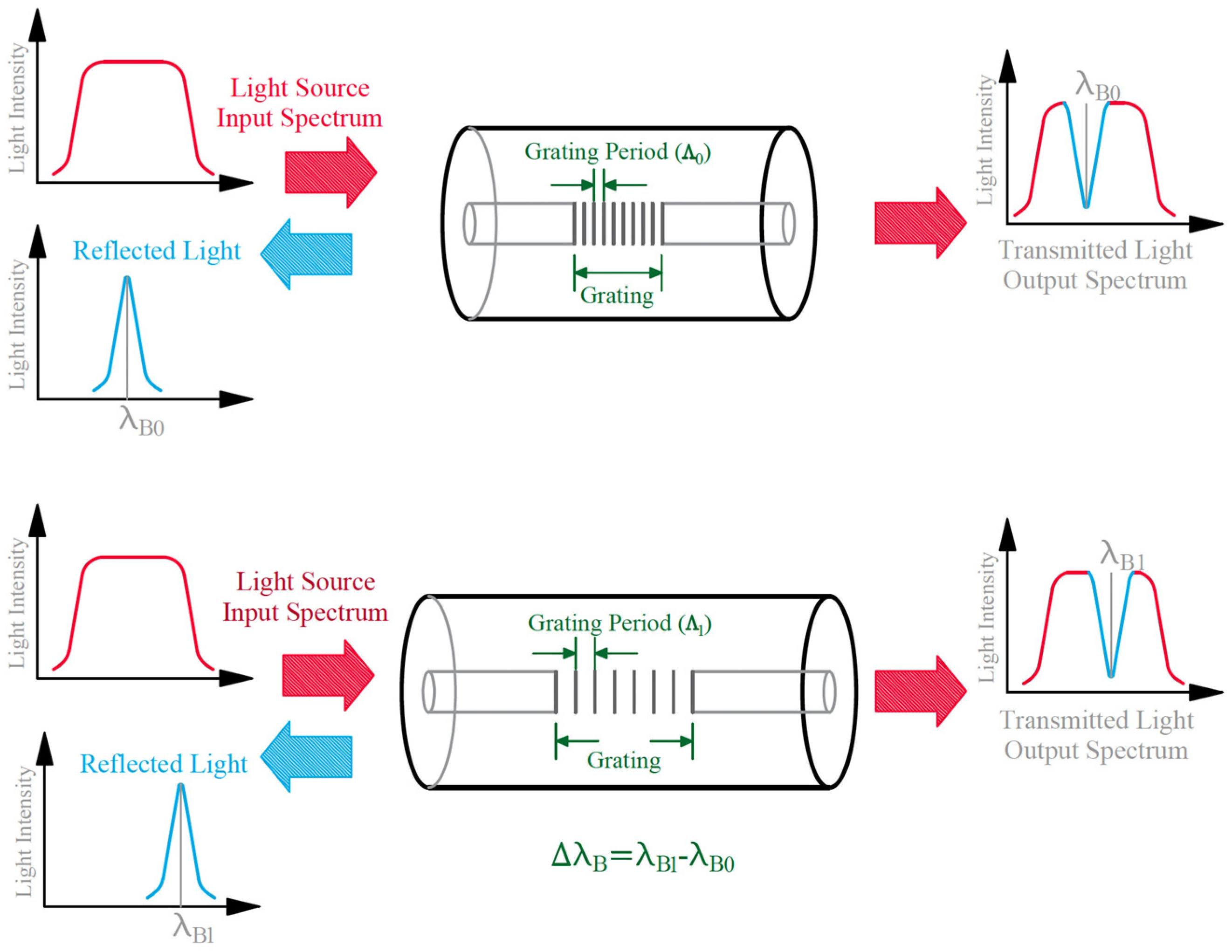
5.2.1. Fiber Bragg Grating Sensor (FBG)
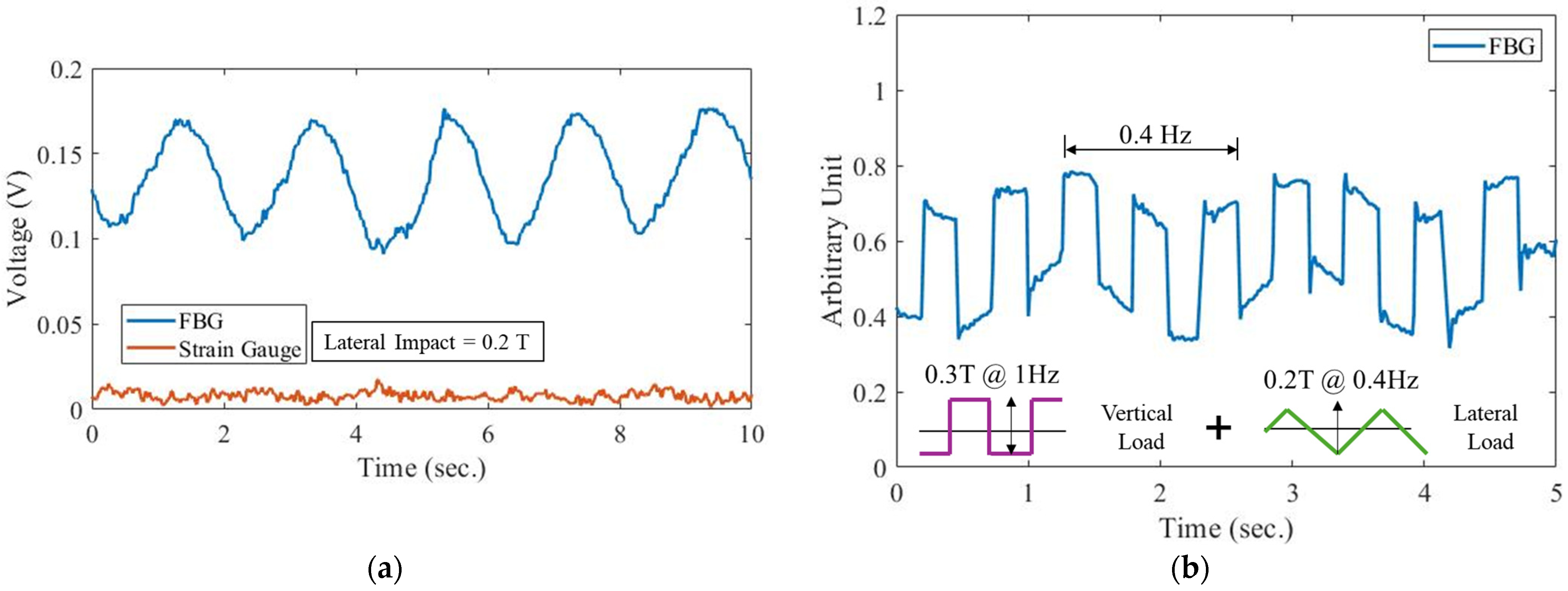
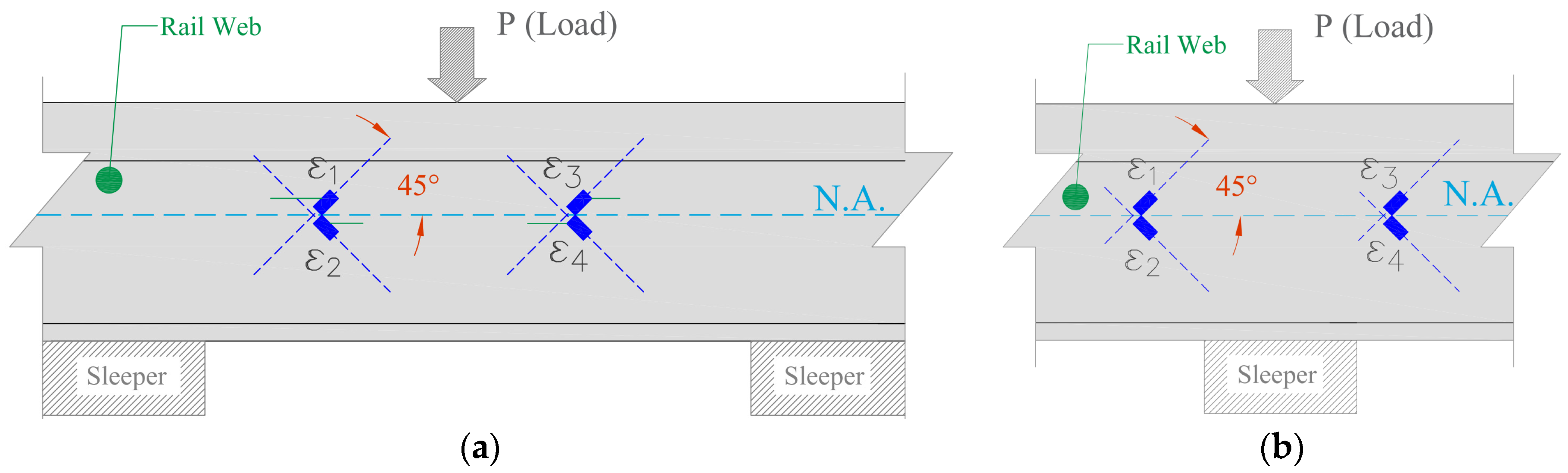
- Applications for FBG Sensors:
5.2.2. Fabry–Perot Interferometer-Based Sensors (FPI)
- Applications for FPI:
5.2.3. Distributed Optical Fiber Sensors (DOFSs):

- Applications for DOFS:
5.3. Potential Application of OFS for Distributed Temperature/Strain Sensing
6. Conclusions
- According to manufacturers’ guidelines, optical sensors are durable, immune to electromagnetic interference (EMI), and offer a higher sensitivity than the electrical-based sensors.
- OFS technologies, both distributed and discrete, provide continuous measurement of strain and temperature with high sensitivity and appropriate spatial and temporal resolution. Discrete optical sensors can be multiplexed along a single fiber, which enables long-distance deployment with fewer installation challenges and higher measurement accuracy.
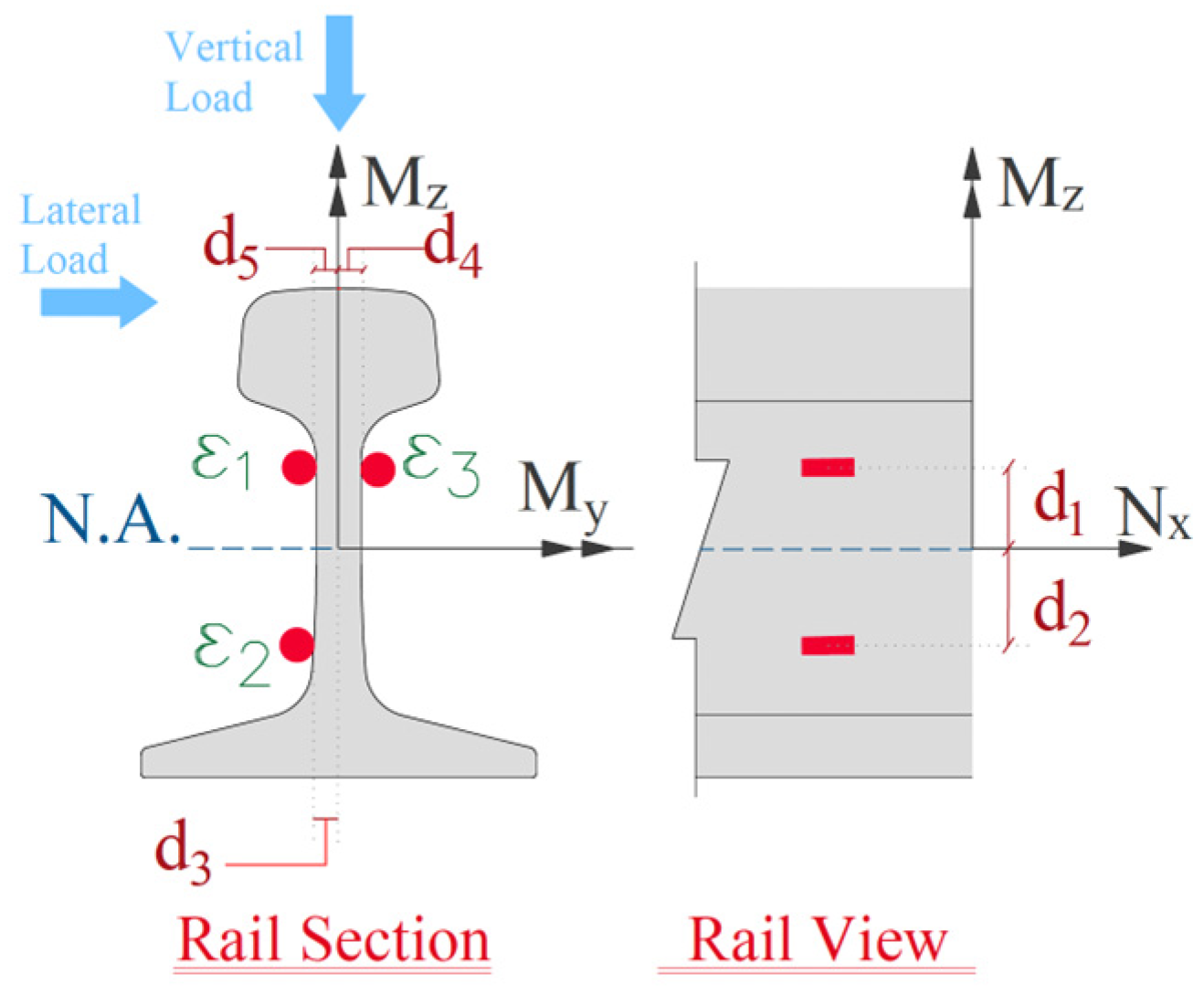
- Both quasi-distributed and fully distributed OFS-based systems can independently supply data to estimate various track parameters, including stress–strain behavior, rail deflection, internal forces, dynamic wheel loads, and sleeper reaction forces within a single integrated system.
- OFS-based monitoring systems with continuous and multi-parameter measurement can improve the understanding of track transition behavior and support condition, and provide early detection of structural and geotechnical defects in railroad tracks.
- OFS-based continuous, high-resolution data collection with high sampling rates can be combined with data-driven methods to detect other critical rail and wheel defects, such as broken or breaking rails and wheel flats.
- Cross-sensitivity of OFS to both temperature and mechanical strain, requiring temperature compensation to separate thermal from mechanical-induced strains.
- Constraints on OFS monitoring parameters influence their measurement accuracy. The monitoring parameters, such as gauge length, strain sensitivity, monitoring length, and sampling frequency, should be optimally designed to enhance the measurement accuracy.
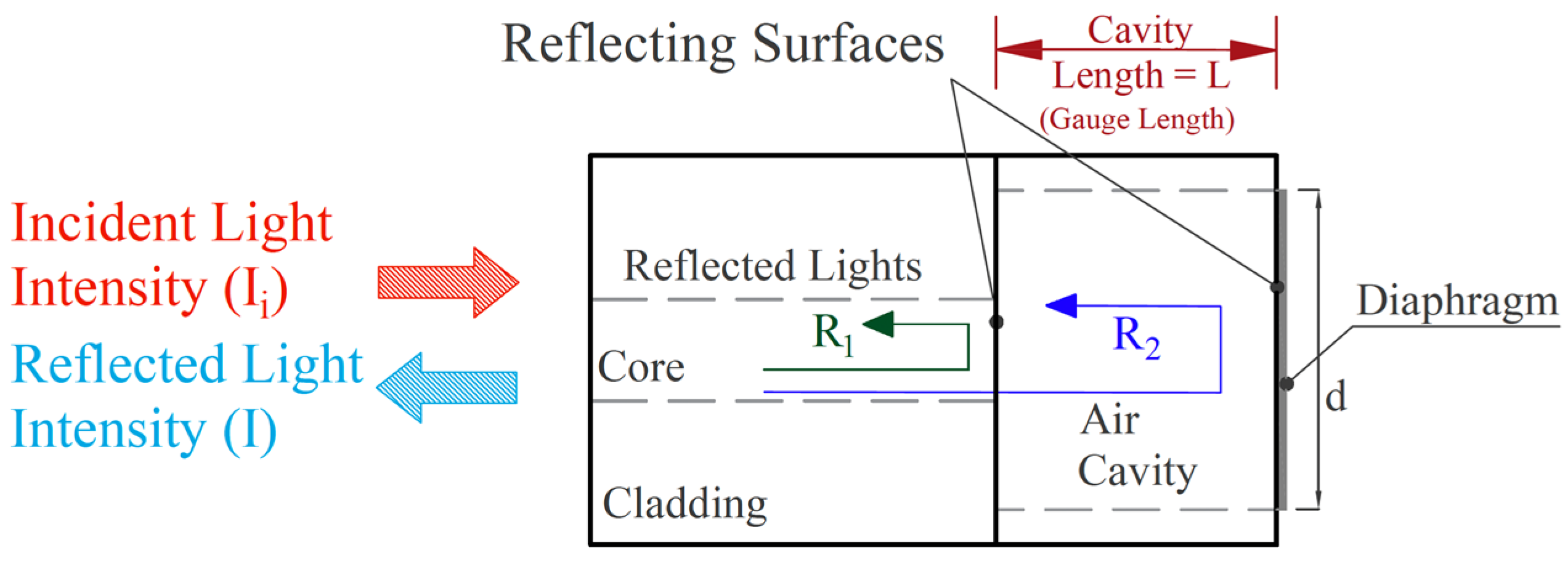
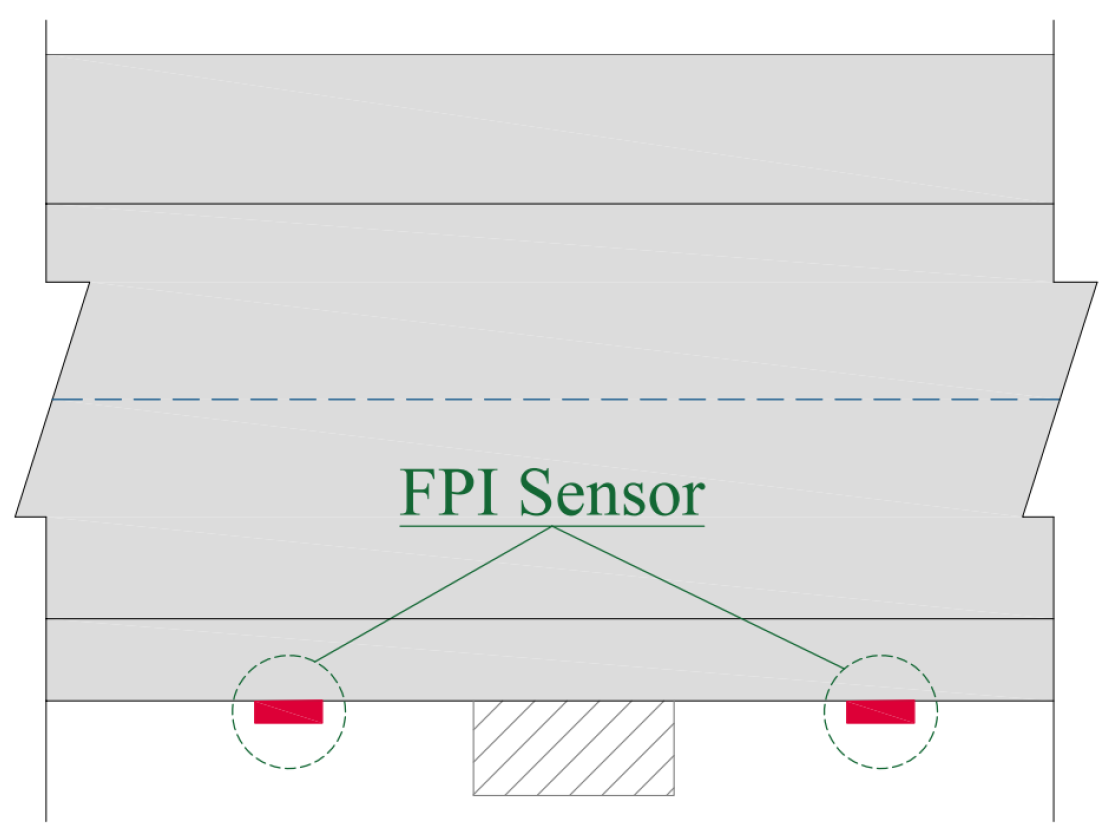
- Difficulty in multiplexing certain types of OFS, such as FPI sensors, makes them unsuitable for continuous measurement purposes. In addition, there is a possibility of significant signal degradation over long optical fibers in both distributed and quasi-distributed OFS configurations.
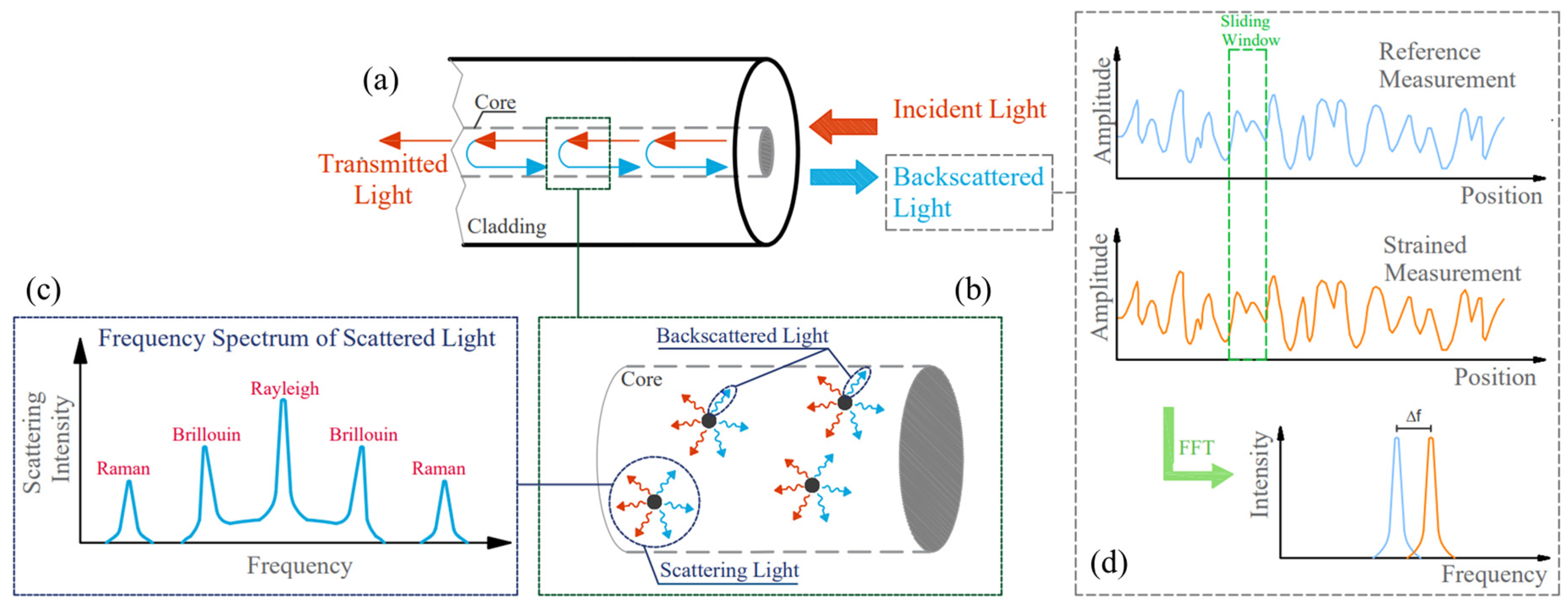
- Long-distance monitoring with distributed optical fiber sensors (DOFSs) may suffer from a relatively low spatial resolution of data collection.
- OFS preparation and field installation require careful handling, along with special protective measures, to ensure the sensor and optical cables’ robustness and promote their practical application in the railroad tracks during operation and maintenance activities.
- Durability and long-term performance: While OFSs are known for resisting harsh environments and erosion, very few studies have examined their long-term performance under significant temperature variations. Recent studies do not provide a consistent picture of the durability challenges of OFS-based monitoring systems.
- Measurement quality and accuracy: Few studies have assessed the feasibility of the OFS-based monitoring system under different operating conditions. Issues like signal quality and noise in OFS measurements under moving loads (from light to heavy loads at low to high travel speeds) over long sections remain challenging and require further laboratory and field investigations. In addition, the OFS measurement accuracy is rarely validated in comparison to theoretical and numerical models.
- Interpretation framework and performance indices: Although the OFS-based monitoring system can theoretically measure multiple track parameters, limited studies have focused on developing frameworks for analyzing and interpreting OFS-measured data or on generating standardized performance indices, such as track modulus and track stiffness, solely from OFS measurements.
- Complexity in sensor design and configuration: Efficient OFS-based systems require careful determination of sensor gauge length, optimal spatial resolution, sensor placement on the rail, sampling frequency, and interrogating method.
- Guidelines for deployment and data processing: Two main mounting methods are used to install the OFS on the rail: gluing and welding. Selecting the optimal mounting approach requires careful consideration of the OFS durability, measurement quality, and track operating conditions. On the other hand, considering the long-distance monitoring of track transitions, methods of data reduction and signal processing also require further discussion.
- Cost analysis: OFS-based monitoring is an emerging system with unit prices comparable to conventional systems. Accordingly, the system currently requires a comprehensive cost–benefit analysis for large-scale implementations compared to the existing conventional alternatives.
Author Contributions
Funding
Institutional Review Board Statement
Informed Consent Statement
Data Availability Statement
Conflicts of Interest
Appendix A. Overview of the Case Studies by the OFS Monitoring System in Railroad Tracks

| Author | Location | Purpose | Installation Method | OFS Properties | |
|---|---|---|---|---|---|
| Lee et al. [80] | Hong Kong | Assessment of rail derailment potential by measuring vertical and lateral wheel load on a twisted rail beam using strain gauge and FBG sensors | Gluing FBG to the rail | TYP./QTY. | 3# FBGs in one array |
| Conclusion: Results from strain gauge and the FBG sensors demonstrated strong correlation with measurement errors remaining below 20%. | |||||
| Chan et al. [81] | Tsing Ma bridge (Hong-Kong) | Investigating the feasibility of FBG sensors for structural health monitoring (SHM) by measuring dynamic strain and temperature variations and comparing their performance with conventional instruments. | - | TYP./QTY. | 40# FBGs on the bridge |
| Fs | 500 Hz | ||||
| Conclusion: The findings demonstrated that FBG sensors performed well, and presented advantages over conventional instruments, such as remote sensing functionality, reduced maintenance costs, straightforward installation, and corrosion resistance. | |||||
| Wang et al. [63] | Field study | Measurement of axial forces induced by thermal expansion and rail-bridge interaction in a Continuous Welded Rail (CWR) system. FBG sensors were used to monitor curvature and axial force, while LVDTs and extensometers measured displacement, and thermocouples recorded the temperature variations. | Welding two anchor seats to the rail web for installation of FBGs | TYP./QTY. | 132# FBG along 227 m length. Connected to 8 channels |
| Conclusion: FBG sensors could effectively monitor track-bridge interaction. A railway safety warning system was developed, where alarm and action thresholds were determined based on thermally induced rail stress and rail buckling strength theory. The alarm value was calculated as the critical temperature at which rail buckling occurs. At rail buckling strength, the maximum axial force was determined, and the corresponding temperature was identified. Additionally, the alarm threshold of longitudinal rail displacement was established through a statistical analysis of long-term monitoring data and estimating upper and lower limits of the axial displacements. | |||||
| Filograno et al. [60,61] | Madrid-Barcelona line (250–300 km/h) | Identifying train type, axel loading, train speed, acceleration, wheel defects, and dynamic loads |
| TYP./QTY. | 11# FBGs |
| GL | 7 mm | ||||
| Fs | 4 kHz | ||||
| Conclusion: A one-year inspection confirmed that the adhesive bonding method maintained a consistent performance. Dynamic load was measured by two diagonal sensors (oriented at 45 degrees) positioned on the rail’s neutral axis, with calculations based on mechanics of structure. These values were then compared to the nominal static load. OFS proved effective for railway safety monitoring. A single sensor under bending was identified as the optimal configuration for detecting wheel defects, as it produced large deformation and a corresponding optical signal that enhanced the visibility of wheel flats. The dynamic wheel load was found to be dependent on train speed. At 200 km/h and 300 km/h speeds, it was about 14.5% and 21% higher than the static load, respectively. | |||||
| Kang et al. [82] | Lab study | A laboratory study conducted on a 1/6th scale model of a gauge change facility, both under normal conditions and simulated rail malfunctions. Measurement of strain and development of a real-time monitoring system to assess the performance of the gauge change facility. | - | TYP./QTY. | 16# FBGs on 4 channels |
| GL | 10 mm | ||||
| Fs | 200 Hz | ||||
| Conclusion: A strain threshold for real-time field monitoring was established. It was defined as 70% of the maximum strain recorded at each location by individual FBG sensors. The train speed did not affect the measured strains; however, the strain variations were influenced by the train type, specifically the wheelset design. | |||||
| Schroder et al. [83] | Switzerland (Lab and field study) | Measurement of the contact force in collector-catenary (Current Collector) (CC) of the trains | Embedding sensors in CC | TYP./QTY. | 6# and 3# FBGs for strain and temperature |
| Fs | 10 Hz | ||||
| Conclusion: Sensor placement was optimized using FEM analysis to identify strain distribution and the location of the neutral axis under bending conditions. Additional FBG-based temperature sensors were installed near each mechanical strain sensor along the neutral axis to compensate for thermally induced strains. The CC was modeled as a bending beam with two types of end support, free and fixed supports. Sensors were spaced no more than 25 cm. Contact forces and their positions were calculated using strain measurements in combination with beam deflection theory. | |||||
| Qiushi et al. [54] | Chengdu Station in China | Monitoring vibration and temperature variations in the braking system. Measurement of wheel stress, wheel load, and train speed. | Welding and attaching a metal holder ring to the rail surface and attaching the FBG to the holder | TYP./QTY. | 12# FBGs on 9 m long rail. 4# FBG on the train, 2# FBG on the brake. It was linked to 4 channels. |
| Fs | 200 MHz | ||||
| Conclusion: Train derailment risk was found to be predictable through installation of FBG sensors on both sides of the rail, which offered a cost-effective alternative to conventional systems such as wheel weighing system. The FBG sensors effectively detected load imbalances by identifying significant discrepancies between measured axle wheel loads. Thresholds were established to evaluate the status of the rail condition. | |||||
| Roveri et al. [62] | Milan-Italy (50–80 km/h) (80 trains per day) | Monitoring the rail and wheel by measuring mechanical strains under the wheel-rail interaction. | Pasting the FBG sensor on the rail with epoxy resin. | TYP./QTY. | 4# FBGs at 45-degree near sleeper on neutral axis (NA). 2#–3# FBGs on NA for ambient temperature. FBG @ 10–20 cm. |
| Fs | 400 Hz | ||||
| Conclusion: OFS installed along a 1.2 km section of the railway. Among all the deployed sensors, 21 sensors with the highest signal-to-noise ratio were selected for data analysis. Fourier transform analysis of the strain signal was performed to detect frequency peaks corresponding to rolling wheel impacts, indicating the presence of flat spots on the wheels. | |||||
| Hussaini et al. [84] | Large-scale lab study | Measurement of lateral strain of the ballast foundation in tracks at different depths using LVDT and smart sensing sheet instrumented by FBG sensors | Gluing FBG sensors to the sheet grooves using Cyanoacrylate adhesive. | TYP./QTY. | 4# arrays of FBG |
| GL | 10 mm | ||||
| Fs | 1.25 Hz | ||||
| Conclusion: FBG sensors effectively captured both macroscopic (i.e., the overall lateral strains or movement) and microscopic responses (i.e., the inward and backward movements of the ballasts, which caused a fluctuation in the recorded strains). Their high sensitivity and resolution, fast response time, and immunity to electromagnetic and electrical interferences have enabled reliable detection of the ballast vibrations (i.e., movement fluctuations). Additionally, a linear relationship was established between the measured lateral strains and corresponding measured lateral displacement at each depth. | |||||
| Lai et al. [85] | Lab study | Measurement of differential settlement in railway track | - | TYP./QTY. | FBG-based liquid level sensor |
| Conclusion: Changes in the liquid level within the sensor induced tensional forces in the embedded FBG sensor. Sensor measurement errors were approximately ±1.3% across the temperature ranges of 30 °C to 80 °C, indicating greater reliability compared to conventional electronic-based instruments. The system shows strong potential for integration into a multiplex sensing network enabling measurement of differential settlement along extended railway section. | |||||
| Kouroussis et al. [48] | Lab and field study in Belgium | Evaluating FBG performance through both laboratory experiments and numerical simulations. Measuring train speed using FBG sensors installed on the rail foot, while detecting wheel loads using 45-degree-oriented FBG sensors positioned on the rail’s neutral axis. | Gluing FBGs on the rail surface | TYP./QTY | Lab: 9# FBGs @ 10 cm. Field: 4# FBGs on the rail neutral axis, 2# FBGs on the rail foot |
| Conclusion: Optimal FBG sensors placement was guided by prior experience with the strain gauges and validated by numerical simulation of a three-point flexural laboratory test under moving load conditions. The rail foot was identified as the critical position for measuring train speed and wheel position, while the measurement on the rail’s neutral axis was optimal for capturing train weight and detecting local wheel defects. A single FBG sensor was sufficient to measure the train speed when the train configuration was known; two FBG sensors enabled determination of both train speed and direction. Additionally, four FBG sensors positioned on the rail’s neutral axis accurately estimated the vertical wheel load. | |||||
| Zhang et al. [86] | Guangzhou-Shenzhen-Hong Kong railway (>300 km/h) | Monitoring railway track temperature, axial rail displacement, stress, and strain along 1960 m railway | - | TYP./QTY. | 285# FBGs in 16 channels |
| Fs | 50 Hz | ||||
| Accuracy | 50 mm | ||||
| Conclusion: A real-time monitoring system was developed to assess rail track conditions. The developed monitoring system showed strong environmental compatibility and effectively estimated the condition of the high-speed railway track. | |||||
| Yucel & Ozturk [56] | Lab study | Validation of FBG sensor sensitivity and measuring the rail strain under vertical loading up to 200 kN | - | TYP./QTY. | 1# FBG at mid-length on the rail foot |
| Conclusion: A minor deviation was observed between the theoretical predictions and measured results. The error increased as the vertical load increased. The maximum discrepancy was 2.5%. In addition, the strain sensitivity (ratio of wavelength shift and strain) was about 1.38 pm/με. | |||||
| Xu et al. [87] | Shijiazhuang Tiedao University | Validation of the practicality of the FBG displacement sensors. Measuring the distance between the basic rail and sharp rail in railway turnouts. | A steel shell is mounted on the bottom of the basic rail using a mounting hole and fixed to the sharp rail from the sleeve side | TYP./QTY. | 2# FBGs on a cantilever beam |
| Sensitivity /Resolution | 24.8 pm/mm 0.04 mm | ||||
| Conclusion: Monitoring the distance between the basic and sharp rail in turnouts is essential to ensure complete rail closure. Though the sensors measurement was accurate, their sensitivity did not fully align with the theoretical predictions. The FBG displacement sensors were deployed for a two-year period, during which the sensor durability was challenging. | |||||
| Martincek et al. [66] | Field study in Slovak Republic | Measuring the number of wheel axles and train speed and detecting individual wheels under 30 train passages at a speed of 20–100 km/h. | - | TYP./QTY. | Fabry-Perot Interferometer |
| Conclusion: Train speed was calculated using the time interval between interference centers () and the known distance between the corresponding wheels. Repetitive shocks (i.e., local signal) were found during the wheel rotation, which indicated wheel imperfections or flat spots. The optical fiber sensor used for this measurement showed an error of less than 0.56%. | |||||
| Kacik et al. [88] | Field study | Monitoring the rail strain under a train speed of 15.47 km/h | - | TYP./QTY. | Fabry-Perot Interferometer |
| Conclusion: The designed configuration, in which the optical sensors were mounted on an aluminum profile, proved to be a reliable technique for installation on the rail and for monitoring the rail deflection. | |||||
| Van Esbeen et al. [89] | Field and lab study | In the lab: performing a 3-point bending test to identify the optimal FBG sensor position for axle counting. In the field: train detection, axle counting, and measurement of train speed through installing a metal pad containing FBG sensors underside of the rail foot. | In the lab: Gluing FBG on the rail using UV15DC80 adhesive. The rail surface was not grinded. In the field: Polishing the rail surface. Gluing a metal pad containing the FBG sensors to the rail using the PTOTAC 7300 adhesive. | TYP./QTY. | 9# and 4# FBGs in lab and field |
| GL | 8 mm | ||||
| Sensitivity | 32.08 pm/ton | ||||
| Conclusion: The FBG sensors installed underside of the rail foot exhibited the highest load sensitivity (wavelength shift per unit load), which makes it the optimal position for axel counting. Two of those metal pads equipped with four FBG sensors were required for effective train detection, axle counting, and train speed measurement. | |||||
| Nasrollahi et al. [38] | Field study | Monitoring track degradation through measuring sleeper deflection, rail bending moment, and accumulated differential settlement using optical and electrical sensors. |
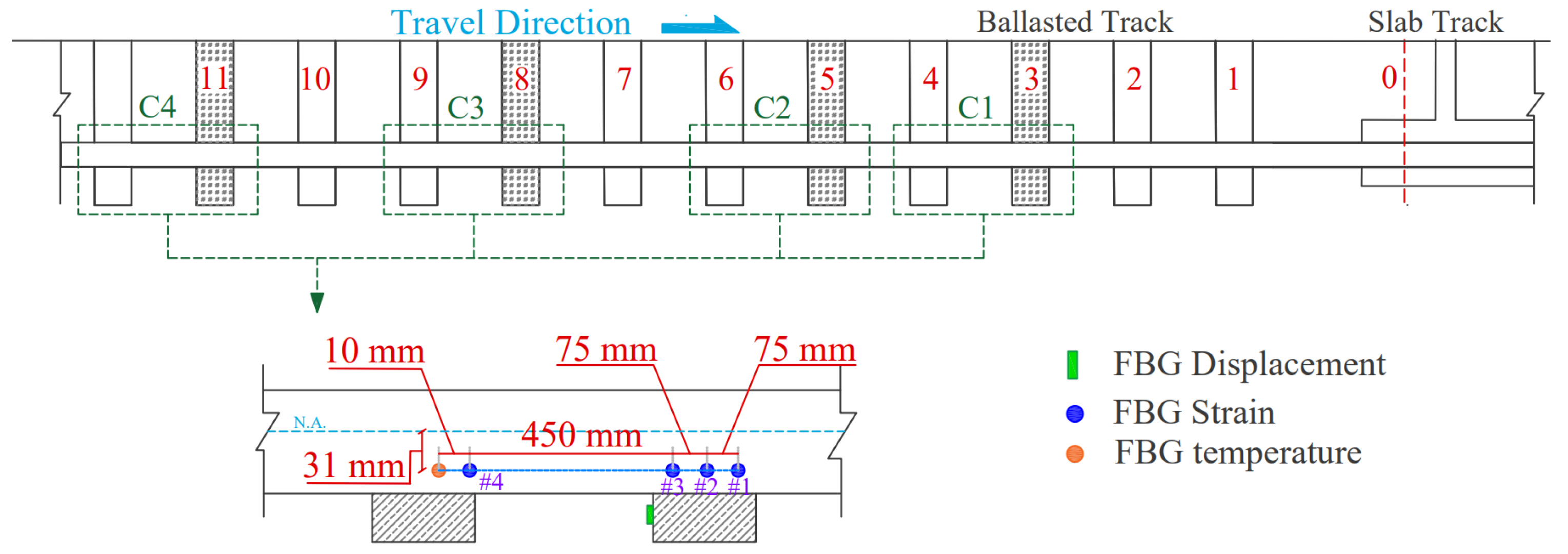
| TYP./QTY | 2# FBG-based displacement transducer on sleeper, 1# FBG-based accelerometer on sleeper, 4 arrays of 4# FBG-based strain measurements on the rail web @ 10 mm–75 mm, 4# FBG-based temperature measurement on the rail web |
| Fs | 2 kHz | ||||
| Conclusions: An array of axial strain was measured along the rail web above four sleepers. The Euler–Bernoulli beam theory correlated the axial strains with the rail curvature and bending moment. Additionally, two half-bridge strain gauges were used on opposite sides of the rail web to measure the applied load, and their results overlapped, confirming negligible influence of the lateral load. Accordingly, a single line of axial strain measurement was adequate for curvature estimation. A strong correlation was obtained between bending moment distribution, sleeper deflection, and track support conditions. The rail section with a larger bending moment aligned with locations where sleeper foundation was poor, as indicated by larger sleeper deflection. | |||||
| Peng et al. [75] | Field test | Real-time monitoring of train location and speed | The optical cables were buried in the ground at a depth of 0.7–1.5 m with a distance of 15–20 m from the railway track | TYP./QTY. | DOFS for 10.2 km |
| Interrogator | |||||
| Conclusion: The train position was successfully identified through vibration detection in optical cables. The train movement generated vibrations that produced two distinct peaks in vibration distribution along the cable. These two peaks correspond to the leading (head) and trailing (tail) edges of the train within the monitoring zone. A waterfall plot of vibration data was obtained by detecting the peaks over time and normalizing the vibration curve. In this plot, the vibration edges were detectable, and the slope of the vibration edges provided accurate estimation of the train speed. | |||||
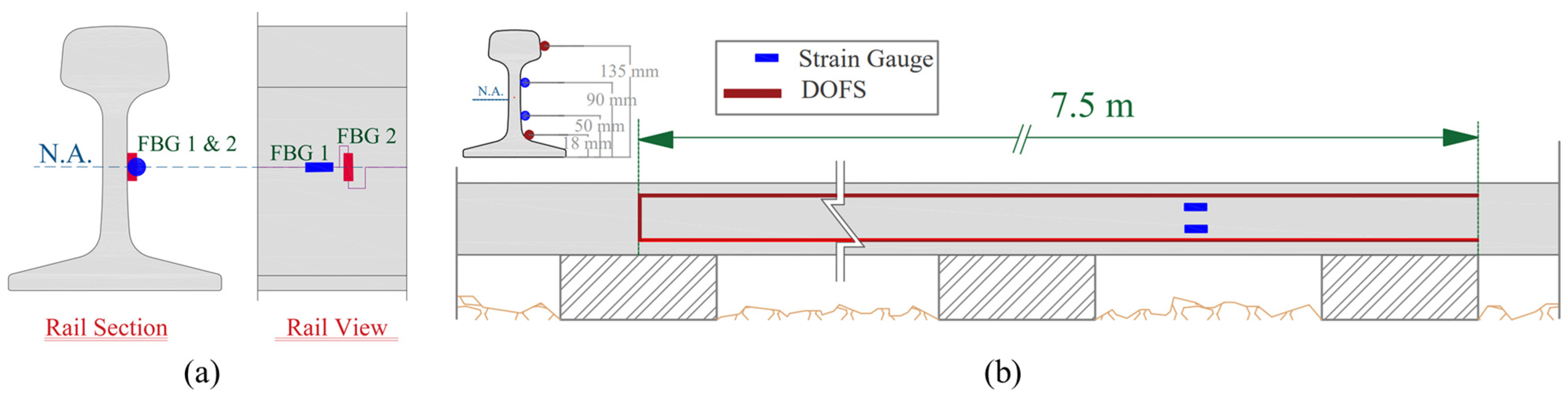
| Wheeler et al. [42] | Lab test and field study in a level crossing- Ontario, Canada | Validating optimal position of DOFS by laboratory test on a 2.8-m long rail under static and cyclic load (0.5 Hz). Investigating the applicability of the DOFS in measuring rail strain under dynamic low-frequency and high-frequency passenger train loading in a 7.5-m long rail. Using 5# Linear Potentiometers (LPs) and 4# DICs to measure the rail deflection. Determination of wheel load location, applied load, and track support condition. |
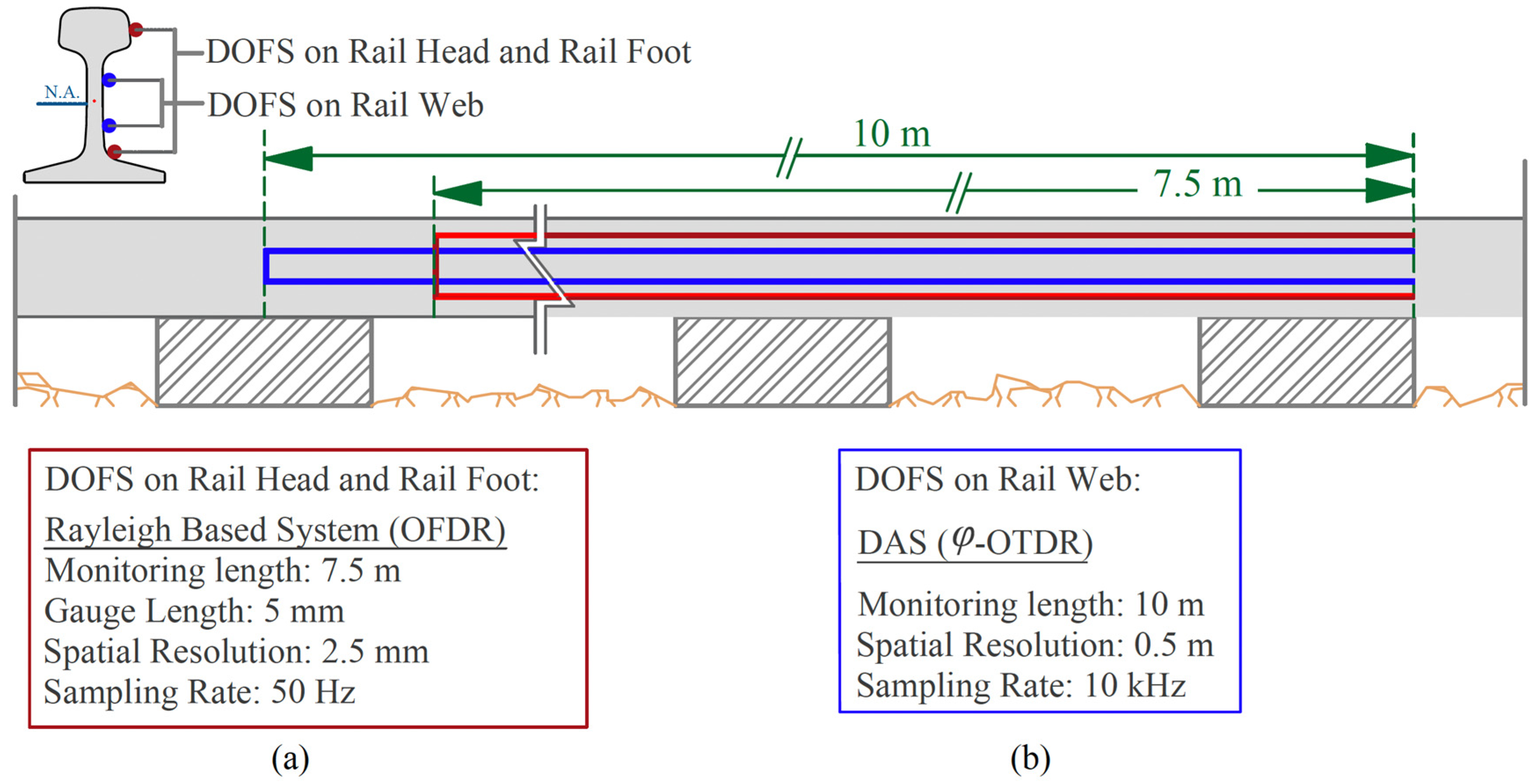
| TYP./QTY | DOFS, Rayleigh-based backscattered (4# lines) |
| Interrogator | OFDR | ||||
| GL | 20 mm (in lab) | ||||
| 5.12 mm (in field) | |||||
| Conclusion: Strain values measured under static and dynamic loading were comparable; however, dynamic strains exhibited noisier signals. The noise level was pronounced at the fiber end than at the start points due to increased frequency interference in reflected light from the fiber end. The sensor effectively captured local strain variations, enabling the detection of rail cracking, and early maintenance warnings. Rail curvature calculation was more accurate for two lines of fibers placed at a greater vertical distance. The accuracy of the curvature measurements of the OFS was validated by comparing calculated rail deflection with the deflection measured by LP, showing strong agreement. Measured rail curvature captured the track support condition. Comparing the rail curvature and deflection envelopes revealed poorly supported zone exhibited an increased positive curvature with downward rail deflection; however, a well-supported zone showed considerable negative curvature with small downward rail deflection. The monitoring system was found to be less suitable for detecting high-frequency vibrations associated with high-speed train operations in the field conditions. | |||||
| Wheeler et al. [43] | level crossing in Quebec, Canada | Investigating the applicability of the DOFS in measuring rail strain under heavy dynamic low-frequency (freight train with a speed of 8–11 km/h) load on a 7.5-m long rail. Measuring rail deflection by 3# DICs to measure rail deflection and investigating the track support condition. |
| TYP./QTY. | DOFS, 2# lines (Rayleigh) |
| Interrogator | OFDR | ||||
| GL | 5.12 mm | ||||
| Resolution | 2.56 mm | ||||
| Fs | 50 Hz | ||||
| Conclusion: DOFS successfully recorded data under the influence of freight trains operating at reduced speeds. Comparing the sleeper reaction force from DOFS-based static calculation and theoretical values based on Beam on Elastic Foundation (BOEF) showed an uneven force distribution, which indicated the presence of voids under some sleepers. The combination of DOFS-based calculation of wheel load and DIC-based deflection measurements enabled the characterization of the track’s load-deflection behavior. Comparing the magnitude of the void, inferred from the load-deflection of each sleeper, with the sleeper reaction force revealed that the load carried by each sleeper is a function of the void and support condition of adjacent sleepers. These findings highlighted the necessity of monitoring multiple consecutive sleepers to accurately interpret overall track support conditions. | |||||
| Milne et al. [47] | Field study | Monitoring a 10.4-m long rail with some poor sleeper foundation. Measuring strain using strain gauges and DOFS and recording track deflection with both DOFS and DIC. | Gluing optical cable to the top and bottom of the rail surface | TYP./QTY. | DOFS, 2# lines (Rayleigh) |
| Interrogator | (DAS) | ||||
| Conclusion: The studies showed that different factors influence the monitoring system’s performance, which requires trade-offs between the factors to achieve precise measurement. The most critical factors were gauge length, sampling frequency, strain sensitivity, and bandwidth of the interrogator. The DAS system demonstrated reliable strain measurement capabilities, which can be used to quantify both track deflection and applied loads on the rail. In addition, the system is suitable for continuous measurement, either as a permanent or temporary monitoring solution, over a long segment of the track. | |||||
| He et al. [90] | Lab and field in Shanghai, China | Validating the sensors through lab tests on a 6-m long rail with two supporting conditions. Estimating the rail deflection with a length of 48 m using DOFS. | - | TYP./QTY. | A line of DOFS and 1# FBG at mid-length |
| Conclusion: Laboratory results from FBG and DOFS were compared with theoretical calculations and numerical simulations based on FEM. The predicted strain value in FEM was slightly larger than the FBG measured values. The FBG-measured strain values were slightly larger than those from DOFS, with pronounced discrepancies under heavier loads. Under a simply supported condition, the maximum differences between theoretical strain and measured values were 1.79% for FBG and 5.02% for DOFS. Also, for the continuously supported rail condition, the deviation between the sensor measurement and FEM predictions was less than 40 με. This difference was justified by the effect of gauge length and spatial resolution of the sensor on strain accuracy. In field testing, three adjacent fasteners (spaced 65 cm apart) were removed, and the rail was displaced upwards in stages. DOFS performed effectively in the field measurement but showed sensitivity to ambient temperature and emphasizing temperature compensation for strain measurement in field applications. | |||||
| Zhou et al. [91] | Field test | Investigating the characteristics of the track subgrade layer using DOFS data to evaluate the layer’s modulus. Instrumenting a 4.5-km section of railroad track with DOFS and analyzing data for three specific selected sections. Comparing the results of subgrade modulus derived from DOFS with the values collected by Dynamic Cone Penetration (DCP) test. | The DOFS cables were buried at a depth of 0.9 m and a distance of 4.5 m away from the center track line. | TYP./QTY. | DOFS, 1# line (4.5 km) (Rayleigh) |
| Interrogator | OTDR (DAS) | ||||
| Resolution | Gauge length 10 m, Spatial sampling 1 m | ||||
| Conclusion: DAS was primarily used to collect track traffic information, such as train length and speed. Additionally, the buried DOFS signals adequately captured the pattern of the surface wave propagation within the track substructure. By transforming the collected signal into the frequency domain and analyzing the phase velocity in the wavelength domain, the fundamental mode of vibrations was identified (i.e., characterized by the slowest phase velocity with the highest amplitude per wavelength). The corresponding phase velocity was then used to calculate the shear wave velocity of the subgrade. Considering linear elastic theory, the shear wave velocity is correlated with the elastic modulus, which enabled the generation of a depth profile of the subgrade’s elastic modulus. Comparing the results with those from DCP test on the subgrade confirmed that DAS-based data analysis can reliably estimate subgrade properties under train moving loads. | |||||
| Zhou et al. [92] | Lab test | Assessment of sleeper support conditions in the transverse direction of the track with small-scale modeling of the sleepers using wooden pieces (30 cm long) and instrumenting of the top and bottom center of the sleeper. Simulating different sleeper support conditions by altering the number and placement of wooden support sticks beneath the sleeper segment. | Gluing the optical cable with M-Bond 200 adhesive to the wood surface | TYP./QTY. | DOFS, 2# lines (Rayleigh) |
| Resolution | 5.2 mm (64# points) | ||||
| Fs | 30 Hz | ||||
| Conclusion: The Euler–Bernoulli beam theory was applied to correlate the measured strain with the force distribution along the sleeper. The sleeper support condition was accordingly studied based on this force distribution. A high-order B-spline function represented the strain distribution along the sleeper length. The shear force profile was used to assess the sleeper support condition and calculate the applied force. The calculated force distribution showed a strong agreement with theoretical predictions. The predicted applied force was initially overestimated; nevertheless, accuracy improved when the number of wooden support sticks (representing the sleeper support) increased. | |||||
References
- Indraratna, B.; Sajjad, M.B.; Ngo, T.; Correia, A.G.; Kelly, R. Improved performance of ballasted tracks at transition zones: A review of experimental and modelling approaches. Transp. Geotech. 2019, 21, 100260. [Google Scholar] [CrossRef]
- Hölscher, P.; Meijers, P. Literature Study of Knowledge and Experience of Transition Zones; Report (415990-0011); GeoDelf: Delft, The Netherlands, 2007. [Google Scholar]
- Varandas, J.N.; Hölscher, P.; Silva, M.A. Dynamic behaviour of railway tracks on transitions zones. Comput. Struct. 2011, 89, 1468–1479. [Google Scholar] [CrossRef]
- Sasaoka, C.; Davis, D. Long Term Performance of Track Transition Solutions in Revenue Service; Technology Digest TD-05-036; Transportation Technology Center Inc.; Association of American Railroads: Washington, DC, USA, 2005. [Google Scholar]
- Hyslip, J.P.; Li, D.; McDaniel, C.R. Railway bridge transition case study. In Bearing Capacity of Roads, Railways and Airfields, Proceedings of the 8th International Conference (BCR2A’09), Champaign, IL, USA, 29 June–2 July 2009; CRC Press: Boca Raton, FL, USA, 2009. [Google Scholar]
- Wang, H.; Chang, L.; Markine, V. Structural health monitoring of railway transition zones using satellite radar data. Sensors 2018, 18, 413. [Google Scholar] [CrossRef]
- Wang, H.; Markine, V.; Liu, X. Experimental analysis of railway track settlement in transition zones. Proc. Inst. Mech. Eng. Part. F J. Rail Rapid Transit. 2018, 232, 1774–1789. [Google Scholar] [CrossRef]
- Li, D.; Hyslip, J.; Sussmann, T.; Chrismer, S. Railway Geotechnics; CRC Press: Boca Raton, FL, USA, 2015. [Google Scholar]
- Nicks, J.E. The Bump at the End of the Railway Bridge. Ph.D. Dissertation, Texas A&M University, College Station, TX, USA, December 2009. [Google Scholar]
- Sañudo, R.; Dell’Olio, L.; Casado, J.A.; Carrascal, I.A.; Diego, S. Track transitions in railways: A review. Constr. Build. Mater. 2016, 112, 140–157. [Google Scholar] [CrossRef]
- Wang, H.; Markine, V. Dynamic behavior of the track in transitions zones considering the differential settlement. J. Sound. Vib. 2019, 459, 114863. [Google Scholar] [CrossRef]
- Hunt, G.A. EUROBALT optimises ballasted track. Railw. Gaz. Int. 2000, 156, 813. [Google Scholar]
- Pita, A.L.; Teixeira, P.F.; Robuste, F. High speed and track deterioration: The role of vertical stiffness of the track. Proc. Inst. Mech. Eng. Part. F J. Rail Rapid Transit. 2004, 218, 31–40. [Google Scholar] [CrossRef]
- Castillo-Mingorance, J.M.; Sol-Sánchez, M.; Moreno-Navarro, F.; Rubio-Gámez, M.C. A critical review of sensors for the continuous monitoring of smart and sustainable railway infrastructures. Sustainability 2020, 12, 9428. [Google Scholar] [CrossRef]
- Zhang, S.; Xiao, X.; Wen, Z.; Jin, X. Effect of unsupported sleepers on wheel/rail normal load. Soil. Dyn. Earthq. Eng. 2008, 28, 662–673. [Google Scholar] [CrossRef]
- Mishra, D.; Qian, Y.; Huang, H.; Tutumluer, E. An integrated approach to dynamic analysis of railroad track transitions behavior. Transp. Geotech. 2014, 1, 188–200. [Google Scholar] [CrossRef]
- Lundqvist, A.; Dahlberg, T. Load impact on railway track due to unsupported sleepers. Proc. Inst. Mech. Eng. Part. F J. Rail Rapid Transit. 2005, 219, 67–77. [Google Scholar] [CrossRef]
- Wang, H.; Markine, V.L.; Shevtsov, I.Y.; Dollevoet, R.P.B.J. Analysis of the dynamic behaviour of a railway track in transition zones with differential settlement. In Proceedings of the ASME/IEEE Joint Rail Conference, San Jose, CA, USA, 23-26 March 2015; American Society of Mechanical Engineers: New York, NY, USA, 2015; Volume 56451, p. V001T01A024. [Google Scholar] [CrossRef]
- Mishra, D.; Boler, H.; Tutumluer, E.; Hou, W.; Hyslip, J.P. Deformation and dynamic load amplification trends at railroad bridge approaches: Effects caused by high-speed passenger trains. Transp. Res. Rec. 2017, 2607, 43–53. [Google Scholar] [CrossRef]
- Mishra, D.; Tutumluer, E.; Stark, T.D.; Hyslip, J.P.; Chrismer, S.M.; Tomas, M. Investigation of differential movement at railroad bridge approaches through geotechnical instrumentation. J. Zhejiang Univ. Sci. A 2012, 13, 814–824. [Google Scholar] [CrossRef]
- Mishra, D.; Tutumluer, E.; Boler, H.; Hyslip, J.P.; Sussmann, T.R. Railroad track transitions with multidepth deflectometers and strain gauges. Transp. Res. Rec. 2014, 2448, 105–114. [Google Scholar] [CrossRef]
- Stark, T.D.; Wilk, S.T. Root cause of differential movement at bridge transition zones. Proc. Inst. Mech. Eng. Part. F J. Rail Rapid Transit. 2016, 230, 1257–1269. [Google Scholar] [CrossRef]
- Kerr, A.D.; Moroney, B.E. Track transition problems and remedies. Bulletin 1993, 742, 267–298. [Google Scholar]
- Namura, A.; Suzuki, T. Evaluation of countermeasures against differential settlement at track transitions. Q. Rep. RTRI 2007, 48, 176–182. [Google Scholar] [CrossRef]
- Plotkin, D.; Davis, D. Bridge Approaches and Track Stiffness; U.S. Department of Transportation, Federal Railroad Administration: Washington, DC, USA, 2008; Report No. DOT/FRA/ORD-08/01. [Google Scholar]
- Tutumluer, E.; Stark, T.D.; Mishra, D.; Hyslip, J.P. Investigation and mitigation of differential movement at railway transitions for U.S. high-speed passenger rail and joint passenger/freight corridors. In Proceedings of the ASME/IEEE Joint Rail Conference, Philadelphia, PA, USA, 17–19 April 2012; Volume 44656, pp. 75–84. [Google Scholar] [CrossRef]
- Li, D.; Davis, D. Transition of railroad bridge approaches. J. Geotech. Geoenviron. Eng. 2005, 131, 1392–1398. [Google Scholar] [CrossRef]
- Coelho, B.Z. Dynamics of Railway Transition Zones in Soft Soils. Ph.D. Dissertation, Delft University of Technology, Delft, The Netherlands, 13 May 2011. [Google Scholar]
- Le Pen, L.; Watson, G.; Powrie, W.; Yeo, G.; Weston, P.; Roberts, C. The behaviour of railway level crossings: Insights through field monitoring. Transp. Geotech. 2014, 1, 201–213. [Google Scholar] [CrossRef]
- Markine, V.; Wang, H.; Shevtsov, I. Experimental analysis of the dynamic behaviour of a railway track in transition zones. In Proceedings of the Ninth International Conference on Engineering Computational Technology, Naples, Italy, 2–5 September 2014; pp. 2–5. [Google Scholar]
- ProRail. Constructive Measures to Prevent Settlement of the Track (in Dutch Constructieve Maatregelen ter Voorkoming Van Ontoelaatbare Zakkingen Van Het Spoor); ProRail: Utrecht, The Netherlands, 2010. [Google Scholar]
- Zuada Coelho, B.; Priest, J.; Hölscher, P. Dynamic behaviour of transition zones in soft soils during regular train traffic. Proc. Inst. Mech. Eng. Part F J. Rail Rapid Transit 2018, 232, 645–662. [Google Scholar] [CrossRef]
- Coelho, B.; Hölscher, P.; Priest, J.; Powrie, W.; Barends, F. An assessment of transition zone performance. Proc. Inst. Mech. Eng. Part F J. Rail Rapid Transit 2011, 225, 129–139. [Google Scholar] [CrossRef]
- Pinto, N.; Ribeiro, C.A.; Gabriel, J.; Calçada, R. Dynamic monitoring of railway track displacement using an optical system. Proc. Inst. Mech. Eng. Part F J. Rail Rapid Transit 2015, 229, 280–290. [Google Scholar] [CrossRef]
- Boler, H.; Mishra, D.; Tutumluer, E.; Chrismer, S.; Hyslip, J.P. Stone blowing as a remedial measure to mitigate differential movement problems at railroad bridge approaches. Proc. Inst. Mech. Eng. Part F J. Rail Rapid Transit 2019, 233, 63–72. [Google Scholar] [CrossRef]
- Sañudo, R.; Jardí, I.; Martínez, J.-C.; Sánchez, F.-J.; Miranda, M.; Alonso, B.; dell’Olio, L.; Moura, J.-L. Monitoring Track Transition Zones in Railways. Sensors 2021, 22, 76. [Google Scholar] [CrossRef]
- Huang, Z.; Su, Q.; Huang, J.; He, X.; Pei, Y.; Yang, C. Field assessment of a subgrade-culvert transition zone constructed with foamed concrete in the ballasted railway. Int. J. Rail Transp. 2023, 12, 391–413. [Google Scholar] [CrossRef]
- Nasrollahi, K.; Dijkstra, J.; Nielsen, J.C. Towards real-time condition monitoring of a transition zone in a railway structure using Fibre Bragg Grating sensors. Transp. Geotech. 2024, 44, 101166. [Google Scholar] [CrossRef]
- Paixão, A.; Varandas, J.N.; Fortunato, E. Dynamic behavior in transition zones and long-term railway track performance. Front. Built Environ. 2021, 7, 658909. [Google Scholar] [CrossRef]
- Çati, Y.; Gökçeli, S.; Anil, Ö.; Korkmaz, C.S. Experimental and numerical investigation of usp for optimization of transition zone of railway. Eng. Struct. 2020, 209, 109971. [Google Scholar] [CrossRef]
- Jain, A.; van Dalen, K.N.; Metrikine, A.V.; Faragau, A.B.; Steenbergen, M.J.M.M. Comparative analysis of the dynamic amplifications due to inhomogeneities at railway transition zones. In Proceedings of the Fifth International Conference on Railway Technology: Research, Development and Maintenance; Pombo, J., Ed.; Civil-Comp Press: Edinburgh, UK, 2023; Volume CCC 1. [Google Scholar] [CrossRef]
- Wheeler, L.N.; Pannese, E.; Hoult, N.A.; Take, W.A.; Le, H. Measurement of distributed dynamic rail strains using a Rayleigh backscatter-based fiber optic sensor: Lab and field evaluation. Transp. Geotech. 2018, 14, 70–80. [Google Scholar] [CrossRef]
- Wheeler, L.N.; Take, W.A.; Hoult, N.A.; Le, H. Use of fiber optic sensing to measure distributed rail strains and determine rail seat forces under a moving train. Can. Geotech. J. 2019, 56, 1–13. [Google Scholar] [CrossRef]
- Lu, P.; Lalam, N.; Badar, M.; Liu, B.; Chorpening, B.T.; Buric, M.P.; Ohodnicki, P.R. Distributed optical fiber sensing: Review and perspective. Appl. Phys. Rev. 2019, 6, 041302. [Google Scholar] [CrossRef]
- Sasy Chan, Y.W.; Wang, H.P.; Xiang, P. Optical Fiber Sensors for Monitoring Railway Infrastructures: A Review towards Smart Concept. Symmetry 2021, 13, 2251. [Google Scholar] [CrossRef]
- Du, C.; Dutta, S.; Kurup, P.; Yu, T.; Wang, X. A review of railway infrastructure monitoring using fiber optic sensors. Sens. Actuators A Phys. 2020, 303, 111728. [Google Scholar] [CrossRef]
- Milne, D.; Masoudi, A.; Ferro, E.; Watson, G.; Le Pen, L. An analysis of railway track behavior based on distributed optical fibre acoustic sensing. Mech. Syst. Signal Process. 2020, 142, 106769. [Google Scholar] [CrossRef]
- Kouroussis, G.; Kinet, D.; Moeyaert, V.; Dupuy, J.; Caucheteur, C. Railway structure monitoring solutions using fibre Bragg grating sensors. Int. J. Rail Transp. 2016, 4, 135–150. [Google Scholar] [CrossRef]
- M2 Optics. Key Differences Between Single Mode and Multimode Optical Fibers. Available online: https://www.m2optics.com/blog/understanding-the-difference-between-single-mode-and-multimode-fiber (accessed on 26 April 2021).
- Kouroussis, G.; Caucheteur, C.; Kinet, D.; Alexandrou, G.; Verlinden, O.; Moeyaert, V. Review of trackside monitoring solutions: From strain gages to optical fibre sensors. Sensors 2015, 15, 20115–20139. [Google Scholar] [CrossRef]
- Fomitchov, P.; Krishnaswamy, S. Response of a fiber Bragg grating ultrasonic sensor. Opt. Eng. 2003, 42, 956–963. [Google Scholar] [CrossRef]
- Takeda, N. Characterization of microscopic damage in composite laminates and real-time monitoring by embedded optical fiber sensors. Int. J. Fatigue 2002, 24, 281–289. [Google Scholar] [CrossRef]
- Arsenault, T.J.; Achuthan, A.; Marzocca, P.; Grappasonni, C.; Coppotelli, G. Development of an FBG based distributed strain sensor system for wind turbine structural health monitoring. Smart Mater. Struct. 2013, 22, 075027. [Google Scholar] [CrossRef]
- Qiushi, M.; Xiaorong, G.; Hongna, Z.; Zeyong, W.; Quanke, Z. Composite railway health monitoring system based on fiber optic bragg grating sensing array. In Proceedings of the 2014 IEEE Far East Forum on Nondestructive Evaluation/Testing; IEEE: New York, NY, USA, 2014; pp. 259–264. [Google Scholar] [CrossRef]
- da Cunha, J.R.A.; Alcantara, P.; Brígida, A.S.; Borges, G.; Costa, J.W. New approach to the strain analysis of bragg grating sensors. Photonic Sens. 2013, 3, 74–80. [Google Scholar] [CrossRef]
- Yucel, M.; Ozturk, N.F. Real-time monitoring of railroad track tension using a fiber Bragg grating-based strain sensor. Instrum. Sci. Technol. 2018, 46, 519–533. [Google Scholar] [CrossRef]
- Othonos, A. Fiber bragg gratings. Rev. Sci. Instrum. 1997, 68, 4309–4341. [Google Scholar] [CrossRef]
- Tosi, D. Review and analysis of peak tracking techniques for fiber Bragg grating sensors. Sensors 2017, 17, 2368. [Google Scholar] [CrossRef]
- Ou, W. Fiber Bragg Gratings Strain Sensors for Railway Applications. Master’s. Thesis, University of Illinois at Urbana-Champaign, Champaign, IL, USA, 1 June 2009. [Google Scholar]
- Filograno, M.L.; Guillén, P.C.; Rodríguez-Barrios, A.; Martín-López, S.; Rodríguez-Plaza, M.; Andrés-Alguacil, Á.; González-Herráez, M. Real-time monitoring of railway traffic using fiber Bragg grating sensors. IEEE Sens. J. 2011, 12, 85–92. [Google Scholar] [CrossRef]
- Filograno, M.L.; Corredera, P.; Rodriguez-Plaza, M.; Andres-Alguacil, A.; Gonzalez-Herraez, M. Wheel flat detection in high-speed railway systems using fiber Bragg gratings. IEEE Sens. J. 2013, 13, 4808–4816. [Google Scholar] [CrossRef]
- Roveri, N.; Carcaterra, A.; Sestieri, A. Real-time monitoring of railway infrastructures using fibre Bragg grating sensors. Mech. Syst. Signal Process. 2015, 60, 14–28. [Google Scholar] [CrossRef]
- Wang, C.Y.; Tsai, H.C.; Chen, C.S.; Wang, H.L. Railway track performance monitoring and safety warning system. J. Perform. Constr. Facil. 2011, 25, 577–586. [Google Scholar] [CrossRef]
- Chtcherbakov, A.A. Reflective Interferometric Fibre Optic Sensors. Ph.D. Dissertation, University of Johannesburg, Johannesburg, South Africa, September 1997. [Google Scholar]
- Islam, M.; Ali, M.M.; Lai, M.H.; Lim, K.S.; Ahmad, H. Chronology of Fabry-Perot interferometer fiber-optic sensors and their applications: A review. Sensors 2014, 14, 7451–7488. [Google Scholar] [CrossRef]
- Martincek, I.; Kacik, D.; Horak, J. Interferometric optical fiber sensor for monitoring of dynamic railway traffic. Opt. Laser Technol. 2021, 140, 107069. [Google Scholar] [CrossRef]
- Pendão, C.; Silva, I. Optical Fiber Sensors and Sensing Networks: Overview of the Main Principles and Applications. Sensors 2022, 22, 7554. [Google Scholar] [CrossRef]
- Minardo, A.; Porcaro, G.; Giannetta, D.; Bernini, R.; Zeni, L. Real-time monitoring of railway traffic using slope-assisted Brillouin distributed sensors. Appl. Opt. 2013, 52, 3770–3776. [Google Scholar] [CrossRef]
- Zeni, L.; Minardo, A.; Porcaro, G.; Giannetta, D.; Bernini, R. Monitoring railways with optical fibers. SPIE Newsroom 2013, 3–5. [Google Scholar] [CrossRef]
- Klug, F.; Lackner, S.; Lienhart, W. Monitoring of railway deformations using distributed fiber optic sensors. In Proceedings of the Joint International Symposium on Deformation Monitoring (JISDM), Wien, Austria, 30 March–1 April 2016; Volume 1. [Google Scholar]
- Rahman, M.A.; Taheri, H.; Dababneh, F.; Karganroudi, S.S.; Arhamnamazi, S. A review of distributed acoustic sensing applications for railroad condition monitoring. Mech. Syst. Signal Process. 2024, 208, 110983. [Google Scholar] [CrossRef]
- Berrocal, C.G.; Fernandez, I.; Rempling, R. Crack monitoring in reinforced concrete beams by distributed optical fiber sensors. Struct. Infrastruct. Eng. 2021, 17, 124–139. [Google Scholar] [CrossRef]
- Chen, M.; Masoudi, A.; Brambilla, G. Performance analysis of distributed optical fiber acoustic sensors based on φ-OTDR. Opt. Express 2019, 27, 9684–9695. [Google Scholar] [CrossRef]
- Masoudi, A.; Pilgrim, J.A.; Newson, T.P.; Brambilla, G. Subsea cable condition monitoring with distributed optical fiber vibration sensor. J. Light. Technol. 2019, 37, 1352–1358. [Google Scholar] [CrossRef]
- Peng, F.; Duan, N.; Rao, Y.J.; Li, J. Real-time position and speed monitoring of trains using phase-sensitive OTDR. IEEE Photonics Technol. Lett. 2014, 26, 2055–2057. [Google Scholar] [CrossRef]
- Zhang, G.; Song, Z.; Osotuyi, A.G.; Lin, R.; Chi, B. Railway traffic monitoring with trackside fiber-optic cable by distributed acoustic sensing Technology. Front. Earth Sci. 2022, 10, 990837. [Google Scholar] [CrossRef]
- Wagner, A.; Nash, A.; Michelberger, F.; Grossberger, H.; Lancaster, G. The effectiveness of distributed acoustic sensing (DAS) for broken rail detection. Energies 2023, 16, 522. [Google Scholar] [CrossRef]
- Wang, P.; Xie, K.; Shao, L.; Yan, L.; Xu, J.; Chen, R. Longitudinal force measurement in continuous welded rail with bi-directional FBG strain sensors. Smart Mater. Struct. 2015, 25, 015019. [Google Scholar] [CrossRef]
- Barker, C.; Hoult, N.; Zhang, M. Longitudinal strain monitoring of rails using distributed and discrete sensors. In Proceedings of the 9th European Workshop on Structural Health Monitoring (EWSHM 2018), Manchester, UK, 10–13 July 2018; e-Journal of Nondestructive Testing; Volume 23. Available online: https://www.ndt.net/?id=23383 (accessed on 10 February 2026).
- Lee, K.Y.; Lee, K.K.; Ho, S.L. Exploration of using FBG sensor for derailment detector. WSEAS Trans. Top. Syst. 2004, 3, 2433–2439. [Google Scholar]
- Chan, T.H.; Yu, L.; Tam, H.Y.; Ni, Y.Q.; Liu, S.Y.; Chung, W.H.; Cheng, L.K. Fiber Bragg grating sensors for structural health monitoring of Tsing Ma bridge: Background and experimental observation. Eng. Struct. 2006, 28, 648–659. [Google Scholar] [CrossRef]
- Kang, D.; Kim, D.H.; Jang, S. Design and development of structural health monitoring system for smart railroad-gauge-facility using FBG sensors. Exp. Tech. 2014, 38, 39–47. [Google Scholar] [CrossRef]
- Schröder, K.; Ecke, W.; Kautz, M.; Willett, S.; Jenzer, M.; Bosselmann, T. An approach to continuous on-site monitoring of contact forces in current collectors by a fiber optic sensing system. Opt. Lasers Eng. 2013, 51, 172–179. [Google Scholar] [CrossRef]
- Hussaini, S.K.; Indraratna, B.; Vinod, J.S. Application of optical-fiber Bragg grating sensors in monitoring the rail track deformations. Geotech. Test. J. 2015, 38, 387–396. [Google Scholar] [CrossRef]
- Lai, C.C.; Au, H.Y.; Liu, M.S.; Ho, S.L.; Tam, H.Y. Development of level sensors based on fiber Bragg grating for railway track differential settlement measurement. IEEE Sens. J. 2016, 16, 6346–6350. [Google Scholar] [CrossRef]
- Zhang, Y.; Liu, F.; Jing, Y.; Li, W. Application of FBG sensing technique for monitoring and early warning system of high-speed railway track conditions. In Proceedings of the 2017 25th Optical Fiber Sensors Conference (OFS), Jeju, Republic of Korea, 24-28 April 2017; IEEE: New York, NY, USA, 2017; pp. 1–4. [Google Scholar] [CrossRef]
- Xu, H.B.; Li, F.; Zhao, W.G.; Tian, X.S.; Du, Y.L.; Gao, Y. Fiber optic displacement sensor used in railway turnout contact monitoring system. Optoelectron. Lett. 2019, 15, 165–169. [Google Scholar] [CrossRef]
- Kacik, D.; Martincek, I.; Maciak, J.; Goraus, M. Fabry–Pérot interferometer monitoring system for counting train axle. IEEE Trans. Instrum. Meas. 2022, 71, 7005409. [Google Scholar] [CrossRef]
- Van Esbeen, B.; Finet, C.; Vandebrouck, R.; Kinet, D.; Boelen, K.; Guyot, C.; Kouroussis, G.; Caucheteur, C. Smart railway traffic monitoring using fiber Bragg grating strain gauges. Sensors 2022, 22, 3429. [Google Scholar] [CrossRef]
- He, J.; Li, P.; Zhang, S. Continuous deformation measurement for track based on distributed optical fiber sensor. Struct. Monit. Maint. 2020, 7, 1–12. [Google Scholar] [CrossRef]
- Zhou, Y.; Huang, H.; Pudel, A. Continuous Railroad Track Health Monitoring Using Distributed Fiber Optic; American Railway Engineering and Maintenance-of-Way Association: Indiana, Indianapolis, 2023. [Google Scholar]
- Zhou, Y.; Huang, H.; Shen, S.; Wang, X. Measuring under-tie support condition: An approach using distributed fiber-optic strain sensors. Measurement 2024, 227, 114279. [Google Scholar] [CrossRef]


| Sensor | Sensing Parameters | Operational Conditions |
|---|---|---|
| LVDT/MDD | Track deformation (Elastic and plastic) (Relative motion) (superstructure and substructure) | Difficulty of mounting and stabilizing, Limitation on the depth of installation of MDD, Uncertainty in the fixity of the MDD anchor in a non-deformable layer, Point-based measurement, Sensitivity to EMI *, Difficulty of multiplexing |
| Geophone | Velocity and track deformation (Relative motion) (Elastic) (superstructure), Rail and wheel defects, Track traffic information | Specific data analysis, Point-based measurement, Sensitivity to EMI, Difficulty of multiplexing |
| Accelerometer | Acceleration, velocity, and track deformation (Absolute motion) (superstructure), Rail and wheel defects, Track traffic information | Specific data analysis, Point-based measurement, Sensitivity to EMI, Difficulty of multiplexing |
| Strain Gauge | Rail micro-deformations (elastic and plastic), Sleeper Reaction Force, Wheel Load, Track traffic information | Difficulty of positioning and mounting, Sensitivity to EMI, Point-based measurement, Sensitivity to temperature variations, Difficulty of multiplexing |
| DIC | Track deformation (Elastic) (Relative motion) (superstructure) | Low accuracy for deflections smaller than pixel size, Sensitivity to ground and wind-generated vibrations, high cost of performance, Manual operation, Setting-up errors, Difficulty in camera positioning, Trade-off between the size of field-of-view and measurement accuracy, Limited monitoring length, Special post-processing of recorded data |
| PSD | Track deformation (Elastic) (Relative motion) (superstructure) | Error in long laser distance, Limited range of deflection measurement, Specific mounting considerations, Point-based measurement |
| Measuring coach | Track geometry, Track photo and video, Acceleration of train components | High cost of measurement, low frequency of measurement (twice per year), Limited to loaded deflection profile |
| InSAR | Track deformation (plastic) | Low frequency of measurement (bi-/tri-weekly), Variable and large spatial resolution, Sensitive to persistency and quality of scattering reflection from ground targets |
| Reference | Monitoring Period/No. of Train Passage | Train Speed (km/h) | TRANSITION TYPE | Measurement Location | Measured Parameters | Monitoring Systems |
|---|---|---|---|---|---|---|
| Nasrollahi et al. [38] | 10 mos 1 | 60–80 | Ballasted track–slab track | Embankment side | Ac, P/ED, BM, VL | (Acm, DS, T,) 16 SG |
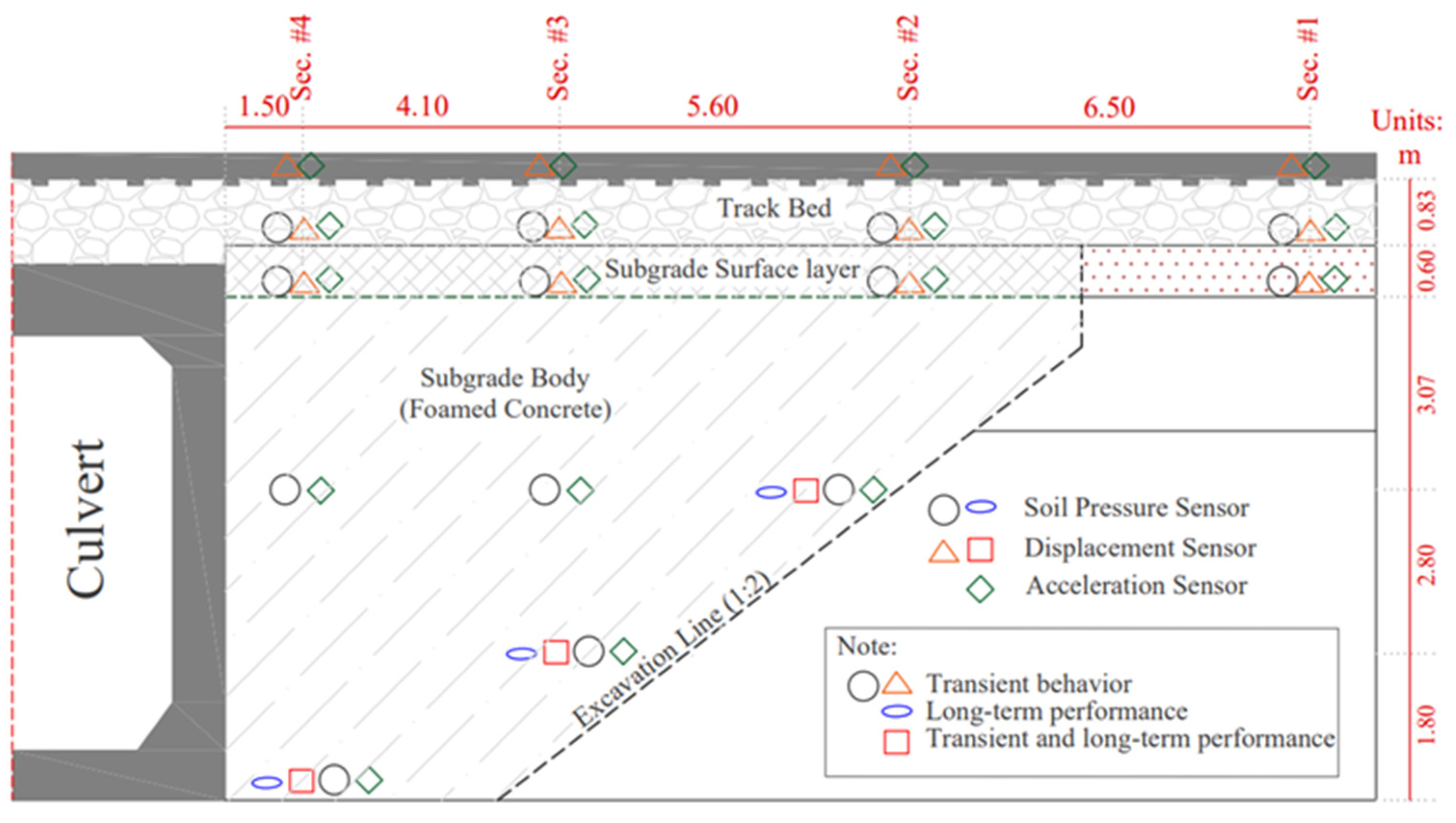
| Huang et al. [37] | 8 and 1 mos 2 | 40–60 | Ballast on culvert–Ballasted track | Embankment Side | SSL, Ac, ED 11, PD | Acm, PC, DS |
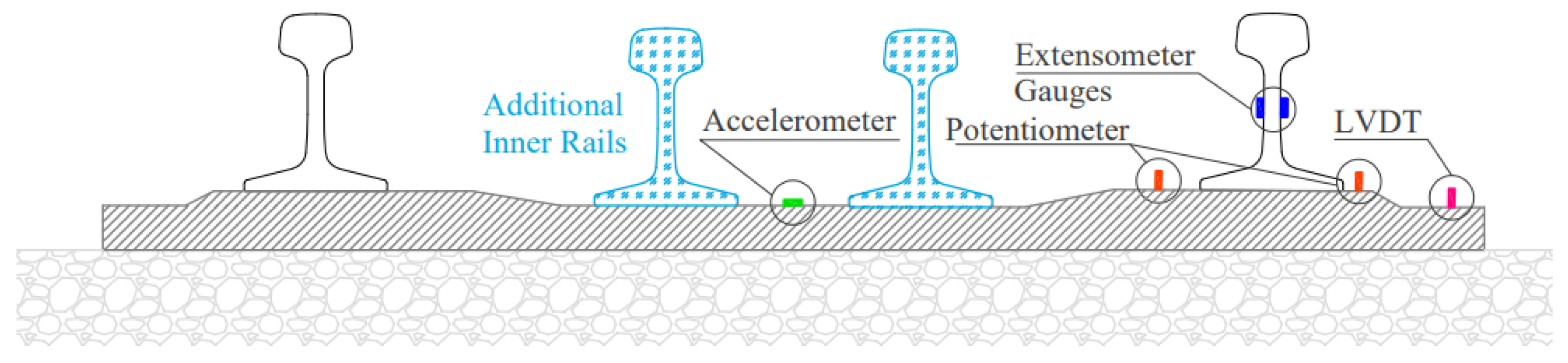
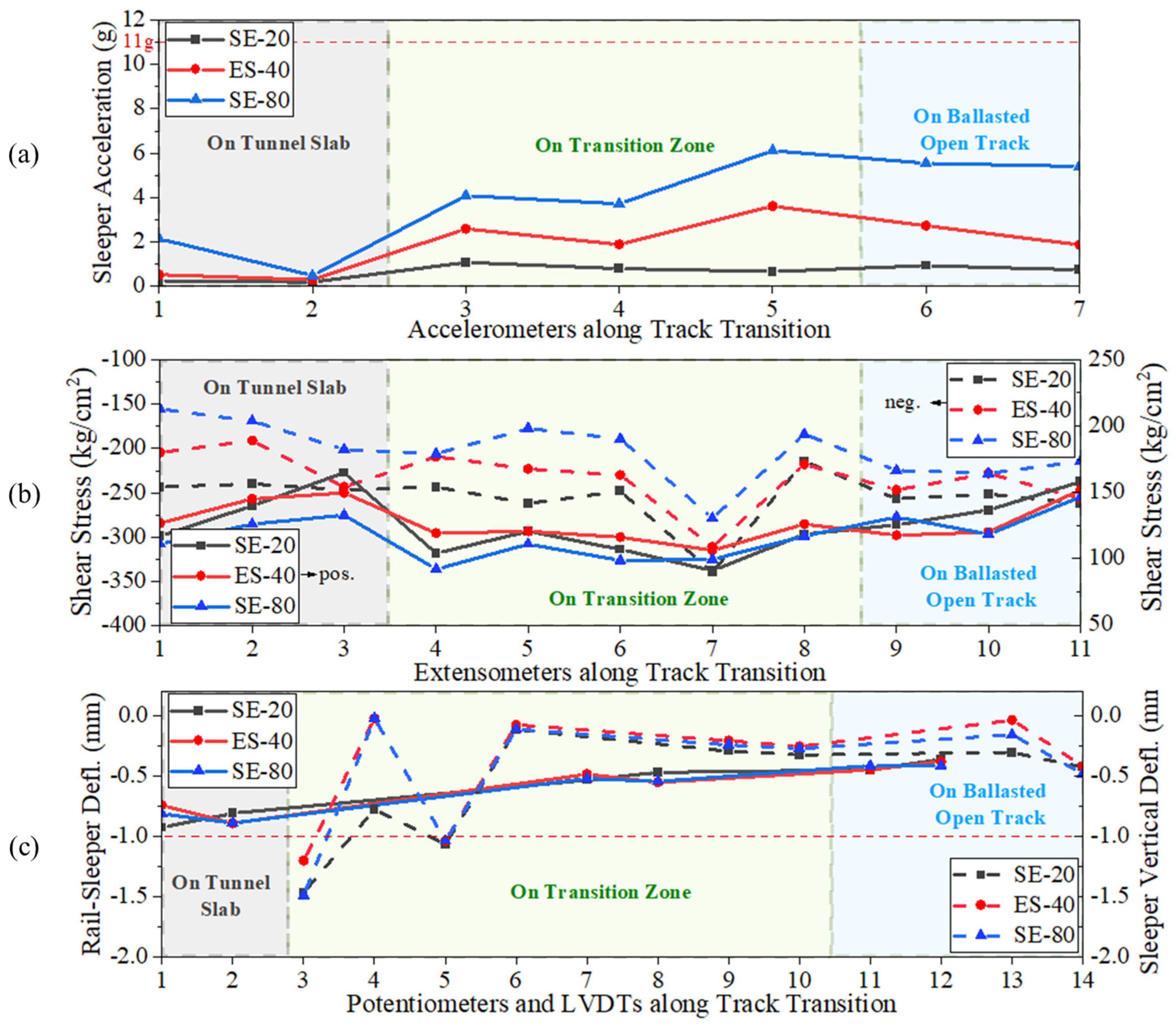
| Sanudo et al. [36] | 26 3 | 20–80 | Tunnel slab track–Ballasted track | Embankment and slab sides | Ac 12, SS, ED 13 | Acm, EXG, Pm, LVDT |
| Wheeler et al. [42,43] | 1 4 | 8–11, 129 9 | Level crossing | Embankment side | BM, ED, SF/R/L, | OFS, DIC |
| Boler et al. [35] | 2 yrs | 40–177 | Open-deck bridge–Ballasted track | Embankment side | EDS 14, VL, Ac | MDD 17, SG |
| Wang et al. [6] | 6 yrs, 30 5 | 120 10 | Open deck bridge–Ballasted track | Embankment and bridge sides | P/ED, TA | DIC, InSAR, MC |
| Wang et al. [7] | 4–42 6 | 100 | Open-deck bridge–Ballasted track | Embankment side | ED | DIC |
| Mishra et al. [19,21] | 3 yrs | 177–241 | Ballast on bridge deck–Ballasted track | Embankment side | VL, P/EDS 15 | SG, MDD |
| Pinto et al. [34] | 1 7 | 220 | Ballast on culvert–Ballasted track | Embankment and culvert sides | ED | PSD |
| Le Pen et al. [29] | 2 8 | 100–112 | Level crossing | Embankment side | ED, TA | GP, DIC, TRC |
Disclaimer/Publisher’s Note: The statements, opinions and data contained in all publications are solely those of the individual author(s) and contributor(s) and not of MDPI and/or the editor(s). MDPI and/or the editor(s) disclaim responsibility for any injury to people or property resulting from any ideas, methods, instructions or products referred to in the content. |
© 2026 by the authors. Licensee MDPI, Basel, Switzerland. This article is an open access article distributed under the terms and conditions of the Creative Commons Attribution (CC BY) license.
Share and Cite
Gharizadehvarnosefaderani, M.; Rabbi, M.F.; Mishra, D. Track Transition Performance: A Sensor-Centric Literature Review and Optical Sensing Advances. Geotechnics 2026, 6, 25. https://doi.org/10.3390/geotechnics6010025
Gharizadehvarnosefaderani M, Rabbi MF, Mishra D. Track Transition Performance: A Sensor-Centric Literature Review and Optical Sensing Advances. Geotechnics. 2026; 6(1):25. https://doi.org/10.3390/geotechnics6010025
Chicago/Turabian StyleGharizadehvarnosefaderani, Mahsa, Md. Fazle Rabbi, and Debakanta Mishra. 2026. "Track Transition Performance: A Sensor-Centric Literature Review and Optical Sensing Advances" Geotechnics 6, no. 1: 25. https://doi.org/10.3390/geotechnics6010025
APA StyleGharizadehvarnosefaderani, M., Rabbi, M. F., & Mishra, D. (2026). Track Transition Performance: A Sensor-Centric Literature Review and Optical Sensing Advances. Geotechnics, 6(1), 25. https://doi.org/10.3390/geotechnics6010025