
Site-Specific and Economic Optimization of Populus Plantations for Veneer Production in Appalachian Landscapes


Abstract
1. Introduction
2. Materials and Methods
2.1. A Summary of SRWC-PEAM
2.2. Description of VP-PEAM
2.2.1. Site Elevation
2.2.2. Stand Density
2.2.3. Site Quality Rating (SQR, VP-PEAM)
2.2.4. Additional VP-PEAM Considerations
- VP-PEAM assumes the selection of site-suitable poplar genotypes for veneer poplar (VP) production.
- The model estimates total stand stem biomass and calculates stand total veneer log biomass, assuming that it constitutes 50% of the total stem biomass.
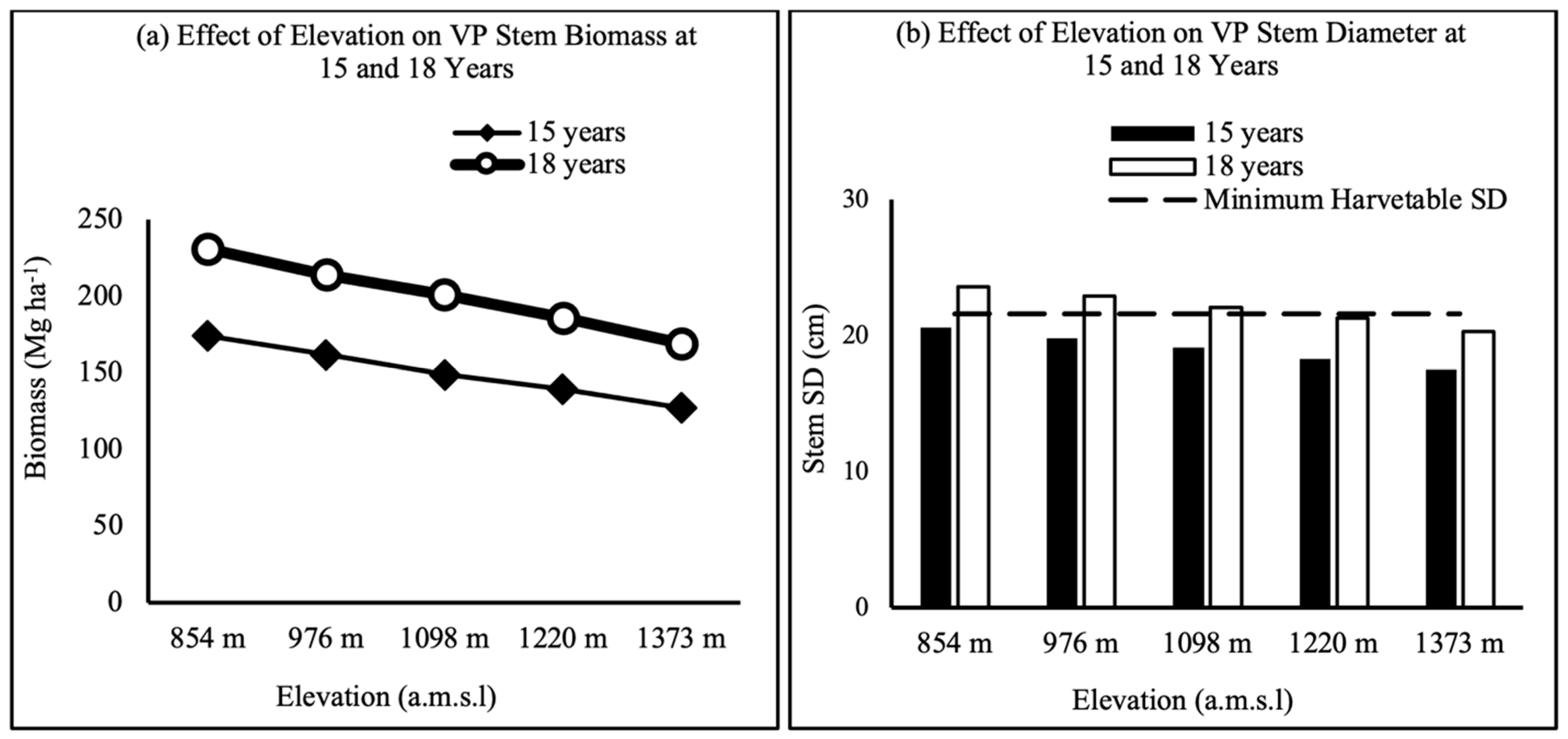
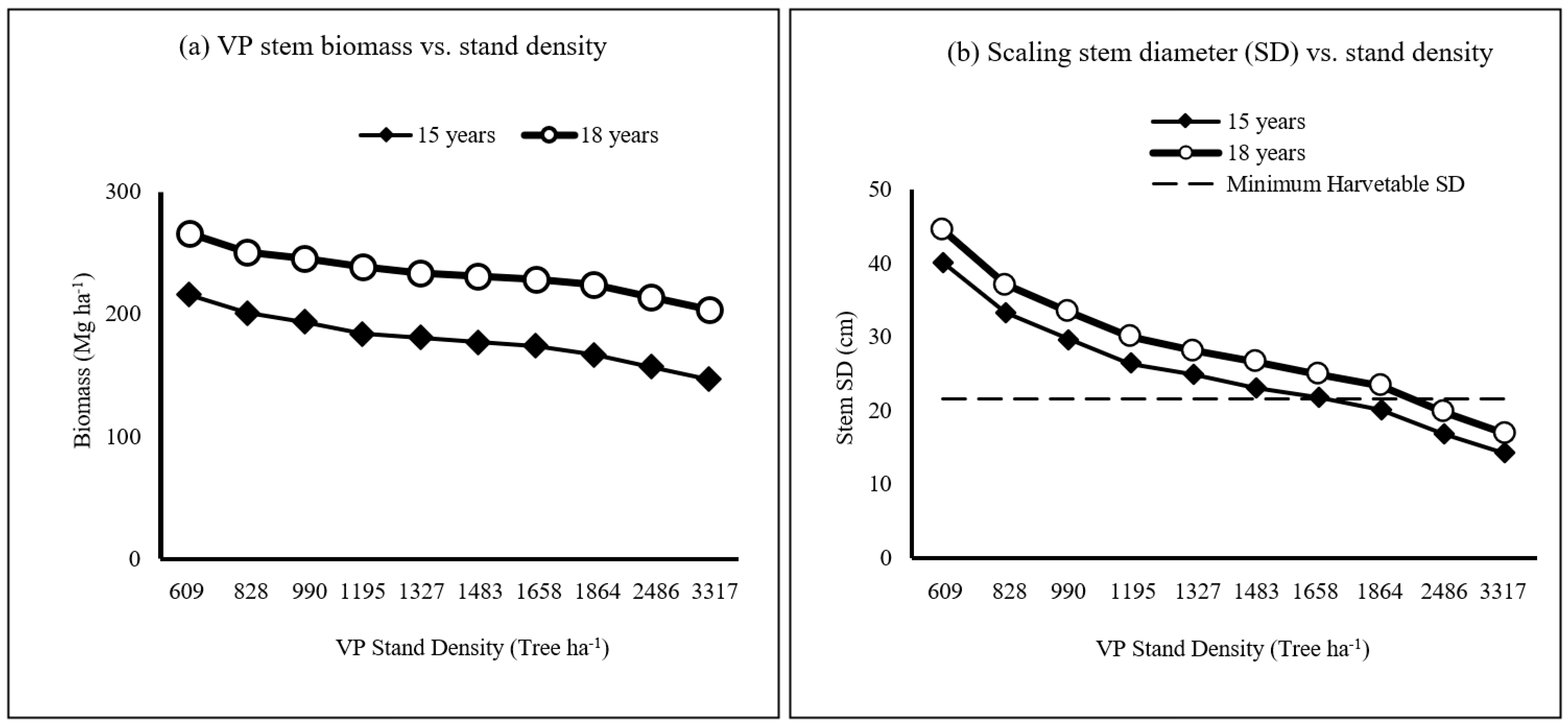
- It is assumed that 75% of standing VP trees produce veneer logs, each 2.75 m long, when their scaling diameter (SD, which refers to the inside-bark or under-bark stem diameter) reaches at least 21.6 cm; trees with SDs smaller than 21.6 cm are not ready for harvest.
- Stand total veneer log biomass is converted into volume using the mean poplar wood density of 492 kg m−3. The per-tree volume of veneer logs is estimated based on a truncated cone formula (Equations (4) and (5)), assuming logs are truncated cones with a length of 2.75 m and basal diameters 1.187 times SD.
- No interactions between elevation and stand density effects on productivity were considered.
- The cost-effectiveness of VP production is evaluated using net present value (NPV, $ ha−1) and assuming the veneer log delivered price of USD 190 m−3 of wood (log).
- VP-PEAM includes opportunity benefit (gain) comparisons between VP production and commonly grown crops in WNC such as corn, wheat, tobacco and small-grain hay. Expected annual VP revenues are expressed as equivalent annual values (EAVs, $ ha−1 yr−1) and compared with revenues from alternative crops using data from the 2024 Crop Comparison Tool [31].
2.3. Assessment of VP Productivity and Profitability in WNC
3. Results
4. Discussion
5. Conclusions
- Elevation effects: Higher elevation reduced the productivity and profitability of VP stands. However, small elevation differences resulted in similar NPVs at harvestable rotations (18–19 years), which suggests diminishing economic returns beyond certain elevation thresholds.
- Stand density effects: Higher densities slow stem growth, requiring longer rotations (up to 60%) to reach harvest size (SD ≥ 21.6 cm). Cost-effectiveness increased as stand density decreased, which indicates that wider spacing improves economic returns and growth efficiency.
- Land types and use history: All land-use types considered can support profitable VP production by adjusting rotation length. Sites with less intensive past land use or undisturbed conditions were up to ~20% more profitable than previously intensively used lands.
- Site factors: Soil depth, texture and structure significantly affected VP productivity and economic returns. Deep soils and medium textures yielded higher biomass and NPVs, whereas strongly compacted soils reduced productivity and NPV by up to ~15%. Soil pans lowered profitability by up to ~19%, and shallow water tables negatively affected growth. Lower slopes and stream terraces outperformed upland sites in biomass production and cost-effectiveness. Depressions and concave microsites yielded better growth compared to ridges.
- Opportunity gain: VP production could be substantially more cost-effective than several annually harvested systems (corn, wheat, tobacco, hay) common across WNC and the broader Appalachian landscapes (opportunity benefits: USD 1568–USD 2763 ha−1 yr−1 in 15- to 18-year rotations). This makes VPs a strong alternative for land-use planning in WNC.
Author Contributions
Funding
Data Availability Statement
Acknowledgments
Conflicts of Interest
References
- USDA. National Agricultural Statistics Service—NASS. Census of Agriculture. 2022. Available online: https://www.nass.usda.gov/AgCensus (accessed on 8 June 2025).
- Ghezehei, S.B.; Nichols, E.G.; Hazel, D.W. Early clonal survival and growth of poplars grown on North Carolina Piedmont and Mountain marginal lands. BioEnergy Res. 2015, 9, 548–558. [Google Scholar] [CrossRef]
- Agricultural Marketing Resource Center. Christmas Trees. 2024. Available online: https://www.agmrc.org/commodities-products/forestry/christmas-trees (accessed on 12 June 2025).
- Pettersson, M.; Frampton, J.; Sidebottom, J. Influence of Phytophthora root rot on planting trends of Fraser Fir Christmas trees in the Southern Appalachian Mountains. Tree Plant Notes 2017, 60, 4–11. [Google Scholar]
- Kunkel, K.E.; Easterling, D.R.; Ballinger, A.; Bililign, S.; Champion, S.M.; Corbett, D.R.; Dello, K.D.; Dissen, J.; Lackmann, G.M.; Luettich, R.A., Jr.; et al. North Carolina Climate Science Report; North Carolina Institute for Climate Studies: Asheville, NC, USA, 2020; Available online: https://ncics.org/nccsr (accessed on 12 June 2025).
- North Carolina Christmas Tree Association. Fraser Fir Trees. 2021. Available online: https://ncchristmastrees.com/fraser-fir-trees/ (accessed on 14 June 2025).
- North Carolina Forest Service. Buyers of Timber Products in North Carolina. 2023. Available online: https://www.ncforestservice.gov/Managing_your_forest/timber_buyers.htm (accessed on 21 June 2025).
- International Poplar Commission (IPC). Synthesis of country progress reports. In Proceedings of the Twenty-Sixth Session of the International Commission on Poplars and Other Fast-Growing Trees Sustaining People and the Environment, Rome, Italy, 5–8 October 2021. [Google Scholar]
- Isebrands, J.G.; Aronsson, P.; Ceulemans, M.C.; Coleman, M.; Dimitriou, N.D.; Doty, S.; Gardiner, E.; Heinsoo, K.; Johnson, J.D.; Koo, Y.B.; et al. Environmental applications of poplars and willows. In Poplars and Willows: Trees for Society and the Environment; Isebrands, J.G., Richardson, J., Eds.; CABI: Oxford, UK; FAO: Rome, Italy, 2014; pp. 258–336. [Google Scholar]
- U.S. Department of Energy. Billion-Ton Report: Advancing Domestic Resources for a Thriving Bioeconomy; Oak Ridge National Laboratory: Oak Ridge, TN, USA, 2016. Volume 1. Available online: http://energy.gov/eere/bioenergy/2016-billion-ton-report (accessed on 23 May 2025).
- Balatinecz, J.J.; Kretschmann, D.E.; Leclercq, A. Achievements in the utilization of poplar wood—Guideposts for the future. For. Chron. 2001, 77, 265–269. [Google Scholar] [CrossRef]
- Hematabadi, H.; Madhoushi, M.; Khazaeian, A.; Ebrahimi, G. Structural performance of hybrid poplar-beech cross-laminated timber (CLT). J. Build. Eng. 2021, 44, 102959. [Google Scholar] [CrossRef]
- Knudson, R.; Brunette, G. Evaluation of Canadian prairie-grown hybrid poplar for high-value solid wood products. For. Chron. 2015, 91, 141–149. [Google Scholar] [CrossRef]
- Mitchell, C.P. Ecophysiology of short rotation forest crops. Biomass Bioenergy 1992, 2, 25–31. [Google Scholar] [CrossRef]
- Ghezehei, S.B.; Nichols, E.G.; Maier, C.A.; Hazel, D.W. Adaptability of Populus to physiography and growing conditions in the Southeastern USA. Forests 2019, 10, 118. [Google Scholar] [CrossRef]
- Ghezehei, S.B.; Nichols, E.G.; Hazel, D.W. Productivity and cost-effectiveness of short-rotation hardwoods on various land types in the southeastern USA. Int. J. Phytoremediation 2019, 22, 98–110. [Google Scholar] [CrossRef]
- Farmer, R.E., Jr.; Stettler, R.F.; Bradshaw, H.D., Jr. The genecology of Populus. In Biology of Populus and Its Implications for Management and Conservation, 3rd ed.; Stettler, R.F., Bradshaw, H.D., Jr., Heilman, P.E., Hinckley, T.M., Eds.; NRC Research Press: Ottawa, ON, Canada, 1996; pp. 33–55. [Google Scholar]
- Kurt, R. Suitability of three hybrid poplar clones for laminated veneer lumber manufacturing using melamine urea formaldehyde adhesive. BioResources 2010, 5, 1868–1878. [Google Scholar] [CrossRef]
- Marcon, B.; Viguier, J.; Candelier, K.; Thevenon, M.F.; Butaud, J.C.; Pignolet, L.; Gartili, A.; Denaud, L.; Collet, R. Heat treatment of poplar plywood: Modifications in physical, mechanical, and durability properties. iForest 2023, 16, 1–9. [Google Scholar] [CrossRef]
- Ghezehei, S.; Hazel, D.; (Department of Forestry & Environmental Resources, College of Natural Resources, North Carolina State University, Raleigh, NC 27695, USA). Intercropping Populus for Bioenergy and Veneer. Final Report to the Bioenergy Research Initiative Grant Program, North Carolina Department of Agriculture and Consumer Services. Unpublished report. 2022. [Google Scholar]
- Ghezehei, S.B.; Wright, J.; Zalesny, R.S., Jr.; Nichols, E.G.; Hazel, D.W. Matching site-suitable poplars to rotation length for optimized productivity. For. Ecol. Manag. 2020, 45, 117670. [Google Scholar] [CrossRef]
- Ghezehei, S.B.; Ewald, A.L.; Hazel, D.W.; Zalesny, R.S., Jr.; Nichols, E.G. Productivity and profitability of poplars on fertile and marginal sandy soils under different density and fertilization treatments. Forests 2021, 12, 869. [Google Scholar] [CrossRef]
- Stanturf, J.A.; Young, T.M.; Perdue, J.H.; Dougherty, D.; Pigott, M.; Guo, Z.; Huang, X. Potential profitability zones for Populus spp. biomass plantings in the Eastern United States. For. Sci. 2017, 63, 586–595. [Google Scholar] [CrossRef]
- Jiang, X.Z.H.; Wang, X.Q.; Fei, B.H.; Ren, H.Q. Effect of stand and tree attributes on growth and wood quality characteristics from a spacing trial with Populus. Ann. For. Sci. 2007, 64, 807–814. [Google Scholar] [CrossRef]
- Buchholz, T.; Volk, T.A. Improving the profitability of willow crops—Identifying opportunities with a Crop Budget Model. BioEnergy Res. 2011, 4, 85–95. [Google Scholar] [CrossRef]
- Lazarus, W. Energy Crop Production Costs and Breakeven Prices Under Minnesota Conditions; Department of Applied Economics Staff Papers, No. 2008-18 (or Staff Paper P08-18); University of Minnesota, University of Minnesota: St. Paul, MN, USA, 2008. [Google Scholar]
- Lazarus, W.; Headlee, W.L.; Zalesny, R.S. Impacts of supply-shed-level differences in productivity and land costs on the economics of hybrid poplar production in Minnesota. BioEnergy Res. 2015, 8, 231–248. [Google Scholar] [CrossRef]
- Lazarus, W.F.; Nelson, N.; Jackson, J.; Berguson, B.; McMahon, B.; Buchman, D.; Cai, M. Comparison of Hybrid Poplar Wood Breakeven Prices as Affected by Current and Improved Genetics; Technical Report NRRI/TR-2021/16; Natural Resources Research Institute: Hermantown, MN, USA, 2021. [Google Scholar]
- Bolstad, P.V.; Vose, J.M.; McNulty, S.G. Forest productivity, leaf area, and terrain in Southern Appalachian deciduous forests. For. Sci. 2001, 47, 419–427. [Google Scholar] [CrossRef]
- Krinard, R.M.; Johnson, R.L. Cottonwood Plantation Growth Through 20 Years; Res Pap SO-212; US Department of Agriculture, Forest Service, Southern Forest Experiment Station: Asheville, NC, USA, 1984. [Google Scholar]
- Piggott, N.; Washburn, D. The 2024 Crop Comparison Tool (Crop-Comparison-Tool_2024_with_Yieldpredictor, Version 2-28-2024); Department of Agricultural and Resource Economics, North Carolina State University: Raleigh, NC, USA, 2024. Available online: https://cals.ncsu.edu/agricultural-and-resource-economics/extension/business-planning-and-operations/enterprise-budgets (accessed on 23 November 2024).
- Truax, B.; Fortier, J.; Gagnon, D.; Lambert, F. Planting density and site effects on stem dimensions, stand productivity, biomass partitioning, carbon stocks, and soil nutrient supply in hybrid poplar plantations. Forests 2018, 9, 293. [Google Scholar] [CrossRef]
- Christersson, L. Wood production potential in poplar plantations in Sweden. Biomass Bioenergy 2010, 34, 1289–1299. [Google Scholar] [CrossRef]
- Tullus, A.; Rytter, L.; Tullus, T.; Weih, M.; Tullus, H. Short-rotation forestry with hybrid aspen (Populus tremula L. × P. tremuloides Michx.) in Northern Europe. Scand. J. For. Res. 2011, 27, 10–29. [Google Scholar] [CrossRef]
- Rajkai, K.; Végh, K.R.; Várallyay, G.; Farkas, C.S. Impacts of soil structure on crop growth. Int. Agrophysics 1997, 11, 97–109. [Google Scholar]
- Baker, J.B.; Broadfoot, W.M. A Practical Field Method of Site Evaluation for Commercially Important Southern Hardwoods; General Technical Report SO-26; USDA Forest Service, Southern Forest Experiment Station: Asheville, NC, USA, 1979. Available online: https://www.srs.fs.usda.gov/pubs/gtr/uncaptured/gtr_so026.pdf (accessed on 28 September 2022).
- Stanturf, J.A.; von Oosten, C.; Netzer, D.A.; Colman, M.D.; Pritwood, C.J. Ecology and silviculture of poplar plantations. In Poplar Culture in North America; Dickman, D.I., Eckenwald, J.E., Richardson, J., Eds.; NRC Research Press, National Council Canada: Ottawa, ON, Canada, 2001; pp. 152–206. [Google Scholar]
- Johansson, T.; Karacic, A. Increment and biomass in hybrid poplar and some practical implications. Biomass Bioenergy 2011, 35, 1925–1934. [Google Scholar] [CrossRef]
- Böhlenius, H.; Övergaard, R.; Jämtgård, S. Influence of soil types on establishment and early growth of Populus trichocarpa. Open J. For. 2016, 6, 361–372. [Google Scholar] [CrossRef]
- Salehi, A.; Calagari, M.; Ahmadloo, F. Effect of some soil properties on growth of three-year black poplar (Populus nigra L.) trees in poplar plantations in south of Tehran. Iran. J. For. Poplar Res. 2018, 26, 344–354. [Google Scholar] [CrossRef]
- McIvor, I.; Marden, M.; Douglas, G.; Hedderley, D.; Phillips, C. Influence of soil type on root development and above-and below-ground biomass of 1–3-year-old Populus deltoides × nigra grown from poles. Int. J. Environ. Sci. Nat. Resour. 2020, 24, 556138. [Google Scholar] [CrossRef]
- Mahoney, J.M.; Rood, S.B. Response of a hybrid poplar to water table decline in different substrates. For. Ecol. Manag. 1992, 54, 141–156. [Google Scholar] [CrossRef]
- Imada, S.; Yamanaka, N.; Tamai, S. Water table depth affects Populus alba fine root growth and whole plant biomass. Funct. Ecol. 2008, 22, 1018–1026. [Google Scholar] [CrossRef]
- Coomes, D.A.; Allen, R.B. Effects of size, competition and altitude on tree growth. J. Ecol. 2007, 95, 1084–1097. [Google Scholar] [CrossRef]
- Wang, Q.; Zhang, Y.; Wang, Z. Variation of soil microsite moisture-physical properties and its effect on Fraxinus mandshurica juvenile stand growth. Ying Yong Sheng Tai Xue Bao 2001, 12, 335–338. [Google Scholar]
- Pinno, B.D.; Bélanger, N. Competition control in juvenile hybrid poplar plantations across a range of site productivities in Central Saskatchewan, Canada. New For. 2009, 37, 213–225. [Google Scholar] [CrossRef]
- Attia, Z.; Domec, J.C.; Oren, R.; Way, D.A.; Moshelion, M. Growth and physiological responses of isohydric and anisohydric poplars to drought. J. Exp. Bot. 2015, 66, 4373–4381. [Google Scholar] [CrossRef]
- Méndez-Toribio, M.; Ibarra-Manríquez, G.; Navarrete-Segueda, A.; Paz, H. Topographic position, but not slope aspect, drives the dominance of functional strategies of tropical dry forest trees. Environ. Res. Lett. 2017, 12, 085002. [Google Scholar] [CrossRef]
- Kohlway, W.H.; Cothron, C.P.; Chiang, A.; Ghezehei, S.; Nichols, E.G.; Whitehill, J. Potential for elite veneer poplar on marginal Phytophthora spp.–infected Christmas tree lands. Plant Dis. 2025, 109, 2114–2122. [Google Scholar] [CrossRef] [PubMed]
- Fortier, J.; Truax, B.; Gagnon, D.; Lambert, F. Allometric equations for estimating compartment biomass and stem volume in mature hybrid poplars: General or site-specific? Forests 2017, 8, 309. [Google Scholar] [CrossRef]
- Brown, K.R.; Beall, F.D.; Hogan, G.D. Establishment-year height growth in hybrid poplars; relations with longer-term growth. New For. 1996, 12, 175–186. [Google Scholar] [CrossRef]
- Nelson, N.D.; Berguson, W.E.; McMahon, B.G.; Cai, M.; Buchman, D.J. Growth performance and stability of hybrid poplar clones in simultaneous tests on six sites. Biomass Bioenergy 2018, 118, 115–125. [Google Scholar] [CrossRef]
- Maier, C.A.; Burley, J.; Cook, R.; Ghezehei, S.B.; Hazel, D.W.; Nichols, E.G. Tree water use, water use efficiency, and carbon isotope discrimination in relation to growth potential in Populus deltoides and hybrids under field conditions. Forests 2019, 10, 993. [Google Scholar] [CrossRef]



| Used for Assessing | Site and Stand Information |
|---|---|
| Case 1: Elevation (Stand density: 1864 trees ha−1) Case 2: Stand density (Elevation: 915 m a.m.s.l.) | Pastureland, moderately (<10 yrs.) used Blackland soil with medium (0.61–1.22 m) depth: No soil pan or compaction Medium soil texture with granular RZ Structure: WTD: 0.61–1.83 m; no yearlong waterlogging Flat (microsite), lower slopes (topography) |
| Case 3: Land-use type (Moderate (<10 yrs.) past use intensity) Case 4: Past use (intensity) (Fallow field with Herbaceous spp.) | Open and grassed land Loess, deep (>1.22 m) soil No soil pan or compaction Flat (microsite), flood plains (topography) WTD: 0.61–1.83 m; no yearlong flooding |
| Case 5: Soil depth (Medium texture, prismatic structure) Case 6: Soil texture (Deep soil, >1.22 m, prismatic structure) Case 7: Root-zone (RZ) soil structure (Deep soil (>1.22 m) with medium loamy texture) | Fallow land with Herbaceous spp. Moderately used Blackland No soil pan or compaction WTD: 0.61–1.83 m Topography: Stream bottom Microsite: Flat No waterlogging |
| Case 8: Soil compaction (No soil pan) Case 9: Pan (Moderately compacted soil) | Cropped land with intensive (>10 yrs.) use history Deep (>1.22 m), loess Soil Medium texture, granular RZ structure Flat (microsite), stream bottom (topography) WTD: 0.61–1.83 m; no waterlogging. |
| Case 10: WTD (Flat, flood plain) Case 11: Topographic position (0.61–1.83 m WTD, flat microsite) Case 12: Microsite (0.61–1.83 m WTD, lower-slope topography.) | Cropped with intensive (>10 yrs.) use history Deep (>1.22 m), Blackland soil Medium texture, granular RZ structure Compaction: Moderate but no pan No yearlong flooding |
| Site/Stand Criteria | NPV ($ ha−1) | ||
|---|---|---|---|
| 15 Years | 18 Years | ||
| a Elevation | 854 m | NH/NVR c | USD 32,453 |
| 976 m | NH/NVR | USD 29,940 | |
| 1098 m | NH/NVR | USD 27,909 | |
| 1220 m | NH/NVR | NH/NVR | |
| 1373 m | NH/NVR | NH/NVR | |
| b Stand density in trees ha−1 | 3317 (1.8 m × 1.8 m) | NH/NVR | NH/NVR |
| 2486 (1.8 m × 2.4 m) | NH/NVR | NH/NVR | |
| 1864 (2.4 m × 2.4 m) | NH/NVR | USD 31,456 | |
| 1658 (2.4 m × 2.7 m) | USD 23,849 | USD 32,053 | |
| 1483 (2.7 m × 2.7 m) or (2.4 m × 3.1 m) | USD 24,362 | USD 32,604 | |
| 1327 (2.7 m × 3.1 m) | USD 25,275 | USD 33,183 | |
| 1195 (3.1 m × 3.1 m) | USD 25,733 | USD 33,753 | |
| 990 (3.4 m × 3.4 m) or (3.1 m × 3.7 m) | USD 27,070 | USD 34,830 | |
| 828 (3.7 m × 3.7 m) | USD 28,391 | USD 35,891 | |
| 609 (4.3 m × 4.3 m) | USD 30,584 | USD 38,009 | |
| Site/Stand Criteria | 15 Years | 18 Years | |||||
|---|---|---|---|---|---|---|---|
| a Biomass (Mg ha−1) | SD (cm) | NPV ($ ha−1) | a Biomass (Mg ha−1) | SD (cm) | NPV ($ ha−1) | ||
| b Land use—Past history | Undisturbed or near-virgin forest | 186 | 22.6 | USD 25,667 | 249 | 26.2 | USD 34,794 |
| Used moderately intensively or for <10 years | 177 | 21.8 | USD 24,003 | 231 | 25.1 | USD 32,245 | |
| Used highly intensively or for >10 years | 154 | 20.6 | NH/NVR k | 201 | 23.4 | USD 27,701 | |
| c Soil Depth | Deep (>1.22 m) | 177 | 21.8 | USD 24,003 | 231 | 25.1 | USD 32,245 |
| Medium (0.61–1.22 m) | 167 | 21.3 | NH/NVR | 221 | 24.6 | USD 30,729 | |
| Shallow (<0.61 m) | 124 | 18.5 | NH/NVR | 164 | 21.1 | NH/NVR | |
| d Texture | Coarse (sandy) | 167 | 21.3 | NH/NVR | 221 | 24.6 | USD 30,729 |
| Fine (clayey) | 137 | 19.3 | NH/NVR | 181 | 22.1 | USD 24,669 | |
| Medium (silty/loamy) | 177 | 21.8 | USD 24,003 | 231 | 25.1 | USD 32,245 | |
| e RZ Structure | Granular | 184 | 22.4 | USD 25,261 | 246 | 25.9 | USD 26,703 |
| Prismatic/Blocky | 177 | 21.8 | USD 24,003 | 231 | 25.1 | USD 32,245 | |
| Massive/Platy | 144 | 19.8 | NH/NVR | 194 | 23.1 | USD 26,703 | |
| f Compaction | None: Loose, porous soil, BD j < 1400 kg m−3 | 162 | 21.1 | NH/NVR | 214 | 24.1 | USD 29,762 |
| Moderate: Firm, moderately tight soil, BD 1400–1700 kg m−3 | 157 | 20.6 | NH/NVR | 206 | 23.9 | USD 28,728 | |
| Strong: Tight soil, BD > 1700 kg m−3 | 139 | 19.6 | NH/NVR | 184 | 22.4 | USD 25,217 | |
| g Pan (Presence) | None | 157 | 20.6 | NH/NVR | 206 | 23.9 | USD 28,728 |
| Plow pan | 149 | 20.3 | NH/NVR | 201 | 23.4 | USD 27,731 | |
| Inherent pan | 127 | 18.5 | NH/NVR | 169 | 21.6 | USD 23,186 | |
| h WTD | 0.61–1.83 m | 157 | 20.6 | NH/NVR | 206 | 23.9 | USD 28,728 |
| 0.305–0.61 m or 2.14–3.05 m | 149 | 20.3 | NH/NVR | 201 | 23.4 | USD 27,731 | |
| >3.05 m | 139 | 19.6 | NH/NVR | 184 | 22.4 | USD 25,217 | |
| <0.305 m | 0 | 0.0 | NH/NVR | 0 | 0.0 | NH/NVR | |
| i Topography | Flood plains/Stream bottom | 179 | 22.1 | NH/NVR | 239 | 25.4 | USD 33,311 |
| Stream terraces/Lower slopes | 177 | 21.8 | NH/NVR | 231 | 25.1 | USD 32,275 | |
| Upland | 157 | 20.6 | NH/NVR | 206 | 23.9 | USD 28 728 | |
| j Microsite | Depression/Concave | 179 | 22.1 | NH/NVR | 239 | 25.4 | USD 33,311 |
| Flat | 177 | 21.8 | NH/NVR | 231 | 25.1 | USD 32,275 | |
| Ridge/Convex | 162 | 21.1 | NH/NVR | 214 | 24.1 | USD 29,762 | |
| Alternative Production | VP—a EVA ($ ha−1 yr−1) | b VP Opportunity Benefit ($ ha−1 yr−1) | ||||
|---|---|---|---|---|---|---|
| Type | Revenues ($ ha−1 yr−1) | |||||
| 15-Years | 18-Years | 15-Years | 18-Years | |||
| Corn | USD 230 | Cases 1–2 | USD 2212 | USD 2692 | USD 1982 | USD 2461 |
| Wheat | USD 170 | Cases 3–4 | USD 2434 | USD 2933 | USD 2264 | USD 2763 |
| Tobacco | USD 655 | Cases 5–7 | USD 2313 | USD 2757 | USD 1658 | USD 2102 |
| Small-grain hay | USD 463 | Cases 8–12 | USD 2031 | USD 2459 | USD 1568 | USD 1995 |
Disclaimer/Publisher’s Note: The statements, opinions and data contained in all publications are solely those of the individual author(s) and contributor(s) and not of MDPI and/or the editor(s). MDPI and/or the editor(s) disclaim responsibility for any injury to people or property resulting from any ideas, methods, instructions or products referred to in the content. |
© 2026 by the authors. Licensee MDPI, Basel, Switzerland. This article is an open access article distributed under the terms and conditions of the Creative Commons Attribution (CC BY) license.
Share and Cite
Beyene, S.; Blumenfeld, S.; Nichols, E.G. Site-Specific and Economic Optimization of Populus Plantations for Veneer Production in Appalachian Landscapes. Geographies 2026, 6, 5. https://doi.org/10.3390/geographies6010005
Beyene S, Blumenfeld S, Nichols EG. Site-Specific and Economic Optimization of Populus Plantations for Veneer Production in Appalachian Landscapes. Geographies. 2026; 6(1):5. https://doi.org/10.3390/geographies6010005
Chicago/Turabian StyleBeyene, Solomon, Sam Blumenfeld, and Elizabeth Guthrie Nichols. 2026. "Site-Specific and Economic Optimization of Populus Plantations for Veneer Production in Appalachian Landscapes" Geographies 6, no. 1: 5. https://doi.org/10.3390/geographies6010005
APA StyleBeyene, S., Blumenfeld, S., & Nichols, E. G. (2026). Site-Specific and Economic Optimization of Populus Plantations for Veneer Production in Appalachian Landscapes. Geographies, 6(1), 5. https://doi.org/10.3390/geographies6010005