Article

Traditional Agrarian Landscapes and Climate Resilience in the Rural–Urban Transition Between the Sierra de las Nieves and the Western Costa del Sol (Andalusia, Spain)


by
Hugo Castro Noblejas
1,* and
Álvaro Daniel Rodríguez Escudero
2
1
Human Geography Department, University of Granada, Cartuja University Campus, 18071 Granada, Spain
2
Geography Department, Autonomous University of Madrid, University City of Cantoblanco, 28049 Madrid, Spain
*
Author to whom correspondence should be addressed.
Geographies 2025, 5(4), 78; https://doi.org/10.3390/geographies5040078
Submission received: 14 November 2025 / Revised: 11 December 2025 / Accepted: 12 December 2025 / Published: 16 December 2025

Abstract

The study examines the recent transformation of traditional agricultural landscapes in the transition zone between Sierra de las Nieves and the Western Costa del Sol (Andalusia, Spain), one of the European regions where urban development pressure has reached its peak in replacing agricultural land with residential and tourism uses. Through a diachronic analysis of historical orthophotos (1956–2025), statistical sources (Agricultural Census, SIGPAC), and fieldwork, land-use changes and their impact on ecological functionality and territorial resilience are quantified. Results reveal a widespread loss of agricultural land—exceeding 68% overall—particularly severe in Benahavís, where more than 70% of farmland has disappeared, largely converted to urban areas. In contrast, in Istán and Ojén, the predominant trend is the renaturalization of abandoned agricultural land. These dynamics illustrate a coastal–inland territorial model that epitomizes the Mediterranean “territorial consumption” process, in which tourism-driven urbanization fragments traditional agroforestry mosaics. The study concludes that, despite their regression, traditional agricultural landscapes continue to play a key role in water regulation, soil conservation, and wildfire risk mitigation. Their restoration and maintenance are proposed as a replicable strategy for climate change adaptation and for reconciling territorial sustainability with economic development in other Mediterranean regions under intense urban pressure.

1. Introduction

In the context of global climate change, the valorization and management of traditional agrarian landscapes acquire strategic importance, especially in the Mediterranean arc—one of the regions most vulnerable to global warming. Several international reports, such as the Sixth Assessment Report of the IPCC (AR6) [1], indicate that the Mediterranean is warming 20% faster than the global average, with a significant increase in the frequency and intensity of extreme events such as prolonged droughts, heatwaves, and large-scale wildfires. The United Nations 2030 Agenda [2] and the European Union Strategy on Adaptation to Climate Change [3] acknowledge these risks and emphasize the need to strengthen territorial resilience, with particular attention to urban–rural interface areas, where land-use pressures are especially intense.
Traditional agrarian landscapes, historically shaped through dry-stone terraces, irrigated gardens, and permanent arboreal or shrub crops such as olive groves, vineyards, and agro-silvopastoral systems, represent a key component in this equation. Beyond their recognized cultural and heritage value—acknowledged by UNESCO and by European initiatives such as the European Landscape Convention [4]—these landscapes provide essential ecosystem services: water regulation, soil conservation, creation of local microclimates, and, of particular relevance, the interruption of forest fuel continuity [5]. Their active maintenance through grazing, pruning, extensive tillage, or periodic clearing generates mosaics that limit wildfire propagation, reduce their severity, and foster subsequent natural regeneration [6].
However, since the mid-20th century, traditional Mediterranean agrarian landscapes have undergone profound transformations driven by simultaneous processes of agricultural abandonment and accelerated urbanization, particularly in coastal areas. Several studies have documented a marked loss of agricultural land in the second and third coastal fringes, where urban development pressure associated with residential tourism has fragmented traditional mosaics and fostered the expansion of continuous cover by unmanaged shrubland and secondary forest. This process has significantly reduced the average size of habitats—around 0.4 km2 along the coast compared to 0.9 km2 in inland areas—revealing a clear fragmentation of agrarian and natural fabrics [7]. This dynamic increases biomass accumulation and, consequently, vulnerability to wildfires, as evidenced by numerous studies on fire ecology across the Mediterranean region [8].
Historically, these territories—associated with both rainfed and irrigated agriculture on terraced slopes—have experienced a progressive abandonment of agrarian practices over recent decades, resulting in: (i) the degradation of terraces and orchards, accompanied by erosive processes; (ii) a substantial increase in wildfire hazard due to the accumulation of unmanaged vegetation. Land-cover mapping and historical wildfire inventories in the region demonstrate a clear correlation between the abandonment of agricultural activity and the greater extent and severity of recent fire events [9]. The main objective of this study is to highlight the value of traditional agricultural landscapes and their functions in fostering climate resilience and sustainable development, through the analysis of a paradigmatic case in the municipalities of Benahavís, Istán, and Ojén, located in the transitional area between the Sierra de las Nieves and the Western Costa del Sol (Province of Málaga, Andalusia, Spain). Despite the increasing attention to the role of agricultural landscapes in climate change adaptation and wildfire prevention, significant research gaps persist regarding the integrated analysis of ecological, territorial, and socioeconomic dimensions.
In particular, few studies have explored the relationships between the loss and abandonment of traditional agricultural landscapes, the processes of touristic urbanization, and the functional reconfiguration of rural areas in the second and third coastal belts of the Costa del Sol.
Within this framework, the study examines the recent transformation of traditional agricultural landscapes in this transitional area, assessing their impacts on ecological functionality, territorial structure, and overall landscape resilience in the face of urban development pressures and agricultural abandonment. More specifically, it aims to:
(a) Identify and quantify land-use changes between 1956 and 2025 through a diachronic analysis of historical orthophotographs, statistical data, and field surveys;
(b) Characterize the current structure of the agricultural parcel system, focusing on patterns of fragmentation, land ownership concentration, and the abandonment of traditional uses;
(c) Compare the territorial dynamics of the municipalities of Benahavís, Istán, and Ojén, highlighting the contrasts between coastal urbanization and inland renaturalization processes;
(d) Analyze the functional and ecological implications of these transformations on landscape connectivity, water regulation, soil conservation, and wildfire vulnerability; and
(e) Propose strategic guidelines for the governance, preservation, and valorization of traditional agricultural landscapes as key elements for sustainability and climate change adaptation in Mediterranean regions.
Through these analyses, the study aims to demonstrate that the conservation of Mediterranean agrarian landscapes provides multiple benefits that transcend their productive value: they contribute to environmental regulation, landscape quality, and the social perception of the territory. The persistence of these landscapes is associated with stronger community cohesion and an enhanced capacity for resistance and recovery in the face of climate crisis impacts, manifested in the study area through increasingly frequent and intense wildfires, torrential rains, and coastal storms.
Recent literature also highlights a link between landscape quality and residential satisfaction, as well as the influence of traditional agrarian environments on real estate valuation [10]. Research in urban economics and spatial planning has shown that proximity to cultural landscapes and well-managed green spaces not only enhances perceived quality of life but is also capitalized in housing values, generating positive externalities for both permanent residents and second-home owners in tourist contexts [11,12].

2. Materials and Methods

2.1. The Study Area and Its Geographical Context

2.1.1. Physical and Socio-Economic Setting of the Study Area

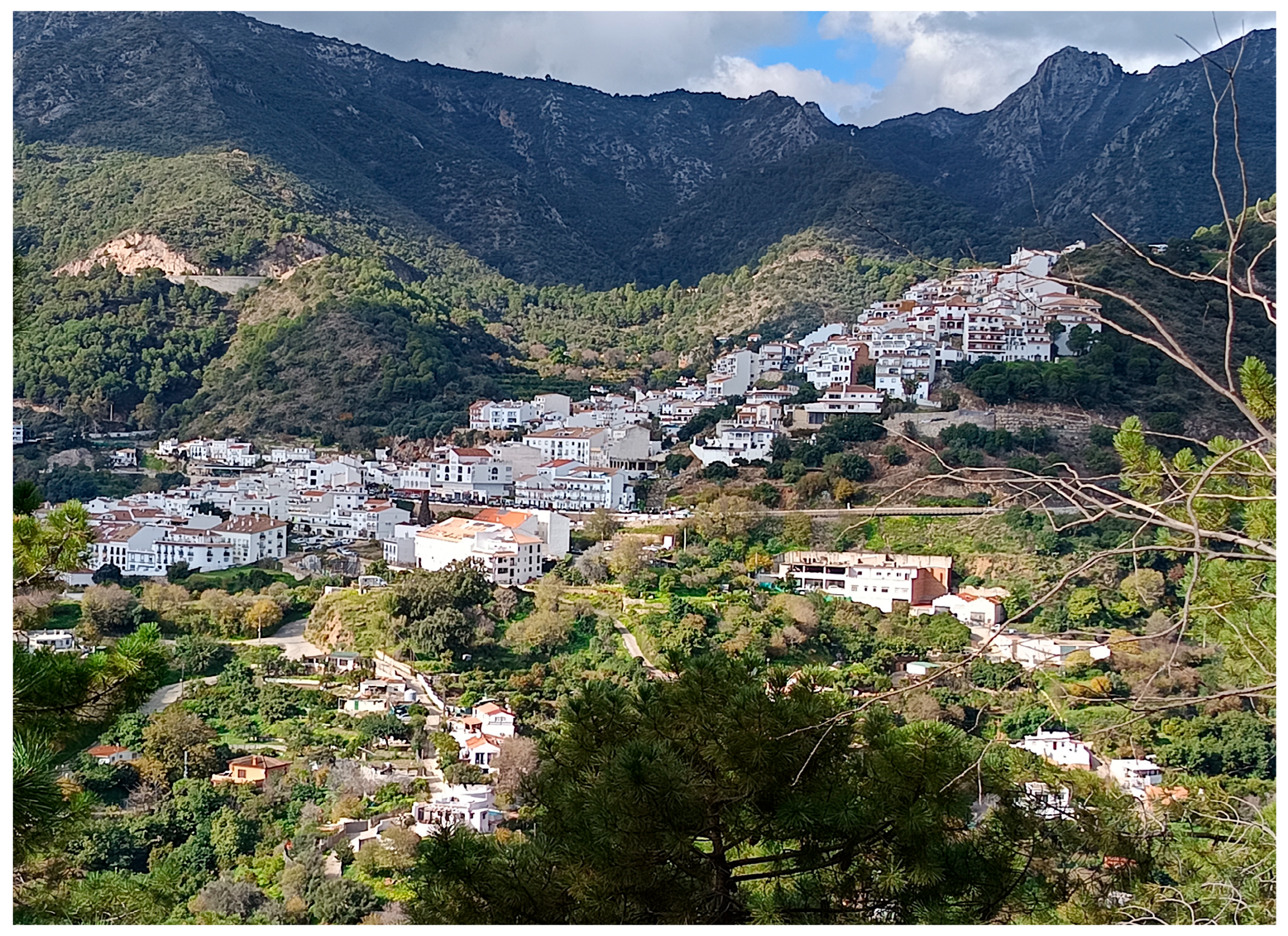
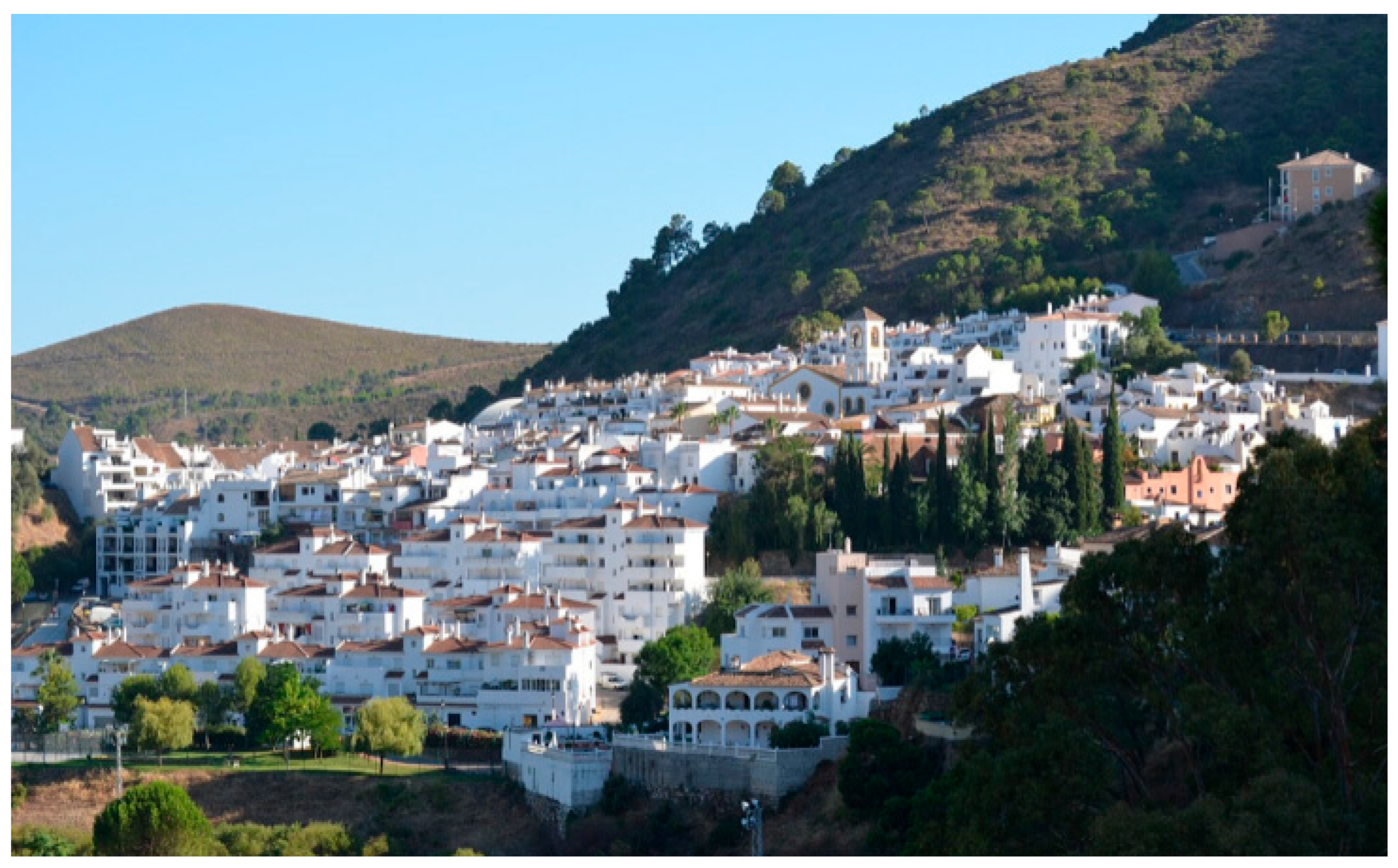
The study area comprises the municipalities of Benahavís, Istán, and Ojén, located in the hinterland of the Western Costa del Sol and in the southernmost sector of the Sierra de las Nieves, within the province of Málaga (Andalusia, Spain). Parts of the municipal territories of Benahavís and Istán fall within the boundaries of the Sierra de las Nieves National Park—Law 9/2021, of 1 July, declaring the Sierra de las Nieves National Park [13]. Prior to this, in 1989, the Regional Government of Andalusia declared the Sierra de las Nieves a natural park, marking the first milestone in the long process of protecting the values of this mountainous area in Málaga. Later, in 1995, UNESCO designated it as a Biosphere Reserve, and in 2006 it was integrated into the Intercontinental Mediterranean Biosphere Reserve (Spain–Morocco). All these actions are significant as they include measures and recommendations aimed at promoting sustainable social and economic development in the area. (Figure 1).
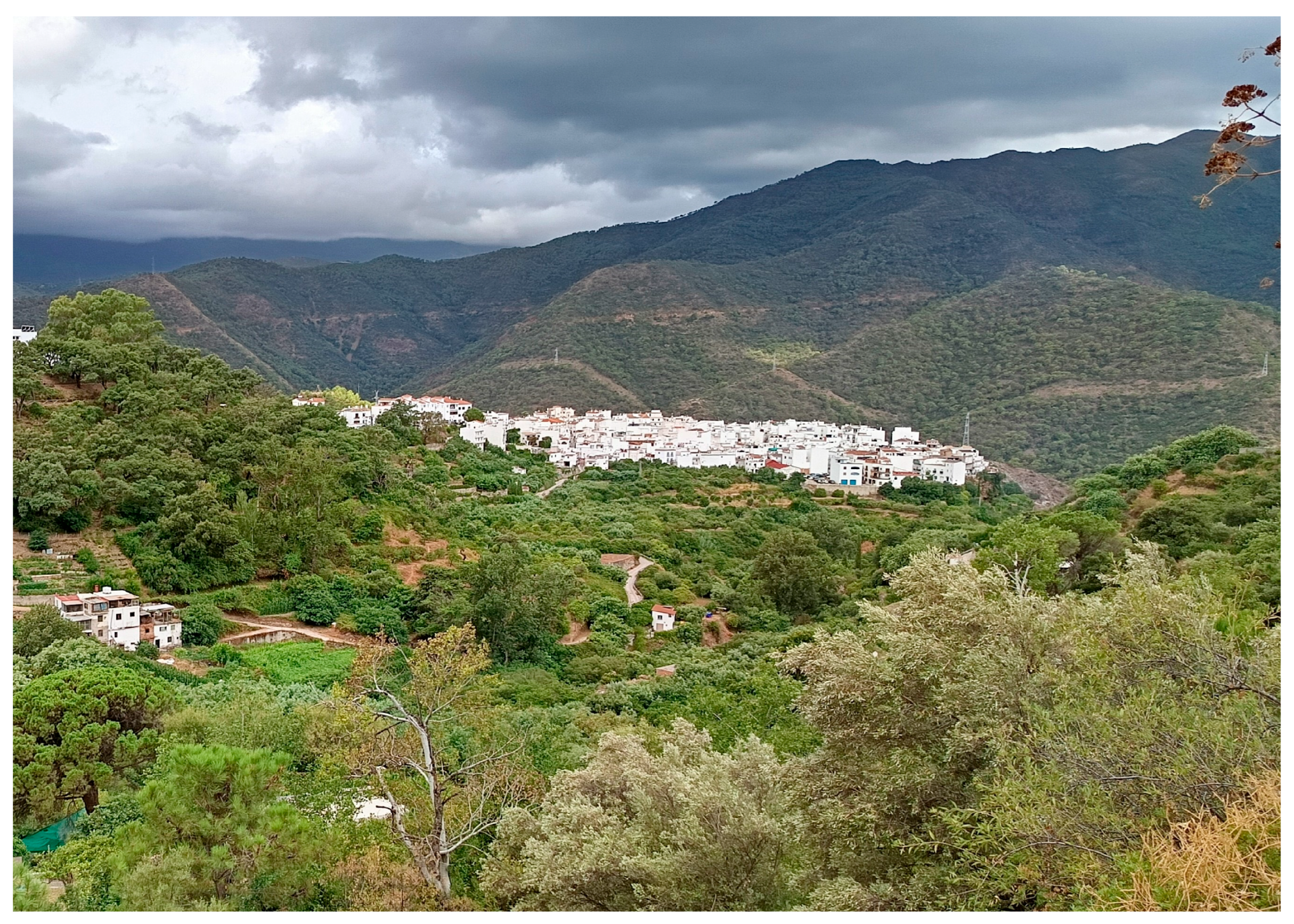
These municipalities (Figure 2, Figure 3 and Figure 4), characterized by their mountainous setting due to their location on the piedmont yet close to the coast—the distance from the urban centers of Ojén and Istán to the shoreline is only 10 and 15 km, respectively—have historically depended on agricultural activities. However, these activities have undergone significant abandonment as a result of the socio-economic shift in the Costa del Sol toward mass sun-and-beach tourism in recent decades. Today, this is one of the most dynamic coastal areas in Spain, with recognized urban centers such as Marbella, within whose sphere of influence the aforementioned municipalities are located.
The intermediate position of Benahavís, Istán, and Ojén between the mountains and the sea explains their physical, socio-economic and cultural characteristics throughout history and today. This is primarily due to their location on the piedmont of the Sierra de las Nieves, which shelters these municipalities from northern winds, creating particular climatic conditions similar to those of the rest of the Andalusian Mediterranean coast between Algeciras (Cádiz) and Almería.
This climatic protection, together with other positive features of the mountains (such as water storage and serving as a refuge in past times) and certain negative aspects (such as difficult internal mobility), constitutes the origin of “the specificity of Mediterranean Andalusia” [16]. The effort to exploit these highly favorable climatic conditions gave rise to characteristic agricultural landscapes, where successive societies overcame obstacles such as steep slopes and marginal spaces from a productive standpoint. This long-standing agricultural culture fostered the development of smallholding social models [16], contrasting with the traditional conception of Andalusia as a region of large estates and major landowners. Here, land has historically been distributed among many, which is another defining feature of these landscapes. In addition to the mentioned physical conditions, the small size of farms and the disorganized and scattered parcel structure further characterize this territorial specificity.
All these elements and factors, among others, broadly explain the traditional agricultural system in the area and also help to understand the progressive abandonment of this activity in recent decades, as analyzed later. Historically, this activity was characterized by vineyards, citrus groves, and olive trees as its most representative crops, along with flax fields, chestnut, walnut, and mulberry trees—for silk production—on a smaller scale, in addition to traditional subsistence orchards located near urban centers. From an economic perspective, traditional agriculture in Benahavís, Istán and Ojén combined subsistence-oriented production in small orchards near the villages with market-oriented sales of olives, almonds, wine and raisins. Vegetable gardens and part of the fruit crops located around the settlements were primarily destined for household consumption, while surplus production of tree crops and livestock products was regularly channelled through local and regional markets, especially in Marbella and Málaga, integrating these mountain areas into wider commercial circuits [16,17]. Although the three municipalities never achieved full food self-sufficiency and imported cereals and other staples from neighbouring agrarian districts, the progressive loss of local production has increased their structural dependence on external food supplies, in line with broader trends documented for the Western Costa del Sol [17].
From a demographic perspective, the decline in agricultural activity, although initially causing a slight population decrease, did not lead to the collapse of traditional settlement patterns, which in recent years have experienced a resurgence driven by coastal tourism development. Employment in the thriving Costa del Sol tourism sector, along with the arrival of numerous residents from Central and Northern Europe—retirees with considerable purchasing power seeking to spend their retirement years in Málaga—largely explains the demographic expansion experienced by these inland municipalities in recent decades, despite the collapse of their former socio-economic model and the initial impact of tourism on their territorial structures.
In many Mediterranean mountain areas, agricultural abandonment has been closely linked to pronounced rural depopulation, with declining birth rates and the out-migration of younger cohorts acting as primary drivers of land-use change. In the case of Benahavís, Istán and Ojén, demographic trajectories show a more complex pattern. Population figures remained relatively stable or only mildly declining during the late twentieth century and have grown significantly in recent decades, particularly in Benahavís, as a result of tourism-related employment and the arrival of new residents. Rather than a sharp demographic collapse, the key processes have been the ageing of the local farming population and the occupational shift in younger generations away from agriculture towards the tourism and service sectors of the Costa del Sol. These dynamics progressively reduced the availability of family labour and weakened farm succession, thereby acting as a significant underlying driver of agricultural abandonment, especially in Istán and Ojén. In Benahavís, by contrast, the direct conversion of agricultural land into residential and tourism uses linked to the coastal conurbation has played an even more decisive role than demographic decline per se.
Demographic and economic processes are strongly conditioned by the proximity of these municipalities to the coast, which has enabled population retention, although increasingly in non-agrarian activities.
While population levels remained relatively stable during the late twentieth century, with slight declines in some years, recent decades have seen continuous growth, with extraordinary increases during certain periods—“The town in Málaga that has almost quadrupled its population in the last 20 years” [18] (https://www.elespanol.com/malaga/20231227/pueblo-malaga-multiplica-poblacion-ultimos-anos/820168374_0.html, accessed on 18 May 2025). The population of Benahavís has grown from 2401 people in 2003 to 9244 in 2023, representing an increase of 285%, the highest recorded in the entire province of Málaga over the past two decades. In 1980, Benahavís had 1276 inhabitants, Istán 1556 and Ojén 2023. At the beginning of the century, in 2000, these municipalities had populations of 2079 (Benahavís), 1348 (Istán) and 2048 (Ojén), respectively. Currently, Benahavís has 9244 inhabitants, Istán 1621 and Ojén 4480—official population figures as of 1 January 2023, in accordance with the Local Government Act (Article 17) [19]. Taken together, the trajectories indicate that the progressive abandonment of traditional agricultural activities in these hinterland slopes has had a more significant impact on landscape and territorial configuration than on aggregate demographic trends, although deep social, economic and cultural changes have indeed occurred.

2.1.2. The Progressive Abandonment of Traditional Agricultural Landscapes in the Sierra de las Nieves—Costa del Sol Transition Zone

As previously noted, the abandonment of traditional agricultural models in the study area dates back several decades, representing a process that numerous authors addressed in its initial stages and that continues to attract attention from various disciplines. Revisiting this process from its origins is useful for understanding the current condition and characteristics of these landscapes, recognizing that it is a phenomenon still underway, albeit evolving over recent decades.
Although other elements and factors—many inherent to the agricultural model—also play a role, the growth of coastal tourism explains the progressive abandonment of traditional agricultural landscapes, with Benahavís, Istán, and Ojén as illustrative examples. In the 1980s, Mignon analyzed the origins and consequences of the collapse of slope-based systems, which ultimately affected the historical articulation between the coast and the interior, an idea later corroborated by Ocaña-Ocaña and Gómez-Moreno [20]. The decline in the importance of agriculture has disrupted traditional patterns of interaction between society and its territory.
The development of tourism has been accompanied by the inherent characteristics of the traditional agricultural model and its evolution, all of which have contributed to the decline in the significance of this activity. Among these factors, the following can be highlighted:
-
The difficulty in modernizing an agricultural system generated minimal profits. Investment was redirected toward tourism, as it represented an activity with greater and more immediate profitability.
-
The near impossibility of mechanization due to the challenging conditions of the physical environment characterized by steep slopes. The introduction of machinery for land management or crop harvesting was virtually unfeasible, limiting operations to animal labor and manual collection.
-
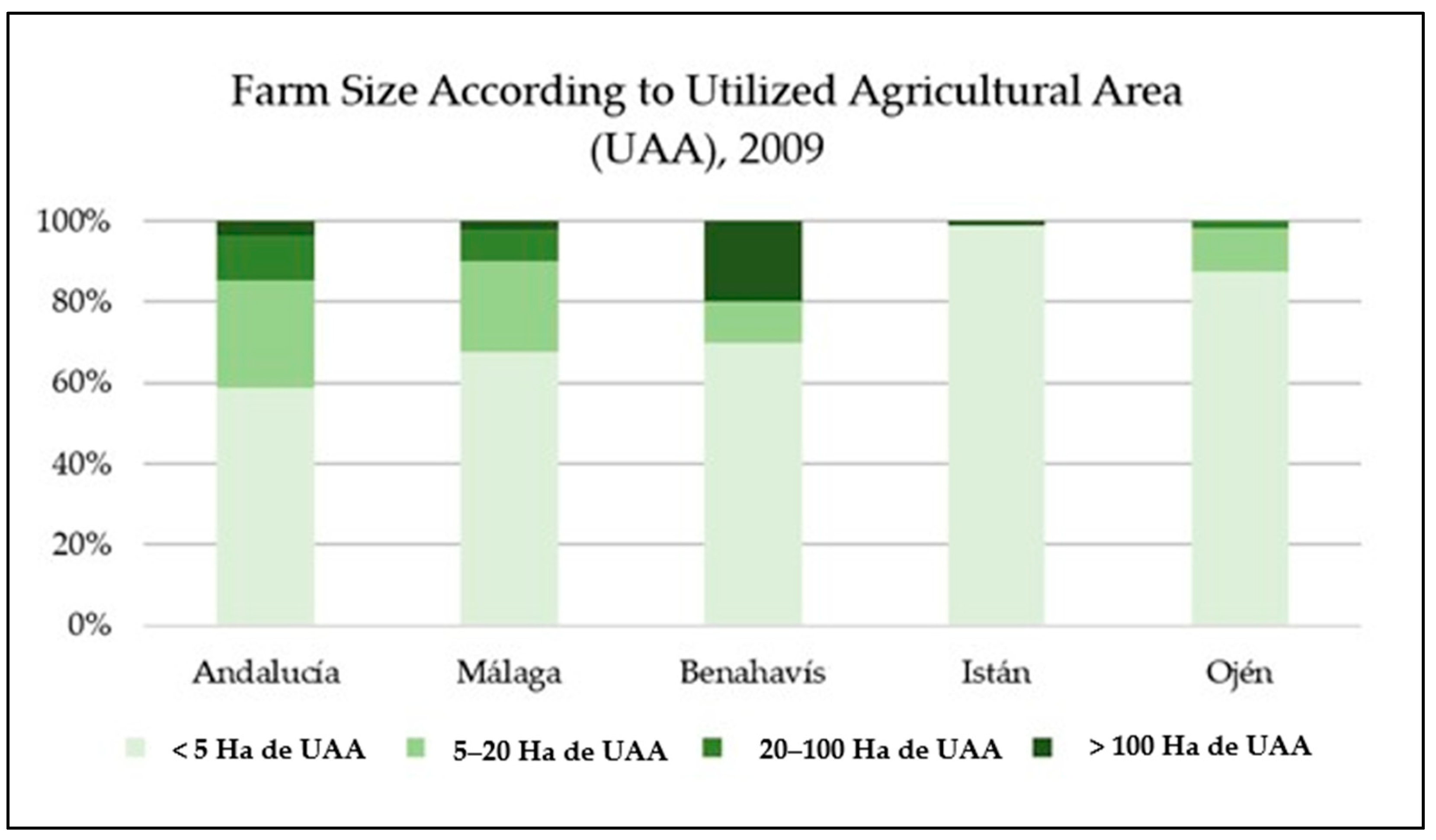
The traditional smallholding culture, with farms of very limited size (Figure 5), and above all, the fragmentation and disorganization of plots inherited from historical land occupation models.
-
The progressively declining profitability of agricultural production, either due to competition from other regions where production and commercialization occurred under more favorable conditions, or because of the extensive nature of local farms, which lacked the capacity for large-scale production.
This scenario has created an adverse context for historical crops, which has been exploited by emerging activities. It is a context that has led to the gradual, sustained, and irreversible abandonment of these landscapes—now reduced to remnants of an activity that was once far more prosperous. The visual and scenic consequences of this abandonment entail numerous negative implications for the territory and its society.
Consequently, tourism occupies a pivotal position within the study area, coexisting with traditional agricultural systems that have been relegated to an insignificant and highly fragile status. Beyond the social and economic consequences introduced by these changes, the most relevant aspect for this research is that the landscape associated with traditional agricultural activity has also been abandoned. The transformations observed in these landscapes conceal numerous and more significant implications, which are addressed below.

2.2. Methodology: Analysis Based on Land-Use Changes

The study’s methodology is based on a documentary analysis of case studies and relevant scientific literature, complemented by an examination of land-cover changes in the regions of interest. To this end, photointerpretation techniques using orthophotographs, fieldwork and historical analysis of forest fires, considering both their extent and severity, were employed. All photointerpretation and vector editing were performed in ArcGIS Pro 3.1, using projected data in ETRS89 / UTM zone 30N. Two reference years were considered, 1956 and 2025, corresponding respectively to the earliest available high-resolution aerial coverage and the most recent complete SIGPAC dataset.
The documentary analysis includes a review of academic sources, institutional reports and historical data related to land use and the evolution of agricultural activities in the studied areas. This body of information provides the necessary context for understanding territorial changes and linking them to the socioeconomic transformations of rural environments.
The comparative study of land cover was carried out through the photointerpretation of historical and current orthophotographs, with the aim of assessing how the abandonment of agricultural activities has influenced landscape transformation and its resilience to forest fires and other adverse climatic phenomena. The diachronic comparison of orthophotographs enables a dual analysis: on the one hand, a quantitative spatial analysis, measuring changes based on occupied surface area as the reference unit; on the other hand, a qualitative analysis, allowing the approximate identification of transformations in crop types, considering their structure and morphology.
For both dates, the analysis relied on a set of vector information layers derived from official cartography and photointerpretation. For the baseline situation (1956), vector cartography produced by the Regional Ministry of Environment and Spatial Planning of the Andalusian Government was employed and subsequently revised and enriched through direct reinterpretation of the corresponding aerial photography. In this case, georeferenced and orthorectified aerial photographs from the 1956–1957 American Flight B series (approximate scale 1:33,000; ground resolution c. 1–2 m), provided by the Spanish National Geographic Institute (Instituto Geográfico Nacional, IGN) through the National Centre for Geographic Information (Centro Nacional de Información Geográfica, CNIG) download centre [22], were used; their georeferencing accuracy was visually checked.
For the current situation, land-cover information was primarily derived from the CORINE Land Cover project [23], complemented by updated data from the Geographic Information System for Agricultural Parcels (SIGPAC) for the year 2025 and by the most recent orthophotography available under the National Plan for Aerial Orthophotography (PNOA). CORINE Land Cover was used to provide a consistent regional framework and to cross-check the main land-cover transitions (agriculture–forest–urban) at approximately 1:100,000 scale, whereas the detailed crop-type classification and parcel-scale analysis relied on SIGPAC and orthophotographs, which offer complete coverage of the study area.
Parcel boundaries and crop types were digitised by on-screen photointerpretation, complemented by extensive fieldwork in the three municipalities. Homogeneous land parcels were identified on the basis of canopy structure, texture and plot configuration observed in the orthophotographs, and subsequently refined and validated in situ. Fieldwork was not limited to a small control sample but involved repeated visits covering all major crop types and systematically checking on the ground all parcels whose interpretation from imagery was uncertain (e.g., mixed orchards, young plantations, recent changes in irrigation systems or understorey management). Photointerpretation followed a common protocol applied consistently by the authors; doubtful or borderline cases were jointly reviewed and, where possible, verified in the field in order to maximise diachronic classification consistency. The resulting vector layers constitute the spatial basis for the comparison presented in Section 3.
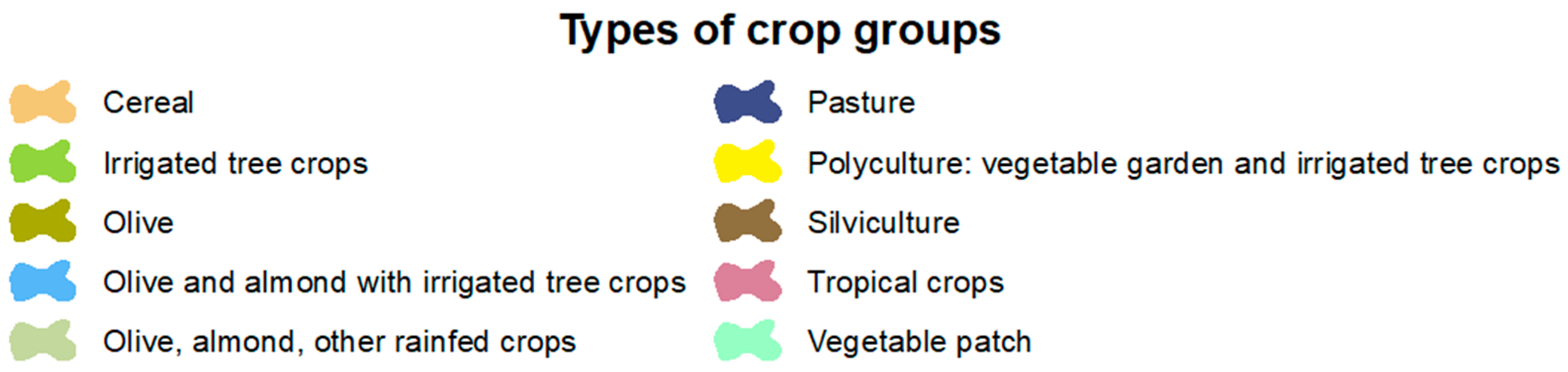
The following crop types were distinguished: (i) olive, (ii) olive, almond and other dryland crops; (iii) olive and almond with irrigated tree crops (citrus and tropical fruits); (iv) polyculture combining vegetable garden and irrigated tree crops (tropical fruits, citrus and other fruit trees); (v) irrigated tree crops (tropical fruits and citrus); (vi) tropical fruits; (vii) vegetable garden; (viii) pasture; (ix) cereal; (x) silviculture. This typology takes the official SIGPAC legend as its main reference but reorganises and refines several classes—especially those related to subtropical crops and irrigated polycultures—in order to obtain a more expressive and informative framework for analysing water demand, structural complexity and the provision of ecosystem services. Definitions and thresholds were refined through fieldwork. Although the combination of CORINE Land Cover, SIGPAC, the Agrarian Census and historical orthophotographs provides a robust basis for analysing land-use dynamics, each source entails specific limitations that condition the level of detail and certainty of the results. CORINE operates with a minimum mapping unit of 25 ha and a relatively coarse legend, which makes it unsuitable for capturing micro-scale changes in crop types and small agroforestry mosaics; in this study it is therefore used only to identify regional trends. By contrast, SIGPAC offers parcel-level detail but is partly biased towards CAP-subsidised farms, underrepresents very smallholdings and non-subsidised plots, and may lag behind rapid changes in land use in highly dynamic areas such as the Western Costa del Sol. Agrarian Census data provide only aggregated information that cannot be fully reconciled with the spatial units used here. Finally, the diachronic land-use reconstruction relies on manual photointerpretation and field verification. This approach favours internal consistency through time but, in the absence of an independent reference dataset, does not allow a rigorous, quantitative estimation of classification accuracy; uncertainties are expected to be higher for mixed-use and transitional parcels than for clearly defined crop types.
In order to quantify the relative weight of exclusive residential enclaves within the urban fabric, a specific GIS overlay analysis was carried out for the year 2025. High-end gated developments in each municipality were identified on the basis of planning documents, cadastral information and fieldwork. Consolidated urban land was then subdivided into two categories: (i) ordinary urban areas (village cores and non-gated residential expansions); (ii) exclusive gated enclaves. Dispersed dwellings and scattered constructions embedded within agricultural or natural land were not included in the calculation of consolidated urban area. For each municipality, the surface of exclusive gated developments and the total consolidated urban area were computed in the GIS and are reported in aggregate form in Section 3.
In addition to cartographic and statistical sources, a qualitative component was incorporated through non-structured interviews with long-standing residents in the three municipalities. These interviews were conducted during fieldwork, followed an open-ended conversational format and were not audio-recorded; instead, contemporaneous field notes were taken to register the most relevant information. The conversations focused on memories of traditional agricultural practices, perceived changes in land use and landscape appearance, and the perceived erosion of local knowledge and identity. Although this material does not constitute a statistically representative survey, it provides empirically grounded insights that help to contextualise and interpret the evolution of cultural ecosystem services discussed in Section 3.2.

3. Results

The results describe the main transformations of traditional agricultural landscapes in the study area, starting with the structure of the agrarian parcel system and continuing with the evolution of crops, land-use changes, and their landscape and ecological implications.

3.1. Characterization of the Ager and Its Evolution
In this subsection, the term “plots” refers to the agricultural parcels recorded in the 2025 SIGPAC (Geographic Information System for Agricultural Parcels). SIGPAC is constructed on the basis of the official cadastral parcel fabric but reorganises it into agricultural parcels specifically defined for the management of Common Agricultural Policy (CAP) subsidies, so that these units do not correspond exactly, on a one-to-one basis, to cadastral plots. In the present analysis, SIGPAC is employed solely to characterise the current parcel structure and the degree of agricultural use in 2025 (Table 1).
Conversely, the diachronic land-use and crop-type changes discussed later in this section (Table 2 and Figure 6, Figure 7, Figure 8 and Figure 9) are derived from independent land-use polygons obtained through photointerpretation of the 1956 and 2025 orthophotographs, as detailed in Section 2.2. The comparison among the three municipalities highlights the coexistence of highly contrasting agricultural models within a transitional area between the Sierra de las Nieves and the coastal strip of the Costa del Sol. While Benahavís is characterized by a high concentration of land—comprising only 52 plots with an average size of 26.2 hectares, a figure influenced by the presence of several large estates (over 1000 hectares), often dedicated to uses not strictly agricultural. The strong divergence between the mean (26.2 ha) and the median parcel size (1.2 ha; Table 1) further illustrates this highly asymmetric structure and the concentration of land in a small number of very large estates. In Istán and, particularly, in Ojén, a marked fragmentation of land ownership is observed. In these latter two municipalities, the number of plots is significantly higher (1017 and 1955, respectively), with much smaller average sizes (2.3 ha in Istán and barely 1.1 ha in Ojén). In both cases, mean and median parcel sizes are also much closer to each other (2.3 vs. 0.2 ha in Istán and 1.1 vs. 0.2 ha in Ojén), which is consistent with a predominantly smallholding parcel structure and a much less concentrated distribution of land ownership than in Benahavís.
When considering the percentage of effectively cultivated area relative to the total agricultural land parcel structure, the differences become even more pronounced: in Benahavís, only 3% of the average surface area is allocated to agricultural uses, compared to 19.9% in Istán and 33.2% in Ojén. This figure suggests that, despite the larger plot sizes in Benahavís, a substantial portion of the land remains underutilized or devoted to other purposes (forestry, urban development, or recreational uses—particularly golf courses), whereas in Istán and, especially, in Ojén, the agricultural utilization of plots is far more intensive and representative.
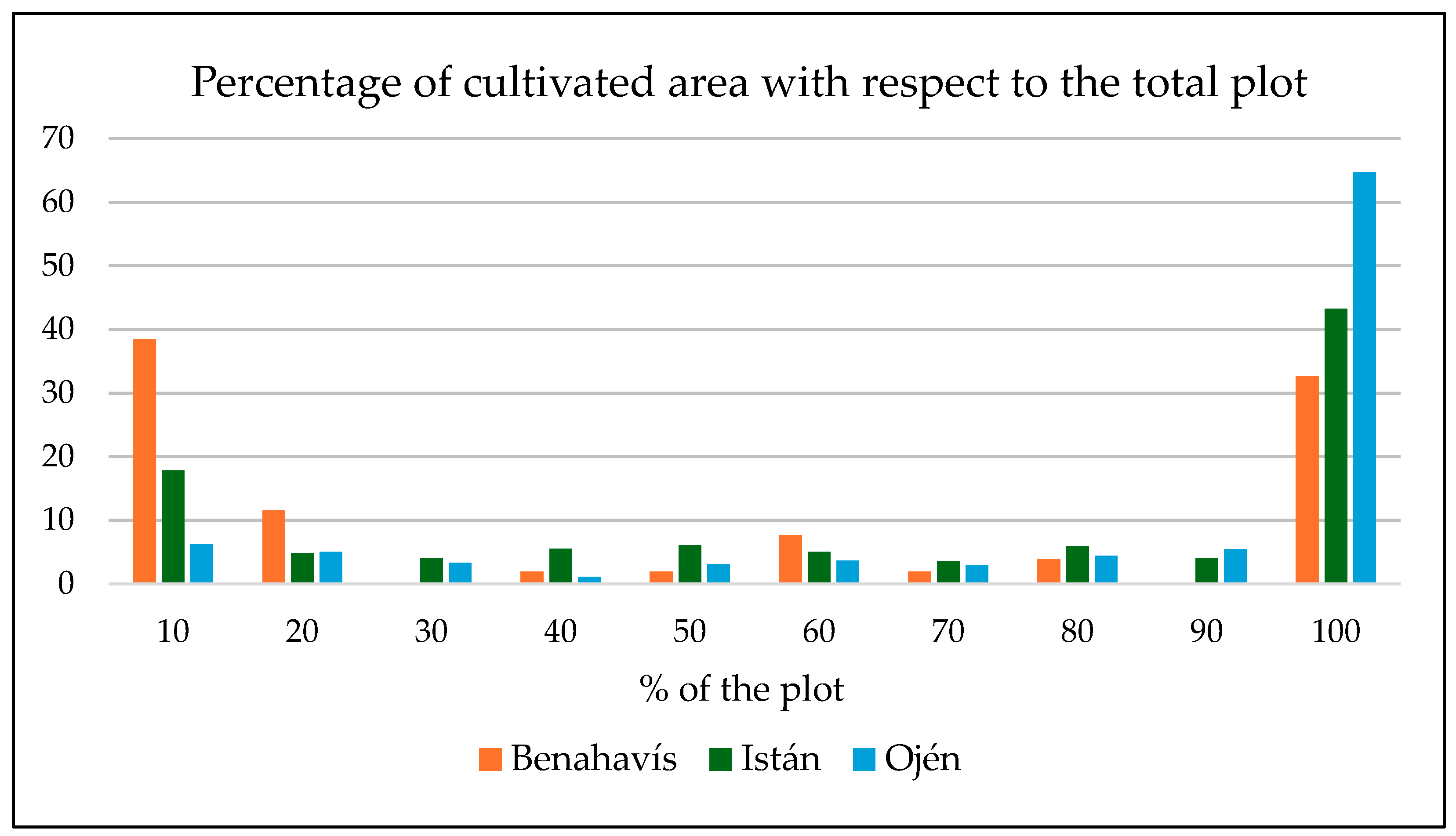
The distribution of plots according to the percentage of land devoted to agricultural activity reveals differentiated dynamics among the municipalities studied, as shown in Figure 6. In Benahavís, the pattern is markedly polarized: nearly 40% of the plots allocate barely 10% of their surface to agriculture, while 32.7% are entirely dedicated to it.
In Istán, although full dedication (100%) also predominates (43.3%), there is a greater presence of farms with intermediate uses, reflecting a more diverse mosaic. In contrast, Ojén exhibits clear specialization, with almost two-thirds of the plots (64.8%) fully agricultural. This higher share of actively cultivated land is consistent with its predominantly smallholding parcel structure, its more limited direct exposure to the coastal real-estate market and the persistence of local farming networks, which have continued to operate even as tourism and residential functions expanded along the coast. These results underscore that, in this transitional zone between the Sierra de las Nieves and the Costa del Sol, the agrarian landscape is shaped by the coexistence of traditional farms fully dedicated to agriculture alongside others with partial or mixed uses.
This combination helps maintain the spatial and functional heterogeneity of the territory—a key feature for strengthening climate resilience (by diversifying crops, practices, and uses) and preserving the cultural and environmental values of traditional agricultural landscapes in the context of increasing urban and tourism pressure. At the spatial level, profound changes can be observed, particularly regarding the types of crops that currently predominate (Table 2). In general, rainfed crops (olive groves, almond trees, and cereals) have experienced a sharp decline in their surface area. In Benahavís, for example, the area devoted to olive groves in 1956 was 141.7 ha, compared to just 4.2 ha today.
Except for Istán, the process in Ojén has been very similar, with 93.4 ha currently dedicated to olive groves, whereas in the mid-20th century the figure was nearly 260 ha. As for the mix of olive and almond trees with other rainfed crops, all municipalities have undergone a significant reduction according to the data in the previous table. For instance, in Istán, of the more than 500 ha dedicated to these crops in the 1950s, only slightly more than 25 ha remain today; 32 ha in the case of Ojén, compared to 403 ha recorded in that period. Cereals, for their part, have practically disappeared.
The evolution of polyculture—also representative of traditional agricultural landscapes, consisting mainly of vegetable gardens with fruit trees for self-consumption located around population centers—has followed a similar trend, becoming almost anecdotal today in Benahavís.
Conversely, irrigated crops have expanded within the study area, not reaching the surface areas once occupied by almond or olive groves, but enough to affirm that these crops are currently the most representative of agricultural activity and its landscapes here. In Ojén, for example, the association of olive and almond trees with irrigated tree crops (citrus and tropical species) occupies the largest area in the municipality, with 253 ha.
No other crop association today reaches these figures across the entire study area, even more so when adding the 42.2 ha devoted to irrigated tree crops or the 4 ha of irrigated land. In Benahavís and Istán, these irrigated crops—absent from the 1956 analyses—are now present, although far less extensively than in Ojén.
Consequently, based on all these quantitative data, the trend of agricultural activity in the study area over recent decades is clear: alongside the drastic reduction in the surface area devoted to traditional rainfed crops—especially olive and almond trees—the land currently cultivated is clearly oriented toward irrigated fruit production, with a marked expansion of subtropical species (primarily avocado and mango) and citrus, as well as a conversion of olive groves into irrigated crops.
The following section presents the legend of the cartography (Figure 7), followed by comparative maps showing the distribution of crops between 1956 and 2025 for the three municipalities, along with their corresponding analyses.
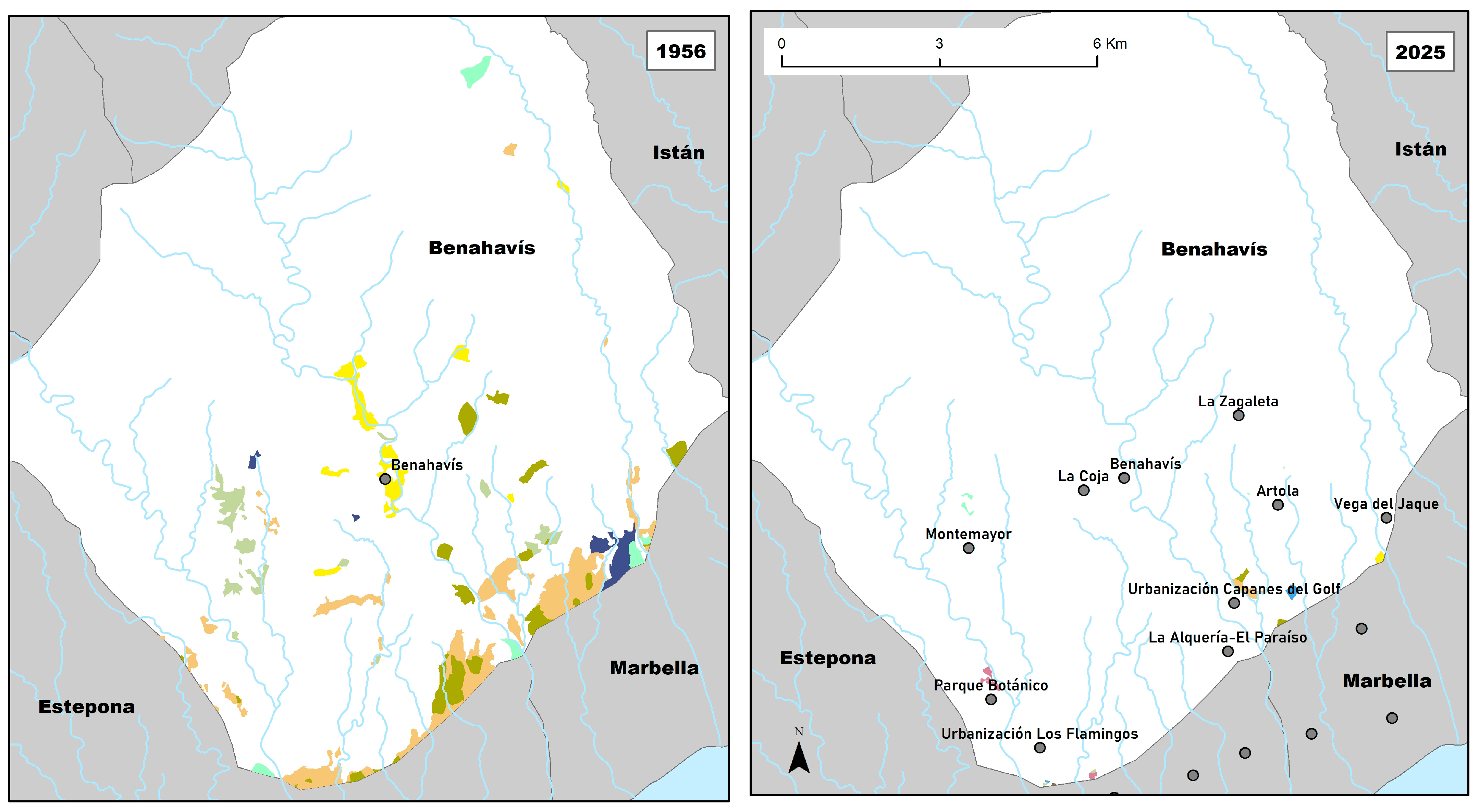
In the case of Benahavís (Figure 8), a profound functional transformation of the municipality is evident, particularly in its most fertile southern area, bordering the municipalities of Marbella and Estepona, which has lost its agricultural function. The expansion of the Costa del Sol conurbation has led to the urbanization of this entire zone, now predominantly residential in character. Among all the municipalities, Benahavís is where the abandonment of agricultural land—and especially its “artificialization” driven by residential expansion—is most evident. Most of this new urban and tourism fabric occupies parcels that were still under agricultural use in 1956, especially dryland crops and orchards located on the most fertile valley bottoms and gentle piedmont slopes.
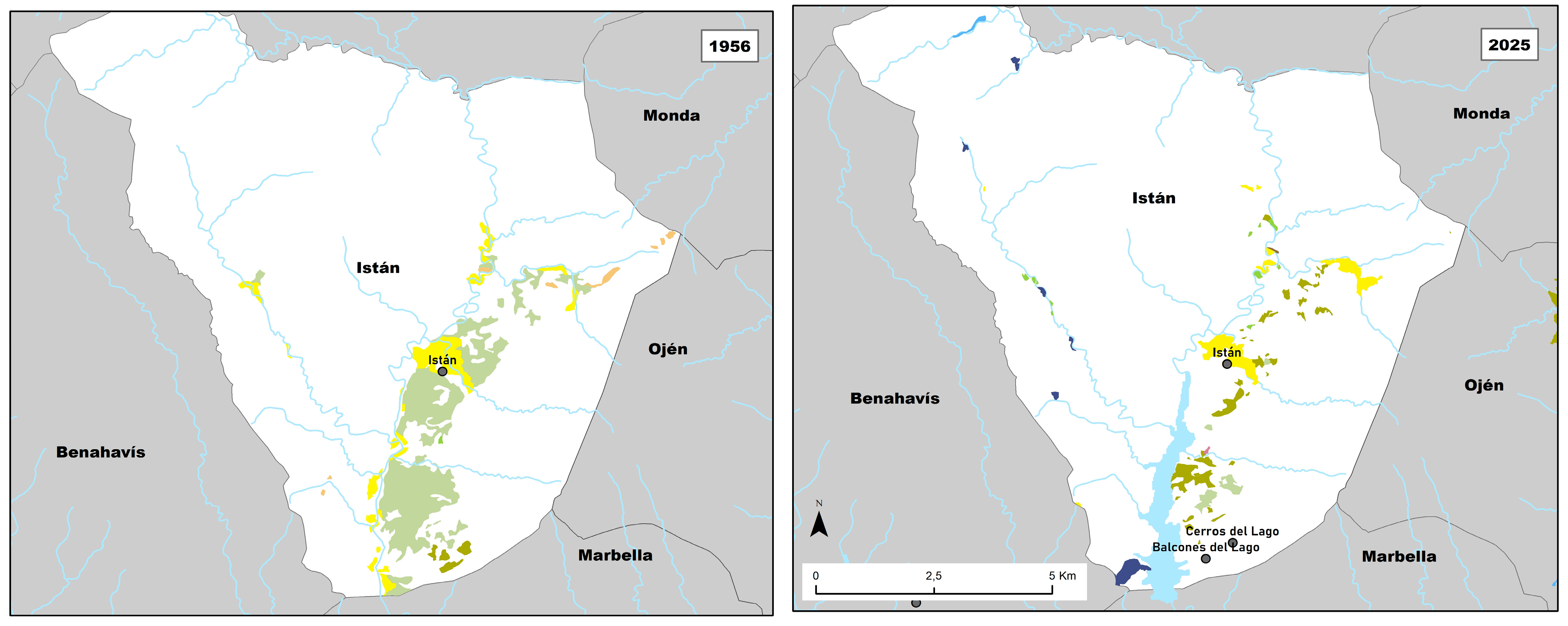
Istán has maintained a close connection with agricultural activity (Figure 9). This is reflected not only in the extent of land devoted to farming but also in the lesser transformation of crop types. Traditional polyculture areas have largely been preserved, while in the extensive rainfed zones—particularly in the southern half, on the left bank of the Verde River—which previously included olive groves, almond trees, and other species such as carob, a transition toward irrigated olive monocultures has taken place. Meanwhile, polyculture and orchard areas increasingly feature tropical crops such as avocado, mango, or cherimoya, to the detriment of citrus.
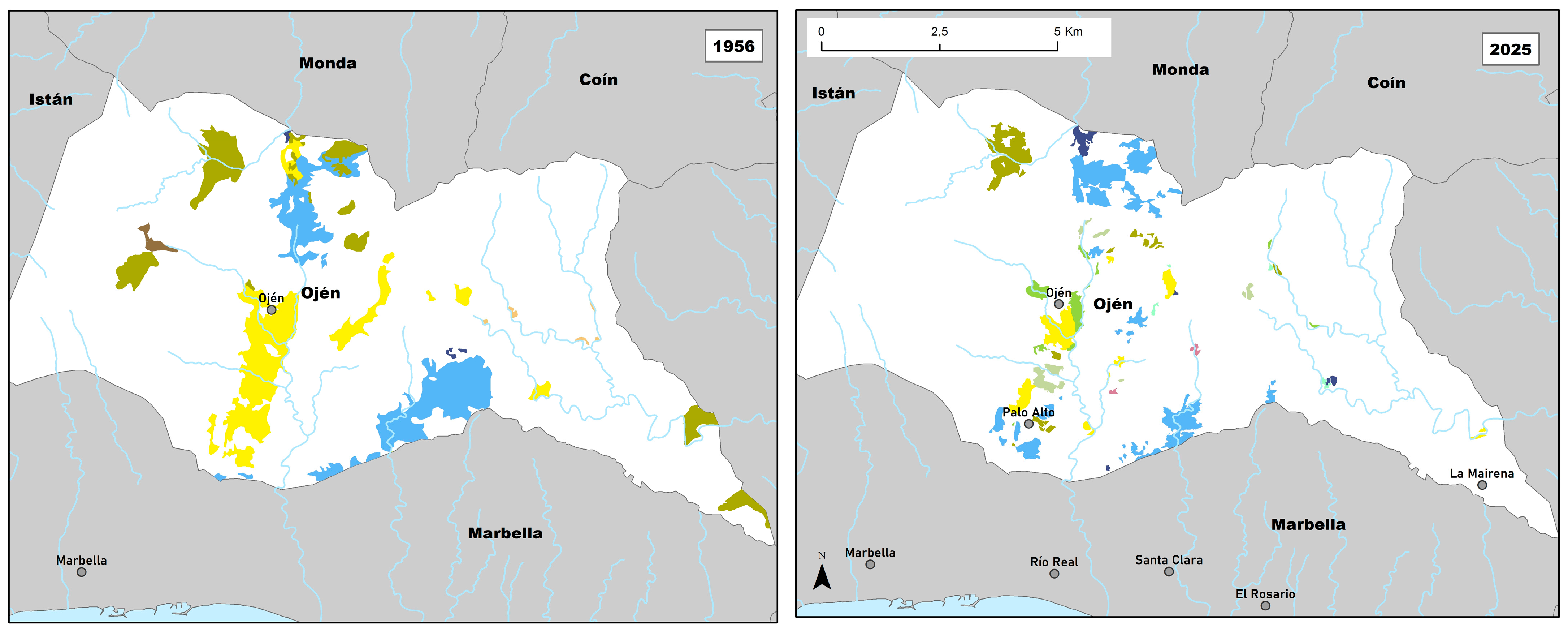
In Ojén, the western mountainous area has practically lost all agricultural activity, becoming abandoned and repurposed for recreational use as a natural space (Figure 10). In the central zone, where the main population center is located, agriculture has gradually lost ground to successive rings of urban expansion. As in Istán, the peri-urban orchards linked to local supply are shifting toward tropical tree crops, although citrus and other fruit trees, such as pomegranate, still persist. The eastern area has virtually lost all its agricultural function, now consisting of scattered small polyculture farms accompanied by a few heads of mixed livestock.
All cases share a common pattern, with cultivated spaces becoming more fragmented and exhibiting greater edge complexity, as their contours are increasingly irregular. This is the result of agriculture playing an increasingly secondary role, combined with a greater fragmentation of agricultural holdings. In spatial terms, tourism and residential developments have expanded mainly over parcels that were under agricultural use in 1956, generally following a gradual trajectory in which many plots first underwent abandonment and partial renaturalisation before being reclassified and built up. As the most suitable and accessible agricultural land has been progressively urbanised, new projects have increasingly extended onto steeper and less agronomically favourable slopes, which are nevertheless highly valued for their wide views towards the coast. The data in Table 3 reveal a sharp decline in agricultural land across the entire study area, amounting to 68% between 1956 and 2025. This process shows very different intensities depending on the municipality. Benahavís records the highest reduction, with a loss of 95.3% of its original agricultural surface. In Istán, the loss reaches 64.9%, while in Ojén it is somewhat lower, at 52.1%.
Figure 7. Crop types in the study area. Source: own elaboration.
Geographies 05 00078 g007
Figure 8. Comparison of crop types in Benahavís between 1956 and 2025. Source: own elaboration.
Geographies 05 00078 g008
Figure 9. Comparison of crop types in Istán between 1956 and 2025. Source: own elaboration.
Geographies 05 00078 g009
Figure 10. Comparison of crop types in Ojén between 1956 and 2025. Source: own elaboration.
Geographies 05 00078 g010
Table 3. Loss of agricultural land in the study area during the period 1956–2025. Source: own elaboration.
BenahavísIstánOjénTotal Study Area
% of agricultural land lost95.364.952.168.0
% of agricultural land converted to urban use62.22.64.020.2
% of agricultural land that has undergone renaturalization34.370.5 *59.852.8
* In the case of Istán, 14.2% of the agricultural land that was converted into natural areas between 1956 and 2025 corresponds to water zones, due to the construction of the La Concepción reservoir (source: own elaboration).
The conversion of agricultural land into urban areas also shows a strong spatial disparity. In Benahavís, 62.2% of the former agricultural land has been transformed into urban use, compared to very low percentages in Istán (2.6%) and Ojén (4.0%). Conversely, the process of renaturalization—understood as the transition from agricultural land to natural or forest vegetation—is predominant in Istán (70.5%) and Ojén (59.8%), while in Benahavís it accounts for 34.3%.
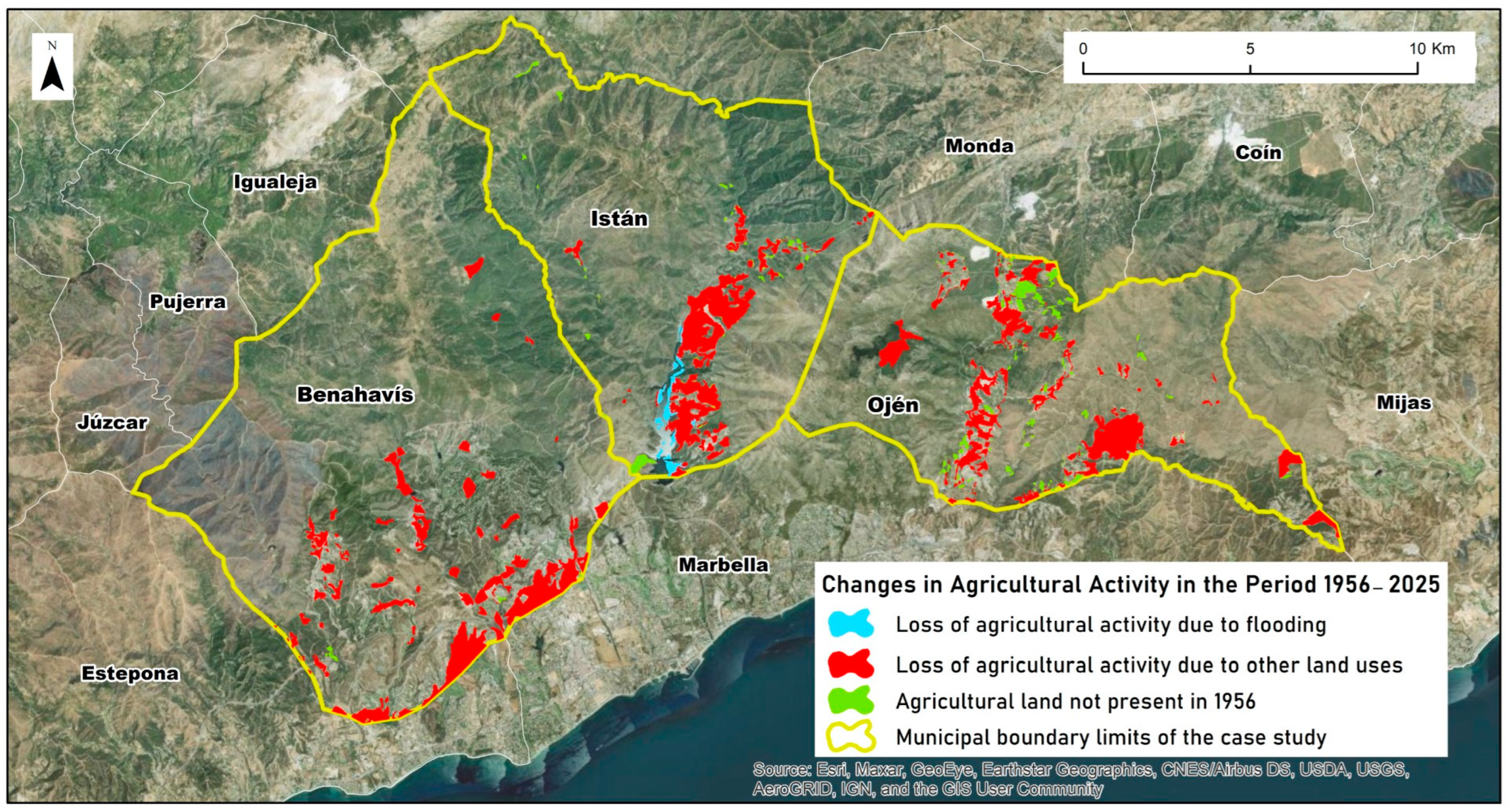
A spatial analysis, considering the specific characteristics of the three municipalities, helps explain these differences. Most of the scarce fertile lands in Benahavís are located at the boundary of its municipal area with Marbella. Therefore, given the urban expansion process on the Costa del Sol, with the neighboring municipality already saturated with urbanized land, its logical expansion has occurred in this zone (see Figure 11).
The other two municipalities have also undergone an urbanization process, although to a lesser extent. A functional shift in the economic activity of their residents has led to the abandonment of numerous cultivated plots, while areas that were previously used for grazing have continued through ecological succession, resulting in the development of scrubland. As shown in green, some spaces have been reclaimed from the saltus that existed in 1956.
A particular case is that of Istán, where 10.5% of its agricultural land—fertile sedimentary soils located on valley bottoms—was lost due to the construction of the Concepción reservoir dam in 1971. Figure 11 shows in blue the portion of this land that was submerged, as well as the remaining surface that has undergone a change in territorial function.

3.2. Alteration of the Landscape and Consequences of the Loss of Traditional Agricultural Landscapes

The landscape of the municipalities of Istán, Ojén, and Benahavís today stands as a visible testimony to the territorial transformations that have taken place over recent decades. The rural mountain landscape along the coast, once based on terraced slopes, irrigated orchards, olive groves, and networks of rural paths, is now a territory marked by the abandonment of agricultural uses and the emergence of scattered urban developments, along with a trend toward urban continuity driven by the expansive coastal conurbation of the Costa del Sol [25]. This transition has generated a profound alteration of the landscape, affecting not only the structure and morphology of the territory but also the perceptual experience of those who traverse it.
The disappearance of extensive areas devoted to dryland crops, predominantly olive and almond trees, has blurred the framework that once gave meaning to the landscape, transforming the former agroforestry mosaic into a more uniform surface dominated by Mediterranean scrub and reforested pine stands. Furthermore, the remaining crops have shifted toward monoculture models, often under irrigation.
On the slopes of the Blanca, Bermeja, and Alpujata ranges, dry farming was not a homogeneous monoculture but rather a mixed-use system in which tree alignments coexisted with rotational herbaceous crops—wheat, barley, oats—and legumes such as chickpeas, vetch, or dry beans, which enriched the soil and served as fodder for livestock [17,26]. Among the clearings, scattered vines were common, intended for raisin or wine production, along with isolated fig trees that provided fruit and shade during agricultural tasks [27]. Native shrubs and woody species such as wild olive, mastic, or broom were tolerated for firewood and fodder, completing a landscape of great visual and chromatic complexity.
According to the non-structured interviews conducted with long-standing residents during fieldwork, species such as the carob tree have seen their presence diminish, as they were closely linked to livestock feeding. This perception coincides with recent research [28], which notes that the loss of their productive function, combined with lack of maintenance and climate change (heat waves, droughts), jointly reduces regeneration and increases vulnerability to pests. The disappearance of this polyculture—combining tree, herbaceous and livestock production—has entailed the loss of a dynamic and highly legible agroforestry matrix [29], replaced by a more homogeneous plant cover, less diverse and with a reduced capacity to convey the cultural memory of the territory. The richness of textures, colours and volumes that characterised the traditional landscape has been replaced by a more monotonous image, with fewer chromatic contrasts. The relief, once perceived as stepped thanks to terraces and embankments, now appears visually flatter, and the dynamism provided by seasonal crop changes has vanished, leaving a landscape that is almost immutable throughout the year. These accounts are consistent with the qualitative evidence described in Section 2.2 and provide an empirical basis for the interpretation of cultural ecosystem services and the evolving sense of place in this area. In continuity with the above, irrigated orchards (vegetable gardens and citrus groves) have followed different trajectories: in Benahavís, the urbanization of valley bottoms and floodplains has led to the near disappearance of traditional irrigation systems, consistent with the territorial diagnosis that documents the intense urban-tourism transformation of this sub-area [29,30]. In Istán and Ojén, although residual enclaves persist, there is clear evidence of the retreat of the horticultural-citrus mosaic and its gradual replacement by subtropical fruit trees (avocado and mango), in line with the regional and provincial expansion of these crops in recent years [31,32]. From a landscape analysis perspective, this change reduces the legibility of the historical agrarian mosaic (loss of patterns, edges, sequences, and identity elements such as terraces and irrigation channels) and compromises the coherence of the whole, while impoverishing compositional and phenological diversity (a more uniform color palette and seasonal rhythms due to perennial cover) [29,30,33] and increasing fragmentation and the disruption of connectivity (visual, ecological, and the network of traditional paths) [29,34].
Operationally, it is advisable to objectify these transformations through landscape metrics (class richness, Shannon index, edge density, patch size/shape) [34,35] and viewshed analysis within the current methodological framework in Andalusia [29,36] while incorporating the hydromorphological dimension, given that the higher water demand of subtropical crops introduces pressures on irrigation systems with territorial and landscape effects recently documented in Málaga province (Axarquía) [31,32,37].
Landscape connectivity has also suffered a significant breakdown. The former rural roads and paths that structured the territory were not merely functional infrastructures, but backbone axes that connected productive spaces and settlements, allowing observers to traverse and experience the landscape continuously.
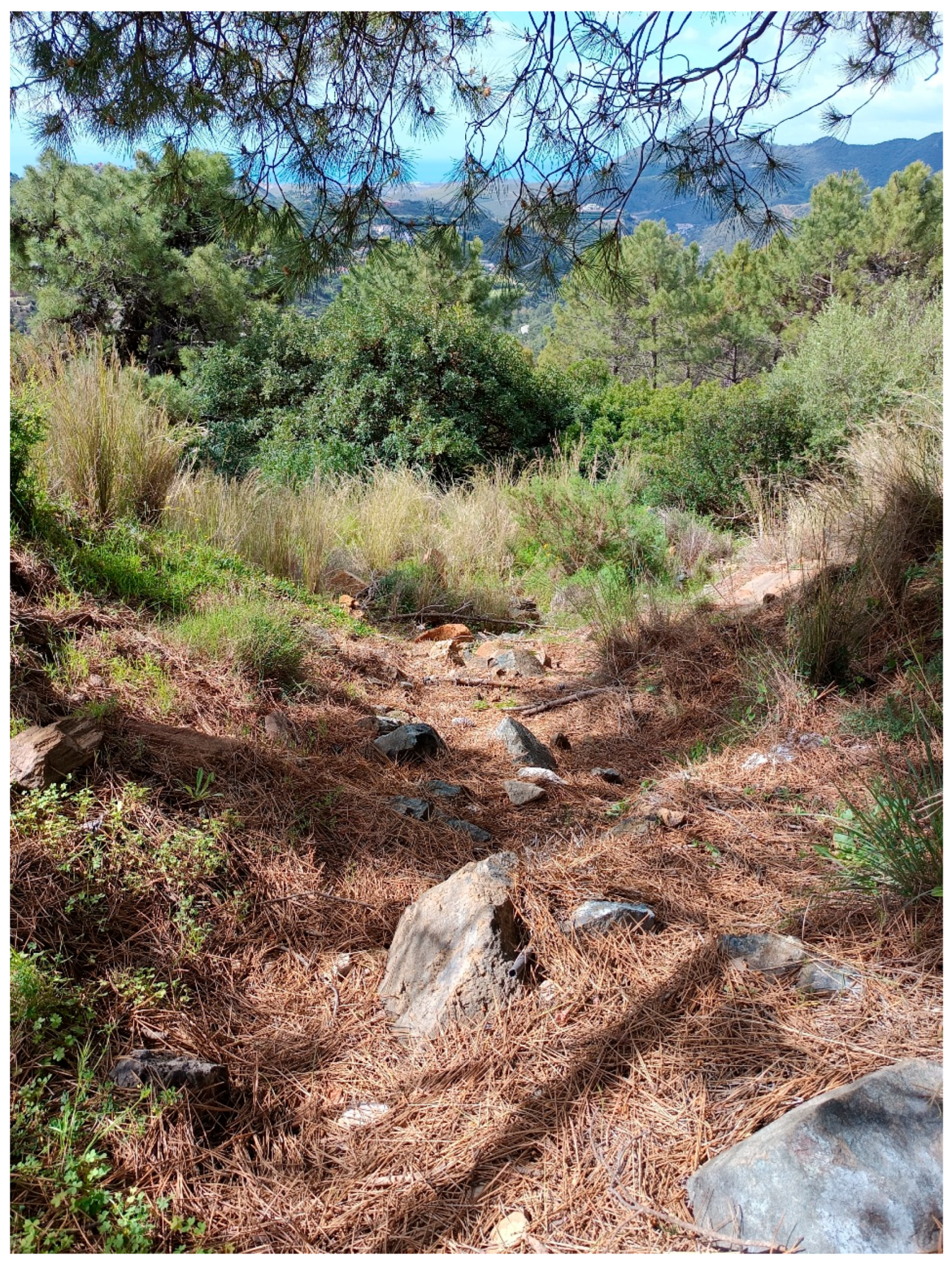
Their abandonment and gradual physical disappearance—often colonized by spontaneous vegetation—has erased these guiding threads, making the landscape less legible and harder to interpret, as the traces of the ways of life that used them have vanished. The visitor’s experience is now more fragmented, with fewer access points and viewpoints, limiting direct contact with the environment. An example shown in Figure 12 corresponds to an old path that once connected the Ronda road with several structuring elements of the territory: the Benahavís village, a sawmill, a sheepfold, and other minor settlements.
The expansion of housing developments over formerly agricultural land also introduces forms and materials that contrast with the character of the place [38]. Large-scale constructions with rigid geometries replace terraces and stepped fields that once adapted to slopes and reduced erosion, creating a much more visible presence on the hillsides. The white façades, the gray asphalt, and the new shades of ornamental green in gardens introduce a chromatic palette that breaks with the earthy and vegetative tones of the agrarian matrix. Likewise, these new buildings alter the perception of territorial scale: they stand out on the horizon and fragment views, closing panoramas that were once open and allowed a complete reading of the valley.
This visual impact is compounded by the growing privatization of the landscape, which adds a social and symbolic dimension to the transformation [39]. Spaces that were once communal or used for grazing have become restricted-access enclaves, reserved for a very small number of residents [40].
Examples can be found in all three municipalities: Palo Alto in Ojén, Sierra Blanca Country Club in Istán, and the case of La Zagaleta in the southeastern area of Benahavís, which is paradigmatic: this territory, which for generations served as pasture and livestock transit, has been transformed into one of the most exclusive luxury developments in Europe—closed and heavily guarded. In this way, a space that was part of the everyday environment of the local community has become a hermetic enclave, inaccessible to the local population despite occupying areas with exceptional visual basins. Thus, not only is a productive and cultural resource lost, but the community is also deprived of the experience of the landscape—by appropriating the best views and limiting their enjoyment to those who can afford it—creating fragmentation not only visual but also social, reinforcing the sense of disconnection between the territory and the community that once inhabited it. From a spatial point of view, the quantitative weight of these exclusive residential enclaves within the urban fabric is remarkable. In Benahavís, the eight gated developments identified occupy 1835.2 ha, which represents 71.5% of the municipality’s consolidated urban land (2568.4 ha). In Ojén, two high-end gated communities (Palo Alto and La Mairena) cover 142.7 ha, equivalent to 68.2% of the consolidated urban fabric (209.2 ha). Even in Istán, where the absolute extent of urban land is much smaller, the three exclusive enclaves identified add up to 22.5 ha, i.e. 41.6% of the consolidated urban area (54.1 ha). Although their physical morphology and market positioning vary, in all three municipalities a very large share of recent urban growth has been channelled through gated residential compounds rather than through the expansion of open, mixed-use village fabrics.
This progressive abandonment of traditional agricultural landscapes, whose perceptible consequences on the territory have been outlined, also entails a series of additional implications that, derived from these changes, are equally significant, although less evident visually. If agriculture has historically been the main agent of social, economic, and territorial structuring, the loss of agricultural functions modifies its relevance.
On the one hand, the loss of traditional agricultural uses implies the disappearance of both ecological and cultural services. On the other hand, its abandonment has led, in recent decades, to a significant increase in forest fires, both in burned surface area and in their intensity.
Linking cultural ecosystem services with the aforementioned privatization of the landscape—which fragments and disconnects the relationship between the territory and the community inhabiting it—the intangible assets associated with places and agro-systems, where these crops have developed for decades, also tend to disappear. These cultural ecosystem services include, among other elements, local knowledge derived from agricultural practices developed over centuries, which constitute a remarkable form of intangible heritage. Although cultural ecosystem services inherently involve a high degree of subjectivity in their perception and valuation by humans [41], the qualitative evidence gathered during fieldwork, together with the existing literature for similar Mediterranean rural contexts, suggests that the abandonment of traditional agriculture is accompanied by a gradual erosion of local knowledge, practices and identity markers. In this light, the weakening of this pillar of local identity can be regarded as a plausible and relevant consequence of land-use change, while its precise magnitude would nevertheless require dedicated social research based on systematic surveys and in-depth interviews that explicitly address generational turnover and the limited number of residents who have directly experienced the full temporal span (1956–2025) of the transformations analysed. The new forms of agriculture expanding across this hinterland of the Costa del Sol simplify and homogenize the landscape, fostering practices typical of commercial farming in which traditional techniques have little place. One of the pillars of local identity is therefore progressively lost, contributing to a weakening of the sense of belonging and the community’s ability to transmit its knowledge to future generations. Moreover, the abandonment of these lands also entails the loss of spaces that could be used for other purposes, such as environmental and heritage education or local development through activities like agritourism or ecotourism.
The disappearance of these cultural ecosystem services, in any case, implies a loss of intangible benefits that are difficult to measure—and even harder to recover [41]—and remains a topic scarcely addressed in academic literature despite its relevance in rural areas with a strong agricultural identity [42,43].
These everyday landscapes play a crucial role in people’s attachment to their territory, and it is precisely these landscapes to which populations tend to be most sensitive [44], as they foster stronger bonds and, consequently, greater commitment [45].
The abandonment and homogenization of these landscapes entail a loss of values [46]—a loss of inherited elements from traditional agro-systems with which the population identifies, as they represent the legacy of past generations and the expression of this territory’s particularities.
As for ecological ecosystem services—the benefits that the territory (and people) ultimately obtain from the structures and ecological processes created by living organisms [47]—the loss of traditional crops entails the disappearance of these structures. The characteristic mosaic of crops, present for decades and based mainly on dryland arboriculture and polyculture around urban nuclei, has gradually disappeared, especially in areas adjacent to residential growth near the coast. Land abandonment or the shift toward irrigated monoculture—primarily avocado—implies the loss of several key ecological services highlighted by Álvarez-Montoya, Pavón-Benítez & Sánchez-González [48], which affect:
-
Biodiversity, by reducing varied habitats for other wild species as agricultural landscapes become uniform.
-
Biological pest control, by undermining natural ecological balance due to reliance on pesticides typical of intensive, commercially oriented crops such as subtropicals.
-
Water resources and their regulation, as the surface area dedicated to crops like avocado—consuming enormous amounts of water—expands exponentially.
-
Soil conservation, through the use of fertilizers and amendments unnecessary for traditional agriculture and the loss of practices that prevented erosion.
If we add to all this the current climate crisis, the loss of traditional agriculture only exacerbates the sustainability and resilience of these landscapes and the populations that live in and depend on them, as they lose their foundational support. The significant decline in the provision of ecosystem services from traditional agrarian systems is evident [49]—and, in this context, irreversible.
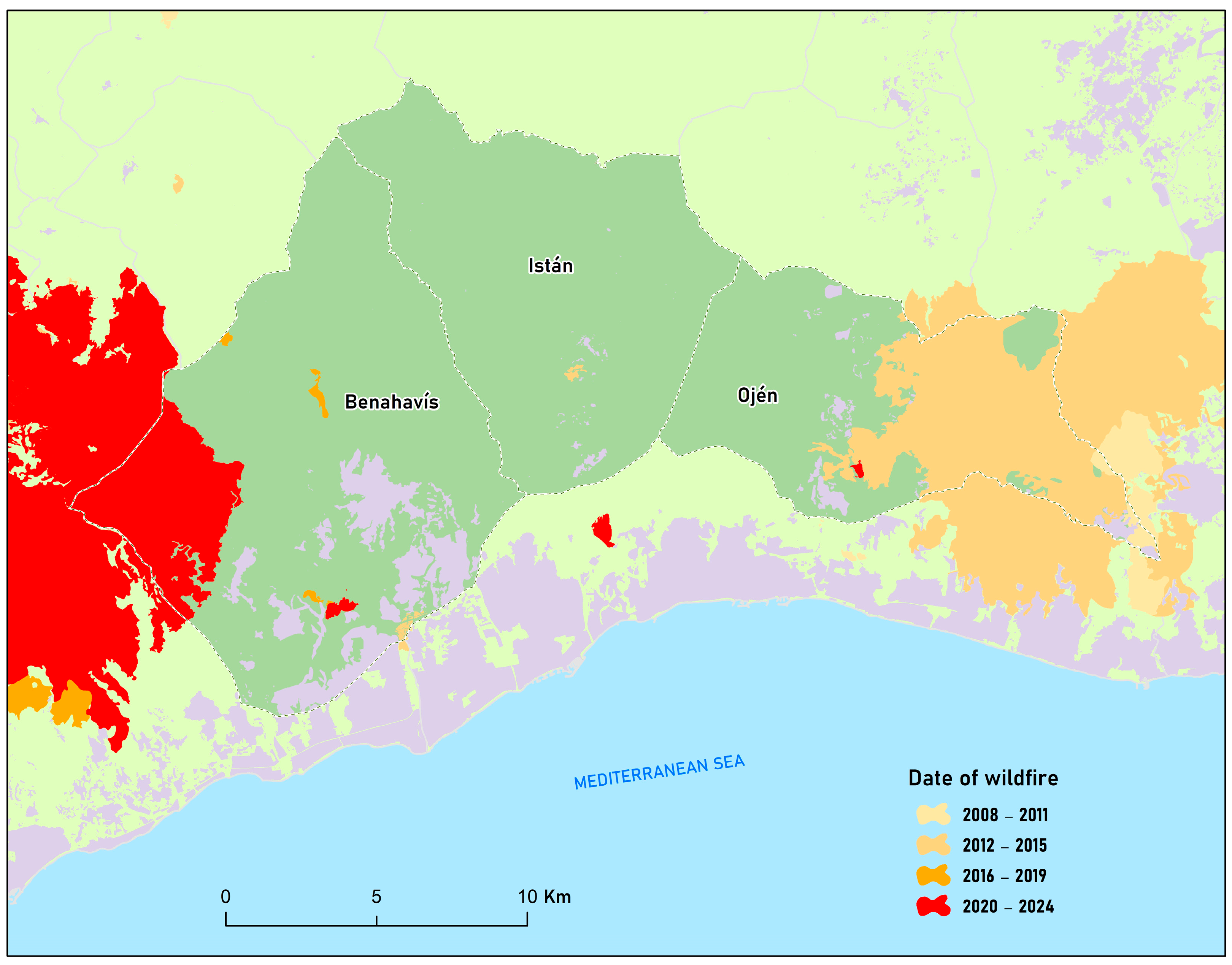
Rural abandonment and the loss of traditional agricultural uses have only contributed to increasing the risk of forest fires [50]. This does not only affect the municipalities addressed in this document but also the entire Costa del Sol, where large wildfires have threatened and destroyed landscapes of great value, such as the fire in the nearby Sierra Bermeja in 2021, which devastated 10,000 ha, and others that recurrently affect the study area or zones around the Sierra de las Nieves [51]. According to data from the Andalusian Forest Fire Prevention and Extinction Plan (Plan INFOCA [52], during the period 2008–2024 a total of 11 forest fires were recorded that affected the municipalities included in the study area, burning an accumulated surface of 5596.17 ha (Figure 13). Four of these events had their ignition point within Benahavís and one within Istán, whereas the largest fire originated in the neighbouring municipality of Coín and subsequently spread into the eastern half of Ojén; in all cases, the percentages reported here refer only to the area actually burned within the three municipalities, irrespective of where the fire started. Although the absolute number of fire events can be considered relatively modest, their mean size is high, so that 16.9% of the surface of the study area has been affected by fire at least once during the period analysed, compared with 1.8% for Andalusia as a whole—almost an order of magnitude higher.
These figures refer to burnt area (fire severity) rather than to the number of fire events, and therefore capture the spatial impact of a relatively small set of large fires. In all cases, the percentage reported for the study area relates only to the area actually burned within the three municipalities, regardless of the ignition point (including, for instance, the large fire that started in Coín and subsequently spread into eastern Ojén). Fire occurrence and severity in this region result from a multifactorial combination of climatic drivers, fuel continuity and changes in forest management, to which agricultural abandonment contributes as a well-documented facilitating factor in Mediterranean environments. The abandonment of traditional agriculture is likely to be one of the key factors behind this increased vulnerability to fire, together with the lack of forest management properly adapted to climatic and environmental conditions and strong urban and tourism pressures. The disappearance of traditional agricultural and livestock practices entails the loss of preventive management activities that historically contributed to the ecological balance of the territory [50], fostering biomass accumulation and, consequently, greater fire hazard—A study shows that rural abandonment causes more wildfires than climate change” [53] (https://revistajaraysedal.es/causa-incendios-abandono-rural-cambio-climatico/, accessed on 8 May 2025).
As noted in the Report on the Structure of Rural Land in Spain [54], “traditional landscape management was not only sustainable, but constituted a natural barrier against fire”. In short, “the abandonment of farmland has allowed uncontrolled natural vegetation to grow in formerly cultivated areas, creating perfect fuel for fire” [54].
Figure 13. Location and extent of forest fires in the study area between 2008 and 2024. Source: REDIAM 2025 [55,56].
Geographies 05 00078 g013
All these processes derived from agricultural abandonment or changes in agricultural vocation must be added to those driven by climate change. The loss of these landscapes, as well as the conversion of the traditional agrarian matrix into irrigated monocultures, limits the territory’s resilience to the effects of the climate crisis. The polyculture patterns—dryland arboriculture combined with small, irrigated plots for self-consumption, scattered vines and fig trees, alternating with rotational herbaceous crops and interspersed with native shrubs and woody species—have given way either to conversion into residential spaces, to homogeneous agrarian landscapes, or directly to abandonment. The typically Mediterranean agrarian matrix, long recognised as being well adapted to local climatic conditions and functioning as a system closely coupled to the territory, has clearly receded. The increase in the intensity and frequency of extreme weather events—such as prolonged droughts or torrential rainfall—or rising average temperatures, with increasingly recurrent and prolonged heat waves, comes precisely at a time when species adapted to this environment have disappeared. Their biological cycles, as well as those of crops, are equally affected as a consequence of the climate crisis.
In recent years, we have witnessed a notable expansion of intensive production models, primarily driven by avocado cultivation, which takes advantage of the thermal potential of the area but is highly vulnerable to the growing water deficit in Andalusian Mediterranean basins and the increasing irregularity of water availability—unlike traditional crops in the area, which were well adapted to these constraints. Moreover, the development of these models requires the construction of new infrastructures, leading to the transformation of historic landscapes and, inevitably, soil loss.
These processes contribute to increasing the vulnerability of agriculture—both its production models and its landscapes—to the impacts of global climate change. Added to this is the specific situation of the Western Costa del Sol, where tourism development further intensifies competition for resources such as water, and where traditional agriculture plays only a marginal role.
However, despite recent changes in trend, agriculture has not received recognition from public administrations for its ecological, environmental, landscape, and/or cultural value [57]. Therefore, although agricultural landscapes often embody extremely high identity values for local populations, their protection remains scarce and, when promoted, tends to follow a highly monumental and/or urban bias, as noted by the cited author. Thus, material elements associated with traditional agro-systems are protected with a strongly heritage-oriented vision, limited in typology and space, but not the landscapes as a whole.

4. Discussion

4.1. Agrarian Dynamics, Landscape Transformation and Territorial Vulnerability

The results obtained reveal a profound reconfiguration of the traditional agrarian landscape in the transitional area between the Sierra de las Nieves and the Western Costa del Sol. The structure of land parcels (Table 1) shows the coexistence of contrasting agrarian models: a pattern of land concentration in Benahavís—with only 52 agricultural parcels, an average size of 26.2 ha and a median of 1.2 ha, strongly shaped by a few very large estates whose main use is residential or recreational—versus a much more fragmented smallholding structure in Istán and Ojén, where average parcel sizes are 2.3 and 1.1 ha and the corresponding median values are 0.2 ha in both municipalities. These differences are not merely morphological but also functional: in Benahavís only 3.0% of the agricultural parcel area is effectively cultivated, whereas in Istán and Ojén the figures rise to 19.9% and 33.2%, respectively. This contrast indicates that, despite the larger average plot sizes in Benahavís, a substantial proportion of the land remains underused or oriented towards forestry, hunting, amenity or urban and tourism uses, while in Istán and Ojén agriculture still plays a much more significant role and contributes to preserving the spatial and ecological heterogeneity of the territory. While the quantitative figures presented here do not include formal confidence intervals or statistically derived accuracy estimates, the magnitude of the differences between municipalities (for instance, between the 3% of actively cultivated agricultural land in Benahavís and the 33.2% in Ojén) clearly exceeds the plausible range of misclassification associated with mixed-use and transitional parcels. In addition, the combination of a common photointerpretation protocol and extensive field verification—including the systematic on-site revision of all doubtful cases—substantially reduces classification uncertainty, even if it cannot be expressed as a precise numerical error margin. Finally, the structural underrepresentation of very small and non-subsidised holdings in SIGPAC, as discussed in Section 4.3, suggests that the percentages of actively cultivated land reported for Istán and Ojén should be interpreted as conservative estimates rather than as upper bounds.
The evolution of crop types (Table 2) confirms the trend towards the abandonment of traditional dry farming systems—olive groves, almond trees and cereals—and the expansion of irrigated subtropical crops, particularly avocado and mango, which are only partially linked to commercial demand and international markets. This productive shift has transformed the landscape’s physiognomy and ecological dynamics: small-scale agroforestry mosaics, characterised by the alternation of crops, fallows, orchards and pastures, have been replaced by monospecific cover types with higher water consumption and lower ecological regulation capacity [58]. The expansion of irrigated subtropical orchards in Istán and Ojén can be interpreted as an adaptive strategy by smallholders to maintain the economic viability of their farms under increasing pressure from tourism and the decline of traditional rainfed crops. This shift reflects a strong market pull linked to international demand for avocados and mangoes, building on the commercial circuits already consolidated in nearby subtropical fruit districts along the Andalusian Mediterranean coast, combined with a technological and institutional “push” associated with the development of irrigation infrastructure (notably the La Concepción reservoir and local irrigation networks) and CAP support schemes. However, the long-term sustainability of these cropping patterns is constrained by rising water scarcity and the increasing irregularity of water availability in Andalusian Mediterranean basins. Updated data in Table 3 confirms and quantifies the magnitude of these transformations. Across the entire study area, the loss of agricultural land reaches 68% between 1956 and 2025. This decline is particularly pronounced in Benahavís, where 95.3% of agricultural land has disappeared, compared to 64.9% in Istán and 52.1% in Ojén. The nature of land-use change also differs by municipality: in Benahavís, the conversion of agricultural land to urban uses predominates (62.2%), whereas in Istán and Ojén, urban conversion is relatively limited (2.6% and 4.0%, respectively), with abandonment and subsequent re-naturalization being the most common processes (70.5% and 59.8%, respectively). This spatial pattern reflects the coastal–inland logic of the Costa del Sol’s tourism–residential model [59], in which urban expansion extends over river valleys and alluvial plains, displacing agricultural functions toward steeper or marginal areas.
In landscape terms, these changes have produced a morphological and visual homogenization: the loss of terraces, irrigation channels, dry-stone walls, and traditional paths reduces territorial legibility and disrupts ecological, cultural, and perceptual connectivity [29].
Moreover, the privatization of large areas through gated residential developments—such as La Zagaleta in Benahavís—has restricted public access and landscape experience, generating fragmentation not only ecological but also social [39]. The high proportion of consolidated urban land occupied by exclusive gated developments reinforces the interpretation of recent urbanisation as a process of territorial privatisation. In Benahavís and Ojén, between two thirds and three quarters of the urban fabric are concentrated in gated residential enclaves, while even in Istán, where the absolute extent of urban land remains modest, more than 40% of consolidated urban surfaces belong to high-end gated compounds. This indicates that the dominant urbanisation model over the last decades has been based on the multiplication of exclusive, spatially segregated enclaves rather than on the incremental expansion of open village cores, with clear implications for both landscape fragmentation and socio-spatial differentiation.
Finally, the analysis of the historical wildfire record (2008–2024) shows a clear correlation between agricultural abandonment and the increase in the area affected by fire. Within the study area, a total of 5596 ha has burned—nearly 17% of its total surface—a proportion ten times higher than the Andalusian average [51]. The abandonment of traditional agricultural and pastoral practices, which historically functioned as preventive management mechanisms (grazing, clearing, boundary maintenance), has favored biomass accumulation and, consequently, greater fire vulnerability [40,50]. These results reinforce the notion that the loss of agrarian functionality entails not only ecological and landscape degradation but also a direct increase in environmental risk and territorial exposure to increasingly recurrent and intense wildfires.

4.2. Proposed Strategies for Adaptation to the Climate Crisis

Based on the analyses presented in the previous sections, it becomes evident that traditional agricultural landscapes in the transition area between the Sierra de las Nieves and the Western Costa del Sol require active attention from public administrations—attention that should be oriented in two complementary directions. On the one hand, it is essential to maintain and strengthen agricultural activity where it still persists. On the other, more challenging yet equally necessary, is to encourage the reactivation of farming in those lands that are currently abandoned but were once cultivated, as well as in other areas that, although not historically used for agriculture, may be suitable for future cultivation.
Although numerous actions can be undertaken to enhance climate resilience and promote sustainable development in this territory, those linked to traditional agricultural activity are particularly relevant. Furthermore, due to the cross-cutting nature of the strategies that can be implemented, their medium- and long-term effects are likely to be significant. Having analyzed the evolution of traditional agricultural landscapes in recent decades, identified their current condition, and understood the challenges and phenomena associated with the climate crisis, several strategies are proposed below that public administrations could implement to strengthen the territory’s adaptive capacity over the coming years and decades. Most of these strategies should be accompanied by complementary measures and, above all, by a strong commitment from governing bodies—at European, national, regional, and local levels—as well as from the stakeholders to whom these measures are addressed, whether as binding actions or as recommendations and guidelines:
-
Establishment of economic incentives aimed at maintaining traditional crops and the associated local land management practices and techniques, promoting agroecological models and sustainable agriculture respectful of the environment.
-
Financial support for the modernization of plots through the acquisition of machinery that allows agriculture to become a complementary activity to other occupations of the local population, optimizing the time dedicated to it and facilitating agricultural tasks. This measure would help attract younger generations with other primary jobs to engage part-time in agriculture, thus stimulating innovation.
-
Promotion of sustainable natural resource management through investment in infrastructures and technologies adapted to the needs of traditional agricultural practices.
-
Recognition and enhancement of the tangible cultural heritage linked to agricultural activity as a key element for reinforcing territorial identity.
-
Strengthening of the local agricultural social fabric, integrating traditional knowledge with scientific and technical advances, thereby fostering participatory territorial governance.
All these actions should promote traditional crops over intensive production systems, which, together with tourism, exert enormous pressure on agricultural areas that are now largely abandoned. The maintenance and expansion of such intensive crops are unsustainable due to the high-water consumption they require in a territory where both the availability and regularity of the resource are increasingly limited.
In relation to these strategies, several ideas have recently emerged that are expected to be incorporated in the short and medium term into territorial planning policies for the study area. In this regard, within the drafting process of the new Territorial Planning Scheme for the Western Costa del Sol—In 2006, the Regional Government of Andalusia enacted Decree 142/2006 of 18 July, which approved the Territorial Planning Scheme for the Western Costa del Sol in the province of Málaga. However, in 2015, the Spanish Supreme Court annulled the plan in its entirety, thereby repealing it and rendering it legally invalid. Consequently, in 2016, the regional administration initiated the drafting of a new document, which is currently in the stage of preparing its final version and conducting the corresponding Strategic Environmental Assessment. It is proposed to delimit large land reserves for agricultural purposes, aimed at curbing urban expansion and preventing further land artificialization in a space already under strong development pressure and where the open-space system is notably constrained.

4.3. Limitations of Spatial Databases and Improvement Proposals

The analysis of land-use changes and the transformation of traditional agrarian landscapes within the study area has been constrained by the limitations of the available spatial databases—both in their thematic and temporal resolution and in their capacity to capture the socioeconomic complexity of Mediterranean agrarian land uses.
Among the main sources employed—CORINE Land Cover, SIGPAC, the Agrarian Census, and historical orthophotographs (the 1956 American Flight and the most recent PNOA imagery)—none, on its own, allows for a precise reconstruction of the microterritorial evolution of land parcels or for the establishment of cause–effect relationships between land-use changes, property structures, and land-use dynamics.
First, CORINE Land Cover operates at a minimum mapping unit of twenty-five hectares and employs an overly general classification system that groups highly diverse territorial realities under broad categories such as “heterogeneous agricultural areas” or “natural and semi-natural vegetation.” This limitation leads to a loss of information concerning detailed processes of abandonment, intensification, or diversification that characterize Mediterranean agrarian landscapes [30]. At the local scale, therefore, CORINE is useful only for identifying regional trends, but inadequate for assessing the disappearance of agroforestry mosaics or the replacement of dry-farming systems by subtropical crops. For its part, the Geographic Information System for Agricultural Parcels (SIGPAC) provides detailed resolution (1:5000) and significant potential for parcel-level analysis, yet it lacks homogeneous temporal continuity and does not include qualitative variables on the actual condition of crops, the degree of abandonment, or the type of exploitation (professional, recreational, or subsistence).
These shortcomings hinder the accurate reconstruction of the diachronic trajectories of each parcel or agricultural mosaic. Moreover, its dependence on Common Agricultural Policy (CAP) surface declarations introduces a bias toward subsidized farms, systematically excluding a large proportion of family gardens and non-subsidized holdings, which are common in the hinterland of the Costa del Sol.
The Agrarian Census [20], despite being the main statistical source on agrarian structure and land tenure, also presents notable limitations. Its ten-year periodicity and the delayed publication of results—the 2020 data began to be released in 2022—mean that the information is partially outdated with respect to recent transformation processes such as the expansion of subtropical crops or the accelerated loss of traditional drylands. In addition, its low spatial resolution, restricted to municipal or regional scales, prevents direct integration with land-use cartography and SIGPAC data, thus hindering spatially integrated analyses. Finally, the inclusion criteria of Regulation (EU) 2018/1091 [60], which exclude very small or low-economic-value holdings, result in a systematic underrepresentation of micro-farms and subsistence gardens—a defining feature of both peri-urban and rural landscapes along the Costa del Sol.
These methodological limitations constrain the possibility of establishing causal relationships between agrarian structure, urban pressure, and landscape evolution. Consequently, it becomes necessary to rely on diachronic reconstructions through manual photointerpretation and the comparison of historical orthophotographs, complemented by direct field observation.
In the case of the study area, the absence of publicly available information on land ownership and actual land operators prevents a comprehensive understanding of agrarian governance dynamics, the functional specialization of farms, and the trajectories of land abandonment. The lack of cadastral transparency and the absence of interoperability between Cadastre, SIGPAC, and the Agrarian Census reduce the traceability of transformations and hinder the long-term reproducibility of spatial analyses.

5. Conclusions

The transformation of the landscape along the Costa del Sol, driven by urban development pressure and the progressive abandonment of traditional agrarian land uses, has led to a significant loss of ecological functionality and an increase in territorial vulnerability [61]. However, in those areas where traditional agrarian landscapes have persisted, their maintenance continues to provide decisive benefits for territorial sustainability and resilience against the impacts of climate change. In these spaces, it remains feasible to apply agricultural techniques compatible with sustainable land use, contributing to the preservation—and even the strengthening—of the ecological, landscape, and cultural values recognized by UNESCO [61]. Traditional agriculture, grounded in local knowledge, continues to play a key role as a preventive management tool against wildfire risk [40] and as an essential support for biodiversity and soil fertility. The persistence of these mosaic-like cultivation systems, even in residual enclaves, constitutes a crucial factor of territorial resilience in the face of urban pressure—the main driver of landscape transformation along the Costa del Sol. This transformation, largely driven by the economic and symbolic valorization of landscape within the real estate market, generates and perpetuates a paradox in which what is valued as a landscape resource becomes altered by the very dynamics that seek to capitalize on it [62].
The progressive decline of traditional agricultural systems, as exemplified by this sector of the Costa del Sol, has led to the abandonment of landscapes of exceptional value—the result of centuries of human occupation processes that have been historically integrated into a heterogeneous natural environment, with which they coevolved in balance. As several authors have noted [26,58,63], the Mediterranean landscape is undergoing a process of deconstruction derived from the cessation of traditional activities. Added to the ecological, economic, and social transformations are the impacts of climate change, which further increase the fragility of rural systems and accelerate the loss of territorial identity.
The transformations observed in the study area are representative of processes affecting much of the Mediterranean arc, where the traces of agrarian labor—terraces, dry-stone walls, orchards, irrigation channels, and mule tracks—are progressively fading due to the replacement or abandonment of the structures that once articulated space and ensured continuity between landscape units. The sensory identity of these places has also changed: sounds, smells, and textures associated with rural life are disappearing, while recent urban dynamics impose a more homogeneous and fragmented territory, impoverishing perceptual experience and the evocative capacity of valleys and slopes.
In contrast to this trend, traditional small-scale agrarian mosaics with diversified management retain strategic value. They sustain spatial heterogeneity, foster biodiversity, and enhance climate resilience by mitigating episodes of extreme heat or drought while maintaining essential ecosystem functions such as water regulation, soil protection, and ecological connectivity. Preserving and restoring terraces, dry-stone walls, irrigation channels, and public paths is essential for recovering visual coherence, cultural memory, and the adaptive capacity of the territory.
The differences observed among municipalities illustrate the coexistence of opposing territorial models: large estates, such as those in Benahavís, offer investment advantages but are associated with lower diversity in traditional land uses, whereas the fragmented systems of Istán and Ojén, though more vulnerable to abandonment, preserve agrarian and ecological heritage whose conservation is key to achieving more balanced and resilient development in a context of strong tourism and urban pressure.
Taken together, the results demonstrate that the structure of land ownership conditions both local socioeconomic dynamics and the capacity of agricultural landscapes to sustain environmental functions and contribute to resilience against climate change. Recognizing and revalorizing traditional small-scale systems should therefore be a priority objective in the effective transition toward territorial sustainability.
In this context, integrated policies are required that recognize the environmental and ecosystem services provided by traditional agricultural landscapes to both territory and society, articulating measures that combine environmental conservation with the economic and social viability of rural areas. In the case study area—the municipalities of Benahavís, Istán, and Ojén, located in the transitional zone between the Sierra de las Nieves and the Western Costa del Sol—such policies should be coordinated across different levels of public administration, fostering collaboration among national, regional, and local governments. It would also be crucial to involve public–private entities and inter-municipal consortia—such as the Sierra de las Nieves Rural Development Group or the Association of Municipalities of the Western Costa del Sol—to promote initiatives for the recovery of terraces, irrigation channels, and traditional crops. These initiatives should integrate funding from the CAP and European rural development programmes—notably the European Agricultural Fund for Rural Development (EAFRD) and the LIFE programme (LIFE).
Equally important is the need to improve the quality and updating of spatial and agrarian statistical databases, enabling a more precise understanding of the relationships between land use, property structure, and landscape dynamics, thereby reinforcing the technical and social foundations for coherent territorial governance and effective climate adaptation.
Looking ahead to future research and planning actions, it is essential to move towards the development of a participatory catalogue of landscapes at risk of disappearance, identifying agrarian elements, infrastructures, and traditional layouts—such as paths, irrigation channels, or terraced fields—that are currently abandoned or endangered. This inventory should be complemented by an analysis of ownership changes, both in agricultural holdings and in common lands, in order to understand recent dynamics of concentration, fragmentation, or privatization of the territory.
On the basis of this knowledge, it would be possible to design governance models that reconcile the continuity of productive systems with the preservation of territorial and landscape heritage, thus ensuring their long-term sustainability.

Author Contributions

Conceptualization, H.C.N.; methodology, H.C.N.; software, H.C.N.; validation, H.C.N. and Á.D.R.E.; formal analysis, H.C.N.; investigation, H.C.N.; resources, H.C.N.; data curation, H.C.N.; writing—original draft preparation, H.C.N. and Á.D.R.E.; writing—review and editing, H.C.N. and Á.D.R.E.; visualization, H.C.N. and Á.D.R.E.; supervision, H.C.N.; project administration, H.C.N.; funding acquisition, H.C.N. All authors have read and agreed to the published version of the manuscript.

Funding

This research was supported by the R&D&I project CITOSEQ, titled “Ciencia ciudadana y TIG para la evaluación del riesgo compuesto sequías-olas de calor” (ref. PID2022-139046OA-I00), funded by the Ministry of Science, Innovation and Universities of the Government of Spain under the 2022 Call.

Data Availability Statement

The main spatial and statistical datasets used in this study are publicly available: CORINE Land Cover (Copernicus Land Monitoring Service), the Geographic Information System for Agricultural Parcels (SIGPAC) provided by the Spanish Ministry of Agriculture, Fisheries and Food, the National Plan for Aerial Orthophotography (PNOA), population and agrarian data from the Spanish National Statistics Institute (INE), and wildfire perimeter datasets from REDIAM (Junta de Andalucía). The derived cartographic layers, land-use classifications, and analytical outputs generated by the authors are available from the corresponding author upon reasonable request.

Acknowledgments

We are grateful for the assistance and insights provided by long-standing residents with deep knowledge of the territory across the three municipalities. In Ojén, we acknowledge the support of Esteban Martín; in Istán, the guidance of Miguel Macías and his family, Juan García, and the Anaya Ruiz family; and in Benahavís, the help of José Toro, Francisca Sánchez, and Francisco Toro. Additionally, other anonymous neighbors kindly assisted us, facilitating the recognition of the territory during the fieldwork phase.

Conflicts of Interest

The authors declare no conflicts of interest.

References

  1. Intergovernmental Panel on Climate Change (IPCC). Climate Change 2023: Synthesis Report; IPCC: Geneva, Switzerland, 2023; Available online: https://www.ipcc.ch/report/ar6/syr/downloads/report/IPCC_AR6_SYR_LongerReport.pdf (accessed on 2 January 2025).
  2. United Nations. Transforming Our World: The 2030 Agenda for Sustainable Development; United Nations: New York, NY, USA, 2015; Available online: https://sdgs.un.org/2030agenda (accessed on 14 December 2024).
  3. European Commission. Forging a Climate-Resilient Europe: The New EU Strategy on Adaptation to Climate Change; European Commission: Brussels, Belgium, 2021; Available online: https://climate.ec.europa.eu/eu-action/adaptation-and-resilience-climate-change/eu-adaptation-strategy_en (accessed on 7 July 2025).
  4. Council of Europe. European Landscape Convention; Florence, 20 October 2000; Council of Europe: Strasbourg, France, 2000; Available online: https://www.coe.int/en/web/landscape/reference-texts (accessed on 7 July 2025).
  5. Plieninger, T.; Höchtl, F.; Spek, T. Traditional Land-Use and Nature Conservation in European Rural Landscapes. Environ. Sci. Policy 2006, 9, 317–321. [Google Scholar] [CrossRef]
  6. Moreira, F.; Ascoli, D.; Safford, H.; Adams, M.A.; Moreno, J.M.; Pereira, J.M.C.; Catry, F.X.; Armesto, J.; Bond, W.; González, M.E.; et al. Wildfire Management in Mediterranean-Type Regions: Paradigm Change Needed. Environ. Res. Lett. 2020, 15, 011001. [Google Scholar] [CrossRef]
  7. European Environment Agency (EEA). Landscape Fragmentation in Europe; EEA Report No 2/2021; European Environment Agency: Copenhagen, Denmark, 2021; Available online: https://www.eea.europa.eu/publications/landscape-fragmentation-in-europe (accessed on 17 March 2025).
  8. Pausas, J.G.; Fernández-Muñoz, S. Fire Regime Changes in the Western Mediterranean Basin: From Fuel-Limited to Drought-Driven Fire Regime. Clim. Change 2012, 110, 215–226. [Google Scholar] [CrossRef]
  9. Castro-Noblejas, H.; Orellana-Macías, J.M. Percepción del riesgo de incendio forestal y su impacto en la valoración de la vivienda: La transición entre la Sierra de las Nieves y la Costa del Sol (Málaga, España). BAGE. Boletín Asoc. Española Geogr. 2025, 104. [Google Scholar] [CrossRef]
  10. Roe, B.; Irwin, E.G.; Morrow-Jones, H.A. Consumer Preference for Neotraditional Neighborhood Characteristics. Hous. Policy Debate 2004, 15, 171–202. [Google Scholar] [CrossRef]
  11. Brueckner, J.K.; Helsley, R.W. Lectures on Urban Economics; The MIT Press: Cambridge, MA, USA, 2011. [Google Scholar]
  12. Gibbons, S.; Mourato, S.; Resende, G.M. The Amenity Value of English Nature: A Hedonic Price Approach. Environ. Resour. Econ. 2014, 57, 175–196. [Google Scholar] [CrossRef]
  13. Ley 9/2021, de 1 de Julio, de Declaración del Parque Nacional de la Sierra de las Nieves (Boletín Oficial del Estado, Número 157). 2021. Available online: https://www.boe.es/buscar/act.php?id=BOE-A-2021-10958 (accessed on 9 January 2025).
  14. Ministerio para la Transición Ecológica y el Reto Demográfico. Organismo Autónomo Parques Nacionales; Madrid, Spain. Madrid, Spain, 2025. Available online: https://www.miteco.gob.es/es/parques-nacionales-oapn (accessed on 24 November 2025).
  15. Pixabay. Available online: https://pixabay.com/es/photos/casas-rustico-paisaje-turismo-809394/ (accessed on 25 November 2025).
  16. Mignon, C. Campos y Campesinos en la Andalucía Mediterránea; Servicio de Publicaciones Agrarias: Madrid, Spain, 1982; pp. 1–606. [Google Scholar]
  17. Gómez-Zotano, J. El Papel de Los Espacios Montañosos Como Traspaís del Litoral Mediterráneo Andaluzel Caso de Sierra Bermeja (Provincia de Málaga). Ph.D. Thesis, Universidad de Granada, Granada, Spain, 2006. Available online: https://digibug.ugr.es/handle/10481/4564 (accessed on 13 July 2025).
  18. El Español. Available online: https://www.elespanol.com/malaga/20231227/pueblo-malaga-multiplica-poblacion-ultimos-anos/820168374_0.html (accessed on 18 May 2025).
  19. Instituto Nacional de Estadística (INE). Padrón Municipal; INE: Madrid, Spain, 2025; Available online: https://sede.ine.gob.es/padronciudadano/pages/frmPresentacion.xhtml (accessed on 20 July 2025).
  20. Ocaña-Ocaña, M.C.; Gómez-Moreno, M.L. Changes in Territorial Organization: Caso de estudio: Dinámicas territoriales en Málaga, la axarquía:¿Qué organización del territorio? Entre la urbanización difusa y la nueva agricultura. In España y el Mediterráneo: Una reflexión desde la Geografía española. Aportación española al XXXI Congreso de la Unión Geográfica Internacional; Alario Trigueros, M., Ed.; Servicio de Publicaciones: Valladolid, Spain, 2008; pp. 67–71. ISBN 978-84-612-5196-4. Available online: https://dialnet.unirioja.es/servlet/articulo?codigo=2913891 (accessed on 12 January 2025).
  21. Instituto Nacional de Estadística (INE). Censo Agrario 2009; INE: Madrid, Spain, 2025; Available online: https://ine.es/CA/Inicio.do (accessed on 20 September 2025).
  22. Instituto Geográfico Nacional (IGN). Centro de Descargas del CNIG. Coberturas de Ortofotografía Aérea Histórica (Vuelo Americano) y del Plan Nacional de Ortofotografía Aérea (PNOA); Ministerio de Transportes y Movilidad Sostenible: Madrid, Spain. Available online: https://centrodedescargas.cnig.es (accessed on 20 February 2025).
  23. Copernicus Land Monitoring Service. CORINE Land Cover (CLC). Available online: https://land.copernicus.eu/en/products/corine-land-cover (accessed on 20 September 2025).
  24. Ministerio de Agricultura; Pesca y Alimentación (MAPA). Sistema de Información Geográfica de Parcelas Agrícolas (SIGPAC); MAPA: Madrid, España. Available online: https://servicio.mapama.gob.es/en/agricultura/temas/sistema-de-informacion-geografica-de-parcelas-agricolas-sigpac-/objetivos (accessed on 15 October 2025).
  25. Castro-Noblejas, H.; De la Fuente-Roselló, A.L. Análisis de las relaciones entre tipologías constructivas y la expansión urbana en espacios turísticos litorales. Aplicación a la Costa del Sol Occidental (Málaga, España). In XVI Coloquio de Geografía Urbana: Procesos Urbanos y Turísticos en Escenarios Post-Pandemia. En Visiones Desde dos Continentes; Asociación Española de Geografía (AGE) y Universidad de Málaga: Málaga–Melilla, Spain, 27–30 June 2022; University of Málaga: Málaga, Spain, 2022; Available online: https://hdl.handle.net/10630/24621 (accessed on 13 October 2025).
  26. López Ontiveros, A. Caracteres geográficos de Andalucía. In Gran Atlas de España; Aguilar, S.A., Ed.; de Ediciones: Madrid, Spain, 1993; pp. 276–289. [Google Scholar]
  27. Guzmán-Álvarez, J.R. Los Sistemas Agrarios Tradicionales de la Axarquía y la Serranía de Ronda; Diputación de Málaga: Málaga, Spain, 2011. [Google Scholar]
  28. Mayordomo-Maya, S.; Hermosilla-Pla, J. Heritage Evaluation of the Carob Tree MTAS in the Territory of Valencia: Analysis and Social Perception of the Ecosystem Services and Values from Cultivating It. Land 2024, 13, 922. [Google Scholar] [CrossRef]
  29. Fernández-Cacho, S.; Fernández-Salinas, V.; Hernández-León, E. Paisajes y Patrimonio Cultural en Andalucía: Tiempo, Usos e Imágenes; Vol. II; Andalusian Institute of Cultural Heritage: Seville, Spain, 2010; Available online: https://repositorio.iaph.es/handle/11532/263940 (accessed on 5 February 2025). (In Spanish)
  30. Mata-Olmo, R.; Molinero, F.; Sanz-Herráiz, C. Atlas de los Paisajes de España; Ministerio de Medio Ambiente: Madrid, Spain, 2003; pp. 1–683. ISBN 84-8320-236-0. Available online: https://www.miteco.gob.es/es/biodiversidad/servicios/banco-datos-naturaleza/informacion-disponible/paisajes.html (accessed on 13 March 2025).
  31. Observatorio de Precios y Mercados (Junta de Andalucía). Datos básicos de Aguacate (Campaña 20242/5); Junta de Andalucía: Sevilla, Spain, 2024. Available online: https://ws142.juntadeandalucia.es/agriculturaypesca/observatorio/servlet/FrontController?action=RecordContent&table=11114&element=5125231&subsector=& (accessed on 13 January 2025).
  32. Observatorio de Precios y Mercados (Junta de Andalucía). Datos básicos de Mango (Campaña 2024/25); Junta de Andalucía: Sevilla, Spain, 2024. Available online: https://ws142.juntadeandalucia.es/agriculturaypesca/observatorio/servlet/FrontController?action=RecordContent&table=11113&element=4965388&subsector=& (accessed on 13 January 2025).
  33. Antrop, M. Why Landscapes of the Past Are Important for the Future. Landsc. Urban Plan. 2005, 70, 21–34. [Google Scholar] [CrossRef]
  34. Botequilha-Leitão, A.; Ahern, J. Applying Landscape Ecological Concepts and Metrics in Sustainable Landscape Planning. Landsc. Urban Plan. 2002, 59, 65–93. [Google Scholar] [CrossRef]
  35. McGarigal, K.; Marks, B.J. FRAGSTATS: Spatial Pattern Analysis Program for Quantifying Landscape Structure; USDA Forest Service, Pacific Northwest Research Station, General Technical Report PNW-GTR-351; U.S. Department of Agriculture, Forest Service, Pacific Northwest Research Station (PNW): Portland, OR, USA, 1995. Available online: https://www.fs.usda.gov/pnw/pubs/pnw_gtr351.pdf (accessed on 1 November 2025).
  36. Consejería de Agricultura, Ganadería, Pesca y Desarrollo Sostenible, Junta de Andalucía. Guía de Buenas Prácticas Para la Producción Integrada en Olivar; Junta de Andalucía: Sevilla, Spain, 2019. Available online: https://www.juntadeandalucia.es/export/drupaljda/guia_pp_v1_2019011.pdf (accessed on 13 September 2025).
  37. Junquera, V.; Rubenstein, D.I.; Levin, S.A.; Hormaza, J.I.; Vadillo, I.; Jiménez-Gavilán, P. Severe Water Crisis in Southern Spain Under Expanding Irrigated Agriculture: A Multidimensional Drought Analysis. Proc. Natl. Acad. Sci. USA 2025, 122, e2508055122. [Google Scholar] [CrossRef]
  38. Antrop, M. Landscape change and the urbanization process in Europe. Landsc. Urban Plan. 2004, 67, 9–26. [Google Scholar] [CrossRef]
  39. Atkinson, R.; Blandy, S. Introduction: International perspectives on the new enclavism and the rise of gated communities. Hous. Stud. 2005, 20, 177–186. [Google Scholar] [CrossRef]
  40. Romero-Martínez, J.M.; Romero-Padilla, Y.; Navarro-Jurado, E. Atributos urbanos contemporáneos del litoral mediterráneo en la crisis global: Caso de la zona metropolitana de la Costa del Sol. Scr. Nova 2015, 19, 515. Available online: http://hdl.handle.net/10481/37323 (accessed on 13 September 2025).
  41. Matos-Márquez, L.A.; Bardella-Castro, J.D.; Martins, E.L. Servicios ecosistémicos culturales y métodos de valoración: Una revisión sistemática. Tur. Soc. 2024, 34, 111–126. [Google Scholar] [CrossRef]
  42. Aznar-Sánchez, J.A.; Velasco-Muñoz, J.F. Valoración de los ecoservicios en los agroecosistemas españoles: Un estado de la cuestión. Obs. Medioambient. 2016, 19, 105–132. [Google Scholar] [CrossRef]
  43. Gómez Baggethun, E.; de Groot, R.S.; Lomas, P.L.; Montes, C. The history of ecosystem services in economic theory and practice: From early notions to markets and payment schemes. Ecol. Econ. 2010, 69, 1209–1218. [Google Scholar] [CrossRef]
  44. Mata-Olmo, R. El paisaje, patrimonio y recurso para el desarrollo territorial sostenible. Conocimiento y acción pública. Arbor 2008, 184, 155–172. [Google Scholar]
  45. Caballero-García, P.; Domínguez-Gómez, J.A.; Zoido-Naranjo, F. Los paisajes como patrimonio cultural y natural: Perspectivas y retos. Obs. Medioambient. 2015, 18, 45–68. Available online: https://dialnet.unirioja.es/servlet/articulo?codigo=5205662 (accessed on 23 May 2025).
  46. Nogué-Font, J. El paisaje en la ordenación territorial: La experiencia del Observatorio del Paisaje de Cataluña. Estud. Geográficos 2010, 71, 415–448. [Google Scholar] [CrossRef]
  47. Millennium Ecosystem Assessment. Ecosystems and Human Well-Being: Synthesis; Island Press: Washington, DC, USA, 2005; Available online: https://www.millenniumassessment.org/documents/document.356.aspx.pdf (accessed on 3 September 2025).
  48. Álvarez-Montoya, J.M.; Pavón-Benítez, L.; Sánchez-González, P. Una mirada compleja al fenómeno de la despoblación rural. In El Camino Hacia las Sociedades Inclusivas; Dykinson: Madrid, Spain, 2023; pp. 1223–1236. ISBN 978-84-1122-373-7. Available online: https://digibug.ugr.es/handle/10481/84233 (accessed on 5 May 2025).
  49. Ramírez-Suárez, W.M.; López-Chouza, J.C.; Flores-Acosta, M.A.; Sánchez-Cárdenas, S.; Rodríguez-Morejón, P.L. La biodiversidad y los servicios ecosistémicos en sistemas agroecológicos. Una revisión. Pastos Y Forrajes 2024, 47. Available online: http://www.scielo.sld.cu/scielo.php?script=sci_arttext&pid=S0864-03942024000100002 (accessed on 18 May 2025).
  50. Santín-González, C.; Madrigal-González, J.; Cerdà-Serrano, X.; Pausas-Ferrer, J.G. Incendios Forestales; Centro Superior de Investigaciones Científicas (CSIC): Madrid, Spain, 2023. [Google Scholar]
  51. Romero-Padilla, J.; Martínez-Murillo, J.F. Análisis cartográfico del nivel de afectación de los incendios forestales sobre áreas urbanizadas en la Costa del Sol occidental (1991–2013). Papeles De Geogr. 2019, 65, 49–66. [Google Scholar] [CrossRef]
  52. Consejería de Sostenibilidad, Medio Ambiente y Economía Azul, Junta de Andalucía. Plan Andaluz de Prevención y Extinción de Incendios Forestales (Plan INFOCA); Junta de Andalucía: Sevilla, Spain, 2025. Available online: https://www.juntadeandalucia.es/medioambiente/infoca (accessed on 13 July 2025).
  53. Jara y Sedal. Available online: https://revistajaraysedal.es/ (accessed on 8 May 2025).
  54. Cocampo. Informe Sobre la Estructura del Suelo Rústico en España; Cocampo: Madrid, Spain, 2025; Available online: https://www.cocampo.com/es/es/noticias/wp-content/uploads/2025/03/Informe-2025-Cocampo-sobre-la-Estructura-del-Suelo-Rustico-en-Espana.pdf (accessed on 3 October 2025).
  55. Consejería de la Presidencia, Interior, Diálogo Social y Simplificación Administrativa, Junta de Andalucía. Perímetros de incendios forestales en Andalucía 2008–2024 [Dataset]; Junta de Andalucía: Sevilla, Spain, 2007. Available online: https://portalrediam.cica.es/geonetwork/static/api/records/933fa6f2-1316-4e99-9baa-49c86d0cfc0c (accessed on 13 September 2025).
  56. Consejería de Sostenibilidad, Medio Ambiente y Economía Azul, Junta de Andalucía. Red de Información Ambiental de Andalucía (REDIAM); Junta de Andalucía: Sevilla, Spain, 2025. Available online: https://www.juntadeandalucia.es/medioambiente/portal/acceso-rediam (accessed on 4 October 2025).
  57. Silva-Pérez, R. Agricultura, paisaje y patrimonio territorial. Los paisajes de la agricultura vistos como patrimonio. Boletín De La Asoc. Española De Geogr. (BAGE) 2008, 49, 309–334. Available online: https://bage.age-geografia.es/ojs/index.php/bage/article/view/786 (accessed on 21 February 2025). (In Spanish).
  58. Nadal-Romero, E.; García-Ruiz, J.M. Market as a factor in soil erosion: The expansion of new and old crops into marginal Mediterranean lands. Reg. Environ. Change 2025, 25, 16. [Google Scholar] [CrossRef]
  59. Castro-Noblejas, H. Paisaje y Desarrollo Inmobiliario en el Litoral Mediterráneo Andaluz: El caso de la Costa del Sol Occidental (Málaga). Ph.D. Thesis, Universidad de Málaga, Málaga, Spain, 2023. Available online: https://riuma.uma.es/xmlui/handle/10630/26729 (accessed on 21 February 2025).
  60. European Parliament and Council of the European Union. Regulation (EU) 2018/1091 of the European Parliament and of the Council of 18 July 2018 on integrated farm statistics and repealing Regulations (EC) No 1166/2008 and (EU) No 1337/2011. Off. J. Eur. Union 2018, L 200, 1–29. Available online: https://eur-lex.europa.eu/eli/reg/2018/1091/oj/eng?utm_source=chatgpt.com (accessed on 2 February 2025).
  61. UNESCO. Operational Guidelines for the Implementation of the World Heritage Convention (Annex 3); World Heritage Centre: Paris, France, 1992; Available online: https://whc.unesco.org/archive/opguide08-es.pdf (accessed on 14 April 2025).
  62. Castro Noblejas, H.; De Paola, P.; y Vías Martínez, J. Landscape value in the Spanish Costa del Sol’s real estate market: The case of Marbella. Land 2023, 12, 987. [Google Scholar] [CrossRef]
  63. Molinero-Hernando, F. Atlas de los Paisajes Agrarios de España; Ministerio de Agricultura, Alimentación y Medio Ambiente: Madrid, Spain, 2013. Available online: https://uvadoc.uva.es/handle/10324/37111 (accessed on 23 March 2025).
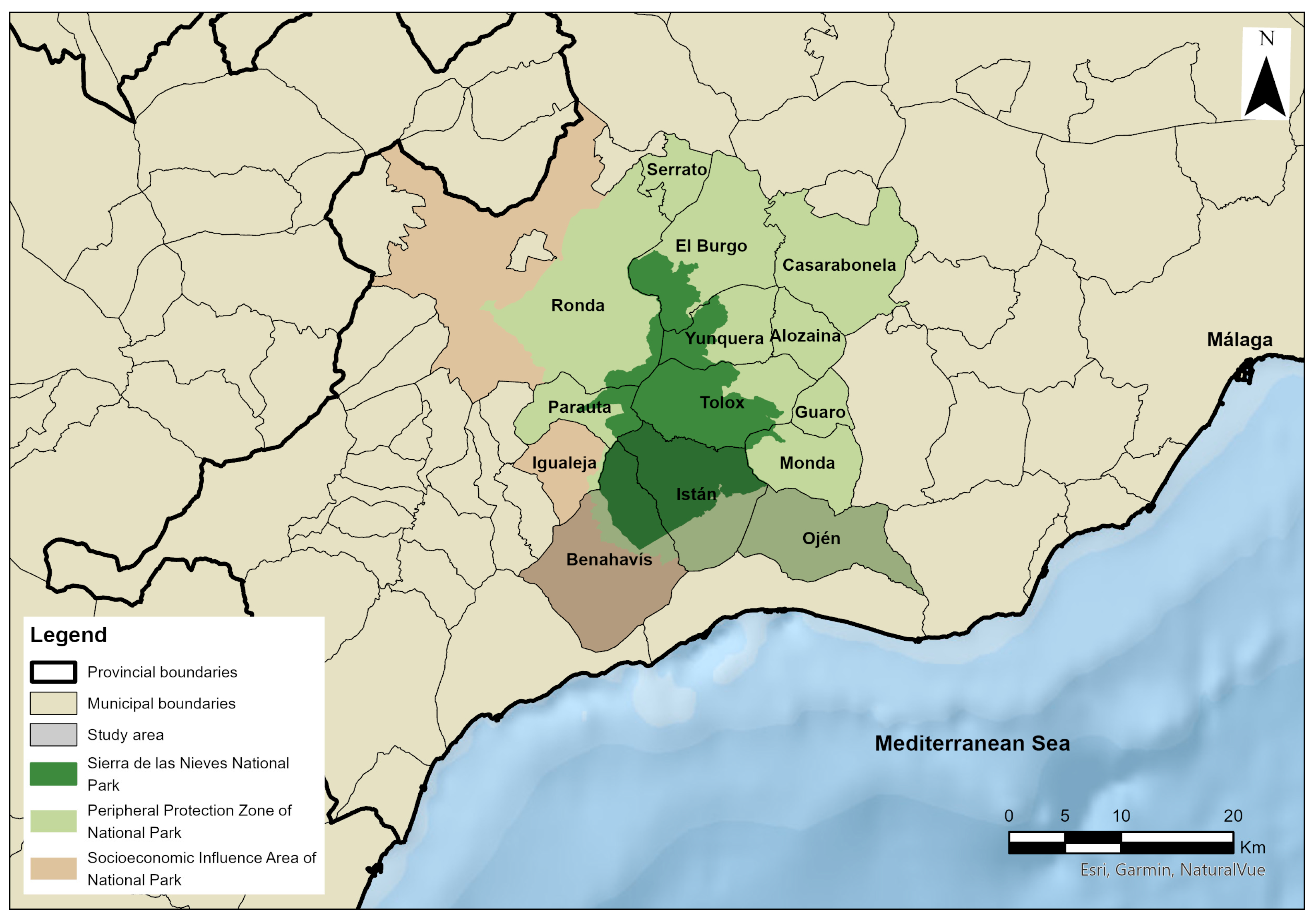
Figure 1. Boundaries of the National Park and its socio-economic influence area. Source: own elaboration based on the National Parks Autonomous Agency (Organismo Autónomo Parques Nacionales, OAPN) [14].
Geographies 05 00078 g001
Figure 2. Benahavís. Source: [15].
Geographies 05 00078 g002
Figure 3. Istán. Source: authors.
Geographies 05 00078 g003
Figure 4. Ojén. Source: authors.
Geographies 05 00078 g004
Figure 5. Farm size according to Utilized Agricultural Area (UAA). Comparative analysis between municipalities within the study area, the province of Málaga, and Andalusia. Source: own elaboration based on Agricultural Census [21].
Geographies 05 00078 g005
Figure 6. Percentage of cultivated area with respect to the total plot. Source: own elaboration based on remote sensing and photointerpretation.
Geographies 05 00078 g006
Figure 11. Spatial distribution of agricultural land loss in the study area (1956–2025). Source: own elaboration.
Geographies 05 00078 g011
Figure 12. Example of an abandoned path in the municipality of Benahavís. Source: authors.
Geographies 05 00078 g012
Table 1. Characteristics of the agricultural land parcel structure in 2025. Source: own elaboration based on SIGPAC [24].
BenahavísIstánOjén
Total agricultural plots5210171955
Size range (ha)0.1–10680.1–6650.1–216
Area of plots with agricultural activity (ha)1360.12290.52198.8
Average plot size (ha)26.22.31.1
Median plot size (ha)1.20.20.2
Percentage of cultivated area relative to the total agricultural plot area3.019.933.2
Table 2. Crop types and their spatial distribution. Area in hectares. Source: own elaboration based on SIGPAC [24].
Crop TypeBenahavísIstánOjén
Circa 19562025Circa 19562025Circa 19562025
Olive141.74.219.586.0259.693.4
Olive, almond, other dryland crops85.30.9500.925.4 403.532.0
Olive and almond with irrigated tree crops (Citrus and tropical fruits)-4.8-5.3-253.0
Polyculture: vegetable garden and irrigated tree crops (Tropical fruits, citrus, and other fruit trees)92.52.7152.586.0373.382.9
Irrigated tree crops: tropical fruits and citrus--1.310.4-42.2
Tropical fruits-7.3-1.2-4.2
Vegetable garden41.52.9---5.4
Pasture46.4--30.56.021.6
Cereal329.88.718.2-7.3-
Silviculture-0.3-1.115.6-
Disclaimer/Publisher’s Note: The statements, opinions and data contained in all publications are solely those of the individual author(s) and contributor(s) and not of MDPI and/or the editor(s). MDPI and/or the editor(s) disclaim responsibility for any injury to people or property resulting from any ideas, methods, instructions or products referred to in the content.