Abstract
A social–ecological system is a highly connected organization of biophysical and social actors that interact across multiple scales, share resources, and adapt to the actors’ changes. The ways in which humans and nature interact have traditionally been characterized and influenced by competing intrinsic and utilitarian values. However, recently, relational values and relational models have been used to unpack the myriad of values society assigns to nature and create general typologies of nature–human relationships. Here, we investigate the spectrum of environmental values that exist in the San Marcos River (SMR)—a social–ecological system (SES) in which a spring-fed river flows through an urban environment in central Texas (USA) including a university campus that attracts regional and international tourists. Recognizing that scholars have struggled to identify a nuanced understanding of environmental values and how these values shape nature–human relationships in SES, we use the SMR case study to capture the nature–human relational models that exist among social and user groups of the blue space. Analyzing different groups of visitors and stakeholders of the SMR (n = 3145), this study serves as a pilot to apply relational models using a variety of metrics to build a framework for understanding models of nature–human relationships, beyond ecosystem services and dualistic valuations. In our sample, most respondents were classified under the stewardship model (59%). The utilization model (34%) was the second most common, followed by wardship (6%). We found that patterns of place identity emerged to support the development of relational models beyond utilization. Despite the differences among perceptions, values, and some variation in relational models, one commonality was the innate, ubiquitous preference to protect natural habitat, water quality, and the river’s aquifer water source. Our study contributes to the growing literature around relational values and is a pathway to integrate ecosystem services, environmental values, and human–environment interactions into a more holistic approach to environmental valuation.
1. Introduction
Conservation biologists, practitioners, economists, and the environmental ethics community have long been divided over the appropriate ways to value nature [1,2]. Over the past two decades, the ecosystem services (ES) framework has been broadly used to quantify the utilitarian benefits nature provides to people and the ways those benefits are impacted by human actors [3,4]. The ES framework, as presented in the Millennium Ecosystems Assessment [5], made direct connections between healthy ecosystems and healthy humans, such as air and water quality [6]. Subsequent works expanded on the role ecosystem services—specifically knowledge systems, inspiration, cultural heritage, sense of place, and social relations—play in fostering a sense of responsibility and connectedness to nature [7,8]. Quantifying ecosystem services can lead to the prioritization of monetized, utilitarian values [3,7,9], which fails to capture the complex nonmonetary, intrinsic, cultural, and moral dimensions of nature–human relationships and, therefore, does not offer a holistic framework for environmental management [10,11]. Because of these shortcomings, other frameworks emerged to describe nature–human relationships by examining different value orientations, such as nature’s contributions to people (NCP) [12].
Alongside the ES tradition, environmental valuation has long been dichotomized—for almost 200 years—into utilitarian or intrinsic values [1,13,14]. Utilitarian values are those perceived as a means to an end and are substitutable, e.g., a person may value a river ecosystem because of the recreational activities, but these activities can be replaced by another river and result in the same end. Intrinsic values, on the other hand, are those that assign meaning and importance to nature as an end to itself, irrespective of the utility provided to humans [15]. Because these values are inherent to a specific ecosystem, they are not substitutable and consequently invaluable. For example, if an individual values a river ecosystem because of its habitat for an endangered species, damage to that species (and habitat) will inherently reduce the attributed value.
Ethical constructs around the environment often are used to articulate support for policies that promote and protect biodiversity [1] ([16] p. 2). Value orientations were traditionally used to promote and implement conservation practices, which often resulted in policy discrepancies about how much and in what context to emphasize the intrinsic or utilitarian values of nature ([16] p. 1). Regardless of the extent to which intrinsic or utilitarian values should be emphasized in policy recommendations, the underlying objective is to promote and encourage conservation actions from the individual to the international level [1]. However, to reach that objective, there is a need for more nuanced valuations of the environment to understand the multitude of ways humans process, experience, and assign meaning to nature [2,12,13]. Understanding the importance people assign to an ecosystem is a crucial aspect of management. As such, a new value construct termed relational has emerged in recent decades to better capture the complexity of nature–human relationships.
Relational values are those that are embedded in the “preferences, principles, and virtues associated with relationships, both interpersonal and as articulated by policies and social norms” [13]. In other words, relational values manifest because of the relationship a person feels they have with the environment. Value is not necessarily found in the benefits they receive or the inherent functions of the environment, but rather in the connection between humans and nature. Relationships with nature might be valued because of certain goals, emotional factors, spiritual or cultural significance, or other interactive processes between humans and the ecosystem.
The Intergovernmental Platform on Biodiversity and Ecosystem Services (IPBES) has embraced relational values, despite the stark contrast to the typical valuation framework that focuses on utilitarian ecosystem services and nature’s benefits to people [17]. Still, there has been confusion over the introduction of relational values as a third category and the interpretation of relational values as an epistemological framing rather than a concept of values [18]. Here, we add relational values to traditional ecosystem services frameworks and environmental values surveys to develop nature–human relational models based on empirical data, beyond just theory. We developed our empirical nature–human relational models using a riverine social–ecological system (SES) and asking the following questions:
(1) To what extent are relational values experienced across different social actors of a blue space?
(2) What are the perceptions of the value, management, and vulnerability of the SES? How do these perceptions vary among social actors?
(3) How do different values, preferences, practices, and management priorities manifest as different relational models?
By assessing a large, diverse sample of social actors based on their patterns of use and sociodemographic information, we advance the evolution of associating traditional measures, such as ecosystem services, cultural ecosystem services, and intrinsic or utilitarian valuation, with more nuanced nature–human relationships, as expressed through Muradian and Pascual’s (2018) theory of relational models.
2. Theoretical Background: Toward a Nature–Human Relational Model
Nature–human relationships are often reduced to opposing categories of assigned importance, either utilitarian or intrinsic values [1]. This approach fails to express nature–human interactions as they are: a complex model of cognitive, emotional, and practical attributions—and does not translate to the general public because reducing nature to its intrinsic or utilitarian value is not reflective of the “ways that people make decisions, understand the world, and decide what is right” ([16] p. 2).
Relational values provide more nuance to the valuation process; however, it is still considered another category, which continues to limit our understanding [19]. Critics argue that relational values cannot exist as an adequate category because all valuations are relational in some way [18]. The introduction of relational values will lead to some ambiguity and critique because it is such a departure from the categorical, analytical, and often economic ways that nature–human interactions have been studied for decades, i.e., the ES framework focused on monetary values [15]. Like intrinsic values, scholars argue relational values are non-substitutable because they are inherent to a person’s relationship with a certain place [16]. In this way, relational values are not present in things but derived from our interactions with an environment and our preferences for that environment [13].
The inclusion and articulation of relational values are “essential to adequately represent non-Western languages of valuation” [14] and move the nature–human debate forward toward a holistic approach that includes eudemonic values (self-actualization values, or values that are associated with living a good life) [13]. Critiques argue that relational values are difficult to distinguish from intrinsic and utilitarian values [20,21], but Himes and Muraca state that distinguishing relational values further into those that are anthropocentric, yet non-utilitarian may help reduce confusion [16]. An understanding of non-utilitarian relational values can help fill the gap in the utilitarian/intrinsic value debate, including valuations such as place-based values, fundamental values, relations of responsibility, and care, as well as non-utilitarian relationships with nature [19]. Indeed, using a pluralistic approach is essential to understanding the motivations behind a certain value [7].
A pluralistic approach to the valuation of ecosystems is the process of analyzing, assessing, or understanding the multiple ways in which ecosystems and their benefits are important for people and how these multiple ways of importance are related (e.g., coexistences, synergies, or trade-offs) [15]. Scholars now argue that a pluralistic approach is essential to understand preferences for certain benefits over others and how the ways people assign importance are related [22].
According to Arias-Arévalo and colleagues, a pluralistic approach may aid in understanding “the coupled nature of social-ecological systems” offering new points of intervention, framing values as drivers of change, and aligning interventions with people’s values, and identifying complementary or conflicting values associated with management approaches [15]. Toward that end, Muradian and Pascual push the conversation further by constructing discrete theoretical relational models, each characterized by an interaction of social conventions that provide a holistic model of nature–human relationships [7]. By dividing aspects of environmental valuation into a more complex typology, relational models go beyond values of nature or preferences of ecosystem services to represent multiple dimensions of nature–human relationships.
3. Materials and Methods
3.1. Study Area: San Marcos River Social–Ecological System (SES)
The San Marcos River (SMR) is an SES (Figure 1) that is extensively managed as a water resource, as a heavily used recreation area (for both the city and university), as a popular tourism destination, and as critical habitat for numerous endangered species [23]. Being one of the longest continuously inhabited human settlements in North America, multiple books exist on this historic and cultural site [24,25,26,27]. The ecological significance of the river has led to many scientific studies of the SMR’s physical features and fauna [27,28,29]. With recent rapid population increases in the region, other scholars turned their focus to the social demand on the natural resources—largely the San Marcos River but also the extensive greenspaces and hiking trails in the city [30,31,32]. Social demand refers to the ways stakeholders collectively use, prefer, perceive, and value the ecosystem services provided by a landscape [32,33] or, in this case, a riverscape (sensu [34]).
Figure 1.
San Marcos River (SMR) social–ecological system (SES) study area, located in central Texas, USA. The river flows from the university campus at top of map south through the City of San Marcos riverside parks. Inset photo shows one of these parks (Rio Vista Park) on a typical summer day.
The headwaters of the SMR are in the subhumid subtropical savanna-like Edwards Plateau ecoregion of central Texas, better known as Texas’ scenic Hill Country. The City of San Marcos is located in Hays County between two major metropolitan areas, Austin and San Antonio, two of the nation’s top 10 cities in terms of population [35]. San Marcos was named the nation’s fastest-growing city from 2012 to 2014 [36]. From 2010 to 2019, the city’s population increased by about 50% [35]. From 2010 to 2020, Hays County was the fastest-growing county (100,000 minimum population) in the nation by percentage [36]. San Marcos is also a major tourist destination, with over 14 million people per year as of 2018, and home to Texas State University, which has a student enrollment of over 38,000 (2020). The recent population boom combined with intense droughts has led to water shortages and restrictions, and water demand is expected to exceed local supply in the near future [37].
In addition to a rapidly growing population, San Marcos is also home to diverse and valuable river ecosystems. The San Marcos River is spring-fed from the karst Edwards Aquifer, a highly protected aquifer because of the presence of seven endangered species [38]. Water emerges through the San Marcos Spring at the impounded Spring Lake and continues to form the San Marcos River with several park access points throughout the university and city (Figure 1). In recorded history, the springs have never run dry, and evidence shows the watershed to be one of the longest inhabited places in North America [24]. The ecosystem boasts excellent water quality, pristine habitats, high biodiversity, and the presence of endangered species that ensure the ecosystem’s legal protection through a Habitat Conservation Plan [23]. The demand for biological and hydrological services is well-documented at the river, but social demand is less so.
The SMR is a social–ecological system (SES), and as such, “the delineation between social and natural systems is artificial and arbitrary” [39,40]. Because of the multitude of benefits provided by the river, there are often competitions between the functions of the ecosystem and the overwhelming social demand for the recreational and aesthetic opportunities the river provides. Within this SES, it is important to consider the impact of social demand for ecosystem services on those benefits and the biodiversity supported by the river through a more complex method of nature–human relational models.
3.2. Data and Methods
To measure social demand of the SMR SES and ultimately construct nature–human relational models, we conducted a questionnaire survey (Appendix A) in spring/summer 2015 across the city of San Marcos, Texas, USA. No risks were anticipated as a result of participation in this study (IRB EXP2015Y951777). All subjects gave their informed consent for inclusion before they participated in the survey. Our survey collected mostly closed responses; however, there were many additional comments and explanations of responses. As detailed in Table 1, the survey focused on five measurements: a ranked measurement of ecosystem services; statements that reflected utilitarian, intrinsic, or relational values; a measurement of the perception of the river (if the river is well-managed and protected, if the river is clean, and if the river is sensitive to urban growth); and behavior (activities) and environmental management priorities (Table 1).
Table 1.
Survey questionnaire and categories of analysis and associated grammars.
Other questions on the survey asked for sociodemographic information to help categorize participants into user groups and social groups. Social groups were categorized based on sociodemographic information that was independent of their use of the river. User groups were categorized based on frequency of use and residential status, both of which can influence or be determined by relationships with use of the river [22].
We used descriptive statistics and a series of nonparametric statistical tests (chi-squared, Kruskal–Wallis, Mann–Whitney—depending on the number of groups—and Dunn’s multiple comparison) to understand if significant differences existed among the user and social groups and the ranking of ecosystems services, environmental values, perceptions, and preferences. All descriptive statistics and nonparametric tests were conducted using JMPro. Cronbach’s α was 0.7218 for the entire set of responses.
3.3. Framing Conventional Metrics to Relational Models
For the present study, we use conventional metrics to then follow Muradian and Pascual’s (2018) argument for the adoption of discrete relational models, each characterized by an interaction of social conventions that provide a holistic model of nature–human relationships. We propose two ways to include and expand on the concept of relational values toward relational models. The first is the adoption of relational models, each with its own “grammar” of associated goals, emotions, and perceptions. The second is to investigate cognitive frameworks that shape a given relationship with nature [7]. This second approach requires integrating theories from cognitive and social psychology, particularly social representation theory, or how individuals assign meaning to the world based on the social constructs to which they are exposed. In brief, social representation theory is the content and production of common sense, or how individuals make sense of the world by adhering to social codes and constructs [41]. Because fully unpacking social representation theory is beyond the scope of this study, we aim to categorize users of the SMR into relational models based on patterns of shared values and preferences. Muradian and Pascual (2018) use seven parameters of reported “grammars” to distinguish between relational models: ontology including a clear society–nature distinction, whether nature is an entity with agency, how nature is positioned vis-à-vis humans, goal orientation, emotional drivers, practices, and main mode of interaction [7]. Out of these dimensions forms a typology of seven nature–human relational models. We propose that using this relational framework will uncover the ways in which blue spaces impact human well-being, as well as how relationships with blue spaces affect environmental management.
Though assigning relational models requires rich qualitative data, in this pilot study, we offer a means by which to transition from traditional metrics toward a relational model by attempting to identify or determine relational models through a survey of concepts related to ecosystem services and utilitarian, intrinsic, and relational values. In other words, our method uses traditional categories to uncover the “grammar” that defines relational models (Table 1).
Our study utilizes measures of ecosystem services and social demand (uses, perceptions, preferences, and environmental values) at the San Marcos River to categorize user groups and social groups and determine whether there are any significant relationships between groups and various perceptions, behaviors, values, or preferred services. Table 1 shows the survey questions related to understanding these grammars. The complete survey instrument is in Appendix A.
Using a subset of our survey questions and logical arguments, we classified our respondent sample into relational models (Table 2) based on the criteria of Muradian and Pascual (2018) [7]. Specifically, our method used a question hierarchy, which moved from detachment to wardship; our survey questions did not capture responses that could be classified as ritualized exchange or devotion. We first identified those with a detachment model and then sorted out respondents based on signals from key questions. For example, to examine what, if any, respondents may view “nature as inexistent” (detachment), we set a criterion of three salient survey questions with corresponding answers: (1) river provides benefits to fish and wildlife; corresponding answer as disagree or neutral, i.e., not agreeing that the river provides benefits; (2) river provides benefits to human well-being; corresponding answer as disagree or neutral; (3) importance of water; not environmental health (cultural use or human consumption). Here, the river (and therefore “water”) is nature, and respondents, in this model, are unable to see the value or existence of nature, i.e., nature not important (Table 2).
Table 2.
Relational model classification system based on survey questions.
We continued with sets of three questions, some of which overlap and carry over to the next model, though using different corresponding answers based on the relational model, e.g., for the stewardship model, the corresponding answer for importance of water is environmental health, rather than cultural uses or human consumption. Finally, with wardship comes a preference for pristine conditions. As such, we selected those that identify habitat as the primary river benefit and prefer no people in the river. The question hierarchy was designed to be mutually exclusive where no one could be assigned to more than one relational model.
4. Results
4.1. Social Actors and Social Demand
The questionnaire survey was completed by 3145 participants. The sampling method was mixed-modal: surveys along the river parks captured river users, an online version was distributed to the student population at Texas State University, and mail-out surveys captured rural residents who may not visit the river frequently. We also sampled at neighborhood markets, the city’s activity center, and outlet malls for diversity/inclusion and to ensure our survey sample corresponded with the 2015 American Community Survey (ACS) demographic data. Overall, our survey participants were younger, had lower income, and were more educated than the census statistics for the San Marcos population (Table 3). This result is reflective of the disproportional number of college students that completed our survey. While this could be viewed as a limitation, students are indeed the largest subpopulation in San Marcos and an influential user of the San Marcos River (Julian et al., 2018). Another notable difference was the over-representation of women in our sample (+16 percentage points relative to the population), but this is a common pattern in questionnaire surveys [42]. Racial/ethnic diversity in our survey was similar to census statistics; however, we over-sampled the White-only population by 10 percentage points and under-sampled the Hispanic/Latino population by 12 percentage points.
Table 3.
Survey respondents’ characteristics and 2015 American Community Survey data for the City of San Marcos.
Our survey sample included a spectrum of social actors. There were long-time residents (50+ years) who visit the river daily on one end of the spectrum, and international tourists who only visited the river this one time on the other end of the spectrum. We had 226 respondents who said they have never visited the San Marcos River, including 185 students, 38 tourists, and 3 non-student residents. However, the vast majority of our sample visited the river multiple times. Thirty-one percent of river users visited between one and five times per year, which we classified as low frequency for later statistical analyses. medium-frequency (6–15 visits per year) river users made up 26% of our sample. The remaining river users (43%) were classified as high frequency (>15 visits per year).
We found that river use was partly explained by residency and student status (Table 4, Appendix B). In general, non-student residents were the most frequent visitors, with a mean of 72 annual visits. Median annual visitation for this group (30) was three times higher than university students and regional tourists. River usage among students did not vary with residency status; both resident and non-resident students visited the river weekly on average during school sessions. Approximately 70% of the university students visited the river in groups of three or more people, but it was non-regional tourists who visited the river in the largest groups—5+ for half of them. Some of these respondents came to the river on large tour buses. Compared to other user groups, non-student residents were twice as likely to visit the river alone.
Table 4.
User groups and their uses of the San Marcos River.
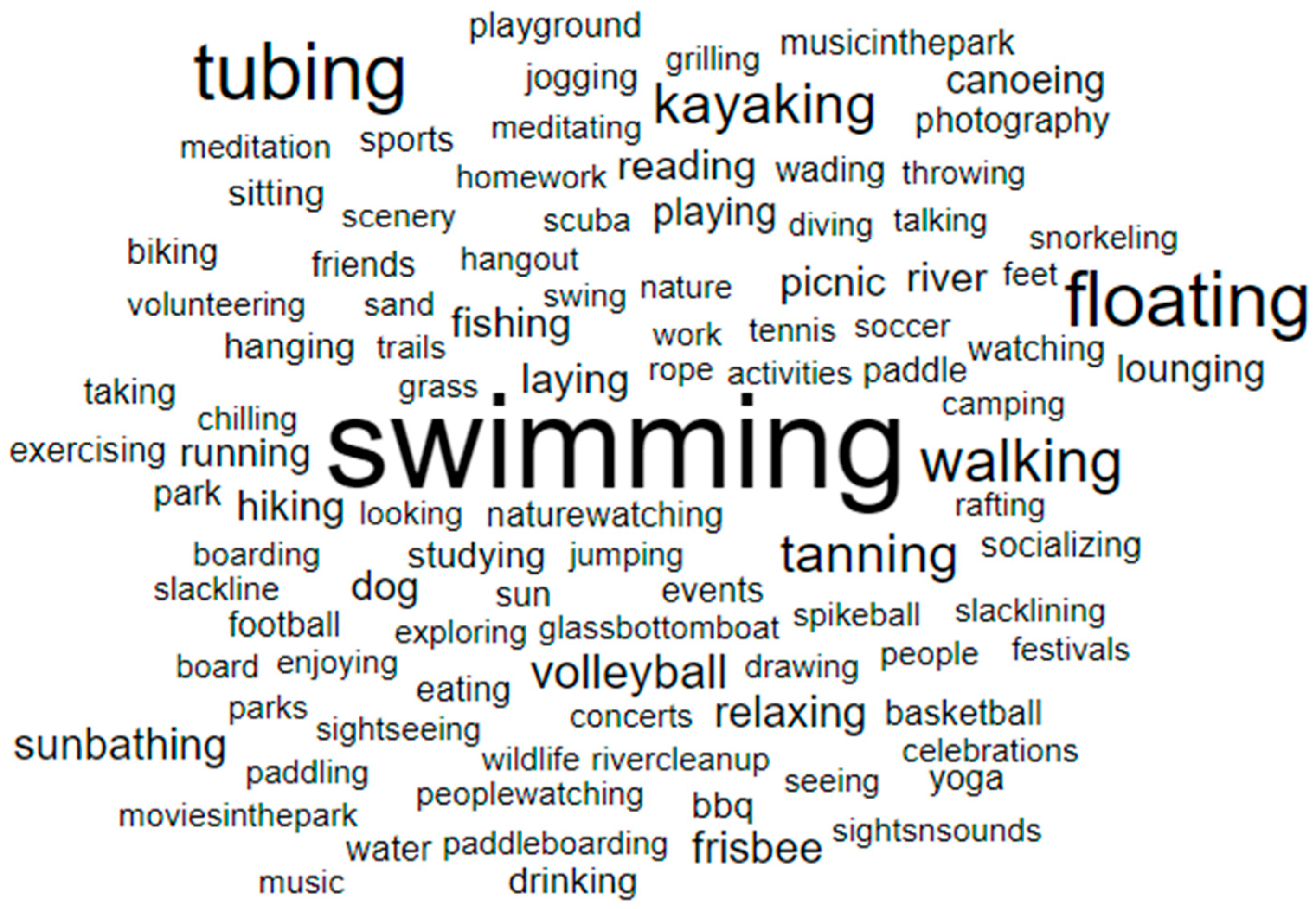
In addition to quantifying river usage (Table 4), we also measured social demand by asking (in a free-response format) what activities they participated in when visiting the San Marcos River (Figure 2). The most common categories of activities were swimming, floating/tubing, relaxing/stress relief/meditation/sunbathing, socializing/community event/picnic/drinking, park exercise (walking, running, jogging), park sports/recreation, water sports/recreation, dog activities, work/school/research, wildlife/nature viewing, river clean-up/volunteering, and reading (Appendix C). Swimming was the most popular activity, being mentioned by 41% of participants who listed at least one activity. Most river users (66%) listed 2–3 activities and as many as 19 activities. While people enjoyed the river in multiple ways, there were different preferences among the user groups. Non-student residents used the river more for physical exercise, while the other user groups (students and tourists) participated more in leisure activities (Table 4).
Figure 2.
Activities reported by river users, where size of word is proportional to frequency. Verbs with multiple tenses were changed to the same tense. Categorical data are reported in Appendix C. Word cloud was generated using Word it Out, a product of Enideo.
4.2. Perceptions and Preferences
Other measures of social demand for a social–ecological ecosystem are the perceptions and preferences of the social actors (Table 5 and Table 6; Appendix B and Appendix D). Regarding perceptions, two-thirds (67%) of respondents agreed or strongly agreed that “the environmental health of the San Marcos River (SMR) is well managed and well protected”, while 9% disagreed or strongly disagreed with this statement. The remaining 24% were neutral (neither agree nor disagree). Similarly, 9% of the respondents perceived the river as slightly dirty or extremely dirty, with the vast majority citing trash as the reason. Four out of every five respondents (80%) perceived the river as mostly clean or very clean; the remaining 11% were neutral. Newer residents (less than 4 years) were more likely to perceive the SMR as well-managed, well-protected, and clean (Appendix D).
Table 5.
Social actors’ perceptions of the San Marcos River and its management. Only statistically significant differences are listed. See Appendix D for statistical results.
Table 6.
Preferences of river use by social actors. Level of significance: * (0.05), ** (0.01), *** (0.001).
Another perception we measured was the sensitivity of the river to rapid urban growth. Only 13 respondents (less than 1%) disagreed with the statement “the San Marcos River and its environment are sensitive to rapid urban growth”. The vast majority (87%) believed the river is sensitive to rapid urban growth; older users, those with higher incomes, and those with higher levels of education were more likely to have this perception (Table 5). To expand on the perception of sensitivity and, thus, social demand, we asked two preference questions.
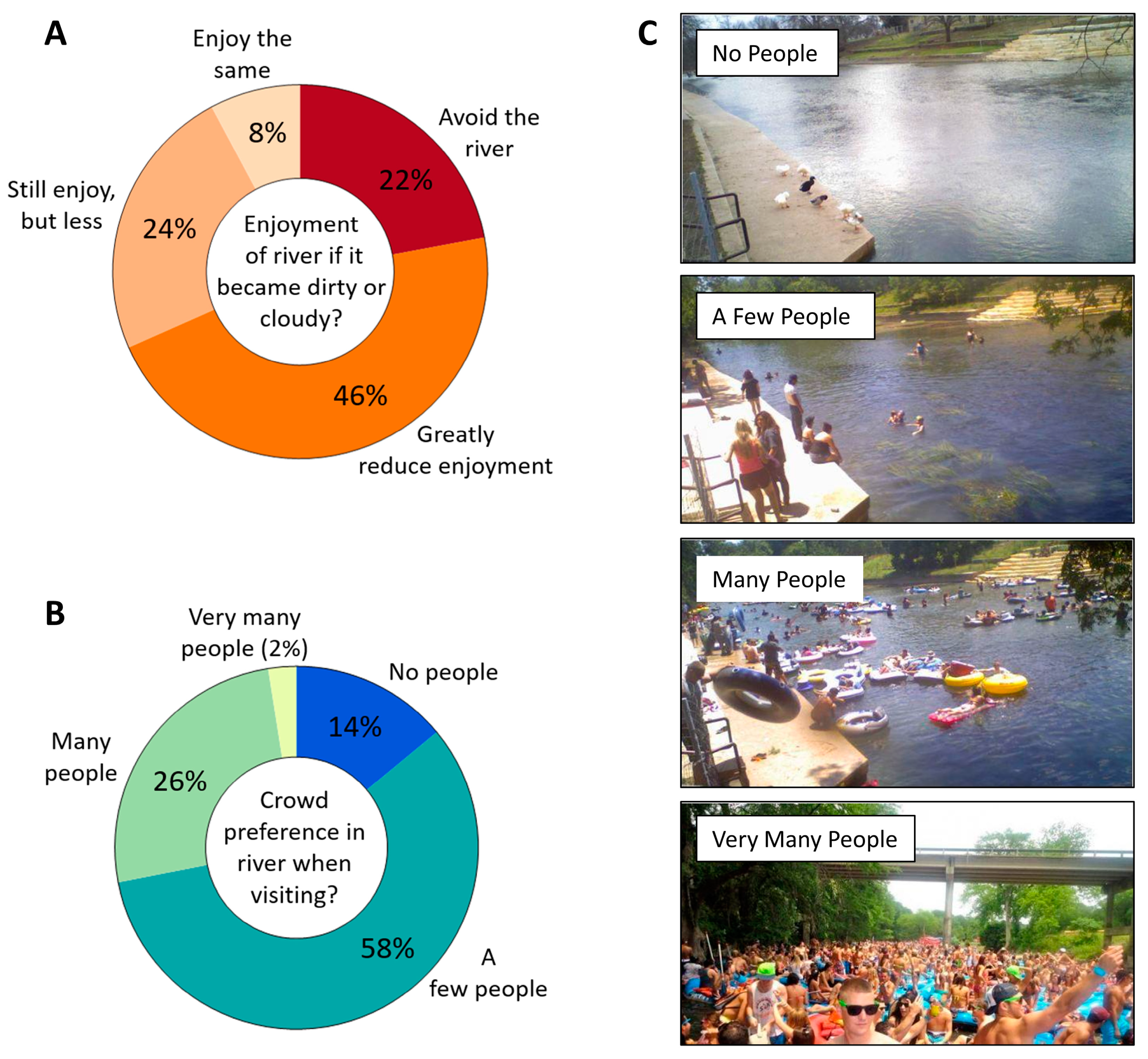
When asked “if the river became dirty or cloudy, would you still use and enjoy it the way you do now?” the most popular response for those who use the river (46%) was “it would greatly reduce my ability to use or enjoy the river” (Figure 3A). Almost a quarter (24%) said they “would still enjoy the river, but less than I do now”, and more than a fifth of the respondents (22%) said they “would avoid the river” if it became dirty or cloudy. These preferences did not vary among user groups, but those with higher income were more likely to avoid the river if water quality degraded (Table 6). In addition to wanting a clean and clear river, most respondents who use the river (58%) preferred only a few people in the river (Figure 3B). Some preferred no people in the river (14%). A quarter (26%) said they preferred many people in the river and 2% preferred very many people in the river. Compared to water quality preference, there was much more variation in crowd preferences in the river among social and user groups (Table 6). Those reporting longer-term residencies and higher education levels preferred fewer people in the river when visiting compared to other groups. White river users also preferred fewer people when compared to non-White river users. Regional tourists differed from resident and student user groups by preferring more of a crowd and enjoying the river the same regardless of water quality (Table 6).
Figure 3.
Preferences of river use by social actors based on water quality (A) and crowding preference (B). The images on the right (C) were included in the survey as a reference for crowd preference. The top three images are from City Park in San Marcos. Note in the second image the Texas wild rice present in the river and the exceptional water clarity when there are not “very many people” in the river. The bottom image was taken farther downstream near a commercial tubing operation.
4.3. Ecosystem Services and Environmental Values
Survey participants overwhelmingly (90%) agreed (or strongly agreed) that “the San Marcos River provides benefits to fish and wildlife.” Even more (96%) agreed (or strongly agreed) that “the San Marcos River provides benefits to human well-being.” With acknowledgment of the benefits provided by the river, we explored ecosystem services in the traditional categories of provisioning (food and water source), regulating (habitat and clean water), and cultural services (recreation and culture). Results showed that people generally assigned the highest importance to regulating services: 39% chose habitat as the most important benefit and 23% chose clean water first (Appendix E). Cultural services followed in importance: 20% chose culture first and 13% chose recreation as the most important benefit. Provisioning services ranked last: only 4% chose water source as most important and less than 1% chose food source. To assess environmental values, we asked participants to rank the relative importance of water and fish (separately) in the San Marcos River for human consumption (utilitarian, U), environmental health (intrinsic, I), and non-material (cultural) uses (relational, R) (Appendix E). For water, most respondents (70%) prioritized the intrinsic value of environmental health, with utilitarian and relational values each ranked highest by 15% of the sample. Among user groups, non-student residents were the only one significantly different than the others, with only 6% prioritizing human consumption (U). Almost four out of every five non-student residents (79%) prioritized environmental health (I), ten percentage points higher than the other user groups. Fish in the San Marcos River were overwhelmingly prioritized for their intrinsic value (84%), followed by relational value (10%) and utilitarian value (6%). Non-regional tourists were significantly different than other user groups: 10% prioritized human consumption (U), 16% prioritized cultural uses (R), and 75% prioritized environmental health (I), the lowest among all user groups.
We then assessed environmental values across social and user groups using multiple divisions of intrinsic (I), utilitarian (U), and relational (R) values (Table 7 and Table 8; Appendix E). Intrinsic values, such as habitat and clean water, were more prevalent among respondents with higher education levels and long-term residents of San Marcos. Respondents with lower education levels (e.g., less than a bachelor’s degree) and tourists prioritized utilitarian values, such as food and water source. Relational values—spanning culture, inspiration, education, identity, and spirituality—varied across residential status and years of residency. Newer residents, student residents, and tourists placed higher value on culture and recreation, whereas long-term residents (non-students) reported stronger relational values of spirituality and identity.
Table 7.
Summary of environmental values by social groups. Only statistically significant differences are listed. See Appendix E for statistical results.
Table 8.
Summary of user groups and environmental values. Only statistically significant differences are listed. See Appendix E for statistical results.
Overall, the user group of residential status exhibited more differences across environmental values than the user group frequency. For example, residential status affected how respondents were likely to value variables in each of the three environmental values (Table 8). Users who were residents (non-students) were more likely to value clean water (I) and spirituality (R), while more transient visitors such as tourists and students valued recreation (R), culture (R), and water source (I). Frequency groups showcased differences only in relational values with those who visit less frequently valuing recreation (R) and aesthetics (R) higher on average (Table 8).
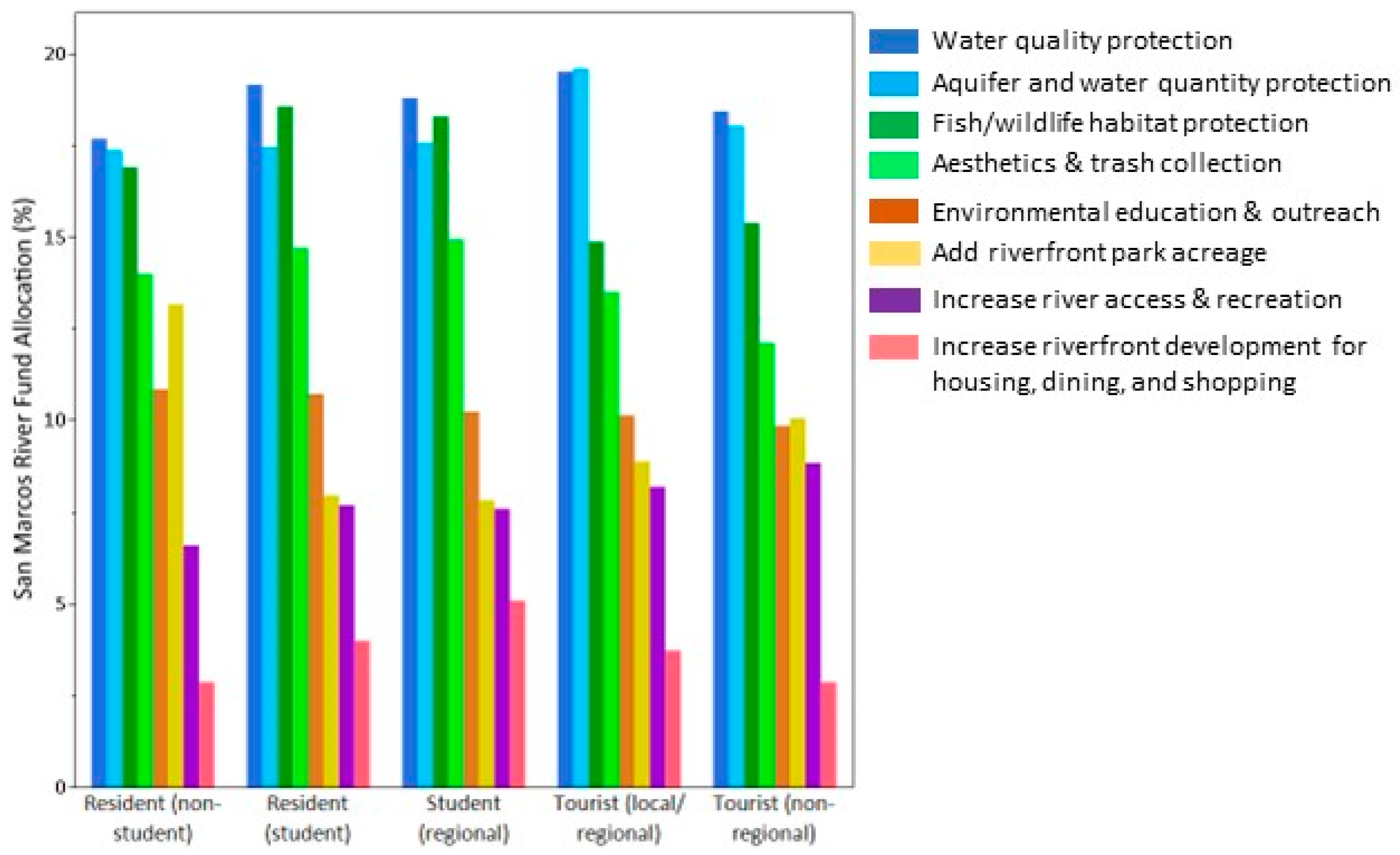
The final method we used to measure environmental values was asking participants to distribute money (percentage-wise, totaling 100%) from a hypothetical annual fund dedicated to improving the San Marcos River. The funding distributions were relatively consistent across all user groups (Figure 4), with water quality protection, water quantity protection, and habitat protection being the top three funding priorities. Riverfront development for housing, dining, and shopping was by far the least important—less than 5% for all user groups. However, there were some notable differences among user groups. Students (both resident and non-resident) placed greater importance on habitat protection for fish and wildlife. Non-student residents placed relatively high importance on increasing riverfront park acreage. Regional tourists placed the greatest importance on protection of water quality and water quantity, almost equally.
Figure 4.
Environmental values of user groups as measured by funding priorities for improvement projects on the San Marcos River.
4.4. Relational Models
Using a hierarchical subset of our survey questions and logical arguments (Table 2), we classified each participant into a relational model that ranged from detachment (nature as inexistent) to wardship (nature to be protected above all else). Only 1% of our surveyed sample fell into the detachment category, and only seven participants (<1%) were labeled as domination (human control over nature). Almost a third of our sample (34%) fell into the utilization relational model, where their priority was to benefit from nature rather than protect it. The most common relational model was stewardship (59%), where participants prioritized environmental health over human benefits. Finally, 6% of our sample were labeled as wards with a preference for a healthy ecosystem absent of people.
Once the respondents were sorted into relational models, we then looked at how the different user groups fell into the five relational models (Table 9). Detachment, although uncommon overall, was highest among regional tourists (4%). Domination was rare, only representing seven respondents overall, most of whom were resident students. Utilization was most common with regional students (37%) and nonregional tourists (36%), followed by resident students (34%) and regional tourists (31%). Twenty-seven percent of residents (non-students) were categorized as having a utilization relational model with the SMR, the lowest among all groups. Stewardship was the predominant relational model for all user groups, but highest for non-student residents (67%). Wardship models comprised a small but significant percentage of student and resident respondents (5–6%), but only accounted for 1% of tourist user groups.
Table 9.
User group distribution across relational models.
Using open-ended voluntary comments provided by respondents, we found supportive evidence for different relational models (Table 10). For example, to showcase “nature as nonexistent”, a student resident suggested that the river “needs more publicity”, which can be interpreted as more people should know about it and use it. The SMR is a tourist destination and was cited as being overcrowded in other user comments. In another example, those categorized as having a utilitarian relationship provided comments such as “more parking in general” and “more consideration for the humans who recreate” (Table 10). Stewardship model respondents stated that the SMR should be “treasured and preserved” and that it is “best to honor and protect it.” Wardship respondents would like “more strict actions of people within the river...” and show a willingness to “pay more or limit [...] recreational use for its sake” (Table 10).
Table 10.
Example comments from survey respondents (user group in parentheses) paired with their relational model.
Another finding from the open-ended comments is that there is overlap in social demand and environmental values between some of the relational models, particularly between stewardship and wardship. We expand on this overlap in the Discussion. One river feature that occurred frequently in the comments was Texas wild rice (Zizania texana), the rare and endangered plant species (endemic to our study area) that is protected and influences management of the river. This aquatic species—referred to as rice, grass, plant, and weed—was mentioned at least 50 times in the open-ended comments, sometimes in a positive context and sometimes in a negative context. We explore this controversial river feature further in the Discussion as well.
5. Discussion
5.1. Relational Models Built from Social Demand
The San Marcos River is a social–ecological system (SES) where different social actors (non-student residents, student residents, regional/commuter students, regional tourists, and extra-regional tourists) interact with one another and a natural environment that provides many benefits to society. Using this riverine SES as a natural experiment, we first assessed social demand—the uses, behaviors, preferences, perceptions, and values of society (sensu [32,33]). We found that the San Marcos River is heavily used (Table 3) for a multitude of activities (Figure 2, Appendix C). It is also a highly valued resource, particularly for its clean water, natural habitat, and tranquil milieu (Appendix C and Appendix D). Indeed, most river users preferred only a few people (or no people) when they visit and said that their use/enjoyment of the river would be greatly reduced (or they would avoid the river altogether) if the water became dirty or cloudy (Figure 3). The vast majority of survey participants prioritized environmental health over human use of the river. These findings accord with other SES studies from around the world [15,43,44,45,46].
Our study was also analogous to these international SES studies in that different social actors interacted with their environment in different modes (Table 3). In general, non-student residents visited the river weekly with a relatively small group and used the river parks for swimming, exercising, and socializing. Students visited the river much less (monthly or semi-monthly) and also used the river parks primarily for swimming, but floating (in an inner tube) and relaxing were their second and third most popular activities, respectively. Tourists mostly used the river for floating (often with an alcoholic beverage cooler) a few times a year depending on how close they live to the river. While students and tourists used the river for alike activities and with similar frequency, a notable difference between the two social actors was that students placed significantly higher value on the cultural aspects of the river (Table 8; Appendix E). The overall sum of social demand for the San Marcos River showed that people have preference for an ecologically healthy river that is swimmable and clean enough to float. A decline in any of those attributes could result in negative (and possibly unsustainable) outcomes [40,46].
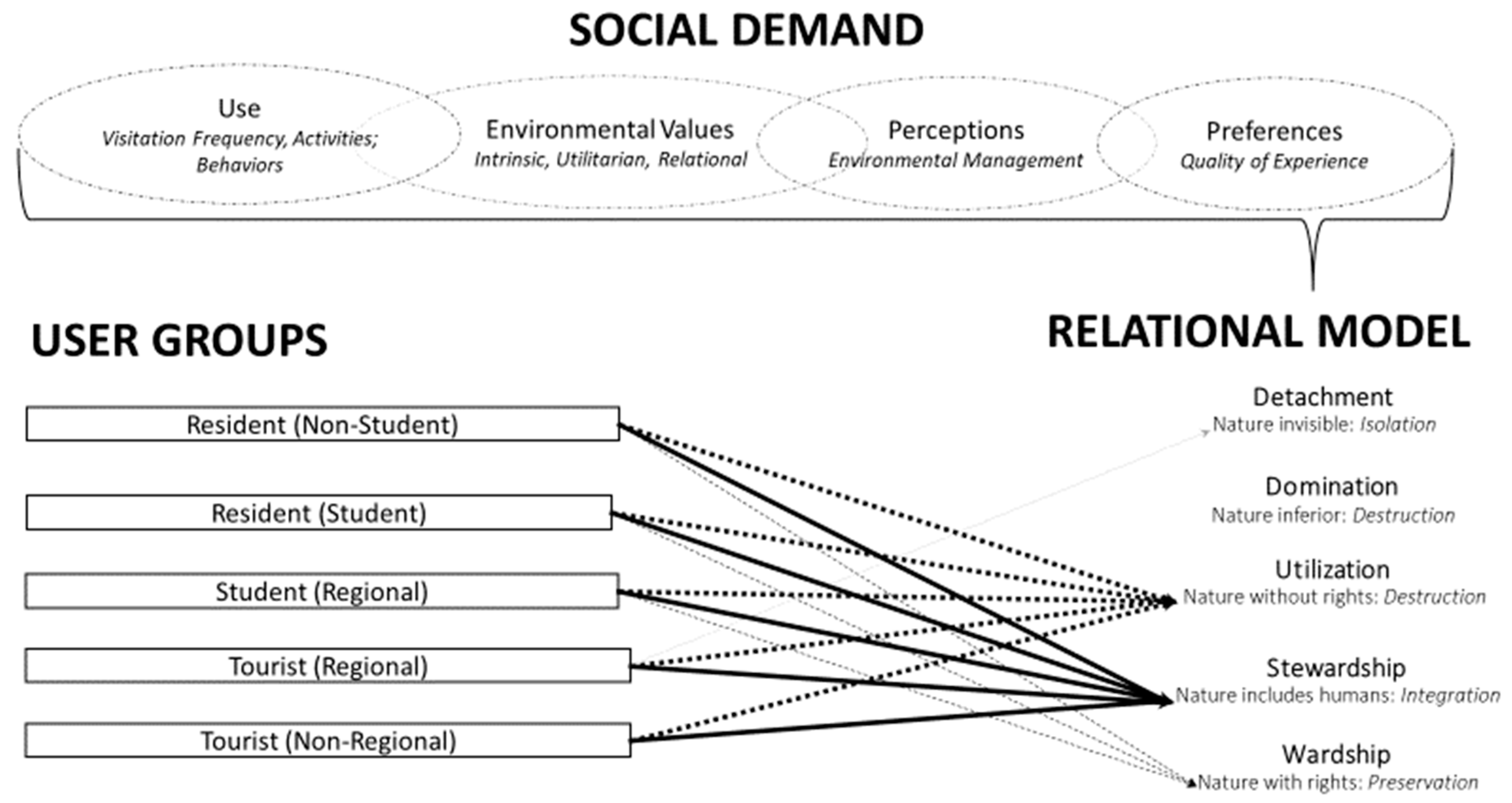
We used the ecosystem services framework to collect some of our social demand data because of its convenience and common language, but as recent scholars have pointed out, this framework fails to capture the complex ways humans and nature interact, particularly the cultural and moral dimensions (i.e., relational values) [3,7,12]. Thus, we expanded our SES analysis by exploring the relational models outlined in Muradian and Pascual (2018) [7]. We identified three prominent relational models within the San Marcos River SES: stewardship, utilization, and wardship (Table 10; Figure 5). Those that reflect the stewardship model showed a respect for nature by prioritizing environmental health over human use. Stewards also acknowledged the role of functioning aquatic ecosystems, showing knowledge and respect for the maintenance of SES. This system mindset and respect demonstrate a mostly relational value [13]. Those who fall into the utilization model agreed that water has benefits to human well-being but did not prioritize environmental health. They value nature’s agency, but not its rights; its benefit is as a service to society, i.e., its primary value is utilitarian. Wards demonstrate mostly intrinsic values. They prioritize environmental health above all else; they view the river as habitat and prefer no people in that habitat. These perceptions and preferences reveal adherence to the relational model of wardship, which views nature as an entity with rights that should be protected.
Figure 5.
Empirical relational models built on measures of social demand from different user groups. Arrow thickness and line variations (solid vs. dashed) indicate quantity of users assigned to model.
Our relational model’s methodology placed individuals into specific categories (Table 10; Figure 5); however, value expressions often overlapped. For example, a resident student classified as a steward stated: “[the] SM river is an amazing place that should be preserved, and if that means that I (and others) should not use it, I wouldn’t.” This comment is perhaps more reflective of a ward, who believes nature needs to be protected, in this case, from humans. In the same vein, a student resident also classified as a steward posed the question: “It’s a great river and homes a lot of living creatures, why do [we] as humans view that we are more important than them?” In this example, humans should not interfere with nature, i.e., nature as a separate entity with distinct rights (wardship model). Finally, the stewardship model boundary also blurred with the utilitarian model boundary. For example, a student resident said, “I think there should be more places to drink at the river and more trash bins along the river so people can throw away their trash with more ease,” which leans toward using the river as a place to consume alcohol while having the amenity of trash receptacles. This blurring of boundaries, or value heterogeneity, is quite common in social–ecological systems with valuable natural resources [46].
The San Marcos River is teeming with valuable natural resources: clear, flowing water rich in biodiversity and surrounded by scenic, amenity-rich parks. This natural wonderland is extensively managed and largely protected for the endangered species that rely on a healthy ecosystem [23]. One of these protected endangered and endemic species is Texas wild rice (Zizania texana). From the more than 50 comments that specifically mentioned this protected species, we found both shared (Table 10) and conflicting values. Respondents classified as stewards stated the following regarding the management of the endangered species:
“I think it’s pointless to keep weeds in the water. All to save some rice?? Sorry but I put humans needs over rice....” (Resident, student; punctuation original)
“Don’t restrict access because of wild rice.” (Resident, non-student)
“The rice grass is growing too much it makes the river look really gross and tacky.” (Resident, non-student)
These attitudes may be attributed to differences in social demand, and the dislike of the wild rice may simply reflect a more utilization relational model. To be sure, respondents who were sorted into a utilization model felt similar, as supported in the following example comments:
“Sometimes we spend too much time and money protecting the endangered species in preference to making it a nicer recreational area. Cut the weeds, they grow back and I think we pay far too much time and money to protect the wild rice. It grows back.” (Resident, student)
“Stop making barricades in the river to save the over abundance of wild rice grass.” (Resident, student)
“Trim some of the grass so it’s not sticking out of the water.” (Resident, student)
One difference between the two sets of comments is that the stewardship model included non-student residents, while those who held negative perceptions of Texas wild rice and fell into a utilization model were all students. This result could be a consequence of a lack of education about the importance of the species and its proper management, i.e., “cutting the grass”. Nonetheless, in this pilot approach to classifying users of a blue space into relational models, we find that—similar to relational values—there are patterns, yet the edges and transitions are blurry.
Relational values are dependent on the desire for harmony between social and ecological actions, meaning intrinsic values and utilitarian values are both important but are interwoven to promote a relational value with place [13]. If someone enjoys time spent in blue spaces, is it because they receive a direct utilitarian benefit (stress relief) or because of their relationship with the place? The individual making the value attribution may be unable to articulate a distinction. It is important to acknowledge that bundles of services and intertwined values create a more holistic picture of individuals’ experiences [33]. Indeed, there are differences between the ways in which practitioners, academics, and the public conceptualize ecosystem services [11]. For example, Lehnen and colleagues have used the IPBES and nature’s contributions to people framing to “zoom into connections between people and nature” with their “individual relationships with entities of nature framework”, which acknowledges issues of justice and equity when assessing environmental values [47]. That is, their multi-dimensional examination of nature–human relationships helps “detect inequalities in the benefits and detriments individual people receive” ([47] p. 596).
5.2. Our Relationship with Nature Is a Shared Value
Despite differences in social demand among groups, several key values and preferences were shared. Across social groups, intrinsic values (habitat) and relational values (aesthetics and sense of place) were highly regarded. Additionally, inspiration, education, and culture were similarly valued among groups. In this way, relational values blur the lines between utilitarian and intrinsic values because they prioritize healthy ecosystems to promote deeper connections. Further blurring the lines of relational values is the fact that across groups, most of the relational values we measured held few differences—and the differences that did exist were mostly from long-term residents having deeper levels of place meaning and connection. These shared valuations and preferences for ecosystem services show a general societal preference for the maintenance of ecosystems for relational values over utilitarian and intrinsic values [13,15,22].
An important finding from our research is that social actors have idealized expectations of their social–ecological system. The majority of social actors (across all user groups) prefer clear water and would “greatly reduce” their use and enjoyment of the river if it became dirty or cloudy. More than a fifth (22%) of the respondents would avoid the river altogether if it was in this degraded condition. This general demand for clean water has been shown for a spectrum of blue spaces around the world [48,49,50,51,52,53,54]. These studies, along with our study, have shown that people are willing to travel far and incur higher costs to enjoy clean lakes and rivers. Indeed, the visual characteristics of an environment, e.g., water clarity, are often used by the public to gauge environmental quality [55]. While the previous studies attribute this increased demand for aesthetics and recreational preferences, our multi-dimensional data reveal deeper connections—connections between environmental health and our overall well-being. While the interpretation of “aesthetics” is highly variable and dependent on personal experiences, as well as frames of beauty [56], we can reasonably assume that respondents did not just prioritize clean water to meet their subjective view of aesthetics but prefer clean water because it supports ecosystem functioning as 70% of the social actors prioritize environmental health over any human uses supports this stewardship relational model.
Furthermore, social actors want pristine conditions with few or no people in the river; yet, they use the river a lot and for many activities. Non-student residents best exemplify this hypocrisy on account that 75% of them wanted either a few or no people in the river; yet, they were the most frequent users of the river (Table 4; Figure 3). Regional students had similar expectations but were the most likely to avoid the river if it became dirty or cloudy (26% of them). We attribute this “delight or flight” attitude to their greater mobility. These regional students come to the San Marcos River specifically for its natural benefits, but if these benefits are degraded, it is easy for them as non-residents to visit a more desirable blue space. Residents are less mobile and will continue to use their river even if it is degraded, although their enjoyment will be less. Because residents are more place-invested, they are more likely to be stewards and wards of their precious resource.
In addition to place-investment, one possible explanation for residents reflecting behaviors of stewardship—as shown in other studies—is that the activities themselves allow the “relation” to form [54,57,58]. According to Tuan’s theory of “body ballet”, it is the habitual movements in and across a space that create place [59]. In previous studies, users of blue places with higher levels of place dimensions (sense of place, place dependence, and place identity) were found to have a stronger response to the place, i.e., “a willingness to take action to preserve” ([59], p. 675) [46]. We found evidence of the desire to protect a place-based, communal asset and identity-expressive place meanings [60,61] in some of the additional, optional comments from respondents (Table 11).
Table 11.
Example comments reflective of place-based meanings.
We see this phenomenon reflected here through the additional comments left by residents, including student residents, possibly showcasing identity-expressive meanings [61] with the SMR. We explore place identity further below.
5.3. Social Connectivity and Place Identity
The manifold social demand for the San Marcos riverscape reflects multiple scales and dimensions of connectivity [34,62,63]. The preference for readily available clean water (Figure 3, Appendix D) and the high value placed on protecting the aquifer, water quality, and fish/wildlife (Figure 4), combined with the consensus that the river is sensitive to rapid urban growth (Table 5), establishes the watershed-scale connections of the river. That is, most river users recognize that the health of their beloved river reach is affected by land use and management at the watershed-scale.
In addition to being a biodiversity hotspot, the San Marcos River is a cultural hotspot [64]. Kondolf and Pinto suggest the social connectivity—or the “communication and movement of people, goods, ideas, and culture along and across rivers”, namely through the recognition of “longitudinal lateral, and vertical connectivity” ([62], p. 182)—plays a role in “river culture” wherein the “intersection of hydrologic, biological, and cultural uses and values of rivers as a basis for preserving ecological and cultural diversity along rivers” [57] ([62], p. 182). Our study site, the upper San Marcos River, offers exceptional social connectivity. There is a high degree of lateral connectivity on account of the river being narrow enough (~20 m) to observe human activities on the other side of the river and shallow enough (mostly waist-deep) to cross the river and interact with both riverbanks. The multiple pedestrian and vehicle bridges enhance this lateral connectivity. Vertical and longitudinal connectivity are maintained through the various parks and public access points along the river, with the right side of the river being continuous in this regard. Additional longitudinal connectivity is provided by a ~2 km sidewalk/trail system that connects the downstream extent of our study area all the way to the headwaters, with paths underneath the vehicle bridges.
Furthermore, the small river with excellent water quality and social connectivity enables activities in the stream, along the bank, and throughout riverside parks. The opportunity for various activities—swimming, tubing, snorkeling, kayaking, nature-watching, sunbathing, and music, just to name a few (Figure 2)—plays a vital role in creating and reinforcing relational values in the City of San Marcos and abroad. That is to say, diverse populations have the opportunity to form a relationship with the (clear flowing, not too crowded) blue space through their preferred method. It is this relationship that leads to "place identity”—a deep form of place attachment wherein the self develops in relation to the physical environment by means of preferences, beliefs, values, and goals [65]. This place identity fosters a stewardship ethic, especially in natural areas [66,67]. These stewards feel a responsibility to take care of their environment and, thus, visit it more frequently, intensifying relational values in the process. This positive feedback phenomenon most likely manifests in long-term residents, as length of time in residency is the strongest predictor of place identity [68]. Indeed, the residents subgroup in our study gravitated toward relational models of stewardship and wardship. Their relations with the SMR seem to be a part of their overall identity (as shown in the comments in Table 11), whereas more transient visitors such as tourists have not had the extended interaction needed to create deep place meanings.
In the middle of this spectrum—between long-term resident stewards and casual tourists—are students, some short-term residents and some commuters. While most of these students classified as stewards (with a heightened appreciation of the cultural benefits of the river), they were more likely to have stronger utilitarian values. Their utilitarian activities (e.g., tubing and sunbathing) are substitutable, meaning one can tube or sunbathe at a different blue space, one that best meets their social demands. Commuter students were particularly acute to this scenario, where more than a quarter of them said they would avoid the river if its water clarity did not meet their preference. Earlier, we related this “delight or flight” attitude to the commuter students’ greater mobility (ease of finding a new blue space), but this attitude is also related to a lack of place identity [58].
The importance of place-identity and environmental stewardship goes well-beyond social connectivity and relational values. A persistent problem is how to meet the increasing social demands placed on the environment and maintain healthy ecosystems [69]. Recent scholars have suggested and shown that environmental stewardship (voluntary action on behalf of the environment [70]) can fill these multi-scale gaps in natural resource management [71,72]. Motivation for volunteerism/stewardship has been widely investigated [72,73,74,75,76], and researchers have found that participation in stewardship activities—from individual litter pick-up to organized group efforts such as water-quality monitoring—can catalyze deepening the human–environment relationship, thereby crafting a stewardship relational model that may transcend geographic boundaries [71]. Such a relational model could serve as a leverage point for guiding sustainable human–environment behavior [47], as broader society should seek to implement “stewardship at all levels to maintain and improve ecosystem services” [77].
Understanding and enacting sustainable human–environment behavior is a critical component of social–ecological systems (SES) research, as it is often “problem-oriented” by seeking to inform environmental management policy and practice [40]. SES governance is centered on knowledge from multiple actors, using socio-ecological relationships to make decisions that prompt system sustainability [78], thereby adapting management plans based in part on stakeholder knowledge. User surveys, such as the one in this study, are a useful mechanism to capture potential relational models and individual dimensions of SES, which lead to adaptive plans that reflect the local context [79].
Our study, situated in an SES framework, establishes the social demand (uses, preferences, perceptions, and values) of stakeholders. Relational values, coupled with multi-dimensional data and relational models, are a path toward incorporating social dynamics into environmental planning, rather than relying on market value preferences or preferences for ecosystem services, including willingness-to-pay studies [80,81]. Preferences for ubiquitous values of ecosystems (clean water and fewer people) can be leveraged into heuristics to guide decision-making in complex conditions with multiple stakeholder opinions (see [82] for an education tool). For example, our case study quantifies social dynamics within an SES to adjust local environmental planning. Since 2013, the San Marcos River has been managed under the Edwards Aquifer Habitat Conservation Plan (EAHCP) [23]. The EAHCP works to ensure suitable habitat for threatened and endangered species within the Edwards Aquifer system, which includes the San Marcos River. The HCP is implemented through a “stakeholder driven process,” which can be informed by this study [23]. Environmental education, recreation, and user behavior change are crucial to the EAHCP’s success, which balances the sensitive habitat with social demand.
Limitations include applying relational models to a single social–ecological system, i.e., in a limited context and geographical scope. Had the survey been administered to various users of multiple SES, the results may be different. In addition, we did not include ecosystem disservices, or the harm nature can cause humans, in our questionnaire and analysis [83]. Future research could use a questionnaire crafted to address all grammars of relational models, i.e., to include statements about domination, detachment, etc., as related to ecosystem disservices. Furthermore, our questionnaire and analysis did not address the multifaceted aspects of aesthetics as it relates to the overall experience of the SES. We acknowledge that aesthetics is examined in a variety of disciplines (philosophy, urban design, and environmental psychology to name a few) but that unpacking the breadth of the term was outside of the scope of our study. We suggest that future research works to ameliorate discrepancies between users’ lived experiences and references points for aesthetics [56] and applies the framework of relational models to users of multiple and varied blue spaces.
6. Conclusions
This study is one of the largest survey samples to date of a social–ecological system (SES) wherein ecosystem services, environmental values, social demand, and nature–human relational models were assessed. Our SES is also noteworthy because it is one of the most intensively managed aquatic ecosystems in the fastest growing region of the United States. We collected a wealth of data on ecosystem services and social demand to gain a deeper understanding of this exceptional SES, and then applied the framework of Muradian and Pascual (2018) to develop empirical relational models [7]. These empirical models provide a real-world assessment (beyond just theory) of how social actors engage with and value a blue space. Broader implications of applying relational models suggest that stewardship and wardship models could be leveraged to encourage policies and practices encouraging environmental stewardship. An environmental stewardship ethic, once introduced, is likely to create a positive feedback loop where frequent relational experiences in nature lead to human behaviors that are aware, attached, informed, engaged, and nurturing.
Looking forward, we found that relational values as a third category (beyond intrinsic and utilitarian) does offer additional insights; however, the nuances found (such as the blurring of boundaries and plural relational values) are a signal that three categories may be insufficient. Multiple relational models and system archetypes may offer multi-dimensional solutions, but nature–human relationships that transcend epistemological boundaries are on the horizon.
Author Contributions
Conceptualization, J.P.J., C.W.L. and M.T.W.; methodology, J.P.J.; software, C.W.L., M.T.W., and J.P.J.; validation, J.P.J.; formal analysis, C.W.L.; data curation, J.P.J.; writing—original draft preparation, C.W.L. and M.T.W.; writing—review and editing, M.T.W. and J.P.J.; visualization, C.W.L. All authors have read and agreed to the published version of the manuscript.
Funding
This research received no external funding.
Acknowledgments
We are grateful to Graham Daly and Emily McBroom for helping administer the survey. Graham Daly also helped design the survey and with initial data organization. The City of San Marcos and the San Marcos Convention and Visitor Bureau, respectively, provided access to facilities and resources to assist in the commissioning of the survey.
Conflicts of Interest
The authors declare no conflict of interest. The funder had no role in the design of the study, in the collection, analyses, or interpretation of data, in the writing of the manuscript, and in the decision to publish the results.
Appendix A. Survey Questionnaire
A Survey of Peoples’ Use and Value of the San Marcos River
TEXAS STATE UNIVERSITY: Department of Geography
Consent Form:
This survey is designed to measure how people use and value the San Marcos River. Even if you do not visit the San Marcos River, your input is still valuable for a better understanding of the relationship between people and the river. This survey should take about 15 min to complete. All survey responses are confidential and remain anonymous and can in no way be linked to your identity. Your participation is voluntary and very much appreciated, but you may opt out at any moment. However, it is preferred that you answer all of the questions so that the data we collect will be accurate and representative of the people surveyed. It is our intention to conduct a thorough study of the relationship between people and the San Marcos River to inform a better understanding of this important relationship.
This survey questionnaire [EXP2015Y951777I] did receive Texas State University IRB exemption on 8 May 2015.
- Are you willing to participate in this survey?
- Yes/No
- Have you already taken the San Marcos River Use and Value Survey?
- Yes/No
[If yes, thank you for your time. We are only able to survey individuals once. If no, please continue.]
(1) Do you live in San Marcos? [If yes, continue to question #2. If no, skip to question #5.] Yes/No
(2) How many years have you lived in San Marcos? [Enter whole numbers only.]
(3) Approximately how close (in miles) do you live to the San Marcos River?
[Enter a decimal place if appropriate.]
(4) What role did the San Marcos River play in your decision to live in San Marcos?
___ It was the primary reason I chose to live in San Marcos.
___ It played a major role in my decision to live in San Marcos.
___ It played a minor role, being one of many reasons I chose to live in San Marcos.
___ It did not factor into my decision to live in San Marcos.
(5) What is the zip code of where you live?
(6) Have you visited the San Marcos River and its neighboring parks?
Yes/No
[If yes, continue to question #7 below. If no, skip to question #17.]
(7) How many years have you been visiting the San Marcos River and its neighboring parks?
[Please mark 0 if this is your first visit to the river, 1 if it is your first year of visits.]
(8) How many people usually accompany you on your visits to the San Marcos River and its neighboring parks?
__ None: I usually visit alone.
__ Usually one other person.
__ Usually two or three other people.
__ Usually in a large group of more than four.
(9) During which seasons do you visit the San Marcos River and its neighboring parks?
[Mark all that apply.]
___ Winter
___ Spring
___ Summer
___ Fall
(10) When do you visit the San Marcos River and its neighboring parks throughout the week?
___ Weekends: Saturday and Sunday
___ Weekdays: Monday through Friday
___ Both: Weekends and Weekdays
(11) What times of day do you visit the San Marcos River and its neighboring parks?
[Mark all that apply.]
___ Mornings
___ Afternoons
___ Nights
(12) How many times do you visit the San Marcos River and its neighboring parks in a typical week?
[Whole numbers only.]
(13) How many times do you visit the San Marcos River and its neighboring parks in a typical year?
[Whole numbers only.]
(14) What activities do you participate in when visiting the San Marcos River and its neighboring parks? [List as many as you like and rank in order of preference with 1 being most preferred.]
(15) How much money do spend on your average visit to the river? Consider transportation and consumable goods separately. [Enter whole numbers only.]
Transportation: Gas, parking, public transport, etc. $
Consumables: Food, drink, ice, charcoal, tube rentals, sunscreen, etc. $
(16) How much money do you spend on average per year for large, multiple-use, river-related items such as (but not limited to) kayaks, canoes, tubes, fishing equipment, swim fins, snorkels, and river shoes? [Enter whole numbers only.]
Total: $
(17) The San Marcos River provides benefits to fish and wildlife.
___ Strongly agree
___ Agree
___ Neither agree nor disagree
___ Disagree
___ Strongly disagree
(18) The San Marcos River provides benefits to human well-being.
___ Strongly agree
___ Agree
___ Neither agree nor disagree
___ Disagree
___ Strongly disagree
(19) Rank the following benefits of the San Marcos River below.
[1 being the most important and 6 being the least important.]
___ Habitat: for plants and animals.
___ Food: a source of fish for your meals.
___ Recreation: a place for recreational fishing, swimming, tubing, and boating.
___ Clean water: clean and reliable water from the aquifer groundwater system.
___ Water source: a source for municipal, industrial, or agricultural water uses.
___ Culture: a place for relaxing or enjoying the scenery and local culture.
(20) Rank the following cultural benefits of the San Marcos River below.
[1 being the most important and 6 being the least important.]
___ Inspiration: artistic, cultural, or work related activities.
___ Aesthetics: relaxation, scenery, or sentimental value.
___ Education: opportunity to experience, learn about, or appreciate nature.
___ Identity: cultural heritage, local pride, sense of place, or symbol of San Marcos.
___ Spirituality: sacred, religious, or mental health activities.
___ Recreation: tubing, fishing, boating, swimming, or physical health activities.
(21) Rank the importance of water in the San Marcos River.
[1 being the most important and 3 being the least important.]
___ Environmental health: water quantity, water quality, air quality, and habitat for plants and animals.
___ Non-material human uses: associated with recreation, aesthetics, education, inspiration, spirituality, and identity.
___ Human consumption: use associated with municipal, agriculture, and industry water supply.
(22) Rank the importance of fish in the San Marcos River.
[1 being the most important and 3 being the least important.]
___ Environmental health: one part of the ecosystem and food web which also includes birds, mammals, insects, and plants.
___ Non-material human uses: recreational fishing, aesthetics of viewing, and education of the environment.
___ Human consumption: a food high in protein, low in fat, and a source of fatty acids.
(23) The environmental health of the San Marcos River is well-managed and well-protected.
___ Strongly agree
___ Agree
___ Neither agree nor disagree
___ Disagree
___ Strongly disagree
(24) If you were in charge of an annual fund dedicated to improvement projects for the San Marcos River, how would you distribute the money? [The 100% is representative of all of the money in the fund. Total must add up to 100%, whole numbers only.]
| Landscaping, beautification, and trash collection | |
| Increase public outreach and environmental education | |
| Aquifer and water quantity protection | |
| Increase access and recreational opportunities for kayaks, canoes, tubes, and swimming | |
| Add acreage to existing riverfront parks | |
| Water quality protection | |
| Increase riverfront development for housing, dinning, and shopping | |
| Fish and wildlife habitat protection and restoration | |
| Total % | 100% |
(25) What dollar amount of your own money would you be willing to donate per year to a San Marcos River fund for the following improvements? You can donate to more than one area or none at all. [Whole numbers only.]
| Landscaping, beautification, and trash collection | $ |
| Increase public outreach and environmental education | $ |
| Aquifer and water quantity protection | $ |
| Increase access and recreational opportunities for kayaks, canoes, tubes, and swimming | $ |
| Add acreage to existing riverfront parks | $ |
| Water quality protection | $ |
| Increase riverfront development for housing, dinning, and shopping | $ |
| Fish and wildlife habitat protection and restoration | $ |
| Total $ | $ |
(26) Please describe how clean the San Marcos River is.
___ Very clean
___ Mostly clean
___ I am not aware of the cleanliness of the San Marcos River
___ Slightly dirty
___ Extremely dirty
(27) Please list the reason(s) you chose to describe the river as dirty.
[If you chose Slightly dirty or Extremely dirty.]
(28) Usually the water in the San Marcos River is clean and clear. If the river became dirty or cloudy, would you still use and enjoy it the way you do now?
___ I would continue to use or enjoy the river the way I do now.
___ I would still enjoy the river, but less than I do now.
___ The cleanliness and clarity of the river has no effect on how much I use or enjoy the river.
___ If the river became dirty or cloudy, it would greatly reduce my ability to use or enjoy the river.
___ I would avoid the river if it was a dirty or cloudy river.
___ I do not currently use or enjoy the river.
(29) What is your personal preference of the amount of people in the river and parks when you visit? [Refer to photos.]
___ No people
___ A few people
___ Many people
___ Very many People
___ I do not visit the San Marcos River and neighboring parks
(30) Select up to five areas you visit along the San Marcos River, including areas not mentioned in the examples below. [Mark your areas with small circles.]

(31) Do you appreciate the San Marcos River being in San Marcos?
___ I greatly appreciate it.
___ I appreciate it somewhat.
___ I don’t care one way or another.
___ I don’t appreciate it.
___ I wish it were not in San Marcos.
(32) Do you appreciate Texas State University being in San Marcos?
___ I greatly appreciate it.
___ I appreciate it somewhat.
___ I don’t care one way or another.
___ I don’t appreciate it.
___ I wish it were not in San Marcos.
(33) Do you appreciate the Outlet Malls being in San Marcos?
___ I greatly appreciate it.
___ I appreciate it somewhat.
___ I don’t care one way or another.
___ I don’t appreciate it.
___ I wish it were not in San Marcos.
(34) Rank the following in terms of the benefits they provide San Marcos.
[1 being the most beneficial and 3 being the least beneficial.]
___ Outlet Malls
___ Texas State University
___ San Marcos River
(35) The San Marcos River contains endangered or threatened plant or animal species.
___ Yes
___ No
___ I do not know
(36) The San Marcos River and its environment are sensitive to rapid urban growth.
___ Strongly agree
___ Agree
___ Neither agree nor disagree
___ Disagree
___ Strongly disagree
(37) Please explain your answer to the above question concerning the sensitivity of the San Marcos River to rapid urban growth.
(38) Describe the amount of time you spent enjoying outdoor activities during childhood and adolescence.
___ Regularly
___ Occasionally
___ Rarely
___ Never
(39) List the outdoor activities you enjoyed doing during childhood and adolescence and then rank them accordingly with 1 being the most enjoyed.
[Enter “None” if your answer to the previous question was “Never”.]
(40) Which setting best describes where you grew up?
___ Urban
___ Suburban
___ Rural
(41) During your childhood and adolescence, what was the occupation(s) of the person(s) who raised you?
------------------------------------------------Demographic Information----------------------------------
(42) Are you employed?
Yes/No
(43) What is your current or most recent occupation?
(44) Is your occupation related to the San Marcos River?
Yes/No
(45) If yes, please explain how your occupation is related to the San Marcos River.
(46) Do you own or work on a farm or ranch? [If yes, continue to question # 47. If no, skip to # 49.] Yes/No
(47) How long have you owned or worked on the farm or ranch? [Whole number years.]
(48) Please describe the type of farm or ranch, and its activities including if irrigation or groundwater wells are used.
(49) How old are you?
___ <25
___ 25–34
___ 35–44
___ 45–54
___ 55–64
___ 65 +
(50) Gender
Male/Female
(51) Race or Origin [You may select more than one.]
___ American Indian or Alaskan Native
___ Asian
___ Black or African American
___ Hispanic or Latino or Spanish
___ Native Hawaiian or Pacific Islander
___ White or Anglo
___ Other________________________
(52) Annual household income
___ <$20,000
___ $20,000–$40,000
___ $40,000–$60,000
___ $60,000–$80,000
___ >$80,000
(53) How many people live in your household?
(54) What is the highest level of education you have completed?
___ Some secondary or high school
___ High school graduate
___ Some college, but no degree
___ Associate or technical degree
___ Bachelor’s degree
___ Post-graduate masters or professional degree
___ PhD, law, or medical degree
(55) What is the highest level of education of the person(s) who raised you?
___ Some secondary or high school
___ High school graduate
___ Some college, but no degree
___ Associate or technical degree
___ Bachelor’s degree
___ Post-graduate masters or professional degree
___ PhD, law, or medical degree
(56) Is there anything else you would like to tell us regarding your use or perception of the San Marcos River? [If “No”, enter “No”.]
Thank you for completing this survey. We appreciate your participation and are happy to discuss any questions or comments you may have.
Appendix B. User-Group Characteristics

Table A1.
User-Group Characteristics.
Table A1.
User-Group Characteristics.
| Characteristics | Resident (n = 362) | Resident (Student) (n = 1984) | Regional Student (n = 564) | Regional Tourist (n = 167) | Nonregional Tourist (n = 68) |
|---|---|---|---|---|---|
| Years in SM | Range: 0–73 | Range: 0–52 | N/A | N/A | N/A |
| Median: 9 | Median: 2 | ||||
| Mean: 15 | Mean: 3 | ||||
| Race/Ethnicity | |||||
| Nonwhite | 31% | 40% | 38% | 54% | 33% |
| White | 69% | 60% | 62% | 46% | 67% |
| Gender | |||||
| Female | 58% | 69% | 72% | 61% | 59% |
| Male | 42% | 31% | 28% | 39% | 41% |
| Age | |||||
| <25 | 21% | 76% | 77% | 18% | 15% |
| 25–34 | 18% | 17% | 16% | 21% | 23% |
| 35–44 | 16% | 4% | 3% | 17% | 22% |
| 45–54 | 14% | 2% | 2% | 16% | 10% |
| 55–64 | 19% | - | 2% | 15% | 17% |
| 65+ | 11% | - | - | 13% | 13% |
| Education | |||||
| High School | 6% | - | - | 10% | 10% |
| Some College | 23% | 83% | 84% | 21% | 24% |
| Associate | 8% | - | - | 13% | 8% |
| Bachelor | 32% | 15% | 12% | 34% | 31% |
| Masters | 22% | 3% | 4% | 16% | 19% |
| Doctorate/Professional | 9% | - | - | 6% | 8% |
| Income | |||||
| <$20 k | 22% | 83% | 81% | 14% | 5% |
| $20–40 k | 19% | 10% | 10% | 12% | 21% |
| $40–60 k | 18% | 4% | 3% | 24% | 18% |
| $60–80 k | 12% | 2% | 2% | 14% | 21% |
| $80 k+ | 29% | 2% | 3% | 37% | 34% |
| Environment Raised | |||||
| Urban | 18% | 18% | 16% | 23% | 24% |
| Suburban | 53% | 57% | 61% | 47% | 53% |
| Rural | 29% | 25% | 23% | 30% | 24% |
| Loss of Water Clarity | |||||
| No change in use | 7% | 7% | 5% | 21% | 14% |
| Use less | 26% | 23% | 24% | 20% | 32% |
| Greatly reduce | 49% | 47% | 44% | 42% | 32% |
| Avoid | 18% | 22% | 26% | 17% | 22% |
| Crowding preference | |||||
| Do not visit | 1% | 3% | 3% | 2% | 3% |
| No people | 14% | 15% | 14% | 4% | 8% |
| A few people | 61% | 56% | 56% | 56% | 62% |
| Many people | 20% | 25% | 26% | 30% | 20% |
| Very many people | 5% | 2% | - | 9% | 8% |
Appendix C. Activities
Table A2.
Activities listed by user groups.
Table A2.
Activities listed by user groups.
| User Group | All Participants | Resident Students | Resident Non-Students | Regional Students | Local/Regional Tourist | Non-Regional Tourist |
|---|---|---|---|---|---|---|
| % that listed at least 1 activity | 88.3 | 88.5 | 93.6 | 87.9 | 80.7 | 86.8 |
| Total # of activities | 7956 | |||||
| Avg. # of activities per person | 2.53 | 2.48 | 3.45 | 2.41 | 1.79 | 1.62 |
| Most common activity (#) | Swimming | Swimming (1008) | Swimming (237) | Swimming (295) | Floating/Tubing (65) | Floating/Tubing (31) |
| % of respondents who listed most common activities | 48.1 | 48.3 | 56.8 | 48.8 | 37.8 | 42.6 |
| 2nd most common activity (#) | Floating/Tubing (1326) | Floating/Tubing (845) | Socializing/Community Event/Picnic/Drinking (172) | Floating/Tubing (247) | Swimming (64) | Socializing/Community Event/Picnic/Drinking (16) |
| % of respondents that listed 2nd most common activity | 41.8 | 42.4 | 31.3 | 43.6 | 35.3 | 21.7 |
| 3rd most common activity (#) | Relaxing/Stress Relief/Meditation/Sunbathing (920) | Relaxing/Stress Relief/Meditation/Sunbathing (643) | Park Exercise (168) | Relaxing/Stress Relief/Meditation/Sunbathing (177) | Socializing/Community Event/Picnic/Drinking (43) | Swimming (15) |
| % of respondents that listed 3rd most common activity | 27.2 | 30.3 | 38.8 | 29.6 | 20.3 | 21.7 |
Table A3.
Frequency of activities listed across user groups.
Table A3.
Frequency of activities listed across user groups.
| Swimming | 1618 |
| Floating/Tubing | 1326 |
| Relaxing/Stress Relief/Meditation/Sunbathing | 920 |
| Park Exercise | 717 |
| Water Sports/Recreation | 650 |
| Park Sports/Recreation | 604 |
| Socializing/Community Event/Picnic/Drinking | 589 |
| Wildlife/Nature Viewing | 102 |
| Reading | 94 |
| Work/School/Research | 88 |
| Photography | 26 |
Appendix D. Perceptions and Preferences of Survey Respondents
Table A4.
Perceptions among social groups, as tested using Kruskal–Wallis and Dunn’s multiple comparison.
Table A4.
Perceptions among social groups, as tested using Kruskal–Wallis and Dunn’s multiple comparison.
| Perceptions on River Health and Watershed Management | Social Group: Residency (Years) | |||||||
|---|---|---|---|---|---|---|---|---|
| 1 Year | 2 Years | 3 Years | 4 Years | 5 Years | 6+ Years | Chi-Square p-Value | Post Hoc Summary | |
| The environmental health of the San Marcos River is well-managed and well-protected. | 4 3.9 0.85 | 4 3.77 0.89 | 4 3.85 0.81 | 4 3.74 0.86 | 4 3.67 0.99 | 4 3.46 1.08 | 40.0422 <0.0001 | 6 years differs from 1 year, 2 years, and 3 years 4 years differs from 1 year |
| Please describe how clean the San Marcos River is. | 4 4.0 0.80 | 4 3.94 0.83 | 4 3.99 0.77 | 4 3.91 0.78 | 4 3.94 0.94 | 4 3.83 0.90 | 12.6337 0.0271 | 6 years differs from 1 year |
| The San Marcos River and its environment are sensitive to rapid urban growth. | 5 4.40 0.74 | 5 4.41 0.75 | 5 4.39 0.72 | 5 4.47 0.76 | 5 4.40 0.74 | 5 4.65 0.65 | 34.8574 <0.0001 | 6 years differs from all years except 4 years |
Table A5.
Perceptions among social groups, as tested using Mann–Whitney.
Table A5.
Perceptions among social groups, as tested using Mann–Whitney.
| Perceptions on River Health and Watershed Management | Nonwhite | White | ||
|---|---|---|---|---|
| Med Mean SD | Chi p-Value | Interpretation | ||
| The environmental health of the San Marcos River is well-managed and well-protected. | 4 3.71 0.90 | 4 3.80 0.90 | 4.3497 0.0370 | White users perceive as more healthy. |
| Please describe how clean the San Marcos River is. | 4 3.92 0.82 | 4 3.96 0.83 | 2.4025 0.1212 | |
| The San Marcos River and its environment are sensitive to rapid urban growth. | 5 4.40 0.75 | 5 4.46 0.72 | 2.4789 0.1154 |
Table A6.
Perceptions among social groups, as tested using Kruskal–Wallis and Dunn’s multiple comparison.
Table A6.
Perceptions among social groups, as tested using Kruskal–Wallis and Dunn’s multiple comparison.
| Perceptions on River Health and Watershed Management | Social Group: Age | |||||||
|---|---|---|---|---|---|---|---|---|
| <25 | 25–34 | 35–44 | 45–54 | 55–64 | 65+ | Chi-Square p-Value | Post Hoc | |
| Med Mean SD | ||||||||
| The environmental health of the San Marcos River is well-managed and well-protected. | 4 3.79 0.88 | 4 3.79 0.84 | 4 3.63 0.96 | 4 3.64 1.06 | 4 3.58 1.08 | 4 3.44 0.94 | 13.6353 0.0188 | No differences |
| Please describe how clean the San Marcos River is. | 4 3.93 0.82 | 4 3.93 0.83 | 4 3.82 0.94 | 4 3.95 0.91 | 4 3.96 0.86 | 4 3.76 0.90 | 4.9279 0.4247 | |
| The San Marcos River and its environment are sensitive to rapid urban growth. | 5 4.40 0.74 | 5 4.45 0.72 | 5 4.46 0.73 | 5 4.57 0.70 | 5 4.68 0.63 | 5 4.69 0.64 | 33.8761 <0.0001 | <25 differs from 55–64 and 65+ 25–34 differs from 55–64 |
Table A7.
Perceptions among social groups, as tested using Kruskal–Wallis and Dunn’s multiple comparison.
Table A7.
Perceptions among social groups, as tested using Kruskal–Wallis and Dunn’s multiple comparison.
| Perceptions on River Health and Watershed Management | Social Group: Household Income in Thousands of Dollars per Year | ||||||
|---|---|---|---|---|---|---|---|
| <20 | 20–40 | 40–60 | 60–80 | 80+ | Chi-Square p-Value | Post Hoc Summary | |
| Med Mean SD | |||||||
| The environmental health of the San Marcos River is well-managed and well-protected. | 4 3.76 0.88 | 4 3.79 0.88 | 4 3.78 0.98 | 4 3.68 1.09 | 4 3.76 0.89 | 0.8783 0.9276 | |
| Please describe how clean the San Marcos River is. | 4 3.91 0.83 | 4 3.94 0.79 | 4 3.99 0.83 | 4 3.87 1.02 | 4 4.01 0.80 | 4.8909 0.2987 | |
| The San Marcos River and its environment are sensitive to rapid urban growth. | 5 4.40 0.73 | 5 4.47 0.73 | 5 4.59 0.72 | 5 4.53 0.71 | 5 4.54 0.70 | 24.7413 <0.0001 | <20 diff from 40–60 and 80 + |
Table A8.
Perceptions among social groups, as tested using Kruskal–Wallis and Dunn’s multiple comparison.
Table A8.
Perceptions among social groups, as tested using Kruskal–Wallis and Dunn’s multiple comparison.
| Perceptions on River Health and Watershed Management | Social Group: Education | |||||||
|---|---|---|---|---|---|---|---|---|
| High School | Some College | Associate | Bachelor | Master | PhD | Chi-Square p-Value | Post Hoc Summary | |
| Med Mean SD | ||||||||
| The environmental health of the San Marcos River is well-managed and well-protected. | 4 4.18 0.88 | 4 3.8 0.87 | 4 3.87 0.89 | 4 3.58 0.97 | 4 3.67 0.95 | 4 3.35 0.89 | 33.6249 <0.0001 | High School differs from Master and PhD Some College differs from PhD Bachelors differs from Some College and High School |
| Please describe how clean the San Marcos River is. | 4 4.11 0.85 | 4 3.94 0.67 | 4 4.02 0.8 | 4 3.86 0.9 | 4 3.9 0.8 | 4 3.97 0.82 | 4.8220 0.4380 | |
| The San Marcos River and its environment are sensitive to rapid urban growth. | 5 4.40 0.77 | 5 4.39 0.75 | 5 4.49 0.75 | 5 4.50 0.71 | 5 4.75 0.50 | 5 4.64 0.67 | 46.5611 <0.0001 | Bachelors differs from Some College and Masters Masters differs from Some College |
Table A9.
Perceptions among user groups, as tested using Kruskal–Wallis and Dunn’s multiple comparison.
Table A9.
Perceptions among user groups, as tested using Kruskal–Wallis and Dunn’s multiple comparison.
| Perceptions on River Health and Watershed Management | User Group | ||||||
|---|---|---|---|---|---|---|---|
| Resident (Non-Student) | Resident (Student) | Regional Student | Regional Tourist | Non-Regional Tourist | Chi-Square p-Value | Post Hoc Summary | |
| Med Mean SD | |||||||
| The environmental health of the San Marcos River is well-managed and well-protected. | 4 3.55 1.1 | 4 3.77 0.88 | 4 3.8 0.85 | 4 3.86 0.94 | 4 3.92 0.83 | 12.9956 0.0013 | Resident (Non-Student) differs from Regional Tourist and Student Resident |
| Please describe how clean the San Marcos River is. | 4 3.86 0.91 | 4 3.93 0.83 | 4 3.93 0.76 | 4 3.93 0.95 | 4 4.03 0.91 | 3.2786 0.5123 | |
| The San Marcos River and its environment are sensitive to rapid urban growth. | 5 4.71 0.59 | 5 4.40 0.74 | 5 4.42 0.73 | 5 4.34 0.77 | 5 4.39 0.76 | 58.3521 <0.0001 | Resident (Non-Student) differs from all other user groups. |
Table A10.
Perceptions among user groups, as tested using Kruskal–Wallis and Dunn’s multiple comparison.
Table A10.
Perceptions among user groups, as tested using Kruskal–Wallis and Dunn’s multiple comparison.
| Perceptions on River Health and Watershed Management | User Groups: Frequency | ||||
|---|---|---|---|---|---|
| Low | Medium | High | Chi p-Value | Post Hoc Summary | |
| The environmental health of the San Marcos River is well-managed and well-protected. | 4 3.87 0.88 | 4 3.78 0.90 | 4 3.73 0.92 | 11.0091 0.0041 | Low differs from High |
| Please describe how clean the San Marcos River is. | 4 4.00 0.83 | 4 3.96 0.78 | 4 3.91 0.85 | 8.4987 0.0143 | Low differs from High |
| The San Marcos River and its environment are sensitive to rapid urban growth. | 5 4.43 0.72 | 5 4.43 0.73 | 5 4.48 0.73 | 4.476 0.1067 | |
Table A11.
Preferences among social groups, as tested using Kruskal–Wallis and Dunn’s multiple comparison.
Table A11.
Preferences among social groups, as tested using Kruskal–Wallis and Dunn’s multiple comparison.
| Social Group: Residency (Years) | Chi-Square p-Value | |||||||
|---|---|---|---|---|---|---|---|---|
| 1 Year | 2 Years | 3 Years | 4 Years | 5 Years | 6+ Years | Post | ||
| Loss of Water Quality | 3 2.79 0.85 | 3 2.85 0.85 | 3 2.85 0.83 | 3 2.88 0.80 | 3 2.79 0.76 | 3 2.82 0.84 | 3.3980 0.6389 | |
| Crowding Preference | 2 2.26 0.68 | 2 2.17 0.66 | 2 2.20 0.65 | 2 2.11 0.71 | 2 2.04 0.63 | 2 2.04 0.68 | 29.7388 <0.0001 | 1 year differs from 4, 5, and 6 years 2 years differs from 6 years |
Table A12.
Preferences among social groups, as tested using Mann–Whitney.
Table A12.
Preferences among social groups, as tested using Mann–Whitney.
| White | Nonwhite | Chi-Square p-Value | |
|---|---|---|---|
| Loss of Water Quality | 3 2.79 0.84 | 3 2.83 0.88 | 9.554 0.3284 |
| Crowding Preference | 2 2.15 0.70 | 2 2.30 0.84 | 13.8414 0.0002 |
Table A13.
Preferences among social groups, as tested using Kruskal–Wallis and Dunn’s multiple comparison.
Table A13.
Preferences among social groups, as tested using Kruskal–Wallis and Dunn’s multiple comparison.
| Social Group: Age | |||||||
|---|---|---|---|---|---|---|---|
| <25 | 25–34 | 35–44 | 45–54 | 55–64 | 65+ | Chi-Square p-Value | |
| Loss of WQ | 3 2.85 0.84 | 3 2.83 0.90 | 3 2.75 0.88 | 3 2.74 0.88 | 3 2.82 0.83 | 3 2.65 0.93 | 5.1199 0.4014 |
| Crowding Preference | 2 2.16 0.7 | 2 2.15 0.67 | 2 2.28 0.75 | 2 2.24 0.64 | 2 2.18 0.67 | 2 2.08 0.60 | 5.6094 0.3461 |
| Income: | <20 k | 20–40 | 40–60 | 60–80 | |||
| Loss of WQ | 3 2.87 0.85 | 3 2.76 0.88 | 3 2.73 0.86 | 3 2.75 0.86 | 10.9633 0.0270 | ||
| Crowding Preference | 2 2.14 0.69 | 2 2.24 0.71 | 2 2.22 0.71 | 2 2.11 0.69 | 9.2198 0.0558 | ||
Table A14.
Preferences among social groups, as tested using Kruskal–Wallis and Dunn’s multiple comparison.
Table A14.
Preferences among social groups, as tested using Kruskal–Wallis and Dunn’s multiple comparison.
| Social Group: Education | Post Hoc | |||||||
|---|---|---|---|---|---|---|---|---|
| High School | Some College | Associate | Bachelor | Masters | PhD | Chi-Square p-Value | ||
| Loss of WQ | 3 2.66 1.11 | 3 2.85 0.85 | 3 2.52 0.98 | 3 2.83 0.87 | 3 2.82 0.8 | 3 2.76 0.85 | 5.7568 0.3306 | |
| Crowding Preference | 2 2.54 0.66 | 2 2.16 0.69 | 2 2.5 0.82 | 2 2.11 0.68 | 2 2.16 0.63 | 2 2.18 0.69 | 20.6223 0.0010 | Bachelors differs from Associate and High School High School differs from Some College |
Table A15.
Preferences of user groups, as tested using Kruskal–Wallis and Dunn’s multiple comparison.
Table A15.
Preferences of user groups, as tested using Kruskal–Wallis and Dunn’s multiple comparison.
| User Group: Residential Status | |||||||
|---|---|---|---|---|---|---|---|
| Resident (Non-Student) | Resident (Student) | Regional Student | Regional Tourist | Non-Regional Tourist | Chi-Square p-Value | Post Hoc | |
| Loss of WQ | 3 2.8 0.82 | 3 2.85 0.85 | 3 2.9 0.85 | 3 2.56 1 | 3 2.62 0.98 | 17.2383 0.0017 | Regional Tourist differs from Resident (Student) and Regional Student |
| Crowding Preference | 2 2.15 0.71 | 2 2.15 0.68 | 2 2.14 0.64 | 2 2.44 0.71 | 2 2.28 0.72 | 20.8940 0.0003 | Regional Tourist differs from Resident (Student), Resident (non-student) and Regional Student |
| User group: Frequency | |||||||
| Low | Medium | High | |||||
| Loss of WQ | 3 2.81 0.85 | 3 2.79 0.86 | 3 2.83 0.86 | 0.9415 0.6245 | |||
| Crowding preference | 2 2.21 0.69 | 2 2.16 0.68 | 2 2.14 0.68 | 4.1133 0.1279 | |||
Appendix E. Ecosystem Services and Environmental Values of Survey Respondents
Table A16.
Environmental values among social groups, as tested using Kruskal–Wallis and Dunn’s multiple comparison.
Table A16.
Environmental values among social groups, as tested using Kruskal–Wallis and Dunn’s multiple comparison.
| Ecosystem Service (Benefits of SM River) | Social Group: Age | Chi-Square p-Value | ||||||
|---|---|---|---|---|---|---|---|---|
| <25 | 25–34 | 35–44 | 45–54 | 55–64 | 65+ | Post Hoc Summary | ||
| Median Mean SD | Med Mean | Med Mean | Med Mean | Med Mean | ||||
| Habitat For plants and animals | 5 4.7 1.36 | 5 4.65 1.41 | 5 4.61 1.43 | 5 4.72 1.39 | 5 4.75 1.23 | 5 4.57 1.42 | 1.4142 0.9228 | |
| Food A source of fish for your meals | 1 1.37 0.84 | 1 1.40 0.84 | 1 1.48 0.94 | 1 1.52 0.98 | 1 1.39 0.93 | 1 1.29 0.79 | 9.3724 0.0960 | |
| Recreation A place for recreational activities | 3 3.61 1.45 | 3 3.60 1.51 | 3 3.73 1.49 | 3 3.57 1.37 | 4 3.72 1.46 | 4 3.75 1.26 | 2.2203 0.8179 | |
| Clean Water Clean and reliable water from the aquifer groundwater | 4 3.9 0.8 | 4 3.9 0.8 | 4 3.8 0.9 | 4 4 0.9 | 4 4 0.9 | 4 3.8 0.9 | 4.9279 0.4247 | |
| Water Source A source for municipal, industrial, or agricultural water uses | 3 2.91 1.33 | 3 3.03 1.35 | 3 3.11 1.47 | 3 2.99 1.43 | 2 2.93 1.39 | 3 3.02 1.26 | 4.9879 0.4174 | |
| Culture A place for relaxing or enjoying the scenery and local culture | 4 4.16 1.38 | 4 4.04 1.43 | 4 3.68 1.46 | 4 3.60 1.44 | 4 3.70 1.42 | 3 3.33 1.31 | 52.5633 <0.0001 | <25 different from 35–44; 45–54; and 55–64; 65+ 25–34 diff from 64+ |
Table A17.
Environmental values among social groups, as tested using Kruskal–Wallis and Dunn’s multiple comparison.
Table A17.
Environmental values among social groups, as tested using Kruskal–Wallis and Dunn’s multiple comparison.
| Cultural Ecosystem Services (Benefits of SM River) | Social Group—Age | |||||||
|---|---|---|---|---|---|---|---|---|
| <25 | 25–34 | 35–44 | 45–54 | 55–64 | 65 + | |||
| Med Mean SD | ||||||||
| Inspiration Artistic, cultural, or work-related activities | 3 2.76 1.32 | 2 2.67 1.43 | 2.5 2.77 1.38 | 2 2.62 1.31 | 3 2.90 1.28 | 2 2.25 1.06 | 14.1331 0.0148 | 65+ and 55–64 different |
| Aesthetics Relaxation, scenery, or sentimental value | 5 4.26 1.42 | 5 4.27 1.36 | 5 4.28 1.51 | 4 4.30 1.23 | 5 4.36 1.37 | 5 4.59 1.30 | 3.5172 0.6208 | |
| Education Opportunity to experience, learn about, or appreciate nature | 4 3.77 1.56 | 4 3.8 1.57 | 4 3.67 1.52 | 4 3.74 1.60 | 4 3.63 1.62 | 5 4.44 1.28 | 13.2574 0.0211 | 65+ different from all except 45–54. |
| Identity Cultural heritage, local pride, sense of place, symbol of San Marcos | 4 3.71 1.66 | 4 3.76 1.60 | 3 3.43 1.60 | 3 3.59 1.72 | 4 3.7 1.70 | 3 3.23 1.68 | 10.1497 0.0711 | |
| Spirituality Sacred, religious, or mental health activities | 2 2.23 1.52 | 2 2.37 1.56 | 2 2.49 1.61 | 2 2.65 1.77 | 2 2.64 1.80 | 2 2.20 1.40 | 14.9423 0.0106 | No differences |
| Recreation Physical activities | 5 4.27 1.66 | 4 4.12 1.75 | 5 4.35 1.74 | 4 4.11 1.79 | 4 3.757 1.87 | 5 4.3 1.55 | 9.4042 0.0940 | |
Table A18.
Environmental values among social groups, as tested using Kruskal–Wallis and Dunn’s multiple comparison.
Table A18.
Environmental values among social groups, as tested using Kruskal–Wallis and Dunn’s multiple comparison.
| Ecosystem Service (Benefits of SM River) | Social Group: Residency (Years) | Chi-Square p-Value | ||||||
|---|---|---|---|---|---|---|---|---|
| 1 Year | 2 Years | 3 Years | 4 Years | 5 Years | 6 Years+ | Post Hoc Summary | ||
| Median Mean SD | Med Mean | Med Mean | Med Mean | Med Mean | ||||
| Habitat For plants and animals | 5 4.52 1.40 | 5 4.64 1.42 | 5 4.82 1.25 | 5 4.77 1.29 | 5 4.82 1.36 | 5 4.71 1.14 | 13.2328 0.0213 | 1 year and 3 years (p <0.05). |
| Food A source of fish for your meals | 1 1.36 0.84 | 1 0.33 0.81 | 1 1.27 0.71 | 1 1.35 0.79 | 1 1.22 0.56 | 1 1.41 0.87 | 8.9910 0.1094 | |
| Recreation A place for recreational activities | 4 3.77 1.47 | 4 3.67 1.45 | 4 3.70 1.37 | 3 3.53 1.45 | 3 3.58 1.43 | 4 3.71 1.36 | 6.3053 0.2776 | |
| Clean Water Clean and reliable water from the aquifer groundwater | 4 4.11 1.38 | 4 4.23 1.35 | 4 4.25 1.34 | 5 4.34 1.37 | 5 4.31 1.33 | 5 4.59 1.26 | 26.5827 <0.0001 | 6 years + different from 1–2–3-years (p < 0.05) |
| Water Source) A source for municipal, industrial, or agricultural water uses | 3 2.95 1.30 | 3 2.94 1.32 | 2 2.85 1.27 | 3 2.86 1.34 | 3 3.05 1.36 | 2 2.77 1.33 | 7.2293 0.2041 | |
| Culture A place for relaxing or enjoying the scenery and local culture | 4 4.29 1.45 | 4 4.18 1.36 | 4 4.12 1.43 | 4 4.14 1.32 | 4 4.02 1.31 | 4 3.80 1.37 | 27.5988 <0.0001 | 6 years + differ from 2 years and 1 year, and 3 yrs |
Table A19.
Environmental values among social groups, as tested using Kruskal–Wallis and Dunn’s multiple comparison.
Table A19.
Environmental values among social groups, as tested using Kruskal–Wallis and Dunn’s multiple comparison.
| Cultural Ecosystem Services (Benefits of SM River) | Social Group—Years Lived in San Marcos | |||||||
|---|---|---|---|---|---|---|---|---|
| 1 Year | 2 Years | 3 Years | 4 Years | 5 Years | 6 Years | |||
| Med Mean SD | ||||||||
| Inspiration Artistic, cultural, or work-related activities | 3 2.91 1.41 | 2 2.70 1.31 | 2 2.66 1.32 | 2 2.64 1.28 | 2 2.8 1.37 | 2 2.57 1.35 | 16.2336 0.0062 | 6 years or more diff. from 1 year |
| Aesthetics Relaxation, scenery, or sentimental value | 5 4.25 1.74 | 5 4.32 1.36 | 4 4.22 1.42 | 4 4.26 1.42 | 4 3.9 1.58 | 4 4.27 1.38 | 5.8591 0.3202 | |
| Education Opportunity to experience, learn about, or appreciate nature | 4 3.61 1.54 | 4 3.77 1.58 | 4 3.77 1.55 | 4 3.82 1.56 | 3 3.64 1.63 | 4 3.86 1.51 | 7.4792 0.1874 | |
| Identity Cultural heritage, local pride, sense of place, symbol of San Marcos | 3 3.52 1.61 | 4 3.79 1.65 | 4 3.79 1.70 | 4 3.85 1.59 | 4 4.08 1.63 | 4 3.98 1.61 | 22.5570 0.0004 | 1 year different from 5 years and 6 years or more |
| Spirituality Sacred, religious, or mental health activities | 2 2.27 1.58 | 2 2.14 1.45 | 2 2.17 1.43 | 2 2.37 1.66 | 2 2.37 1.58 | 2 2.60 1.75 | 13.2376 0.0213 | 6 years or more different from 2 years |
| Recreation Physical activities | 5 4.44 1.61 | 5 4.28 1.60 | 5 4.39 1.59 | 4 4.1 1.74 | 5 4.21 1.64 | 4 3.72 1.80 | 39.5480 <0.0001 | 6 years or more different from, 1 year, 2 years, and 3 years 4 years diff from 1 year |
Table A20.
Environmental values among social groups, as tested using Mann–Whitney.
Table A20.
Environmental values among social groups, as tested using Mann–Whitney.
| Ecosystem Service (Benefits of SM River) | Social Groups: Race/Ethnicity | |||
|---|---|---|---|---|
| Nonwhite | White | Chi-Square p-Value | Interpretation | |
| Median Mean SD | Median Mean SD | |||
| Habitat For plants and animals | 5 4.65 1.39 | 5 4.67 1.36 | 0.0142 0.9053 | |
| Food A source of fish for your meals | 1 1.36 0.83 | 1 1.36 0.82 | 0.0010 0.9747 | |
| Recreation A place for recreational activities | 3 3.60 1.48 | 4 3.70 1.44 | 3.1896 0.0714 | |
| Clean Water Clean and reliable water from the aquifer groundwater | 5 4.29 1.35 | 4 4.30 1.35 | 0.0041 0.9490 | |
| Water Source A source for municipal, industrial, or agricultural water uses | 3 3 1.33 | 3 2.9 1.33 | 3.2037 0.0735 | |
| Culture A place for relaxing or enjoying the scenery and local culture | 4 4.1 1.40 | 4 4 1.41 | 0.2175 0.6409 | |
Table A21.
Environmental values among social groups, as tested using Kruskal–Wallis and Dunn’s multiple comparison.
Table A21.
Environmental values among social groups, as tested using Kruskal–Wallis and Dunn’s multiple comparison.
| Cultural Ecosystem Services (Benefits of SM River) | Social Groups –Race | ||
|---|---|---|---|
| Nonwhite | White | Chi-Square p-Value | |
| Med Mean (SD) | |||
| Inspiration Artistic, cultural, or work-related activities | 3 2.80 1.32 | 2 2.64 1.32 | 9.0052 0.0027 |
| Aesthetics Relaxation, scenery, or sentimental value | 5 4.35 1.40 | 4 4.3 1.38 | 1.7554 0.1852 |
| Education Opportunity to experience, learn about, or appreciate nature | 4 3.7 1.56 | 4 3.8 1.54 | 1.3803 0.2401 |
| Identity Cultural heritage, local pride, sense of place, symbol of San Marcos | 4 3.62 1.64 | 4 3.7 1.65 | 1.5537 0.2126 |
| Spirituality Sacred, religious, or mental health activities | 2 2.27 1.56 | 2 2.27 1.54 | 0.0947 0.7583 |
| Recreation Physical activities | 5 4.21 1.70 | 5 4.26 1.68 | 0.3548 0.5514 |
Table A22.
Environmental values among social groups, as tested using Kruskal–Wallis and Dunn’s multiple comparison.
Table A22.
Environmental values among social groups, as tested using Kruskal–Wallis and Dunn’s multiple comparison.
| Ecosystem Service (Benefits of SM River) | Social Group: Income | Chi-Square p-Value | ||||||
|---|---|---|---|---|---|---|---|---|
| <20 k | 20–40 | 40–60 | 60–80 | 80+ | Post Hoc Summary | |||
| Median Mean SD | Med Mean | Med Mean | Med Mean | Med Mean | ||||
| Habitat For plants and animals | 5 4.72 1.36 | 5 4.59 1.38 | 5 4.72 1.37 | 5 4.64 1.35 | 5 4.52 1.43 | 5.6955 0.2231 | ||
| Food A source of fish for your meals | 1 1.35 0.82 | 1 1.49 0.97 | 1 1.38 0.86 | 1 1.51 0.96 | 1 1.45 0.95 | 8.9166 0.0632 | ||
| Recreation A place for recreational activities | 3 3.61 1.45 | 3 3.61 1.48 | 3 3.70 1.48 | 4 3.81 1.39 | 4 3.68 1.50 | 2.5019 0.6443 | ||
| Clean Water Clean and reliable water from the aquifer groundwater | 4 4.26 1.34 | 4 4.24 1.43 | 5 4.55 1.26 | 5 4.43 1.26 | 5 4.41 1.39 | 9.3721 0.0524 | ||
| Water Source A source for municipal, industrial, or agricultural water uses | 3 2.9 1.31 | 3 3.07 1.49 | 2 2.98 1.39 | 2 2.91 1.42 | 3 3.25 1.35 | 12.1323 0.0164 | <20 k diff from 80+ | |
Table A23.
Environmental values among social groups, as tested using Kruskal–Wallis and Dunn’s multiple comparison.
Table A23.
Environmental values among social groups, as tested using Kruskal–Wallis and Dunn’s multiple comparison.
| Cultural Ecosystem Services (Benefits of SM River) | Social Group–Income | |||||
|---|---|---|---|---|---|---|
| <20 k | 20–40 | 40–60 | 60–80 | 80+ | Chi-Square p-Value | |
| Med Mean SD | ||||||
| Inspiration Artistic, cultural, or work-related activities | 2 2.72 1.34 | 3 2.83 1.37 | 3 2.85 1.40 | 2 2.63 1.35 | 2 2.59 1.18 | 4.2081 0.3786 |
| Aesthetics Relaxation, scenery, or sentimental value | 5 4.28 1.41 | 4 4.17 1.41 | 5 4.32 1.36 | 4 4.21 1.47 | 5 4.42 1.36 | 4.2736 0.3702 |
| Education Opportunity to experience, learn about, or appreciate nature | 4 3.76 1.57 | 4 3.87 1.60 | 3 3.53 1.57 | 4 4.02 1.42 | 4 3.9 1.45 | 8.5737 0.0727 |
| Identity Cultural heritage, local pride, sense of place, symbol of San Marcos | 4 3.73 1.66 | 4 3.65 1.59 | 3 3.50 1.59 | 3 3.48 1.78 | 3 3.61 1.64 | 5.6271 0.2288 |
| Spirituality Sacred, religious, or mental health activities | 2 2.30 1.54 | 1.5 2.20 1.56 | 2 2.52 1.81 | 2 2.50 1.60 | 2 2.17 1.47 | 6.4630 0.1671 |
| Recreation Physical activities | 5 4.21 1.69 | 5 4.29 1.67 | 5 4.28 1.69 | 5 4.16 1.72 | 5 4.31 1.76 | 2.1985 0.6993 |
Table A24.
Environmental values among social groups, as tested using Kruskal–Wallis and Dunn’s multiple comparison.
Table A24.
Environmental values among social groups, as tested using Kruskal–Wallis and Dunn’s multiple comparison.
| Ecosystem Service (Benefits of SM River) | Social Group: Education | Chi-Square p-Value | ||||||
|---|---|---|---|---|---|---|---|---|
| High School | Some College | Associate | Bachelor | Master | PhD | Post Hoc Summary | ||
| Median Mean SD | Med Mean | Med Mean | Med Mean | Med Mean | ||||
| Habitat For plants and animals | 4.5 4.22 1.64 | 5 4.69 1.36 | 5 4.56 1.56 | 5 4.58 1.37 | 6 4.99 1.32 | 5 5.03 1.18 | 18.4964 0.0024 | Master diff from bach and some college |
| Food A source of fish for your meals | 1 1.91 1.33 | 1 1.35 0.81 | 1 2.02 1.47 | 1 1.44 0.92 | 1 1.34 0.82 | 1 1.26 0.68 | 30.7748 <0.0001 | HS differ from some college, master, phd Assoc. differs from some college, masters, and phd |
| Recreation A place for recreational activities | 3 3.13 1.48 | 3.5 3.63 1.45 | 3 3.49 1.35 | 4 3.68 1.52 | 3 3.58 1.33 | 3 3.62 1.33 | 4.7410 0.4483 | |
| Clean Water Clean and reliable water from the aquifer groundwater | 4 4.66 1.23 | 4 4.25 1.34 | 4 4 1.43 | 5 4.4 1.37 | 5 4.47 1.34 | 5 4.62 1.23 | 15.7517 0.0091 | No between group differences |
| Water Source A source for municipal, industrial, or agricultural water uses | 4 3.63 1.45 | 3 2.9 1.33 | 3 3.3 1.73 | 3 3.05 1.41 | 3 3.01 1.23 | 3 3.1 1.19 | 15.0863 0.0100 | No between group differences |
| Culture A place for relaxing or enjoying the scenery and local culture | 3 3.47 1.76 | 4 4.18 1.38 | 4 3.56 1.65 | 4 3.84 1.42 | 4 3.6 1.41 | 3 3.38 1.5 | 53.3079 <0.0001 | Some college differs from phd; master; and bach |
Table A25.
Environmental values among social groups, as tested using Kruskal–Wallis and Dunn’s multiple comparison.
Table A25.
Environmental values among social groups, as tested using Kruskal–Wallis and Dunn’s multiple comparison.
| Cultural Ecosystem Services (Benefits of SM River) | Social Group—Education | ||||||
|---|---|---|---|---|---|---|---|
| High School | Some College | Associate | Bachelor | Masters | PhD | ||
| Med Mean SD | |||||||
| Inspiration Artistic, cultural, or work-related activities | 3 2.7 1.54 | 3 2.8 1.33 | 3 3.1 1.32 | 2 2.66 1.34 | 2 2.57 1.33 | 2 2.72 1.49 | 8.1204 0.1497 |
| Aesthetics Relaxation, scenery, or sentimental value | 5 4.58 1.50 | 5 4.27 1.40 | 5 4.33 1.60 | 5 4.30 1.38 | 5 4.23 1.41 | 5 4.67 1.47 | 6.7386 0.2408 |
| Education Opportunity to experience, learn about, or appreciate nature | 4 3.74 1.48 | 4 3.76 1.58 | 4 3.9 1.48 | 4 3.77 1.55 | 4 4 1.41 | 3 3.56 1.59 | 4.5821 0.4690 |
| Identity Cultural heritage, local pride, sense of place, symbol of San Marcos | 4 3.61 1.45 | 4 3.74 1.66 | 3 3.42 1.62 | 3 3.54 1.60 | 3 3.52 1.71 | 3 3.69 1.61 | 8.9959 0.1092 |
| Spirituality Sacred, religious, or mental health activities | 2 2.45 1.50 | 2 2.23 1.50 | 1 2.30 1.77 | 2 2.52 1.73 | 2 2.43 1.59 | 2 2.21 1.38 | 8.9775 0.1100 |
| Recreation Physical activities | 4 3.74 2.00 | 5 4.25 1.68 | 4 4 1.72 | 5 4.21 1.74 | 5 4.23 1.74 | 4 4.15 1.53 | 2.8634 0.7210 |
Table A26.
Environmental values of user groups, as tested using Kruskal–Wallis and Dunn’s multiple comparison.
Table A26.
Environmental values of user groups, as tested using Kruskal–Wallis and Dunn’s multiple comparison.
| Types of Values | User Group | Chi-Square p-Value | |||||
|---|---|---|---|---|---|---|---|
| Resident (Non-Student) | Resident (Student) | Regional Student | Regional Tourist | Non-Regional Tourist | Post Hoc Summary | ||
| Med Mean SD | |||||||
| Habitat For plants and animals | 5 4.7 1.4 | 5 4.72 1.36 | 5 4.69 1.35 | 5 4.55 1.5 | 4 4.29 1.45 | 6.9618 0.1379 | |
| Food A source of fish for your meals | 1 1.49 1 | 1 1.34 0.8 | 1 1.34 0.83 | 1 1.72 1.23 | 1 1.5 0.93 | 25.5370 <0.0001 | Regional Tourist different from Regional Student and Resident (Student). |
| Clean Water Clean and reliable water from the aquifer groundwater | 5 4.58 1.3 | 4 4.24 1.3 | 4 4.26 1.38 | 5 4.45 1.35 | 5 4.56 1.53 | 26.5124 <0.0001 | Resident (Non-Student) differs from Student Resident and Regional Student. |
| Water Source A source for municipal, industrial, or agricultural water uses | 3 3 1.37 | 3 2.9 1.31 | 3 2.96 1.31 | 3 3.35 1.44 | 4 3.65 1.5 | 30.8199 <0.0001 | Nonregional Tourist differs from Student Resident, Regional Student, and Resident (non-student) Regional Tourist differs from Student Resident and Regional Student |
| Culture A place for relaxing or enjoying the scenery and local culture | 4 3.631.43 | 4 4.2 1.37 | 4 4.12 1.4 | 3 3.4 1.53 | 3 3.27 1.44 | 97.7462 <0.0001 | Resident (non-student) differs from: Student Residents and Regional Students Residents (students) differs from Nonregional Tourist and Regional Tourist Regional Students differs from Nonregional Tourist and Regional Tourist |
| Inspiration Artistic, cultural, or work-related activities | 2 2.73 1.44 | 2 2.73 1.32 | 2 2.65 1.31 | 3 2.8 1.25 | 3 2.89 1.53 | 3.1691 0.5299 | |
| Aesthetics Relaxation, scenery, or sentimental value | 4 4.24 1.46 | 5 4.26 1.42 | 4 4.27 1.37 | 5 4.27 1.44 | 5 4.35 1.33 | 0.02199 0.9944 | |
| Education Opportunity to experience, learn about, or appreciate nature | 4 3.81 1.53 | 4 3.78 1.57 | 4 3.84 1.57 | 4 3.91 1.55 | 4 3.62 1.57 | 2.5734 0.6315 | |
| Identity Cultural heritage, local pride, sense of place, symbol of San Marcos | 4 3.82 1.60 | 4 3.7 1.64 | 4 3.8 1.66 | 3 3.26 1.6 | 3 3.24 1.64 | 19.3270 0.0007 | Regional Tourist differs from Student Resident; Resident (Non-student), and Regional Student |
| Spirituality Sacred, religious, or mental health activities | 2 2.66 1.78 | 2 2.26 1.54 | 2 2.17 1.46 | 2 2.38 1.54 | 2 2.3 1.5 | 16.4590 0.0025 | Resident (non-student) differs from Student Resident and Regional Student |
| Recreation Physical activities | 4 3.74 1.79 | 5 4.27 1.67 | 5 4.25 1.67 | 5 4.38 1.78 | 5 4.59 1.56 | 33.2091 <0.0001 | Resident (Non-Student) differs from Resident (Student), Regional Student, Regional Tourist, and Nonregional Tourist. |
Table A27.
Environmental values of user groups, as tested using Kruskal–Wallis and Dunn’s multiple comparison.
Table A27.
Environmental values of user groups, as tested using Kruskal–Wallis and Dunn’s multiple comparison.
| Types of Values | User Groups | ||||
|---|---|---|---|---|---|
| Low | Medium | High | |||
| Med Mean (SD) | Chi-Square p-Value | ||||
| Habitat For plants and animals | 5 4.63 (1.40) | 5 4.65 (1.40) | 5 4.70 (1.36) | 0.9945 0.6082 | |
| Food A source of fish for your meals | 1 1.36 (0.81) | 1 1.38 (0.83) | 1 1.33 (0.80) | 2.8755 0.2375 | |
| Clean Water Clean and reliable water from the aquifer groundwater | 4 4.29 (1.35) | 4 4.22 (1.34) | 5 4.33 (1.33) | 2.8386 0.2419 | |
| Water Source A source for municipal, industrial, or agricultural water uses | 3 2.96 (1.35) | 3 2.95 (1.36) | 3 2.92 (1.29) | 0.2053 0.9024 | |
| Culture A place for relaxing or enjoying the scenery and local culture | 4 4.1 (1.4) | 4 4.1 (1.43) | 4 4.1 (1.4) | 0.3420 0.8428 | |
| Inspiration Artistic, cultural, or work-related activities | 2 2.74 (1.28) | 2 2.64 (1.35) | 3 2.74 (1.33) | 3.5733 0.1675 | |
| Aesthetics Relaxation, scenery, or sentimental value | 4 4.19 (1.4) | 5 4.38 (1.4) | 5 4.38 (1.38) | 12.7286 0.0017 | Low differs from Medium and High |
| Education Opportunity to experience, learn about, or appreciate nature | 4 3.78 (1.55) | 4 3.83 (1.55) | 4 3.74 (1.56) | 0.8967 0.6387 | |
| Identity Cultural heritage, local pride, sense of place, symbol of San Marcos | 4 3.70 (1.66) | 4 3.76 (1.62) | 4 3.62 (1.64) | 3.1672 0.2052 | |
| Spirituality Sacred, religious, or mental health activities | 1.50 2.20 (1.54) | 2 2.17 (1.39) | 2 2.37 (1.62) | 5.8892 0.0526 | |
| Recreation Physical activities | 5 4.39 (1.66) | 5 4.23 (1.67) | 5 4.15 (1.71) | 9.6379 0.0081 | Low different from High |
References
- Mulder, M.B.; Coppolillo, P. Conservation: Linking Ecology, Economics, and Culture, 1st ed.; Princeton University Press: Princeton, NJ, USA, 2005; p. 368. [Google Scholar]
- Sandbrook, C. What is Conservation? Oryx 2015, 49, 565–566. [Google Scholar] [CrossRef]
- Muradian, R.; Gómez-Baggethun, E. Beyond ecosystem services and nature’s contributions: Is it time to leave utilitarian environmentalism behind? Ecol. Econ. 2021, 185, 107038. [Google Scholar] [CrossRef]
- Kubiszewski, I.; Concollato, L.; Constanza, R.; Stern, D. Changes in authorship, networks, and research topics in ecosystems services. Ecosyst. Serv. 2023, 59, 101501. [Google Scholar] [CrossRef]
- Millennium ecosystem assessment (MEA). Ecosystems and Human Well-Being; Island Press: Washington, DC, USA, 2005; Volume 5, p. 563. [Google Scholar]
- Costanza, R.; d’Arge, R.; De Groot, R.; Farber, S.; Grasso, M.; Hannon, B.; Limburg, K.; Naeem, S.; O’Neil, R.; Pauerlo, J.; et al. The value of the world’s ecosystem services and natural capital. Nature 1997, 387, 253–260. [Google Scholar] [CrossRef]
- Muradian, R.; Pascual, U. A typology of elementary forms of human-nature relations: A contribution to the valuation debate. Curr. Opin. Environ. Sustain. 2018, 35, 8–14. [Google Scholar] [CrossRef]
- Carpenter, S.R.; Mooney, H.A.; Agard, J.; Capistrano, D.; DeFries, R.S.; Díaz, S.; Whyte, A. Science for managing ecosystem services: Beyond the Millennium Ecosystem Assessment. Proc. Nat. Acad. Sci. USA 2009, 106, 1305–1312. [Google Scholar] [CrossRef]
- De Vos, A.; Joana, C.B.; Dirk, R. Relational values about nature in protected area research. Curr. Opin. Environ. Sustain. 2018, 35, 89–99. [Google Scholar] [CrossRef]
- Maund, P.R.; Irvine, K.N.; Dallimer, M.; Fish, R.; Austen, G.E.; Davies, Z.G. Do ecosystem service frameworks represent people’s values? Ecosyst. Serv. 2020, 46, 101221. [Google Scholar] [CrossRef]
- Costanza, R.; De Groot, R.; Sutton, P.; Van der Ploeg, S.; Anderson, S.J.; Kubiszewski, I.; Farber, S.; Turner, R.K. Changes in the global value of ecosystem services. Glob. Environ. Chang. 2014, 26, 152–158. [Google Scholar] [CrossRef]
- Díaz, S.; Pascual, U.; Stenseke, M.; Martín-López, B.; Watson, R.T.; Molnár, Z.; Shirayama, Y. Assessing nature’s contributions to people. Science 2018, 359, 270–272. [Google Scholar] [CrossRef]
- Chan, K.M.; Balvanera, P.; Benessaiah, K.; Chapman, M.; Díaz, S.; Gómez-Baggethun, E.; Turner, N. Opinion: Why protect nature? Rethinking values and the environment. Proc. Nat. Acad. Sci. USA 2016, 113, 1462–1465. [Google Scholar] [CrossRef]
- Piccolo, J.J. Intrinsic values in nature: Objective good or simply half of an unhelpful dichotomy? J. Nat. Conserv. 2017, 37, 8–11. [Google Scholar] [CrossRef]
- Arias-Arévalo, P.; Martín-López, B.; Gómez-Baggethun, E. Exploring intrinsic, instrumental, and relational values for sustainable management of social-ecological systems. Ecol. Soc. 2017, 22, 43. [Google Scholar] [CrossRef]
- Klain, S.C.; Olmsted, P.; Chan, K.M.; Satterfield, T. Relational values resonate broadly and differently than intrinsic or instrumental values, or the New Ecological Paradigm. PLoS ONE 2017, 12, E0183962. [Google Scholar] [CrossRef] [PubMed]
- Díaz, S.; Demissew, S.; Carabias, J.; Joly, C.; Lonsdale, M.; Ash, N.; Larigauderie, A.; Ram Adhikari, J.; Arico, S.; Bldi Zlatanova, D. The IPBES Conceptual Framework—Connecting nature and people. Curr. Opin. Environ. Sustain. 2015, 14, 1–16. [Google Scholar] [CrossRef]
- Stålhammar, S.; Thorén, H. Three perspectives on relational values of nature. Sustain. Sci. 2019, 14, 1201–1212. [Google Scholar] [CrossRef]
- Himes, A.; Muraca, B. Relational values: The key to pluralistic valuation of ecosystem services. Curr. Opin. Environ. Sustain. 2018, 35, 1–7. [Google Scholar] [CrossRef]
- Maier, D.S.; Feest, A. The IPBES conceptual framework: An unhelpful start. J. Agric. Environ. Ethics 2016, 29, 327–347. [Google Scholar] [CrossRef]
- Hahn, T.; McDermott, C.; Ituarte-Lima, C.; Schultz, M.; Green, T.; Tuvendal, M. Purposes and degrees of commodification: Economic instruments for biodiversity and ecosystem services need not rely on markets or monetary valuation. Ecosyst. Serv. 2015, 16, 74–82. [Google Scholar] [CrossRef]
- Gale, T.; Ednie, A. Can intrinsic, instrumental, and relational value assignments inform more integrative methods of protected area conflict resolution? Exploratory findings from Aysén, Chile. J. Tour. Cult. Chang. 2020, 18, 690–710. [Google Scholar] [CrossRef]
- Edwards Aquifer Habitat Conservation Plan. Edwards Aquifer Recovery Implementation Program; City of New Braunfels: New Braunfels, TX, USA, 2021.
- Kimmel, J. The San Marcos: A River’s Story; Texas A&M University Press: College Station, TX, USA, 2006. [Google Scholar]
- Van Oudekerke, R. Historic San Marcos: An Illustrated History; HPN Books: San Antonio, TX, USA, 2011. [Google Scholar]
- Butler, D.R. San Marcos (Images of America); Arcadia Publishing: Dover, NH, USA, 2016. [Google Scholar]
- Poole, J.; Hutchinson, J.T.; Hathcock, C.R.; Han, D. A thirty-year assessment of the endangered aquatic macrophyte, Zizania texana, endemic to the upper reach of the San Marcos River in Central Texas, USA. Aquat. Bot. 2022, 177, 103482. [Google Scholar] [CrossRef]
- Alexander, M.L.; Phillips, C.T. Habitats used by the endangered fountain darter (Etheostoma fonticola) in the San Marcos River, Hays County, Texas. Southwest. Nat. 2012, 57, 449–452. [Google Scholar] [CrossRef]
- Hardy, T.; Kollaus, K.; Tolman, K.; Heard, T.; Howard, M. Ecohydraulics in applied river restoration: A case study in the San Marcos River, Texas, USA. J. Appl. Water Eng. Res. 2016, 4, 2–10. [Google Scholar] [CrossRef]
- Wade, M. Blue Index San Marcos: Emotional Experiences, Values, and Use Patterns of Waterscapes in San Marcos, Texas. Master’s Thesis, Texas State University, San Marcos, TX, USA, 2022. Available online: https://digital.library.txstate.edu/handle/10877/15755 (accessed on 28 October 2022).
- Maleki, S.; Julian, J.P.; Weaver, R.C.; Lopez, C.; Kraft, M. Social Demand for Urban Wilderness in Purgatory. In Human-Nature Interactions; Misiune, I., Depellegrin, D., Egarter Vigl, L., Eds.; Springer Cham: New York City, NY, USA, 2022; pp. 247–260. [Google Scholar] [CrossRef]
- Julian, J.P.; Daly, G.S.; Weaver, R.C. University students’ social demand of a blue space and the influence of life experiences. Sustainability 2018, 10, 3178. [Google Scholar] [CrossRef]
- Martin-Lopez, B.; Iniesta-Arandia, I.; Garcia-Llorente, M.; Palomo, I.; Casado-Arzuaga, I.; Amo, D.G.; Gomez-Baggethun, E.; Oteros-Rozas, E.; Palacios-Agundez, I.; Willaarts, B.; et al. Uncovering ecosystem service bundles through social preferences. PLoS ONE 2012, 7, e38970. [Google Scholar] [CrossRef]
- Lookingbill, T.R.; Meitzen, K.M.; Julian, J.P. Riverscapes. In The Routledge Handbook of Landscape Ecology; Francis, R.A., Millington, J.D.A., Perry, G.L.W., Minor, E.S., Eds.; Routledge: London, UK, 2021; pp. 411–429. [Google Scholar]
- US Census Bureau. American Community Survey. 2019. Available online: https://data.census.gov/cedsci/all?q=hays%20county (accessed on 15 September 2021).
- Osborn, C. Census: San Marcos Fastest-Growing US City—Again. Austin American Statesman. 2016. Available online: https://www.statesman.com/story/news/2016/09/23/census-san-marcos-fastest-growing-us-city-again/10040009007/ (accessed on 3 February 2023).
- Texas Water Development Board. Texas State Water Plan-Water for Texas. Available online: https://www.twdb.texas.gov/waterplanning/swp/2022/index.asp (accessed on 15 September 2021).
- United States Fish and Wildlife Service. Draft Environmental Impact Statement: Edwards Aquifer Recovery Implementation Program, Habitat Conservation Program; U.S. Fish and Wildlife Service: Austin, TX, USA, 2012; p. 1728. [Google Scholar]
- Biggs, R.; Clements, H.; de Vos, A.; Folke, C.; Manyani, A.; Maciejewski, K.; Schlüter, M. What are social-ecological systems and social-ecological systems research? In The Routledge Handbook of Research Methods for Social-Ecological Systems; Routledge: London, UK, 2021; pp. 3–26. [Google Scholar]
- Berkes, F.; Folke, C. Linking Social and Ecological Systems: Management Practices and Social Mechanisms for Building Resilience; Cambridge University Press: New York, NY, USA, 1998. [Google Scholar]
- Buijs, A.E.; Arts, B.J.; Elands, B.H.; Lengkeek, J. Beyond environmental frames: The social representation and cultural resonance of nature in conflicts over a Dutch woodland. GeoForum 2011, 42, 329–341. [Google Scholar] [CrossRef]
- Porter, S.R.; Whitcomb, M.E. Non-Response in Student Surveys: The Role of Demographics, Engagement and Personality. Res. Higher Educ. 2005, 46, 127–152. [Google Scholar] [CrossRef]
- Martin-Lopez, B.; Montes, C.; Benayas, J. Influence of user characteristics on valuation of ecosystem services in Donana Natural Protected Area (south-west Spain). Environ. Conserv. 2007, 34, 215–224. [Google Scholar] [CrossRef]
- Casado-Arzuaga, I.; Madariaga, I.; Onaindia, M. Perception, demand and user contribution to ecosystem services in the Bilbao Metropolitan Greenbelt. J. Environ. Manag. 2013, 129, 33–43. [Google Scholar] [CrossRef]
- Castro, A.J.; Vaughn, C.C.; Julian, J.P.; García-Llorente, M. Social demand for ecosystem services and implications for watershed management. J. Am. Water Resour. Assoc. 2016, 52, 209–221. [Google Scholar] [CrossRef]
- van Riper, C.J.; Thiel, A.; Penker, M.; Braito, M.; Landon, A.C.; Thomsen, J.M. Incorporating multilevel values into the social-ecological systems framework. Ecol. Soc. 2018, 23, 25. [Google Scholar] [CrossRef]
- Lehnen, L.; Arbieu, U.; Böhning-Gaese, K.; Díaz, S.; Glikman, J.A.; Mueller, T. Rethinking individual relationships with entities of nature. People Nat. 2022, 4, 596–611. [Google Scholar] [CrossRef]
- Keeler, B.L.; Wood, S.A.; Polasky, S.; Kling, C.; Filstrup, C.T.; Downing, J.A. Recreational demand for clean water: Evidence from geotagged photographs by visitors to lakes. Front. Ecol. Environ. 2015, 13, 76–81. [Google Scholar] [CrossRef] [PubMed]
- Foley, R.; Kistemann, T. Blue space geographies: Enabling health in place. Health Place 2015, 35, 157–165. [Google Scholar] [CrossRef] [PubMed]
- Šebo, J.; Gróf, M.; Šebová, M. A contingent valuation study of a polluted urban lake in Košice, Slovakia: The case of the positive distance effect. J. Environ. Manag. 2019, 243, 331–339. [Google Scholar] [CrossRef]
- Khan, I.; Zhao, M. Water resource management and public preferences for water ecosystem services: A choice experiment approach for inland river basin management. Sci. Total Environ. 2019, 646, 821–831. [Google Scholar] [CrossRef]
- McDougall, C.W.; Hanley, N.; Quilliam, R.S.; Needham, K.; Oliver, D.M. Valuing inland blue space: A contingent valuation study of two large freshwater lakes. Sci. Total Environ. 2020, 715, 136921. [Google Scholar] [CrossRef]
- Stephenson, J. The Cultural Values Model: An integrated approach to values in landscapes. Landsc. Urban Plan. 2008, 84, 127–139. [Google Scholar] [CrossRef]
- Anciaes, P. Revealed preference valuation of beach and river water quality in Wales. J. Environ. Econ. Policy 2022, 11, 75–94. [Google Scholar] [CrossRef]
- House, M. Public perception and water quality management. Water Sci. Technol. 1996, 34, 25–32. [Google Scholar] [CrossRef]
- Kirillova, K.; Fu, X.; Cai, L. What makes a destination beautiful? Dimensions of tourist aesthetic judgement. Tour. Manag. 2014, 41, 282–293. [Google Scholar] [CrossRef]
- Ganzevoort, W.; van den Born, R.J. Exploring place attachment and visions of nature of water-based recreationists: The case of the longitudinal dams. Landsc. Res. 2019, 44, 149–161. [Google Scholar] [CrossRef]
- Verbrugge, L.; Buchecker, M.; Garcia, X.; Gottwald, S.; Müller, S.; Præstholm, S.; Stahl Olafsson, A. Integrating sense of place in planning and management of multifunctional river landscapes: Experiences from five European case studies. Sustain. Sci. 2019, 14, 669–680. [Google Scholar] [CrossRef]
- Tuan, Y.F. Space and Place: The Perspective of Experience; University of Minnesota Press: Minneapolis, MN, USA, 1977. [Google Scholar]
- Lopez, C.W.; Weaver, R.C. On the Possible Existence of a ‘First Law of Environmental Stewardship’: How Organisations Bring Volunteers Together in Social and Geographic Space. Environ. Values 2022, 31, 463–492. [Google Scholar] [CrossRef]
- Williams, D.R. Making sense of ‘place’: Reflections on pluralism and positionality in place research. Landsc. Urban Plan. 2014, 131, 74–82. [Google Scholar] [CrossRef]
- Kondolf, G.M.; Pinto, P.J. The social connectivity of urban rivers. Geomorphology 2017, 277, 182–196. [Google Scholar] [CrossRef]
- Dunham, J.B.; Angermeier, P.L.; Crausbay, S.D.; Cravens, A.E.; Gosnell, H.; McEvoy, J.; Moritz, M.; Raheem, N.; Sanford, T. Rivers are social–ecological systems: Time to integrate human dimensions into riverscape ecology and management. Wiley Interdiscip. Rev. Water 2018, 5, e1291. [Google Scholar] [CrossRef]
- Wantzen, K.M.; Ballouche, A.; Longuet, I.; Bao, I.; Bocoum, H.; Cisse, L.; Chauhan, M.; Girard, P.; Gopal, B.; Kane, A.; et al. River Culture: An eco-social approach to mitigate the biological and cultural diversity crisis in riverscapes. Ecohydrol. Hydrobiol. 2016, 16, 7–18. [Google Scholar] [CrossRef]
- Manzo, L.C.; Perkins, D.D. Finding common ground: The importance of place attachment to community participation and planning. J. Plan. Lit. 2006, 20, 335–350. [Google Scholar] [CrossRef]
- Vaske, J.J.; Kobrin, K.C. Place attachment and environmentally responsible behavior. J. Environ. Educ. 2001, 32, 16–21. [Google Scholar] [CrossRef]
- Uzzell, D.; Pol, E.; Badenas, D. Place identification, social cohesion, and environmental sustainability. Environ. Behav. 2002, 34, 26–53. [Google Scholar] [CrossRef]
- Lewicka, M. Place attachment: How far have we come in the last 40 years? J. Environ. Psychol. 2011, 31, 207–230. [Google Scholar] [CrossRef]
- Darvill, R.; Lindo, Z. The inclusion of stakeholders and cultural ecosystem services in land management trade-off decisions using an ecosystem services approach. Landsc. Ecol. 2016, 31, 533–545. [Google Scholar] [CrossRef]
- Welchman, J. A defense of environmental stewardship. Environ. Values 2012, 21, 297–316. [Google Scholar] [CrossRef]
- Lopez, C.W.; Weaver, R.C. Understanding impacts of environmental stewardship programs through community geography: Pro-environment behaviors cultivated and reinforced. Electron. Green J. 2021, 1, 1–27. [Google Scholar] [CrossRef]
- Bennett, N.J.; Whitty, T.S.; Finkbeiner, E.; Pittman, J.; Bassett, H.; Gelcich, S.; Allison, E.H. Environmental stewardship: A conceptual review and analytical framework. Environ. Manag. 2018, 61, 597–614. [Google Scholar] [CrossRef] [PubMed]
- Svendsen, E.; Campbell, L.K. Urban ecological stewardship: Understanding the structure, function and network of community-based urban land management. Cities Environ. (CATE) 2008, 1, 4. [Google Scholar]
- Bramston, P.; Pretty, G.; Zammit, C. Assessing environmental stewardship motivation. Environ. Behav. 2011, 43, 776–788. [Google Scholar] [CrossRef]
- Asah, S.T.; Blahna, D.J. Motivational functionalism and urban conservation stewardship: Implications for volunteer involvement. Conserv. Lett. 2012, 5, 470–477. [Google Scholar] [CrossRef]
- Lopez, C. Motives for Citizen Science Program Participation and the Role of the Organization: Lessons from Water Quality Monitors in Texas. Citiz. Sci. Theory Pract. 2021, 6, 3. [Google Scholar] [CrossRef]
- Hernández-Blanco, M.; Costanza, R.; Chen, H.; DeGroot, D.; Jarvis, D.; Kubiszewski, I.; Montoya, J.; Sangha, K.; Stoeckl, N.; Turner, K.; et al. Ecosystem health, ecosystem services, and the well-being of humans and the rest of nature. Glob. Chang. Biol. 2022, 28, 5027–5040. [Google Scholar] [CrossRef] [PubMed]
- Loorbach, D.; Frantzeskaki, N.; Avelino, F. Sustainability Transitions Research: Transforming Science and Practice for Societal Change. Ann. Rev. Environ. Resour. 2017, 42, 599–626. [Google Scholar] [CrossRef]
- Shackleton, S.; Bezerra, J.C.; Cockburn, J.; Reed, M.G.; Abu, R. Interviews and surveys. In The Routledge Handbook of Research Methods for Social-Ecological Systems; Routledge: London, UK, 2021; pp. 107–118. [Google Scholar]
- Obeng, E.A.; Aguilar, F.X. Value orientation and payment for ecosystem services: Perceived detrimental consequences lead to willingness-to-pay for ecosystem services. J. Environ. Manag. 2018, 206, 458–471. [Google Scholar] [CrossRef] [PubMed]
- Thapa, S.; Shrestha, S.; Adhikari, R.K.; Bhattarai, S.; Paudel, D.; Gautam, D.; Koirala, A. Residents’ willingness-to-pay for watershed conservation program facilitating ecosystem services in Begnas watershed, Nepal. Environ. Dev. Sustain. 2022, 24, 7811–7832. [Google Scholar] [CrossRef]
- Kliskey, A.; Alessa, L.; Griffith, D.; Oslen, S.; Williams, P.; Matsaw, S.; Cenek, M.; Gosz, J.; Dengler, S. Transforming sustainability science for practice: A social–ecological systems framework for training sustainability professionals. Sustain. Sci. 2021, 16, 283–294. [Google Scholar] [CrossRef]
- Von Döhren, P.; Haase, D. Ecosystem disservices research: A review of the state of the art with a focus on cities. Ecol. Indic. 2015, 52, 490–497. [Google Scholar] [CrossRef]
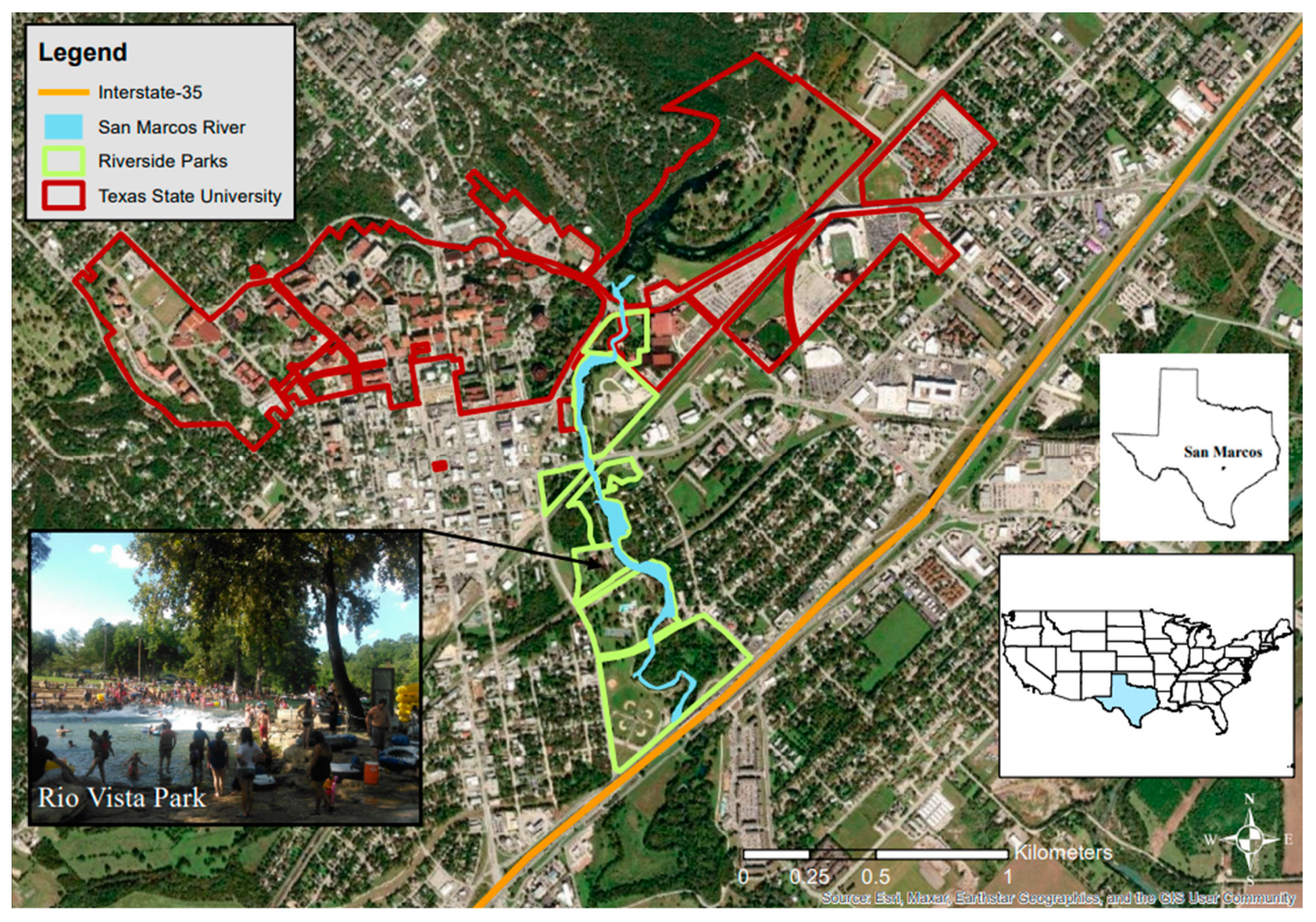
Disclaimer/Publisher’s Note: The statements, opinions and data contained in all publications are solely those of the individual author(s) and contributor(s) and not of MDPI and/or the editor(s). MDPI and/or the editor(s) disclaim responsibility for any injury to people or property resulting from any ideas, methods, instructions or products referred to in the content. |
© 2023 by the authors. Licensee MDPI, Basel, Switzerland. This article is an open access article distributed under the terms and conditions of the Creative Commons Attribution (CC BY) license (https://creativecommons.org/licenses/by/4.0/).